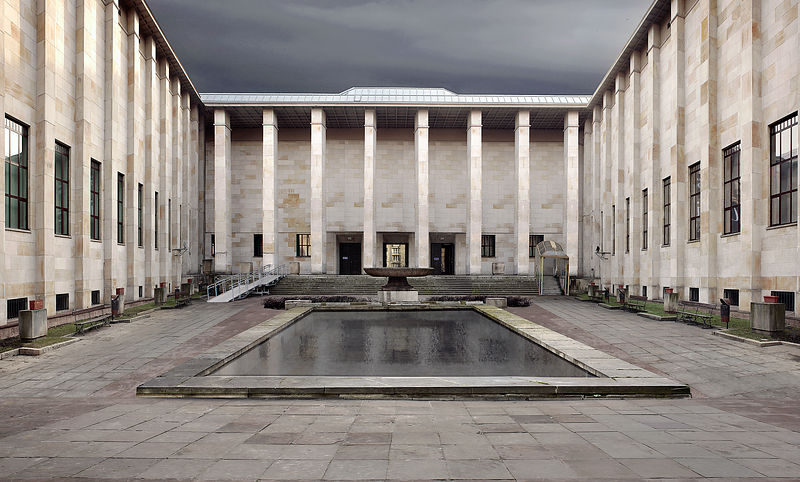
The museum's modernist main building at Al. Jerozolimskie 3, completed 1938.
Muzeum Narodowe w Warszawie · CC BY-SA 4.0National Museum in Warsaw
Museum · Muzeum Narodowe w Warszawie · Founded 1862
Open, admission and hours confirmed 8 September 2026 · 14 sources
On this page 16 sections
ContentsClose
The museum's real distinction is not size alone, though at roughly 830,000 objects it is the largest collection in Poland. It is the combination of two things nowhere else in Europe pairs in one building: the Faras Gallery's medieval Nubian Christian frescoes, rescued wholesale from a cathedral about to be flooded, and one of the two or three deepest public holdings of 19th-century Polish history and Symbolist painting anywhere, anchored by Matejko's two best-known canvases. The medieval Central European sculpture and the applied-art and design galleries are secondary strengths that most foreign visitors underrate going in.
| Local name | Muzeum Narodowe w Warszawie |
|---|---|
| Kind | Museum |
| Founded | 1862 |
| City and country |  Warsaw, Poland Warsaw, Poland |
| Address | Al. Jerozolimskie 3, 00-495 Warsaw, Poland |
| Website | mnw.art.pl |
| Status | Open, confirmed |
| Record last verified |
Visiting
- Hours
- Tue, Thu, Sat, Sun10:00 to 18:00Tuesday: permanent galleries free
- Wed10:00 to 18:00on the 2nd and 3rd Wednesday of the month, 16:00-18:00 are quiet hours for visitors sensitive to noise and crowds
- Fri10:00 to 20:0017:00-20:00 happy hour, 50% off all tickets
- Closed
- Monday.
- Admission
- Permanent galleries, regularPLN 30
- Permanent galleries, reducedPLN 15students, seniors 65+, disabled visitors and carers, teachers, veterans and other statutory categories
- Permanent galleries, groupsPLN 15per person, minimum 10 people
- Combined ticket (NMW + Museum of Sculpture + Museum of Interiors), regularPLN 50valid 30 days from purchase
- Combined ticket, reducedPLN 35valid 30 days from purchase
- Children, teenagers and students under 26PLN 1ticket office only, permanent galleries
- Children under 7Freefree
- Temporary exhibition, normalPLN 45a temporary-exhibition ticket also covers the permanent galleries
- Temporary exhibition, reducedPLN 30
- One-year individual pass, regularPLN 300365 days, covers the main building and branches
- One-year individual pass, reducedPLN 200
Free entry: Tuesday, permanent galleries only- Tickets
- bilety.mnw.art.pl/index.html?lang=en The museum's own ticket page.
- Do I need to book?
- No advance booking needed for individual entry; tickets are sold online and at the desk, and the ticket office closes 45 minutes before the galleries do
- Address
- Al. Jerozolimskie 3, 00-495 Warsaw, Poland MapTram Lines 7, 8, 9, 22, 24 and 25 stop at Muzeum Narodowe, directly in front of the building
Bus Lines 111, 117, 158, 507, 517 and 521 stop at Muzeum Narodowe; lines 116, 128, 180, 195, 222 and 503 stop nearby at Foksal
Metro Centrum (M1) or Nowy Swiat-Uniwersytet (M2), both about a 10-minute walk - Website
- mnw.art.pl
- Telephone
- +48 22 621 10 31
- [email protected]
Before you go how long, access, photography, bags, eating, shop
- How long to allow
- Two to three hours for the permanent galleries alone; the museum's own regulations reserve the right to close parts of a gallery for conservation or state functions on any given day
- Access
- A wheelchair can be borrowed for the visit, subject to availability, and is disinfected after each use, per the museum's own visitor regulations
- Photography
- Personal, non-flash photography without a tripod is allowed throughout the permanent galleries and temporary exhibitions; flash, tripods, additional lighting and any commercial photography or filming require the Director's prior consent
- Bags
- Outerwear and bags must be left in the cloakroom; self-service lockers take a 2 zloty coin deposit. Food and drink are not permitted inside the galleries
- Eating
- The museum's own site currently carries no dedicated cafe or restaurant page. A February 2026 TripAdvisor review specifically flags the absence of any coffee stop along the gallery route as unusual for a museum of this size; that claim has not been independently confirmed against a primary museum source and is recorded here as a visitor account, not a verified fact
- Shop
- A museum bookshop operates on site, reachable through the contact directory on the museum's own website
Prices and hours change. We take them from the institution's own pages and print the day we read them, and you can check the current position at the source we used. Confirm before you travel.
What is inside
Gallery of Ancient Art
About 1,800 objects from Egypt, the ancient Middle East, Greece and Rome, spanning funerary, religious and everyday material culture across roughly two millennia
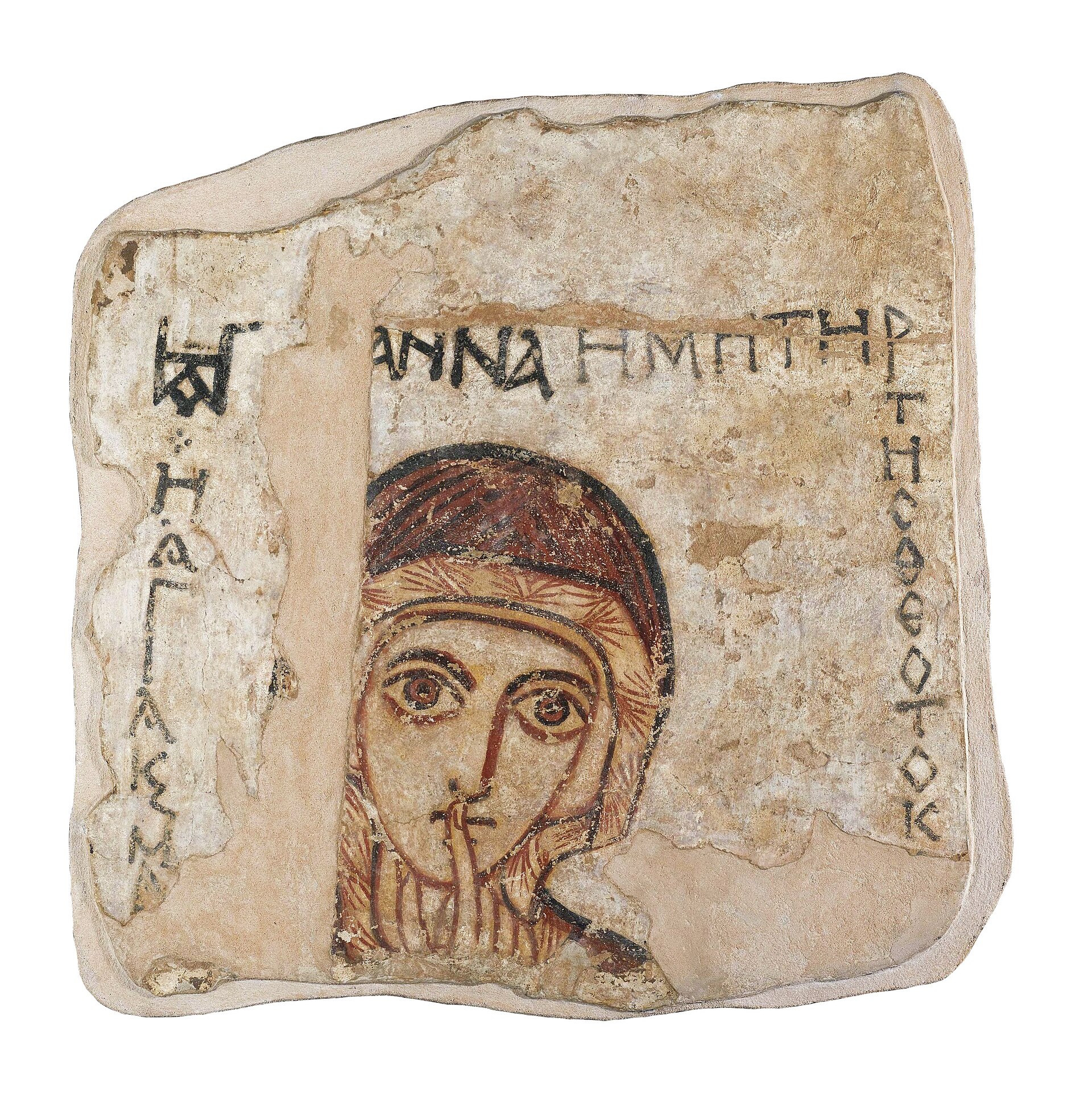
Public domain Faras Gallery
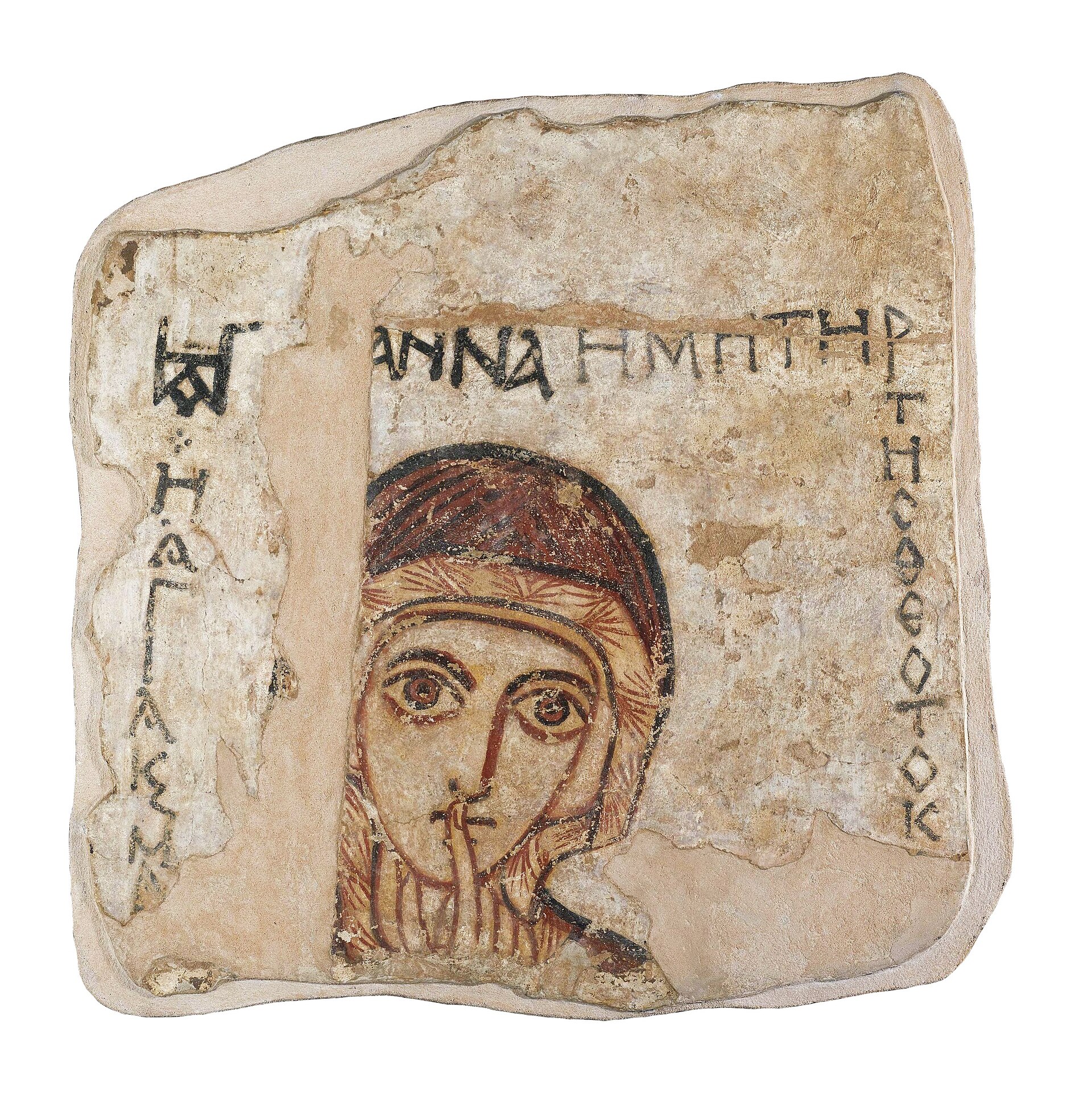
More than 60 wall paintings, 8th-14th century, physically removed from the cathedral at Faras in Sudanese Nubia ahead of the flooding caused by the Aswan High Dam, plus pottery, architectural fragments and bishops' burial goods from the same site. Europe's largest collection of medieval Nubian Christian art and unique to this museum on the continent
Gallery of Medieval Art
Polish and Central European religious sculpture and panel painting from the Late Middle Ages (14th-16th century), including the Beautiful Madonna from Wroclaw (c. 1390), the Grudziadz Polyptych and the Annunciation with the Unicorn Polyptych
Gallery of Old Masters
Painting, sculpture, drawing, prints and applied art including porcelain, glass, rock crystal and goldsmith's work, arranged thematically around court culture, religion and devotion, and city life
Gallery of 19th-Century Art
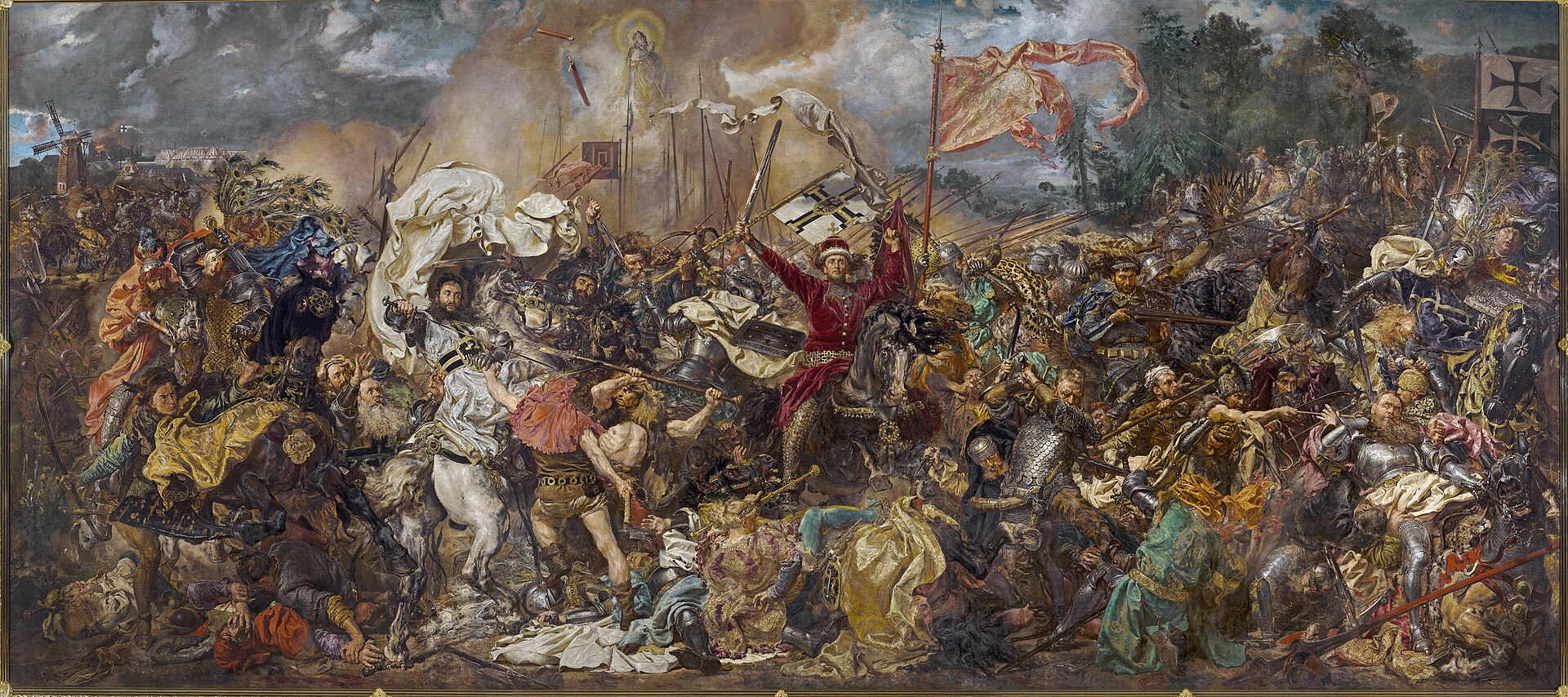
The museum's most-visited rooms: Polish history and portrait painting including Jan Matejko's Battle of Grunwald and Stanczyk, plus Malczewski, the Gierymski brothers, Siemiradzki and Wyspianski, with a dedicated Photography Room
Gallery of Polish Design
Polish applied and industrial art from the early 20th century to the present: furniture, posters, fashion and product design
What to see first
Battle of Grunwald
Jan Matejko, 1878At 426 x 987 cm one of the largest canvases in Polish painting, commemorating the 1410 defeat of the Teutonic Order; looted by the Nazis in 1939, recovered after the war, and now the anchor work of the 19th-century gallery7
Stanczyk
Jan Matejko, 1862The court jester Stanczyk sitting apart from a royal ball, grieving the loss of Smolensk; looted in the Second World War, seized by Soviet forces and returned to Poland around 1956, and named by the museum itself as one of its most recognisable paintings7
Wall paintings from Faras Cathedral
Nubian workshop painters, 8th-14th centuryRescued from the cathedral at Faras, Sudan, during the UNESCO Nubia Campaign ahead of the Aswan High Dam flooding and transferred to Warsaw in 1972; the only collection of its kind on display in Europe4
Beautiful Madonna from Wroclaw
Master of the Beautiful Madonnas, c. 1390A key surviving example of the International Gothic 'Beautiful Style' of Madonna sculpture that spread across Central Europe around 14005
Christian Dirce
Henryk Siemiradzki, 1897A large-scale academic history painting depicting the martyrdom of an early Christian woman in the Roman arena, representative of the museum's strength in 19th-century Polish academic painting7
Polish Hamlet - Portrait of Aleksander Wielopolski
Jacek Malczewski, 1903A Symbolist portrait of the controversial 19th-century Polish statesman cast as Hamlet, one of Malczewski's best-known works and a staple of the gallery's Symbolist holdings7
Insurgent Patrol
Maksymilian Gierymski, 1873A restrained, tonal depiction of the 1863 January Uprising against Russian rule, part of the museum's core holding of Polish 19th-century history painting7
Capsheaves
Stanislaw Wyspianski, 1898-99A pastel by the Young Poland painter, playwright and designer, shown in the gallery's Photography Room-adjacent 19th-century holdings alongside his better-known stained-glass and stage designs elsewhere in Poland7
Exhibitions on now
- On now15 Sep to 13 Dec 2026Confirmed , 7 weeks ago
- Opening soon16 Dec 2026 to 21 Mar 2027Confirmed , 7 weeks ago
Past exhibitions here
- Closed17 Apr to 13 Sep 2026Confirmed · check before you travel
- Closed10 Jun to 10 Sep 2026Confirmed · check before you travel
A modernist building raised for a museum still finding its collection
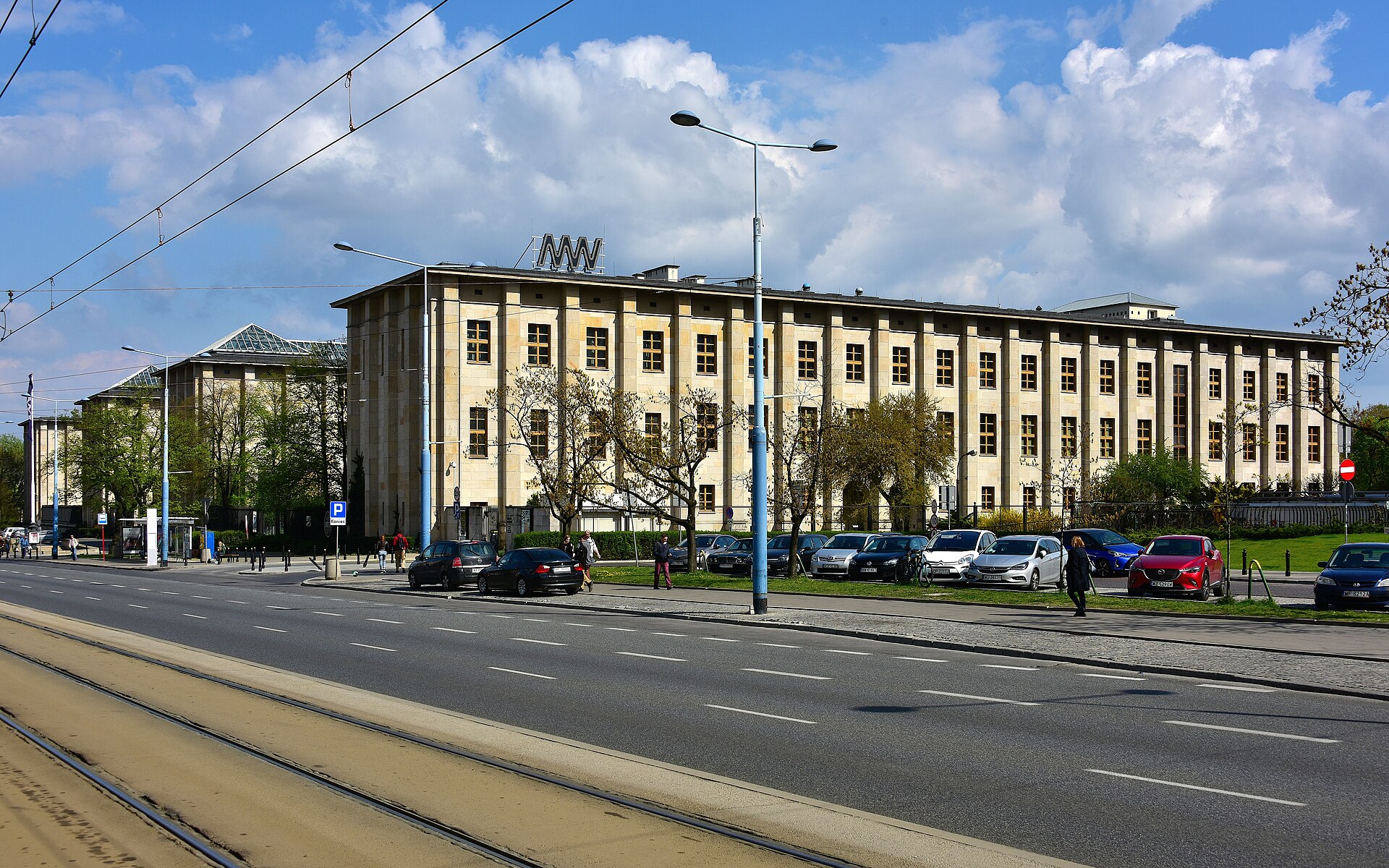
The National Museum in Warsaw occupies a deliberately plain modernist block at Al. Jerozolimskie 3, on the edge of what had been Na Ksiazecem Park. Tadeusz Tolwinski designed it and construction ran from 1927 to 1938, with a preliminary wing of decorative art opening to the public in 1932 while the rest of the building was still going up around it. The whole complex was inaugurated on 18 June 1938, barely a year before the war that would empty large parts of it. Reviewers today are split on the building itself: several call it an unglamorous concrete block at the less picturesque end of the Royal Route, and say the collection inside makes you forget the facade within minutes of walking in.
From a fine arts society's rooms to a national collection
The museum did not start in this building or under this name. It opened on 20 May 1862 as the Museum of Fine Arts, Warsaw, absorbing the holdings of the Society for the Encouragement of the Fine Arts (Zacheta) and the University of Warsaw's own museum of antiquity. It was renamed the National Museum in 1916, under German occupation during the First World War, more than two decades before it had a purpose-built home of its own. That earlier, scattered existence is why the museum's own collection catalogue still carries acquisition numbers going back to institutions that no longer exist under those names.
Occupation, looting, and what has never come back
After the German invasion in September 1939, the collection was systematically looted under the direction of the Nazi art historian Dagobert Frey, who had already surveyed the museum's most valuable holdings on official visits in 1937. Individual works were redistributed as gifts within the occupation administration. One recorded case: Francesco Guardi's Palace Stairs, requisitioned from the museum in 1939, resurfaced decades later and was formally returned to Poland by Germany in 2014, one of a small number of individually documented recoveries rather than a resolved account of the whole loss. Poland's own government estimate, repeated on the museum's Wikipedia entry and consistent with the national wartime-losses database, puts more than 5,000 objects from the museum's pre-war holdings as still missing. The museum's own public-facing pages describe the war years in general terms; they do not carry an itemised public reckoning of what from the current collection has a wartime-looting history attached to it, and that gap is worth flagging to any researcher relying on this collection's provenance.
Stanislaw Lorentz and a collection rebuilt under a new regime
Stanislaw Lorentz directed the museum from 1935 to 1982, spanning the occupation, the recovery effort that followed it, and the entire communist period. Under his direction the museum tracked down and recovered a large share of what the Nazis had dispersed into repositories across occupied Poland and Germany. But recovery did not mean simple restitution: many works retrieved from Nazi storage were nationalised by the postwar communist state between 1945 and 1958 under decrees classifying them as abandoned property, rather than returned to identifiable prewar owners or their heirs. Some of what is on the walls today therefore carries a double provenance question: what happened to it under German occupation, and separately, on what legal basis the Polish state took formal title to it afterward. Neither question is addressed in detail on the museum's own current visitor-facing pages.
The Nubia rescue that gave Warsaw a gallery no other European museum has
The Faras Gallery exists because of a single archaeological rescue operation. Ahead of the Aswan High Dam's flooding of the Nile valley in Sudan, Polish archaeologists working under the UNESCO-coordinated Nubia Campaign excavated the 8th-century cathedral at Faras and physically removed more than 60 wall paintings, dated from the 8th to the 14th century, from its walls using a tempera-lifting technique. The paintings, along with pottery, inscriptions and burial goods from the same site, were transferred to Warsaw and installed in a dedicated gallery in 1972. It remains, on the museum's own account, the largest collection of medieval Nubian Christian art anywhere in Europe, and nothing comparable to it exists in any other European museum's permanent display.
What the six permanent galleries actually hold today
The current permanent display is organised into six galleries. The Gallery of Ancient Art covers roughly 1,800 objects from Egypt, the Near East, Greece and Rome. The Faras Gallery, described above, stands alone. The Gallery of Medieval Art holds Late Gothic Central European religious sculpture and panel painting, including the Beautiful Madonna from Wroclaw. The Gallery of Old Masters spans painting, sculpture, prints and applied art from the court culture of early modern Europe. The Gallery of 19th-Century Art, the museum's own most-visited rooms, centres on Matejko's Battle of Grunwald and Stanczyk alongside Malczewski, the Gierymski brothers, Siemiradzki and Wyspianski, and includes a dedicated Photography Room. The Gallery of Polish Design closes the sequence with applied and industrial design from the early 20th century to the present. Across all six, the museum reports holdings of roughly 830,000 objects in total, of which only a fraction is on permanent display at any time.
What visitors say
Visitors consistently describe the National Museum in Warsaw as one of the largest and most rewarding collections in Poland, worth at minimum a half day, with free Tuesday admission repeatedly cited as a reason to go. A second, unrelated theme recurs across independent reviews: a language barrier and, in several accounts, openly unhelpful or hostile front-of-house and gallery staff. A smaller but repeated complaint is the lack of anywhere to sit down with a coffee once inside the ticketed route.
What is praised, what is criticised
- Praised: The range and depth of the collection, from ancient Egyptian, Greek and Nubian material through Polish 19th-century painting to contemporary design
- Praised: Jan Matejko's Battle of Grunwald and the Faras Gallery are named again and again as the two rooms not to miss
- Praised: Free admission and lighter crowds on Tuesdays
- Praised: A free cloakroom for coats and bags
- Criticised: Multiple independent reviewers, months apart, describe staff who do not speak English and respond to questions with visible irritation; one January 2026 review calls the gallery attendants' manner toward visitors a national embarrassment
- Criticised: Weak or absent object labelling leaves some visitors feeling lost without a guide or audio guide
- Criticised: No coffee stop along the gallery route, flagged as unusual for a museum of this size
Ratings on other platforms
TripAdvisor: 4.2 from 669 ratings, read 11 August 2026
A platform average is a tertiary source: it moves, it is not audited, and we quote no visitor's words.
Questions about National Museum in Warsaw
Where is National Museum in Warsaw?
Al. Jerozolimskie 3, 00-495 Warsaw, Poland.
How much does it cost to visit?
Permanent galleries, regular: PLN 30; Permanent galleries, reduced: PLN 15; Permanent galleries, groups: PLN 15; Combined ticket (NMW + Museum of Sculpture + Museum of Interiors), regular: PLN 50; Combined ticket, reduced: PLN 35. As confirmed 8 September 2026.
When is it open?
Tue, Thu, Sat, Sun 10:00-18:00; Wed 10:00-18:00; Fri 10:00-20:00. Closed: Monday. As confirmed 8 September 2026.
How do you get there?
Tram: Lines 7, 8, 9, 22, 24 and 25 stop at Muzeum Narodowe, directly in front of the building; Bus: Lines 111, 117, 158, 507, 517 and 521 stop at Muzeum Narodowe; lines 116, 128, 180, 195, 222 and 503 stop nearby at Foksal; Metro: Centrum (M1) or Nowy Swiat-Uniwersytet (M2), both about a 10-minute walk.
What should you see first?
Battle of Grunwald (Jan Matejko, 1878); Stanczyk (Jan Matejko, 1862); Wall paintings from Faras Cathedral (Nubian workshop painters, 8th-14th century); Beautiful Madonna from Wroclaw (Master of the Beautiful Madonnas, c. 1390); Christian Dirce (Henryk Siemiradzki, 1897); Polish Hamlet - Portrait of Aleksander Wielopolski (Jacek Malczewski, 1903).
What we could not confirm
- More than 5,000 objects looted from the museum in 1939-45 remain unaccounted for on Poland's own wartime-losses reckoning, and the museum's current public pages do not carry an itemised account of which surviving works in its collection have a documented looting history
- An unknown share of the works recovered after 1945 were nationalised under communist-era 'abandoned property' decrees between 1945 and 1958 rather than restored to identified prewar owners or heirs; the museum does not address, on its own site, how many current holdings arrived by that route or whether any claims remain open
- Third-party listings describe an on-site restaurant (Muzealna) and a Lorentz Cafe with an outside entrance, while the museum's own English-language site currently carries no dedicated food-and-drink page and a recent visitor review reports no coffee stop on the gallery route; which of these is currently accurate was not resolved from primary sources
Images
Sources
- 1National Museum in Warsaw, Visit page (hours, admission, contact) mnw.art.pl/en/visit/
- 2National Museum in Warsaw, Regulations for Visiting the National Museum in Warsaw (2022 PDF) mnw.art.pl/gfx/muzeumnarodowe/userfiles/_public/rules_for_visitors_nmw_2022.pdf
- 3National Museum in Warsaw, Permanent galleries overview mnw.art.pl/en/collections/permanent-galleries/
- 4National Museum in Warsaw, Faras Gallery mnw.art.pl/en/collections/permanent-galleries/faras-gallery/
- 5National Museum in Warsaw, Gallery of Medieval Art mnw.art.pl/en/collections/permanent-galleries/gallery-of-medieval-art/
- 6National Museum in Warsaw, Gallery of Old Masters mnw.art.pl/en/collections/permanent-galleries/gallery-of-old-masters/
- 7National Museum in Warsaw, Gallery of 19th-Century Art mnw.art.pl/en/collections/permanent-galleries/gallery-of-19th-century-art/
- 8National Museum in Warsaw, About the Museum mnw.art.pl/en/about-the-museum/
- 9Wikipedia, National Museum, Warsaw (: WWII looting detail, Lorentz directorship, missing-objects estimate, visitor numbers) en.wikipedia.org/wiki/National_Museum,_Warsaw
- 10muzea.waw.pl, National Museum in Warsaw listing (transport, hours corroboration) muzea.waw.pl/en/museums/national-museum/
- 11TripAdvisor, Muzeum Narodowe W Warszawie reviews tripadvisor.com/Attraction_Review-g274856-d274996-Reviews-Muzeum_Narodowe_W_Warszawie-Warsaw_Mazovia_Province_Central_Poland.html
- 12Center for Art Law, Trailblazing in the 21st century? A brief summary of Poland's restitution efforts for Holocaust looted artwork (Guardi Palace Stairs restitution) itsartlaw.org/art-law/trailblazing-in-the-21st-century-a-brief-summary-of-polands-restitution-efforts-for-holocaust-looted-artwork/
- 13Wikidata, National Museum in Warsaw (Q153306) (: identity, coordinates, founding date) wikidata.org/wiki/Q153306
- 14National Museum in Warsaw, Contact page mnw.art.pl/en/contact/