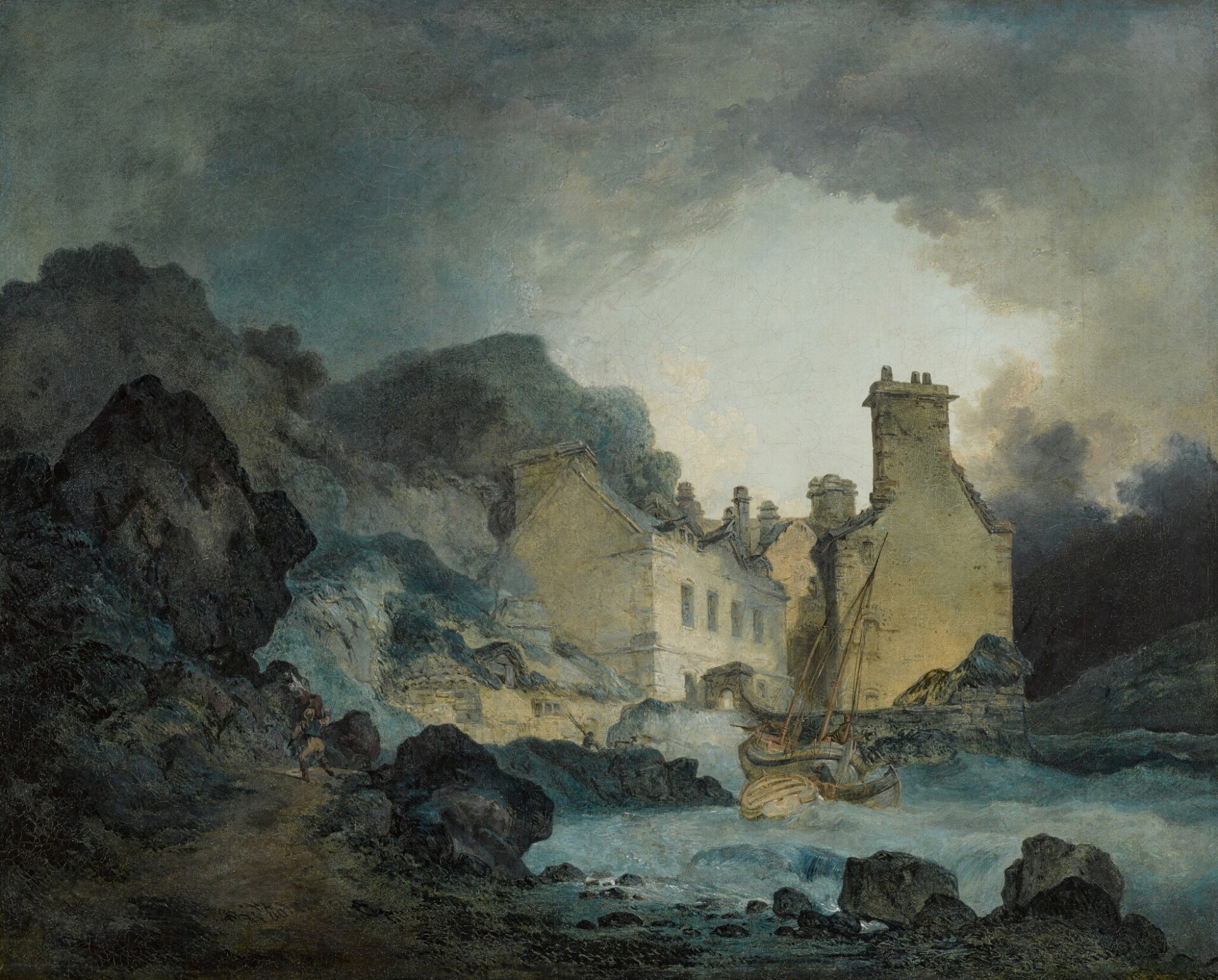
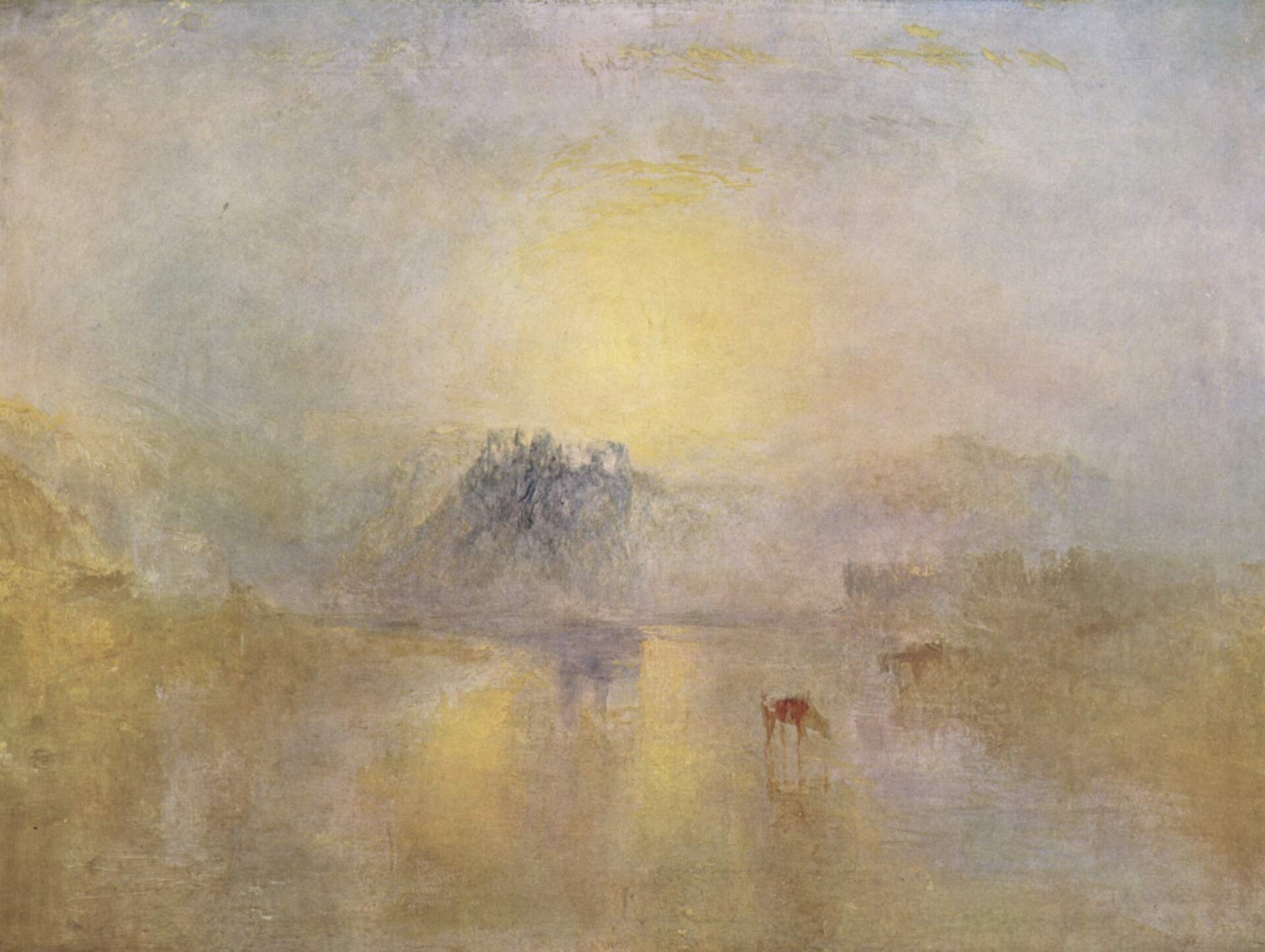
The Rising Squall, Hot Wells, from St Vincent's Rock, Bristol
c. 1792 · Oil on canvas
Private collection, United Kingdom
British · 1775-1851
1 record in the archive · Last verified 15 September 2026 · 40 sources cited
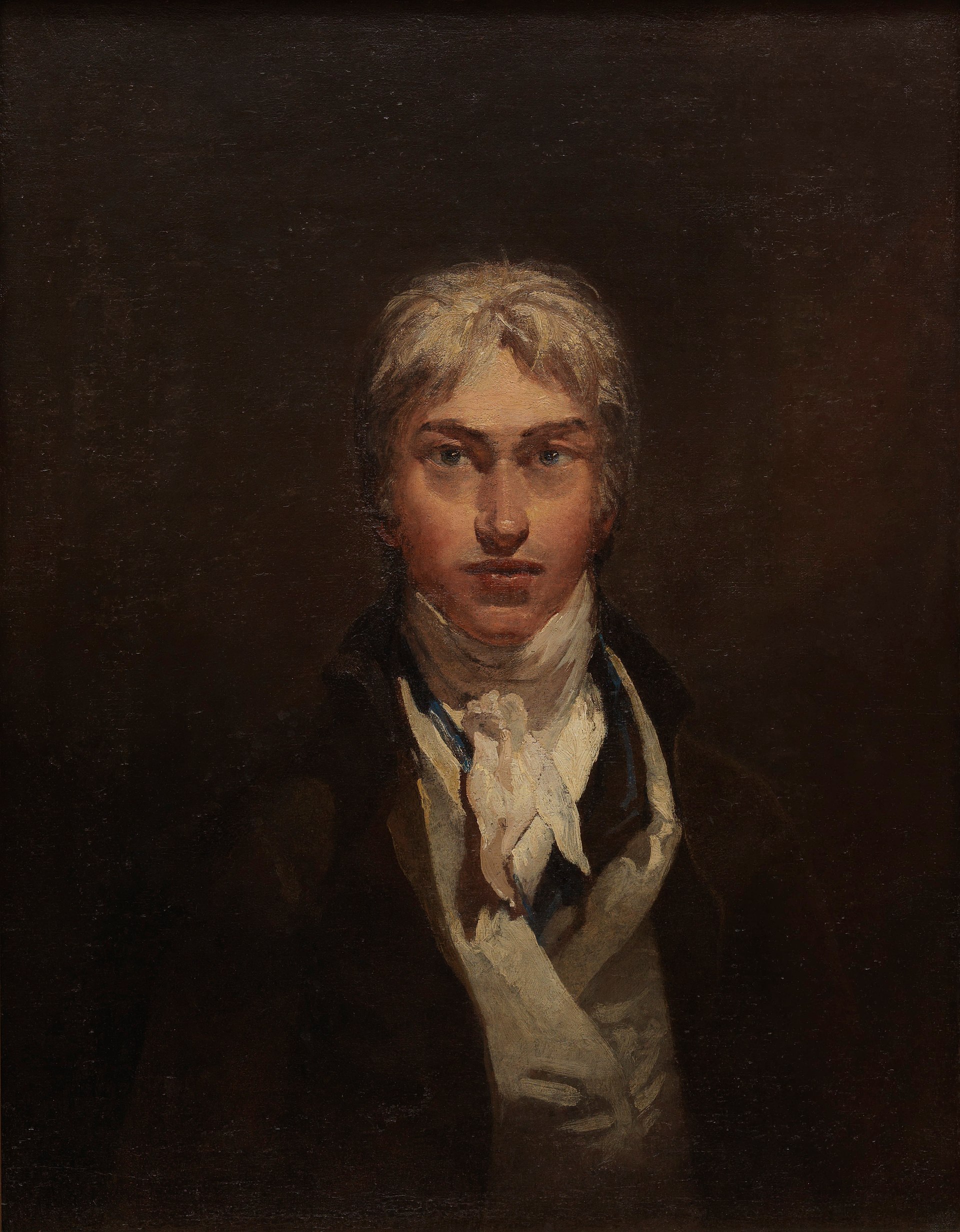
Oil on canvas, about 1799, 74.3 by 58.4 cm, Tate Britain (N00458), part of the Turner Bequest and possibly painted to mark his election as an Associate of the Royal Academy in November 1799. The sitter is securely Turner: early inventories of the Bequest record it as a portrait of Turner and that identification has never been contested. The authorship is now in dispute. In May 2026 the biographer James Hamilton argued in Turner Society News that the picture is not a self-portrait at all but a work by John Opie, pointing out that the early lists never called it one and that the full-face directness and dramatic shadow are Opie's manner rather than Turner's; Tate has said it will explore the research. Some specialists accept that it may not be a self-portrait while rejecting Opie; others maintain it is Turner's own. The image is the one reproduced on the Bank of England's polymer GBP 20 note issued in 2020. Licence verified from the Wikimedia Commons file record: extmetadata.LicenseShortName = Public domain.
Tate Britain, London (N00458)| Full name | Joseph Mallord William Turner |
|---|---|
| Worked as | Painter, Watercolourist, Etcher, Printmaker |
| Born | 23 April 1775 · Maiden Lane, Covent Garden, London |
| Died | 19 December 1851 · Cheyne Walk, Chelsea, London; buried in St Paul's Cathedral |
| Nationality | British |
| Movement | British Romanticism |
| In this archive | 1 record |
| Last verified | 15 September 2026 |
Turner is the only major European painter whose studio survived him almost intact and became public property. That single fact governs everything else about him. Roughly 300 oil paintings and some 30,000 works on paper passed to the nation, not because he gave them but because his relatives sued, and the compromise the Court of Chancery approved on 19 March 1856 handed over far more than his will had ever offered. Tate holds the result. It is the largest body of work by any one artist in any national collection anywhere, and it is the reason you can watch a painter think.
The consequence for anyone dealing in Turner is arithmetical and brutal. Two-thirds of his oils are permanently unavailable, which is why so few reach the market and why those that do set records. The consequence for scholarship is the opposite: because the studio survived, the unfinished canvases, the abandoned colour studies and the 300 sketchbooks are all there, and the private working method of a nineteenth-century painter can be reconstructed page by page in a way that is impossible for almost anyone else.
The thing most accounts get vague is the will itself. Turner did not leave his pictures to the nation out of patriotism. He left about 100 finished oils to the National Gallery on the strict condition that a dedicated Turner's Gallery be built within ten years, and he left the bulk of an estate of roughly GBP 140,000 to found almshouses for poor and decayed English landscape painters. The almshouses were never built. The gallery, on the terms he set, has arguably never been built either. What the nation got was the studio, which he had not offered, in exchange for the money, which he had.
Born 23 April in Maiden Lane, Covent Garden, son of a barber and wigmaker.26
Accepted into the Royal Academy Schools at fourteen. Studies with the topographical draughtsman Thomas Malton, whom he later called his real master.26
Exhibits his first watercolour at the Royal Academy, A View of the Archbishop's Palace, Lambeth.26
Paints The Rising Squall, Hot Wells, from St Vincent's Rock, Bristol, at seventeen.6
Exhibits The Rising Squall at the Royal Academy as no. 323, his first oil painting shown in public. The Reverend Robert Nixon acquires it directly from him. The picture then vanishes from view for over 150 years.69
Works in the evenings at Dr Thomas Monro's house alongside Thomas Girtin, copying John Robert Cozens and other topographical watercolours. Ruskin later called Monro his true master.2635
Exhibits Fishermen at Sea, long believed to be his first exhibited oil.926
Elected Associate of the Royal Academy in November. The Tate self-portrait is dated to about this year and may commemorate it.21
Elected Royal Academician. Travels to Paris and sees the Louvre, including David's Napoleon Crossing the Alps of 1801.2634
Opens his own gallery in Harley Street, later Queen Anne Street, showing his work on his own terms.26
His mother Mary dies in Bethlem Hospital, having been confined for mental illness since 1799.26
Elected Professor of Perspective at the Royal Academy on 10 December. Begins the Liber Studiorum, etching the plates himself for engravers to work up in mezzotint.2930
Delivers his first perspective lecture on the evening of 7 January. He makes about 170 diagrams for the course.29
Exhibits Snow Storm: Hannibal and his Army Crossing the Alps with the first published extract from his own poem The Fallacies of Hope. The composition abandons linear perspective for a central vortex.34
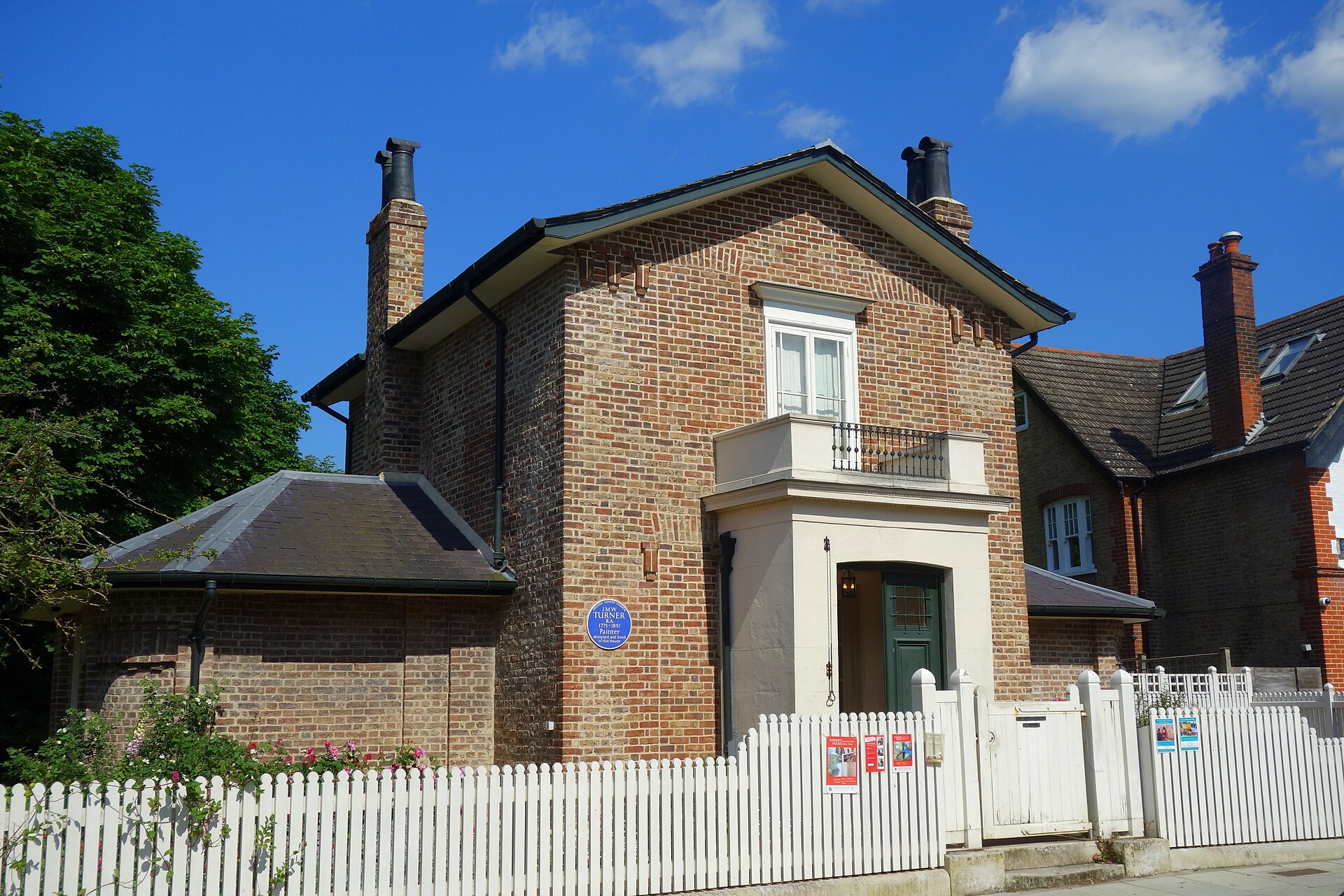
Builds Sandycombe Lodge at Twickenham to his own design, on land where he also planned the almshouses for decayed artists.2627
Exhibits Dido building Carthage and The Decline of the Carthaginian Empire, the rise and fall of a maritime empire addressed to a British audience.34
First visit to Italy. Rome and Venice become recurring subjects for the rest of his life.26
Publication of the Liber Studiorum ends with 71 plates issued since 1807, well short of the hundred planned.30
Paints Regulus in Rome, with Medea and a view of Orvieto. Dedicates an engraving after his Deluge to the abolitionist John Joshua Proby.3335
Gives his perspective lectures for the last time, though he does not resign the chair until December 1837.29
Draws his first will, in which two pictures are to hang beside two Claudes at the National Gallery. His father dies.226
New will directing the executors to sell his land and found a charity for poor and decayed English landscape painters; a codicil of 1832 adds a gallery on the Dulwich model.326
Adds a spot of red lead to Helvoetsluys on varnishing day beside Constable's Opening of Waterloo Bridge. Constable's reaction is recorded only by C.R. Leslie.33
Exhibits the first of the two canvases of The Burning of the Houses of Lords and Commons, worked up on the wall during varnishing days.33
Repaints Regulus on a varnishing day at the British Institution, nine years after first painting it.33
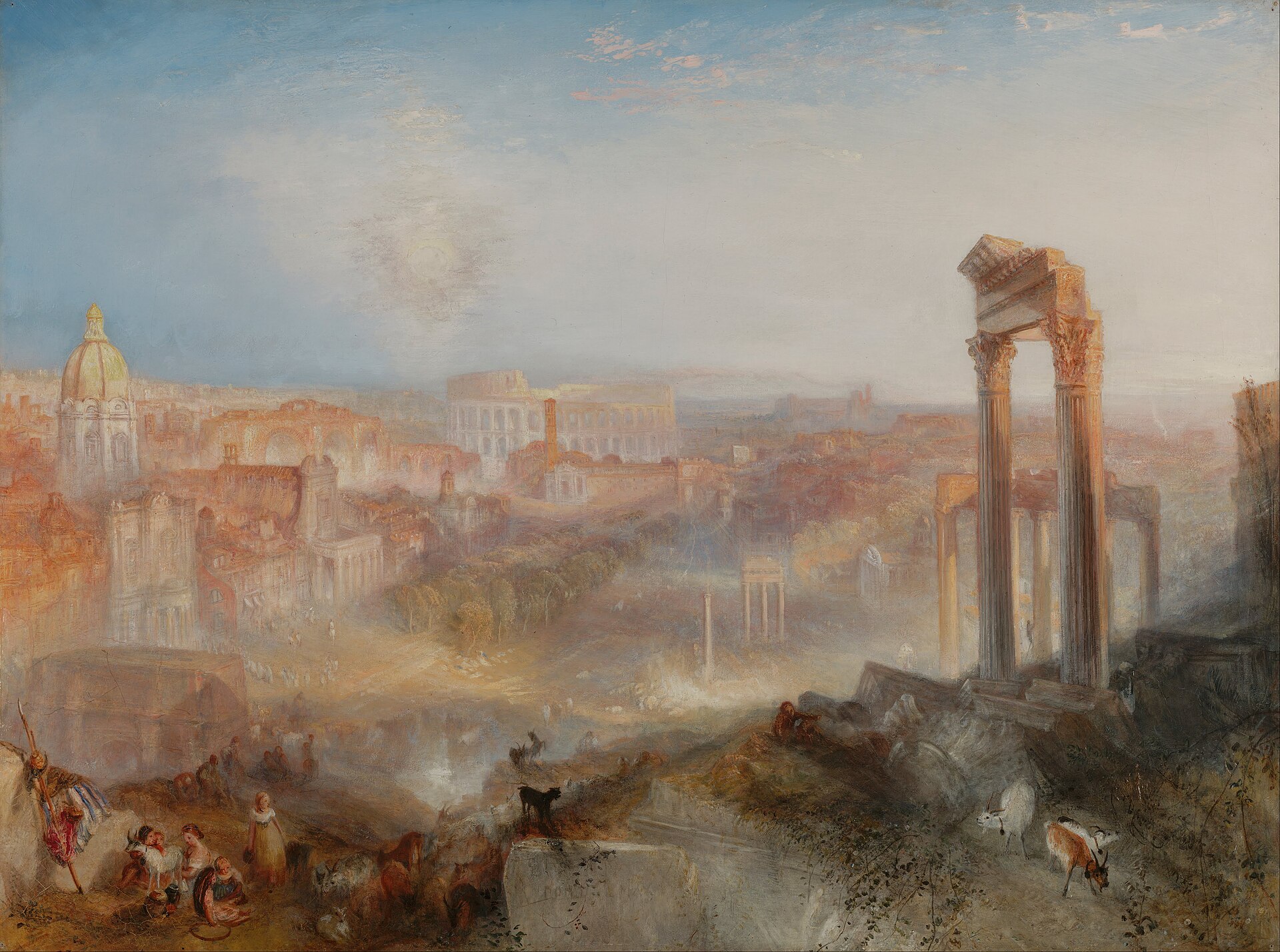
Exhibits Modern Rome - Campo Vaccino, his last painting of Rome. Hugh Munro of Novar buys it from the exhibition for 4,450 guineas.12
Exhibits Slavers Throwing overboard the Dead and Dying - Typhon coming on, with verses from The Fallacies of Hope, in the year two international anti-slavery conventions meet in London. Eastlake publishes his English translation of Goethe's Zur Farbenlehre.3538
Exhibits Shade and Darkness - the Evening of the Deluge and Light and Colour (Goethe's Theory) - the Morning after the Deluge, naming Goethe's book in the title of the second.36
Ruskin's father gives him The Slave Ship. Ruskin writes that if he had to rest Turner's immortality on one work he would choose it.35
Living in Chelsea with Sophia Caroline Booth under the name Mr Booth.26
Final amendment to the will: the finished pictures are to be kept constantly in a Turner's Gallery at an enlarged National Gallery, the gift to lapse if this is not done within ten years of his death.23
Dies on 19 December, aged 76. Buried in St Paul's Cathedral.26
The cousins contest the will. The executor Philip Hardwick urges the National Gallery's Trustees to apply at once for the two pictures left to them, and Dido building Carthage and Sun Rising through Vapour move to Trafalgar Square.2
First full schedule of the studio contents including works on paper, dated 21 June. Vulnerable works begin moving to the National Gallery for safe keeping.1
Court of Chancery approves the settlement on 19 March. The charity falls, the family and the Royal Academy take the money, and all works of art by Turner's hand at Queen Anne Street pass to the nation. The Trustees take legal possession on 25 September.123
First display of 102 works on paper at the end of January. Ruskin offers in The Times to arrange the whole Bequest and, after an editorial and an appeal to Palmerston, is invited to do it.1
Ruskin completes the survey in the spring and hands the keys to Wornum in May. Later in the year Wornum is said to have burned the erotic drawings.1
Marlborough House is assigned to the Prince of Wales and the Turners move to a gallery adjoining the South Kensington Museum.2
A House of Lords enquiry upholds Turner's wish that the paintings be housed together and the finished pictures return to Trafalgar Square as a separate Turner Collection. The unfinished works and the drawings stay at South Kensington.2
Walter Stephenson, destitute and unwell, stabs Regulus repeatedly in the Turner Room at the National Gallery. He is sentenced to six months hard labour; the restorer Charles Buttery charges eight guineas.33
The touring Loan Collections begin, built from Ruskin's category of works fit for the provinces. They run into the twentieth century and physically fragment the Bequest.1
The Barry Rooms open at Trafalgar Square and the whole Bequest is briefly reunited there.2
An Act permits the National Gallery to make long loans to the provinces notwithstanding a donor's conditions, once twenty-five years have passed.3
A.J. Finberg is commissioned to catalogue the Bequest.1
Finberg's A Complete Inventory of the Drawings of the Turner Bequest published in two volumes.1
The bulk of the Bequest is transferred to the Tate Gallery, opened in 1897 as an annexe of the National Gallery.2
In January the Thames floods the Tate cellars and submerges every work on paper. Finberg leads the rescue. The survivors go to the British Museum for conservation and rebinding, which disturbs his numbering.1
The National Gallery and Tate Gallery Act makes the division of the collection between the two institutions permanent.3
The two galleries agree a clearer division of British pictures. Seven Turners are selected for the National Gallery, and the two Turners and two Claudes are reunited.2
Butlin and Joll's catalogue raisonne of the paintings published; revised edition 1984.2839
The Clore Gallery opens at Tate on 1 April, designed by James Stirling, Michael Wilford and Associates, with Andrew Wilton as lead curator.15
Shade and Darkness and Light and Colour are stolen from the Schirn Kunsthalle, Frankfurt, on 28 July while on loan from Tate.17
Shade and Darkness recovered 19 July 2000, kept quiet; Light and Colour recovered 16 December 2002. Both back on show at Tate Britain from 8 January 2003.17
Ian Warrell concludes that the 1858 bonfire of Turner's erotic drawings never happened and that the material survives in the Bequest.1
Tate acquires The Blue Rigi for GBP 4.95m after an export bar and a public appeal.16
Three doubted Turners at the National Museum of Wales, including The Beacon Light, are reaccepted after technical examination; Martin Butlin revises his 1977 opinion. Tate's online catalogue of the works on paper reaches the end of its first funded phase.122
Sandycombe Lodge reopens to the public in July after a GBP 2.4m restoration that strips the render and reveals the brick Turner intended to be seen.27
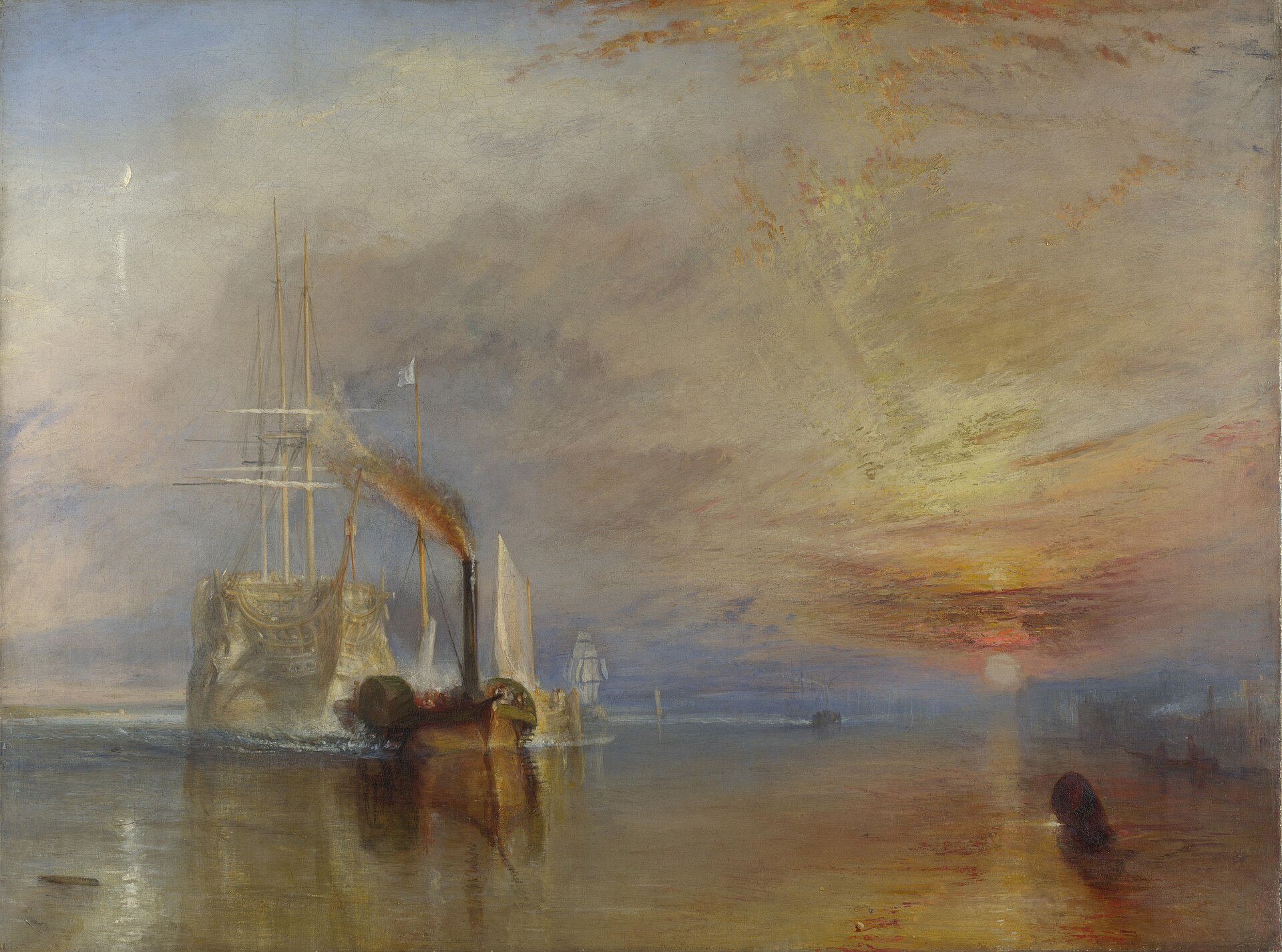
The Bank of England's polymer GBP 20 note enters circulation carrying the Tate self-portrait and The Fighting Temeraire.9
The Rising Squall sells at Sotheby's on 2 July at GBP 1.5m hammer, fifteen months after making GBP 400 at Dreweatts. Tate Britain opens Turner and Constable: Rivals and Originals on 27 November for the 250th anniversary year.679
James Hamilton argues in Turner Society News that the Tate self-portrait is not by Turner but by John Opie. Tate says it will look at the research.2021
The market for Turner is defined by scarcity that is structural rather than cyclical. About two-thirds of the oils are in the Turner Bequest and can never be sold. By 2014 Sotheby's was describing no more than half a dozen major works as remaining in private hands. That is why the top of the market is a straight line upward with very few points on it: USD 9m for Seascape, Folkestone in 1984, USD 35.8m for the Venetian Giudecca at Christie's in 2006, GBP 29,721,250 with premium for Modern Rome - Campo Vaccino in 2010, and GBP 27m hammer, GBP 30,332,500 with fees, for Rome, from Mount Aventine in 2014, which remains the record for the artist and for any pre-twentieth-century British painter.
Both thirty-million pictures were painted for the same patron, Hugh Munro of Novar, and both passed to the Rosebery family. That is not a market; it is one collection unwinding.
Below that the shape changes completely. Finished watercolours trade in the hundreds of thousands to low millions, and at that level a British institution can occasionally win: The Blue Rigi was bought for the nation at GBP 4.95m after an export bar, against GBP 5.8m paid at auction. And beneath everything sits the sleeper trade. Turner is the artist most likely to appear in a country sale under someone else's name, and the 2024-25 sequence, GBP 400 at Dreweatts to GBP 1.5m hammer at Sotheby's in fifteen months, is the largest documented multiple of its kind.
Read the reported figures with care. Press coverage of the two Rome pictures routinely calls the with-premium total a hammer price, and dollar equivalents shift with the conversion date. Where this record could not verify a hammer separately it says so.
| Date | Sale | Work | Result | Note |
|---|---|---|---|---|
| 1984 | Sotheby's | Seascape, Folkestone | Hammer not published in the sources consulted With premium USD 9m as reported USD | The previous Turner record before 2006, and the benchmark against which the 2006 result was measured. Reported as a single figure; whether it is hammer or includes premium is not stated in the source. |
| 2006-04 | Christie's, New York | Giudecca, la Donna della Salute and San Giorgio, 1841 | Hammer not published in the sources consulted With premium USD 35,856,000 as reported USD | Estimate USD 15-20m. Set a record for Turner and for a British painting at auction. The source does not state whether the figure includes buyer's premium; on the balance of auction reporting convention it does. |
| 5 June 2006 | Christie's, London | The Blue Rigi (watercolour) | Hammer not published in the sources consulted With premium GBP 5.8m as reported GBP | A record for any British watercolour. Export licence deferred by the Culture Minister David Lammy to 20 March 2007. Tate then acquired it at GBP 4.95m after eligible tax remissions, funded by an NHMF grant of up to GBP 1.95m, GBP 500,000 from the Art Fund, GBP 2m allocated by Tate's Trustees including Tate Members, and a public appeal that raised over GBP 550,000 from about 11,000 donors in five weeks. |
| 7 July 2010 | Sotheby's, London | Modern Rome - Campo Vaccino, 1839 | Hammer not separately published in the sources this record fetched With premium GBP 29,721,250 including buyer's premium (GBP 30,284,968.75 including VAT) GBP | Estimate GBP 18m; six bidders. Bought by Hazlitt, Gooden and Fox for the J. Paul Getty Museum. The two figures given are the fair market prices the Reviewing Committee recommended on 3 November 2010, excluding and including VAT, and are the most reliable published numbers. Several trade reports give a hammer of GBP 26.5m; this record could not verify that from a source it read and does not assert it. Painted for Hugh Munro of Novar, who bought it from the 1839 Royal Academy exhibition for 4,450 guineas; acquired by the 5th Earl of Rosebery and Hannah Rothschild in 1878; on loan to the National Gallery of Scotland from 1978. Export licence granted to the Getty on 3 February 2011. |
| 3 December 2014 | Sotheby's, London | Rome, from Mount Aventine, 1835 | Hammer GBP 27,000,000 With premium GBP 30,332,500 with fees (reported as approximately USD 47.4m) GBP | Old Master Paintings Evening Sale. Estimate GBP 15-20m. Record for Turner and for any pre-twentieth-century British artist, and it still stands. Commissioned by Hugh Munro of Novar, bought by the 5th Earl of Rosebery in 1878 and in the Rosebery collection until the sale. Artnet and The Independent reported the consignor as the father of Lord Dalmeny, chairman of Sotheby's UK, which Sotheby's own release does not address. Sotheby's stated at the time that no more than half a dozen major Turners remained in private hands. |
| 4 July 2023 | Christie's, London | Sunrise Over The Sea, perhaps at Margate (watercolour) | Hammer not published in the sources consulted With premium GBP 1,032,200 including fees GBP | Old Master and British Drawings and Watercolours sale. Estimate GBP 600,000-800,000. Owned by Sophia Caroline Booth, Turner's Margate landlady and companion, then by the collector Walter Brandt and his family. Christie's attributed the result partly to the condition, the sheet having been carefully kept. |
| 4 April 2024 | Dreweatts, Newbury | The Rising Squall, Hot Wells, from St Vincent's Rock, Bristol, 1792, catalogued as follower of Julius Caesar Ibbetson, House by the Water in a Stormy Sky | Hammer GBP 400 With premium GBP 524.80 including fees and VAT GBP | Lot 23. Estimate GBP 600-800; it sold below the low estimate. The buyer had it cleaned and Turner's signature, W Turner, appeared at lower left. |
| 4 February 2025 | Christie's, New York | The Approach to Venice, also called Venice from the Lagoon, c. 1840 (watercolour) | Hammer not separately published in the sources consulted With premium USD 327,600 as reported USD | Old Master and British Drawings sale. Estimate USD 300,000-500,000. Submitted as a blurred photograph through Christie's online estimate service by a family that had owned it since about 1930, catalogued as a Turner then and later downgraded to Ruskin. Rosie Jarvie at Christie's flagged it; Peter Bower matched the paper to Turner's Venice sheets in the Bequest; Ian Warrell wrote the catalogue essay endorsing the 1840 dating. |
| 2 July 2025 | Sotheby's, London | The Rising Squall, Hot Wells, from St Vincent's Rock, Bristol, 1792 | Hammer GBP 1,500,000 With premium GBP 1.9m with fees (about USD 2.6m) GBP | Old Master and 19th Century Paintings Evening Auction, lot 28. Estimate GBP 200,000-300,000; four bidders; bought by a UK private collector at more than six times the high estimate. Turner's first exhibited oil, shown at the Royal Academy in 1793. Bristol Museum and Art Gallery raised over GBP 100,000 from about 1,450 donors in five days and was outbid; donations were refunded. Requested for Tate Britain's Turner and Constable exhibition, 27 November 2025 to 12 April 2026. |
Hammer is the price at which the bidding stopped; with premium adds the fee the house charges the buyer on top. Hammer price and buyer's premium in the glossary.
| Institution | City | Holdings | Note |
|---|---|---|---|
| Tate Britain, Clore Gallery | London | The Turner Bequest: some 300 oils and around 30,000 works on paper including 300 sketchbooks. The Clore, designed by James Stirling, Michael Wilford and Associates, opened 1 April 1987 with Andrew Wilton as lead curator and was purpose-built for it. | The only place the corpus can be understood as a whole, and the only place the unfinished pictures are. About 52 oils and 40 watercolours are typically on view; the works on paper rotate through a dedicated room and can otherwise be seen by appointment in the Prints and Drawings Room. Norham Castle, Sunrise and the c. 1799 self-portrait are among the works usually shown. |
| The National Gallery | London | Nine Turners, seven usually on display, selected under the 1968 agreement dividing British pictures between the two national collections. | The place to see Turner's own argument about himself: Dido building Carthage and Sun Rising through Vapour hang in Room 36 with Claude's Seaport with the Embarcation of the Queen of Sheba and The Mill, as his will required and as the Gallery declined to do between the Second World War and 1968. The Fighting Temeraire and Rain, Steam and Speed are here. |
| Victoria and Albert Museum | London | Turner oils, watercolours and drawings, principally through the Sheepshanks Gift of about 500 British works in 1857, the Ellison collection of 100 British watercolours given in 1860 and 1873, and the Salting Bequest of 1909. | Also the building the unfinished Bequest pictures and the drawings were exiled to between 1859 and 1876, when it was the South Kensington Museum. |
| Yale Center for British Art | New Haven, Connecticut | Over four hundred works by Turner recorded in the collection database, from the Paul Mellon collection, spanning oils, watercolours, drawings and prints. | The largest and best Turner holding outside Britain, and the publisher, through the Paul Mellon Centre, of Butlin and Joll. The centre of gravity for Turner study in North America. |
| Turner's House, Sandycombe Lodge | Twickenham, London | The villa Turner designed for himself and built about 1813, restored and reopened in July 2017 after a GBP 2.4m conservation programme. | The only building by Turner. The restoration stripped nearly two centuries of white render to reveal the multicoloured plum brick with penny-line pointing that he intended to be seen, and returned the interiors using his own sketches, a Havell drawing of 1814 and paint analysis. He planned his almshouses for artists on land here. |
| Amgueddfa Cymru - National Museum Wales | Cardiff | Seven Turners from the bequest of Gwendoline Davies, 1952, including The Beacon Light (NMW A 433). | The place to see an attribution reversed. The Beacon Light was rejected as genuine in 1956, condemned by Butlin and Joll in 1977, and reaccepted in 2012 after technical analysis as solely by Turner's hand. |
| Museum of Fine Arts | Boston | Slavers Throwing overboard the Dead and Dying - Typhon coming on, 1840, known as The Slave Ship. | Given to Ruskin by his father in 1844 and the picture on which he said he would rest Turner's immortality if he could choose only one. He sold it in 1872; it was auctioned in 1876 to Alice Hooper and has been in Boston since. |
| The J. Paul Getty Museum | Los Angeles | Modern Rome - Campo Vaccino, 1839. | Bought at Sotheby's in July 2010 and exported in February 2011 after the deferral period expired with no British offer. The clearest demonstration of what a Waverley starring is worth without funding behind it. |
Turner made his second will in 1831 and added codicils through the 1830s and 1840s. The two constants were a charity and a gallery. The charity was to be almshouses for poor and decayed English landscape painters, sited at Twickenham where he had lived, funded from a fortune of about GBP 140,000 built by careful investment; a codicil of 1832 added a picture gallery attached to the almshouses on the model of Dulwich. The gallery clause was refined in 1848 into its final form: the finished pictures still in his possession, about 100 of them, were to go to the National Gallery and be kept constantly there, meaning not lent out, in a room or rooms to be called Turner's Gallery. If that was not done within ten years of his death, the gift was cancelled.
Two paintings were carved out and given separately, on a shorter fuse. Dido building Carthage and Sun Rising through Vapour were left to the National Gallery on condition they hang beside two Claudes, the Seaport with the Embarcation of the Queen of Sheba and the Landscape with the Marriage of Isaac and Rebecca, known as The Mill, and that the Gallery accept and so place them within twelve months. Turner had drawn the first version of this clause in 1829, when the National Gallery was still a townhouse in Pall Mall and its hang was not chronological, so a Turner next to a Claude was an ordinary piece of comparison rather than a claim. By 1848 it was a claim.
Nothing in any version of the will gave the works on paper to anybody. At one point he considered it; in the final text they do not appear. The drawings, the watercolours, the sketchbooks and the unfinished canvases became national property by accident of litigation.
Turner died on 19 December 1851. His cousins contested the will almost at once. The challenge was coordinated by Jabez Tepper, the son of one of them, and its legal core was not sentiment but the law of charitable bequests: the proposed institution for decayed artists was argued to be invalid. An earlier attempt to claim that Turner had been of unsound mind went nowhere.
On 19 March 1856 the Court of Chancery approved a settlement reached between the executors and the claimants. The charity fell. The money, the property and the engravings went to the family, with a share to the Royal Academy. In exchange, everything that was a work of art by Turner's hand in his house in Queen Anne Street became the property of the nation in the care of the National Gallery. The Trustees took legal possession on 25 September 1856, although vulnerable works had begun moving to the Gallery for safe keeping in the summer of 1854 at the executors' request.
Read that trade honestly and it is not a bequest at all. It is a purchase in which the nation paid with Turner's own money by letting his relatives keep it, and the price was the contents of the studio. The Turner's Gallery conditions survived the decree as legally binding; whether they have ever been honoured has been argued ever since, and the answer depends on what constantly means.
Anyone quoting a figure for the Turner Bequest should say which figure and from when, because there are at least six and they do not reconcile.
The executors' first full schedule including works on paper was drawn on 21 June 1854. Ian Warrell's reconstruction of it puts the total at something like 19,828, including sheets by other artists that had been swept in with Turner's. A second schedule followed in March 1856. A third, compiled in October and November 1856 by Sir Charles Eastlake, the National Gallery's first Director and one of Turner's friends, with John Prescott Knight, the Royal Academy's Secretary and one of the executors, gave 19,049 drawings and sketches in colour and in pencil, including about 300 coloured drawings, and excluded prints. The Director's Report of 1857 gives 19,331. Ruskin's manuscript preface to the fifth volume of Modern Painters gives 19,723. Finberg's Inventory of 1909 lists 19,743 sketches and drawings and an overall total of 20,098 items including sketchbooks. Tate today records nearly 32,000 by accession number, and about 37,500 accessioned works on paper by Turner altogether once later purchases and gifts are added.
The reasons are mundane and instructive. Tate's accessioning numbers both sides of a sheet, and sometimes two drawings on one side of a folded sheet, so a single object can score two or three. Sketchbooks were counted as books or as pages depending on who was counting. Eleven sketchbooks were missed entirely in the 1850s tallies, and two groups of diagrams Turner had made for his Royal Academy perspective lectures were found in the house and added late. Five of the missed sketchbooks contain material of an erotic nature, which the executors had deliberately set aside at an early stage.
For the oils the figures are steadier. The National Gallery's own account of the settlement gives 100 finished pictures and 182 unfinished, which is where nearly 300 oils comes from. Tate states the Bequest as some 300 oils and around 30,000 sketches and watercolours including 300 sketchbooks. Both are right; they are counting different things at different dates.
The National Gallery had no idea what to do with what it had been given. Its first move was small: a committee of Eastlake, the trustee William Russell, the Keeper Ralph Wornum and three of Turner's executors, H.A.J. Munro of Novar, Clarkson Stanfield and David Roberts, picked 102 works on paper for display at the end of January 1857.
Then John Ruskin wrote to The Times on 28 October offering to sort and arrange the whole of it, unpaid. He had resigned as an executor and his relations with Eastlake were bad, and the offer was ignored until a Times editorial and a direct appeal to Palmerston forced the issue. Through the winter of 1857 to 1858 he opened the boxes, unpacked the parcels, cleaned and matted drawings, went through every sketchbook and pocket book and labelled each bundle with its contents and his estimate of its worth. He finished in the spring of 1858 and, as he wrote years later, had never in his life felt so exhausted as when he locked the last box and gave the keys to Mr Wornum, in May 1858.
His recommendations on framing, storage and above all on keeping coloured drawings out of the light were ahead of the National Gallery and anticipate modern collection care. His principles of selection did the damage. He sorted the material into works fit for immediate display in London, works fit for later display, works fit only for distribution among provincial schools of art, and works too slight to exhibit at all. In a manuscript catalogue of May 1862 he graded the unexhibited parcels on a scale that began at rubbish, a distinction he himself called horrible and provisional. To build his selections he took drawings out of sketchbooks, broke up Turner's own annotated groupings and laid sheets down on mounts, hiding whatever was on the verso. By 1905 the National Gallery could state that the leaves of more than 150 dismembered sketchbooks, each originally of about 100 pages, were spread across all these categories. His third category fuelled the touring Loan Collections that circulated from 1869 into the twentieth century and scattered the Bequest geographically as well as physically.
Ruskin had spent two decades defending Turner in print. Going through the studio broke something in him. He had formed his view of Turner from the early pictures, watercolours and prints he had seen as a young man, and what he found was a painter he did not recognise. He began writing not of failing powers but of failure of mind.
Alexander J. Finberg was invited in 1905 to catalogue the Bequest properly. His A Complete Inventory of the Drawings of the Turner Bequest appeared in two volumes in 1909, published by His Majesty's Stationery Office, and it is still the primary source for the works on paper more than a century later.
Finberg's structural decision was to abandon Ruskin's hierarchy of merit and impose a strictly chronological arrangement. He was polite about Ruskin but precise about the cost: the system had broken the chronological and topographical connections of the drawings, so that a single tour of the English Midlands ended up scattered across the Turner Water Colour Rooms, six loan collections, the Oxford loan collection and three hundred odd parcels of unexhibited work. His taxonomy is plain. Sketchbooks and related groups take a Roman numeral, pages within them take numbers or letters, miscellaneous sheets are grouped by function, one of those functions being the category he called Colour Beginnings. Those Turner Bequest numbers, cited as TB followed by the Roman numeral, are still used alongside Tate accession numbers.
He was frank about the limits. He called the Inventory no more than a beginning or first instalment. Dismembered sketchbooks needed rebinding; drawings hidden on the versos of Ruskin's mounts needed revealing; he could not always read Turner's handwriting, which he described as appallingly illegible and phonetically spelled; and identifying the continental subjects needed foreign travel he had not had. He reserved his opinions for Turner's Sketches and Drawings in 1910 and his life of Turner in 1939.
His work was then damaged by an accident. In January 1928 the Thames flooded the cellars of the Tate Gallery where the works on paper were housed, and all of them went under. Finberg himself led the group who pulled them out in icy water and darkness. Sheets were lost, colour transferred from an image onto the back of the next leaf, bindings broke. The survivors went to the British Museum's Department of Prints and Drawings for conservation and rebinding, in the course of which sketchbook pagination was sometimes altered to reflect new knowledge, disturbing Finberg's numbers and in some cases restoring a sequence that had existed before Ruskin. Tate's own accession numbers were assigned from Finberg without a fresh look at the objects, so they carry his errors forward.
Tate's online catalogue, begun with dedicated funding to 2012 and still in progress, is the revision Finberg asked for. It is arranged chronologically and thematically, retains Finberg's numbers for reference, gives every sketchbook page its own entry, and prints concordances where the modern order and Finberg's disagree.
For the paintings the authority is Martin Butlin and Evelyn Joll, The Paintings of J.M.W. Turner, published in 1977 and revised in 1984 by Yale University Press for the Paul Mellon Centre for Studies in British Art and the Tate Gallery, in two volumes, text and plates. The revised edition adds entries for paintings that had surfaced since 1977 and carries sections for works no longer attributed to Turner and for untraced works, which is the part a buyer needs. Its companion for the finished watercolours is Andrew Wilton's The Life and Work of J.M.W. Turner of 1979, the first methodical listing of them; for the prints it is W.G. Rawlinson's The Engraved Work of 1908 to 1913.
Butlin and Joll is not infallible, and the two most instructive Turner stories of the last twenty years both turn on its being wrong. In 1977 the catalogue described The Beacon Light at the National Museum of Wales as a partly reworked fragment with a curiously unauthentic appearance which had certainly been worked on by a hand other than Turner's. In 2024 a picture came up at a country auction as by a follower of Julius Caesar Ibbetson; it was Turner's first exhibited oil, and the reason nobody had recognised it for a century and a half was in part that Butlin and Joll, following Thornbury, had recorded its subject as Rochester Castle.
Turner's father prepared his stretchers and grounds while he lived, and the grounds are the single most consequential thing about his oils. They are highly absorbent, lead white with occasional chalk and gypsum, and, on the ones his father made, laid without a size coat so that the canvas drank the oil out of the paint. That makes paint dry fast and lets a picture be rolled and shipped, which suited a painter who worked at speed and travelled. It also means that many of these canvases have needed relining, and relining an absorbent ground changes how the picture looks.
He rejected the mid-toned grounds Reynolds and Gainsborough used and worked on white, which is a watercolourist's decision. He rarely drew underneath; the unfinished Bequest canvases show him blocking out a composition in thinned oil washes, again a watercolour habit carried into oil. He then worked fast with stiff brushes loaded heavily over large areas, came back to glaze and retouch, sometimes with his fingers, laid skies in with the palette knife and put wave crests in with thick short strokes.
The materials were the problem. He used megilp, the mastic-and-drying-oil jelly that let a painter build soft impasto quickly, and bitumen for shadows. Neither ever dries properly. Both produce the wide shallow drying cracks and the crawling craquelure that disfigure a large number of his exhibited pictures, and they did so within his own lifetime. Ruskin, writing in Modern Painters in 1856, complained that the treacherous means Turner used had left not a single work unaltered. Turner was also an early adopter of new industrial pigments, taking up chrome yellow, chrome orange, chrome scarlet, cobalt blue, emerald green, viridian and barium chromate within a few years of their invention, and several of them, along with cochineal carmine, were known to fade while he was alive. He knew. He did not stop.
On paper he worked in the opposite direction from the schoolroom method. He soaked the sheet, laid a thin warm yellow wash over the whole of it, followed it with a cool light blue and added further colours as the paper dried, so that the earliest marks have soft edges and everything applied later, on dry paper, is hard-edged. Lights were not painted in. They were taken out.
Taking paint off is the diagnostic Turner habit, and he used everything. A brushload of clean water. A wetted natural sponge. A rag. A needle or a pocket knife. His fingers, which is why fingerprints turn up all over the sheets. The thumbnail on his right hand, which he kept sharpened for the purpose. And bread: he pinched the dough out of each day's loaf and let it dry, producing over a few days a graded set of erasers from soft to hard. Where he wanted a passage of dark water to look glossy and liquid he skimmed gum arabic locally over the top of it. His medium, as Joyce Townsend's analysis at Tate established, was mainly gum arabic with traces of gum tragacanth and varying amounts of sugar or honey.
He also moved off white paper, working on light grey and blue sheets and using opaque colour on them rather than transparent washes, letting the tone of the paper do work that paint would otherwise have to do. Peter Bower's two studies of Turner's papers, covering 1787 to 1820 and 1821 to 1851, are the reference for identifying the sheets, and paper identification is now a routine part of authenticating a Turner watercolour.
Several hundred sheets in the Bequest are broad, unpeopled washes that go no further. Finberg grouped them under the heading Colour Beginnings and the name has stuck, though it is a cataloguer's term rather than Turner's. They are the reason the Bequest matters: they are the stage of the process that every other artist of the period threw away.
The Royal Academy and the British Institution gave exhibitors several days before an opening to repair transit damage and put final touches to their pictures. Turner turned the concession into a public performance and, in his later years, into a working method. He would send in canvases with only the roughest indication of colour and form and finish them on the wall in front of whoever was in the room. The painter Edward Villiers Rippingille, watching him at work on one of these days, wrote that the picture as sent in had been a mere dab of several colours and without form and void, like chaos before the creation, and that in the three hours he was there Turner never stopped, having been at it since the morning.
The best-known instance is competitive. In 1832 Turner's Helvoetsluys hung beside Constable's Opening of Waterloo Bridge. Watching Constable put final touches of vermilion into his picture, Turner added a single dot of red lead to his own pale harbour, larger than a shilling, and walked out; he came back a day later and worked it up into a buoy. Constable's remark, recorded by his friend Charles Robert Leslie, was that Turner had been there and fired a gun. Leslie is the only source for it.
The practice has consequences a conservator can read. Paint applied on the wall of an exhibition, over a picture already partly dry, sits differently from paint applied in the studio, and some of Turner's most extreme surfaces are exhibition-room surfaces. Regulus, first painted in Rome in 1828, was taken back and overpainted on a varnishing day at the British Institution in 1837; it also carries a repair to a bad tear in the upper left of the canvas, probably sustained on the journey back from Italy.
Turner left almost no explanatory prose. What he left instead was verse, and it is the strongest evidence there is of what he thought his pictures were for.
In 1812 he printed an extract from an original poem of his own, The Fallacies of Hope, in the Royal Academy catalogue beside Snow Storm: Hannibal and his Army Crossing the Alps. It was the poem's first appearance and it set the pattern for the rest of his career. The poem was never finished and never published as a poem; it existed only as the passages he attached to pictures. The 1812 lines name the Salassian tribe falling on Hannibal's rear, Saguntum's spoil, plunder that seizes the victor and the captive alike, the downward year at the autumn equinox and the fierce archer of Sagittarius staining Italy's blanched barrier with storms, and they close on a warning: Capua's joys beware. That last line is the whole argument. It invokes the Capuan Luxury, the lesson drawn from Livy that Hannibal's army, having survived everything hardship could do to it, was destroyed by a comfortable winter in Capua. Turner is not illustrating a crossing. He is telling a British audience in the middle of the Napoleonic wars that victory is the beginning of ruin, and he is doing it in a landscape, in a genre the academic hierarchy ranked below history painting. Nicola Moorby's point about the verse is the right one: the language is convoluted and the references abstruse, but given how little else Turner wrote down, it is worth paying attention to.
The Carthaginian argument runs for decades. Dido building Carthage of 1815 and The Decline of the Carthaginian Empire of 1817 are the rise and the fall of a maritime empire, and to a British audience Carthage was Britain. It is worth holding on to the fact that Dido building Carthage is one of the two pictures Turner singled out in his will to hang beside Claude for ever. The painting he chose to define himself by is a painting about an empire that did not last.
The reading behind the pictures is documented rather than inferred. Turner owned the 1786 edition of Goldsmith's The Roman History and drafted a list of possible subjects on the inside front cover; the words Regulus returns are in it. He worked from Polybius and Livy for Hannibal, from Horace for Regulus. James Thomson's The Seasons mattered to him from the late 1790s, when he was already putting quotations from it beside his Academy exhibits. For The Slave Ship of 1840 the likely source is the second edition, published in 1839, of Thomas Clarkson's history of the abolition of the slave trade, which carries the Zong case: in 1781 the captain of a slaver bound for Jamaica ordered 132 enslaved people thrown overboard as the water ran short, because the insurance covered jettison and did not cover death from natural causes. Turner had form on the subject. In 1828 he dedicated an engraving after his Deluge to the abolitionist John Joshua Proby. He showed The Slave Ship at the Academy in 1840, the year two international anti-slavery conventions met in London, and he hung verses from The Fallacies of Hope beside it that name the act directly, telling the crew to throw overboard the dead and dying and never mind their chains.
The aesthetic Turner was working inside was Edmund Burke's, set out in the Philosophical Enquiry into the Origin of Our Ideas of the Sublime and the Beautiful of 1757. Burke's account gave Turner two things. The first was the licence to make disorder and terror the subject of a landscape and to treat the viewer's fear as the point rather than a failure of decorum, which is what Snow Storm: Hannibal was built to prove could be done in paint as well as in poetry. Turner's own excitement in front of a Yorkshire thunderstorm in 1810 was recorded by Hawksworth Fawkes, down to the word he used for it, sublime, and to his telling the boy that in two years he would see it again and call it Hannibal crossing the Alps.
The second thing Burke gave him was more specific and more useful. Burke wrote that a light such as that of the sun exerted directly on the eye overpowers the sense, and that extreme light, by overcoming the organs of sight, obliterates all objects so as in its effect exactly to resemble darkness. That is a formal instruction, and Turner followed it. The blazing centre that dissolves everything near it is not atmospheric charm; it is Burke's proposition executed. Contemporaries felt it as violence and said so. Of Dort the Academician Henry Thomson said it almost put your eyes out; of Ulysses Deriding Polyphemus the Literary Gazette complained that so red-hot a mass had seldom been applied to a critic's visual organs; of Regulus the same paper wrote that Turner's sun absolutely dazzled the eyes. Ruskin, defending him in the first volume of Modern Painters in 1843, made the dazzle the whole case: it was the intensity of the light Turner sent through every hue, more than the brilliance of the colour, that produced the overpowering effect.
The composition that carries this is the vortex. Snow Storm: Hannibal is built on a central vortex and irregular intersecting arcs instead of the horizontals, verticals and diagonals of the classical scheme, an innovation John Walker described as sucking the eye into vast distances, and Turner used the device again, most obviously in Snow Storm: Steam-Boat off a Harbour's Mouth of 1842. That the device recurs is a matter of record. What it means is a matter of argument, and the argument is not Turner's. He never explained it. Readings of the vortex as an emblem of history turning back on itself are proposals made by later critics, and this record treats them as proposals.
Charles Lock Eastlake published his English translation of Goethe's Zur Farbenlehre as Theory of Colours in 1840. Three years later Turner exhibited a pair of paintings at the Royal Academy, Shade and Darkness - the Evening of the Deluge and Light and Colour (Goethe's Theory) - the Morning after the Deluge - Moses Writing the Book of Genesis. The second names the book in its own title, which is about as explicit a statement of a source as a nineteenth-century exhibitor ever made, and Turner wrote lines of The Fallacies of Hope to run alongside both.
Goethe's system was a rejection of Newton. Where Newton divided white light into seven colours, Goethe made colour arise from the meeting of light and darkness, so that every colour is a particular ratio of the two and the number of them is not seven but unlimited. He then split them into a plus side and a minus side, red and yellow on the plus side carrying buoyancy and warmth, blue on the minus side carrying melancholy and desolation, and he traced yellow as the first colour to emerge from light and to deepen, as light passes its peak, into orange and finally into ruby red. The pair of pictures maps directly onto that division: the evening of the flood on the minus side in blues and shadow, the morning after on the plus side in yellow. Turner's deluge is the point where the world is destroyed and remade, which is what a theory about colour arising from the meeting of light and dark is for.
Two cautions. The reading of Light and Colour's circular format as a figure for the construction of the eye, and of the picture as a statement about divine omnipotence, is interpretation by later writers, not a documented statement by Turner. And a surviving copy of Eastlake's translation annotated by Turner is frequently cited in the literature; this record has not verified its present whereabouts or its contents from a source it has read, and does not assert them. What is documented is the title, the pairing, the date and the fact that Eastlake, the translator, was also the man who as first Director of the National Gallery signed off the 1856 inventory of Turner's studio.
The story every reader has heard is that in December 1858 Ruskin, with the connivance of the Keeper Ralph Wornum, burned Turner's erotic drawings to protect his reputation. The evidence for it is a letter Ruskin later wrote to Wornum in which he says he is satisfied Wornum had no other course than to burn them for the sake of Turner's reputation, they having assuredly been drawn under a certain condition of insanity, and declares that the parcel was undone by him and all the obscene drawings it contained burnt in his presence in the month of December 1858.
That is a signed confession, and it is why the story has held for a century and a half. The difficulty is that the drawings are still there. In 2005 Ian Warrell, then a Turner curator at Tate, went through the collection and concluded that most and probably all of the material survives in the Bequest; about 150 sheets across four decades, from 1802 to 1845, can be classed as erotica. Tate's own account of the Bequest sets the matter out carefully: Wornum appears to have believed that owning such things was illegal, Ruskin's letter does appear to implicate him, his wider comments are ambiguous, the proof is inconclusive, and at any rate material of this kind survived.
Tate's further point is the sharper one. The bonfire is a distraction. Ruskin did far more lasting damage to the Bequest by dismembering sketchbooks, laying sheets down over their own versos and grading thousands of drawings as rubbish, and he did all of it in the open, with permission, and it is all still visible in the objects.
There is no Turner authentication board and there never has been. Attribution rests with a small number of scholars, with Tate's curators and conservation scientists, and with the specialist departments of the auction houses, and the mechanism by which a judgement changes is technical evidence.
The clearest case is at Amgueddfa Cymru, the National Museum of Wales. Gwendoline Davies bought The Beacon Light at auction through the dealer Hugh Blaker in June 1922 for GBP 2,625 and bequeathed it to the museum, with six other Turners, in 1952. It was rejected as genuine in 1956. Butlin and Joll in 1977 called it a partly reworked fragment with a curiously unauthentic appearance which had certainly been worked on by a hand other than Turner's. In 2012 it and two companion pictures were re-examined with X-radiography, infrared reflectography and pigment analysis, the results were consistent with Turner's materials and practice around 1840, Martin Butlin revised the opinion he had contributed to the 1977 de-attribution, and the museum's record now states that after recent investigations into the materials and technique the picture is accepted as genuine and solely by the hand of Turner. Three pictures worth a few thousand pounds became three pictures worth millions in an afternoon.
Turner is unusually exposed to attribution risk for structural reasons. He was imitated in his own lifetime and copied heavily afterwards; the watercolour market of the later nineteenth century was full of work in his manner; and because the Bequest kept the unfinished and the abandoned work, the public standard of comparison includes hundreds of objects that look nothing like a finished exhibition picture. The countervailing tools are strong. Paper identification, which Peter Bower's two catalogues of Turner's papers made systematic, will place a sheet in a date range independently of style, and pigment dating gives a hard terminus for anything using chrome or cobalt colours.
Turner is the classic sleeper artist, and the reason is not that dealers are careless. It is that he painted for sixty years, that his early work looks nothing like his late work, that a great deal of it is unsigned or signed faintly, and that the standard literature carries errors which actively conceal individual pictures.
The 2024 and 2025 case is the cleanest example on record. On 4 April 2024 Dreweatts in Newbury sold lot 23, catalogued as by a follower of Julius Caesar Ibbetson and titled House by the Water in a Stormy Sky, estimated at GBP 600 to 800. It made GBP 400 at the hammer, GBP 524.80 with fees and VAT. The buyer had it cleaned and a signature came up in the lower left: W Turner. The picture is The Rising Squall, Hot Wells, from St Vincent's Rock, Bristol, painted in 1792 when Turner was seventeen and exhibited at the Royal Academy in the spring of 1793 as number 323, days before his eighteenth birthday. It is the first oil painting Turner ever exhibited. Until it reappeared, that distinction had been given to Fishermen at Sea of 1796.
The trail of the error is worth following because it is the reason nobody found it. The picture was bought from Turner in 1793 by the Reverend Robert Nixon, an early patron who encouraged his move into oil, and passed to Nixon's son, the Bishop of Tasmania, which is how it came to be exhibited in Hobart in 1845 and 1858. It was consigned to Christie's on 9 July 1864 as lot 152 and did not sell. It then went into a private collection in Northamptonshire and stayed there by descent. Meanwhile the literature garbled it. Thornbury in 1862 identified the subject as Rochester Castle and the error propagated for a hundred and fifty years, into John Gage in 1969 and into Butlin and Joll in 1977. Others, including C.F. Bell in 1901, Armstrong in 1902, Wilton in 1979 and again in 1987, recorded it as a watercolour. Only Samuel Redgrave's dictionary of 1878 had both the title and the medium right. Andrew Wilton published the rediscovery in Turner Society News in spring 2025.
Sotheby's offered it in London on 2 July 2025 at GBP 200,000 to 300,000. Four bidders competed and a UK private collector took it at GBP 1.5m hammer, GBP 1.9m with fees, more than six times the high estimate. Bristol Museum and Art Gallery had raised over GBP 100,000 from about 1,450 donors in a five-day appeal and was outbid; the money was returned.
The same year produced a quieter version on paper. A member of the public sent a blurred photograph of a watercolour through Christie's online estimate service. It had been in the family of the collector Haddon C. Adams since about 1930, catalogued as a Turner at that date and later downgraded to Ruskin, and it was still behind old greenish glass. Rosie Jarvie at Christie's thought the brushwork, the economy of line and the palette warranted a look. Peter Bower matched the paper to that of Turner's Venice watercolours in the Bequest and Ian Warrell wrote the catalogue essay endorsing the reattribution to the 1840 Venice visit. As The Approach to Venice it made USD 327,600 at Christie's New York on 4 February 2025 against an estimate of USD 300,000 to 500,000.
Because the Bequest removed most of the corpus from circulation, almost any significant Turner leaving a British collection triggers the export licence machinery, and Turner cases have shaped how the public understands it.
The system runs on the Waverley criteria, set by the Waverley Committee, whose report in 1952 also created the Reviewing Committee on the Export of Works of Art and Objects of Cultural Interest. An object qualifies as a national treasure if it meets at least one of three tests: that it is closely connected with British history and national life; that it is of outstanding aesthetic importance; or that it is of outstanding significance for the study of art, learning or history. If it does, the Committee recommends that the Secretary of State defer the decision on the licence for a stated period, normally three months, during which a UK buyer may declare an intention to purchase at the recommended fair market price. If a serious intention is declared, a second period follows to allow the money to be raised. If nothing is raised, the licence is granted and the object leaves.
Turner meets all three tests routinely, which is exactly the problem: a starred rating does not produce money. When Modern Rome - Campo Vaccino was barred on 3 November 2010 the Committee found it closely connected with our history and national life, of outstanding aesthetic importance, and of outstanding significance for the study of Turner, of British enthusiasm for Italy and Rome, and of the relationship between painting and poetry explored by Turner and his generation. The recommended price was GBP 29,721,250 excluding VAT and GBP 30,284,968.75 including it. The deferral ran to 2 February 2011, extendable to 2 August 2011. No British institution came close, and the Getty received its licence on 3 February 2011.
The counter-example is The Blue Rigi. It sold at Christie's on 5 June 2006 for GBP 5.8m, a record for any British watercolour. The Culture Minister David Lammy barred it until 20 March 2007. Tax remissions brought the price to Tate down to GBP 4.95m, and the money was assembled from a National Heritage Memorial Fund grant of up to GBP 1.95m, GBP 500,000 from the Art Fund, GBP 2m allocated by Tate's Trustees including a contribution from Tate Members, and a public appeal launched on 22 January 2007 that raised over GBP 550,000 from about 11,000 donors in a little over five weeks, many of them buying a brushstroke for GBP 5. A watercolour at five million can be saved by public subscription. An oil at thirty million cannot.
On 28 July 1994 two Turners on loan from the Tate Gallery to an exhibition at the Schirn Kunsthalle in Frankfurt were stolen. The thieves had themselves locked into the building overnight and overpowered a guard. The pictures were Shade and Darkness - the Evening of the Deluge and Light and Colour (Goethe's Theory) - the Morning after the Deluge - Moses Writing the Book of Genesis, the 1843 pair. A Caspar David Friedrich on loan from Hamburg went with them.
Sandy Nairne negotiated for Tate, secretly, for eight years. Shade and Darkness was recovered on 19 July 2000 and no announcement was made, for fear of losing the other. Light and Colour was recovered on 16 December 2002 and reached Britain on 18 December. Both were in good condition; the original frames were gone. They went back on show at Tate Britain on 8 January 2003. Tate has not published what the recovery cost, and figures that circulate for it should be treated as unverified.
The Clore Gallery at Tate Britain, designed by James Stirling, Michael Wilford and Associates with Andrew Wilton as lead curator, opened on 1 April 1987 and was built to hold the Bequest. It has galleries for the paintings and a dedicated works on paper room where sketchbooks, drawings and watercolours are shown in rotation and can be seen by appointment. That is a genuine reunion of a collection that had been split between Trafalgar Square, Marlborough House and South Kensington for most of a century.
It is not, on one reading, what Turner asked for. The finished pictures were to be kept constantly together in a Turner's Gallery. Seven Turners remain at the National Gallery under the 1968 agreement dividing British pictures between the two institutions, including Dido building Carthage and Sun Rising through Vapour, which were reunited with the two Claudes and hang with them today. Works have been lent out since an Act of 1883 permitted long loans to the provinces notwithstanding a donor's conditions once twenty-five years had passed. The split between the two national collections was made permanent by the National Gallery and Tate Gallery Act of 1954. The Independent Turner Society, which campaigns on this, counts 52 oils and 40 watercolours on view at Tate Britain and nine at the National Gallery, against a Bequest of nearly 300 oils and over 32,000 works on paper, and argues that the terms of the 1856 decree have never been met. Tate's answer is that the works on paper cannot be permanently displayed without destroying them and are available on request, which is a conservation argument Ruskin himself would have made and did.
Both positions are stated here because both are held. This record does not arbitrate between them.
Painter; Watercolourist; Etcher; Printmaker. 1775-1851.
Born 23 April 1775, Maiden Lane, Covent Garden, London; died 19 December 1851, Cheyne Walk, Chelsea, London; buried in St Paul's Cathedral.
The Beacon Light, National Museum of Wales (NMW A 433): a downgrade, not a forgery. Gwendoline Davies bought the picture at auction through the dealer Hugh Blaker in June 1922 for GBP 2,625 and bequeathed it, with six other Turners, in 1952. It was rejected as genuine in 1956.
Tate Britain, Clore Gallery (London); The National Gallery (London); Victoria and Albert Museum (London); Yale Center for British Art (New Haven, Connecticut); Turner's House, Sandycombe Lodge (Twickenham, London); Amgueddfa Cymru - National Museum Wales (Cardiff).
The market for Turner is defined by scarcity that is structural rather than cyclical. About two-thirds of the oils are in the Turner Bequest and can never be sold.
Where is Turner's annotated copy of Eastlake's 1840 translation of Goethe's Theory of Colours, and what exactly do the annotations say? The annotated copy is widely cited in the Turner literature and John Gage's Colour in Turner: Poetry and Truth of 1969 is the standard reference for it, but this record could not verify its present location or its contents from a source it read.
A GBP 524.80 picture catalogued as a follower of Ibbetson turned out to be Turner's first exhibited oil.
7 min read
Britain defers, France refuses for thirty months and may decline to buy, Italy prohibits outright.
7 min read
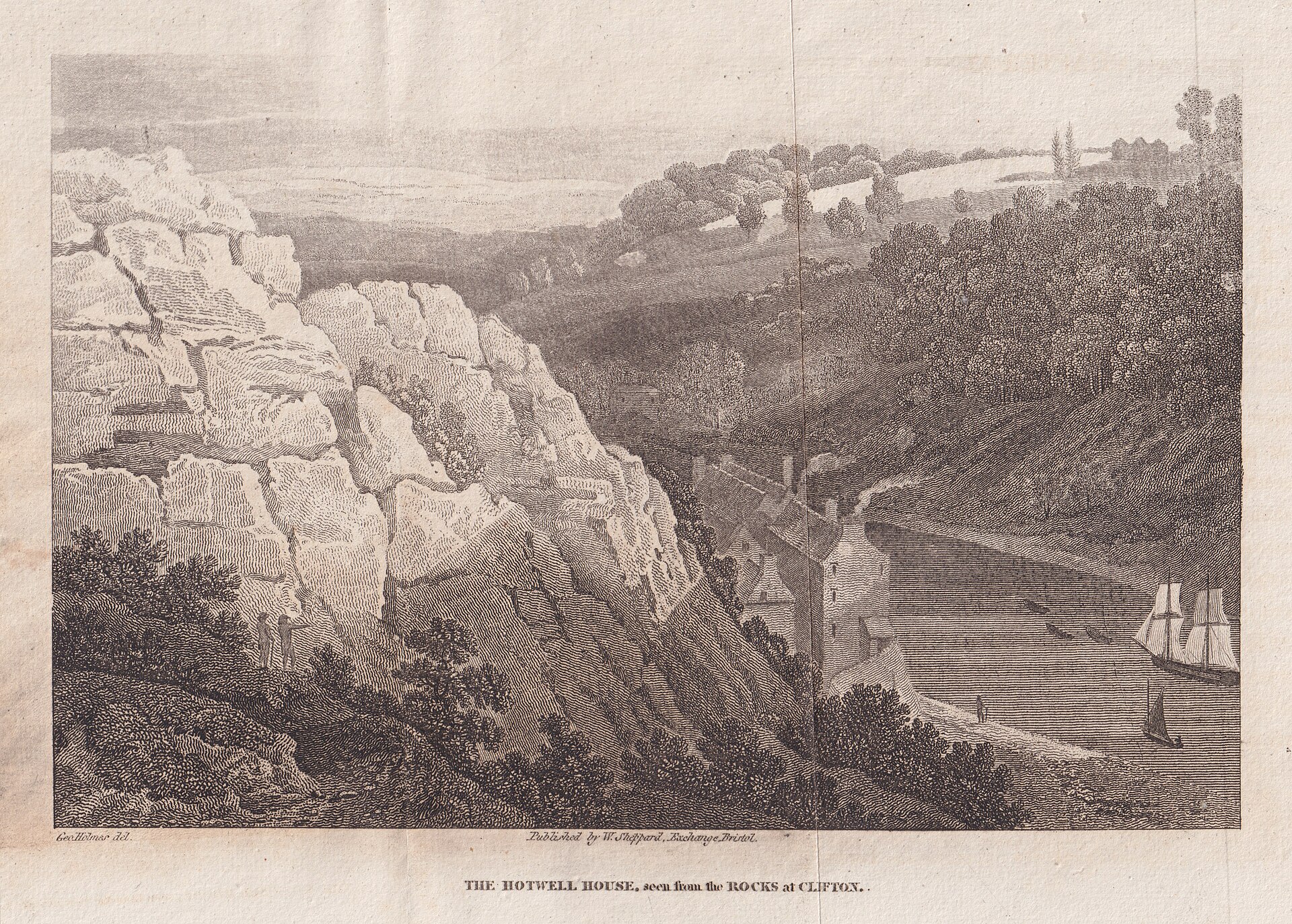 Shown: The Rising Squall, Hot Wells, from St Vincent's Rock, Bristol, Joseph Mallord William Turner
Highland Council bought a Bouchardon for GBP 5 and is selling it privately.
8 min read
When the same object returns to a saleroom the price series looks like an index of the object.
8 min read
Measured across 223 records, an inheritance link spans a median of 27 years against 14 for a purchase and 7 for a purchase at...
12 min read
Ten objects in this archive were bought, or fought for, by public subscription between 1892 and 2025.
10 min read
Six objects in this archive were offered at auction and not sold. An unsold lot is a price nobody paid and a date the object went...
10 min read
Last verified 15 September 2026
One letter a week, on a Tuesday. What was researched, what a chain turned out to say, and what is closing in the exhibition calendar. No promotion, and nothing we cannot cite.
We send one email to confirm the address and keep nothing else. Every letter carries a one-click unsubscribe. How we handle your data.
