Export Bans and National Treasures: What Happens After the Hammer
Britain defers, France refuses for thirty months and may decline to buy, Italy prohibits outright. And a British buyer means the machinery never starts at all.
Records in this piece: The Mocking of Christ, The Rising Squall, Hot Wells, from St Vincent's Rock, Bristol
On this page 6 sections
ContentsClose
In short
- In 2024-25 the Reviewing Committee deferred 18 objects worth GBP 40 million; six were acquired, for a combined GBP 586,132.
- A Hans Coper bottle was lost because the deferral price of GBP 584,200 was itself a hammer of GBP 460,000 plus GBP 124,200 of premium.
- France may refuse a certificate and then decline to buy, in which case the work is released after thirty months.
- Bristol's Turner appeal succeeded and its bid failed, and because the buyer was British no export deferral was ever triggered.
Three mechanisms that reach three different answers
Several jurisdictions can stop a work of art leaving, and they do it in ways that produce very different outcomes for the buyer. The United Kingdom defers a licence decision for a defined period during which a domestic institution may make a matching offer. France refuses an export certificate, classifies the object a national treasure, and gives itself thirty months in which it may make an offer. Italy, for objects that have been through its declaration procedure, prohibits definitive export outright.
What the three share is that the sale itself stands. Title passes at the hammer. What the buyer does not have is the right to remove the object from the country, which for a foreign buyer is close to the same thing as not having it. A successful bidder on a work of national importance can find themselves holding a very expensive object, abroad, for years, with an uncertain outcome and no straightforward way to realise the value.
Sophisticated buyers price this in, and the discount is part of why a state's matching price is sometimes achievable. The presence of export risk depresses bidding from abroad, which lowers the number a domestic institution later has to find.
The British system: three criteria, a case-by-case clock, and the buyer's own price
The Reviewing Committee on the Export of Works of Art and Objects of Cultural Interest was established in 1952 following the recommendations of the Waverley Committee, and advises the Secretary of State for Culture, Media and Sport whether a cultural object intended for export is a national treasure. It has eight permanent members, and each case is advised by three independent assessors who become full members for that case.
The three Waverley criteria are published as questions. History: is it closely connected with our history and national life? Aesthetics: is it of outstanding aesthetic importance? Scholarship: is it of outstanding significance for the study of some particular branch of art, learning or history? The Committee designates an object a national treasure if it considers that its departure from the United Kingdom would be a misfortune on one or more of those grounds. Meeting one is enough.
The clock is not fixed. Deferral periods are set case by case and recorded in the annual reports as an initial period followed by a further period if a serious expression of interest is received and the owner grants an option agreement: three months plus four, three plus three, four plus six. The price is not set by the Committee either. It is the value declared on the export licence application, which is what the departing buyer actually paid, so the domestic institution has to match a figure fixed in a saleroom it may not have attended.
What the numbers look like, and where the premium hides
In the year to April 2024 the Committee met eleven times and considered sixteen objects. Fifteen met at least one Waverley criterion, eleven cases were referred for deferral, and the Secretary of State accepted every recommendation, covering objects with an aggregate value of GBP 18,422,490. Five of the eleven were acquired within the United Kingdom for a total of GBP 8,112,058; six were not saved, with a collective value of GBP 10,310,432.
The following year the imbalance widened. The Committee considered twenty objects, eighteen met one or more criteria and eighteen were referred, with an aggregate value of GBP 40,009,133. Six had been acquired at the time of reporting, for a combined GBP 586,132, which is 1.5 per cent of the value deferred. Three remained under deferral at GBP 22,453,981, and nine were not saved at GBP 16,969,020. Nine cases received no serious expression of interest at all.
A single case shows how the deferral price is built. A monumental Hans Coper stoneware bottle with disc top was found to meet all three criteria. The value on the export licence application was GBP 584,200, which the report itemises as a hammer price at auction of GBP 460,000 plus buyer's premium of GBP 124,200, with artist's resale royalty of GBP 7,791.87 also payable. The Sainsbury Centre expressed serious interest and then could not reach the full amount of funding required, and an export licence was issued. The institution was asked to match a foreign buyer's total, premium included, and fell short. In the same year a walrus ivory carving of the Deposition from the Cross went the other way: deferred at GBP 2,006,595, taken up by the Victoria and Albert Museum after an option agreement, and purchased at exactly that figure.
France may refuse and then decline to buy
The French system starts earlier. No object above a certain value threshold may leave French territory, temporarily or permanently, without an export certificate, and the rule applies to professionals and private individuals alike. Where a certificate is refused, the object may be classified a national treasure, defined as a cultural good presenting a major interest for the national heritage from the point of view of art history or archaeology, on the recommendation of the commission consultative des tresors nationaux.
What follows is permissive rather than mandatory, and this is routinely misdescribed. Within the thirty months following refusal of the certificate, the administration may make an offer to purchase from the owner. If the owner rejects the offer, the price is determined by experts. If the state renounces the acquisition, the work may then leave French territory. France can therefore freeze an object for two and a half years and release it, and the owner has no assurance of a sale at any point in the process.
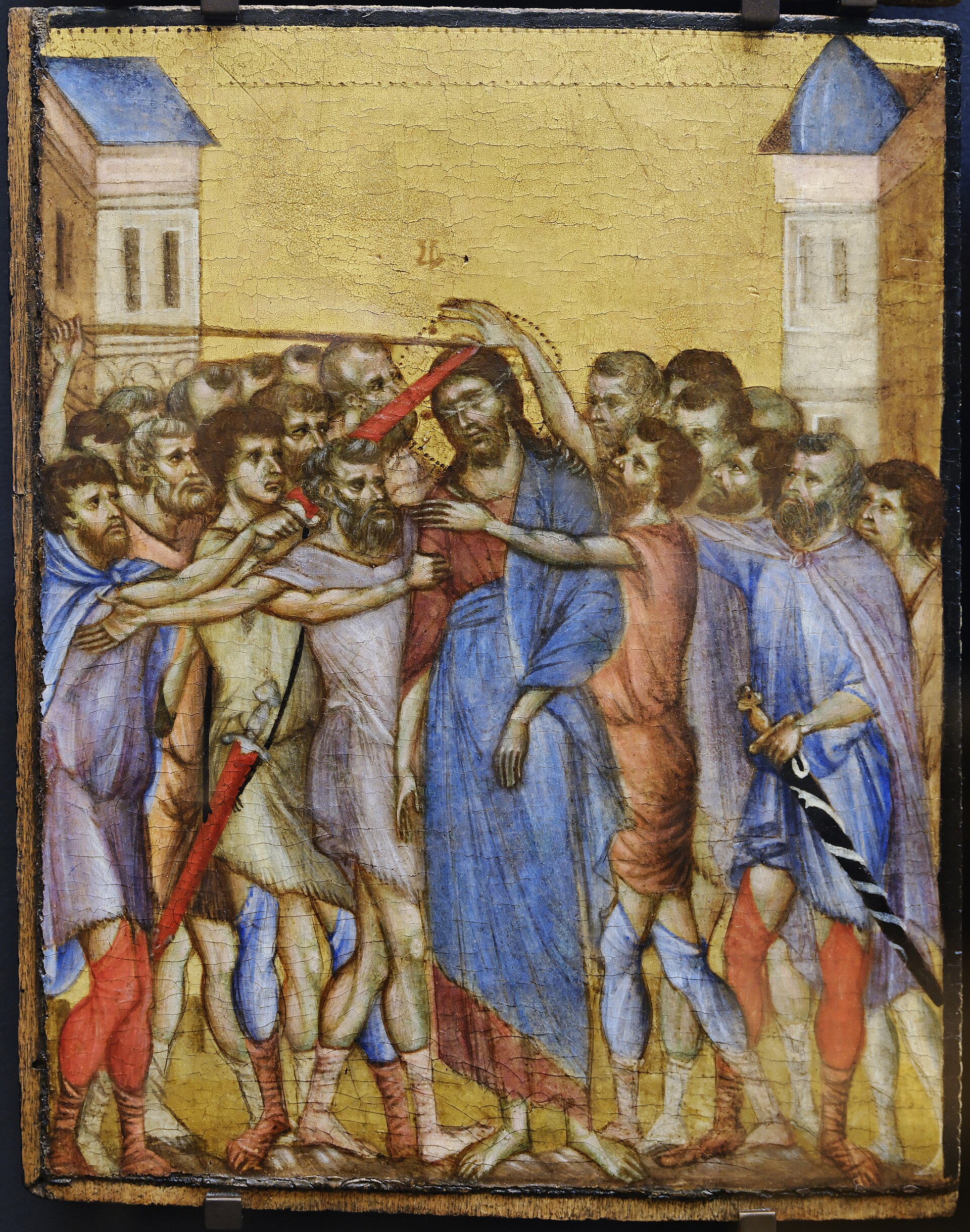
The Cimabue Derision du Christ ran the full course. It sold at Senlis on 27 October 2019 at a hammer of EUR 19.5 million to the Alana collection, and the Louvre's own record dates the national treasure classification to 20 November 2019. The Louvre announced its acquisition on 3 November 2023, four years after the sale, crediting the Societe des Amis du Louvre, Harry and Linda Fath, and the bequest of Guy Maherault. Neither the museum's press release nor the ministry published a price; The Art Newspaper reported only that it understood the Louvre had matched the EUR 24.1 million sale total, and that figure should be treated as unconfirmed.
Italy simply says no
The Italian code of cultural heritage operates by declaration rather than deferral. Under article 13 a declaration establishes that an object possesses the cultural interest the code requires; under article 14 the procedure opens with a communication from the superintendent to the owner, possessor or holder, which is the step the trade calls the notifica. The owner has not less than thirty days to make observations.
The critical provision is that the communication brings the protective regime into force immediately, by way of precaution, before the declaration itself is adopted. Protection therefore bites at the moment the owner is told, not at the end of the process. Article 65 then states that definitive export from the territory of the Republic of the cultural goods covered by the code is prohibited. It is not a period of grace and there is no matching offer, because there is nothing to match.
For objects outside the declared categories, an authorisation regime applies to works by a deceased author executed more than seventy years ago and worth over EUR 50,000, with a lower threshold of EUR 13,500 for books. Below those figures no authorisation is required. The contrast with the other two systems is stark: Britain buys time, France buys an option, and Italy converts the object into something that cannot lawfully leave.
When the appeal succeeds and the bid does not
The most instructive recent British case never reached the Reviewing Committee at all. Turner's The Rising Squall, Hot Wells from St Vincent's Rock, Bristol, his earliest exhibited oil, painted at seventeen in the city it depicts, came up at Sotheby's on 2 July 2025. Bristol Museum and Art Gallery launched a public appeal with a target of GBP 100,000.
The appeal worked. It passed the GBP 100,000 target on 27 June 2025 with four days remaining and closed at GBP 109,120 from more than 1,700 donors. The trust then went into the room with that money and more than GBP 1 million in grants, and was the second highest bidder. The painting sold to a private UK collector at a hammer of GBP 1.5 million, GBP 1.9 million with fees. The money donated was returned. The senior curator Kate Newnham summarised it without excuses: it just wasn't our night.
The distinction carries the whole subject. A failed appeal is a story about public indifference. An appeal that succeeds and is then outbid is a story about what a provincial museum can raise against a private buyer, and it is the more common outcome by some distance. There is a second lesson underneath it. Because the buyer was a UK collector, no export licence application was triggered and none of the Waverley machinery ever engaged. The system that exists to keep national treasures in the country only operates when somebody tries to take one out of it, and a domestic private buyer defeats a museum without the state ever being asked a question.
Questions
No. Title passes at the hammer and the sale stands. What is restricted is movement of the object. In the United Kingdom that is a deferral of the licence decision; in France a refusal of the export certificate; in Italy, for declared objects, a standing prohibition on definitive export.
In the United Kingdom the deferral price is the value declared on the export licence application, which is what the departing buyer paid, so a domestic institution must match that total including buyer's premium. In France the state may make an offer, and if the owner rejects it the price is set by experts.
No. The French ministry's own guidance is permissive: within thirty months of refusal the administration may make an offer, and if the state renounces the acquisition the work may then leave. British deferrals likewise lapse when no serious expression of interest is received, which happened in nine cases in 2024-25.
Those judged of national importance. Britain publishes the three Waverley criteria of history, aesthetics and scholarship, and one is sufficient. France classifies goods of major interest for the national heritage from the point of view of art history or archaeology. Italy sets value and age thresholds alongside its declaration procedure.
Sources
- 1Arts Council England, 'Reviewing Committee on the Export of Works of Art and Objects of Cultural Interest', on its 1952 establishment, membership and the Waverley criteria. artscouncil.org.uk/supporting-arts-museums-and-libraries/...
- 2Reviewing Committee on the Export of Works of Art and Objects of Cultural Interest, 'Export of Objects of Cultural Interest 2023-24', 69th annual report, November 2024, including the walrus ivory and Hans Coper cases. assets.publishing.service.gov.uk/media/...
- 3Reviewing Committee on the Export of Works of Art and Objects of Cultural Interest, 'Export of Objects of Cultural Interest 2024-25'. assets.publishing.service.gov.uk/media/...
- 4Arts Council England, 'Summary of items currently under temporary export deferral'. artscouncil.org.uk/creative-matters/...
- 5Ministere de la Culture, 'Circulation des biens culturels et Marche de l'art', on export certificates, national treasure classification and the thirty-month period. culture.gouv.fr/thematiques/...
- 6Musee du Louvre, collection record for Cimabue, La Derision du Christ, inv. RFML.PE.2023.33.1, giving the Senlis hammer and the classification date of 20 November 2019. collections.louvre.fr/en/...
- 7Musee du Louvre, press release, 'Deux Tresors nationaux pour le musee du Louvre', 3 November 2023. presse.louvre.fr/deux-tresors-nationaux-pour-le-musee-du-...
- 8The Art Newspaper, 'Cimabue kitchen painting placed under export ban ends up at the Louvre', 6 November 2023, reporting the price as understood rather than published. theartnewspaper.com/2023/...
- 9Normattiva, Decreto Legislativo 22 gennaio 2004 n. 42, Codice dei beni culturali e del paesaggio, articles 13, 14 and 65. normattiva.it/uri-res/...
- 10BBC News, 'Lost Turner work sold as museum outbid at auction', 2 July 2025, recording Bristol as the second highest bidder and the return of donations. bbc.co.uk/news/...
- 11Museums Association, 'Bristol museum raises 100,000 pounds in five days to bid for Turner painting', 1 July 2025. museumsassociation.org/museums-journal/...
- 12Anna Brady, 'Turner painting bought last year for 500 pounds sells for almost 2m pounds at Sotheby's', The Art Newspaper, 4 July 2025, giving the GBP 1.5m hammer and GBP 1.9m with fees. theartnewspaper.com/2025/...
More in Provenance and Restitution
The partA return is a new arrangement, not a conclusion
Four contested antiquities, four different things a return turned out to be: a renaming, a rotating loan, a forfeiture nobody enforced and a broken...
When the Only Proof of Where an Object Was Is a Photograph
The Third Imperial Easter Egg was photographed once, in March 1902, and that single plate is what identified it in 2014.
Moved for Safekeeping Is a Link in the Chain
Nine evacuations in this archive: three objects never returned to the building they left, one came back unrecognised and title changed once, by a...