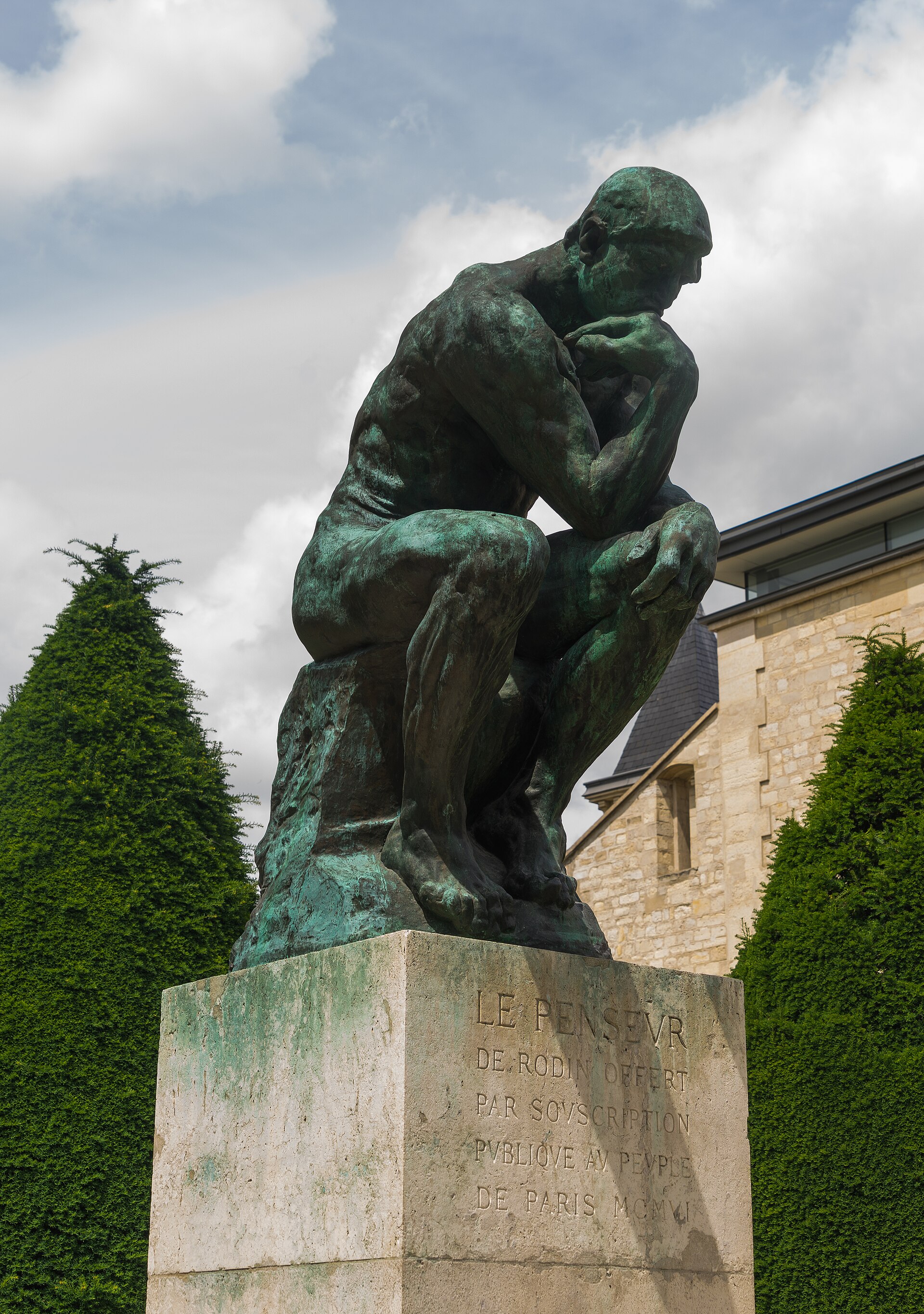
The Thinker
Conceived 1880 for The Gates of Hell · Bronze
Musee Rodin
 French · 1840-1917
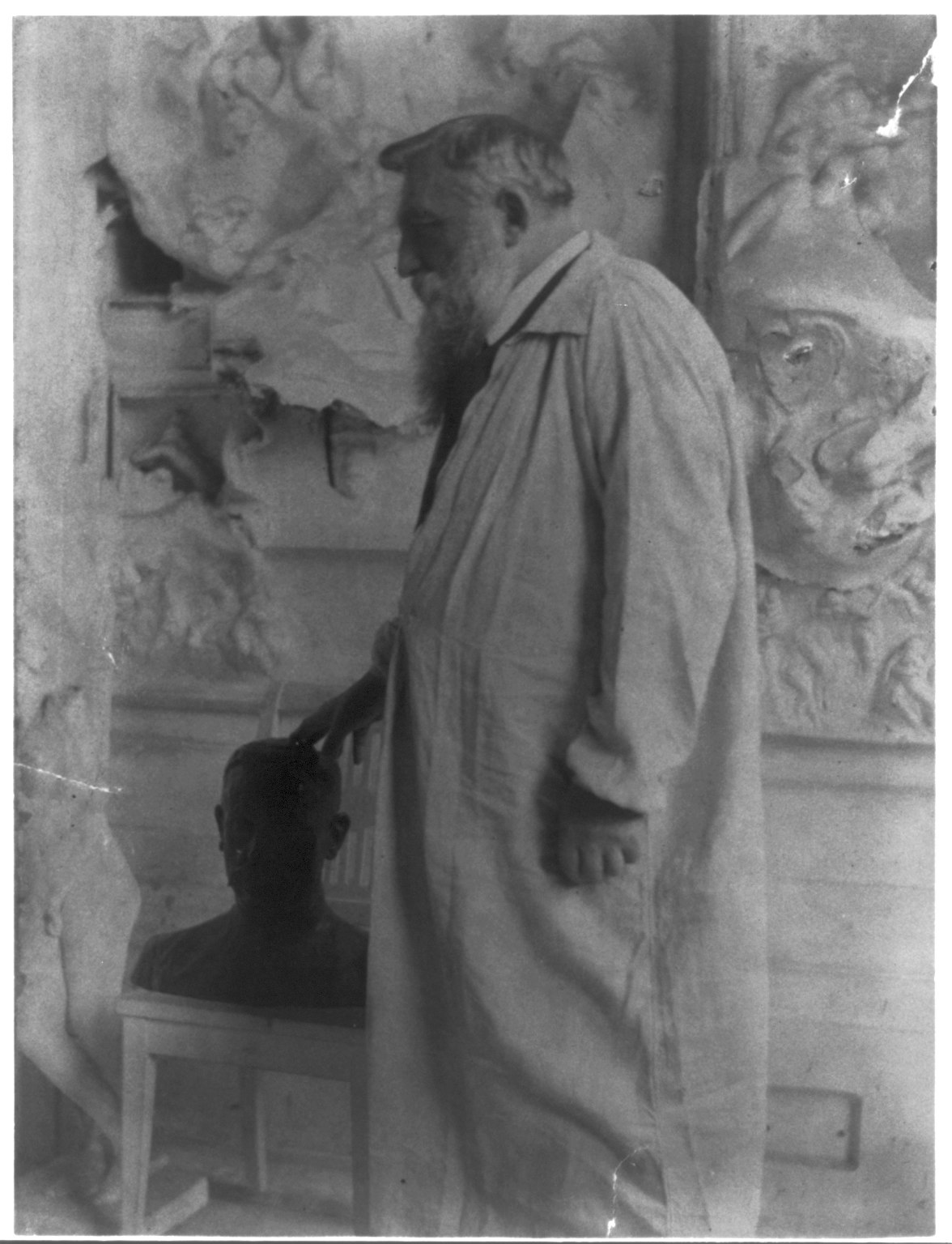
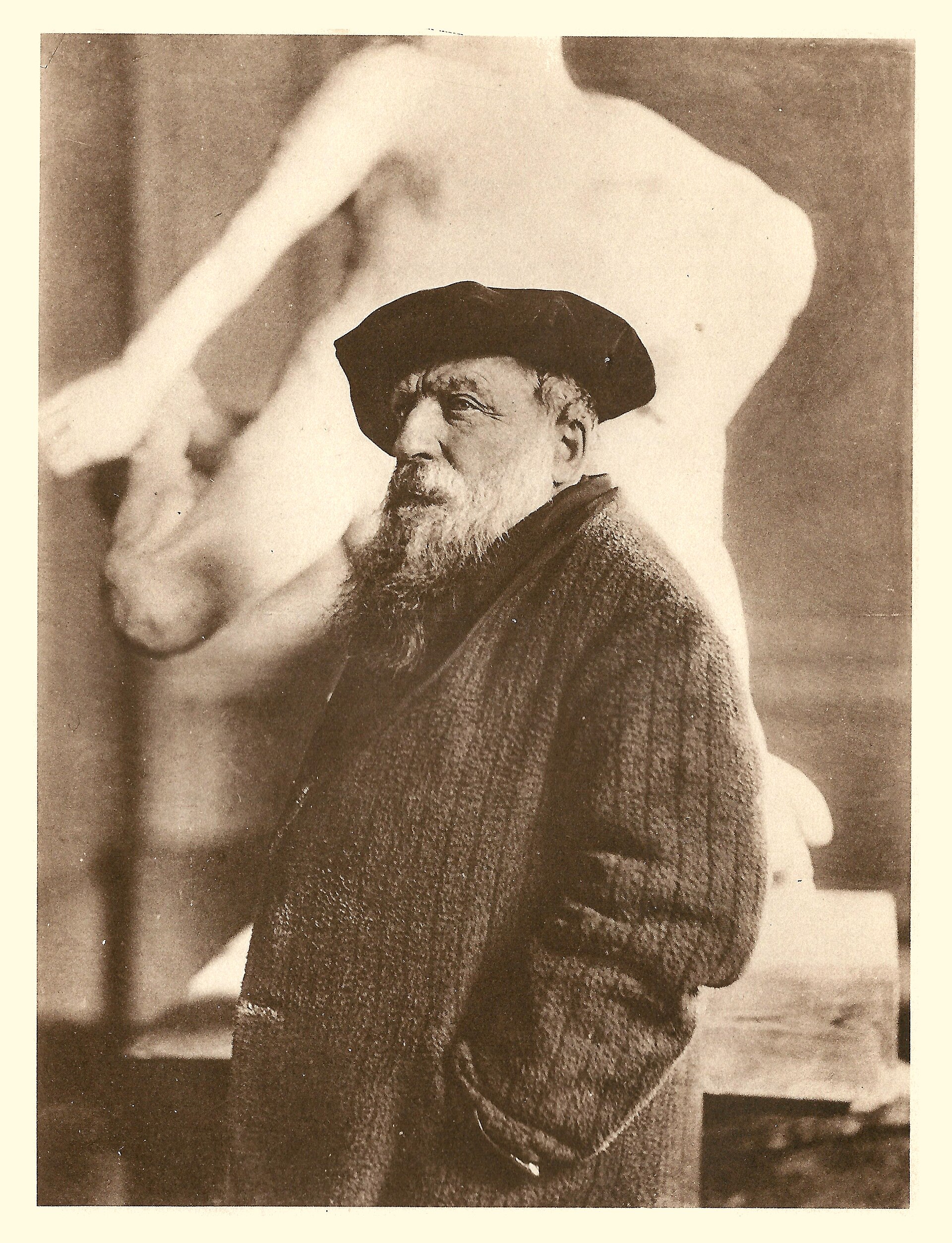
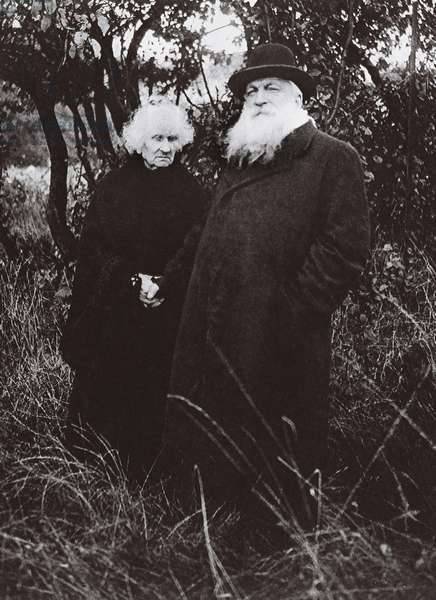
Auguste Rodin photographed by Gertrude Kasebier in 1905, at Meudon. Photographic print, image 21.5 x 16.2 cm, Library of Congress, call reference LCCN 2004674404. The identification is secure: the sitter is named in the Library of Congress catalogue record, the photographer is named, and Kasebier's 1905 sitting with Rodin at Meudon is documented. He was sixty-five, at the height of his fame, and running a studio of up to fifty people. Licence verified per file from Wikimedia Commons extmetadata: LicenseShortName, Public domain.
Library of Congress, Prints and Photographs Division| Full name | Francois Auguste Rene Rodin |
|---|---|
| Worked as | Sculptor, Draughtsman, Modeller, Collector |
| Born | 12 November 1840 · Paris |
| Died | 17 November 1917 · Villa des Brillants, Meudon |
| Nationality | French |
| Movement | Independent |
| In this archive | 1 artwork |
| Sources | 44 cited |
| Last verified | 17 September 2026 |
About this page 1 artwork in the archive · Last verified 17 September 2026 · 44 sources cited
Auguste Rodin modelled in clay. He never carved his own marble and he never poured his own bronze, and both were signed with his name. That arrangement was ordinary for a nineteenth-century sculptor. What is not ordinary is what he did with it: in 1916, a year before he died, he gave his works, his collections, his archives, his intellectual property rights and, critically, his moulds and models to the French state, on condition that a museum be created at the Hotel Biron. The Musee Rodin has been casting bronzes from those moulds ever since, lawfully, as original works, and pays for its own existence with the proceeds. It is the only national museum in France that receives no state operating subsidy.
The single most consequential thing to know about Rodin is therefore not biographical. It is that by Rodin, applied to a bronze, describes a chain of authority rather than a hand, and that French law draws a hard line through that chain at twelve. Editions of sculpture are original within a limit of twelve copies, numbered copies and artist's proofs taken together; the museum numbers its editions 1/8 to 8/8 and I/IV to IV/IV, and lifetime casts count against the twelve rather than sitting outside it. The thirteenth cast is not an illegal object. It is a different category of object, a reproduction, and French law requires it to say so on its own surface in visible and indelible letters. Two bronzes of identical appearance can be separated by two orders of magnitude in value by nothing that is visible.
The scale of the resulting problem is published by the people who examine these objects for a living. The Comite Rodin, which has been preparing a critical catalogue of the sculpted work since 2004 and holds records on more than nine thousand examined objects, states that almost half of the works attributed to Rodin that it has examined are illegitimate. In 2002 its director put it at two in three. The Musee Rodin itself does not authenticate. There is no published catalogue raisonne of the sculpture. One forger's operation produced an estimated six thousand bronzes beyond those seized from him, of which about a third have been traced, and a second produced roughly seventeen hundred from sixteen genuine moulds bought from a Paris dealer. This page is written for the reader who has to decide what a Rodin in front of them actually is.
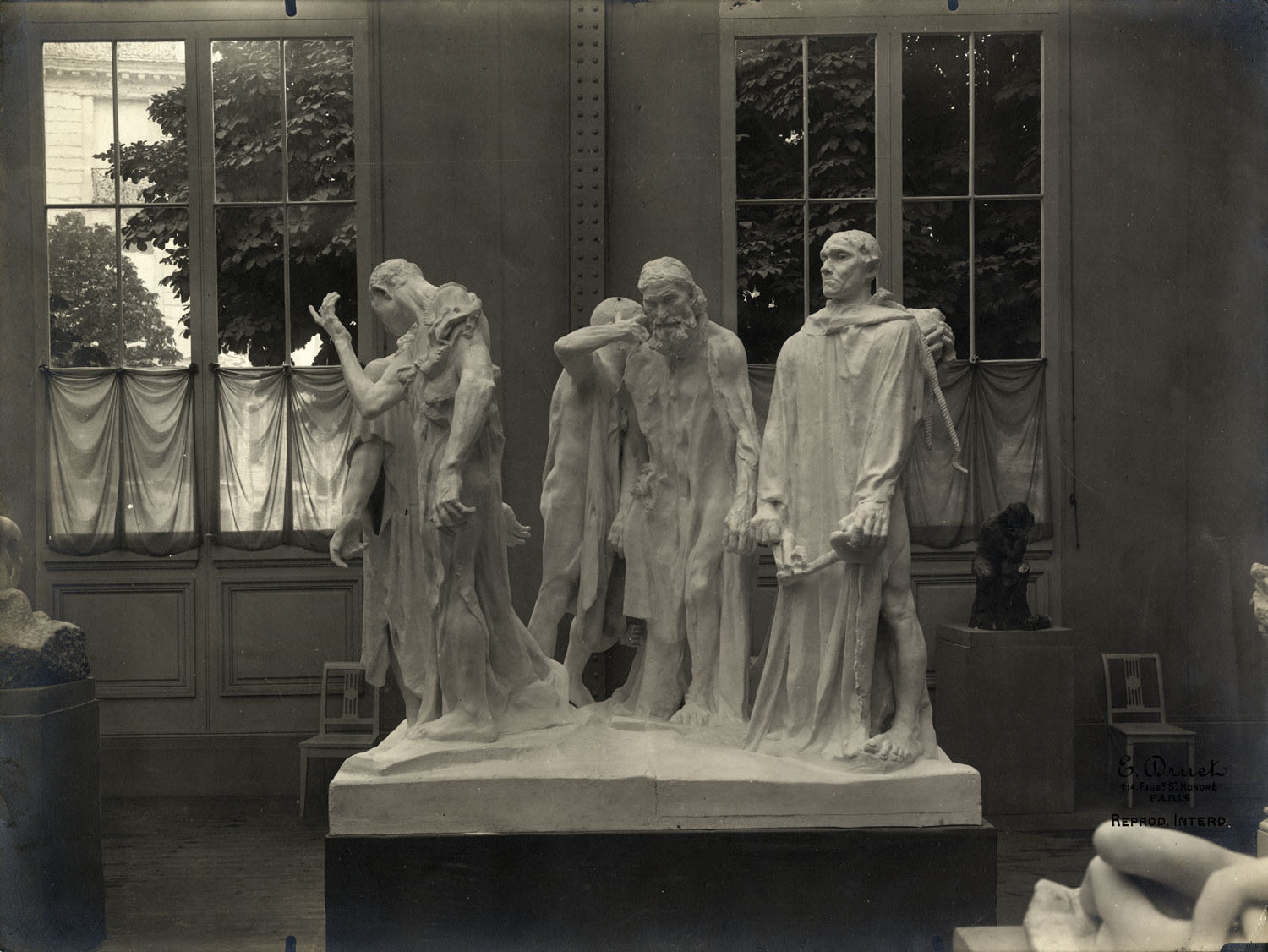
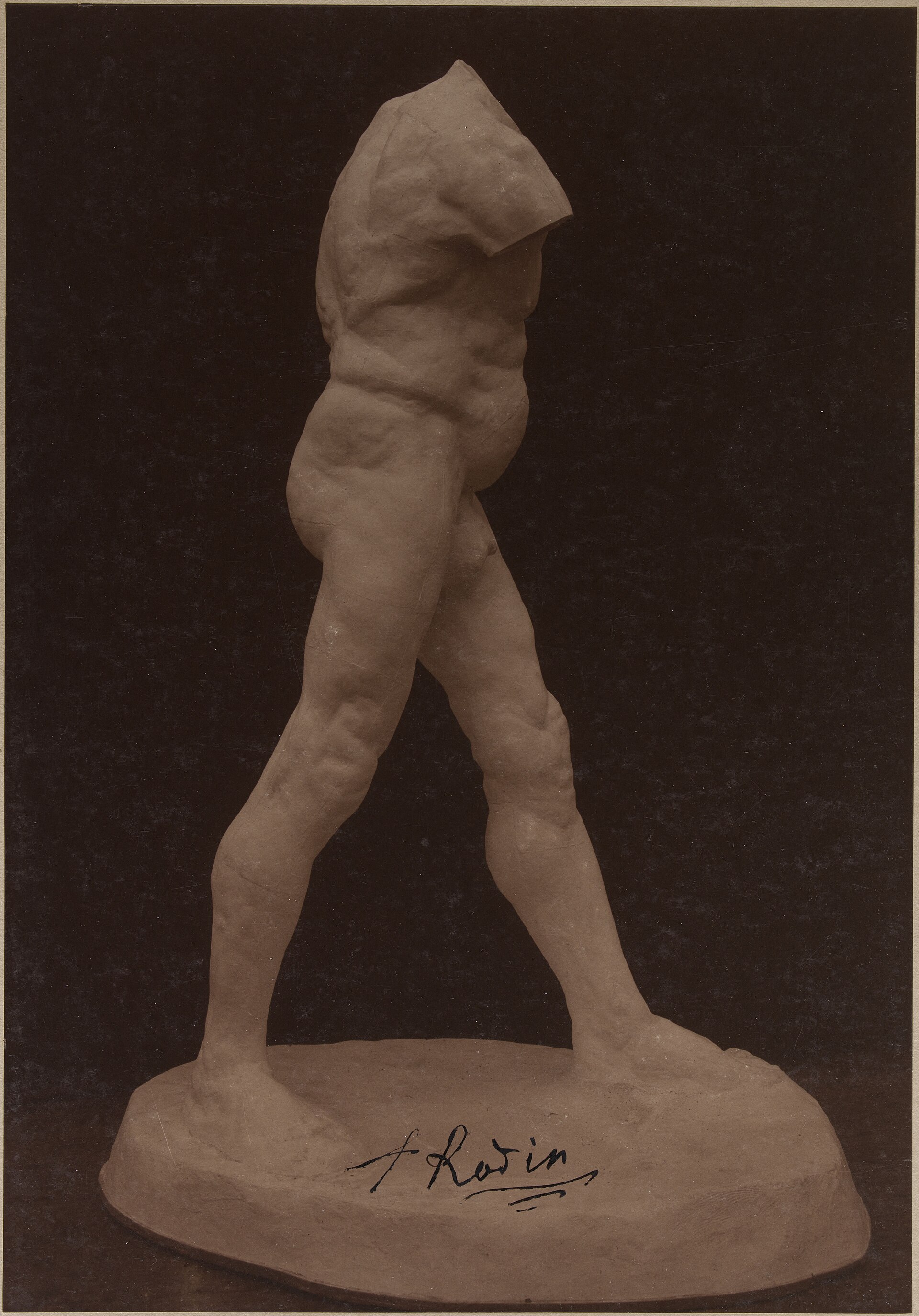
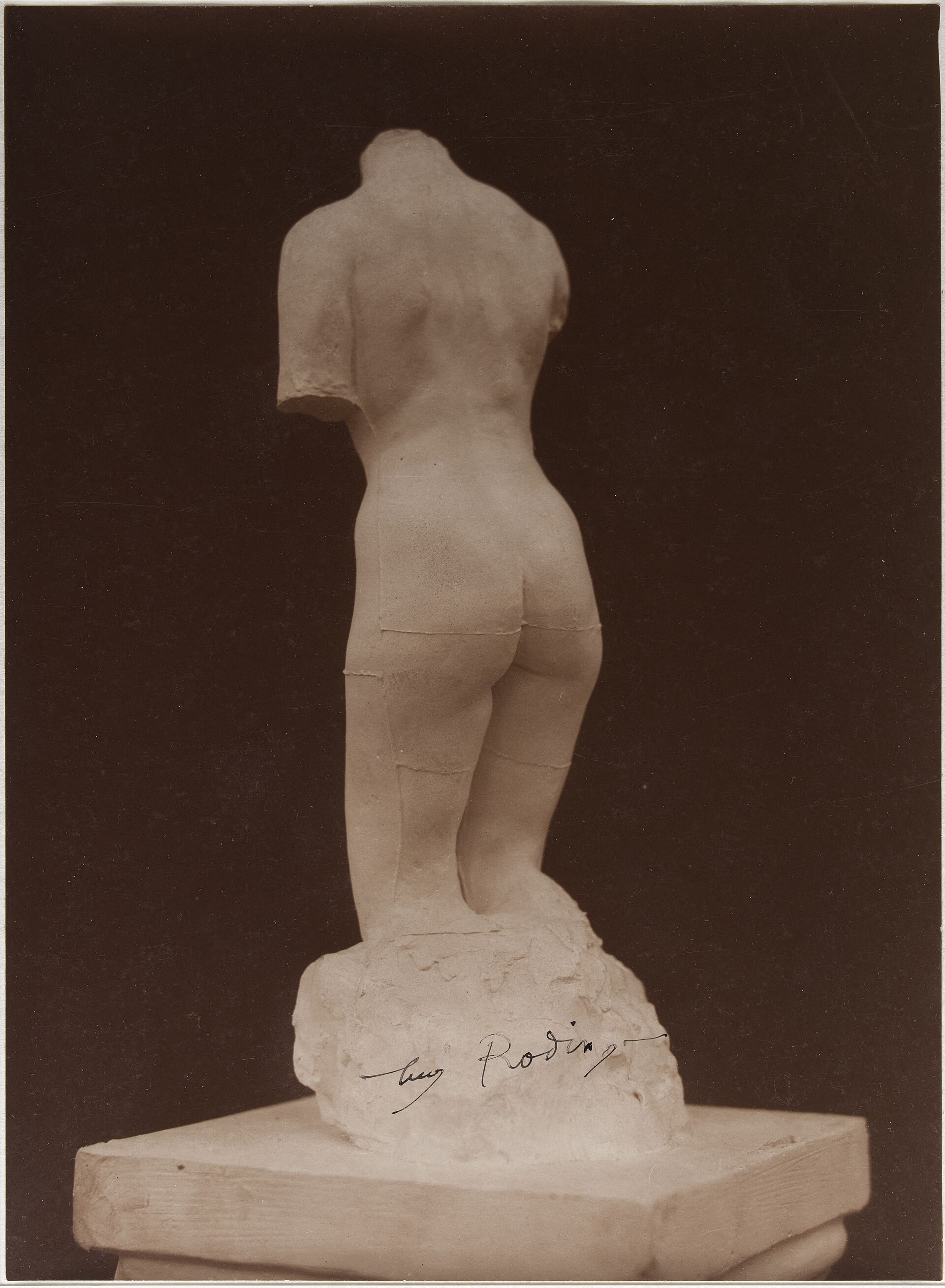
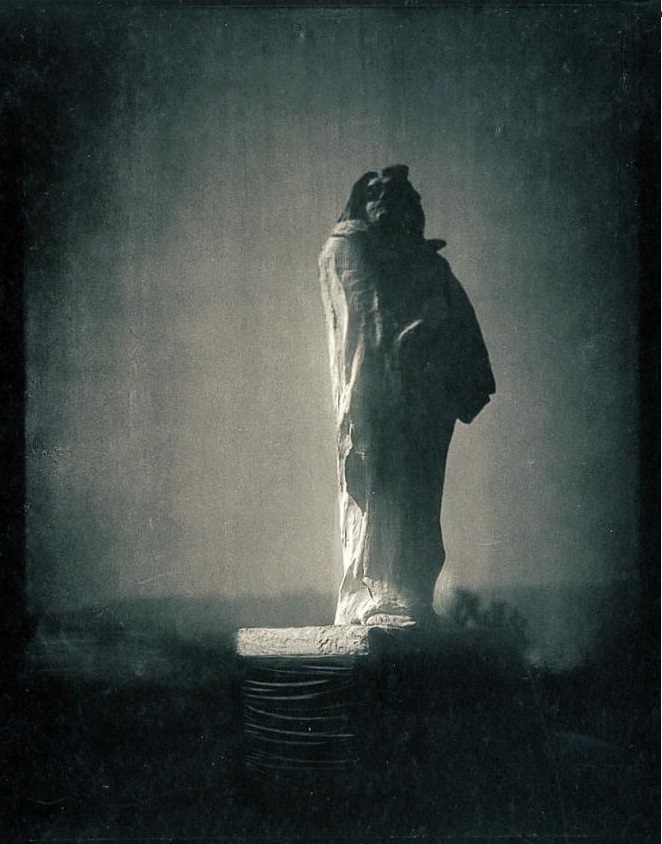
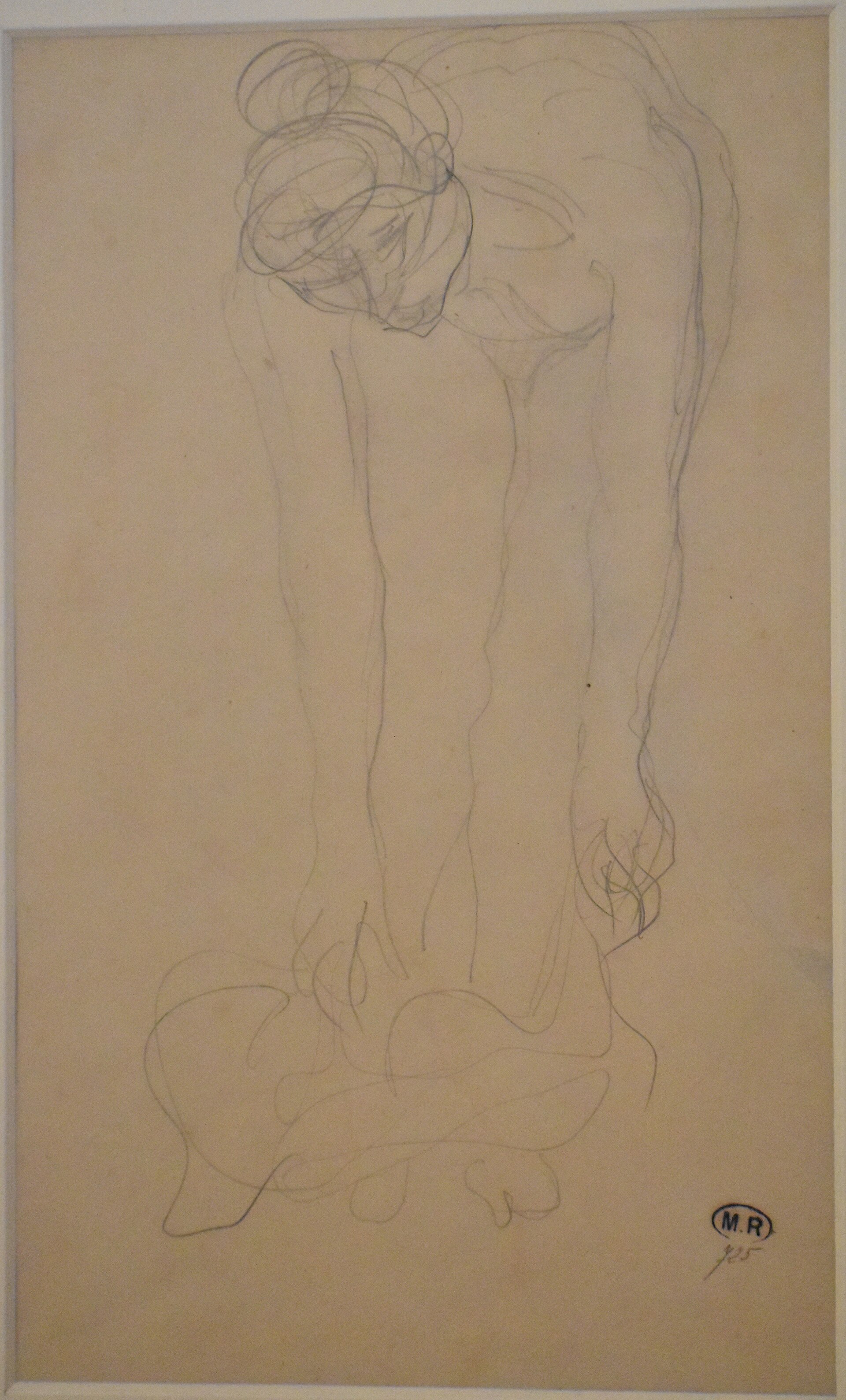
Born 12 November in Paris, son of Jean-Baptiste Rodin, a police clerk, and Marie Cheffer.26
Attends the Petite Ecole, studying drawing and painting under Horace Lecoq de Boisbaudran.26
Rejected by the Ecole des Beaux-Arts. Two further applications are also refused.26
His sister Maria dies of peritonitis in a convent. Rodin enters the Congregation of the Blessed Sacrament as a lay brother; its founder, Peter Julian Eymard, tells him to go on sculpting.26
Begins living with the seamstress Rose Beuret, born June 1844, and enters the studio of Albert-Ernest Carrier-Belleuse. Submits his first sculpture for exhibition.26
Birth of his son Auguste-Eugene Beuret.26
Brief service in the Franco-Prussian war; then works with Carrier-Belleuse on the Bourse in Brussels.26
Six years in Belgium, working in partnership with Antoine-Joseph Van Rasbourgh.26
Two months in Italy. Donatello and Michelangelo. He later says it is Michelangelo who freed him from academic sculpture.26
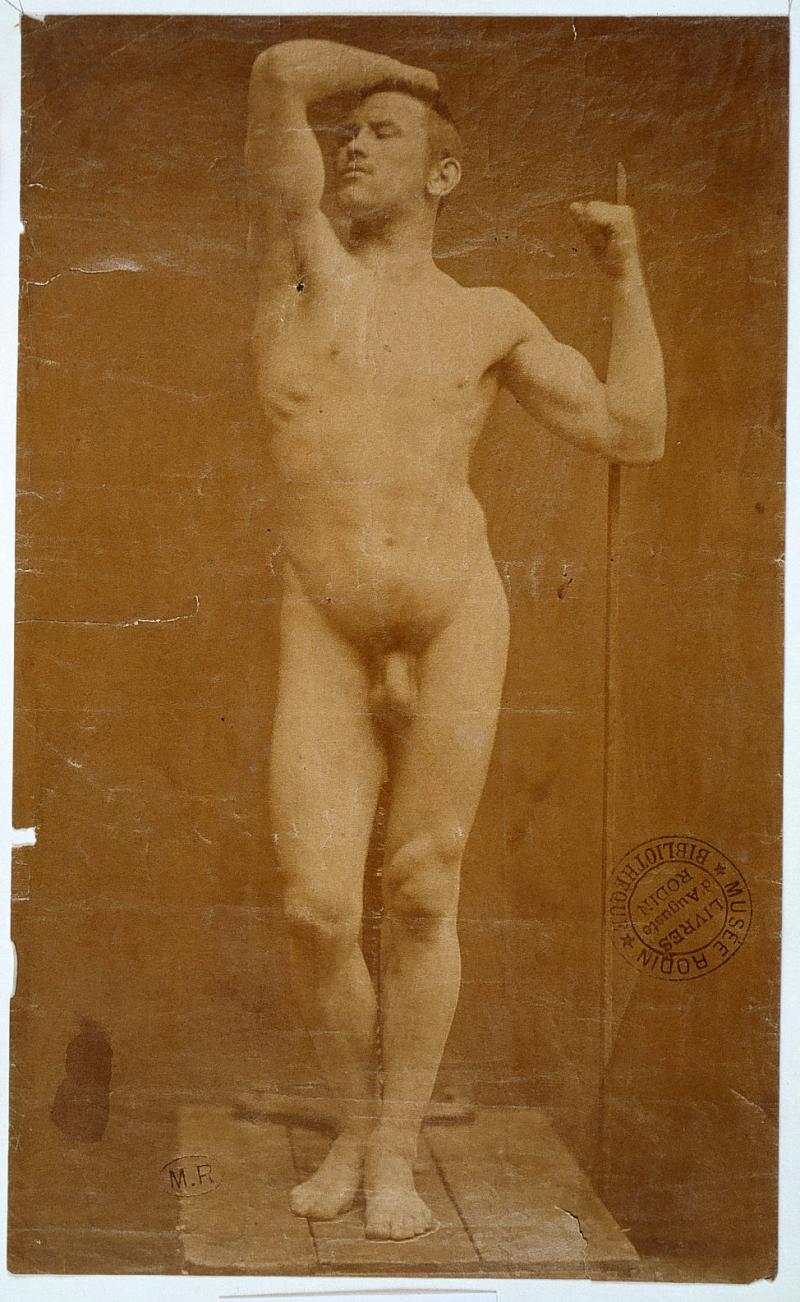
The Age of Bronze shown at the Cercle Artistique in Brussels and then at the Paris Salon. Critics accuse him of moulding the figure directly from his model, the Belgian soldier Auguste Neyt. He has Neyt photographed by Gaudenzio Marconi, demands an inquiry and is exonerated. The word surmoulage enters his story as an accusation against him.626
Commissioned by the Directorate of Fine Arts to make a monumental doorway for a museum of decorative arts that is never built, decorated with subjects from Dante's Divine Comedy. He works on The Gates of Hell for thirty-seven years and never casts it in bronze. Takes a part-time post at the Sevres porcelain factory under Carrier-Belleuse.2640
Leaves Sevres. Income now comes from private commissions.26
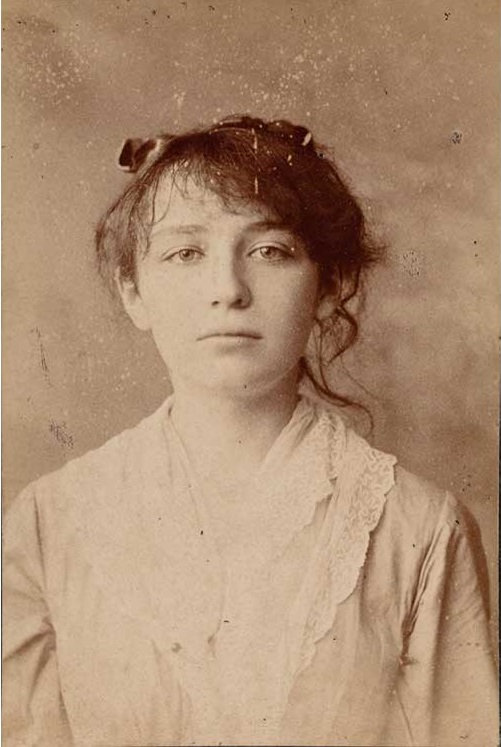
Camille Claudel, aged eighteen, rents a studio on the rue Notre-Dame des Champs. Her teacher Alfred Boucher leaves for Italy and entrusts his pupils to Rodin.7
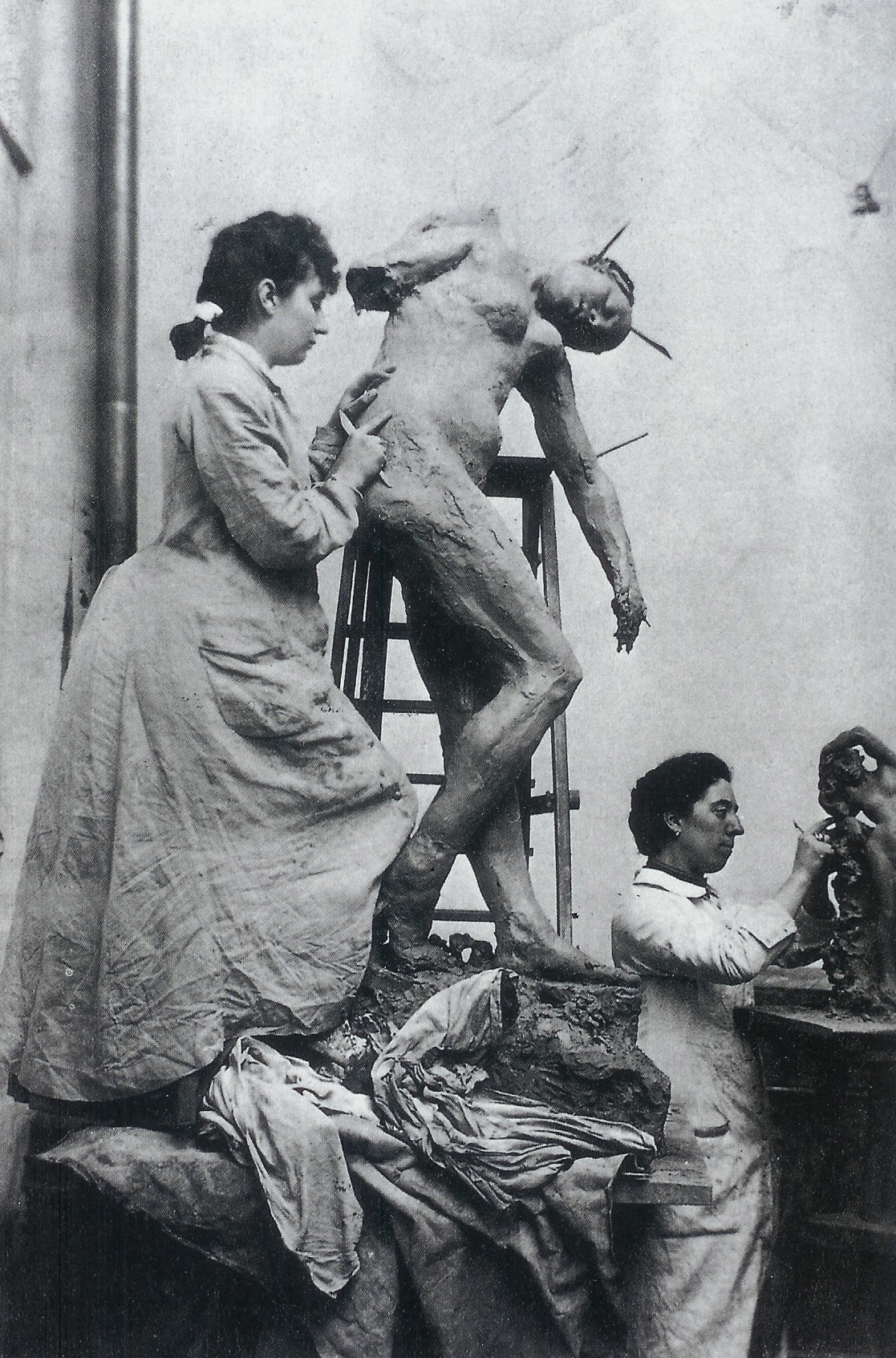
Claudel joins the studio as an assistant, working chiefly on hands and feet for the monumental sculptures, notably The Gates of Hell. Rodin begins The Burghers of Calais.726
Jean Escoula cuts marbles for Rodin including Eve, L'Eternelle idole, the busts of Madame Alfred Roll and Madame Vicuna with Louis Cornu, a Danaide, and with Victor Peter the horses of the Claude Gellee monument.42
The heads of The Slave and Laughing Man are modelled by Camille Claudel and signed by Rodin when they are cast in bronze.7
After Claudel goes to England to put distance between them, Rodin signs what the Musee Rodin calls a contract, promising that she will be his only pupil and swearing fidelity.7
The publisher Paul Gallimard asks Rodin to illustrate his own copy of the rare 1857 first edition of Baudelaire's Les Fleurs du Mal. Rodin works on it for barely four months and draws twenty-seven designs directly into the book.26
The Burghers of Calais first shown. Claudel's Bust of Rodin exhibited at the Salon. Commissioned to make a monument to Victor Hugo.26
Rodin and Claudel work together at the Chateau de l'Islette near Azay-le-Rideau.7
The Societe des Gens de Lettres commissions a monument to Balzac. Emile Zola advocates for Rodin after the death of Henri Chapu. Rodin proposes a three-metre statue in eighteen months.28
Camille Claudel models a bronze portrait of Rodin, cast by Adolphe Gruet.43
Antoine Bourdelle begins work as Rodin's praticien; he stays about fifteen years. Rodin settles at Meudon.737
The Societe des Gens de Lettres threatens legal action over Balzac and proposes reassigning the commission to Alexandre Falguiere. Henri Lebosse begins enlarging and reducing Rodin's models on the Collas pantograph machine, among them Les Ombres, Ugolin, Iris, Le Penseur and La Porte de l'Enfer.2842
Buys the Villa des Brillants at Meudon on 19 December. Wikipedia dates the purchase 1897; the museum's own account gives 1895.2526
Alexis Rudier dies, according to the Artcult account; the foundry continues under his name, run by his son Eugene.12
The full-size plaster of Balzac is shown at the Salon de la Societe Nationale des Beaux-Arts. The Societe des Gens de Lettres rejects it. Cezanne, Toulouse-Lautrec and Monet support him and a petition raises 30,000 francs to have it completed; Rodin declines every offer and keeps the plaster at Meudon. His relationship with Claudel ends.2628
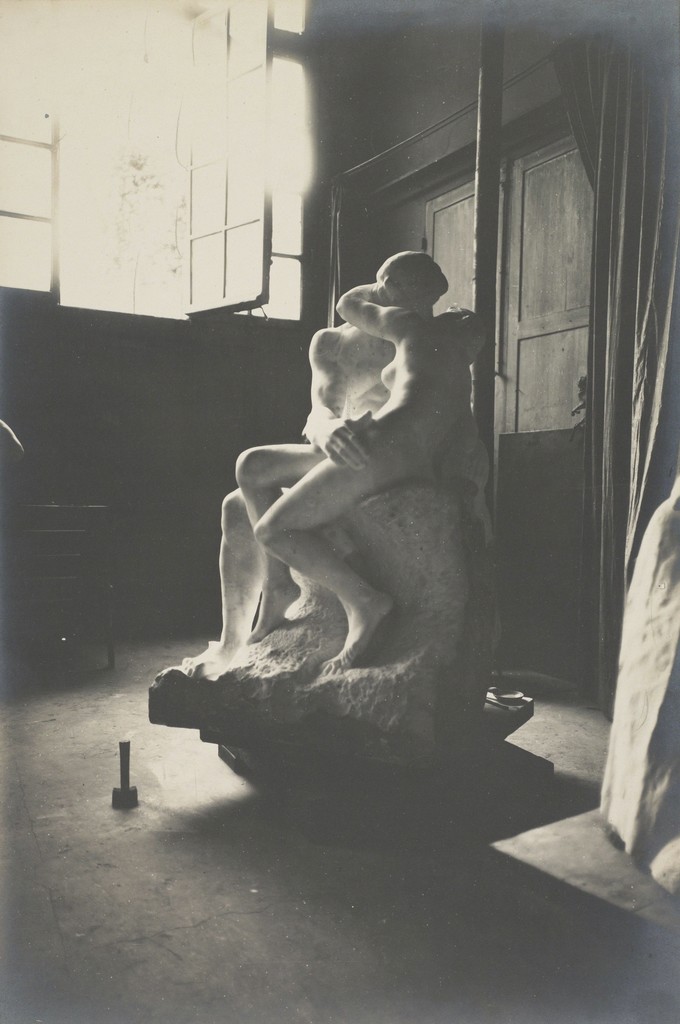
Eugene Druet photographs the marble of The Kiss in the Depot des marbres studio, the marble having been cut by the praticien Jean Turcan.4243
Rodin builds and fills a pavilion of his own at the place de l'Alma during the Exposition Universelle, showing marbles, bronzes and above all plasters, with drawings and photographs by Eugene Druet. Financed with the help of banker patrons; the catalogue prepared with Jean-Paul Laurens, Claude Monet, Albert Besnard and Eugene Carriere. He is by now earning some 200,000 francs a year from portrait commissions alone.263839
The Alexis Rudier foundry, managed by Eugene Rudier, becomes Rodin's principal founder. The relationship, and the mark, run to 1952. A Rodin retrospective of 88 sculptures and 74 frames of drawings opens in Prague on 10 May under the protection of the municipality.134243
Rodin files his first forgery lawsuit, against English and German dealers. Elected president of the International Society of Painters, Sculptors and Engravers in succession to Whistler.926
Rainer Maria Rilke works as Rodin's secretary and afterwards writes a monograph on him.26
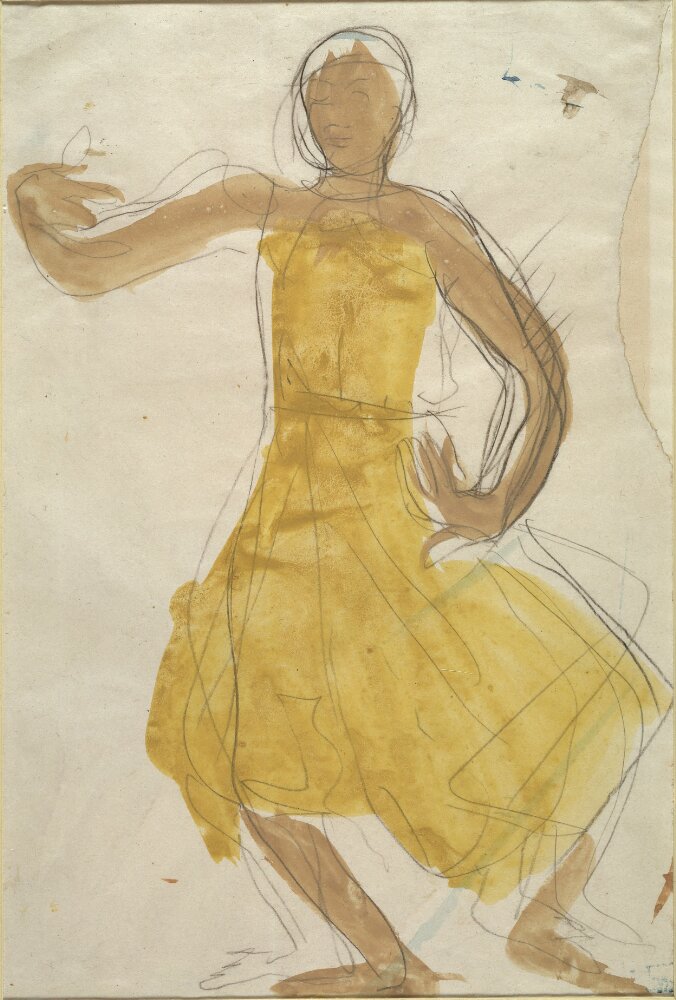
The Royal Cambodian Ballet performs in Marseilles and Paris; Rodin follows the dancers and draws them in pencil and watercolour.43
Bourdelle completes the marble Eve au rocher, 1.70 m, with students from his own atelier working under him. Rodin takes an honorary doctorate at Oxford.2637
Repeated studies of the Japanese actress Hisa Ota, known as Hanako, in heads and masks.43
Rents rooms on the ground floor of the Hotel Biron, an abandoned rococo mansion of 1732 by Jean Aubert, and from 1911 takes over the whole building.25
Bourdelle leaves the role of praticien after the success of his own Herakles Archer.37
Travels through France drawing cathedrals at Etampes, Mantes, Nevers, Amiens, Le Mans, Soissons, Reims, Laon and Chartres.26
In July, Camille Claudel is committed to the asylum at Ville-Evrard at her family's request. She is later transferred to Montdevergues in the Vaucluse.7
Publishes Les Cathedrales de France, the only book he wrote.26
Three donations, on 1 April, 13 September and 25 October, transfer his works, collections, archives, intellectual property rights, moulds and models to the French state. A law of 22 December accepts them and allocates the Hotel Biron and its garden to a museum to be called the Musee Rodin. Rodin keeps the right to live there.425
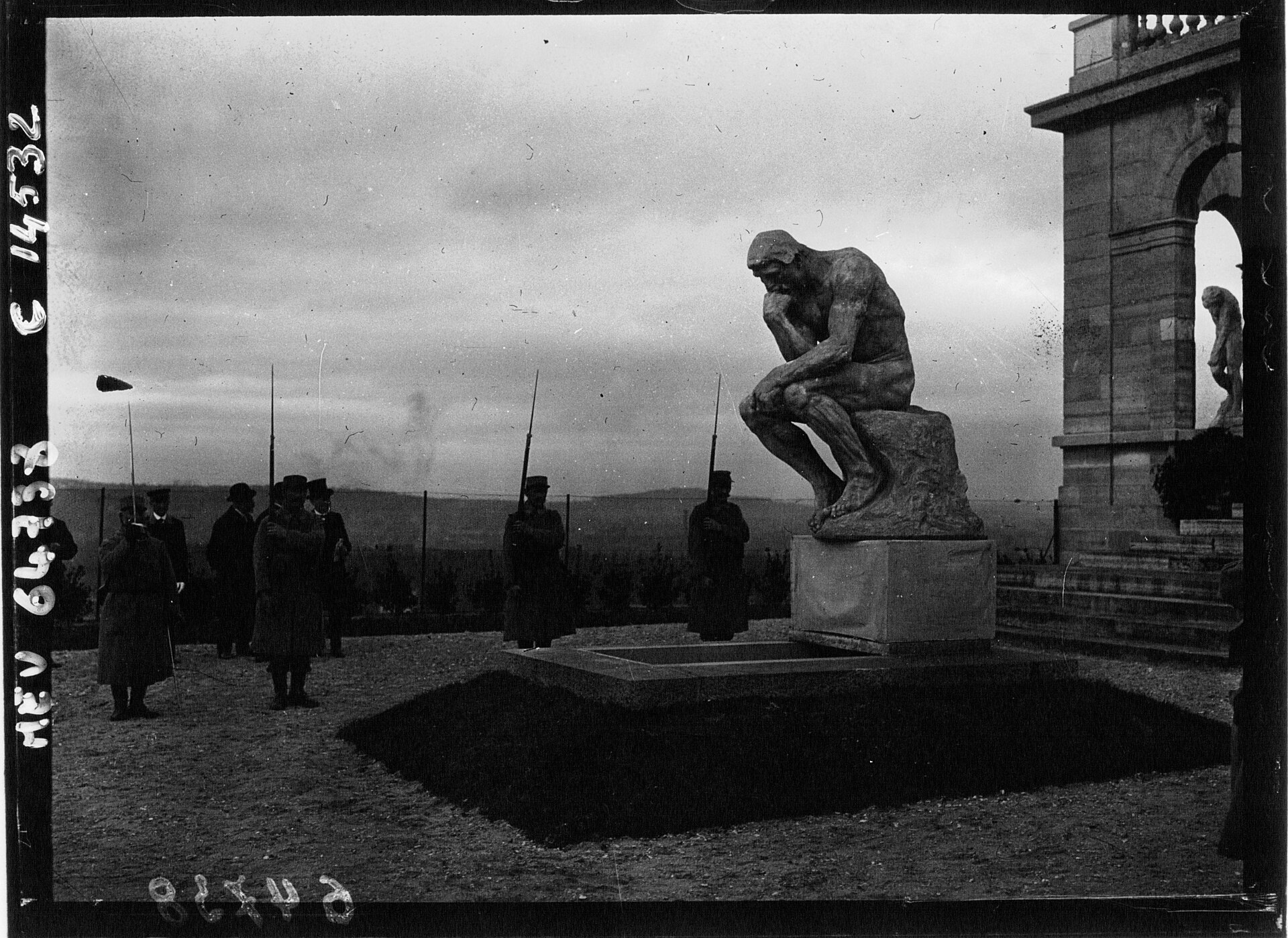
Marries Rose Beuret on 29 January after fifty-three years. She dies on 16 February. Rodin dies at Meudon on 17 November, aged seventy-seven, and is buried beside her on 24 November with a cast of The Thinker on the tomb.2643
The Musee Rodin opens at the Hotel Biron on 4 August. Eugene Rudier's foundry is appointed founder to the museum. The museum brings the first of its large-scale actions against forgers.925
Jules Mastbaum visits the Musee Rodin in September 1924, buys a bronze the same day, and acquires more than 150 sculptures over the next two years. He commissions two bronze casts of The Gates of Hell, one for Philadelphia and one presented to the Musee Rodin.3340
The Gates of Hell is cast in bronze for the first time, by Alexis Rudier, for Philadelphia. Rodin never saw a bronze of it.33
The Rodin Museum opens in Philadelphia in November, completed by Mastbaum's widow Etta and their daughters after his death in 1926.33
On 2 July, twenty-two years after Rodin's death, the Balzac plaster is cast in bronze for the first time and set up at the junction of the boulevards Raspail and Montparnasse.28
By this year the Musee Rodin's own gallery bronze of The Age of Bronze, inventory S.986, has been cast by the Fonderie Alexis Rudier. It is a posthumous cast carrying the mark the market reads as lifetime.6
Camille Claudel dies at Montdevergues after thirty years in the asylum.7
The Meudon site, with the plaster gallery, opens as the second Musee Rodin.25
A plaster cast of Jean d'Aire from The Burghers of Calais, six and a half feet high, disappears from Glasgow Museums after an outdoor exhibition at Kelvingrove Park. Its loss is not made public for more than seventy years.24
Eugene Rudier dies. His nephew Georges Rudier takes over and casts under the name Fonderie Georges Rudier into the 1980s. Paul Claudel gives four major works by his sister to the Musee Rodin.742
French law first limits sculpture editions to twelve examples at each size.20
The Fondation de Coubertin foundry opens, forty-six years after Rodin's death. It later becomes the museum's founder, which makes a Coubertin mark an unambiguous declaration that a cast is posthumous.22
LIFE of 4 June exposes the forgeries of Ernest Durig, three years after his death. His estate is found to contain 155 forged Rodin drawings.1327
Athena Tacha Spear's Cleveland catalogue argues, against the received view, that Rodin was himself a skilled marble carver, while accepting that he left most of the stone cutting to assistants.13
French law requires the date of casting to be inscribed on the sculpture. Compliant casts made after 1 January 1968 carry a year; earlier ones do not.20
Rodin Drawings, True and False at the National Gallery of Art, Washington, 20 November to 30 January: 132 drawings by Rodin shown with 28 forgeries, nine of them by Durig and the rest by two unidentified hands catalogued as Hand A and Hand B. Organised by J. Kirk T. Varnedoe with Albert Elsen.13
John Tancock's The Sculpture of Auguste Rodin published for the Philadelphia Museum of Art.13
A French decree defines the museum's competence over original editions in bronze, executed from models in terracotta or plaster realised by Rodin and under the museum's direct control, acting as the holder of the artist's right of authorship.15
Decree 81-255 of 3 March requires that reproductions be marked as such, visibly and indelibly. The Coubertin foundry casts the Gates of Hell for Stanford by the lost-wax process.2022
Rodin's copyright expires seventy years after his death. Nothing in copyright law now prevents anyone with access to a plaster or a mould from casting a Rodin; control rests on moral rights, marking rules and trademark.14
Guy Hain closes his gallery, sets up a chasing workshop at Nogent-sur-Marne and in 1990 buys the Balland foundry at Luxeuil-les-Bains. Two Rambouillet auctioneers are calculated to have earned twelve million francs from fake sculpture consigned by him between 1987 and 1991.11
A Rodin Age of Bronze from the Hain operation makes four million francs at Drouot in November.11
The Hain workshops are raided. Several hundred pieces are seized, and about twenty metric tons of bronze. The Musee Rodin brings its second large-scale action.9
A February decree vests enforcement of Rodin's perpetual moral rights in the Musee Rodin and requires authorised casts to be made from moulds and plasters in the museum's possession. The total value of fake bronzes sold by Hain is calculated at more than 130 million francs.11
Georges Rudier dies a year after his business goes bankrupt, having admitted shortly before his death that Hain had erased his signature from pieces he cast.11
Hain is sentenced to four years by the court of summary jurisdiction at Lure and serves eighteen months. Sentence on the appeal, after the prosecutor asked the Besancon court for five years and a two million franc fine, is given on 28 June.11
The Musee Rodin files the complaint that begins the Gruppo Mondiale case. Hain, out of prison, is prosecuted again over about 1,100 works by 98 artists.1123
Jerome Le Blay, formerly special adviser at the Musee Rodin, and Francois Lorenceau of the Galerie Brame et Lorenceau found the Comite Rodin to prepare a critical catalogue of the sculpted work.910
Antoinette Le Normand-Romain publishes The Bronzes of Rodin in two volumes, cataloguing the 455 bronzes in the Musee Rodin's own collection.5
The Musee Rodin and the Musee d'Orsay run a catalogue raisonne project on the carved stones and marbles, directed by Chloe Ariot and Francois Blanchetiere, covering some 450 marbles representing about 220 subjects, of which roughly a hundred are of unknown location. Publication in four stages from 2022, with a directory of praticiens and pointers.5
Iris, messagere des dieux makes 11.57 million pounds at Sotheby's London on 3 February. L'Eternel Printemps makes a reported 20,410,000 dollars at Sotheby's New York on 9 May, an artist record, for a marble Rodin did not carve.293031
A museum devoted to Camille Claudel opens at Nogent-sur-Seine.7
The Musee Rodin quadruples the number of works eligible for bronze casting.22
In April the Paris court sentences Gary Snell to a one-year suspended sentence and a 15,000 euro fine and Robert Crouzet to four months suspended, with 500,000 euros in damages to the museum, over roughly 1,700 casts made at Vicenza from sixteen moulds Crouzet had sold to Snell.23
The museum increases casting to offset a projected 4.4 million euro revenue loss from the pandemic. Director Catherine Chevillot confirms that The Thinker's edition of twelve is complete, that one cast remains in the edition of The Kiss and four in that of The Gates of Hell.22
A freedom-of-information request establishes that the Glasgow Jean d'Aire plaster, valued at 3.7 million dollars, has been missing since 1949, and that some 1,750 works are unaccounted for across Glasgow Museums.24
The Comite Rodin records a further large-scale action by the Musee Rodin against forgers, and states that some recently discovered cases are still awaiting judgment. No court record for a 2024 action has been located for this page.9
On 8 June the marble Le Desespoir, modelled 1890 and carved 1892-93, rediscovered on a family's piano after vanishing from the market in 1906 and authenticated by the Comite Rodin, hammers at 860,000 euros at Rouillac's Garden Party sale at the Chateau de Villandry.32
Christie's offers a bronze Eve au rocher from the collection of the Hon Patrick and Lady Amabel Lindsay in its Classic Week sales from 30 June, estimated at 1 to 1.5 million pounds. No result has been published in the sources fetched for this record.41
The Rodin market prices a chain of custody. Rodin is not scarce, and nobody buying him should reason from scarcity: the museum that owns his moral rights has been lawfully manufacturing new original casts of his work for over a century and takes about 3 million euros a year from doing so. What is scarce is a documented lifetime cast, and what is worthless is an object that cannot say which plaster, which foundry, which year and which number it belongs to.
Three facts shape the whole ladder. First, the artist record is held by a marble Rodin did not carve: L'Eternel Printemps, conceived 1884 and cut in 1901 to 1903, at a reported 20,410,000 dollars in New York in May 2016. Second, a documented lifetime bronze roughly two and a half times in nine years: Iris, messagere des dieux, cast by Rudier between 1902 and 1905, bought at auction in 2007 for 4.6 million pounds and sold in London in February 2016 for 11.57 million. Third, the rediscovery premium is real and it is a premium on paperwork: a 28-centimetre marble that had sat on a family piano since before 1906, believed by them to be a copy, hammered at 860,000 euros in June 2025 after several months of examination by the Comite Rodin. The authentication was the value.
Auction reporting on Rodin is unusually bad about the hammer. Most published figures for his major results are premium-inclusive totals reported as though they were bids, and the houses do not separate them; where this record could not establish the split it says so rather than guessing. The supply position is also knowable in a way it is not for any other sculptor: as of July 2020 the edition of The Thinker was closed at twelve, The Kiss had one cast left and The Gates of Hell four, which means the primary market in those subjects is a finite inventory being sold down rather than a supply that responds to demand.
Two comparanda belong here because they measure the same studio. Camille Claudel, who modelled hands and feet for the Gates and whose modelled heads Rodin signed, holds an auction record of 5.1 million pounds. A cast of her L'Age mur found in an abandoned Paris apartment hammered at 3.1 million euros in February 2025 and made 3.7 million with fees. Her work is now priced in the same order of magnitude as good Rodin bronzes, which was not true twenty years ago.
| Date | Sale | Work | Result | Note |
|---|---|---|---|---|
| 9 May 2016 | Sotheby's, New York | L'Eternel Printemps, marble, conceived 1884, carved 1901-03 from a single block, about two feet high | Hammer Not separately published in the sources fetched With premium USD 20,410,000 reported as the price achieved USD | Artist record at auction. Estimate USD 8,000,000 to 12,000,000. Impressionist and Modern Art evening sale, which totalled USD 144,434,000. Believed to be the fifth of ten uniquely finished marble carvings of the subject and singled out by Frederick Lawton in his 1906 biography as the most magnificent of the series; the first marble of the subject at auction in more than two decades. One report describes 20.4 million as the hammer and another as the final price; the exact split has not been established here and the figure should be quoted as the reported total. The record for the artist is therefore held by an object Rodin modelled but did not cut. |
| 3 February 2016 | Sotheby's, London | Iris, messagere des dieux, bronze, 82.9 cm, cast by Rudier 1902-05 | Hammer Not separately reported With premium GBP 11,570,000 (given elsewhere as about GBP 11.5 m and USD 16.7 m) GBP | Described as one of only seven castings known from Rodin's lifetime. Sold from the collection of Sylvester Stallone, who had bought it at auction in 2007 for GBP 4,600,000, then a record for the artist. Press reporting does not separate hammer from premium; treat the sterling figure as the reported total. Other results for the same subject at other sizes: Christie's 2007, USD 880,000; Bonhams 2014, USD 509,000; Sotheby's 2016, USD 2,890,000 for the 95.5 cm version. Sotheby's own public lot pages for this material do not display a price realised, which is why the hammer is unavailable for most Rodin results on this page. |
| 8 June 2025 | Rouillac, Chateau de Villandry | Le Desespoir, marble, about 28.5 x 15 x 25 cm, modelled 1890, carved 1892-93, a figure originally made for The Gates of Hell | Hammer EUR 860,000 With premium About EUR 1,100,000 with fees (reported as about USD 1,200,000) EUR | Lot 76 of the 37th Garden Party sale, conducted by Aymeric and Philippe Rouillac. Opening figure EUR 500,000. The sculpture had disappeared from the market after an auction in 1906 and spent the intervening period on the owners' piano; the family believed it a copy. Authentication took several months and was given by the Comite Rodin. Bought by a young banker from the American west coast. This is the cleanest hammer-versus-premium split available for a Rodin: the hammer is published by one outlet and the fee-inclusive figure by another, and quoting either alone misstates the sale by a quarter. |
| 1989-11 | Drouot, Paris | The Age of Bronze, bronze, from the Guy Hain operation | Hammer Not reported With premium FRF 4,000,000 reported as the price FRF | NOT A GENUINE CAST. Included because it fixes what a well-made forgery achieved at a major French saleroom at the top of the 1980s market, and because the same operation's total sales were calculated in 1993 at more than 130 million francs, about GBP 13.2 m or USD 18.2 m at the time. The objects reached TEFAF Maastricht as well as Drouot. |
| 2013-06 | Sotheby's, London | Camille Claudel, La Valse, first version, bronze | Hammer Not reported With premium GBP 5,100,000 reported as the price GBP | COMPARANDUM, not a Rodin. The auction record for Camille Claudel, who worked as Rodin's assistant on the hands and feet of the monumental sculptures and two of whose modelled heads he signed. Included because the studio's division of labour is only legible if both halves of it are priced. |
| 18 February 2025 | Philocale, Orleans | Camille Claudel, L'Age mur, bronze, sand-cast in 1907 by the dealer Eugene Blot, from a numbered edition of six | Hammer EUR 3,100,000 With premium EUR 3,700,000 EUR | COMPARANDUM, not a Rodin. Found in 2024 in an abandoned Paris apartment. Sold more than fifty per cent above the low estimate and the second-highest price for the artist. Hammer and premium are both published, which is why this result is more useful than most Rodin results. |
Hammer is the price at which the bidding stopped; with premium adds the fee the house charges the buyer on top. Hammer price and buyer's premium in the glossary.
| Institution | City | Holdings | Note |
|---|---|---|---|
| Musee Rodin, Hotel Biron | Paris | About 6,600 sculptures, 8,000 drawings, 8,000 historic photographs and 7,000 objects, plus Rodin's own collection of more than 6,000 antiquities and his paintings by Van Gogh, Renoir and Monet | The rights holder as well as the collection. Opened 4 August 1919 under the terms of the 1916 donation, in a rococo mansion of 1732 by Jean Aubert that Rodin found practically abandoned in 1908. Receives no state operating subsidy. About 700,000 visitors a year. |
| Musee Rodin, Villa des Brillants | Meudon | The house Rodin bought in December 1895 and the plaster gallery | Opened 1948. The plasters are shown in their successive states, which makes this the only place where the sequence of a Rodin subject can be read as a sequence: The Gates of Hell, the Burghers of Calais, the studies for Balzac, the monuments to Victor Hugo, Puvis de Chavannes and Whistler. Rodin and Rose Beuret are buried in the grounds. |
| Rodin Museum, Philadelphia Museum of Art | Philadelphia | The collection assembled by Jules Mastbaum, who bought more than 150 sculptures between September 1924 and 1926, in bronze, plaster, marble and terracotta | Described by the museum as one of the largest public collections of Rodin's work outside Paris. Opened November 1929, completed by Mastbaum's widow and daughters after his death in 1926. Its Gates of Hell, cast by Alexis Rudier in 1926-28, is the first bronze of that work ever made, and Rodin never saw it. Mastbaum commissioned a second cast which he presented to the Musee Rodin. |
| Musee d'Orsay | Paris | The original plaster of The Gates of Hell | A co-director of the museum's marble catalogue project, Francois Blanchetiere, is its curator of sculpture for 1848 to 1880. The plaster, not any bronze, is the object from which every cast of the Gates descends. |
| Cantor Arts Center, Stanford University | Stanford, California | A large collection given by Iris and B. Gerald Cantor, with a sculpture garden dedicated in May 1985 | Its Gates of Hell was cast by the Coubertin foundry in 1981 by the lost-wax process, which makes it an unambiguous, documented, posthumous original edition cast and a useful teaching object for exactly that reason. The Cantor Foundation established study centres here and at the Brooklyn Museum. Stanford's own published figures could not be fetched for this record: its site returned a bot block. |
| North Carolina Museum of Art | Raleigh | 31 works given by the Iris and B. Gerald Cantor Foundation in 2009, 30 by Rodin and one by Camille Claudel | The Foundation's largest single gift, establishing a regional study centre. Fifteen American museums received works in the same distribution. |
| Musee Camille Claudel | Nogent-sur-Seine | The dedicated Claudel museum, opened 2017 | The Musee Rodin holds the largest collection of Claudel's work in existence, including the four major pieces given by her brother Paul in 1952: Vertumnus and Pomona, both versions of The Age of Maturity, and Clotho. Rodin himself provided for a room reserved exclusively for her work in the museum he was founding. |
| National Museum of Western Art | Tokyo | A bronze cast of The Gates of Hell | One of the small number of casts of the Gates. Wikipedia lists Paris, Philadelphia, Tokyo, Zurich, Stanford, Shizuoka, Mexico City and Seoul among the holders; the total is variously given as seven or more, and no consolidated census with dates and foundries has been located. |
| Kunsthaus Zurich | Zurich | A bronze cast of The Gates of Hell | See the note above on the census. A reader planning to compare casts should establish the casting year and foundry of each before travelling, because they were poured across more than sixty years. |
| Museum of Modern Art | New York | Drawings by Ernest Durig | Listed here for a reason that is not celebratory. Durig drawings are held by MoMA and by the Musee d'Orsay, in the latter case works previously thought to be by Rodin. Anyone studying Rodin's drawings should know where the known forgeries sit. |
| Glasgow Museums | Glasgow | Nothing, in the relevant case | A plaster Jean d'Aire from the Burghers of Calais, six and a half feet high and valued at 3.7 million dollars, has been missing since an outdoor exhibition at Kelvingrove Park in autumn 1949. Seven other plaster casts of the figure survive in public collections, with one earthenware and eleven bronzes of the complete group. |
Rodin modelled in clay. He did not carve marble and he did not pour bronze.
Rodin modelled in clay. He did not carve marble and he did not pour bronze. His assistants replicated the modelled work first in clay and then in plaster, and from those plasters pieces were cut in marble by hired carvers or prepared for casting at foundries chosen from among the scores then working in Paris. The Cantor Foundation, which has spent fifty years assembling and studying his work, puts the consequence in a single sentence: although Rodin would supervise, he rarely participated in the creation of these marbles or bronzes. He signed both.
That is not a scandal and it was not concealed. It is the ordinary industrial arrangement of nineteenth-century sculpture, and Rodin ran it at unusual scale. After 1900 he may have had as many as fifty people at work for him. What makes his case different from that of every other sculptor of his generation is that he then wrote the arrangement into French law, gave the machinery to the French state, and left an institution empowered to keep operating it after he was dead. A hundred and ten years later that institution is still casting bronzes, still selling them, and still funding itself on the proceeds.
So the first question a collector, a curator or a student has to answer about any object bearing the name Rodin is not whether Rodin made it. He almost certainly did not make it in the sense that word carries for a painting. The question is which link in a documented chain of authority the object occupies, and whether the marks on its surface tell the truth about that link. Everything else on this page follows from that.
The vocabulary matters, because the trade uses it loosely and the law does not. A lifetime cast was poured while Rodin was alive and under his authority. An original edition cast is a posthumous bronze made by the Musee Rodin from the plasters Rodin bequeathed, inside a statutory limit, numbered and stamped, and treated by French law as an original work of art. A reproduction is anything outside that limit, and French law requires it to say so on its own surface in visible and indelible letters. A surmoulage is a cast taken from a finished bronze rather than from an artist's model, and it is treated in the trade as a copy rather than as art. Four categories, one appearance. The eye cannot separate them. The paperwork and the metal can.
The rule everybody quotes is that a sculpture edition is limited to twelve.
The rule everybody quotes is that a sculpture edition is limited to twelve. It is worth knowing that the number sits in two separate places in French law, written slightly differently, and that specialists cite whichever one suits the question in front of them.
The intellectual-property version is Article R. 122-3 of the Code de la propriete intellectuelle, which lists the categories of work that count as original art when executed in a limited number of copies under the author's responsibility. Its sub-paragraph on sculpture sets the limit at twelve copies, numbered copies and artist's proofs taken together. Read the words: the twelve is inclusive. Artist's proofs sit inside it and are not additional to it.
The tax version is Article 71-3 of Appendix III to the Code general des impots, which governs whether an object qualifies for the reduced rate applied to original works of art. Gilles Perrault, the conservator who has served as expert to the Cour de Cassation on bronzes and who supplied the technical evidence in the largest French sculpture-forgery prosecution of the twentieth century, states the tax rule in his own published guidance as eight copies plus four artist's copies, cast under the supervision of the artist or his successors. Eight plus four is twelve, so in practice the two texts agree on the ceiling; they differ in how they describe its internal structure, and a reader who has only seen one of them will not understand the numbering when it appears on the metal.
The numbering is not itself a law. It is a convention adopted to make the ceiling legible. The Musee Rodin states it plainly: its original editions are limited to twelve casts, numbered 1/8 to 8/8 and I/IV to IV/IV, including the existing original editions. Eight arabic numerals for the open market, four roman numerals reserved for cultural institutions. The phrase including the existing original editions is doing heavy work, because it means that bronzes poured in Rodin's own lifetime count against the twelve rather than sitting outside it. Every lifetime cast of a given subject reduces the number of posthumous casts the museum may lawfully make of it.
The chronology behind the codified text runs through three statutory moments and one decree. A law of 1956 first limited each work to twelve examples at each size. A law of 1968 required the date of casting to be inscribed on the sculpture, which is why compliant casts made after 1 January 1968 carry a year and earlier ones do not. Decree 81-255 of 3 March 1981 required that any facsimile, aftercast, copy or other reproduction of a work of art be described as such, with the word Reproduction applied visibly and indelibly. Perrault notes the practical weakness of that requirement, and it is the weakness the forgers used: the decree does not specify how large the word must be or where it must go, so it is often applied in minute letters in an inconspicuous place.
A separate decree of 1978 defined the museum's own competence, and its wording is the source of a philosophical argument that has never been settled. It describes original editions in bronze as executed from models in terracotta or plaster realised by Rodin and under the direct control of the museum, acting as the holder of the artist's right of authorship. Authorship, not copyright. The Dutch artist and researcher Hans de Roos, who assembled the most detailed public dossier on the question, argues that authorship is a quality bound to a person and cannot be transferred or inherited at all, and that a museum which signs on a dead artist's behalf has stepped from defending him into substituting for him. A decree of February 1993 vested enforcement of Rodin's perpetual moral rights under Article L. 121-1 in the museum and required that authorised casts be made from moulds and plasters in the museum's possession.
The last piece of the legal picture is the one that surprises people. Rodin died in November 1917 and the French copyright term of seventy years ran out in 1987. His work is in the public domain. Nothing in copyright law now stops anybody who can reach a plaster or a mould from casting a Rodin. What stops them is a combination of perpetual moral rights, the marking rules, and trademark: the museum holds the terms R, RODIN, AUGUSTE RODIN and musee RODIN as its exclusive property. Every prosecution described further down this page was built on those instruments and not on copyright, which is why the offences are described in court as counterfeiting rather than as infringement.
The single most consequential document in Rodin's afterlife is a set of gifts he made in 1916, the year before he died, in the middle of a war, at the age of seventy-five and after at least one...
The single most consequential document in Rodin's afterlife is a set of gifts he made in 1916, the year before he died, in the middle of a war, at the age of seventy-five and after at least one stroke. He gave everything to France.
The museum records his own statement of what he was handing over: he bequeathed to the state all his works in plaster, marble, bronze and stone, together with his drawings and the collection of antiquities. The transfer was made in three donations, dated 1 April, 13 September and 25 October 1916, and accepted by a law of 22 December 1916 which also allocated the Hotel Biron and its garden to a museum to be called the Musee Rodin. The condition was explicit and it was territorial: the state was to keep the collections at the Hotel Biron, and the Hotel Biron was to be the museum. Rodin retained the right to live there for the rest of his life. The museum opened to the public on 4 August 1919, twenty months after his death. The Meudon site, the Villa des Brillants he had bought in December 1895 and where he actually worked, opened as a second museum in 1948.
Four things travelled with the works, and it is the fourth that matters most.
The collections: not only his own sculpture but what he had bought with the money it made. By 1917 he had accumulated more than six thousand antiquities from Egypt, Greece, Rome and the Far East, three paintings by Van Gogh including the portrait of Pere Tanguy of late 1887, Renoir's Nude in the Sunlight and a Monet from Belle-Ile. A sculptor's collection of antique fragments is not decoration; it is the reference library he worked against, and its survival intact inside the museum is one of the reasons the museum's holdings run to some 6,600 sculptures, 8,000 drawings, 8,000 historic photographs and 7,000 objects.
The archives: correspondence, contracts, studio records and a photographic collection of about 25,000 images, roughly 7,000 of which Rodin gathered himself. He commissioned photographers to record his work and used their prints as working documents, drawing and cutting on them. That archive is the reason technical claims about his working method can be tested at all.
The intellectual property rights: the museum is the holder of the artist's moral rights and enforces the rights of paternity and integrity.
And the moulds and models. This is the operative clause. The museum states that the moulds and models he bequeathed are used to produce original bronze casts. Rodin did not simply leave France his art. He left France a means of production and the legal standing to keep running it, and he did so deliberately, because he wanted his museum to be able to pay for itself.
It does. The Musee Rodin is the only national museum in France that is fully self-funding and receives no state operating subsidy. Its published figures put annual revenue at about 11 million euros, of which roughly 8 million comes from tickets, the shop, the restaurant and hire of its spaces, and about 3 million from the sale of original bronzes. The museum's own statement of the share is between 30 and 35 per cent of its annual budget. Casting is therefore not a sideline the museum could abandon if the ethics became uncomfortable. It is the mechanism by which the institution exists, and it was designed that way by the artist.
The twelve-cast ceiling has a consequence that almost nothing written about Rodin states plainly: the supply of new original casts of his most famous works has already stopped, and the supply of the...
The twelve-cast ceiling has a consequence that almost nothing written about Rodin states plainly: the supply of new original casts of his most famous works has already stopped, and the supply of the rest is finite and being consumed.
In July 2020 the museum's director Catherine Chevillot set out the position while explaining how the institution proposed to survive the closure of its galleries. The Thinker has reached its limit; the twelve exist and there will be no more. The Kiss had one cast left in the edition. The Gates of Hell had four. Prices for a cast from the museum run from about 50,000 euros to eight figures depending on the subject and the size. Two years before, the museum had quadrupled the number of works eligible for casting, which is the only lever it has: as the famous editions close it must open editions of less famous subjects, and the works being cast now are by definition works Rodin's own market did not exhaust.
Every casting project must be validated by two committees of French and foreign sculpture specialists under a binding ethical charter, and the museum traditionally takes one of the twelve into the French national collections. The casting itself is done by the Fondation de Coubertin foundry, which opened in 1963, forty-six years after Rodin died. That last fact is worth holding: a Coubertin mark is an unambiguous declaration that a cast is posthumous, and it is the only foundry mark on a Rodin that carries no ambiguity at all.
The consequence for the market is structural rather than sentimental. A subject whose edition has closed cannot be supplied at any price by the rights holder, and demand for it can only be met by resale of existing casts. A subject whose edition is still open has a rights holder standing behind it with inventory to sell. Two Rodins of comparable quality can therefore sit in quite different supply positions, and the position is knowable in advance from the museum rather than inferred from auction frequency. Nothing equivalent is published for any other major sculptor.
It also creates a slow-motion problem for the institution. Revenue that comes from selling down a finite asset is not revenue; it is liquidation on a hundred-year schedule. The museum has never published how many casts it makes in a year or how many slots remain across the whole corpus, and until it does, the date on which the arrangement Rodin designed in 1916 stops working cannot be calculated from outside.
The foundry mark is the first thing a specialist looks for and the first thing a forger changes.
The foundry mark is the first thing a specialist looks for and the first thing a forger changes. On a Rodin the mark that matters most is Alexis Rudier Fondeur Paris, and almost everything the trade believes about it is a half-truth.
Rodin used many founders across his career. He commissioned a series of different houses, among them Perzinka, Barbedienne, Hebrard and Francois Rudier, and for plaster casting he employed the Montagutelli brothers, the mouleurs Dieudonne and Eugene Guioche, an assistant named Barbier and later Paul Cruet. From about 1900 to 1902 the Alexis Rudier foundry became his principal founder, and by the last years of his life it was effectively his only one. One French summary of the studio dates the Rudier relationship precisely as 1902 to 1952, which is fifty years, of which thirty-five fall after Rodin's death.
Here is the trap. One account, published by Artcult and reproduced in the RODIN-WEB dossier, states that Alexis Rudier died in 1897, before Rodin's association with the firm began, and that the business was carried on under his name by his son Eugene. Other accounts encountered in the course of this research date the firm's establishment earlier and treat Alexis as its active head; this record has not verified them against a fetched source and does not adopt them. The operative date is not in dispute: no Rodin bronze bearing the Alexis Rudier mark predates about 1902. What every source agrees on is the part that costs buyers money: the Alexis Rudier mark continued in use for decades after Rodin died. Eugene Rudier was appointed founder to the Musee Rodin and went on casting under his father's name until his own death in 1952. His nephew Georges Rudier then took over, casting under the name Fonderie Georges Rudier into the 1980s.
The result is that an Alexis Rudier mark bounds the date of a cast on one side only. It cannot predate about 1902. It can postdate Rodin's death by thirty-five years. The clearest demonstration of that is inside the Musee Rodin itself. The bronze Age of Bronze in its permanent display, inventory S.986, at 180.5 by 68.5 by 54.5 centimetres, is recorded by the museum as cast before 1941 by the Fonderie Alexis Rudier. The founding institution's own gallery bronze of Rodin's first great work is a posthumous cast bearing the mark that the market reads as lifetime.
The signature gives no help. Rodin's bronzes carry an A. Rodin cast into the metal from a model he supplied to his founders. It is a moulded feature of the object, not a handwritten act, and a forger reproduces it exactly as easily as a legitimate founder does. Both of the industrial-scale forgery operations described below cast in the signature themselves.
The number is more useful than it looks, in both directions. None of Rodin's lifetime casts was numbered, because numbering is a later administrative habit; the absence of a number on a genuinely early bronze proves nothing. But the absence of a number on a bronze that also carries a post-1968 date, or that claims to be from a modern edition, is a declaration in itself. Perrault notes that Guy Hain's casts were typically both unnumbered and without a legitimate foundry cachet.
The museum stamp is the single clearest tell on a modern cast, because a compliant posthumous bronze declares its whole status on its own surface: artist, foundry, rights holder, year of casting, position in the edition. A cast that will not tell you that much about itself is telling you something.
Beyond the object there is one sentence from the rights holder that disposes of an entire category of sales talk. The Musee Rodin refuses to authorise anyone's use of the original plasters and moulds in its collections, and states that a claim of museum authorisation for a cast made elsewhere can consequently only conceal an attempt to sell a work under false pretences. There is no such thing as a Rodin cast made by a third party with the museum's blessing. The museum says so itself.
A surmoulage is a cast taken from a finished bronze rather than from the artist's plaster.
A surmoulage is a cast taken from a finished bronze rather than from the artist's plaster. It is the cheapest way to make a convincing fake, because the parent object supplies every detail without any need for modelling skill, and it is detectable, because physics leaves a signature.
Metal shrinks as it solidifies and cools. The technical literature puts the solid-state contraction of bronze at about 2.5 per cent for red-pink alloys and about 3.18 per cent for yellow alloys, and the total reduction between an original and a cast taken from it compounds several separate shrinkages: the wax pattern, the setting of the plaster investment, the firing of that investment, and the metal itself. Every generation of copying therefore comes out measurably smaller than its parent, and the reduction is cumulative, so a copy of a copy is roughly twice removed. Surface quality goes the same way. The chased detail of an original is one casting generation further away at every point in a surmoulage, and the literature describes the result as harder and softer at once: harder in the sense of mechanical, softer in the sense that the modelling has lost its edges.
Two detection methods follow. Ann H. Allison and Robert B. Pond, writing in the Journal of the American Institute for Conservation in 1983, proposed a systematic internal-measurement method: caliper readings at standardised anatomical stations, as many as thirty per figure, compared statistically rather than eyeballed. The method works because the differences are real but small, and because a single dimension can be defeated by casual variation while thirty cannot. Perrault adds the second and, in his account, the most definitive: alloy analysis. Founders historically used distinct formulas, so the metal itself can be read against a known house recipe. The Comite Rodin now scans and tests works at its own premises for comparative alloy studies, and does so explicitly for court-appointed expertise as well as for research.
Both methods have a limitation that the trade rarely admits. As one account of the Hain case put it, different versions of the same bronze rarely get measured together, so marginal differences in size go unnoticed as objects pass through the trade. Detection requires the comparison to be made, and the comparison requires access to a reference cast. That is the practical value of a body holding twelve thousand high-definition photographs and a database of foundry marks: not connoisseurship but a control group.
The word itself has a particular history in Rodin's case, and it runs the other way. In 1877 he exhibited a life-size male nude, first at the Cercle Artistique in Brussels and then at the Paris Salon, so exactly observed that critics accused him of having moulded it directly from a living body. The model was a young Belgian soldier, Auguste Neyt. Rodin's defence was documentary rather than rhetorical: he had Neyt photographed by Gaudenzio Marconi in 1877, so that the body and the sculpture could be compared, wrote to the newspapers, demanded an inquiry and was cleared. The Musee Rodin's own account says he demonstrated that the figure came from a thorough study of profiles and not from a life cast. The statue is The Age of Bronze. The scandal made him.
The episode is not a curiosity. It established, at the very start of his public career, that a question about how a Rodin was physically produced could only be settled by physical evidence, and that photography was the instrument that settled it. A century later the same principle decides whether a bronze is his: not what it looks like, but what can be measured.
The institution that owns the moral rights does not authenticate.
The institution that owns the moral rights does not authenticate. The Musee Rodin states in its own guidance to professionals that it does not authenticate works submitted for examination. An owner may inform the director of a piece attributed to Rodin, giving provenance, dimensions and visible markings, and the museum will record it. It will not issue an opinion on it.
That refusal creates the vacuum that the Comite Rodin fills. The committee was created in 2004 by Jerome Le Blay, who had been special adviser at the Musee Rodin from 1992 to 1997, and Francois Lorenceau, head of the Galerie Brame et Lorenceau in Paris. Its stated purpose is to prepare the Catalogue Critique de l'Oeuvre Sculpte d'Auguste Rodin, still in preparation more than twenty years later. Its address is care of the gallery, at 68 boulevard Malesherbes.
What it has built, rather than what it has published, is the reason the market defers to it. The committee reports records for more than 9,000 examined works, drawing on past auctions, exhibitions, literature and public and private archives including the workshop archives of Rodin's founders; high-definition photographs of more than 12,000 works in plaster, terracotta, bronze, wax and marble; and a comparative database of foundry marks, signatures, moulding and casting techniques and carvers' techniques covering most of Rodin's suppliers and assistants in his lifetime and the museum's editions since. It scans and metal-tests works on its premises. Le Blay told ARTnews that the committee sees every work in person, and by 2019 put his own tally at roughly 5,000 works examined since late 2004, of which about 3,000 were accepted as authentic, lifetime or posthumous.
The headline number is the one the committee publishes about itself, and it should stop any casual buyer: almost half of the Works attributed to Auguste Rodin that we have examined is illegitimate. In 2002 Le Blay put it more sharply still, saying that two out of three bronzes he saw were problematic.
The procedure is a paid private service, not a public function. The owner emails, receives an application form to be signed and returned with no alterations or erasures, arranges professional high-definition photographs or brings the object to Paris, and pays a non-refundable research fee; ARTnews reported the flat fee at 1,600 euros. The committee may then require physical inspection. It concludes by addressing a letter of opinion to the applicant. Rejected works receive a certificate of non-inclusion with an explanation. The committee gives no valuations and no verbal authentications.
Four limits on that authority deserve to be understood before anyone treats a committee letter as a guarantee.
First, it has no legal standing over the artist. Its own legal notice says so: the Comite Rodin is not the heir of the artist and does not represent or defend the moral rights, which are the prerogative of the Musee Rodin. Second, its opinion is an opinion. A certificate of non-inclusion excludes a work from a catalogue that does not yet exist; it is not a judicial finding of forgery. Third, Le Blay has described works being resubmitted repeatedly through different channels after refusal, which tells you both that refusal has real commercial consequences and that it is not the end of the object's career. Fourth, the committee is housed inside a commercial gallery, a structural feature it discloses and which every user of its service should weigh for themselves.
What the market thinks of it is not in doubt. The committee states that Sotheby's, Christie's, Bonhams and the Hotel Drouot request its opinion before offering a Rodin sculpture for sale, and quotes ARTnews to the effect that the market craves its blessing. In practice, for a bronze offered at auction today, an unfavourable or absent Comite Rodin opinion is closer to disqualifying than a favourable one is to conclusive.
This is the fact that most surprises people who arrive from painting.
This is the fact that most surprises people who arrive from painting. For an artist of Rodin's rank, with a national museum devoted to him and a corpus counted in thousands, there is no completed catalogue raisonne of the sculpture. There are four partial instruments and a project.
The most substantial published work is Antoinette Le Normand-Romain's The Bronzes of Rodin, two volumes, 2007, which catalogues the 455 bronzes in the Musee Rodin's own collection with more than a thousand illustrations. It is a catalogue of one collection, not of the artist. A bronze anywhere else in the world is outside it.
The marbles are being catalogued now, by the museum itself. Chloe Ariot, heritage curator for sculpture at the Musee Rodin, and Francois Blanchetiere of the Musee d'Orsay have directed a project running from 2011 to 2025 covering the marbles, the associated pointing models and marble casts. Its published scope sets out the size of the problem in one line: the marbles number around 450 and represent some 220 subjects, and about a hundred of them are of unknown location. The catalogue is to appear online and in stages, and it is to include new information on Rodin's studio, with its praticiens and pointers, and a directory of them.
The two older reference works remain in use and both are half a century old. John Tancock's The Sculpture of Auguste Rodin, published for the Philadelphia Museum of Art in 1976, is the standard English catalogue of a major collection and the source most often cited for Rodin's working method. Athena Tacha Spear's Cleveland catalogue of 1967, with its 1974 supplement, is the work that first argued against the received idea that Rodin never touched marble, finding evidence that he was himself a skilled carver even though he left most of the actual stone cutting to assistants.
The Comite Rodin's Catalogue Critique is the only project that proposes to cover the sculpted work entire. It has been in preparation since 2004. Nothing has been published.
The practical consequence is that there is no book a buyer can open to check whether a given cast is recorded. Every other authentication mechanism on this page exists because that book does not. It is also why the Comite's private database has the standing it has: for the sculpted corpus outside the Musee Rodin's own holdings, it is not one source among several. It is the only one.
The largest sculpture forgery prosecution in modern French history was not built on a false signature.
The largest sculpture forgery prosecution in modern French history was not built on a false signature. It was built on a false foundry mark, and it is the reason foundry marks are now read the way they are.
Guy Hain was an autodidact from Dijon who began his working life selling veterinary products, noticed the nineteenth-century animal bronzes his customers owned, and became a dealer. In 1962 he bought a Rodin Kiss for fifty thousand old francs. Barred from the veterinary trade, he opened a gallery in the Louvre des Antiquaires under the name Aux ducs de Bourgogne, closed it in 1988 as the art market peaked, and turned himself into a publisher of bronzes. He set up a chasing workshop at Nogent-sur-Marne and in 1990 bought the Balland foundry at Luxeuil-les-Bains in the Haute-Saone.
The mechanism was simple and it depended on a family. At Sotheby's he met Georges Rudier, who with his son Bernard was still casting under the Rudier name. Hain had bronzes cast from genuine Rodin plasters and from plasters d'atelier, and he also made aftercasts using long-lasting flexible elastomer moulds taken from existing bronzes, building up the bases to compensate for the height lost to shrinkage. Then he milled off Georges Rudier's mark and stamped Alexis Rudier in its place, so that a bronze poured in the 1980s would read as one poured before 1917. He cast in the signatures and founders' marks himself. He never applied the word Reproduction to anything.
His defence, when it came, was that he had a contract with Georges Rudier to continue the foundry's activity, and that he had registered Alexis Rudier, Rodin and a set of other founders' names including Barbedienne as trademarks with the Institut national de la propriete industrielle in 2000. He also said, in court, that he had offered to take over Georges Rudier's work for the Musee Rodin after the museum switched to Coubertin and had been turned down. Georges Rudier sued to recover the use of his own family's names, and shortly before his death in 1994, a year after his business went bankrupt, admitted that Hain had erased his signature from pieces he had cast.
The scale is documented in the seizures and in one expert's reconstruction. When the authorities of the Haute-Saone raided him, ministry officials seized several hundred pieces made to his order, and about twenty metric tons of bronze. Gilles Perrault spent a year studying the plaster models, bronzes and moulds found at the Balland foundry and in other workshops, and calculated on the technical evidence that Hain had made about six thousand sculptures beyond those confiscated, of which only one third have been traced. The second trial cited about 1,100 works by 98 different artists, among them Rodin, Maillol, Claudel, Bourdelle, Barye, Carpeaux and Mene. The total value of the fake bronzes he had sold was calculated in 1993 at more than 130 million francs, put at about 13.2 million pounds or 18.2 million dollars at the time. Two auctioneers at Rambouillet through whom he consigned are calculated to have earned twelve million francs from fake sculpture between 1987 and 1991; they were summonsed with him and later discharged. His partner received eighteen million francs across various bank accounts in the same period. When those channels became suspicious he consigned through third parties, on one occasion paying his daughter's father-in-law thirty-five thousand francs to travel up from Marseilles and put a sculpture in a sale.
The objects reached the top of the market, not the bottom. They were sold through international fairs including TEFAF Maastricht and at public auction; a Rodin Age of Bronze from the operation made four million francs at Drouot in November 1989. The patinas were right, the chasing was competent, and the sizes were plausible because nobody was measuring.
He was tried first by the court of summary jurisdiction at Lure, sentenced to four years and released after eighteen months. He resumed on release, distributing the work across several foundries in a remote part of France, one to cast, another to chase and a third to patinate, and reassuring the craftsmen by telling them he owned the names as trademarks. The state prosecutor asked the appeal court at Besancon for five years and a two million franc fine; sentence was given on 28 June. The prosecutor's formulation of the offence is the sentence to remember, because it defines the crime for the whole field: the true forger is someone who aims to cause confusion, particularly by faking the foundry mark.
One consequence outlives the sentence. Any bronze by any of the artists whose plasters or moulds were found in Hain's workshops, without a documented history reaching back before about 1988, has to be treated as requiring examination. That is not a claim about a particular object. It is a change in the burden of proof across a whole segment of the market, and it has not been reversed.
The second industrial case is more recent, more legally interesting, and it turns on the question of where a forger gets a mould.The Musee Rodin filed its complaint in 2001.
The second industrial case is more recent, more legally interesting, and it turns on the question of where a forger gets a mould.
The Musee Rodin filed its complaint in 2001. Judgment came from the Paris court in April 2019, after an eighteen-year legal battle. The American dealer Gary Snell received a one-year suspended sentence and a fine of 15,000 euros for having counterfeited the work of the artist. The Paris dealer Robert Crouzet received a four-month suspended sentence for having sold sixteen Rodin moulds to Snell. Together with Snell's company Gruppo Mondiale they were ordered to pay 500,000 euros in damages to the museum.
The court put the operation at roughly 1,700 casts, produced at Vicenza in northern Italy, offered at about 40,000 euros each, which values the enterprise at some 68 million euros. The works cast included The Thinker, The Walking Man and Eve in various sizes. Hundreds were seized at Vicenza and in Toronto, where they were being sold to a local gallery. The bronzes were marketed under an invented house label, and de Roos records the name used: Master Editions.
The reason the case matters more than its numbers is the legal question underneath it. Rodin has been out of copyright since 1987. Snell had genuine moulds, lawfully bought from a French dealer. On the face of it he was casting a public-domain sculpture from material he owned. What made the casts unlawful was narrower and more instructive: they carried Rodin's signature and a Fonderie Rudier foundry mark, and they did not carry the word Reproduction that French law requires. The prosecutor's charge was that Snell had shamelessly used Rodin's name to sell fake-genuine bronzes on an industrial scale. Perrault's evidence went to quality rather than legality, and his description is worth recording because it is the aesthetic case rather than the legal one: the copies betrayed Rodin, distorting his forms, cutting hands or heads from the figures and even inventing shapes he never made.
De Roos, writing before the judgment, described the underlying situation as a paradox and it remains one. Because the twelve-cast ceiling counts lifetime casts against the total, the Musee Rodin cannot make new original editions of the works that were most heavily cast in Rodin's lifetime, The Kiss and Eternal Spring among them. A party outside French jurisdiction, holding plasters or moulds, is under no such limit. The rights holder is constrained by the rule and the unauthorised caster is not, which is why enforcement has had to run through marking, moral rights and trademark rather than through any restriction on casting itself.
The Comite Rodin dates the sequence of large-scale actions the museum has brought as heir: 1919, 1992, 2001 and 2024, and adds that some recently discovered cases are still awaiting judgment. Rodin himself began the sequence. The committee records that he filed his first forgery lawsuit against English and German dealers in 1903, and de Roos notes that the Montagutelli brothers, the mouleurs who cast his plasters, were prosecuted by him for forging his work. The 2024 action has not been traced to a published court record in the sources fetched for this page, and is listed here as the committee's own claim.
Everything above concerns sculpture. The drawings have their own contamination, their own principal forger and their own reckoning, and the reckoning happened first.Ernest Durig, born in Zurich in...
Everything above concerns sculpture. The drawings have their own contamination, their own principal forger and their own reckoning, and the reckoning happened first.
Ernest Durig, born in Zurich in 1894 and dead in Washington in 1962, was a sculptor who claimed to have been Rodin's pupil. The only documentation of the two men having met is a single photograph. The claim was worth more than the truth: it made him plausible, and he produced Rodin drawings for decades. His operation was first exposed in the issue of LIFE of 4 June 1965, three years after his death. When his estate was settled it contained 155 forgeries.
That settlement is what triggered the most useful exhibition ever mounted on the subject. J. Kirk T. Varnedoe, then a Finley fellow at the National Gallery of Art and a doctoral candidate at Stanford, and Albert Elsen of Stanford, chose to investigate. The result, Rodin Drawings, True and False, ran at the National Gallery of Art in Washington from 20 November 1971 to 30 January 1972. It showed 132 drawings by Rodin and 28 forgeries together, with four sculptures. One section showed nine works by Durig and by two further forgers identified only as Hand A and Hand B, because their work was distinguishable and their names were not known. The final section, True and False, put thirty unlabelled sheets in front of visitors and invited them to sort them. The accompanying book presented the drawings in chronological order for the first time and separated the hands of several fakers.
Two problems were being addressed at once, and they compound each other. The chronology of Rodin's drawings was unsettled, and there were a great many fakes; an unsettled chronology makes a fake harder to exclude, because there is no firm sequence for it to violate.
The contamination reached collections. Drawings by Durig are held by the Museum of Modern Art in New York and by the Musee d'Orsay, in the latter case pieces previously thought to be by Rodin. The problem is not closed. In July 2016 the BBC series Fake or Fortune? examined a privately held watercolour of a Cambodian dancer, supposedly by Rodin, and concluded it was a Durig.
The Cambodian dancers are exactly the subject a forger would choose. Rodin drew the Royal Cambodian Ballet at Marseilles and Paris in 1906, rapidly, in pencil and watercolour, in enormous numbers and to a formula. Sheets of that kind are the easiest work in his output to imitate and the hardest to place in a sequence. That is the diagnostic point for anyone looking at a Rodin on paper: the late line drawings and washes are the most attacked part of the corpus precisely because they are the least documented, and a plausible provenance for a drawing is worth more, relatively, than for a bronze.
The studio was a production system with distinct trades, and the documents that survive name the tradesmen.
The studio was a production system with distinct trades, and the documents that survive name the tradesmen. Reading a Rodin without knowing which trade did what is like reading a building without knowing which parts the architect drew.
The sequence began with Rodin in clay, wax or plaster. Clay has to be kept damp to stay workable, and in the early years Rose Beuret did that work. Assistants then replicated the modelled piece in clay and in plaster, and from the plaster two branches diverged: marble could be cut, or a bronze could be prepared.
The mouleurs made the moulds and pulled the plasters: the Montagutelli brothers, Dieudonne and Eugene Guioche, an assistant named Barbier, later Paul Cruet. The enlarger was Henri Lebosse, Rodin's principal assistant in that trade from 1894, who ran his own studio and used the pantograph machine invented by Achille Collas to scale a model up or down mechanically; the works that passed through his hands include Les Ombres, Ugolin, Iris, Le Penseur and La Porte de l'Enfer. The praticiens cut the stone. The founders cast the metal off site. The patineur finished the surface; Jean Limet did that work for Rodin, using a process of his own, and the patina of a bronze is a deliberate chemical operation performed by a named specialist, not a property of the alloy.
The praticiens are the group whose contribution has been most thoroughly erased, and it is now being reconstructed by the institution that has the records. The Musee Rodin's public collections database carries an author-function field, and filtering it for praticien returns seventy-two sculptures. That is the museum's own admission, object by object, that a second named maker stands behind those objects. The catalogue of the marbles now in preparation is to publish a directory of the praticiens and pointers.
Individual attributions are documented. Jean Escoula cut, between 1884 and 1900, the marbles of Eve and L'Eternelle idole, the bust of Madame Alfred Roll of about 1887 and that of Madame Vicuna of 1888 both in collaboration with Louis Cornu, a Danaide of about 1889 and, with Victor Peter, the horses of the Claude Gellee monument in 1892. Jean Turcan executed the marble of The Kiss. Antoine Bourdelle worked as Rodin's praticien from 1893 to about 1909, fifteen years, and cut Eve au rocher, one metre seventy high, completed in 1907, with students from his own atelier on the impasse du Maine working under him and Bourdelle correcting them before the piece was finished. He stopped after the success of his own Herakles Archer in 1909 made a subordinate role impossible. Charles Despiau appears in the museum's praticien records. Camille Claudel, Malvina Hoffmann, Francois Pompon, Constantin Brancusi and Gustav Vigeland all passed through the studio.
Three consequences follow, and they are the whole of the attribution problem for the marbles.
First, the object bearing Rodin's name in stone was cut by a man whose own name is recorded, in the museum's files, on some of them. Second, the aesthetic difference between one carver and another is real. Catherine Lampert, who curated the 1989 Hayward Gallery exhibition, wrote that looking back through the editions made since 1950 one sees the product reflect the tastes of curators, fashions in patinas and the market, and within that many dubious decisions about what looks good in bronze at what scale. Her comment is about posthumous casting, but the same is true of carving: the hand that cuts decides how the marble reads. Third, and most pointedly for a buyer, the highest price ever paid at auction for a work by Rodin was paid for a marble he did not cut.
Spear's 1967 finding cuts against the simplest version of this story and should be recorded with it. She argued, against the received view, that Rodin was himself a very skilled marble carver, on the evidence of the objects. What is not in dispute is that he left most of the actual stone cutting to his assistants, and that in his years of fame the volume of demand made any other arrangement impossible.
De Roos draws the conclusion that the whole system, rather than any object in it, was the achievement: the modelling separated from the physical execution, the fragment treated as a finished work, the same figure repeated at different scales and in different combinations, an art factory employing dozens of people. Rosalind Krauss has argued that this system of repetition is itself Rodin's invention of modernism. That is a critical position rather than a fact, and it is recorded here as one.
Camille Claudel was born in 1864 and studied at the Academie Colarossi because the Ecole des Beaux-Arts did not admit women.
Camille Claudel was born in 1864 and studied at the Academie Colarossi because the Ecole des Beaux-Arts did not admit women. She rented a studio on the rue Notre-Dame des Champs in 1882. When her teacher Alfred Boucher left for Italy that year he entrusted his pupils to Rodin, who was impressed by the first works she showed him. She joined the studio around 1884, when the major commissions arrived.
What she did there is stated by the Musee Rodin in words that carry an admission: she apparently spent most of her time on difficult pieces, such as the hands and feet of figures for monumental sculptures, notably The Gates of Hell. Hands and feet are the hardest forms in the figure and the most diagnostic. The Gates carry around 180 figures by the count of one standard description and over 200 by another, and a large proportion of their extremities were modelled by a woman whose name appears nowhere on the object.
The museum goes further on two specific works. The heads of The Slave and Laughing Man, of about 1885, were signed by Rodin when they were cast in bronze and were actually modelled by Claudel. That is not an inference from style. It is the rights-holding institution recording, in its own published resource, that two works signed by Rodin were made by somebody else.
The relationship is documented in the correspondence, and the museum characterises its early phase as passion on his side and reserve on hers. She left for England to put distance between them; on her return in September Rodin signed what the museum calls a contract, promising that she would be his only pupil and swearing fidelity. Between 1889 and 1891 they worked together at the Chateau de l'Islette near Azay-le-Rideau. In October 1891 he took the Folie Neufbourg to be nearer her. He would not leave Rose Beuret, and by the end of 1893 he had settled at Meudon. The break is generally dated 1898.
Her later life is the part usually told as tragedy and is better told as record. Her work was repeatedly refused by the state. She was supported by private patrons, among them the Countess de Maigret, who bought Perseus and the Gorgon. In July 1913, living as a recluse in her studio on the Quai de Bourbon, she was committed to the asylum at Ville-Evrard at her family's request. She was transferred to Montdevergues in the Vaucluse and remained there until her death in 1943, thirty years.
Rodin's own posthumous arrangement included her. He provided for an exhibition space reserved exclusively for Camille Claudel's works in the future museum. In 1952 her brother Paul Claudel gave four major works: Vertumnus and Pomona, both versions of The Age of Maturity and Clotho. The Musee Rodin now holds the largest collection of her work in existence. A museum devoted to her opened at Nogent-sur-Seine in 2017.
The market has moved sharply and recently, and it is the best available measure of how badly her reputation was mispriced. Her auction record is 5.1 million pounds, set at Sotheby's in London in June 2013 for the first version of La Valse. On 18 February 2025 a bronze of L'Age mur, sand-cast in 1907 by the dealer Eugene Blot as part of a numbered edition of six, found in 2024 in an abandoned Paris apartment, was sold by Philocale at Orleans. It hammered at 3.1 million euros and made 3.7 million euros with fees, more than fifty per cent above its low estimate and the second-highest price ever paid for her work. Guy Hain, incidentally, forged her as well: Claudel is on the list of the ninety-eight artists whose work appeared in his workshops.
Everything in Rodin's afterlife depends on plaster.
Everything in Rodin's afterlife depends on plaster. A plaster is the reference object from which a marble is pointed and a bronze is prepared, and in Rodin's practice it was also a working medium: he cut plasters away, added clay to them to thicken or alter a passage, and had a new plaster pulled from the edited one. Albert Elsen's summary is that no process or medium was ever finished or unalterable for him. Old photographs taken under his direction and the surviving objects in the Meudon reserve both show the reworking.
That makes the plaster archive the primary evidence for the whole corpus, and Le Blay makes the case for its importance in physical terms: the plasters preserve fingerprints and the marks of the clay, which the bronze and the marble transmit at one remove. They were historically undervalued against bronze and marble for exactly that reason. They looked like tools.
The museum holds them. Its collections run to about 6,600 sculptures, and the plaster gallery at Meudon shows monumental works in their successive states: The Gates of Hell, the Burghers of Calais, the studies and figures for Balzac, the monuments to Victor Hugo, Puvis de Chavannes and Whistler. This is the only place where the sequence of a Rodin subject can be seen as a sequence rather than as a finished object.
Control of the plasters and moulds is the museum's actual power, and it is exercised as a refusal. The museum will not authorise anyone's use of them. There is no licensing programme, no partnership, no exception; a claim of museum authorisation is, in the museum's own words, an attempt to sell under false pretences.
The refusal only works to the extent that the material stays inside. It has not always. The Crouzet judgment turned on the sale of sixteen Rodin moulds to a dealer who then cast 1,700 bronzes from them, and Hain worked from plasters and from studio plasters as well as from aftercasts. Moulds and plasters in private hands are lawful objects with no registry and no controlling authority.
They also disappear from public hands. In 2022 a freedom-of-information request established that Glasgow Museums had lost a plaster cast of Jean d'Aire, one of the six figures of the Burghers of Calais, six and a half feet high and valued at 3.7 million dollars. It vanished after an outdoor exhibition at Kelvingrove Park in the autumn of 1949, and the only surviving documentation records that it suffered damage during that exhibition. Seven other plaster casts of the figure are in public collections, plus one earthenware and eleven bronzes of the complete group. The same request established that roughly 1,750 works were unaccounted for across Glasgow Museums, 254 recorded as stolen and 1,482 missing for a significant period.
A missing plaster is not the same kind of loss as a missing painting. It is a missing master, and a master that surfaces in the wrong hands is a production licence for an object that will look exactly right.
Rodin's international market was manufactured in a single season, by Rodin, at his own risk.In 1900, taking advantage of the crowds drawn to the Exposition Universelle, he built a pavilion at the...
Rodin's international market was manufactured in a single season, by Rodin, at his own risk.
In 1900, taking advantage of the crowds drawn to the Exposition Universelle, he built a pavilion at the place de l'Alma and filled it with his own work. It was largely a glass structure. He showed marbles and bronzes but above all plasters, models of the principal works, together with drawings and photographs of his sculpture commissioned specially from Eugene Druet, who photographed the same object from several viewpoints and in several lights. Rodin financed it with support from banker patrons and had the catalogue prepared with the help of Jean-Paul Laurens, Claude Monet, Albert Besnard and Eugene Carriere. He hoped to make the display permanent, and the closing date is not precisely recorded. The number of works shown, the cost of the pavilion and the attendance are not established in the sources fetched for this page.
What the pavilion did is not in doubt. It converted a French sculptor with a difficult public reputation into an international commodity, and the commissions that followed made him rich: by 1900 he was earning something like 200,000 francs a year from portrait commissions alone. The pattern repeated abroad; a Prague poster of 1902 advertises a Rodin exhibition of 88 sculptures and 74 frames of drawings, which is the scale of a museum retrospective mounted in a foreign capital two years after the Alma.
Two American collectors then built the demand side. Jules Mastbaum, a Philadelphia cinema magnate, visited the Musee Rodin for the first time in September 1924 and bought a bronze the same day; over the next two years he acquired more than 150 sculptures. He commissioned two bronze casts of The Gates of Hell, one for the museum he was building in Philadelphia and one presented to the Musee Rodin in Paris. The Gates had never been cast in bronze in Rodin's lifetime. The Philadelphia Museum's own record dates its cast 1926 to 1928, by the founder Alexis Rudier. Wikipedia states instead that three casts were made in 1917; this record follows the museum. Either way the point stands and it is the sharpest illustration on this page of what a Rodin is: the first bronze of Rodin's most ambitious work is a posthumous cast, commissioned by an American cinema owner, poured by a foundry trading under the name of a man who was probably already dead when Rodin started using it. Mastbaum died in 1926; his widow Etta and their daughters completed the museum, which opened in November 1929.
B. Gerald Cantor, founder of Cantor Fitzgerald, and his wife Iris assembled a Rodin collection of 750 pieces and gave more than 450 of them away: more than 250 Rodin-related objects to Stanford, 69 works to the Brooklyn Museum, 46 or more to the Los Angeles County Museum of Art, 46 to the College of the Holy Cross, 34 to the Metropolitan Museum of Art and ten studies to the Museum of Modern Art, with exhibitions that had toured 53 cities in 23 states by 1974 and later reached Tel Aviv, Beirut, Tokyo, Helsinki, Prague, Stockholm, Athens, Munich, Kyoto, London and Rome. Directors of the Musee Rodin called it the most important collection ever achieved of the sculptor's work. The Foundation's own separate accounting should be read alongside that figure rather than instead of it: the Foundation itself acquired 104 Rodin objects by purchase between 1969 and 1996, plus six given by the Cantors, and in 2009 distributed works to fifteen American museums, the largest gift being 31 works to the North Carolina Museum of Art. The two sets of numbers measure different things, the personal collection and the Foundation's, and this record does not reconcile them. Cantor money also paid for casting: the Gates of Hell at Stanford was cast by the Coubertin foundry in 1981 by the lost-wax process.
The prices are set out in the results block below and three of them define the shape of the market.
The record is L'Eternel Printemps, a marble conceived in 1884 and carved in 1901 to 1903, sold at Sotheby's New York on 9 May 2016 against an estimate of 8 to 12 million dollars for a reported 20,410,000 dollars. It is believed to be the fifth of ten uniquely finished marble carvings of the subject. The reported figure is the price achieved; the hammer is not separately published in the sources fetched. That the artist's record is a marble he did not cut is the fact this page exists to make legible.
The second is Iris, messagere des dieux, 82.9 centimetres, cast by Rudier between 1902 and 1905 and described as one of only seven castings known from Rodin's lifetime, sold at Sotheby's in London on 3 February 2016 for 11.57 million pounds. Sylvester Stallone had bought it at auction in 2007 for 4.6 million pounds, then a record for the artist. The price of a documented lifetime cast roughly two and a half times in nine years.
The third is the bottom of the ladder rather than the top, and it is instructive because it is recent and because the hammer is published. On 8 June 2025 the auctioneers Aymeric and Philippe Rouillac sold, as lot 76 of their thirty-seventh Garden Party sale at the Chateau de Villandry, a marble Le Desespoir of about 28 centimetres, modelled 1890 and carved 1892 to 1893, a figure originally made for The Gates of Hell. It had last been sold at auction in 1906 and had spent the intervening century on a family's piano, believed by them to be a copy. It hammered at 860,000 euros and made about 1.1 million euros with fees, against an opening figure of 500,000 euros. It was bought by a young banker from the American west coast. The authentication took several months and was given by the Comite Rodin, which the reporting describes as the highest authority on the question. Without that opinion the object was a piano ornament.
The gap between the three is the gap this page is about. A marble with a documented history and a committee opinion; a lifetime bronze cast with a foundry mark that can be dated; a posthumous cast at a small size. Same artist, same rights holder, three orders of value.
Rodin was rejected by the Ecole des Beaux-Arts three times from 1857 onwards, at an institution whose entrance standards were not especially demanding.
Rodin was rejected by the Ecole des Beaux-Arts three times from 1857 onwards, at an institution whose entrance standards were not especially demanding. He had been trained at the Petite Ecole under Horace Lecoq de Boisbaudran, in a light eighteenth-century manner, and the judges were neoclassicists. He never held the diploma that his contemporaries built careers on, and the intellectual formation that replaced it can be reconstructed from what he read, what he bought and where he travelled.
In 1862 his sister Maria died of peritonitis in a convent. Rodin entered the Congregation of the Blessed Sacrament as a lay brother. Its founder, Peter Julian Eymard, told him to go on sculpting, and he left. The episode is documented and it is the only formal religious affiliation recorded for him. It matters mainly because the reader should know that the vast quantity of Christian and infernal subject matter in his work rests on a young man's year in a Eucharistic congregation and on his reading, not on a continuing confessional commitment for which there is evidence.
Italy in 1875 supplied the argument that made him. Two months among Donatello and Michelangelo produced the sentence he repeated for the rest of his life: it is Michelangelo who freed him from academic sculpture. What he took was not a style but a permission, the idea that the unfinished and the fragmentary could be exhibited as complete.
Dante supplied the programme. The commission of 1880 was for a door for a museum of decorative arts that was never built, decorated in low relief with illustrations of the Divine Comedy. Rodin took the Inferno and modelled somewhere between 180 and 200 figures for it over thirty-seven years, isolating, enlarging and recombining them until the door had generated a large part of his independent output. Le Desespoir, sold in 2025 as a marble on a piano, began as a figure on the Gates. So did The Kiss, as Paolo and Francesca of Inferno V.
Baudelaire supplied the other half. In 1887 the publisher and bibliophile Paul Gallimard asked Rodin to illustrate his own copy of the rare 1857 first edition of Les Fleurs du Mal. Rodin worked on it for barely four months, in late 1887 and early 1888, and made twenty-seven drawings directly into the book. The volume is in the Musee Rodin. Baudelaire had already been feeding the Gates. That an artist would draw into a first edition rather than produce plates for a new one is characteristic: he treated the object in front of him as material.
The one book he wrote himself is the clearest statement of what he thought he was doing. Les Cathedrales de France, published in 1914, collects his thoughts on French medieval architecture with reproductions of drawings made while travelling around 1910 and 1911, through Etampes, Mantes, Nevers, Amiens, Le Mans, Soissons, Reims, Laon, Chartres and Notre-Dame. A sculptor of the modern nude spent the last decade of his life writing about Gothic masonry, and the connection is not sentimental: the cathedrals were built by anonymous carvers working from a master's design, at scale, over decades, with no signature on the stone. He was describing his own workshop, six centuries earlier.
He collected in the same direction. More than six thousand antiquities from Egypt, Greece, Rome and the Far East had accumulated by 1917, and they went to France with everything else. He also bought his contemporaries: three Van Goghs including the portrait of Pere Tanguy, a Renoir and a Monet. A sculptor's collection of fragments is a working reference, and its presence inside the museum means the comparison Rodin was making between his own torsos and the antique ones on his shelves can still be made in the same building.
Two late encounters point outwards. In 1906 the Royal Cambodian Ballet performed in Marseilles and Paris, and Rodin followed the dancers and drew them rapidly in pencil and watercolour. From about 1907 he made repeated studies of the Japanese actress Hisa Ota, known as Hanako, producing more heads and masks of her than of any other model. Both bodies of work are of a physical vocabulary he had no other access to, and both are among the least documented parts of his output, which is precisely why the Cambodian dancers became a forger's subject.
Alongside all of it he ran an unusually literary studio. Rainer Maria Rilke worked as his secretary in 1905 and 1906 and wrote a monograph on him. He was elected president of the International Society of Painters, Sculptors and Engravers in 1903, in succession to Whistler, and took an honorary doctorate at Oxford in 1907. None of that is evidence about his beliefs. It is evidence about the company he kept, and the company is the reason so much was written down.
On 29 January 1917 Rodin married Rose Beuret, the seamstress he had begun living with in 1864 and by whom he had a son, Auguste-Eugene Beuret, born in 1866.
On 29 January 1917 Rodin married Rose Beuret, the seamstress he had begun living with in 1864 and by whom he had a son, Auguste-Eugene Beuret, born in 1866. They had been together fifty-three years. She died on 16 February 1917, two and a half weeks later. He died at the villa at Meudon on 17 November 1917, aged seventy-seven, and was buried there beside her on 24 November, in the fourth winter of the war. A cast of The Thinker stands on the tomb at his own wish; that object is the subject of a separate record on this site.
What he left standing was not a body of work in the ordinary sense. It was an institution with a legal monopoly, a stock of moulds, a statutory ceiling of twelve, and an income stream. The museum opened at the Hotel Biron on 4 August 1919 and today receives no state operating subsidy at all.
The arrangement has held for a hundred and ten years and it has produced exactly the disputes a lawyer would have predicted in 1916. Whether a bronze poured in 1992 from a plaster of 1885 by a foundry founded in 1963 is an original work is a question the French state has answered yes and a series of critics have answered no. Gary Arseneau's position, argued publicly against the Cantor Foundation's touring exhibitions, is that when the artist died the right to sign his name died with him and everything after is counterfeit. De Roos, who is more sympathetic to the museum, concedes the narrower point: the term original edition may be legally exact and still leave the public expecting something it does not get, and a posthumously applied signature stamp does falsely suggest that the artist approved that particular cast. The Cantor Foundation's answer, given by its director Judith Sobel, is that these are original pieces cast after Rodin's death and at his direction.
All three positions are defensible and none of them is a fact about the object. The fact about the object is the chain: which plaster, which foundry, which year, which number, whose stamp. A Rodin that can answer those five questions is a known quantity whatever you decide to call it. A Rodin that cannot answer them is not a cheaper Rodin. It is a different thing wearing the same face, and roughly half of everything examined by the people who examine them for a living turns out to be exactly that.
Sculptor; Draughtsman; Modeller; Collector; Author. 1840-1917.
Born 12 November 1840, Paris; died 17 November 1917, Villa des Brillants, Meudon; buried there on 24 November beside Rose Beuret.
Guy Hain, from the late 1980s to 2001. The largest sculpture forgery operation prosecuted in modern France. Hain, a former veterinary salesman turned dealer, closed his gallery in 1988, set up a chasing workshop at Nogent-sur-Marne and bought the Balland foundry at Luxeuil-les-Bains in 1990.
Musee Rodin, Hotel Biron (Paris); Musee Rodin, Villa des Brillants (Meudon); Rodin Museum, Philadelphia Museum of Art (Philadelphia); Musee d'Orsay (Paris); Cantor Arts Center, Stanford University (Stanford, California); North Carolina Museum of Art (Raleigh).
The Rodin market prices a chain of custody. Rodin is not scarce, and nobody buying him should reason from scarcity: the museum that owns his moral rights has been lawfully manufacturing new original casts of his work for over a century and takes about 3 million euros a year from doing so.
When was the Alexis Rudier foundry actually established, and was Alexis Rudier alive when Rodin began using it? The Artcult account states he died in 1897 and that his son Eugene ran the business under his name; other accounts date the firm earlier and treat Alexis as its active head.
Four auction records in this archive were set by a buyer who took the object into a museum within seven years.
10 min read
Ten objects in this archive were bought, or fought for, by public subscription between 1892 and 2025.
10 min read
Twelve records here sit in a museum that carries a collector's name. In none of them is the museum the owner.
11 min read
Last verified 17 September 2026
One artwork and its story every Tuesday, with the picture: who owned it, what it made, and what closes soon in the exhibition calendar. No promotion, and nothing we cannot cite.
We send one email to confirm the address and keep nothing else. Every letter carries a one-click unsubscribe. How we handle your data.