The Thinker
Auguste Rodin · Conceived 1880 for The Gates of Hell; enlarged c. 1903-1904; this cast 1904
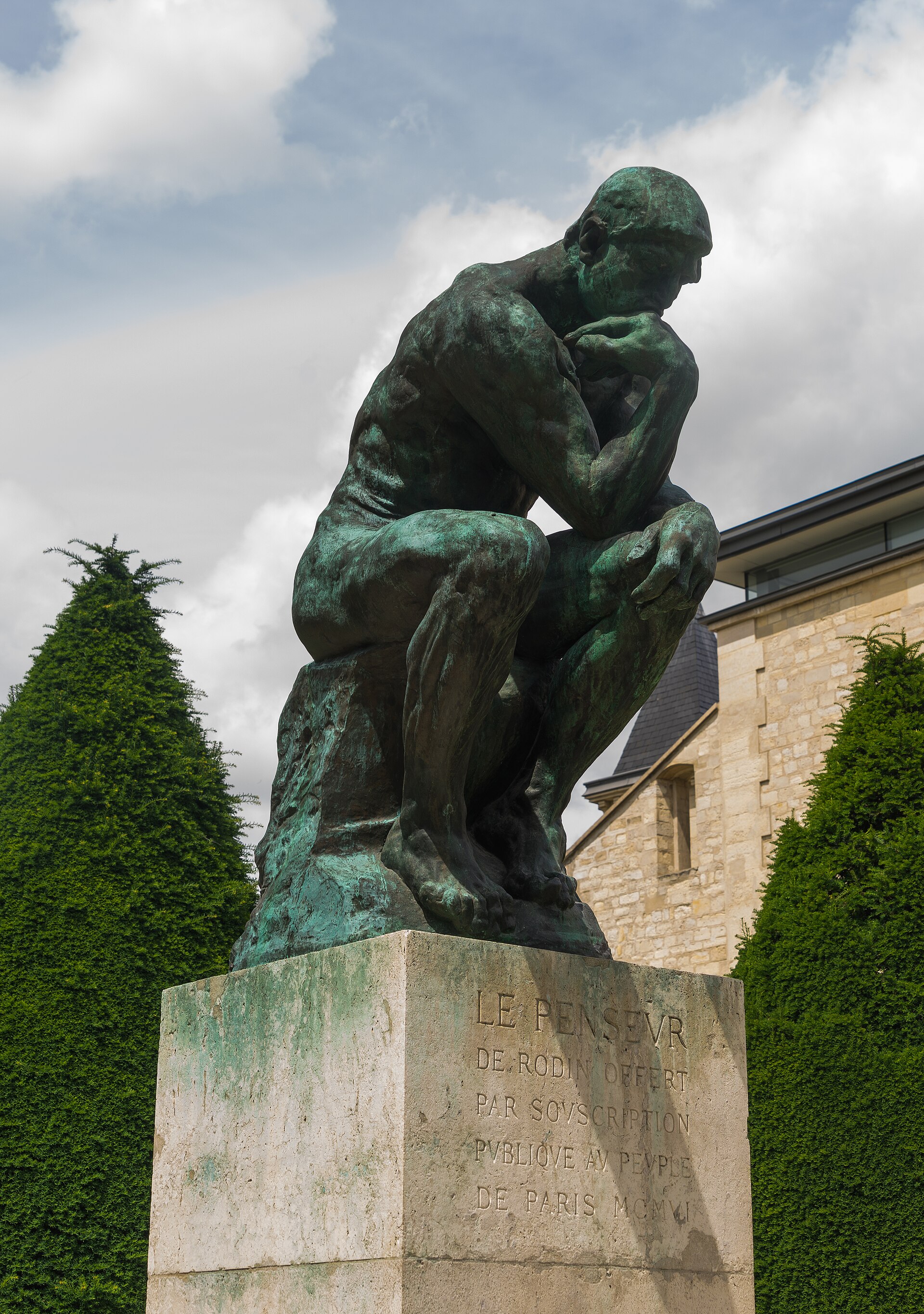
The object of this record. The monumental bronze cast by Alexis Rudier in 1904, inventory S.01295, in the garden of the Hotel Biron. The plinth reads LE PENSEUR DE RODIN OFFERT PAR SOUSCRIPTION PUBLIQUE AU PEUPLE DE PARIS MCMVI, which records the 1906 subscription that bought it for the city.
| Artist | Auguste Rodin |
|---|---|
| Date | Conceived 1880 for The Gates of Hell; enlarged c. 1903-1904; this cast 1904 |
| Medium | Bronze, cast by the Alexis Rudier foundry, Paris |
| Dimensions | H. 189 cm; W. 98 cm; D. 140 cm (Musee Rodin) |
| Where it is now | Garden of the Musee Rodin, Hotel Biron, 77 rue de Varenne, Paris |
| Inventory number | S.01295 |
| Attribution | AcceptedAccepted without dispute as Rodin's composition. Full note |
| Object type | Sculpture |
| Period | Symbolism, 1880-1910 |
| Culture | French |
| Genre | allegorical figure |
| Inscriptions | The stone plinth carries the incised inscription LE PENSEUR DE RODIN OFFERT PAR SOUSCRIPTION PUBLIQUE AU PEUPLE DE PARIS MCMVI, legible in plate 1. This record has not established from a published source what marks the bronze itself carries, and does not assume them. |
| Owners on record | 4 links4 documented |
| Sources | 31 cited |
About this record Last verified 29 August 2026 · 31 sources cited · Change log
On this page 11 sections
ContentsClose
The monumental Thinker in the garden of the Musee Rodin is the bronze that Alexis Rudier poured in 1904, that Parisians paid for by public subscription, that stood in front of the Pantheon from 1906, and that was moved to the Hotel Biron in 1922. It is French state property, it has never been offered for sale, and it is one of a large number of bronzes of the same figure.
That last fact is the reason this record exists. Rodin modelled in clay and never cast metal himself, so a bronze signed A. Rodin is the product of a chain of authority rather than of his hand. In 1916 he gave his works, his plasters and his rights to France, and the Musee Rodin has cast from those plasters ever since. French law treats an edition of sculpture as original only within a limit of twelve, and the museum numbers its editions 1/8 to 8/8 and I/IV to IV/IV. Outside that limit a cast is a reproduction and must say so on its own surface.
Two Thinkers of identical appearance can therefore be separated by a factor of a hundred in value, and in 2019 a Paris court convicted two dealers over roughly 1,700 casts made from genuine Rodin plasters and sold without the word reproduction on them. This record sets out where the line falls, how it is worded, and what a buyer has to establish before believing a Thinker is what the seller says it is.
Provenance
Each link is graded. Documented: a cited source supports it. Disputed: the identification is argued but not established. Unknown: no owner for that span, and the gap is not smoothed into a narrative. The grades in the glossary.
- 1880 - c. 1903Auguste Rodindocumented
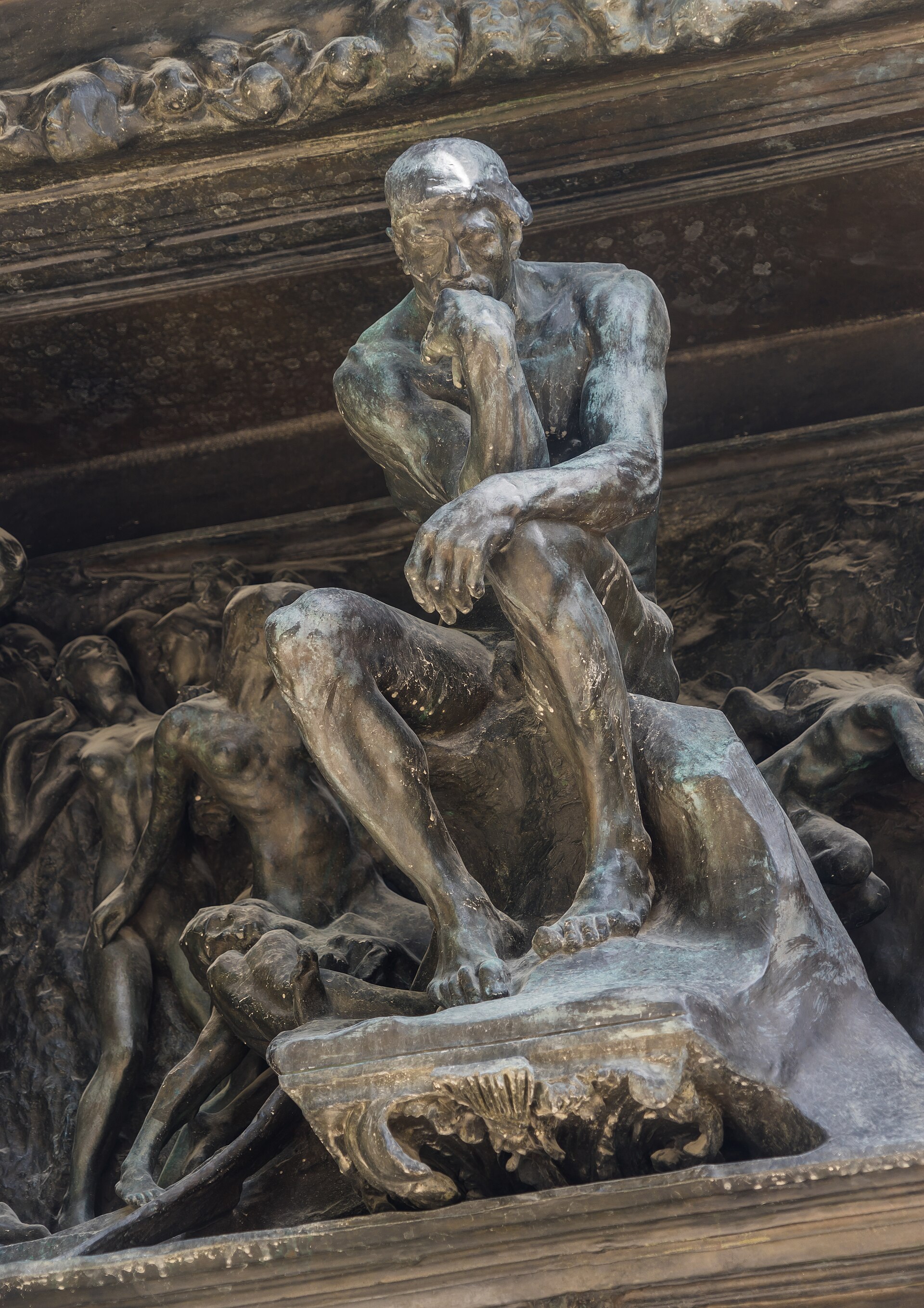
Modelled in 1880 as The Poet for The Gates of Hell, a doorway commissioned by the French state for a museum of decorative arts that was never built, and placed in the centre of the tympanum. Renamed The Thinker by foundry workers after Michelangelo's Il Penseroso. Exhibited independently from 1888. The enlargement date is unsettled: the Musee Rodin catalogue gives 1904, its own resource page gives 1903, Wikipedia gives 1902.182225
- 1904 - 1906Auguste Rodindocumented
Cast by the Fonderie Alexis Rudier, Paris, in 1904, the year the enlarged version was first shown publicly at the Salon. The whereabouts of this bronze between the pour and the 1906 installation are not recorded in the sources consulted.12425
- 1906 - 1922City of Parisdocumented
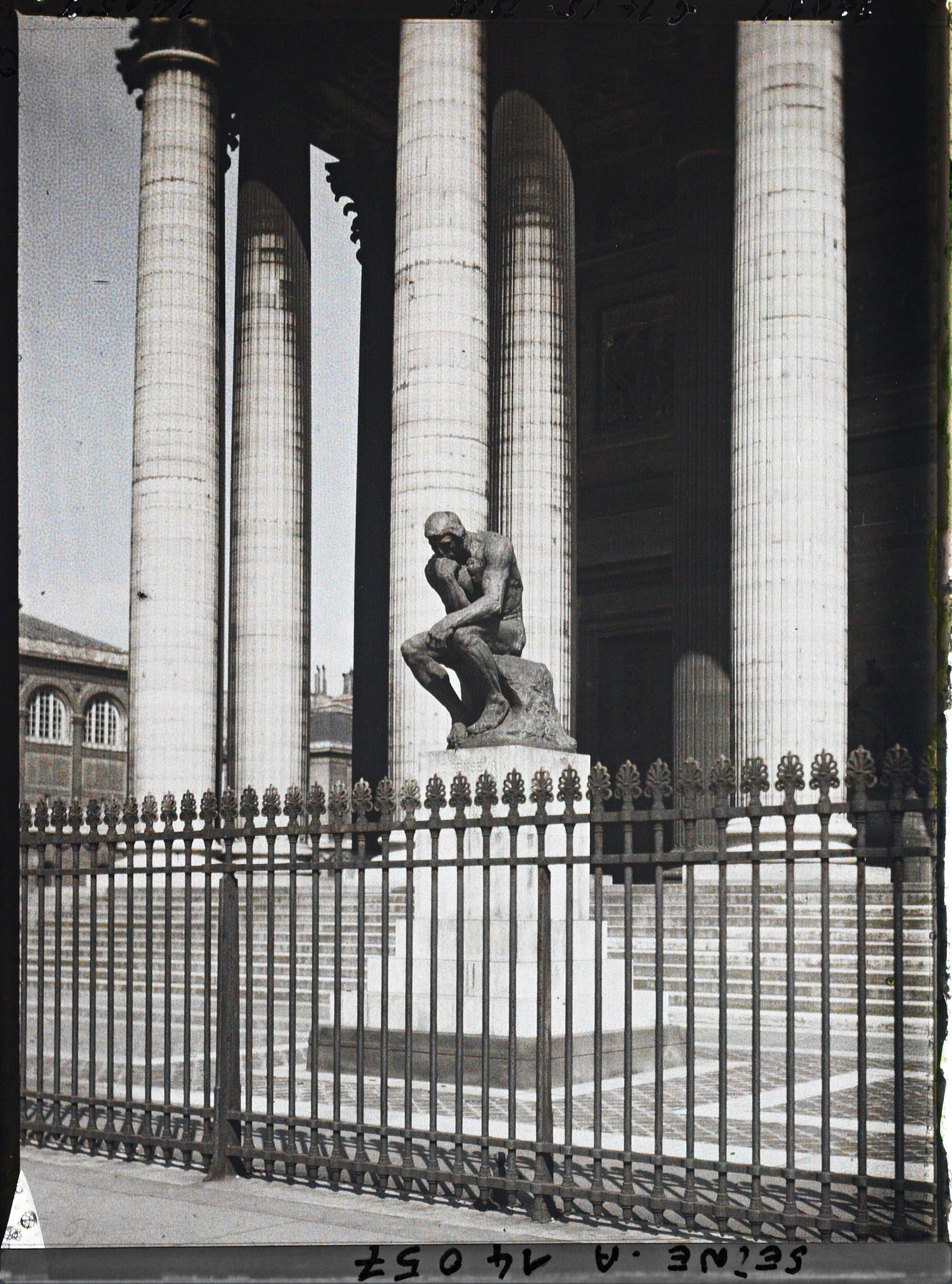
Bought by public subscription and given to the people of Paris, then installed on the forecourt of the Pantheon. The stone plinth carries the inscription LE PENSEUR DE RODIN OFFERT PAR SOUSCRIPTION PUBLIQUE AU PEUPLE DE PARIS MCMVI, legible in plate 1, and the same plinth appears under the same bronze in the 1918 autochrome at plate 3. The organiser of the subscription and the sum raised are not established.12430
- 1922 - presentMusee Rodin, Paris (French national collections)documented
Transferred to the Musee Rodin in 1922 and installed in the garden of the Hotel Biron, inventory S.01295, where it remains. As state property it is inalienable and has never been offered for sale.124
Prices realised
| Date | Sale | Estimate | Result | Note |
|---|---|---|---|---|
| 7 May 2013 | Sotheby's | USD 8,000,000 - 12,000,000 | Hammer Not published With premium USD 15,285,000 USD | NOT THIS OBJECT. Impressionist and Modern Art Evening Sale, New York, sale N08987, lot 45: Le Penseur, taille de la Porte dit moyen modele, 71.5 cm, conceived 1880-81, cast 1906, foundry mark Alexis Rudier Fondeur Paris, signed A. Rodin, with a plaque reading Le Penseur: Execute en 1906 dans mes ateliers et sous ma surveillance pour Monsieur Ralph Pulitzer, Auguste Rodin. Provenance Ralph Pulitzer, New York (1906), later William S. Paley. A record for the figure. Sotheby's does not publish the hammer; the 15,285,000 figure is reported as hammer with buyer's premium and should not be quoted as hammer. Listed here as the benchmark for a documented lifetime cast, not as a sale of the object in this record, which is French state property. |
| 2022 | Christie's | EUR 9,000,000 - 14,000,000 | Hammer Not separately reported With premium EUR 10,700,000 reported as the price achieved EUR | NOT THIS OBJECT. Paris. A posthumous cast at about 70 cm, the original model size, cast around 1928, from a private Paris collection. Reported at EUR 10,700,000, given in dollars as about 11.1 to 11.4 million depending on the outlet and the conversion date. Press coverage does not separate hammer from premium; treat the euro figure as the reported total until Christie's own record is consulted. The source consulted dates the sale 1 July 2022; a preview article dated 7 April 2022 also circulated, so the date is unresolved. The same coverage described it as one of roughly forty authentic casts without stating at which size, which is a press claim and not a census. |
| 2016-02 | Sotheby's | Not recorded in the source consulted | Hammer Not reported With premium GBP 1,568,750 (about USD 1,900,000) GBP | NOT THIS OBJECT. London. Penseur, petit modele, cast 1920-1930. Included to fix the bottom of the range: the same composition, at the small size, in a posthumous cast, at roughly one eighth of the price a documented lifetime cast reached. The dollar figure is a conversion and is date-dependent. Whether the sterling figure is hammer or premium-inclusive is not stated in the source; auction reporting of this kind is normally premium-inclusive. |
Hammer is the price at which the bidding stopped; with premium adds the fee the house charges the buyer on top. Hammer price and buyer's premium in the glossary.
Technical evidence
| Attribution note | Accepted without dispute as Rodin's composition. The question this object raises is not who designed it but which cast you are looking at. Rodin modelled the figure and never touched the metal; the bronze in the garden of the Musee Rodin was poured by the Alexis Rudier foundry in 1904 under Rodin's authority, and the museum records it as an original cast, inventory S.01295. Dozens of other bronzes of the same figure exist. Some are lifetime casts, some are authorised posthumous casts made under the terms of Rodin's 1916 donation to the French state, and some are neither. Attribution to Rodin, for a bronze, is a statement about a chain of authority rather than about a hand. |
|---|---|
| Object type | Sculpture. Bronze, cast in an edition, from a plaster model enlarged mechanically from a smaller plaster.19 |
| Dimensions (this cast) | H. 189 cm; W. 98 cm; D. 140 cm, as given by the Musee Rodin for S.01295. Figures for other monumental casts differ: Cleveland records 182.9 x 98.4 x 142.2 cm and a weight of 1,650 pounds, and general accounts give about 180 to 182 cm. Variation between casts of the same model is normal and is one reason dimensions alone do not identify a cast.12225 |
| Dimensions (original size) | About 70 to 71.5 cm, the size Rodin called the taille de la Porte or moyen modele. A reduction at 14 3/4 inches, the petit modele, also exists.917 |
| Foundry and date of casting | Fonderie Alexis Rudier, Paris, 1904. The Alexis Rudier foundry opened in 1902, which sets a hard earliest date for any cast bearing that mark.121 |
| Casting method | Most of Rodin's bronzes are sand cast, the standard method for sculptural multiples in Paris at the time; the monumental Thinker at Louisville was cast by A. A. Hebrard by lost wax, and the Detroit cast by Alexis Rudier by sand casting, so method varies between casts of the same model. Lost wax produces a hollow bronze; after the pour the supply network is cut, the core crumbled out, and the surface chased and polished before patination by controlled corrosion.111224 |
| Enlargement | Executed by Henri Lebosse in his own studio using the pantograph machine invented by Achille Collas, which traces successive profiles off a model and cuts them proportionally scaled into a blank. Rodin employed Lebosse from 1894 and rejected results he judged imperfect. The Thinker was conceived at 28 inches, reduced by Lebosse to 14 3/4 inches, and enlarged to 79 inches.8913 |
| Plinth inscription | LE PENSEUR DE RODIN OFFERT PAR SOUSCRIPTION PUBLIQUE AU PEUPLE DE PARIS MCMVI, incised on the stone block. Legible in plate 1. It records the 1906 public subscription, which is what links the object now in the garden to the object photographed in front of the Pantheon in 1918.30 |
| Signature convention | Rodin's bronzes carry an A. Rodin signature cast into the metal from a model he supplied, together with a foundry stamp. It is a moulded feature of the object, not a handwritten act, which is why a cast signature carries no authenticating weight on its own. Both the Hain and the Gruppo Mondiale operations cast in the signature themselves.61415 |
| The Alexis Rudier mark does not prove a lifetime cast | This is the trap. The foundry opened in 1902, so the mark sets an earliest date of 1902, but it does not set a latest one: Alexis Rudier continued to cast for the Musee Rodin long after Rodin's death in 1917. The Oglethorpe University Museum of Art records a Penseur modelled 1880, reduced 1903 and cast about 1931 by Alexis Rudier, and the cast sold at Christie's in 2022 was an Alexis Rudier of about 1928. Guy Hain's whole method was to strip the Georges Rudier mark and substitute Alexis Rudier precisely because buyers read the older name as lifetime.16202129 |
| Numbering convention | None of Rodin's lifetime casts was numbered or dated; numbering is a later administrative practice. Musee Rodin editions run 1/8 to 8/8 and I/IV to IV/IV, twelve in total including existing original editions, and the museum traditionally takes one of the twelve into the national collections. Each project is validated by two committees of French and foreign sculpture specialists under a binding ethical charter. A 1968 law requires the date of the cast to be inscribed.236 |
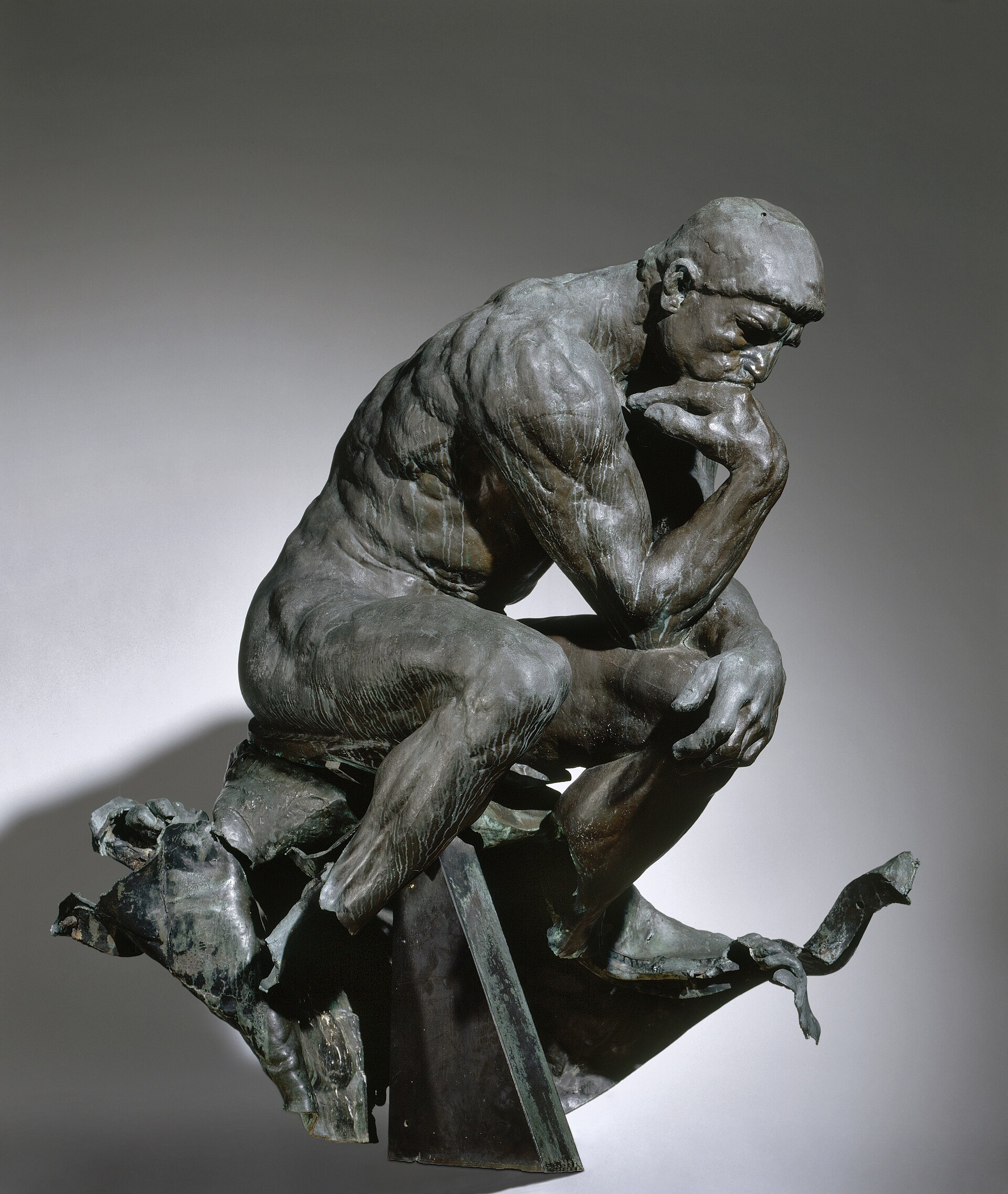
| Condition | Intact and in the open air. It has stood outdoors continuously since 1906, first on the Pantheon forecourt and since 1922 in the Musee Rodin garden, and carries the green patina of a century of weathering, visible in plate 1. That is worth stating because other monumental casts of the same model are not intact: the Cleveland bronze has stood with its base and lower legs destroyed since a bomb went off under it on 24 March 1970, and the Laren cast was hacked at by metal thieves in 2007 and restored.232430 |
| Marks on an authorised posthumous cast | A compliant example, transcribed from the Shizuoka Prefectural Museum of Art's record of its Gates of Hell: A.Rodin FONDERIE DE COUBERTIN (c) By MUSEE Rodin 1992 No 6/8 FC. Artist, foundry, rights holder, year of cast, position in the edition of eight, foundry cipher.31 |
| Marking of reproductions | French law requires that any facsimile, aftercast, copy or other reproduction of a work of art be described as such, with the word Reproduction applied in a visible and indelible manner on the object itself, immediately legible without handling. The Musee Rodin casts its own authorised reproductions in resin rather than bronze and marks them.2 |
| Surmoulage, physical signature | A cast taken from a finished bronze rather than from the artist's plaster. Mould shrinkage in baking and shrinkage on cooling make it measurably smaller than its parent, and the surface detail is softer because it is one casting generation further from the chased original. Surmoulages typically carry no edition number and no foundry cachet.2627 |
| Legal test of originality | Code de la propriete intellectuelle, Article R. 122-3, paragraph b: Les editions de sculpture, dans la limite de douze exemplaires, exemplaires numerotes et epreuves d'artiste confondus. Editions of sculpture within a limit of twelve copies, numbered copies and artist's proofs taken together.5 |
| Copyright status | Rodin died in November 1917; the works are out of copyright in France under the seventy-year term. Control now rests on perpetual moral rights under Article L. 121-1, vested in the Musee Rodin by a decree of February 1993, and on the fraud-marking rules, not on copyright.7 |
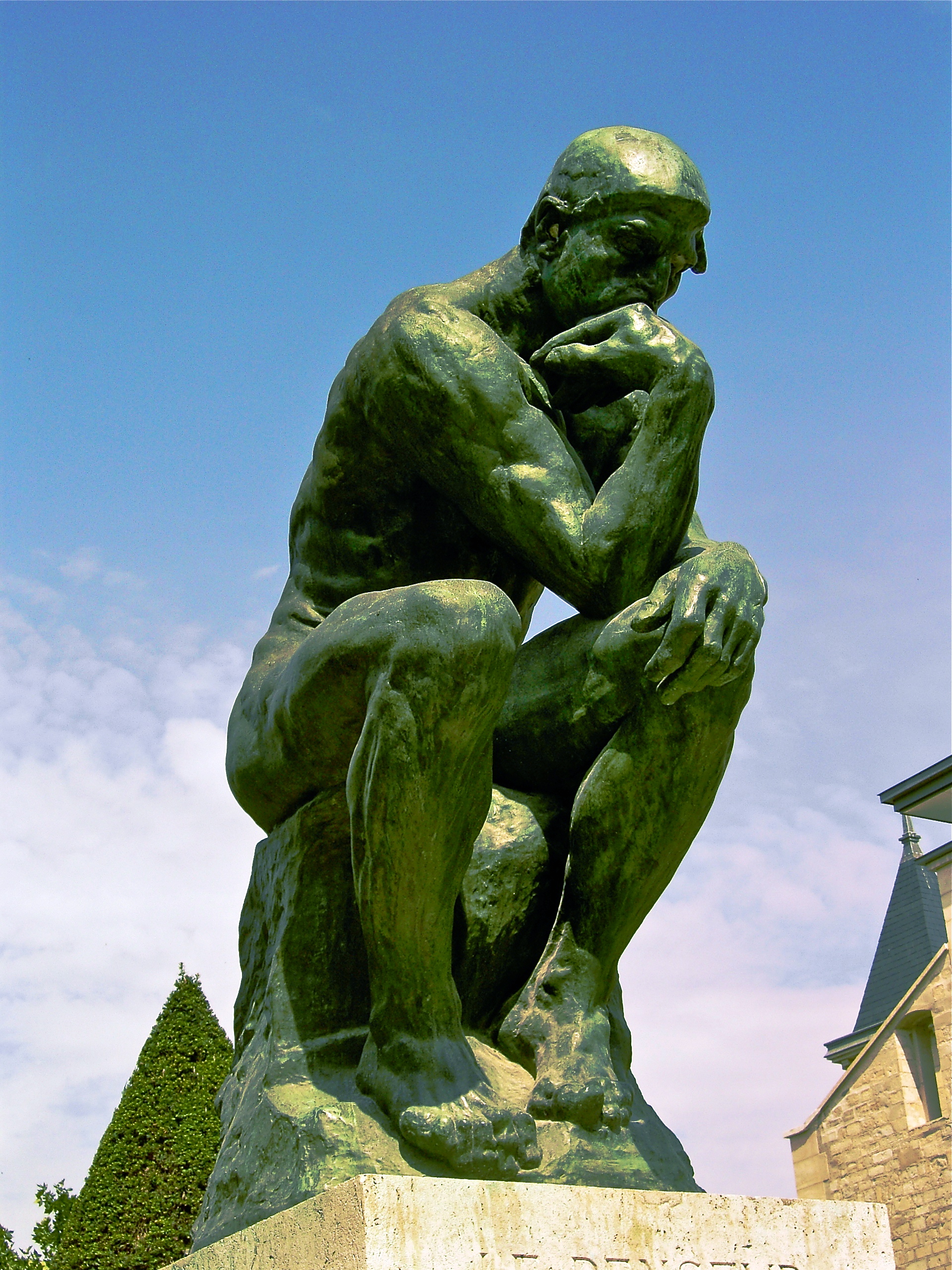
Images
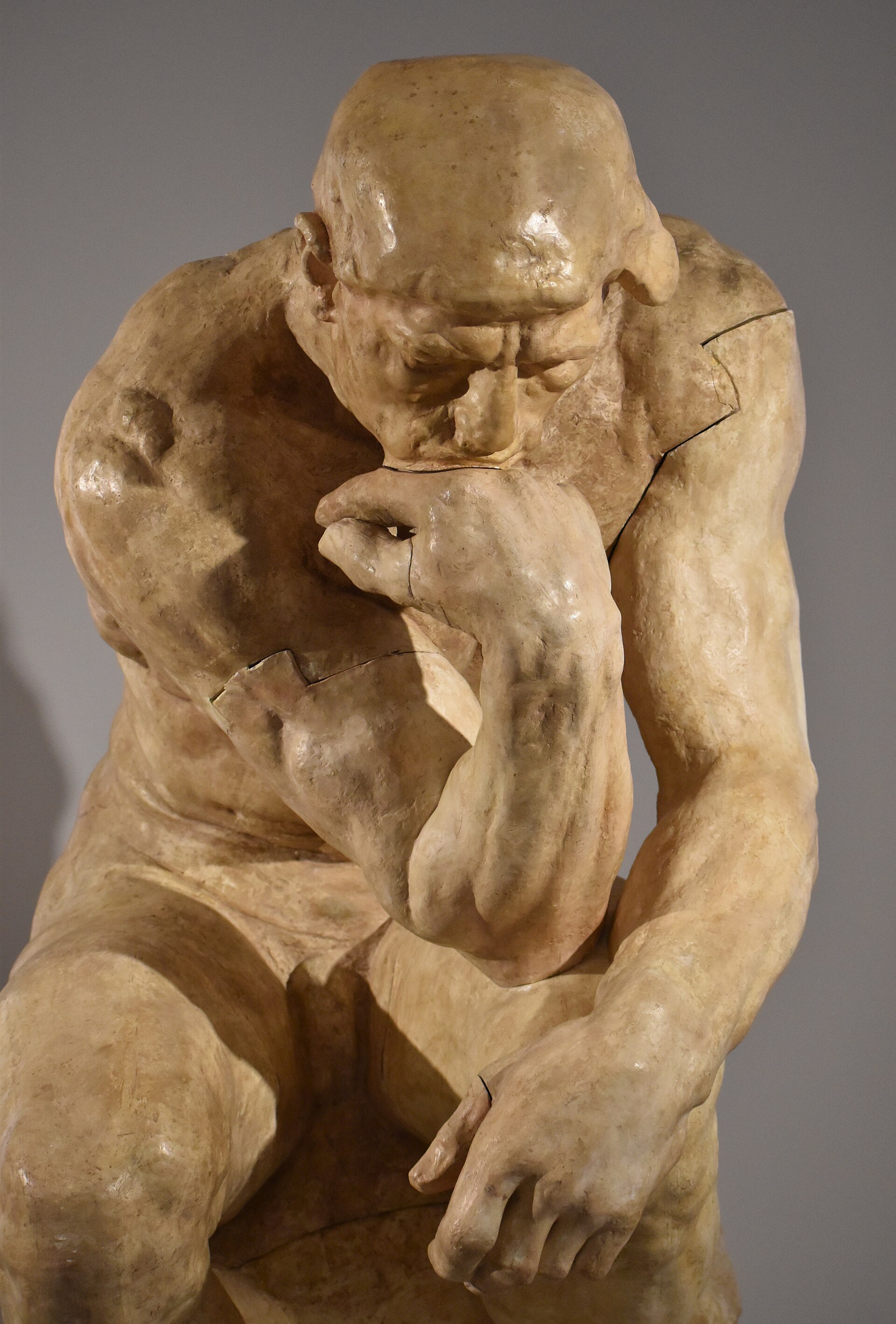
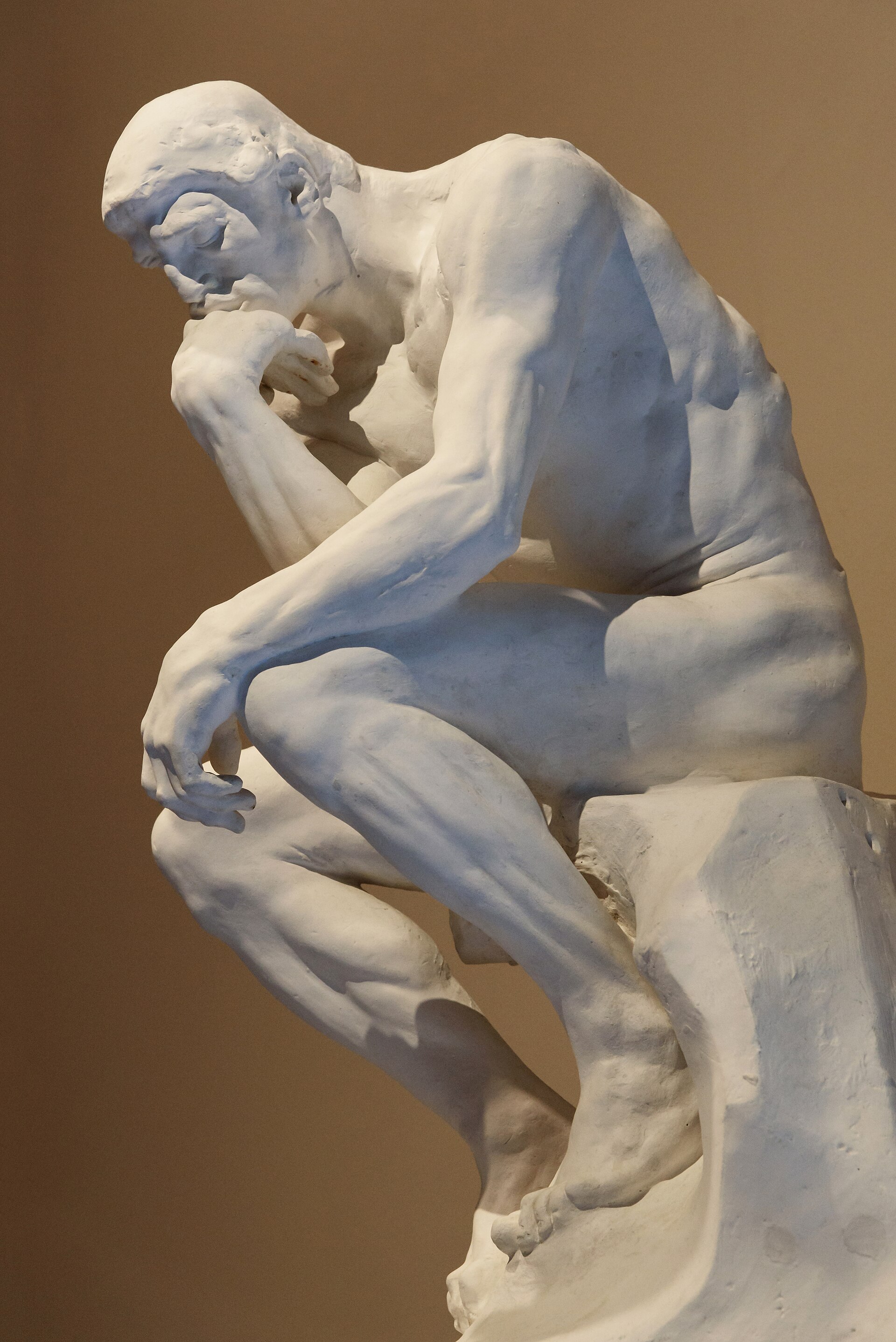
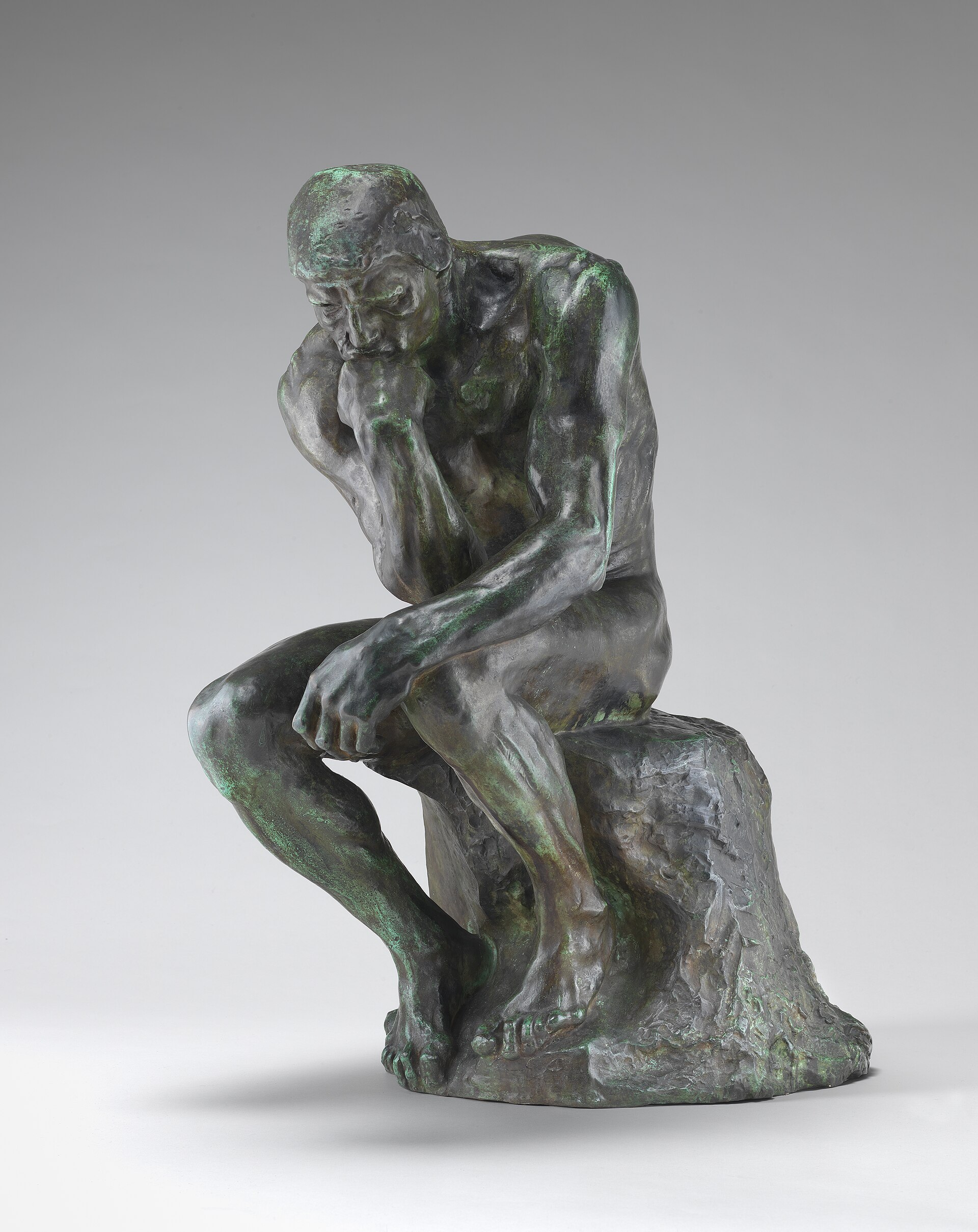
The record in full
Chapter 1This is one cast among many, and the record says which one
The object described here is the monumental bronze Thinker in the garden of the Musee Rodin in Paris, inventory S.01295, poured by the Fonderie Alexis Rudier in 1904 and recorded by the museum at 189...
The object described here is the monumental bronze Thinker in the garden of the Musee Rodin in Paris, inventory S.01295, poured by the Fonderie Alexis Rudier in 1904 and recorded by the museum at 189 by 98 by 140 centimetres. It is not for sale and never has been. It belongs to the French national collections and has stood in the same garden since 1922.
It is also one of a substantial number of bronzes of the same figure at the same size, and a much larger number at smaller sizes. That is not a defect in the object and not a doubt about it. Rodin worked in editions on purpose. The confusion that surrounds The Thinker is not version confusion, of the kind that arises when a painter paints the same subject four times and the market loses track of which is which. It is edition confusion: a single approved composition, lawfully repeated, with a legal boundary running through the repetitions that is invisible to the eye.
Everything below is written to locate that boundary and to say what falls on each side of it.
Chapter 2It began as Dante, at the top of a door
In 1880 the French state commissioned Rodin to make a monumental doorway for a museum of decorative arts that was never built.
In 1880 the French state commissioned Rodin to make a monumental doorway for a museum of decorative arts that was never built. He took his subject from Dante and worked on The Gates of Hell for the rest of his life. Seated in the centre of the tympanum, looking down at the damned, was a figure Rodin called The Poet: Dante contemplating his own creation.
The name did not survive. Foundry workers called it The Thinker, after Michelangelo's Il Penseroso, and the nickname stuck. The Cleveland Museum of Art, which owns one of the monumental bronzes, still describes the origin plainly: the figure was intended to sit directly above the doors as a generalised image of Dante.
The figure was shown on its own from 1888 and detached itself from the Gates entirely. This is characteristic. Rodin treated his own work as a stock of parts. He cast figures and fragments in plaster, repeated them, turned them, recombined them and joined them by a technique he called marcottage, generally leaving the joins visible. A fragment could become a work in its own right. The Thinker is the most successful instance of a method Rodin applied to everything he made.
Chapter 3The enlargement, and who actually made it
The figure at the top of the Gates is roughly 70 centimetres.
The figure at the top of the Gates is roughly 70 centimetres. The famous version is two and a half times that, and Rodin did not enlarge it himself. From 1894 he employed Henri Lebosse, who ran his own studio and worked a machine invented by Achille Collas that used a pantograph linkage to trace a succession of profiles off the model and cut them, proportionally scaled, into a blank. The Cantor Foundation records the Thinker's passage through that machine precisely: first conceived at twenty-eight inches, then reduced by Lebosse to fourteen and three quarter inches, then enlarged to seventy-nine.
Rodin supervised and rejected what he did not accept, and he reworked the enlarged plasters. But the enlargement was mechanical, it was done off site, and it was done by another man. The Musee Rodin says the enlargement gave works conceived twenty years earlier a monumentality and a new vigour. That is true and it is also an admission about process: the monumental Thinker is a machine-scaled derivative of a small model, finished by hand, and its author signed it without having cut it.
The bronze went the same way. Rodin chose from among the scores of foundries in Paris; the casting was done off site; and although he supervised, he rarely participated in the making of the marbles or the bronzes. After 1900 he may have had as many as fifty assistants, among them Bourdelle, Camille Claudel, Despiau and Malvina Hoffmann. He never carved his own marble either. He hired praticiens to do it.
Chapter 4The twelve-cast rule, as it is actually worded
The rule that governs this object is not a museum policy dressed up as law.
The rule that governs this object is not a museum policy dressed up as law. It is codified. Article R. 122-3 of the French Code de la propriete intellectuelle lists the categories of work that count as original art when executed in a limited number of copies under the author's responsibility, provided they are numbered or signed or otherwise duly authorised by the author. Sub-paragraph (b) reads, in the French, Les editions de sculpture, dans la limite de douze exemplaires, exemplaires numerotes et epreuves d'artiste confondus: editions of sculpture, within a limit of twelve copies, numbered copies and artist's proofs taken together.
Read the words. The limit is twelve, not twelve plus proofs. Artist's proofs are inside the twelve, not additional to it. And the article defines what qualifies as an original work of art, which is why the thirteenth cast does not become an illegal object so much as a different category of object: a reproduction, which French law requires to be described as such.
The Musee Rodin applies the limit in a specific numbering scheme, and states it in its own words: the museum limits its original editions to twelve casts, numbered 1/8 to 8/8 and I/IV to IV/IV, including the existing original editions. Eight arabic for the open market, four roman reserved for cultural institutions, and the phrase including the existing original editions is doing real work, because it means lifetime casts count against the twelve rather than sitting outside it. The museum traditionally takes one of the twelve into the national collections. Each casting project must be validated by two committees of French and foreign sculpture specialists under a binding ethical charter.
The chronology behind the codified text, as the Cantor Foundation sets it out, runs: a 1956 law limiting each work to twelve examples at each size, a 1968 law requiring the date of the cast to be inscribed on the sculpture, and a numbering system established in 1981 splitting the twelve into 1/8 to 8/8 for sale and I/IV to IV/IV for institutions. A decree of February 1993 vests enforcement of Rodin's moral right in the museum and requires that authorised casts be made from moulds and plasters in the museum's possession. Article 8 of decree 81-255 of 3 March 1981 requires that reproductions be designated as such.
Chapter 5Lifetime cast, authorised posthumous cast, surmoulage
Three objects can stand side by side and look the same.A lifetime cast was poured while Rodin was alive and under his authority.
Three objects can stand side by side and look the same.
A lifetime cast was poured while Rodin was alive and under his authority. Cleveland's monumental bronze is one, and the museum's own note is a useful measure of how few there are: this enlarged version of The Thinker is one of fewer than ten cast during Rodin's lifetime. Lifetime casts were not numbered. Numbering is a later administrative habit, which means the absence of a number on a genuinely early cast proves nothing either way.
An authorised posthumous cast is poured by the Musee Rodin from the plasters Rodin bequeathed, inside the twelve, numbered, dated and stamped with the museum's copyright. Rodin's 1916 donation transferred his works, collections, archives and rights to the French state on condition that a museum be created at the Hotel Biron, and it is what gives these casts their standing. They are originals in French law. They are not forgeries and it is wrong to call them so.
A surmoulage is a cast taken from a finished bronze rather than from the artist's plaster. Because the mould shrinks in baking and the bronze shrinks again on cooling, a surmoulage comes out measurably smaller than its parent and its surface is softer: the chased detail of the original is one generation further away at every point. In the trade it is treated as a copy, not as art. The word has a particular sting in Rodin's case, because in 1877 he was himself accused of surmoulage over The Age of Bronze, on the grounds that the figure was too naturalistic to have been modelled. He wrote to the newspapers, had the model photographed, demanded an inquiry and was exonerated.
Chapter 6How a buyer establishes which one it is
Four things are read off the object, and none of them is conclusive alone.The foundry mark dates the cast by a hard boundary rather than a stylistic impression, but it bounds the date on one side...
Four things are read off the object, and none of them is conclusive alone.
The foundry mark dates the cast by a hard boundary rather than a stylistic impression, but it bounds the date on one side only, and this is where buyers go wrong. Alexis Rudier opened in 1902, so no cast bearing that mark predates 1902. It does not follow that an Alexis Rudier cast is a lifetime cast. The foundry went on working for the Musee Rodin for decades after Rodin's death in 1917: the cast Christie's sold in 2022 is an Alexis Rudier of about 1928, and Oglethorpe's Penseur is an Alexis Rudier of about 1931. The Coubertin foundry, by contrast, opened in 1963, forty-six years after Rodin died, so a Coubertin mark is an unambiguous declaration that the cast is posthumous. Georges Rudier, Susse and E. Godard sit between. The mark is also the single most attacked feature on the object, because it is the cheapest thing to falsify and the most valuable thing to falsify: Guy Hain's entire method was to remove the Georges Rudier stamp and put Alexis Rudier in its place.
The signature is not a signature in the ordinary sense. Rodin's bronzes carry an A. Rodin cast into the metal, taken from a model he supplied. It is a feature of the object, not an autograph event, and a forger casts it as easily as the founder did.
The number tells you which slot in the edition the cast occupies, and its absence tells you either that the cast predates numbering or that someone did not want you to ask. The museum stamp is the clearest single tell on a modern cast. Plate 9 shows what a compliant posthumous cast declares on its own surface, transcribed from the Shizuoka Prefectural Museum of Art's record of its Gates of Hell: A.Rodin FONDERIE DE COUBERTIN (c) By MUSEE Rodin 1992 No 6/8 FC. Maker, foundry, rights holder, year, position in the edition, foundry cipher. Nothing is left to inference.
Beyond the object, there is the museum. Its position on claimed authorisations is blunt, and worth quoting because it disposes of an entire category of sales talk: the Musee Rodin refuses to authorise use of the original plasters and moulds in its collections, so a claim of museum authorisation for an unauthorised cast can consequently only conceal an attempt to sell a work under false pretences.
Chapter 7What the difference is worth
None of the sales below is this object, which has never been offered.
None of the sales below is this object, which has never been offered. They are given because they measure the gap that the edition rules create.
On 7 May 2013, Sotheby's New York sold as lot 45 of its Impressionist and Modern Art evening sale a Penseur at 71.5 centimetres, the size Rodin called the taille de la Porte, conceived 1880-81 and cast by Alexis Rudier in 1906, bearing a plaque that reads Le Penseur: Execute en 1906 dans mes ateliers et sous ma surveillance pour Monsieur Ralph Pulitzer, Auguste Rodin. It came from Ralph Pulitzer, then William S. Paley. Estimate 8 to 12 million dollars. It made 15,285,000 dollars including buyer's premium, a record for the figure. The hammer alone is not published; Sotheby's withholds it behind a login and the reported figure is the premium-inclusive one.
In 2022 Christie's Paris sold a Thinker at about 70 centimetres, the same size, cast around 1928, from a private Paris collection, against an estimate of 9 to 14 million euros. It made 10.7 million euros, reported as about 11.1 to 11.4 million dollars. Press coverage does not separate hammer from premium and the euro figure should be read as the reported total until Christie's own record is checked.
In February 2016 Sotheby's London sold a Penseur petit modele, cast between 1920 and 1930, for 1,568,750 pounds, about 1.9 million dollars.
Same figure, three times. The premium attaches to a lifetime cast with a documented commission and an inscription in Rodin's own words about supervision. A posthumous cast at the same size, twenty-two years later, gives up roughly a quarter of that. A small posthumous cast gives up nearly nine tenths. As one specialist put it, the market is very strong for the top lifetime casts, and 1920s casts are also strong, partly because the patinas were often applied by the same craftsmen who had worked with Rodin.
Chapter 8The casts that were made outside the rules
The problem is documented in court records rather than rumour, and it is large.Guy Hain persuaded Georges and Bernard Rudier to recast known Rodin works from original moulds, then removed Georges...
The problem is documented in court records rather than rumour, and it is large.
Guy Hain persuaded Georges and Bernard Rudier to recast known Rodin works from original moulds, then removed Georges Rudier's mark and substituted the mark of Alexis Rudier so that the casts would read as lifetime work. He never marked anything as a reproduction and cast in the signatures and founder's marks himself. Police seized about twenty metric tons of bronze when they raided him in January 1992. The expert Gilles Perrault estimated that he had produced more than six thousand copies beyond what was confiscated, of which only a third have been traced. He came to court on 17 January 1996, was sentenced to four years and served eighteen months. What convicted him was not the casting itself but the imitation of the Alexis Rudier foundry seal.
The second case is more recent and touches The Thinker directly. In April 2019, after a legal battle that began with a Musee Rodin complaint in March 2001, a Paris court sentenced the American dealer Gary Snell to a one-year suspended sentence and a 15,000 euro fine, and the Paris dealer Robert Crouzet to four months suspended; with Snell's company Gruppo Mondiale they were ordered to pay 500,000 euros in damages to the museum. Court experts put the operation at roughly 1,700 bronzes cast from about 52 Rodin moulds, produced at Vicenza in northern Italy, offered at around 40,000 euros each. The works cast included The Kiss, The Hand of God and The Thinker. The prosecutor accused Snell of shamelessly using Rodin's name to sell fake-genuine bronzes on an industrial scale.
The phrase is exact and it is the reason this record is worded the way it is. The plasters were real. The moulds were real. Rodin has been out of copyright since 1987. The casts were unlawful because they carried Rodin's signature and foundry marks, lacked the required reproduction marking, and were sold in numbered editions with certificates that told buyers they were something they were not.
Chapter 9What has happened to the casts
Because so many exist, in the open air, the group has a casualty list.At 12.44 in the morning of 24 March 1970, a bomb equivalent to three sticks of dynamite went off under the monumental Thinker...
Because so many exist, in the open air, the group has a casualty list.
At 12.44 in the morning of 24 March 1970, a bomb equivalent to three sticks of dynamite went off under the monumental Thinker outside the Cleveland Museum of Art, blew it off its pedestal and turned its lower legs to shrapnel. The words off the ruling class were left on the pedestal. Nobody was charged; the police attributed it to a Cleveland faction of the Weather Underground. The museum decided not to repair it, and it has stood since in the state the bomb left it. Plate 8 is that object. It is the only Thinker in the world that cannot be confused with any other.
In 2007 thieves took the Thinker and six other bronzes from the grounds of the Singer museum in Laren in the Netherlands, intending to sell them for scrap; the bronze in the Thinker was worth about 350 euros as metal against a value of over a million as sculpture. Six of the seven were destroyed. The Thinker was recovered, hacked at, and restored.
A cast stands over Rodin's grave at Meudon, next to his wife's, which is what he wanted. The figure that began as Dante looking down at the damned ended as the sculptor's own headstone.
The artist
Francois Auguste Rene Rodin
Rodin is the case that breaks the ordinary meaning of authorship in art. He was a modeller. He worked in clay and had it cast in plaster, and from the plaster his staff produced marbles and his chosen foundries produced bronzes. He did not carve his own marble and he did not pour his own metal. He signed both. Understanding what a Rodin bronze is means accepting that by Rodin describes a system of production that Rodin designed and controlled, and that after November 1917 the system continued under the French state with his written consent. That is not a scandal and it is not a loophole. It is what he arranged.
Exhibited
- 1904Salon de la Societe Nationale des Beaux-ArtsParis - the enlarged version shown publicly for the first time; sources differ on whether the object exhibited was the plaster or a bronze
Related works
| Work | Relation | Where it is |
|---|---|---|
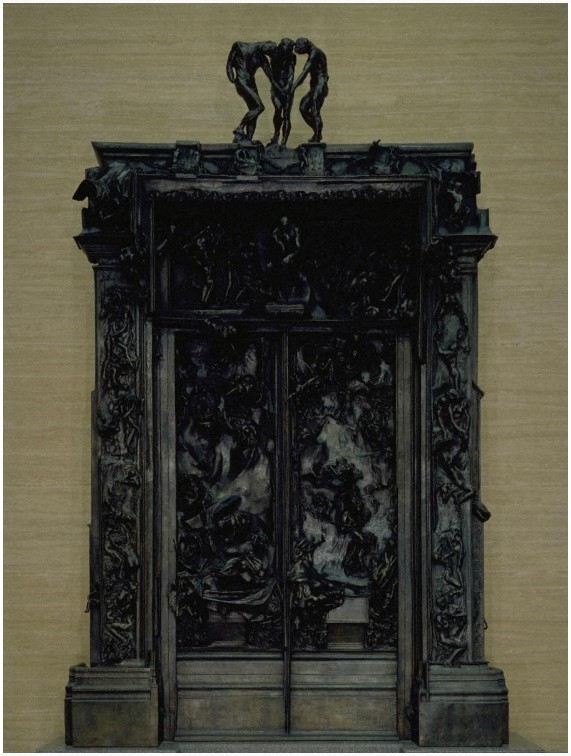
| The Gates of Hell Auguste Rodin | The work this figure was made for and detached from Commissioned 1880 for a museum of decorative arts that was never built. The Thinker sits in the centre of the tympanum. The Shizuoka bronze, cast by Coubertin in 1992 and marked No 6/8, is the clearest published example of what an authorised posthumous cast declares on its own surface. | Musee Rodin, Paris (S.01304); other casts at the Musee d'Orsay, Shizuoka, Zurich, Philadelphia, Tokyo and Stanford |
| The Thinker, original size Auguste Rodin | The model the monumental version was enlarged from About 70 to 71.5 cm. Lifetime casts of this size exist from 1884 onward, and posthumous casts continued for decades. A Thinker at this size is not a reduction of the famous one; the famous one is an enlargement of it. | National Gallery of Art, Washington (model 1880, cast 1901); Cleveland Museum of Art 1979.138; many others |
| The Thinker, Cleveland Auguste Rodin | Another monumental lifetime cast The museum records it as one of fewer than ten monumental casts made in Rodin's lifetime. Bombed on 24 March 1970 and deliberately left unrepaired. | Cleveland Museum of Art, accession 1917.42, gift of Ralph King |
| The Thinker, Meudon Auguste Rodin | Monumental cast serving as the sculptor's grave marker Placed on the tomb of Rodin and his wife, at his own wish. | Villa des Brillants, Meudon (S.02838) |
| The Age of Bronze Auguste Rodin | The work that drew the surmoulage accusation against Rodin himself in 1877 Its naturalism led to a charge that Rodin had cast from a living model. He demanded an inquiry and was exonerated. The vocabulary of Rodin forgery starts here. | Musee Rodin and many other collections |
| The Three Shades Auguste Rodin | Another figure from the Gates that Lebosse enlarged and that became independent Stands on top of the Gates. Enlarged in 1904, the same programme of work that produced the monumental Thinker. | Musee Rodin and other collections |
Open questions
- When exactly was The Thinker enlarged? The Musee Rodin catalogue entry says 1904, the museum's own page on Rodin's working method says 1903, and Wikipedia says 1902. Lebosse's studio records would settle it.
- What marks does the bronze S.01295 itself carry? The plinth inscription is legible in plate 1, but no published source consulted records the signature placement, foundry stamp or any other mark on this specific cast.
- Who organised the 1906 public subscription that bought this cast for Paris, and how much was raised? The plinth records the fact of the subscription and nothing else.
- Where was this bronze between the 1904 pour and the 1906 installation in front of the Pantheon?
- How many monumental casts exist in total, and how many are lifetime? Published counts range from about 22 to about 29 for monumental casts, Cleveland says fewer than ten monumental lifetime casts, and press coverage of the 2022 sale cited roughly 40 authentic casts without saying at which size. No consolidated census has been located.
- What were the hammer prices in the 2013 Sotheby's and 2022 Christie's sales? Both reported figures appear to be premium-inclusive; the hammer is withheld or not reported.
- What is the exact date of the 2022 Christie's Paris sale? The article consulted gives 1 July 2022; a preview article dated 7 April 2022 also circulated. Christie's own sale record would resolve it.
- How many casts does the Musee Rodin currently produce each year, and what share of its budget do they fund? The museum publishes the rules and the committee process but no figures were located.
- Of the more than six thousand casts Guy Hain is estimated to have produced beyond those seized, roughly two thirds remain untraced. How many are Thinkers, and where are they?
Questions about this object
What is The Thinker?
The Thinker is a sculpture, dated conceived 1880 for The Gates of Hell; enlarged c. 1903-1904; this cast 1904. Medium: Bronze, cast by the Alexis Rudier foundry, Paris.
Who made The Thinker, and is the attribution settled?
The attribution to Auguste Rodin is recorded here as accepted. Accepted without dispute as Rodin's composition. The question this object raises is not who designed it but which cast you are looking at. Rodin modelled the figure and never touched the metal; the bronze in the garden of the Musee Rodin was poured by the Alexis Rudier foundry in 1904 under Rodin's authority, and the museum records it as an original cast, inventory S.01295. Dozens of other bronzes of the same figure exist. Some are lifetime casts, some are authorised posthumous casts made under the terms of Rodin's 1916 donation to the French state, and some are neither. Attribution to Rodin, for a bronze, is a statement about a chain of authority rather than about a hand.
Where is The Thinker now?
Garden of the Musee Rodin, Hotel Biron, 77 rue de Varenne, Paris. Inventory number S.01295.
What has The Thinker sold for?
Hammer Not published; with premium, USD 15,285,000. Sotheby's, 2013-05-07.
What is still unknown about The Thinker?
When exactly was The Thinker enlarged? The Musee Rodin catalogue entry says 1904, the museum's own page on Rodin's working method says 1903, and Wikipedia says 1902. Lebosse's studio records would settle it.
Sources
- 1Musee Rodin, collection entry for The Thinker, inventory S.01295: bronze, H. 189 cm, W. 98 cm, D. 140 cm, cast by the Fonderie Alexis Rudier in 1904, transferred to the Musee Rodin in 1922, with the account of its origin as The Poet on The Gates of Hell and the 1906 Pantheon installation. musee-rodin.fr/en/...
- 2Musee Rodin, 'Respecting Rodin's moral right'. Primary statement of the twelve-cast limit numbered 1/8 to 8/8 and I/IV to IV/IV including existing original editions; the requirement that reproductions be marked visibly and indelibly; the museum's refusal to authorise use of its plasters and moulds; Article 121-1. musee-rodin.fr/en/...
- 3Musee Rodin, 'Original bronze casts'. 'The number of bronzes that may be cast from an original work is limited to twelve'; the museum traditionally acquires one of the twelve for the national collections; validation by two committees of French and foreign sculpture experts under an ethical charter. musee-rodin.fr/en/...
- 4Musee Rodin, 'The Musee Rodin, the artist's heir'. The 1916 donation of works, collections, archives and rights to the French state in exchange for the Hotel Biron; the transfer of moulds and models so the museum could produce original bronze casts; the museum as holder of the moral rights. musee-rodin.fr/en/...
- 5Legifrance, Code de la propriete intellectuelle, Article R122-3. Primary legal text. Paragraph b: 'Les editions de sculpture, dans la limite de douze exemplaires, exemplaires numerotes et epreuves d'artiste confondus.' legifrance.gouv.fr/codes/...
- 6Iris and B. Gerald Cantor Foundation, 'Laws that Govern the Casting of Rodin's Work'. The 1956 law limiting casting to twelve examples of each size, the 1968 law requiring the date of the cast to be inscribed, and the 1981 numbering system splitting the twelve into 1/8-8/8 for public sale and I/IV-IV/IV for institutions. cantorfoundation.org/resources/...
- 7The IPKat, 'French Moral Rights May Prevent Copy of Rodin's Public Domain Sculptures'. Article L.121-1 perpetual moral rights; the February 1993 decree vesting enforcement in the Musee Rodin and requiring authorised casts to come from museum moulds and plasters; Article 8 of decree no. 81-255 of 3 March 1981 on marking reproductions; the Gruppo Mondiale dispute. ipkitten.blogspot.com/2014/...
- 8Musee Rodin, 'Multiples, fragments, assemblages'. Rodin's use of casting as part of invention; Henri Lebosse employed from 1894; the Collas pantograph machine; the enlargement of The Thinker dated 1903 on this page; marcottage and visible joins. musee-rodin.fr/en/...
- 9Iris and B. Gerald Cantor Foundation, 'Reductions and Enlargements'. The Collas machine of 1836; Rodin's collaboration with Lebosse and his rejection of imperfect results; The Thinker conceived at 28 inches, reduced to 14 3/4 inches and enlarged to 79 inches. cantorfoundation.org/resources/...
- 10Iris and B. Gerald Cantor Foundation, 'In Rodin's Studio'. As many as fifty assistants after 1900, including Bourdelle, Claudel, Despiau and Hoffmann; 'Although Rodin would supervise, he rarely participated in the creation of these marbles or bronzes'; casting done off site at selected Paris foundries. cantorfoundation.org/resources/...
- 11Victoria and Albert Museum, 'Auguste Rodin: production techniques'. Clay to plaster to bronze; sand casting as the main method for sculptural multiples in Rodin's Paris; lost wax and the Montagutelli Freres; Alexis Rudier as a founder Rodin trusted; patination in stages; more than 300 lifetime bronze casts of The Kiss. vam.ac.uk/articles/...
- 12Musee Rodin, 'Lost-wax bronze casting'. The gelatin mould, the core, the wax print retouched and signed, the burnout, the pour, then cutting the supply network, crumbling the core, chasing and polishing, and patination by controlled corrosion; bronzes are hollow. musee-rodin.fr/en/...
- 13Tate, 'The Making of Rodin' exhibition guide. Clay requiring constant moisture and Rose Beuret's role; plaster casts allowing repeated revision; Lebosse and the pantograph; large sculptures dismantled and enlarged piece by piece; assemblage and reuse of heads. tate.org.uk/whats-on/...
- 14The Art Newspaper, 'Two art dealers sentenced over fake-genuine Rodin sculptures after 18 year legal battle', 24 April 2019. Gary Snell and Robert Crouzet sentenced; EUR 500,000 damages to the Musee Rodin with Gruppo Mondiale; about 1,700 casts made in Vicenza at about EUR 40,000 each; the court's finding that the casts were unlawful because they lacked reproduction markings and carried Rodin's signature and foundry marks. theartnewspaper.com/2019/...
- 15VW Art, 'The saga of the real fake Rodin sculptures'. Detail on the Gruppo Mondiale case: about 1,700 bronzes from roughly 52 Rodin moulds, the works cast including The Kiss, The Thinker and The Hand of God, the numbered editions and certificates, the Musee Rodin complaint of March 2001 and the procedural history. Secondary; to be replaced with the Paris court judgment. vwart.com/post/...
- 16Wikipedia, 'Guy Hain'. The Rudier connection, the substitution of the Alexis Rudier mark for that of Georges Rudier, the twenty metric tons seized in January 1992, Gilles Perrault's estimate of more than 6,000 copies with only a third traced, the trial of 17 January 1996 and the four-year sentence of which eighteen months were served. Tertiary; flagged for replacement with the French court record and Perrault's own report. en.wikipedia.org/wiki/...
- 17Sotheby's, Impressionist and Modern Art Evening Sale, New York, sale N08987, 7 May 2013, lot 45: Le Penseur, taille de la Porte dit moyen modele, conceived 1880-81, cast 1906, 71.5 cm, foundry mark Alexis Rudier Fondeur Paris, signed A. Rodin, with the Ralph Pulitzer inscription; provenance and estimate USD 8-12 m. Price realised withheld behind a login on the lot page. sothebys.com/en/...
- 18Robin Rile Fine Art, 'World record price for Rodin's Thinker'. Gives the result as USD 15,285,000 explicitly labelled hammer price with buyer's premium, against a previous record of USD 12 m. Secondary; flagged for replacement with the Sotheby's published result. robinrile.com/world-record-price-for-rodins-thinker
- 19Paul Fraser Collectibles, 'Rodin's The Thinker cast estimated at $12m'. Preview of the 7 May 2013 Sotheby's New York sale, the 1906 Alexis Rudier cast for Ralph Pulitzer and the plaque confirming Rodin's supervision, comparison sales including a Le Penseur cast sold in Sweden in December 2012 for USD 2.3 m, and a claim of 28 known original casts. paulfrasercollectibles.com/blogs/...
- 20Daily Sabah, 'Posthumous cast of Rodin's The Thinker sells for $11.4M in Paris'. Christie's Paris, a cast of about 70 cm made around 1928, estimate EUR 9-14 m, result EUR 10.7 m (about USD 11.14 m), described as one of roughly 40 authentic casts. Date given as 1 July 2022; unresolved against an April 2022 preview. dailysabah.com/arts/...
- 21Judd Tully, 'Appraising Rodin'. David Norman on lifetime casts and on 1920s casts retaining strength because the patinas were applied by craftsmen who had worked with Rodin; Guy Hain's exploitation of the Alexis Rudier lifetime appellation; Penseur, petit modele, cast 1920-1930, GBP 1,568,750 at Sotheby's London, February 2016; L'eternel printemps USD 20.4 m, Sotheby's New York, May 2016. juddtully.net/articles/...
- 22Cleveland Museum of Art, accession 1917.42, The Thinker: bronze, 182.9 x 98.4 x 142.2 cm, weight 1,650 lb, gift of Ralph King, dated 1880-81, with the museum's statement that 'this enlarged version of The Thinker is one of less than 10 cast during Rodin's lifetime' and the account of the figure's origin on The Gates of Hell. The published record carries no provenance text. clevelandart.org/art/...
- 23Cleveland Historical, 'The Thinker: Cleveland's Philosopher King'. Installed 1917; the bomb of 24 March 1970 at about 1 am, equivalent to three sticks of dynamite, which destroyed the pedestal and the lower legs; the decision to reinstall without repair; attribution to a Cleveland faction of the Weather Underground with no charges brought; ongoing conservation with Incralac. clevelandhistorical.org/items/...
- 24Wikipedia, 'List of The Thinker sculptures'. Cast-by-cast list including Louisville 1903 (A. A. Hebrard, lost wax), Detroit 1903 (Alexis Rudier, sand cast), Musee Rodin Paris 1904 installed outside the Pantheon in 1906 and moved to the garden in 1922, Legion of Honor 1904 (Alexis Rudier), Meudon 1916 on Rodin's grave, Cleveland 1916, and the Laren theft of 2007 with restoration and re-exhibition in 2010. Tertiary; flagged for replacement with the Musee Rodin's own census. en.wikipedia.org/wiki/...
- 25Wikipedia, 'The Thinker'. Origin as The Poet on The Gates of Hell, the renaming by foundry workers after Michelangelo's Il Penseroso, the first small plaster of about 1881 and first bronze of 1884, the enlargement to 181 cm dated 1902 on this page, the 1904 Salon and the public subscription that placed a cast in front of the Pantheon, and the note that the progression from models to castings is still not entirely clear. Tertiary; flagged for replacement with the Musee Rodin catalogue and Tancock. en.wikipedia.org/wiki/...
- 26Wikipedia, 'Auguste Rodin'. Three rejections by the Ecole des Beaux-Arts from 1857; the 1877 surmoulage accusation over The Age of Bronze and Rodin's exoneration; his use of assistants to re-sculpt compositions at larger sizes, cast them and carve his marbles; the bequest of his studio and the right to make casts from his plasters; death at Meudon on 17 November 1917 and the cast of The Thinker placed at his tomb at his own wish; the post-1956 laws limiting reproduction to twelve casts. Tertiary; flagged for replacement with the Musee Rodin archive and a standard monograph. en.wikipedia.org/wiki/...
- 27The Daumier Register, 'Bronze surmoulage'. Definition of a surmoulage as a bronze reproduction taken from an existing sculpture; the observation that such copies come out smaller because of mould shrinkage in baking and shrinkage on cooling; the absence of foundry marks and edition numbers as a detection signal; Guy Hain's unnumbered, uncacheted casts. daumier.org/fileadmin/...
- 28Musee Rodin, collection entry for The Thinker at Meudon, inventory S.02838: bronze, H. 189 cm, W. 98 cm, D. 140 cm, the colossal enlargement dated 1904, with a cast in the Meudon garden on the tomb of the sculptor and his wife. Foundry not given on the page. musee-rodin.fr/en/...
- 29Oglethorpe University Museum of Art, 'Auguste Rodin: The Thinker'. Source for the Rodin quotation, cited there to Saturday Night, Toronto, 1 December 1917, as given in John Tancock, The Sculpture of Auguste Rodin, 1976. The museum's own cast is described as modelled 1880, reduced 1903 and cast about 1931 by the Alexis Rudier foundry. museum.oglethorpe.edu/exhibits/...
- 30Wikimedia Commons, file description and image, 'File:Le Penseur Musee Rodin Paris S.1295.jpg', CC0, geolocated to the Musee Rodin garden and identified by the museum inventory number. The plinth inscription LE PENSEUR DE RODIN OFFERT PAR SOUSCRIPTION PUBLIQUE AU PEUPLE DE PARIS MCMVI is legible in the image and is the direct evidence for the 1906 subscription recorded in the provenance. commons.wikimedia.org/wiki/...
- 31Wikimedia Commons, file description, 'File:The Gates of Hell - Auguste Rodin - FONDERIE DE COUBERTIN - Musee Rodin 1992 Nr 6-8.jpg', transcribing the inscription of the Shizuoka Prefectural Museum of Art's cast as 'A.Rodin FONDERIE DE COUBERTIN (c) By MUSEE Rodin 1992 No 6/8 FC', accession 987, sourced to the museum's own object record. commons.wikimedia.org/wiki/...


Last verified 29 August 2026 · Published 2 August 2026
Change log
2 August 2026 - Record created at the house standard: researched narrative, technical evidence, maker dossier, graded provenance chain, prices with hammer and premium separated, related works, open questions and sources.