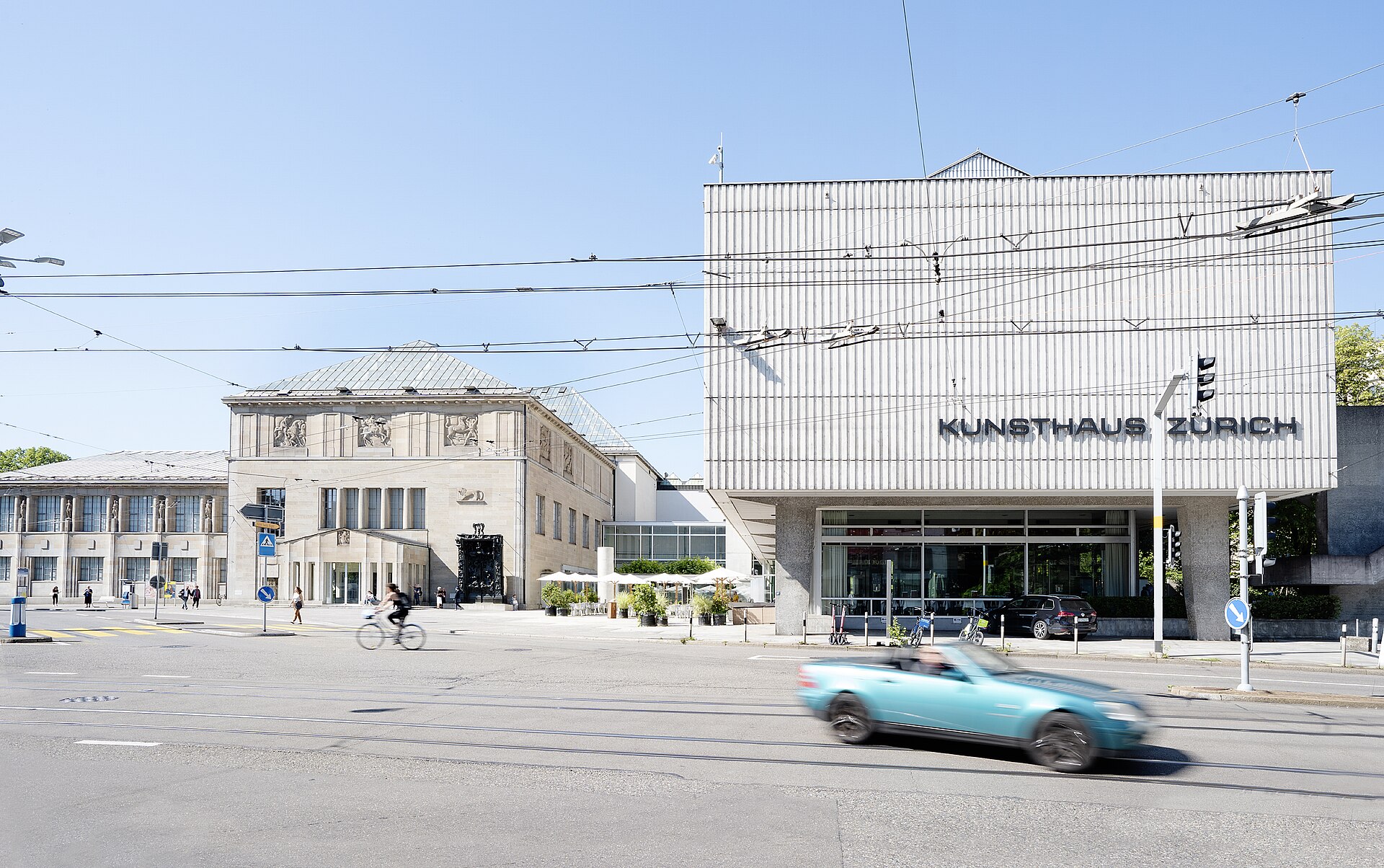
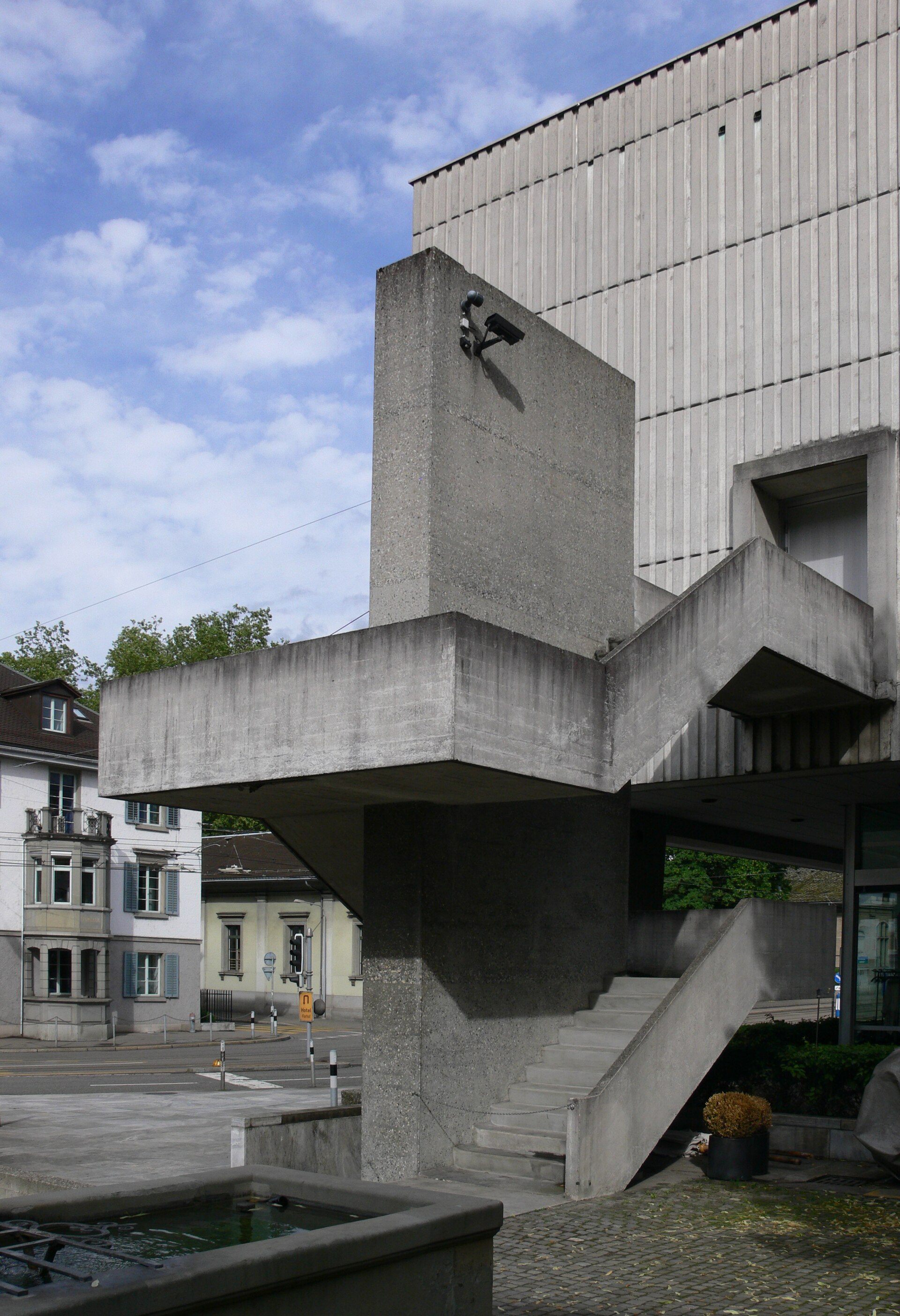
The Kunsthaus's Moser building (1910, left) and Pfister exhibition hall (1958, right), photographed in June 2020.
Franca Candrian / Kunsthaus Zurich, CC BY-SA 4.0 · Photograph by Kunsthaus Zürich MarKomKunsthaus Zurich
Museum · Founded 1787
Open, admission and hours confirmed 26 September 2026 · 21 sources
On this page 14 sections
ContentsClose
The Kunsthaus's real depth sits in three areas assembled by specific patrons rather than by institutional purchase: the largest Munch painting collection outside Norway, the most important single collection of Alberto Giacometti's work through the dedicated foundation established in 1965, and what the museum describes as the world's largest collection of Dada material, marking the movement's own 1916 birthplace a few streets away at the Cabaret Voltaire. Around those three pillars sits a federation of named private collections, from 17th-century Dutch painting to post-1960 contemporary work, that chose over more than a century to attach themselves to the same Heimplatz address, culminating in the Foundation E.G. Buhrle Collection now shown, and still being argued over, in the 2021 Chipperfield building.
| Kind | Museum |
|---|---|
| Founded | 1787 |
| City and country |  Zurich, Switzerland Zurich, Switzerland |
| Address | Heimplatz 1, 8001 Zurich, Switzerland |
| Website | kunsthaus.ch |
| Status | Open, confirmed |
| Record last verified |
Visiting
- Hours
- Tue-Wed, Fri-Sun10:00 to 18:00Exhibition and collection galleries close about 10 minutes before the museum
- Thu10:00 to 20:00
- Garden of Art (public grounds)06:00 to 21:30Open daily except 25 December and 1 January
- Closed
- Monday. 25 December. 1 January.
- Admission
- Adult, all-inclusive (exhibitions and collection)CHF 36
- Adult, collection and small exhibitionsCHF 24
- Adult, major exhibition ticket (Kerry James Marshall, Marisol, Vilhelm Hammershoi)CHF 31each
- Reduced (groups of 20+, students, apprentices, pensioners, disability-pension recipients)CHF 17range CHF 17 to 25 depending on ticket type
- Under 14, members, Swiss school classes, art students, wheelchair users and one companion, KulturLegi Zurich holdersFreefree
Free entry: Wednesday, collection and small exhibitions free for everyone- Tickets
- tickets.kunsthaus.ch The museum's own ticket page.
- Do I need to book?
- Not required for general entry; timed online tickets available and recommended for major exhibitions
- Address
- Heimplatz 1, 8001 Zurich, Switzerland MapTram Lines 3, 8 and 9 to the Kunsthaus stop
Bus Line 31 to the Kunsthaus stop
Parking Public garages at Hirschengraben and Obergericht; the Hohe Promenade garage on Ramistrasse 22A; two disabled spaces at the Chipperfield building on Kantonsschulstrasse 4 - Website
- kunsthaus.ch
- Telephone
- +41 44 253 84 84
- [email protected]
Before you go how long, access, photography, bags, eating, shop
- How long to allow
- Not stated by the museum; the collection is spread across five linked buildings, and the Buhrle rooms alone hold 190-205 works
- Access
- Fully wheelchair accessible via lifts in both buildings; free entry for wheelchair users and one companion; two disabled parking bays at the Chipperfield building; assistance dogs permitted; barrier-free restrooms in the basement and on the first floor; wheelchairs and folding seats loaned free of charge
- Photography
- Photography without flash, tripod or selfie stick is permitted for private use; some individual works carry their own restriction, marked on site
- Bags
- Small bags up to A4 size (30 x 21 x 20 cm) are allowed in the galleries; lockers for coats, bags and umbrellas are provided in both buildings
- Eating
- Kunsthaus Bar: Tue 8:00-19:00, Wed-Fri 8:00-21:00, Sat 9:00-21:00, Sun 9:00-19:00
- Shop
- Museum shop: Tue-Wed and Fri-Sun 10:00-18:00, Thu 10:00-20:00
Prices and hours change. We take them from the institution's own pages and print the day we read them, and you can check the current position at the source we used. Confirm before you travel.
What is inside
Moser Building - Old Masters and Swiss painting
Medieval sculpture and panel painting, Dutch and Italian Baroque built up from Leopold Ruzicka's 17th-century Dutch gift (1949) and the Betty and David M. Koetser gift of Dutch, Italian Baroque and Venetian Settecento painting (1986), and the Kunsthaus's own core holding of Swiss painting from Johann Heinrich Fussli to Ferdinand Hodler, the reason the museum exists in the first place.
Pfister and Muller wings - Munch, Classical Modernism and Dada
The largest collection of Edvard Munch paintings outside Norway, built up after director Wilhelm Wartmann's first Munch exhibition in 1922; Picasso, Chagall, Kokoschka, Bonnard and Kandinsky in the Classical Modernism rooms; and what the museum states is the world's largest collection of objects from the Dada movement, founded in Zurich in 1916 and assembled here mainly from donations since 1980.
Alberto Giacometti Rooms
Roughly 800 objects held through the Alberto Giacometti Foundation, established in Zurich in 1965 by a group of collectors around Hans C. Bechtler and enlarged by gifts from the artist himself and, in 2006, by 75 plaster casts and further bronzes from Bruno and Odette Giacometti. The museum's own account calls it the most important museum collection of Giacometti's work anywhere.
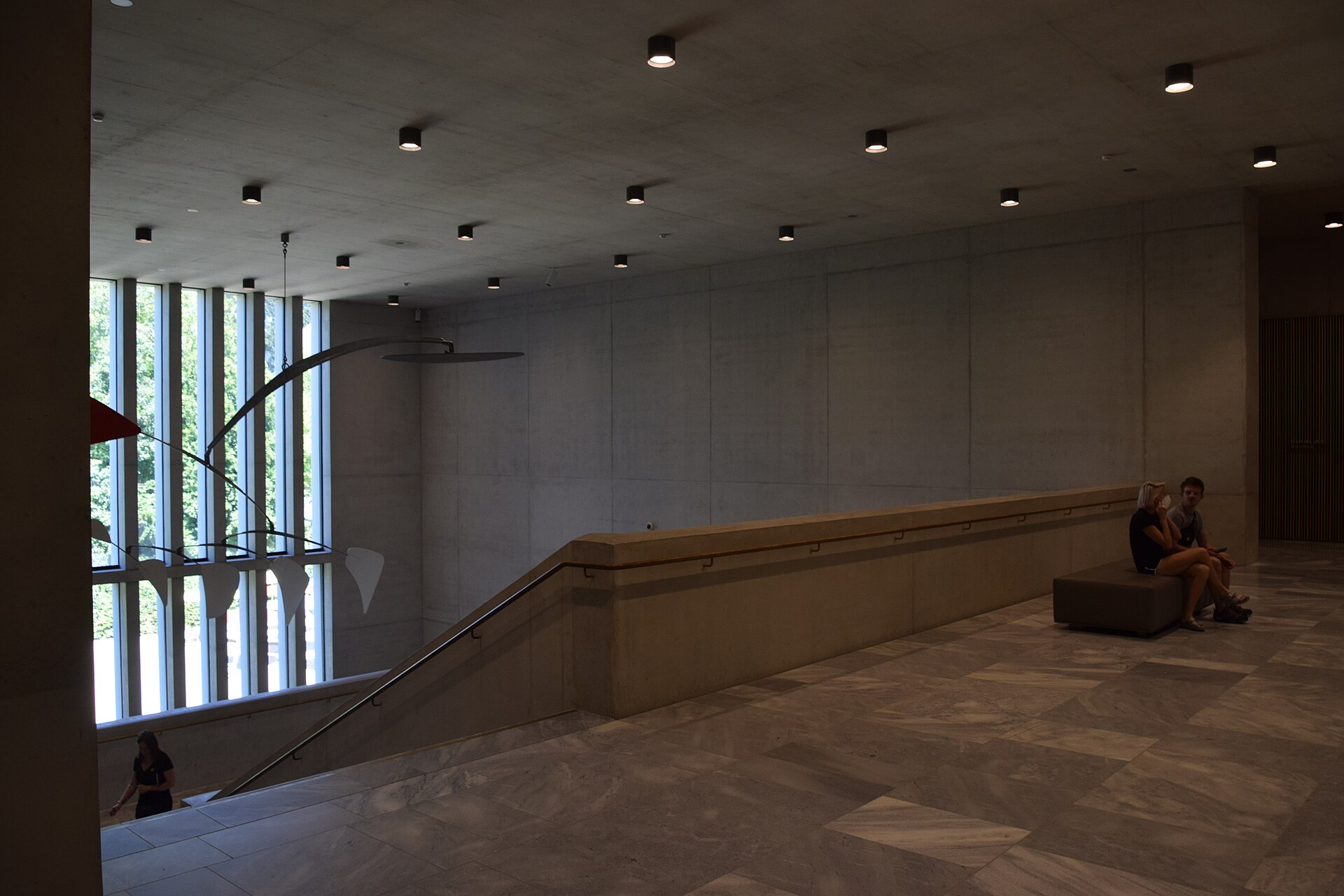
Photograph by Jeanhousen · CC BY-SA 4.0 Chipperfield Building - the Buhrle, Merzbacher, Looser and Knecht collections
The 205 works on long-term loan from the Foundation E.G. Buhrle Collection since 2021, shown alongside the Gabriele and Werner Merzbacher collection of Fauvism and Expressionism, the Looser collection of post-1960 art, and the Karin and Ferdinand Knecht Old Master collection. Kunsthaus Zurich's own history page describes the combined French holdings as the most important collection of French painting and Impressionism in Europe outside Paris.
Prints, Drawings and the Kunsthaus Library
A graphics collection the museum describes as holding tens of thousands of works on paper from the 13th century to the present, from Old Master drawings to contemporary prints, alongside the Kunsthaus's own specialist art library.
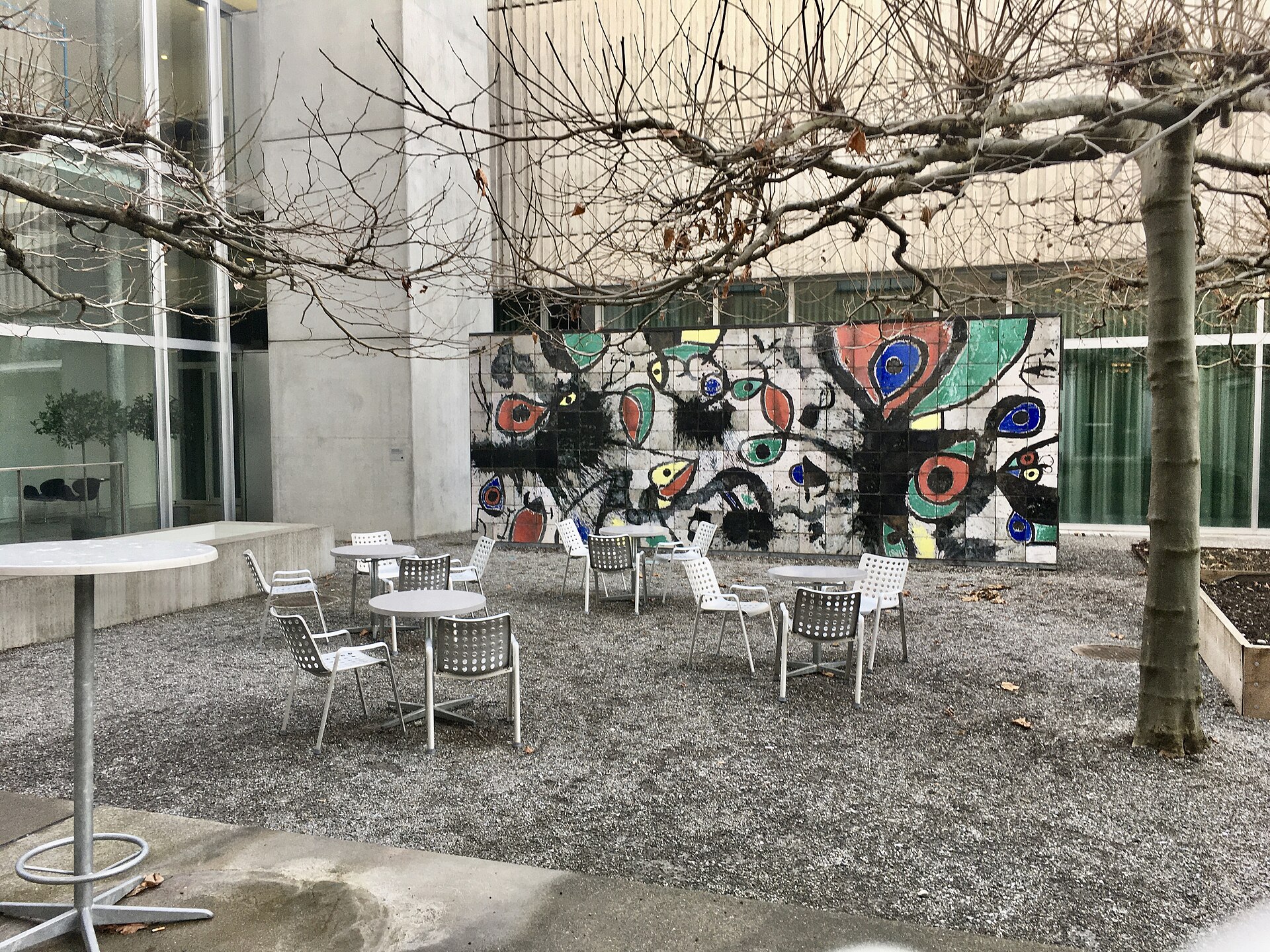
Photograph by Manuelarosi · CC BY-SA 4.0 Garden of Art and the internal courtyards
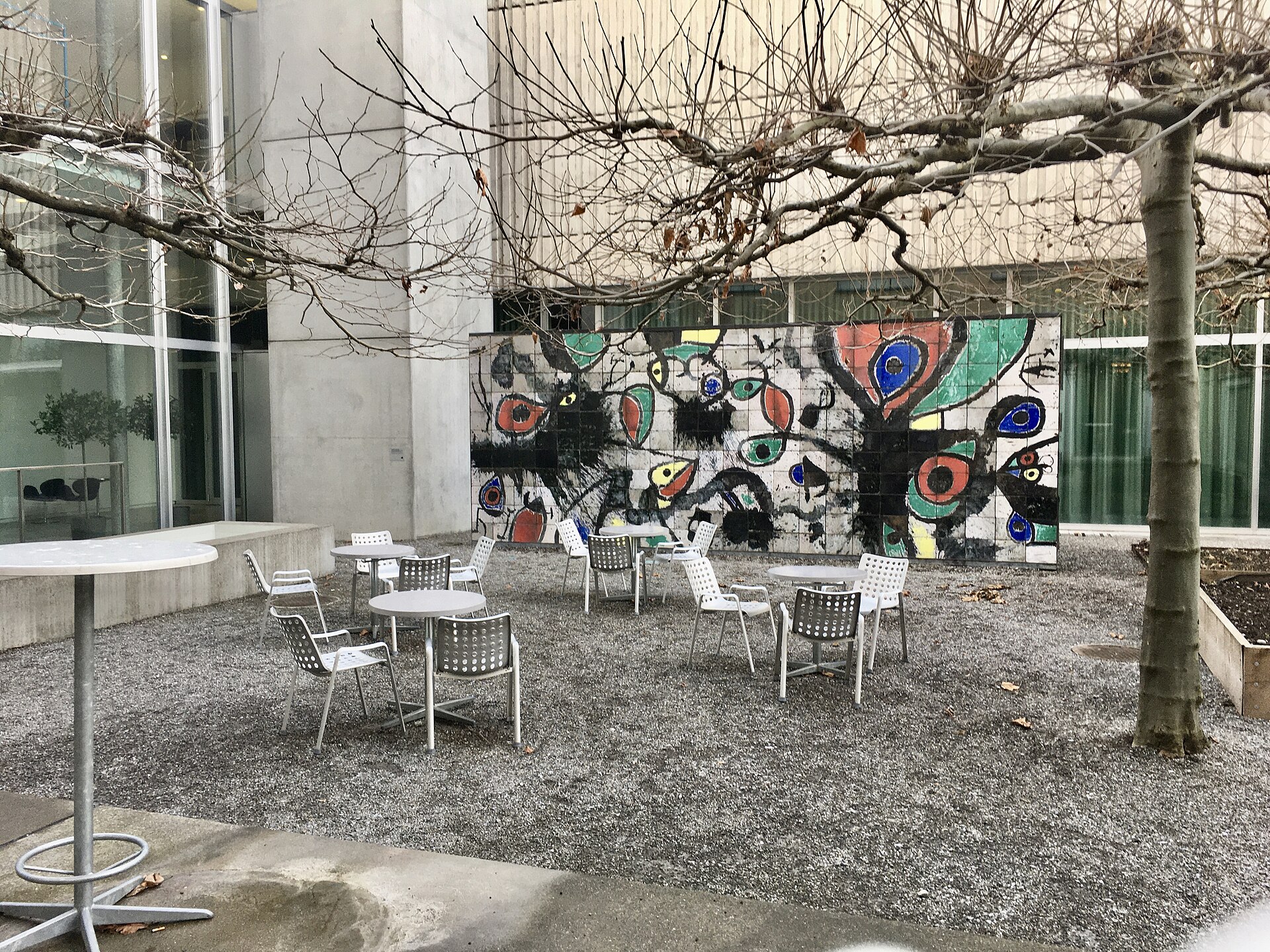
The public Garden of Art around the Chipperfield building, open daily; internal courtyards used by the Kunsthaus Bar and shaded by trees, one of them holding a large ceramic wall piece.
What to see first
Bildnis Dr. Wilhelm Wartmann (Portrait of Dr. Wilhelm Wartmann)
Edvard MunchA 1923 portrait of the Kunsthaus's own first director, gift of Alfred Rutschi in 1929, and a marker of how early and how personally the museum backed Munch before its Norway-rivalling holding existed.3
The two large water-lily panels (Nympheas)
Claude MonetAcquired after a Monet retrospective once director Rene Wehrli redirected the collection toward French painting from 1950 onward; the anchor of the Impressionist rooms.3
The Alberto Giacometti sculpture, painting and drawing holding
Alberto GiacomettiAround 800 objects spanning his full career, held through the Foundation established in Zurich in 1965; described by the museum as the most important single collection of his work.6
Le Semeur au soleil couchant (The Sower at Sunset)
Vincent van GoghOne of the best-known paintings in the Foundation E.G. Buhrle Collection, on long-term loan to the Kunsthaus since 2021 and part of the collection now under a five-year provenance research project.7
Schwarzer Fleck (Black Spot)
Wassily KandinskyA 1921 painting anchoring the Classical Modernism galleries alongside Matisse, Picasso and Braque.5
The Dada collection
Various (Hans Arp, Marcel Janco, Sophie Taeuber-Arp and others associated with the Cabaret Voltaire)The museum states this is the world's largest collection of Dada objects, assembled mainly from donations from 1980, marking the movement's own 1916 birthplace in Zurich.4
The Ferdinand Hodler holding
Ferdinand HodlerAfter the Kunsthaus's 1917 Hodler exhibition outran the Kunstgesellschaft's own funds, Alfred Rutschi founded the Vereinigung Zurcher Kunstfreunde specifically to keep buying Hodler's large compositions and landscapes for the museum, a body that still funds acquisitions today.3
Exhibitions on now
- On now3 Jul to 25 Oct 2026Confirmed · check before you travel
- On now11 Sep 2026 to 10 Jan 2027Confirmed , 7 weeks ago
Five buildings, two centuries apart
Kunsthaus Zurich did not begin as a museum. It began in 1787 as a small, sociable dining and discussion club of Zurich artists and art lovers, the Kunstgesellschaft, who from 1794 contributed a drawing or a colleague's work each year to a shared 'Malerbuch'. In 1818, an international subscription let the group secure the city's principal artistic holding at the time, the Gessner Gallery of gouache landscapes and drawings, and in 1847 a small gallery designed by Gustav Albert Wegmann was annexed to the club's existing premises to show it. The society's own account of its history opens with this line: it began 'not with a prince, a state or a collector' but with a group that simply kept meeting.
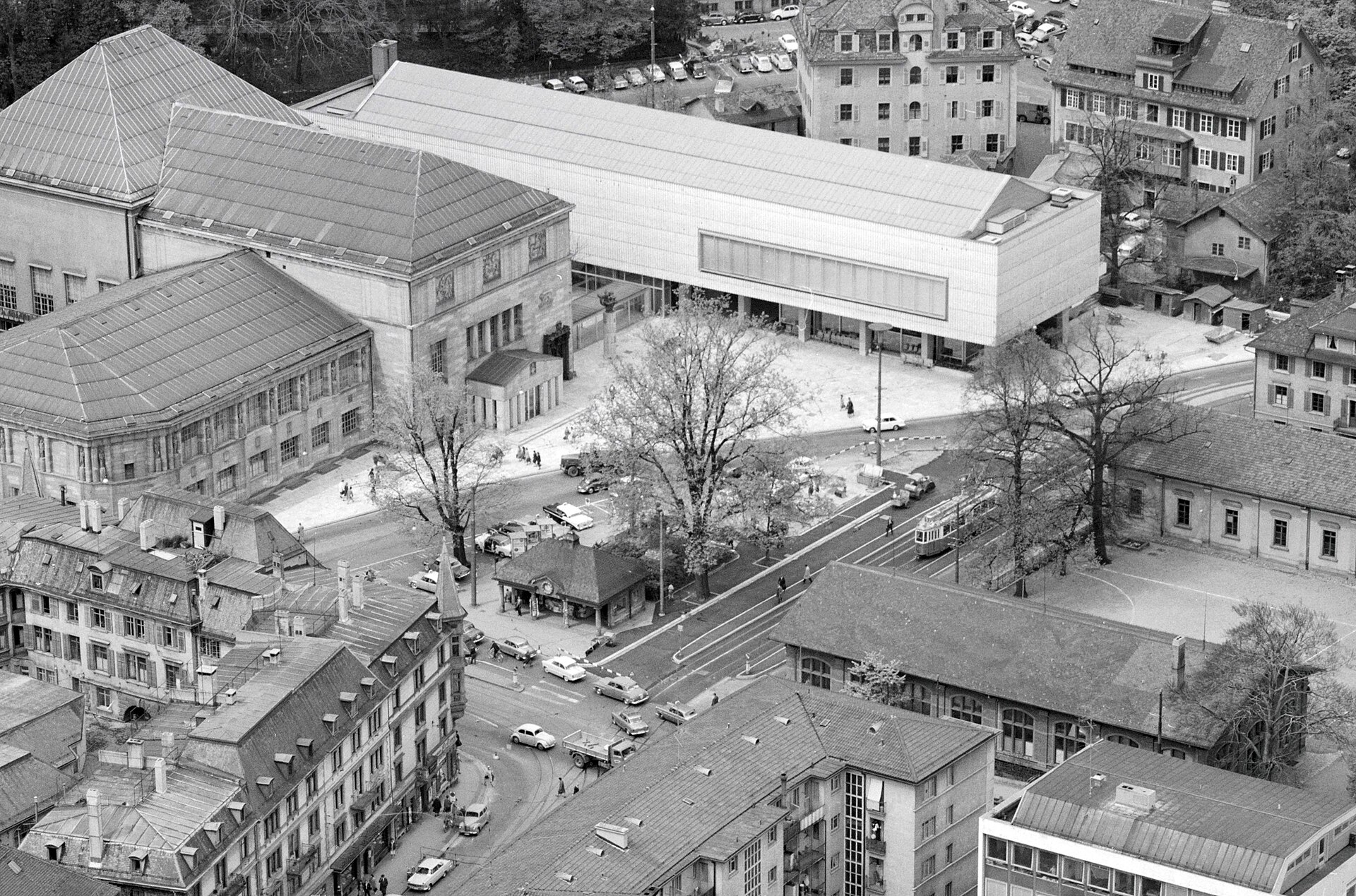
The building recognisable today as the Kunsthaus opened on Heimplatz on 17 April 1910, with the university rector Arnold Meyer telling the opening audience the house should stay 'far removed from all false appearance and grandeur'. Architectural histories generally call this the Moser building; Kunsthaus Zurich's own institutional history credits Karl Moser specifically with an extension in 1925, once the original 1910 structure had already outgrown itself under the collection built up by the museum's first director, Wilhelm Wartmann. A second, larger campaign followed in 1958: a column-free exhibition hall with its own auditorium and restaurant, designed by the Pfister brothers and financed personally by the industrialist Emil G. Buhrle, whose own art collection would return to the same site more than six decades later under much less comfortable circumstances. A third extension by architect Erwin Muller opened in 1976, and the Villa Tobler, a Renaissance-style townhouse a few streets away, was restored between 1998 and 2000 to house the museum's administration.
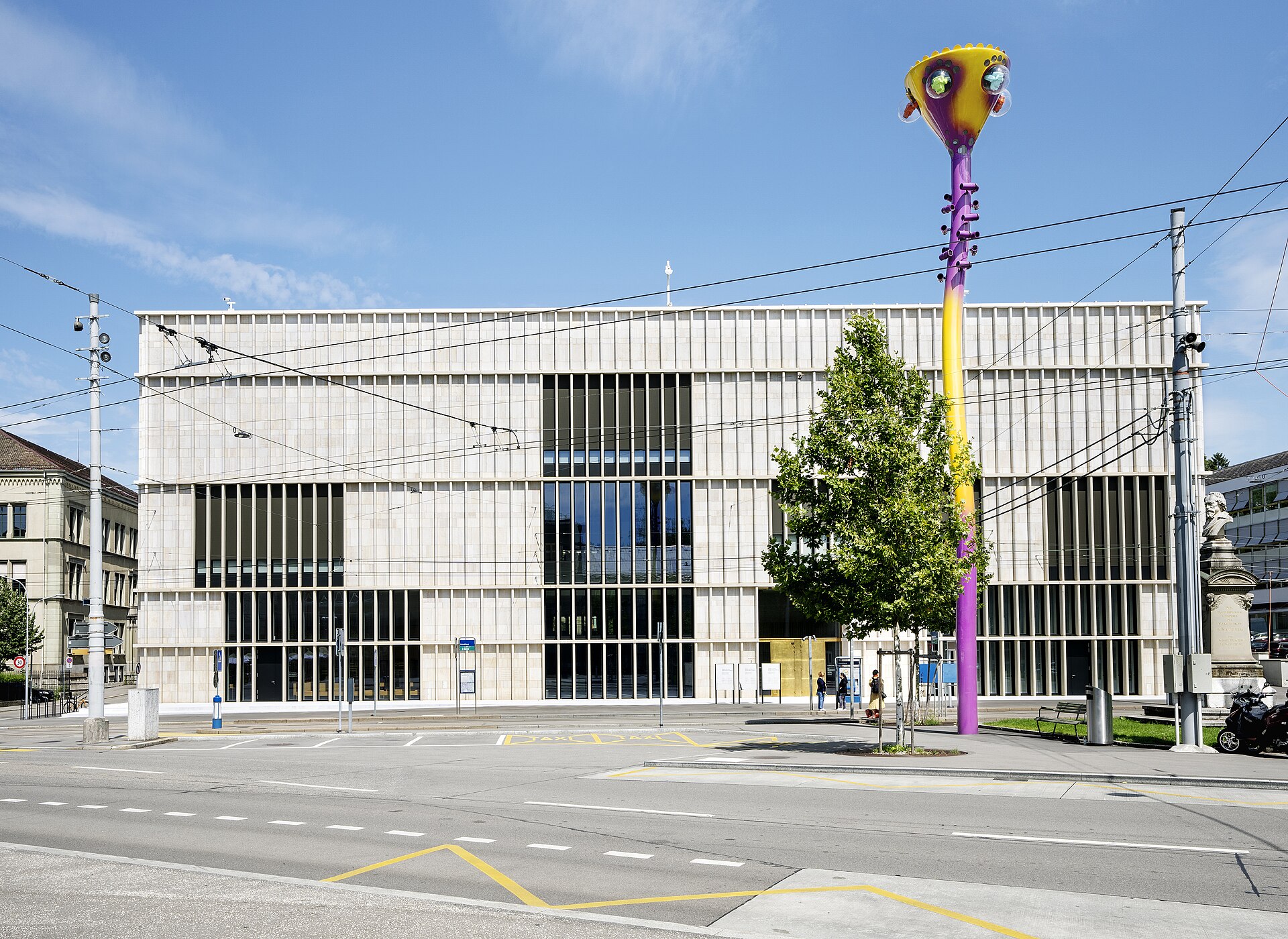
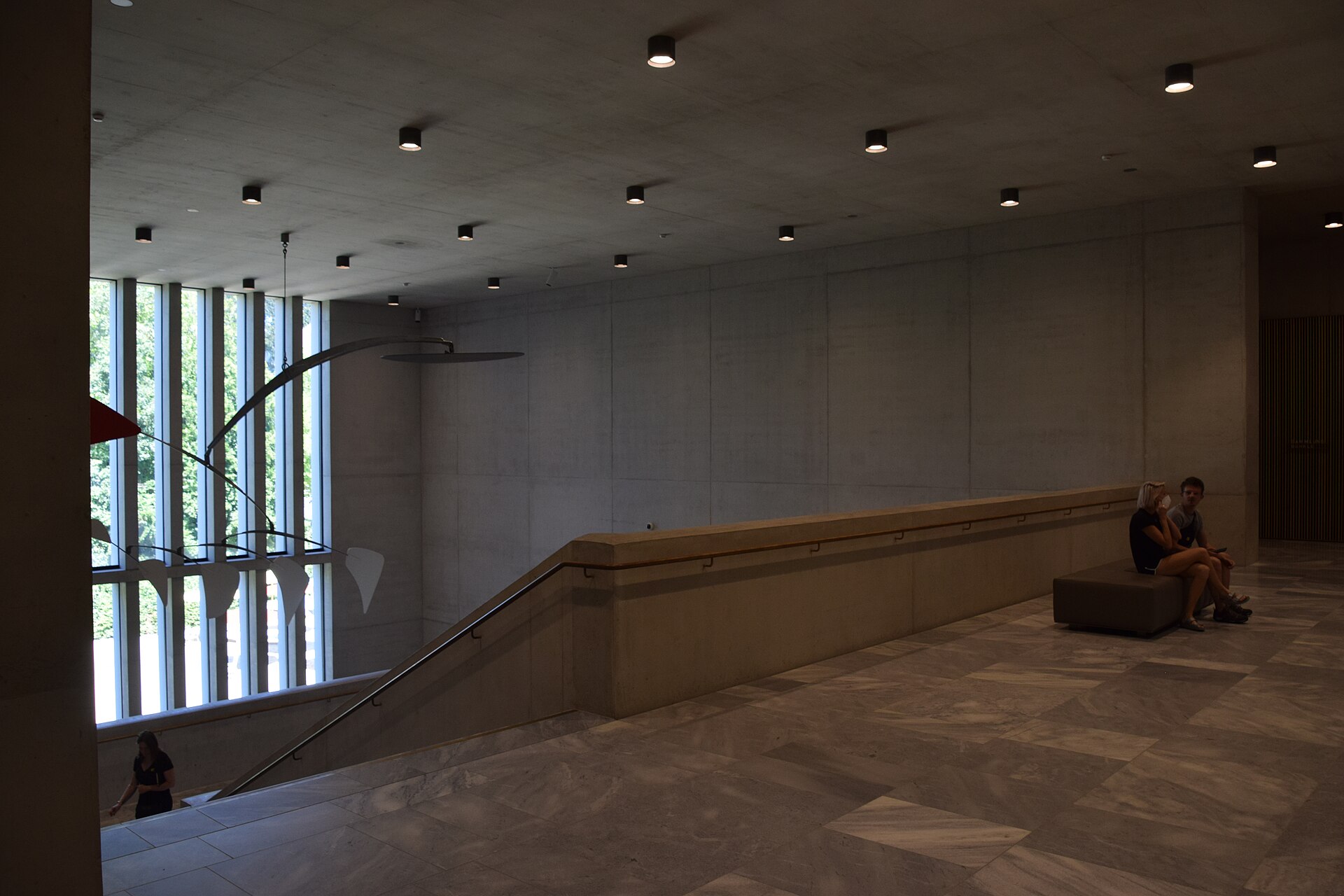
The newest and largest addition is the David Chipperfield-designed Kunsthaus Zurich Erweiterung, first proposed publicly in May 2002 by the outgoing president of the Zurcher Kunstgesellschaft, the museum's director and the mayor of Zurich together, and opened on 9 October 2021 at a reported cost of USD 222 million, according to Architectural Record. Clad in vertical fins of sawn Jura limestone and built mostly in poured concrete, the extension roughly doubled the museum's public floor area; Chipperfield told Architectural Record that he and his practice 'weren't interested in an architecture of opposition' to the older buildings across Heimplatz. The result is what Kunsthaus Zurich now calls Switzerland's largest art museum, four visibly different building languages standing on and around the same square: Moser's dressed stone, the Pfister brothers' mid-century hall, Muller's ribbed concrete facade carrying the museum's name, and Chipperfield's pale limestone screen.
What eight centuries of collecting produced
The Kunsthaus's own account of its collection spans roughly 800 years, but its real strength is concentrated in three areas built up by specific patrons rather than by the museum acting alone. The first is Nordic and German Expressionist painting: Wilhelm Wartmann organised the museum's first Edvard Munch exhibition in 1922 and set out deliberately to build the largest collection of the artist's paintings outside Scandinavia, a distinction the museum still claims. The second is Alberto Giacometti: a group of collectors around Hans C. Bechtler founded a dedicated foundation in 1965, drawing on works Giacometti donated himself and later on a large gift of plasters and bronzes from Bruno and Odette Giacometti in 2006, so that roughly 800 objects covering his surrealist period through his late bronzes are held permanently at the Kunsthaus. The third is Dada: founded a few streets from Heimplatz at the Cabaret Voltaire in 1916, the movement is represented here, by the museum's own description, in the largest collection of Dada objects anywhere, assembled mostly through donations from 1980 onward.
Around these three pillars sit collections that arrived as named gifts and loans rather than through museum purchase: Leopold Ruzicka's Dutch 17th-century paintings (1949); the sculpture collection Nelly Bar gave in memory of Werner Bar, running from Rodin to Germaine Richier (1966); the Marc Chagall gallery created in 1973 with support from Gustav Zumsteg; the Johanna and Walter L. Wolf collection of French painting from Impressionism to Classical Modernism (1984); the Betty and David M. Koetser collection of Dutch and Italian Baroque and Venetian Settecento painting (1986); and twelve paintings from Monet to Magritte given by Walter Haefner in 1995. The pattern repeats with the Chipperfield extension, which now also houses the Gabriele and Werner Merzbacher collection of Fauvist and Expressionist painting, the Looser collection of art after 1960, and the Karin and Ferdinand Knecht Old Master collection. Kunsthaus Zurich is, in other words, less a single institutional collection than a federation of private collections that chose, at different moments across more than a century, to attach themselves to the same address on Heimplatz. That pattern is also the reason the museum's most difficult holding arrived the way it did.
The Buhrle Collection: how it got here
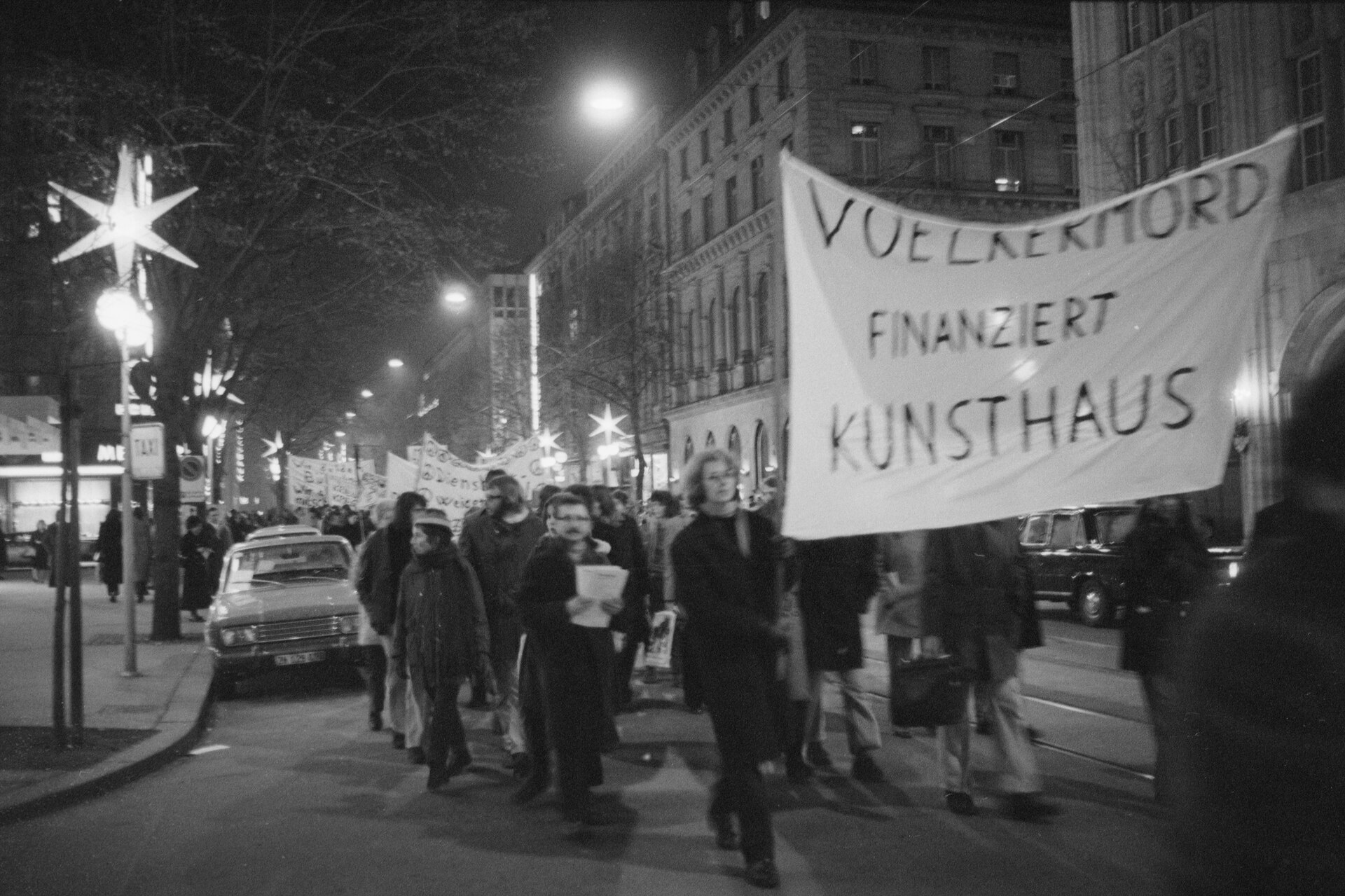
According to Frieze's account, Emil Georg Buhrle was a German-born industrialist who settled in Switzerland in 1924 after service in the Freikorps paramilitaries that put down Germany's 1918-19 uprisings. Through his firm Oerlikon-Buhrle he became, according to reporting by Frieze's Kito Nedo drawing on wartime BBC broadcasts, the operator of what the BBC in 1943 called 'Germany's greatest bomb-free arms factory', selling weapons to Nazi Germany and the Allies alike from officially neutral Switzerland; the same reporting states his company drew royalties from a Velten, Germany munitions plant worked by women prisoners from Ravensbruck concentration camp under SS guard. Buhrle began collecting art in 1936 and, according to a 2020 University of Zurich report cited by Frieze, spent some 40 million Swiss francs assembling around 600 works by the end of his life. That same 2020 report found that Buhrle's first sixteen purchases on the Paris art market came during the German occupation, when Jewish dealers and collectors were having works confiscated, and that of 93 works he bought between 1941 and 1945, 13 were classified as looted art after the war. Buhrle was made to return all 13 in restitution proceedings at the end of the 1940s; he then bought nine of them back on the postwar market, which had the effect of clearing their title. Buhrle himself died in 1956; the collection and the foundation that manages it survived him, and he had personally financed the Kunsthaus's own 1958 exhibition hall two years after his death from funds he had already committed.
The Kunsthaus and the city of Zurich began negotiating a long-term loan of roughly 200 Buhrle Foundation works in 2019, according to Frieze's reporting; a formal loan agreement between the Foundation and the Zurcher Kunstgesellschaft was signed in 2022, and the works themselves went on display in the new Chipperfield building from its October 2021 opening. Then-director Christoph Becker told the Swiss paper NZZ, as reported by Frieze, that a collection could 'not be used as a vehicle to portray historical facts'; former Buhrle Foundation director Lukas Gloor told the Swiss magazine Blick in November 2021 that turning the collection into 'a memorial to Nazi persecution' would not 'do justice to the pictures'. Separately, at the end of December 2021, Swiss-Jewish painter Miriam Cahn announced in an open letter to the journal Tacheles, and in a Swiss Radio and Television interview, that she was withdrawing her own work from the Kunsthaus over what she called the museum's historical whitewashing of the collection.
Three attempts at a display, five years on
The Kunsthaus's response to that criticism has been to keep changing the presentation rather than to remove the collection. A first, more contextualised rehang opened in November 2023 as 'A Future for the Past - The Buhrle Collection: art, context, war and conflict', explicitly built around the biographies of the collection's former Jewish owners; the museum's own text for the show states plainly that the works themselves 'are in no way implicated' in Nazi crimes but 'do, however, bear witness to them'. That show never opened cleanly: on 13 October 2023, according to reporting in The Art Newspaper, the entire academic advisory panel appointed to guide it resigned three weeks before the opening, in a dispute the paper's sources described as centred on how much weight the exhibition should give to the individual fates of the Jewish owners the works were taken from, against curators who wanted a more balanced framing. Director Ann Demeester, who had taken up the post in 2022, called the resignation 'regrettable' and said it showed 'how complex the subject is'.
In March 2024 the United States State Department issued updated best-practice guidance for Nazi-looted art, timed to the 25th anniversary of the 1998 Washington Principles. Citing that guidance rather than any new archival discovery, the Foundation E.G. Buhrle Collection announced on 14 June 2024 that it would pull five paintings from display while it sought settlements with the legal successors of the former owners: Claude Monet's Jardin de Monet a Giverny, Vincent van Gogh's The Old Tower, Paul Gauguin's La route montante, Gustave Courbet's Portrait of the Sculptor Louis-Joseph and Henri de Toulouse-Lautrec's Georges-Henri Manuel, according to reporting by CBS News; a sixth painting, Edouard Manet's La Sultane, was flagged separately for special consideration. One of the paintings under review is understood to have belonged to Max Silberberg, a German Jewish industrialist whose collection was sold under duress at forced Nazi-era auctions and who is believed to have been murdered at Auschwitz. Settlements later allowed two of the six, Manet's La Sultane and Gauguin's La route montante, to remain in the collection.
On 17 April 2026 the Kunsthaus opened a third version of the display, an interim rehang the museum has described as an 'interim status report' rather than a finished argument, according to a Kunsthaus spokesperson quoted in SWI swissinfo.ch's report on the opening. The new hang crowds roughly 190 of the Foundation's 205 works into a dense, salon-style installation with few wall labels, requiring visitors to use pamphlets or touchscreens for artist names and provenance; the Neue Zurcher Zeitung, as reported in that same SWI swissinfo.ch piece, called the result 'as loveless as a stock inventory'. The Art Newspaper's coverage of the same opening, by Martin Bailey, noted the display also includes a copy of Van Gogh's Self-Portrait for Paul Gauguin painted as an homage by Judith Gerard around 1897-98, later doctored and sold as an authentic Van Gogh, which Buhrle bought in 1948 and was told in 1952 was fake, a judgment he accepted; it is shown now as a curiosity rather than a Van Gogh. Since 1 April 2026 the Kunsthaus has taken over a five-year research project into the provenance of all 205 works, according to the museum's own collection page, working with an interdisciplinary panel of outside experts toward a fourth, more permanent presentation targeted for 2027 or 2028; funding for the project was approved in February 2026 by the City of Zurich Parliament, and the Zurich news site Tsri.ch reported the parliament's vote at CHF 3.86 million, passed 104 to 13 with only the SVP opposed. The Foundation's current loan agreement with the Zurcher Kunstgesellschaft runs to 2034.
Visiting
The Kunsthaus sits directly on Heimplatz in central Zurich, reachable on tram lines 3, 8 and 9 or bus line 31, all of which stop outside the museum. The collection and small exhibitions are free to everyone on Wednesdays; on other days an all-inclusive ticket covering both the collection and any major exhibition costs CHF 36 for an adult, with a collection-only ticket at CHF 24. Reduced tickets are available for groups, students, apprentices and pensioners, and admission is free for under-14s, members, Swiss school classes, art students and wheelchair users travelling with a companion. Both buildings are fully wheelchair accessible by lift, with barrier-free restrooms, free loan wheelchairs and folding seats, and dedicated disabled parking at the Chipperfield building. Bags up to A4 size are allowed in the galleries; anything larger goes into lockers provided in both buildings. Photography without flash, tripod or selfie stick is permitted for private use, with restrictions on individual works marked on site.
The museum is open Tuesday, Wednesday and Friday to Sunday from 10:00 to 18:00, and Thursday until 20:00; it is closed Mondays and on 25 December and 1 January. The surrounding Garden of Art, a public square around the Chipperfield building, stays open separately from 6:00 to 21:30 every day of the year bar Christmas and New Year's Day. As of August 2026 the temporary exhibitions on view include Kerry James Marshall: The Histories, a survey of the American painter's work, and Vilhelm Hammershoi: The Eye That Listens, alongside the ongoing Buhrle Collection rehang in the Chipperfield building; each carries its own admission tier rather than a single flat museum price, and the museum's own visitor page is the only reliable source for which ticket a given visit requires.
What visitors say
The Kunsthaus's own collection spans one of the deepest single-site groupings of Munch, Giacometti and Dada material in Europe, laid out across a calm sequence of five linked buildings from 1910 to 2021; the museum states that the collection and small exhibitions are free to everyone on Wednesdays and that an audioguide is included with online tickets. A longer run of named critics agree that the museum has not yet settled how to present the Buhrle Collection: this is its third attempt at a display concept since the collection arrived in 2021, and each version has drawn its own criticism.
What is praised, what is criticised
- Praised: the depth and free public access (Wednesdays) to the Munch, Giacometti and Dada holdings
- Praised: the calm, daylight-filled galleries of the 2021 Chipperfield extension, which Architectural Record described as largely daylit, with grey walls it said set off the Buhrle Collection rather than competing with it
- Praised: helpful, friendly gallery staff and the free collection audioguide included with online tickets
- Criticised: the crowded, label-sparse 2026 rehang of the Buhrle rooms in a dense 19th-century salon style, which the Neue Zurcher Zeitung described as loveless as a stock inventory, according to reporting in SWI swissinfo.ch
- Criticised: years of unresolved argument, documented since 2019, over how openly the museum discloses the wartime and provenance history behind the Buhrle Collection it now displays
Questions about Kunsthaus Zurich
Where is Kunsthaus Zurich?
Heimplatz 1, 8001 Zurich, Switzerland.
How much does it cost to visit?
Adult, all-inclusive (exhibitions and collection): CHF 36; Adult, collection and small exhibitions: CHF 24; Adult, major exhibition ticket (Kerry James Marshall, Marisol, Vilhelm Hammershoi): CHF 31; Reduced (groups of 20+, students, apprentices, pensioners, disability-pension recipients): CHF 17; Under 14, members, Swiss school classes, art students, wheelchair users and one companion, KulturLegi Zurich holders: free. As confirmed 26 September 2026.
When is it open?
Tue-Wed, Fri-Sun 10:00-18:00; Thu 10:00-20:00; Garden of Art (public grounds) 06:00-21:30. Closed: Monday. 25 December. As confirmed 26 September 2026.
How do you get there?
Tram: Lines 3, 8 and 9 to the Kunsthaus stop; Bus: Line 31 to the Kunsthaus stop; Parking: Public garages at Hirschengraben and Obergericht; the Hohe Promenade garage on Ramistrasse 22A; two disabled spaces at the Chipperfield building on Kantonsschulstrasse 4.
What should you see first?
Bildnis Dr. Wilhelm Wartmann (Portrait of Dr. Wilhelm Wartmann) (Edvard Munch); The two large water-lily panels (Nympheas) (Claude Monet); The Alberto Giacometti sculpture, painting and drawing holding (Alberto Giacometti); Le Semeur au soleil couchant (The Sower at Sunset) (Vincent van Gogh); Schwarzer Fleck (Black Spot) (Wassily Kandinsky); The Dada collection (Various (Hans Arp, Marcel Janco, Sophie Taeuber-Arp and others associated with the Cabaret Voltaire)).
What we could not confirm
- Which specific Buhrle Foundation works remain withheld from display pending settlement with heirs, beyond the six named in the June 2024 announcement, is not stated consistently across the sources checked here and should be re-verified against the Foundation's own current disclosures.
- The exact split of design credit between the 1910 opening building and Karl Moser's 1925 extension is not spelled out on the museum's own history page, which names Moser only for the 1925 work; broader architectural literature calls the whole 1910 structure the Moser building. Both claims are reported here, attributed to their sources, rather than resolved.
- No figure for current annual visitor numbers post-2021 extension was found and confirmed on a museum-published page during this research pass.
Images
Sources
- 1Kunsthaus Zurich, Plan Your Visit (hours, admission, current exhibitions), read 2026-08-13 kunsthaus.ch/en/besuch-planen/
- 2Kunsthaus Zurich, Visitor Information (contact, transport, accessibility, bags, photography, cafe and shop hours), read 2026-08-13 kunsthaus.ch/en/besuch-planen/besucherinfos/
- 3Kunsthaus Zurich, History, read 2026-08-13 kunsthaus.ch/en/museum/ueber-uns/geschichte/
- 4Kunsthaus Zurich, The Collection, read 2026-08-13 kunsthaus.ch/en/sammlung/
- 5Kunsthaus Zurich, Classical Modernism, read 2026-08-13 kunsthaus.ch/en/sammlung/klassische-moderne/
- 6Kunsthaus Zurich, Alberto Giacometti Foundation, read 2026-08-13 kunsthaus.ch/en/sammlung/private-sammlungen/alberto-giacometti-stiftung/
- 7Kunsthaus Zurich, Collection Emil Buhrle, read 2026-08-13 kunsthaus.ch/en/sammlung/private-sammlungen/emil-buehrle/
- 8Kunsthaus Zurich, A Future for the Past - The Buhrle Collection: art, context, war and conflict, read 2026-08-13 kunsthaus.ch/en/besuch-planen/ausstellungen/buehrle-neupraesentation/
- 9Kito Nedo, 'The Ugly Provenance of Kunsthaus Zurich's Collection', Frieze, 8 February 2022 frieze.com/article/ugly-provenance-kunsthaus-zurichs-collection
- 10The Art Newspaper, 'Kunsthaus Zurich advisers quit in conflict over new Buhrle exhibition', 27 October 2023 theartnewspaper.com/2023/10/27/kunsthaus-zurich-advisers-quit-in-conflict-over-new-buhrle-exhibition
- 11CBS News, 'Museum in Switzerland to pull famous paintings by Monet, van Gogh over Nazi looting fears', 15 June 2024 cbsnews.com/news/kunsthaus-zurich-museum-switzerland-nazi-art-looting/
- 12SWI swissinfo.ch, 'Zurich art museum to remove suspected Nazi-looted works', 16 June 2024 swissinfo.ch/eng/culture/zurich-kunsthaus-to-remove-potentially-nazi-looted-works/80663939
- 13SWI swissinfo.ch, 'Buhrle's troubled art collection is squashed together in new Zurich show', 2026 swissinfo.ch/eng/culture/b%C3%BChrles-troubled-art-collection-is-squashed-together-in-new-zurich-show/91507839
- 14Martin Bailey, 'Zurich's controversial Buhrle Collection is rehung, including five paintings by Van Gogh - plus one forgery', The Art Newspaper, 17 April 2026 theartnewspaper.com/2026/04/17/zurichs-controversial-buhrle-collection-rehung-including-five-paintings-van-gogh-one-forgery
- 15Wikipedia, 'Kunsthaus Zurich', read 2026-08-13, source for identity and general facts only en.wikipedia.org/wiki/Kunsthaus_Z%C3%BCrich
- 16Wikidata, Q685038, read 2026-08-13, source for identity and coordinates only wikidata.org/wiki/Q685038
- 17Wikimedia Commons, File:Kunsthaus Zuerich Franca Candrian.jpg, licence and description verified 2026-08-13 commons.wikimedia.org/wiki/File:Kunsthaus_Zuerich_Franca_Candrian.jpg
- 18Wikimedia Commons, File:Chipperfield Candrian.jpg, licence and description verified 2026-08-13 commons.wikimedia.org/wiki/File:Chipperfield_Candrian.jpg
- 19Wikimedia Commons, File:ETH-BIB-Zurich, Protestmarsch gegen Buhrle-Com L19-0790-0002-0006.tif, licence and description verified 2026-08-13 commons.wikimedia.org/wiki/File:ETH-BIB-Z%C3%BCrich,_Protestmarsch_gegen_B%C3%BChrle-Com_L19-0790-0002-0006.tif
- 20Jenny Bargetzi, 'Zuercher Gemeinderat spricht 4 Millionen Franken fuer Buehrle-Forschung', Tsri.ch (Tsueri.ch), 5 February 2026, reporting the Gemeinderat's 104-13 vote approving CHF 3.86 million for the five-year Buhrle provenance research project, read 2026-08-13 tsri.ch/a/zuercher-gemeinderat-spricht-4-millionen-fuer-buehrle-forschung
- 21Andrew Ayers, 'David Chipperfield Architects Completes Extension to Kunsthaus in Zurich', Architectural Record, 18 October 2021, read 2026-08-13 architecturalrecord.com/articles/15353-david-chipperfield-architects-completes-extension-to-kunsthaus-in-z%C3%BCrich

