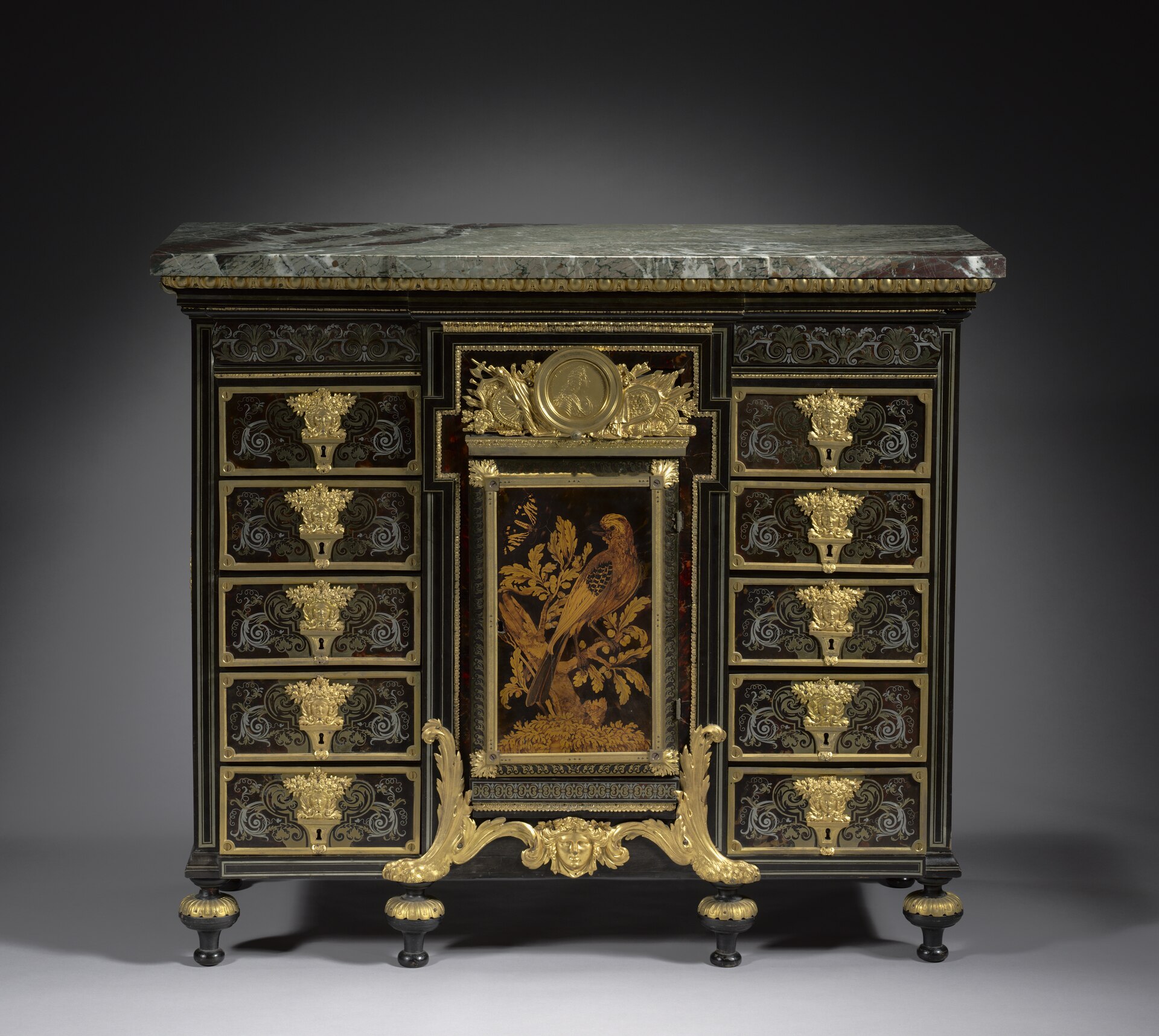
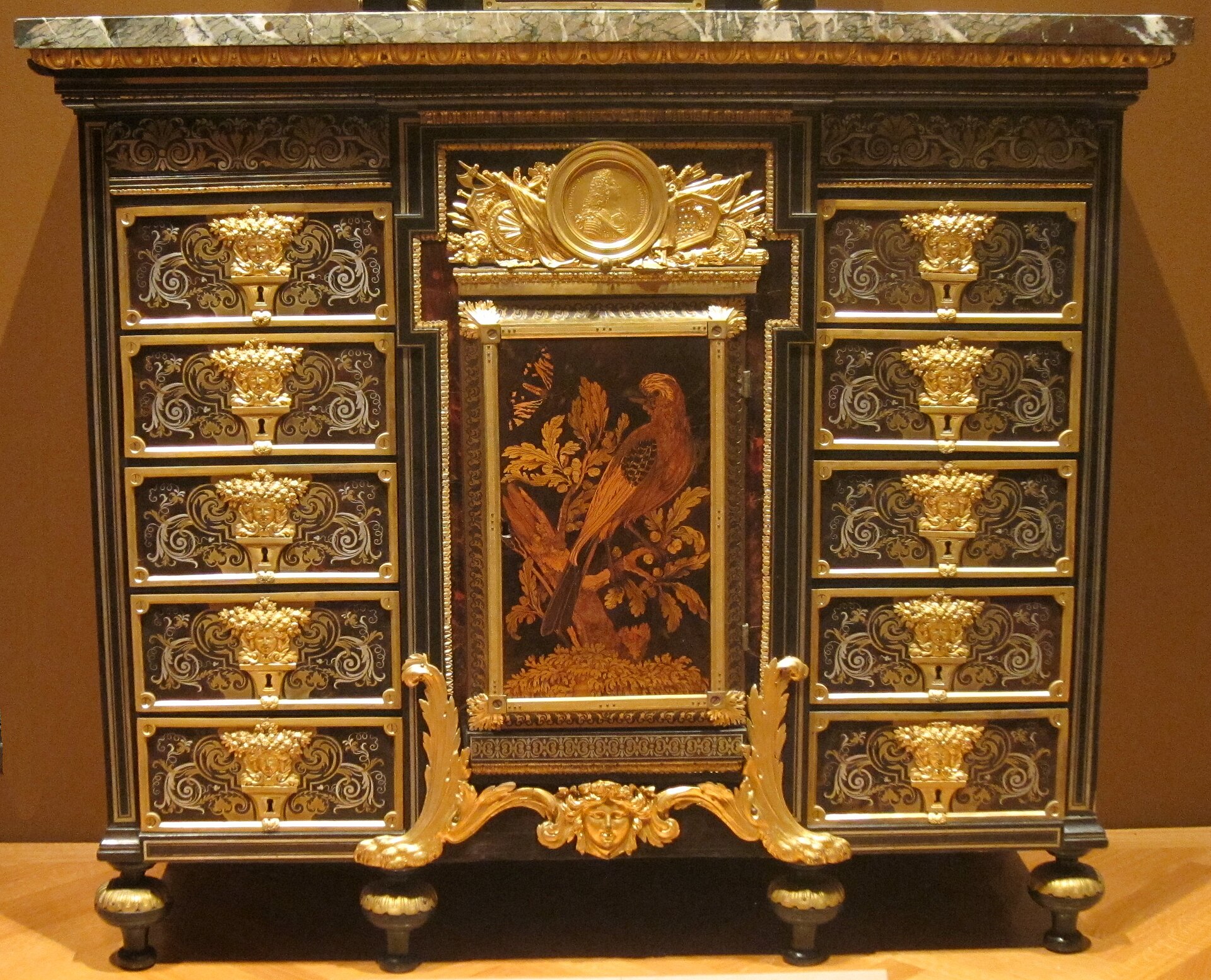
Cabinet
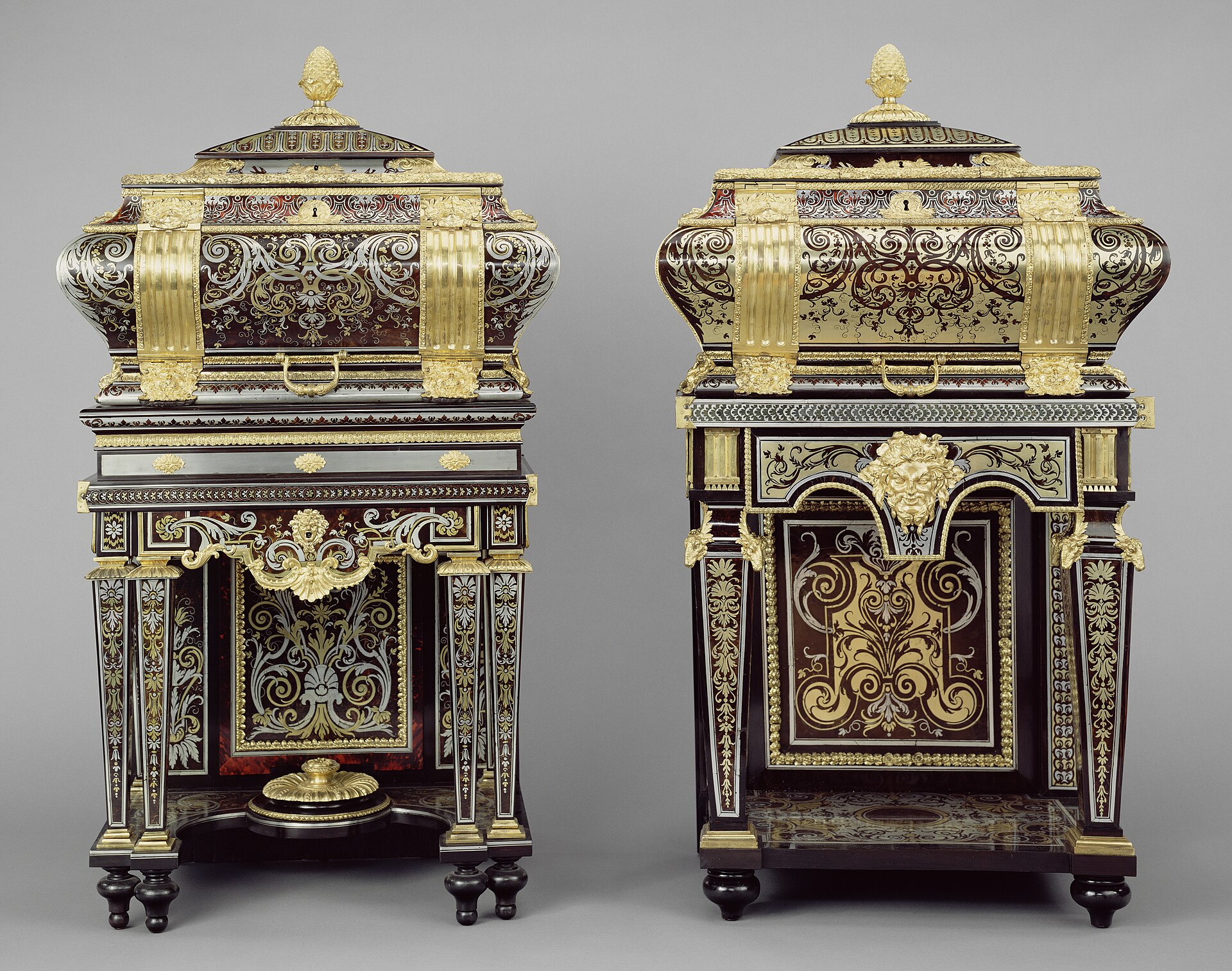
c. 1690 · Ebony veneer over a carcase
Cleveland Museum of Art, Gallery 215
 French · 1642-1732
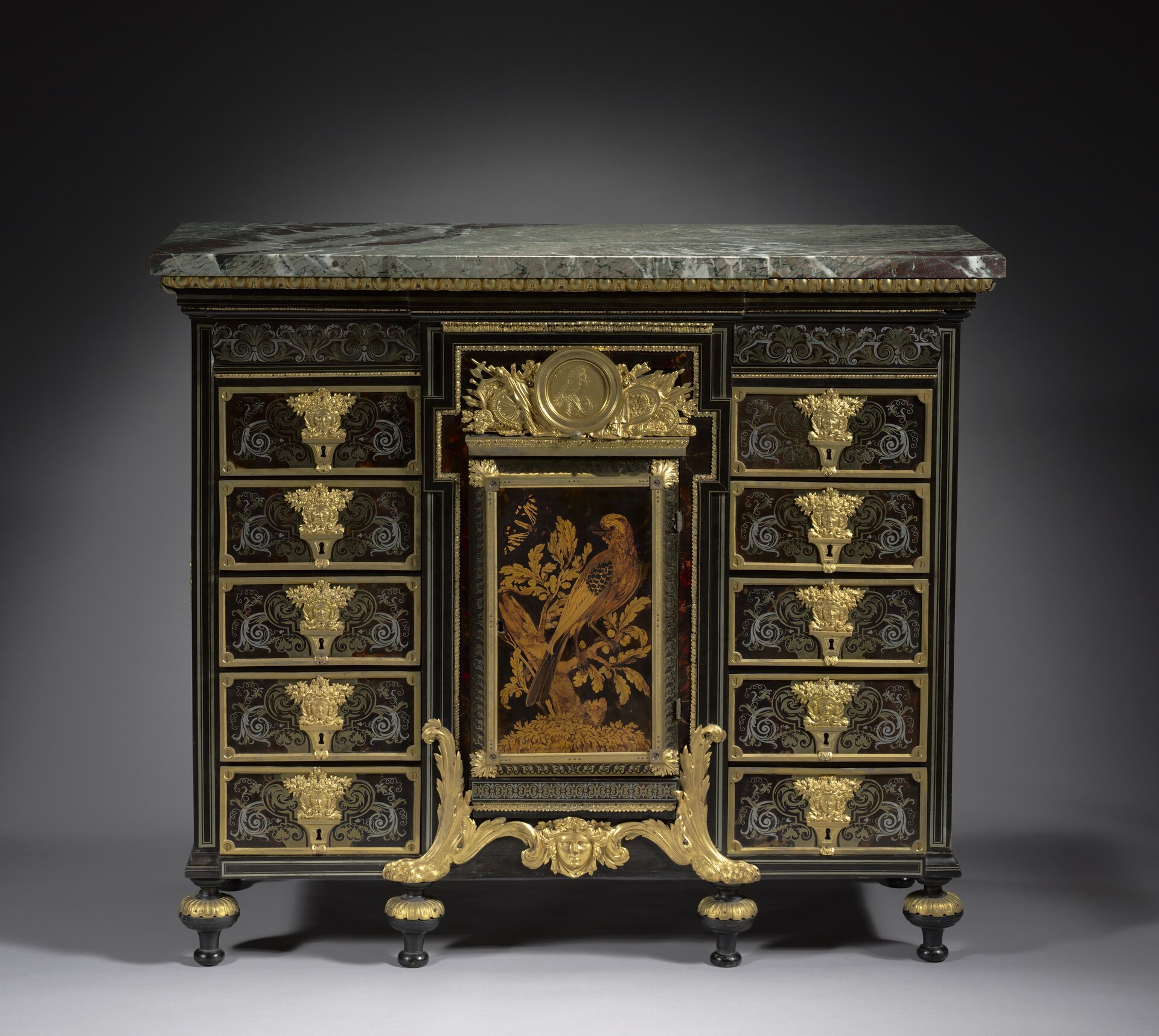
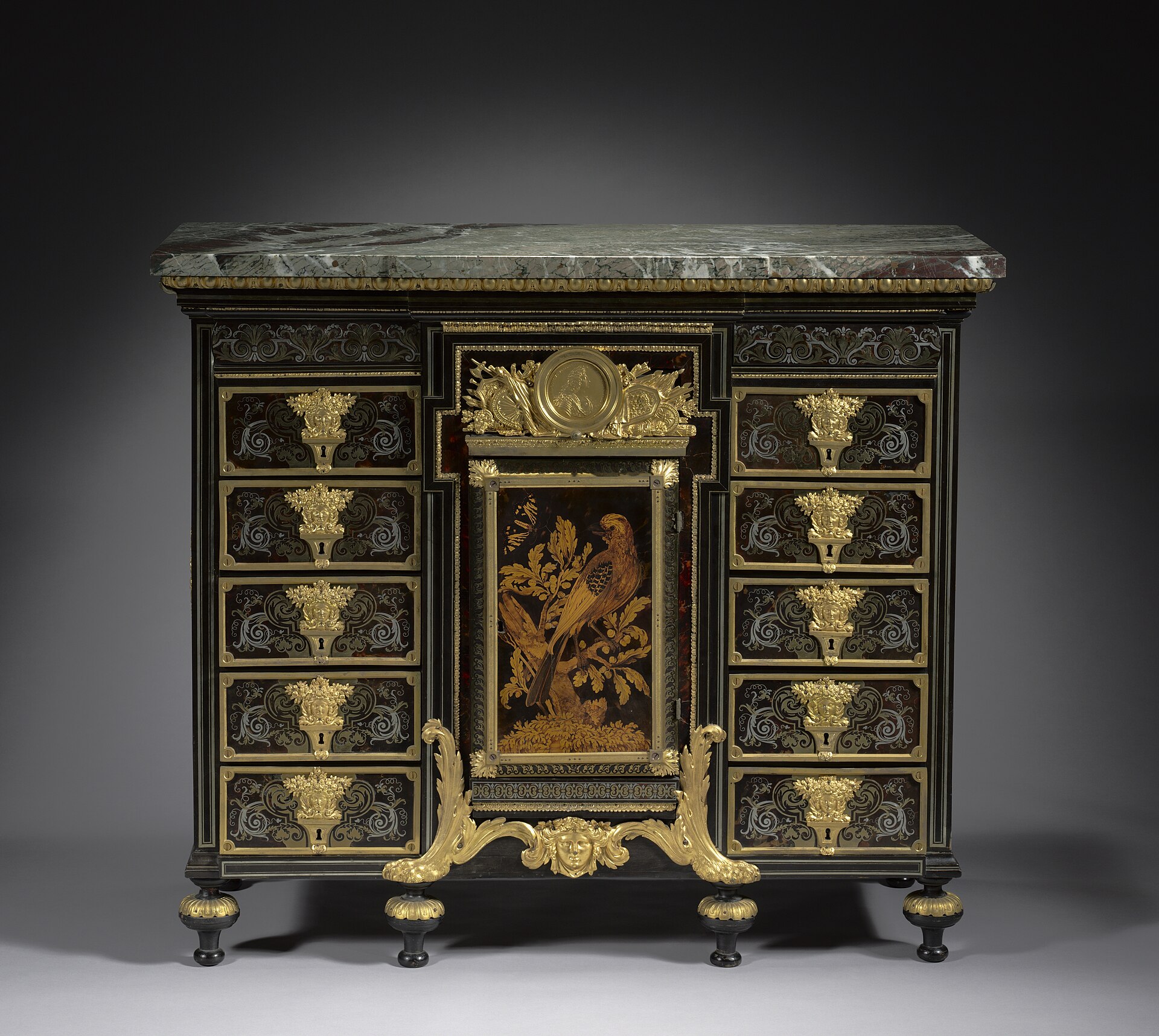
Cabinet, about 1690 Ebony veneer with brass-and-tortoiseshell marquetry and gilt-bronze mounts, attributed to Boulle. Cleveland Museum of Art, 1949.539. No verified portrait. No securely identified likeness of this maker is known under a free licence. We do not publish a face we cannot verify.
Cleveland Museum of Art, John L. Severance Fund, 1949.539| Worked as | Cabinetmaker (ebeniste), Marquetry maker, Bronze chaser and gilder |
|---|---|
| Born | 11 November 1642 (his own declared date, given on his... · Paris, France |
| Died | 29 February 1732 · the Louvre, Paris |
| Nationality | French |
| Movement | French court decorative arts under Louis XIV |
| In this archive | 1 artwork |
| Sources | 14 cited |
| Last verified |
About this page 1 artwork in the archive · Last verified · 14 sources cited
No piece of furniture made by Andre-Charles Boulle carries his signature or his stamp. Every attribution to him rests on connoisseurship, archival documents that name a commission without describing the object that survives, or a resemblance to his own printed designs - never on a mark he put on the wood himself. That single fact governs everything else on this page: the size of his surviving output, which pieces are genuinely his workshop's and which are his four sons' or a nineteenth-century admirer's, and why scholars still argue case by case, institution by institution, more than three hundred years after his death.
Boulle gave his name to a technique he did not invent: veneering furniture with brass, pewter and tortoiseshell cut from a single sandwich of material into matching positive and negative patterns, so that one panel shows brass inlaid into shell and its pair shows shell inlaid into brass. He held the title of cabinetmaker to Louis XIV, was given lodgings inside the Louvre itself, and ran three workshops at once - and still spent most of his working life in debt, because nearly everything he earned went on paintings, drawings and prints he could not stop buying. In 1720 a fire in a neighbouring workshop reached his own and destroyed most of what that habit had built. What is hard to find about Boulle is not the shape of his furniture, which museums photograph constantly; it is the honest boundary of what he actually made with his own hands, against three centuries of work made in his name.
c. 1690 · Ebony veneer over a carcase
Cleveland Museum of Art, Gallery 215
Born 11 November, by his own declaration on his 1677 marriage certificate; no independent birth record survives.1
Getty Museum's own dating records him as master cabinetmaker before this year; the only surviving document from his early career is a notarial apprenticeship contract for his nephew, dated 19 July.13
Granted lodgings in the galleries of the Louvre, succeeding the cabinetmaker Jean Mace, and given the title of cabinetmaker and sculptor to Louis XIV, exempting him from ordinary guild restrictions.13
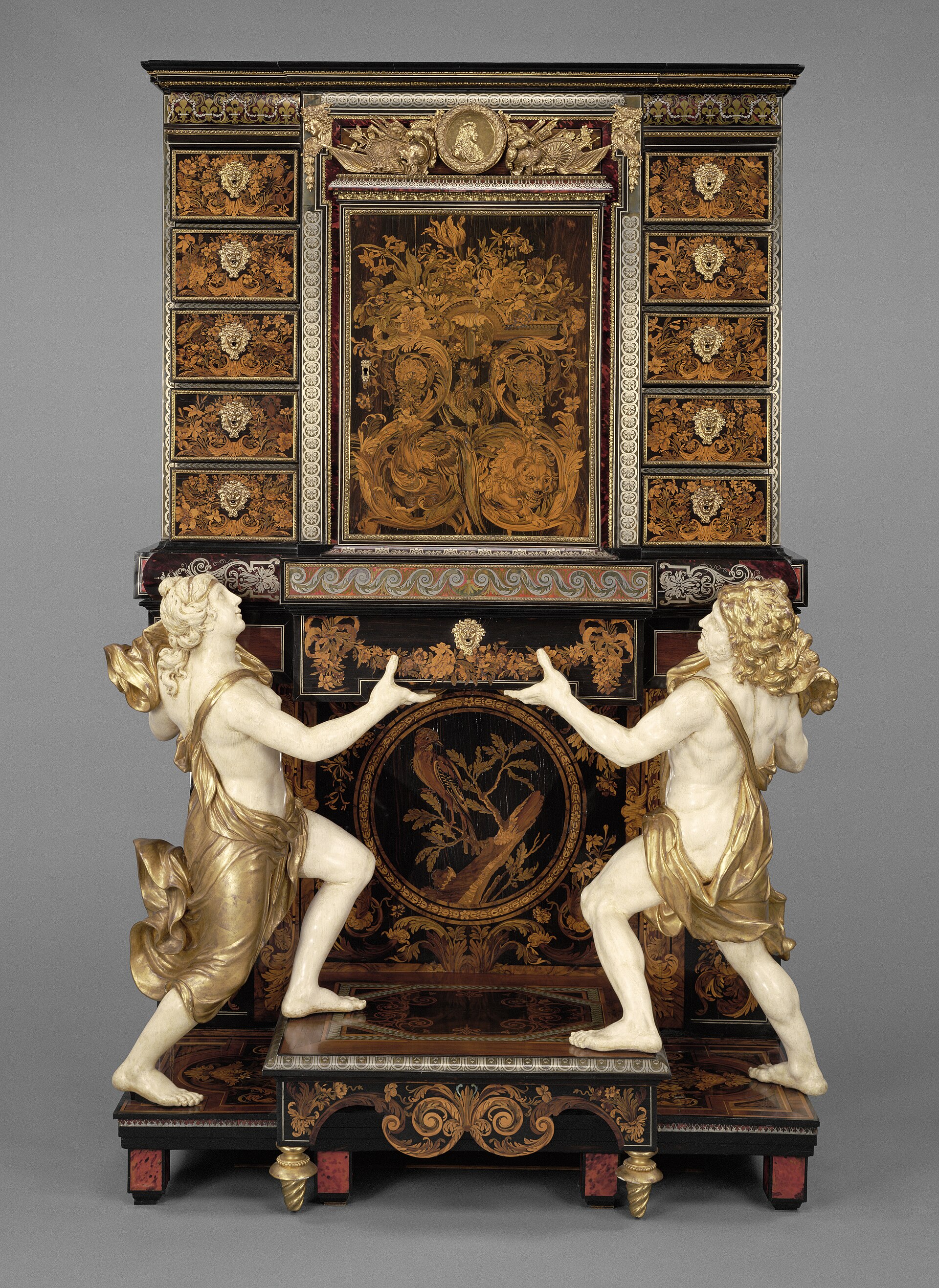
Approximate date of the Cabinet on Stand now at the J. Paul Getty Museum (77.DA.1), its marquetry celebrating France's victories in the Dutch War of 1672-78.1
Approximate date of the Two Coffers on Stands now at the J. Paul Getty Museum (82.DA.109).2
Supplies a pair of octagonal pedestals to the Grand Dauphin at Versailles, built to display two Algardi firedogs the Dauphin owned.9
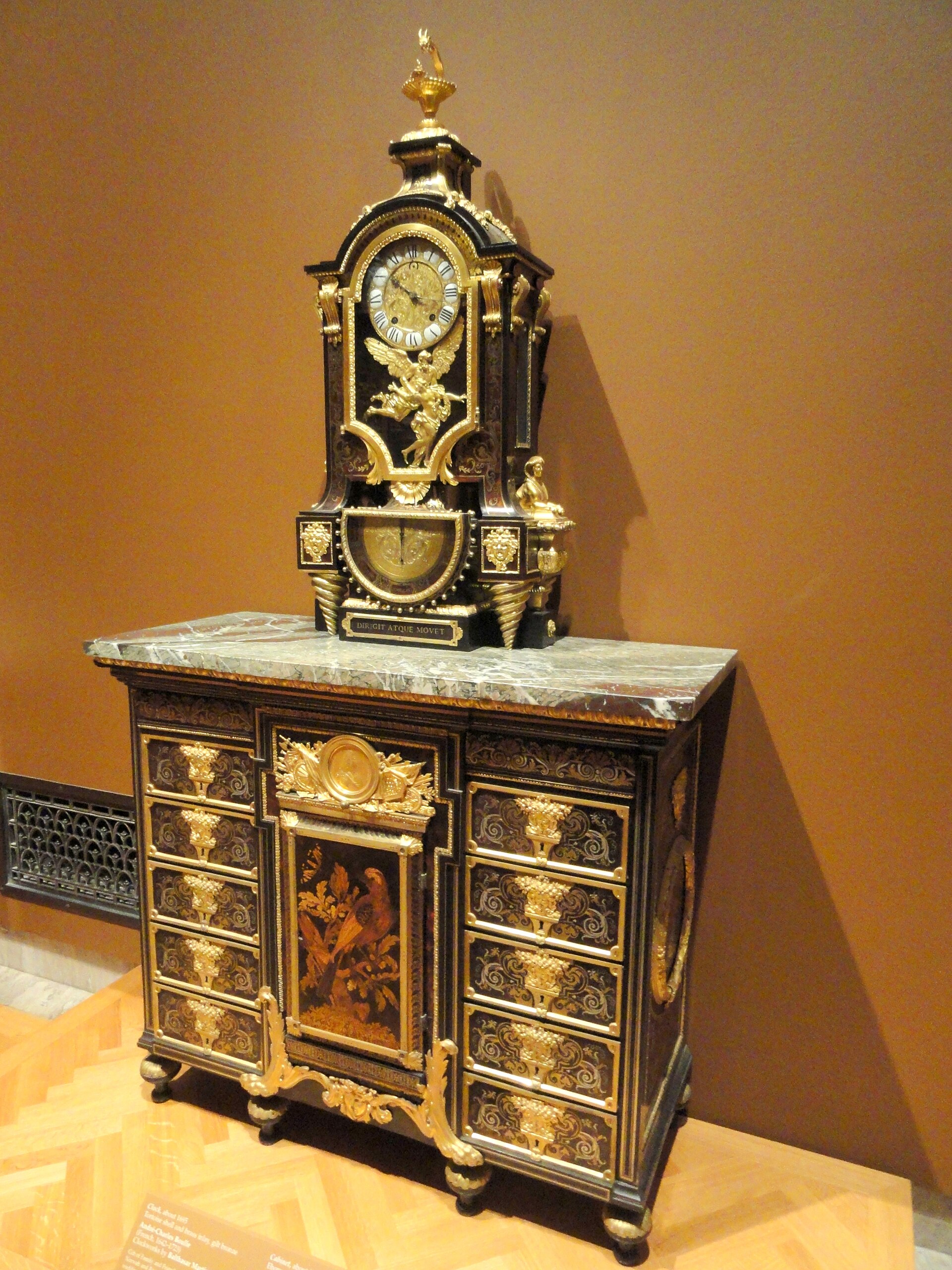
Approximate date of the cabinet now at the Cleveland Museum of Art (1949.539).
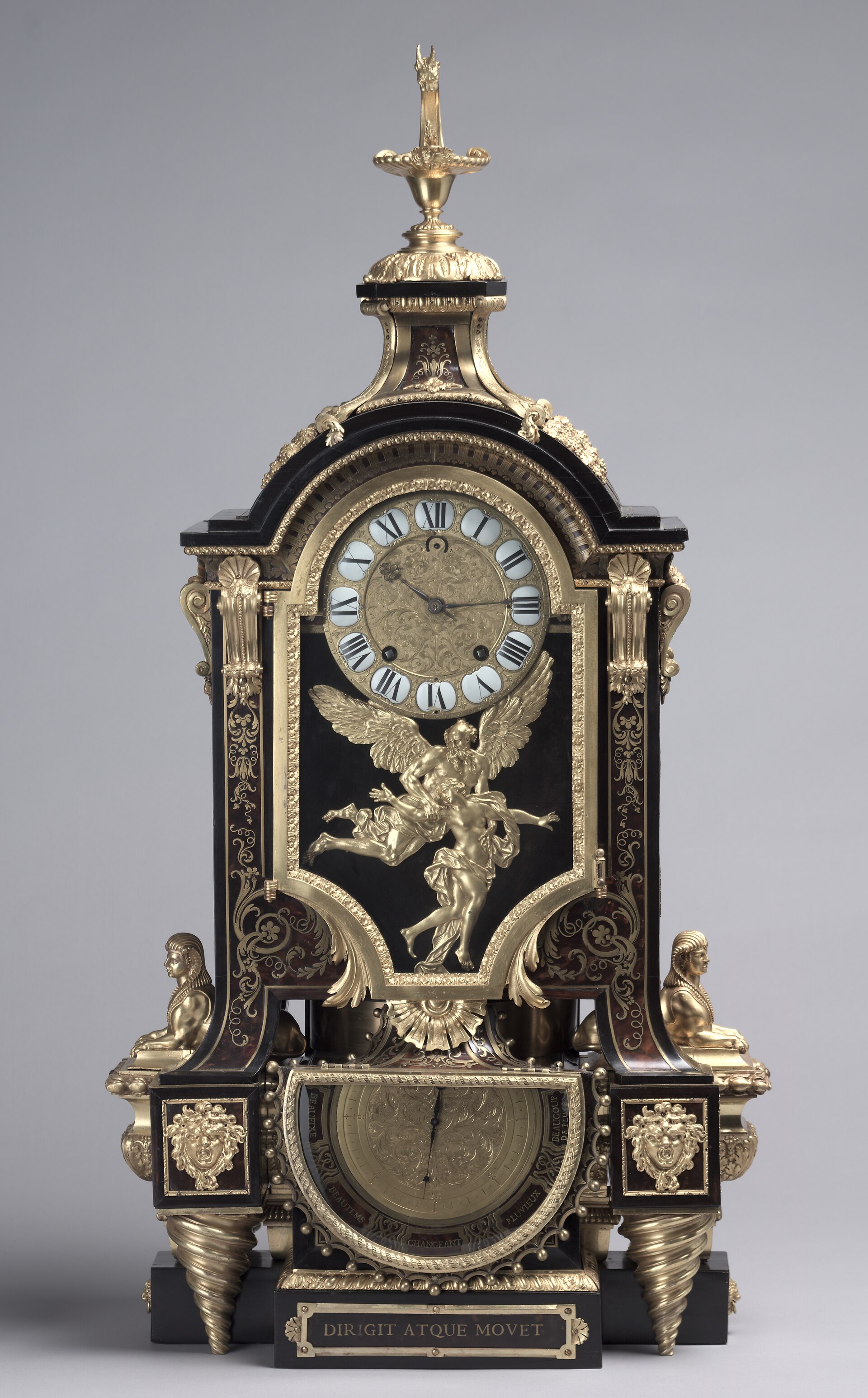
Approximate date of the mantel clock, with movement by Balthasar Martinot, now at the Cleveland Museum of Art (1967.153).5
Approximate date of the cabinet now at the Metropolitan Museum of Art (59.108), analysed in detail by curator Wolfram Koeppe.4
Louis XIV grants Boulle six months' formal protection from his creditors, on condition he use the time to settle his affairs.13
Approximate publication date of Boulle's own engraved design series, published by Jean Mariette, fixed by a Duke of Wurttemberg representative's purchase of a set in early 1709.6
Delivers a pair of chests of drawers to Louis XIV's bedroom at the Grand Trianon, using Indian coralwood drawers found nowhere else in his documented output.7
6 October: formally transfers his workshop and its contents to his four sons; the accompanying inventory is one of the only surviving documents describing his materials in his own hand.713
Night of 30 August: a fire spreading from a neighbouring workshop destroys most of his stock, tools and personal art collection, including forty-eight drawings attributed to Raphael.1013
Dies 29 February in the Louvre, leaving debts to his four sons.13
The Paris furniture guild's requirement that makers stamp their work with the JME mark is rigorously enforced for the first time - after Boulle's death, so a stamped piece cannot be his own hand.8
The 4th Marquess of Hertford commissions at least seven acknowledged reproductions of historic Boulle pieces, not disguised as originals.8
The J. Paul Getty Museum acquires the Cabinet on Stand (77.DA.1) from the heirs of the 6th Viscount Gort.1
The J. Paul Getty Museum acquires the Two Coffers on Stands (82.DA.109) through the dealer Lazare Freres, from Helene Violette de Talleyrand.2
30 October to 31 January 2010: 'A New Style for Europe', the first full retrospective of Boulle's work, opens at the Museum fur Angewandte Kunst, Frankfurt, curated by Jean-Neree Ronfort.14
8 June to 6 October: the Musee Conde at the Chateau de Chantilly holds the first exhibition on Boulle's life and work staged in France, curated by Mathieu Deldicque, Sebastien Evain and William Iselin.14
Documented sales of pieces securely attributed to Boulle's own workshop are infrequent and the closely related comparanda published by the major auction houses are more informative than any single headline result. A commode closely related in design to a Boulle-attributed example, formerly owned by the Marquis Ferdinand de Ghistelles, made 620,000 pounds at Sotheby's London in 2000; a separate, similarly related commode, with its own distinct provenance through the Earls Cowper and Rosemary, Lady Ravensdale, made 275,000 pounds at Christie's London in 1989 - the same 2004 catalogue note cites both as comparanda, not as a pair with each other. Neither figure is broken out into hammer price against buyer's premium in the source that reports them, and this record repeats that limitation rather than inventing a split. Separately, comparanda and archival research - not a saleroom discovery - reunited two halves of a single premiere-partie and contre-partie commode pair sold apart in 2015 and 2020, a reminder that for this maker provenance research is itself a form of connoisseurship with direct market consequences.
| Date | Sale | Work | Result | Note |
|---|---|---|---|---|
| 7 December 2000 | Sotheby's | Louis XIV ormolu-mounted commode, closely related in design to the Boulle-attributed lot 33 of the Greenberg Collection sale | With premium GBP 620,000 (price achieved; source does not separate hammer from premium) GBP | Cited by Sotheby's own 2004 catalogue note as a comparandum for lot 33 of the Greenberg Collection sale, formerly owned by the Marquis Ferdinand de Ghistelles. |
| 22 June 1989 | Christie's | Contre-partie commode of the same closely related type, formerly in the collection of the Earls Cowper, Panshanger | With premium GBP 275,000 (price achieved; source does not separate hammer from premium) GBP | Sold from the collection of Rosemary, Lady Ravensdale; cited only as a separate comparandum, not as a pair with the 2000 Sotheby's lot. |
Hammer is the price at which the bidding stopped; with premium adds the fee the house charges the buyer on top. Hammer price and buyer's premium in the glossary.
| Institution | City | Holdings | Note |
|---|---|---|---|
| Wallace Collection | London | The largest single documented holding of Boulle and Boulle-style furniture, catalogued in full by Peter Hughes (1996). | Built by the 4th Marquess of Hertford and Sir Richard Wallace. |
| Musee du Louvre | Paris | Multiple cabinets, a floral-marquetry wardrobe, and pieces with direct royal provenance. | |
| Chateau de Versailles | Versailles | Furniture from the Grand Dauphin's apartments and the Grand Trianon commission of 1708-9. | |
| J. Paul Getty Museum | Los Angeles | 21 objects attributed to Boulle in some degree, including the Cabinet on Stand (77.DA.1) and the Two Coffers on Stands (82.DA.109) illustrated on this page. | |
| Metropolitan Museum of Art | New York | A cabinet of about 1700 (59.108), catalogued in detail by curator Wolfram Koeppe. | |
| Cleveland Museum of Art | Cleveland | A cabinet of about 1690 (1949.539) and a mantel clock of about 1695 with movement by Balthasar Martinot (1967.153). | |
| Musee Jacquemart-Andre, Abbaye de Chaalis | Chaalis, France | The pair of octagonal pedestals made for the Grand Dauphin in 1686. |
The technique pairs two sheets of contrasting material - most often brass and tortoiseshell, sometimes with pewter, horn or ivory added - glued into a single sandwich and cut together with a fine saw...
The technique pairs two sheets of contrasting material - most often brass and tortoiseshell, sometimes with pewter, horn or ivory added - glued into a single sandwich and cut together with a fine saw following one design. Separating the sandwich yields two complementary panels: premiere-partie, where the pale metal sits inlaid into the dark shell ground, and contre-partie, the reverse, where shell fills a brass ground. Because both panels come from the same cutting, Boulle work was normally produced and sold as pairs, and a piece described as premiere-partie implies that a contre-partie twin exists or once did somewhere else.
The Metropolitan Museum's own catalogue entry on its cabinet of about 1700, written by curator Wolfram Koeppe, notes that contre-partie marquetry was roughly twenty percent less expensive to produce than premiere-partie - a straightforward cost difference that shaped which version a patron actually got, and one Koeppe reads as evidence that the Museum's own predominantly contre-partie cabinet once had a premiere-partie pair.
Boulle did not invent this marquetry; brass-and-shell inlay had circulated in Italy and the Netherlands before him. He raised it to an unmatched standard of finish and married it to gilt-bronze mounts, modelled in his own workshop, so that a three-dimensional bronze figure or scroll on the corner of a cabinet door often echoes, in relief, the flat pattern inlaid beside it.
The Wallace Collection's own research states plainly that none of the clocks or furniture that left Boulle's workshop bear his signature, and that attributions to him rest either on documentary...
The Wallace Collection's own research states plainly that none of the clocks or furniture that left Boulle's workshop bear his signature, and that attributions to him rest either on documentary evidence - a bill, an inventory entry, a royal commission record - or, far more often, on stylistic analysis of the object itself. An eighteenth-century sale catalogue description of 'une belle pendule' by Boulle is quoted by the Wallace Collection as a case in point: it calls the clock plausible as one of his good works, not certain, and that qualified confidence is the normal register of a Boulle attribution, not an exception to it.
A separate, later fact sharpens the problem rather than solving it. Furniture-making in Paris was placed under stricter guild control requiring makers to stamp their work with their name and the JME mark, but that requirement was not rigorously enforced until 1743 to 1751 - eleven to nineteen years after Boulle died in 1732. A stamped 'Boulle' piece is, by this chronology alone, evidence against a seventeenth or early-eighteenth-century date rather than for one; a genuine Boulle workshop piece from his lifetime is expected to carry no maker's mark at all.
Andre-Charles Boulle was born into the trade.
Andre-Charles Boulle was born into the trade. His father, Jean Boulle, was cabinetmaker to the king and lived, by royal decree, in the Louvre; his grandfather Pierre Boulle had held the same royal cabinetmaker's post under Louis XIII and had lived there before him. The Getty Museum's own catalogue record dates Boulle's mastership to before 1666, though almost nothing documents his training directly - the one surviving record of his early career is a notarial apprenticeship contract dated 19 July 1666, for his own nephew rather than for himself.
By 1672, at about thirty, Boulle had been granted lodgings in the galleries of the Louvre that Louis XIV reserved for his most favoured artists, succeeding the cabinetmaker Jean Mace. Being admitted to those galleries carried real practical value: it placed him outside the restrictions of the Paris guild system, which normally forbade a craftsman from working in more than one trade, and let him produce both furniture and gilt-bronze work himself rather than subcontracting the metal to a separate guild bronzier. The Getty Museum's own account of the artist records that his contemporaries called him, in translation, the most skillful artisan in Paris - the assessment behind the royal favour.
Boulle's most important patron after the king himself was the Grand Dauphin, Louis XIV's son, for whose apartment at Versailles he built the Cabinet of Mirrors: a room whose floor and ceiling were...
Boulle's most important patron after the king himself was the Grand Dauphin, Louis XIV's son, for whose apartment at Versailles he built the Cabinet of Mirrors: a room whose floor and ceiling were set with mirrors framed in Boulle's own marquetry panelling, built to display the Dauphin's collection of porcelain, gems and small bronzes. The Wallace Collection's own published research on the commission establishes that Boulle also supplied a pair of octagonal pedestals to the Dauphin in 1686, made specifically to display two firedogs by the sculptor Alessandro Algardi - the tops of the pedestals are shaped to match the bronzes' own bases, meaning the furniture was designed around a specific pair of objects rather than as a generic stand. Those pedestals were moved with the Dauphin's collection from Versailles to the Chateau de Choisy in 1693 and to Meudon in 1695, then sold during the French Revolution; they and the firedogs both survived and are now divided between the Abbaye de Chaalis and the Wallace Collection, the latter's pair having been bought back into a single English collection by the 4th Marquess of Hertford.
Boulle's furniture also carried political content when the commission called for it. The Getty Museum's own catalogue note on its Cabinet on Stand of about 1675 to 1680 describes the marquetry on the central door as showing the cockerel of France standing over the eagle of the Holy Roman Empire and the lion of Spain and the Spanish Netherlands - a direct reference to France's victory in the Dutch War of 1672 to 1678 - with fleurs-de-lis worked into the top identifying the piece unambiguously as a royal commission rather than decoration chosen for its own sake.
The Metropolitan Museum's own catalogue entry on its cabinet of about 1700, written by curator Wolfram Koeppe, sets out in detail how Boulle's workshop economised on an object that reads, from the...
The Metropolitan Museum's own catalogue entry on its cabinet of about 1700, written by curator Wolfram Koeppe, sets out in detail how Boulle's workshop economised on an object that reads, from the front, as unlimited expense. Ebony was bought by the pound and was the most costly material in the piece; on the Museum's own cabinet, genuine ebony veneer is used only up to eye level, and above that height - where a viewer looks up rather than straight on - it is replaced with local fruitwood stained black to match. The inside of the doors, never intended to face the room, is veneered with plain burl wood stained to imitate the tortoiseshell used everywhere on the exterior. The degree of hand-chiselling on the gilt-bronze mounts increases the closer they sit to eye level.
Koeppe's entry also records that the piece was built predominantly in contre-partie, the cheaper of the two marquetry types, which he reads as evidence that a matching premiere-partie cabinet - the more expensive half of the pair - once existed alongside it, now lost or unidentified. Mount patterns such as rosettes, scrolls and hinges recur across different Boulle workshop pieces closely enough that Koeppe judges them to have been prefabricated in batches and held in stock rather than made afresh for each commission. In spite of its scale, the cabinet is built to come apart for transport in fifteen to twenty minutes.
A 1715 deed by which Boulle transferred his workshop to his four sons included an inventory of its contents, and it is one of the only surviving documents to describe his materials in his own working...
A 1715 deed by which Boulle transferred his workshop to his four sons included an inventory of its contents, and it is one of the only surviving documents to describe his materials in his own working lifetime. The inventory lists oak, fir, walnut, cherry, 'Norwegian wood', an unidentified 'yellow wood', ash, ebony, red or sandalwood, wood from the Baltic port of Stettin, boxwood, barberry, holly and brazilwood - but, as the Wallace Collection's own conservation research points out, it does not mention brass, pewter or tortoiseshell at all, the three materials that define Boulle work to a modern eye.
Technical study complicates the obvious assumption about the wood. Given the Baltic timber named in the inventory, high-quality oak used in Boulle furniture might be expected to come from Poland or Norway by way of Stettin; dendrochronological analysis has instead shown that the oak in Boulle's furniture came primarily from French forests. A separate wood identified by X-ray fluorescence and other technical analysis on Getty and Louvre pieces attributed to Boulle around 1690 is naturally golden-yellow mulberry, plausibly the inventory's mysterious 'yellow wood'. For the pair of chests of drawers he delivered to Louis XIV's bedroom at the Grand Trianon in 1708-9, Boulle used drawers of Indian coralwood (Pterocarpus indicus), a timber the Wallace Collection's own conservation team describes as used uniquely for that one royal commission - a deliberately singular material choice for a piece meant to be recognised as unrepeatable. Analysis of the floral marquetry wardrobe in the Louvre, carried out during its restoration at the Centre de recherche et de restauration des musees de France, further found copper- and iron-based pigments applied directly behind the tortoiseshell and paper inserts placed under the shell to introduce blue, red and black colour into the marquetry - meaning some of the colour a viewer sees in Boulle work is paint hidden under translucent shell, not the natural material alone.
On the night of 30 August 1720, a fire that began in a workshop next door to Boulle's own spread into his premises at the Place du Louvre, one of the three workshops he then maintained.
On the night of 30 August 1720, a fire that began in a workshop next door to Boulle's own spread into his premises at the Place du Louvre, one of the three workshops he then maintained. It destroyed twenty workbenches, the tools of eighteen ebenistes and two menuisiers, and most of his stock of seasoned precious wood, models and finished furniture. Boulle petitioned the Regent for financial assistance afterward; whether that petition succeeded is not recorded in the sources consulted for this page.
The fire's cost went beyond his trade stock. Boulle was an obsessive, undisciplined collector of Old Master paintings, drawings and prints, a habit his friend the connoisseur Pierre-Jean Mariette said he could never cure himself of and which was blamed by contemporaries for his chronic debt. The inventory of what the 1720 fire destroyed, by report, exceeded 40,000 livres in value and included forty-eight drawings attributed to Raphael, wax models attributed to Michelangelo, and the manuscript journal Peter Paul Rubens is said to have kept during his travels in Italy - a documented loss on the scale of a small museum's holdings, destroyed in one night in a working cabinetmaker's shop.
The fire also, incidentally, gives furniture historians one of their few fixed dates. A desk now at the Chateau de Chantilly, described by the museum's own curatorial team as the only Boulle desk that can be firmly dated, is known to have been saved from the fire of 30 August 1720 - which fixes it to that date or earlier and makes it a rare anchor point in a corpus otherwise dated almost entirely by style.
Boulle's chronic financial trouble was serious enough that in 1704 Louis XIV granted him six months' formal protection from his creditors, on the explicit condition that he use the time to put his...
Boulle's chronic financial trouble was serious enough that in 1704 Louis XIV granted him six months' formal protection from his creditors, on the explicit condition that he use the time to put his affairs in order - the king's decree apparently warning that this would be the last such grace extended to him. The pattern outlived him: one of his sons was later arrested for debt at Fontainebleau and was imprisoned until Louis XV personally ordered his release.
On 6 October 1715, some seventeen years before his death, Boulle formally transferred his workshop and its contents to his four sons - Jean-Philippe (1678-1744), Pierre-Benoit (about 1683-1741), Andre-Charles II (1685-1749) and Charles-Joseph (1688-1754). All four were granted the same royal title of ebeniste du roi their father had held, and all four went on producing furniture in the family style and technique for decades after 1715, including through the years of Boulle's own death in 1732 and well past it. Three of the four brothers are recorded as having died in debt themselves. The practical consequence for this page's subject is unavoidable: a great deal of furniture catalogued loosely as 'Boulle' or 'Boulle workshop' from the first half of the eighteenth century may in fact be the work of one of these four sons, made after the founder's death, in a style he had already fixed but did not personally execute.
Boulle's technique was fashionable again in the nineteenth century, and reputable dealers commissioned open, acknowledged copies of specific historic pieces rather than disguised fakes.
Boulle's technique was fashionable again in the nineteenth century, and reputable dealers commissioned open, acknowledged copies of specific historic pieces rather than disguised fakes. The Wallace Collection's own conservation history records that Richard Seymour-Conway, 4th Marquess of Hertford, commissioned at least seven such reproductions between 1853 and 1857, including two copies of the Elector of Bavaria's writing table at a combined cost of 1,650 pounds and a copy of Jean-Henri Riesener's jewel cabinet for the comtesse de Provence at 2,500 pounds - for comparison, Hertford paid 4,550 pounds the year before for Rubens' The Rainbow Landscape, a point the Wallace Collection's own furniture catalogue by Peter Hughes uses to show how seriously Hertford rated fine Boulle furniture against major paintings of the period. These were legitimate, acknowledged copies, not forgeries, and no attempt was made to pass them off as seventeenth-century originals.
Separating a genuine Boulle-workshop piece from a later copy in the same technique, when a dealer's paper trail has not survived, falls back on the same tools used for attribution generally: the absence of a maker's stamp on anything genuinely from Boulle's lifetime (see above), technical analysis of the wood and pigments, and comparison against Boulle's own printed designs and surviving drawings. Connoisseurs also point to a broader stylistic tell: the architectural symmetry and restraint of Boulle's own late-seventeenth and early-eighteenth-century designs, against the freer proportions nineteenth-century revival makers allowed themselves when adapting the technique to contemporary taste. None of this produces certainty case by case, which is why so much surviving furniture is catalogued as 'attributed to' or 'circle of' Boulle rather than given to him outright.
No catalogue raisonne fixes a numbered, agreed corpus of Boulle's work the way one exists for many painters.
No catalogue raisonne fixes a numbered, agreed corpus of Boulle's work the way one exists for many painters. The J. Paul Getty Museum alone holds twenty-one objects attributed to him in some form, from cabinets and clocks to candelabra and gueridons. Peter Hughes's three-volume Wallace Collection Catalogue of Furniture, published in 1996, remains the single most rigorous piece of cataloguing done on this material - 337 entries covering the Wallace's eighteenth-century French furniture in full technical and historical detail - but it catalogues one collection's holdings, Boulle and Boulle-style alike, rather than Boulle's total output.
The closest thing to a full retrospective survey is Jean-Neree Ronfort's 'Andre-Charles Boulle, 1642-1732: A New Style for Europe', the catalogue of an exhibition held at the Museum fur Angewandte Kunst in Frankfurt from 30 October 2009 to 31 January 2010 - described at the time as the first retrospective ever devoted to him, the product of eight years of research by an international team, bringing together 121 works of which about seventy-five were furniture or decorative art objects. Chantilly's Musee Conde held its own exhibition, curated by Mathieu Deldicque with Sebastien Evain and William Iselin, from 8 June to 6 October 2024 - described by its organisers as the first exhibition on Boulle's life and work held in France itself, as distinct from the earlier Frankfurt retrospective. There is, in short, no single ruling authority on attribution today: it is argued piece by piece among specialist furniture historians - Ronfort, the late Alexandre Pradere, Hughes, Peter Fuhring and the Chantilly curatorial team among them - drawing on documents, technical analysis and stylistic comparison, with no board or committee that issues a final ruling the way some painters' foundations do.
Sotheby's own 2004 catalogue note on a Louis XIV commode attributed to Boulle traces a chain of closely related, near-identical commodes across two centuries of sales and collections, and gives real...
Sotheby's own 2004 catalogue note on a Louis XIV commode attributed to Boulle traces a chain of closely related, near-identical commodes across two centuries of sales and collections, and gives real comparanda with real figures. A commode formerly owned by the Marquis Ferdinand de Ghistelles sold at Sotheby's London on 7 December 2000 for 620,000 pounds; a separate commode, from the collection of the Earls Cowper and later Rosemary, Lady Ravensdale, sold at Christie's London on 22 June 1989 for 275,000 pounds. The catalogue note cites both only as comparanda to the lot it describes - which itself descended from the Comte de Vaudreuil to Thomas Philip, 2nd Lord de Grey, and by descent at Newby Hall - not as a pair with each other. Sotheby's own catalogue text reports these as the prices the lots made without separating a hammer figure from a buyer's premium, so this record repeats them on the same basis rather than inventing a split the source does not give.
A separate case shows how comparanda research itself can locate objects. Sotheby's identified a commode en tambour offered in Paris on 16 June 2020, estimated at 400,000 to 800,000 euros, as one half of a premiere-partie and contre-partie pair - the two halves of a single cut sandwich of marquetry, sold apart for generations without either owner knowing the other half existed. Sotheby's traced the contre-partie twin to a November 2015 Paris sale from the Rohan-Chabot collection, and established the attribution and the pairing by comparing both objects against Boulle's own preparatory drawings held at the Hermitage Museum in Saint Petersburg - provenance research and connoisseurship working together to reunite, on paper, two objects that had been apart since at least the eighteenth century.
The largest single documented holding is the Wallace Collection in London, built by the 4th Marquess of Hertford and Sir Richard Wallace in the nineteenth century and catalogued in full by Peter...
The largest single documented holding is the Wallace Collection in London, built by the 4th Marquess of Hertford and Sir Richard Wallace in the nineteenth century and catalogued in full by Peter Hughes. The Musee du Louvre and the Chateau de Versailles hold pieces with direct royal provenance, including furniture from the Grand Dauphin's own apartments. The J. Paul Getty Museum in Los Angeles holds twenty-one attributed objects, among them the Cabinet on Stand of about 1675-80 and the Two Coffers on Stands of about 1684-89 illustrated on this page. The Metropolitan Museum of Art in New York, the Cleveland Museum of Art and the Frick Collection in New York each hold individual pieces with their own published catalogue entries, and the Musee Jacquemart-Andre's Abbaye de Chaalis holds the pair of pedestals made for the Grand Dauphin in 1686.
Cabinetmaker (ebeniste); Marquetry maker; Bronze chaser and gilder. 1642-1732.
Born 11 November 1642 (his own declared date, given on his marriage certificate of 1677; no birth record survives), Paris, France; died 29 February 1732, the Louvre, Paris.
Nineteenth-century Boulle revival, generally. Boulle's technique returned to fashion in the nineteenth century. Reputable dealers and patrons, including the 4th Marquess of Hertford, commissioned open reproductions of specific historic pieces rather than disguised fakes - Hertford ordered at least seven between 1853 and 1857, priced comparably to major Old Master paintings he bought the same decade.
Wallace Collection (London); Musee du Louvre (Paris); Chateau de Versailles (Versailles); J. Paul Getty Museum (Los Angeles); Metropolitan Museum of Art (New York); Cleveland Museum of Art (Cleveland).
Documented sales of pieces securely attributed to Boulle's own workshop are infrequent and the closely related comparanda published by the major auction houses are more informative than any single headline result. A commode closely related in design to a Boulle-attributed example, formerly owned by the Marquis Ferdinand de Ghistelles, made 620,000 pounds at Sotheby's London in 2000; a separate, similarly related commode, with its own distinct provenance through the Earls Cowper and Rosemary, Lady Ravensdale, made 275,000 pounds at Christie's London in 1989 - the same 2004 catalogue note cites both as comparanda, not as a pair with each other.
Where Boulle's own personal art collection - what survived the 1720 fire - actually went after his 1732 death sale, which the Wallace Collection's own research notes was conducted without a printed catalogue.
One family name appears in nine records in this archive across seven object classes.
9 min read
Thirty-two objects in this archive were bought on the income of six named endowment funds, and in every case the person named had...
10 min read
Last verified
One artwork and its story every Tuesday, with the picture: who owned it, what it made, and what closes soon in the exhibition calendar. No promotion, and nothing we cannot cite.
We send one email to confirm the address and keep nothing else. Every letter carries a one-click unsubscribe. How we handle your data.