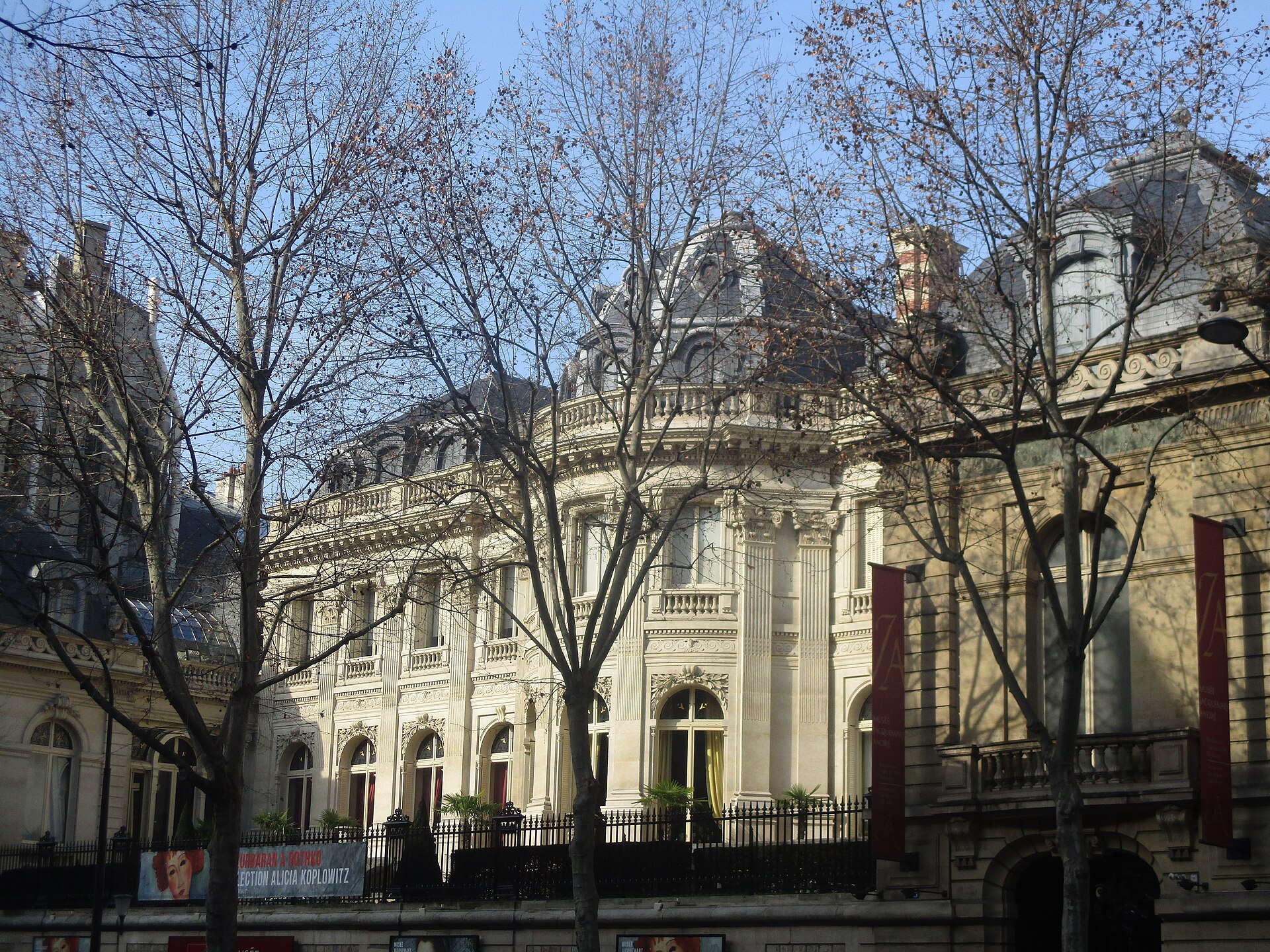
The mansion's facade on Boulevard Haussmann, built 1869-1876 to the design of the architect Henri Parent.
Thomon · CC BY-SA 4.0Musee Jacquemart-Andre
Museum · Musée Jacquemart-André · Founded 1913
Open, admission and hours confirmed 18 August 2026 · 11 sources
On this page 15 sections
ContentsClose
The collection's strength is the split itself: French 18th-century decorative art and painting on the ground floor, assembled by a banker with conventional taste for his period, against an Italian Renaissance collection at the back of the house assembled by a portrait painter with an independent eye, including Uccello, Mantegna, Bellini, Carpaccio and Botticelli. Few private house-museums anywhere hold Renaissance panel painting of this quality; the trade-off is depth without range, since the collection stops at the late 18th and 19th century and makes no claim on anything modern.
| Local name | Musée Jacquemart-André |
|---|---|
| Kind | Museum |
| Founded | 1913 |
| City and country |  Paris, France Paris, France |
| Address | 158 boulevard Haussmann, 75008 Paris, France |
| Website | musee-jacquemart-andre.com/en |
| Status | Open, confirmed |
| Record last verified |
Visiting
- Hours
- Every day, until 10 September 202610:00 to 18:00Last admission 30 minutes before closing
- Monday-Thursday, from 11 September 202610:00 to 18:00
- Friday, from 11 September 202610:00 to 22:00
- Saturday-Sunday, from 11 September 202610:00 to 19:00
- Admission
- Full price (permanent collection)EUR 19Rate for the permanent-collection-only period running 3 August to 10 September 2026
- ReducedEUR 15.50
- Youth, 7-18 yearsEUR 10
- Family (2 adults + 2 children 7-18)EUR 51
- Under 7FreeFree
- Tickets
- musee-jacquemart-andre.com/en/tickets The museum's own ticket page.
- Do I need to book?
- Not required but recommended; online tickets are timed only during the busiest periods and carry no fixed date otherwise
- Address
- 158 boulevard Haussmann, 75008 Paris, France MapMetro Line 9 and Line 13, Saint-Augustin, Miromesnil or Saint-Philippe du Roule stations
RER Line A, Charles de Gaulle-Etoile station
Bus Lines 22, 28, 43, 52, 54, 80, 83, 84, 93 - Website
- musee-jacquemart-andre.com/en
- Telephone
- +33 1 45 62 11 59
Before you go how long, access, photography, bags, eating, shop
- How long to allow
- One and a half to two hours for the mansion and the Italian Museum; visitors who add the tea room should allow longer, since it is a destination in its own right
- Access
- Wheelchair accessible; strollers and suitcases are not allowed in the galleries and must be left in the cloakroom
- Photography
- Not addressed on the pages fetched for this record; not stated here rather than assumed
- Bags
- Strollers and suitcases are prohibited in the galleries and must be stored in the cloakroom
- Eating
- Le Nelie, a restaurant and tea room in the former dining room beneath a Tiepolo ceiling, widely singled out by visitors and guides as one of the best tea rooms in Paris
- Shop
- A cultural gift shop operates on site, and a separate online boutique sells museum publications
Prices and hours change. We take them from the institution's own pages and print the day we read them, and you can check the current position at the source we used. Confirm before you travel.
What is inside
The grand salons and private apartments
The ground-floor reception rooms Edouard Andre and Nelie Jacquemart used to entertain Parisian society: the smoking room, the tapestry salon, the music room and the winter garden, hung with the couple's 18th-century French paintings by Boucher, Fragonard, Chardin and Nattier and furnished exactly as they left it, since the museum was never redecorated after 1913.
The grand staircase
A double spiral staircase rising through the centre of the mansion beneath Giambattista Tiepolo's 1745 ceiling fresco of Henri III being received at the Villa Contarini, brought to Paris from a villa outside Venice and installed as the visual centrepiece of the house.
The picture gallery
The main run of Northern and French Old Master paintings, including Rembrandt's Pilgrims of Emmaus and portraits, Van Dyck, Frans Hals, and works by David and Guardi, hung salon-style against the room's original wall coverings.
The Italian Museum: sculpture gallery
A gallery of Italian Renaissance sculpture that Nelie Jacquemart installed after Edouard's death, arranged by her own eye rather than by school or date, including Donatello's Martyrdom of Saint Sebastian and busts by Bernini and Houdon.
The Italian Museum: Florentine gallery
A room fitted out as a private chapel or mausoleum, built around choir stalls, an altarpiece and a funerary monument, with Florentine School paintings including Botticelli's Virgin and Child and his Flight into Egypt, and Perugino's Virgin and Child.
The Italian Museum: Venetian gallery
Works from Venice and the northern Italian schools that reflected Edouard Andre's own preference, among them Paolo Uccello's Saint George and the Dragon, Andrea Mantegna's Ecce Homo, Vittore Carpaccio's Embassy of Hippolyta to Theseus, and paintings by Bellini, Crivelli and Schiavone, under a Venetian grisaille ceiling.
What to see first
Saint George and the Dragon
Paolo UccelloThe single painting most guides and the museum's own must-see list treat as the collection's centrepiece, and one of only a handful of Uccello panels outside Italy and the UK's National Gallery.3
Henri III Received at the Villa Contarini
Giambattista TiepoloA full ceiling fresco removed from a Venetian villa and rebuilt over the staircase specifically to be seen from below as a visitor climbs, rather than a canvas bought to hang on a wall.3
The Pilgrims of Emmaus
RembrandtOne of three Rembrandts in the house, painted with the extreme dark-and-light contrast that put 17th-century critics in mind of Caravaggio.3
The Flight into Egypt
Sandro BotticelliAn early Botticelli held in the Florentine gallery the couple built specifically to house their Tuscan Renaissance holdings.3
The Toilette and Sleep of Venus
Francois BoucherA pair of Rococo mythological scenes from the 18th-century French paintings that were Edouard Andre's own starting collection before Nelie widened it into Italian art.3
Ecce Homo
Andrea MantegnaA grisaille devotional panel in the Venetian gallery, the room built around Edouard Andre's personal preference for the Venetian school.3
Martyrdom of Saint Sebastian
DonatelloThe sculpture gallery Nelie Jacquemart installed alone, after her husband's death, on her own connoisseurship rather than a shared decision.3
The double spiral staircase
Henri Parent, architectThe mansion's own architecture is a highlight independent of any single object in it: a symmetrical neoclassical hotel particulier built in 1869-1876 specifically to be a private picture gallery, not adapted into one afterward.1
Exhibitions on now
A marriage of convenience that became a shared obsession
The Musee Jacquemart-Andre is the physical record of a partnership that started as a transaction and ended as a shared body of work neither party could have built alone. Edouard Andre, born in 1833 to a wealthy Protestant banking family, began collecting gold and silverware, jewellery, ceramics, miniatures and tapestries from 1860, alongside paintings by Delacroix and the Barbizon painters. Nelie Jacquemart, born in 1841 to a far more modest background, trained as a portrait painter and exhibited at the Salon; Edouard commissioned her to paint his portrait in 1872, and the two married in 1881. Contemporary accounts describe it plainly as a marriage of convenience between two very different people, and it is worth stating that plainly rather than romanticising it, because what makes the museum unusual is not a love story but two independent collecting sensibilities, a banker's taste for French decorative art and a painter's eye for Italian Renaissance work, operating inside one house and eventually merging into one collection.
A mansion built to be a picture gallery, not converted into one
The architect Henri Parent designed the mansion at 158 boulevard Haussmann between 1869 and 1876, in the middle of the Haussmann rebuilding that gave the street its name, with a symmetrical neoclassical plan built around a double spiral staircase specifically so the house could function as both a private residence and an exhibition space for the couple's collection. The 1876 inauguration was reported at the time for the sumptuousness of its materials. After their 1881 marriage the couple travelled repeatedly through Italy and the Near East, buying architectural fittings and decorative work as they went and having them installed into rooms built to receive them, rather than filling existing rooms with whatever they found; the Italian Museum sequence at the back of the house is the clearest result, three galleries assembled specifically to hold Renaissance sculpture and painting rather than repurposed drawing rooms.
A will that was contested, and a museum built from its terms
Edouard Andre died in 1893, having drawn up a will shortly before his death leaving everything to his wife; the bequest was challenged on the grounds that she had misappropriated the estate, and Nelie won the case. She spent the following two decades adding to the collection alone, including a world tour beginning in 1902 that brought back further Asian and Islamic material, and installed the sculpture gallery of the Italian Museum herself after her husband's death, the one part of the house that reflects her judgment without his. When she died on 15 May 1912 she left the mansion and its entire collection to the Institut de France, stipulating in her will that the collections be made available to the broadest possible public and setting out in detail how the museum should be arranged. It opened to the public on 8 December 1913 with the president of the Republic, Raymond Poincare, presiding; 800 people visited the following day, rising to 1,700 the Sunday after. The museum has been run under this bequest, by the Institut de France, ever since; day-to-day management has been contracted to the operator Culturespaces since 1996, which introduced seven-day-a-week opening, free audioguides and children's materials, and the current cafe and shop.
What is inside: two collections under one roof
The ground-floor reception rooms, the smoking room, the tapestry salon, the music room and a winter garden, hold Edouard Andre's own starting collection: 18th-century French painting by Boucher, Fragonard, Chardin and Nattier, and the decorative furniture and objects he had begun buying as a young man before Nelie's Italian taste entered the house. The grand staircase, roofed by Tiepolo's 1745 ceiling fresco of Henri III's reception at the Villa Contarini, carries visitors up to the picture gallery, hung with Rembrandt, Van Dyck, Frans Hals and David, and then into the Italian Museum, the three-room sequence at the rear of the house: a sculpture gallery Nelie built alone after Edouard's death, a Florentine gallery fitted out as a private chapel around a genuine choir stall, altarpiece and funerary monument, and a Venetian gallery under a grisaille ceiling holding Uccello's Saint George and the Dragon, Mantegna's Ecce Homo and work by Bellini, Crivelli, Schiavone and Carpaccio. The two halves of the house read as two different collectors' work because they are: French decorative taste at the front, Italian Renaissance connoisseurship at the back, joined by one staircase.
Reception: quieter than the Louvre, and not for everyone
What is said about the museum converges on one comparison more than any other: it is consistently offered as the alternative to the Louvre or the Musee d'Orsay for a visitor who wants comparable Old Master quality without comparable crowds. That comparison comes from a named guide, The Geographical Cure, which also called Uccello's Saint George the jewel of the collection and the tea room one of the most beautiful in Paris, while noting plainly that the museum may be skippable for a visitor with no interest in Old Master painting, since the collection stops well short of anything modern. Visitor comment gathered through the museum's own booking platform adds a narrower complaint: the online ticketing system itself, which some found confusing or unreliable, and harder going for older visitors than the queue it replaced.
A house that was never redecorated
The fact that gives the museum its particular character is negative: nothing in it was rearranged for public display after Nelie Jacquemart's death, because her will specified how the museum should be arranged and the Institut de France has held to it. A visitor sees the paintings in the rooms they were bought to furnish, at the scale of a private house rather than a converted palace, which is the opposite experience from a national collection assembled institution by institution and rehung generation by generation. The Google rating shown on the museum's own site, 4.5 out of 5 as re-read on 18 August 2026, sits inside that pattern rather than against it: a small, privately founded museum whose reputation rests on being exactly what it was built to be, not on having been expanded or modernised since.
What visitors say
The pattern across what the museum's own visitor feedback, a named guidebook review and general visitor comment converge on, in our own words: this is consistently framed as the smaller, quieter alternative to the Louvre and the Musee d'Orsay, valued for showing comparable Old Master quality without comparable crowds, and for a tea room under a Tiepolo ceiling that visitors and guides both treat as a destination in its own right rather than an afterthought.
What is praised, what is criticised
- Praised: the low visitor pressure relative to the Louvre or the Musee d'Orsay, repeatedly given as the reason to choose this museum over a larger one
- Praised: the tea room, Le Nelie, housed in the former dining room under a Tiepolo ceiling and described by more than one guide as among the best in Paris
- Praised: the fact that the mansion has never been redecorated since 1913, so the paintings are seen in the domestic rooms they were bought for rather than in neutral gallery walls
- Criticised: the online booking system has drawn complaints from some visitors as confusing or technically unreliable, and as difficult for older visitors to use
- Criticised: at least one named review calls the museum skippable for visitors with no interest in Old Master painting, since the collection does not extend into the modern or contemporary periods
Ratings on other platforms
Google: 4.5, read 18 August 2026
A platform average is a tertiary source: it moves, it is not audited, and we quote no visitor's words.
Questions about Musee Jacquemart-Andre
Where is Musee Jacquemart-Andre?
158 boulevard Haussmann, 75008 Paris, France.
How much does it cost to visit?
Full price (permanent collection): EUR 19; Reduced: EUR 15.5; Youth, 7-18 years: EUR 10; Family (2 adults + 2 children 7-18): EUR 51; Under 7: free. As confirmed 18 August 2026.
When is it open?
Every day, until 10 September 2026 10:00-18:00; Monday-Thursday, from 11 September 2026 10:00-18:00; Friday, from 11 September 2026 10:00-22:00; Saturday-Sunday, from 11 September 2026 10:00-19:00. As confirmed 18 August 2026.
How do you get there?
Metro: Line 9 and Line 13, Saint-Augustin, Miromesnil or Saint-Philippe du Roule stations; RER: Line A, Charles de Gaulle-Etoile station; Bus: Lines 22, 28, 43, 52, 54, 80, 83, 84, 93.
What should you see first?
Saint George and the Dragon (Paolo Uccello); Henri III Received at the Villa Contarini (Giambattista Tiepolo); The Pilgrims of Emmaus (Rembrandt); The Flight into Egypt (Sandro Botticelli); The Toilette and Sleep of Venus (Francois Boucher); Ecce Homo (Andrea Mantegna).
What we could not confirm
- The museum's own pages fetched for this record do not state a photography policy inside the galleries; several third-party guides claim photography is banned but this record does not assert that without a primary source stating it.
- Sources disagree on how comprehensively Nelie Jacquemart's will dictated the museum's exact room arrangement versus general principles; the museum's own history page says she 'meticulously outlined' it without giving specifics.
- The museum's contact page lists only purpose-specific email addresses (groups, corporate events, private hire) and a virtual-assistant/support link; no single general public enquiries address was found on the pages fetched for this re-check, so none is recorded in contact.
Images
Sources
- 1Musee Jacquemart-Andre, History of the place (Edouard Andre, Nelie Jacquemart, the mansion, the bequest), read 2026-08-07. musee-jacquemart-andre.com/en/discover/place-of-history
- 2Musee Jacquemart-Andre, Opening times and access, read 2026-08-07, re-read 2026-08-18. musee-jacquemart-andre.com/en/prepare-your-visit/opening-times-and-access
- 3Musee Jacquemart-Andre, The must-see works of art, object list, read 2026-08-07, re-read 2026-08-18. musee-jacquemart-andre.com/en/discover/must-see-works-art
- 4Musee Jacquemart-Andre, The Italian Museum, read 2026-08-07. musee-jacquemart-andre.com/en/discover/discovering-site/italian-museum
- 5Musee Jacquemart-Andre, Rates, read 2026-08-07, re-read 2026-08-18. musee-jacquemart-andre.com/en/prepare-your-visit/rates
- 6Leslie Livingston, 'Guide to the Musee Jacquemart-Andre', The Geographical Cure, 25 January 2023 (updated 12 March 2026). thegeographicalcure.com/post/guide-to-the-jacquemart-andre
- 7Musee Jacquemart-Andre, homepage, Google rating widget (4.5 stars), read 2026-08-07, re-read 2026-08-18. musee-jacquemart-andre.com/en
- 8Come To Paris, Jacquemart-Andre museum visitor feedback aggregate (4.58/5, 43 reviews), read 2026-08-07. cometoparis.com/museums-and-monuments/jacquemart-andre-museum-m9000627/reviews
- 9Wikidata, Musee Jacquemart-Andre (Q1165526), read 2026-08-07. wikidata.org/wiki/Q1165526
- 10Musee Jacquemart-Andre, Tickets page, read 2026-08-18, to re-check booking-requirement wording and current exhibition sale status. musee-jacquemart-andre.com/en/tickets
- 11Musee Jacquemart-Andre, Contact page, read 2026-08-18, to check for a general public email address; only purpose-specific addresses (groups, corporate events, private hire) and a virtual assistant were found, so none was added to contact. musee-jacquemart-andre.com/en/contact-0