The Unicorn Tapestries
c. 1495-1505 · Wool warp with wool
The Met Cloisters, New York, Gallery 17
c. 1495-1505
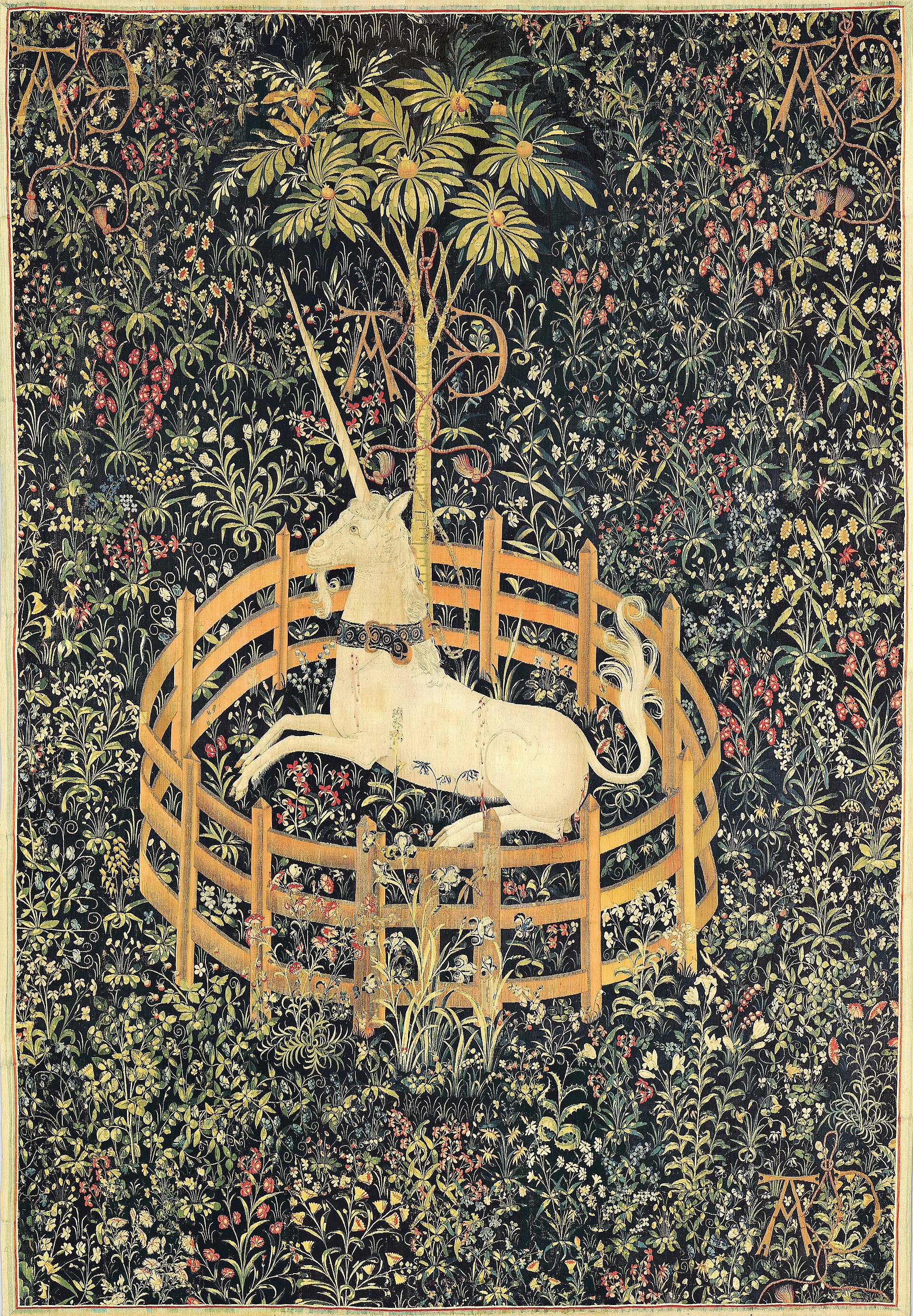
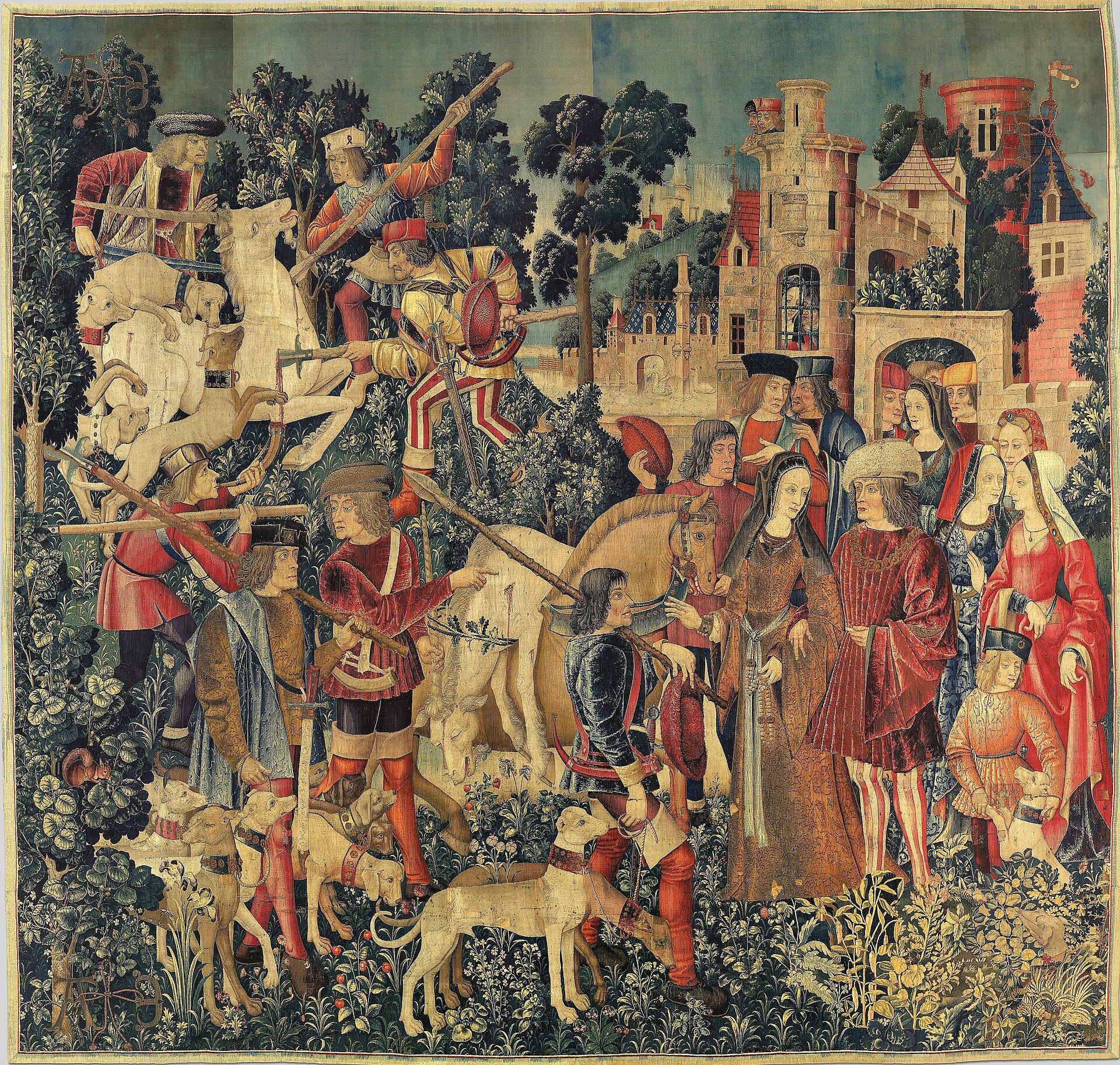
The Unicorn Rests in a Garden, accession 37.80.6 The seventh and last hanging, catalogued today as The Unicorn Rests in a Garden and known everywhere else as The Unicorn in Captivity. The most reproduced image in the set and, on the Museum's own account, the one most doubted as an original part of the series: the red marks on the unicorn's flank are read as pomegranate juice rather than a wound, and the fantastical fruiting tree above him has been used as separate evidence, from its botanically inconsistent pomegranates, that a different hand designed this hanging from the one that designed the hunt itself. Public domain, licence verified at fetch. No verified portrait. No securely identified likeness of this maker is known under a free licence. We do not publish a face we cannot verify.
The Metropolitan Museum of Art, The Cloisters, gift of John D. Rockefeller Jr., 1937| Full name | No individual name survives for either the painter who supplied the design or the workshop that wove it. |
|---|---|
| Worked as | Tapestry designer (cartoon), Weavers, Dyers |
| Nationality | Presumed French for the designer of the cartoons and South... |
| Movement | Late Gothic Franco-Flemish tapestry, millefleurs ground |
| In this archive | 1 artwork |
| Sources | 14 cited |
| Last verified |
About this page 1 artwork in the archive · Last verified · 14 sources cited
Nobody signed this. No contract, workshop ledger or weaver's mark survives for the seven hangings known as the Hunt of the Unicorn, and the Metropolitan Museum, which owns all of them, catalogues every one of the eight accession numbers with no maker's name at all. What can be said about who made them is said from the objects themselves: from a weave that specialists read as Brussels work, from three vegetable dyes chemically identified in the wool, from a cipher of two tied letters that appears on every hanging and identifies nobody, and from a century of argument among curators and art historians about whether what survives is even one commission or the remnant of two.
The single most important thing a reader coming to this page probably does not know is that the disagreement is not only about who paid for the tapestries. It is about what the tapestries are. Scholars who have devoted careers to this set do not agree on whether the seven surviving hangings tell one continuous hunt or whether two of them, the first and the last, are stylistic outsiders stitched to the group later by nothing firmer than a shared cipher. That is not a footnote. It is the condition of the evidence, and this page states it as such rather than smoothing it into the confident single story that most reproductions imply.
The object itself, its dimensions, inscriptions, current title changes and gallery history, is recorded in this archive's own entry for the Hunt of the Unicorn. This page exists to carry what belongs to the makers and the patron: the attribution problem, the cipher, the money, the provenance chain from an undocumented origin to a Fifth Avenue drawing room, and the religious and secular readings the design itself was built to carry at once.
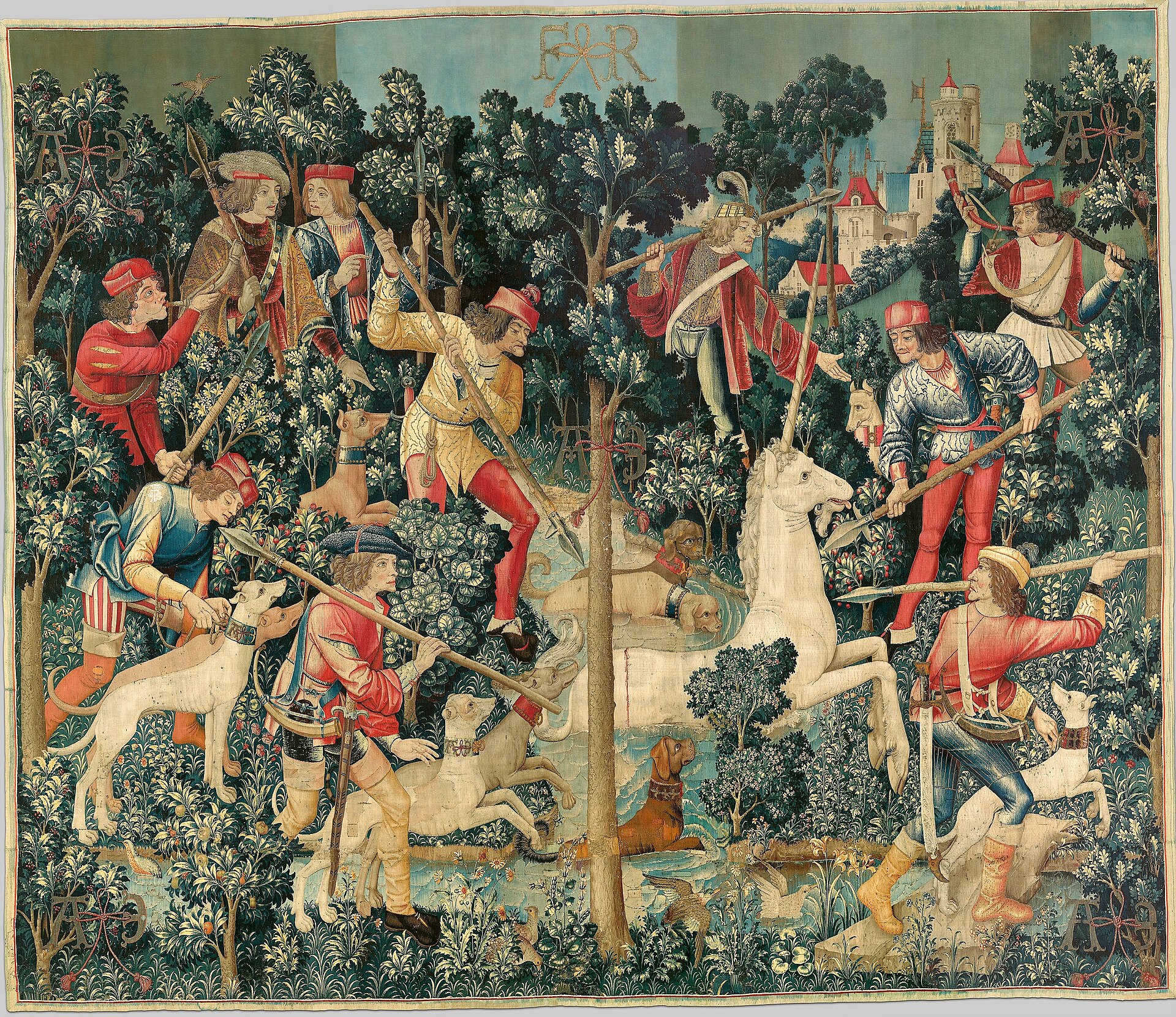
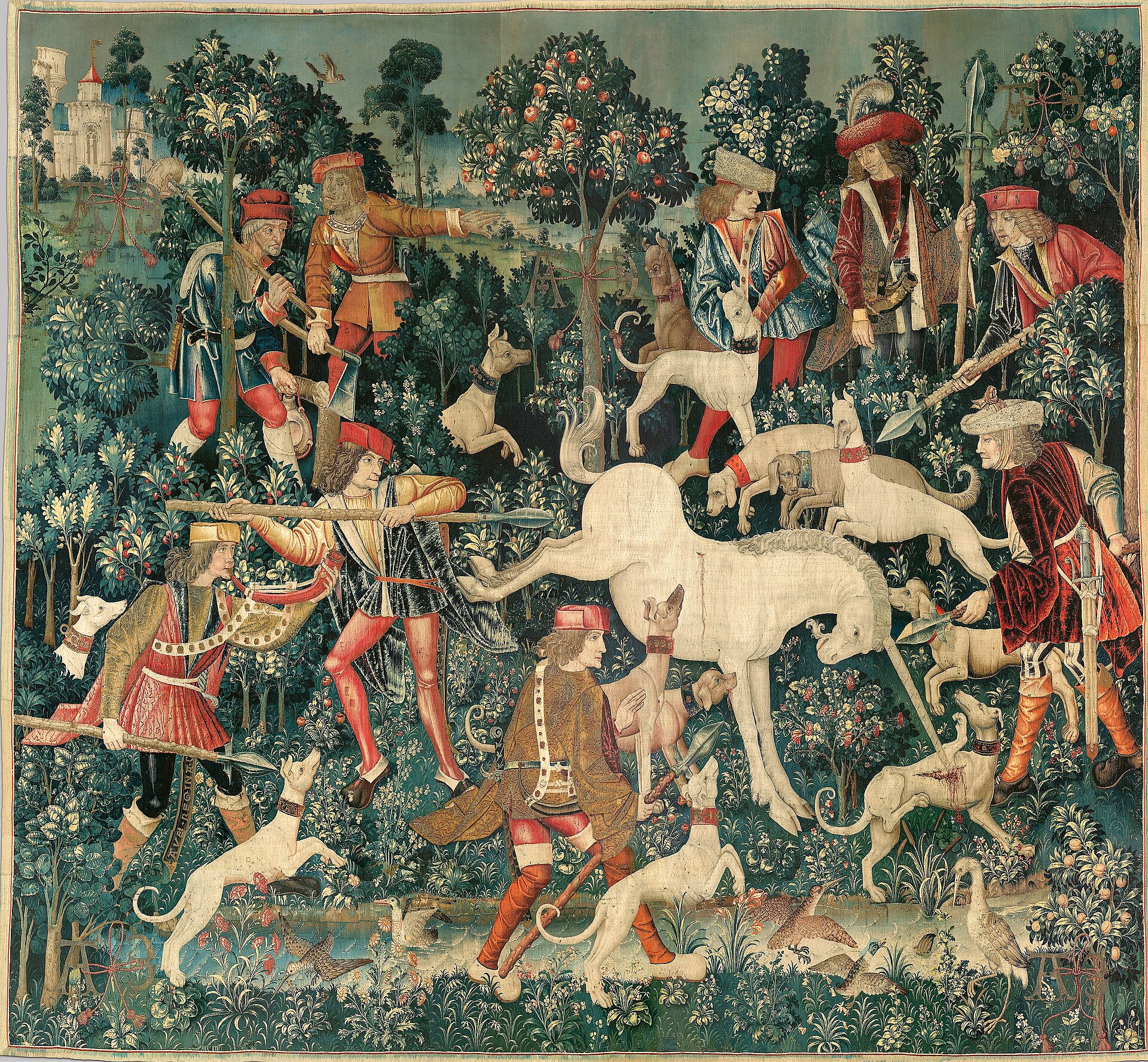
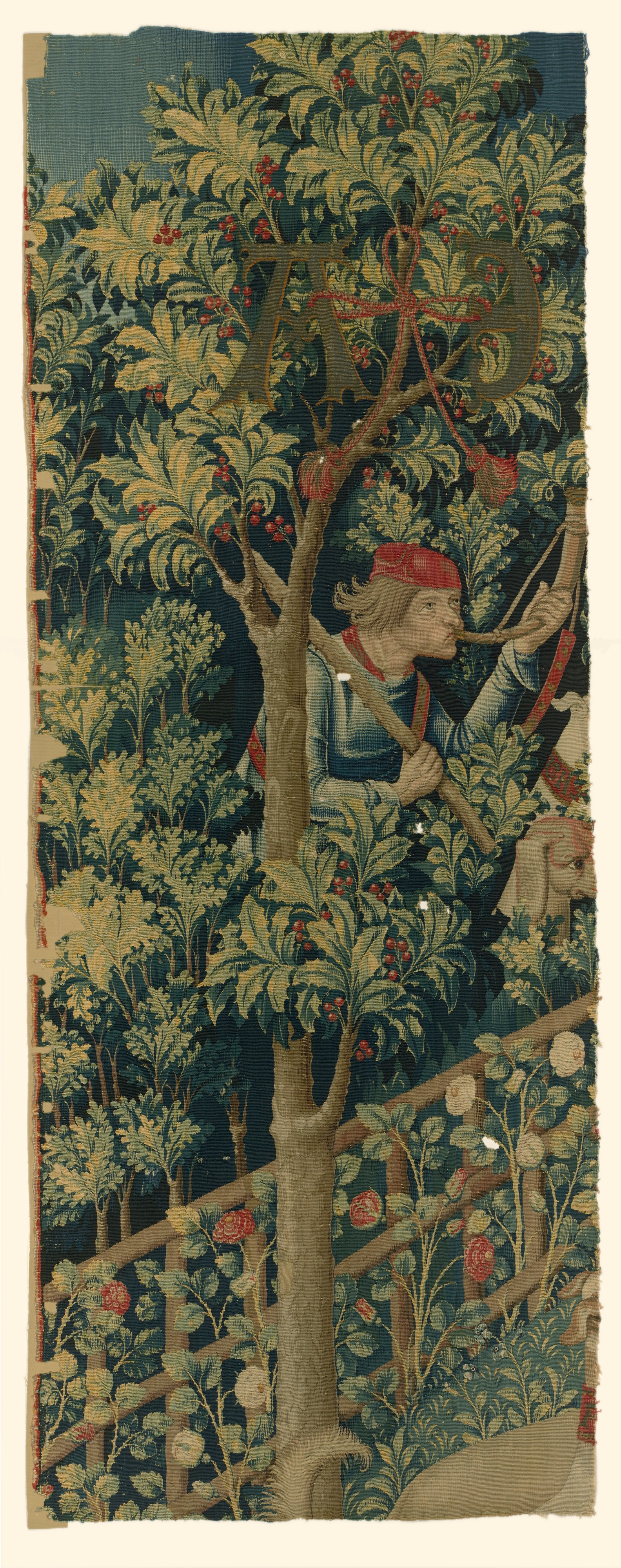
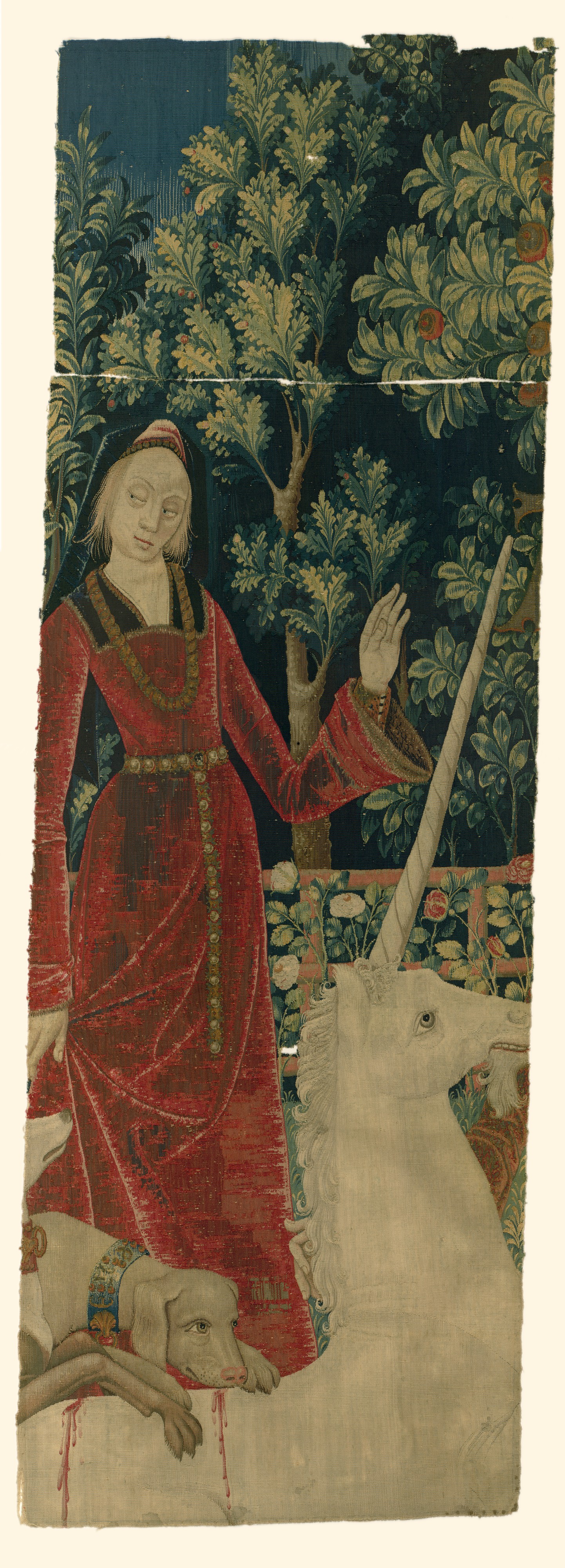
The seven hangings are woven, on the dating the Metropolitan Museum gives from costume, style and weave technique. No contract or workshop record survives to date the work more precisely.14
Proposed but unconfirmed occasion: the marriage of Anne of Brittany to King Louis XII on 8 January, the event James Rorimer's 1942 theory ties to the AE cipher. Margaret Freeman and Adolfo Cavallo later rejected the identification.611
First documented appearance of the tapestries anywhere: hanging in the Paris home of Francois VI de La Rochefoucauld, author of the Maximes. Nothing earlier is documented.111
The set is recorded at the family's Chateau de Verteuil in western France, with five of the seven hangings furnishing a bedroom.111
The tapestries are looted from Verteuil during the French Revolution. What happened to them for the next six decades is not documented.111
The tapestries are recovered by the La Rochefoucauld family.111
The recovered set has been restored and rehung in the chateau's salon.111
John D. Rockefeller Jr. acquires the set from the La Rochefoucauld family, reportedly on a tip from the sculptor and collector George Grey Barnard. The price and the identity of the selling family member are not documented in any museum source consulted.19
Secondary press reporting places a public confirmation of the purchase around this date, with a price near 1.1 million dollars. Not corroborated by a museum-published source.13
Rockefeller gives the six complete hangings, 37.80.1 to 37.80.6, to the Metropolitan Museum of Art.14
Rockefeller gives the two surviving fragments of the seventh hanging, 38.51.1 and 38.51.2, and the Cloisters opens as a branch of the Metropolitan Museum, built in part to house the gift.14
Eleanor C. Marquand publishes the first systematic study of the tapestries' plants, working from their symbolic associations.7
E. J. Alexander and Carol H. Woodward publish a botanical identification of the tapestries' flora in the Journal of the New York Botanical Garden, the basis for the Museum's current species count.7
James Rorimer publishes the theory that the tapestries were made for Anne of Brittany's 1499 marriage to Louis XII, reading the AE cipher as her initials.611
Genevieve Souchal publishes the argument that the set divides into two stylistically distinct series and proposes the notname the Master of the Hunt of the Unicorn for the presumed designer.6
Margaret Freeman publishes The Unicorn Tapestries, the standard twentieth-century monograph, setting out the dual Christian and secular reading and rejecting the Anne of Brittany identification of the cipher.11
Helmut Nickel, the Metropolitan Museum's curator of Arms and Armor, publishes an argument in the Museum's own journal that the traditional sequence is dramatically inconsistent with real stag-hunting practice, proposes a revised order, and states in print the possibility that the first hanging is the sole survivor of a separate, lost hunting set.6
Adolfo Salvatore Cavallo publishes the Metropolitan Museum's next full monograph on the set, restating the rejection of the Anne of Brittany identification and giving the current standard account of the tapestries' technique and iconography.14
The set has never appeared at public auction. It passed once, by private sale, from the La Rochefoucauld family to John D. Rockefeller Jr. in 1922, and once more, by gift, from Rockefeller to the Metropolitan Museum of Art in 1937 and 1938. A figure near one million dollars, sometimes given as 1.1 million and dated to a confirmation in February 1923, circulates in secondary journalism, but no Metropolitan Museum publication consulted for this page states a price, a specific date of sale, a dealer or the identity of the selling family member, and this page does not adopt the circulating figure as established.
| Institution | City | Holdings | Note |
|---|---|---|---|
| The Metropolitan Museum of Art, The Cloisters | New York | The six complete or near-complete hangings, accessions 37.80.1 through 37.80.6, permanently displayed in Gallery 17. | The only place any part of this set can be seen. Nothing from the commission is held elsewhere. |
| The Metropolitan Museum of Art, The Cloisters | New York | The seventh, fragmentary hanging, The Unicorn Surrenders to a Maiden (accessions 38.51.1 and 38.51.2), shown alongside the other six in Gallery 17. | Catalogued and displayed separately from the other six because only two fragments of this hanging survive; still the same single site as the rest of the set. |
A tapestry of this class was made in two stages by two different trades, often in two different cities under two different jurisdictions.
A tapestry of this class was made in two stages by two different trades, often in two different cities under two different jurisdictions. A painter supplied a full-scale design, called a cartoon. A weaving workshop, organised around a small number of master weavers and a larger number of apprentices and journeymen working a low-warp or high-warp loom, translated that design into cloth, thread by thread, over months. The Metropolitan Museum's culture line for every one of the eight accession numbers records exactly this division and nothing more: French for the cartoon, South Netherlandish for the weaving. Its own descriptive text narrows the second half further, to probably Brussels. Neither a painter's name nor a weaving workshop's name is attached to either half.
In 1973 the French tapestry historian Genevieve Souchal proposed a working name for the presumed Parisian designer: the Master of the Hunt of the Unicorn. This is a notname, the convention art history uses when a hand is consistent and real across a body of work but carries no documented identity, built outward from the objects rather than inward from a biography. It has not displaced unknown in the Museum's own catalogue entries, and it is not a discovery of who the designer was. It is a label that lets scholars discuss a consistent design personality without pretending to know a name.
Tapestry attribution before the era of workshop marks is a discipline built almost entirely on comparison.
Tapestry attribution before the era of workshop marks is a discipline built almost entirely on comparison. Weave structure and thread count place a piece within the working practice of a documented weaving centre. Dye analysis identifies the specific plant sources behind a palette, since different regions and periods favoured different combinations and, where a workshop's dye recipes are independently documented elsewhere, a match is evidence. Stylistic comparison sets faces, costume and drapery against securely documented and dated tapestries and prints from the same decades. None of the three is proof on its own; together they are what the field has instead of a contract.
For the Hunt of the Unicorn, chemical analysis has identified three vegetable dyes behind the whole palette, weld for yellow, madder for red and woad for blue, combined by the weavers to produce every other colour in the set. The warp is wool; the wefts are wool, silk, silver and silver-gilt metal-wrapped thread. It is this combination of technical reading and stylistic comparison, not a document, that supports the Brussels attribution for the weaving and the Parisian attribution for the design.
The seven narrative subjects are usually described and reproduced as a single continuous hunt: the company sets out, finds the unicorn, chases it, is defended against, tames it with a maiden, kills...
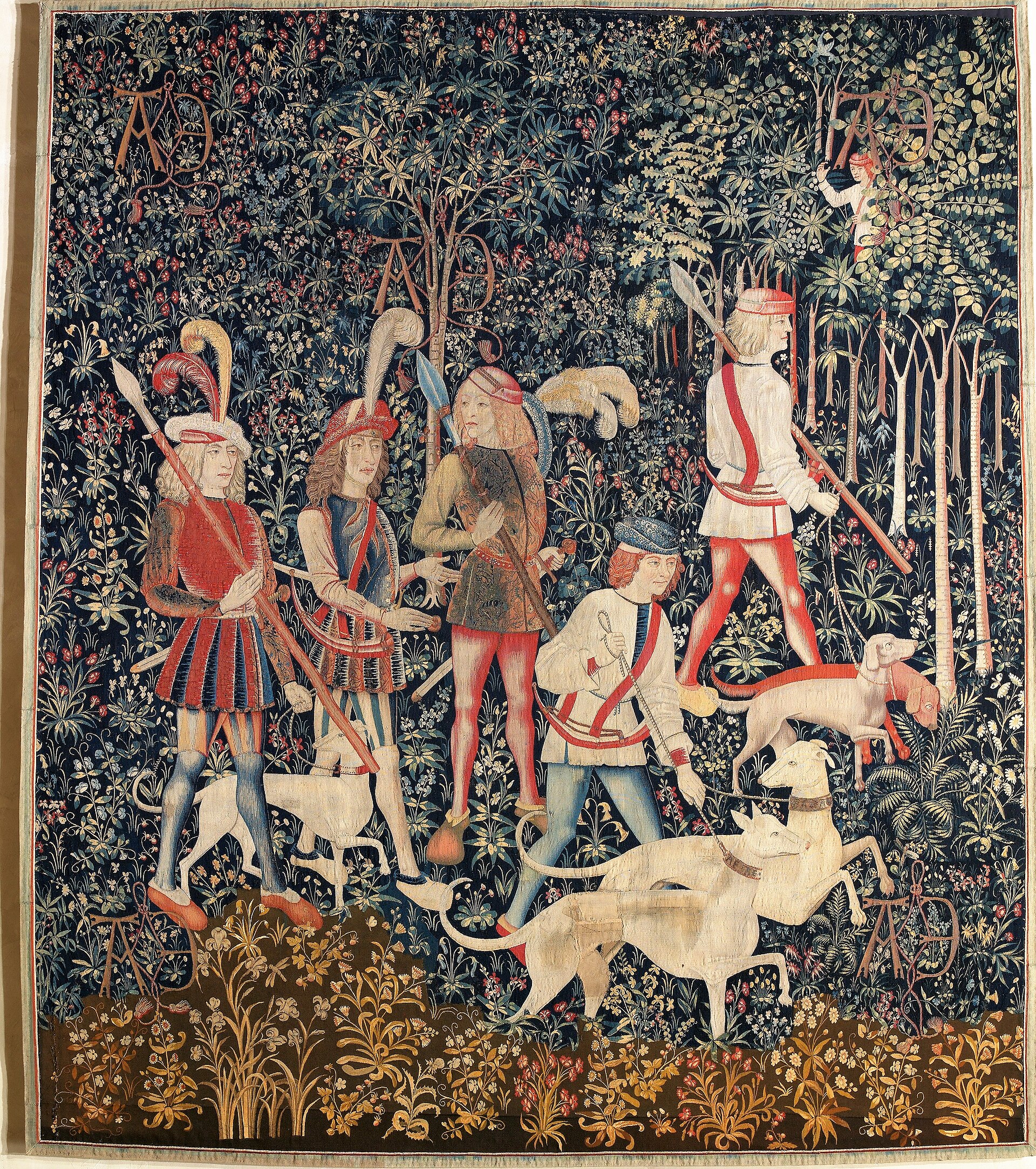
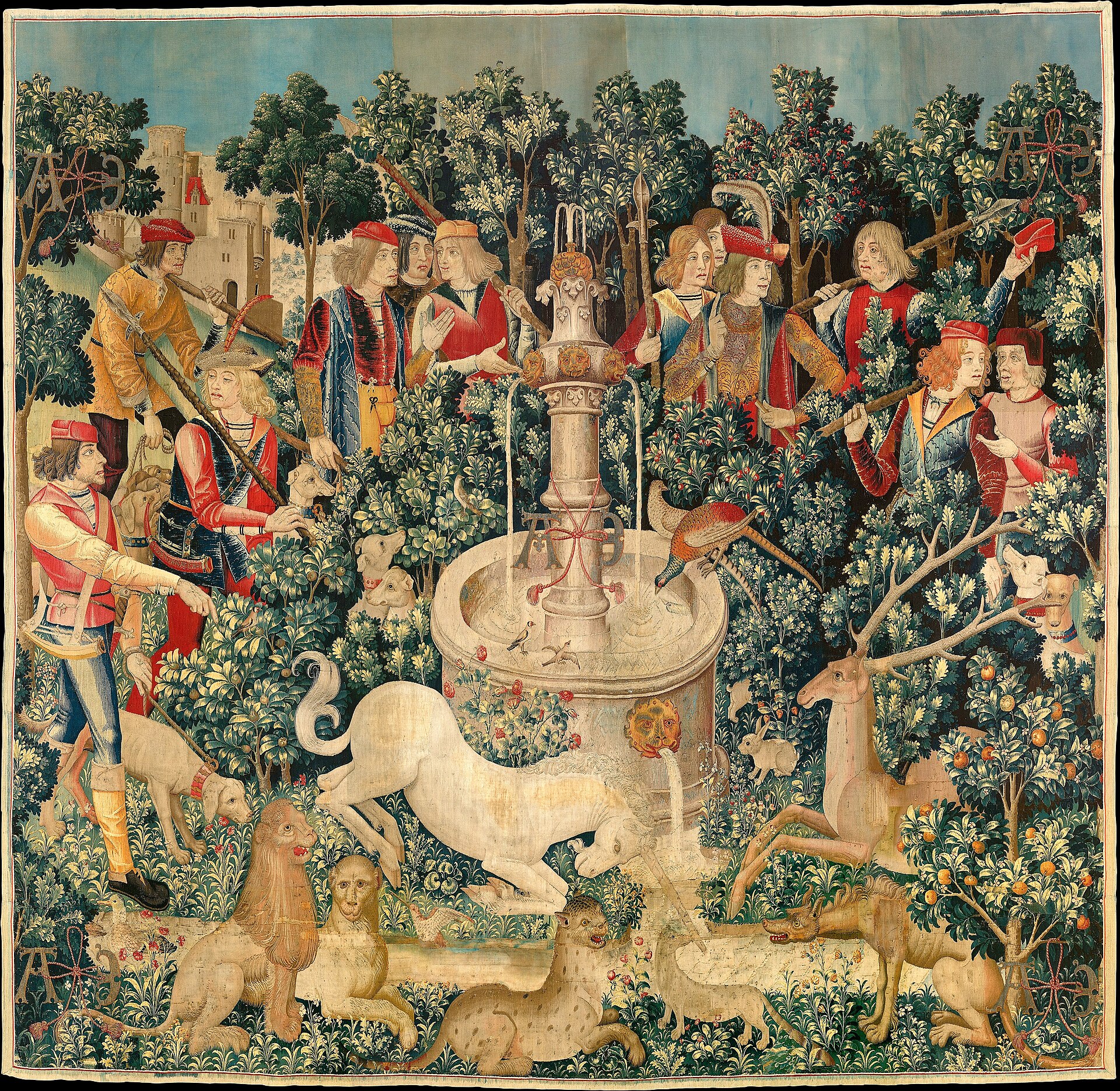
The seven narrative subjects are usually described and reproduced as a single continuous hunt: the company sets out, finds the unicorn, chases it, is defended against, tames it with a maiden, kills it, and finally shows it alive again inside a fenced garden. That sequence was established in publications by James Rorimer and Margaret Freeman, successive curators of the Cloisters, and it is the order most books still use. The fifth subject in that sequence, the taming by the maiden, is also the one hanging that does not survive complete: only two narrow strips remain, and most of the maiden's own figure is lost from both.
It has been directly challenged in print. Genevieve Souchal argued that the group divides into two series: five hangings that read consistently as one hunting narrative, and two others, the first hanging showing the hunters entering the woods and the last showing the unicorn alone in captivity, that are in a style entirely different from the rest and may not belong to the same commission at all. Writing in the Metropolitan Museum's own journal, the Museum's curator of Arms and Armor, Helmut Nickel, went further and set out the specific possibility in print: that the first hanging is the sole survivor of an entirely separate, and otherwise lost, hunting set, perhaps a stag or boar hunt, and that the last hanging, the most famous image in the whole group, may never have been part of a series at all. Nickel's own solution was not to split the set but to reorder the middle five hangings into a sequence that matches the real technical stages of a medieval stag hunt as set out in a hunting manual of 1387, arguing that the traditionally accepted order is dramatically inert and does not match how an actual hunt of the period would have run.
No position commands agreement. The Museum's own current entry for the last hanging separately concedes that it may have been created as a single image rather than as part of any series, which is the institution owning all seven hangings declining to assert that they are certainly one thing.
A cipher formed from the letters A and a reversed E, tied together with a knotted cord, is woven into every one of the seven hangings, five times over on the first alone.
A cipher formed from the letters A and a reversed E, tied together with a knotted cord, is woven into every one of the seven hangings, five times over on the first alone. It is the only mark either the designer or the weavers left on the work, and the Metropolitan Museum's own formula for it is exact: the cipher alludes to the tapestries' original owners, who remain unknown.
In 1942 the Cloisters' first curator, James Rorimer, proposed that the cipher identified Anne of Brittany, reading A and E as the first and last letters of her name, and argued the tapestries were made to mark her marriage to King Louis XII of France on 8 January 1499, her second marriage to a king of France. The proposal had circumstantial support: a knotted cord, the cordeliere, was a documented personal emblem Anne had already adopted by 1498, when she founded the Order of the Ladies of the Cord, and the emblem appears in her own manuscripts and building commissions. Margaret Freeman rejected the identification in her 1976 monograph, and Adolfo Cavallo, writing the Museum's next full study of the set in 1998, restated that rejection. Neither published a competing name they considered secure. A separate proposal ties the letters to the La Rochefoucauld family itself, reading them as the initials of Antoine de La Rochefoucauld and his wife Antoinette de Amboise, which would place the cipher inside the first family actually documented owning the tapestries rather than at their creation. This record does not adopt any of the three; each is reported as a proposal and none is corroborated by a document naming a patron.
Silver and silver-gilt weft on this scale put the commission in the most expensive class of tapestry made in this period.
Silver and silver-gilt weft on this scale put the commission in the most expensive class of tapestry made in this period. Only a royal or a very great household could have paid for it, which is the entire basis, evidentially, for guessing that the patron sat close to a court. Beyond that inference, nothing survives: no payment record, no household inventory entry describing a commission, no correspondence naming the buyer.
The leading theory remains Rorimer's royal marriage proposal, because it supplies a specific date, a specific couple and a documented emblem the cipher could plausibly echo. Its weakness is exactly what Freeman and Cavallo pointed to: the cipher does not obviously spell Anne of Brittany's name, and no accounts, wardrobe records or chronicle of the 1499 marriage mentions a tapestry commission of this kind. The alternative, that the cipher names a member of the family that is actually documented owning the set from 1680, has the opposite problem: it explains the letters more directly but leaves the roughly one hundred and seventy-five years between the tapestries' manufacture and their first documented appearance in Paris completely unaccounted for, and it requires the family to have commissioned an object at the top of the market at a date that is not otherwise evidenced in their own history. Both theories are argued in print by named scholars. Neither is corroborated by a contract, an inventory entry contemporary with the weaving, or a chronicle account, and this page states that as the finding rather than adopting either.
Silver and silver-gilt weft is not a decorative effect.
Silver and silver-gilt weft is not a decorative effect. It is metal, wound on a silk core and woven through the cloth, and it made a tapestry of this class a portable store of bullion as much as a picture. That is the direct explanation for why so few tapestry sets of comparable ambition survive from this period at all: sets that fell out of fashion, or that a debt-pressed owner needed to liquidate, were burned, and the metal was recovered and sold. An intact narrative set with silver and gilt thread still in the cloth after five centuries is the exception that a bonfire, not neglect, was usually the rule.
That the Hunt of the Unicorn survived that risk at all before 1680, when the documentary record even begins, is itself unexplained. Nothing in the sources establishes where the set was kept, or by whom, in the century and three quarters between manufacture and its first appearance in a Paris household.
The millefleurs ground behind the hunt is not a generic field of decorative blossom.
The millefleurs ground behind the hunt is not a generic field of decorative blossom. The Metropolitan Museum's own count is that of one hundred and one plant species represented, eighty-five have been identified, work that began with Eleanor Marquand's 1938 study of the plants by their symbolic associations and was put on a botanical footing in 1941 by E. J. Alexander and Carol H. Woodward, botanists who identified the species from the images themselves. That count has been revisited since, and not every nineteen-forties identification has held up: a re-examination of the fruit and nut species alone, by the horticulturists Jules Janick and Anna Whipkey, corrected the 1941 reading of one shrub from plum to bilberry on the shape of the fruit, and reassigned another tree from plum to elder on the leaf structure, crediting the correction to the botanist Todd Kennedy.
The same paper turns the flora into evidence about the workshop's world rather than only its skill. The captive unicorn's fantastical fruiting tree in the last hanging is hung with pomegranates whose seeds are shown split open, a species genuinely uncommon in French gardens of this date, while ordinary, correctly rendered pomegranate trees also appear earlier in the set: a discrepancy the paper reads as evidence that whoever designed the final image was not the same hand responsible for the middle hangings, an independent line of argument for exactly the two-designers, possibly two-campaigns problem the sequence literature argues from style alone. A citrus tree elsewhere in the set, meanwhile, sits inside a live, unresolved argument in the horticultural literature over whether sweet orange reached France before or only after 1500, which is a debate the tapestry itself is cited as evidence for.
The unicorn's medieval literary life, which the Metropolitan Museum dates to the Greek physician Ctesias in the fourth century BC, carried two readings that late medieval viewers held at once rather...
The unicorn's medieval literary life, which the Metropolitan Museum dates to the Greek physician Ctesias in the fourth century BC, carried two readings that late medieval viewers held at once rather than in competition. In the bestiary tradition descending from the Physiologus, the unicorn's ferocity, its capture only through the offices of a virgin, and its supposed single horn were read as an allegory of the Incarnation and the Passion: the untameable made gentle by a virgin stands for Christ made flesh through Mary, and the hunt, wounding and death of the animal stand for the arrest and crucifixion of Christ. Church writers had underwritten the identification centuries earlier: Basil of Caesarea compared the unconquerable nature of God to a unicorn's, and Ambrose of Milan asked directly who the unicorn could be but the only-begotten Son of God. Read this way, the final hanging's unicorn, tethered but alive inside its fenced garden with pomegranate juice, not blood, marking its flank, is a Resurrection image. The design carries the religious register into the hunt itself, not only into its ending: on the fourth hanging a hunter blowing a horn wears a scabbard inscribed AVE REGINA C[OELI], Hail Queen of Heaven, a Marian prayer knotted onto the equipment of a man helping to kill the animal.
The same design supports an entirely secular reading that medieval viewers did not need to choose between. Courtly love poetry of the period used the unicorn tamed and captured by a virgin as a figure for the lover subdued and made captive by desire, and the final garden, with its collar and chain rather than a wound, reads equally as a marriage image: a bridegroom secured, not a martyr. Margaret Freeman, whose 1976 monograph remains a standard reference on the set, argued explicitly that the two readings were not felt as contradictory by a late medieval audience, for whom devotion to God and devotion in love were treated as structurally the same experience aimed at different objects. This page follows that position because it is argued by a named scholar on textual and art-historical grounds, not because a resemblance makes it obviously true; a reader should take the double reading as the documented critical consensus about how the image worked, not as a fact about what any specific, unidentified patron privately believed.
Nothing documents the tapestries between their manufacture, on stylistic and technical grounds placed at 1495 to 1505, and 1680, when they are first recorded hanging in the Paris home of Francois VI...
Nothing documents the tapestries between their manufacture, on stylistic and technical grounds placed at 1495 to 1505, and 1680, when they are first recorded hanging in the Paris home of Francois VI de La Rochefoucauld, author of the Maximes. No commission, no intervening owner, no sale is documented in that gap. By 1728 the set had moved to the family's chateau at Verteuil in western France, where five of the seven hangings furnished a bedroom, not a hall of state, which is itself informative: objects that stayed in domestic use inside one family, rather than circulating through the market, are exactly the objects that tend to survive.
The tapestries were looted from Verteuil during the French Revolution and recovered by the family in the 1850s; by 1856 they had been restored and rehung in the chateau's salon.
The tapestries were looted from Verteuil during the French Revolution and recovered by the family in the 1850s; by 1856 they had been restored and rehung in the chateau's salon. What happened to them in the intervening six decades is not documented by the Metropolitan Museum's own account of the object, which states only the loss and the recovery. A widely repeated story, that peasants used the hangings in a barn to cover potatoes or to protect fruit trees from frost, appears across popular and tertiary sources including Wikipedia, but no museum publication or primary account consulted for this page corroborates it. This page follows the same discipline already applied in this archive's object record for the tapestries themselves: the loss and the recovery are stated as documented, and the barn story is named as a widely circulated but unverified tradition rather than repeated as fact.
John D. Rockefeller Jr. acquired the set from the La Rochefoucauld family in 1922, reportedly on a tip from the sculptor and collector George Grey Barnard, whose own collection of medieval...
John D. Rockefeller Jr. acquired the set from the La Rochefoucauld family in 1922, reportedly on a tip from the sculptor and collector George Grey Barnard, whose own collection of medieval architectural fragments Rockefeller had already been buying and would go on to give the Metropolitan Museum as the core of the future Cloisters. The six complete hangings hung in the dining room of Rockefeller's own New York townhouse for the next fifteen years before he gave them to the Museum in 1937, with the two fragments of the seventh following in 1938, the year the Cloisters opened as a branch of the Metropolitan Museum built in large part to house them.
What Rockefeller actually paid, and to which member of the La Rochefoucauld family, is not stated in any Metropolitan Museum publication consulted for this page. A figure of roughly one million dollars, sometimes given more precisely as 1.1 million and dated to a confirmation in February 1923, circulates in secondary journalism and has done for decades, but this page does not adopt it as established: it is not corroborated by a museum-published source, and this archive's own object record for the tapestries reached the identical conclusion after a dedicated check for exactly this figure. No dealer's name is documented in any source consulted here.
Tapestry designer (cartoon); Weavers; Dyers. active c. 1495-1505, on the dating the Metropolitan Museum gives from costume, style and weave technique; no contract or workshop record fixes the date more closely.
No forgery case is documented for this set, and none would be expected: a unique, museum-owned object generates no market for a fake to enter. The recurring problem is not fraud but mislabelling and confusion in circulation. The Musee de Cluny's Lady and the Unicorn, six hangings from the same approximate period but a different design tradition and a different collection, is routinely captioned online as though it were this set.
The Metropolitan Museum of Art, The Cloisters (New York); The Metropolitan Museum of Art, The Cloisters (New York).
The set has never appeared at public auction. It passed once, by private sale, from the La Rochefoucauld family to John D.
Who commissioned the set, and does the AE cipher name them? Three named proposals exist and none is corroborated by a document.
In this archive the commonest reason an object is in pieces is not war, time or accident. It is a sale.
9 min read
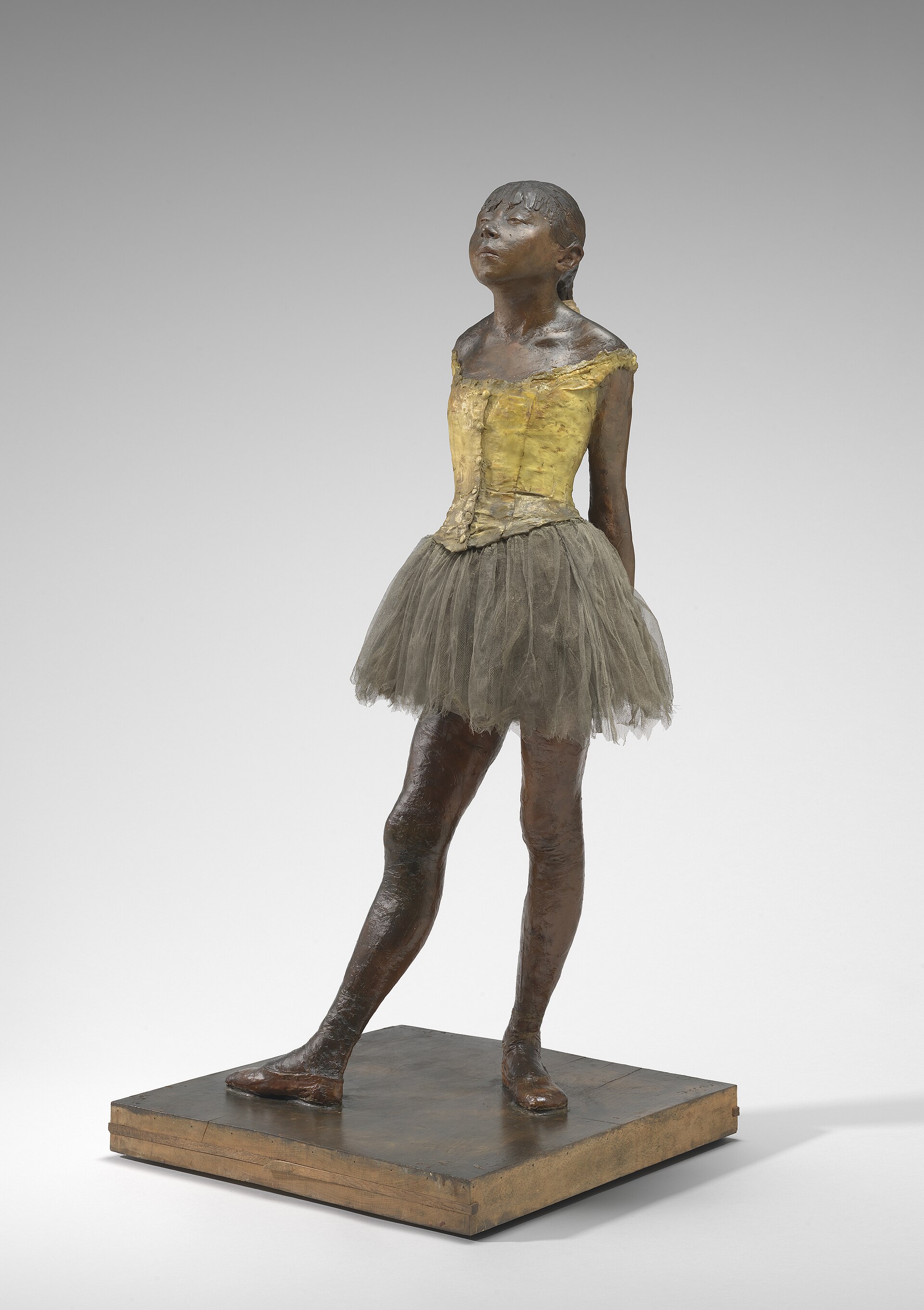
Degas made one Little Dancer and never sold it. The 41.6 million dollars paid in 2022 was for a bronze cast a decade after his...
12 min read
Ninety-seven ownership links in this archive move an object because someone died.
9 min read
Eighty-nine of the 266 objects published here name nobody as their maker.
9 min read
One hundred and eighty-six exhibition entries across 60 records, and they are not one kind of thing.
9 min read
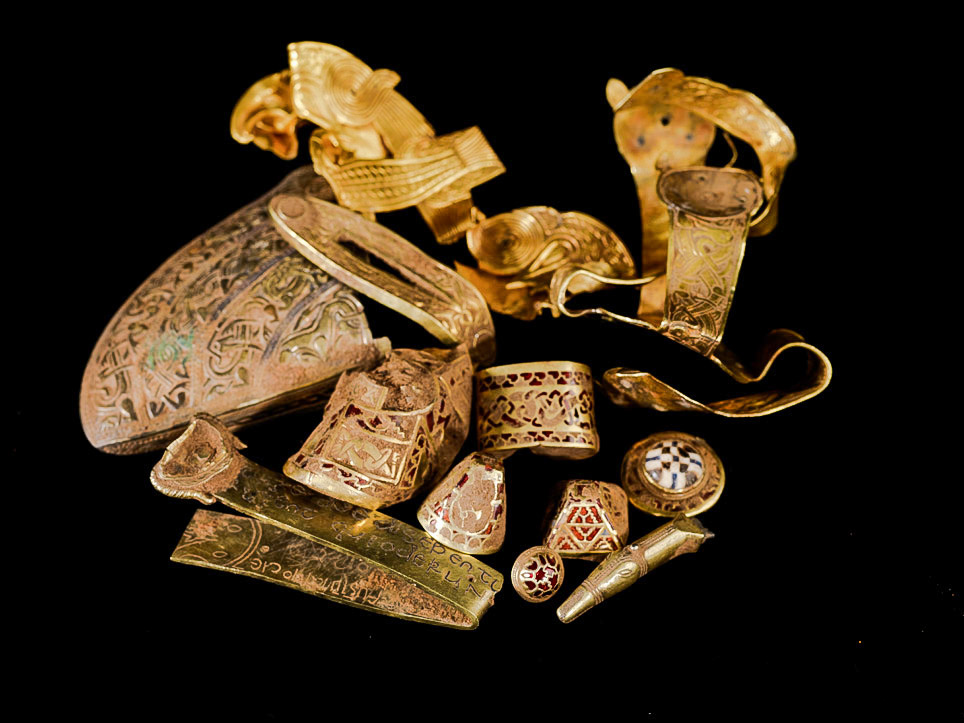
The Staffordshire Hoard is 4,600 pieces, or just under 4,000, or around 700, or more than 600, depending on which official page...
11 min read
Last verified
One artwork and its story every Tuesday, with the picture: who owned it, what it made, and what closes soon in the exhibition calendar. No promotion, and nothing we cannot cite.
We send one email to confirm the address and keep nothing else. Every letter carries a one-click unsubscribe. How we handle your data.