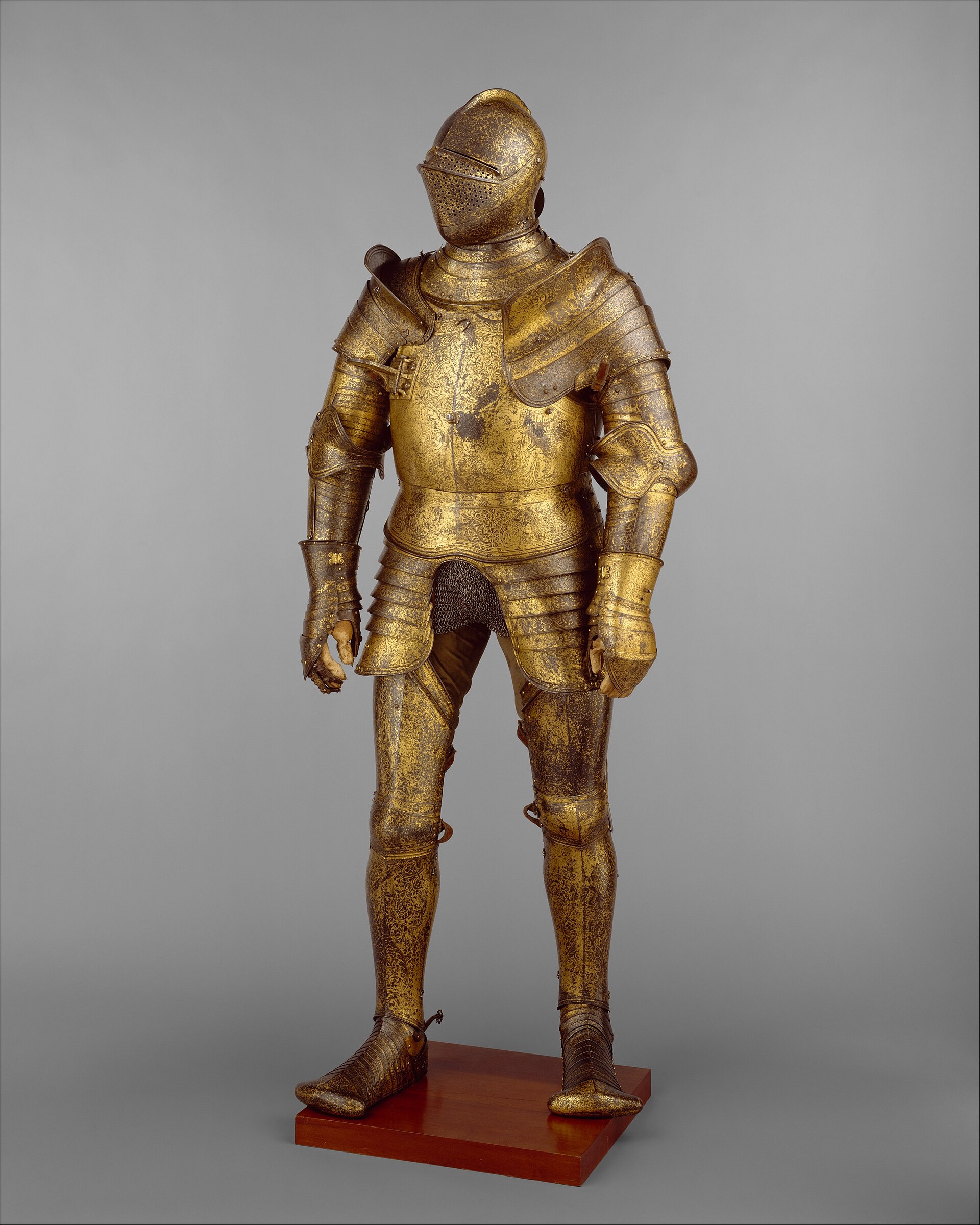
Armor Garniture, Probably of King Henry VIII of England
dated 1527 · Steel
The Metropolitan Museum of Art, New York
 active 1511-1640
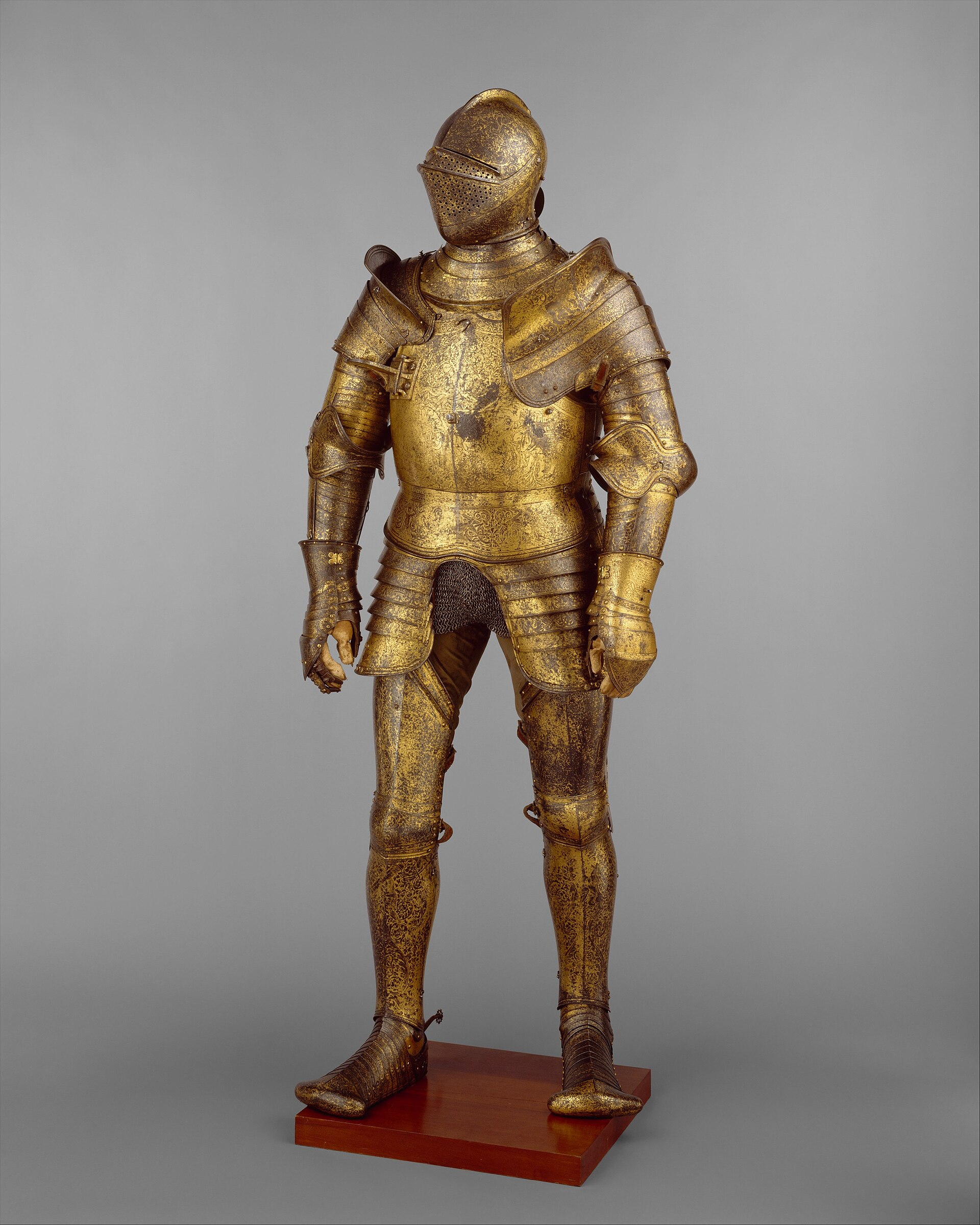
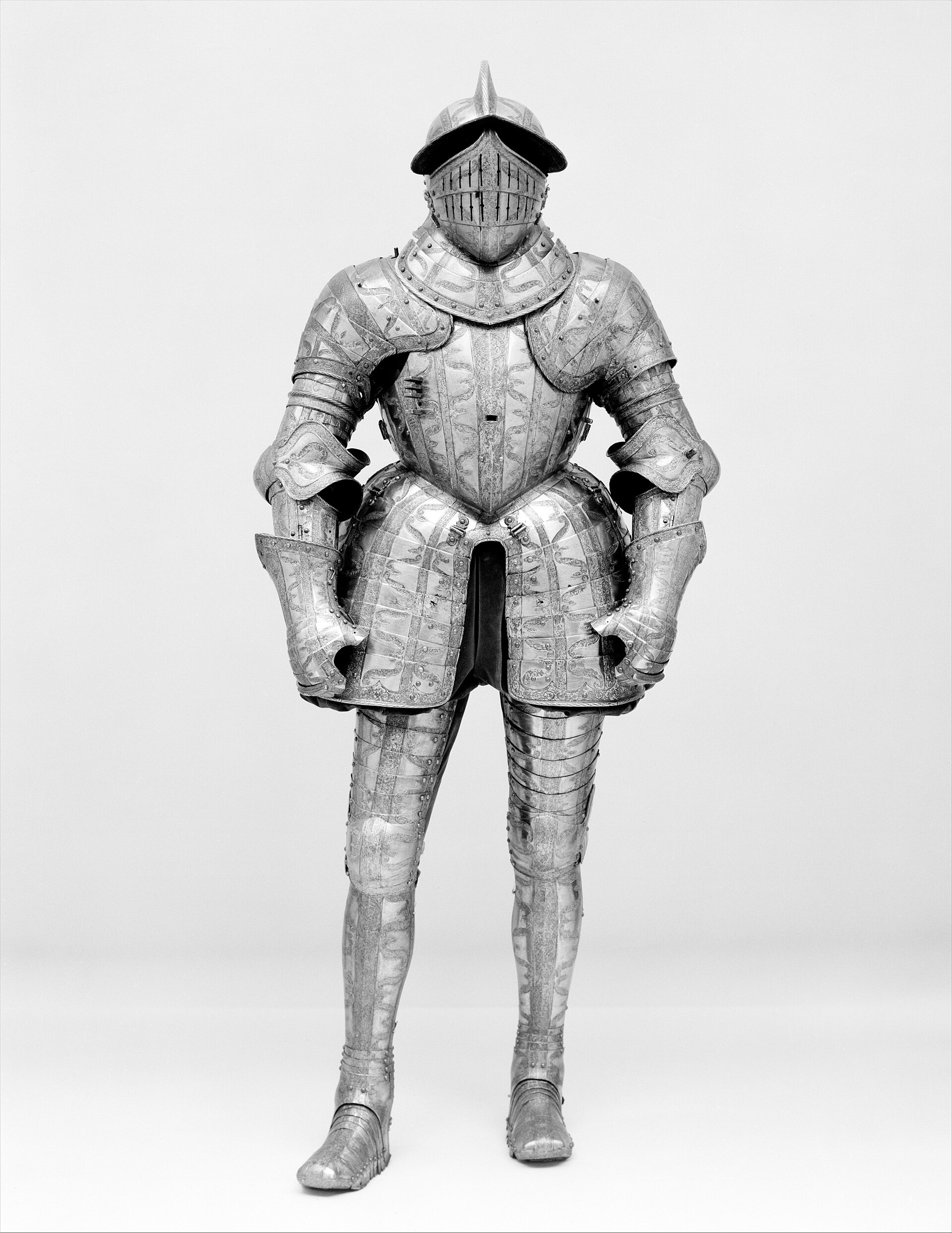
Garniture dated 1527 The earliest dated Greenwich armour: etched and gilt across its whole surface, 28.45 kg as mounted, Metropolitan Museum 19.131.1. The museum's title says probably Henry VIII; earlier it was the Genouilhac armour, and Nickel proposed the vicomte de Turenne. The Met's own maker field is the Royal Workshops at Greenwich. Check the museum's component list before treating every mounted piece as original. No verified portrait. No portrait applies to a royal workshop. The site, per the V&A, is now a lawn in front of the National Maritime Museum, and I found no verified image of the premises under an open licence. The armourers' marks are known only from reports of an unattributed armet mark (II.5), with no open image. The album drawings below are the nearest to a group record, and each caption says what it shows.
The Metropolitan Museum of Art (CC0)| Full name | The Royal Almain Armoury (the Greenwich armour workshop), founded by Henry VIII |
|---|---|
| Worked as | Armourers, Royal court workshop |
| Nationality | English royal workshop, staffed first by Italian, Flemish and German... |
| Movement | Tudor and early Stuart court armour (Henrician to Jacobean) |
| In this archive | 1 artwork |
| Sources | 21 cited |
| Last verified |
About this page 1 artwork in the archive · Last verified · 21 sources cited
Greenwich armour is the name for what Henry VIII's own armour workshop made between the 1510s and the Civil War: plate harness built to a courtier's measurements, etched, gilded and blued, and arranged as a garniture of exchangeable pieces so one owner could fight in the field, run at the tilt or fight on foot at the barrier. Nobody signed it. The surviving makers' names are the heads of the shop, the Master Workmen, and the best-documented of them, Jacob Halder, left one sentence of authorship on a design sheet: 'Thes peces wer made by me Jacobe'.
The single most important thing a reader probably doesn't know is how much of the workshop's identity rests on one book. The Almain Armourers' Album at the Victoria and Albert Museum holds 29 working designs made between 1557 and 1587, each annotated with the name of the courtier it was for. The V&A states that before the album surfaced on the market in the late nineteenth century the origins of many surviving Greenwich armours were not known. It was bought in 1894 from M. C. Stein of Paris for 5,000 francs, and its earlier owners can be traced only in part. A workshop that served a king and a short list of named courtiers is, for most of its life, a matter of designs, inventories and a few dated objects.
Even the basics move depending on the source. The workshop is said to have been founded in 1511, c. 1514 or 1515, and to have closed c. 1630, in 1642 or in the Commonwealth years. This page gives each figure with the person who holds it, and says where no source I could open states a number at all. That includes the question of how many Greenwich armours survive: no authority I found publishes a count.
Payments to Milanese armourers at Greenwich begin under a contract that started in March 1511, with a mill set up and tools bought.17
The V&A dates the start of the Greenwich armoury's operation to around 1514.2
The first German 'Almain' armourers begin work at Greenwich; by this year six German masters, two Flemish masters, two polishers and an apprentice are listed.217
The armourers move to a mill in Southwark while a new mill is built at Greenwich.17
An 'Anthonius Snyster' appears in the Almain workshop's name roll, possibly the later Holbein will witness 'Anthony Snecher'.9
Henry VIII wears Greenwich-made armour at the Field of Cloth of Gold; a second, hastily assembled tonlet armour is made when Francis I changes the foot-combat rules three months before.3
The Greenwich workshop returns from Southwark to the completed Greenwich mill.17
The garniture now in the Metropolitan Museum is dated 1527: the earliest dated Greenwich armour.911
A Royal Armouries armour of Henry VIII has 1540 etched on its armet collar and the Montana thesis places it under Kirkenar; a separate great garniture of Henry is said to have been etched by F. Queblaunche.189
Erasmus Kirkenar is Master Workman; the V&A credits him with solving the hardening of steel by slack quenching.12
Jacob Halder compiles the Almain Armourers' Album: 29 designs on 56 sheets.12
Halder first recorded in a list of Almains at the armoury.12
Halder becomes Master Workman, serving until 1607; he dies in 1608.12
Sir Henry Lee is credited with establishing the Accession Day tilts, the festival these armours served.2
The Cumberland garniture is dated 1586 by the Metropolitan Museum.12
Halder makes the Buckhurst armour now in the Wallace Collection, made for Armada preparations and never used.16
Armour for Henry, Prince of Wales, is among the best late Greenwich work.12
Per the V&A, Edward Ansley is asked to retrieve the remaining royal armour from Greenwich in 1642 and it is moved to the Tower two years later.2
Per the Royal Armouries, the Ordnance officers decide that Edward Annesley should move the old armour from Greenwich Palace to the Tower.4
The first Line of Kings is recorded at the Tower in an October inventory.8
The album is shown at the Society of Antiquaries of London by a Mr Virtue.2
A fire on 30 October destroys most of the displays in the Tower's Grand Storehouse.8
The V&A buys the album from M. C. Stein of Paris for 5,000 francs.2
Viscount Dillon publishes selections from the album, the first major publication on it.2
The Met completes restoration of the Scudamore armours bought in 1911; Dillon challenges the identity of the second suit in the same year.141510
The Metropolitan Museum buys the 1527 garniture.11
An exhibition of armour made in the royal workshops at Greenwich is held at the Tower of London.9
Helmut Nickel publishes his study of the 1527 garniture and its decoration in the Metropolitan Museum Journal.9
The Royal Armouries Museum opens in Leeds.20
Leslie Southwick publishes a reconstruction of the Master Workmen, 1515-1603.19
I found no verified auction result for a Greenwich-made armour of the royal period. Searches for Christie's, Sotheby's and Bonhams sales returned only later harquebusier and pikeman armours catalogued as 'possibly Greenwich', and the lot pages I opened gave no price. The institutions hold the armours that count, and they bought them privately.
The documented figures are old. The V&A paid 5,000 francs for the album in 1894. The Metropolitan's 1527 garniture was sold by the family of the dukes of Uzes in 1914 according to Nickel; no price appears in the sources I read. The period price, up to GBP 500 for a decorated garniture, is the V&A's figure. It is not a market result and the V&A's modern equivalent states no method.
| Institution | City | Holdings | Note |
|---|---|---|---|
| The Metropolitan Museum of Art | New York | The 1527 garniture (19.131.1-2), Pembroke armour (32.130.5), Cumberland garniture (32.130.6) and the two Scudamore armours (11.128.1 and .2), most in gallery 371 | The Scudamore armours were restored and completed in 1915; check the object's component data for modern replacements before citing a plate. |
| Victoria and Albert Museum | London | The Almain Armourers' Album (D.586-614-1894) | Viewing by request in the Prints and Drawings Study Room; the designs are also searchable online. |
| Royal Armouries Museum | Leeds | Henry VIII's foot combat armour (II.6) and the tonlet armour (II.7), both for the Field of Cloth of Gold, and per the V&A the c. 1575 Leicester armour (II.81, VI.49) | The Royal Armouries' own page places II.6 in the Tournament Gallery; where II.7 is shown is not stated on that page. |
| Tower of London (Royal Armouries) | London | The Line of Kings (armours of many dates, relabelled over time) | The Line of Kings is reworked and is not a reconstruction of the Greenwich shop. The present location of II.5, the silvered and engraved armour, is not stated in the pages I read. |
| Wallace Collection | London | Armour of Sir Thomas Sackville, Lord Buckhurst, Halder, c. 1587 | Arms and Armour III. |
| Worshipful Company of Armourers and Brasiers | London | Sir Henry Lee's 1587 armour, almost intact | Per the V&A. |
The most quoted date, 1511, comes from a payment record: the Wikipedia article on Greenwich armour, which this page treats as tertiary, reports a July 1511 payment to Milanese armourers at Greenwich...
The most quoted date, 1511, comes from a payment record: the Wikipedia article on Greenwich armour, which this page treats as tertiary, reports a July 1511 payment to Milanese armourers at Greenwich of GBP 6 2/3 and two hogsheads of wine, under a two-year contract that began in March 1511, with other payments recording the setting up of a mill and the purchase of tools. By 1515 the same article counts six German master armourers, working perhaps separately from two apparently Flemish masters, with two polishers and an apprentice, all under the English King's Armourer John Blewbury.
The V&A gives a different frame in the object history of its album: the armoury operated from around 1514 to around 1630, Henry first invited armourers from Brussels and Milan, and the first 'Almains', the German armourers he came to favour, began work in 1515. 'Almain' is the period English word for German. So the 1511 Milanese contract and the 1515 German arrival describe different events, and a statement that the workshop was founded in one year picks between them without saying so.
The shop was not always at Greenwich. The Wikipedia article reports that in 1516 the armourers moved to a mill in Southwark, outside the City where guild rules might have bitten, while a new mill went up at Greenwich, and returned in 1520. The V&A adds that the site, on the south bank of the Thames near the palace, is now a lawn in front of the National Maritime Museum, and that the river supplied water for the mills and kept the foreign craftsmen at a distance from the London guild, where tension over their employment sometimes turned riotous.
The ending is equally soft. The V&A says a royal commission recommended closure in 1630, that in 1642 a London armourer called Edward Ansley was asked to retrieve the remaining royal armour from Greenwich and that it reached the Tower two years later. The Royal Armouries' own account of the Line of Kings says instead that in 1650-51 the Ordnance officers decided that Edward Annesley should move the old armour from Greenwich Palace to the Tower. The names are probably the same man and the dates cannot both be right for the same removal; the sources do not reconcile them.
The V&A's account of the first master, Martin van Royne, gives a staff of around 22: hammermen who shaped the plates, millmen who burnished them, locksmiths who assembled and articulated the harness...
The V&A's account of the first master, Martin van Royne, gives a staff of around 22: hammermen who shaped the plates, millmen who burnished them, locksmiths who assembled and articulated the harness, labourers, apprentices and administrators. There was also a mercury gilder, who the V&A says was paid less than everyone else despite the dangers of his work. The first generation was from overseas and English armourers gradually appeared on the staff and became 'Almains' too.
The Master Workmen are the names that survive. The V&A gives Martin van Royne as first master, Erasmus Kirkenar as master between 1544 and 1567 (the Royal Collection spells it Kyrkenar), Jacob Halder from 1576 to 1607 (dying in 1608) and, after Halder, William Pickering, an Englishman with a career in the Armourers' Company. Halder came from Landshut in southern Germany and is first recorded in a 1558 list of Almains at the armoury. Sir Henry Lee is a different kind of name. He was Master of the Armoury, an administrative post the V&A calls the sixteenth-century equivalent of a chief executive, and the V&A gives his tenure as 1578 to 1611 in one place and as from 1580 in another.
Below the masters the record thins. In his 1972 study Helmut Nickel notes that the first of the four witnesses to Hans Holbein's will of 7 October 1543 was 'Anthony Snecher', armourer at Greenwich, and that an 'Anthonius Snyster' appears in the Almain workshop's name roll of 1518; Nickel suggests they are the same man and probably of the Augsburg armourers' family Schnitzer. That is a documented link between the king's painter and the shop floor, and Nickel's identification of the two names is his own inference. No source I opened says whether women worked in the armoury. I found nothing, so this page says nothing.
The Royal Armouries' story of Henry VIII's foot combat armour gives the clearest documented case of what the shop was for.
The Royal Armouries' story of Henry VIII's foot combat armour gives the clearest documented case of what the shop was for. Henry, 29 and 188 centimetres tall, needed armour for the Field of Cloth of Gold in June 1520. The first foot-combat armour, catalogued II.6, is described by the Royal Armouries as fully enclosing, with internal turning joints, weighing 42.6 kilograms, and not quite finished: the right neckguard was never fitted and it was still described as 'black from the hammer' almost a century later. It was built for fighting within an enclosure with a pollaxe.
Then, the page says, Francis I changed the rules. Three months before the tournament the French king decided the foot combats would be fought over a barrier, with big swords that kept the fighters apart. A second armour, the tonlet armour II.7 with its deep skirt and great basinet, was made at the Royal Greenwich Workshop and 'shows signs of being hastily assembled using elements from several earlier armours drawn from store'. So the 1520 armour shows the shop doing the job it existed for on a hard deadline, and it shows that the store held earlier armours to cannibalise.
What the workshop was, in the 1510s, remains disputed in detail. The Royal Armouries' Line of Kings story captions a silvered and engraved armour, II.5, as made in Greenwich about 1515 for Henry and engraved with Tudor roses and the pomegranates of Katherine of Aragon. A 2014 Montana State master's thesis, the secondary source I used for this, reports a long-standing debate over whether it was made at Greenwich or in one of Maximilian I's workshops at Innsbruck, with most historians favouring Greenwich, and records an armourer's mark on the armet (a profile with a crown) that may be van Royne's but cannot be proved to be, since several other armourers were at Greenwich then and no comparison marks exist. The title of Claude Blair's 1965 paper in Archaeologia links the armour with the Emperor Maximilian's gift of armour to Henry.
The earliest dated Greenwich armour is the Metropolitan Museum's garniture, dated 1527 on the central plate of the backplate in Nickel's rubbing and weighing 28.45 kilograms as mounted.
The earliest dated Greenwich armour is the Metropolitan Museum's garniture, dated 1527 on the central plate of the backplate in Nickel's rubbing and weighing 28.45 kilograms as mounted. It has been published under two owners. It entered the museum in 1919 as the armour of Galiot de Genouilhac, Grand Master of the Artillery of France, on an oral tradition in the family of the dukes of Uzes, which Nickel says descended to the Crussol family through Genouilhac's daughter and was sold in 1914. The museum now calls it 'probably of King Henry VIII' and its credit line records it as a 1919 purchase with the William H. Riggs Gift and the Rogers Fund. The museum's own maker field is the Royal Workshops at Greenwich, and its Commons metadata names Hans Holbein the Younger as designer of the decoration.
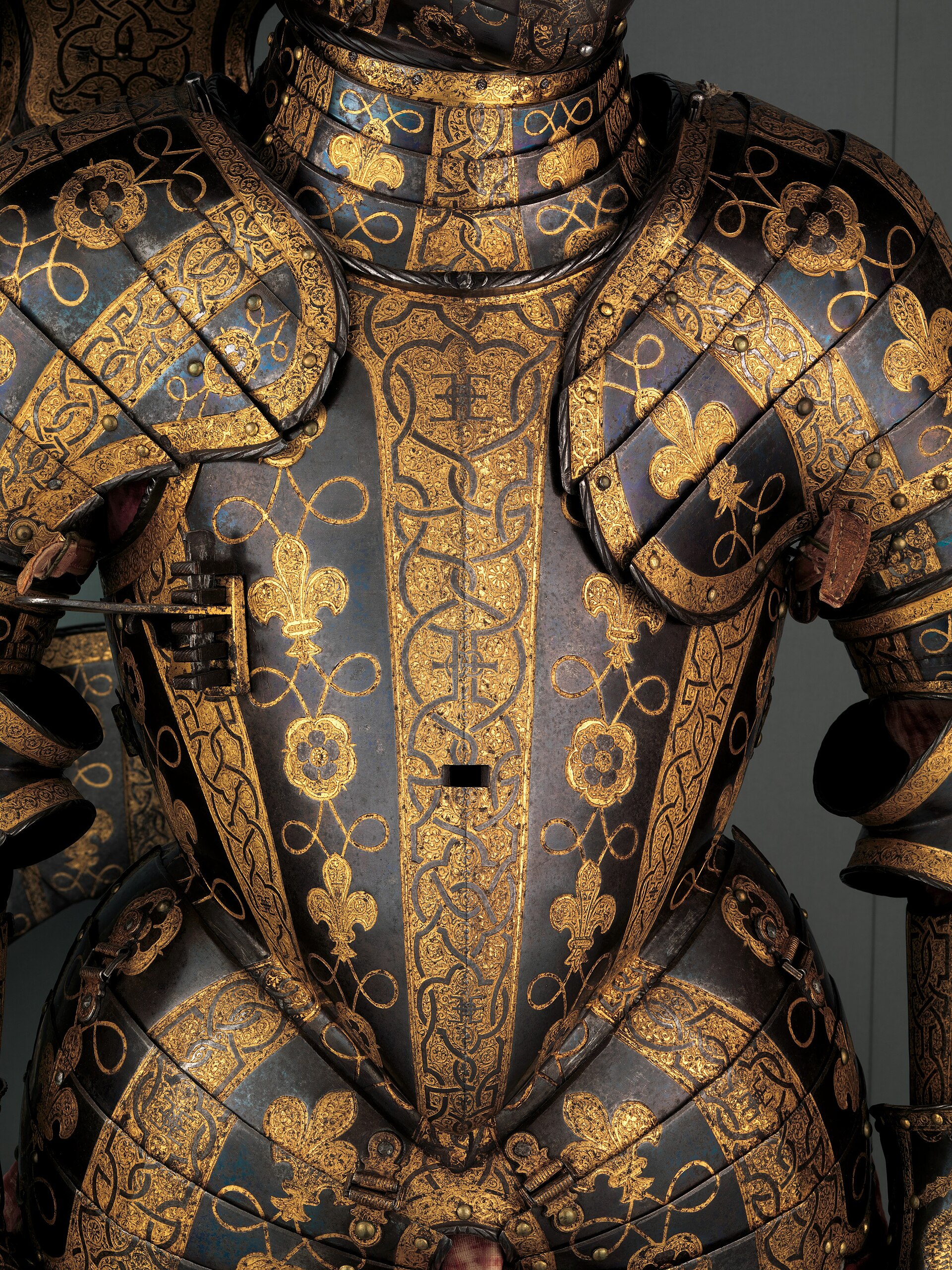
Nickel's 1972 paper sets out three candidate owners: Genouilhac, Henry VIII and Francois II de la Tour d'Auvergne, vicomte de Turenne, who led a French embassy to England in 1527. The documentary hook is Edward Hall's chronicle, which describes the king on Shrove Tuesday that year in 'a newe harnes all gilte, of a strange fashion', and a report of Henry ordering a suit made for Turenne like his own. Nickel argued that the heraldry in the ornament fits Turenne better than Genouilhac: the lion, unicorn, stag, elephant and crane on the breastplates correspond, he says, to animals on a c. 1375 tapestry in the Metropolitan that came down through the Turenne line, and the de la Tour griffins and falcon appear too. That is argued, not documented. The Hercules scenes on the leg defences, long read as Genouilhac's personal signal, Nickel traces to Durer's 1511 Hercules drawings. He also reports that it has been pointed out that none of Genouilhac's own offices, the belted sword, cannon and flaming ball, appears in the ornament.
The authorship of the etching is a second dispute. Nickel distinguishes two hands, the Master of the Many Animals and the Master of the Deeds of Hercules, calls the first at the very top of etched armour work and the second mediocre, and records that Claude Blair proposed Giovanni da Maiano, a Florentine sculptor working at Henry's court, as designer on the strength of merknights and mermaids matching reliefs at Hampton Court. Nickel counters that the merknight is a Flemish, not an Italian, motif, and that the 5 in the date has a form typical of the Rhine countries; he reads the decoration as the work of a Rhenish-trained etcher in a workshop staffed largely by Flemings, which is how he describes the 'Almain' shop under van Royne. A. B. Chamberlain, followed by Wilhelm Waetzoldt and Blair, had suggested that the 'Maister Hans' who assisted Maiano at the 1527 festivities might be Hans Holbein. Nickel goes further and argues from style, by comparison with Holbein's designs for metalwork, that Holbein was the designer and in part the etcher of this armour. That is Nickel's argued case, not a document: no payment or contract naming Holbein for this armour has been cited, and Blair preferred Maiano.
A footnote in Nickel, citing Ortwin Gamber for the reconstruction, says the great garniture of Henry VIII in the Tower was composed of the same elements as the 1527 garniture, and that its decoration...
A footnote in Nickel, citing Ortwin Gamber for the reconstruction, says the great garniture of Henry VIII in the Tower was composed of the same elements as the 1527 garniture, and that its decoration is thought to have been etched by one F. Queblaunche, on the payroll in 1539, after designs by Holbein of 1533-36. Nickel gives no date for that garniture and I could not trace the Queblaunche claim to a primary source, so it is secondhand. Separately, the Montana thesis catalogues a plainer armour of about 1540 in the Royal Armouries, which it places under Erasmus Kirkenar, with 1540 etched on the armet collar, gilt borders as its only decoration and a left pauldron bowed to protect the side facing an opponent. This page does not identify the two as one object.
The more diagnostic point is metallurgical. The V&A states the workshop imported good medium-carbon steel for its first few decades but could not harden it without warping until, under Kirkenar between 1544 and 1567, slack quenching solved it: letting the heated steel cool briefly before immersion. It adds that this may have encouraged the horizontally lamed 'anime' body armour associated with Greenwich, as smaller pieces cool more controllably, and then declines to settle the question, since banded doublets also appear in mid-century portraits. A technical cause and a fashion cause are both on the table, and the V&A leaves them there.
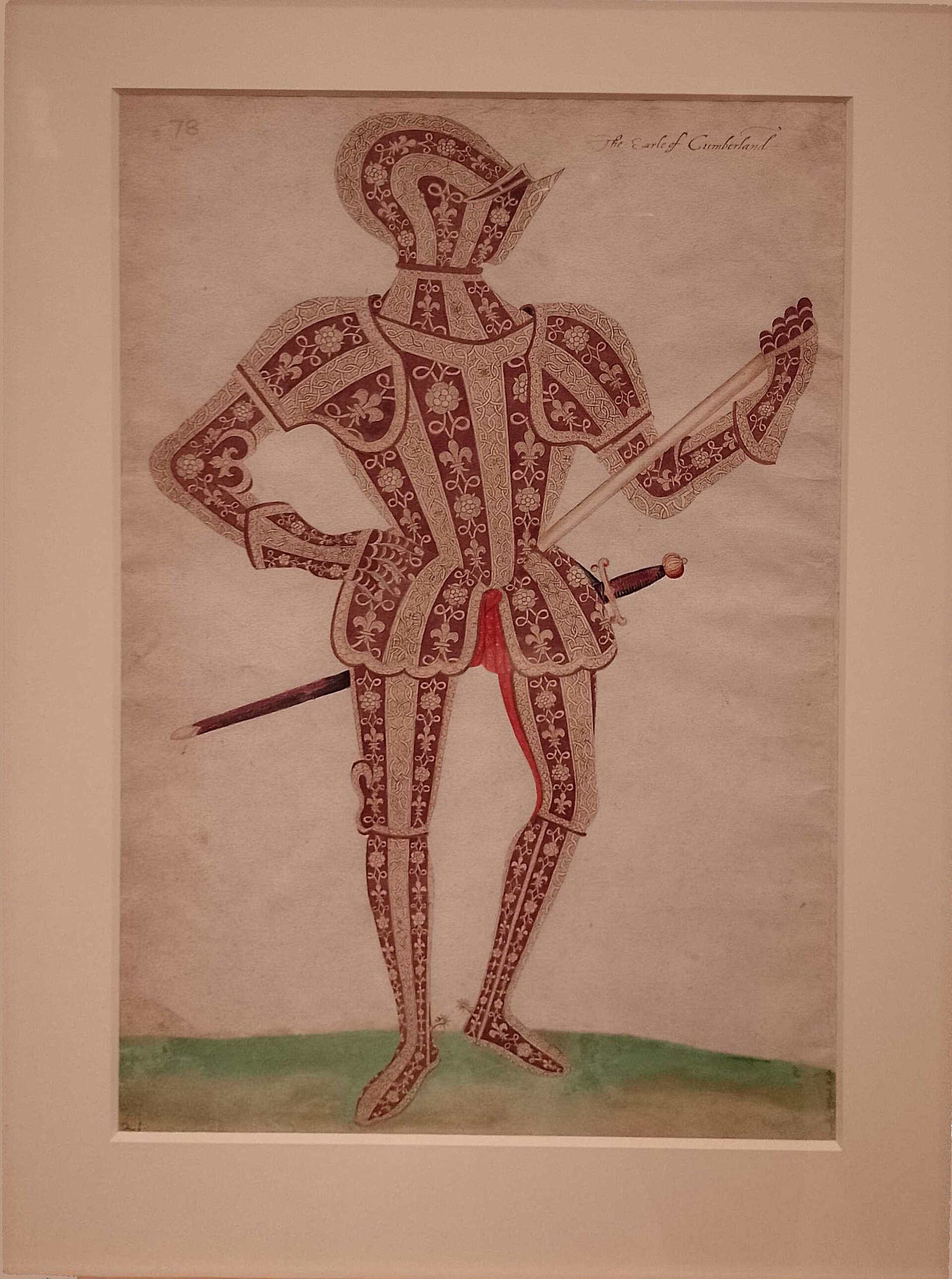
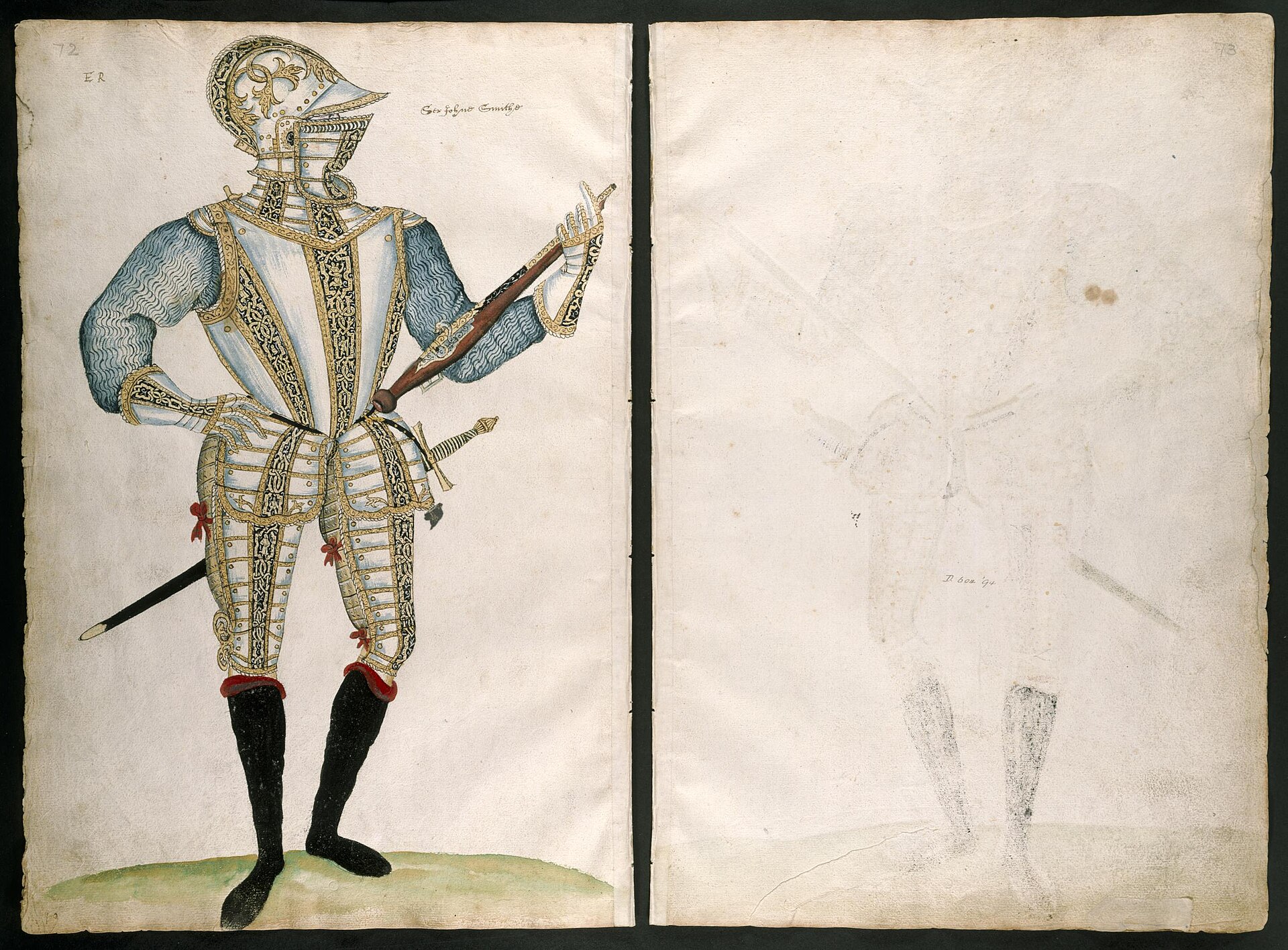
The album has 29 designs for armour on 56 sheets plus one sheet of additional components; the first two are marked MR for Mary Tudor and the rest ER for Elizabeth.
The album has 29 designs for armour on 56 sheets plus one sheet of additional components; the first two are marked MR for Mary Tudor and the rest ER for Elizabeth. Each shows a figure in cavalry armour posed to display it, with the facing sheet holding the pieces of exchange for lighter cavalry, infantry, tilting or tournament use. Halder hand-coloured and annotated the stencilled sheets with the names of the commissioning noblemen, and the V&A reads them as working designs. The paper is watermarked as imported from the south of France.
What it proves is design intent and clientele. Several armours drawn survive, some with minor alterations; the Wikipedia article reports the drawings as near-exact against the finished pieces, with the Worcester sheet's red ground against a black ground in the sitter's portrait the main departure. The names read as a who's who: two designs for Robert Dudley, Earl of Leicester, at least three for Sir Christopher Hatton, three for Sir Henry Lee, Clifford, Worcester, Buckhurst, Scudamore and a Pembroke. The album also holds a design for Duke John of Finland, which the V&A links to his stay at Elizabeth's court in 1559-60, and a last design for Sir Horatio Palavicino, whose armour does not survive.
It does not prove that the album is complete. The V&A says lost drawings left imprints on the backs of other sheets. Bashford Dean argued in 1920 that it appears to have been one volume of an inventory, since suits of the same pattern evidently existed that it does not depict. That makes the album strong evidence for the sheets it holds and silent about the rest.
Its own history is partly mapped. Viscount Dillon, who published it in 1905 and is quoted on the V&A's page, says it was shown to the Society of Antiquaries in 1725 by a Mr Virtue, was reproduced by Pennant in 1792 with the permission of its then owner, the Dowager Duchess of Portland, and was drawn on by Strutt in 1799; Dillon notes that her library was sold in 1786, which sits awkwardly with her ownership in 1792, and guesses it once belonged to the Harleian library and says nothing is known of its history from 1799 until it appeared in the Spitzer collection, from whose sale it passed to M. Stein of Paris. The V&A bought it from Stein in 1894 for 5,000 francs. An inscription on the back of the Rutland sheet reads 'J. West, 1754', possibly James West of Alscott Park. An eighteenth-century listing at the front wrongly credits the designs to Holbein, an error the museum says was known when it bought them.
The documented function of these armours was the tilt and the tournament, and the V&A is explicit that they were not merely for show: men fought, jousted and skirmished in them, and some of the later...
The documented function of these armours was the tilt and the tournament, and the V&A is explicit that they were not merely for show: men fought, jousted and skirmished in them, and some of the later designs were for armours made to meet the Spanish threat of 1588. The Wallace Collection's armour for Thomas Sackville, Lord Buckhurst, made about 1587 by Halder at Greenwich, was by the museum's account made for that preparation and never used. Sir Henry Lee, per the V&A, became Queen's Champion in 1571, established the Accession Day tilts probably about 1581 and is credited with their choreography and scripts, festivals of jousting, poetry, music and feasting aimed at glorifying the Queen.
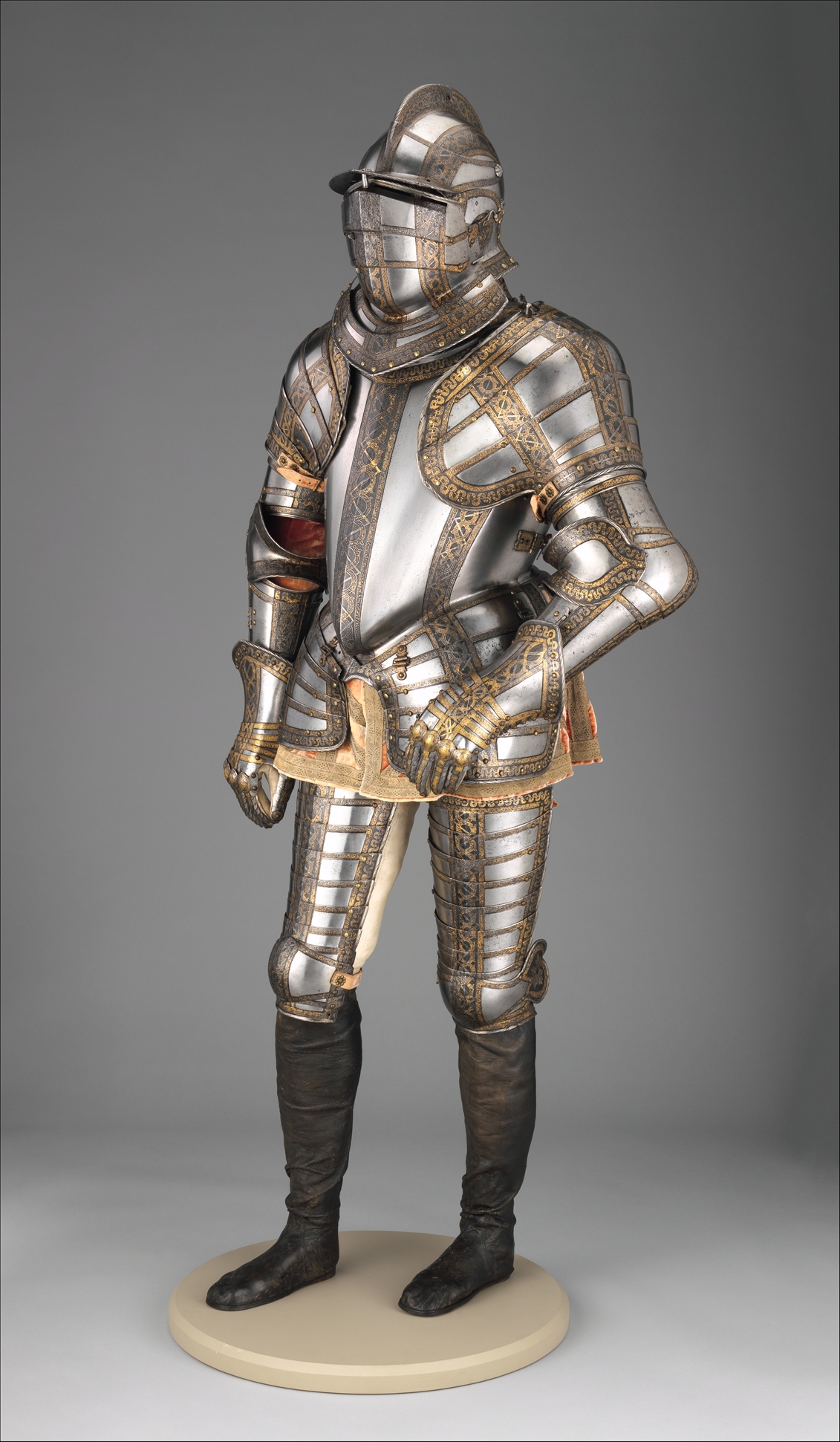
Within that, the V&A reads the decoration as courtship. Dudley's armour carries his ragged staff and lovers' knots; the V&A calls them a sign of devotion to the Queen. Hatton's etched lovers' knots tied to the Tudor rose, it says, almost turn his armour into a love letter in steel, set beside his passionate correspondence with Elizabeth. These are the museum's readings, argued by its curators from the sitters' known behaviour and the motifs, and nobody has produced Hatton's order stating the intent. Clifford's garniture, drawn in the album with Tudor roses, fleurs-de-lys and lovers' knots, is the V&A's example of the full flamboyance of the 1580s; Clifford took over from Lee as Queen's Champion when Lee retired in 1591, according to the V&A.
The V&A also frames armour as clothing: the 1570s peascod belly appears on doublets and breastplates alike, and nobles who led fashion were obliged to present themselves in the most expensive and up-to-date manner. Clients, it says, paid up to GBP 500 for a decorated garniture and needed a royal licence; the museum equates that with around GBP 2 million today but states no method, so I do not treat the modern figure as evidence. Hatton, who commissioned lavishly, died GBP 42,000 in debt according to the V&A.
The V&A describes the decoration process: the formed piece is coated with an acid-resistant wax into which the pattern is incised, then immersed in an acid solution until the exposed steel is eaten...
The V&A describes the decoration process: the formed piece is coated with an acid-resistant wax into which the pattern is incised, then immersed in an acid solution until the exposed steel is eaten away, after which gilding or blackening may be added. Nickel's note on the 1527 garniture adds that it was etched in what was later called the Italian fashion, the whole surface covered in resist and the design silhouetted by scraping, as against the German method of drawing in liquid wax with a brush. The 1527 armour is etched and gilded across its whole surface; the Pembroke and Cumberland armours in the plates show bands of etched and gilt ornament against bright or blued steel.
The album also carries technical evidence. X-ray analysis of the Buckhurst sheet showed the reddish-brown ground was iron oxides with traces of zinc and lead, and the pale blue on the stirrups of the 1587 Lee sheet was indigo; the V&A infers iron oxide as a cheaper or more available way to suggest large areas of blued steel. Where the armours survive they were heat-treated until iridescent blue. The weights vary: the Met gives 28.45 kg for the 1527 garniture, 27.24 kg for Pembroke and 27.2 kg for Clifford; the Wallace gives 32.03 kg for Buckhurst.
After Halder's death in 1608, the V&A says, William Pickering ran the armoury and produced superb work, notably the armour of Henry, Prince of Wales, in 1611, but demand and output declined.
After Halder's death in 1608, the V&A says, William Pickering ran the armoury and produced superb work, notably the armour of Henry, Prince of Wales, in 1611, but demand and output declined. A Royal Armouries account says inventories of Greenwich Palace storerooms under Henry VIII show wooden horses there by at least 1547, that twelve horses were recorded by 1629, and that on 5 April 1650 the Surveyor of the Ordnance recorded wooden horses with men mounted on them. Whether those horses went to the Tower is unknown; the Royal Armouries says no records prove it and there are no known records of wooden horses at the Tower before 1652.
What happened next is a story about names. The first Tower Line of Kings is recorded in an October 1660 inventory, after Charles II ordered an audit of arms and armour and tried to recover royal property that had been sold or disposed of. In its 1689 reworking the display became fourteen kings from William the Conqueror to Charles II, and the Royal Armouries says its organisers had deliberately to ignore the known facts about certain armours, such as Leicester's, and give them to a king. Meyrick, the leading armour scholar of the day, complained that visitors were deceived by false representations and began a chronological re-arrangement in 1826. A fire on 30 October 1841 destroyed most of the displays in the Grand Storehouse. In the 1990s the Tower's recreated Line of Kings dressed its figures in a plain early seventeenth-century Greenwich armour of the type known to have been used in it, because the old attributions could not be repeated.
The Metropolitan Museum took its Greenwich armours in the early twentieth century under its first curator of arms and armour, Bashford Dean.
The Metropolitan Museum took its Greenwich armours in the early twentieth century under its first curator of arms and armour, Bashford Dean. Its collection data record the Scudamore field armour (11.128.1) and the armour of Sir James Scudamore (11.128.2) as bought in 1911 through the Frederick C. Hewitt Fund, both dated with the note 'restored and completed 1915'; the 1527 garniture as the 1919 purchase; and the armours of Henry Herbert, second Earl of Pembroke (Rogers Fund, 1932, dated c. 1585-86 by the museum) and George Clifford (Munsey Fund, 1932, dated 1586). The museum's Commons file descriptions and its API give the maker of the Pembroke armour as the Royal Workshops at Greenwich and of the Clifford armour as Jacob Halder.
The Wallace Collection holds the Buckhurst armour; how it reached Sir Richard Wallace I could not establish from the sources I opened. The V&A says an armour made for Dudley about 1575 is in the Royal Armouries at Leeds (II.81, VI.49), Lee's Armada armour is almost intact with the Worshipful Company of Armourers and Brasiers, and Prince Henry's 1611 armour is in the Royal Collection (WIND.678). Leeds is a late home: the Wikipedia article on the Royal Armouries says the artillery collection moved to Fort Nelson in 1995 and the new museum opened in Leeds the following year, and the Royal Armouries' own history page says responsibility for the Tower armouries passed through several government departments until the National Heritage Act 1983.
No forgery of a Greenwich armour is documented in the sources I opened.
No forgery of a Greenwich armour is documented in the sources I opened. The recorded failure modes are restoration, composite assembly and misattribution. The Scudamore armours were found packed in a chest at Holme Lacy and, in the Met's own data, restored and completed in 1915. The Met's maker data name Daniel Tachaux as the restorer: for 11.128.1 the helmet, left pauldron, gauntlets and right sabaton are his, and for 11.128.2, the armour of Sir James, the breastplate, backplate and gauntlets, so much of what is seen on that figure is 1915 work, not Greenwich steel.
The identity of the second Scudamore suit became a dispute in print. Viscount Dillon, writing in the Archaeological Journal in 1915, argued that the broad-banded suit did not belong to Sir James Scudamore but to Lord Henry Compton. Dean's reply in the same journal, in the volume dated 1920 (Dean dates both suits to about 1585; the Met dates 11.128.2 to about 1595-96), argues from a contemporary portrait of Scudamore himself wearing that armour, from the Holme Lacy find and from the fact that the Compton armour is recorded in the Tower armoury as late as 1625 (he cites Laking). Dean also rebuts Dillon's reasoning that the album shows no second Scudamore suit, since the album seems to be one volume of an inventory. The Met's catalogue still gives Scudamore, so its title follows Dean; I have not found a source recording Dillon conceding.
The citable literature is a handful of studies.
The citable literature is a handful of studies. Dillon's 1905 edition of the album; Laking's A Record of European Armour and Arms through Seven Centuries (1920-22) with Cripps-Day; Mann's 1951 Tower of London exhibition of Greenwich armour; Claude Blair's articles in Archaeologia (1965) and the Connoisseur (1960, 'New Light on Four Almain Armours'); Alan Williams and Anthony de Reuck's The Royal Armoury at Greenwich 1515-1649 (1995); and Leslie Southwick's 2025 article in Arms and Armour 22, pages 67-130, which reconstructs the Master Workmen from 1515 to 1603. I confirmed Southwick's title, pages and publication through the Crossref record only; the publisher's page refused automated access and I did not read his text. The Dillon-Mann-Blair-Williams items are cited through footnotes in Nickel and bibliography entries in the Montana thesis.
There is no authentication board, no catalogue raisonne and no register of surviving Greenwich armours. Attribution runs through the Royal Armouries and the Met's Department of Arms and Armor, whose public data I used, and through the album, which makes the surviving armour for a named courtier an easy case and an anonymous one a hard one.
Armourers; Royal court workshop. Active c. 1511-1640s (sources differ on both ends), Greenwich, London.
No forgery documented; the recorded problems are restoration, composites and misattribution. The Scudamore armours were restored and completed at the Met in 1915. Viscount Dillon argued in 1915 that the broad-banded suit belonged to Lord Henry Compton, not Sir James Scudamore.
The Metropolitan Museum of Art (New York); Victoria and Albert Museum (London); Royal Armouries Museum (Leeds); Tower of London (Royal Armouries) (London); Wallace Collection (London); Worshipful Company of Armourers and Brasiers (London).
I found no verified auction result for a Greenwich-made armour of the royal period. Searches for Christie's, Sotheby's and Bonhams sales returned only later harquebusier and pikeman armours catalogued as 'possibly Greenwich', and the lot pages I opened gave no price.
Who was the 1527 garniture made for: Henry VIII, the vicomte de Turenne or Galiot de Genouilhac? Nickel (1972) argues Turenne from heraldic animals, the Met now says probably Henry, and the family tradition says Genouilhac; no document naming armour and recipient has been cited.
In this archive the person who authenticated, acquired or won back an object is repeatedly the person who owned it, named it or...
8 min read
Arms and armour carries more disputed provenance than any other class in this archive: 22 of its 95 ownership links, against one...
11 min read
Fifty-seven records here use composite, pastiche or assembled, and the words are doing three incompatible jobs.
12 min read
Of 2,439 provenance links in 330 records, 75 per cent are documented. Clocks reach 83 per cent and arms and armour 65.
7 min read
Durer paid a florin for her illuminated Salvator in 1521 and called it a wonder. In England she is a courtier.
9 min read
Last verified
One artwork and its story every Tuesday, with the picture: who owned it, what it made, and what closes soon in the exhibition calendar. No promotion, and nothing we cannot cite.
We send one email to confirm the address and keep nothing else. Every letter carries a one-click unsubscribe. How we handle your data.