The Illuminator Durer Paid a Florin For
Durer paid a florin for her illuminated Salvator in 1521 and called it a wonder. In England she is a courtier. No surviving work is firmly hers.
Records in this piece: The Rothschild Prayerbook, Armor Garniture, Probably of King Henry VIII of England
On this page 8 sections
ContentsClose
In short
- Durer's diary, in Conway's 1889 translation, says the illuminator's daughter Susanna was about 18, had illuminated a Salvator on a little sheet, and that he paid her 1 florin. It also says it is very wonderful that a woman can do so much.
- Her birth year, 1503, is only arithmetic from Durer's "about 18". No baptism record appears in any source we read.
- In England her household position is documented by modern writers citing records we have not opened, and her painting is not. Soberton says the household accounts do not name her as a painter.
- The Vienna Holbein miniature often said to show her carries an inscribed age of 28 in 1534, which counts against a woman of about 31, and the museum does not name her.
- No work is firmly attributed to her. Compton Verney's attribution of a c. 1546 miniature of Mary Tudor is an argument from the deaths of Gerard and Lucas, and a reviewer, writing about what appears to be the same miniature, calls it the family workshop's.
What Durer wrote in Antwerp in May 1521
The one document that gives us Susanna Horenbout at work is a diary entry by Albrecht Durer, written in Antwerp in May 1521. In William Martin Conway's 1889 English translation it reads: the illuminator "has a daughter about 18 years old named Susanna. She has illuminated a Salvator on a little sheet, for which I gave her 1 fl." The next sentence is "It is very wonderful that a woman can do so much." That is one translation. Kennedy renders it as a woman's picture being so good, and the German word he used is "Weibsbild".
Conway prints it between the entries marked 21 May and 26 May. The father is Gerard Horenbout of Ghent, and Conway's own footnote says so. A Salvator is a picture of Christ, and the sentence tells us Durer paid money, a modest sum in his accounts, for one small painted sheet. Conway prints the price as 1 fl.
That is the whole of it. Durer gives her first name, an age and a price. He does not say where the sheet was made or whether he saw her paint it. We have no source that says the sheet survives. Another Susanna also turns up in the same diary: Durer's own maid, named in the entries about his household. She is a different woman, and the two are easy to mix up.
One sentence needs care. Durer calls it a wonder that a woman could do so much, and we can quote that. What he felt when he wrote it is not on the page.
Her birth year is arithmetic, not a record
Susanna Horenbout's birth year, 1503, comes from Durer's "about 18" and from nothing we have read that is independent of it. The 1891 Dictionary of National Biography gives 1503, and the writer Sylvia Barbara Soberton explains that the figure follows from Durer's remark in 1521. Kathleen Kennedy, who teaches at Bristol, writes "c. 1500" and says she was probably born in Ghent.
So the year is a calculation from an age that Durer himself hedged with the word "about". The place is a probability. Nobody we read has produced a baptism entry.
Her parents are better documented. The Dictionary of National Biography says Gerard Horenbout was married to Margaret Svanders, daughter of Derick Svanders and widow of Jan van Heerweghe, by a Ghent deed of December 1517. It calls Gerard one of the best illuminators of the day, much used by Margaret of Austria, regent of the Netherlands.
Our own record of the Rothschild Prayerbook gives the same standing to Gerard from the manuscript side. It says the illuminator long catalogued as the Master of James IV of Scotland is generally recognised as Gerard Horenbout. It has no entry for Susanna. It was made about 1505 to 1510 and she was, at most, a small child then, so she cannot have worked on it.
The family's one firmly documented project
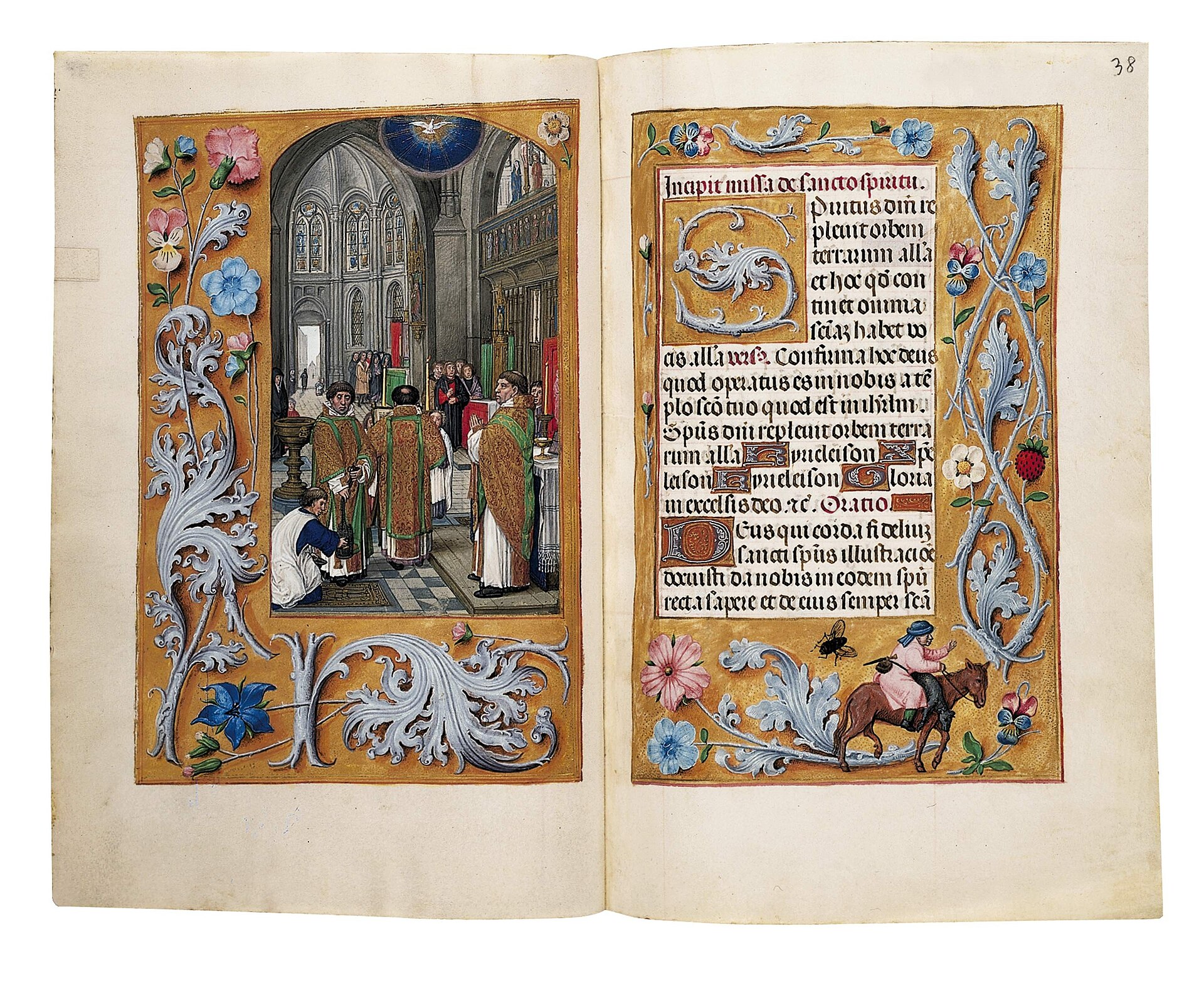
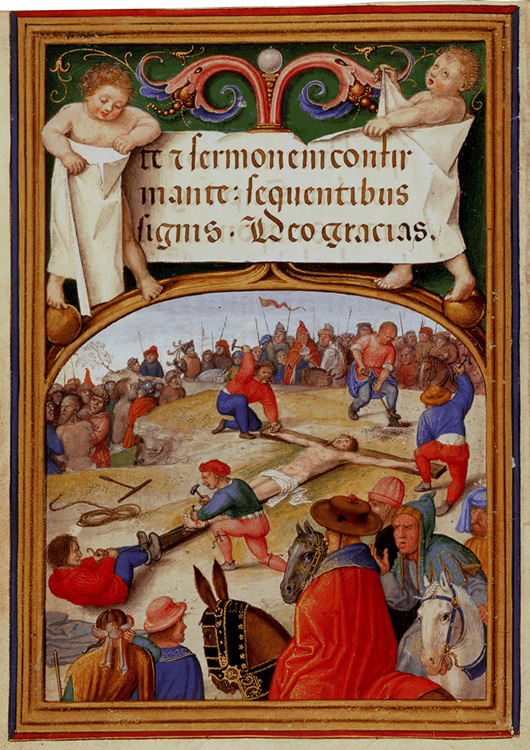
The best-documented Horenbout commission is the set of miniatures Gerard added to the Sforza Hours for Margaret of Austria, and Susanna's share in it is unknown. Kennedy says it is the one extant project that can be tied to Gerard through archival documents, and that most critics think his workshop painted parts of the images too. The Wikimedia Commons file for the page shown here dates it c. 1519 to 1520 and credits Gerard.
Kennedy then goes further. If Susanna was skilled by 1521, she argues, she must have taken part, and where critics write Gerard we may have to read Susanna. We should call that an argument, not a finding. Kennedy herself writes that today "we cannot tell the work of Susanna, Lucas, or Gerard apart."
That sentence is the real limit of the case. Three people worked in one family workshop and signed almost nothing. When a book says "Horenbout", it means a name that covers all of them.
What the documents say of her in England
Susanna's English record is mostly records of a household position, and almost none of it describes her painting. The sources we read give these points, and they are not all equally firm.
| Point | Where we read it | How firm |
|---|---|---|
| Mother Margaret buried at Fulham, 26 November 1529, under a brass | Dictionary of National Biography (1891) | A brass, as the Dictionary reports it |
| Susanna named on that brass, the only child named | Kennedy, citing the brass | One reading, not seen by us |
| Husband John Parker, a yeoman of the robes | Dictionary of National Biography; Kennedy | Two sources, same post named differently |
| Gentlewoman to Anne of Cleves in 1539 to 1540 | Kennedy; Soberton; Wikipedia citing Campbell and Foister | Several modern writers, accounts not seen by us |
| Second husband John Gilman, married 22 September 1539 | Wikipedia, citing Campbell and Foister; the Dictionary of National Biography and Kennedy name only Parker | One tertiary report, not seen by us |
| Death | 1545 (Dictionary of National Biography); c. 1554 (Kennedy); dead by 1554 (Wikipedia) | Disputed |
Lucas is far better documented. Kennedy and Soberton call him her brother. Guicciardini does too, according to the Dictionary of National Biography, which doubts it and thinks a brother or cousin of Gerard more likely. We do not know which he was. Goldring writes in the London Review of Books that he is first recorded in Henry VIII's service in 1525. The Dictionary of National Biography adds a patent of 22 June 1534 making him king's painter, and a household entry of May 1544 recording him dead.
Gerard appears in the household accounts from October 1528 at 20 pounds a year, again according to that dictionary. He died in 1540, which it says an entry in the Ghent accounts proves.
Soberton states that the household accounts do not name Susanna as a painter, while another woman, Levina Teerlinc, is called a paintrix in 1546. We have not seen those accounts ourselves. The honest reading is that her place at court is documented and her painting there is not.
The portrait that is not her
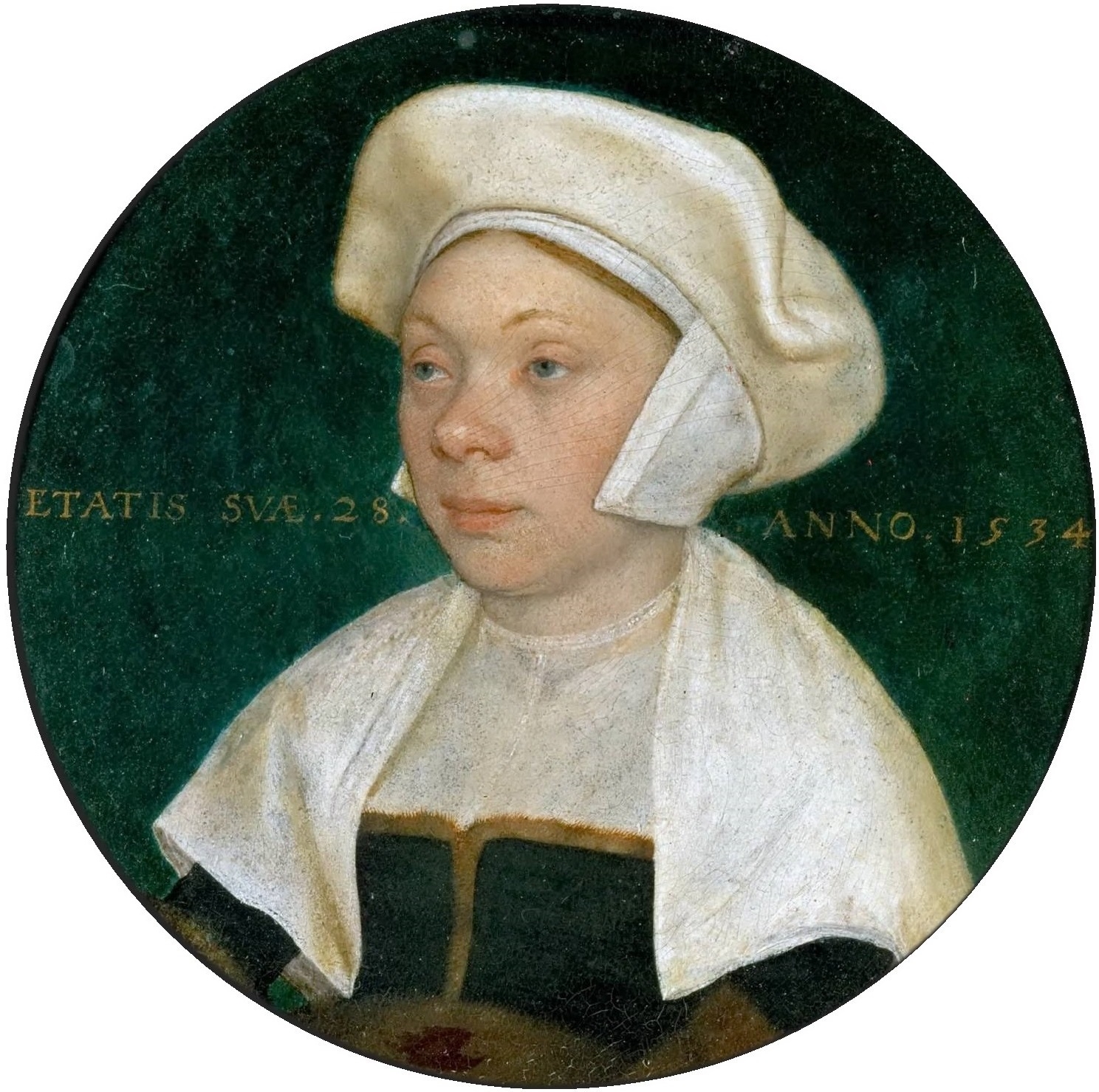
A Holbein miniature in Vienna is often said to show Susanna, and the evidence counts against it, starting with its own inscription. The Commons description of the picture says the sitter is an unidentified lady, probably the wife of a servant of Henry VIII, aged 28 in 1534. Durer's "about 18" in 1521 puts Susanna's birth near 1503, which would make her about 31 in 1534. The Commons page cites Foister's Holbein in England (Tate, 2006), p. 47, for a Susanna already in her thirties by 1534. The Vienna catalogue does not name her.
The mistake spread because it is tidy. A woman painter at the Tudor court, a famous painter next door and a small portrait of a woman with no name. A caption would have written itself.
Durer's "about 18" may have been loose, but the sitter's inscribed age would need a gap of about three years in his estimate. The Vienna museum does not claim the identification either. We treat the portrait as unknown.
Our own record of the Greenwich armour of Henry VIII shows a smaller case of the same habit: the Metropolitan Museum once attributed that design to Hans Holbein the Younger and no longer does. Names attached to Tudor court craft tend to move.
The family miniatures and the brother's name
The surviving Horenbout miniatures are credited to Lucas because he is the one painter named in the royal records. Soberton writes that most of what the workshop produced was later attributed to Lucas, that neither Lucas nor Gerard signed, and that Susanna could as likely have painted any of it. Kennedy makes the same observation.
That is a reason to hold the credit to Lucas loosely. Soberton also reports that Susan James once proposed Susanna for an early miniature of Henry VIII, and that the historian Robert Tittler refuted it. The newest case is different. A miniature of Princess Mary at Compton Verney, dated about 1546, is now labelled as attributed to Susanna. Soberton reports that a team led by Emma Rutherford made the attribution. Her reasoning, as Soberton gives it, is that Gerard and Lucas were already dead. The Dictionary of National Biography supports that premise: it dates Gerard's death to 1540 and Lucas's to May 1544.
Goldring, reviewing an exhibition, describes what appears to be the same miniature only as a portrait by the Horenbout family workshop, about 1544 to 1550, with a sitter more likely to be Mary than Catherine Parr. She does not name Susanna or Compton Verney's label. So the attribution rests on an argument by elimination, and a workshop can have other hands. We do not know that the Compton Verney miniature is hers.
Soberton also floats a second candidate, a miniature of Anne of Cleves at the Victoria and Albert Museum. She calls it "not impossible", which is where it should stay.
A reader tempted by a coincidence
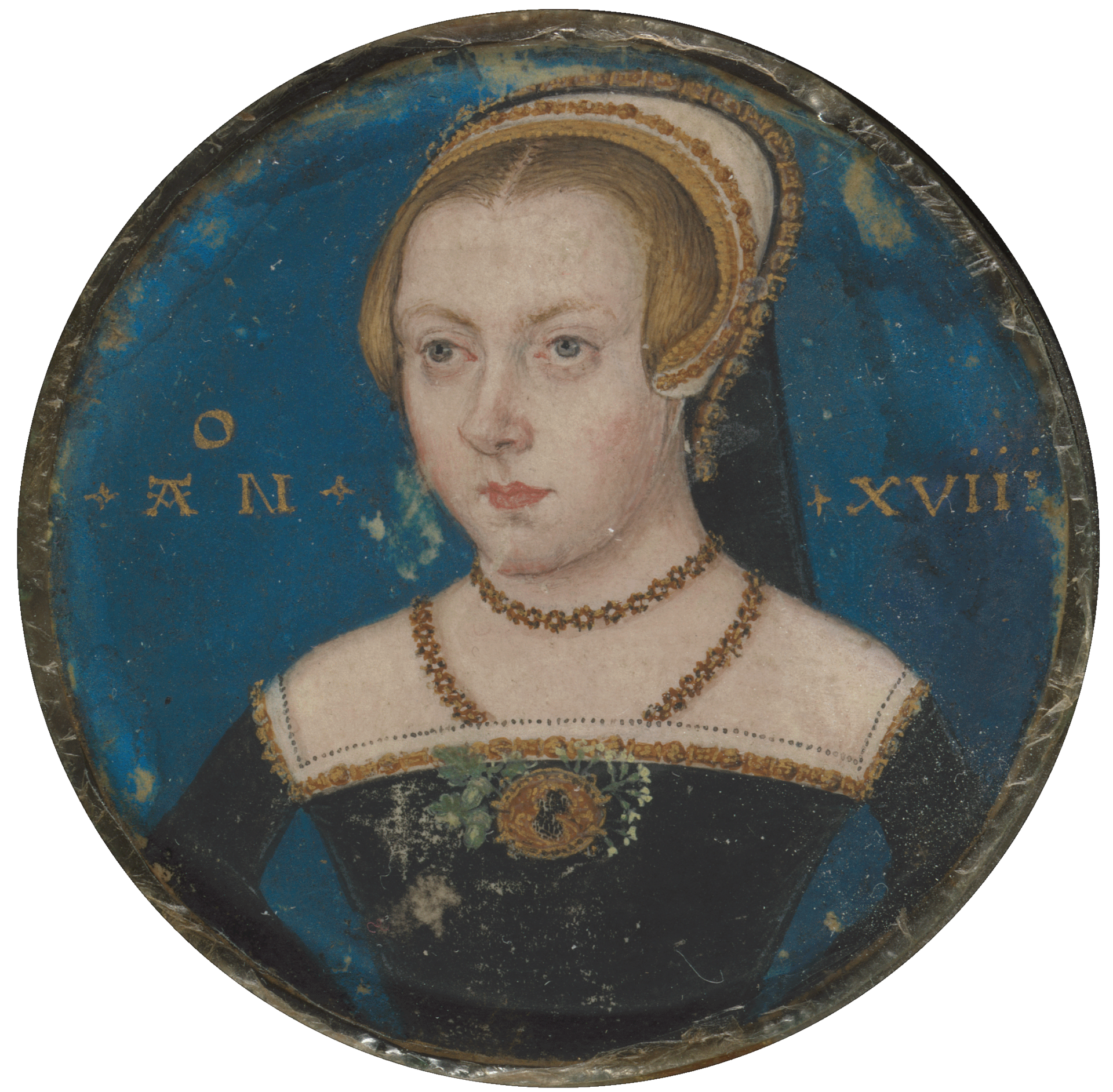
The portrait at the head of this piece is a Horenbout miniature with the numeral XVIII painted beside the sitter, and it has nothing to do with Susanna. It is a portrait of an unknown lady, filed under Lucas Horenbout's name and dated about 1535 in its Commons record from the Yale Center for British Art, and the numeral is the sitter's age. Susanna was about eighteen in 1521, fourteen years earlier.
The overlap is a coincidence of a number. No source links the sitter to the family, and the date is wrong for it. We show it because it is the kind of object the workshop made in England, and the kind whose makers we cannot separate. Its attribution to Lucas is the museum's, and we have not tested it.
What we know, how we know it, and what we do not
We know that a woman named Susanna, daughter of an illuminator, made a small painted Salvator that Durer bought in 1521, and we know it because he wrote it down. We know a Susanna Horenbout later stood close to the English court, from several modern writers who cite household records we have not opened.
We do not know the following. No surviving work is firmly attributed to her. We do not know her exact birth year, her place of birth, when she left for England, when she married John Parker or John Gilman, or when she died. We cannot say how much of the Sforza Hours or any English miniature is hers.
We also cannot say what she thought of any of it. No letter, will or note in her own hand has been cited by anyone we read, and her motives are guesses that nobody should print.
A fair summary is short. In one sentence from 1521 she is an artist with a name, an age and a price. In the English documents she is a courtier with a husband and a household. The two lives meet in no picture that anyone can prove.
Questions
She was the daughter of the Ghent illuminator Gerard Horenbout, born about 1503 if Durer's age is right. She later lived in England, where she married John Parker and, on one account, later John Gilman, and held a place in royal households.
In Antwerp in May 1521 he wrote that the illuminator had a daughter about 18 named Susanna, that she had illuminated a Salvator on a little sheet and that he gave her 1 florin. He added that it was very wonderful that a woman can do so much.
No work is firmly attributed to her. Compton Verney labels a miniature of Princess Mary of about 1546 as attributed to her, but that rests on an argument by elimination.
Probably not. Its inscription gives the sitter's age as 28 in 1534, and the Vienna catalogue does not name Susanna.
Sources
- 1William Martin Conway, Literary Remains of Albrecht Durer (Cambridge, 1889), the diary of the journey to the Netherlands, full text read at the Internet Archive; the entry sits between the 21 May and 26 May 1521 entries, with Conway's footnote on Gerhard Horebout. archive.org/details/...
- 2Lionel Henry Cust, 'Hornebolt, Gerard', Dictionary of National Biography, vol. 27 (1891), with entries for Lucas and Susanna, read on Wikisource. en.wikisource.org/wiki/...
- 3Kathleen E. Kennedy, 'Susanna Horenbout, Courtier and Artist', guest post, Art Herstory, 1 December 2019, quoting Durer's German and citing Campbell and Foister, Burlington Magazine 128 (1986), 719 to 727. artherstory.net/susanna-horenbout-courtier-and-artist
- 4Sylvia Barbara Soberton, 'The Lost Works of Susanna Horenbout', guest post, Art Herstory, on the Vienna miniature, the household accounts and the Compton Verney attribution. artherstory.net/the-lost-works-of-susanna-horenbout-femal...
- 5Elizabeth Goldring, 'At Compton Verney', London Review of Books 47:3 (2025), on the Reflected Self exhibition and the Horenbout family workshop miniature. lrb.co.uk/the-paper/...
- 6Wikipedia, 'Susannah Hornebolt', wikitext read; , used only for leads and for the Cleves, Gilman and Court of Requests points, all of which cite Campbell and Foister or other books we did not open. en.wikipedia.org/wiki/...
- 7Wikimedia Commons file pages for the Holbein Vienna miniature, Lucas Horenbout's Yale miniature (B1974.2.59) and the Sforza Hours folio; descriptions and licence fields read. commons.wikimedia.org/wiki/...
- 8Christie's, lot 157, sale 2819, New York, 29 January 2014, the Rothschild Prayerbook; read through Iconotheca's record of the book, not opened directly. christies.com/en/...
More in The Women Behind the Art
The partWho Stitched the Bayeux Tapestry? What the Documents Say About English Women's Embroidery
No document names who stitched the Bayeux Tapestry. What Domesday, the 1476 inventory and the Queen Matilda story show about English women's...
The Two Women in the Oseberg Ship, and the Queen Nobody Named
Two women lay in the Oseberg ship in 834. What the bones, isotopes and DNA show, and how a queen and a servant were read into a grave that no text...
The Name on the Rim: What Documents Say About Projecta
The Projecta Casket names its bride in one line of Latin. What the British Museum, Dalton 1901, an epitaph and Parliament say about her, and what is...