The Benin Bronzes
c. 1500 · Cast leaded brass
Dispersed
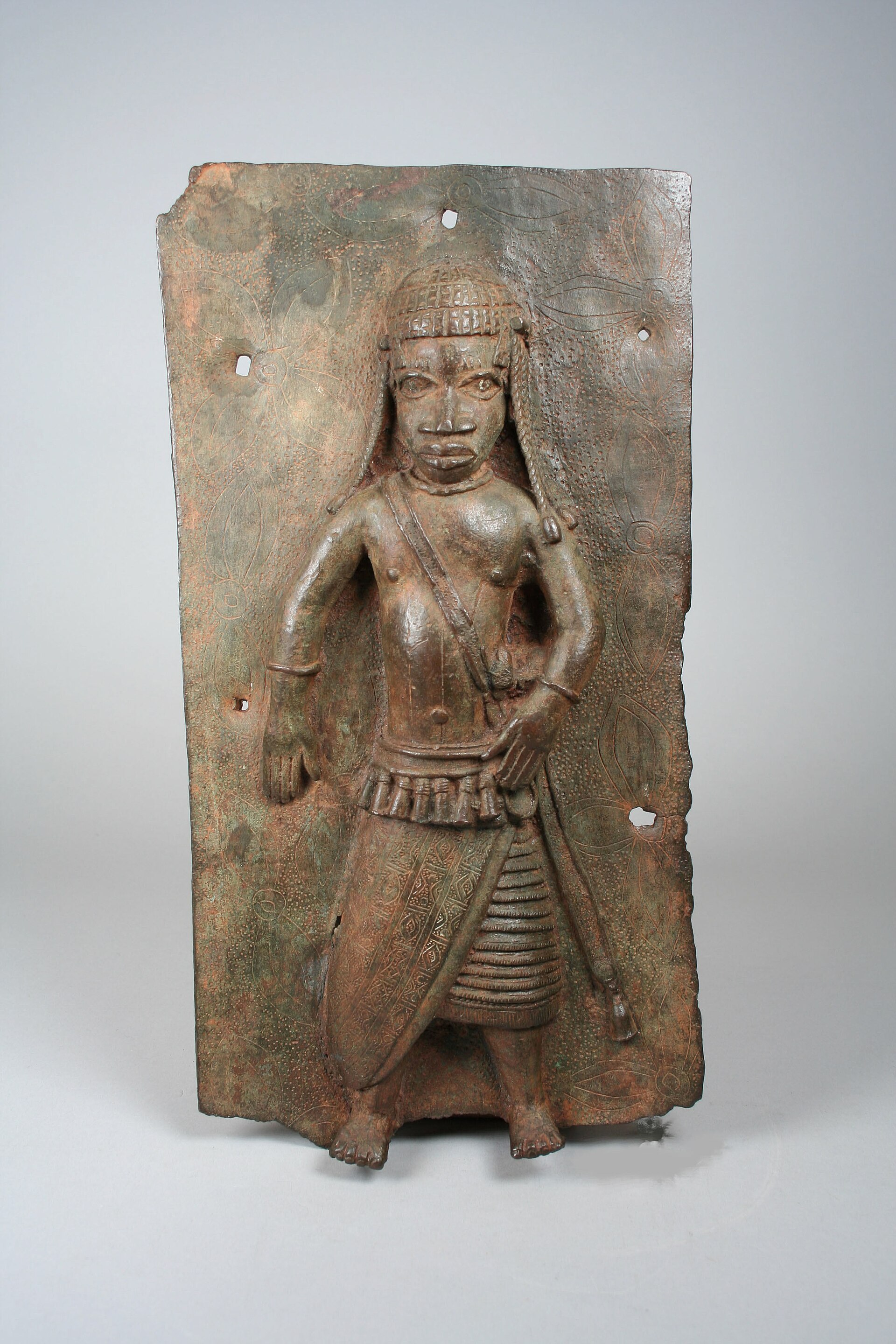
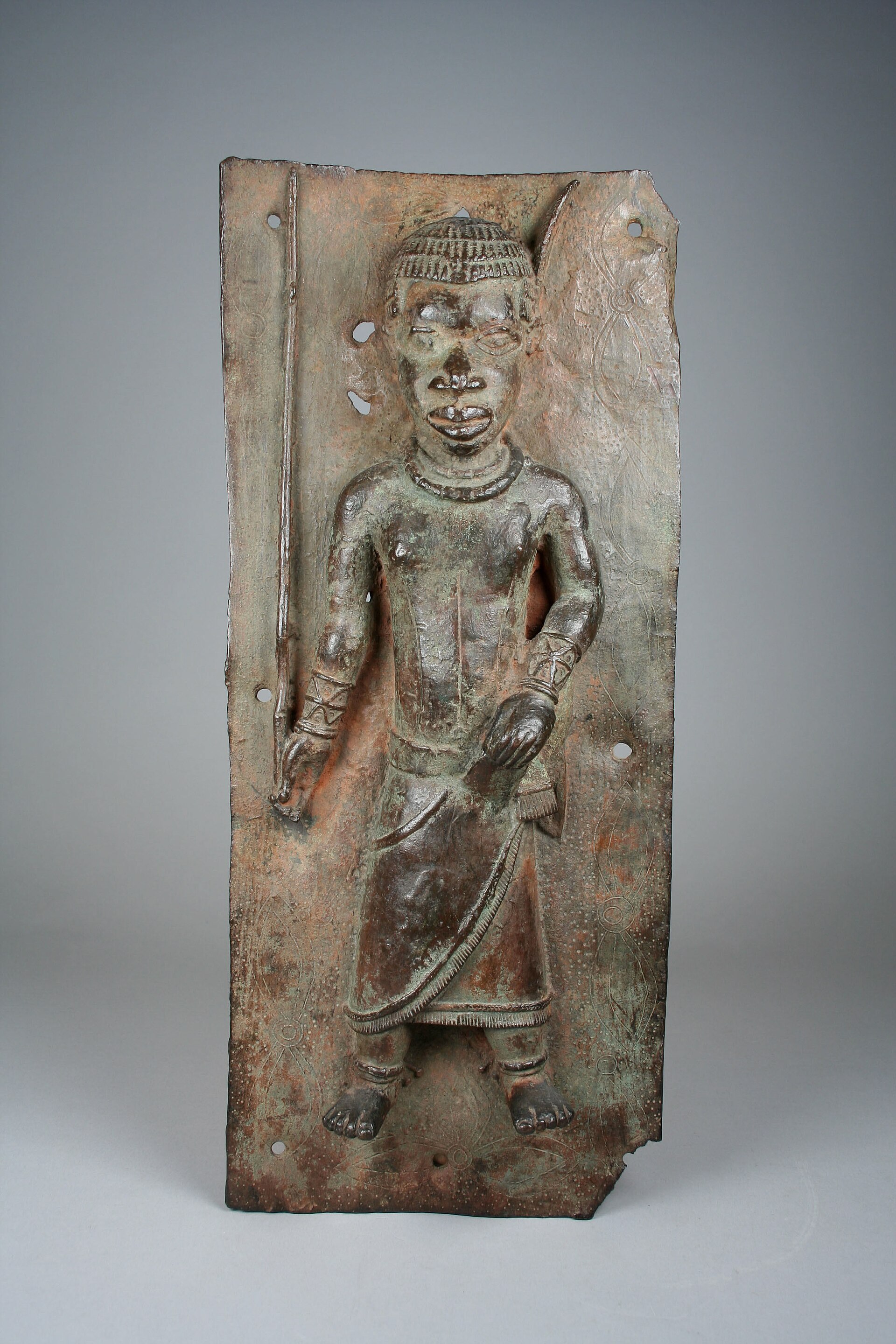
Plaque with a court official, Met 1991.17.26 Brass, about 1540 to 1570, 39.4 by 20.3 by 3.5 cm, credited by the Metropolitan Museum to Igun Eronmwon guild artists. Gift of Mr. and Mrs. Klaus G. Perls, 1991. Fixing holes are visible in the sheet. No verified portrait. No securely identified likeness of this maker is known under a free licence. We do not publish a face we cannot verify.
The Metropolitan Museum of Art, New York (CC0)| Full name | Igun Eronmwon, the guild of brass casters of the royal court of Benin |
|---|---|
| Worked as | Royal brass casters, Lost-wax founders, Palace guild of the Oba (Iwebo society), Makers of ancestral altar heads, wall plaques and regalia |
| Born | Undated. Edo court oral history: the Metropolitan Museum... · Benin City, Edo State, Nigeria (historic capital of the... |
| Died | Not extinct. Quarters inside the palace ended in 1897 · Benin City |
| Nationality | Edo, Kingdom of Benin (now Edo State, Nigeria) |
| Movement | Court art of the Kingdom of Benin, c. 1500 to 1897, resumed after 1914 |
| In this archive | 1 artwork |
| Sources | 25 cited |
| Last verified |
About this page 1 artwork in the archive · Last verified · 25 sources cited
Igun Eronmwon is a hereditary guild, not a person, and that is a fact about the objects rather than a gap in the scholarship. It was the highest-ranking of the artisan guilds attached to the palace of the Oba of Benin, and it held the right to cast brass for the court. The Metropolitan Museum credits its Benin brasswork to the guild as a corporate artist. No individual caster of the plaque period is named in any document I could open, from either the Edo or the European side.
The things most readers probably do not know are these. The guild's quarters stood inside the palace grounds until the British expedition of February 1897, so the street that now carries its name is a post-1914 address and the craft was broken and then resumed, not carried through. The metal was imported German brass, which has been measured, and the same guild is still casting by the same method, which means technique cannot tell you whether a Benin head is five hundred years old or five years old. And at least one auction-house catalogue note argues that a single hand inside the guild can be picked out from the heads, by the shape of the ears. That proposal is graded here as argued by one unnamed author, not established.
The guild's current position is the one the market pages leave out. Reporting from Benin City in July 2026 counted fewer than forty active art stores and barely two dozen foundries on Igun Street, many of them idle, while the objects the guild's ancestors cast are being returned to Nigeria and the question of who receives them is still contested among the federal commission, the Oba and the state of Edo.
Court oral history places the introduction of lost-wax casting and the foundation of the guild in the thirteenth century (the Met, which names no Oba) or in the fourteenth under Oba Oguola (a Nigerian newspaper interview). No document or dated excavation fixes it.28
Trade, diplomatic and missionary contact between Benin and Portugal develops, bringing manillas, the brass rings later traced to the Rhineland.16
Oba Esigie takes the throne; the Art Institute calls him the first Oba to commission palace plaques and says casting flourished under him. Wikipedia, citing a 2017 article not opened here, says he also consolidated the guild's monopoly and quarters.418
The Metropolitan Museum's date for its 1991 plaques; the British Museum gives 1500 to the mid-1600s for the plaque group as a whole.117
Philip Dark's proposed date for the Albright-Knox head, around the reigns of Ehengbuda and Ahuan.9
Dutch accounts compiled by Olfert Dapper describe the palace galleries on wooden pillars covered with cast metal bearing war pictures.4
Rulers emphasise their mystical powers and ancestry after conflict with the chiefs; the Art Institute says the royal arts of the period turn ornate and dense with supernatural imagery.4
Cyril Punch photographs an ancestral shrine inside the palace, described in the Sotheby's note as the only such photograph from before the invasion.9
Captain Gallwey writes of Benin's brass ware as very clever workmanship, quoted by Roth in 1903.5
Acting Consul-General James Phillips's party is attacked on the road to Benin City; the British Museum counts seven British and 230 African carriers dead. Sources differ on the date.1419
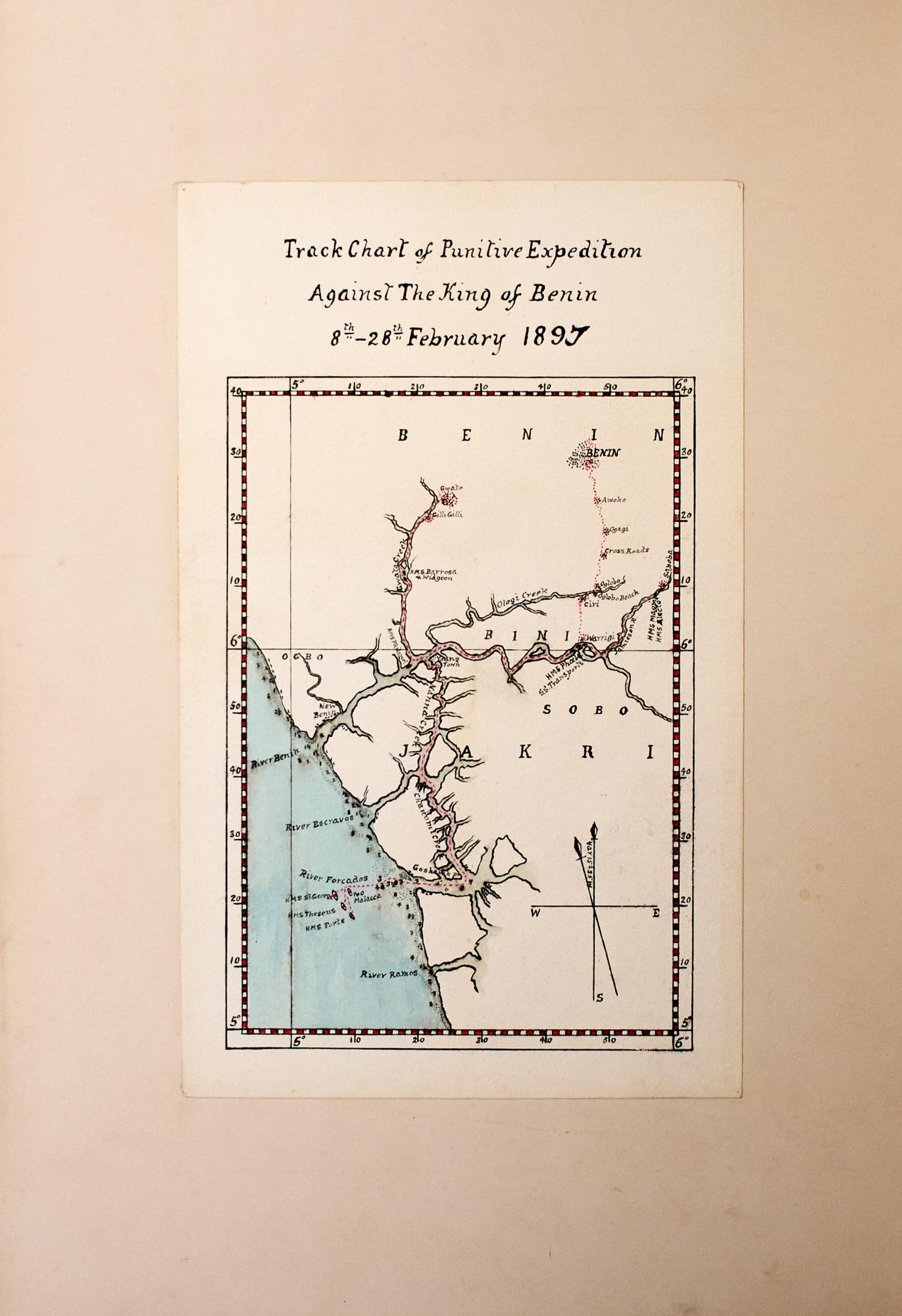
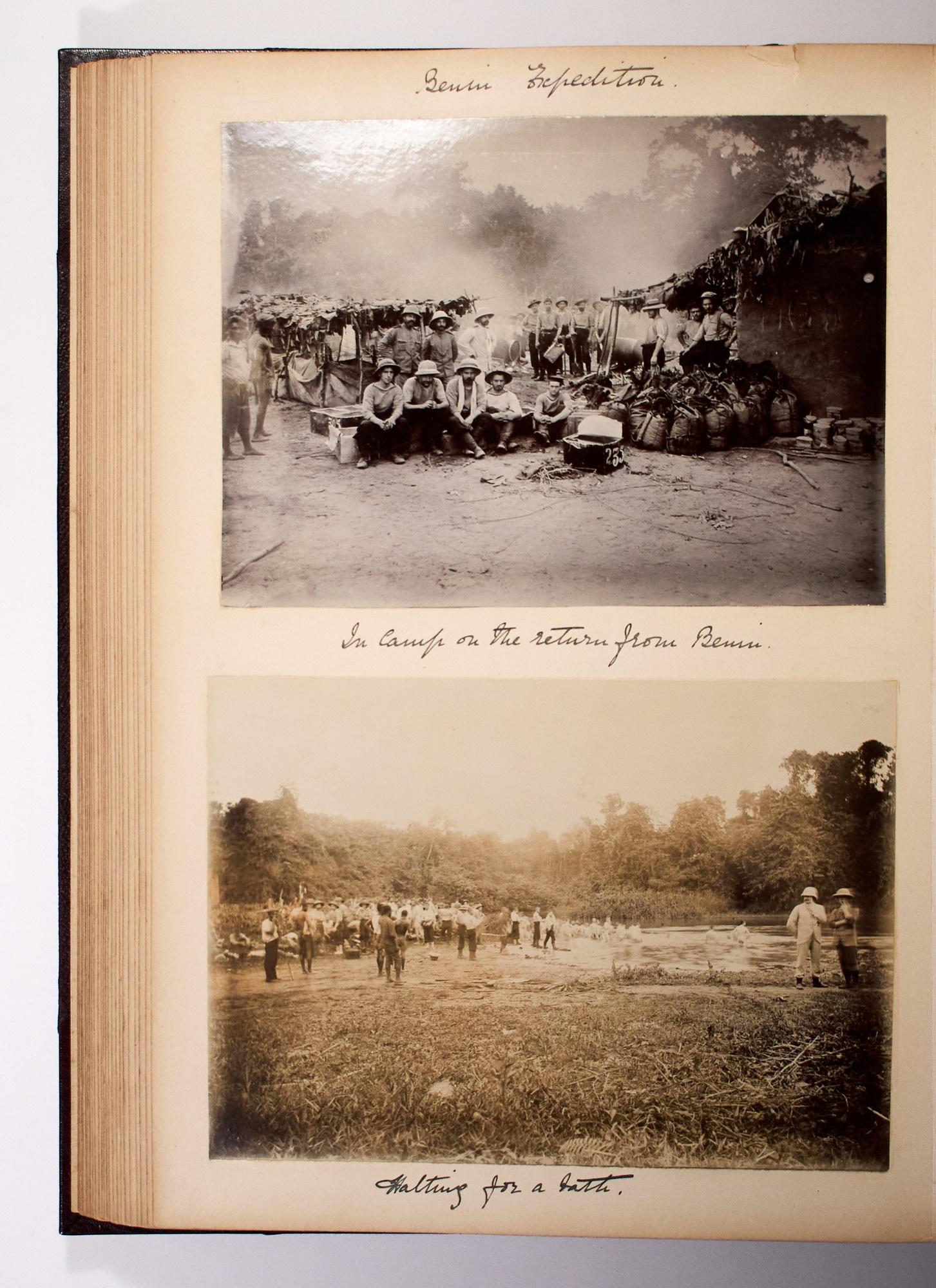
A force of about 1,200 takes Benin City; the palace is burned and looted and the Oba exiled.1419
Dr Allman finds casting compound with smelting pots, clay, beeswax and moulds in stages of completion next to the palace; the British Museum displays 304 plaques lent by the Foreign Office that autumn.15
Felix von Luschan buys 13 of 50 tusks at two London auctions of Benin material.12
Captain Roupell records chiefs' accounts of the origin of brass casting, printed by Roth in 1903; the British Museum completes receipt of 203 plaques.15
Oba Ovonramwen dies in exile; Eweka II is crowned; guild members begin returning and the quarter becomes Igun Street.24
Luschan's Die Altertuemer von Benin appears, recording the known Benin objects.12
Britain returns pieces of Ovonramwen's coral regalia to Oba Akenzua II.4
The British Museum deaccessions 29 plaques wrongly held to be duplicates.1
Ernest Ohly's ledger records a Benin head bought at Glendining's for GBP 230.20
William Fagg (1963) and Philip Dark (1973, 1975, 1982) establish the style chronology of commemorative heads.9
Nigeria uses a bronze replica of the Idia ivory mask as the emblem of its festival of Black and African arts, after the British Museum asked for 2 million naira to lend the original.15
Sotheby's New York sells the Albright-Knox head, estimated USD 1,000,000 to 1,500,000, for a reported USD 4.74 million including premium.91025
Sotheby's announces and four days later withdraws the Idia ivory pendant mask, estimated GBP 3.5 to 4.5 million.10
The British Museum's then director meets Oba Ewuare II, who repeats his request for return.1
The British Museum receives Nigeria's written request; Aberdeen and Cambridge return an Oba head and a cockerel.17
Berlin signs over ownership of 512 objects, about a third staying on loan.21
Digital Benin launches with documentation of more than 5,200 objects from 131 institutions.13
Nigeria's federal government recognises the Oba as custodian of returned objects; Igun sculptors cast the 22-foot Queen Mother statue; the PLOS ONE manilla study is published on 5 April.6716
119 objects handed over in Lagos by the Netherlands, 4 more on loan in Leiden.22
Protesters disrupt the preview of the Museum of West African Art in Benin City.1516
Cambridge transfers title to 116 objects.14
Al Jazeera reports fewer than 40 active art stores on Igun Street.7
Almost nothing from the court corpus reaches public auction now, and what does is not a guide to the rest. The two public benchmarks I could verify are the 2007 Albright-Knox head, reported at about USD 4.7 million including premium, and the 2011 Idia mask estimate, which never sold publicly. The mask later appeared in a private collection, and a head sold privately in 2016 is reported by one blog as bought by a dealer for GBP 10 million, and as a substantial seven-figure sum by the auctioneer's chairman in a trade report the archive cites. Since 2011 the trade has moved toward private treaty, and since 2021 returns have moved objects out of the market altogether. The prices below are for historic court pieces only. Modern Igun Street castings are a separate trade without published prices.
| Date | Sale | Work | Result | Note |
|---|---|---|---|---|
| 1951-12 | Glendining's, London | Early Benin memorial head, bought by dealer Ernest Ohly | Hammer GBP 230 (as recorded in Ohly's ledger, reported via BBC and a trade blog) With premium Not published GBP | Same head sold privately in 2016. The blog is tertiary; its modern-money equivalent for 1951 names no method and is not used. |
| 17 May 2007 | Sotheby's, New York | Lot 121, head of an Oba, circa 1575-1625, Albright-Knox Art Gallery | Hammer Not published With premium USD 4.74 million including buyer's premium per the CultureGrrl blog; The Art Newspaper rounds to USD 4.7 million USD | Estimate USD 1,000,000 to 1,500,000. Sotheby's page shows 'Log in to view results'. The auction-record claim is the archive's earlier finding, not re-checked here. |
Hammer is the price at which the bidding stopped; with premium adds the fee the house charges the buyer on top. Hammer price and buyer's premium in the glossary.
| Institution | City | Holdings | Note |
|---|---|---|---|
| Igun Street (Igun-Eronmwon Quarters) | Benin City, Nigeria | The living guild's workshops and shops; fewer than 40 active art stores and about two dozen foundries counted in 2026. | Visitors watch casting. Modern work, openly sold. |
| National Museum and NCMM facilities | Benin City, Lagos and other Nigerian cities | Objects from the Kingdom of Benin in national museums in Benin City, Lagos, Ibadan, Enugu, Kaduna and Jos; the new Oba Ovonramwen storage facility in Benin City. | Returned objects are going into storage in Benin City and the Lagos museum is being rebuilt. |
| The British Museum | London | Over 900 objects from the historic kingdom; more than 100 on rotating display, including the leopard-sacrifice plaque. | No transfer has been made. |
| Ethnologisches Museum, Staatliche Museen zu Berlin | Berlin | Among the largest holdings; 512 objects transferred in title to Nigeria in 2022, about a third on loan. | Displayed at the Humboldt Forum. |
| The Metropolitan Museum of Art | New York | 127 guild-credited records in a 24 November 2026 search of its open-access data; 102 with a Perls credit line. | Gallery 342 for the Oba or chief plaque, 1991.17.16, per the archive's record. |
| Art Institute of Chicago | Chicago | Altar Head of an Oba, 18th or early 19th century, 2003.16. | Its 2008 Benin exhibition site remains online. |
| Weltmuseum Wien, MARKK Hamburg and other German and UK museums | Vienna, Hamburg, Cologne, Dresden, Leipzig, Stuttgart, Cambridge, Oxford, Edinburgh and others | Listed by the British Museum as holders of important Benin collections; some have transferred title and kept objects on loan. | Check each holder's page for whether an object is now Nigerian property on loan. |
The Metropolitan Museum of Art lists the artist of its Benin court brasswork as 'Igun Eronmwon (brass-casting guild) artists', a corporate maker.
The Metropolitan Museum of Art lists the artist of its Benin court brasswork as 'Igun Eronmwon (brass-casting guild) artists', a corporate maker. I pulled the museum's open-access collection data on 24 November 2026: the Met retired its older search endpoint on 1 October 2026, so the count rests on the newer search, where the query Edo peoples returned 211 object IDs, of which 204 resolve (six return not found, one failed to load). The query also catches Edo-period Japanese prints, so many of the other records are not Benin work. In those 204 records, 127 carry the guild as credited artist (two of them with 'and obo (ritual specialist)' added), 28 carry the sister guild of ivory and wood carvers, Igbesanmwan, 2 the blacksmiths' guild Igun Ematon, and 17 leave the field empty. 102 of the 127 guild-credited objects carry a credit line to Mr. and Mrs. Klaus G. Perls and 15 to the Michael C. Rockefeller Memorial Collection. Those are counts from one search, not a census of the Met's Benin holdings. The Met also uses a notname, 'Master of the Heraldic Ship', for one ivory saltcellar, and I found none for the brass.
Where a Western catalogue prints a personal name in the artist field for these objects, it is printing a convention. The guild is the maker in the sense that matters: membership passed from father to son, the technique was taught inside families, and the Oba controlled who could commission casting. The Met says the guild was established to organise brass-casting specialists under the protection and exclusive patronage of the king, and that it was the highest-ranking of up to fifty guilds operating within the palace complex. The Art Institute of Chicago's 2008 exhibition site calls the brass casters the highest-ranking guild of visual artists in Benin's palace societies, and places the royal artisan guilds in the Iwebo association of palace chiefs. Daniel Inneh, a retired palace secretary born into the casters' clan, told a Nigerian newspaper the same: the guild sits under the Iwebo society.
The name itself is spelled differently by almost every source: Igun Eronmwon (Met, Art Institute), Igun-Eronmwon Quarters (Wikipedia), Ine N'Igun Eronmwon (the newspaper interview) and Igun Eroonwwon in a 2026 Al Jazeera report. The quarter and the street are called Igun, and the head of the guild holds the hereditary title Inneh.
The Met gives the standard court account: one of many Benin oral histories says that in the thirteenth century a foreign artisan named Ahammangiwa or Igueghae brought lost-wax technology and the...
The Met gives the standard court account: one of many Benin oral histories says that in the thirteenth century a foreign artisan named Ahammangiwa or Igueghae brought lost-wax technology and the knowledge of copper-tin and copper-zinc alloys to the kingdom, and the guild was then set up to organise the specialists. A Nigerian newspaper interview reprinted on an Edo cultural site gives a fourteenth-century foundation under Oba Oguola and records a paper read by Daniel Inneh in 2008 in which the Ooni of Ife sends his son Ezohe at Oguola's request; Ezohe declines to stay but leaves a Benin-born son, Igueghae, to teach and cast for the Oba. In the same interview Omorege Obaseki of the Igun Ematon guild (the Met's name for a blacksmiths' guild) argues that Igueghae and Ezohe are not Yoruba-sounding names and that Ife heads share no function or aesthetic with Benin heads. The interviewer also reports a school of thought that the technique was introduced from outside Africa.
The oldest version I could read was written down in 1898, a year after the conquest. Henry Ling Roth's Great Benin (1903) prints testimony given to Captain Roupell by Benin chiefs: in Oba Esigie's time a man named Ahammangiwa 'came with' the white men, made brasswork and plaques for the king and was given many boys to teach, and they added that 'Ahammangiwa was a white man'. Roth himself rejected the idea that the art was imported from the Portuguese. He argued that Portuguese heads on the plaques look like afterthoughts added to existing compositions, so plaques of native subject came first, and that an imported art could not have developed so fast between about 1472 and the accurately drawn sixteenth-century European figures.
These are incompatible foundation stories (a thirteenth-century Ife connection, a fourteenth-century Oguola foundation, a sixteenth-century foreigner at Esigie's court) and no source I read decides between them. The art-historical dating that auction houses and museums use still takes the Ife tradition as its premise: William Fagg's 1963 three-period scheme and Philip Dark's later five-type typology of heads both assume that heads closest to classic Ife bronzes are earliest, as summarised in a 2007 Sotheby's catalogue note. The British Museum offers the wider frame: the Benin castings sit inside a regional tradition of cast brass reaching back into the medieval period, including Ife and Igbo-Ukwu. The 2023 metal study cited below finds Benin brasses chemically and isotopically unlike the earlier Igbo-Ukwu bronzes.
The Benin casters worked imported metal.
The Benin casters worked imported metal. In April 2023 Tobias Skowronek and colleagues published lead-isotope and trace-element results in PLOS ONE for 67 manillas, the horseshoe-shaped brass rings used as trade currency, recovered from five shipwrecks and three land sites. They conclude that the early Portuguese 'tacoais' type was an exclusive product of Rhenish industries between Cologne and Aachen, that millions of manillas went to West Africa, and that these 'likely' supplied the major, 'virtually the only' source of brass for West African casters from the fifteenth to the eighteenth century, including the principal source of the Benin Bronzes. The paper is careful where reports of it are not: the difference in trace-element pattern between manillas and Benin castings does not allow the authors to say the manillas were the only source.
The paper also supplies the baseline. Citing over 700 earlier chemical analyses, it says most Benin castings are brass or leaded brass, sometimes with small amounts of tin, and chemically very different from the earlier Igbo-Ukwu bronzes. Of 212 Benin objects whose lead isotopes had been measured earlier, 113 fall into an unusually small field, which the authors say pointed to a single source that nobody had identified. They also note that lead isotopes in leaded brass are hard to interpret, since lead can come from the copper, the calamine ore or deliberate addition, and recycled metal blurs the signal. Edo casters, the authors suggest, were selective: the tacoais manillas had better casting qualities and were demanded in trade.
The British Museum puts the other side of this trade into its own account: the Atlantic slave trade shaped the period, African kingdoms including Benin took part in capturing and selling enslaved people, and the precise nature and extent of that participation remains debated. A plaque cast about 1550 is therefore a West African sculpture in metal that arrived as currency in an economy whose main export was people for much of the period. The metal is not a neutral technical fact.
The method is lost wax over a clay core.
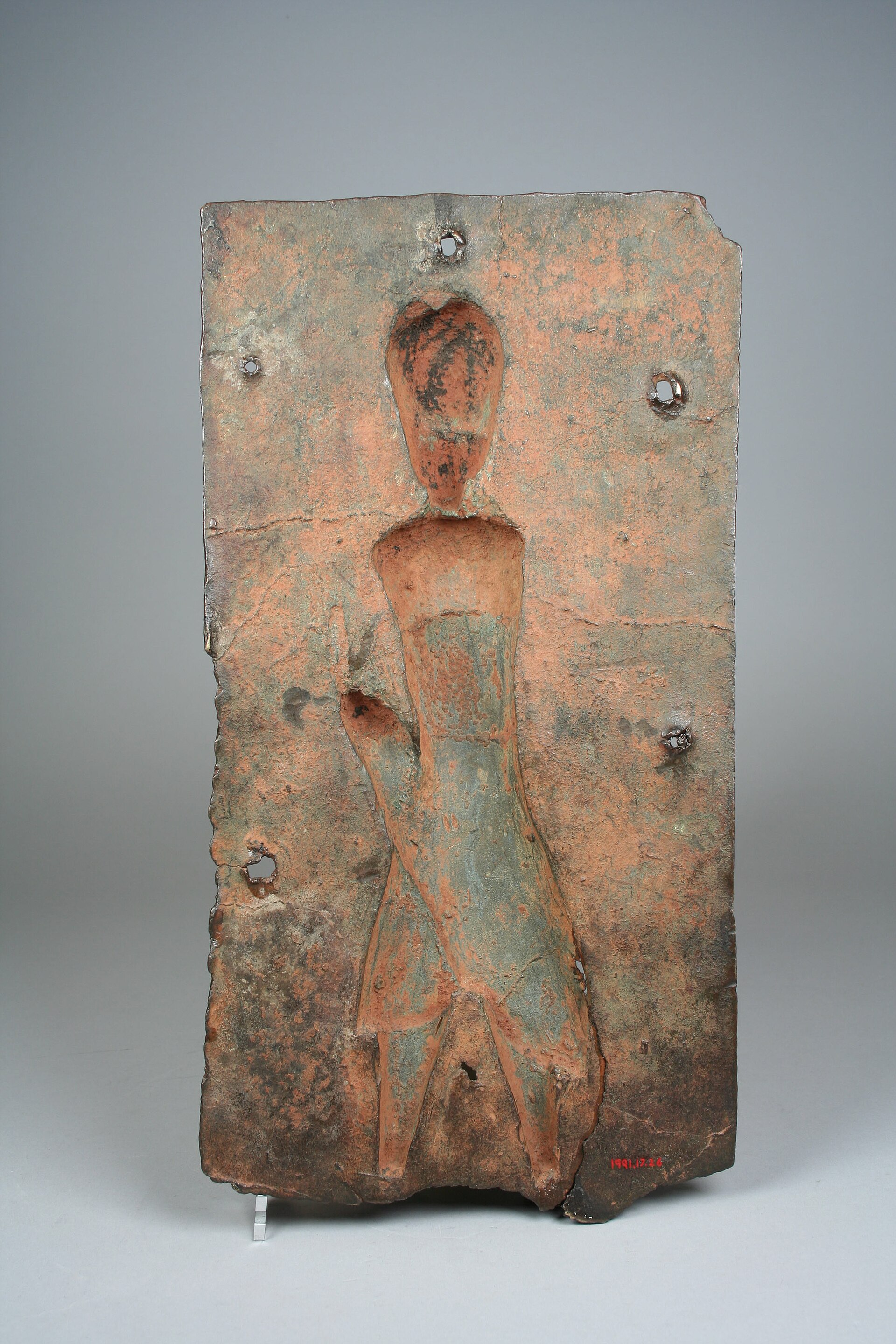
The method is lost wax over a clay core. The Art Institute's exhibition site describes it: a precisely detailed wax model is formed over a clay core, clay is applied over the wax, the assembly is heated so the wax runs out through a narrow channel, molten metal is poured in, and the hardened clay is chipped away. Because the mould is destroyed, each casting is unique by construction. There is no edition, no cast number and no foundry mark.
Two men in Benin in 1897 left descriptions that survive in Roth's 1903 book. Dr Robert Allman, the expedition's principal medical officer, wrote that the manufacture of bronzes had evidently been carried on under the direct supervision of the kings, because the smelting pots and the clay and beeswax for moulding were all arranged in a compound next to the palace, with several moulds in various stages of completion. Cyril Punch, whose 1891 photograph of an altar is discussed below, disagreed in part: he did not think the castings were done under the king's direct supervision, since the king's personal staff did not include bronze workers, and he thought the work was done elsewhere. Punch also thought none of the large castings were made in his day, though he was not certain, and said every head he saw was old, with no marks of fresh firing. He did see fairly large bells with fish-scale pattern that looked new. Roth himself noted that in the head of one staff the hard sandy core could still be scraped out, and that the casters showed skill in saving metal and weight by making protuberances concave at the back.
The Metropolitan Museum's photograph of the back of plaque 1991.17.26 shows exactly that: the reverse is hollowed to follow the figure, with fixing holes through the sheet. Philip Dark, as quoted in the Sotheby's note, adds a detail that matters for connoisseurship: on the earliest group of Type 3 heads the iron irises and the two vertical marks above the inner corners of the eyes were laid into the wax before casting, not set in afterwards.
The method has not changed in its principle. Al Jazeera's July 2026 report on Igun Street describes the same sequence (clay core, wax model, clay coat, baking, pouring, breaking the mould and polishing) and records the small changes: iron pots replacing some clay vessels, electric fans replacing manual bellows, modern moulds shortening production. The caster Agbonmwenre Alex told the reporter the principles remain largely unchanged. That is why a technical examination cannot read age off the method.
Documented function. The British Museum says many pieces were commissioned for the ancestral altars of past Obas and Queen Mothers and were used in rituals that honour ancestors and validate the...
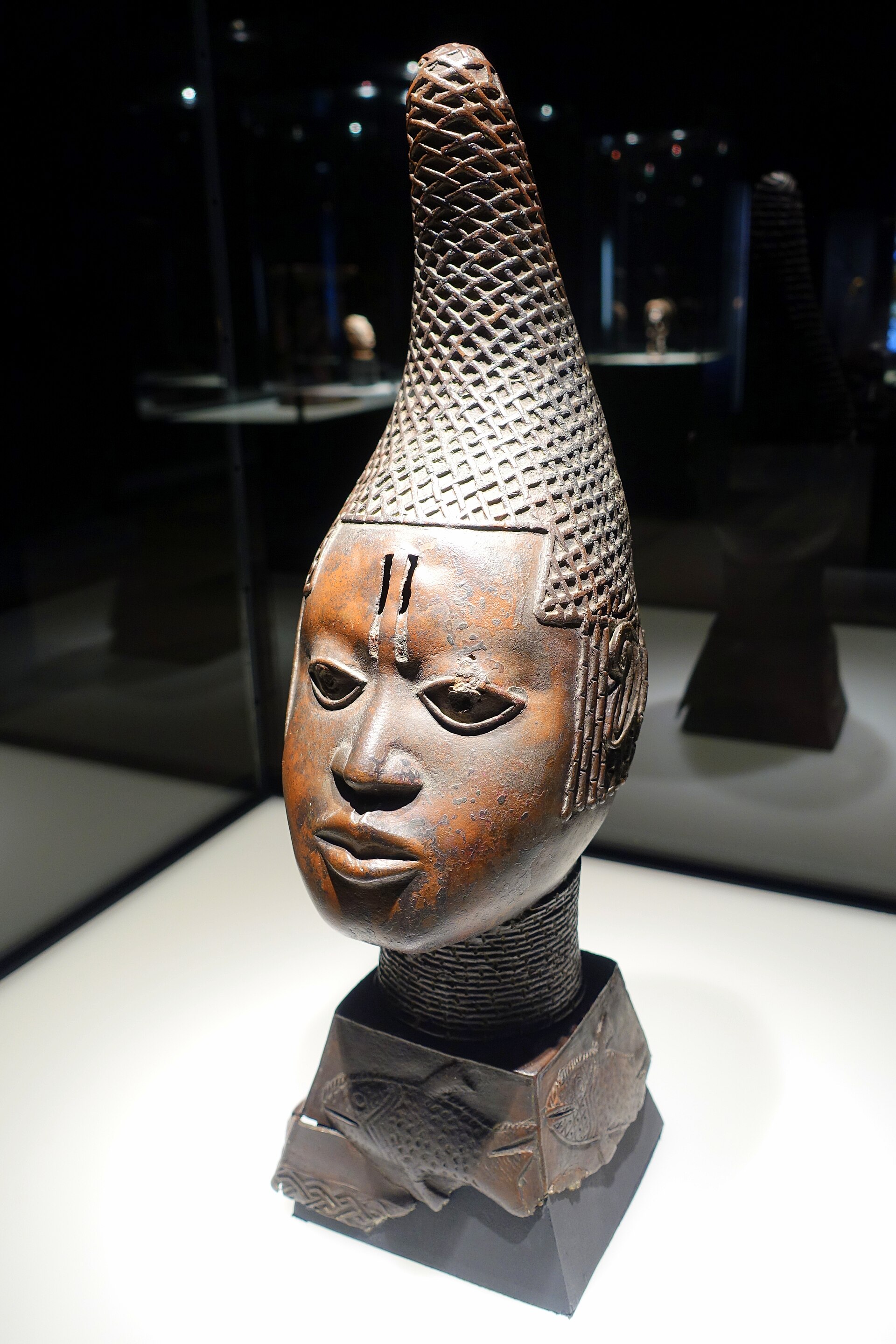
Documented function. The British Museum says many pieces were commissioned for the ancestral altars of past Obas and Queen Mothers and were used in rituals that honour ancestors and validate the accession of a new Oba. The Art Institute states the mechanism: a newly installed Oba creates an altar for his father, commissions its objects and activates it with offerings of food or animal blood, and does the same for his mother if she held the title of iyoba. Bells and rattle staffs sit on all ancestral altars, but ivory tusks and commemorative brass heads are made specifically for royal altars. British troops reported 18 altars to earlier Obas when they took the palace in 1897. The Sotheby's note, summarising Philip Dark, says there were about 15 altar compounds and that the heads were 'not portraiture but memorials', a vehicle for communication with the spirit of the departed. Daniel Inneh puts it the same way: heads of departed Obas were placed in the shrine for propitiation and worship.
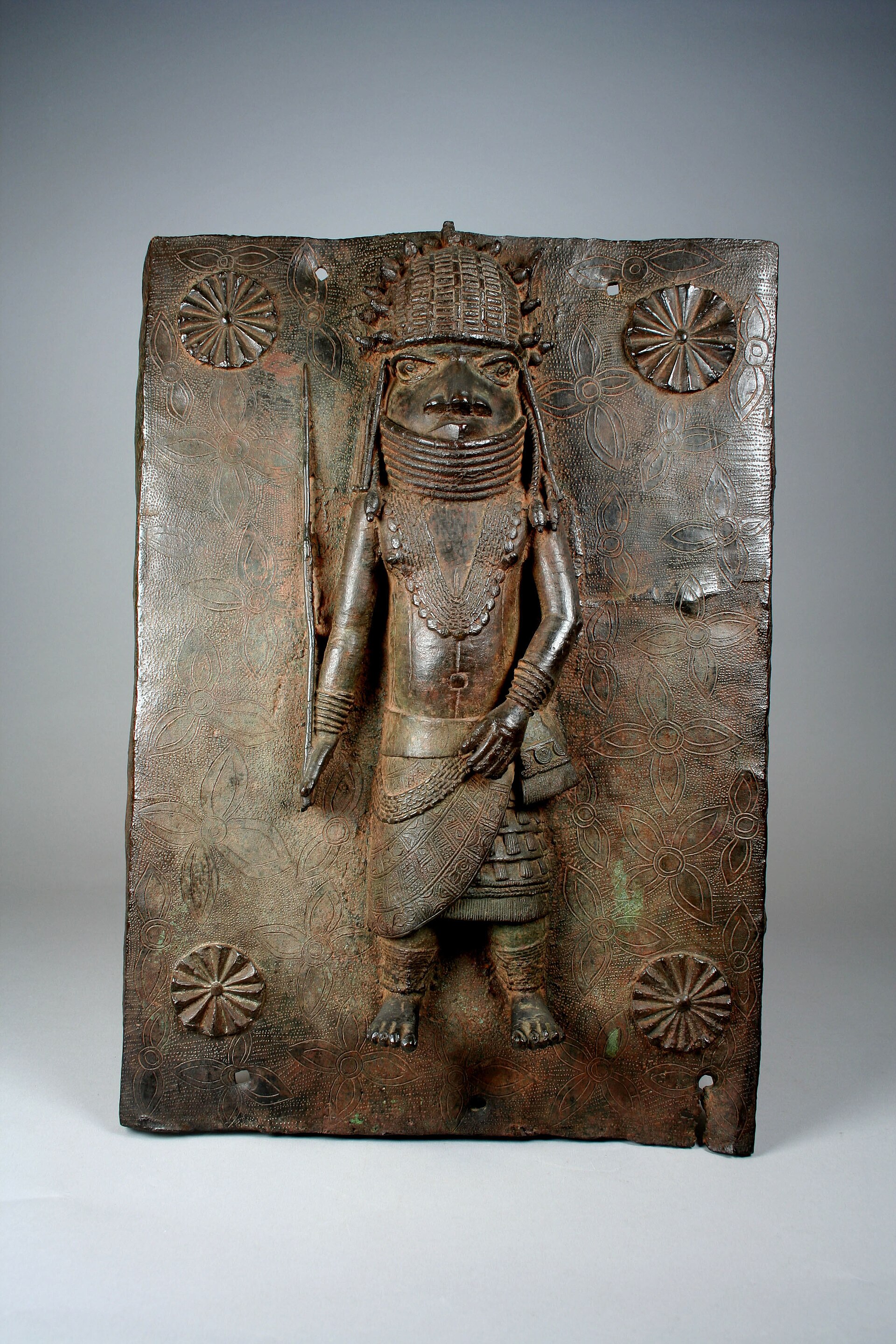
The walls. The more than 900 plaques the British found in a palace storeroom had previously decorated the pillars of the palace compounds, and the Art Institute quotes the Dutch geographer Olfert Dapper's seventeenth-century description of galleries on wooden pillars covered with cast metal bearing pictures of war exploits. The British Museum reads the plaques as a record of dynastic and social history, and one of its own, showing the Oba sacrificing leopards in an annual ceremony, is captioned as a rite to strengthen his mystical powers and the well-being of the Edo people. The Art Institute says the Oba is called 'the leopard of the house' and that leopards in the royal arts also link to military might.
Materials. The Art Institute reads brass and ivory as durable, valuable and associated with trade, and reads their colours, white like sacred kaolin and red like fire and coral beads, as relating to royal power. It reports that Oba Ewuare is said in legend to have stolen the coral regalia from Olokun, god of the waters and prosperity, and that coral, red stone, ivory and brass are filled with supernatural energy called ase. That is the exhibition curators' account of Edo belief, graded here as argued by the exhibition's own text, which rests on a concept by Barbara Plankensteiner of Vienna and was curated in Chicago by Kathleen Bickford Berzock. It also says Portuguese figures in Benin visual arts are strongly associated with Olokun and appear beside mudfish, crocodiles and snakes, beings that move between water and land, as the seafaring Portuguese did. That is an interpretation, not a statement by a caster.
Nothing hidden. I found no evidence of a concealed programme behind this work beyond the court religion itself: ancestors, the divine kingship and the annual cycle of rites. The secrecy that does exist is a trade oath. Alex told Al Jazeera that until about two decades ago teaching the craft to anyone outside the family was taboo and that breaking the oath of secrecy carried a curse. Osazee, another caster, said some ancient works were kept in shrines and that 'people prayed to them'. Those are the casters' own statements about the practice, reported in 2026.
Entry was by birth. Inneh said in the newspaper interview that no initiation exists for a son born into the casters' family; a boy is seasoned from an early age, and initiation only comes in when a...
Entry was by birth. Inneh said in the newspaper interview that no initiation exists for a son born into the casters' family; a boy is seasoned from an early age, and initiation only comes in when a non-member is directed to be taught. He also said that every member takes a place in the guild's age-grade arrangement and that he was placed in his on the death of his father in 1976. The same newspaper piece quotes the guild's public relations officer, Emmanuel Ikponmwosa Inneh, saying that women and girls are not allowed to practise casting, because of the fear of taking the art to husbands' homes. That is the guild's own position as reported in 2015 and I did not find a later statement changing it.
Al Jazeera's 2026 reporting records change. Non-family members can now join through a formal initiation with fees, rituals and oaths administered by guild leaders. Apprenticeship used to run five to seven years: five of learning and two of unpaid service to the master, after which the master rents the apprentice a shop, furnishes it with tools and gives him a couple of finished bronzes. That model is fading. Wikipedia's Igun Street entry, a tertiary source, says the guild is headed by the hereditary Inneh and a non-hereditary literate secretary, and says only descendants of seven original families may practise. I could not confirm the seven families from a primary source and the 2026 reporting suggests the rule has loosened.
On the economics of the plaque period nothing was recorded that I could find: no contract, wage, piece rate or payment survives. Roth cites the early French traveller Landolphe for the statement that artisans who distinguished themselves received a patent of nobility, and the Roupell testimony of 1898 says the king gave Ahammangiwa 'plenty of boys to teach'. Both are secondhand accounts from outside the guild.
The standard answer is no: no caster of the period can be named.
The standard answer is no: no caster of the period can be named. The Sotheby's catalogue note for lot 121 in the sale of 17 May 2007 makes the one attempt I found to say otherwise. It starts from Fagg and Dark. William Fagg divided Benin commemorative heads into early (fifteenth to mid-sixteenth century), middle (mid-sixteenth to late seventeenth) and late periods, ordering them by decreasing naturalism and increasing ornament. Philip Dark replaced the sequence with five overlapping types and placed the Albright-Knox head, which he catalogued as X0/13, in a small early group of Type 3 heads datable around the reigns of Oba Ehengbuda and Oba Ahuan, 1575 to 1625.
The note then argues from resemblance. The Albright-Knox head and the head in the British Museum (accession 1944.Af.4.11, as the note gives it) both hide the lower lip completely behind the beaded collar, share small flat ears with the antihelix drawn as a loop like the numeral 9, and match in the iris position, the braids behind the left ear, the profile of the collar and the cap. The note adds two court horn-blower figures with the same eye, lip and ear treatment, one in the British Museum and one formerly in the Sturgis Ingersoll collection, and says the four could have been made at one time for one altar and 'undoubtedly' by the leading artist of the time, who in the absence of another name should be called 'The Master of the Albright-Knox Head'.
Grade: argued, by one author whose name the lot page does not give, in a sale catalogue. The note itself builds on the premise that every Benin artist developed his own individual style for the ear, and it is open that the two heads differ in the openwork of the braids and the angle of the eyes. I found no scholar who endorses or rejects the grouping, and the note is not a peer-reviewed publication. It does show two things worth keeping: pairs were a Benin habit, and a photograph taken by Cyril Punch in 1891 is described there as the only photograph of an ancestral shrine inside the palace before the invasion, showing two Type 5 heads that the note calls a pair by the same hand.
The Metropolitan Museum states that the guild's quarters remained inside the palace grounds until the British invasion of Benin City in 1897, during and after which many court artisans fled the...
The Metropolitan Museum states that the guild's quarters remained inside the palace grounds until the British invasion of Benin City in 1897, during and after which many court artisans fled the capital. After Eweka II was restored to the throne in 1914, guild members began returning and casting specialists populated what became known as Igun Street. Wikipedia's Igun Street entry adds, without a primary citation I could check, that the returning craftsmen were encouraged to replicate objects taken by the British and that restrictions on selling their work were lifted. The newspaper interview with Inneh gives the same account of commercialisation: royal control over casting lasted until about 1914, when Eweka II, with the royal treasury depleted, let casters sell work. It is a tradition resumed in a new place, not carried through unaltered.
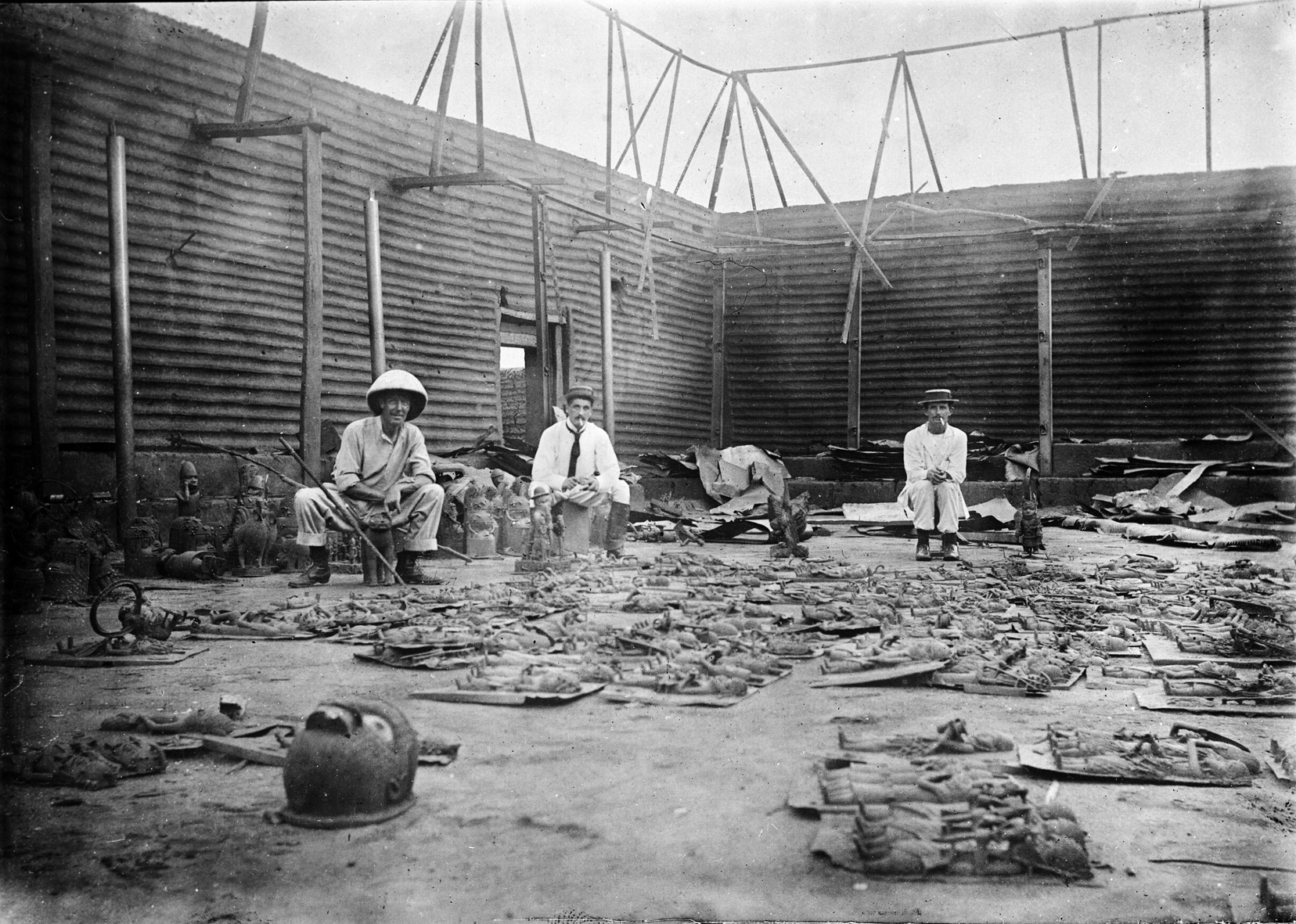
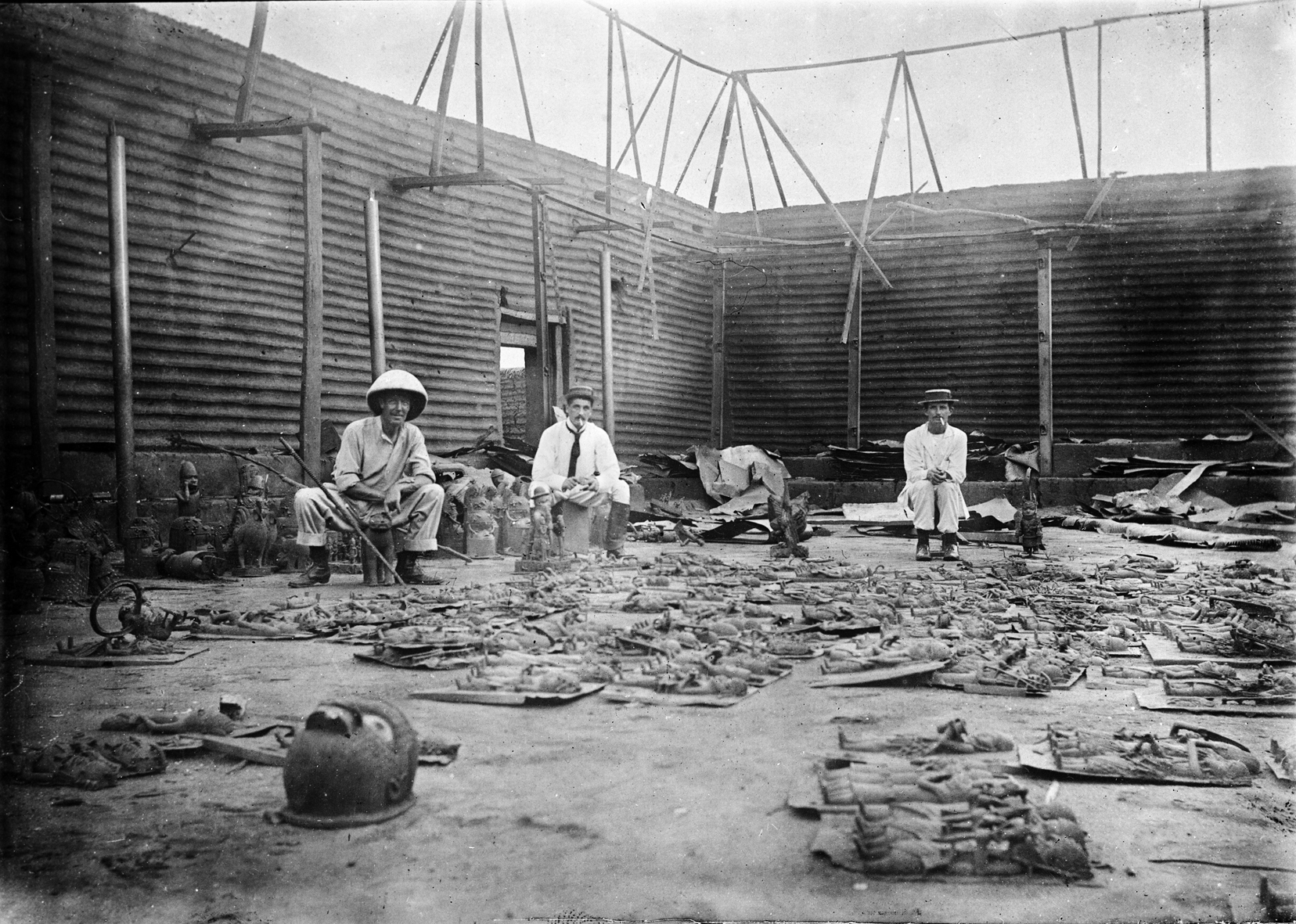
How the objects left is stated without euphemism by the British Museum, which with the Berlin Ethnological Museum holds the largest groups. A trade mission under James Phillips was attacked in January 1897, killing seven British delegates and 230 of the mission's African carriers in the Museum's count. The Art Institute says the party was ambushed by an Edo force that by all accounts acted without the Oba's knowledge and that almost the whole party was killed; the two sources do not agree on the date, so I record it only as early January. Wikipedia gives 4 January and the Art Institute 12 January, which is the date Wikipedia assigns to the appointment of Rear-Admiral Harry Rawson, so the Art Institute date may be a slip. A retaliatory expedition of about 1,200 men took Benin City on 18 February 1897. The palace was burned and partly destroyed, its shrines and compounds looted, thousands of objects taken to the United Kingdom as official spoils of war or distributed among members of the force according to rank, and the Oba was exiled. Oba Ovonramwen died in exile in 1914, the year his son was crowned Eweka II.
The ancestral altars were the target in a specific sense. Among the objects the British Museum says were taken were those removed from royal ancestral shrines, commemorative heads and tusks. A Wikipedia article on the altars, a tertiary source, says the British believed removing the sacred objects would break the ruler's ancestral power in the eyes of the Edo. I did not find a primary document for that motive and do not rely on it. In 1938, the Art Institute records, the British returned pieces of Ovonramwen's coral regalia to his grandson Oba Akenzua II, who is said to have sung, 'The poisonous arrow has killed the elephant'.
No census of what left Benin exists, and the numbers in circulation come from different kinds of source.
No census of what left Benin exists, and the numbers in circulation come from different kinds of source. The Sotheby's note says around 3,000 castings were taken to London. Wikipedia, a tertiary source, gives 2,500 as an official figure for religious artefacts and artworks sent to Britain, and says the Admiralty sold part of the booty to defray costs, beginning at Stevens Auction Rooms in London on 25 May 1897. The anthropologist Felix von Luschan, who bought for Berlin, counted 2,400 known Benin objects when his own museum reached 580, according to the German popular-science journal Spektrum, which says his three-volume Die Altertuemer von Benin of 1919 recorded all known Benin objects and is still a reference work. The British Museum displayed 304 plaques lent by the Foreign Office in autumn 1897 and petitioned to receive 203 as a donation, completed in 1898; most of the rest went to British and German museums and dealers.
Digital Benin, a union catalogue led by the Museum am Rothenbaum in Hamburg with 1.5 million euros of funding from the Ernst von Siemens Kunststiftung, launched in November 2022 with documentation for more than 5,200 objects from 131 institutions in 20 countries. The British Museum now cites more than 5,000 objects across 136 institutions. These counts include ivory and wood as well as metal, and exclude private collections.
The catalogue sequence is itself the attribution history. Roth (1903) treated the casting as a newly discovered 'unknown Bini art' and asked whether it was imported. Luschan (1919) recognised the work as genuinely African art, writing in 1897 that the bronzes had a beauty for which he had for the moment only the word 'enigmatic'. Fagg (1963) and Dark (1973, 1975, 1982) built the style typology of heads that dates pieces today, as summarised in the Sotheby's note. The exhibition Benin: Kings and Rituals, conceived by Barbara Plankensteiner of Vienna and organised with Nigeria's national commission and institutions in Berlin, Paris and Chicago, was shown in Chicago in 2008 and re-read the corpus through court function. I did not open Fagg, Dark or the exhibition catalogue and cite them only through the sources that summarise them.
One institutional error is on record. In 1950 and 1951 the British Museum deaccessioned 29 plaques it then took to be duplicates of others it kept, and says further research has shown that understanding to be incorrect. Since each plaque is a unique casting from a broken mould, there cannot be duplicates. Of the 29, the Museum says 25 went to the Colony and Protectorate of Nigeria, one to the Gold Coast and eight (sold or exchanged between 1952 and 1972) to private dealers and collectors. Those figures do not sum to 29 as printed, a discrepancy in the Museum's text that I report and do not resolve.
Almost none of the corpus has been at auction, and what has sold is not a guide to the rest, because the same guild's output runs from unique royal altar heads to souvenir casts made on Igun Street...
Almost none of the corpus has been at auction, and what has sold is not a guide to the rest, because the same guild's output runs from unique royal altar heads to souvenir casts made on Igun Street last month. Hammer and premium are rarely both published here. The 2007 record, a head of an Oba dated circa 1575 to 1625 from the Albright-Knox Art Gallery of Buffalo, was estimated at USD 1,000,000 to 1,500,000 on Sotheby's lot page, which prints 'Log in to view results' where the result would be. The Art Newspaper reports it sold for USD 4.7 million at Sotheby's New York on 17 May 2007, and the CultureGrrl blog on ArtsJournal, posted the day after the sale, gives USD 4.74 million and says its prices include buyer's premium. The figure is therefore a premium-inclusive total, not a hammer price, and I derived no hammer.
The provenance on the lot page is the usual shape: reportedly collected by a member of the 1897 expedition, then in the Paris collection of Louis Carre, acquired from him in London in 1932 with the participation of Charles Ratton, and sold on to the Albright Art Gallery through Knoedler in December 1935. The gap between 1897 and 1932 is a single reported name with no date or route.
In 2016 a head belonging to the children of the London dealer Ernest Ohly was placed by private treaty through Woolley and Wallis and the dealer Lance Entwistle. Ohly's own ledger recorded it as bought at Glendining's in December 1951 for GBP 230. The Duende Art Projects blog, summarising Barnaby Phillips's reporting for the BBC, gives GBP 10 million as the price the dealer paid in 2016 and adds that the heirs did not get that full sum; the archive's Benin Bronzes record, citing the auctioneer's chairman in the Antiques Trade Gazette, says the house itself would only call it a substantial seven-figure sum. These cannot both be right, and a private treaty sale publishes nothing it need not.
The sale that failed shows what the market does with this material. Sotheby's announced a sixteenth-century Benin ivory pendant mask, thought to represent Idia, with an estimate of GBP 3.5 to 4.5 million for 17 February 2011, and cancelled four days after the announcement of 20 December 2010 at the request of the consignors, descendants of Sir Henry Lionel Galway who had taken part in the 1897 expedition. A dealer told The Art Newspaper that consignors would now be less likely to use auction houses. The mask resurfaced in 2021 in the Al-Thani Collection in Paris, one of five known masks of its kind, none of them in Nigeria, the paper reported in 2022.
Igun Street itself trades in modern work. Al Jazeera reports that a kilogram of brass that cost 500 naira five years ago now costs close to 8,000 (DERIVED: a sixteen-fold rise, 8,000 divided by 500) and that this is slowing profit and patronage.
The Oba commissioned this work and the Oba's court still exists, so the maker's patron and today's claimant are the same institution.
The Oba commissioned this work and the Oba's court still exists, so the maker's patron and today's claimant are the same institution. Oba Ewuare II's position, as the New York Review of Books summarises it in October 2026, is that the bronzes belong to him because most were commissioned by Obas and crafted by the court's guilds. He told a press conference in July 2021 that the only legitimate destination for repatriated objects is a Benin Royal Museum within the palace precincts, from where they were looted.
The British Museum has not transferred any object. It records a written request for the return of 'Nigerian antiquities' from Nigeria's federal ministry in October 2021, a Benin Dialogue Group meeting the same month, and its then director's audience with Oba Ewuare II in August 2018 at which the Oba repeated his request and acknowledged that the objects serve as 'cultural ambassadors' when displayed abroad. Others have moved. The Stiftung Preussischer Kulturbesitz signed over ownership of 512 Berlin objects on 25 August 2022, with about a third remaining on loan in Berlin. The Netherlands returned 119 objects in June 2025, 113 from the state collection and 6 from Rotterdam, with 4 staying in the Wereldmuseum on loan. The University of Cambridge's museum transferred title to 116 objects in February 2026; the Museums Association gives 17 kept on loan and The Art Newspaper 16, and I record both. Al Jazeera notes that Aberdeen's Oba head and a Cambridge cockerel were returned in October 2021, and that in 2022 Nigeria and Germany signed an agreement covering 1,130 objects.
In 2023 the Nigerian federal government formally recognised the Oba as custodian of the returned objects, which changed the recipient of every later negotiation. In early 2025 the director-general of the national commission, Olugbile Holloway, signed a five-year agreement with the Oba allowing the commission to manage returned bronzes on the Oba's behalf, The Art Newspaper reported in February 2026. European museums, Cambridge's director said, can generally only return objects to government agencies.
The building planned for the returned material did not open. A preview of the Museum of West African Art in Benin City on 9 November 2025 was disrupted by protesters, its remaining preview events were postponed and the museum has since been closed indefinitely, with viewings by appointment. The Edo State governor was reported to have revoked its certificate of occupancy, a notice made public on 10 November 2025, and one report had Germany's ambassador denying that anything was revoked, so I do not treat the revocation as settled. A communications officer told Al Jazeera in July 2026 that the museum holds no Benin Bronzes, and the museum said in November 2025 that it does not hold, nor has it ever claimed title to them. An opinion piece in the Nigerian outlet allAfrica in August 2026 argues that the dispute now threatens the renewal of the January 2022 United States and Nigeria cultural property agreement. That is one writer's argument, not a finding, and I report it as such. Returned objects meanwhile go to the national commission's new Oba Ovonramwen storage facility at the National Museum in Benin City, and the commission is rebuilding the Lagos national museum. This account is current to the sources dated through 4 October 2026.
Al Jazeera's 3 July 2026 report from Igun Street counted fewer than 40 active art stores and barely two dozen foundries, many of which had not operated for weeks, and found former workshops turned...
Al Jazeera's 3 July 2026 report from Igun Street counted fewer than 40 active art stores and barely two dozen foundries, many of which had not operated for weeks, and found former workshops turned into motorcycle-parts traders and bars. Casters told the reporter that apprentices are scarce and that the craft once included ivory carving that has died out. Several are turning to Facebook, WhatsApp, TikTok and websites, and one now stocks plaques, paintings, fibre and wood alongside bronze.
The guild still takes royal commissions. In 2023 a team of Igun sculptors cast a 22-foot statue of the Queen Mother Ikuoyemwen (Iyoba N'Uselu) commissioned by Oba Ewuare II, which stands at Five Junction in Benin City. In May 2025 the Metropolitan Museum released a short film on Igun Street made with the World Monuments Fund, in which a caster describes continuing the lost-wax tradition for royal and public clients.
The street also casts replicas. Replica and original use the same method, so there is a standing category of modern Benin City castings, openly made, that circulate in the trade and can be mistaken for old work. Named hands exist on the modern side: the sculptor Erhabor Emokpae cast a bronze replica of the Idia ivory mask as the emblem of the 1977 festival of Black and African arts in Lagos, from a carving by Pa Joseph Alufa Obgayabona, after the British Museum asked for 2 million naira plus insurance to lend the original. The New York Review gives that sum as the equivalent of more than 16 million dollars today and names no method, so I record the original figure only.
Roth called the castings in 1903 an 'unknown Bini art' that the taking of Benin had opened to knowledge, though he noted that an 1892 report by Captain Gallwey had already described brass ware of...
Roth called the castings in 1903 an 'unknown Bini art' that the taking of Benin had opened to knowledge, though he noted that an 1892 report by Captain Gallwey had already described brass ware of very clever workmanship. Luschan, buying for Berlin from August 1897, bought 13 of the 50 tusks offered at two London auctions that month and borrowed 5,000 gold marks from his brother-in-law to stay in the trade, according to Spektrum. The same article says he knew the objects were war booty and that he, unlike many contemporaries, saw them as genuinely African art and spoke against calling Africans savages, while supporting German colonial policy. By 1977 the Idia mask had become a national emblem of resilience for the Nigerian state. By 2022 Digital Benin framed the objects through oral history and Edo-language names. The guild's own work appears in that story as the thing that made the objects, rarely as a living trade.
Royal brass casters; Lost-wax founders; Palace guild of the Oba (Iwebo society); Makers of ancestral altar heads, wall plaques and regalia. Guild tradition placed in the 13th or 14th century by Edo court oral history; still working.
Born Undated. Edo court oral history: the Metropolitan Museum places the introduction of lost-wax casting in the 13th century, a Nigerian newspaper interview with a former palace secretary places the guild under Oba Oguola in the 14th, Benin City, Edo State, Nigeria (historic capital of the Kingdom of Benin); died Not extinct. Quarters inside the palace ended in 1897; the craft resumed from 1914 and continues on Igun Street, Benin City.
Modern Igun Street castings circulating as old work. The same guild still casts the same way, and the 2023 PLOS ONE paper notes that replicas exist, citing a 2008 volume on authenticity of African and Asian bronzes. Casters on Igun Street openly make replicas and original designs.
Igun Street (Igun-Eronmwon Quarters) (Benin City, Nigeria); National Museum and NCMM facilities (Benin City, Lagos and other Nigerian cities); The British Museum (London); Ethnologisches Museum, Staatliche Museen zu Berlin (Berlin); The Metropolitan Museum of Art (New York); Art Institute of Chicago (Chicago).
Almost nothing from the court corpus reaches public auction now, and what does is not a guide to the rest. The two public benchmarks I could verify are the 2007 Albright-Knox head, reported at about USD 4.7 million including premium, and the 2011 Idia mask estimate, which never sold publicly.
Which origin story is right, the thirteenth-century Ife connection, the fourteenth-century Oguola foundation or the sixteenth-century foreign artisan of the 1898 testimony? No source I read ties any of them to a dated excavation of a casting workshop.
In this archive the commonest reason an object is in pieces is not war, time or accident. It is a sale.
9 min read
Berlin's title to the Nefertiti bust rests on a document written by Egypt's own inspector on 20 January 1913.
11 min read
Twenty-nine of 250 records in this archive name why an object came to market: death duties, gambling debts, a bankruptcy, a...
8 min read
Eight records in this archive carry a museum or a state as the seller. The Bodleian sold its First Folio as a duplicate and paid...
11 min read
Last verified
One artwork and its story every Tuesday, with the picture: who owned it, what it made, and what closes soon in the exhibition calendar. No promotion, and nothing we cannot cite.
We send one email to confirm the address and keep nothing else. Every letter carries a one-click unsubscribe. How we handle your data.
