Pair of Commodes
Bernard II van Risenburgh (BVRB) · Paris, c. 1750
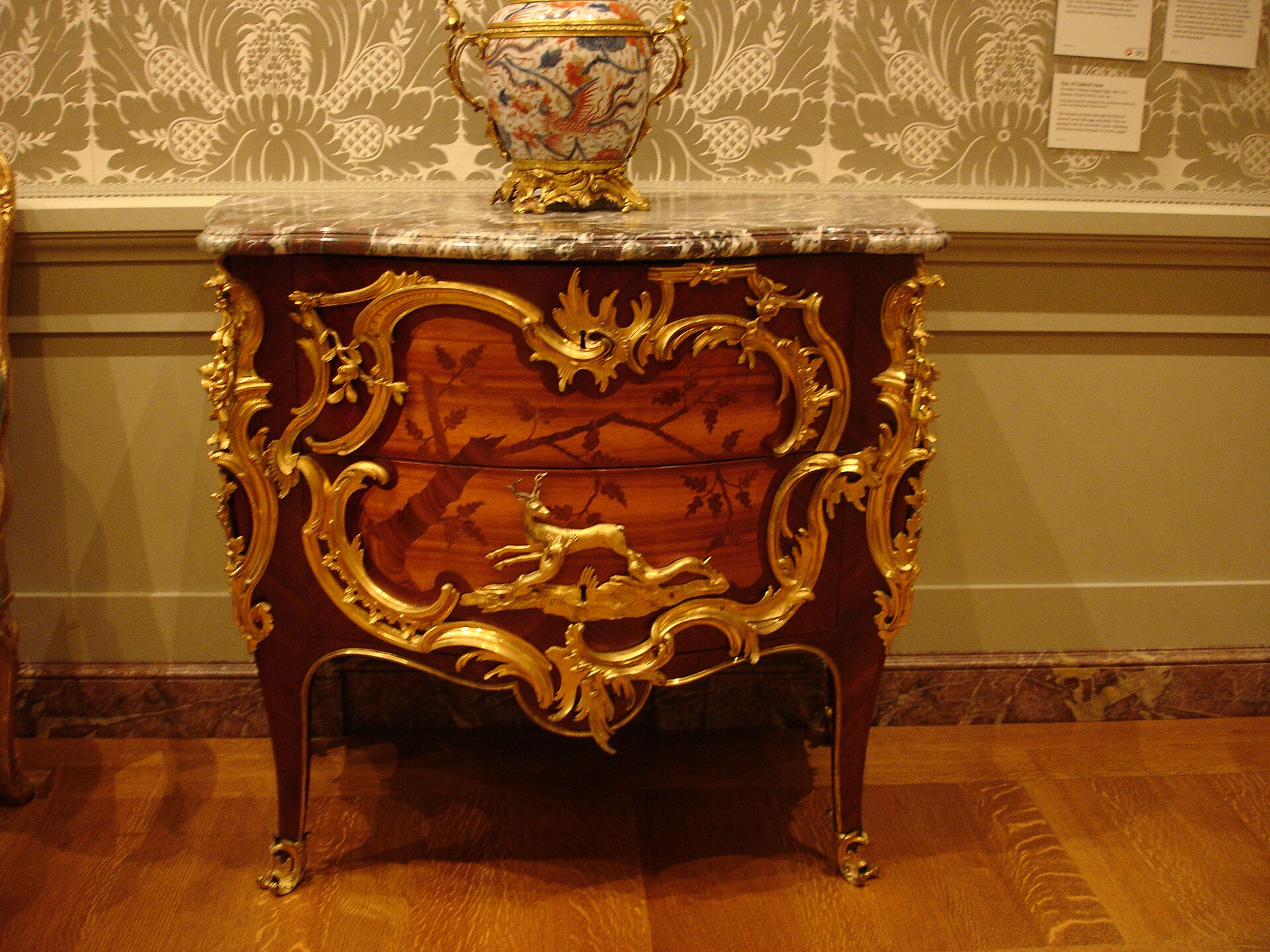
One of the two commodes discussed in this record, photographed at the Getty Center. The lower drawer carries the marquetry scene of a stag under attack from two hounds; the corner mounts combine foliate scrollwork with hunting-trophy motifs of horns, spears and quivers.
| Artist | Bernard II van Risenburgh (BVRB) |
|---|---|
| Date | Paris, c. 1750 |
| Medium | White oak carcase veneered with bloodwood, kingwood and amaranth, with walnut and oak drawer linings; cast and gilded bronze mounts; brass, steel and iron locks; breche marble top (a non-original replacement, dated to the 1990s) |
| Dimensions | 86.8 x 101.4 x 56 cm (2 ft 10 3/16 in x 3 ft 3 15/16 in x 1 ft 10 1/16 in), each of the pair |
| Where it is now | J. Paul Getty Museum, Los Angeleslast confirmed |
| Inventory number | 71.DA.96.1-.2 |
| Attribution | DisputedBoth commodes are stamped B.V.R.B. Full note |
| Object type | Furniture |
| Period | French, eighteenth century (Louis XV) |
| Cases | Disputed attribution · Has a provenance gap |
| Inscriptions | Each commode stamped B.V.R.B. on the tops of the front legs, flanked by the JME guild-inspection stamp (jurande des menuisiers-ebenistes) |
| Owners on record | 10 links8 documented, 1 disputed, 1 unknown |
| Sources | 11 cited |
About this record Last verified · 11 sources cited · Change log
On this page 12 sections
ContentsClose
A pair of gilt-bronze-mounted commodes stamped B.V.R.B., the mark of the Parisian cabinetmaker Bernard II van Risenburgh, whose own name was unreadable behind that stamp for two centuries until a student's archival research solved it in 1957. The pair belonged to the Saxon royal House of Wettin, was sold out of the family in the early 1930s, was turned down by Duveen Brothers as too heavy and overdecorated, and was eventually bought by the Detroit automobile heiress Anna Thomson Dodge for the breakfast room of her Grosse Pointe mansion because the pieces happened to be the right size.
The stranger fact is that the Getty's own scholarship doubts the design is really his. The mounts do not resemble anything else documented from his workshop, and the museum's published catalogue entry says so without hedging: without the stamp, no specialist would call this Van Risenburgh's design on stylistic grounds alone. A pair of matching corner cupboards that once stood with these commodes in Dresden was destroyed in the 1945 bombing of the city, and the story that the whole suite was a royal gift from the Dauphin to his Saxon father-in-law has no surviving document behind it.
What is certain is the metal stamp, the guild mark beside it, and the paper trail that runs from an eighteenth-century Dresden palace inventory through a deposed prince, a Berlin dealing family, a Parisian decorating house, and a widow's Michigan mansion to a Los Angeles museum. What is not certain is whether the object the stamp names is the object the mounts show.
Provenance
Each link is graded. Documented: a cited source supports it. Disputed: the identification is argued but not established. Unknown: no owner for that span, and the gap is not smoothed into a narrative. The grades in the glossary.
- c. 1750 - unknownWorkshop of Bernard II van Risenburgh, Parisdisputed
The maker's stamp B.V.R.B. is physically present and undisputed as a guild mark. Whether the pair's design and mounts genuinely represent Van Risenburgh's own workmanship, rather than a departure built to a client's specification, is an open scholarly question raised in the Getty's own catalogue entry.1
- unknown - 1798Unknownunknown
No document records the commodes between their manufacture and the 1798 Dresden inventory addendum. The tradition that they were a gift from the Dauphin Louis to Frederick Augustus II of Saxony around the time of the 1747 marriage of the Dauphin to Maria Josepha of Saxony is repeated in the trade and in the Getty's own catalogue, which states plainly that no document proves it.1
- 1798 - c. 1924House of Wettin (Albertine line), rulers of Saxonydocumented
Recorded in an addendum to the inventory of the Kurlander Palais, Dresden, in 1798. Intermediate holders within the family across the nineteenth century are not individually named in the sources consulted.1
- c. 1924 - early 1930sPrince Ernst Heinrich von Wettindocumented
Son of Frederick Augustus III, the last King of Saxony, who abdicated in 1918. The commodes were kept at Schloss Moritzburg, in the palace's Porzellanquartier, near Dresden.1
- 1925 - 1925Duveen Brothers (offered, declined)documented
Duveen Brothers' own correspondence, quoted in the Getty's catalogue, describes the pair as 'too rich [and] heavy made probably for [the] German market' and, in a separate note, records an asking price of 10,000 pounds and the writer's view that the pieces were small and over-decorated. Duveen did not buy them.1
- early 1930s - 1934Alexander Ball, dealer (Paris and New York, out of his father Hermann Ball's Berlin firm)documented
Ball acquired the commodes from Prince Ernst Heinrich von Wettin in the early 1930s and sent them to America to the decorating house of Jansen. No source consulted documents any specific duress, persecution or forced-sale circumstance attached to this transaction beyond the general context of the family's post-1918 financial retrenchment and the timing within the early Nazi period; this record states the fact of the sale and does not assert more.16
- 1934 - 1970Anna Thomson Dodgedocumented
Seen at the decorator Jansen's and bought, according to the Getty's catalogue, mainly because the pair fit the breakfast room at Rose Terrace, her house on Lake St Clair in Grosse Pointe Farms, Michigan, completed in 1934 to the design of Horace Trumbauer.15
- 1970 - 1971Estate of Anna Thomson Dodgedocumented
Dodge died in 1970. The Music Room's contents went directly to the Detroit Institute of Arts by her will; this pair remained with the general estate pending sale.5
- 1971 - 1971French and Company, New York, acting for the J. Paul Getty Museumdocumented
Sold at Christie's, London, 24 June 1971, lot 102, as part of the estate sale of Anna Thomson Dodge's collection. No hammer price or premium figure specific to this lot is published in the sources consulted.1
- 1971 - presentJ. Paul Getty Museum, Los Angelesdocumented
Accessioned as 71.DA.96.1-.2. Displayed in Detroit at the exhibition 'The J. Paul Getty Collection of French Decorative Arts', Detroit Institute of Arts, October 1972.1
Prices realised
| Date | Sale | Estimate | Result | Note |
|---|---|---|---|---|
| 24 June 1971 | Christie's Estate sale of Anna Thomson Dodge, French furniture and works of art, Christie's, London, lot 102 | Not published in the sources consulted | Hammer Not published in the sources consulted With premium Not published in the sources consulted GBP (sale conducted in London) | The Getty's own catalogue entry cites this sale and lot number as the source of its acquisition but does not itself publish a hammer or premium figure, and no other source consulted for this record supplies one. Only the total realized by the entire multi-lot sale has been reported in general coverage of the Dodge estate, which is not a price for this lot and is not used here. |
Hammer is the price at which the bidding stopped; with premium adds the fee the house charges the buyer on top. Hammer price and buyer's premium in the glossary.
Technical evidence
| Attribution note | Both commodes are stamped B.V.R.B. on the front leg tops, which under French guild law is a maker's mark rather than a signature of personal design. The J. Paul Getty Museum's own published catalogue entry states the paradox directly: if it were not for the presence of the stamp on these pieces and on the related commodes now in the Kunstgewerbemuseum in Dresden, they would not be attributed to Van Risenburgh on the basis of their design and quality. The gilt-bronze mounts are of a bombastic, asymmetrical character unlike anything else documented in his oeuvre, and their attachment to the case is described by specialists as ill-considered. The mark is not in dispute. What specialists dispute is whether the design is his own, or a departure forced on his workshop by a foreign client's taste. |
|---|---|
| Construction | White oak carcase, bowed front, four six-sided cabriole legs, serpentine lower profile; drawer linings of walnut and oak.1 |
| Veneer | Bloodwood, kingwood and amaranth veneers over the oak carcase.1 |
| Marquetry | The lower drawer of each commode carries a marquetry scene of a stag at bay attacked by two hounds, on rocky ground.18 |
| Mounts | Cast and gilded bronze corner mounts of opposed foliate scrolls terminating in pierced flamework, combined with hunting trophies of horns, spears, powder flasks and quivers. One commode of the pair is missing its gilt-bronze molding along the middle sides and rear corners.1 |
| Marks | Each commode is stamped B.V.R.B. on the tops of the front legs, flanked by the JME guild-inspection stamp, the mark French law required on every piece of furniture offered for sale from 1743.17 |
| Marble tops | Current tops are a breche marble described as campan grand melange; both are non-original replacements dated to the 1990s.1 |
| Metallurgical analysis | X-ray fluorescence analysis of twelve mounts found alloys typical of eighteenth-century Parisian brass casting in most; three mounts returned an elevated zinc content of 25-28 percent, an anomaly the published report does not resolve.1 |
| Restoration history | Recorded restoration campaigns in the 1930s and again in 1972-73. X-radiography indicates probable reveneering of side panels, likely to repair historic splits.1 |
Images
The record in full
Chapter 1What the pair is
Each commode is a bowed rectangular case standing on four six-sided cabriole legs, veneered in bloodwood, kingwood and amaranth over an oak carcase, with a serpentine lower profile.
Each commode is a bowed rectangular case standing on four six-sided cabriole legs, veneered in bloodwood, kingwood and amaranth over an oak carcase, with a serpentine lower profile. At each front corner sits a heavy, pierced gilt-bronze mount of opposed foliate scrolls that end in flamework, and worked into the same casting are hunting trophies: horns, spears, powder flasks and quivers. The lower drawer of each commode carries a marquetry picture in the center of its front, a stag at bay under attack from two hounds, set on rocky ground.
The two commodes are close to identical in construction and design and appear to be original partners rather than a later marriage of separate pieces. Both are stamped B.V.R.B. on the tops of the front legs, next to the guild inspection mark JME.
Chapter 2A mark that took two hundred years to read
From 1743 the corporation of Parisian menuisiers-ebenistes required every piece of furniture offered for sale to be struck with its maker's stamp before a second stamp, JME, could be added by the...
From 1743 the corporation of Parisian menuisiers-ebenistes required every piece of furniture offered for sale to be struck with its maker's stamp before a second stamp, JME, could be added by the guild's own quality inspectors, who examined workshops four times a year. The rule survives on both of these commodes. What it does not do, on its own, is say a name a reader can recognise.
B.V.R.B. is four consonants with no vowel, and for close to two centuries nobody could expand it. Pierre Verlet, the great French furniture historian at the Musee du Louvre, guessed at one point that it belonged to an otherwise undistinguished joiner named Bernard, with the remaining three letters carrying no further meaning. The stamp appeared on some of the finest case furniture of the Louis XV period, and the finest furniture of the period had no name attached to it.
Chapter 3The student who found the family
The mystery was solved in 1957, not by a museum director but by Jean-Pierre Baroli, a student of Verlet's at the Ecole du Louvre, who published his findings in Connaissance des Arts that March under...
The mystery was solved in 1957, not by a museum director but by Jean-Pierre Baroli, a student of Verlet's at the Ecole du Louvre, who published his findings in Connaissance des Arts that March under the title Le mysterieux BVRB enfin identifie. Baroli's method was archival rather than connoisseurial: he went into the notarial records of the Faubourg Saint-Antoine, the Paris district where the furniture trade concentrated outside guild jurisdiction, and traced a family of Dutch origin named Van Risenburgh, whose name was spelled by French clerks in at least three variants, Vanrisemburgh, Vanrisamburgh and Van Risen Burgh.
The stamp belonged not to one man but to three, grandfather, father and son, all sharing the same first name. Bernard I, born in Groningen and settled in Paris by 1696, established the workshop. Bernard II, active from around 1730 and master by 1735 when the guild's surviving membership records begin, is the maker now credited with the finest work under the stamp and the one to whom these commodes are attributed. Bernard III inherited the business in 1764 and ran it without particular success before his father's death, after which he is recorded working as a plaster modeller rather than a cabinetmaker; he never sought guild mastership in his own right.
Chapter 4The maker the stamp actually names
Bernard II van Risenburgh worked chiefly for and through the marchands-merciers, the dealer-decorators who controlled access to imported materials and to court clients and who commissioned specialist...
Bernard II van Risenburgh worked chiefly for and through the marchands-merciers, the dealer-decorators who controlled access to imported materials and to court clients and who commissioned specialist craftsmen to execute their designs: Thomas-Joachim Hebert, Lazare Duvaux and Simon-Philippe Poirier all placed work with him. Through that channel he supplied furniture to Queen Marie Leszczynska at Fontainebleau from 1737 and later to Madame de Pompadour, and he is credited as the first Parisian ebeniste to mount furniture with plaques of Sevres and Vincennes porcelain, almost certainly under Poirier's arrangement with the factory. His reputation rests on floral marquetry in end-cut veneers, usually kingwood or tulipwood, and on his work in Chinese and Japanese lacquer panels supplied to him ready-made by the dealers who employed him.
He retired for reasons of ill health in 1764, selling a workshop reduced by then to three benches to his son on 18 October of that year, and died not long after. None of that biography is in dispute. What is in dispute is whether this particular pair, with its heavy asymmetrical hunting mounts, belongs to it.
Chapter 5A commode that argues with its own stamp
The Getty's own published scholarship does not soften the problem.
The Getty's own published scholarship does not soften the problem. Its catalogue entry states that if it were not for the stamp on these commodes, and on the related commodes now in the Kunstgewerbemuseum of the Staatliche Kunstsammlungen Dresden, no specialist would attribute them to Van Risenburgh on the evidence of their design and quality. The mounts are described as of designs quite unlike any others used by him, and their fit to the case is called ill-considered, with an attachment strategy that obscures the case's upper profile rather than complementing it.
Nobody proposes the stamp is a later forgery. The dispute is narrower and, in a way, more interesting: whether the design is Van Risenburgh's own invention, executed to his usual standard but in an idiom he did not otherwise use, or a commission he built to someone else's specification, with mounts supplied or dictated by a client whose taste ran to a heavier, more overtly aristocratic style than his Parisian patrons preferred. Scholars have proposed the second explanation without being able to document it, and this record does not resolve it either.
Chapter 6The suite that scattered, and the pieces that did not survive
These two commodes are not thought to have been made alone.
These two commodes are not thought to have been made alone. On grounds of shared design and shared early provenance, the Getty's catalogue links them to a larger suite that once included a pair of corner cupboards, a further pair of larger commodes, and a single commode, some of which survive in the Kunstgewerbemuseum in Dresden today.
The corner cupboards do not survive. They were destroyed in the bombing of Dresden in 1945. That fact belongs in any account of this pair, because it is the reason the group can never be reassembled and examined as a whole, and because it places an ordinary piece of Rococo case furniture inside one of the twentieth century's worst single acts of destruction, alongside the palaces and churches the same raids leveled.
Chapter 7A royal gift with no paper behind it
The suite carries a specific origin story: that the commodes and the corner cupboards were a gift from the Dauphin Louis, son of Louis XV and father of the future Louis XVI, to his father-in-law...
The suite carries a specific origin story: that the commodes and the corner cupboards were a gift from the Dauphin Louis, son of Louis XV and father of the future Louis XVI, to his father-in-law Frederick Augustus II, Elector of Saxony. The Dauphin married Frederick Augustus's daughter, Maria Josepha of Saxony, in 1747, which is the kind of dynastic occasion such a gift would mark.
The Getty's catalogue records the tradition and then records, in the same breath, that there are no documents to prove it. This record repeats that pairing deliberately. A gift story attached to a piece of royal-adjacent furniture is exactly the kind of claim that improves with retelling and degrades with sourcing, and the honest position is that it is a reputation, not a fact.
Chapter 8What is documented: the Wettin ownership
Documentation begins later and more prosaically than the gift story: an addendum to an inventory of the Kurlander Palais in Dresden records the commodes there in 1798, in the possession of the...
Documentation begins later and more prosaically than the gift story: an addendum to an inventory of the Kurlander Palais in Dresden records the commodes there in 1798, in the possession of the Albertine line of the House of Wettin, the ruling family of Saxony. That is the first point at which the pair can be placed with confidence, and everything before it, including the manner and date of its arrival in Dresden, is unrecorded in the sources consulted for this record.
Ownership then follows the Wettin family down to Prince Ernst Heinrich von Wettin, a son of Frederick Augustus III, the last King of Saxony, who abdicated in 1918. By around 1924 and into the early 1930s the commodes were with Prince Ernst Heinrich at Schloss Moritzburg, in the porcelain quarter of the palace near Dresden, a family residence retained after the monarchy itself had ended.
Chapter 9Out of a princely house and into the trade
By 1925 the commodes were being shown on the international market: Duveen Brothers, then the most famous decorative-arts dealership in the world, examined them and turned them down.
By 1925 the commodes were being shown on the international market: Duveen Brothers, then the most famous decorative-arts dealership in the world, examined them and turned them down. Their own correspondence from that year, quoted in the Getty's catalogue, calls the pair signed Burb too rich and heavy, made probably for the German market, and records a separate note that at an asking price of 10,000 pounds the writer did not care for them at all, finding them small and over-decorated. It would be nearly a decade before the pair found a buyer.
The dealer who eventually placed them was Alexander Ball, who traded in Paris and New York out of the Berlin dealing family of his father Hermann Ball, proprietor of the Berlin auction house Ball and Graupe. Ball acquired the commodes from the Wettin family in the early 1930s. This record notes, without asserting more than the sources support, that the sale falls within the years of the family's broader financial retrenchment after the fall of the Saxon monarchy and, separately, within the early years of the Nazi period in Germany; no source consulted for this record documents any specific compulsion, persecution or Aryanization connected to this particular transaction, and none is claimed here. The question of what pressures, if any, bore on this sale is recorded as open rather than answered.
Chapter 10A breakfast room in Grosse Pointe
Ball sent the commodes to America to the decorating house of Jansen, and it was there, apparently, that Anna Thomson Dodge saw and approved their purchase in 1934, mainly, the Getty's catalogue...
Ball sent the commodes to America to the decorating house of Jansen, and it was there, apparently, that Anna Thomson Dodge saw and approved their purchase in 1934, mainly, the Getty's catalogue records, because they were the right size for the breakfast room of her house.
Dodge was the widow of the automobile pioneer Horace E. Dodge; after his death in 1920 and her remarriage to the actor Hugh Dillman in 1926, the couple built a new Rose Terrace on Lake St Clair in Grosse Pointe Farms, Michigan, a Louis XVI-style chateau designed by the Philadelphia architect Horace Trumbauer and completed in 1934 at a reported cost of four million dollars. Dodge and Dillman spent two years in Europe assembling its contents with the advice of Joseph Duveen among others, which makes it a small, sharp irony that the firm bearing Duveen's name had already rejected this particular pair for being too heavy for its taste. The commodes that Duveen would not buy ended up furnishing the breakfast room of the house Duveen helped furnish everything else in.
Chapter 11From an estate sale to the Getty
Anna Thomson Dodge died in 1970. The contents of Rose Terrace's music room were willed directly to the Detroit Institute of Arts, and the remainder of the collection, including this pair, was...
Anna Thomson Dodge died in 1970. The contents of Rose Terrace's music room were willed directly to the Detroit Institute of Arts, and the remainder of the collection, including this pair, was consigned to Christie's in London, which sold it on 24 June 1971 as lot 102. The buyer of record was the New York gallery French and Company, acting for the J. Paul Getty Museum, which completed the acquisition the same year under accession number 71.DA.96.1-.2.
No hammer price or premium figure for lot 102 specifically is published in the sources consulted for this record, and none is asserted here. Rose Terrace itself outlived its contents by only a few years: designated a Michigan State Historic Site and listed on the National Register of Historic Places in 1971, it was demolished in the summer of 1976 for want of a preservation-minded buyer able to carry its maintenance costs.
Chapter 12What examination has found since
The Getty has examined the pair at least twice since acquisition, with restoration campaigns recorded in the 1930s, before the museum owned them, and again in 1972-73, shortly after.
The Getty has examined the pair at least twice since acquisition, with restoration campaigns recorded in the 1930s, before the museum owned them, and again in 1972-73, shortly after. One commode of the pair is missing its gilt-bronze molding along the middle sides and rear corners, a loss not matched on its partner. X-radiography suggests the side panels were reveneered at some point, probably to repair splits in the original wood, and the marble tops now on the commodes are modern replacements dated to the 1990s, not the eighteenth-century originals.
X-ray fluorescence analysis of twelve of the gilt-bronze mounts found alloys consistent with ordinary eighteenth-century Parisian brass casting in most of them, but three mounts returned an elevated zinc content of 25 to 28 percent, well outside that range. The Getty's published technical account does not explain the anomaly, and this record does not guess at one. It is left here as a specific, checkable finding rather than folded into a general assurance that the mounts are original.
The artist
Bernard II van Risenburgh, known only by the stamp B.V.R.B. until 1957
For close to two centuries the finest cabinetwork of the reign of Louis XV carried a stamp nobody could read. B.V.R.B. is four letters with no vowel and no obvious expansion, and the maker behind it was reconstructed only in the twentieth century, through notarial archives rather than through any signed or dated work. This dossier is written the way the identification was made: what the archives establish about the family, set against what the stamp alone cannot tell a reader about any single object it appears on, including this pair.
Exhibited
- 1972The J. Paul Getty Collection of French Decorative ArtsDetroit Institute of Arts, Detroit (3 October 1972 - 31 August 1973; this pair shown 3 October - 17 December 1972)
Literature
- Jean-Pierre Baroli, 'Le mysterieux BVRB enfin identifie', Connaissance des Arts, March 1957, pp. 56-63.
- Alexandre Pradere, French Furniture Makers: The Art of the Ebeniste from Louis XIV to the Revolution, J. Paul Getty Museum. (1989)
- Pierre Ramond, Masterpieces of Marquetry, vol. 2, J. Paul Getty Museum. (2000)
- Gillian Wilson, 'The J. Paul Getty Museum: 6eme partie', Connaissance des Arts 279 (May 1975), pp. 107-13.
- Gisela Haase et al., Kunstgewerbemuseum Dresden in Schloss Pillnitz, Staatliche Kunstsammlungen Dresden. (1996)
- Christie's, London, sale catalogue, 'The Highly Important Collection of French Furniture and Works of Art' (estate of Anna Thomson Dodge), 24 June 1971, lot 102.
Related works
| Work | Relation | Where it is |
|---|---|---|
| Commode and further commode, from the same suite Attributed to Bernard II van Risenburgh | Surviving members of the larger suite this pair is thought to belong to, on grounds of shared design and early Dresden provenance It is against these Dresden pieces, alongside the Getty pair, that specialists say the stamp is the only secure link to Van Risenburgh's name. | Kunstgewerbemuseum, Staatliche Kunstsammlungen Dresden |
| Pair of corner cupboards, from the same suite Attributed to Bernard II van Risenburgh | Companion pieces to this pair and to the Dresden commodes Destroyed in the 1945 bombing of Dresden. Their loss means the suite can never be reassembled and studied as a whole. | Formerly Dresden; destroyed |
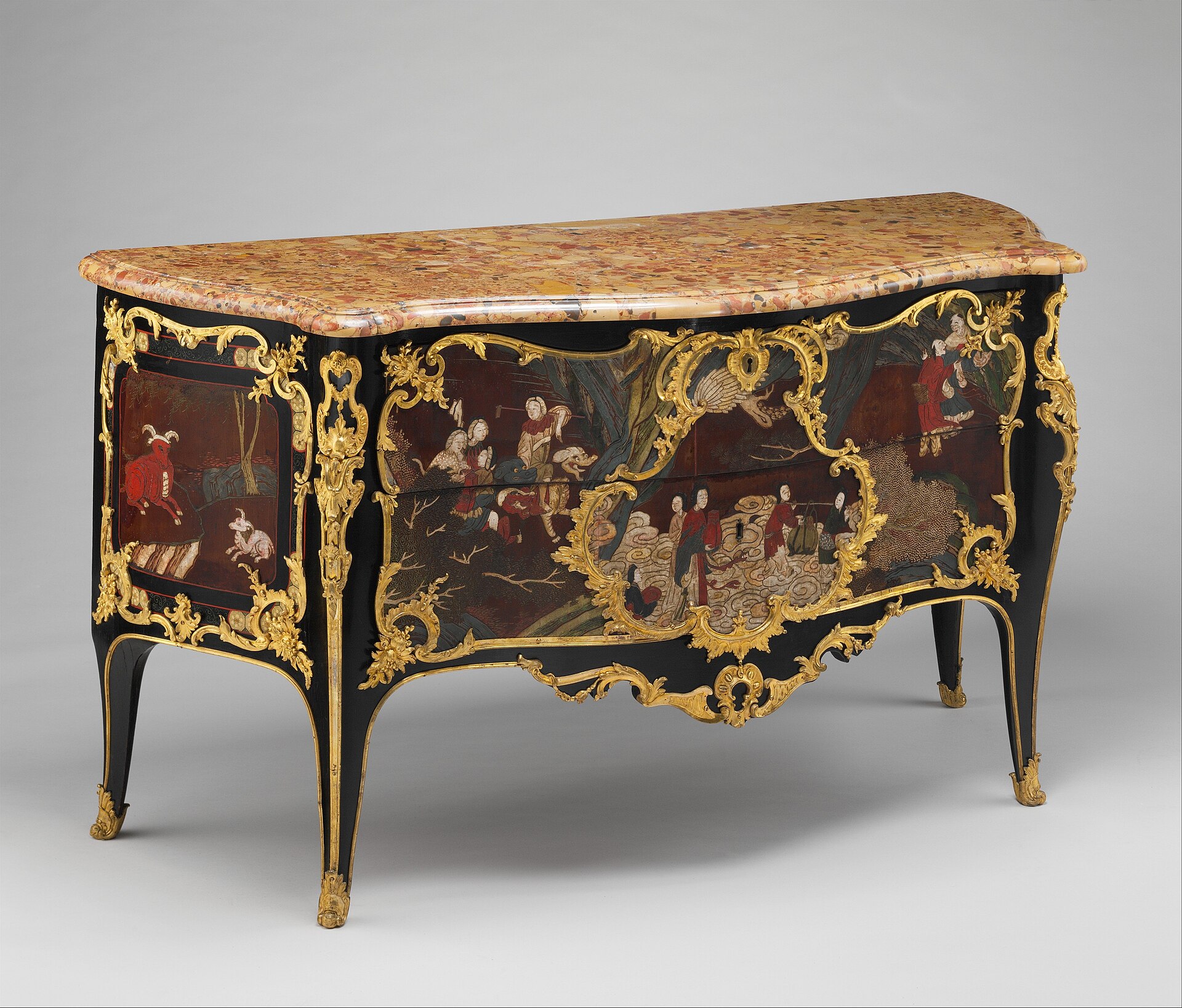
| Commode, accession 1974.356.189 Bernard II van Risenburgh | A documented example of his more typical lacquer-and-marquetry work, shown here for contrast with the hunting-trophy mounts on this pair Oak, lacquer, gilt bronze and marble; closer in character to the floral marquetry and lacquer panels for which Van Risenburgh's workshop is otherwise documented. | Metropolitan Museum of Art, New York |
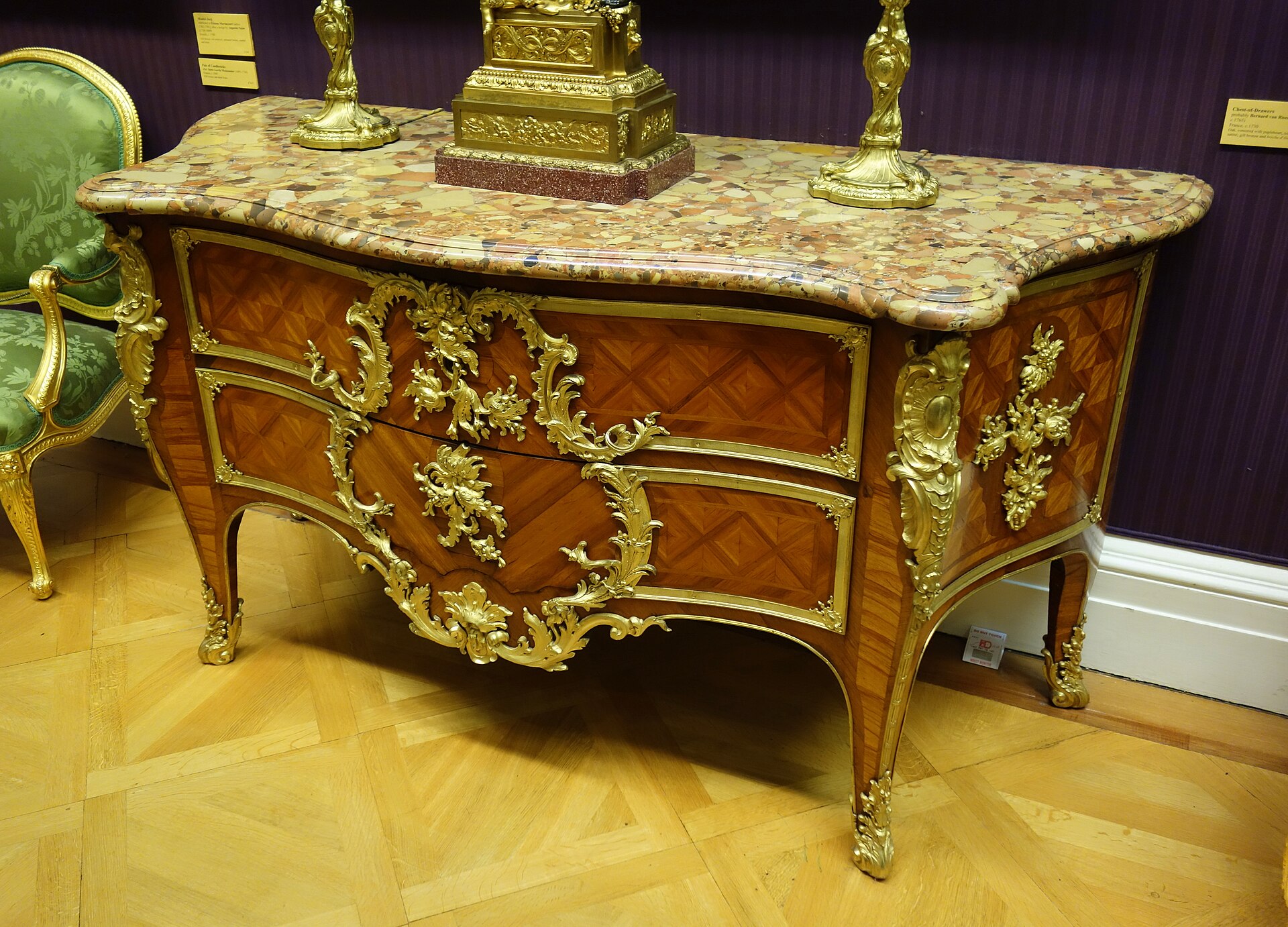
| Chest of drawers Attributed, with the qualification "probably by", to Bernard II van Risenburgh | A second BVRB-attributed piece carrying its own attribution caveat, illustrating that stylistic uncertainty around this stamp is not unique to the Getty pair Oak veneered with purpleheart, tulipwood and quartered satine, with gilt bronze and breche d'Alep marble, c. 1730. | The Wallace Collection, London |
Open questions
- Where were the commodes, and where was the rest of the suite, before the 1798 Kurlander Palais inventory addendum records them in Dresden? No earlier document has been found.
- Is the tradition that the Dauphin Louis gave the suite to Frederick Augustus II around the time of the 1747 marriage true? The Getty's own catalogue states plainly that no document proves it.
- If the mounts are not typical of Van Risenburgh's documented output, who designed them, and were they cast to a foreign client's specification rather than the maker's own choice? Scholars have raised the possibility without being able to document it.
- What price did the pair make at Christie's, London, on 24 June 1971, as lot 102? No hammer price or premium figure for this specific lot is published in the sources consulted.
- Was Alexander Ball's acquisition of the commodes from Prince Ernst Heinrich von Wettin in the early 1930s connected to any specific financial or political pressure on the Wettin family beyond the ordinary retrenchment that followed the end of the Saxon monarchy in 1918? No source consulted establishes more than the fact of the sale and its approximate date.
- What explains the elevated zinc content, 25 to 28 percent, found in three of the twelve gilt-bronze mounts examined by X-ray fluorescence? The Getty's published technical report records the anomaly without resolving it.
Questions about this object
What is Pair of Commodes?
Pair of Commodes is a furniture, dated paris, c. 1750. Medium: White oak carcase veneered with bloodwood, kingwood and amaranth, with walnut and oak drawer linings; cast and gilded bronze mounts; brass, steel and iron locks; breche marble top (a non-original replacement, dated to the 1990s).
Who made Pair of Commodes, and is the attribution settled?
The attribution to Bernard II van Risenburgh (BVRB) is recorded here as disputed. Both commodes are stamped B.V.R.B. on the front leg tops, which under French guild law is a maker's mark rather than a signature of personal design. The J. Paul Getty Museum's own published catalogue entry states the paradox directly: if it were not for the presence of the stamp on these pieces and on the related commodes now in the Kunstgewerbemuseum in Dresden, they would not be attributed to Van Risenburgh on the basis of their design and quality. The gilt-bronze mounts are of a bombastic, asymmetrical character unlike anything else documented in his oeuvre, and their attachment to the case is described by specialists as ill-considered. The mark is not in dispute. What specialists dispute is whether the design is his own, or a departure forced on his workshop by a foreign client's taste.
Where is Pair of Commodes now?
J. Paul Getty Museum, Los Angeles. Inventory number 71.DA.96.1-.2. Last confirmed 26 August 2026. Bought from French and Company, New York, in 1971, following the pair's sale at Christie's, London, 24 June 1971, lot 102, from the estate of Anna Thomson Dodge.
What has Pair of Commodes sold for?
Hammer Not published in the sources consulted; with premium, Not published in the sources consulted. Christie's, 1971-06-24.
What is still unknown about Pair of Commodes?
Where were the commodes, and where was the rest of the suite, before the 1798 Kurlander Palais inventory addendum records them in Dresden? No earlier document has been found.
Sources
- 1J. Paul Getty Museum, catalogue entry for the Pair of Commodes, accession 71.DA.96.1-.2, in French Rococo Ebenisterie in the J. Paul Getty Museum. Source for the accession number, dimensions, materials, marks, condition (missing molding, reveneering, replacement marble tops), the X-ray fluorescence findings, the attribution puzzle and its exact wording, the Dresden suite (corner cupboards and further commodes) and the destruction of the corner cupboards in 1945, the unproven Dauphin-gift tradition, the 1798 Kurlander Palais inventory, the ownership by Prince Ernst Heinrich von Wettin, the Duveen Brothers 1925 correspondence quotations, the sale via Alexander Ball and the decorator Jansen to Anna Thomson Dodge in 1934, and the 1971 Christie's sale (lot 102) and Getty acquisition via French and Company. getty.edu/publications/...
- 2J. Paul Getty Museum, catalogue entry for a related single commode by Bernard II van Risenburgh, accession 72.DA.46, in French Rococo Ebenisterie in the J. Paul Getty Museum. Used for general context on Van Risenburgh's documented workshop practice, lacquer commissions and the cohort of comparable commodes attributed to him. getty.edu/publications/...
- 3Wikipedia, 'Bernard II van Risamburgh'. Source for the family's three generations, guild mastership dates, work through the marchands-merciers Hebert, Duvaux and Poirier, supply to Marie Leszczynska and Madame de Pompadour, the porcelain-plaque innovation, his documented marquetry and lacquer specialty, and his 1764 retirement and death. en.wikipedia.org/wiki/...
- 4Ateliers Allot, 'BVRB: the mysterious story of a stamp'. Source for Pierre Verlet's earlier wrong guess at the stamp's meaning, Baroli's identity as Verlet's student at the Ecole du Louvre, his archival method in the notarial records of the Faubourg Saint-Antoine, the discovery of the Van Risenburgh family name and its variant spellings, and the note that Bernard III never sought guild mastership and later worked as a plaster modeller. ateliers-allot.com/bvrb-the-mysterious-story-of-a-stamp/...
- 5Wikipedia, 'Rose Terrace (Grosse Pointe Farms, Michigan)'. Source for Anna Thomson Dodge's biography, her marriage to Horace E. Dodge and later to Hugh Dillman, the construction of the second Rose Terrace by the architect Horace Trumbauer (completed 1934), the couple's two years in Europe consulting Joseph Duveen while furnishing the house, the bequest of the Music Room's contents to the Detroit Institute of Arts on her death in 1970, the 1971 Christie's sale of the remaining contents, and the house's 1971 historic designations and 1976 demolition. en.wikipedia.org/wiki/...
- 6Open Art Data, 'Artworks linked to A&R Ball'. Source for the identification of Alexander Ball as the son of the Berlin dealer Hermann Ball of Ball and Graupe, and for the general background that the Ball family acquired decorative-art works from German aristocratic collections including the Wettins in the early 1930s. The source does not establish, and this record does not assert, any specific persecution, duress or Aryanization connected to this transaction. openartdata.org/2018/...
- 7Christie's, 'Collecting guide: 18th-century French cabinet-makers'. Source for the 1743 guild requirement that every piece of furniture offered for sale be stamped with its maker's mark, and for the JME guild-inspection stamp applied after quality review by elected guild members who examined workshops four times a year. christies.com.cn/en/...
- 8Wikimedia Commons file page for 'File:Van Risenburgh, one of a pair of commodes.JPG'. LicenseShortName returned by the API is 'Public domain'. Source for the physical description of the photographed commode and the marquetry subject (a stag attacked by two hounds), matching the Getty catalogue's own description. commons.wikimedia.org/wiki/...
- 9Wikimedia Commons file page for 'File:Commode MET DP105699.jpg', Metropolitan Museum of Art, accession 1974.356.189. commons.wikimedia.org/wiki/...
- 10Wikimedia Commons file page for the Wallace Collection chest of drawers 'probably by' Bernard van Risen Burgh II (DSC06234). commons.wikimedia.org/wiki/...
- 11Wikimedia Commons file page for the Munich Residenz commode attributed to Bernard II van Risamburgh (DSC07492). commons.wikimedia.org/wiki/...


Last verified · Published
Change log
26 August 2026 - Record created at the house standard: researched narrative, technical evidence, maker dossier, graded provenance chain, prices with hammer and premium separated, related works, open questions and sources.