Moulin Rouge: La Goulue
Henri de Toulouse-Lautrec · 1891
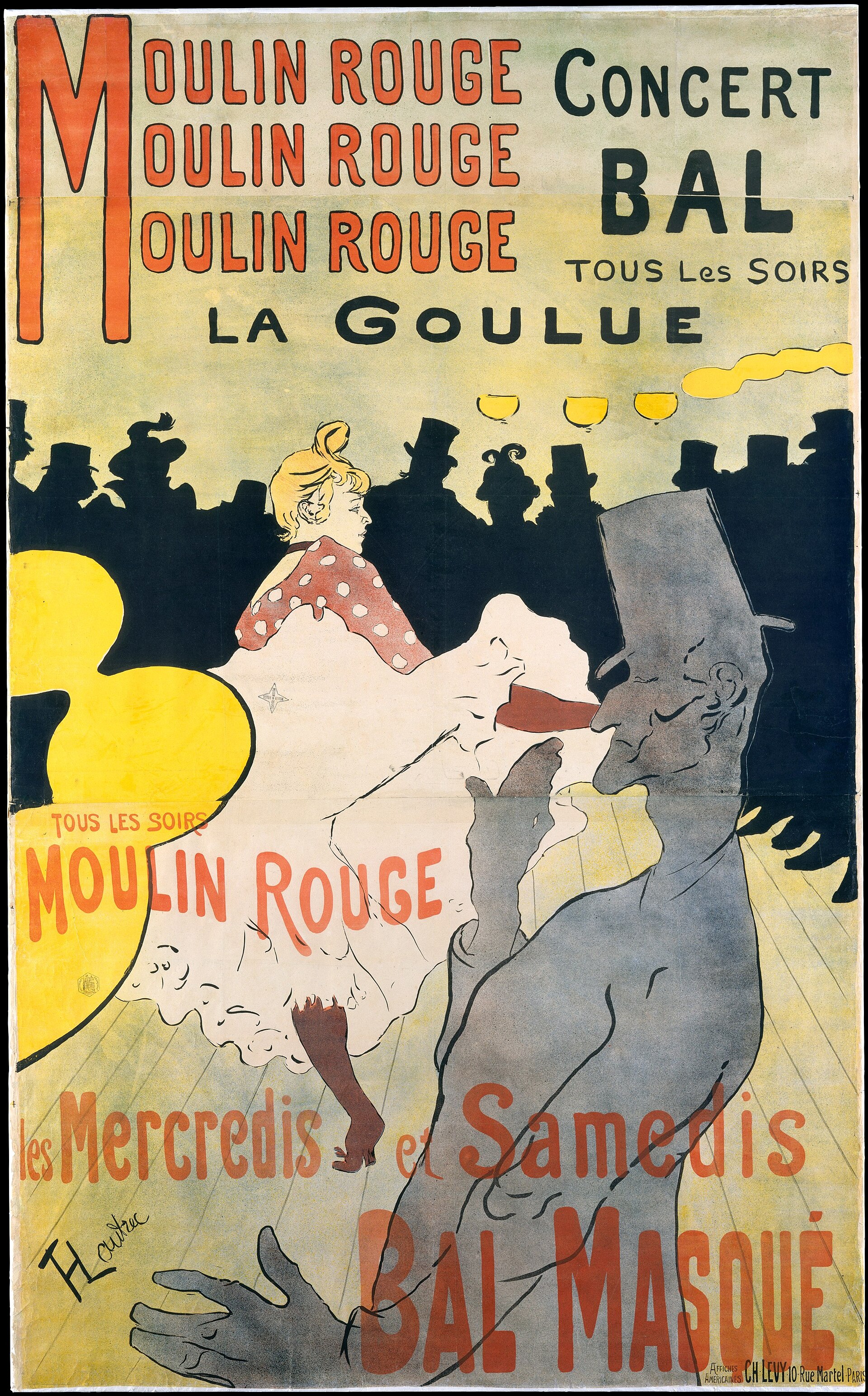
This exact institutional impression: the Metropolitan Museum of Art's own accessioned sheet (32.88.12), purchased with the Harris Brisbane Dick Fund in 1932. This is one specific surviving impression of an 1891 poster edition, not the poster as an abstract design -- other institutions hold separate physical sheets with their own histories.
| Artist | Henri de Toulouse-Lautrec |
|---|---|
| Date | 1891 |
| Medium | Color lithograph printed in four colors from multiple stones (this impression: three sheets of wove paper) |
| Dimensions | Sheet: 190 x 116.5 cm (74 13/16 x 45 7/8 in.) |
| Where it is now | The Metropolitan Museum of Art, New York, Department of Drawings and Printslast confirmed |
| Inventory number | 32.88.12 |
| Attribution | AcceptedNever disputed. Full note |
| Object type | |
| Period | French, Belle Epoque (late 19th century) |
| Cases | Has a provenance gap |
| Inscriptions | MOULIN ROUGE / CONCERT BAL TOUS LES SOIRS, printed across the top of the design; Lautrec's monogram is incorporated into the lithograph itself rather than added as a separate hand signature. |
| Owners on record | 4 links3 documented, 1 unknown |
| Sources | 16 cited |
About this record Last verified · 16 sources cited · Change log
On this page 10 sections
ContentsClose
This record describes one specific impression of Henri de Toulouse-Lautrec's first poster: the Metropolitan Museum of Art's sheet, accession 32.88.12, purchased in 1932. Commissioned in 1891 by Charles Zidler for the Moulin Rouge to advertise its star dancer La Goulue, it was printed not by Lautrec's later regular printer Edouard Ancourt but by the commercial house of Charles Levy, and it turned an untested 27-year-old painter into the defining poster artist of his generation overnight.
The Art Institute of Chicago holds a separate impression of the same design, accession 1954.1193, with its own distinct provenance through the collection of five-term Chicago mayor Carter H. Harrison -- a different physical object, kept clearly distinct here from the Met's own sheet. Neither impression's full life before it reached its museum is documented, and no reliable count exists of how many complete impressions of this poster survive worldwide against an original print run usually but unreliably estimated at about 3,000.
La Goulue herself, born Louise Weber, went from the era's highest-paid entertainer to death in poverty in 1929, a contrast this record states rather than dramatizes: a single impression of the poster bearing her image now carries auction estimates in the low hundreds of thousands of dollars.
Provenance
Each link is graded. Documented: a cited source supports it. Disputed: the identification is argued but not established. Unknown: no owner for that span, and the gap is not smoothed into a narrative. The grades in the glossary.
- 1891 - 1891Moulin Rouge (commissioning management, under director Charles Zidler)documented
Commissioned by Zidler for the cabaret and printed by the commercial house Affiches Americaines, Charles (Ch.) Levy, Paris, in an edition estimated at roughly 3,000 impressions in secondary literature; no primary print order has been located. Pasted publicly as street advertising in 1891.13568
- 1891 - 1932Unrecordedunknown
No owner, dealer, or collection is documented for this specific sheet between its 1891 printing and its appearance in the Met's 1932 accession record.1
- 1932 - 1932Metropolitan Museum of Art, New Yorkdocumented
Purchased with the Harris Brisbane Dick Fund, the acquisitions endowment established by paper manufacturer and print collector Harris Brisbane Dick, whose earlier gift and fund led to the creation of a separate Met print department in 1916. Accession number 32.88.12; no dealer or seller is named in the sources consulted.1
- 1932 - presentMetropolitan Museum of Art, Department of Drawings and Printsdocumented
Remains in the Met's collection under accession 32.88.12. No gallery number is assigned in the museum's own object record.1
Prices realised
| Date | Sale | Estimate | Result | Note |
|---|---|---|---|---|
| 2 May 2014 | Sotheby's | USD 200,000-250,000 | Hammer not published in the sources consulted (result requires account login) With premium not published in the sources consulted USD | Prints sale, New York, lot 142. Not a standard finished poster impression: catalogued as one of Wittrock's three recorded trial proofs and the only known impression of the key (line) stone printed alone, in black, using the spatter (crachis) technique, on two joined sheets. Documents a printing stage rather than a finished four-color impression. |
| 29 April 2019 | Sotheby's | USD 250,000-300,000 | Hammer not published in the sources consulted (result requires account login) With premium not published in the sources consulted USD | Prints & Multiples Evening Sale, New York, lot 28. Two-sheet impression, linen-backed. Delteil 339; Adriani 1; Wittrock P1. |
| 14 April 2026 | Sotheby's | USD 150,000-250,000 | Hammer not published in the sources consulted (result requires account login) With premium not published in the sources consulted USD | Prints & Photographs Part I, lot 12. Two-sheet impression (third, masthead sheet replaced and redrawn), catalogued as Wittrock's "C of D" state. Consigned as Property from a Distinguished Private Collection, Japan. |
| 2014 (exact date not established) | not named in the source reporting it | not given | Hammer GBP 260,000 as reported by MyArtBroker; not stated whether hammer or premium-inclusive With premium not specified GBP | MyArtBroker's seller's guide to the artist cites this result without naming the auction house, lot number, or city. It does not reconcile with the USD-denominated New York Sotheby's lot independently identified above for the same year, which carried a different estimate range. Recorded here as unverified rather than merged into a single confident figure. |
Hammer is the price at which the bidding stopped; with premium adds the fee the house charges the buyer on top. Hammer price and buyer's premium in the glossary.
Technical evidence
| Attribution note | Never disputed. Lautrec's monogram is worked into the printed design itself, the commission is documented contemporary to the event, and the design is catalogued under three independent standard reference numbers used by every institution and auction house that has since handled an impression: Delteil 339, Adriani 1, and Wittrock P1. |
|---|---|
| Support | Wove paper, pieced from three sheets to reach full poster scale. The top sheet carries the MOULIN ROUGE masthead text and is absent from a number of surviving impressions of this design, including examples catalogued as a distinct, rarer state.13 |
| Medium and technique | Color lithograph printed in four colors from multiple stones, built from large flat, unmodulated fields of ink bounded by heavy black contour line, with a spatter (crachis) technique used for textured passages.13 |
| Dimensions (this impression) | Sheet: 190 x 116.5 cm (74 13/16 x 45 7/8 in.).1 |
| Printer | Printed by the commercial poster house Affiches Americaines, run by Charles (Ch.) Levy, Paris. Not printed by Edouard Ancourt's workshop, which became Lautrec's regular printer for posters and prints starting the following year.135613 |
| Catalogue numbers | Delteil 339; Adriani 1; Wittrock P1. Two-sheet impressions of this design (with the masthead sheet replaced, redrawn, or absent) are recorded by dealers as Wittrock's "C of D" state.2356 |
| Signature | Lautrec's monogram is incorporated into the lithographic design itself; commercial posters of this type carry no separate hand signature.7 |
Images
The record in full
Chapter 1One poster, many objects
This record describes one specific sheet of paper: the impression of Moulin Rouge: La Goulue accessioned by the Metropolitan Museum of Art in 1932 under number 32.88.12.
This record describes one specific sheet of paper: the impression of Moulin Rouge: La Goulue accessioned by the Metropolitan Museum of Art in 1932 under number 32.88.12. It does not describe "the poster" as an abstract design, because no single object of that description exists. Lautrec's 1891 design was printed as a commercial edition, pasted to walls as advertising, and today survives in an unknown number of separate physical impressions scattered across public and private collections, each with its own condition, its own missing or intact third sheet, and in most cases its own undocumented history before it reached a museum.
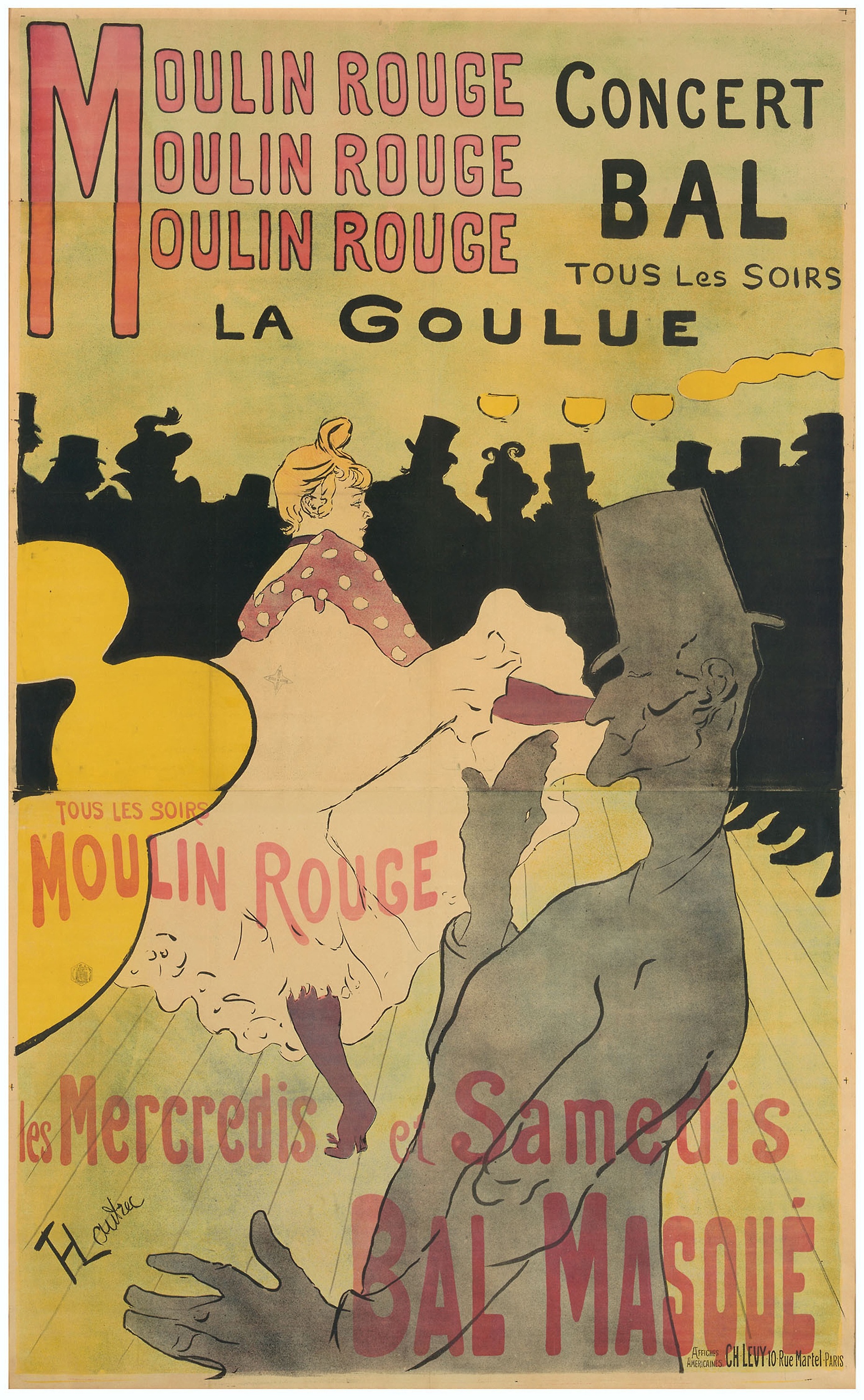
The Art Institute of Chicago holds a second, entirely separate impression under its own accession number, 1954.1193, from the collection of Mr. and Mrs. Carter H. Harrison. That sheet is treated here strictly as a comparandum: a different physical object bearing the same printed design, with its own provenance, not a second copy of this record's subject. Where the two are at risk of being confused, this record says so explicitly.
Chapter 2What the sheet shows
The design shows the dancer Louise Weber, known as La Goulue, mid-kick in a yellow bodice and white petticoats rendered with only a few contour lines against the bare paper.
The design shows the dancer Louise Weber, known as La Goulue, mid-kick in a yellow bodice and white petticoats rendered with only a few contour lines against the bare paper. In the foreground, her partner Valentin le Desossey is reduced to a flat black silhouette, all bowler hat and elongated limbs. Behind them, a crowd of anonymous spectators appears as black cut-out shapes beneath the round white globes of the hall's gas lamps.
Everything is built from large, flat, unmodulated fields of ink bounded by heavy black contour, with almost no internal shading or modeled volume. This is a deliberate rejection of the illusionistic, richly worked poster style that dominated Parisian advertising when Lautrec took the commission.
Chapter 3A commission built on a doubtful bet
The Moulin Rouge opened on the Boulevard de Clichy in 1889 under the management of Charles Zidler and Joseph Oller.
The Moulin Rouge opened on the Boulevard de Clichy in 1889 under the management of Charles Zidler and Joseph Oller. Its first advertising poster had already been supplied by Jules Cheret, the reigning master of the Parisian lithographic poster and the artist whose colorful, softly modeled style had effectively invented the modern commercial poster a decade earlier.
Zidler judged Cheret's design too gentle for a venue that needed to sell a specific, disruptive attraction: its own biggest star, La Goulue, and the transgressive energy of the cancan itself. He turned instead to Henri de Toulouse-Lautrec, then 27 years old, an aristocrat's son known in a narrow Montmartre circle as a painter of brothels and cabaret life but with no track record whatsoever as a poster designer. Handing a large commercial advertising commission, in a competitive medium with an established master already on the venue's books, to an untested painter was a genuine gamble on Zidler's part. It paid off entirely: this was Lautrec's first poster, and it made his reputation in the medium overnight.
Chapter 4How it was printed, and by whom
The design was printed by the commercial poster house Affiches Americaines, run by Charles (Ch.) Levy, in Paris.
The design was printed by the commercial poster house Affiches Americaines, run by Charles (Ch.) Levy, in Paris. This is documented directly in the printer's imprint carried on the sheet itself and confirmed independently by the Metropolitan Museum, the Victoria and Albert Museum, and Sotheby's cataloguing of multiple impressions sold since. It was not printed by Edouard Ancourt, whose Paris workshop -- and its master craftsman, Pere Cotelle -- became Lautrec's regular printer starting the following year, producing Reine de Joie (1892), Divan Japonais (1892-93), and the great majority of his subsequent posters and prints. The association between Lautrec and Ancourt is so strong in the literature on his later work that it is easy to assume, wrongly, that Ancourt printed everything Lautrec ever designed. He did not print this one.
At full scale the design exceeded what a single press sheet of the period could carry, so it was printed and pasted up in sections: a large image sheet or sheets, plus a narrower masthead strip carrying the words MOULIN ROUGE across the top. Because the masthead strip was a separate piece of paper, it did not always survive intact where the rest of the sheet did, and it is missing from a number of impressions that have reached public collections today, including examples catalogued as a distinct rarer state.
Chapter 5The debt to Japan
The flat, unmodulated color fields, the bold black contour, the silhouette treatment of Valentin, and the cropped, oblique framing of the crowd are all formal devices that scholarship on Lautrec's...
The flat, unmodulated color fields, the bold black contour, the silhouette treatment of Valentin, and the cropped, oblique framing of the crowd are all formal devices that scholarship on Lautrec's posters directly connects to Japanese ukiyo-e woodblock prints, which circulated widely among Paris's painters and printmakers in the years immediately before this commission. This is best treated as an argued art-historical reading of the design's formal vocabulary, made by scholars working from the finished object and from the broader, well-documented vogue for Japanese prints among Lautrec's Montmartre contemporaries, rather than as a recorded statement of Lautrec's own intentions. No letter, inventory, or contemporary account in the sources consulted for this record has Lautrec explaining the choice in those terms himself.
Chapter 6Overnight, by every account but his own
The poster's effect on Lautrec's career is not in serious dispute, even where a single, tidy quotation is.
The poster's effect on Lautrec's career is not in serious dispute, even where a single, tidy quotation is. Museum scholarship describes this poster as the moment that elevated the commercial advertising lithograph to a form taken seriously as art, and credits it with making Lautrec's name known overnight and drawing further poster commissions from other performers and venue owners in short order. A widely repeated anecdote, traced in the sources consulted only to "a friend of Lautrec's" rather than to Lautrec himself, describes the poster being carried by horse and cart along the Avenue de l'Opera not long after it appeared, evidence of how quickly it moved from novelty to citywide talking point. That anecdote is tertiary and unattributed by name; it is included here as color, not as documented fact, and is flagged for replacement if a primary account can be found.
Chapter 7Printed to be thrown away
Posters of this kind were commercial ephemera by design: pasted directly onto Paris walls, meant to be papered over by the next campaign within weeks, not preserved.
Posters of this kind were commercial ephemera by design: pasted directly onto Paris walls, meant to be papered over by the next campaign within weeks, not preserved. What is actually known about how many survive today, against how many were originally printed, is limited and should be stated precisely rather than rounded into a tidy figure.
An edition of approximately 3,000 impressions is the figure repeated across secondary and tertiary sources on this poster, including Wikipedia's own article on the design -- which carries the figure without a citation to a primary print order or ledger. No documented original print-run record has been located for this record. The one concrete, sourced number available concerns not the whole edition but a single bibliographic state within it: the Victoria and Albert Museum's own catalogue entry for its two-sheet impression identifies it as Wittrock's rarer "Version C," of which only four impressions are known to survive in public collections worldwide, including examples at the Philadelphia Museum of Art and the Albertina in Vienna. That is a real, sourced census of one state, not of the design as a whole, and this record treats the two as distinct.
No comprehensive survival count across all recorded states was found in the sources consulted. This is recorded as an open question rather than filled with an estimate.
Chapter 8This impression: the Met's
The Metropolitan Museum's sheet, accession 32.88.12, was purchased in 1932 with the Harris Brisbane Dick Fund, an acquisitions endowment established by the paper manufacturer and print collector...
The Metropolitan Museum's sheet, accession 32.88.12, was purchased in 1932 with the Harris Brisbane Dick Fund, an acquisitions endowment established by the paper manufacturer and print collector Harris Brisbane Dick, whose gift of more than 3,500 nineteenth-century etchings and accompanying purchase fund led directly to the creation of a dedicated Met print department in 1916. The purchase falls within the tenure of William M. Ivins Jr., the department's founding curator.
No dealer, agent, or prior private owner is named for this specific sheet in the sources consulted for this record, and no record has been found of where it was between its 1891 printing and its 1932 accession. That is recorded here as a gap, not bridged with a guess. The impression carries no assigned gallery number in the Met's own object record, indicating it is currently held in print-room storage rather than displayed.
Chapter 9A separate impression, a separate history
The Art Institute of Chicago's impression, accession 1954.1193, comes from the collection of Mr.
The Art Institute of Chicago's impression, accession 1954.1193, comes from the collection of Mr. and Mrs. Carter H. Harrison. Carter H. Harrison IV (1860-1953) served five terms as mayor of Chicago (1897-1905 and 1911-1915) and later, from 1933 to 1944, as the United States Collector of Internal Revenue for the Chicago district. He was an avid collector who assembled works by Gauguin, Cassatt, Monet and Toulouse-Lautrec alongside historical letters and autographs, and gave his collection to the Art Institute; the museum's accession date of 1954 falls the year after his death.
Nothing in the sources consulted connects the post-1891 history of the Chicago sheet to that of the Met's. They are two pieces of paper, printed from the same stones in the same year, that took two entirely different routes into two different American museums four decades apart, through two collectors -- a print curator's acquisitions fund and a five-term mayor's private taste -- who never intersect in this story.
Chapter 10The dancer the poster made famous
The woman in the yellow bodice was Louise Weber, born 12 July 1866, who performed under the stage name La Goulue -- "the glutton" -- earned, by most accounts, from a habit of finishing cabaret...
The woman in the yellow bodice was Louise Weber, born 12 July 1866, who performed under the stage name La Goulue -- "the glutton" -- earned, by most accounts, from a habit of finishing cabaret patrons' abandoned drinks while she danced. (One tertiary source, Encyclopedia.com, gives her birth year as 1869; this record follows the more widely repeated 1866 and flags the discrepancy rather than silently picking one.) Partnered with the dancer Jacques Renaudin, known as Valentin le Desossey -- "the boneless" -- she helped originate the athletic, high-kicking cancan routine the Moulin Rouge built its reputation on, and by the early 1890s was reported to be the highest-paid entertainer in Paris. She sat for Lautrec repeatedly, in paintings as well as this poster, and became one of the defining faces of his early Montmartre work.
Chapter 11What recent research corrects
Will Visconti's 2022 academic biography, Beyond the Moulin Rouge: The Life and Legacy of La Goulue, drew on Weber's own diary and on police records rather than repeating the standard secondhand...
Will Visconti's 2022 academic biography, Beyond the Moulin Rouge: The Life and Legacy of La Goulue, drew on Weber's own diary and on police records rather than repeating the standard secondhand narrative. It argues that Weber was already a well-known performer before the Moulin Rouge hired her, not a discovery the venue made; that she was the primary financial support for her family for much of her career; and that she survived and formally reported domestic violence at a time when working women had little legal standing to do so. Visconti's account also extends her working life well past the Moulin Rouge years she is most remembered for: an independent career as a belly dancer, animal tamer, and sideshow performer that ran across five decades in total, not a brief rise followed only by collapse. Where this reading differs from the shorter, more familiar version of her story repeated in general encyclopedic sources, this record follows Visconti as the sourced, argued position and names the disagreement rather than picking a version silently.
Chapter 12Decline and death
Weber left the Moulin Rouge in 1895 to run an independent fairground booth built around her own fame; audiences who had come to the Moulin Rouge specifically did not follow her into the new venture...
Weber left the Moulin Rouge in 1895 to run an independent fairground booth built around her own fame; audiences who had come to the Moulin Rouge specifically did not follow her into the new venture on the scale she needed, and the business failed. On the standard, shorter version of her story repeated in general encyclopedic sources, poverty and decline followed directly from that failure. Visconti's account, which this record follows per the preceding section, instead documents Weber continuing to work independently for decades afterward as a belly dancer, animal tamer, and sideshow performer, rather than collapsing immediately - this record does not have a specific sourced date for when that later independent career itself gave way to decline, and does not invent one. What is documented, across the general run of sources, is that by 1928 she had returned to Montmartre, severely overweight, in poor health, and largely unrecognized, selling peanuts, cigarettes, and matches from a street corner near the cabaret she had once headlined.
She died on 29 January 1929, in the tenth arrondissement of Paris, at the age of 62. She was buried initially at the Cimetiere de Pantin; her remains were later moved to the Cimetiere de Montmartre, closer to the district that had made her famous.
Chapter 13The irony the market prices in
A single institutional impression of this poster -- one piece of paper bearing Weber's likeness -- has carried Sotheby's estimates in the low hundreds of thousands of dollars in each of three sales...
A single institutional impression of this poster -- one piece of paper bearing Weber's likeness -- has carried Sotheby's estimates in the low hundreds of thousands of dollars in each of three sales identified for this record, spanning 2014 to 2026. The woman depicted on it died selling peanuts on a street corner a few hundred meters from where she once commanded the highest fee in Paris entertainment. That contrast needs no interpretation added to it; it is simply what the documented facts, set side by side, show.
Chapter 14The market for this design today
Three Sotheby's sales identified for this record bracket the design's recent market: a 2 May 2014 New York sale (lot 142, estimated USD 200,000-250,000) offering an unusual object -- one of...
Three Sotheby's sales identified for this record bracket the design's recent market: a 2 May 2014 New York sale (lot 142, estimated USD 200,000-250,000) offering an unusual object -- one of Wittrock's three recorded trial proofs, printed in black only, on two joined sheets, documenting a single printing stage rather than a finished poster; a 29 April 2019 New York sale (lot 28, estimated USD 250,000-300,000) of a standard two-sheet impression; and a 14 April 2026 sale (lot 12, estimated USD 150,000-250,000) of a two-sheet impression catalogued as Wittrock's "C of D" state, consigned from a private collection in Japan. Hammer and premium figures for all three require an account login not available to this research and are not published in the sources consulted; only the pre-sale estimates are recorded here.
A separate figure, a reported GBP 260,000 result in 2014 in London, appears in MyArtBroker's seller's guide to the artist without a named auction house, lot number, or statement of whether the figure includes buyer's premium. It cannot be reconciled with the USD-denominated New York lot identified independently above for the same year, and is recorded here as unverified rather than merged into a single confident number.
Chapter 15Restrikes, states, and what has not been documented for this title
Toulouse-Lautrec's printed oeuvre as a class is treated by dealers and scholars as genuinely vulnerable to confusion between early pulls and later ones: the standard authentication tool for his...
Toulouse-Lautrec's printed oeuvre as a class is treated by dealers and scholars as genuinely vulnerable to confusion between early pulls and later ones: the standard authentication tool for his prints, Wolfgang Wittrock's two-volume catalogue raisonne (1985), exists precisely because paper type, printing variant, and state have to be checked against a documented record rather than assumed from a design alone. A documented case of an actual later reprinting exists for a different Lautrec project: lithographic stones the artist made for Editions Joubert in 1895 were rediscovered decades later in the publisher's basement and reprinted at the Atelier Mourlot in Paris before being formally cancelled and deposited at the Bibliotheque Nationale's Cabinet des Estampes.
No case of a forged or later restrike specifically of Moulin Rouge: La Goulue was found in the sources consulted for this record. That absence is reported as a finding, not as proof of the design's safety from the same risk documented elsewhere in Lautrec's market -- a claim this record is not in a position to make either way.
The artist
Henri Marie Raymond de Toulouse-Lautrec-Monfa
Lautrec was born into an aristocratic family whose closed marriage pattern -- his parents, Count Alphonse and Countess Adele de Toulouse-Lautrec, were first cousins -- is directly implicated in the condition that shaped his adult life. He is best known today as a painter and printmaker of Montmartre's cabarets and brothels, a subject matter strikingly at odds with his own inherited social position, and this poster was his first commission in the medium that made him famous in his own lifetime.
Related works
| Work | Relation | Where it is |
|---|---|---|
| Moulin Rouge, La Goulue Henri de Toulouse-Lautrec | A separate physical impression of the same 1891 design, not the object described in this record From the Mr. and Mrs. Carter H. Harrison collection, accessioned in 1954, one year after Harrison's death. Its own provenance and condition are distinct from the Met's sheet. | Art Institute of Chicago (accession 1954.1193) |
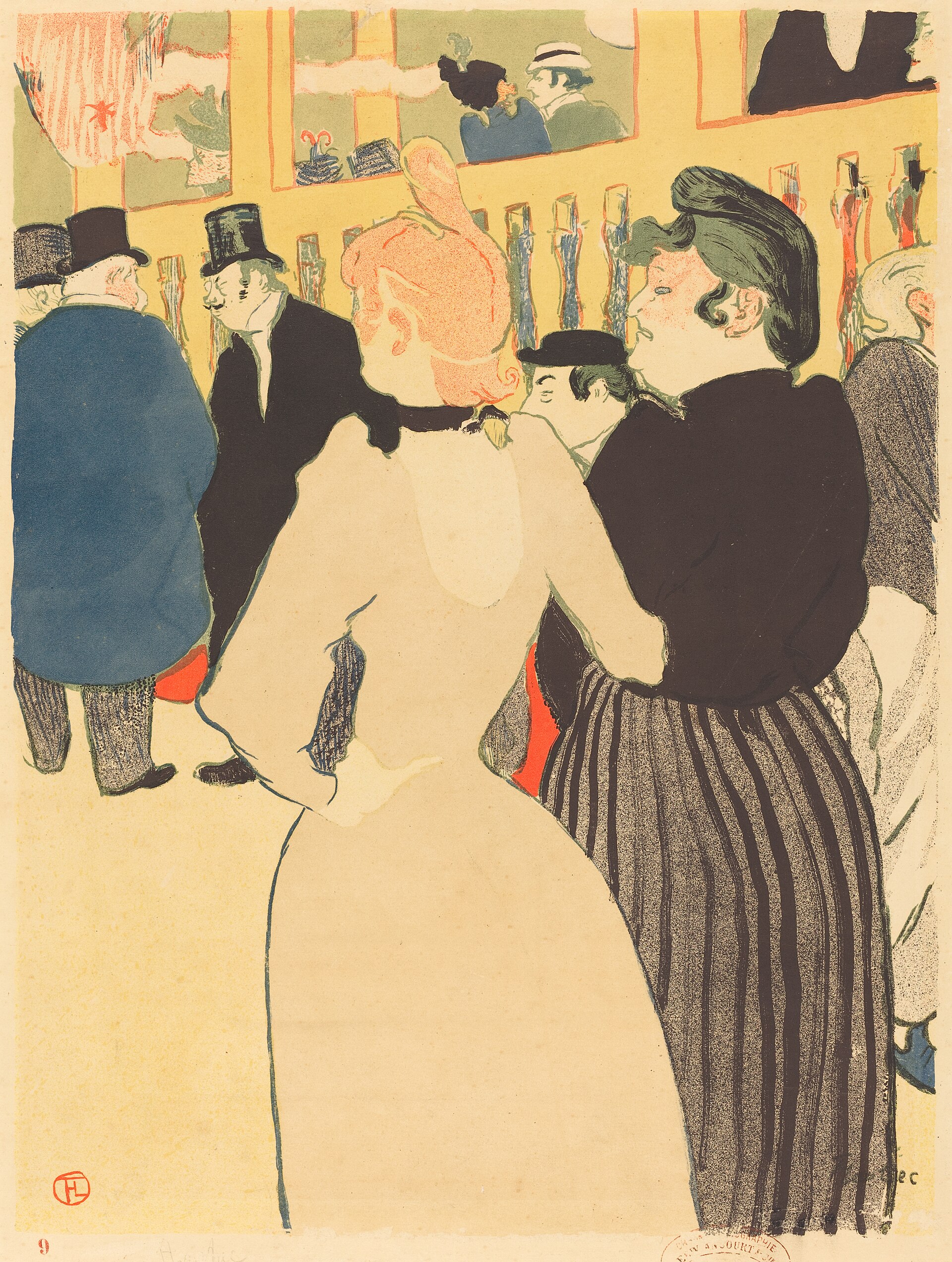
| At the Moulin Rouge, La Goulue and Her Sister Henri de Toulouse-Lautrec | Painting of the same dancer by the same artist, made the following year Shown for comparison of Lautrec's continued engagement with La Goulue as a subject, not as evidence in this record's provenance chain. | National Gallery of Art, Washington |
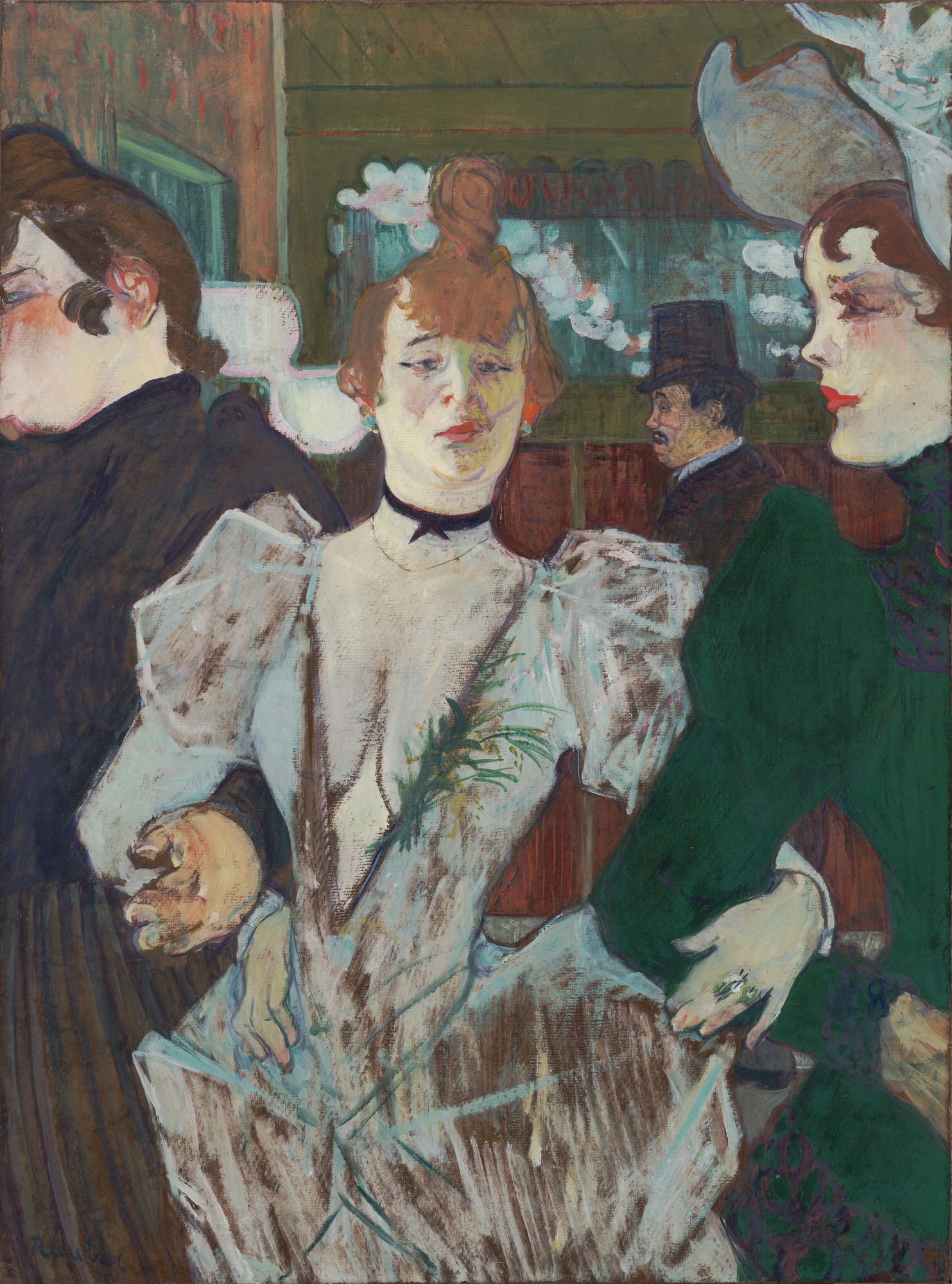
| La Goulue at the Moulin Rouge Henri de Toulouse-Lautrec | Another depiction of the same dancer from the same period, in a different medium Illustrates how central La Goulue was to Lautrec's early Montmartre subject matter. | Museum of Modern Art, New York |
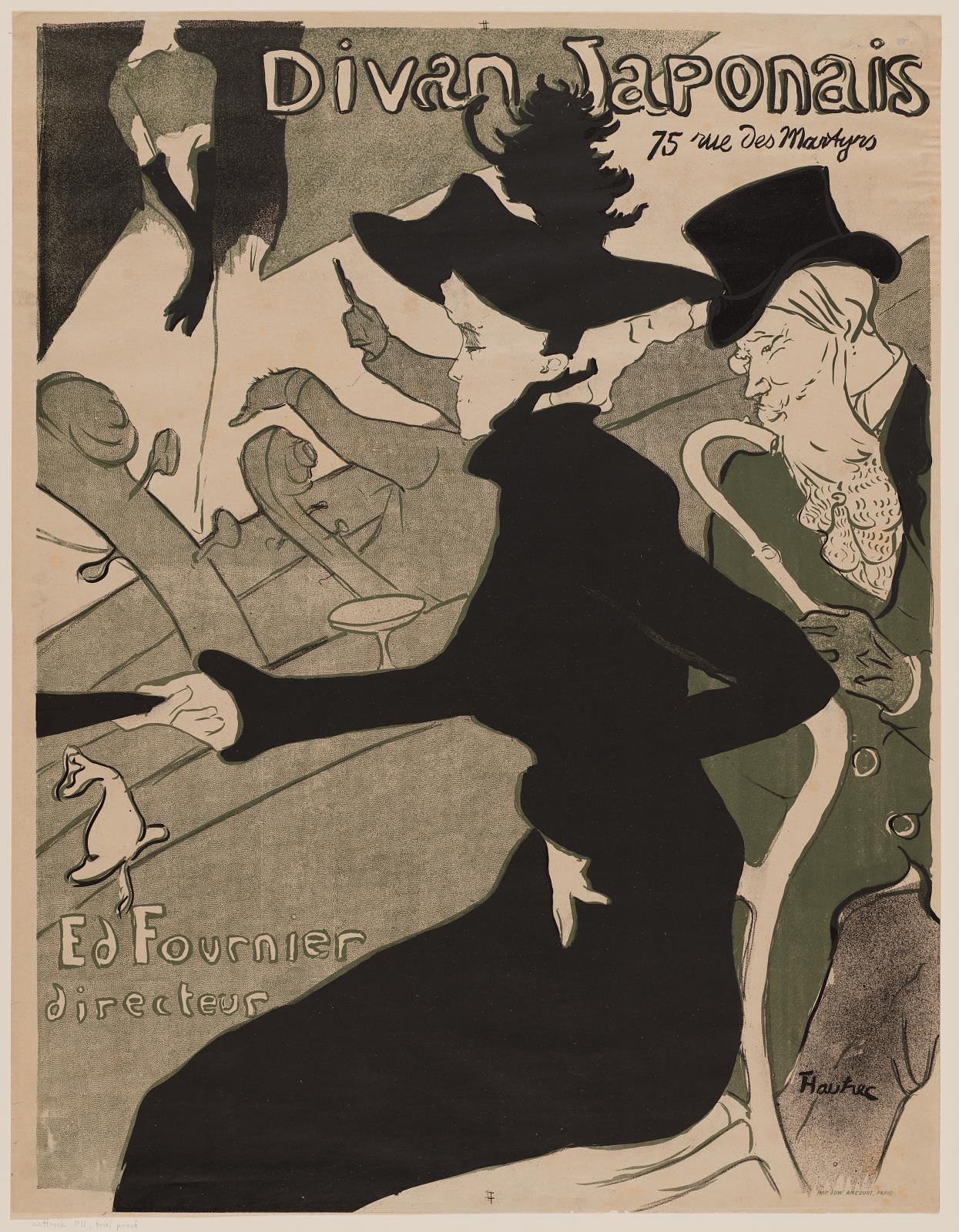
| Divan Japonais Henri de Toulouse-Lautrec | Lautrec's next major poster, made for a different Montmartre venue the following year Printed at Edouard Ancourt's workshop, illustrating the change of printer this record documents: Ancourt did not print the poster described here. | Museum of Fine Arts, Boston (accession 68.724), among other public collections |
Open questions
- What was the actual original print run of this design? An estimate of approximately 3,000 is repeated across secondary and tertiary sources, including an uncited figure in Wikipedia's own article, but no primary print order or ledger has been located.
- Who owned or held this specific Met impression between its 1891 printing and its 1932 purchase by the museum? No dealer, agent, or private owner is named in the sources consulted.
- What is Louise Weber's correct birth year? Most sources give 12 July 1866; Encyclopedia.com gives 1869. This record follows 1866 but the discrepancy is unresolved.
- How many large, intact impressions of this design survive today across all recorded states? No comprehensive census was found; the only sourced count located covers a single state (the Victoria and Albert Museum's four known copies of Wittrock's two-sheet Version C), not the edition as a whole.
- Has a forged or later restrike specifically of Moulin Rouge: La Goulue ever circulated? General scholarship documents Lautrec's posters as a class vulnerable to conflating early and later pulls, and a documented restrike case exists for a different Lautrec project (the 1895 Editions Joubert stones), but no case specific to this title was found in the sources consulted.
- What is the true source and basis of the GBP 260,000 result MyArtBroker reports for 2014? No auction house, lot number, or hammer-versus-premium breakdown is given, and it does not match the USD-denominated New York Sotheby's lot independently identified for the same year.
Questions about this object
What is Moulin Rouge: La Goulue?
Moulin Rouge: La Goulue is a print, dated 1891. Medium: Color lithograph printed in four colors from multiple stones (this impression: three sheets of wove paper).
Who made Moulin Rouge: La Goulue, and is the attribution settled?
The attribution to Henri de Toulouse-Lautrec is recorded here as accepted. Never disputed. Lautrec's monogram is worked into the printed design itself, the commission is documented contemporary to the event, and the design is catalogued under three independent standard reference numbers used by every institution and auction house that has since handled an impression: Delteil 339, Adriani 1, and Wittrock P1.
Where is Moulin Rouge: La Goulue now?
The Metropolitan Museum of Art, New York, Department of Drawings and Prints. Inventory number 32.88.12. Last confirmed 15 August 2026. Purchased with the Harris Brisbane Dick Fund, 1932. No gallery number is assigned in the Met's own object record, consistent with the museum's practice of keeping large, light-sensitive prints in print-room storage rather than on permanent view.
What has Moulin Rouge: La Goulue sold for?
Hammer not published in the sources consulted (result requires account login); with premium, not published in the sources consulted. Sotheby's, 2014-05-02.
What is still unknown about Moulin Rouge: La Goulue?
What was the actual original print run of this design? An estimate of approximately 3,000 is repeated across secondary and tertiary sources, including an uncited figure in Wikipedia's own article, but no primary print order or ledger has been located.
Sources
- 1The Metropolitan Museum of Art, 'Moulin Rouge: La Goulue,' object record and public Collection API (accession 32.88.12, object ID 333990). metmuseum.org/art/...
- 2The Art Institute of Chicago, 'Moulin Rouge, La Goulue,' object record and public API (accession 1954.1193). artic.edu/artworks/...
- 3Victoria and Albert Museum, 'Moulin Rouge, La Goulue,' object record (E.704-2000), including its identification as Wittrock's Version C and the four known public-collection copies of that state. collections.vam.ac.uk/item/...
- 4Sotheby's, Prints, New York, 2 May 2014, lot 142. sothebys.com/en/...
- 5Sotheby's, Prints & Multiples Evening Sale, New York, 29 April 2019, lot 28. sothebys.com/en/...
- 6Sotheby's, Prints & Photographs Part I, 14 April 2026, lot 12 (Property from a Distinguished Private Collection, Japan). sothebys.com/en/...
- 7MyArtBroker, 'A Seller's Guide to Henri De Toulouse Lautrec.' dealer source; used for the Wittrock catalogue raisonne discussion and a reported 2014 London result that could not be independently verified. myartbroker.com/artist-henri-de-toulouse-lautrec/...
- 8Wikipedia, 'Moulin Rouge: La Goulue.' source; the article's own print-run figure carries no citation. en.wikipedia.org/wiki/...
- 9Wikipedia, 'La Goulue.' source for Louise Weber's biography and death. en.wikipedia.org/wiki/...
- 10Will Visconti, Beyond the Moulin Rouge: The Life and Legacy of La Goulue (University of Virginia Press, 2022), as reported by the University of Sydney. sydney.edu.au/arts/...
- 11Montmartre Artists' Studios (montmartrefootsteps.com), 'Toulouse-Lautrec's Moulin Rouge Paintings and Posters.' blog source, used only for an unattributed contemporary anecdote; with a period press account. montmartrefootsteps.com/toulouse-lautrec-moulin-rouge-pai...
- 12Cora Michael, 'Henri de Toulouse-Lautrec (1864-1901),' Heilbrunn Timeline of Art History, The Metropolitan Museum of Art. metmuseum.org/essays/...
- 13Nelson-Atkins Museum of Art, 'Toulouse-Lautrec, Jane Avril Looking at a Proof,' for Edouard Ancourt's workshop and master printer Pere Cotelle's role in Lautrec's later posters. nelson-atkins.org/fpc/...
- 14Riva Castleman and Wolfgang Wittrock, Henri de Toulouse-Lautrec: Images of the 1890s (Museum of Modern Art, 1985), p. 44, for the quotation 'I have always been a pencil,' as given on Wikiquote. en.wikiquote.org/wiki/...
- 15Wikipedia, 'Count Alphonse de Toulouse-Lautrec Montfa.' source, for the artist's father and family background. en.wikipedia.org/wiki/...
- 16Sotheby's, '21 Facts About Henri de Toulouse-Lautrec.' source for general biographical facts (childhood accident, likely genetic cause, output, death). sothebys.com/en/...
Last verified · Published
Change log
15 August 2026 - Record created at the house standard: researched narrative, technical evidence, maker dossier, graded provenance chain, prices with hammer and premium separated, related works, open questions and sources.