Girl with a Pearl Earring
Johannes Vermeer · c. 1665
Last verified 11 August 2026 · 19 sources cited · Change log
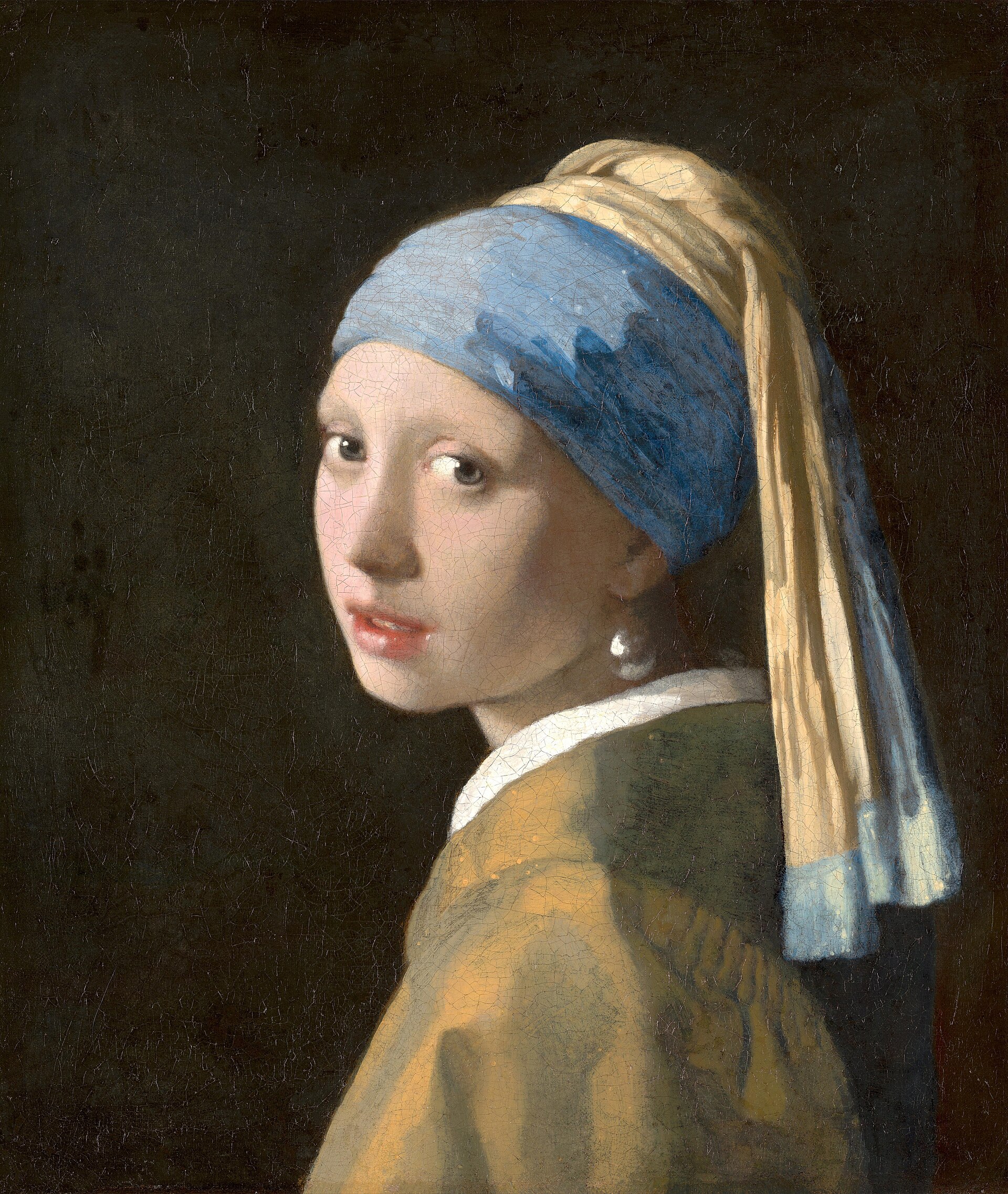
The record subject. Oil on canvas, 44.5 x 39 cm, signed upper left IVMeer with IVM in ligature. Mauritshuis, The Hague, inv. 670. This is the Mauritshuis reproduction of the painting in its present state, after the 1994 treatment.
| Artist | Johannes Vermeer |
|---|---|
| Date | c. 1665 |
| Medium | Oil on canvas |
| Dimensions | 44.5 x 39 cm |
| Where it is now | Mauritshuis, The Hague, inv. 670last confirmed 2 August 2026 |
| Attribution | acceptedAccepted as autograph Vermeer. |
| Object type | Painting |
| Period | Dutch Golden Age, 1600-1700 |
| Cases | Has a provenance gap |
| Culture | Dutch |
| Genre | tronie |
| Inscriptions | Signed upper left: IVMeer |
- Where it is now
- Mauritshuis, The Haguelast confirmed 2 August 2026
- Attribution
- accepted
- Provenance
- 8 links2 documented, 5 disputed, 1 unknown
- Sources
- 19 cited
- Last verified
- 11 August 2026Change log
On this page 10 sections
The best-known head in European painting, and one of the shortest documented ownership histories attached to a famous picture. The Mauritshuis prints a chain reaching back to Vermeer's lifetime in which every link before 1881 carries a question mark, and this record keeps those question marks rather than smoothing them out. The painting enters the documentary record in 1881, at the Braams sale in The Hague, where it was bought for two guilders with a thirty cent mark-up by Arnoldus Andries des Tombe, after the cultural official Victor de Stuers agreed not to bid against him. Des Tombe left it to the Mauritshuis in a secret will; it entered the collection in 1903 as inv. 670.
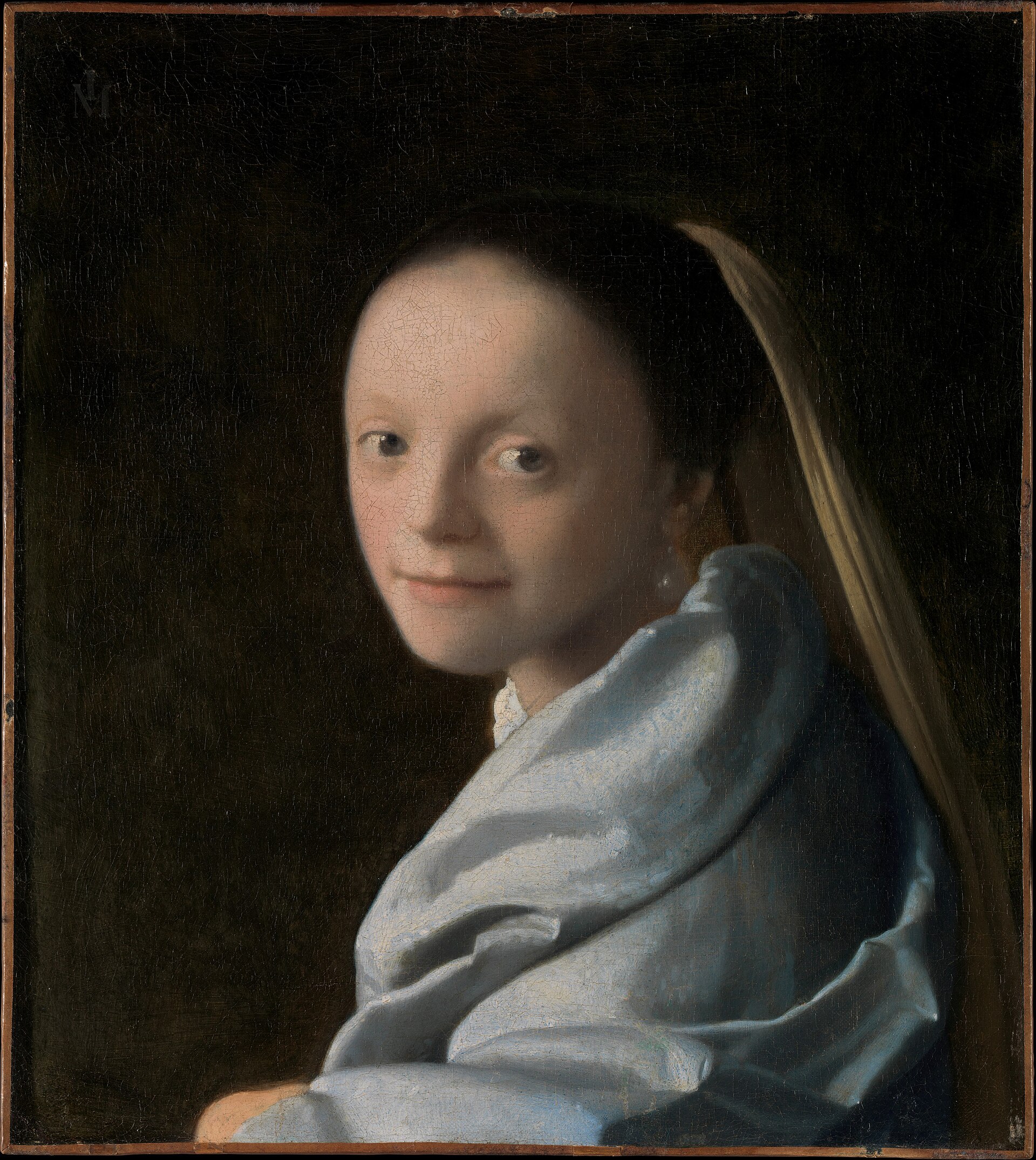
It is a tronie, not a portrait: a study of a head in exotic costume, made for the open market rather than for a sitter. No identification of the girl has ever been established and the category means there may never have been one to establish. The long-standing association with a tronie in the Dissius sale of 16 May 1696 remains an argument, not a fact, and cannot be narrowed even to which of the three candidate lots is meant; the Metropolitan Museum's Study of a Young Woman is a competing claimant for the same entries.
What is known in detail is the paint. The 2018 project The Girl in the Spotlight examined the picture non-invasively for two weeks in front of the museum public and published its findings across nine open-access papers. The background is a faded green glaze of indigo and weld over charcoal black, and the imaging found diagonal modelling in it that the researchers read as folded fabric, very probably a curtain. The eyelashes everyone believed absent are there. The ultramarine came from lapis that had been heated before grinding; the lead white came from Derbyshire. The pearl is two strokes of paint over a finished neck, with no contour and no hook, and it is too large to have been a real one.
Provenance
Each link is graded. Documented: a cited source supports it. Disputed: the identification is argued but not established. Unknown: no owner for that span, and the gap is not smoothed into a narrative. The grades in the glossary.
- c. 1665 - 1674(?) Pieter Claesz van Ruijven, Delftdisputed
The Mauritshuis records this link with a question mark. Van Ruijven and his wife owned about twenty-one Vermeers, more than half the surviving output, and Vermeer worked almost exclusively for them and their circle for roughly thirteen years from 1657. No document ties this particular canvas to him.112
- 1674 - 1681(?) Maria de Knuijt, widow of van Ruijven, Delftdisputed
Recorded by the Mauritshuis with a question mark. De Knuijt's 1665 will left Vermeer five hundred guilders should she predecease him, which establishes the relationship but not the ownership of this picture.118
- 1681 - 1682(?) Magdalena van Ruijven and Jacob Dissius, Delftdisputed
Recorded by the Mauritshuis with a question mark.1
- 1682 - 1695(?) Jacob Dissius, Delft, with his father Abraham Dissius 1685-1694disputed
Recorded by the Mauritshuis with a question mark. Dissius died in 1695 and the collection was sold the following year.1
- 1696 -Unidentified buyer at the Dissius sale, Amsterdamdisputed
Dissius sale, Oude Heeren Logement, Amsterdam, 16 May 1696, lot 38 (36 guilders), 39 (17 guilders) or 40 (17 guilders), all described only as tronies. Twenty-one Vermeers were sold that day for 1,503 guilders and 10 stuivers. The identification of this painting with one of these three lots is long-standing and unresolved; the Metropolitan Museum's Study of a Young Woman is a competing candidate for the same entries. No buyer is recorded against any of the three in the sources consulted.1111912
- - 1881Unknownunknown
No owner is documented between the 1660s and 1881, and if the Dissius identification is rejected the gap runs the full two centuries. The painting was unknown to the public until 1881 and its authorship had been forgotten.13
- 1881 - 1902Arnoldus Andries des Tombe, The Haguedocumented
Bought at the Braams sale, Venduhuis der Notarissen, Nobelstraat, The Hague, 1881 (day and month not recorded) for two guilders plus a thirty-cent mark-up, after Victor de Stuers and Des Tombe agreed not to bid against each other. The painting was in a sorry state of neglect. It was lent to the Mauritshuis in the year of purchase and hung in Des Tombe's house at Parkstraat 26, where Abraham Bredius saw it in 1885. Sent to Antwerp in 1881 for lining by a restorer named Van de Haeghen.1411
- 1903 - presentMauritshuis, The Haguedocumented
Des Tombe died on 16 December 1902 without heirs, having made a secret will leaving twelve paintings to the Mauritshuis. This was one of them. It entered the collection in 1903 as inv. 670 and is on view in Room 15. On temporary loan to the Nakanoshima Museum of Art, Osaka, while the Mauritshuis is closed from 24 August to 20 September 2026.11017
Prices realised
| Date | Sale | Estimate | Result | Note |
|---|---|---|---|---|
| 16 May 1696 | Dissius sale, Oude Heeren Logement, Amsterdam | Hammer 36 guilders (lot 38); 17 guilders (lot 39); 17 guilders (lot 40) With premium Not recorded Dutch guilders | DISPUTED IDENTIFICATION. This painting has long been associated with one of these three lots and cannot be assigned to any of them. Lot 38 was described as a tronie in antique dress, uncommonly artful; lots 39 and 40 as further works by the same hand. Twenty-one Vermeers were sold that day for a total of 1,503 guilders and 10 stuivers. No premium arrangement is recorded for this sale in the sources consulted, so no hammer-to-premium split can be made. The Essential Vermeer catalogue entry gives 46 guilders for lot 38; the Mauritshuis provenance and the same site's account of the auction both give 36, which is the figure recorded here. | |
| 1881 | Braams sale, Venduhuis der Notarissen, Nobelstraat, The Hague | Hammer 2 guilders With premium 0.30 guilders Dutch guilders | Day and month not recorded. Total paid 2.30 guilders, printed by the Mauritshuis as f2,30 and by the head researcher of the 2018 technical project as two guilders plus a thirty cent commission. Bought by Arnoldus Andries des Tombe after Victor de Stuers agreed not to bid against him. Accounts that quote a single figure for this sale are conflating the hammer and the mark-up; both components are documented. No conversion to a modern figure is offered here: the guilder amount is the fact, any equivalent is a derived and date-dependent estimate. |
Hammer is the price at which the bidding stopped; with premium adds the fee the house charges the buyer on top. Hammer price and buyer's premium in the glossary.
Technical evidence
| Support | Dense medium-weight plain-weave canvas. Computer-assisted thread-level analysis of the 2018 X-radiograph gives average thread spacing of 0.68 mm in both directions: 14.8 +/- 2.7 threads per cm horizontally (warp) and 14.6 +/- 3.0 vertically (weft). Primary cusping extends more than 5 cm into the picture plane on all four sides at 5 to 7 cm intervals; secondary cusping and weft snakes are also present.5 |
|---|---|
| Dimensions | 44.5 x 39 cm.1 |
| Ground | A warm light grey ground about 100 microns thick, up to 200 microns at one edge, composed of chalk with a smaller quantity of lead white plus umber and traces of yellow and red earth and carbon black. Applied as a thick paste with a curved primer's knife while the canvas was on a large framework, then moved to a smaller strainer. The surviving tacking margins carry ground but no paint. The preparation was probably not done by Vermeer himself.53 |
| Layer structure | Simple: usually one or two monochrome underlayers and a single upper paint layer. The interfaces are distinct lines, showing that Vermeer let each stage dry fully before painting on it. Light paint in the face is built up to nearly 100 microns against 20 to 25 microns in the shadow.37 |
| Palette | Vermilion and red lake (American cochineal) for reds; earth pigments, lead-tin yellow and yellow lake (weld) for yellows and browns; natural ultramarine and indigo for blues; charcoal and bone black; lead white. Apart from the quantity of ultramarine, the palette is typical of the period.3 |
| Ultramarine | High-quality natural ultramarine in the headscarf, judged by lazurite particle size, colour intensity and the scarcity of accessory minerals. Synchrotron sulphur K-edge XANES indicated the lazurite was prepared at least in part from heat-treated lapis lazuli rock. Also mixed into the yellow jacket and present in trace amounts in the pink flesh paint.83 |
| Lead white | Stack-process lead white in at least two deliberately different grades, distinguished by hydrocerussite to cerussite ratio and particle size, with the finest used in the light scumble over the shadowed side of the face. Lead isotope analysis of eight samples traced the ore to the Peak District of Derbyshire.7 |
| Background stratigraphy | Charcoal black underlayer (identified as bone black in 1994 and corrected in 2018) under a translucent glaze containing indigo and weld on a chalk substrate, bound in linseed oil, with a copper drier added. Originally an even, smooth, glossy dark green. Both organic colourants have faded.63 |
| Curtain | MA-XRF maps for lead, copper, potassium and calcium show diagonal lines in the upper right and lower right of the background resembling folds in fabric, corroborated by MS-OCT glaze thickness and by infrared images of the underlayer. The published conclusion is folded fabric, possibly a curtain, established at the underlayer stage and original to Vermeer's conception. The left side shows no diagonals.63 |
| Eyelashes | Present on both eyes. On the proper left eye, tiny black hatched lines visible only at high magnification. On the proper right eye, revealed for the first time in the MA-XRF iron map: painted thinly in an iron-containing paint over the finished background.73 |
| The pearl | Not modelled as an object. A scumble supplies the soft counter-reflection of the white collar and a teardrop-shaped highlight was applied in thick impasto, both on top of the completed skin tone of the neck. No contour and no fitting or hook are painted. The impasto was flattened by historic linings.31 |
| Pentimenti | The ear was shifted upwards and the earlobe and ear canal repainted; the jawline shadow was moved to suit; the line between cheek and headscarf was straightened at the final stage; the back of the neck was softened. Each eye began as a small black dot, and the pupils were repositioned when painted.57 |
| Signature | IVMeer, IVM in ligature, upper left. Sits on top of the background glaze, confirmed by 3D digital microscopy at 140x showing pigment particles of the signature above the glaze and glaze visible beneath cracks in the stroke of the M. Now barely legible to the naked eye because of degradation in the background, and reconstructed by tracing the MA-XRF calcium and lead maps.63 |
| Binding medium | Linseed oil, slightly heat-bodied in the background glaze. Recent chromatography also found a trace of rapeseed oil, possibly contamination from a mill that pressed different seeds without cleaning between runs.3 |
| Degradation | Faded indigo and weld in the background; faded yellow lake in the shadow of the headscarf, leaving large amounts of chalk and a patchy whitish appearance; red lake in the jacket shadow now visible only under UV fluorescence; lead soaps and palmierite formed in the paint; flattened impasto from past linings; a pronounced craquelure aggravated by early twentieth-century treatments.8734 |
| 2018 examination methods | Carried out 24 hours a day from 26 February to 11 March 2018 inside a glass enclosure in the Golden Room of the Mauritshuis, in public. Non-invasive on the painting: technical photography, X-radiography, RIS, FIS, FORS, MS-IRR, MA-XRF, MA-XRPD, MS-OCT, 3D scanning, 3D digital microscopy at up to 4.4 and 1.1 microns per pixel, thread-level canvas analysis. On samples: SEM-EDX, FIB-STEM, FTIR-ATR, UHPLC, GCMS, synchrotron micro-XRPD and micro-XANES, lead isotope analysis.249 |
Images
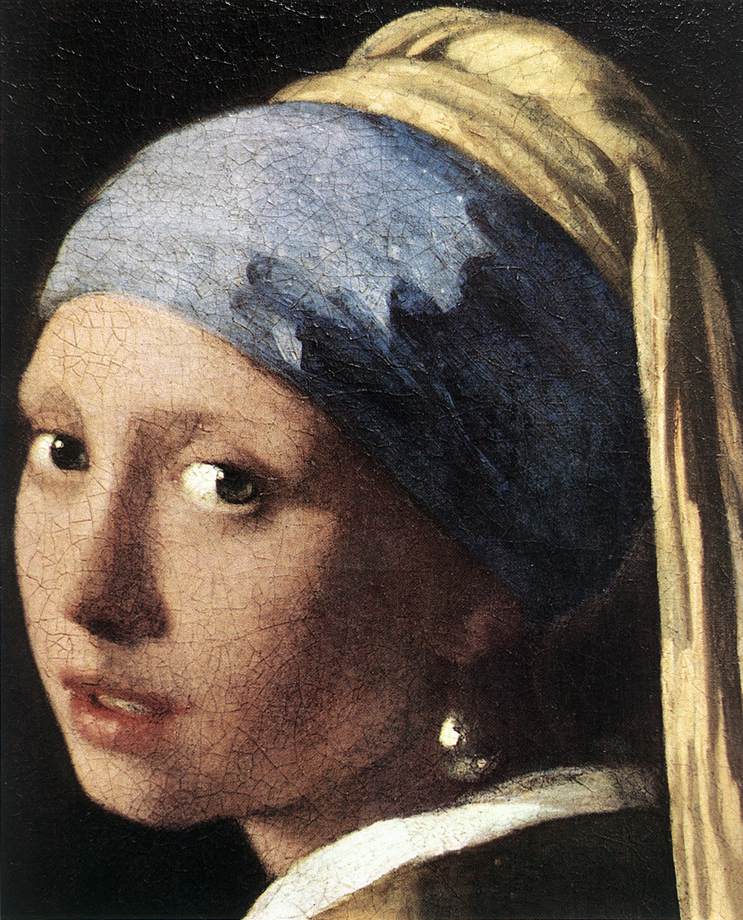
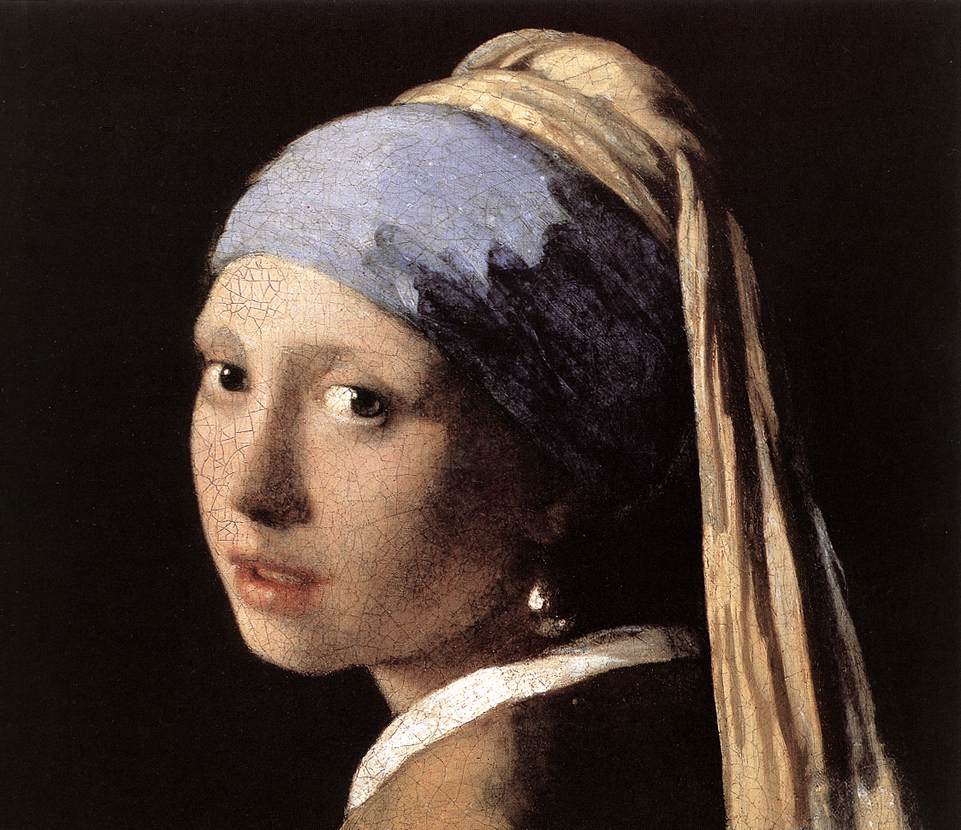
The record in full
It is not a portrait, and the question everyone asks about it is the wrong question
Oil on canvas, 44.5 by 39 centimetres, signed in the upper left IVMeer with the first three letters in ligature. A young woman turns over her shoulder against a dark ground, wearing a turban wound from two pieces of cloth, one blue and one yellow, and an oversized pearl drop. The Mauritshuis dates it 1665 and holds it as inv. 670.
The picture is a tronie, not a portrait. That distinction is the whole of the difference between what this record can state and what it cannot. A tronie is a bust-length study of a head representing a type or a character, made for the open market rather than for a sitter who commissioned it. Rembrandt popularised the form in Dutch painting around 1630 and made dozens, frequently using himself. Seventeenth-century Dutch girls did not wear turbans; the headdress is a costume property that signals an exotic or biblical figure, not a wardrobe.
There would probably have been a model in the room. The point of the exercise was not to record who she was. The conservation literature makes the same point from the paint: the face is idealised and deliberately indistinct, the bridge of the nose has no contour and its tip dissolves into the cheek, and the transitions were blended with a dry brush precisely so that no sharp line would fix a specific person. Asking who she is asks the picture to be something it was not built to be.
Two guilders, plus thirty cents
The painting entered public knowledge in 1881, at the Braams sale at the Venduhuis der Notarissen in the Nobelstraat, The Hague. The exact day and month are not recorded. On the viewing day it caught the eye of Victor de Stuers, the most influential cultural official in the Netherlands, who was there with his friend and neighbour, the collector Arnoldus Andries des Tombe.
Two versions of what happened next survive and the Mauritshuis prints both rather than choosing. In one, De Stuers recognised a Vermeer under the neglect. In the other, the picture was too dirty to be judged at all and the authorship only emerged later, when cleaning uncovered the signature. What is not in dispute is the arrangement between the two men: they agreed not to bid against each other, and Des Tombe bought it alone.
The hammer price was two guilders. The buyer's mark-up was thirty cents. The total was two guilders and thirty cents, and the Mauritshuis prints the figure in its provenance as f2,30. Almost every account of this sale gives a single number and does not say which of the two it is; the two components are both documented and both belong in the record. The painting's condition at the moment of sale was described as a sorry state of neglect.
Des Tombe hung it at Parkstraat 26 in The Hague, where his collection was open to visitors, and lent it to the Mauritshuis in the year he bought it. The future director of the museum, Abraham Bredius, saw it there in 1885 and wrote that Vermeer overshadowed all the rest. When Des Tombe died on 16 December 1902 he was found to have made a secret will leaving twelve paintings to the Mauritshuis. This was one of them, and it entered the collection in 1903.
The two centuries nobody can account for
Between the studio in the 1660s and the saleroom in 1881 there is no owner this record will assert.
The Mauritshuis publishes a chain reaching back to Vermeer's lifetime, and it is worth reading exactly how the museum writes it. Every link before 1881 carries a question mark: Pieter Claesz van Ruijven of Delft before 1674, then his widow Maria de Knuijt to 1681, then their daughter Magdalena van Ruijven with Jacob Dissius, then Dissius alone with his father Abraham to 1695, then the Dissius sale in Amsterdam on 16 May 1696. The museum is not being coy. Those question marks are the finding.
The reconstruction rests on a general fact rather than a specific document. Van Ruijven and De Knuijt owned roughly twenty-one pictures by Vermeer, more than half his surviving output, and for about thirteen years from 1657 the artist worked almost exclusively for them and their circle. Maria de Knuijt's will of 1665 left Vermeer five hundred guilders should she die first, a bequest from a patron to a painter with no known parallel in seventeenth-century Dutch practice. If a Vermeer of the mid-1660s had an owner at all, it was probably one of these two. That is a probability about a body of work, not a document about this canvas.
What the 1696 sale can prove, and what it cannot
On 16 May 1696, twenty-one paintings by Vermeer were sold at the Oude Heeren Logement in Amsterdam from the Dissius estate, for a total of 1,503 guilders and 10 stuivers. It is the single most important document in the history of Vermeer provenance; roughly fifteen surviving pictures are identified through its catalogue descriptions, and most Vermeer ownership histories begin there.
Three of its lots are heads. Lot 38 is described as a tronie in antique dress, uncommonly artful, and fetched 36 guilders. Lot 39 is another by the same hand, 17 guilders. Lot 40 is a companion to it, 17 guilders. No dimensions, no sitter, no distinguishing detail. The Mauritshuis records this painting as lot 38, 39 or 40, without choosing, and Vermeer scholarship has never been able to choose either.
This is why the identification is graded disputed here and why it must stay that way. Two other tronies compete for the same three entries, chiefly the Study of a Young Woman in the Metropolitan Museum, which is close to the same size, was probably painted within a year or two, and is signed IVMeer in the same corner of the canvas. Any argument that puts this painting in lot 38 has to displace that one, and the catalogue wording supports neither.
The prices are worth holding on to for a different reason. A tronie sat low in the seventeenth-century hierarchy of subjects, not far above landscape. In the same sale, comparable canvases by Vermeer went for very much more: the sums attached to lots 38, 39 and 40 are the prices of a category, not of a masterpiece. A Rembrandt tronie in the same room went for seven guilders.
One published figure conflicts. The Essential Vermeer catalogue entry gives 46 guilders for the tronie in antique dress; the Mauritshuis provenance and the same site's own account of the Dissius auction both give 36. The lower figure is recorded here and the discrepancy is flagged.
The Girl in the Spotlight: what was actually done in 2018
For two weeks, from Monday 26 February to Sunday 11 March 2018, the painting was examined twenty-four hours a day inside a glass enclosure in the Golden Room of the Mauritshuis, in front of the public. The project was called The Girl in the Spotlight, it was led by the Mauritshuis paintings conservator Abbie Vandivere, and it was carried out within the framework of the Netherlands Institute for Conservation, Art and Science, with scientists from the University of Antwerp, the National Gallery of Art in Washington, Delft University of Technology, the Rijksmuseum, the Cultural Heritage Agency of the Netherlands and others.
Every method used on the painting itself was non-invasive. Nothing touched it. The list was: technical photography in visible, ultraviolet, raking and infrared light, X-radiography, reflectance and fluorescence imaging spectroscopy, fibre optic reflectance spectroscopy, multispectral infrared reflectography, macroscopic X-ray fluorescence scanning, macroscopic X-ray powder diffraction, multi-scale optical coherence tomography, 3D scanning, 3D digital microscopy, and computer-assisted thread-level canvas analysis. Separately, the microscopic samples taken during the 1994 restoration were re-analysed with electron microscopy, focused ion beam scanning transmission electron microscopy, chromatography, synchrotron X-ray techniques at Grenoble and Hamburg, and lead isotope analysis. Four new samples were taken from areas the 1994 campaign had missed, including the skin.
The results were published across nine papers in a dedicated collection in the journal Heritage Science in 2019 and 2020, all open access. The claim made for the outcome, in the museum's own press language before the work began, was that the painting would afterwards be one of the best documented works of art in the world. That claim held.
What 2018 established about the background
The background is the headline, and it is also the place where the popular account and the published account diverge.
What the paint is, is settled. The dark space behind the figure is a black underlayer of charcoal, over which Vermeer laid a translucent glaze coloured with two organic dyes, indigo and weld, with chalk as the substrate and a copper compound added as a drier. It was originally a deep, even, glossy green. Both organic colourants have faded, which is why the area now reads as a mottled dark grey and why the signature is barely legible to the naked eye.
What was new in 2018 is what the imaging found inside that degraded surface. The X-ray fluorescence maps for lead, copper, potassium and calcium show diagonal lines in the upper right and lower right corners that resemble folds in fabric, with a narrow dark line beside a wider lead-rich band reading as shadow beside a highlight. Optical coherence tomography confirms the glaze is thicker along that line, and the infrared images show that Vermeer had already varied the thickness of the black underlayer in the same places. The modelling was therefore part of his original conception, not a later addition, and it stops behind the figure; the left side is a flat expanse with no diagonals at all.
The published wording is careful and this record follows it. The paper's own abstract says the imaging revealed the suggestion of folded fabric (possibly a curtain), and its conclusion says the folds suggest a draped fabric, possibly a curtain, that puts the Girl into a defined space. The press coverage of 2020 turned this into the flat statement that she stood in front of a green curtain. The evidence is diagonal modelling in a degraded green glaze, consistent with drapery and comparable to the curtain the Metropolitan Museum found by infrared in Vermeer's Mistress and Maid in the Frick. No earlier composition was found beneath the background of this painting. Folded fabric, very probably a curtain, painted green: that is what was established.
What 2018 established about everything else
The eyelashes. The Girl has been described in the literature as having no eyebrows or lashes, and one writer proposed alopecia. She has lashes. Those on her proper left eye are visible at high magnification as tiny black hatched lines. Those on her proper right eye, the one against the background, were visualised for the first time in the macro X-ray fluorescence map for iron: they were painted thinly in an iron-containing brown paint on top of the finished background, and appear as a negative image in the potassium, calcium and copper maps.
The ultramarine. The headscarf is natural ultramarine, ground from lapis lazuli that in the seventeenth century came from what is now Afghanistan, and it is of high quality: large particle size, strong colour, few accessory minerals. Synchrotron sulphur K-edge absorption spectroscopy indicated that the lazurite came, at least in part, from lapis that had been heated before grinding, a treatment some period recipes prescribe because it deepens the blue and makes the rock easier to mill. Ultramarine also turns up mixed into the yellow jacket and in trace amounts in the pink flesh paint. It does not appear in the surviving inventories of the Delft shops that sold painters' materials.
The lead white. Lead isotope analysis of eight samples traced the ore to the Peak District of Derbyshire. Vermeer used at least two grades of it, deliberately, with the finest particles reserved for the thin light scumble over the reddish-brown underpaint in the shadowed side of the face.
The changes. He shifted the ear upwards and repainted the earlobe, moved the shadow along the jawline to suit the new position, straightened the line between cheek and headscarf at the final stage, and softened the back of the neck. Each eye began as a small black dot placed at an early stage; the pupils moved.
The contour that is not there. Along the left side of the figure Vermeer left a gap one to two millimetres wide between the background and the face, jacket and headscarf, in places showing brown underlayer. It is deliberate, it softens the transition, and it produces the impression of light circulating round the side of her head.
There is no pearl
The object the painting is named for is not depicted. It is not modelled, it has no contour, and it hangs from nothing.
The Mauritshuis puts it plainly: Vermeer painted it with two strokes of white, one at the bottom to catch the reflection of the collar and a thick dab at the top, and there is nothing more, not even a silver hook. The technical examination confirms the construction from the paint: a scumble creates the soft counter-reflection from the white collar, a teardrop-shaped highlight was applied in thick impasto, and both sit on top of the already-finished skin tone of the neck. The pearl was added last, onto a completed passage, as two marks.
Nor was there necessarily a pearl in the room. It is too large to be a real pearl of that period. The museum's own catalogue text proposes a glass drop varnished to a matte sheen, or simply Vermeer's invention. Imitation pearls were a substantial industry by the seventeenth century, and pearls both real and false were fashionable between about 1650 and 1680.
One further loss should be recorded against the impasto. Historic linings flattened the raised paint in several areas of this picture, most conspicuously in the pearl itself. The highlight that carries the whole illusion is not as high as Vermeer left it.
What has been done to it since
Five interventions are documented and each left a mark. In 1881, immediately after the sale, a restorer named Van de Haeghen in Antwerp lined the painting with a starch-based adhesive and probably consolidated the front with animal glue; the resulting exposure to moisture shrank the canvas and lifted the edges of the cracks, dislodging fragments of paint. In 1915 Derix de Wild regenerated the top varnish layer, almost certainly by the Pettenkofer method using alcohol vapour and copaiba balsam, and repeated the treatment in 1922; the copaiba was later detected by chromatography and has visibly softened the paint in one place, the highlight on her forehead. In 1960 Jan Cornelis Traas relined the canvas with wax-resin, removed most of the old varnish, revarnished and retouched.
The 1994 treatment, carried out at the Mauritshuis under Jorgen Wadum alongside View of Delft and watched by the public through a glass wall and a skylight, was aesthetic rather than structural. Discoloured varnish and retouchings were removed or adjusted with solvent mixtures, losses were filled with chalk and polyvinyl alcohol, an isolating dammar varnish was applied, retouching was done in watercolour and then in dry pigment in polyvinyl acetate, and the final dammar varnish was given a light stabiliser to slow yellowing. It was published as Vermeer Illuminated, and it was one of the first restorations ever staged in front of a museum audience, a precedent the 2018 examination consciously repeated.
The painting is currently in a stable state of preservation and there are no plans to treat it.
Where it is, as of this record
Mauritshuis, The Hague, inv. 670, on view in Room 15.
It is about to move, briefly. The Mauritshuis closes to the public from Monday 24 August to Sunday 20 September 2026 for building alterations, and during that closure the painting will be shown at the Nakanoshima Museum of Art in Osaka, in a presentation organised by the Asahi Shimbun. The museum will use the proceeds to fund the alterations and the refurbishment of the building on Korte Vijverberg that it took over on 1 December 2025, where an education centre is planned for 2028.
The loan matters to a provenance record because this object effectively does not travel. Its last loan was to the Rijksmuseum's Vermeer retrospective in 2023, and before that its only substantial absence was the 2012 to 2014 world tour, mounted for the same reason: to pay for building work. The museum's director has said publicly that the Osaka showing may be the last time the painting leaves the country. Anyone checking this record against a location should check the date on it.
The artist
Johannes Vermeer
Vermeer left no letters, no diaries and no drawings. Not one preparatory sheet survives, and there is no studio, no documented pupil and no contemporary account of him at work. What exists is a scatter of Delft notarial paperwork about debts, houses and inheritances, and about three dozen paintings. Everything else written about him, including the confident sentences, is inference from those two thin bodies of evidence. He worked for roughly twenty-two years, produced perhaps forty pictures, sold most of them to one household, died insolvent at forty-three, and was effectively forgotten for a hundred and ninety years.
Related works
| Work | Relation | Where it is |
|---|---|---|
| Study of a Young Woman Johannes Vermeer | The rival candidate for the same 1696 lot c. 1665-1667. Very close in size, probably painted within a year or two, signed IVMeer in the upper left, a young woman strongly lit from the left wearing a pearl earring against a seemingly flat dark space. These are the only two Vermeers of a person close-cropped against such a ground. Any claim that the Mauritshuis painting is Dissius lot 38 has to displace this one. | The Metropolitan Museum of Art, New York |
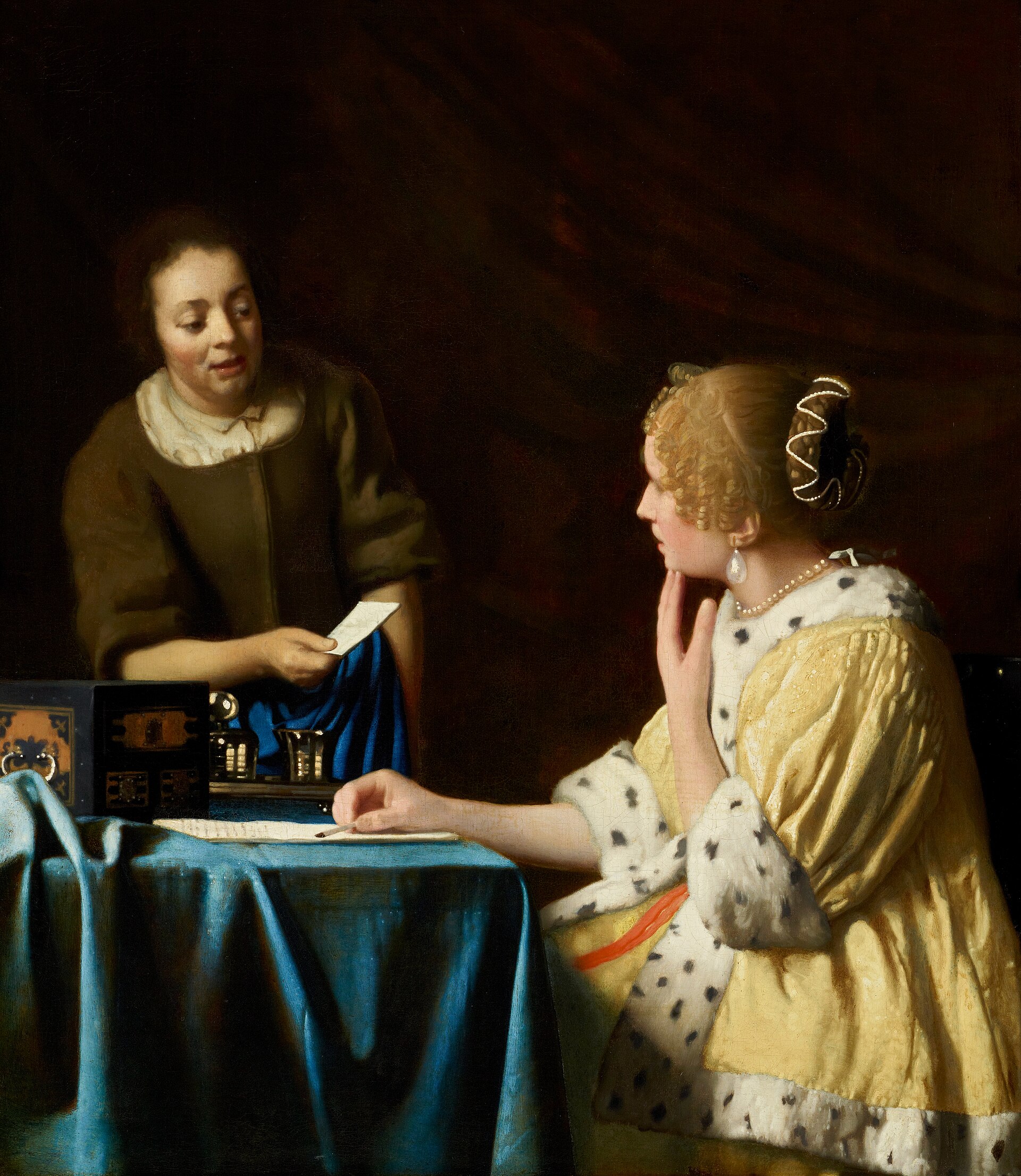
| Mistress and Maid Johannes Vermeer | The comparison the 2018 background paper uses c. 1667. Infrared examination at the Metropolitan Museum found Vermeer first painted a tapestry behind the figures and changed it to a curtain, originally translucent dark green and now a faint brown through pigment degradation. The same material and the same loss of form as the background of the Girl. | The Frick Collection, New York |
| Girl Reading a Letter at an Open Window Johannes Vermeer | Green curtain in the same oeuvre c. 1659. One of the pictures cited as evidence that a green curtain is a normal Vermeer compositional device. Restoration completed in 2021 uncovered a large painted Cupid on the rear wall that had been overpainted after his death. | Gemaeldegalerie Alte Meister, Dresden |
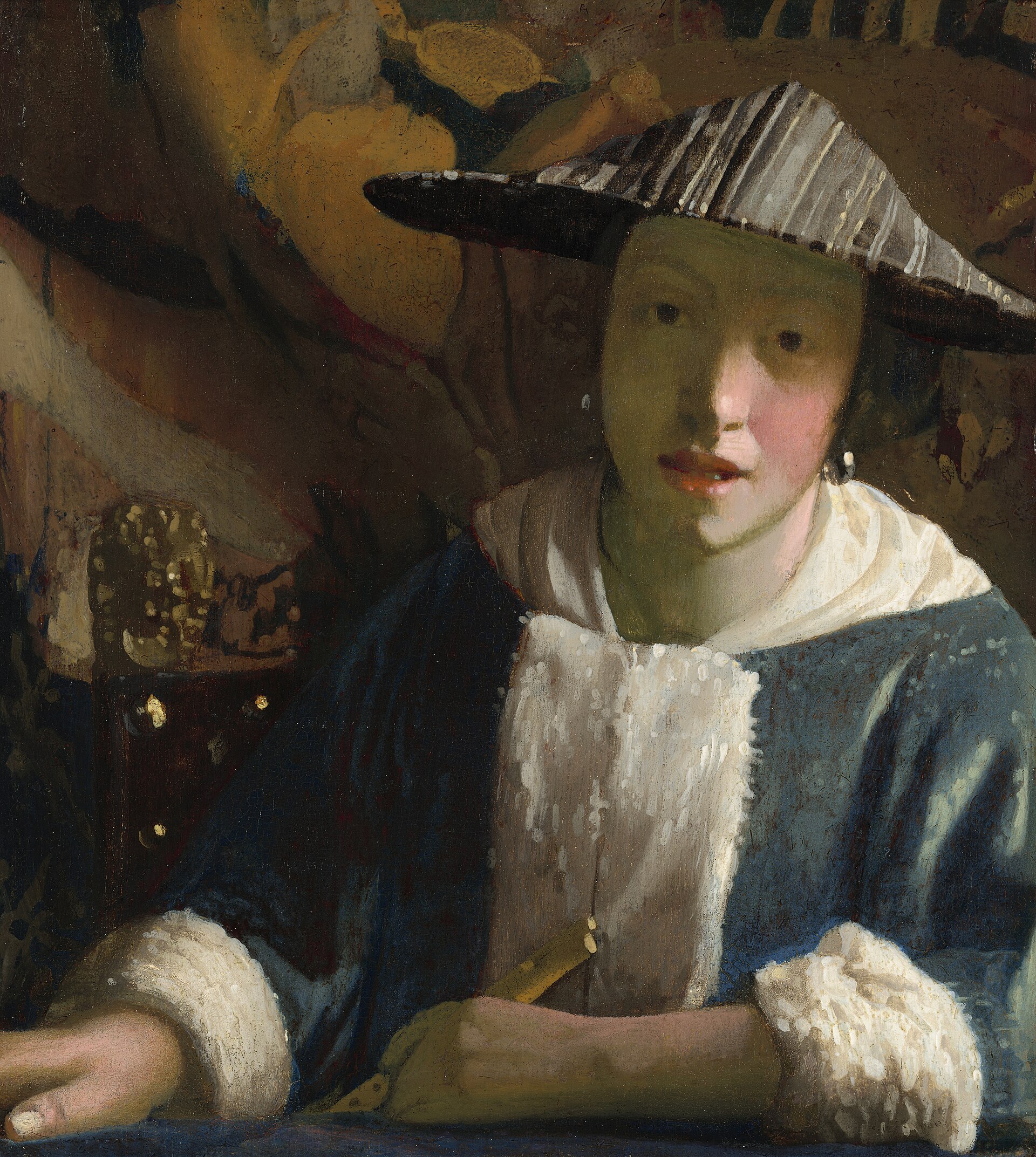
| Girl with a Flute Studio of Johannes Vermeer (National Gallery of Art) / Johannes Vermeer (Rijksmuseum) | The open attribution dispute in the corpus Downgraded by the National Gallery in 2022 on technical evidence; shown as an autograph Vermeer at the Rijksmuseum in 2023. Directly relevant to any statement about how many Vermeers exist. | National Gallery of Art, Washington |
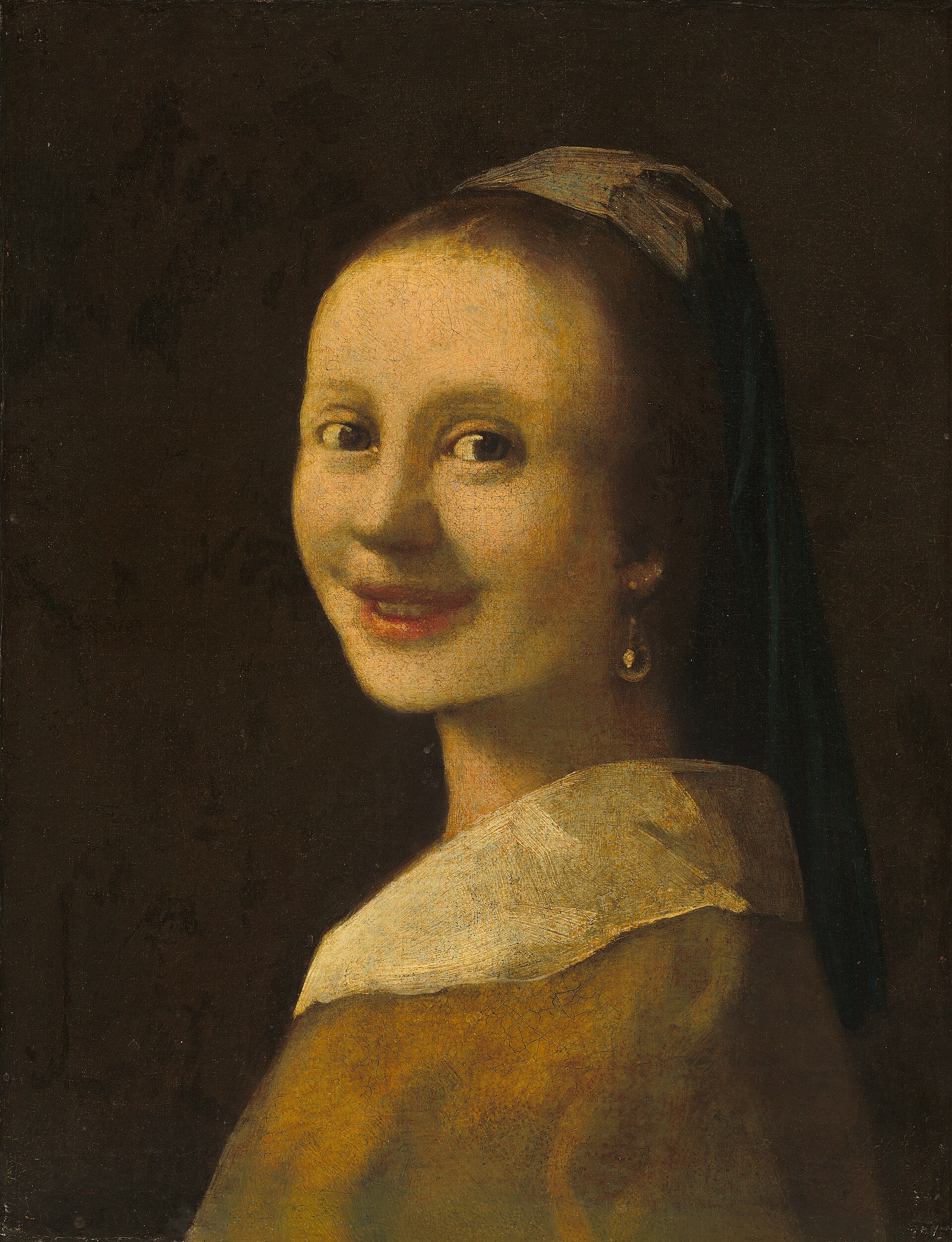
| The Smiling Girl Imitator of Johannes Vermeer, probably Theo van Wijngaarden and/or Han van Meegeren | Not by Vermeer; the confusion risk for this record c. 1925. Given to the National Gallery by Andrew Mellon in 1937 as a Vermeer, exhibited as one at the Royal Academy in 1929 and at Rotterdam in 1935. A close-cropped girl in a yellow jacket with a white collar and a drop earring against a dark ground. It reproduces widely and is on Wikimedia Commons; it is not this painting and it is not a Vermeer. | National Gallery of Art, Washington |
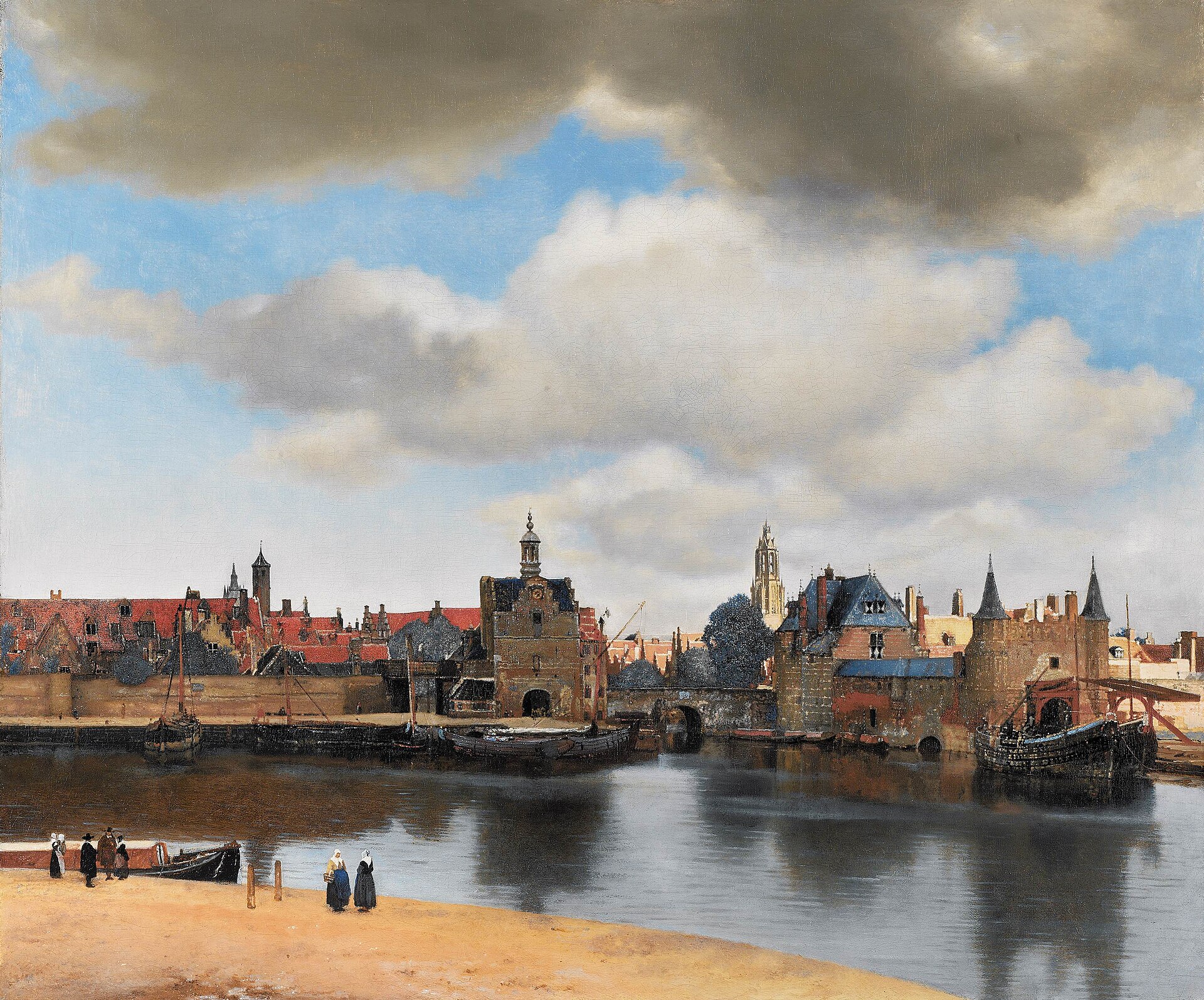
| View of Delft Johannes Vermeer | The museum's other Vermeer; restored alongside this one in 1994 c. 1660-1661. Treated in the same public campaign in 1994 and shown with it in the 1995-1996 Vermeer exhibitions in Washington and The Hague. | Mauritshuis, The Hague |
| The Milkmaid Johannes Vermeer | Price comparison in the 1696 sale c. 1660. Sold in the Dissius sale for a multiple of what the tronie lots fetched, which is the clearest surviving measure of where a head study sat in the seventeenth-century hierarchy of subjects. | Rijksmuseum, Amsterdam |
| Girl with the Red Hat Johannes Vermeer | Another small head study of the same years c. 1665-1669, oil on panel. Frequently grouped with the tronies, and one of the pictures rejected by Blankert in 1976 and now generally accepted. | National Gallery of Art, Washington |
Open questions
- Where was the painting between the 1660s and 1881? No owner is documented for roughly two centuries.
- Is it one of the tronies in the Dissius sale of 16 May 1696, and if so, is it lot 38, 39 or 40? The Mauritshuis records all three without choosing, and the catalogue descriptions carry no dimensions, sitter or distinguishing detail.
- Was it ever owned by Pieter van Ruijven? Every link in the museum's own pre-1696 chain carries a question mark, and the reconstruction rests on a probability about Vermeer's output rather than a document about this canvas.
- On what day and month in 1881 did the Braams sale take place, and who consigned the painting to it? Neither is recorded.
- Is the background a curtain? The published conclusion is folded fabric, possibly a curtain; the popular account states a green curtain as established fact. The distinction has never been closed.
- Was the chalk in the shadow of the blue headscarf added deliberately to adjust the paint's handling, or is it the substrate of a yellow lake that has since faded? The ultramarine paper poses this and leaves it open.
- Was there a specific sitter, and can she be named? Andrew Graham-Dixon proposed Magdalena van Ruijven in a book published in 2025, on interpretative rather than documentary grounds. No identification has ever been established, and the tronie category means one may never have existed.
- Is the date c. 1665 correct? The dating rests on the modelling of the skin, which is an art-historical judgement rather than a physical measurement. Graham-Dixon's 2025 argument requires roughly 1667 to 1668 instead.
Questions about this object
What is Girl with a Pearl Earring?
Girl with a Pearl Earring is a painting, dated c. 1665. Medium: Oil on canvas.
Who made Girl with a Pearl Earring, and is the attribution settled?
The attribution to Johannes Vermeer is recorded here as accepted. Accepted as autograph Vermeer. Signed upper left.
Where is Girl with a Pearl Earring now?
Mauritshuis, The Hague, inv. 670. Last confirmed 2 August 2026. Bequest of A. A. des Tombe, 1903.
What has Girl with a Pearl Earring sold for?
Hammer 36 guilders (lot 38); 17 guilders (lot 39); 17 guilders (lot 40); with premium, Not recorded. Dissius sale, Oude Heeren Logement, Amsterdam, 1696-05-16.
What is still unknown about Girl with a Pearl Earring?
Where was the painting between the 1660s and 1881? No owner is documented for roughly two centuries.
Sources
- 1Mauritshuis, The Hague, collection entry for Johannes Vermeer, Girl with a Pearl Earring, inv. 670: catalogue text, technical details, inscriptions and the full provenance statement with its question marks. Catalogue text is a reworked version of P. van der Ploeg and Q. Buvelot, Royal Picture Gallery Mauritshuis: A Princely Collection, The Hague 2005, pp. 256-258. mauritshuis.nl/en/...
- 2Abbie Vandivere, 'The technical (re-)examination of Vermeer's Girl with a Pearl Earring', Heritage Science 8, art. 26 (2020). Editorial introducing the Girl in the Spotlight collection; gives the project team, the method list and the 1881 price of two guilders plus a thirty cent commission. nature.com/articles/...
- 3Abbie Vandivere, Jorgen Wadum and Emilien Leonhardt, 'The Girl in the Spotlight: Vermeer at work, his materials and techniques in Girl with a Pearl Earring', Heritage Science 8, art. 20 (2020). The concluding review paper of the project. nature.com/articles/...
- 4Abbie Vandivere, Jorgen Wadum, Klaas Jan van den Berg and Annelies van Loon, 'From Vermeer Illuminated to The Girl in the Spotlight: approaches and methodologies for the scientific (re-)examination of Vermeer's Girl with a Pearl Earring', Heritage Science 7, art. 66 (2019). Conservation and treatment history, 1881 to 1994. nature.com/articles/...
- 5Abbie Vandivere and others, 'Revealing the painterly technique beneath the surface of Vermeer's Girl with a Pearl Earring using macro- and microscale imaging', Heritage Science 7, art. 64 (2019). Canvas weave, thread counts, cusping, ground and pentimenti. nature.com/articles/...
- 6Abbie Vandivere and others, 'Fading into the background: the dark space surrounding Vermeer's Girl with a Pearl Earring', Heritage Science 7, art. 69 (2019). Background stratigraphy, the copper drier, the signature, and the diagonal lines interpreted as folded fabric. nature.com/articles/...
- 7Annelies van Loon and others, 'Beauty is skin deep: the skin tones of Vermeer's Girl with a Pearl Earring', Heritage Science 7, art. 102 (2019). Flesh paint stratigraphy, the eyelashes, lead white grades and the Derbyshire lead isotope result. nature.com/articles/...
- 8Annelies van Loon and others, 'Out of the blue: Vermeer's use of ultramarine in Girl with a Pearl Earring', Heritage Science 8, art. 19 (2020). Lazurite quality, the sulphur K-edge XANES evidence for heat-treated lapis lazuli, and the chalk question in the headscarf shadow. nature.com/articles/...
- 9Mauritshuis press release, 31 January 2018, 'New research into Vermeer's Girl with a Pearl Earring'. Announces the Girl in the Spotlight project, its dates and its partners. mauritshuis.nl/en/...
- 10Mauritshuis press release, 8 January 2026, 'Girl with a Pearl Earring travels to Japan while Mauritshuis is closed'. Osaka loan, the closure dates of 24 August to 20 September 2026, the Asahi Shimbun partnership and the 2012-2014 tour. mauritshuis.nl/en/...
- 11Essential Vermeer, catalogue entry for Girl with a Pearl Earring: provenance list, Dissius lot numbers, the tronie discussion and the fake-pearl material. A compiled secondary resource; flagged for replacement with Blankert, Wheelock and the Mauritshuis catalogue raisonne. Note that its 46-guilder figure for lot 38 conflicts with the Mauritshuis. essentialvermeer.com/catalogue/...
- 12Jon Boone, 'The Missing Vermeers: A Brief Account of Vermeer's Oeuvre', Essential Vermeer. Corpus counts, the Dissius sale as the source for twenty-one paintings, and the lost works. Compiled secondary resource; flagged for replacement with Montias, Vermeer and His Milieu. essentialvermeer.com/how_many_vermeers.html
- 13Essential Vermeer, 'Vermeer: Erroneous Attributions and Forgeries'. The history of the corpus count from de Vries 1939 through Gowing, Goldscheider, Blankert, Wheelock and Liedtke, and the National Gallery of Art forgeries. Compiled secondary resource; flagged for replacement with the primary catalogues cited within it. essentialvermeer.com/fakes_thefts_school_of_delft_lost_sp...
- 14Essential Vermeer, 'Thore-Burger and the Rediscovery of Johannes Vermeer'. The 1866 Gazette des Beaux-Arts articles with page ranges, Thore's own account of first seeing the paintings, and his collecting. Compiled secondary resource; flagged for replacement with Frances Suzman Jowell's studies and the Gazette articles themselves. essentialvermeer.com/thore.html
- 15Essential Vermeer, 'Vermeer the Man and Painter', quoting Catharina Bolnes's petition to the States of Holland and West Friesland as given in John Michael Montias, Vermeer and His Milieu: A Web of Social History, Princeton 1989, p. 21. Compiled secondary resource; flagged for replacement with Montias directly. essentialvermeer.com/vermeer_the_man.html
- 16Marjorie E. Wieseman and others, 'Vermeer's Studio and the Girl with a Flute: New Findings from the National Gallery of Art', Journal of Historians of Netherlandish Art 14:2 (2022). The technical case for the downgrade and the current Studio of Johannes Vermeer attribution. jhna.org/articles/...
- 17The Art Newspaper, 9 January 2026, 'Vermeer's Girl with a Pearl Earring will head to Japan this summer in rare loan'. Confirms the Osaka venue, the closure dates, the funding purpose, the 2012-2014 tour attendance and a working figure of thirty-seven known Vermeers. theartnewspaper.com/2026/...
- 18Carla Passino, interview with Andrew Graham-Dixon, Country Life, 16 December 2025, on his book Vermeer: A Life Lost and Found. The Magdalena van Ruijven proposal, the redating to c. 1667-1668, and the van Ruijven patronage figures. Recorded here as a published argument, not as an established identification. countrylife.co.uk/luxury/...
- 19Essential Vermeer, 'The Dissius Auction'. The date, venue, lot descriptions, individual prices and the 1,503 guilders and 10 stuivers total for the twenty-one Vermeers. Compiled secondary resource; flagged for replacement with the 1696 sale catalogue and Montias. essentialvermeer.com/clients_patrons/...
Last verified 11 August 2026 · Published 2 August 2026
Change log
11 August 2026 - Re-verification pass: corrected a conflation of three separate 2026 date ranges around the Mauritshuis closure and the Nakanoshima Museum, Osaka loan (the closure, the painting off display, and the Osaka exhibition itself run on three different schedules); confirmed the attribution, the Des Tombe purchase and the Mauritshuis bequest are unchanged; six sources on the essentialvermeer.com domain, now offline, were repointed to verified Wayback Machine snapshots rather than left to rot.
11 August 2026 - Record deepened to the house standard: narrative sections, technical evidence, artist dossier, related works and open questions added; provenance chain and auction results replaced with the researched versions; sources rebuilt.
2 August 2026 - Record deepened to the house standard: narrative sections, technical evidence, artist dossier, related works and open questions added; provenance chain and auction results replaced with the researched versions; sources rebuilt.
2 August 2026 - Images added, all public domain and self-hosted. Lead plate is the work itself.
2 August 2026 - Record created. Early provenance recorded as disputed; 1660s-1881 gap left open rather than bridged. The 1881 price reduced to 'nominal' rather than asserting a figure that varies between accounts.
7 August 2026 - Re-verified. No change to ownership, attribution or location of record: the painting remains Mauritshuis inv. 670. Noted for the record: a temporary loan to the Nakanoshima Museum of Art, Osaka, 21 August-27 September 2026, made possible only because the Mauritshuis itself closes for building works from 24 August to 20 September 2026 (sources 20, 21). current_location is left as the Mauritshuis, its permanent home, since this is a dated loan and not a change of custody.