The Man with the Golden Helmet
Circle of Rembrandt van Rijn · About 1650 to 1655
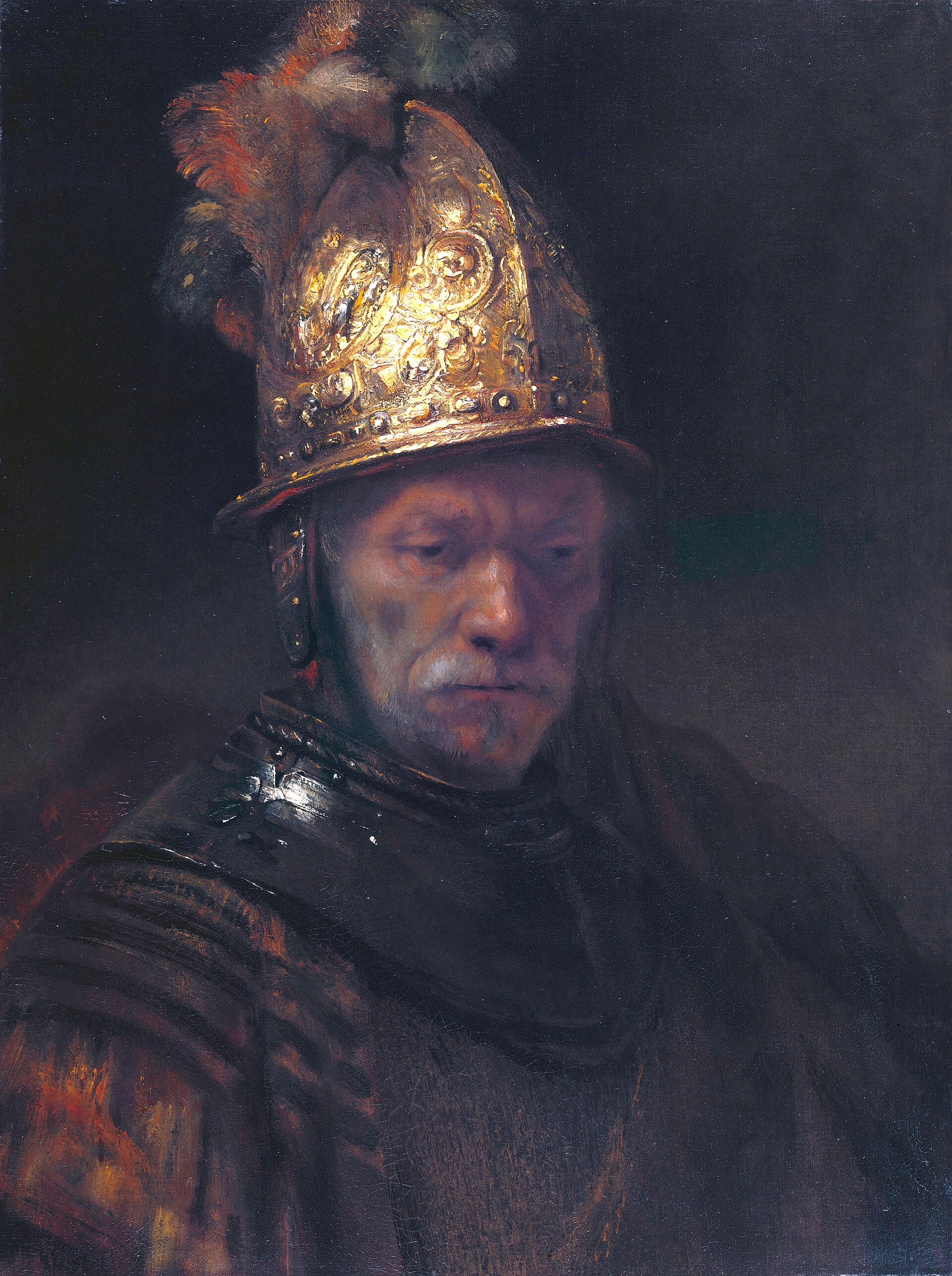
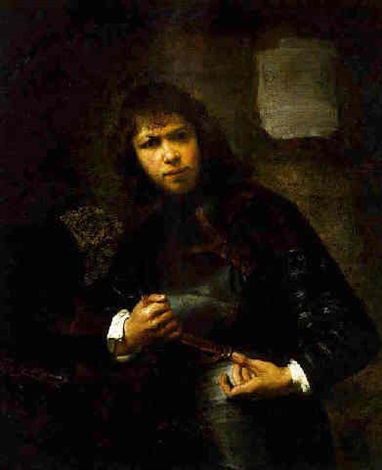
The record subject. Oil on canvas, 67.5 x 50.7 cm, Gemaeldegalerie, Staatliche Museen zu Berlin, inv. 811A, catalogued as circle of Rembrandt. Reproduced from the Google Art Project capture made at the Gemaeldegalerie.
| Artist | Circle of Rembrandt van Rijn |
|---|---|
| Date | About 1650 to 1655 |
| Medium | Oil on canvas |
| Dimensions | 67.5 x 50.7 cm; framed 93.5 x 77.1 x 8 cm |
| Where it is now | Gemaeldegalerie, Staatliche Museen zu Berlin, on deposit from the Kaiser-Friedrich-Museums-Vereinlast confirmed 4 August 2026 |
| Inventory number | 811A |
| Attribution | RejectedAcquired in 1897 as an autograph Rembrandt and doubted from the start by Cornelis Hofstede de Groot and Abraham Bredius. Full note |
| Object type | Painting |
| Period | Dutch, seventeenth century |
| Inscriptions | None recorded. The picture carries no signature, which is one reason the attribution rested entirely on connoisseurship. |
| Owners on record | 5 links4 documented, 1 disputed |
| Sources | 5 cited |
About this record Last verified 5 September 2026 · 5 sources cited · Change log
On this page 10 sections
ContentsClose
An old man's head and shoulders, turned to the right, in an iron gorget under an ornamental helmet loaded with gold paint so thick that it stands off the canvas while the face beside it sinks into shadow. For most of the twentieth century it was among the most reproduced pictures in Germany, hanging as a print, and in embroidery, in a very large number of ordinary homes. It was bought for Berlin in 1897 as a Rembrandt.
In 1986 the Gemaeldegalerie concluded that it is not. That conclusion is the subject of this record, and the precise wording matters: the museum withdrew an attribution. It did not find a fake, and the curator who announced the finding said so at the time in as many words. The picture was made in Rembrandt's lifetime by somebody who worked in his studio or was in close contact with him, and it is still one of the finest things in the gallery.
The examination that unmade it also found something that changes how the object is read. The canvas had been cut down on all sides, and large areas, chiefly in the face, had been filled in or painted over by restorers, under an ochre varnish that gave the picture the warm gallery tone by which generations had recognised it as Rembrandtesque. A judgement of authorship had been made about a surface that was substantially not the painter's.
Provenance
Each link is graded. Documented: a cited source supports it. Disputed: the identification is argued but not established. Unknown: no owner for that span, and the gap is not smoothed into a narrative. The grades in the glossary.
- about 1650-1655 -Painted in the circle of Rembrandt van Rijndocumented
Made by a painter who worked in Rembrandt's studio or was in close contact with him, on the Berlin museum's own statement. Unsigned. No commission, patron or first owner is recorded, which is normal for a tronie made for the open market.1
- before 1761 - unknownClemens August of Bavaria, archbishop-elector of Colognedisputed
The picture is said to have come from the personal estate of Clemens August, who died in 1761. The claim is reported as probable and is not documented in the sources consulted here. It is recorded because it is in circulation, not because it is established.3
- unknown - early 1890sThe De Boccard family, Fribourg, Switzerlanddocumented
Recorded in Hofstede de Groot's catalogue of 1915 as coming from the De Boccard collection at Fribourg. The picture left the collection in the early 1890s.23
- early 1890s - 1897P. and D. Colnaghi and Company, Londondocumented
The London dealers who handled the picture between the Swiss collection and Berlin, on Hofstede de Groot's account. No price is published in the sources consulted.2
- 1897 - presentKaiser-Friedrich-Museums-Verein, Berlin, in the Gemaeldegaleriedocumented
Bought in 1897 by the museum association for the Berlin picture gallery and acquired as an autograph Rembrandt through Wilhelm von Bode. Catalogued as 811A in the Kaiser Friedrich Museum catalogue of 1911 and still under that number. Attribution to Rembrandt withdrawn by the Gemaeldegalerie in 1986 after technical and art-historical examination, and the picture recatalogued as circle of Rembrandt. Restored towards its reconstructed original colouring in 2011. Ownership rests with the Verein rather than the state.1234
Prices realised
No auction record for this picture appears in the sources consulted. It moved from a Swiss private collection through a London dealer to a Berlin museum association in 1897, all by private treaty, and no figure for any of those transactions has been published. There is therefore no hammer and no premium to separate. Any price quoted for a painting under this title should be checked against the picture at Bratislava, O 2246, which carries the same name.
Technical evidence
| Attribution note | Acquired in 1897 as an autograph Rembrandt and doubted from the start by Cornelis Hofstede de Groot and Abraham Bredius. Wilhelm von Bode's endorsement carried the field for most of a century. Werner Sumowski reopened the question in 1957; the Rembrandt Research Project was founded in 1968; a Dutch commission examined the picture in West Berlin in 1984; Jan Kelch announced the result in November 1985, and in 1986 the Gemaeldegalerie concluded, after technical examination, that the painting is not by Rembrandt but by a painter of his circle. The museum has withdrawn an attribution. It has not declared a forgery and has never suggested one: Kelch's own words were that it is not a fake and remains a great and masterly work. No new name has been adopted. Carel van den Pluym, Heyman Dullaert and Johann Ulrich Mayr have all been proposed; the label reads anonymous. |
|---|---|
| Support and medium | Oil on canvas. No signature and no inscription recorded.14 |
| Dimensions | 67.5 x 50.7 cm. Frame 93.5 x 77.1 x 8 cm.14 |
| The canvas has been cut down | The picture was trimmed on all sides at some point before the modern examination, so the visible composition is not the composition originally painted. The extent of the loss is not quantified in the sources consulted.3 |
| Overpaint | Large areas were filled in or painted over by restorers, predominantly in the face. This is the single most consequential finding for the attribution history, because the face is where connoisseurship looks first.3 |
| The gallery tone was a varnish | An earlier restoration applied an ochre-tinted varnish which produced the warm brown tonality long read as characteristically Rembrandtesque. The picture was restored again and returned towards its reconstructed original colouring in 2011.3 |
| Impasto | The gold of the helmet is laid on in heavy impasto and dominates the picture by physical relief as well as by colour, while the partly lit face is thinly painted and recedes.1 |
| The helmet, first identification | The Berlin museum's own object record describes an ornamental Spanish or Italian war helmet of the late sixteenth century, and calls it an object of great rarity.1 |
| The helmet, competing identification | Other accounts identify the helmet as the work of Augsburg armourers, which is used to support the proposal of the Augsburg painter Johann Ulrich Mayr as the author. The two identifications are incompatible and this record does not choose between them.3 |
| Genre | A tronie, a head study of an anonymous or invented character in exotic or antique dress, made for the open market rather than to a commission. No contract, client or documentation exists, which is why the attribution could only ever be argued by eye.1 |
| The 1986 examination | Published as a documentation of the Gemaeldegalerie edited by Jan Kelch, produced in collaboration with the Rathgen research laboratory of the Staatliche Museen Preussischer Kulturbesitz and the Hahn-Meitner-Institut in Berlin. The individual analytical techniques are not enumerated in the sources consulted here.3 |
| Current museum attribution | Circle of Rembrandt, about 1650 to 1660, inventory 811A, Gemaeldegalerie, Staatliche Museen zu Berlin. The painter must have worked in Rembrandt's studio or at least have been in close contact with him. No individual name is adopted.14 |
Images
The record in full
Chapter 1What the picture is, before anyone argues about who made it
Oil on canvas, 67.5 by 50.7 centimetres.
Oil on canvas, 67.5 by 50.7 centimetres. A life-size head of an elderly man, turned diagonally to the right, wearing an iron gorget and an elaborate helmet. The background is dark and gives nothing away. There is no signature and there never was one.
It is not a portrait. It is a tronie, the Dutch studio genre of a head study made for its own sake, usually of an anonymous or invented character in exotic or antique dress, painted for the market rather than for a sitter. That distinction does real work here, because a tronie has no commission, no client and no documentation, and a picture with no documentation can only be attributed by eye.
The helmet does almost all of the work. Its gold is applied in heavy impasto that catches light physically as well as pictorially, so that in a gallery the metal is the first and often the only thing a visitor registers; the face, lit obliquely and painted thinly, retreats. That imbalance is the picture's whole rhetorical strategy and it is also, as the twentieth century eventually noticed, unlike Rembrandt.
Chapter 2A helmet nobody can place
The Berlin museum's own object record describes the helmet as an ornamental Spanish or Italian war helmet of the late sixteenth century, and calls it an item of great rarity.
The Berlin museum's own object record describes the helmet as an ornamental Spanish or Italian war helmet of the late sixteenth century, and calls it an item of great rarity. Other accounts identify it as Augsburg work, which matters because Johann Ulrich Mayr, one of the painters proposed as the author, was an Augsburg painter who worked in Rembrandt's studio around 1648 to 1649.
Those two identifications are not compatible, and this record does not choose between them. An armour identification is a dating and localising instrument of exactly the kind that settles arguments about paintings, and here it points in two directions at once, each conveniently supporting a different reading. It should be treated as unresolved and worth resolving.
Chapter 3Who is he, and why the old answer is impossible
Nineteenth-century tradition identified the sitter as Adriaen van Rijn, Rembrandt's brother.
Nineteenth-century tradition identified the sitter as Adriaen van Rijn, Rembrandt's brother. Cornelis Hofstede de Groot, cataloguing the picture in 1915 as number 261, took the identification apart on plain biographical grounds. Adriaen was a shoemaker and lived in Leiden while Rembrandt was in Amsterdam. He died in 1652. Models with the same features appear in works dated 1654.
Neither objection is decisive on its own and together they are close to it. What is worth noticing is the shape of the reasoning: an unnamed head in a studio genre acquired a name because a famous painter needed a plausible relation to have painted, and the name survived a century after the evidence for it had gone.
Chapter 4How it reached Berlin
The picture is said to have come from the personal estate of Clemens August, the Wittelsbach archbishop-elector of Cologne, who died in 1761.
The picture is said to have come from the personal estate of Clemens August, the Wittelsbach archbishop-elector of Cologne, who died in 1761. That is a claim rather than a documented link, and it is the sort of claim that attaches itself to good pictures.
What is recorded is that it was in the collection of the De Boccard family at Fribourg in Switzerland and emerged from there in the early 1890s through British dealers. Hofstede de Groot's 1915 catalogue names the London firm of P. and D. Colnaghi and Company as the intermediary. In 1897 the Kaiser-Friedrich-Museums-Verein, the private association that buys pictures for the Berlin galleries, acquired it for the collection; it appears as number 811A in the Kaiser Friedrich Museum's catalogue of 1911, and it carries that number still. The Verein, not the state, owns it.
Ernst A. Busche published new findings on the provenance in the Jahrbuch der Berliner Museen in 2015, which indicates that this chain is still being worked on more than a century after the purchase.
Chapter 5Doubted from the beginning, and endorsed anyway
The two most formidable Rembrandt scholars of the day, Hofstede de Groot and Abraham Bredius, questioned the attribution from the moment the picture arrived.
The two most formidable Rembrandt scholars of the day, Hofstede de Groot and Abraham Bredius, questioned the attribution from the moment the picture arrived. They were overruled, in effect, by Wilhelm von Bode, the general director of the Prussian collections, whose restoration campaign and personal endorsement persuaded the field.
The pattern is worth stating without moralising, because it recurs. A picture is bought by an institution on the authority of its director. Specialists object. The director's authority, plus the institution's need to be right about a major purchase, converts a contested attribution into a settled one, and the objections drop out of the literature. Fifty years later the picture is a fixture, taught and reproduced, and dislodging it costs far more than declining it would have done in 1897.
Bode had done the same thing eleven years later with the wax bust of Flora bought as a Leonardo in 1909, over similar objections. The Berlin museums have carried both cases.
Chapter 6The most reproduced face in Germany
Between the purchase and the war the picture became extraordinarily popular.
Between the purchase and the war the picture became extraordinarily popular. Prints of it were mass-produced and hung in ordinary German homes; it was worked in embroidery and reproduced in other media. It functioned less as a museum object than as a domestic icon, and its title, not its author, is what most people knew.
That popularity is part of the record for two reasons. It is the measure of what was at stake in 1985, when a curator had to tell a country that its favourite Rembrandt was not one. And it explains the aftermath: since the attribution was withdrawn the picture's fame has fallen away, although nothing about the object has changed. The quality that made it worth mass-producing is still on the canvas. What was being consumed was the signature that was never there.
Chapter 71957 to 1985: the doubt comes back
Werner Sumowski raised the question again in 1957, in a set of addenda to the Rembrandt year of 1956.
Werner Sumowski raised the question again in 1957, in a set of addenda to the Rembrandt year of 1956. In 1968 a group of Dutch scholars founded the Rembrandt Research Project, with the explicit aim of separating the autograph works from the very large body of pictures that had accumulated around them; over the following decades it removed a great many paintings from the corpus, and the Berlin picture was an obvious candidate.
In 1984 a Dutch commission convened to examine doubtful Rembrandts looked at the painting in West Berlin and recorded its doubts. In November 1985 Jan Kelch, the Berlin curator responsible, announced that important features of the picture's handling did not match Rembrandt's, and that it had probably been painted about 1650 by someone from his circle. He was quoted at the time saying that it is not a fake, and that it remains a great and masterly work.
In 1986 the Gemaeldegalerie published the finding formally, in a documentation edited by Kelch and produced with the Rathgen research laboratory of the Prussian cultural foundation and the Hahn-Meitner-Institut in Berlin. The attribution to Rembrandt ended there.
Chapter 8What the surface turned out to be
The technical examination produced a finding that goes beyond the question of authorship, and it is the part of this case that ought to be better known.The canvas had been cut down on all sides, so...
The technical examination produced a finding that goes beyond the question of authorship, and it is the part of this case that ought to be better known.
The canvas had been cut down on all sides, so the composition anybody has ever seen is not the composition that was painted. Large areas had been filled in or painted over by restorers, and the overpainting was concentrated in the face. On top of that sat an ochre varnish, applied in an earlier restoration, which produced the warm brown so-called gallery tone that the nineteenth and twentieth centuries read as the authentic Rembrandt atmosphere.
Attribution by eye compares brushwork. If the brushwork under discussion is substantially a restorer's, and the colour balance is a varnish, then the comparison is being made against the wrong object. Everyone who defended or attacked the attribution before the mid-1980s, on both sides, was arguing about a surface that had been rebuilt. The picture was restored again and brought back towards its reconstructed original colouring in 2011.
Chapter 9Three candidates and no verdict
Nobody has been able to put a name on it, and the names that have been proposed are instructive about how narrow the evidence is.Carel van den Pluym, a Leiden painter and a relation of Rembrandt's...
Nobody has been able to put a name on it, and the names that have been proposed are instructive about how narrow the evidence is.
Carel van den Pluym, a Leiden painter and a relation of Rembrandt's, has been suggested. So has Heyman Dullaert, a Rembrandt pupil; the argument here rests on Arnold Houbraken's report that a painting by Dullaert was sold in Amsterdam as an authentic Rembrandt, which establishes that such confusion happened in the seventeenth century rather than that it happened to this picture. Johann Ulrich Mayr, from Augsburg, who was in Rembrandt's workshop around 1648 to 1649, is proposed partly on the strength of the reading of the helmet as Augsburg work.
Each proposal is an argument from possibility. The Berlin record says only that the painter must have worked in Rembrandt's studio or at least have been in close contact with him, and the label says anonymous. On the evidence set out in the sources consulted here, that is the correct answer and the other three are hypotheses.
Chapter 10Withdrawing an attribution is not declaring a forgery
This distinction is the reason the record exists in this form, and it is routinely collapsed in retellings.A forgery is an object made with intent to deceive about its authorship.
This distinction is the reason the record exists in this form, and it is routinely collapsed in retellings.
A forgery is an object made with intent to deceive about its authorship. Nothing about this painting suggests that. It is a seventeenth-century Dutch picture, painted within Rembrandt's orbit, in the period it appears to be from, by a highly accomplished hand. It acquired a false name in the nineteenth century, from dealers and scholars, some two hundred years after it was painted. The deception, if there was one, happened in the market and in the literature, not in the studio.
What the Gemaeldegalerie did in 1986 was remove a name it could no longer support and decline to substitute another. That is the harder and rarer institutional act. It is much easier to move an attribution sideways, to a named pupil, because a named pupil still gives a label something to say. Anonymous is an admission, and museums do not enjoy making it.
Chapter 11What the case leaves behind
Three durable points.The first is that condition governs connoisseurship.
Three durable points.
The first is that condition governs connoisseurship. An attribution argued over a cut-down canvas with an overpainted face and a tinted varnish is an attribution argued over a restorer's work. Any technical examination that dates the interventions before it judges the hand is doing the steps in the right order, and this one did.
The second is that the objections were on the record in 1897. Hofstede de Groot and Bredius said so at the time and were overridden by an institutional authority who had just bought the picture. The scholarly correction took eighty-nine years and the evidence that finally carried it was largely physical rather than stylistic.
The third is about the public. A picture that hung in a hundred thousand German homes lost its fame the moment it lost its name, and nothing about the canvas changed. What the market and the public were valuing was a proper noun. The object was always exactly as good as it is now.
Chapter 12September 2026: an AI says 96 percent, Berlin says no
On 2 September 2026 the German public broadcaster Deutschlandfunk reported a new claim: an AI-based image-analysis tool, built by an American IT couple working in the field of computational art...
On 2 September 2026 the German public broadcaster Deutschlandfunk reported a new claim: an AI-based image-analysis tool, built by an American IT couple working in the field of computational art authentication, had assessed the painting and returned a 96 percent probability that the brushwork is Rembrandt's own hand. Sections of the German press picked it up within a day under headlines asking whether art history now had to be rewritten.
The Gemaeldegalerie's answer, given directly to the Berliner Zeitung by Katja Kleinert, deputy director and curator of seventeenth-century Dutch and Flemish painting, was a flat no. The museum had not been contacted before or during the analysis, had not been asked to supply a high-resolution photograph of the canvas, and had not taken part in it in any way. Kleinert stated that the Gemaeldegalerie's own dedicated research project on its Rembrandt paintings had already re-examined this picture and reconfirmed the 1986 finding: it is not an autograph work. Her stated objection is methodological rather than defensive - attribution, in her account, depends on close physical examination of the original object, its materiality and its technical history in a way a digital photograph analysed by an external model cannot supply.
This was not the first such claim. Kleinert's statement notes that an earlier, separate AI-based reattribution attempt, from a German source, had reached a broadly similar conclusion before this one, and had likewise proceeded without contacting the museum. The Gemaeldegalerie's position across both is that neither analysis engaged with the documented 1986 investigation or its own holdings, and that its own finding stands unchanged.
Nothing here resolves the underlying attribution question differently from the record above: no museum, laboratory or peer-reviewed study has adopted the AI finding, and the Gemaeldegalerie's own label and research position have not moved. What has changed is that the question is, for the first time since 1986, being reargued in public by a party outside the institution and outside the community of paper- and paint-based connoisseurship that produced the original finding - a genuinely new kind of challenge to record, not a new answer.
The artist
An unidentified painter of Rembrandt's circle
There is no artist to write a life of here, and the honest dossier is about the structure that makes the anonymity possible. Rembrandt van Rijn ran a large teaching studio for four decades, and it produced a great many pictures that look like his because they were made by people trained to make pictures that look like his. That was the point of the training and, for a time, of the business.
The consequence for the market is permanent. Any Rembrandt-like picture without a documented chain back to the studio is a candidate for the master, for a named pupil, for an anonymous studio hand, or for a later imitator, and the arguments among those four possibilities are made on paint handling. The Rembrandt Research Project was founded in 1968 to conduct exactly that argument systematically, and this painting is one of its casualties.
Related works
| Work | Relation | Where it is |
|---|---|---|
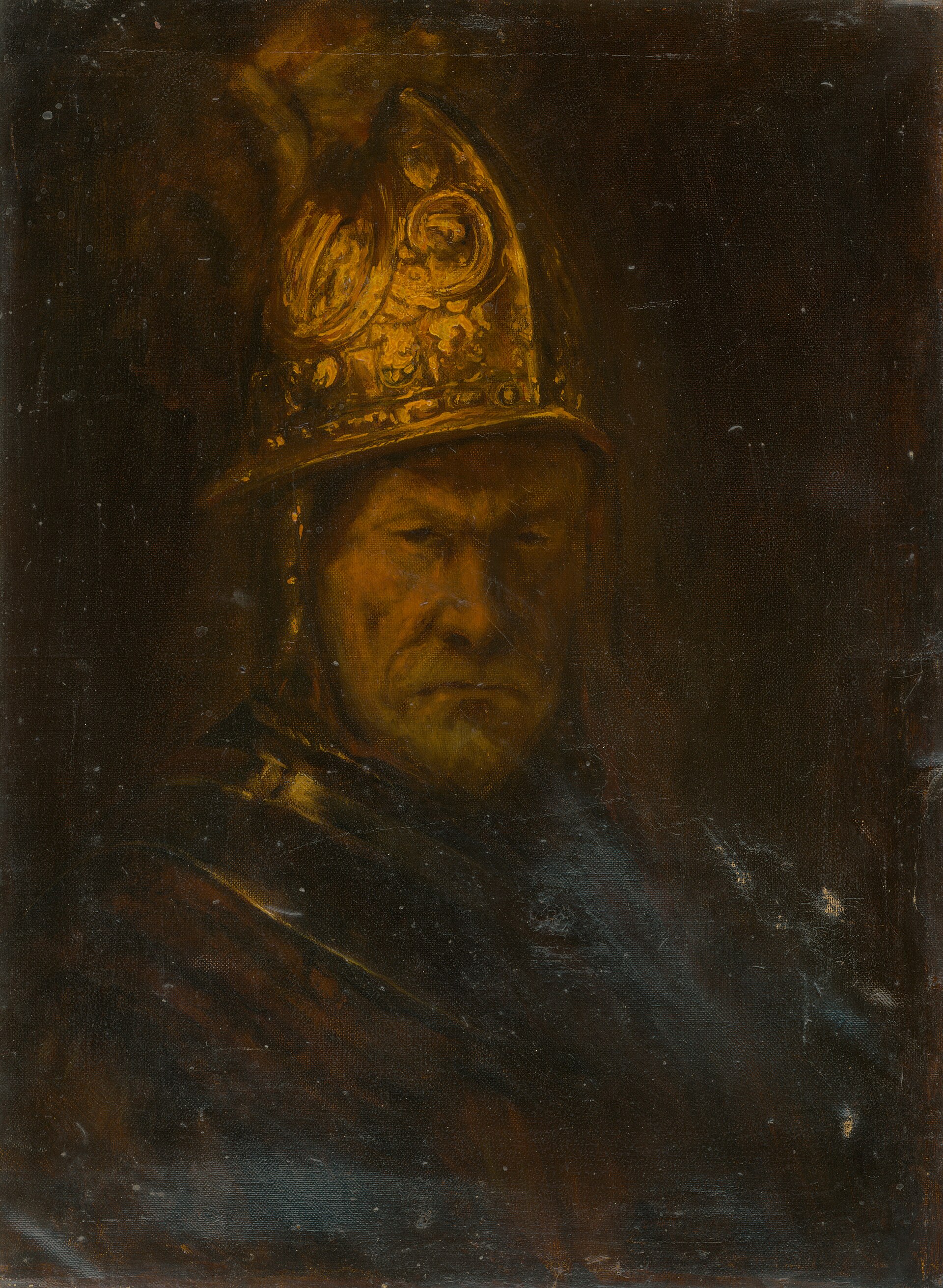
| Man with a Golden Helmet Catalogued at Bratislava as Rembrandt | A different painting of the same composition The existence of at least one other picture of this composition under the same title is the exact hazard this archive exists to flag. Anyone searching the title will find both. | Slovak National Gallery, Bratislava, O 2246 |
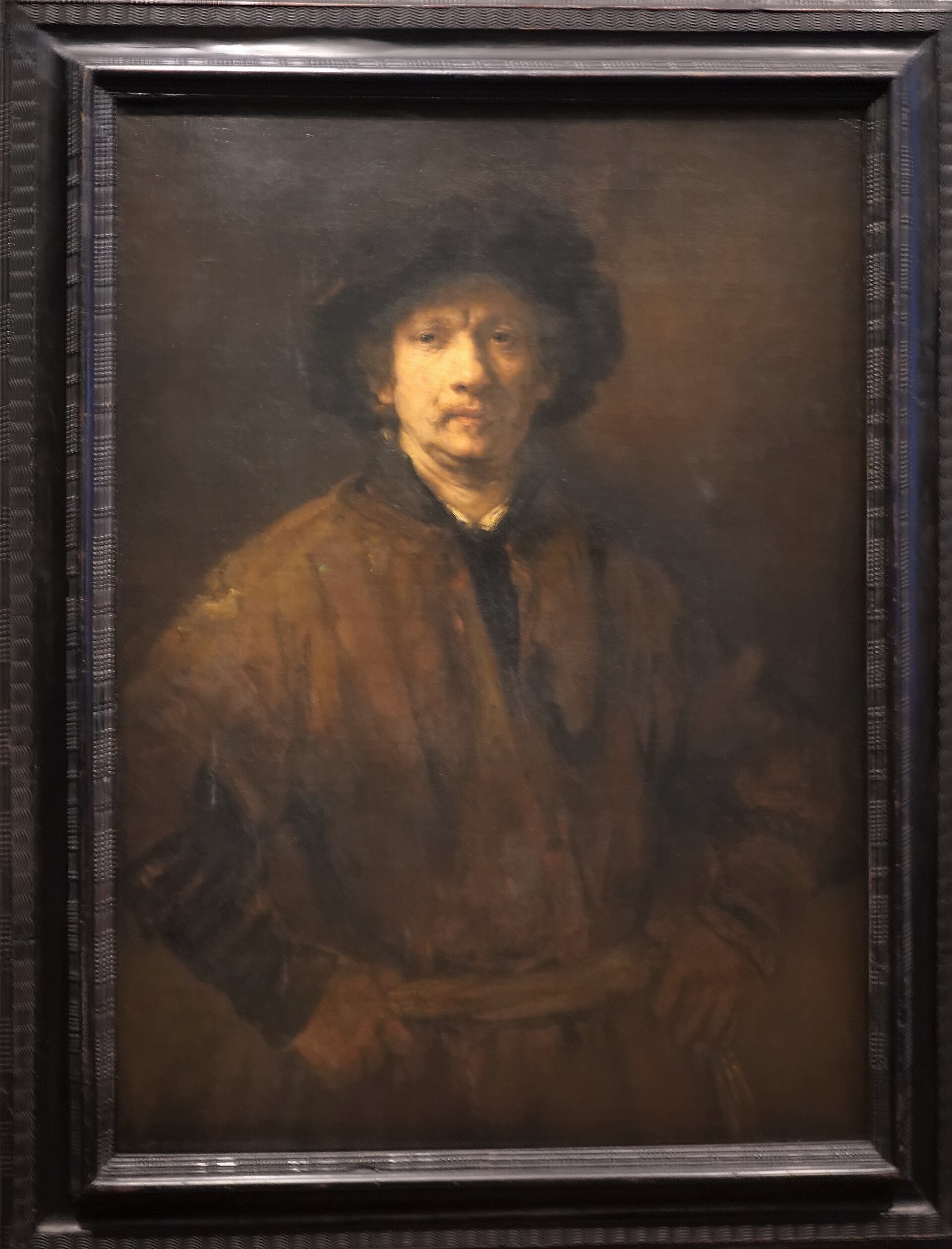
| Large Self-Portrait Rembrandt van Rijn | Autograph benchmark of the same years Dated 1652, contemporary with the Berlin picture and by the hand it was compared against. | Kunsthistorisches Museum, Vienna |
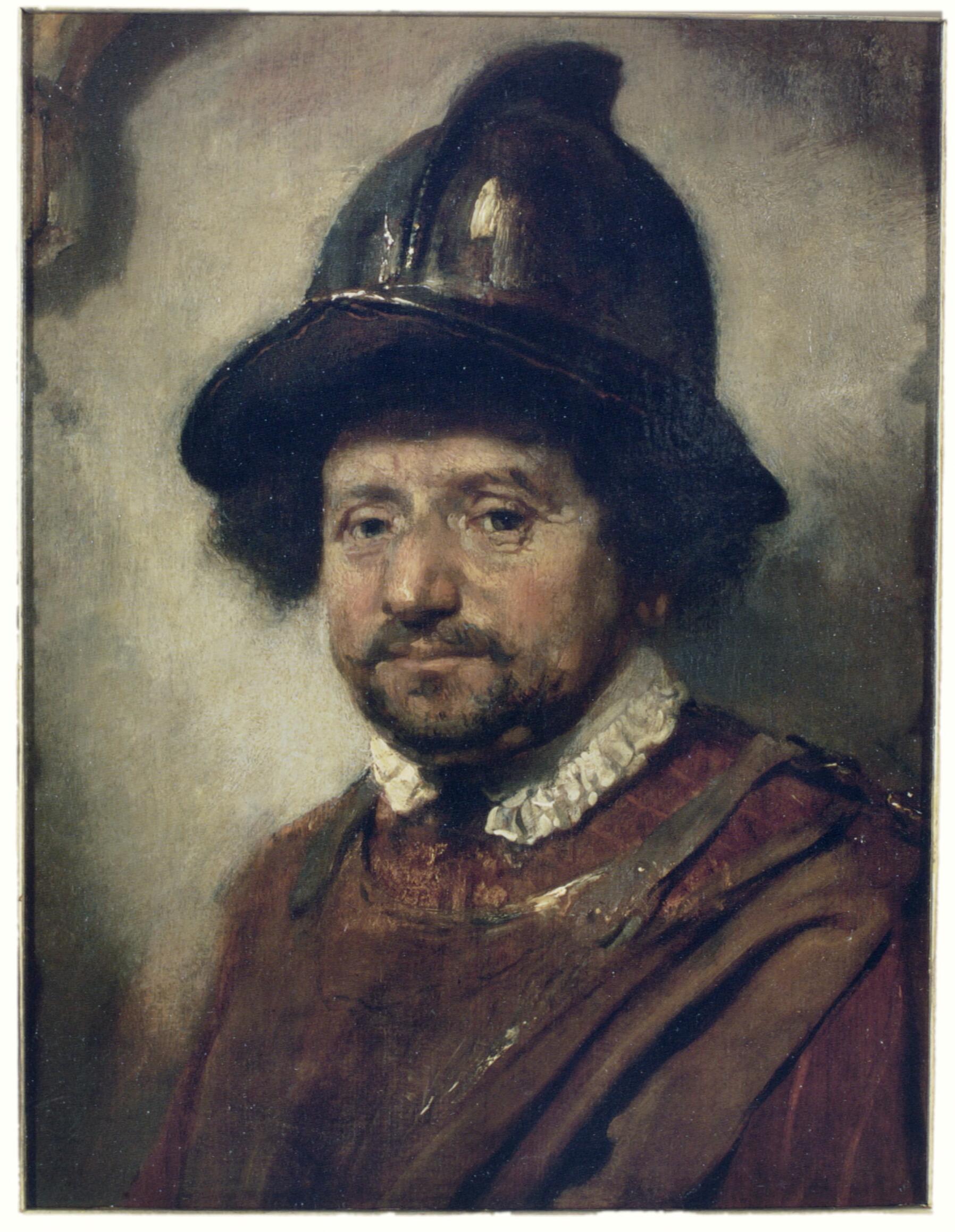
| Man with a Helmet Carel Fabritius | A pupil working the same subject Fabritius was in Rembrandt's studio in the early 1640s. Pupils painting armoured heads is the reason a tronie of this kind cannot be attributed by subject. | Attributed to Fabritius; see the plate in this record |
| A Soldier in Armour Buckling his Belt Willem Drost, after Rembrandt | A Rembrandt pupil on the same ground Drost is one of the pupils whose work the Rembrandt Research Project used to redistribute pictures out of the master's corpus. | See the plate in this record |
| Bust of Flora Attributed to Richard Cockle Lucas | The other great Berlin attribution bought on Wilhelm von Bode's authority and later withdrawn Bought as a Leonardo in 1909 over immediate public objection. Radiocarbon dating published in 2021 placed its materials after 1700. | Bode-Museum, Staatliche Museen zu Berlin, inv. 5951 |
Open questions
- Who painted it? Carel van den Pluym, Heyman Dullaert and Johann Ulrich Mayr have all been proposed and none has been adopted. The museum's label says anonymous.
- Where was the helmet made? The Berlin record says Spanish or Italian, late sixteenth century; other accounts say Augsburg. The identification would materially affect the Mayr proposal.
- How much canvas was cut away, and when? The trimming is established but not quantified in the sources consulted, and neither is the date of the intervention.
- What analytical techniques were used in the 1986 examination? The documentation names the Rathgen research laboratory and the Hahn-Meitner-Institut as collaborators, but the sources consulted do not enumerate the methods.
- Did the painting really come from the estate of Clemens August, archbishop-elector of Cologne? This is reported as probable and is not documented in the sources consulted.
- What did the Kaiser-Friedrich-Museums-Verein pay in 1897, and what did the De Boccard family receive? No figure appears in the sources consulted.
- Is the picture at Bratislava, O 2246, a seventeenth-century version, a later copy after the Berlin painting, or a copy after a lost common original? Its relation to this record's subject is unestablished here.
Questions about this object
What is The Man with the Golden Helmet?
The Man with the Golden Helmet is a painting, dated about 1650 to 1655. Medium: Oil on canvas.
Who made The Man with the Golden Helmet, and is the attribution settled?
The attribution to Circle of Rembrandt van Rijn is recorded here as rejected. Acquired in 1897 as an autograph Rembrandt and doubted from the start by Cornelis Hofstede de Groot and Abraham Bredius. Wilhelm von Bode's endorsement carried the field for most of a century. Werner Sumowski reopened the question in 1957; the Rembrandt Research Project was founded in 1968; a Dutch commission examined the picture in West Berlin in 1984; Jan Kelch announced the result in November 1985, and in 1986 the Gemaeldegalerie concluded, after technical examination, that the painting is not by Rembrandt but by a painter of his circle. The museum has withdrawn an attribution. It has not declared a forgery and has never suggested one: Kelch's own words were that it is not a fake and remains a great and masterly work. No new name has been adopted. Carel van den Pluym, Heyman Dullaert and Johann Ulrich Mayr have all been proposed; the label reads anonymous.
Where is The Man with the Golden Helmet now?
Gemaeldegalerie, Staatliche Museen zu Berlin, on deposit from the Kaiser-Friedrich-Museums-Verein. Inventory number 811A. Last confirmed 4 August 2026. Acquired 1897 by the Kaiser-Friedrich-Museums-Verein for the Berlin picture gallery.
What is still unknown about The Man with the Golden Helmet?
Who painted it? Carel van den Pluym, Heyman Dullaert and Johann Ulrich Mayr have all been proposed and none has been adopted. The museum's label says anonymous.
Sources
- 1Staatliche Museen zu Berlin, museum-digital object record for Der Mann mit dem Goldhelm, Gemaeldegalerie, inventory 811A. The museum's own catalogue data: circle of Rembrandt, 1650-1660, canvas, 67.5 x 50.7 cm, framed 93.5 x 77.1 x 8 cm, described as a tronie, with the helmet identified as a Spanish or Italian ornamental war helmet of the late sixteenth century, the 1897 acquisition by Bode and the 1986 withdrawal of the attribution after investigation by technological and art-historical methods. smb.museum-digital.de/index.php
- 2Wikipedia, 'The Man with the Golden Helmet'. Tertiary source, used for Hofstede de Groot's 1915 catalogue entry number 261 and the De Boccard and Colnaghi provenance, the Adriaen van Rijn identification and its refutation, the 1984 Dutch commission, and Jan Kelch's November 1985 statement as reported in The Ottawa Citizen of 20 November 1985. Flagged for replacement with Hofstede de Groot 1915 and the Kelch documentation of 1986. en.wikipedia.org/wiki/...
- 3Wikipedia (German), 'Der Mann mit dem Goldhelm'. Tertiary source, used for the Kaiser-Friedrich-Museums-Verein ownership, the reported Clemens August provenance, the Hofstede de Groot and Bredius objections of 1897, Sumowski 1957, the cropping and overpainting findings, the ochre varnish and the 2011 restoration, the candidate painters and the Augsburg reading of the helmet. Its bibliography names Jan Kelch (ed.), Der Mann mit dem Goldhelm: eine Dokumentation der Gemaeldegalerie in Zusammenarbeit mit dem Rathgen-Forschungslabor SMPK und dem Hahn-Meitner-Institut Berlin (Berlin, 1986) and Ernst A. Busche, Jahrbuch der Berliner Museen 75 (2015), pp. 99-106, both flagged for direct consultation. de.wikipedia.org/wiki/...
- 4Wikimedia Commons file page for the Google Art Project capture of the painting, carrying the Gemaeldegalerie Berlin institution field, the circle-of-Rembrandt creator field, the dimensions 67.5 x 50.7 cm and the public-domain licence tag. Read as wikitext. commons.wikimedia.org/wiki/...
- 5Berliner Zeitung, Ingeborg Ruthe, 'KI haelt den Goldhelm fuer einen Rembrandt - Berlin widerspricht', published 4 September 2026. Reports a 2 September 2026 Deutschlandfunk radio segment on an AI-based image analysis by an unnamed American IT couple claiming 96 percent probability that the painting is Rembrandt's own hand, and carries a direct on-record response from Katja Kleinert, deputy director and curator of 17th-century Dutch and Flemish painting at the Gemaeldegalerie, stating the museum was not consulted, that no high-resolution photograph of the painting was requested for the analysis, and that the Gemaeldegalerie's own dedicated Rembrandt-paintings research project had already re-examined the picture and reconfirmed the 1986 de-attribution. Also reports that an earlier, separate AI-based reattribution claim 'from the German side' had been made previously, likewise without contacting the museum. berliner-zeitung.de/article/...
_-_The_Man_with_the_Golden_Helmet_-_Google_Art_Project.jpg)
Last verified 5 September 2026 · Published 4 August 2026
Change log
4 August 2026 - Record created at the house standard: researched narrative, technical evidence, maker dossier, graded provenance chain, prices with hammer and premium separated, related works, open questions and sources.
5 September 2026 - Re-verification pass. Attribution, location and provenance unchanged - the Gemaeldegalerie's 1986 de-attribution stands. Added one substantive new development: a September 2026 AI-based reattribution claim (96 percent probability of Rembrandt's own hand, per an American IT couple's analysis reported by Deutschlandfunk 2 September 2026) was put to the museum by the Berliner Zeitung; the museum's deputy director Katja Kleinert stated on the record that it was not consulted, no photograph was requested, and the museum's own Rembrandt research project had already reconfirmed the de-attribution. Recorded as a new, unresolved public dispute, not as a change to the attribution finding itself. One new source added (n5, Berliner Zeitung, 4 September 2026).