The Seizure That Built the Museum
Five objects in this archive were taken by the French state between 1789 and 1810. The confiscation is the reason three of them survive, and it is the one large taking in the archive against which no modern claim is brought.
Records in this piece: The Bayeux Tapestry, Basin known as the Baptistere de Saint Louis, The Apocalypse Tapestry, Armchair (fauteuil) from Louis XVI's Salon des Jeux at Saint Cloud, Fra Mauro's World Map (Mappamondo di Fra Mauro)
On this page 8 sections
ContentsClose
In short
- Five objects in this archive passed through a French revolutionary or Napoleonic confiscation. In three of the five the seizure is the reason the object still exists, because it moved the thing out of an institution that was being dissolved and into one that was being created.
- The same event nearly destroyed two of them. The Apocalypse Tapestry was cut into pieces and used to protect orange trees from frost, and the Bayeux Tapestry is said to have escaped being cut up for a military wagon cover in 1792, although the museum that holds it presents that rescue as local tradition rather than a documented fact.
- State custody did not reliably produce a record. An armchair made for Louis XVI at Saint-Cloud was seized as crown property and then vanishes from the documentation for about 110 years, from spring 1798 until it surfaces in a Paris collection by 1908.
- No restitution framework in current use reaches these takings. They fall outside the 1933 to 1945 window, they are not colonial acquisitions, and title was settled by the confiscating state's own law at the time. Where objects went back, they went back by political decision rather than by claim.
A revolutionary confiscation is the one taking nobody now asks to be undone
Between 1789 and about 1810 the French state took a very large quantity of art out of churches, monasteries, royal palaces and private houses, and in this archive five objects carry that event in their ownership history. It's the largest single category of taking in the corpus after wartime looting, and it's the only one against which no claim is currently pressed by anyone.
The reasons are structural rather than moral. The seizures fall outside the 1933 to 1945 span that the Washington Principles and the national panels built after them address. They aren't colonial acquisitions, so the argument about museum constitutions and inalienability that governs the Benin material doesn't apply. And title was settled at the time by the legislation of the state doing the confiscating, which then built the public museums that the objects entered. The result is that the mechanism which did the most to create the modern French museum is also the one least examined in restitution terms, and the objects themselves show why the accounting isn't simple: the seizure saved some of them and came close to destroying others.
The Bayeux Tapestry was requisitioned in 1794 and paraded in Paris nine years later
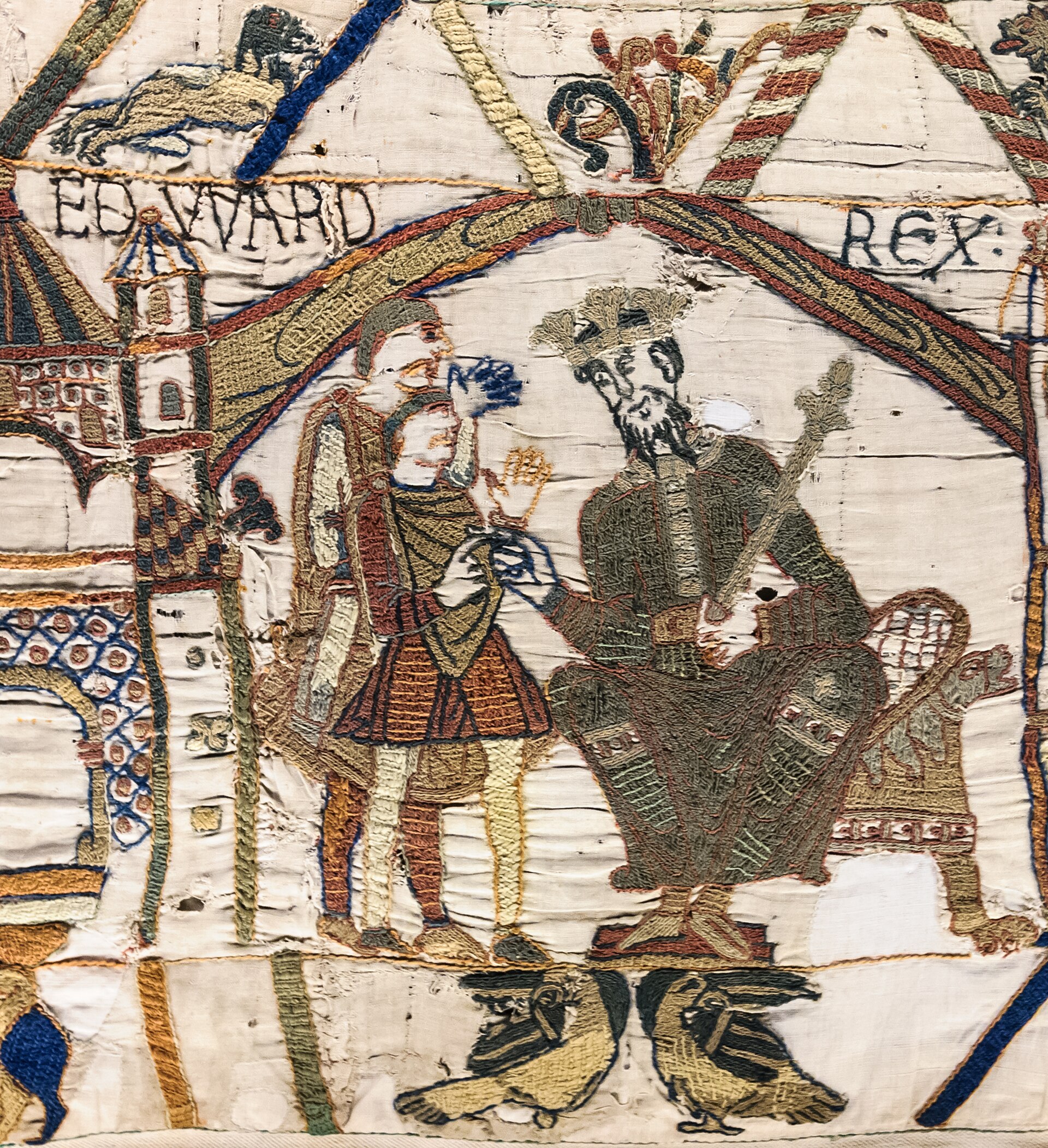
The Bayeux Tapestry became state property in 1794, when the Arts Commission for the Bayeux district confiscated it on behalf of the nation. The museum that holds it today describes that act as the thing which ensured it was protected. Before that it had belonged to the cathedral, where the earliest firm record of its existence dates only from 1476, four centuries after the embroidery was made.
The story most often told about the Revolution and this object is the one the museum is careful with. By persistent local tradition it narrowly avoided being cut up in 1792 to make covers for soldiers' carts, and was saved by a local lawyer, Leonard Lambert-Leforestier. The Bayeux museum repeats the account and marks it as tradition; no source consulted here traces it to a contemporary document. The confiscation two years later is a different kind of fact, because it left paperwork.
What the state then did with its new property was political. On 15 November 1803 the Interior Minister asked for the tapestry to be sent to Paris for the Napoleon Museum, and it was displayed at the Louvre from 6 December 1803 to 18 February 1804, tying a planned invasion of England to a successful one seven and a half centuries earlier. It went back to Bayeux by Napoleon's own order. Vivant Denon's letter on its return records that the First Consul was very interested to see this precious commemoration of French history, and congratulates the townspeople of Bayeux on the care they had taken to preserve it over seven and a half centuries, which is a striking thing to write to people from whom the object had been requisitioned.
A Mamluk basin went into a revolutionary depot and came out at a royal baptism
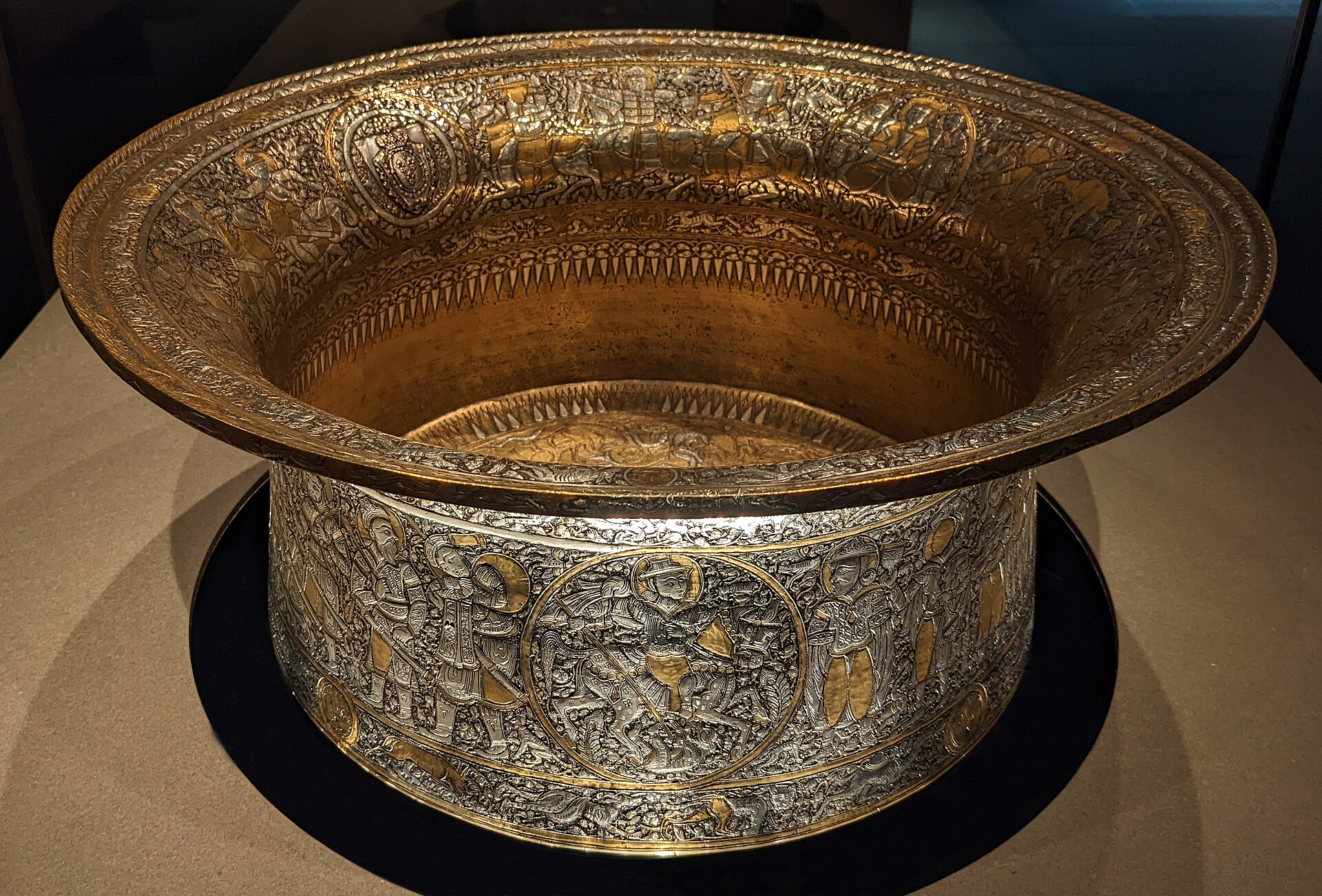
The brass basin known as the Baptistere de Saint Louis is inlaid with gold and silver, signed six times by its maker Muhammad ibn al-Zain, and was made in Mamluk Egypt or Syria in the first half of the fourteenth century. It is first securely recorded in the French royal treasury at the Sainte-Chapelle de Vincennes around 1440, with no explanation of how it got there, and from 1606 it was used to baptise French royal children.
In early 1793 it was sent from the royal treasury to the Petits-Augustins depot, the rescue operation for art and historical objects run by Alexandre Lenoir, and entered the new Museum national des arts shortly afterwards. The sources disagree on the exact date, 17 January against 7 March, which is itself characteristic of a year in which a great deal moved quickly and the paperwork was made under pressure.
The revealing part is what happened when the political weather changed. In 1818, by royal order of the restored Bourbons, the basin left the museum and went back to Vincennes. It was used again for the baptism of Henri d'Artois, Duke of Bordeaux, at Notre-Dame de Paris on 1 May 1821, and two silver plaques bearing French royal arms were added to it for the occasion. A seizure had turned a dynastic object into a museum object; a restoration turned it back into a dynastic one, and left marks on the thing itself.
The Apocalypse Tapestry was cut up, and the cutting is why the pieces survive
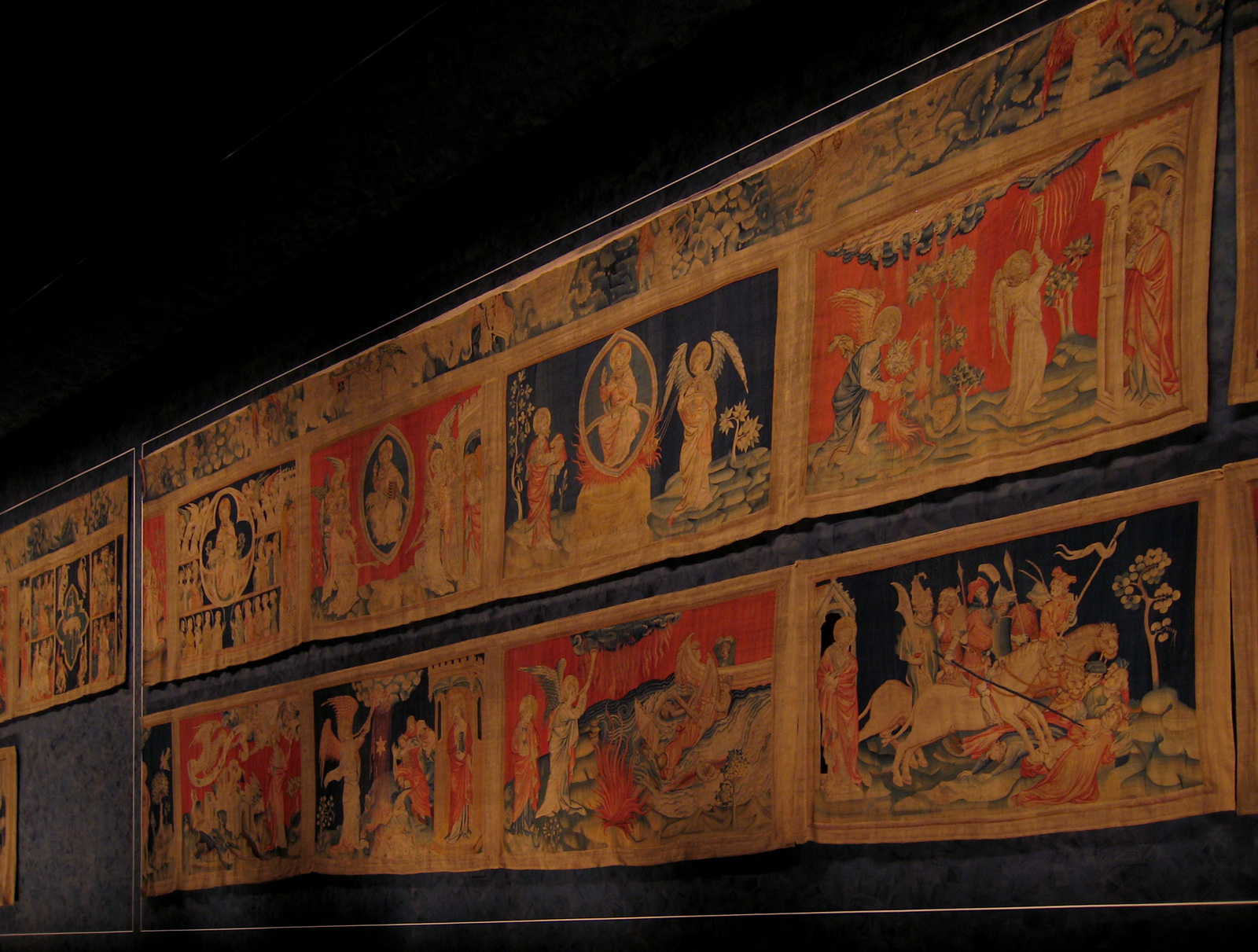
The Apocalypse Tapestry was woven in Paris in about 1377 to 1382 for Louis I, Duke of Anjou, after designs by the court painter Hennequin de Bruges, and ran to roughly 140 metres. It is the oldest and largest surviving monumental tapestry cycle from medieval Europe. It was already neglected before the Revolution, having been taken out of the choir of Angers Cathedral in 1767.
During the revolutionary period it was cut into pieces and put to documented, unglamorous work. The recorded uses include winter protection for the orange trees of the Abbey of Saint-Serge and service as coverings. Restitution to the church was obtained around 1803 under Bishop Montault-Desilles, after which it was stored at the former Angers seminary in the custody of Toussaint Grille and deteriorated in damp conditions rather than being displayed.
This is the case that resists a clean moral. The seizure is the reason large sections were lost, and it's also the reason the surviving sections were still in the country, in secular hands, and eventually recoverable. An object that is being used to keep frost off orange trees is being treated as material rather than as art, and in this archive that demotion is one of the commoner ways a fragile thing gets through a century it would not otherwise have survived.
State custody did not produce a record, and one chair proves it
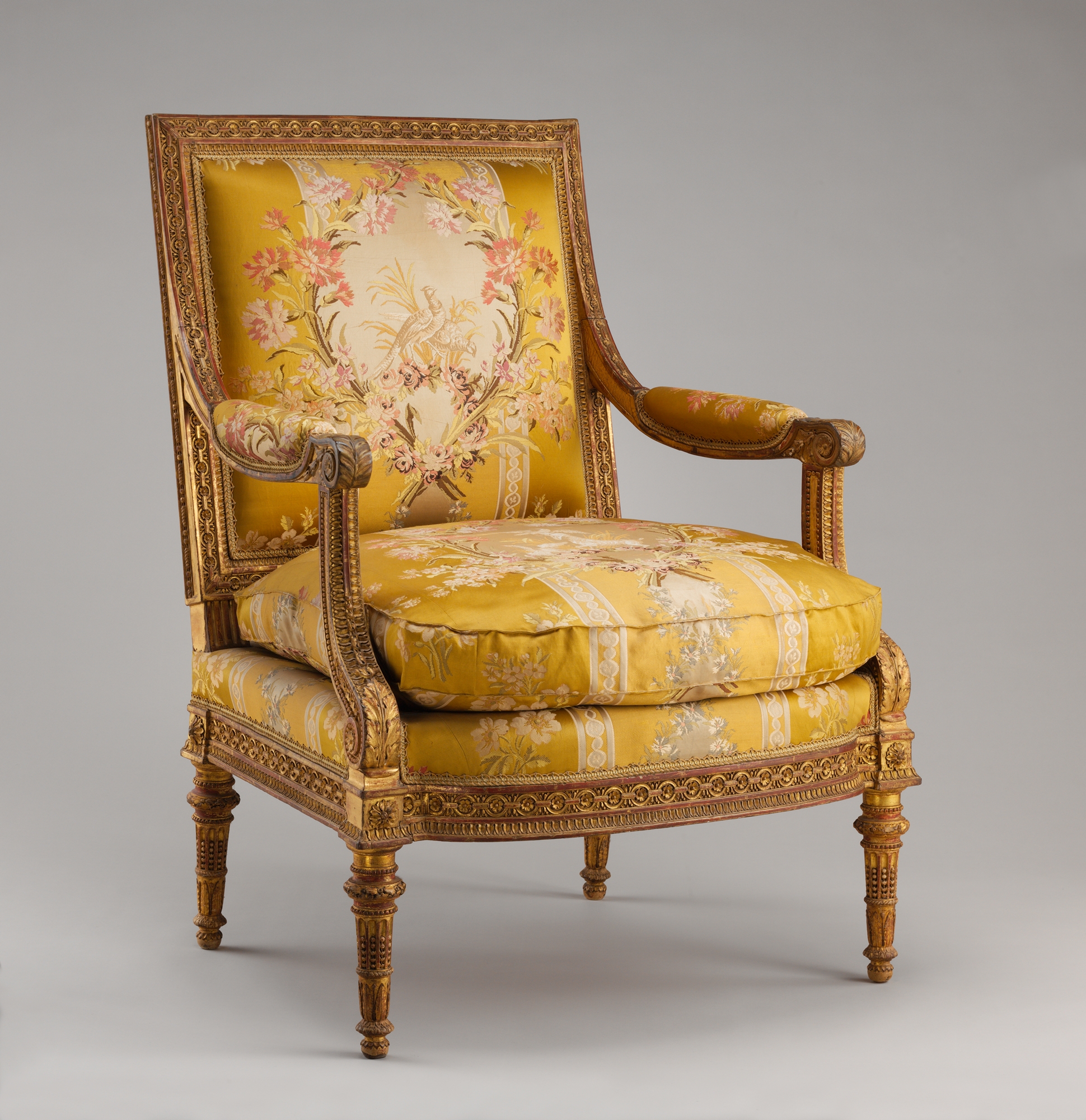
The assumption that a confiscation at least generates documentation does not survive contact with the corpus. An armchair made in 1788 for the King's gaming room at the chateau de Saint-Cloud is one of sixteen supplied by Georges Jacob to the royal Garde-Meuble, and the commission survives in the Metropolitan Museum's own accounts down to the livre: twenty-four for Jacob's joinery, one hundred and eighty for the unnamed carver, two hundred and forty for Louis-Francois Chatard's gilding. That's a better paper trail than most eighteenth-century furniture carries.
Then the monarchy was abolished, the chateau and its contents became state property, and the record stops. No owner, sale, dealer or inventory places this chair anywhere between its last recorded presence at Saint-Cloud in spring 1798 and its appearance in the Paris collection of Georges Hoentschel by 1908 at the latest. That's a gap of about 110 years opening immediately after the state took possession. The chateau itself burned in 1870 and was demolished, which is why the chair and its siblings are now among the more informative physical witnesses to a vanished royal interior, and why the missing century matters.
| Object | Taken | Instrument | Effect on the object | Held now by |
|---|---|---|---|---|
| The Bayeux Tapestry | 1794 | Confiscation by the Arts Commission for the Bayeux district | Protected as state property, then displayed in Paris as propaganda | Bayeux, on loan abroad as of August 2026 |
| Baptistere de Saint Louis | 1793 | Transfer from the royal treasury to the Petits-Augustins depot | Preserved, then returned to royal use in 1818 | Musee du Louvre |
| The Apocalypse Tapestry | 1789 onward | Dispersal during the revolutionary period | Cut into pieces and put to agricultural use | Chateau d Angers |
| Armchair from Saint-Cloud | 1789 onward | Seizure of crown property | Survived, but the ownership record stops for 110 years | The Metropolitan Museum of Art |
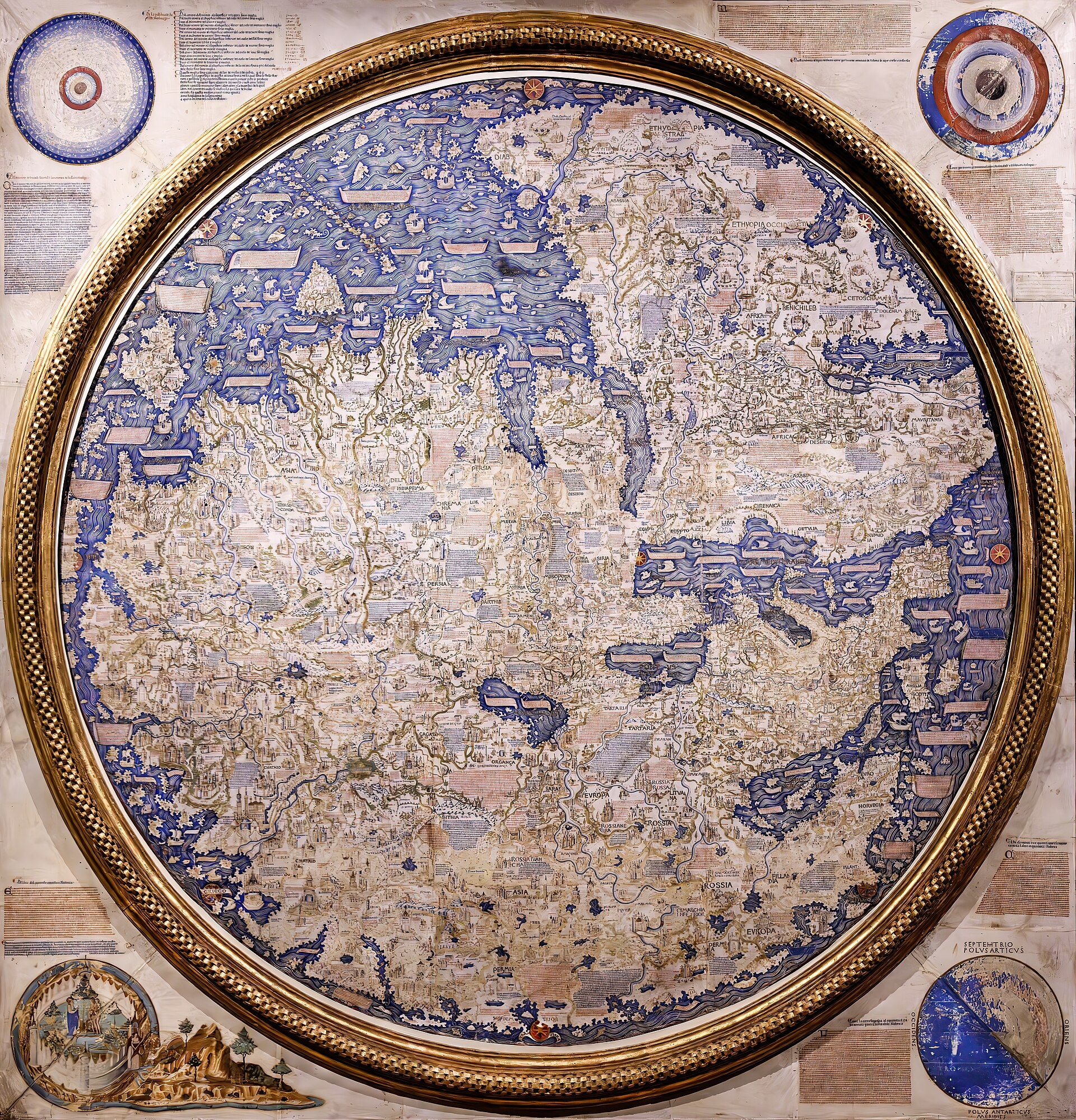
| Fra Mauro world map | About 1810 | Napoleonic suppression of religious orders | Moved from a monastery into a state library | Biblioteca Nazionale Marciana, Venice |
Suppressing the monasteries moved a map into a national library
The last of the five is the quietest and the most consequential for scholarship. Fra Mauro's world map was made around 1450 in the Camaldolese monastery of San Michele in Isola in Venice, oriented with south at the top and carrying close to three thousand descriptive legends. It broke with the schematic mappaemundi that came before it, and its rendering of the shape of Africa anticipated the continent's circumnavigability without yet proving it.
Around 1810 Napoleon's suppression of religious orders in the former Venetian territories ended the Camaldolese community's tenure of San Michele. The map passed into state custody and was moved to the Biblioteca Nazionale Marciana, where it remains. It was shown in the Doge's Palace for an extended period from about 1811. No one was dispossessed in a sense that a court would now recognise, because the order that owned it had been abolished by the same instrument that took the map, and the effect was to move a monastic object into a public research library four decades before Italy existed as a state.
How to read a revolutionary line in a provenance
Treat the date as the first thing to check, because the French revolutionary and Napoleonic takings cluster tightly and each year in the sequence means something different. A 1789 to 1793 entry generally records crown or church property becoming state property. A 1794 entry is often a formal requisition with a commission behind it and therefore a document. An entry around 1803 to 1810 usually reflects Napoleonic policy applied outside France, including the suppression of religious houses in annexed territories, and those objects frequently moved into libraries rather than galleries.
Then check what happened after 1815, because the Restoration reversed some of it selectively and the reversals are informative about how the object was understood. The basin went back to the crown; the map did not go back to the monks. And do not assume that state custody closed a gap. On the evidence here it is as likely to open one, because a confiscating administration inventories what it takes for its own purposes and not for a future reader, and the object can then move within the state for a century leaving nothing a researcher can follow.
Why this archive is free to read
We do this for everyone who loves art. The people who have studied it for years, and the people who just stopped to look. Iconotheca exists so that what we learn belongs to all of them.
Nobody pays us for this. No ads, no sponsors, no commercial interest. These works belong to all of us, and we would rather share them with as many people as we can than keep them to ourselves.
If it gave you something today, tell us to keep going. Follow us, leave a like, or write a positive comment. We read every one, and they are what keeps us going.
Questions
In practice no claims are being pressed. The takings sit outside the 1933 to 1945 framework addressed by the Washington Principles, they are not colonial acquisitions, and title was settled by French law at the time. Where objects were returned, as the Apocalypse Tapestry was around 1803, it was by political decision rather than through a claim.
The five objects in this archive do not settle that, and they point both ways. The Apocalypse Tapestry lost large sections to being cut up, while the Bayeux Tapestry, the Baptistere de Saint Louis and the Fra Mauro map were moved into public custody that has preserved them since.
The story is repeated by every source consulted here, including the museum that holds the tapestry, and it is presented there as local tradition. Nobody traces it to a contemporary document. The 1794 confiscation on behalf of the nation, by contrast, is a matter of record.
Not reliably. The armchair from Saint-Cloud has a commission documented to the livre and then no recorded owner at all for about 110 years after the state took it. A confiscating administration records what it needs for its own administration, which is not the same as a chain of title.
Sources
- 1Musee de la Tapisserie de Bayeux, 'From Odo's Cathedral to the Louvre', giving the 1794 confiscation by the Arts Commission for the Bayeux district, the Interior Minister's request of 15 November 1803, the Louvre display of 6 December 1803 to 18 February 1804, and Vivant Denon's letter on the tapestry's return. bayeuxmuseum.com/en/...
- 2Musee du Louvre, collections record for the Bassin dit Baptistere de Saint Louis, for the object's identification, maker's signatures and institutional history. collections.louvre.fr/en/...
- 3UNESCO, Memory of the World register entry for the Apocalypse Tapestry of Angers, for the weaving date, the commission by Louis I of Anjou and the tapestry's scale. unesco.org/en/...
- 4Chateau d'Angers, Centre des monuments nationaux, 'The tapestry of the Apocalypse', for the object's post-revolutionary condition and its present display. chateau-angers.fr/en/...
- 5The Metropolitan Museum of Art, collection record for the Armchair (fauteuil) from Louis XVI's Salon des Jeux at Saint Cloud, accession 07.225.107, object 189387, for the 1788 commission, the G. JACOB stamp and the chair's arrival with the Hoentschel collection. metmuseum.org/art/...
More in Provenance and Restitution
The partA return is a new arrangement, not a conclusion
Four contested antiquities, four different things a return turned out to be: a renaming, a rotating loan, a forfeiture nobody enforced and a broken...
When the Only Proof of Where an Object Was Is a Photograph
The Third Imperial Easter Egg was photographed once, in March 1902, and that single plate is what identified it in 2014.
Moved for Safekeeping Is a Link in the Chain
Nine evacuations in this archive: three objects never returned to the building they left, one came back unrecognised and title changed once, by a...