The Apocalypse Tapestry
Workshop of Nicolas Bataille, after designs by Hennequin de Bruges (Jean Bondol) · designed from 1373; woven in Paris c. 1377-1382
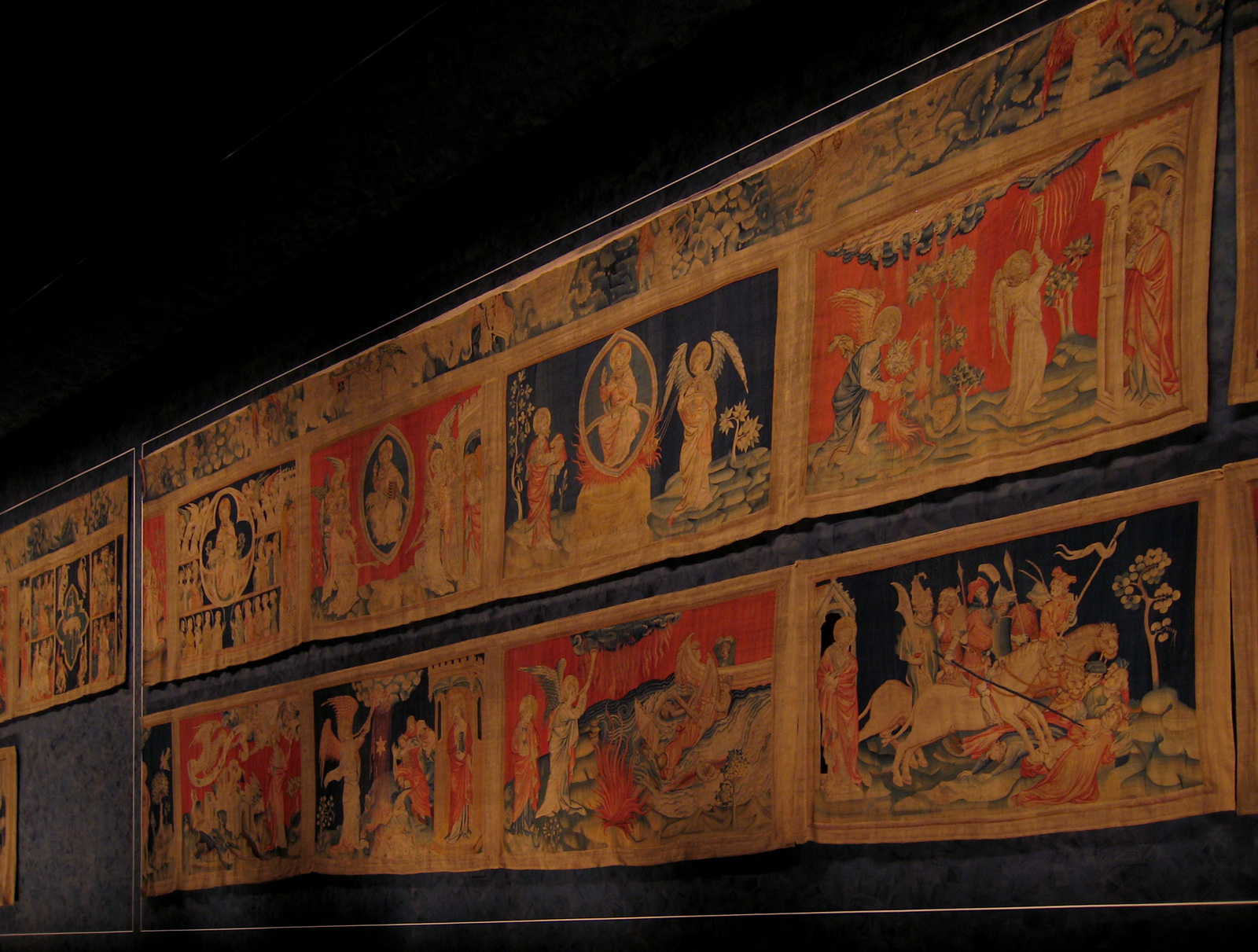
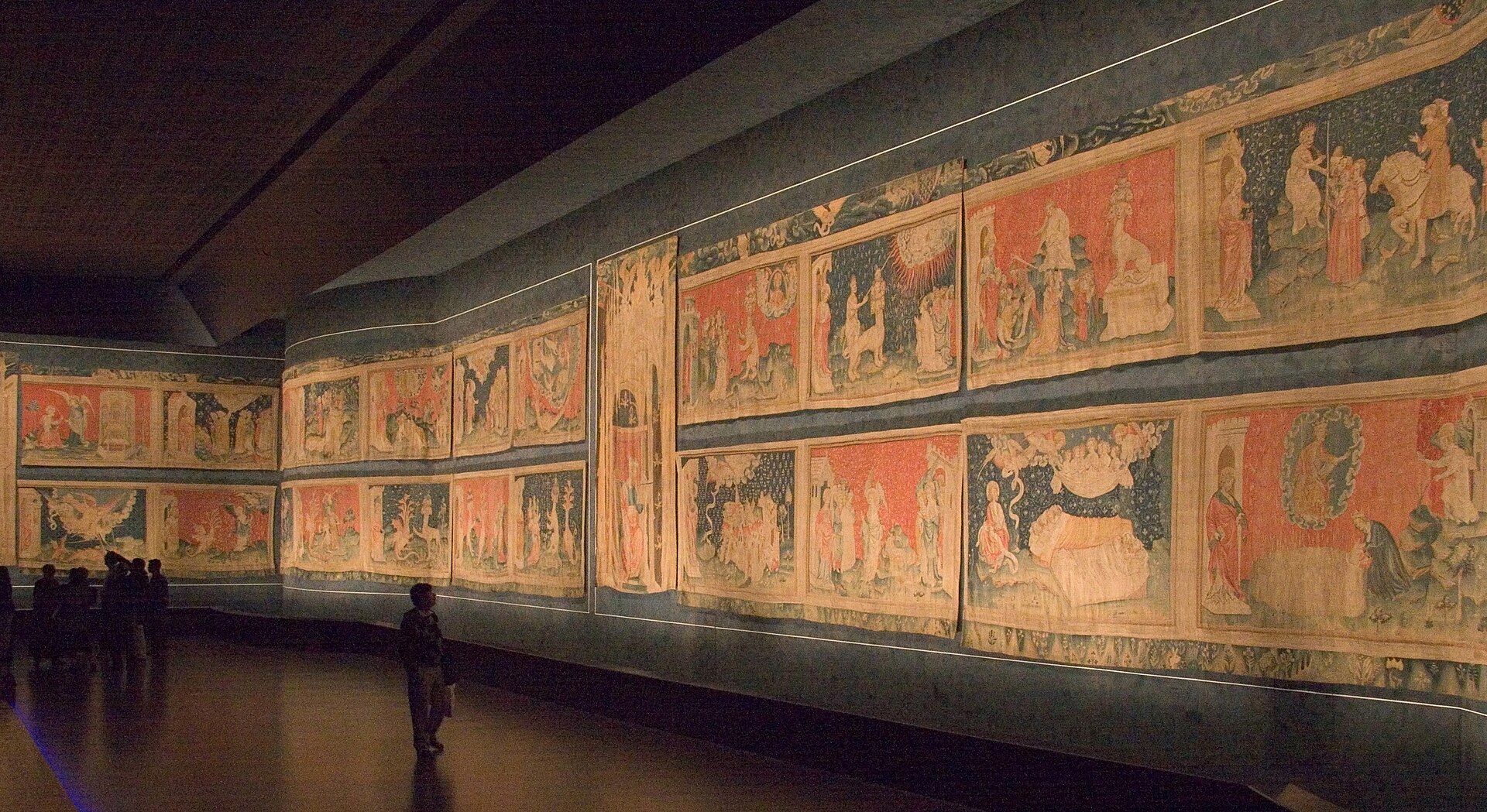
General view of a run of the tapestry as displayed in the 1954 gallery at the Chateau d'Angers.
Photograph by Manfred Heyde, via Wikimedia Commons · CC BY-SA 3.0| Artist | Workshop of Nicolas Bataille, after designs by Hennequin de Bruges (Jean Bondol) |
|---|---|
| Date | designed from 1373; woven in Paris c. 1377-1382 |
| Medium | Wool and silk on a wool warp, tapestry-woven in the high-warp (haute-lisse) technique of the Parisian workshops of this period; metal-wrapped threads of silver originally gilded with gold have been identified in fragments separated from the main hanging |
| Dimensions | Originally six pieces, each about 24 m wide by 6 m high, for a total usually given as approximately 140 m long by 6 m high (one source gives 144 m; total area is given as approximately 800 to 850 sq m across sources). Approximately 100 to 103 m of the original length is on display today, at a reduced height of about 4.5 m. |
| Where it is now | Chateau d'Angers, Domaine national du Chateau d'Angers, Centre des monuments nationaux, Angers, Pays de la Loire, France, displayed in the purpose-built gallery opened in 1954last confirmed |
| Inventory number | State-owned monument historique collection; no museum accession number identified in the sources consulted |
| Attribution | AcceptedThe commission by Louis I, Duke of Anjou, the design by the court painter Hennequin de Bruges (also called Jean de Bruges or Jean Bondol), and the weaving in a Paris workshop financed through the merchant Nicolas Bataille are all documented in period accounts and treated as settled by specialists. Full note |
| Object type | Textile |
| Period | French, Gothic, late fourteenth century (Valois) |
| Cases | Seized, looted or confiscated · Restituted or repatriated · Rediscovered |
| Inscriptions | No inscribed text is documented in the sources reviewed for this record. The woven background of at least one scene (the dragon fighting the servants of God) is reported to carry the initials L and M, read as the monogram of the patron, Louis I of Anjou. |
| Owners on record | 17 links16 documented, 1 disputed |
| Sources | 11 cited |
About this record Last verified · 11 sources cited · Change log
On this page 9 sections
ContentsClose
A monumental set of six tapestries illustrating the Book of Revelation, woven in wool and silk in Paris around 1377 to 1382 for Louis I, Duke of Anjou, after designs by the court painter Hennequin de Bruges and financed through the merchant Nicolas Bataille. At roughly 140 metres in its original length, it is the oldest and largest surviving monumental tapestry cycle from medieval Europe, and one of only two substantial fourteenth-century tapestry sets to survive at all.
Removed from Angers Cathedral's choir in 1767 and neglected even before the Revolution, it was cut into pieces during the revolutionary period and put to documented, unglamorous uses: protecting an abbey's orange trees from frost, covering horses, serving as a sacristy doormat, patching cathedral walls. The popular story that Bishop Angebault personally bought it back from customs in 1843 for 300 francs does not, on the fullest documentary account available, match the archival record; the real recovery ran through an earlier restitution around 1803, damp storage at the old seminary, and Canon Joubert's 1848 rediscovery, with Angebault's genuine role beginning only with the restoration he backed from 1849.
Two nineteenth-century restoration campaigns, a purpose-built gallery opened in 1954, a 1980s discovery that its reverse face had kept its original colour intact, and the 2020 rediscovery of thirty fragments that had sat unrecognised in a Paris dealer's reserve since 1924, bring the story into the present. It is a wholly different object from both the Bayeux Tapestry and the Lady and the Unicorn tapestries at the Musee de Cluny, sharing with them only the word 'tapestry'.
Provenance
Each link is graded. Documented: a cited source supports it. Disputed: the identification is argued but not established. Unknown: no owner for that span, and the gap is not smoothed into a narrative. The grades in the glossary.
- 1373 - 1382Louis I, Duke of Anjou (patron)documented
Commissioned by Louis I of Anjou; designed by Hennequin de Bruges (Jean Bondol), court painter to Charles V, drawing in part on an illuminated Apocalypse manuscript lent by Charles V in 1373; woven in a Paris workshop financed through the merchant Nicolas Bataille. Substantially complete by 1380 or 1382; reported cost 6,000 francs.12710
- 1382 - 1474House of Anjoudocumented
Retained within the House of Anjou following Louis I's death in 1384 until the testament of King Rene of Anjou in 1474.12
- 1474 - 1480Chateau de Bauge, then Angers Cathedraldocumented
Bequeathed under Rene of Anjou's 1474 testament; held at the Chateau de Bauge from 1476; transferred to Angers Cathedral in 1480 under authorisation from King Louis XI. A 1505 inventory records six pieces from Rene's bequest and a seventh added from Anne of France in 1490.2
- 1480 - 1767Chapter of Angers Cathedraldocumented
Displayed at the cathedral's principal feast days for close to three centuries.2
- 1767 - 1782Chapter of Angers Cathedraldocumented
Removed from the choir in 1767, reportedly on grounds that it was interfering acoustically with the singing; offered for sale in 1782 at a low price, with no buyer found.82
- 1789 - c. 1803Unrecovered, dispersed in piecesdocumented
Dispersed and cut into pieces during the revolutionary period. Specific documented uses, per Rene Planchenault's 1966 study as cited in the fullest secondary account available: winter protection for the orange trees of the Abbey of Saint-Serge, a covering for horses, a doormat in the sacristy of the convent of the Sisters of Wisdom, and material to conceal damage in the walls of Angers Cathedral. Read through a secondary citation of Planchenault rather than the monograph itself; flagged for direct verification.129
- 1843 - 1843Bishop Guillaume Angebault (popular account, disputed)disputed
Xavier Barbier de Montault and Jules Guiffrey wrote that Bishop Angebault personally bought the tapestry back from the customs administration in 1843 for 300 francs and bequeathed it to the chapter, a version still repeated in tourism-facing material today. The fullest documentary account available for this record, citing Louis de Farcy's 1889 institutional history, states explicitly that this does not correspond to the archival documents. This record follows the documented sequence in the surrounding entries rather than this popular version.2
- c. 1803 - 1848Diocese of Angersdocumented
Restitution of the tapestry to the church was obtained around 1803 under Bishop Montault-Desilles. It was then stored at the former Angers seminary under Toussaint Grille's custody, where it deteriorated in damp conditions rather than being displayed or actively conserved.2
- 1848 - 1848Diocese of Angersdocumented
Canon Joubert rediscovered the tapestry in poor condition at the former seminary and reported the find to Bishop Guillaume Angebault on 8 June 1848.2
- 1849 - 1863Chapter of Angers Cathedraldocumented
Canon Louis-Francois Joubert led restoration from 1849; his February 1849 inventory listed 55 pieces. Old linings were removed, revealing seven further scenes; misordered tableaus were rearranged to follow the biblical text; the pieces were washed in the river Maine, causing colour loss to the front. Joubert's own retissing proved controversial and was supervised from 1852 by the architect Charles Joly-Leterme, with replacement wool from the Gobelins Manufactory under Adrien-Leon Lacordaire.2
- 1869 - 1870Chapter of Angers Cathedraldocumented
A more invasive restoration under Louis de Farcy, working with Canon Alexandre Machefer and a formal conservation commission, completely rewove missing scenes over the following decades. The tapestry returned to display at the cathedral in 1870; two restored panels were exhibited at the Union centrale des beaux-arts in 1876.2
- 1952 - 1954French state, via the Chateau d'Angersdocumented
Custody passed from the diocese to the state under a 1952 agreement. A purpose-built L-shaped gallery designed by the architect Bernard Vitry was constructed in 1953-1954 at the Chateau d'Angers, replacing older castle buildings; the tapestry went on display there in 1954.214
- 1975 - 1996Centre des monuments nationauxdocumented
Original gallery windows, found to be causing sun damage, were curtained over in 1975. A more thorough remount followed in 1996, displaying scenes at two heights against dark blue walls with pale edging under environmental controls (about 19 C, about 40 lux, managed humidity). Further lighting and ventilation improvements followed between 1990 and 2000.12
- 1980s - 1980sCentre des monuments nationauxdocumented
Conservation examination found the reverse of the weave undamaged and as vividly coloured as the front had originally been, confirming the tapestry was woven without a distinct right and wrong side.9
- 2016 - 2017Centre des monuments nationaux / French Ministry of Culturedocumented
A comprehensive condition assessment of the tapestry was commissioned by the Ministry of Culture and completed in 2017.6
- 2020 - 2021Ratton-Ladriere gallery, then the French statedocumented
Thirty fragments, held since a 1924 acquisition from the dealer Otto Wegener, were found during the 2020 lockdown and matched to the main hanging by motif, colour, weave-density comparison and metallic-thread analysis. Donated to the French state in May 2021.5
- 2023 - presentChateau d'Angers, Centre des monuments nationaux, French statedocumented
Inscribed on the UNESCO Memory of the World international register in 2023. Remains on public display at the Chateau d'Angers in the 1954 gallery as most recently modified.3
Technical evidence
| Attribution note | The commission by Louis I, Duke of Anjou, the design by the court painter Hennequin de Bruges (also called Jean de Bruges or Jean Bondol), and the weaving in a Paris workshop financed through the merchant Nicolas Bataille are all documented in period accounts and treated as settled by specialists. What is not settled, and is treated separately in this record, is the precise division of labour inside the workshop: Bataille is now generally read as the financier and organiser of the commission rather than its technical head, a role some specialists instead assign to the weaver Robert Poincon. No payment record naming Poincon in connection with this specific commission was found in the sources consulted for this record, so that narrower claim is flagged rather than stated as fact. |
|---|---|
| Materials and weave | Wool and silk on a wool warp, tapestry-woven in the high-warp (haute-lisse) technique used in the large Parisian commissions of this period.27 |
| Metal thread | Metal-wrapped thread of silver, originally gilded with gold, identified by chemical analysis in fragments separated from the main hanging and confirmed as belonging to it.5 |
| Original dimensions | Six pieces, each about 24 m wide by 6 m high, for a total length usually given as approximately 140 m (one source gives 144 m) and a woven area given as roughly 800 to 850 sq m across sources.123 |
| Surviving dimensions | Approximately 100 to 103 m of the original length is on display, at a reduced height of about 4.5 m; the height loss reflects missing sky and earth border bands along the whole run rather than trimming at either end.24 |
| Scene count | Sources disagree on the original total, giving either 90 or 84 scenes across two registers per piece. Current survival is given either as 71 scenes, or as 68 intact plus 7 partial (75 total); this record could not reconcile the two counts to a single figure.12 |
| Design source | Design derived in part from an illuminated Apocalypse manuscript reported to have been produced in England around 1250, held in the French royal library and lent by Charles V to his brother Louis I in 1373.17 |
| Reverse condition | Conservation examination in the 1980s found the reverse of the weave undamaged and as vividly coloured as the front had been when new, indicating the piece was woven without a distinct right and wrong side (sans envers).9 |
| Patron's heraldry | The initials L and M, read as the personal monogram of the patron Louis I of Anjou, are reported woven into the background of at least the scene showing the dragon fighting the servants of God.7 |
| Workshop attribution | Nicolas Bataille, historically described as the master weaver, is now generally read by specialists as the commission's financier and organiser; a technical head of the workshop, Robert Poincon, is named in some accounts but was not confirmed against a primary payment record in the sources consulted.1 |
| 2020 fragment discovery | Thirty fragments held since 1924 in a Paris dealer's reserve were matched to the hanging in 2020 by comparison of motifs, colour, weave density (thread-count fingerprinting), and metallic-thread composition, then donated to the French state in May 2021.5 |
Images
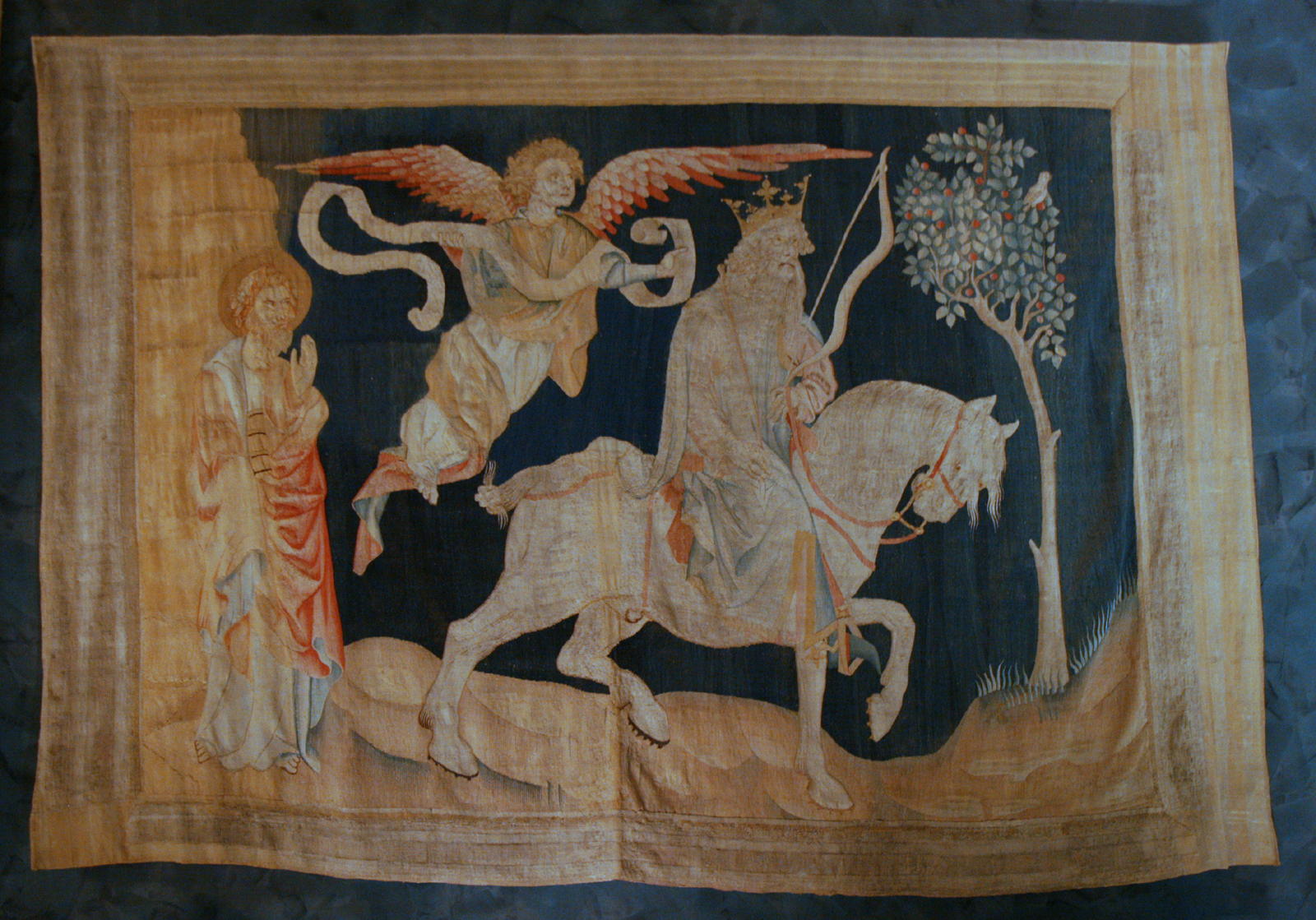
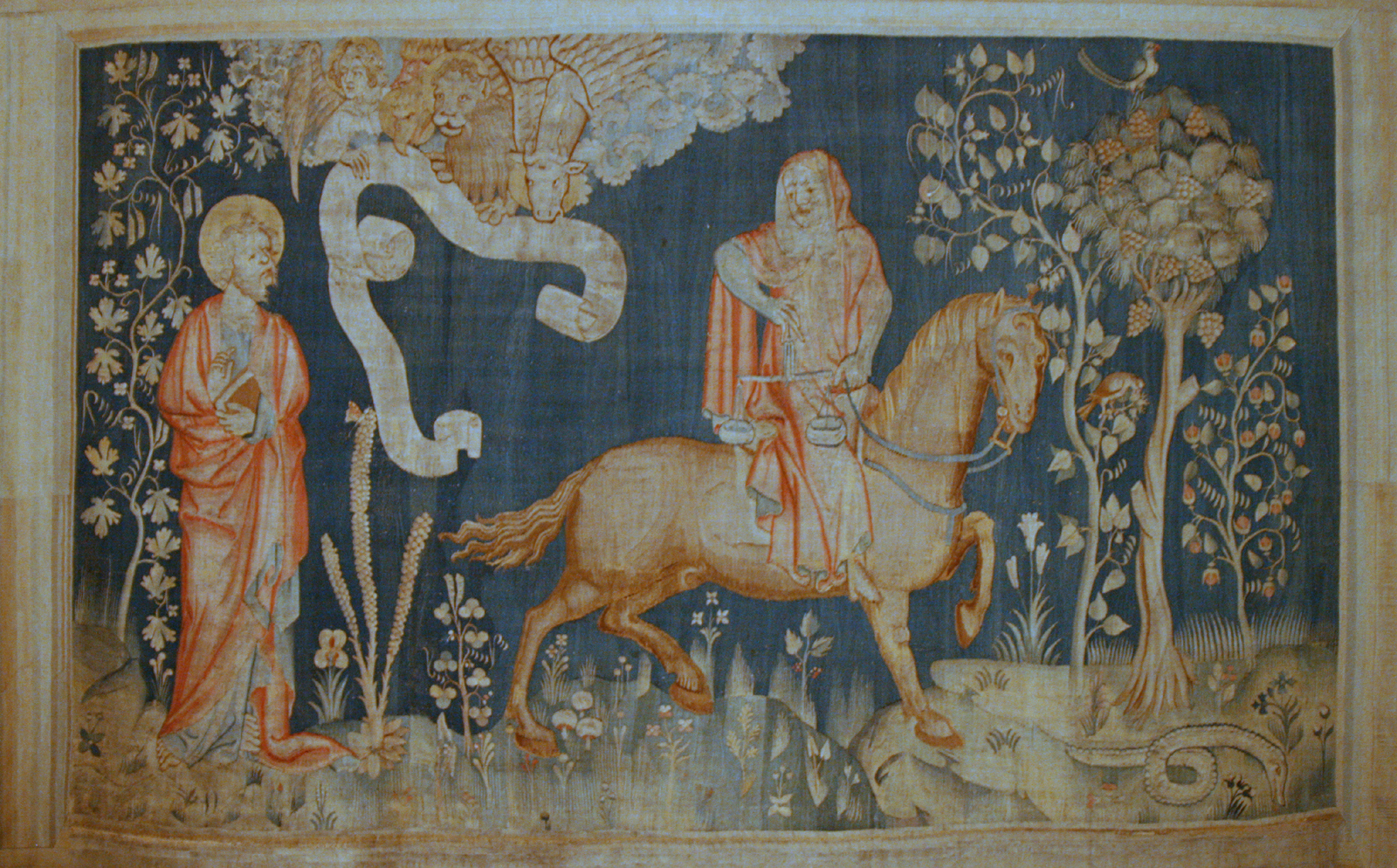
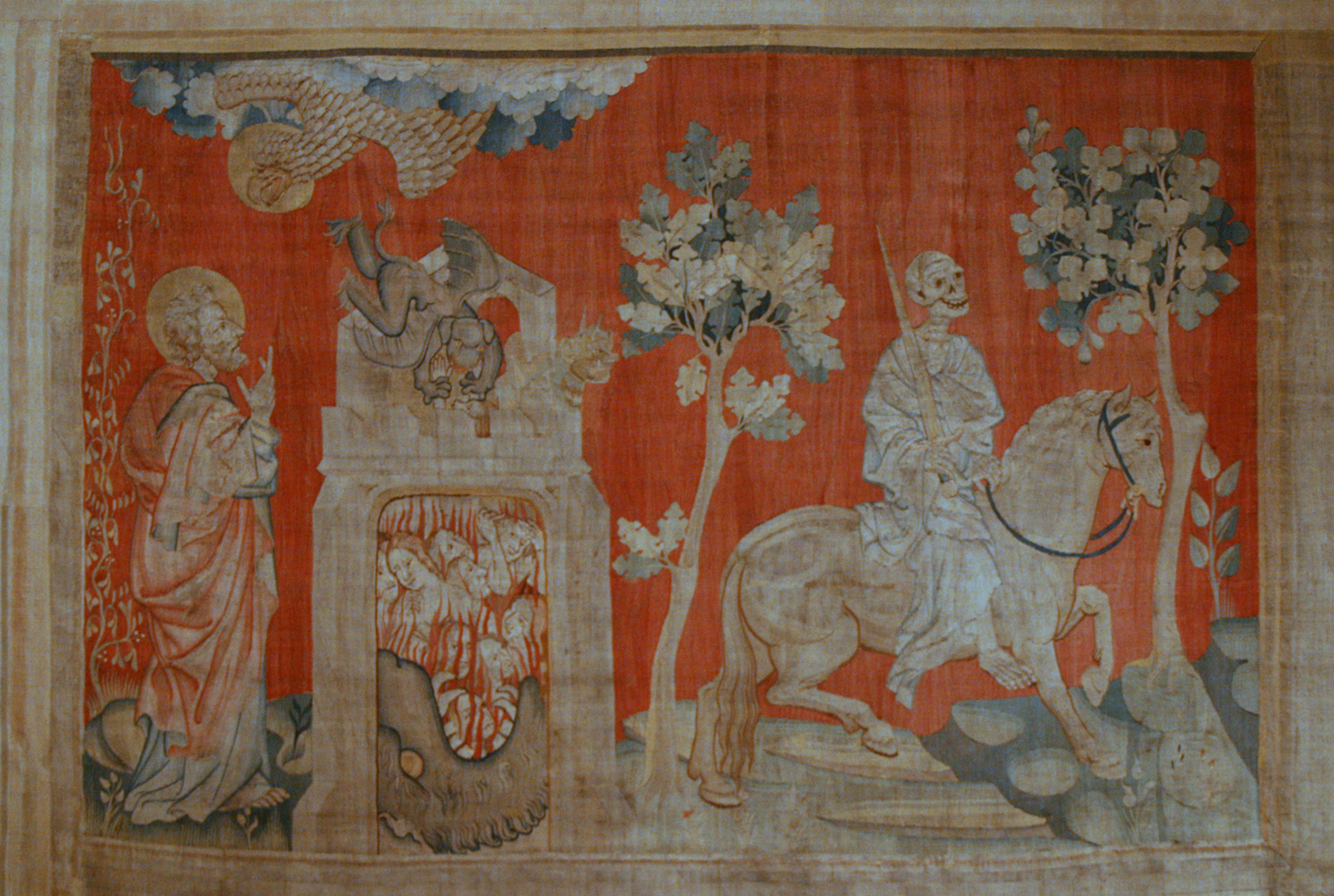
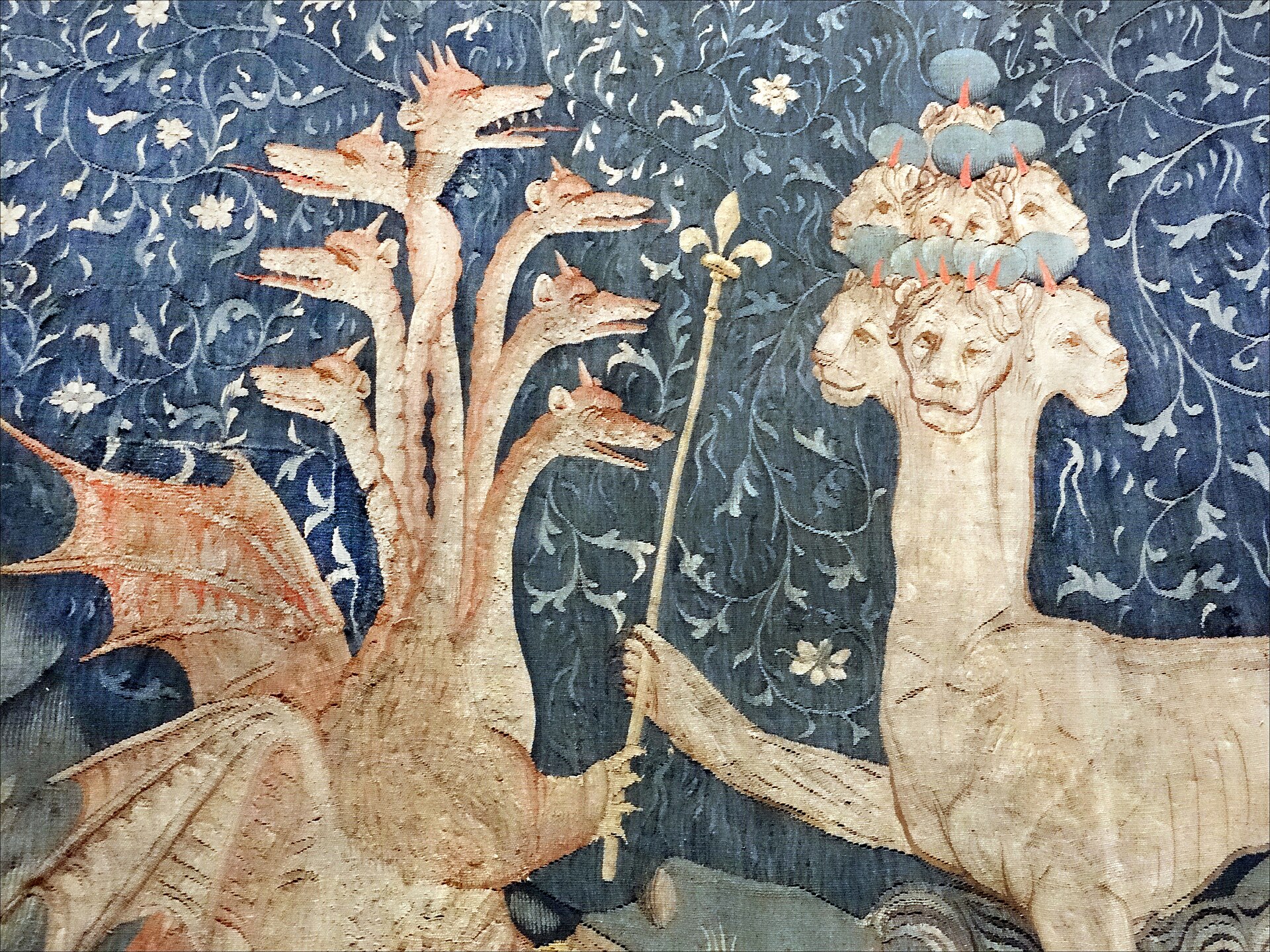
The record in full
Chapter 1A woven Book of Revelation, six pieces and roughly ninety scenes
The Apocalypse Tapestry is a monumental set of narrative hangings illustrating the Book of Revelation, woven in wool and silk on a wool warp in Paris between about 1377 and 1382.
The Apocalypse Tapestry is a monumental set of narrative hangings illustrating the Book of Revelation, woven in wool and silk on a wool warp in Paris between about 1377 and 1382. It was made in six pieces, each originally about 24 metres wide and 6 metres high, for a combined length most commonly given as roughly 140 metres and a woven area of some 800 to 850 square metres depending on the source. That scale makes it, by consensus among the sources reviewed, the oldest and largest surviving monumental tapestry cycle from medieval Europe.
Each piece was organised in two registers of scenes set beneath a painted sky and above a painted earth, with a large seated figure introducing each piece and reading or commenting on the action, in the manner of a narrator standing beside the images he describes. Sources disagree on the precise original scene count, some giving 90, others implying 84 from the two-register structure; this record could not reconcile the two figures against a single modern catalogue and records it as an open question rather than picking one.
Chapter 2The commission: Louis of Anjou, and a manuscript borrowed from his brother
The set was commissioned by Louis I, Duke of Anjou, Count of Provence and Maine, and later titular King of Sicily and Jerusalem, the younger brother of King Charles V of France.
The set was commissioned by Louis I, Duke of Anjou, Count of Provence and Maine, and later titular King of Sicily and Jerusalem, the younger brother of King Charles V of France. Louis fought at Poitiers in 1356, served as his brother's lieutenant general in Languedoc and Guyenne, and spent much of his career pursuing a claim to a kingdom in Italy that he never lived to secure; he died in 1384 in Apulia before the decisive battle of that campaign.
For the design, Louis turned to Hennequin de Bruges, also recorded as Jean de Bruges or Jean Bondol, a Flemish painter who had entered Charles V's service by 1368 and is documented as active into the 1380s. Bondol is recorded as being paid for 'pourtraitures et patrons', that is, designs and patterns, rather than for weaving itself; the working assumption among specialists is that he produced smaller modellos that were then enlarged into full-size cartoons for the weavers. Bondol drew in part on an illuminated Apocalypse manuscript that Charles V lent to his brother in 1373, a manuscript reported to have been produced in England around 1250 and to have belonged to the French royal library; some accounts also suggest Louis may have had in mind a large tapestry given to Charles V by the magistrates of Lille in 1367, though that connection is not established as more than a plausible precedent.
The weaving itself was financed and organised through the merchant Nicolas Bataille, long described in older literature as the master weaver but now generally treated by specialists as the financier and middleman for a Paris workshop; some accounts name Robert Poincon as the workshop's actual technical head, though this record could not verify that attribution against a primary payment record. The commission is reported to have cost 6,000 francs and to have been substantially complete by 1380 or 1382.
Chapter 3A political hanging as much as a devotional one
The tapestry was made during the Hundred Years' War, in the years following the Black Death, and during the opening years of the Western Schism that split the papacy between Rome and Avignon from...
The tapestry was made during the Hundred Years' War, in the years following the Black Death, and during the opening years of the Western Schism that split the papacy between Rome and Avignon from 1378. Louis I backed the Avignon claimant, Clement VII, who in turn promised him a kingdom in Italy and eventually crowned him King of Sicily and Jerusalem in 1382, a title Louis never made good before his death.
Against that background, several writers argue that the hanging did more than illustrate scripture: it placed Louis's own political and dynastic claims inside an image of cosmic order and divine judgement. The initials L and M, read as Louis's personal monogram, are reported woven into the background of the scene showing the dragon fighting the servants of God, casting the patron as a combatant on the side of the heavenly order against Evil. A reading of the whole cycle as pro-Clementist commentary on the Schism has also been argued in the specialist literature on medieval apocalyptic imagery. This record treats both readings as argued rather than settled: they rest on named scholarly interpretation of the imagery rather than on a surviving statement of intent from Louis or Bondol, and this record was not able to consult the primary iconographic study (attributed in a secondary source to Peter K. Klein) directly. What is not in dispute is the plain devotional fact underneath the politics: this was, first, a monumental illustration of the last book of the Christian Bible, made to be displayed at a cathedral's great feasts before a congregation for whom the Apocalypse was a live description of the world's end, not a literary curiosity.
Chapter 4From Anjou to Angers Cathedral, and a first sign of trouble
The tapestry passed by inheritance through the House of Anjou.
The tapestry passed by inheritance through the House of Anjou. Under the 1474 testament of King Rene of Anjou it went first to the Chateau de Bauge from 1476, and then, under an authorisation from King Louis XI in 1480, to Angers Cathedral, where a 1505 inventory records six pieces from Rene's bequest and a seventh, evidently a later addition, from Anne of France in 1490. There it was displayed at the cathedral's major festivals for close to three centuries.
That long, stable custody ended before the Revolution. The hanging was removed from the choir in 1767, in an account that attributes the decision to concerns that the tapestry was interfering acoustically with the choir's singing; and in 1782 it was reportedly offered for sale at a low price with no buyers found, after which it was set aside and neglected rather than actively cared for. Both details point to a hanging that had already fallen out of fashion and out of active use well before the political upheaval of the 1790s made things worse.
Chapter 5The Revolution: what actually happened, stated precisely
The claim that this tapestry was cut into pieces and put to ordinary domestic use during the revolutionary period is widely repeated, and this record set out to verify it rather than assume it, in...
The claim that this tapestry was cut into pieces and put to ordinary domestic use during the revolutionary period is widely repeated, and this record set out to verify it rather than assume it, in the same way a comparable claim was investigated and found not to hold for a different tapestry set already published on this site (the Lady and the Unicorn, at the Musee de Cluny, where the 'used as blankets' story traced instead to other, separate tapestries in Prosper Merimee's own correspondence). For the Angers hanging, the claim does not fall apart on inspection: it is attached, in the most detailed secondary account found, to a specific description rather than a floating rumour.
Rene Planchenault's 1966 study is cited, via the fullest French-language account of the tapestry's history available for this record, as the source for the specific claim that during the revolutionary period elements of the tapestry served to protect the orange trees of the Abbey of Saint-Serge from frost, as a covering for horses, as a doormat in the sacristy of the convent of the Sisters of Wisdom, and to conceal damage in the walls of Angers Cathedral itself. Those are four distinct, named institutions and uses, not a generic legend, and this record grades the claim as documented on that basis, while flagging that it was read through a secondary citation of Planchenault rather than the 1966 monograph itself, which should be checked directly by any reader who needs the claim at primary-source strength.
What should not be repeated uncritically, however, is the popular account of how the tapestry was recovered.
Chapter 6The Angebault legend, and what the documents actually show
The story told in a great deal of secondary and tourism-facing material, including material published by the Chateau d'Angers itself, is a tidy one: Bishop Guillaume Angebault bought the scattered...
The story told in a great deal of secondary and tourism-facing material, including material published by the Chateau d'Angers itself, is a tidy one: Bishop Guillaume Angebault bought the scattered tapestry back from the customs administration in 1843 for 300 francs and gave it to the cathedral chapter, saving it at a stroke. Two named nineteenth and early twentieth century writers, Xavier Barbier de Montault and Jules Guiffrey, are credited with putting this version into circulation.
The fullest documentary account available for this record states plainly that this version does not correspond to the archival documents, citing Louis de Farcy's 1889 institutional history of the cathedral's tapestries, a source written by a canon with direct access to the chapter's own records and who was himself the tapestry's principal restorer in the following decades. The documented sequence, on this account, runs differently. Restitution of the tapestry to the church was obtained not in the 1840s but around 1803, under Bishop Montault-Desilles. It was then stored at the former Angers seminary, under the custody of a Toussaint Grille, where it deteriorated in damp conditions rather than being actively displayed or conserved. It was Canon Joubert who rediscovered it there in poor condition and reported the find to the then bishop, Guillaume Angebault, on 8 June 1848. Angebault's real, documented role was to back a joint restoration effort with the cathedral chapter from 1849, not to conduct a single dramatic purchase from customs five years earlier.
This record follows the documentary account rather than the popular one, and grades the 1843 customs-purchase story as disputed. It is worth pausing on the coincidence with the Cluny case: in both instances, a specific, appealing rescue narrative turns out on inspection to be looser than the archival record supports, and in both instances the correction depends on someone, decades or a century later, going back to check the chapter's own paperwork rather than repeating the story that had already taken root.
Chapter 7Two restorations: Canon Joubert, then Louis de Farcy
The first sustained conservation campaign was led by Canon Louis-Francois Joubert, custodian of the cathedral treasury, beginning in 1849.
The first sustained conservation campaign was led by Canon Louis-Francois Joubert, custodian of the cathedral treasury, beginning in 1849. His inventory of February that year listed 55 surviving pieces. In the course of the work he removed old backing linings and found seven further scenes hidden beneath them, and he reordered several tableaus that had been mounted out of sequence, restoring them to the order implied by the biblical text. The pieces were washed in the river Maine as part of this campaign, a cleaning method that caused significant colour loss to the front of the weave, a loss later shown, in the twentieth century, not to have reached the reverse side at all. Joubert's own retissing of missing sections proved controversial enough that the architect Charles Joly-Leterme was brought in to supervise the work from 1852, with replacement wool supplied by the Gobelins Manufactory under Adrien-Leon Lacordaire. Joubert's restoration ran until 1863.
A second, more invasive campaign followed under Louis de Farcy, working with Canon Alexandre Machefer from around 1869 to 1870 and continuing over subsequent decades; a conservation commission was formed to oversee it. This phase went further than Joubert's, completely reweaving entire missing scenes rather than only consolidating what survived. Two of the restored panels were shown publicly at an exhibition of the Union centrale des beaux-arts in 1876, and the tapestry was formally returned to display at the cathedral in 1870.
Chapter 8How much survives, and the trouble with 'one third'
The tapestry's loss is frequently summarised in round numbers, most often as roughly a third of the original length gone.
The tapestry's loss is frequently summarised in round numbers, most often as roughly a third of the original length gone. The underlying figures, however, vary by source in ways that make a single precise percentage hard to state with confidence. Original length is given as either approximately 140 metres or 144 metres; surviving displayed length is given as approximately 100 metres or 103 metres. Depending which pairing is used, the loss works out to somewhere between roughly a quarter and just under a third of the original run, which makes 'about a third' a defensible rounding rather than a precisely sourced figure, and this record states it that way rather than repeating a single tidy fraction as though it had been measured to a decimal point.
Scene counts show a comparable spread: of an original total most often given as 90 (though some accounts imply 84), current sources give either 71 scenes surviving or, on a different count, 68 scenes intact plus 7 more surviving only in part, which totals 75. The displayed height has also dropped, from an original 6 metres to about 4.5 metres today, not because sections were cut from the top and bottom of individual scenes but because the uppermost painted sky band and the lowest painted earth band were lost along the whole run. This record treats the exact reconciliation of these figures as an open question rather than a settled fact, since no single modern catalogue reconciling all of them was found in the sources consulted.
Chapter 9A woven face with no wrong side, discovered a century later
A restoration campaign in the 1980s produced a striking technical finding: where the front of the hanging had faded under sunlight and handling over centuries, the reverse, protected under a lining...
A restoration campaign in the 1980s produced a striking technical finding: where the front of the hanging had faded under sunlight and handling over centuries, the reverse, protected under a lining for most of that time, had kept its full original colour intensity and was found to be as carefully finished as the front. This is described as a tapestry woven 'sans envers', without a right and wrong side, meaning both faces were worked to full finish, a mark of exceptional technical ambition and cost in a hanging of this scale, and one that also happens to preserve, on its back, a working record of what the front looked like when new.
A further condition assessment was commissioned by France's Ministry of Culture in 2016 and completed in 2017, described by the Chateau d'Angers as a full check-up of its oldest tapestry, with conservators and restorers examining the textile in detail and part of the process documented on video for the public.
Chapter 10A purpose-built gallery, opened in 1954
Under a 1952 agreement between the diocese of Angers and the state, custody of the tapestry passed to the Chateau d'Angers, and a dedicated L-shaped gallery, designed by the architect Bernard Vitry...
Under a 1952 agreement between the diocese of Angers and the state, custody of the tapestry passed to the Chateau d'Angers, and a dedicated L-shaped gallery, designed by the architect Bernard Vitry, was built there in 1953 to 1954 to replace older castle buildings on the site. The tapestry was moved and put on public display there in 1954, its first purpose-built home since leaving the cathedral.
That gallery has itself been adjusted more than once to protect a textile of this age. Large windows in the original design were found to be causing sun damage and were curtained over in 1975. A more thorough remount followed in 1996, hanging the scenes at two heights against dark blue walls with pale edging, and imposing environmental controls appropriate to a fourteenth-century textile: a constant temperature of about 19 degrees Celsius, lighting held to about 40 lux, and managed humidity. Further improvements to lighting and ventilation followed between 1990 and 2000.
Chapter 11Thirty fragments, lost for a century, found during a lockdown
In spring 2020, during the Paris coronavirus lockdown, the dealer Guy Ladriere and his daughter Sandrine, going through their gallery's reserves, found a set of textile fragments accompanied by a...
In spring 2020, during the Paris coronavirus lockdown, the dealer Guy Ladriere and his daughter Sandrine, going through their gallery's reserves, found a set of textile fragments accompanied by a handwritten note stating they came from one of the celebrated Angers tapestries, acquired from the dealer Otto Wegener in 1924. The fragments carry decorative fleurons worked with metallic filament and appear to come from a section of the hanging showing a major seated figure.
The find was investigated by Clementine Mathurin, a conservator at the regional cultural affairs directorate (DRAC) for Pays de la Loire, Montaine Bongrand, a textile restorer who had already been working on the main tapestry since 2016, and Mohamed Dallel, head of textile research at the Laboratoire de recherche des monuments historiques. Their comparison matched the fragments' floral motifs, colours and weave to the main hanging, and a thread-count 'fingerprint' analysis of the weave density matched as well; chemical analysis of the metallic threads found silver wrapped in silk that had originally been gilded with gold. The fragments are believed to have separated from the main body of the tapestry during the nineteenth-century restoration campaigns and to have then passed into the art market through channels not documented in the sources consulted. The Ladriere family donated the fragments to the French state in May 2021, and they are now held in the chateau's reserves, brought out for periodic exhibition.
Chapter 12Materials, and one finding that needs a stronger source before it can be trusted
The base materials are wool and silk on a wool warp, worked in the high-warp technique typical of large Parisian commissions of this period, with silver thread, originally gilt, identified in at...
The base materials are wool and silk on a wool warp, worked in the high-warp technique typical of large Parisian commissions of this period, with silver thread, originally gilt, identified in at least the recovered 2020 fragments. One further claim recurs in less formal sources: that a small number of panels were dyed with a genuine murex-derived purple, a dye associated in the medieval Mediterranean with continued production by Jewish and Muslim dyers in North Africa and reportedly available in Europe through Sicilian trade and itinerant Sephardic merchants, and that this was confirmed as authentic to the fourteenth century by a researcher identified as Dr Kurt Heinisch, rather than being a later repair. This record could not trace that claim beyond a single blog account and has not been able to verify it against a primary scientific publication; it is reported here as a claim attributed to a named but unverified researcher, not as an established fact, and is flagged for direct verification.
Chapter 13A designer's other documented work, and the manuscript-to-monument problem
Bondol's only other securely signed and dated work is the frontispiece miniature of the Bible historiale presented to Charles V in 1371 by his valet de chambre Jean de Vaudetar, now in the Museum...
Bondol's only other securely signed and dated work is the frontispiece miniature of the Bible historiale presented to Charles V in 1371 by his valet de chambre Jean de Vaudetar, now in the Museum Meermanno-Westreenianum in The Hague. That single page is the one fixed point against which every other attribution to Bondol, including the Apocalypse designs, is measured by comparison of style and hand; nothing else in his output is signed.
The Apocalypse Tapestry is, on this evidence, a documented instance of a working method that specialists in tapestry history discuss as a real transition: a royal or ducal patron drawing a set of images from a small illuminated manuscript, made for private reading and held in the hand, and having them enlarged by a court painter into cartoons for weaving at a monumental public scale, intended to be seen across a cathedral nave or a great hall rather than turned page by page. The scale change involved is not decorative; it changes what an image does, from a private devotional aid into a public assertion, in this case one carrying its patron's own political ambitions inside the biblical narrative.
Chapter 14A different object from two other tapestries already on this site
This record covers a single, specific object: the six-piece, late fourteenth century woven tapestry cycle illustrating the Book of Revelation, commissioned by Louis I of Anjou and now at the Chateau...
This record covers a single, specific object: the six-piece, late fourteenth century woven tapestry cycle illustrating the Book of Revelation, commissioned by Louis I of Anjou and now at the Chateau d'Angers. It is not the Bayeux Tapestry, an embroidered linen hanging of the eleventh century depicting the Norman Conquest of England, a different technique, a different period, and a different subject, already published as a separate record on this site. It is also not the Lady and the Unicorn tapestries at the Musee de Cluny in Paris, a set of six woven tapestries on a secular allegorical subject made roughly a century and a quarter later in the southern Netherlands or France, likewise already published here as a separate record. All three objects share only the generic word 'tapestry' and a French connection; none of the facts, images, dates or provenance in this record should be read across to either of the other two.
The artist
Hennequin de Bruges (Jean de Bruges, Jean Bondol), designer; Nicolas Bataille, merchant and financier of the Paris workshop; Robert Poincon, workshop head on some accounts
No individual hand can be shown to have physically woven this hanging in the way a painter's hand is shown in a signed panel. What is documented is a division of labour typical of a major fourteenth-century Parisian commission: a court painter supplied the design, a merchant financed and organised the production, and an unnamed or only partly named workshop of professional weavers carried it out. This dossier covers the two men named in connection with the commission and the little that is documented about each, rather than treating either as a conventional single artist.
Related works
| Work | Relation | Where it is |
|---|---|---|
| Bible historiale of Jean de Vaudetar Jean Bondol (Hennequin de Bruges) | The designer's only other securely signed and dated work A 1371 manuscript frontispiece; the sole fixed benchmark against which every attribution of other work to Bondol, including the Apocalypse designs, is measured. | Museum Meermanno-Westreenianum, The Hague |
| The Nine Heroes Tapestries Workshop associated with Nicolas Bataille's Paris milieu | The only other substantial monumental fourteenth-century tapestry cycle to survive Woven around 1385, a few years after the Angers hanging; together the two sets make up effectively the whole surviving corpus of large-scale fourteenth-century figural tapestry. | The Cloisters, Metropolitan Museum of Art, New York |
| Cloisters Apocalypse Unknown English illuminator, c. 1330 | Comparandum for the type of illustrated Anglo-Norman Apocalypse manuscript that supplied Bondol's models Not established as the specific manuscript Charles V lent to Louis I in 1373; included only to illustrate the manuscript tradition behind the tapestry's design, not as the source itself. | The Morgan Library and Cloisters, New York |
| The Bayeux Tapestry Unknown, Anglo-Norman workshop, 11th century | Frequently confused with this object on the strength of the shared word 'tapestry' alone An embroidered linen hanging depicting the Norman Conquest, three centuries earlier and a wholly different technique, period and subject. Already published as a separate record on this site. | Musee de la Tapisserie de Bayeux, Normandy (on loan to the British Museum, 2026-2027) |
| The Lady and the Unicorn Southern Netherlandish or French workshop, c. 1500 | A different woven tapestry set, occasionally confused with this one as another large medieval French tapestry cycle in state custody A secular, allegorical set on an entirely different subject, woven roughly a century and a quarter later. Already published as a separate record on this site; the comparable 'used as blankets/floor coverings' claim investigated for that record was found NOT to hold for its six surviving panels, unlike the equivalent claim documented here for the Angers hanging specifically. | Musee de Cluny, Paris |
Open questions
- Whether the tapestry originally comprised 90 scenes, the figure most often repeated, or 84, implied by some accounts of its two-registers-per-piece structure, and correspondingly whether 71 or 75 scenes survive today whole or in part: the sources reviewed disagree and this record could not reconcile them to a single settled catalogue figure.
- What precisely justifies the widely repeated 'about one third lost' figure for the hanging's length: the underlying numbers (an original length of 140 or 144 m against a surviving length of 100 or 103 m) support a loss of somewhere between roughly a quarter and just under a third, and a single authoritative measurement reconciling them was not found in the sources consulted.
- Where and under whose custody the tapestry was kept between the failed 1782 sale attempt and Bishop Montault-Desilles's restitution of it to the church around 1803 is not detailed in the sources reviewed.
- Whether further fragments beyond the thirty recovered from the Ratton-Ladriere gallery in 2020 remain unrecognised in other private or dealer collections, given that this group alone went unidentified for roughly a century after entering the art market in 1924.
- How far the reading of the tapestry as pro-Clementist commentary on the Western Schism, and the claim that Louis I's L and M monogram appears programmatically across the cycle rather than in an isolated scene, holds up against the primary iconographic scholarship; the specialist literature (attributed to Peter K. Klein in a secondary source) was not directly consulted for this record.
- Whether the murex-derived purple dye reported in a small number of panels reflects the original 1370s-80s weaving or a later repair or re-dyeing campaign: the claim rests on secondary blog reporting of research attributed to a Dr Kurt Heinisch and could not be verified here against a primary scientific publication.
- Whether Robert Poincon can be securely documented as the technical head of the specific workshop that wove this commission, or whether that attribution belongs to the Parisian tapestry trade of the period more generally: this record could not verify it against the primary payment records referenced only secondhand in the sources consulted.
Questions about this object
What is The Apocalypse Tapestry?
The Apocalypse Tapestry is a textile, dated designed from 1373; woven in Paris c. 1377-1382. Medium: Wool and silk on a wool warp, tapestry-woven in the high-warp (haute-lisse) technique of the Parisian workshops of this period; metal-wrapped threads of silver originally gilded with gold have been identified in fragments separated from the main hanging.
Who made The Apocalypse Tapestry, and is the attribution settled?
The attribution to Workshop of Nicolas Bataille, after designs by Hennequin de Bruges (Jean Bondol) is recorded here as accepted. The commission by Louis I, Duke of Anjou, the design by the court painter Hennequin de Bruges (also called Jean de Bruges or Jean Bondol), and the weaving in a Paris workshop financed through the merchant Nicolas Bataille are all documented in period accounts and treated as settled by specialists. What is not settled, and is treated separately in this record, is the precise division of labour inside the workshop: Bataille is now generally read as the financier and organiser of the commission rather than its technical head, a role some specialists instead assign to the weaver Robert Poincon. No payment record naming Poincon in connection with this specific commission was found in the sources consulted for this record, so that narrower claim is flagged rather than stated as fact.
Where is The Apocalypse Tapestry now?
Chateau d'Angers, Domaine national du Chateau d'Angers, Centre des monuments nationaux, Angers, Pays de la Loire, France, displayed in the purpose-built gallery opened in 1954. Inventory number State-owned monument historique collection; no museum accession number identified in the sources consulted. Last confirmed 15 August 2026. Continuous ecclesiastical and then French state custody since the 1480 gift to Angers Cathedral, interrupted by Revolutionary-era seizure and neglect and restored through nineteenth-century recovery and restoration; transferred to the Chateau d'Angers under a 1952 agreement between the diocese and the state.
What is still unknown about The Apocalypse Tapestry?
Whether the tapestry originally comprised 90 scenes, the figure most often repeated, or 84, implied by some accounts of its two-registers-per-piece structure, and correspondingly whether 71 or 75 scenes survive today whole or in part: the sources reviewed disagree and this record could not reconcile them to a single settled catalogue figure.
Sources
- 1Wikipedia, 'Apocalypse Tapestry' (English). en.wikipedia.org/wiki/...
- 2Wikipedia, 'Tenture de l'Apocalypse' (French). fr.wikipedia.org/wiki/...
- 3UNESCO, 'Apocalypse Tapestry of Angers', Memory of the World register entry, inscribed 2023. unesco.org/en/...
- 4Chateau d'Angers (Centre des monuments nationaux), 'The tapestry of the Apocalypse: the essential in 2 minutes!' chateau-angers.fr/en/...
- 5Chateau d'Angers (Centre des monuments nationaux), 'Une decouverte miraculeuse: les fragments perdus de l'Apocalypse', on the 2020 rediscovery and 2021 donation of thirty fragments. chateau-angers.fr/decouvrir/...
- 6Chateau d'Angers (Centre des monuments nationaux), 'Dans les coulisses du patrimoine... Restaurer la plus grande tapisserie du monde!', on the 2016-2017 condition assessment. chateau-angers.fr/decouvrir/...
- 7Brewminate, 'The Medieval Apocalypse Tapestry of Louis I, Duke of Anjou'. A secondary account citing Jean Mesqui, Peter K. Klein, and Susan Groag Bell among its bibliography; the underlying named studies were not consulted directly for this record. brewminate.com/the-medieval-apocalypse-tapestry-of-louis-...
- 8Needleprint (blog), 'The Apocalypse Tapestry of Angers and the Mystery of the Forgotten Murex Dye'. needleprint.blogspot.com/2013/...
- 9Selvedge Magazine, 'Tapestry Tales: The Apocalypse Tapestry, Angers'. A popular account, used here for the 1980s reverse-face conservation finding. selvedge.org/blogs/...
- 10Wikipedia, 'Jean Bondol'. en.wikipedia.org/wiki/...
- 11Wikimedia Commons file description pages and API metadata for the plates used in this record (Angers_Apocalypse_Tapestry_2007.jpg; Tapisserie_de_l'apocalypse.jpg; Angers-_Apocalypse_(1).JPG; Tenture_Apocalypse_Angers_cavalier_3.jpg; Tenture_Apocalypse_Angers_cavalier_4.jpg; La_tenture_de_lApocalypse_(Angers)_(2).jpg), consulted for LicenseShortName and Artist fields. commons.wikimedia.org/wiki/...
Last verified · Published
Change log
15 August 2026 - Record created at the house standard: researched narrative, technical evidence, maker dossier, graded provenance chain, prices with hammer and premium separated, related works, open questions and sources.