Basin known as the Baptistere de Saint Louis
Muhammad ibn al-Zain · Mamluk Egypt or Syria, first half of the 14th century; the Louvre currently dates it circa 1330-1340. Scholars have proposed ranges from circa 1290-1310 to circa 1325-1360; see Open questions.
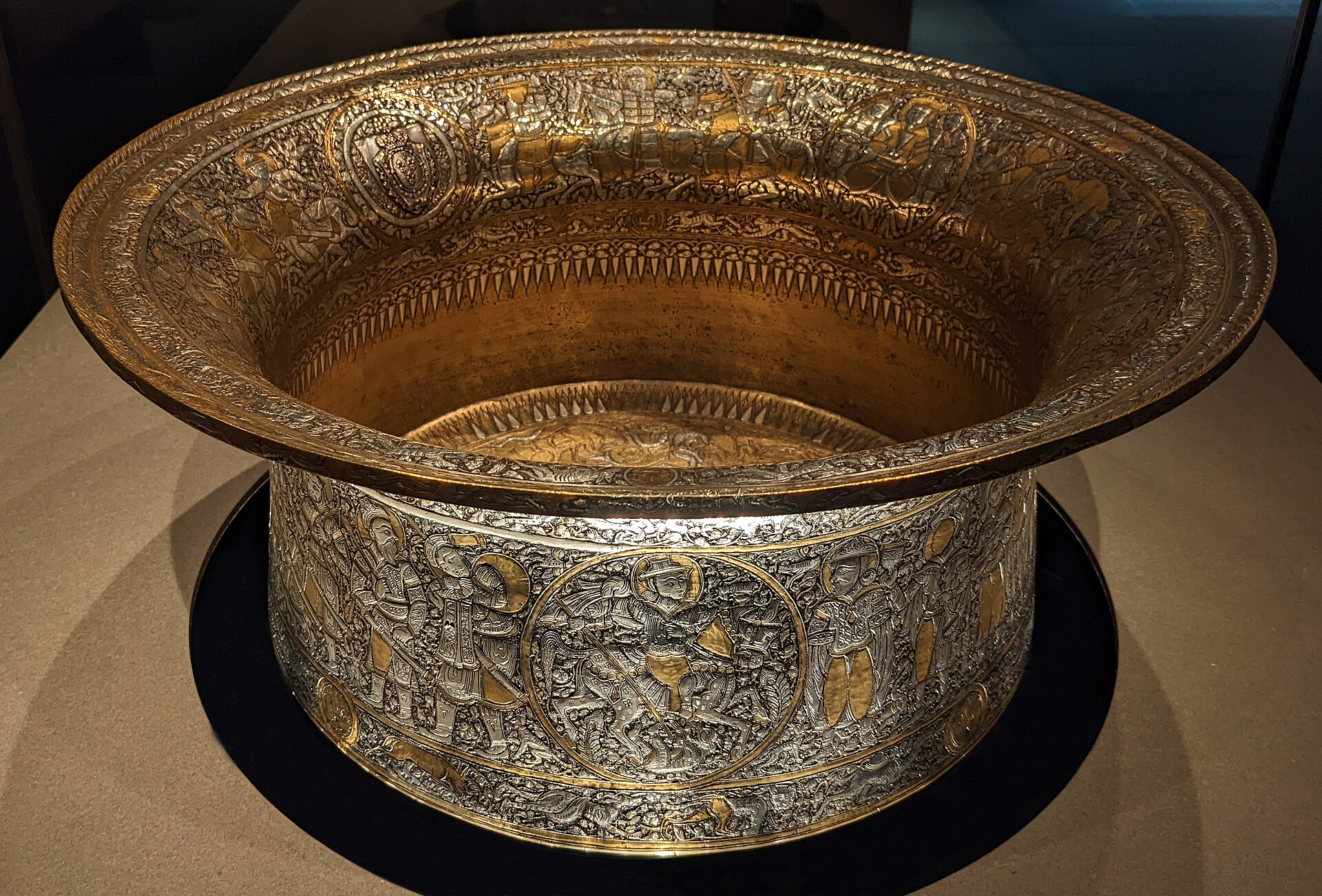
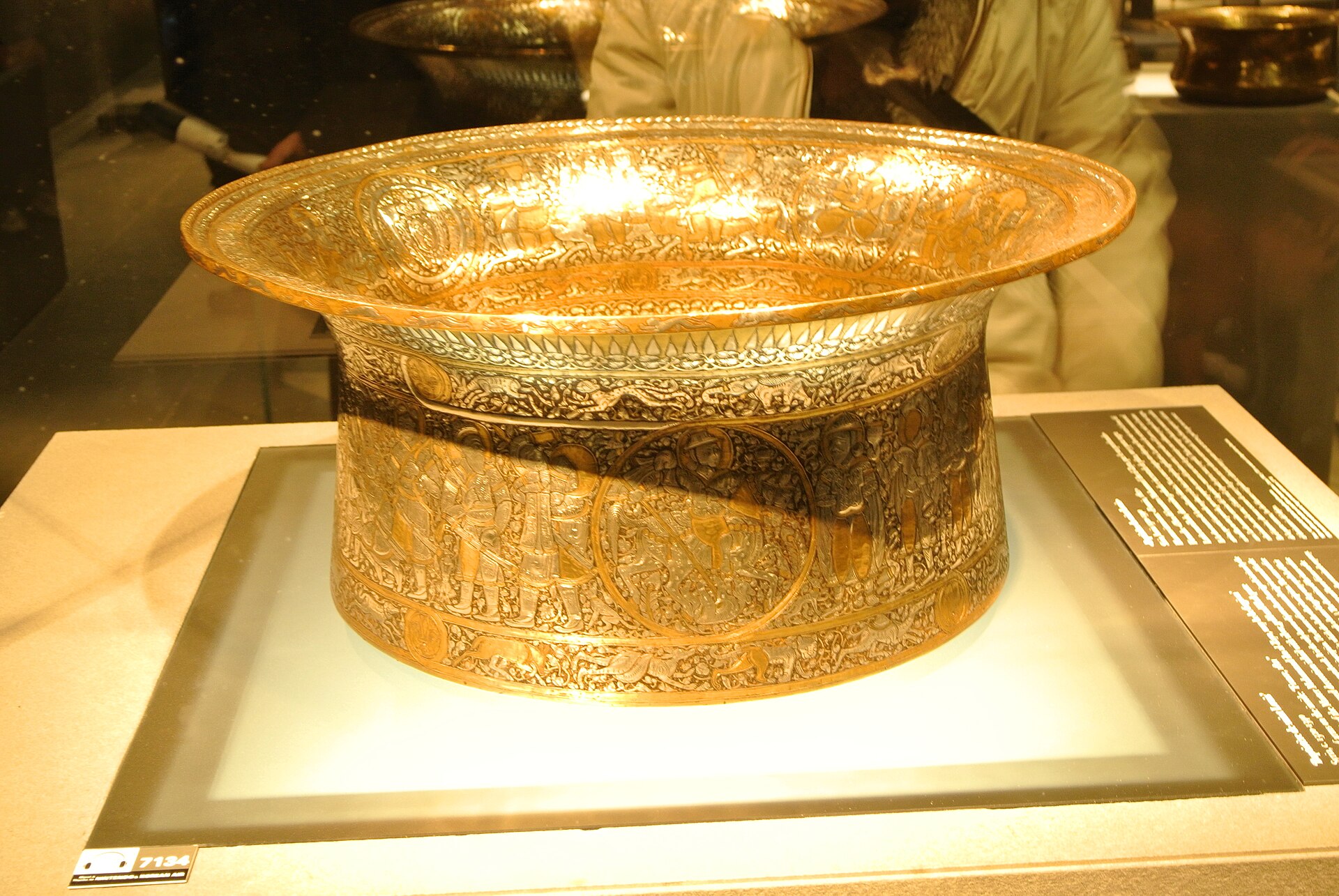
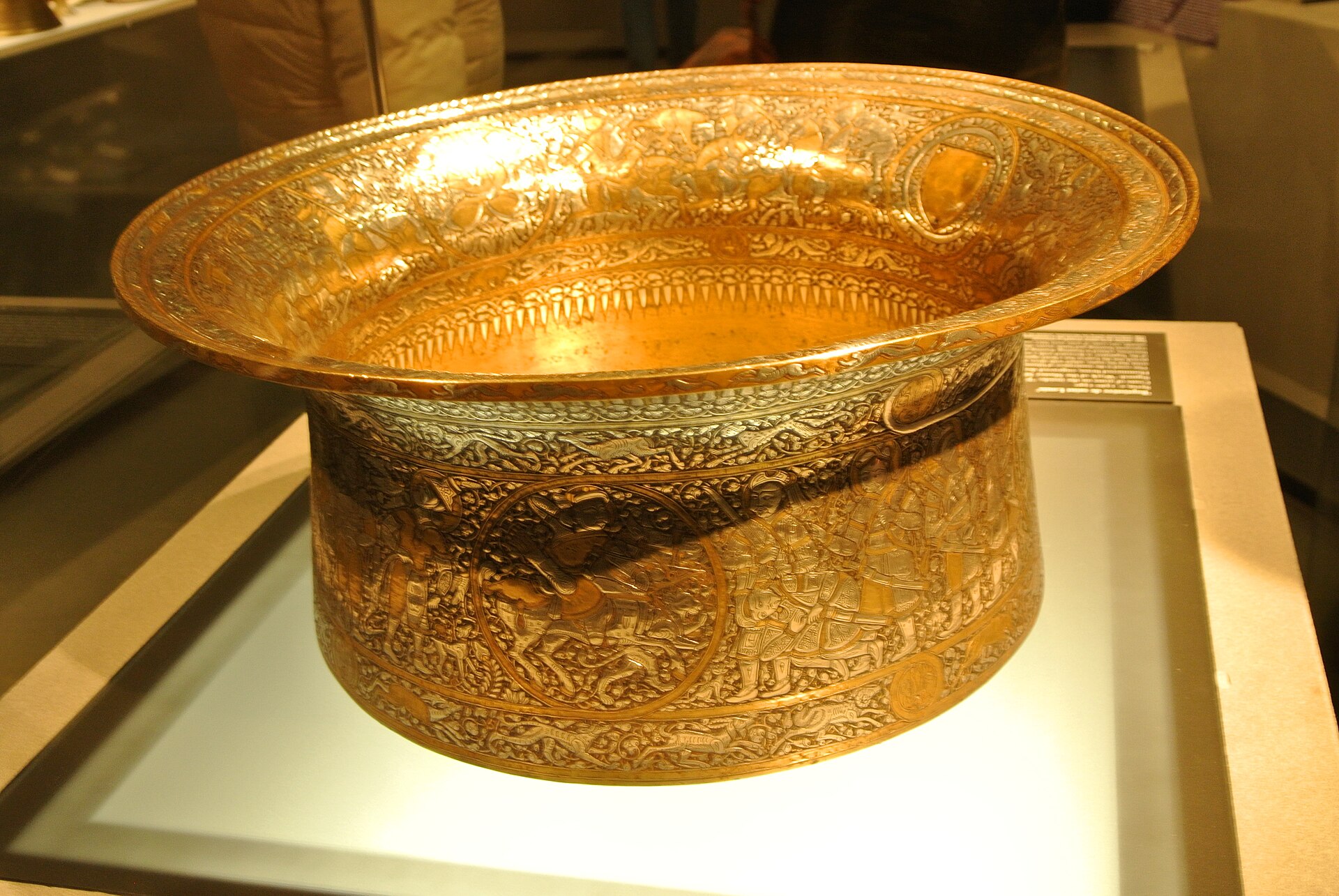
The basin as displayed in the Departement des Arts de l'Islam, Musee du Louvre, Room 186. The file's own title and description identify it explicitly as inventory LP 16, the object described in this record.
| Artist | Muhammad ibn al-Zain |
|---|---|
| Date | Mamluk Egypt or Syria, first half of the 14th century; the Louvre currently dates it circa 1330-1340. Scholars have proposed ranges from circa 1290-1310 to circa 1325-1360; see Open questions. |
| Medium | Hammered brass (a copper alloy), engraved and inlaid with silver, gold, and a black compound (niello or a bituminous black paste, described variously in the literature) |
| Dimensions | Approximately 22 to 24.4 cm in height by 50.2 to 50.5 cm in diameter (sources vary within this range; the Louvre's own record gives 23.2 x 50 cm) |
| Where it is now | Musee du Louvre, Departement des Arts de l'Islam, Paris, Room 186last confirmed 12 September 2026 |
| Inventory number | LP 16 |
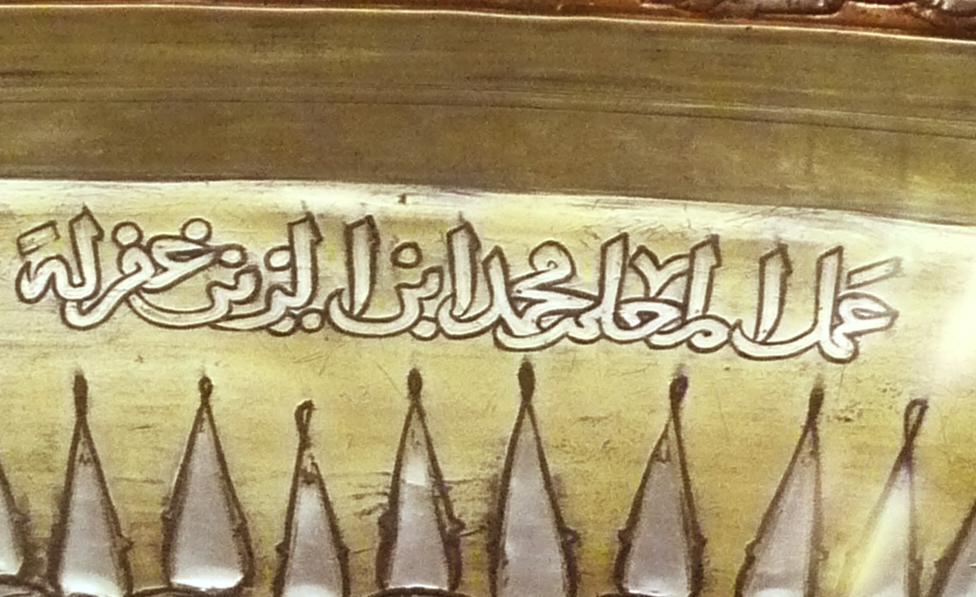
| Attribution | AcceptedSigned six times around the vessel: once in a prominent band in silver letters as the work of the master Muhammad ibn al-Zain, and five further times in smaller lettering as the work of Ibn al-Zain, hidden inside the decoration on objects held by figures in the design. Full note |
| Object type | Islamic metalwork |
| Period | Mamluk, first half of the 14th century |
| Cases | Has a provenance gap · Seized, looted or confiscated · Restituted or repatriated |
| Inscriptions | Six signatures of Muhammad ibn al-Zain (one prominent, five concealed within the decoration); a labelling inscription on the interior reading, in translation, I am a container for carrying food; further inscriptions naming depicted vessels as inkwells. No monumental Quranic or dedicatory inscription naming a patron survives, which is itself part of the scholarly debate over who commissioned it. |
| Owners on record | 7 links5 documented, 2 unknown |
| Sources | 16 cited |
About this record Last verified 12 September 2026 · 16 sources cited · Change log
On this page 10 sections
ContentsClose
A large brass basin, inlaid with gold and silver and covered in hunting and courtly scenes, made in Mamluk Egypt or Syria in the first half of the 14th century and signed six times by its maker, Muhammad ibn al-Zain, an unusually insistent signature for the genre. It carries no name of the ruler or patron who commissioned it, and who that was, and why, has been argued over by specialists for seventy years without agreement.
It is first securely recorded in the French royal treasury of the Sainte-Chapelle de Vincennes around 1440, with no explanation of how a Mamluk basin got there. From 1606 it was used to baptize French royal children, including the future Louis XIII, and it kept that role, on and off, until 1856. It survived the Revolutionary seizure of the royal treasury, entered what became the Louvre in stages across the 19th century, and has been the Islamic Arts department's signature object since the department's galleries opened in 2012.
This is the archive's first Islamic art record. The object it describes is Louvre inventory LP 16 and no other basin: the Louvre holds a second signed work by the same maker under a different inventory number, and at least four other well-known Mamluk basins in other collections are routinely confused with this one online. None of those objects appear in this record's gallery.
Provenance
Each link is graded. Documented: a cited source supports it. Disputed: the identification is argued but not established. Unknown: no owner for that span, and the gap is not smoothed into a narrative. The grades in the glossary.
- first half of the 14th century -Made for an unidentified patron in Mamluk Egypt or Syriaunknown
Signed six times by Muhammad ibn al-Zain. No inscription names the patron who commissioned it. Three scholarly positions on the patron's identity are argued in the literature (Rice: the emir Salar, circa 1290-1310; Behrens-Abouseif: generalised Mamluk courtly furusiyya culture, no named individual; Ward and Makariou: a European Christian patron, possibly Hugh IV of Lusignan, circa 1325-1360). None is documented by a surviving contract, dedication or contemporary record.1234678
- first half of the 14th century - c. 1440Unknownunknown
No owner, transaction or route is documented for roughly a century between the basin's manufacture and its first secure appearance in a French royal inventory. The basin does not appear in the inventory of Charles V of France drawn up before 1380.24
- c. 1440 - 1793French royal treasury, Sainte-Chapelle de Vincennesdocumented
First securely recorded around 1440 in an unpublished inventory of the Sainte-Chapelle de Vincennes treasury; confirmed again in a 1739 sacristy inventory. Used for the baptism of the future Louis XIII at Fontainebleau on 14 September 1606, five years after his birth; a 1606 source records that the font was taken from the treasury of the Sainte-Chapelle of the Chateau of Vincennes, reserved there for the baptism of the Dauphins and children of France.24
- 1793 - 1818Museum national des arts (Revolutionary Louvre), via the Petits-Augustins depotdocumented
Sent from the royal treasury to the Petits-Augustins depot in early 1793 (sources disagree on the exact date, 17 January against 7 March), the rescue operation for art and historical objects run by Alexandre Lenoir. Entered the new Museum national des arts shortly afterward rather than being sent to the mint for melting, unlike much contemporaneous royal precious-metal plate.24
- 1818 - 1852Chateau de Vincennes, by royal order of the restored Bourbon monarchydocumented
Returned to Vincennes in 1818. Used again for the baptism of Henri d'Artois, Duke of Bordeaux, at Notre-Dame de Paris on 1 May 1821; two silver plaques bearing French royal arms were added to the basin for this occasion.24
- 1852 - 1856Musee du Louvre (Musee des Souverains)documented
Transferred permanently to the Louvre in 1852 following a decree of Louis-Napoleon Bonaparte ordering that objects which had belonged to the sovereigns of France be gathered at the Louvre, for the newly created Musee des Souverains. A figure of 1832 for this transfer, sometimes quoted, could not be corroborated against any source consulted in this research pass. Briefly removed from the Louvre in 1856 for its final documented baptismal use, at Notre-Dame de Paris on 14 June 1856, for Napoleon-Eugene, the Prince Imperial, son of Napoleon III.24
- 1856 - presentMusee du Louvre, Departement des Arts de l'Islamdocumented
Held continuously by the Louvre since 1856, catalogued as inventory LP 16. Never sold, privately owned or the subject of any export application in this period; French state property throughout. Displayed in the Departement des Arts de l'Islam's purpose-built galleries since their opening in 2012 and lent for temporary exhibitions in 2025 (Louvre, Paris), 2025-2026 (Abu Dhabi) and 2026 (Louvre-Lens).1510
Prices realised
No auction, private sale, or market transaction of any kind is documented for this object at any point in its recorded history. It has been part of the French royal, then French state, collection continuously since it is first securely recorded around 1440, and part of the Musee du Louvre's own holdings since 1856. No hammer price, premium, insurance valuation, dation or export licence application was found in the sources consulted, because none of the mechanisms that would generate one (a sale, an export request, a tax-relief acquisition) has ever applied to this object.
Technical evidence
| Attribution note | Signed six times around the vessel: once in a prominent band in silver letters as the work of the master Muhammad ibn al-Zain, and five further times in smaller lettering as the work of Ibn al-Zain, hidden inside the decoration on objects held by figures in the design. The density and placement of the signature is unmatched among surviving Mamluk metalwork and is itself treated by scholars as evidence, not just a label. The maker's dates, origin and training are not otherwise documented; everything known about him comes from this basin and one other signed object. |
|---|---|
| Support and technique | Hammered brass (copper alloy), raised and engraved, with the engraved decoration inlaid in silver and gold and finished with a black compound (described in the sources consulted as niello or as a black paste/pastille) to set off the finer lines.123 |
| Dimensions | Approximately 22 to 24.4 cm high by 50.2 to 50.5 cm in diameter; figures vary slightly between publications. The Louvre's own current record gives 23.2 x 50 cm.125 |
| Signature | Six occurrences of the maker's name. One prominent signature in silver letters reads, in translation, the work of the master Muhammad ibn al-Zain, may he be forgiven. Five further, smaller signatures, hidden within the decoration on objects held by depicted figures, read only the work of Ibn al-Zain.12346 |
| Other inscriptions | A labelling inscription on the interior, translated as I am a container for carrying food, and further inscriptions identifying depicted vessels as inkwells (dawah). No monumental Quranic text and no patron's dedication survive on the object.23 |
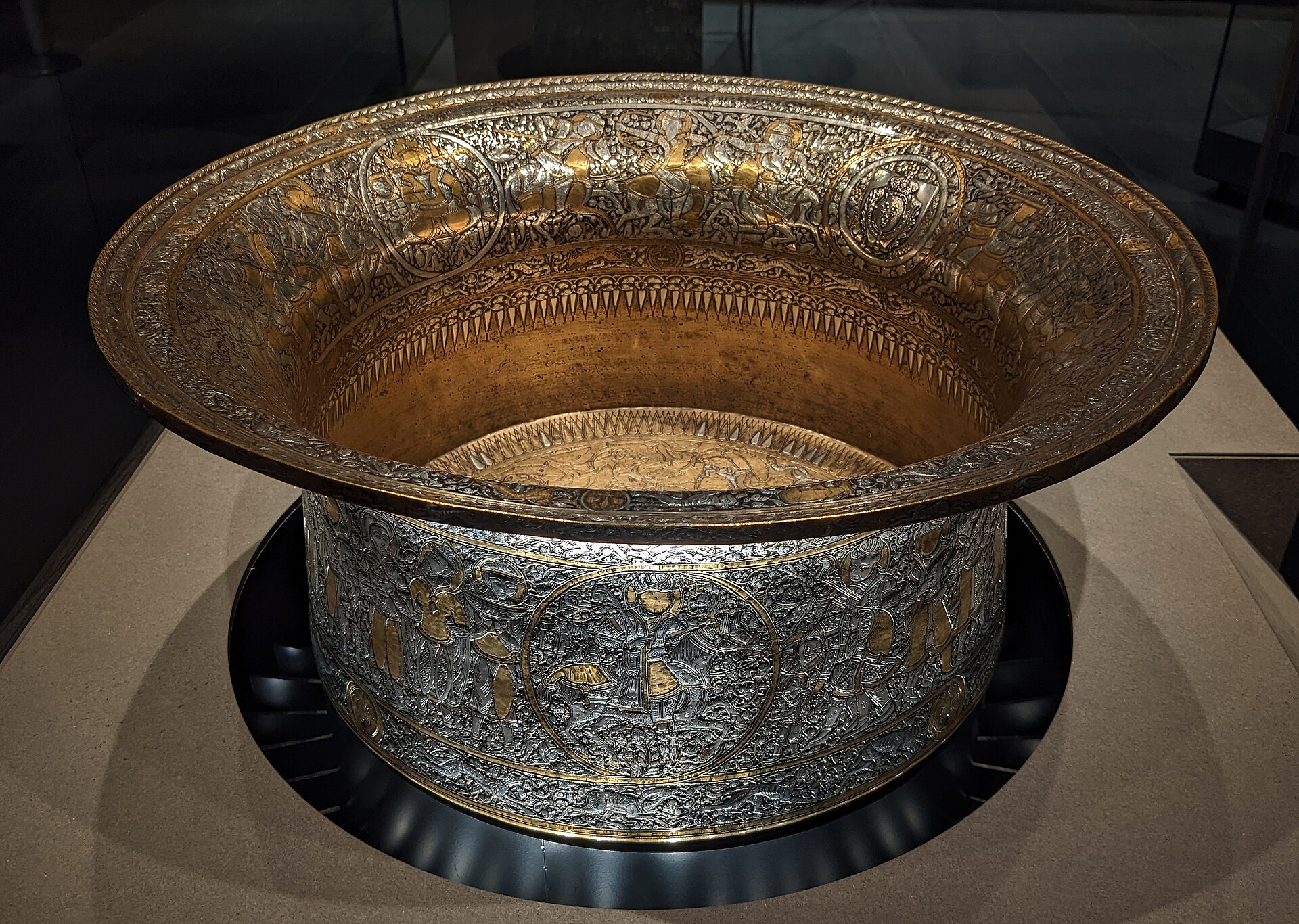
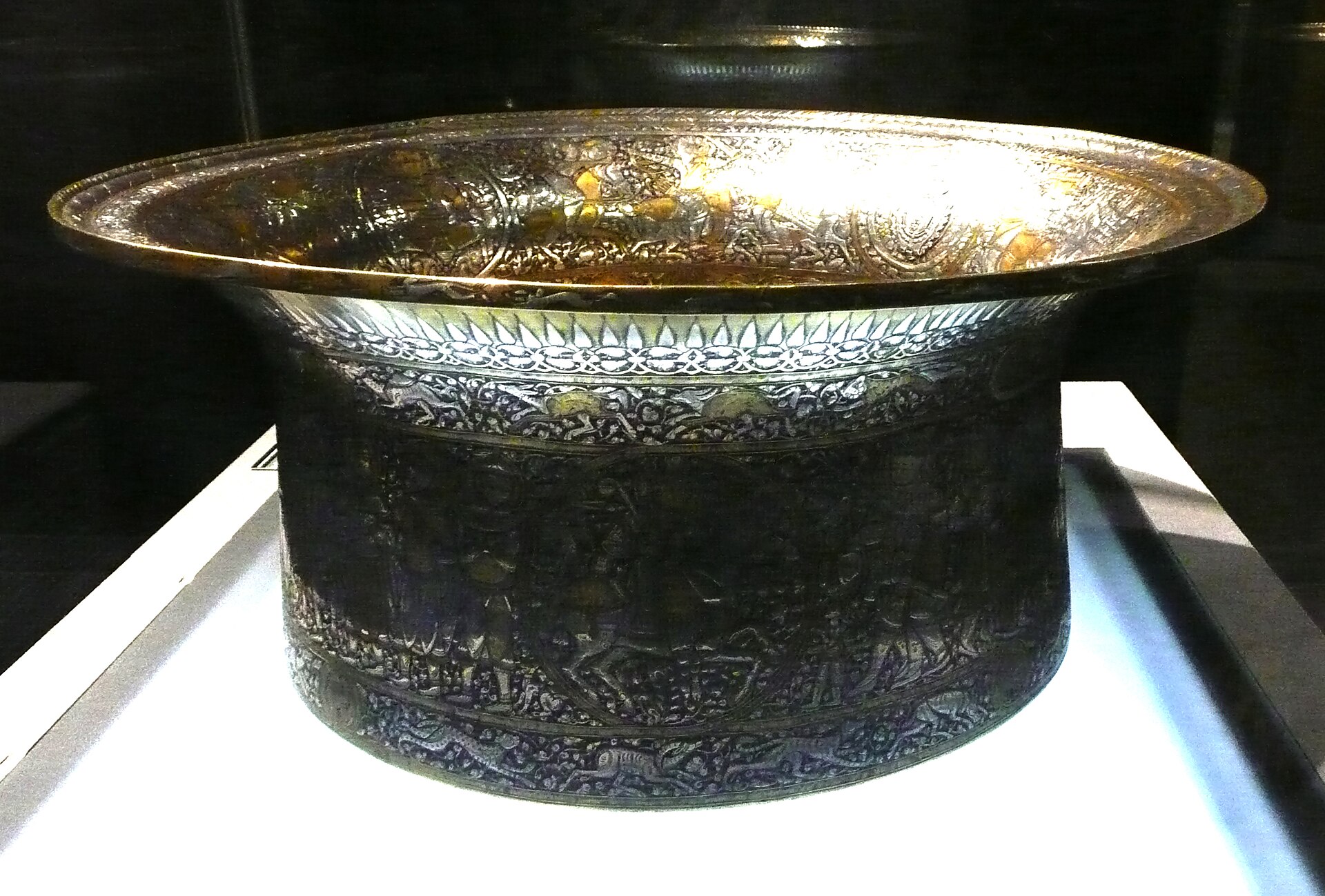
| Decorative program | Outer wall: a frieze of twenty standing figures interrupted by four medallions of mounted huntsmen. Inner wall: four medallions of enthroned rulers with courtiers alternating with four medallions of combat and hunting. Interior floor: a radiating pattern of fish in concentric rings with ducks, crabs, frogs, a crocodile, a pelican, and fantastic creatures (griffins, sphinxes, unicorns, dragons) in the surrounding border.23 |
| Condition and later modification | Two silver plaques bearing French royal arms were added to the basin in 1821 for the baptism of Henri d'Artois, Duke of Bordeaux. This modification is original to the object's documented history rather than a later restoration and is retained.24 |
| Current display | Musee du Louvre, Departement des Arts de l'Islam, Room 186, inventory LP 16. On loan for temporary exhibitions across 2025-2026 (see Narrative, What is happening to it now).1510 |
Images
The record in full
Chapter 1What it is
A basin of hammered brass, wider than it is tall: roughly 23 centimetres high and 50 centimetres across, with gently flaring sides.
A basin of hammered brass, wider than it is tall: roughly 23 centimetres high and 50 centimetres across, with gently flaring sides. Every surface, inside and out, is covered in decoration inlaid in silver and gold with a black compound filling the finer engraved lines. Nothing on it is left plain.
The outer wall carries a wide frieze of twenty standing figures broken by four medallions of mounted huntsmen. The inner wall repeats the scheme at a different scale: four medallions alternate enthroned rulers attended by courtiers with four medallions of combat and hunting. The interior floor is its own composition, unrelated to the walls: a radiating pattern of fish in concentric rings, with ducks, crabs, frogs, a crocodile, a pelican and fantastic creatures, griffins, sphinxes, unicorns and dragons, worked into the borders around them.
It is a basin, not a font. Its curved profile, its size and its decorative program belong to the same class of large inlaid brass vessels Mamluk metalworkers made for washing at court, for water at a banquet, or for presentation. Nothing about its original design serves a baptismal or Christian purpose. That use was added roughly three centuries after it was made, in a country its maker never worked in.
Chapter 2How it was made
The body was raised and hammered from sheet brass, then the decoration was engraved into the surface and the engraved channels packed with silver and gold wire and sheet, finished with a black...
The body was raised and hammered from sheet brass, then the decoration was engraved into the surface and the engraved channels packed with silver and gold wire and sheet, finished with a black compound to set off the finer lines against the bright metal. This is standard Mamluk practice for luxury metalwork of the period, the same technique used on inlaid basins, ewers, candlesticks and pen-boxes made for sultans and emirs across Egypt and Syria.
What sets this basin apart is not the technique but the density of figural work executed in it, and the fact that the maker put his name on it six times. A single prominent signature in silver letters, set where it could not be missed, reads in translation as the work of the master Muhammad ibn al-Zain, may he be forgiven. Five further signatures, in smaller script, are hidden inside the design itself, worked onto objects held by some of the figures, reading only the work of Ibn al-Zain. No other Mamluk metal object approaches this density of signing, and scholars treat it as deliberate: a maker asserting authorship of a piece he clearly considered exceptional, on an object where a patron's name is conspicuously absent.
Chapter 3The decoration, and what it shows
The figures are not generic ornament. The riders in the outer medallions hunt bear, dragon and lion, or play polo.
The figures are not generic ornament. The riders in the outer medallions hunt bear, dragon and lion, or play polo. The standing figures between them wear a mixture of dress: some in turbans consistent with the Mongol-influenced court fashion of the eastern Islamic world in this period, others in tripartite hats and cloaks read by specialists as belonging to a different, non-Mamluk register of costume. The inner medallions pair enthroned rulers, attended by courtiers holding writing boards and swords, with scenes of battle, including a fallen, armoured figure, and hunting.
Doris Behrens-Abouseif reads this cycle as furusiyya, the equestrian and martial culture of the Mamluk military elite, tying the imagery to tournament and ceremony rather than to any single narrated event. Others have read the mixed costumes as a record of a specific diplomatic encounter between the Mamluk court and Mongol or Golden Horde envoys, though no scholar has produced a document that ties the scenes to a named occasion. Both readings are arguments from the imagery itself; neither is confirmed by an inscription naming an event, and this record states both as arguments rather than as fact.
What the basin does not carry is as informative as what it does. There is no monumental Quranic inscription and no formal dedication naming a sultan or emir, the kind of text that appears as a matter of course on other large Mamluk basins made for known patrons, including the two examples this record rules out below. Rachel Ward has argued that this absence, combined with blank heraldic shields left ready to receive a coat of arms that was never added in Mamluk lands, points to a basin made to order for a European buyer rather than for a Mamluk court patron; Sophie Makariou has developed this line further, proposing a specific identification for one of the blazons. Neither reading commands universal agreement, and this record treats the patron question as open.
Chapter 4Who was it made for, and why the question will not close
Three positions have been argued in print since 1951, and none has displaced the others.David Storm Rice, in the founding 1951 monograph, read one of the enthroned figures as a specific Mamluk emir...
Three positions have been argued in print since 1951, and none has displaced the others.
David Storm Rice, in the founding 1951 monograph, read one of the enthroned figures as a specific Mamluk emir, Salar, and dated the basin to around 1290-1310 on that basis, placing it in an Egyptian court context. Doris Behrens-Abouseif, writing in 1989, argued instead that the cycle depicts the generalised courtly and martial culture, furusiyya, associated with the reign of Sultan Baybars, without naming a specific patron. Rachel Ward, in a 1999 paper delivered at a Warburg Institute colloquium on Islam and the Italian Renaissance, proposed a European patron working through Damascus around 1325-1360, naming Hugh IV of Lusignan, the crusader-era king of Cyprus, as a plausible commissioner on the strength of a lion blazon and the absence of Islamic religious text. Sophie Makariou, in her 2012 monograph for the Louvre, took Ward's argument further and proposed a reading of a further heraldic element as a key motif tying the piece more specifically to a Lusignan commission.
Each of these is a named scholar's argument, not a settled attribution, and each rests on reading the same fixed set of images and a small number of inscriptions differently. This record states who holds which position and does not choose between them.
Chapter 5The century that is missing
The basin does not appear in the inventory Charles V of France had drawn up before his death in 1380, which is the closest thing to a negative control this record has: a documented royal inventory of...
The basin does not appear in the inventory Charles V of France had drawn up before his death in 1380, which is the closest thing to a negative control this record has: a documented royal inventory of the correct period that does not mention it. It is first securely documented in an unpublished inventory of the treasury of the Sainte-Chapelle de Vincennes around 1440, already in French royal hands, with no explanation offered anywhere in the literature consulted for how it got there.
Between a manufacture date in the first half of the 14th century and a first French record around 1440 lies a gap of roughly a century, in a country its Mamluk maker never worked in, for which no owner, transaction or route is documented. This record does not attempt to fill it.
Chapter 6A basin made for royal children
The basin's later French name has nothing to do with Louis IX, the sainted 13th-century king known as Saint Louis; he has no documented connection to the object, and the name was attached only in the...
The basin's later French name has nothing to do with Louis IX, the sainted 13th-century king known as Saint Louis; he has no documented connection to the object, and the name was attached only in the 18th century once the basin's use for royal baptisms was established. It is a case of a title migrating onto an object for reasons of association rather than fact, exactly the kind of naming confusion this archive exists to record and correct.
Three uses as a royal baptismal font are documented. On 14 September 1606, at Fontainebleau, it was used to baptize the future Louis XIII, five years after his birth; a contemporary source states plainly that the font was taken from the treasury of the Sainte-Chapelle of the Chateau of Vincennes, which is kept there to baptize only the Dauphins and children of France. On 1 May 1821, at Notre-Dame de Paris, it was used for the baptism of Henri d'Artois, Duke of Bordeaux, the Bourbon claimant later known as the Comte de Chambord; two silver plaques bearing French royal arms were added to the basin for this occasion, a physical modification that is now part of the object's condition. On 14 June 1856, again at Notre-Dame, it was used for the last time, for the baptism of the Prince Imperial, Napoleon-Eugene, son of Napoleon III, an Empire borrowing a Bourbon and Mamluk object for the same dynastic purpose.
Three documented baptisms across two hundred and fifty years and three different regimes, Bourbon, Restoration and Second Empire, is the actual record. Broader claims sometimes made for the object, that it baptized every French king or was used continuously since the Middle Ages, are not supported by the sources consulted and are not repeated here.
Chapter 7How it survived the Revolution
The French Revolution's Convention ordered the royal treasuries stripped and their precious-metal plate sent to the Monnaie to be melted for the war effort and for coin; this is well documented for...
The French Revolution's Convention ordered the royal treasuries stripped and their precious-metal plate sent to the Monnaie to be melted for the war effort and for coin; this is well documented for royal silver and gold generally. The basin's survival through that process, given that it sat in exactly the kind of royal treasury being emptied, is worth stating plainly as a real question rather than assuming an answer.
What is documented is the mechanism, not the reasoning: in early 1793 (sources disagree on the exact date, 17 January against 7 March) the basin was sent not to the mint but to the depot at the former convent of the Petits-Augustins in Paris, the operation run by the antiquarian Alexandre Lenoir to salvage objects of artistic and historical interest that would otherwise have been destroyed or melted, and which became the nucleus of his Musee des Monuments Francais. It entered the new Museum national des arts, the Revolutionary Louvre, within days of arriving at the depot.
No source consulted states explicitly why this basin, made of brass with comparatively modest bullion value once its base metal is separated from its inlay, was routed to Lenoir's rescue operation rather than to the smelter alongside gold and silver plate of no other distinction. The likeliest reading, consistent with Lenoir's documented mission, is that the object was already understood by 1793 as a historical and artistic curiosity rather than as bullion, precisely because its brass carried no meaningful melt value; this record states that as the likeliest reading, not as a documented fact, because no source gives the Revolutionary commissioners' reasoning in the basin's own case.
Chapter 8Vincennes, the Restoration, and back to the Louvre
The basin did not stay in the Revolutionary Louvre.
The basin did not stay in the Revolutionary Louvre. In 1818, under the restored Bourbon monarchy, it was sent back to Vincennes by royal order, which is where it was three years later for the 1821 baptism of the Duke of Bordeaux. It remained there through the July Monarchy.
In 1852 it was transferred permanently to the Louvre, following a decree of Louis-Napoleon Bonaparte, shortly before he took the title Napoleon III, ordering that all objects that had belonged to the sovereigns who had ruled France be gathered and placed in the Louvre, for display in the new Musee des Souverains. That transfer, not a single Revolutionary seizure, is the basin's actual route into the collection that holds it today; a widely repeated figure of 1832 for this transfer could not be corroborated against any source consulted in this research pass, and this record follows the two independently sourced accounts (the Louvre's own published exhibition text and the French Wikipedia synthesis of the secondary literature) that give 1852 and the Napoleon III decree.
Chapter 9From royal font to national icon
After its last baptismal use in 1856 the basin settled into the Louvre's holdings as a museum object rather than a functioning piece of royal plate.
After its last baptismal use in 1856 the basin settled into the Louvre's holdings as a museum object rather than a functioning piece of royal plate. It is catalogued today as LP 16 in the Departement des Arts de l'Islam, a department the Louvre only established as a distinct curatorial unit in 2003 and gave purpose-built galleries in 2012, in the Cour Visconti. The basin is consistently presented as the department's signature object, illustrated on its own museum-shop stationery and used as the lead image for major Mamluk exhibitions.
It has been State property, never privately owned or sold, since at least 1793, and this record found no auction, private sale, insurance valuation, dation or export application anywhere in its documented history. There is nothing to correct on a market history that does not exist; the object has simply never left French national ownership since it is first securely recorded.
Chapter 10The scholarship: Rice, and everyone who came after
David Storm Rice's 1951 monograph, Le Baptistere de Saint Louis, published by Editions du Chene in a limited edition of 1,000 copies with 40 plates, remains the foundational technical study and is...
David Storm Rice's 1951 monograph, Le Baptistere de Saint Louis, published by Editions du Chene in a limited edition of 1,000 copies with 40 plates, remains the foundational technical study and is still cited by the Louvre's own catalogue record as the most complete illustrated reference to the object, more than seventy years after publication. Rice's Egyptian attribution and his identification of a depicted figure as the emir Salar have not held up as consensus, but his documentation of the decoration and the six signatures underlies every study that followed.
Doris Behrens-Abouseif's 1989 furusiyya reading, Rachel Ward's 1999 case for a European export commission, and Sophie Makariou's 2012 monograph for the Louvre (in the museum's Solo series) developing Ward's Lusignan hypothesis, represent three successive revisions of Rice's frame rather than a single line of agreed progress. Carine Juvin's 2022 chapter, The Baptistere de Saint Louis: The Making of a Historical Monument, published in Rediscovering Objects from Islamic Lands in Enlightenment Europe (Routledge, edited by Isabelle Dolezalek and Mattia Guidetti), turns the lens onto the object's own historiography and collecting history rather than its patron, tracing how and when it came to be treated as a monument in the modern sense. Anna Klosowska's 2019 essay in Literature Compass reads the basin through a literary and postcolonial lens, as a case study in how a medieval object accrues meanings its maker never intended; this record treats that reading as a documented later interpretation, not as evidence about the 14th-century maker's or patron's intent.
Chapter 11What is happening to it now
The basin has been in active exhibition circulation through 2025 and into 2026.
The basin has been in active exhibition circulation through 2025 and into 2026. The Louvre's own Mamlouks, 1250-1517 exhibition ran in Paris from April to July 2025; a related exhibition, Mamlouks: l'heritage d'un empire, was shown in Abu Dhabi from September 2025 to January 2026; and a further exhibition, Par-dela les mille et une nuits, was shown at the Louvre-Lens satellite museum from March to July 2026, with the Louvre's own published material for that exhibition naming this basin, under its Une icone ambigue label, as one of the works illustrated. As of the date this record was last verified, the loan cycle for the Louvre-Lens exhibition has concluded and the basin's base location remains the Departement des Arts de l'Islam in Paris; no source consulted gives an exact return date, which this record flags rather than assumes.
Chapter 12What is still unresolved
The patron question, the exact date within a range spanning several decades, the century-long gap before 1440, and the reasoning behind the object's Revolutionary survival are all open on the...
The patron question, the exact date within a range spanning several decades, the century-long gap before 1440, and the reasoning behind the object's Revolutionary survival are all open on the evidence available. So is the precise identity of the maker beyond his own signature. None of these gaps are filled here with invention; they are listed as open questions below.
The artist
Muhammad ibn al-Zain (also transliterated ibn al-Zayn)
Everything documented about this maker comes from two signed objects and nothing else. No biographical record, no other attributed piece outside those two, and no independent mention in a contemporary chronicle has been found in the sources consulted. He is known only through his own hand and his own insistence on naming himself, which is itself unusual enough in this genre of Mamluk metalwork to be treated by scholars as a fact about him worth explaining.
Related works
| Work | Relation | Where it is |
|---|---|---|
| Vasselot Bowl Muhammad ibn al-Zain | The only other object securely signed by the same maker A different inventory number and a different object from this basin; do not conflate the two when sourcing an image or a fact for either. | Musee du Louvre, Departement des Arts de l'Islam, inventory MAO 331 |
| Unfinished basin (attributed) Attributed to Muhammad ibn al-Zain | Stylistic attribution only, no signature; reportedly abandoned owing to a crack in the metal Attribution graded argued, not documented, in this record. | L.A. Mayer Memorial Institute for Islamic Art, Jerusalem |
| Basin in the name of Hugh IV of Lusignan Mamluk workshop, unattributed | Named comparandum in the European-patron reading of this basin's own commission (Ward, Makariou) A different basin, for a documented named European patron, used by scholars as a comparison case, not as evidence about who commissioned LP 16 itself. | Musee du Louvre, Departement des Arts de l'Islam, inventory MAO 101 |
| D'Arenberg Basin Unattributed Ayyubid workshop | Earlier, unrelated inlaid basin, sometimes confused with this one because of the shared basin form and inlay technique VERSION SAFETY: Ayyubid, made for Sultan al-Malik al-Salih Najm al-Din Ayyub circa 1247-1249, roughly a century earlier than the Baptistere de Saint Louis and by a different, unnamed workshop. Not this object; ruled out for any image use in this record. | Smithsonian National Museum of Asian Art (Freer Gallery), Washington, accession F1955.10 |
| Basin made for a son of al-Nasir Muhammad Unattributed Mamluk workshop | Comparable large inlaid Mamluk basin of a similar date, in the same museum group commonly cited alongside this one VERSION SAFETY: Dated circa 1340-1350, inscribed for a son of Sultan al-Nasir Muhammad ibn Qalawun in stately thuluth script covering the whole vessel. Larger in diameter (57 cm) than LP 16 and carries a formal royal dedication LP 16 lacks. Not this object; ruled out for any image use in this record. | Smithsonian National Museum of Asian Art (Freer Gallery), Washington, accession F2017.12 |
| Basin of Sultan al-Nasir Muhammad Unattributed Mamluk workshop | The sultan's own basin, frequently illustrated alongside this one as a comparandum for Mamluk basin production VERSION SAFETY: Acquired 1851, one of the first pieces of Islamic metalwork to enter the British Museum's collection. Carries the sultan's name and titles in monumental thuluth script, which LP 16 does not. Not this object; ruled out for any image use in this record. | British Museum, London, registration W.1851-0104-1 |
| Mamluk brass basin Unattributed Mamluk workshop | Comparable Cairo- or Damascus-made inlaid basin, smaller and on three feet VERSION SAFETY: Purchased 1898, 18.5 x 42.5 cm, carries an extended calligraphic dedication to an unnamed ruler in formal epithets. Smaller than LP 16 and a different object. Not this object; ruled out for any image use in this record. | Victoria and Albert Museum, London, museum number 740-1898 |
Open questions
- Who commissioned the basin, and for what purpose? Rice proposed the emir Salar; Behrens-Abouseif reads a generalised furusiyya court culture rather than a named patron; Ward and Makariou argue for a European Christian patron, possibly Hugh IV of Lusignan. No inscription names a patron, and none of the three positions has displaced the others.
- What is the correct date? Proposals range from circa 1290-1310 (Rice) to circa 1325-1360 (Ward); the Louvre's own current label gives circa 1330-1340. The range spans up to seventy years depending on which scholar's patron theory is accepted.
- Where was the basin between its manufacture in Mamluk lands and its first secure French record in the Sainte-Chapelle de Vincennes treasury around 1440? No owner, transaction or route across this roughly century-long gap has been documented in any source consulted.
- Why did the basin survive the Revolutionary stripping of the royal treasuries when so much precious-metal royal plate was sent to be melted? No source consulted gives the Convention's or its commissioners' stated reasoning in this specific case; this record offers an inference (its brass carried little melt value and it may already have been read as a historical curiosity) but does not present that inference as documented fact.
- On what exact date in 1793 did the basin leave the royal treasury for the Petits-Augustins depot? Sources disagree, giving 17 January and 7 March; this record has not been able to reconcile the two.
- Is the identification of Muhammad ibn al-Zain with a Damascus ironworker active 1340-1359 correct? The literature consulted treats this as questionable, since it would require the same individual to have worked at a master's level in both iron and inlaid brass metalwork, a combination with no known parallel.
- Did Muhammad ibn al-Zain make this basin himself or with a workshop of assistants working under his name? Nothing in the sources consulted addresses the scale of labour behind a single signed master's name on a piece of this size and decorative density.
Questions about this object
What is Basin known as the Baptistere de Saint Louis?
Basin known as the Baptistere de Saint Louis is an islamic metalwork, dated mamluk Egypt or Syria, first half of the 14th century; the Louvre currently dates it circa 1330-1340. Scholars have proposed ranges from circa 1290-1310 to circa 1325-1360; see Open questions.. Medium: Hammered brass (a copper alloy), engraved and inlaid with silver, gold, and a black compound (niello or a bituminous black paste, described variously in the literature).
Who made Basin known as the Baptistere de Saint Louis, and is the attribution settled?
The attribution to Muhammad ibn al-Zain is recorded here as accepted. Signed six times around the vessel: once in a prominent band in silver letters as the work of the master Muhammad ibn al-Zain, and five further times in smaller lettering as the work of Ibn al-Zain, hidden inside the decoration on objects held by figures in the design. The density and placement of the signature is unmatched among surviving Mamluk metalwork and is itself treated by scholars as evidence, not just a label. The maker's dates, origin and training are not otherwise documented; everything known about him comes from this basin and one other signed object.
Where is Basin known as the Baptistere de Saint Louis now?
Musee du Louvre, Departement des Arts de l'Islam, Paris, Room 186. Inventory number LP 16. Last confirmed 12 September 2026. French state collection; transferred permanently to the Louvre in 1852 following a decree of Louis-Napoleon Bonaparte. On loan for temporary exhibitions in 2025-2026 (see Narrative). Confirmed 2026-09-12: the basin is due to travel to the Smithsonian's National Museum of Asian Art, Washington D.C., as part of "From the Louvre: Masterpieces of Islamic Art" (26 objects), opening 26 September 2026 and running through 18 January 2027, co-curated by Souraya Noujaim (Louvre) and Simon Rettig (National Museum of Asian Art) - its first public loan to the United States.
What is still unknown about Basin known as the Baptistere de Saint Louis?
Who commissioned the basin, and for what purpose? Rice proposed the emir Salar; Behrens-Abouseif reads a generalised furusiyya court culture rather than a named patron; Ward and Makariou argue for a European Christian patron, possibly Hugh IV of Lusignan. No inscription names a patron, and none of the three positions has displaced the others.
Sources
- 1Musee du Louvre, collections website, object record for Bassin dit Baptistere de Saint Louis, inventory LP 16, Departement des Arts de l'Islam. collections.louvre.fr/en/...
- 2Wikipedia, Baptistere de Saint Louis (English), consolidating the physical description, patron debate, signature detail, provenance chronology and scholarly citations. Flagged for replacement with the primary monographs (Rice 1951, Makariou 2012) where a claim needs a firmer citation. en.wikipedia.org/wiki/...
- 3Smarthistory, Muhammad ibn al-Zain, Basin (Baptistere de Saint Louis). smarthistory.org/mohammed-ibn-al-zain-basin-baptistere-de...
- 4Wikipedia, Baptistere de Saint Louis (French), for the detailed provenance chronology (1793 seizure, 1818 return to Vincennes, 1821 baptism and repair, 1852 transfer, 1856 final baptismal use) and the patron-debate scholarship sequence (Rice, Ward, Makariou). Flagged as a tertiary synthesis; replace with Juvin 2022 and Makariou 2012 directly where possible. fr.wikipedia.org/wiki/...
- 5Musee du Louvre, exhibition feature, Une icone ambigue, Bassin dit Baptistere de Saint Louis, part of the Mamlouks 1250-1517 exhibition materials. louvre.fr/expositions-et-evenements/...
- 6D.S. Rice, Le Baptistere de Saint Louis: Un chef-d'oeuvre de l'art musulman, Paris, Editions du Chene, 1951 (limited edition of 1,000 copies, 40 plates). The foundational monograph; cited here via its bibliographic record and later scholarship's engagement with it, not read directly in the original. persee.fr/doc/...
- 7Rachel Ward, The Baptistere de Saint Louis: A Mamluk Basin Made for Export to Europe, in Islam and the Italian Renaissance, Warburg Institute Colloquia, 1999. Cited here via its bibliographic record and later scholarship's summary of its argument (European Christian patron, possibly Hugh IV of Lusignan), not read directly in the original. britishmuseum.org/collection/...
- 8Sophie Makariou, Le baptistere de Saint Louis, Paris, Musee du Louvre editions, Collection Solo, 2012. Cited here via its publisher's bibliographic listing and later scholarship's summary of its argument, not read directly in the original. babelio.com/livres/...
- 9British Museum Images, catalogue description referencing the Vasselot Bowl (Louvre MAO 331) as the second inlaid brass object signed by Muhammad ibn al-Zain, and describing his characteristic style. bmimages.com/preview.asp
- 10Search aggregation of press and institutional listings for the exhibitions Mamlouks 1250-1517 (Louvre, Paris, 2025), Mamlouks: l'heritage d'un empire (Abu Dhabi, 2025-2026) and Par-dela les mille et une nuits (Louvre-Lens, 2026), each of which lists this basin among works shown. Flagged as a secondary aggregation; replace with each exhibition's own checklist where available. louvre.fr/expositions-et-evenements/...
- 11Smithsonian National Museum of Asian Art (Freer Gallery), collection record for the D'Arenberg Basin, accession F1955.10, Ayyubid, circa 1247-1249. Used here only as a version-safety comparandum, to confirm this is a different, earlier object from the Baptistere de Saint Louis. asia.si.edu/explore-art-culture/...
- 12Smithsonian National Museum of Asian Art (Freer Gallery), collection record for a basin made for a son of Sultan al-Nasir Muhammad ibn Qalawun, accession F2017.12, circa 1340-1350. Used here only as a version-safety comparandum. asia-archive.si.edu/collections/...
- 13British Museum, collection record for a basin bearing the name and titles of Sultan al-Nasir Muhammad, registration W.1851-0104-1, acquired 1851. Used here only as a version-safety comparandum. britishmuseum.org/collection/...
- 14Victoria and Albert Museum, collection record for a Mamluk brass basin, museum number 740-1898, purchased 1898. Used here only as a version-safety comparandum. collections.vam.ac.uk/item/...
- 15Anna Klosowska, Muhammad ibn al-Zain's basin (baptistere de Saint Louis), Literature Compass, 2019, a literary and postcolonial reading of the object's reception. Cited here via its published abstract and DOI record, not read directly in full. compass.onlinelibrary.wiley.com/doi/...
- 16My Modern Met, "26 Islamic Art Masterpieces From the Louvre Are Coming to the Smithsonian" (tertiary press coverage; flagged for replacement with the National Museum of Asian Art's own exhibition page, which returned a bot/verification wall on both a direct fetch and the in-app browser at the time of this check). mymodernmet.com/louvre-islamic-art-smithsonian-exhibition
Last verified 12 September 2026 · Published 5 August 2026
Change log
5 August 2026 - Record created at the house standard: researched narrative, technical evidence, maker dossier, graded provenance chain, prices with hammer and premium separated, related works, open questions and sources.
12 September 2026 - Re-verification pass: confirmed via press coverage (My Modern Met, citing the Smithsonian's own exhibition announcement) that the basin travels to the Smithsonian's National Museum of Asian Art for "From the Louvre: Masterpieces of Islamic Art," 26 September 2026 - 18 January 2027 - its first public loan to the US. The National Museum of Asian Art's own exhibition page returned a bot/verification wall on both a direct fetch and the in-app browser and could not be read directly; the press source is flagged for replacement with it. No change to attribution or the documented provenance chain.