The Bayeux Tapestry
Unknown English embroiderers, made under the patronage of Bishop Odo of Bayeux · c. 1067-1082, on the evidence of the Domesday connections of named minor figures in the design; probably finished in time for the dedication of Bayeux Cathedral on 14 July 1077, though this date is an inference, not a documented fact
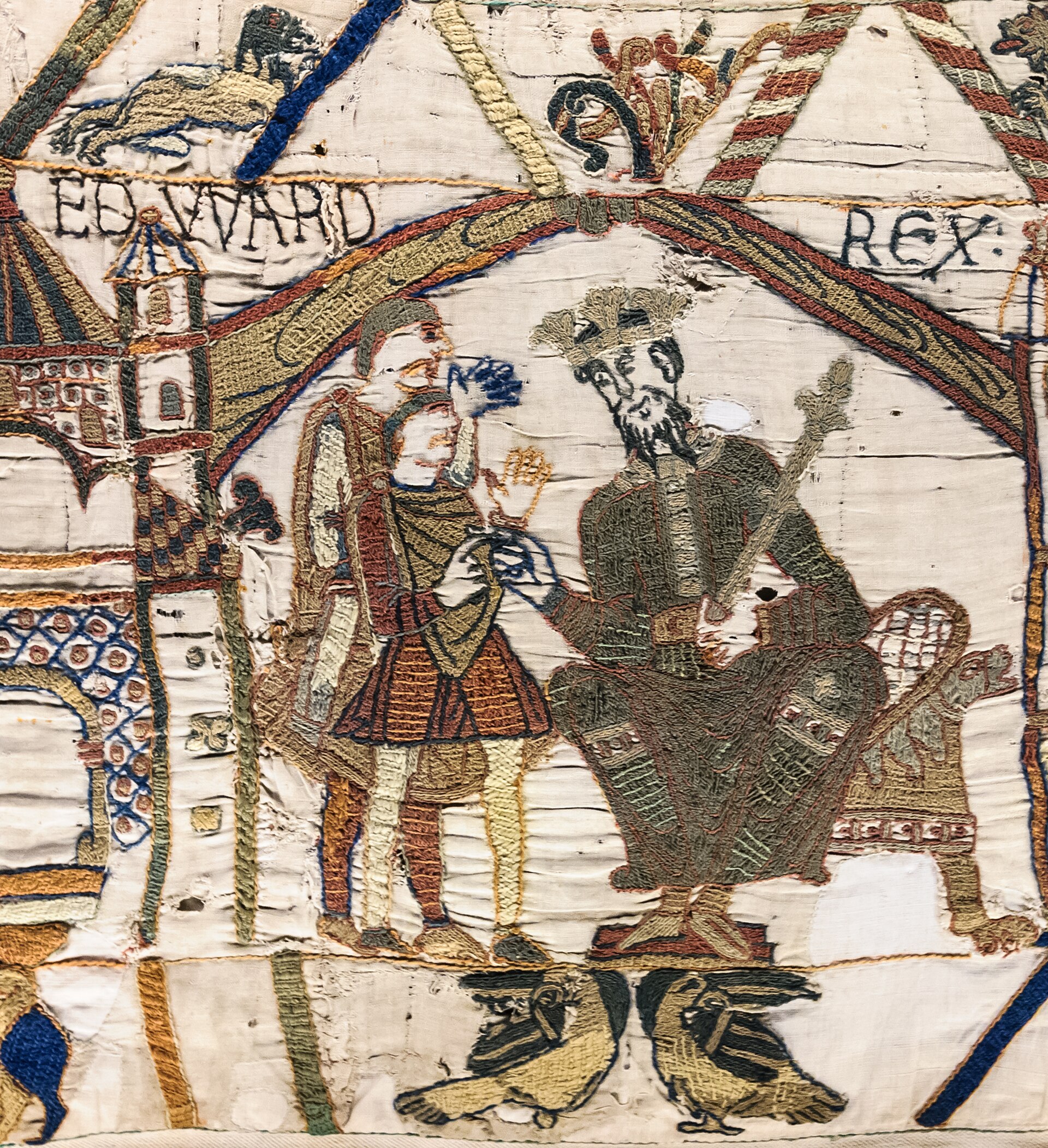
The opening scene of the tapestry: Edward the Confessor, enthroned, sending Harold to Normandy. Photographed at the Musee de la Tapisserie de Bayeux in 2013.
| Artist | Unknown English embroiderers, made under the patronage of Bishop Odo of Bayeux |
|---|---|
| Date | c. 1067-1082, on the evidence of the Domesday connections of named minor figures in the design; probably finished in time for the dedication of Bayeux Cathedral on 14 July 1077, though this date is an inference, not a documented fact |
| Medium | Wool crewel yarn embroidered onto a tabby-woven linen ground; stem stitch and chain stitch for outlines and lettering, laid-and-couched work (locally called the Bayeux stitch) to fill the larger coloured areas. It is worked, not woven, and is an embroidery rather than a tapestry in the technical sense of the word |
| Dimensions | 68.38 x 0.5 m (224.3 x 1.6 ft) as it survives, in nine joined linen panels ranging from about 3 to 14 m in length, the seams disguised with additional stitching. It is generally believed to have run somewhat longer originally; the final scene, thought to have shown William's coronation, is lost |
| Where it is now | On loan to the British Museum, London, 10 September 2026 to July 2027; its permanent home is the Musee de la Tapisserie de Bayeux, Normandy, Francelast confirmed 8 August 2026 |
| Inventory number | Not published in the sources consulted for this record |
| Attribution | DisputedThe leading theory, established by mid-twentieth-century scholarship, holds that the hanging was commissioned by Bishop Odo of Bayeux, William the Conqueror's half-brother, and embroidered by English needleworkers, probably in or near Canterbury. Full note |
| Object type | Textile |
| Period | Anglo-Norman, eleventh century |
| Cases | Disputed attribution · Has a provenance gap · Seized, looted or confiscated |
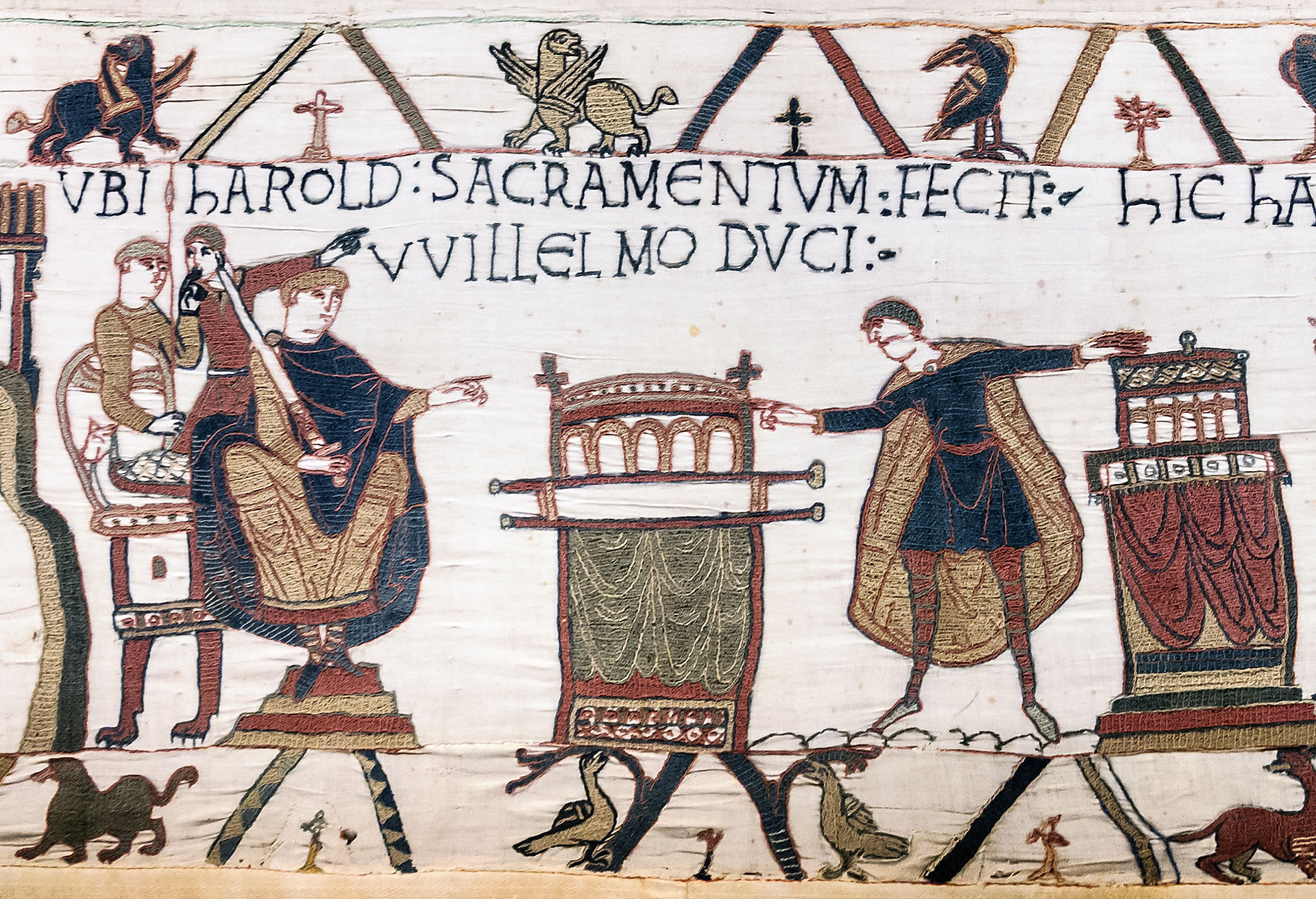
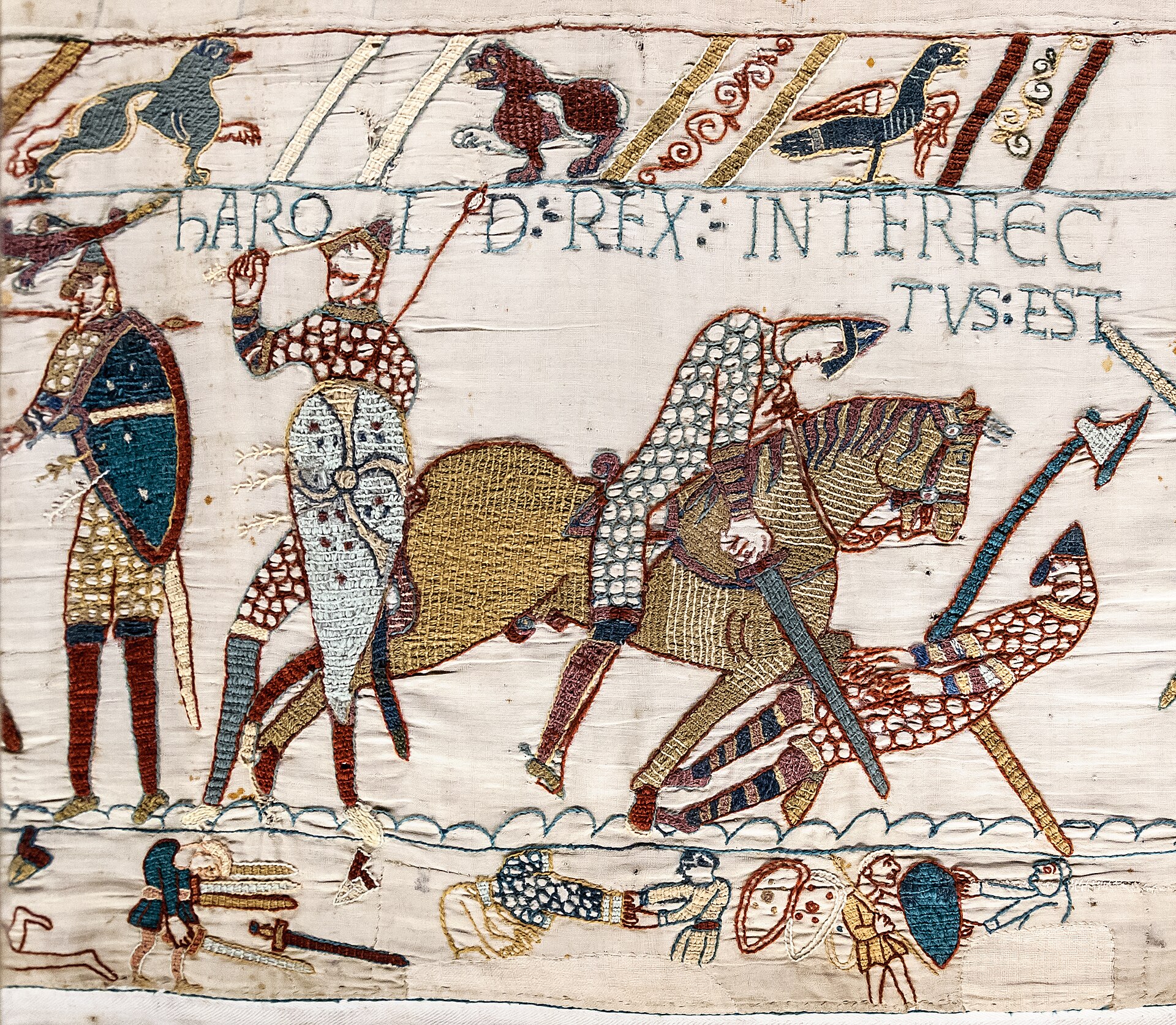
| Inscriptions | Latin captions in stem stitch above the main frieze naming the participants and narrating the action, including EDWARD REX, HAROLD REX, WILLELM DUX and the oath caption VBI HAROLD SACRAMENTVM FECIT WILLELMO DUCI (where Harold made an oath to Duke William) |
| Owners on record | 10 links7 documented, 2 disputed, 1 unknown |
| Sources | 25 cited |
About this record Last verified 8 August 2026 · 25 sources cited · Change log
On this page 9 sections
ContentsClose
Almost 70 metres of eleventh-century wool on linen, telling the story of the Norman Conquest with Harold's broken oath at its moral centre and the Battle of Hastings as its climax. It is an embroidery, not a woven tapestry, and no one alive has ever seen it as new: the last scene is missing, roughly a tenth of the surviving stitching is nineteenth-century repair, and the earliest firm record of its existence dates from 1476, four centuries after it was made.
It has been nearly cut up for a wagon cover in the French Revolution, paraded through Paris by Napoleon as invasion propaganda, hunted by Himmler's SS in the last days of the occupation of Paris, and is now, as of August 2026, on loan to the British Museum for the first time it has left France since it was made - a loan French conservators spent years arguing was too dangerous to attempt.
Provenance
Each link is graded. Documented: a cited source supports it. Disputed: the identification is argued but not established. Unknown: no owner for that span, and the gap is not smoothed into a narrative. The grades in the glossary.
- c. 1067 - c. 1082Made for Bishop Odo of Bayeuxdisputed
Commissioned, on the leading scholarly theory, by Odo of Bayeux and embroidered by English needleworkers probably based at or near Canterbury. No contract survives; the case rests on the Domesday connections of three named minor figures in the design and the tapestry's discovery in Odo's cathedral.1213
- c. 1082 - 1476Unknownunknown
No document naming or locating the tapestry has been found for roughly 375 years, aside from one thin description by a French poet around 1099-1102. It is generally assumed to have remained in or near Bayeux Cathedral throughout, but this is an inference, not a documented fact.1317
- 1476 - 1792Bayeux Cathedral treasurydocumented
First securely documented in the cathedral's 1476 treasury inventory. Displayed annually in the nave for a few days each summer and stored in a wooden chest in the vestry the rest of the year. Survived the 1562 sack of Bayeux by Huguenot forces.117
- 1792 - 1794Municipal and Revolutionary custody, Bayeuxdisputed
By persistent local tradition, narrowly avoided being cut up in 1792 for a military wagon cover, saved by the lawyer Lambert Leonard-Leforestier. This specific rescue story is repeated by every source consulted but is not traced by any of them to a contemporary document; graded here as tradition, not established fact. The transfer of the tapestry into Revolutionary and then state hands by 1794 is documented.1
- 1794 - 1803French state, via the Arts Commission for the Bayeux districtdocumented
Formally seized on behalf of the French nation in 1794, ensuring its protection as state property going forward.1
- 1803 - 1804Musee Napoleon (the Louvre), Parisdocumented
Brought to Paris on Napoleon's order and displayed in the Apollo Gallery, 6 December 1803 to 18 February 1804, as propaganda tying Napoleon's planned invasion of England to William the Conqueror's successful one. Returned to Bayeux by Napoleon's own order of 23 February 1804, on what he called a loan for a thousand years.16
- 1804 - 1939Town of Bayeux / French statedocumented
Displayed from 1812 at the Hotel de Ville in Bayeux, given permanent display in the Matilda Gallery there from 1842, and subjected to a major restoration campaign, 1866-1872, that reworked lost stitching and, in places, altered rather than simply repaired the design.118
- 1939 - 1945French state, moved for wartime safekeepingdocumented
Sheltered at the Hotel du Doyen, Bayeux, from 1939, moved to the Chateau de Sourches in 1941, studied there by the SS Ahnenerbe under Sonderauftrag Bayeux, requisitioned by German occupation authorities to the Louvre on 26 June 1944, and nearly seized for Berlin by the SS on Himmler's order on 21 August 1944 before Paris was liberated. Returned to Bayeux in March 1945.2456
- 1945 - 2026Musee de la Tapisserie de Bayeux, Normandy, Francedocumented
On continuous public display in Bayeux, most recently in the William the Conqueror Centre, ahead of a planned new purpose-built museum announced for 2027.12
- 2026 - 2027On loan to the British Museum, Londondocumented
First announced by President Macron in January 2018 and delayed repeatedly by fragility concerns, a change of UK government, the Covid-19 pandemic and further diplomatic negotiation. Reconfirmed in July 2025; the tapestry crossed the Channel 9-10 July 2026 and is due on public display from 10 September 2026 to July 2027, covered by a UK Treasury indemnity reported at roughly 800 million pounds.789112122
Technical evidence
| Attribution note | The leading theory, established by mid-twentieth-century scholarship, holds that the hanging was commissioned by Bishop Odo of Bayeux, William the Conqueror's half-brother, and embroidered by English needleworkers, probably in or near Canterbury. No contract, receipt or signed commission survives. Serious named alternatives to Odo's patronage have been argued in print, including Edith of Wessex (Carola Hicks, 2007) and Count Eustace of Boulogne (Andrew Bridgeford, 2005); the identity of the person who actually designed the political programme, as against the patron who paid for it, is separately disputed between at least four scholars. This record treats Odo as the majority position and records the dissent rather than smoothing over it. |
|---|---|
| Support | Linen cloth in a plain tabby weave, made up in nine panels of unequal length, from about 3 to 14 m, joined edge to edge with the seams disguised by additional stitching.313 |
| Technique | Embroidery, not weaving: wool crewel yarn stitched onto the pre-woven linen ground in stem stitch and chain stitch for outlines and lettering, and in laid-and-couched work, known locally as the Bayeux stitch, to fill larger coloured areas.3 |
| Dimensions | 68.38 x 0.5 m (224.3 x 1.6 ft) as it survives. Widely believed to have run somewhat longer originally; the final scene is missing and no reliable published figure for the exact original length exists.1323 |
| Dyes | Madder for reds, weld (dyer's rocket) for yellows and woad for blues, identified by spectroscopic analysis, over-dyed in combination (woad over weld for greens, madder with weld for oranges) with tannin and undyed wools filling out the rest of the palette.25 |
| Restoration dyes | Chemical analysis published in 2022 identified some of the earliest known uses of synthetic dyestuffs in the wool added during the 1866-1872 restoration campaign, which now lets conservators distinguish original medieval wool from Victorian repair wool by chemical testing.18 |
| Condition, 2020 survey | A state-commissioned study by eight textile conservators, reported in the press as finding 24,204 stains, 16,445 wrinkles or creases, 9,646 gaps in the cloth or embroidery, and 30 tears across the surviving hanging.1019 |
| Figures depicted | Commonly cited counts put the design at roughly 626 human figures, about 200 horses, several dozen dogs, over 30 ships and dozens of buildings and trees, though published counts vary between sources and no figure should be treated as exact.13 |
| Inscriptions | Latin captions in stem stitch above the main frieze, including EDWARD REX, HAROLD REX, WILLELM DUX, and VBI HAROLD SACRAMENTVM FECIT WILLELMO DUCI at the oath scene.13 |
| Recognition | Inscribed on UNESCO's Memory of the World International Register in 2007.13 |
| 1941 fragment | A fragment of the tapestry's backing fabric, removed by the SS textile expert Karl Schlabow during a 1941 Ahnenerbe study visit, was identified in the Schleswig-Holstein state archives in Germany in March 2025 and is scheduled for reunification with the main hanging in Bayeux in 2027.45 |
| Earliest complete facsimile | Charles Stothard's hand-coloured engravings, made for the Society of Antiquaries of London and published in Vetusta Monumenta between 1821 and 1823, are the first complete colour reproduction of the tapestry and remain a key record of its condition before the 1866-1872 restoration. Stothard cut a small fragment from the upper border during this work; it was returned to Bayeux by the Victoria and Albert Museum in 1871.15 |
| Twentieth-century descendant | The Overlord Embroidery, 34 panels and 83 m depicting the D-Day landings, was commissioned in direct imitation of the Bayeux Tapestry's format and completed in 1974. It is a separate modern object, not a copy of this one, and is on permanent display at The D-Day Story, Portsmouth.20 |
Images

The record in full
Chapter 1What it is, and what it is not
The Bayeux Tapestry is an embroidery, not a tapestry.
The Bayeux Tapestry is an embroidery, not a tapestry. The distinction is not pedantry. In a woven tapestry the design and the cloth are made at the same time, as coloured wefts are worked across a warp on a loom. In an embroidery, a plain cloth is made first and a design is then stitched onto its surface afterward. The Bayeux hanging is linen cloth, woven in a plain tabby weave, with wool crewel yarn worked onto it in stem stitch and chain stitch for outlines and lettering and in a technique of laid and couched threads, sometimes called the Bayeux stitch, to fill the larger coloured areas. The French name, Tapisserie de Bayeux, and the English habit of calling it a tapestry are both, technically, wrong, and the museum that holds it says so on its own website.
It survives at 68.38 metres long and half a metre high, stitched onto nine panels of linen of unequal length, from about three to fourteen metres, joined edge to edge with the seams disguised by further stitching. Along the way it depicts, by the most commonly repeated counts, something in the region of 626 human figures, around 200 horses, dozens of dogs, over 30 ships and dozens of buildings and trees, though published counts vary by source depending on how partial or background figures are tallied, and no single count in the sources used for this record should be read as more precise than the others.
Chapter 2How it was made
The wool was dyed before it was stitched, using the standard vegetable dyestuffs of eleventh-century northern Europe: madder root for reds, weld (dyer's rocket) for yellows, and woad for blues.
The wool was dyed before it was stitched, using the standard vegetable dyestuffs of eleventh-century northern Europe: madder root for reds, weld (dyer's rocket) for yellows, and woad for blues. Overdyeing one with another produced the remaining palette, woad over weld for greens and madder over weld for oranges, with undyed and tannin-darkened wools filling out browns, blacks and near-whites. This was a workshop process with a clear division of labour: someone drew or approved the design across the full 70-metre run, wool had to be spun, dyed and supplied in the necessary quantities, and the actual stitching was almost certainly done by more than one team working different panels, since minor inconsistencies of hand and style are visible across the length of the work.
The needleworkers themselves are anonymous. Not one of them is named anywhere on the hanging, in a period and a medium, in the words of one recent study of the object, in which women's embroidery labour routinely disappears from the historical record even as its products survive. The contrast with the Victorian facsimile made 800 years later is pointed: the 35 women of the Leek Embroidery Society who stitched the full-size replica now in Reading Museum in 1885 and 1886 each signed her own section in the lower border. No one who worked the original left a name.
Chapter 3The story, and the oath at its centre
The narrative opens with Edward the Confessor, enthroned, sending Harold Godwinson to Normandy.
The narrative opens with Edward the Confessor, enthroned, sending Harold Godwinson to Normandy. It follows Harold's capture by Guy of Ponthieu, his release into William's custody, a joint campaign against Brittany, and then the scene that the whole design pivots on: Harold, at Bayeux, places his hands on two reliquaries and swears an oath to William. In the eleventh century an oath sworn on relics was not a formality. Breaking it was not merely dishonourable, it was a mortal sin, an act of sacrilege that put the oath-breaker outside the ordinary protection owed to a Christian. When Edward dies and Harold has himself crowned king in England instead, the tapestry has already told its audience, in terms an eleventh-century viewer could not miss, whose side God is on.
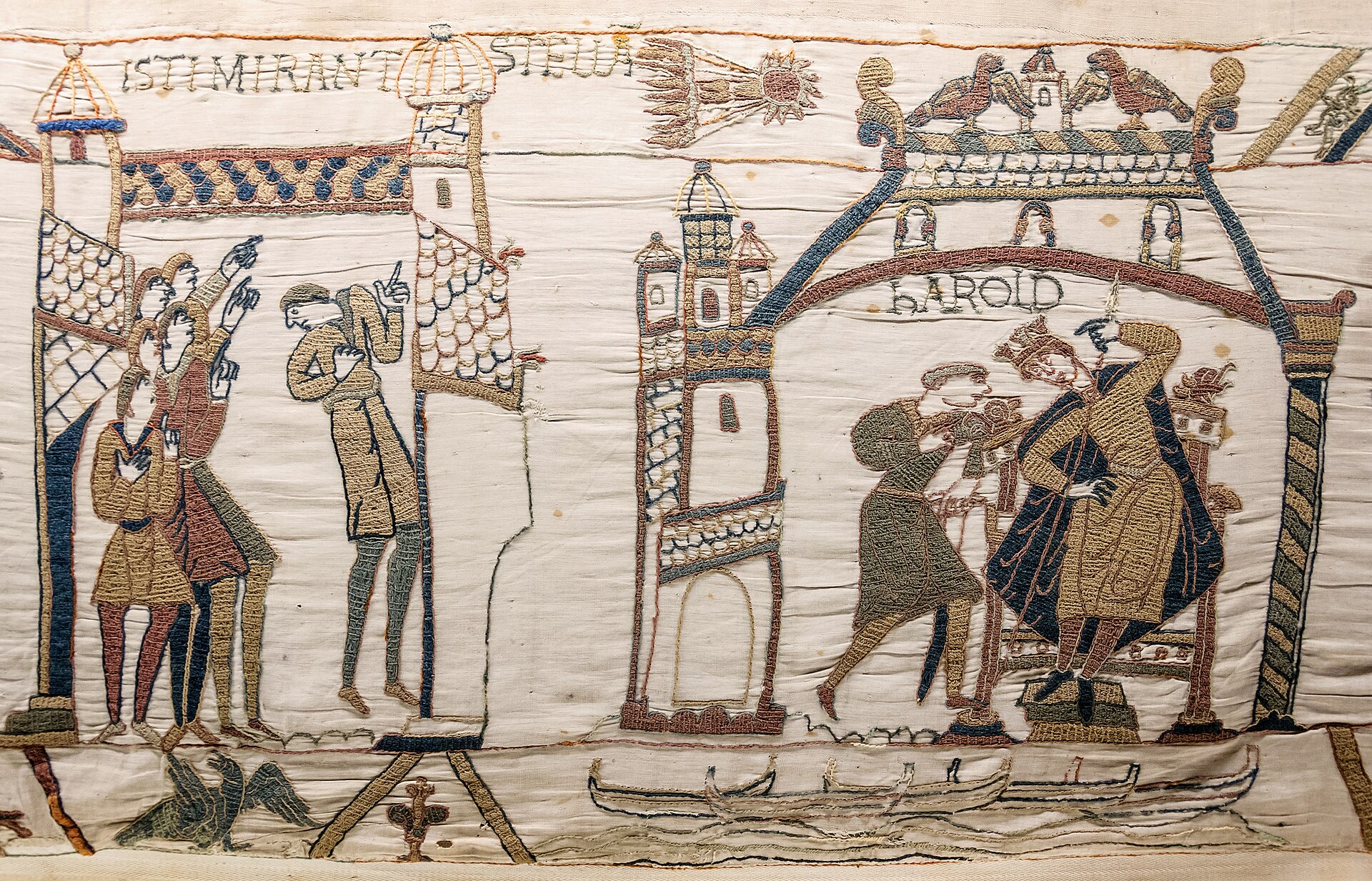
Halley's Comet appears in the sky in the scene immediately after Harold's coronation, with men below pointing at it in evident alarm, and ghost ships waiting at the bottom of the border. The comet did not actually appear until April 1066, months after the January coronation it is placed next to; the designer has moved it out of its true chronological position to read as a divine reaction to Harold's usurpation, a portent of doom for the new king and, in the same image, of the fleet that will come to remove him. It is also, on the current identification, the earliest surviving picture of Halley's Comet.
Running the length of the borders above and below the main frieze are dozens of small scenes drawn from Aesop, most persistently three appearances of the fable of the fox and the crow. The scholar David Bernstein has argued that the sequence works as a coded commentary on the main narrative: the crow with the stolen cheese as Harold, the fox that tricks the cheese away from him as William, the crow's second loss of the cheese to a second fox timed to fall opposite the coronation scene. Other students of the tapestry read the border fables as conventional decorative marginalia with no worked-out programme behind them. Both readings are argued in print; neither is proven, and this record does not choose between them.
Chapter 4Who paid for it, and who is not Queen Matilda
For centuries the French popular tradition held that the tapestry was made by Queen Matilda, William's wife, and her ladies-in-waiting, and it is still sometimes called La Tapisserie de la Reine...
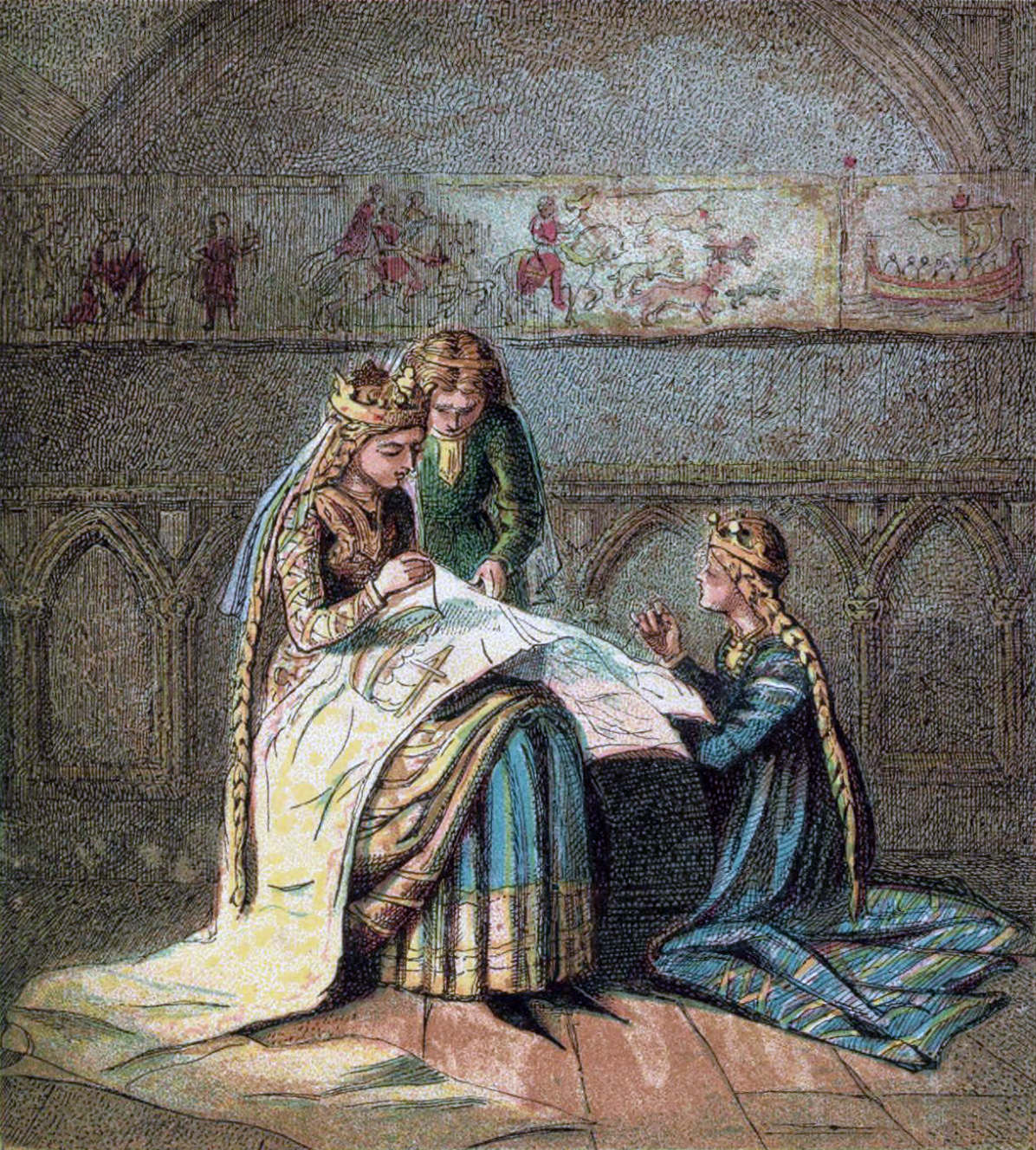
For centuries the French popular tradition held that the tapestry was made by Queen Matilda, William's wife, and her ladies-in-waiting, and it is still sometimes called La Tapisserie de la Reine Mathilde in France. Twentieth-century scholarship discarded this. Matilda has no documented connection to the object at all; the story appears to be a later legend with no eleventh-century evidentiary support, and no serious current scholar defends it.
The mainstream replacement theory is Bishop Odo of Bayeux, William's half-brother, who became Earl of Kent after the Conquest and acted as regent of England in William's absence. The case for Odo rests on more than plausibility: three of his followers named in Domesday Book, Wadard, Vital and Turold, appear as named minor figures in the tapestry itself, an odd honour to extend to obscure Kentish landholders unless the patron wanted them there. The tapestry was also found in the cathedral Odo built at Bayeux, and its likely completion date lines up with that cathedral's 1077 dedication.
Two named scholars have made serious, published cases for other patrons. Carola Hicks, in her 2007 study of the tapestry's making, argued for Edith of Wessex, Harold's own sister and Edward the Confessor's widow, proposing that a female patron close to the English court explains some of the tapestry's oddities of sympathy toward Harold. Andrew Bridgeford, in his 2005 book on the tapestry's hidden history, argued instead for Count Eustace of Boulogne, an inconstant ally of William who appears prominently and by name in the battle scenes and who Bridgeford suggests commissioned the work as a peace gesture toward Odo, with whom he had a history of violent conflict. Neither theory has displaced the Odo consensus, but both are serious, citable, and worth recording rather than erasing in favour of a tidier story.
Separately from who paid for it is who designed it, meaning who was responsible for the political programme rather than the needlework. Francis Wormald first argued in 1957 that the designer drew on illuminated manuscripts associated with Canterbury's religious houses, and Cyril Hart in 1999 made the case for Canterbury manufacture on stylistic grounds that most specialists now accept. Within that Canterbury frame, Howard B. Clarke proposed in 2012 that the designer was Scolland, Abbot of St Augustine's, Canterbury. Christine Grainge has since argued in Kent History and Archaeology that Clarke conflated the political author of the message with its artistic executant, and that the more likely author of the programme was Lanfranc, Archbishop of Canterbury from 1070, citing manuscript-hand comparisons and Lanfranc's documented role as William's political adviser. No contract, no payment record and no signed design survive for any of these theories to test against; all of them are argued from internal and circumstantial evidence, and this record grades them as such.
Chapter 5Four centuries of silence, then the 1476 inventory
The earliest plausible reference to the tapestry's existence is a description by a French poet writing around 1099 to 1102, close enough to the Conquest to be credible but too thin to establish where...
The earliest plausible reference to the tapestry's existence is a description by a French poet writing around 1099 to 1102, close enough to the Conquest to be credible but too thin to establish where the object was or how it was kept. After that, nothing. The next firm documentary trace is the inventory of the treasury of Bayeux Cathedral, dated 1476, which lists among the cathedral's possessions a very long and narrow hanging of linen, embroidered with figures and inscriptions representing the Conquest of England. The inventory also records how the object was used: hung around the nave of the cathedral for a few days each summer during the religious calendar, and kept in a wooden chest in the vestry the rest of the year.
Between the poet's description around 1100 and the 1476 inventory lies a gap of roughly 375 years in which no document naming the tapestry has been found. How, or even whether, it stayed in Bayeux Cathedral throughout that period has never been established by primary evidence; it is inferred rather than documented, and this record records the inference as an inference. The tapestry is next attested with certainty following the 1729-1730 publication by the Benedictine scholar Bernard de Montfaucon of drawings and a description of the whole work in his Les Monuments de la Monarchie Francaise, the first scholarly account to make it widely known outside Normandy.
Chapter 6Nearly a wagon cover: the French Revolution
According to a widely repeated local tradition, the tapestry was seized by Revolutionary authorities in Bayeux in 1792 and was on the point of being cut up to serve as a canvas cover for a military...
According to a widely repeated local tradition, the tapestry was seized by Revolutionary authorities in Bayeux in 1792 and was on the point of being cut up to serve as a canvas cover for a military supply wagon when a local lawyer, Lambert Leonard-Leforestier, intervened and persuaded the authorities to hand it instead to the town's newly formed Revolutionary Committee. Every source consulted for this record repeats a version of this story, and none of them cites a contemporary 1792 document proving it; it is described consistently as tradition rather than as a documented event, and this record treats it that way, as a well-attested local legend rather than a confirmed fact. What is documented is the outcome: in 1794 the Arts Commission for the Bayeux district formally seized the tapestry on behalf of the French nation, which is the point at which it passes securely into state custody.
Chapter 7Napoleon's invasion prop
In 1803, with an invasion army massed at Boulogne, Napoleon had the tapestry brought from Bayeux to Paris and put on public display in the Apollo Gallery of the Louvre, then known as the Musee...
In 1803, with an invasion army massed at Boulogne, Napoleon had the tapestry brought from Bayeux to Paris and put on public display in the Apollo Gallery of the Louvre, then known as the Musee Napoleon, from 6 December 1803 to 18 February 1804. The purpose was explicitly propagandistic: Napoleon wanted the public to see the last successful cross-Channel invasion of England laid out in wool and linen while he prepared to attempt a second one, and he reportedly told his assembled troops at Boulogne that the tapestry recorded one of the greatest moments in French history. The regime also backed a one-act musical play on the same theme, staged in Paris and then toured to towns where the invasion troops were billeted.
The Boulogne invasion never sailed. On 23 February 1804 Napoleon ordered the tapestry returned to the citizens of Bayeux, on what he termed a loan for a thousand years. It had done its political work in Paris regardless of whether the army it was raised to inspire ever crossed the water.
Chapter 8Stothard's fragment and the Victorian restoration
In 1816 the Society of Antiquaries of London commissioned the artist Charles Stothard to produce a complete set of drawings of the tapestry, engraved by James Basire and published in colour in...
In 1816 the Society of Antiquaries of London commissioned the artist Charles Stothard to produce a complete set of drawings of the tapestry, engraved by James Basire and published in colour in Vetusta Monumenta between 1821 and 1823, the first full colour reproduction of the whole work made available to the public and an invaluable record of its state before the major nineteenth-century repairs. During this work Stothard removed a small fragment of the tapestry's upper border, roughly 2.5 by 3 inches, and took it home to England. For a period the theft was blamed on his wife Eliza, who was later cleared; a contemporary 1836 catalogue correctly identifies Stothard himself as the man who cut and removed it. The fragment passed through his family to the Victoria and Albert Museum, which returned it to Bayeux in 1871, where it remains on display in a case separate from the main hanging.
A major restoration campaign ran through the tapestry between 1866 and 1872, replacing lost stitching and, in places, reworking figures and lettering according to the restorers' own assumptions about what the original design must have shown, in ways that scholars now recognise altered rather than merely repaired the eleventh-century image in places, most conspicuously in the final surviving scene. A 2022 analysis of the dye chemistry confirmed that this campaign used some of the earliest synthetic dyestuffs available, which lets conservators today distinguish original medieval wool from nineteenth-century repair wool by chemical means rather than by eye alone. No published figure in the sources consulted for this record states what overall percentage of the surviving embroidery is nineteenth-century thread rather than eleventh-century thread; that remains an open question, not a settled one.
Chapter 9Himmler's tapestry: the Second World War
From September 1938 the tapestry was under a formal protection plan, and by 1939 it had been placed in an underground shelter at the Hotel du Doyen in Bayeux, where it stayed for two years with...
From September 1938 the tapestry was under a formal protection plan, and by 1939 it had been placed in an underground shelter at the Hotel du Doyen in Bayeux, where it stayed for two years with monthly conservation checks. In 1941 it was moved to a National Museums repository at the Chateau de Sourches in the Sarthe. That same year the SS heritage research organisation the Ahnenerbe, founded and directed by Heinrich Himmler, launched what it called Sonderauftrag Bayeux, Special Operation Bayeux, a study intended to present the tapestry as evidence for the supremacy of the early medieval Norman people, whom Ahnenerbe researchers claimed as Germanic and Viking-descended kin. Karl Schlabow, head of the Germanic Costume Institute at Neumunster and an SS member with the rank of Unterscharfuhrer, led a fortnight-long study visit to Bayeux in June 1941. During that visit Schlabow removed a fragment of the tapestry's backing fabric and took it back to Germany; it was not seen again for more than eighty years.
On 26 June 1944, three weeks after D-Day and with the Allied advance closing in, German occupation authorities requisitioned the tapestry from Sourches and moved it to the Louvre in Paris. In August, as the liberation of Paris approached, British codebreakers at Bletchley Park intercepted a message, dated 18 August 1944, in which Himmler instructed the head of the Gestapo in Paris to see that the tapestry was moved to a safe place, understood by those who received the order as an instruction to get it to Germany. The intercept was passed to the French Resistance, which took control of the Louvre with roughly 48 hours to spare. On 21 August 1944 two SS officers presented themselves at General Dietrich von Choltitz's headquarters at the Hotel Meurice carrying Himmler's order to remove the tapestry to Berlin. Von Choltitz told them, falsely, that the Louvre was already in Allied hands and that he could offer them no support to get into the building. The SS men did not press the matter, Paris was liberated within days, and the tapestry never left the museum. It was exhibited briefly at the Louvre from 10 November to 15 December 1944, then returned to Bayeux in March 1945 and went back on public display at the Hotel du Doyen that October.
The fragment Schlabow had taken in 1941 resurfaced in March 2025, identified in the Schleswig-Holstein state archives in Germany. It is scheduled to be reunited with the main tapestry at the Musee de la Tapisserie de Bayeux when the museum's planned new building opens in 2027.
Chapter 10What the missing ending left behind
The tapestry as it survives ends abruptly, not long after the death of Harold, without a scene of William's coronation that most historians assume once existed to close the narrative properly...
The tapestry as it survives ends abruptly, not long after the death of Harold, without a scene of William's coronation that most historians assume once existed to close the narrative properly; specialists estimate the loss at somewhere between two and three metres of missing embroidery, though no source consulted for this record gives an authoritative, universally accepted figure, and this record does not invent one. Whether the ending was cut away, rotted, eaten by damp and moths, or simply never finished is not established by any evidence found for this record; it is recorded here as an open question rather than resolved with a guess.
The gap has generated its own afterlife. In 2012 a community project on the Channel Island of Alderney began stitching a proposed reconstruction of the missing finale, based on historical research into what the coronation scene probably showed, completed by hundreds of volunteer needleworkers and later given to the Musee de la Tapisserie de Bayeux. It is presented explicitly as a modern, speculative recreation, not a recovered original, and this record treats it the same way.
Chapter 11Copies, echoes and one direct descendant
The best-known copy of the whole tapestry is the full-size Victorian replica made in 1885 and 1886 by 35 needlewomen of the Leek Embroidery Society, led by Elizabeth Wardle, working from tracings of...
The best-known copy of the whole tapestry is the full-size Victorian replica made in 1885 and 1886 by 35 needlewomen of the Leek Embroidery Society, led by Elizabeth Wardle, working from tracings of hand-coloured photographs supplied by the Victoria and Albert Museum's predecessor, the South Kensington Museum. Those source photographs had themselves been retouched by South Kensington's male staff to remove nudity from the tapestry's borders before Victorian audiences ever saw them, so the Reading replica reproduces a bowdlerised nineteenth-century view of the original rather than the original itself. After a world tour the town of Reading bought it in 1895, and it remains on permanent display at Reading Museum, in Berkshire, England, the only full-size replica of the whole work. It is not the object described in this record, and no image of it is included here.
A more distant echo is the Overlord Embroidery, a 34-panel, 83-metre narrative embroidery commissioned by Lord Dulverton and designed by Sandra Lawrence between 1968 and 1974, depicting the D-Day landings and the Battle of Normandy as a deliberate twentieth-century answer to the Bayeux Tapestry's account of the last successful cross-Channel invasion, this time running in the opposite direction. It is on permanent display at The D-Day Story in Portsmouth, in the same region of the English Channel the two invasions, 878 years apart, both crossed.
Chapter 12The 2018 announcement and the long road to London
President Emmanuel Macron announced in January 2018 that France would lend the tapestry to Britain, the first time it would leave France since it was made, with the French presidency stating at the...
President Emmanuel Macron announced in January 2018 that France would lend the tapestry to Britain, the first time it would leave France since it was made, with the French presidency stating at the time that it would not travel before 2020 because it was an extremely fragile cultural treasure that would need major restoration work first. That 2020 timetable collapsed. Tests found the tapestry in worse condition than expected, Theresa May's government was replaced by Boris Johnson's, the Covid-19 pandemic intervened, and years of further diplomatic delay followed. Macron confirmed the loan was back on during a state visit to London in July 2025, by his own account a negotiation that took longer than Brexit.
Even after that confirmation the practical hurdles kept coming. The scheduled move of the tapestry into temporary storage ahead of transport, planned for 18 September 2025, was delayed by nationwide strikes in France that raised concerns about the security staffing needed for the move. The tapestry finally left France on 9 to 10 July 2026, travelling by lorry through the Channel Tunnel in a highly secured overnight operation, arriving at the British Museum on 10 July 2026, more than eight years after Macron's original announcement. It is due to go on public display in the Sainsbury Gallery from 10 September 2026, shown horizontally in a single continuous length for the first time, and to remain in London until July 2027.
Chapter 13The conservators who said no
The loan was never uncontested on the French side.
The loan was never uncontested on the French side. A study completed in early 2020 by eight specialist textile conservators, commissioned by the Ministry of Culture through its regional office in Normandy (the DRAC), found extensive existing damage across the hanging: figures cited in press coverage of the study put the count at 24,204 stains, 16,445 wrinkles or creases, 9,646 gaps in the cloth or the embroidery, and 30 tears. A subsequent, confidential 2022 restoration report, described by the newspaper Le Monde, went further, stating that any transport beyond about an hour was strongly inadvisable given the object's dimensions, structure and mechanical fragility.
The art historian Didier Rykner led a public campaign against the loan that gathered more than 68,000 signatures on a petition describing the plan as a cultural crime, and said he had asked every specialist who knows the tapestry, curators and restorers alike, and had been told the same thing: it is not possible to move it. Isabelle Attard, a former director of the Bayeux museum, warned that the tapestry's value was incalculable and that nothing could replace it if anything went wrong. The artist David Hockney separately warned that even minor mishandling, rolling, unrolling or hanging it in an unfamiliar way, could tear the weakened backing linen or shed embroidery threads permanently. Supporters of the loan, including the medievalist Gale Owen-Crocker of Manchester University, argued in response that the conditions in which the tapestry had previously hung in Bayeux were themselves less than ideal, and that the British Museum's climate control, handling protocols and purpose-built display case represented a net improvement in the object's safety rather than a risk. The two sides have not been reconciled; the loan proceeded regardless, on the French government's decision that it was safe to attempt, with vibration limits during transport held to below two millimetres per second and a facsimile used beforehand to test the crating and handling procedures.
Chapter 14What is happening to it now
As of this record's last verification the tapestry has already crossed the Channel and is in an acclimatisation period at the British Museum ahead of its planned public opening on 10 September 2026...
As of this record's last verification the tapestry has already crossed the Channel and is in an acclimatisation period at the British Museum ahead of its planned public opening on 10 September 2026, in a new, purpose-built showcase in the Sainsbury Gallery described by the museum as the longest single display case in the world, intended to let the whole 68-metre run be viewed as one continuous length rather than in the shorter curved sections used in Bayeux. Early ticket releases in July 2026 sold out within hours and crashed the museum's booking website. The loan is covered by a UK Treasury indemnity reported at around 800 million pounds, a figure that is a government indemnity ceiling rather than a market valuation and should not be read as an appraisal of the tapestry's worth; no market comparison is possible in any case, since the tapestry has never been sold and has no auction history of any kind.
Under the terms of the loan the British Museum is responsible for the tapestry's display and safekeeping in London and has agreed to commission a full conservation report, at its own expense, when the object is returned to France. That return is due by July 2027, timed to coincide with the planned opening of a new, purpose-built Musee de la Tapisserie de Bayeux, into which the recovered 1941 Ahnenerbe fragment is expected to be formally reunited with the main hanging for the first time since Karl Schlabow cut it away.
The artist
Unknown embroiderers, working under the patronage of Bishop Odo of Bayeux
No maker's name survives anywhere on 68 metres of stitching. What can be reconstructed is a patron, a probable place of manufacture, and a live, unresolved argument over who actually designed the thing, as distinct from who paid for it and who sewed it. All three roles were probably filled by different people, and this record treats them separately rather than collapsing them into a single attribution the way popular accounts of the tapestry often do.
Related works
| Work | Relation | Where it is |
|---|---|---|
| Fragment removed by the Ahnenerbe, 1941 Karl Schlabow (removed it; not a maker) | A physical fragment of the tapestry's own backing fabric, cut from the object itself during a 1941 SS study visit Not a copy or a version. It is a missing physical piece of the object described in this record, currently separated from it. | Identified in the Schleswig-Holstein state archives, Germany, in March 2025; scheduled to rejoin the main tapestry in Bayeux in 2027 |
| The Stothard fragment Charles Stothard (removed it in 1816; not a maker) | Another physical fragment cut from the tapestry's upper border Removed by Stothard while copying the tapestry in 1816, later held by the Victoria and Albert Museum, and returned to Bayeux in 1871, where it is displayed separately from the main hanging. | Musee de la Tapisserie de Bayeux |
| The Bayeux Tapestry (full-size replica) Leek Embroidery Society, led by Elizabeth Wardle | A full-size Victorian copy of the entire tapestry, made 1885-1886 from retouched photographs This is NOT the object described in this record. It is a nineteenth-century embroidered copy, made from photographs that had already been censored to remove nudity from the borders before the copy was begun. No image of it appears in this record's gallery. | Reading Museum, Berkshire, England |
| The Bayeux Tapestry Finale Volunteer needleworkers, Alderney | A modern speculative reconstruction of the tapestry's lost final scene Begun in 2012, based on historical research into the presumed coronation scene. Presented explicitly as a modern recreation of a lost original, not a recovered fragment. | Museum of Bayeux (given to the museum after completion) |
| The Overlord Embroidery Designed by Sandra Lawrence, commissioned by Lord Dulverton | A twentieth-century narrative embroidery of the D-Day landings, deliberately modelled on the Bayeux Tapestry 34 panels, 83 metres long, made 1968-1974. Conceived explicitly as an answer to the Bayeux Tapestry: a cross-Channel invasion narrative running in the opposite direction, 878 years later. | The D-Day Story, Portsmouth, England |
Open questions
- How did the tapestry survive the roughly 375 years between an isolated description around 1100 and the first firm documentary trace of it, the 1476 Bayeux Cathedral inventory? No record from that gap has been found.
- Is the story that a local lawyer saved the tapestry from being cut up for a military wagon cover in 1792 documented in any contemporary record, or is it entirely later local tradition? Every source consulted repeats the story; none cites a primary 1792 document.
- What did the missing final scene actually show, and how was it lost, torn away, rotted, unfinished, or something else? No evidence found for this record settles the question.
- Who actually designed the tapestry's political and narrative programme? At least four scholars (Wormald, Hart, Clarke, Grainge) have argued different, mutually exclusive positions, none proven.
- What proportion of the surviving embroidery is original eleventh-century wool as against nineteenth-century restoration wool? Dye chemistry can now distinguish the two, but no published overall percentage was found in the sources used for this record.
- What did the original commission cost, and who was actually paid? No contract, receipt or payment record survives; the tapestry's original cost is entirely unknown, which is normal for the 1070s but leaves no anchor for any modern value comparison.
- Will the tapestry complete its full run at the British Museum, to July 2027, and return to Bayeux undamaged, given that French conservators warned as recently as 2022 that any transport beyond about an hour was strongly inadvisable? This record was last verified while the loan was still in progress and cannot answer that question yet.
Questions about this object
What is The Bayeux Tapestry?
The Bayeux Tapestry is a textile, dated c. 1067-1082, on the evidence of the Domesday connections of named minor figures in the design; probably finished in time for the dedication of Bayeux Cathedral on 14 July 1077, though this date is an inference, not a documented fact. Medium: Wool crewel yarn embroidered onto a tabby-woven linen ground; stem stitch and chain stitch for outlines and lettering, laid-and-couched work (locally called the Bayeux stitch) to fill the larger coloured areas. It is worked, not woven, and is an embroidery rather than a tapestry in the technical sense of the word.
Who made The Bayeux Tapestry, and is the attribution settled?
The attribution to Unknown English embroiderers, made under the patronage of Bishop Odo of Bayeux is recorded here as disputed. The leading theory, established by mid-twentieth-century scholarship, holds that the hanging was commissioned by Bishop Odo of Bayeux, William the Conqueror's half-brother, and embroidered by English needleworkers, probably in or near Canterbury. No contract, receipt or signed commission survives. Serious named alternatives to Odo's patronage have been argued in print, including Edith of Wessex (Carola Hicks, 2007) and Count Eustace of Boulogne (Andrew Bridgeford, 2005); the identity of the person who actually designed the political programme, as against the patron who paid for it, is separately disputed between at least four scholars. This record treats Odo as the majority position and records the dissent rather than smoothing over it.
Where is The Bayeux Tapestry now?
On loan to the British Museum, London, 10 September 2026 to July 2027; its permanent home is the Musee de la Tapisserie de Bayeux, Normandy, France. Inventory number Not published in the sources consulted for this record. Last confirmed 8 August 2026. State-owned French cultural property, on a bilateral loan agreed between the French and British governments and covered by a UK Treasury indemnity; the tapestry crossed the Channel on 10 July 2026 and is due back in Bayeux, for a new purpose-built museum planned to open in 2027, at the end of the loan.
What is still unknown about The Bayeux Tapestry?
How did the tapestry survive the roughly 375 years between an isolated description around 1100 and the first firm documentary trace of it, the 1476 Bayeux Cathedral inventory? No record from that gap has been found.
Sources
- 1Musee de la Tapisserie de Bayeux, 'From Odo's Cathedral to the Louvre.' bayeuxmuseum.com/en/...
- 2Musee de la Tapisserie de Bayeux, 'The Bayeux Tapestry during the Second World War.' bayeuxmuseum.com/en/...
- 3Musee de la Tapisserie de Bayeux, 'The Bayeux Tapestry is an embroidery.' bayeuxmuseum.com/en/...
- 4The Conversation, 'Why the Nazis stole a fragment of the Bayeux tapestry' (2025). theconversation.com/why-the-nazis-stole-a-fragment-of-the...
- 5Smithsonian Magazine, 'Newly Rediscovered, a Missing Fragment of the Bayeux Tapestry Is Returning to France.' smithsonianmag.com/smart-news/...
- 6Will Bowen, 'The Nazi tapestry heist: the Bayeux Tapestry is coming to London,' The Oldie. theoldie.co.uk/blog/...
- 7Museums Association, 'A thousand years in the making: the Bayeux Tapestry loan' (July 2026). museumsassociation.org/museums-journal/...
- 8Museums Association, 'Conservators debate Bayeux Tapestry risk as French voice fears over loan' (September 2025). museumsassociation.org/museums-journal/...
- 9'Too fragile or a fuss about nothing? The battle over the Bayeux Tapestry,' via Yahoo News. yahoo.com/news/...
- 10The Globe and Mail, 'Bayeux Tapestry too fragile to be shipped to Britain, art conservators warn.' theglobeandmail.com/world/...
- 11The Art Newspaper, 'Bayeux Tapestry arrives at the British Museum in London after secret English Channel crossing' (July 2026). theartnewspaper.com/2026/...
- 12Christine Grainge, 'The Identity of the Designer of the Bayeux Tapestry,' Kent History and Archaeology (Kent Archaeological Society), journal 144. kentarchaeology.org.uk/journal/...
- 13Wikipedia, 'Bayeux Tapestry.' Tertiary source; flagged for replacement with the Bayeux Museum's own published scholarly catalogue and a critical edition such as Lucien Musset's. en.wikipedia.org/wiki/...
- 14The Conversation, 'The Bayeux tapestry and the hidden history of the women who embroidered it.' theconversation.com/the-bayeux-tapestry-and-the-hidden-hi...
- 15'The Mystery of Charles Stothard, FSA, and the Bayeux Tapestry Fragment,' The Antiquaries Journal, Cambridge University Press. cambridge.org/core/...
- 16napoleon.org, 'Napoleon's loan of Bayeux Tapestry is now official.' napoleon.org/en/...
- 17Andrew Bridgeford, '1066: The Hidden History in the Bayeux Tapestry' (book excerpt). erenow.org/postclassical/...
- 18'Bayeux Tapestry: First use of early synthetic dyes for the restoration of a masterpiece,' ScienceDirect (2022). sciencedirect.com/science/...
- 19DRAC Normandie / Musee de la Tapisserie de Bayeux, press kit on the 2020-21 condition study (PDF). bayeuxmuseum.com/wp-content/...
- 20The D-Day Story, Portsmouth, 'Object 70 - The Overlord Embroidery.' theddaystory.com/d-day-in-80-objects/...
- 21Smithsonian Magazine, 'When the Bayeaux Tapestry Makes Its Historic Return to England, the British Government Will Insure It for More Than $1 Billion.' smithsonianmag.com/smart-news/...
- 22France 24, 'Bayeux Tapestry arrives safely in UK after loan from France.' france24.com/en/...
- 23Reading Museum, 'The History of Britain's Bayeux Tapestry.' readingmuseum.org.uk/collections/...
- 24Medieval Histories, on Carola Hicks, 'The Bayeux Tapestry: The Life Story of a Masterpiece' (2007). medieval.eu/bayeux-tapestry-life-story-masterpiece
- 25Elka Textiles, 'Colours of the Bayeux Tapestry: Natural Dyes, Wool and Medieval Embroidery.' Commercial secondary source on dye chemistry; flagged for replacement with the peer-reviewed spectroscopic study it summarises. elkatextiles.co.uk/blogs/...
Last verified 8 August 2026 · Published 8 August 2026
Change log
8 August 2026 - Record created at the house standard: researched narrative, technical evidence, maker dossier, graded provenance chain, prices with hammer and premium separated, related works, open questions and sources.