The Second Negative
Six canonical documentary photographs in this archive were arranged, retouched or captioned to say more than they showed. In almost every case the thing that proved it was another frame from the same session.
Records in this piece: Home of a Rebel Sharpshooter, The Valley of the Shadow of Death, Destitute pea pickers in California. Mother of seven children. Age thirty-two. Nipomo, California, Addie Card, 12 years. Spinner in North Pownal Cotton Mill, Sallie Gardner at a Gallop, Abraham Lincoln, Cooper Union Portrait
On this page 8 sections
ContentsClose
In short
- In five of the six cases here the correction came from another negative made minutes or hours from the famous one. The decisive document is almost never a diary, a confession or a technical analysis. It is the adjacent frame.
- The interval between publication and correction is measured in generations. Gardner's staging was demonstrated 112 years after the exposure, and the order of Fenton's two views was argued out 152 years after his.
- The alteration is often nowhere near the moment of exposure. The Migrant Mother negative was retouched in 1939, three years after the sitting, to remove a thumb gripping a tent pole, and Lange's own supervisor at the Farm Security Administration is reported to have objected on documentary grounds.
- Two of the six survive the test on the image and fail it on the story. Muybridge's sequence really did settle unsupported transit, but the 25,000 dollar wager attached to it is unsupported by any primary account this archive could find.
The evidence against a famous photograph is usually the frame next to it
A documentary photograph makes two claims at once: that the thing in the frame existed, and that it was found the way it appears. The first claim is generally sound. The second is the one that fails, and in this archive it has failed for six canonical images out of the twelve photographs held.
What's consistent isn't the failure but the method that exposed it. In five of six cases the correcting evidence is another negative from the same session, made minutes or hours away, showing the same subject arranged differently or captioned differently. Not a confession, not chemistry, not a rediscovered letter. The photographer's own adjacent exposure, sitting in the same institutional collection, uncatalogued as evidence of anything, waiting for somebody to lay the two side by side. That's a method a researcher can use, and I want to state it plainly before the individual cases, because each of them on its own reads as a scandal and together they read as a procedure.
Gardner moved a body about forty yards and captioned it as found
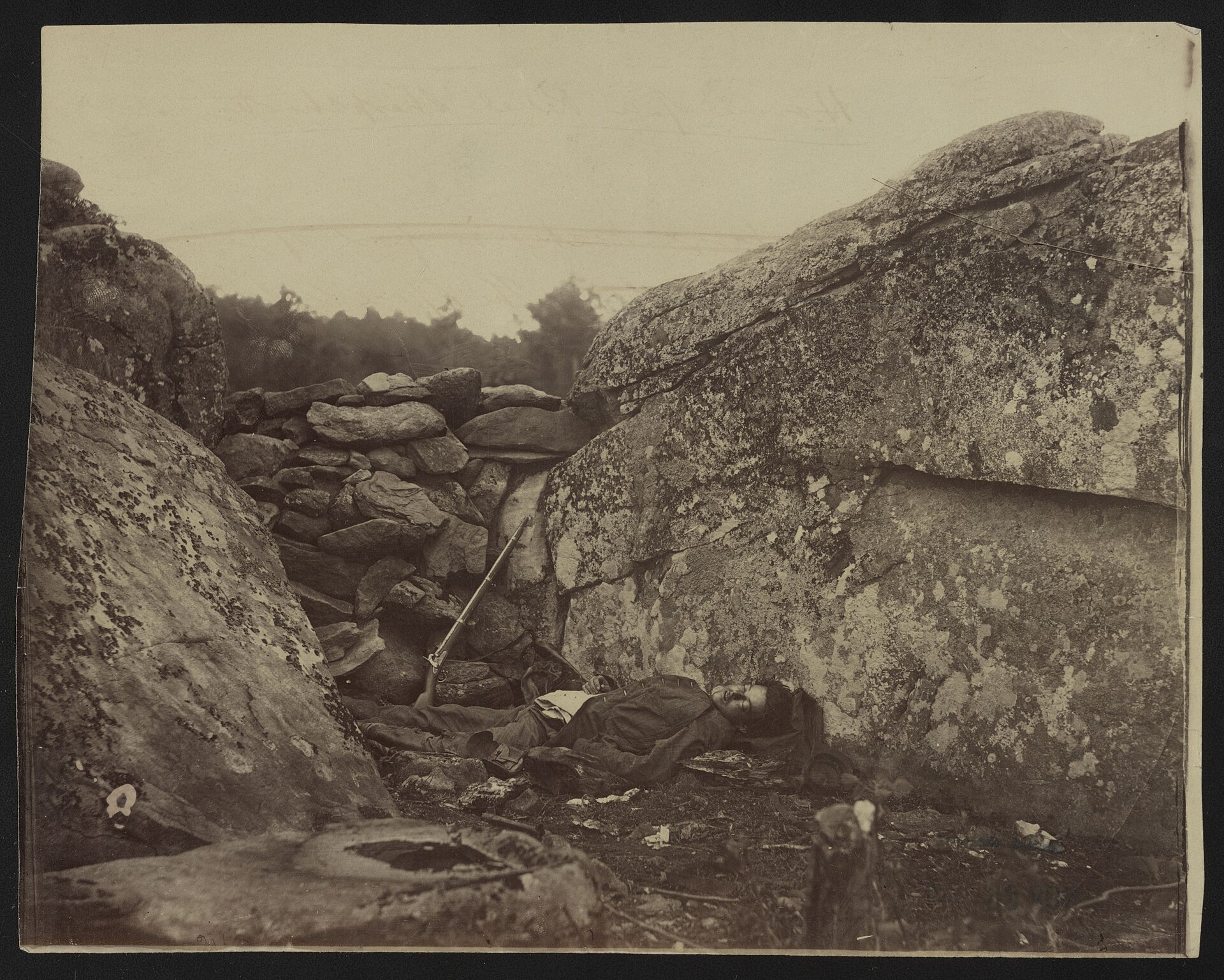
A dead Confederate soldier lies inside a stone sniper's nest at Devil's Den, Gettysburg, in a photograph Alexander Gardner's team made in July 1863 and published as Plate 41 of Gardner's Photographic Sketch Book of the War in 1866. Gardner's caption presented the scene as the discovered post of a rebel sharpshooter.
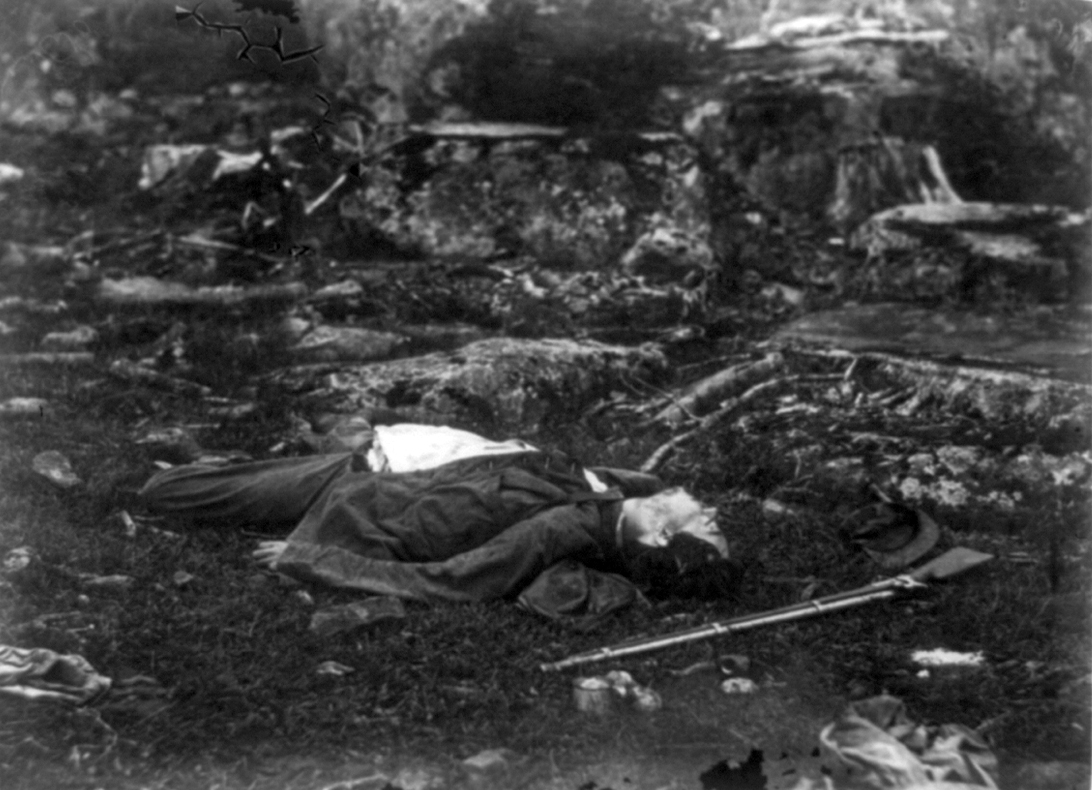
The same corpse appears in a second Gardner photograph, A Sharpshooter's Last Sleep, lying in a more exposed position. The National Park Service, which manages the ground, records that the photographers moved the body some 40 yards from where the soldier is likely to have fallen to the rock nest that produced the famous image, and that Gardner worked at Gettysburg with his assistant Timothy O'Sullivan. The Park Service also notes that the gun propped against the rock would almost certainly not have been used by a sharpshooter.
The photographic historian William Frassanito set the images against each other and against the terrain in 1975, 112 years after the exposures, in work that remains the standard account of the Gettysburg photographs. Nothing in the demonstration required a technique unavailable in 1866. It required somebody to notice that two pictures in the same body of work contained the same dead man.
Fenton made two exposures and five rocks settled which came second
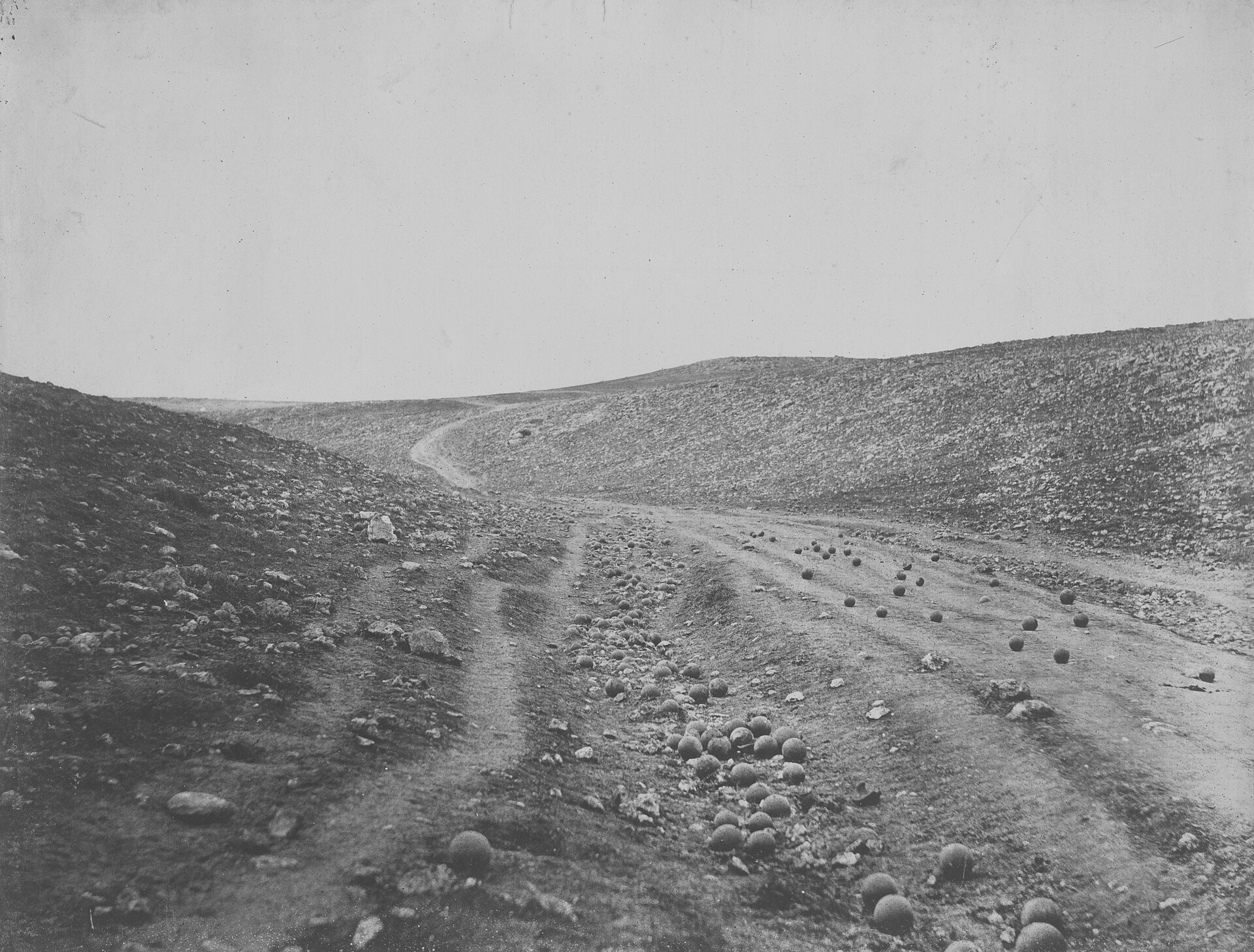
Roger Fenton photographed a dirt road through a ravine near Sevastopol on 23 April 1855, littered with Russian round shot. He made two exposures from the same spot within minutes of each other: one with the road itself clear and the balls confined to the ditch beside it, one with balls scattered across the road. The second is the image everybody knows.
The argument about whether Fenton or an assistant moved the ammunition ran for more than a century and a half, and it turned on a question that looks unanswerable: which negative came first. Susan Sontag had asserted that Fenton oversaw the scattering of the cannonballs onto the road before taking the second picture. Ulrich Keller had argued the same. Neither had a way to prove the order.
In 2007 the documentary filmmaker Errol Morris, working with the optical engineer Dennis Purcell, examined five small rocks on the slope at the left of both frames. In the version with the balls on the road, those rocks sit lower than in the version with the clear road. Gravity doesn't carry rocks uphill. Somebody had walked the slope between the two exposures, dislodging them downward, which places the scattered-road view second and makes it the arranged one. The finding rests entirely on details neither photographer nor critic had any reason to compose.
Lange made five exposures and the negative was altered three years later
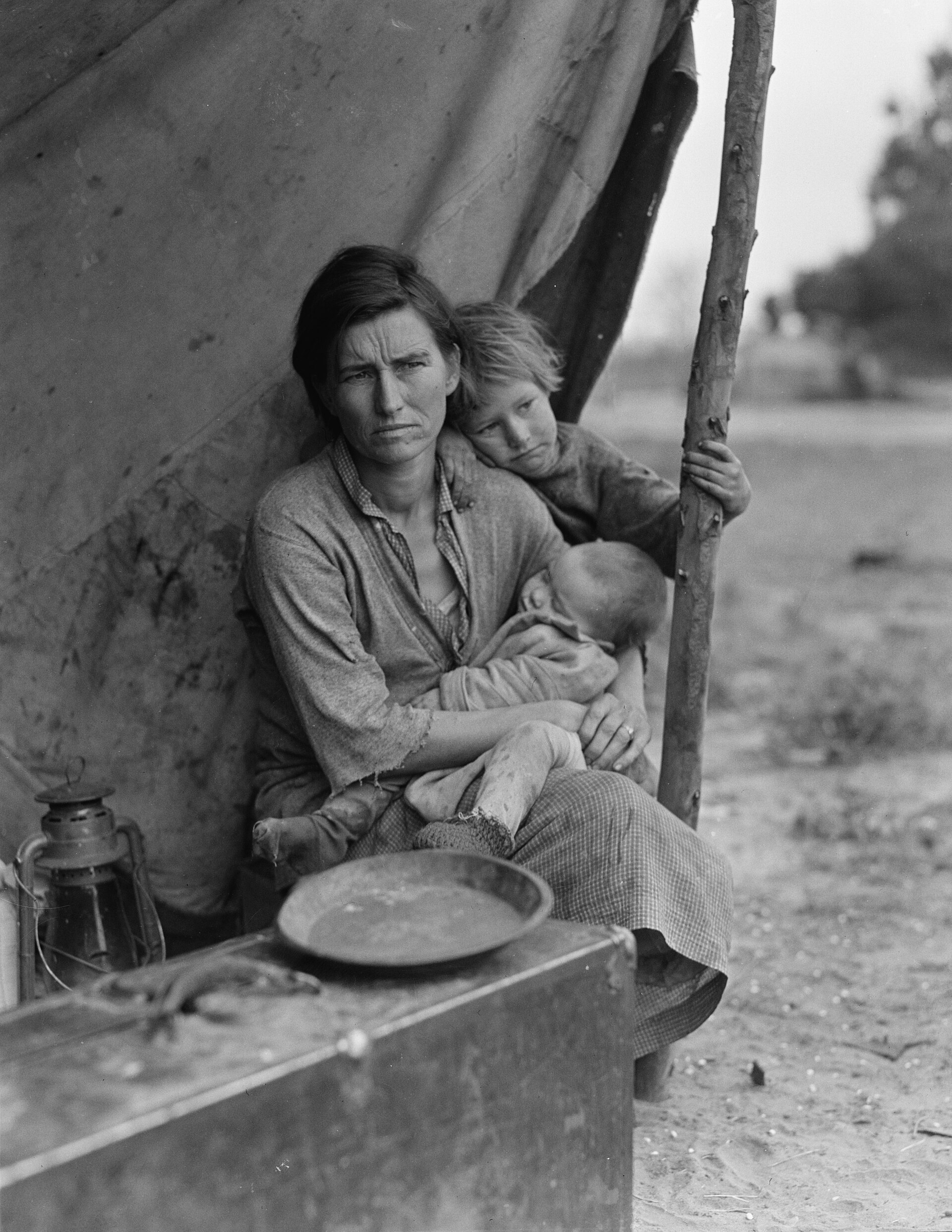
Dorothea Lange photographed a mother at a pea pickers' camp near Nipomo, California, in about ten minutes. In her own account of the assignment she wrote that she made five exposures, working closer and closer from the same direction. Lange herself, writing later about the assignment, could place it only in February or March of 1936, while the collections holding prints of it date the picture to March. The maker isn't always the best source for the facts of the making.
The picture the world knows is therefore the last frame of a short sequence and not a single decisive click, and the other exposures survive in public collections. It was also altered. In 1939, at Lange's instruction, a darkroom assistant removed a thumb visible gripping a tent pole in the lower right corner. Her own supervisor at the Farm Security Administration is reported to have objected to the retouching on documentary grounds, which means the argument about what this image was permitted to be was being had inside the agency at the time, and lost.
The woman was not publicly identified for forty-two years. The photograph that carried more weight than any other made under that programme circulated for four decades without the name of the person in it.
Hine's other negative carries the caption that does the work
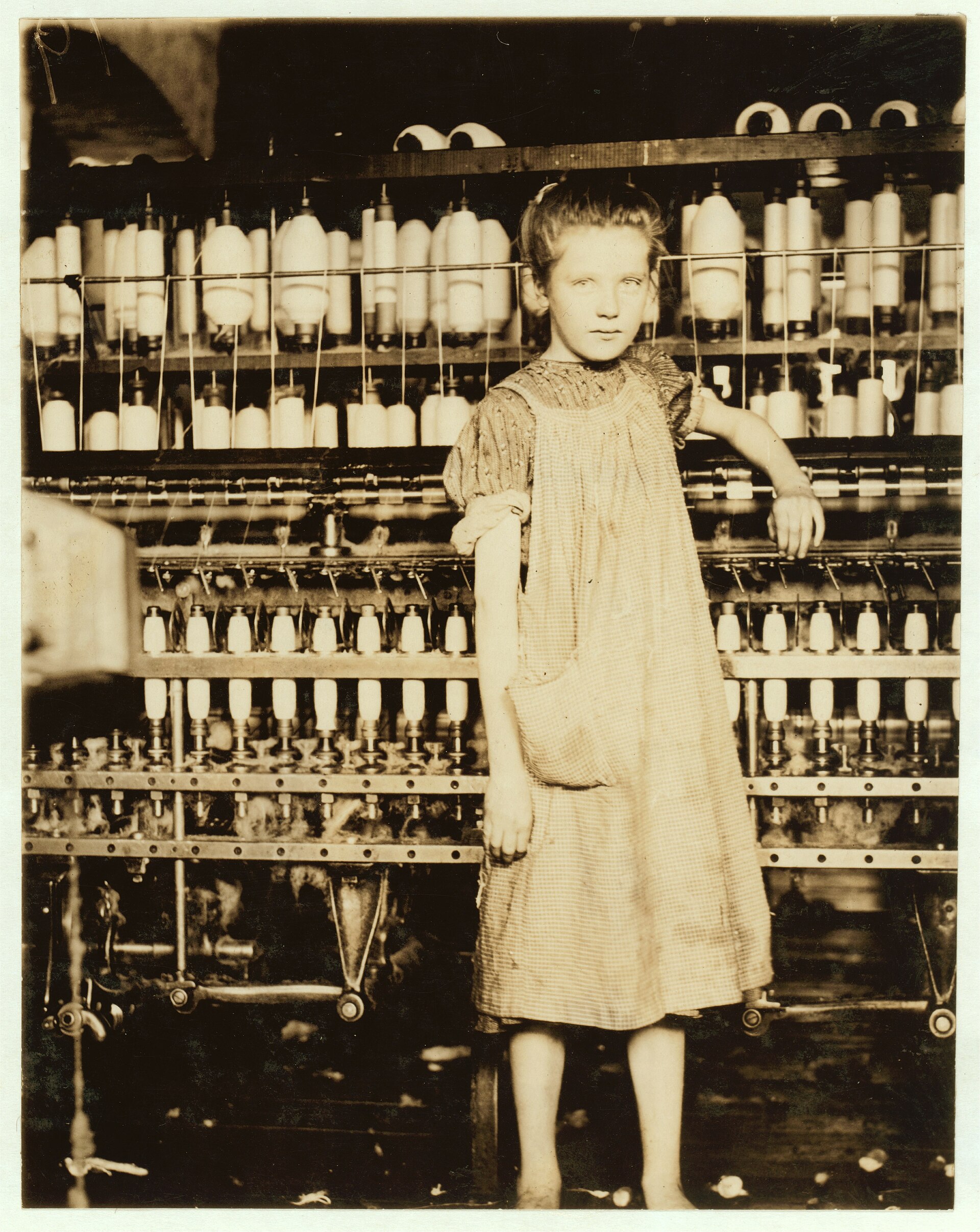
In 1910 Lewis Hine photographed a twelve-year-old spinner at the North Pownal Manufacturing Company in Vermont, on assignment for the National Child Labor Committee. The exact month is disputed across the institutions holding related material. His caption on this negative, Photo No. 1056, calls her an anaemic little spinner.
A companion negative from the same sitting, Photo No. 1050, carries a fuller caption: the mill's other workers claimed she was ten, while she herself admitted to twelve. That is a small documented lie, and the photograph exists to expose the conditions that produced it. The two negatives together show what a caption is doing in this kind of work. Hine was not recording a scene; he was building an evidentiary file for a campaign, and the wording is part of the exhibit.
For most of the twentieth century the girl was misidentified, and a copy of the same 1050 exposure sits in the National Archives filed under a different version of her name. Three federal custody chains, two negatives, one child, and a caption that has to be read as advocacy and as evidence at the same time.
| Photograph | Date | What the famous frame claims | What corrected it | Interval |
|---|---|---|---|---|
| Home of a Rebel Sharpshooter | July 1863 | A sharpshooter found where he fell | A companion negative of the same body about 40 yards away | 112 years |
| Valley of the Shadow of Death | 23 April 1855 | A road under fire, strewn with shot | A second exposure with the road clear, and the position of five rocks | 152 years |
| Migrant Mother | March 1936 | A single decisive frame | The other exposures in the sequence, and a retouched negative | 42 years to the sitter s name |
| Addie Card, spinner | 1910 | An anaemic little spinner | A companion negative carrying the fuller caption | Most of a century |
| Sallie Gardner at a Gallop | 19 June 1878 | Settled unsupported transit | Nothing. The image holds; the wager attached to it does not | Still repeated |
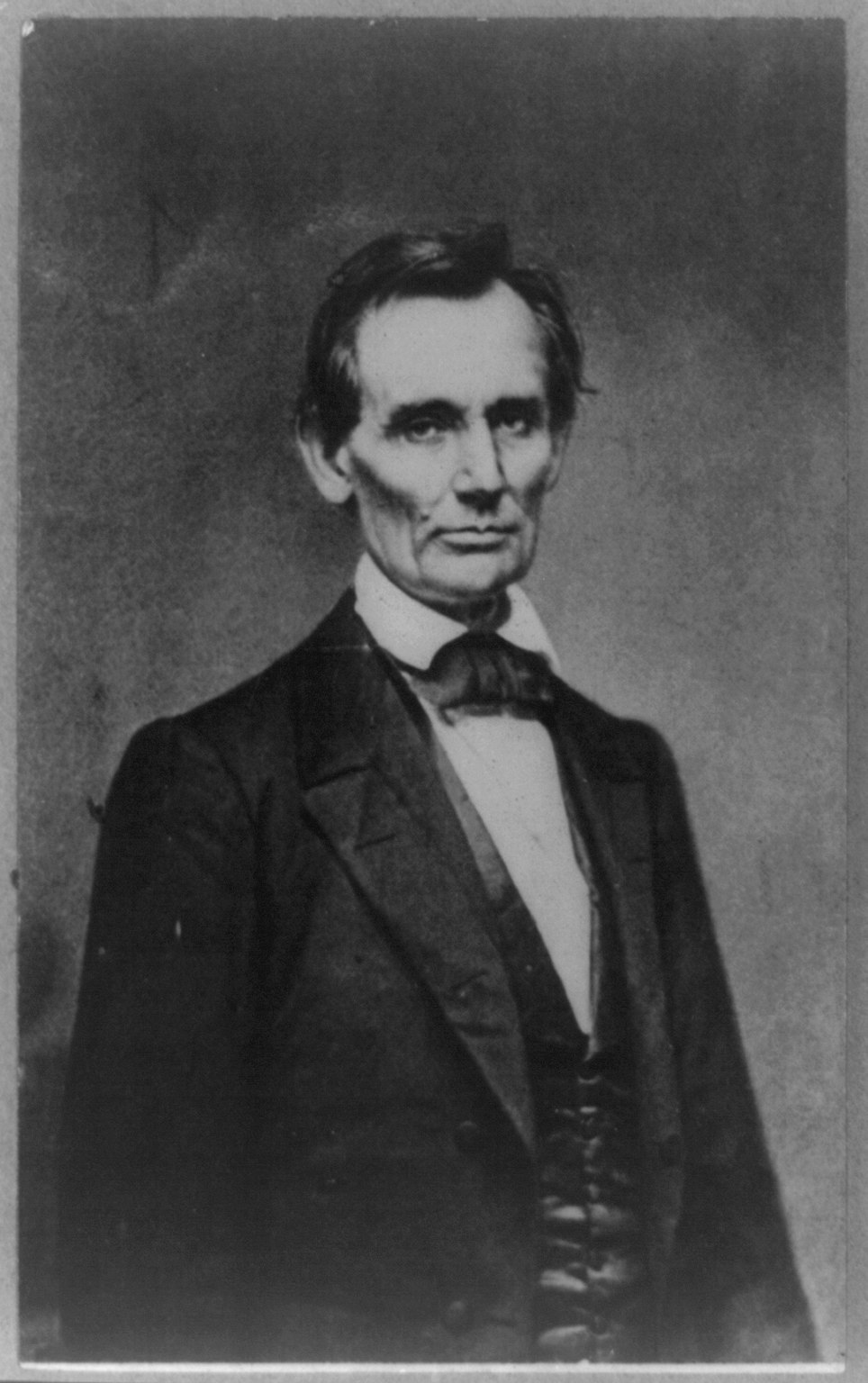
| Lincoln at Cooper Union | 27 February 1860 | A candidate as he looked | The studio s own account of the collar and the retouching | Contemporary |
Two cases where the picture holds and the story does not
The method doesn't always convict the photograph. On 19 June 1878, at Leland Stanford's Palo Alto Stock Farm, Eadweard Muybridge photographed the mare Sallie Gardner in full gallop with a battery of trip-wire cameras and caught, for the first time in a verifiable image, a moment with all four hooves off the ground. That settled a real dispute in equestrian science, unsupported transit, and ended the flying gallop as a convention in painting. The image does what it is said to do.
What doesn't survive checking is the story wrapped around it. The popular version has Stanford with a 25,000 dollar wager riding on the answer, and no primary account consulted for this archive supports it. The photograph is sound and its legend is not, which is the reverse of the Gardner case and just as much a warning.
Mathew Brady's Cooper Union portrait of Lincoln, made at his New York gallery on the morning of 27 February 1860, is the third variety. Nothing here was concealed: Brady drew Lincoln's collar up to shorten the appearance of his long neck, and the studio smoothed the lines of his face. That is ordinary studio practice, done in the open, on a sitter who went on to be nominated. The thing to be careful with is the famous line in which Lincoln credits Brady and the speech together with making him president, which traces back to a single source.
What to ask of a documentary photograph
Ask first how many exposures were made, and where the others are. That single question would have caught five of the six cases here, and in each of them the other frames were already in a public collection, catalogued under the same photographer, available to anyone who requested them. The correction wasn't waiting on access. It was waiting on the comparison.
Then separate the negative from the print from the caption, because they can be made years apart and by different hands. The Migrant Mother negative was altered three years after exposure. Gardner's caption was published three years after his. A print in one archive and a print in another can carry different titles for the same exposure, as Hine's does across the Library of Congress and the National Archives, and a researcher who cites the title rather than the image will lose the thread.
Finally, hold the image and its legend apart. Muybridge's sequence is sound and the wager attached to it is not; Gardner's plate is arranged and the man in it really did die at Gettysburg. Neither finding contaminates the other, and treating a photograph as wholly reliable or wholly discredited throws away most of what it can actually tell you.
Why this archive is free to read
We do this for everyone who loves art. The people who have studied it for years, and the people who just stopped to look. Iconotheca exists so that what we learn belongs to all of them.
Nobody pays us for this. No ads, no sponsors, no commercial interest. These works belong to all of us, and we would rather share them with as many people as we can than keep them to ourselves.
If it gave you something today, tell us to keep going. Follow us, leave a like, or write a positive comment. We read every one, and they are what keeps us going.
Questions
Yes. The National Park Service records that the photographers moved the dead soldier some 40 yards from his likely place of death to the stone nest seen in Home of a Rebel Sharpshooter, and that the two positions are recorded in two separate Gardner photographs. William Frassanito demonstrated it in 1975.
The one with the road clear. In 2007 Errol Morris and the optical engineer Dennis Purcell showed that five small rocks on the left slope had moved downhill between the exposures, which means somebody walked the slope before the shot-strewn version was taken, making it the second and the arranged one.
No. Lange wrote that she made five exposures at the Nipomo camp, working closer and closer from the same direction, and the other frames survive in public collections. The famous image is the last of the sequence, and its negative was retouched in 1939 to remove a thumb gripping a tent pole.
No, but it changes what the photograph is evidence of. Gardner's plate is unreliable about where the soldier fell and reliable about the fact of his death and the terrain. The useful habit is to state what the image can carry rather than to accept or discard it whole.
Search the holding institution's catalogue by photographer and by date rather than by the title of the famous image, since companion negatives are usually catalogued under their own titles and numbers. In these six cases every correcting frame was already publicly held under the same photographer's name.
Sources
- 1National Park Service, Gettysburg National Military Park, 'Confederate Sharpshooter in Original Location near Devil's Den, Then and Now', recording that the body was moved some 40 yards and naming Gardner and Timothy O'Sullivan. nps.gov/places/...
- 2National Park Service, Gettysburg National Military Park, 'Home of a Rebel Sharpshooter, Then and Now', on the improbability that the soldier fell in this location and on the weapon propped against the rock. home.nps.gov/places/...
- 3The Public Domain Review, 'Of Chickens, Eggs, and Cannonballs: Roger Fenton's Valley of the Shadow of Death', on the two exposures, Sontag's and Keller's claims, and the 2007 Morris and Purcell analysis of the displaced rocks. publicdomainreview.org/collection/...
- 4Princeton University Art Museum, catalogue entry for Roger Fenton, Valley of the Shadow of Death, object x1991-193, salted paper print, dated 1855 and carrying the printed publication line of Thomas Agnew and Sons, Manchester, dated 1 January 1856. artmuseum.princeton.edu/art/...
- 5Dorothea Lange, 'The Assignment I'll Never Forget: Migrant Mother', Popular Photography, in which Lange states that she made five exposures, working closer and closer from the same direction, and dates the encounter to February or March 1936. history.hanover.edu/courses/...
- 6The Art Institute of Chicago, collection record for Dorothea Lange, Migrant Mother, Nipomo, California, dated 1936 and described as from a portfolio of ten Farm Security Administration photographs. Consulted through the museum's open collection API. artic.edu/artworks/...
More in Research and Method
The partThe Object on Display Is the Last Restorer's Reading of It
The British Museum gives the Sutton Hoo helmet two production dates: late 6th to early 7th century for the components, and 1971 for the...
The Fields This Archive Cannot Count, and What That Costs
2,592 technical facts wear 1,598 different labels and 1,754 ticket prices wear 1,355.
The First Number in a Hoard Is a Counting Rule
The Staffordshire Hoard is 4,600 pieces, or just under 4,000, or around 700, or more than 600, depending on which official page you read.