Sallie Gardner at a Gallop
Eadweard Muybridge · 19 June 1878
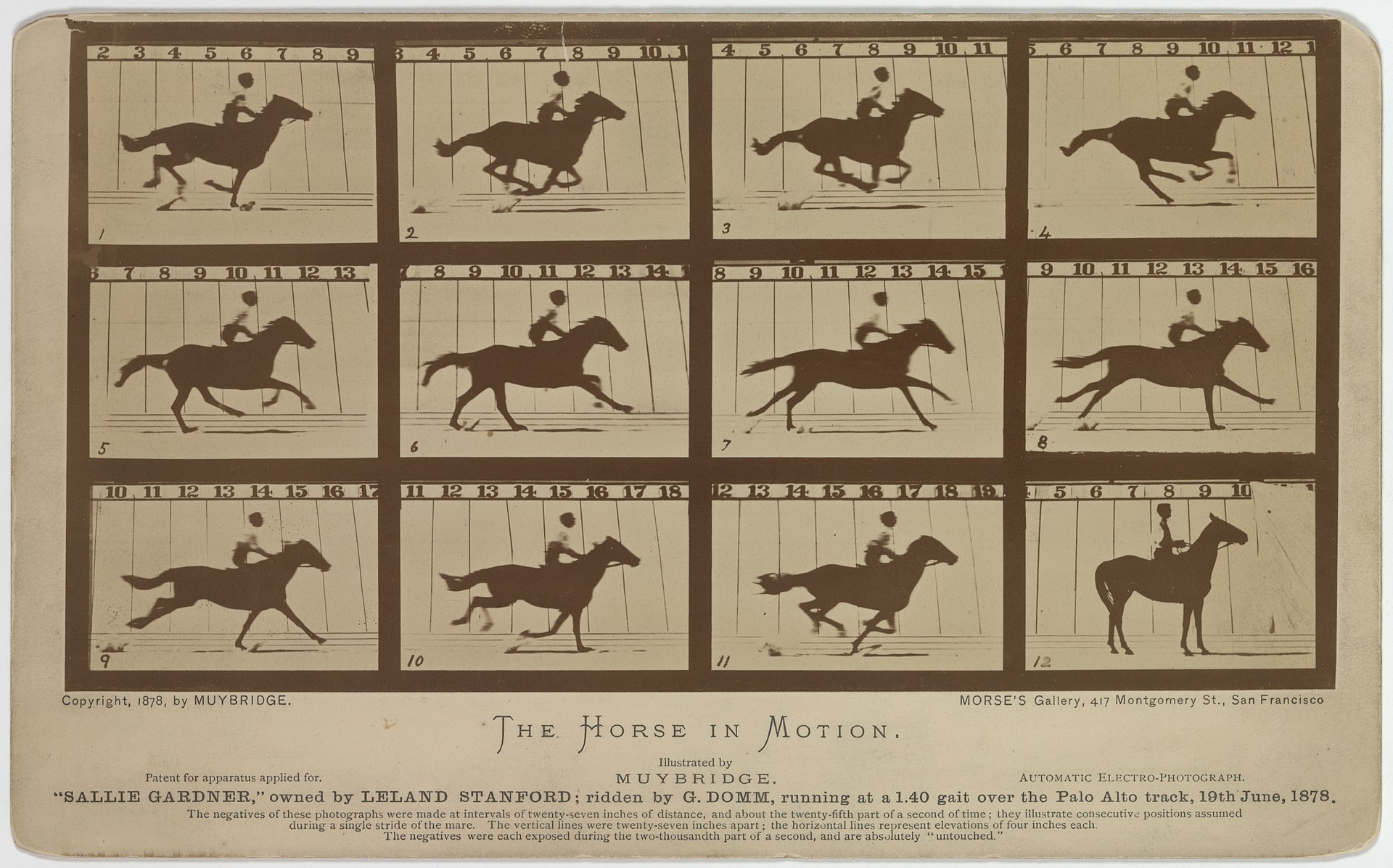
The 19 June 1878 sequence itself: Sallie Gardner, ridden at a gallop across Leland Stanford's Palo Alto track, captured by Muybridge's battery of trip-wire cameras. Public domain, Library of Congress.
| Artist | Eadweard Muybridge |
|---|---|
| Date | 19 June 1878 |
| Medium | Sequence of wet-collodion glass-plate negatives, printed as albumen photographs mounted on card |
| Dimensions | Not given in the Library of Congress catalog records consulted; see open questions |
| Where it is now | Library of Congress, Prints and Photographs Division, Washington, D.C.last confirmed |
| Inventory number | cph 3a45870 |
| Attribution | AcceptedAuthorship of the photographic sequence is not disputed and was registered under Muybridge's own name at the time. Full note |
| Object type | Photograph |
| Period | American, nineteenth century |
| Inscriptions | Printed caption on the mount: "The Horse in Motion. 'Sallie Gardner,' owned by Leland Stanford; running at a 1:40 gait over the Palo Alto track, 19th June 1878" |
| Owners on record | 4 links4 documented |
| Sources | 14 cited |
About this record Last verified · 14 sources cited · Change log
On this page 9 sections
ContentsClose
On 19 June 1878, at Leland Stanford's Palo Alto Stock Farm, Eadweard Muybridge photographed the mare Sallie Gardner in full gallop with a battery of trip-wire cameras and captured, for the first time in a verifiable image, a moment when all four of her hooves were off the ground at once. The result settled a real dispute in equestrian science known as unsupported transit and ended a pictorial convention, the flying gallop, that had governed how horses were painted for centuries.
The popular version of the story, that Stanford had a $25,000 bet riding on the answer, is not supported by any primary account from the period and is treated by the historians who have looked hardest at the record as legend. What is documented is a wealthy horse breeder's genuine scientific curiosity, a disputed share of engineering credit with a railroad engineer named John D. Isaacs, and a sequence of photographs that Muybridge went on to project, as hand-traced silhouettes on spinning glass discs, in a device that is one of the direct ancestors of the movie projector.
The image most people know from magazines and textbooks, the woodcut engraving on the cover of Scientific American in October 1878, is not this photograph. It is a derived illustration. This record is about the photographic plates themselves, made at Palo Alto that June afternoon, now held by the Library of Congress.
Provenance
Each link is graded. Documented: a cited source supports it. Disputed: the identification is argued but not established. Unknown: no owner for that span, and the gap is not smoothed into a narrative. The grades in the glossary.
- 19 June 1878 -Made for Leland Stanford at his Palo Alto Stock Farm; photographed and later copyrighted by Eadweard Muybridgedocumented
The session is independently dated 19 June 1878 by the Library of Congress's own catalog title for this item; some secondary accounts describe preparatory setup work in the days immediately before.1478
- 1878 - 1881Eadweard Muybridgedocumented
Two frames were redrawn as a wood engraving for the cover of Scientific American, 19 October 1878, and the sequence circulated in France via La Nature that December. Muybridge later issued the Palo Alto sessions, including this one, within the portfolio The Attitudes of Animals in Motion, copyrighted 17 May 1881.34714
- 17 May 1881 - unknownLibrary of Congress, via copyright depositdocumented
Copyright deposit is the documented mechanism by which Muybridge's Palo Alto photographs, registered under numbers 7176 and 7185 through 7393, entered the Library's holdings. The exact custodial path from that 1881 deposit to the specific print now catalogued as cph 3a45870, which the Library states is a digital file from a copy negative of "copy 2," is not established by the sources consulted.13
- unknown - presentLibrary of Congress, Prints and Photographs Divisiondocumented
Held under reproduction number cph 3a45870.1
Technical evidence
| Attribution note | Authorship of the photographic sequence is not disputed and was registered under Muybridge's own name at the time. What is disputed, and documented as a dispute, is credit for the electrical triggering apparatus: Stanford's side maintained that the electromagnetic shutter-release system was substantially the work of railroad engineer John D. Isaacs, not Muybridge alone. Muybridge's later book with Stanford's physician J.D.B. Stillman omitted Muybridge from credit entirely, prompting a lawsuit that was dismissed. |
|---|---|
| Negative process | Wet-collodion glass-plate negatives, requiring on-site preparation and immediate development.11 |
| Print process | Albumen prints made from the glass negatives, mounted on card with a printed caption.1 |
| Camera battery | A row of cameras positioned along the track; most secondary accounts of this specific 19 June 1878 run give twelve, while descriptions of the broader 1878 Palo Alto campaign give twenty-four. The sources consulted do not resolve which figure applies here.4711 |
| Shutter | Muybridge's own fast mechanical shutter design, two sliding slitted plates pulled apart by rubber bands, released by an electromagnetic catch. Claimed exposure as brief as roughly one one-thousandth of a second; not independently verified by period instruments.711 |
| Trigger mechanism | Threads stretched across the track, broken in sequence by the horse or the wheel of an accompanying sulky, closing spring electrical contacts that released each shutter in turn.11 |
| Backdrop | Whitened track surface and a white board backdrop set at a slight angle, marked with vertical calibration lines for measuring distance and position frame to frame.7 |
| Digitization generation | The Library of Congress's own online catalog record states its digital file is made from a black-and-white film copy negative of "copy 2," indicating at least one intermediate copying generation between the online image and Muybridge's original plate.1 |
| Reproduction number | cph 3a45870, Library of Congress Prints and Photographs Division.1 |
Images
The record in full
Chapter 1What the plates actually show
The object behind this record is not a single photograph but a sequence: a row of small silhouette images of the mare Sallie Gardner captured at successive, closely spaced instants as she galloped...
The object behind this record is not a single photograph but a sequence: a row of small silhouette images of the mare Sallie Gardner captured at successive, closely spaced instants as she galloped past a fixed bank of cameras, each frame set against a whitened backdrop marked with vertical calibration lines. The horse and her rider read as flat black shapes against the white ground, a deliberate choice that maximized contrast for the extremely short exposures the process required. Companion plates in the same series present the same run as a printed diagram, tracing the position of each leg frame by frame for a viewer working out the sequence of footfalls by eye.
It is known today under several names that have migrated across a century and a half of reproduction: the caption Muybridge himself printed on the mount, "The Horse in Motion," the shorter title "Sallie Gardner, owned by Leland Stanford, running at a 1:40 gait over the Palo Alto track," and the informal modern title "Sallie Gardner at a Gallop," which is how it is generally known once it began circulating as an early motion-picture curiosity rather than a piece of equine science. All three names refer to the same 19 June 1878 session; none of them refers to Muybridge's later, much larger Animal Locomotion project, made at the University of Pennsylvania between 1883 and 1887, which photographed a huge range of human and animal subjects and is a separate body of work by the same photographer.
Chapter 2The dispute it was made to settle
The underlying scientific question was real and had genuinely divided opinion: whether a horse at a trot or gallop ever has all four hooves simultaneously off the ground, a condition later writers...
The underlying scientific question was real and had genuinely divided opinion: whether a horse at a trot or gallop ever has all four hooves simultaneously off the ground, a condition later writers called unsupported transit. Painters for centuries had shown galloping horses with legs extended fore and aft in a flying pose that felt right to the eye but that no one had verified against a moving animal too fast to watch accurately. Leland Stanford, a breeder of trotting and racing horses at his Palo Alto Stock Farm, said plainly that he considered the accepted theory of how a horse's legs moved at speed to be wrong, and he had both the money and the working racetrack to test it.
The popular telling adds a $25,000 wager with a named opponent settling the question over dinner. That version has been examined closely by historians of photography and film and has not held up. Phillip Prodger, who has done extensive archival work on Muybridge, has stated there are no primary accounts of any such bet from the period. Allain Daigle's 2018 study in Film History: An International Journal, devoted specifically to this question, reaches the same conclusion and treats the wager as a myth that later writers attached to a real and better-documented motive, Stanford's own stated scientific interest in the mechanics of his horses' gaits. This record follows that scholarship: Stanford's interest in the outcome is documented, the size and existence of a specific bet is not.
Chapter 3The apparatus, and a credit dispute that is not about the photograph
Capturing a horse moving at roughly forty miles an hour required equipment beyond what any single camera of 1878 could do.
Capturing a horse moving at roughly forty miles an hour required equipment beyond what any single camera of 1878 could do. Muybridge's solution, worked out over several years of trials at Palo Alto, was a row of cameras loaded with wet-collodion glass-plate negatives, each fitted with a fast mechanical shutter of his own design, released not by hand but by an electromagnetic catch. Thin threads were stretched across the track at intervals; as the horse's legs or the wheel of a following sulky broke each thread in turn, a spring-loaded electrical contact closed and fired the corresponding camera. Secondary accounts of the 19 June 1878 run generally describe a battery of twelve cameras; other descriptions of Muybridge's broader 1878 Palo Alto campaign give a larger figure of twenty-four, and the sources consulted for this record do not resolve which count applies to this specific session. The claimed exposure time, on the order of one one-thousandth of a second, is likewise a period claim rather than an independently verified figure.
The electrical triggering system did not come from Muybridge working alone. Stanford's circle credited much of the engineering, particularly the electromagnetic shutter release, to John D. Isaacs, a mechanical engineer employed by the Central Pacific and Southern Pacific Railroad companies that Stanford controlled. This is a real and documented credit dispute, distinct from any question about who took the photographs: when Stanford's physician and friend J.D.B. Stillman wrote the analytical text of the 1882 book The Horse in Motion, Muybridge was named only as an employee rather than as an author, and Muybridge's own suit to recover credit was dismissed. The dispute cost him more than pride. The Royal Society of Arts in London, which had promised him support, withdrew it once the book appeared without his name on it in the way he expected.
Chapter 4The photograph and the murder that preceded it
Muybridge's path to the Palo Alto track ran through a killing.
Muybridge's path to the Palo Alto track ran through a killing. In October 1874 he discovered that his young wife Flora had been involved with a drama critic named Harry Larkyns, and, on grounds that a photograph of his infant son bore an inscription he read as a paternity slight, he tracked Larkyns down and shot him dead. He was tried for murder and acquitted on grounds of justifiable homicide, a verdict later writers have connected to a severe stagecoach accident Muybridge survived in 1860, which left him with lasting changes in behavior that a psychologist examining the case decades later described as consistent with frontal-lobe injury. This record does not extend that speculation any further than the sources support: the accident and the acquittal are documented; a causal medical link between the two is a retrospective argument, not a contemporary finding.
The relevance to this specific photograph is chronological rather than symbolic. Stanford had approached Muybridge about photographing a horse in motion as early as 1872, years before the Larkyns killing, and the definitive 1878 sequence was made after Muybridge's return from a period working in Central America following the trial. The Palo Alto sessions therefore sit on the far side of the most notorious event of his life, not before it, and several accounts read his renewed, near-obsessive focus on the Stanford commission in that light. That is a biographical observation about timing, and this record treats it as one; it is not evidence about the content or the making of the photograph itself.
Chapter 5How it reached print, and why the famous version is not this one
The photographs themselves were difficult to reproduce directly in the printing technology of 1878.
The photographs themselves were difficult to reproduce directly in the printing technology of 1878. When Scientific American ran a piece on the experiment, headlined "A Horse's Motion Scientifically Determined," on its 19 October 1878 cover, what appeared was a wood engraving derived from two of Muybridge's frames, redrawn by an engraver for the halftone-less presses of the day. The French journal La Nature published its own version of the sequence that December and drew an enthusiastic response from Etienne-Jules Marey, the French physiologist whose own chronophotographic research into animal and human movement was already underway and who recognized in Muybridge's plates independent confirmation of what his own instruments were beginning to suggest.
The engraving is the version that circulated in nineteenth-century print culture and the one most often reproduced today without qualification. It is not the object described in this record. The glass-plate negatives and the albumen prints made from them, of the kind held by the Library of Congress, are the primary photographic record; the Scientific American cover is a secondary illustration once removed from it, redrawn by a hand that was not Muybridge's.
Chapter 6The convention it ended
Before 1878, the standard way of painting a galloping horse, in racing prints, in battle scenes, in works as prominent as Theodore Gericault's Epsom Derby of 1821, was the flying gallop: front legs...
Before 1878, the standard way of painting a galloping horse, in racing prints, in battle scenes, in works as prominent as Theodore Gericault's Epsom Derby of 1821, was the flying gallop: front legs stretched forward, hind legs stretched back, the animal appearing to leap through the air like a leaping deer. It was a convention that felt kinetically true and was, according to Muybridge's photographs, mechanically wrong; no gait he recorded put a horse's legs in that configuration. Writers on the reception of the Palo Alto photographs describe the flying gallop disappearing from serious equestrian art and from illustrations in racing periodicals within a few years of the sequence's publication, replaced by the gathered-leg positions the camera had actually recorded.
Not every artist accepted the camera's authority without argument. Accounts of the period describe a divided reaction: some painters began consulting Muybridge's plates directly for anatomical accuracy, while others, Auguste Rodin among the artists named in later commentary, rejected the idea that a frozen photographic instant was a truer picture of motion than the pictorial conventions built up by generations of observation. That disagreement, over whether an instant captured by a machine is a more truthful representation of movement than a synthesis built by an eye and a trained hand, outlived the specific question of the horse's legs and became one of the recurring arguments of early photographic modernism.
Chapter 7From still plates to projected motion
Muybridge did not stop at still sequences.
Muybridge did not stop at still sequences. Working from the Palo Alto plates and further Stanford-funded sessions through 1879, he developed the zoopraxiscope, a projector built around a spinning glass disc roughly sixteen inches across. He gave a private demonstration at Stanford's own house in the fall of 1879 and the first public one at the San Francisco Art Association on 4 May 1880, an event frequently cited as among the earliest projected moving images shown to a paying audience anywhere.
The zoopraxiscope discs are not photographic transfers of the Sallie Gardner plates or any other single Muybridge photograph. An artist Muybridge employed traced the sequence as painted silhouettes onto the glass, a step that let him simplify, exaggerate or recombine figures for a smoother projected loop than the raw photographic frames, taken at irregular real-world intervals, could produce on their own. The device is rightly treated as a direct ancestor of the motion-picture projector and of cinema generally, and this record treats it that way, while being explicit that a zoopraxiscope disc is a distinct made object, a hand-drawn intermediate step, not a reproduction of the photograph described here.
Chapter 8Into print as a portfolio, and how the Library of Congress came to hold it
The Palo Alto sequences, Sallie Gardner's run among them, were eventually issued by Muybridge as part of a formal publication, The Attitudes of Animals in Motion: A Series of Photographs Illustrating...
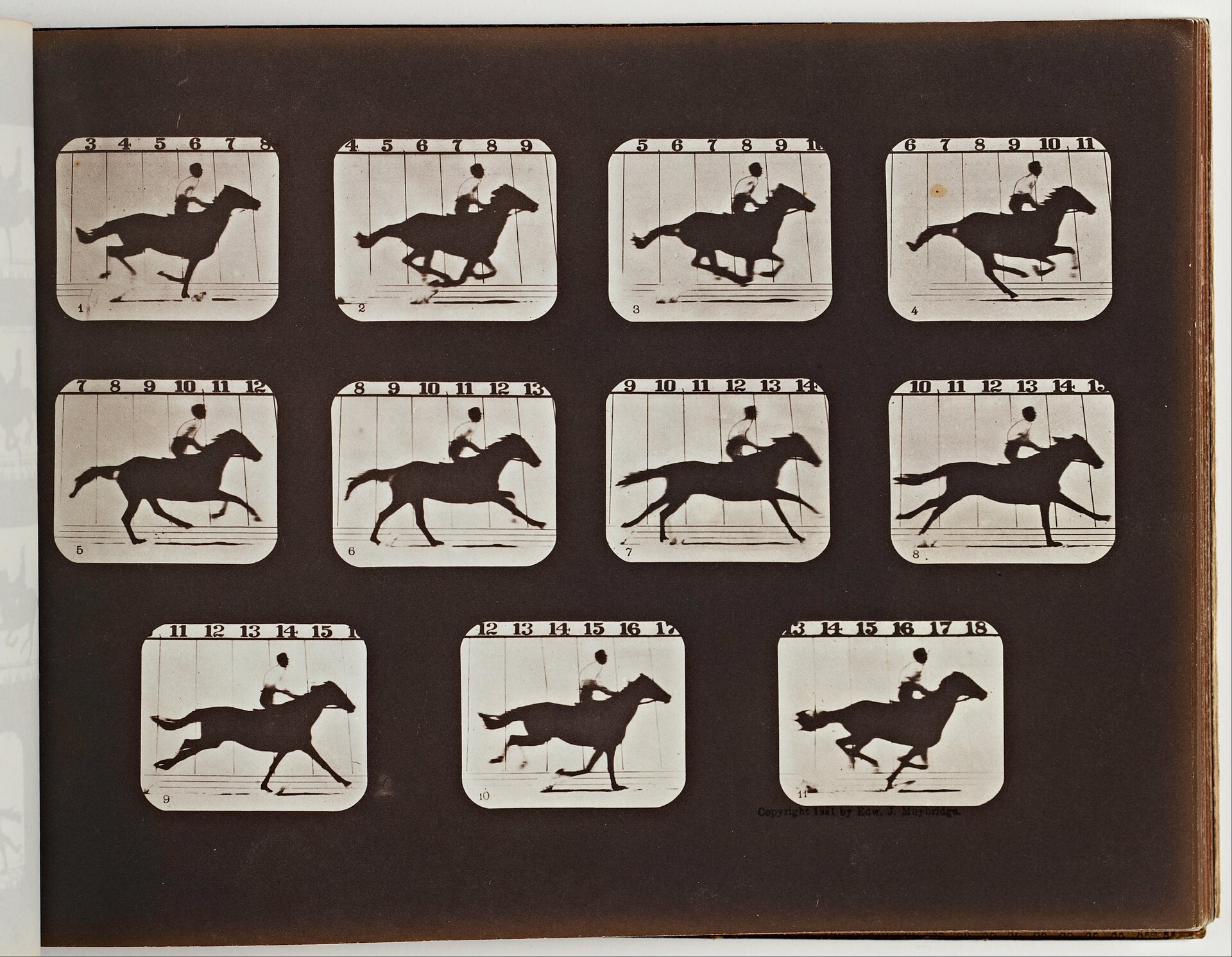
The Palo Alto sequences, Sallie Gardner's run among them, were eventually issued by Muybridge as part of a formal publication, The Attitudes of Animals in Motion: A Series of Photographs Illustrating the Consecutive Positions Assumed by Animals in Performing Various Movements, Executed at Palo Alto, California, in 1878 and 1879. Muybridge registered the work for copyright, and the two copies now in the Library of Congress carry copyright deposit stamps dated 17 May 1881, registration numbers 7176 and 7185 through 7393, the standard mechanism by which nineteenth-century American publishers secured legal protection by depositing copies with the Library.
That deposit explains, in general terms, how Muybridge material entered the Library's collections. It does not by itself establish the exact custodial history of the specific print catalogued today under reproduction number cph 3a45870: the Library's own online record for that image states it is a digital file made from a black-and-white film copy negative of "copy 2," which means at least one intermediate copying generation stands between the plate a reader sees on the Library's website and Muybridge's original 1878 negative. This record states that gap rather than smoothing over it.
Chapter 9This session and the much larger project it is not
Muybridge's name is now most associated with Animal Locomotion, an enormous systematic study undertaken at the University of Pennsylvania between 1883 and 1887, which produced more than 100,000...
Muybridge's name is now most associated with Animal Locomotion, an enormous systematic study undertaken at the University of Pennsylvania between 1883 and 1887, which produced more than 100,000 photographs of humans and animals in motion and was published as an eleven-volume set of 781 collotype plates. That project is separate from, later than, and vastly larger in scope than the 1878 Palo Alto work this record describes. It used a different institutional sponsor, a different location, a different and more elaborate multi-camera rig, and covered an enormous range of subjects Sallie Gardner's session never touched.
The distinction matters because the two bodies of work are frequently conflated in casual reproduction and captioning, and getting it wrong assigns a fact or an image from one project to an object it does not belong to. Every image and fact in this record has been checked against sources that specifically identify the 1878 Palo Alto Sallie Gardner session as the origin, and nothing from the 1887 University of Pennsylvania Animal Locomotion plates has been used here.
Chapter 10What remains open
Several factual questions about this specific object do not have settled answers in the sources available for this record, and they are recorded here rather than smoothed into a confident narrative.
Several factual questions about this specific object do not have settled answers in the sources available for this record, and they are recorded here rather than smoothed into a confident narrative. The precise number of cameras used on 19 June 1878 is given as twelve in some secondary accounts and as twenty-four in descriptions of the wider 1878 Palo Alto campaign, without a source that resolves the discrepancy for this exact session. No published technical or conservation study of the surviving Library of Congress prints, addressing their physical condition, printing generation, or fading, was located during this research. The present whereabouts of Muybridge's original glass-plate negatives from this session, as distinct from the printed and copy-negative material held by the Library of Congress, is not established by the sources consulted.
The artist
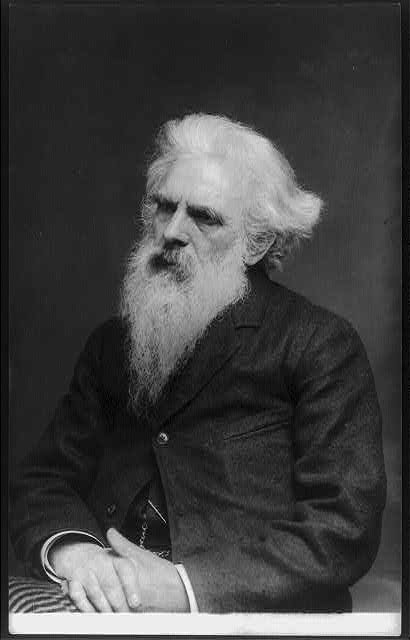
Edward James Muggeridge, known professionally as Eadweard Muybridge
Muybridge remade himself more than once. Born Edward Muggeridge in Kingston upon Thames, he first altered his surname to the archaic-sounding Muygridge and later to Muybridge, and adopted the Old English spelling Eadweard for his given name, believing both forms closer to the town's Anglo-Saxon founders. He worked for a period under the professional name Helios. Before he was known for horses in motion he was known for enormous, technically ambitious landscape photographs of Yosemite, and before that, briefly and violently, he was known as an acquitted killer. Every part of that history bears in some way on how he came to be standing beside a racetrack in Palo Alto in June 1878 with a battery of cameras and a threadwork of trip-wires.
Related works
| Work | Relation | Where it is |
|---|---|---|
| Sallie Gardner Running, from The Attitudes of Animals in Motion Eadweard Muybridge | The same 1878 Palo Alto photograph as reissued within Muybridge's 1881 copyrighted portfolio Same session, different published context; not a different sequence. | Reproduced via Google Art Project; underlying prints held by the Library of Congress and other copyright-deposit repositories |
| Animal Locomotion Eadweard Muybridge | Later, much larger and unrelated project by the same photographer Explicitly NOT the source of any image or fact in this record. A systematic, multi-subject study on a different scale, made five to nine years after the Sallie Gardner session. | University of Pennsylvania, 1883-1887; plates widely held including at the Library of Congress |
| The Epsom Derby Theodore Gericault | The pictorial "flying gallop" convention this photograph is credited with overturning Painted 1821, more than fifty years before Muybridge's photographs showed that no gait actually produces this leg position. | Musee du Louvre, Paris |
| Zoopraxiscope discs Eadweard Muybridge | Hand-painted glass discs Muybridge projected in his zoopraxiscope, derived in spirit from sequences like this one Traced silhouettes by an artist Muybridge employed, not photographic reproductions of any single plate; a distinct made object. | Kingston Museum, Kingston upon Thames, and other collections |
Open questions
- How many cameras were actually used on 19 June 1878: secondary sources give twelve for this specific session and twenty-four for the broader 1878 Palo Alto campaign, without a source resolving the discrepancy.
- What is the true exposure time achieved: the claimed one one-thousandth of a second is a period claim, not independently verified by contemporary instruments.
- Where are Muybridge's original 1878 glass-plate negatives now: the Library of Congress record examined for this entry is stated to derive from a copy negative of a copy print, not from an original plate.
- Has any published technical or conservation study examined the physical condition of the surviving Library of Congress prints: none was located for this record.
- Which specific copyright deposit item corresponds exactly to the plate now catalogued as cph 3a45870: the 1881 deposit covered the full Attitudes of Animals in Motion portfolio under a range of registration numbers, and this record has not traced the individual chain for this one plate.
Questions about this object
What is Sallie Gardner at a Gallop?
Sallie Gardner at a Gallop is a photograph, dated 19 June 1878. Medium: Sequence of wet-collodion glass-plate negatives, printed as albumen photographs mounted on card.
Who made Sallie Gardner at a Gallop, and is the attribution settled?
The attribution to Eadweard Muybridge is recorded here as accepted. Authorship of the photographic sequence is not disputed and was registered under Muybridge's own name at the time. What is disputed, and documented as a dispute, is credit for the electrical triggering apparatus: Stanford's side maintained that the electromagnetic shutter-release system was substantially the work of railroad engineer John D. Isaacs, not Muybridge alone. Muybridge's later book with Stanford's physician J.D.B. Stillman omitted Muybridge from credit entirely, prompting a lawsuit that was dismissed.
Where is Sallie Gardner at a Gallop now?
Library of Congress, Prints and Photographs Division, Washington, D.C. Inventory number cph 3a45870. Last confirmed 27 August 2026. Held in the Library of Congress Prints and Photographs Division under reproduction number cph 3a45870; the digital file on the Library's own site is stated to derive from a black-and-white film copy negative of "copy 2," not from the original plate directly.
What is still unknown about Sallie Gardner at a Gallop?
How many cameras were actually used on 19 June 1878: secondary sources give twelve for this specific session and twenty-four for the broader 1878 Palo Alto campaign, without a source resolving the discrepancy.
Sources
- 1Library of Congress, Prints and Photographs Division, catalog record for "The Horse in Motion. 'Sallie Gardner,' owned by Leland Stanford; running at a 1:40 gait over the Palo Alto track, 19th June 1878" (reproduction number cph 3a45870). loc.gov/pictures/...
- 2Library of Congress, Prints and Photographs Division, catalog record for the companion diagram plate, "...2 frames showing diagram of foot movements." loc.gov/pictures/...
- 3Library of Congress, catalog record for "The attitudes of animals in motion...executed at Palo Alto, California, in 1878 and 1879," noting the copyright deposit stamps of 17 May 1881. loc.gov/item/...
- 4Wikipedia, "The Horse in Motion." source; with the Library of Congress catalog data and a peer-reviewed history of photography source. en.wikipedia.org/wiki/...
- 5Prodger or Solnit). en.wikipedia.org/wiki/...
- 6Wikipedia, "Zoopraxiscope." source; with a museum or archival technical description. en.wikipedia.org/wiki/...
- 7Smarthistory, "Eadweard Muybridge, The Horse in Motion." smarthistory.org/eadweard-muybridge-the-horse-in-motion
- 8Stanford Magazine, "The Man Who Stopped Time." stanfordmag.org/contents/...
- 9Science History Institute, "The Murderer Who Made Movies Possible." Note: this source frames the 1878 project as a "$25,000 project," a figure this record does not adopt given the wager itself is treated as apocryphal by the sources at notes 8 and 10; used here only for biographical material on the Larkyns killing and its chronological relation to the Stanford commission. sciencehistory.org/stories/...
- 10Allain Daigle, "Not a Betting Man: Stanford, Muybridge, and the Palo Alto Wager Myth," Film History: An International Journal, vol. 29 (2018), pp. 112-130. muse.jhu.edu/article/...
- 11IEEE Spectrum, "June 1878: Muybridge Photographs a Galloping Horse." spectrum.ieee.org/consumer-electronics/...
- 12Wikimedia Commons, file and license metadata for the lead plate. commons.wikimedia.org/wiki/...
- 13Wikimedia Commons, file and license metadata for the twelve-frame diagram plate. commons.wikimedia.org/wiki/...
- 14Stanford Libraries, Eadweard Muybridge Collection Spotlight Exhibits, catalog entry for "The Attitudes of Animals in Motion." exhibits.stanford.edu/muybridge/...

_(13624716983).jpg)
Last verified · Published
Change log
27 August 2026 - Record created at the house standard: researched narrative, technical evidence, maker dossier, graded provenance chain, prices with hammer and premium separated, related works, open questions and sources.