Abraham Lincoln, Cooper Union Portrait
Mathew B. Brady · 1860-02-27
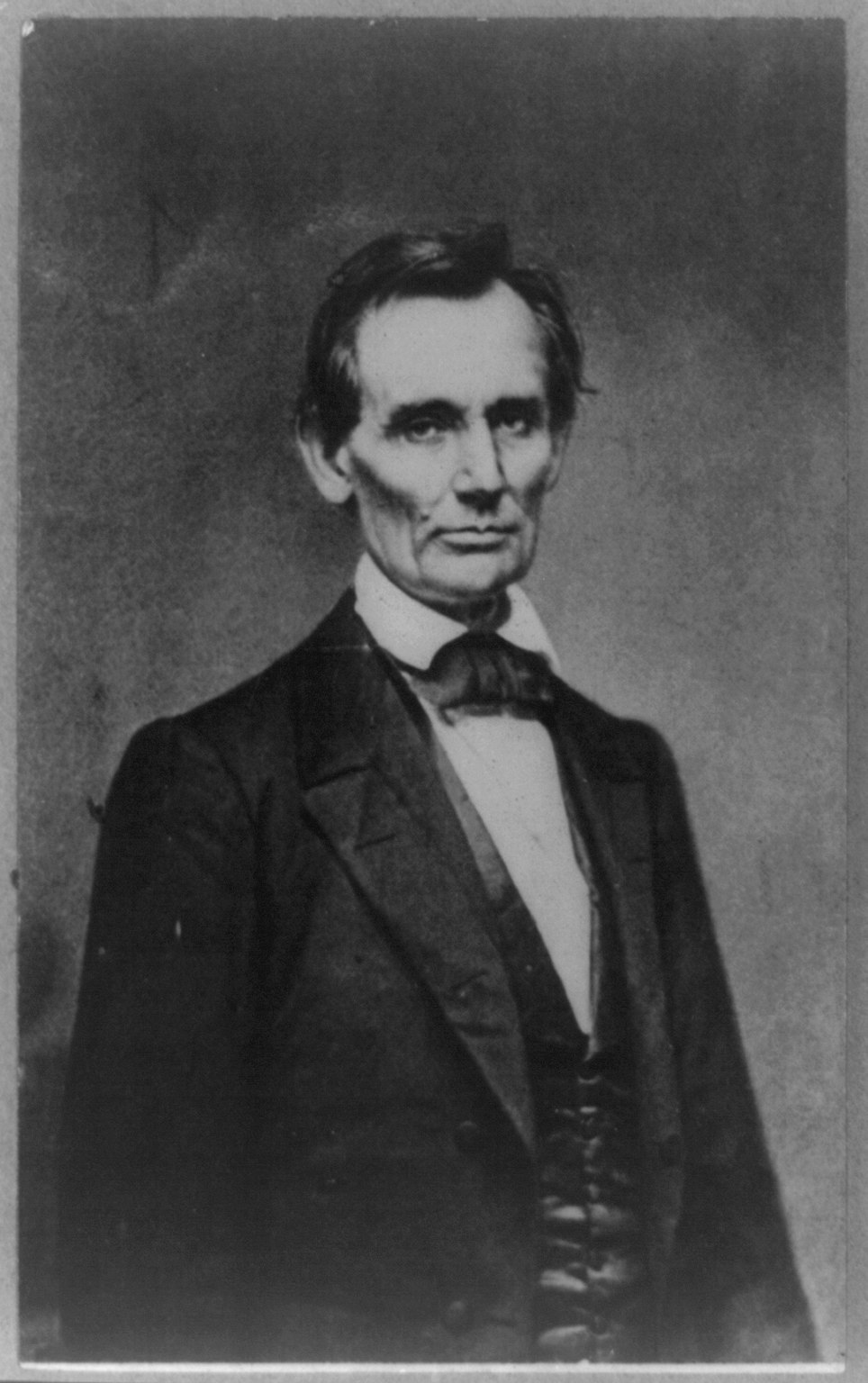
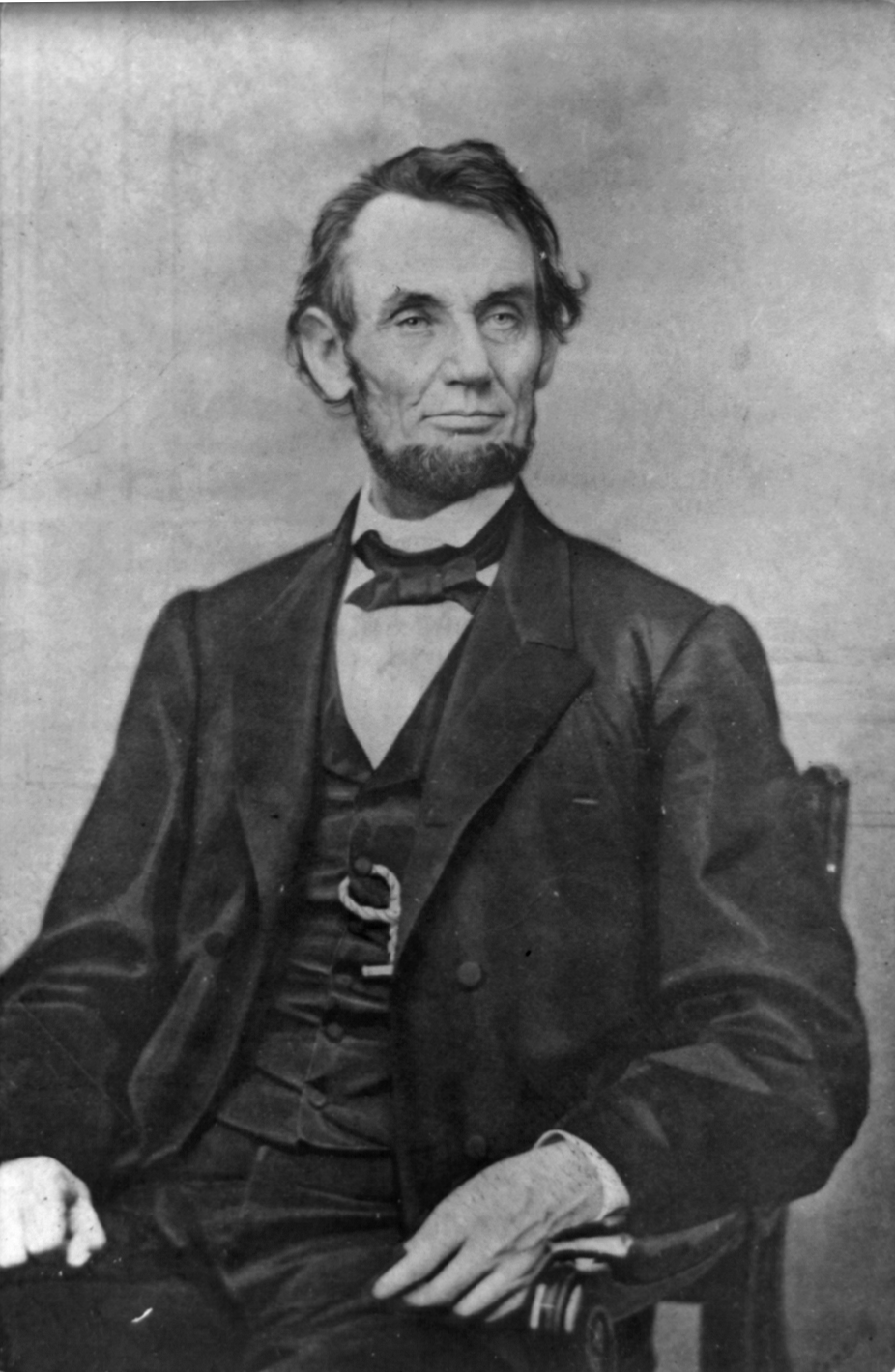
The record subject. Photographed at Mathew Brady's New York gallery on the morning of 27 February 1860, hours before Lincoln's Cooper Union address. Library of Congress digital scan of a period print, LCCN 2009630664.
| Artist | Mathew B. Brady |
|---|---|
| Date | 1860-02-27 |
| Medium | Wet-plate (collodion) glass negative, printed as an albumen silver print; distributed as cartes de visite and later as cabinet-card and imperial-size prints. Surviving Library of Congress prints are albumen silver prints; the museum's digital surrogates are scans of those prints, not of the original negative. |
| Dimensions | Carte de visite prints of this sitting follow the standard format, image approximately 5.7 x 8.9 cm (2 1/4 x 3 1/2 in) mounted on card stock approximately 6.4 x 10.2 cm (2 1/2 x 4 in). Later Brady's Gallery reprints and 'imperial' enlargements were issued in larger formats up to about 43 x 53 cm. The dimensions of the original glass plate negative are not stated in the sources consulted. |
| Where it is now | Library of Congress, Prints and Photographs Division, Washington, DC, which holds multiple period prints of this sitting under separate catalog numbers.last confirmed |
| Inventory number | LC-USZ62-13016 and related reproduction numbers cph.3a05636 and cph.3a09102, corresponding to LCCN 98504529 and LCCN 2009630664; the sitting is further identified in the standard Lincoln photograph literature as Ostendorf no. 17 and Meserve no. 20 (illustrated in Frederick Hill Meserve, The Photographs of Abraham Lincoln, New York, privately printed, 1911, p. 51). Additional period prints and the associated glass-plate material from Brady's studio passed through several custodial hands: some Brady negatives went to Brady's nephew-by-marriage Levin C. Handy, whose family's holdings were bought by the Library of Congress in 1954 as the Brady-Handy collection; a separate large group, including much of the Meserve family's holdings, was later acquired by the National Portrait Gallery, Smithsonian Institution. The sources consulted do not identify which, if any, institution holds the specific original glass negative exposed at this 27 February 1860 sitting, as opposed to the surviving prints made from it. |
| Attribution | AcceptedAttributed to Mathew Brady's New York gallery without dispute. Full note |
| Object type | Photograph |
| Period | American, mid-nineteenth century |
| Cases | Has a provenance gap |
| Inscriptions | Cartes de visite of this sitting carry Brady's gallery imprint on the verso, giving his New York and (on later reprints) Washington gallery addresses; some later prints bear the printed caption identifying the sitting as taken the day of the Cooper Union address. |
| Owners on record | 4 links3 documented, 1 unknown |
| Sources | 14 cited |
About this record Last verified · 14 sources cited · Change log
On this page 9 sections
ContentsClose
Mathew Brady photographed Abraham Lincoln at his temporary New York gallery on the morning of 27 February 1860, hours before Lincoln delivered the Cooper Union address that made him a serious presidential contender. Brady drew Lincoln's collar up to shorten the appearance of his long neck and his studio smoothed the lines of his face, producing the beardless image that Republican printers turned into campaign woodcuts, lithographs and cartes de visite through the 1860 election.
Lincoln is widely quoted as later crediting Brady and the speech together with making him president. That line traces to a single source: an 1891 newspaper interview Brady gave in old age, thirty-one years after the fact, recalling his own introduction to the president through Ward Hill Lamon. No contemporary record of Lincoln saying it has been found, and historians who work with Brady's biography treat the interview itself as unreliable, valuable mainly because so little else about Brady survives in his own words.
This is one of at least seven documented photographic sittings between Brady's studio and Lincoln between 1860 and 1864 (Ostendorf numbers including O-17, O-57, O-59, O-60 and O-84), and it is the earliest: a clean-shaven, pre-nomination Lincoln photographed as a candidate rather than as the bearded wartime president of the later Washington sittings, several of which were actually operated by Brady's studio employee Anthony Berger rather than Brady himself.
Provenance
Each link is graded. Documented: a cited source supports it. Disputed: the identification is argued but not established. Unknown: no owner for that span, and the gap is not smoothed into a narrative. The grades in the glossary.
- 1860-02-27 -Mathew Brady's gallery, New Yorkdocumented
Photographed at Brady's temporary gallery at 643 Broadway, New York, on the morning of 27 February 1860, the day of Lincoln's Cooper Union address. Identified in the standard Lincoln photograph literature as Ostendorf no. 17 and Meserve no. 20, Brady's first photograph of Lincoln.124
- 1860 - 1873Mathew Brady's studio and its negative stockdocumented
The negative was printed and sold commercially by Brady's gallery as cartes de visite during the 1860 campaign and after, and licensed or copied for use by engravers and lithographers producing campaign material. Brady's broader negative stock, including presumably this negative, remained nominally his through the Civil War years until the financial panic of 1873 forced him into bankruptcy and the sale of his New York gallery.4810
- 1873 - 1954Dispersed: partly to Levin C. Handy (Brady's wife's nephew), partly to other later holdersunknown
Following Brady's bankruptcy, his negative stock was not kept together as a single archive. Some material passed to Levin C. Handy, who had apprenticed under Brady and continued operating a photographic studio; his family's holdings, including glass negatives dating back to Brady found in deteriorating storage, were later sold. Whether the specific negative or negatives from this 1860 sitting were among Handy's holdings, as opposed to being lost, destroyed, or held elsewhere, is not established in the sources consulted.10
- 1954 - presentLibrary of Congress, Prints and Photographs Division (prints); National Portrait Gallery, Smithsonian Institution, and other institutions (related Brady studio material)documented
The Library of Congress purchased the Handy family's Brady-related negative holdings in 1954, forming the Brady-Handy collection. Separately, the collector Frederick Hill Meserve's holdings of Brady studio material, including reference prints and negatives used to compile his 1911 book on Lincoln photographs, passed to his daughter Dorothy Meserve Kunhardt and were later acquired in large part by the National Portrait Gallery, Smithsonian Institution, and by Yale University. The Library of Congress today holds and catalogs multiple period prints of this specific 1860 sitting (LCCN 98504529 and LCCN 2009630664); no source consulted identifies a specific surviving original negative of this exact sitting as being held by a named institution.1210
Technical evidence
| Attribution note | Attributed to Mathew Brady's New York gallery without dispute. The sitting is documented by contemporary carte de visite mounts printed with Brady's gallery imprint, by Brady's own later recollection of the session, and by the standard reference numbering of Lincoln photographs (Ostendorf no. 17, Meserve no. 20). As with most mid-nineteenth-century commercial galleries, the man who owned the imprint on the mount did not necessarily operate the camera in person; no operator other than Brady is named for this specific sitting in the sources consulted, unlike several of his 1864 Washington sittings, which are documented as the work of his employee Anthony Berger. |
|---|---|
| Negative process | Wet-plate (collodion) glass negative, the standard commercial photographic process of 1860; no daguerreotype was involved in this sitting.58 |
| Print medium (surviving copies) | Albumen silver print, mounted as a carte de visite; later reprints and enlargements were also produced as albumen prints in cabinet-card and larger 'imperial' formats.38 |
| Studio and location | Mathew Brady's gallery, then operating from temporary rooms at 643 Broadway at the corner of Bleecker Street, New York City.4 |
| Reference numbering | Ostendorf no. 17; Meserve no. 20. Identified in the standard literature as Brady's first photograph of Lincoln.12 |
| Retouching, at the sitting | Brady physically raised Lincoln's shirt collar during the sitting to reduce the visual length of his neck, an adjustment made to the sitter, not the negative.46 |
| Retouching, on the negative | Studio retouching smoothed lines in Lincoln's face and corrected the appearance of a natural upward drift in his left eye. Described in the National Portrait Gallery's curatorial account of the sitting.6 |
| Later print alteration | Engravers and lithographers who adapted the photograph for campaign use (Harper's Weekly, Frank Leslie's, Currier and Ives, and others) further smoothed Lincoln's hair and features beyond Brady's own studio retouching; at least one engraving reversed the image left to right. Historian Harold Holzer has argued the photograph's subsequent proliferation in these derivative forms did nearly as much political work as the speech itself.79 |
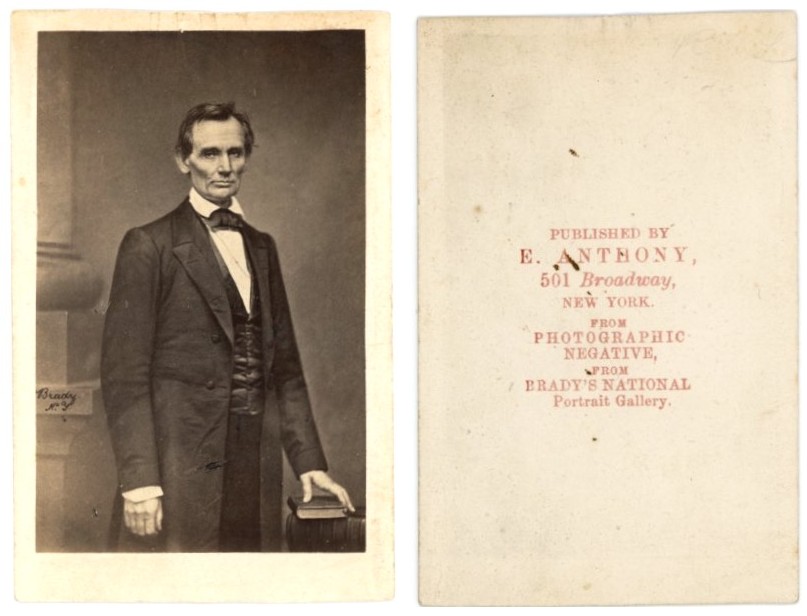
| Verso imprint | Carte de visite mounts of this sitting carry Brady's gallery imprint on the reverse; later reprints add Brady's Washington gallery address alongside New York.2 |
Images
The record in full
Chapter 1What the photograph shows
A three-quarter-length standing portrait of Abraham Lincoln, clean-shaven, in a dark suit with the coat left open, his left hand resting on a stack of books set on a small table, a section of a...
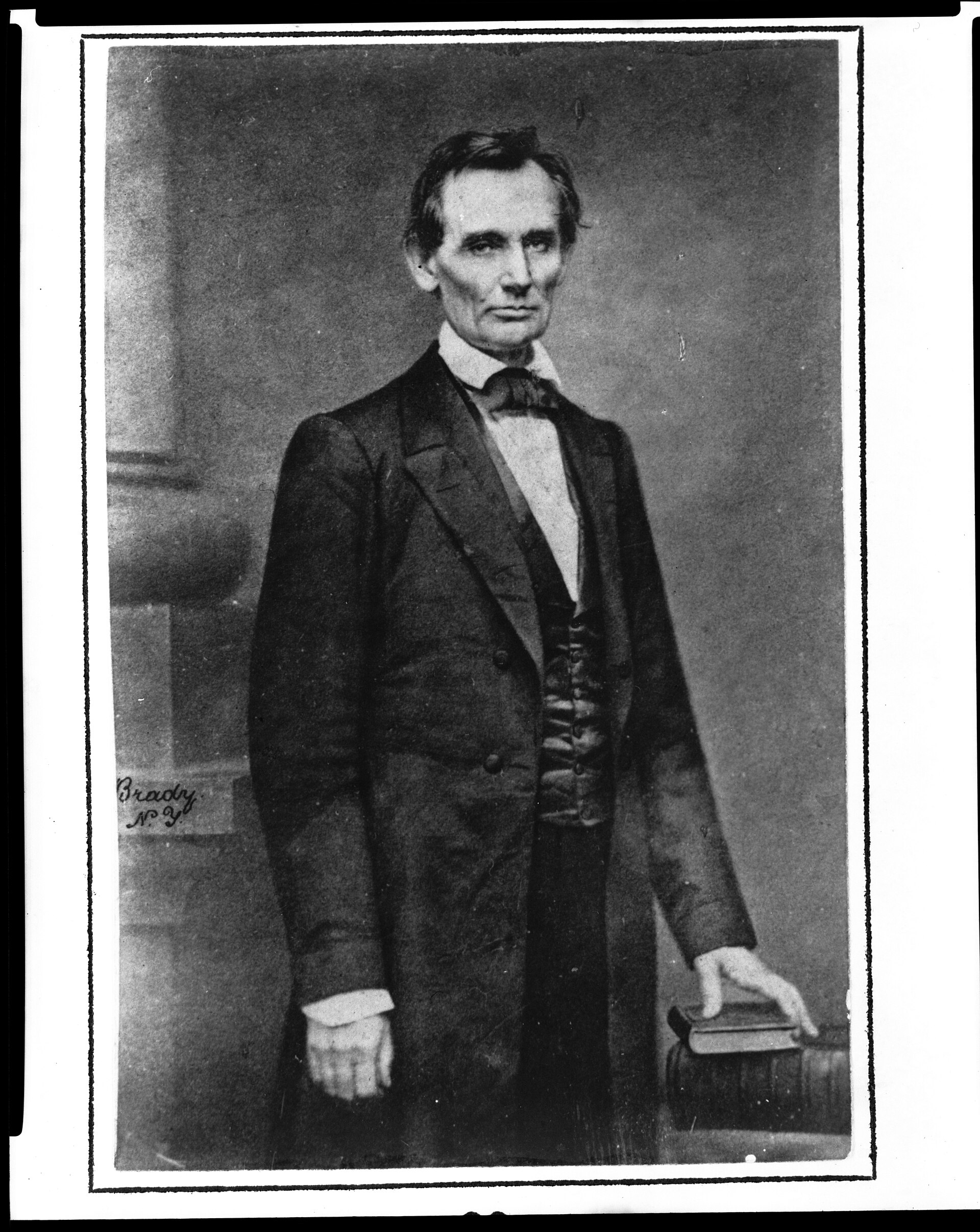
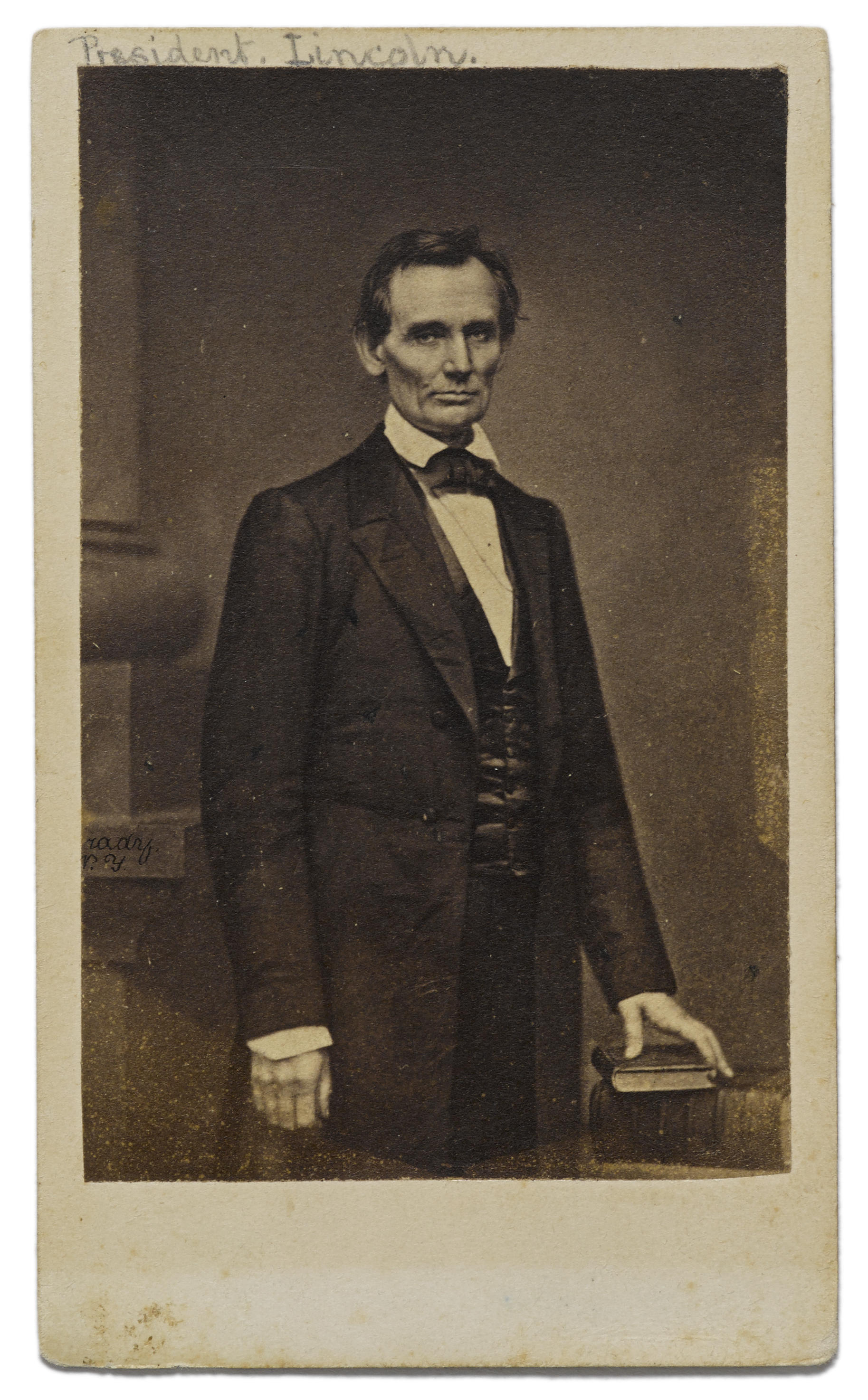
A three-quarter-length standing portrait of Abraham Lincoln, clean-shaven, in a dark suit with the coat left open, his left hand resting on a stack of books set on a small table, a section of a classical column visible behind his right shoulder. The pose is upright rather than seated, which was itself a choice: Lincoln was unusually tall and gaunt, and a standing pose let Brady use his height rather than disguise it.
The image exists today only through prints, chiefly cartes de visite of the standard mid-nineteenth-century format, image roughly 5.7 by 8.9 centimetres on a card mount about 6.4 by 10.2 centimetres, and through later, larger reprints and engraved derivatives made from the same negative or from copy negatives of it. No source consulted for this record locates or describes the original glass plate itself as a surviving, identified object distinct from its prints.
Chapter 2The sitting
Brady made the photograph at his gallery, then operating from temporary rooms at 643 Broadway at the corner of Bleecker Street in New York, on the morning of 27 February 1860, the same day Lincoln...
Brady made the photograph at his gallery, then operating from temporary rooms at 643 Broadway at the corner of Bleecker Street in New York, on the morning of 27 February 1860, the same day Lincoln was to speak that evening at the Cooper Union. Lincoln had arrived in New York the day before to deliver what his sponsors, the Young Men's Central Republican Union, had billed as a major address, and a visit to the city's most famous photographic gallery was arranged as part of the trip, apparently at the suggestion of his New York hosts rather than as Lincoln's own idea.
Brady later recalled the session as difficult. Lincoln's clothes did not fit well by the standards of an Eastern seaboard studio, his neck was unusually long relative to his collar, and the standard head-clamp used to keep sitters still during the long exposure had to be raised because it was built for shorter men. Brady is recorded as saying of the session, 'I had great trouble in making a natural picture.'
Chapter 3Building the pose
The result was not a simple record of how Lincoln looked that morning; it was a constructed image.
The result was not a simple record of how Lincoln looked that morning; it was a constructed image. Brady left Lincoln's coat unbuttoned to broaden the appearance of his narrow chest and shoulders. He set a small table with books at Lincoln's side, a standard studio device for suggesting learning and gravity in a portrait subject. He positioned a classical column behind Lincoln's shoulder, another stock studio prop associated at the time with dignity and permanence in public-man portraiture.
None of this was unusual for a commercial gallery portrait of a public figure in 1860. What made this sitting different was the subject's subsequent history: within months the studio props built for an out-of-town lawyer's portrait were being reproduced by the tens of thousands as the image of a presidential nominee.
Chapter 4The retouching
Brady's own account, corroborated by the National Portrait Gallery's curatorial material on the sitting, describes two distinct interventions.
Brady's own account, corroborated by the National Portrait Gallery's curatorial material on the sitting, describes two distinct interventions. First, during the sitting itself, Brady adjusted Lincoln's collar upward by hand. Lincoln is reported to have recognized what Brady was doing and remarked, 'I see you want to shorten my neck,' to which Brady is said to have answered, 'That's just it.' This was a physical adjustment made to the sitter before exposure, not retouching of the negative afterward.
Second, and separately, the National Portrait Gallery's account of the negative states that Brady's studio retouched the image itself: smoothing the lines of Lincoln's face and correcting the appearance of his left eye, which had a natural upward drift that struck many sitters and viewers as a slight cast or 'roving' quality. This is retouching in the stricter sense, work done on the negative or a working print rather than on the sitter, and it is the element of the record's brief that most needed a citable source rather than repeated retelling: it rests here on the Smithsonian's own curatorial description of the plate, not on a popular retelling of the anecdote.
A further layer of alteration happened after Brady's negative left his hands. When engravers and lithographers adapted the photograph for magazines, campaign prints and the covers of published versions of the Cooper Union speech, several of them went further still, smoothing Lincoln's notoriously unruly hair and softening his features beyond what Brady's own retouching had done. That later, editorial layer of idealization belongs to the printmakers who reproduced the image, not to Brady's studio, and the two should not be collapsed into a single act of retouching.
Chapter 5The Cooper Union address
The speech Lincoln gave that evening, before a large and skeptical audience organized by the Young Men's Central Republican Union of New York, was a closely argued, heavily researched refutation of...
The speech Lincoln gave that evening, before a large and skeptical audience organized by the Young Men's Central Republican Union of New York, was a closely argued, heavily researched refutation of Senator Stephen Douglas's claim that the Constitution's framers had not intended for the federal government to restrict slavery in the territories. Historian Harold Holzer, whose Lincoln at Cooper Union is the standard modern study of the speech, has argued that it did more than any single earlier appearance to convince Eastern Republicans, who knew Lincoln mainly as a Western debater against Douglas, that he was a serious national candidate rather than a regional figure.
The speech and the photograph arrived on the same day for a reason that mattered practically as well as symbolically: an Eastern audience unfamiliar with Lincoln's appearance needed an image to go with the newly persuasive text, and Brady's studio, a short walk from the Cooper Union building, supplied one before the ink on the newspaper accounts of the speech was dry.
Chapter 6From studio print to campaign material
The photograph's political life began after Lincoln's nomination in May 1860, not immediately after the sitting.
The photograph's political life began after Lincoln's nomination in May 1860, not immediately after the sitting. Once Lincoln was the Republican candidate, the image was adapted for reproduction well beyond the limits of a single photographic print. Harper's Weekly converted it into a full-page wood engraving illustrating its coverage of Lincoln's nomination, and Frank Leslie's Illustrated Newspaper used the same image for its own election coverage later in 1860. Harper's Weekly's version reversed the image left to right in the engraving process and added decorative elements, including buffalo imagery, that had no relation to the photograph itself.
Print firms including Currier and Ives, J. C. Buttre, and Ensign, Bridgman and Fanning issued their own lithographed and engraved versions, in both black and white and hand-colored formats, for sale as standalone campaign prints, broadsides, and covers for pamphlet editions of the Cooper Union speech text. Cartes de visite of the photograph itself were also sold, though the format's mass popularity in the United States is generally dated to slightly after 1860, meaning the carte de visite as a mass-collected keepsake object reached its widest circulation only after the campaign had concluded, even though Brady's gallery had begun selling cartes de visite of the sitting during 1860.
The cumulative effect, as both Holzer and Smithsonian curators have argued, was to give a candidate largely unknown east of the Appalachians a settled, dignified visual identity months before most Eastern voters ever heard him speak.
Chapter 7The quotation, examined
The line most often attached to this photograph, that Lincoln himself said 'Brady and the Cooper Union speech made me President,' or in a slightly different wording 'Brady and the Cooper Institute...
The line most often attached to this photograph, that Lincoln himself said 'Brady and the Cooper Union speech made me President,' or in a slightly different wording 'Brady and the Cooper Institute made me President,' is repeated across popular accounts of the sitting as settled fact. It is not.
The only source for the quotation identified in the research for this record is Brady's own recollection, given in an interview with the journalist George Alfred Townsend, published in The World (New York) on 12 April 1891, under the title 'Still Taking Pictures: Brady, the Grand Old Man of American Photography.' In that interview, at the age of roughly sixty-nine and three decades after Lincoln's death, Brady recalled that when Lincoln's aide and marshal Ward Hill Lamon introduced him to the newly inaugurated president, Lincoln replied, 'Brady and the Cooper Institute made me President.'
Several things follow from that. First, this is a self-reported anecdote, related by the one person whose reputation it flattered, about a private remark supposedly made three decades before the interview was recorded no independent witness, contemporary letter, diary, or newspaper account from 1861 corroborates it. Second, the interview itself is treated cautiously by historians who work with Brady's biography precisely because so little other material survives in Brady's own words; a research summary of Brady's life notes that the 1891 Townsend interview 'is exploited in many accounts of his life' because of 'the dearth of material directly relating to the man,' language that describes reliance born of necessity rather than of confidence in the interview's accuracy. Third, Brady in 1891 was an elderly man in declining financial and physical circumstances giving one of the only extended interviews of his life, a context that gives him an obvious, human incentive to recall his own historical importance in the most flattering possible light.
None of this proves Lincoln never said anything like it. It does mean the sentence should not be presented as a documented statement of Lincoln's. It is Brady's memory of Lincoln's words, recorded for the first and only time three decades after the fact, in an interview whose reliability specialists in Brady's life already treat with caution for unrelated reasons. This record states that plainly rather than repeating the line as settled history.
Chapter 8Distinguishing this sitting from Brady's other photographs of Lincoln
Brady or his studio photographed Lincoln on at least seven occasions between 1860 and 1865, and the resulting images are frequently confused with one another in popular reproduction because most show...
Brady or his studio photographed Lincoln on at least seven occasions between 1860 and 1865, and the resulting images are frequently confused with one another in popular reproduction because most show a similar three-quarter or seated pose against a plain studio background. The standard reference numbering for Lincoln photographs, established by Lloyd Ostendorf and used alongside the earlier numbering of Frederick Hill Meserve, identifies this 27 February 1860 sitting as Ostendorf no. 17 and Meserve no. 20, and states specifically that it was Brady's first photograph of Lincoln.
It is not to be confused with, among others: the sitting of 6 April 1861 in Washington (Ostendorf no. 57), made shortly after Lincoln's first inauguration; a pair of sittings on 16 May 1861 in Washington (Ostendorf nos. 59 and 60); a Washington sitting of 8 January 1864, which produced the pose sometimes called 'The Solitary Pine' (Ostendorf no. 84, Meserve no. 75); and the extensively reproduced Washington sitting of 9 February 1864, at which Brady's studio operator Anthony Berger, not Brady personally, photographed a bearded, wartime Lincoln in several poses (including Ostendorf nos. 91 and 92), one of which became the basis for the engraved Lincoln portrait used on the United States five-dollar bill from 1914 until a 2000 redesign. The 1864 Berger sittings show a physically changed man: four years older, bearded since late 1860, and photographed as a wartime president rather than a candidate. Any image purporting to show 'the Cooper Union photograph' that in fact shows a bearded Lincoln belongs to one of these later sittings, not to this one.
Chapter 9Survival and custody of the negatives
Brady's business records and negative stock did not pass down as a single, intact archive.
Brady's business records and negative stock did not pass down as a single, intact archive. Brady himself lost effective control of much of his negative stock through the bankruptcy that followed the Panic of 1873; the government's wartime negatives eventually went to the War Department and then the National Archives, while a large body of studio portrait negatives, including presumably much of his pre-war political portraiture, passed through several later owners. Some negatives went to Levin C. Handy, a nephew of Brady's wife who had apprenticed under him and continued operating a photographic studio in Washington; Handy's family holdings, found in deteriorating condition, were purchased by the Library of Congress in 1954 and now form the Brady-Handy collection. A separate body of Brady studio material was assembled across the early twentieth century by the collector Frederick Hill Meserve, whose holdings were later inherited by his daughter Dorothy Meserve Kunhardt and eventually acquired by the National Portrait Gallery, Smithsonian Institution, and by Yale University's Beinecke Library and Art Gallery.
No source consulted for this record specifies which institution, if any, holds the original glass negative exposed at the 27 February 1860 sitting, as distinct from period prints made from it. The Library of Congress's own catalog records describe its holdings of this image as prints, not as the original negative. This is recorded here as an open question rather than resolved by assumption.
Chapter 10What is unresolved
The location and survival of the original glass plate, as opposed to prints made from it, is not established in any source consulted.
The location and survival of the original glass plate, as opposed to prints made from it, is not established in any source consulted. The full print run and original retail price of the 1860 cartes de visite of this sitting are not documented in the sources consulted. And the anecdote at the center of the image's fame, that Lincoln personally credited Brady with making him president, rests on a single, decades-later, self-interested recollection rather than on any contemporary record, a distinction this record has tried to state plainly rather than smooth over.
The artist
Mathew B. Brady
Brady's own birth date is not settled among the sources consulted, given variously as 1822, 1823 or 1824, in Warren County, New York, to Irish immigrant parents. Almost nothing survives in Brady's own voice: he left no diary and few letters, and the single extended interview he gave late in life is treated cautiously by historians precisely because it is one of the only windows into his own account of his career. That scarcity matters directly for this record, because the most famous line attached to this photograph, Lincoln's supposed remark that Brady made him president, comes from that same interview.
Related works
| Work | Relation | Where it is |
|---|---|---|
| Abraham Lincoln, seated portrait, Washington, D.C. Mathew Brady's studio | Different sitting, 6 April 1861 (Ostendorf O-57), made shortly after Lincoln's first inauguration Not this photograph. A bearded Lincoln is not shown here; the beard was grown over the winter of 1860-61, after this sitting. | Library of Congress, Prints and Photographs Division |
| Abraham Lincoln, 'The Solitary Pine' pose Mathew Brady's studio | Different sitting, 8 January 1864 (Ostendorf O-84, Meserve no. 75), Washington, D.C. Wartime, bearded Lincoln, four years and a presidency removed from the Cooper Union sitting. | Original negative reported at the National Archives; prints at the Library of Congress |
| Abraham Lincoln, seated three-quarter portrait (five-dollar-bill sitting) Anthony Berger, operating Brady's National Photographic Portrait Gallery | Different sitting and different operator, 9 February 1864 (Ostendorf O-91 and O-92), Washington, D.C. The source of the engraved portrait used on the United States five-dollar bill from 1914 to 2000. Photographed by Brady's employee Anthony Berger, not by Brady personally. Frequently confused in casual reproduction with the Cooper Union photograph because both show Lincoln bust-length in similar dark dress, but this sitting shows a bearded wartime president, not the clean-shaven 1860 candidate. | Library of Congress, Prints and Photographs Division |
| Cooper Union speech, published pamphlet editions Various publishers, 1860 | The Cooper Union photograph was reproduced as the cover or frontispiece of at least one published edition of the speech text Direct print use of this specific image as campaign literature, distinguishing it from the later engraved derivatives that altered the image. | Various libraries and collections |
Open questions
- Where is the original glass-plate negative from the 27 February 1860 sitting now, or does it survive at all? The sources consulted describe surviving prints, not a located, identified negative.
- What was the original print run and retail price of the 1860 cartes de visite made from this negative?
- Did Lincoln in fact ever say anything resembling 'Brady and the Cooper Union made me President,' or is the line entirely Brady's own later invention or embellishment? The only source is Brady's single 1891 interview, given three decades after the event and treated cautiously by historians who work with his biography.
- Exactly how much of the facial smoothing seen in widely reproduced versions of this image originates in Brady's own negative retouching, as opposed to the further idealization introduced independently by the various engravers and lithographers who adapted it for campaign use in 1860?
- Who, if anyone other than Brady, was present at or assisted with this specific sitting? Several of Brady's later Lincoln sittings are documented as the work of studio employees such as Anthony Berger; no operator besides Brady himself is named for this sitting in the sources consulted, but Brady's practice of delegating camera work makes this worth confirming rather than assuming.
Questions about this object
What is Abraham Lincoln, Cooper Union Portrait?
Abraham Lincoln, Cooper Union Portrait is a photograph, dated 1860-02-27. Medium: Wet-plate (collodion) glass negative, printed as an albumen silver print; distributed as cartes de visite and later as cabinet-card and imperial-size prints. Surviving Library of Congress prints are albumen silver prints; the museum's digital surrogates are scans of those prints, not of the original negative.
Who made Abraham Lincoln, Cooper Union Portrait, and is the attribution settled?
The attribution to Mathew B. Brady is recorded here as accepted. Attributed to Mathew Brady's New York gallery without dispute. The sitting is documented by contemporary carte de visite mounts printed with Brady's gallery imprint, by Brady's own later recollection of the session, and by the standard reference numbering of Lincoln photographs (Ostendorf no. 17, Meserve no. 20). As with most mid-nineteenth-century commercial galleries, the man who owned the imprint on the mount did not necessarily operate the camera in person; no operator other than Brady is named for this specific sitting in the sources consulted, unlike several of his 1864 Washington sittings, which are documented as the work of his employee Anthony Berger.
Where is Abraham Lincoln, Cooper Union Portrait now?
Library of Congress, Prints and Photographs Division, Washington, DC, which holds multiple period prints of this sitting under separate catalog numbers. Inventory number LC-USZ62-13016 and related reproduction numbers cph.3a05636 and cph.3a09102, corresponding to LCCN 98504529 and LCCN 2009630664; the sitting is further identified in the standard Lincoln photograph literature as Ostendorf no. 17 and Meserve no. 20 (illustrated in Frederick Hill Meserve, The Photographs of Abraham Lincoln, New York, privately printed, 1911, p. 51). Additional period prints and the associated glass-plate material from Brady's studio passed through several custodial hands: some Brady negatives went to Brady's nephew-by-marriage Levin C. Handy, whose family's holdings were bought by the Library of Congress in 1954 as the Brady-Handy collection; a separate large group, including much of the Meserve family's holdings, was later acquired by the National Portrait Gallery, Smithsonian Institution. The sources consulted do not identify which, if any, institution holds the specific original glass negative exposed at this 27 February 1860 sitting, as opposed to the surviving prints made from it.. Last confirmed 23 August 2026. Library of Congress online catalog records for LCCN 98504529 and LCCN 2009630664, cross-referenced against the Ostendorf/Meserve numbering cited in the same catalog records.
What is still unknown about Abraham Lincoln, Cooper Union Portrait?
Where is the original glass-plate negative from the 27 February 1860 sitting now, or does it survive at all? The sources consulted describe surviving prints, not a located, identified negative.
Sources
- 1Library of Congress, Prints and Photographs Division, catalog record for '[Abraham Lincoln, candidate for U.S. president, three-quarter length portrait, before delivering his Cooper Union address in New York City] / Brady, N.Y.' (LCCN 98504529, reproduction number LC-USZ62-13016 / cph.3a05636), citing Ostendorf no. 17, Meserve no. 20, and Frederick Hill Meserve, The Photographs of Abraham Lincoln (New York, privately printed, 1911), p. 51. loc.gov/item/...
- 2Library of Congress, Prints and Photographs Division, catalog record for 'Abraham Lincoln, candidate for U.S. president, before delivering his Cooper Union address, New York, N.Y., on Feb. 27, 1860' (LCCN 2009630664, digital ID cph.3a09102). loc.gov/item/...
- 3Cornell University Library, 'Dawn's Early Light' online exhibition, catalog entry for 'Abraham Lincoln, the Cooper Union Portrait,' describing the print as an albumen print on a carte de visite mount. exhibits.library.cornell.edu/DawnsEarlyLight/...
- 4HistoryNet, 'The Photograph that Made Lincoln President,' on the sitting at 643 Broadway, Brady's difficulties posing Lincoln, Brady's remark 'I had great trouble in making a natural picture,' and Francis B. Carpenter's contemporary assessment of the photograph's political effect. historynet.com/the-photograph-that-made-lincoln-president
- 5Wikipedia, 'List of photographs of Abraham Lincoln,' for the Ostendorf numbering of Brady's several Lincoln sittings (O-17, O-57, O-59, O-60, O-84, O-91, O-92) used here to distinguish this sitting from Brady's other photographs of Lincoln. en.wikipedia.org/wiki/...
- 6National Portrait Gallery, Smithsonian Institution, online exhibition material on Brady's photographs of Lincoln, describing the collar adjustment made during the sitting and the studio retouching of facial lines and Lincoln's left eye on the negative. npg.si.edu/exh/...
- 7Smithsonian Magazine, 'How One Mathew Brady Photograph May Have Helped Elect Abraham Lincoln,' summarizing Harold Holzer's argument in Lincoln at Cooper Union (2004) about the combined political effect of the speech and the photograph. smithsonianmag.com/smithsonian-institution/...
- 8George Alfred Townsend, 'Still Taking Pictures: Brady, the Grand Old Man of American Photography,' interview with Mathew Brady, The World (New York), 12 April 1891, transcribed at Civil War Richmond, containing the sole located source for Brady's account of Lincoln's remark 'Brady and the Cooper Institute made me President,' recalled via Brady's introduction to Lincoln through Ward Hill Lamon. civilwarrichmond.com/written-accounts/...
- 9HistoryNet, 'The Photograph that Made Lincoln President,' on the campaign-era reproduction of the photograph as wood engravings in Harper's Weekly and Frank Leslie's Illustrated Newspaper and as lithographs by Currier and Ives, J.C. Buttre, and Ensign, Bridgman and Fanning, and on the later timing of mass carte de visite popularity in the United States. historynet.com/the-photograph-that-made-lincoln-president
- 10Library of Congress, background note on the Brady-Handy photograph collection, on Levin C. Handy's apprenticeship under Brady, the 1954 Library of Congress purchase of the Handy family's negative holdings from his daughters, and the condition in which the glass negatives were found. loc.gov/pictures/...
- 11EBSCO Research Starters, 'Mathew B. Brady,' noting in its source assessment that the 12 April 1891 Townsend interview with Brady 'is exploited in many accounts of his life' because of 'the dearth of material directly relating to the man,' used here as the basis for treating the interview, and the Lincoln quotation recorded in it, with caution. ebsco.com/research-starters/...
- 12Emerging Civil War, 'A Spirit in My Feet Said Go, and I Went,' on Brady's own recorded words explaining his decision to organize a corps of photographers to cover the Civil War at his own financial risk. emergingcivilwar.com/2024/...
- 13American Battlefield Trust, biography of Mathew Brady, for his early training under William Page and Samuel F.B. Morse, his New York and Washington gallery openings, the 1873 bankruptcy, and his death in the charity ward of Presbyterian Hospital in 1896. battlefields.org/learn/...
- 14The Henry Ford, museum catalog entry on a portrait of Abraham Lincoln taken 9 February 1864, for the identification of that sitting's photographer as Anthony Berger, a studio operator employed by Brady, distinct from Brady himself. thehenryford.org/collections/...
Last verified · Published
Change log
23 August 2026 - Record created at the house standard: researched narrative, technical evidence, maker dossier, graded provenance chain, prices with hammer and premium separated, related works, open questions and sources.