The Valley of the Shadow of Death
Roger Fenton · 23 April 1855
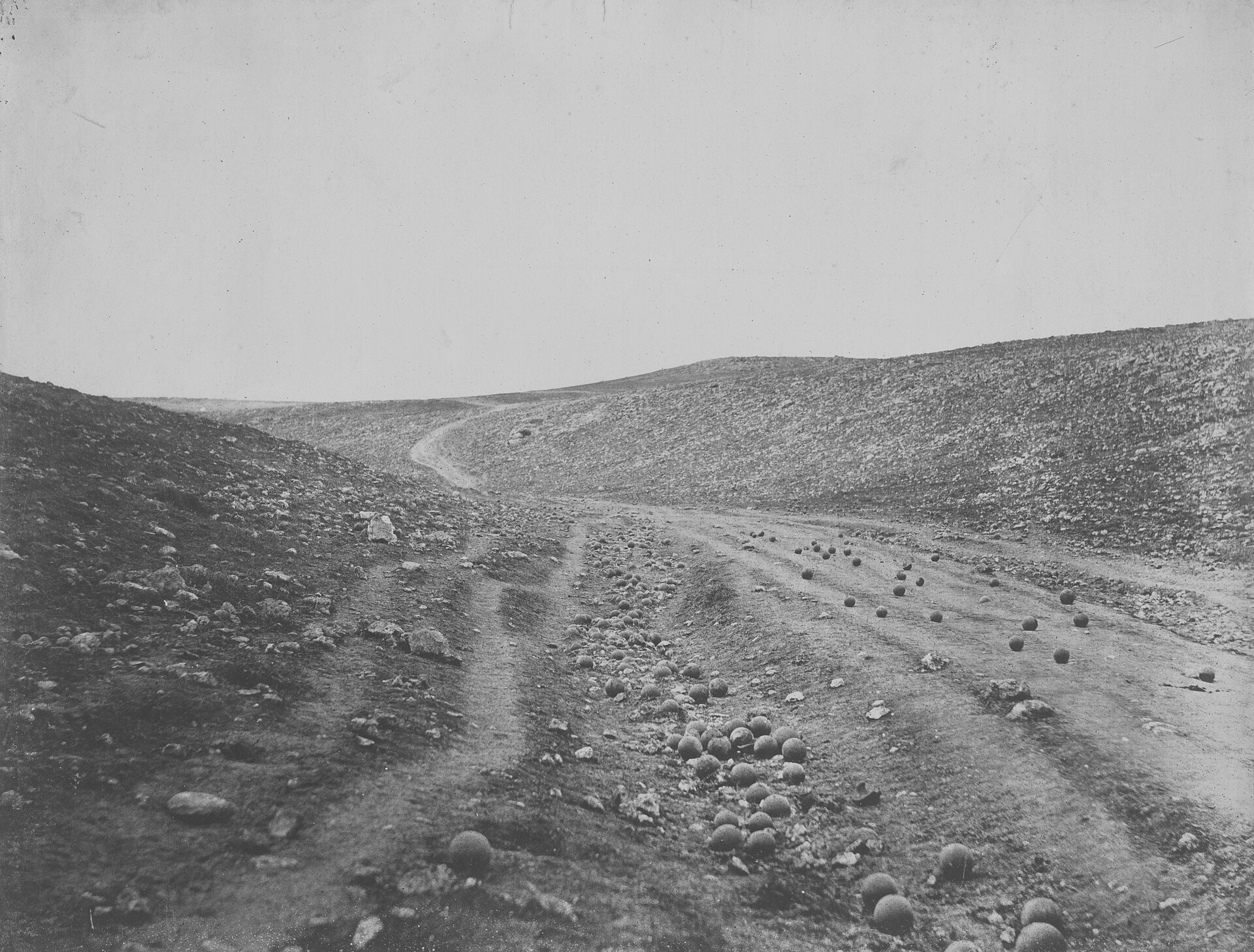
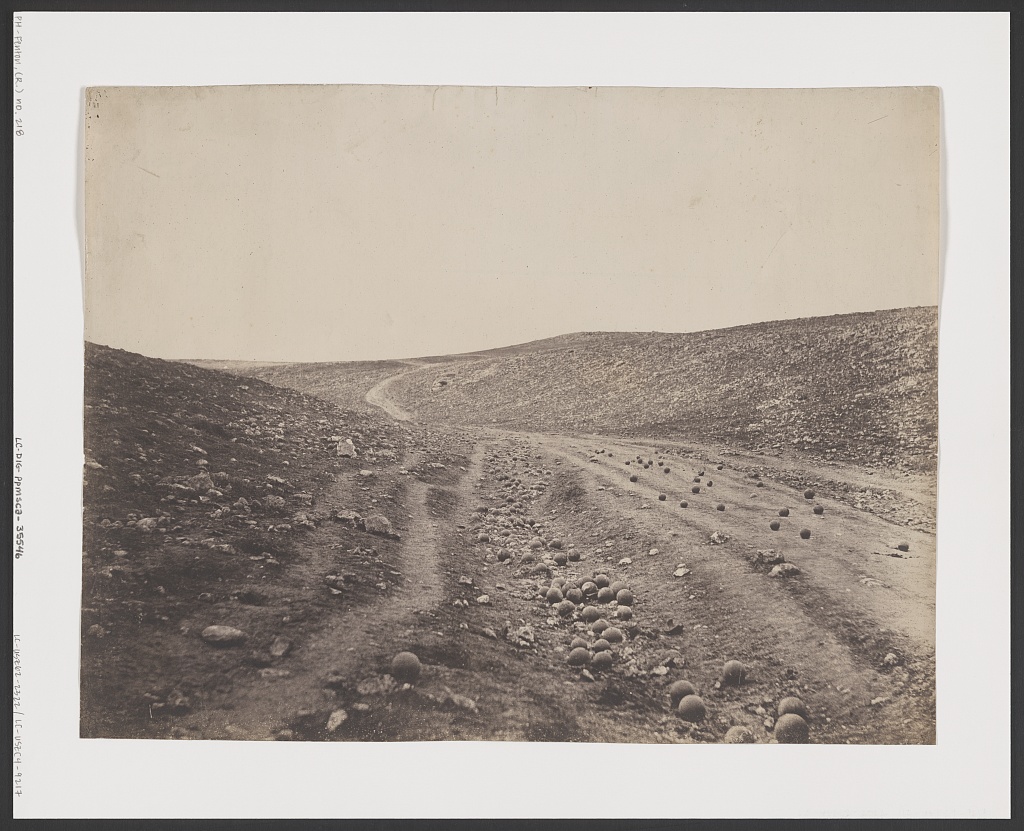
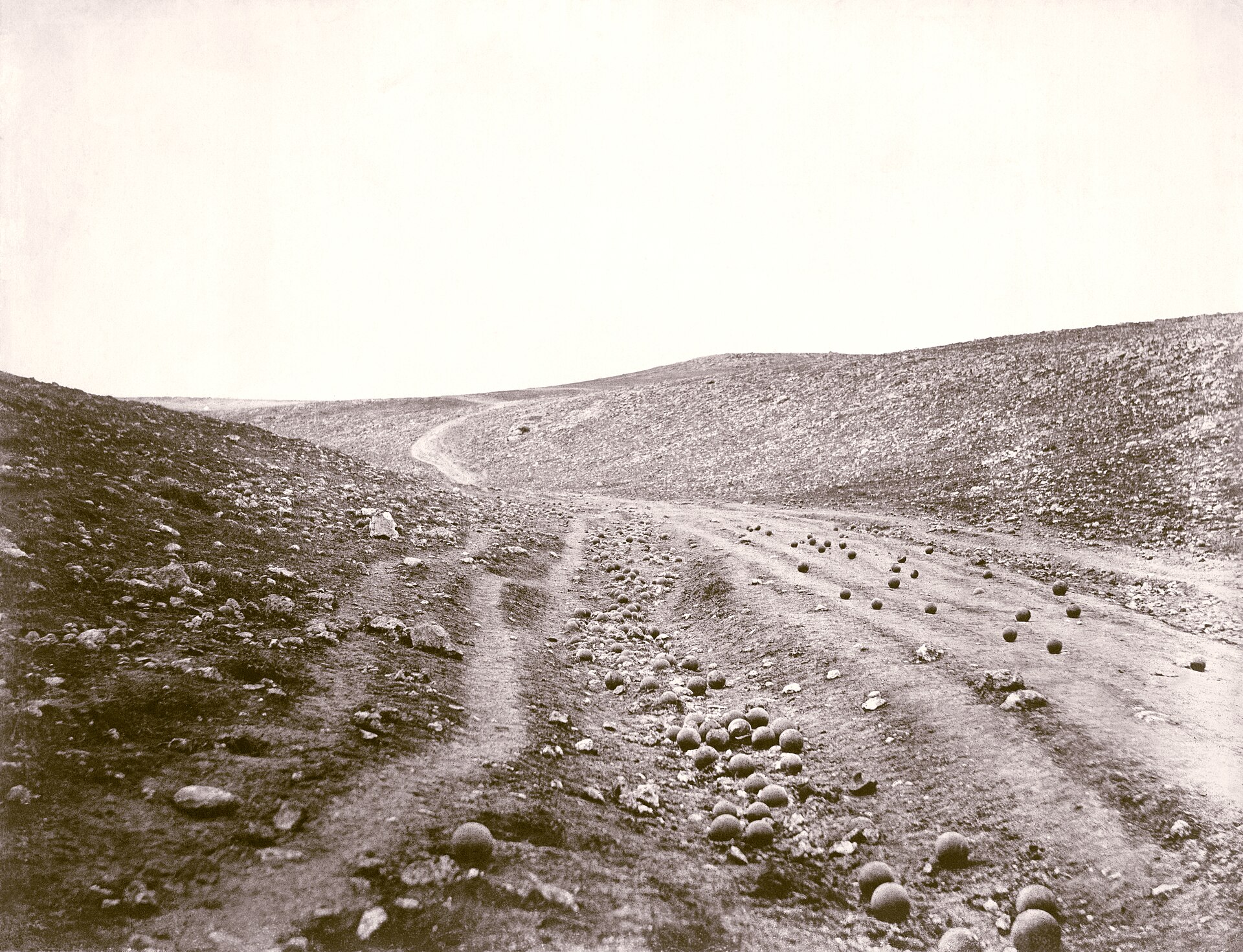
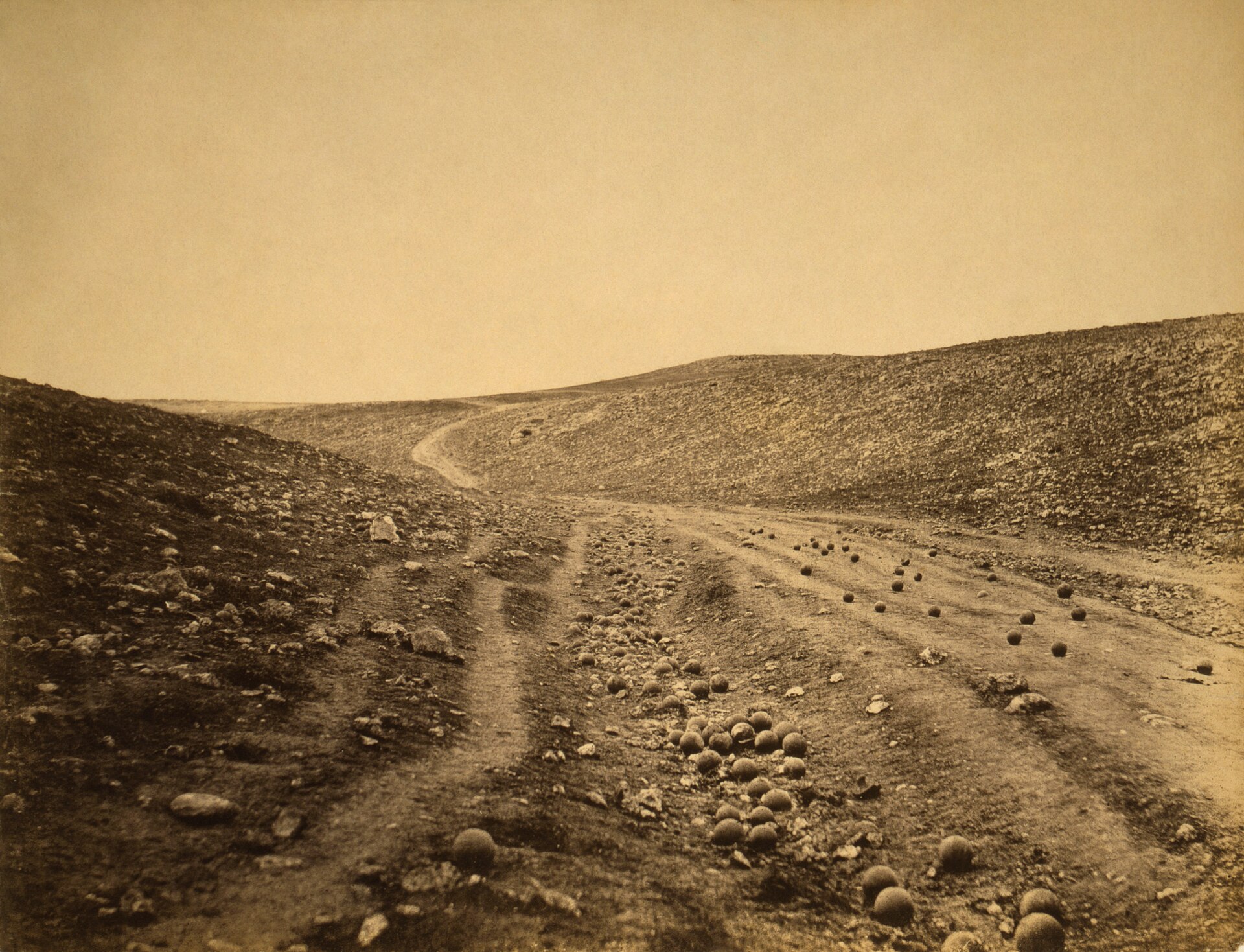
The image conventionally reproduced under this title, showing Russian round shot scattered across the road itself. Library of Congress print, salted paper, 1855. Per Errol Morris's rock-shadow analysis, this is the second of Fenton's two exposures at this spot.
| Artist | Roger Fenton |
|---|---|
| Date | 23 April 1855 |
| Medium | Salted paper print from a wet collodion glass negative |
| Dimensions | Varies by surviving print, since prints were made individually from the negative and later trimmed and mounted by the publisher. Recorded examples: Library of Congress sheet 28 x 36 cm; J. Paul Getty Museum image 27.6 x 34.9 cm; Princeton University Art Museum sheet 26.6 x 35.1 cm, mount 35.4 x 46.6 cm; Victoria and Albert Museum 20.6 x 16.4 cm. The V&A figure is markedly smaller than the others and could not be reconciled from the sources consulted; see notes_for_editor. |
| Where it is now | No single print is 'the' object. Prints made from Fenton's negative are held by, among others, the Library of Congress, the Royal Collection Trust, the Victoria and Albert Museum, the Musee d'Orsay, the J. Paul Getty Museum, the Museum of Modern Art, the Art Institute of Chicago, and the Princeton University Art Museum. The Library of Congress copy (LCCN 2001698869) is used as the reference print for this record because it is fully catalogued, digitized and rights-cleared.last confirmed |
| Inventory number | Library of Congress reference print: LC-USZC4-9001 group, LCCN 2001698869 |
| Attribution | AcceptedAuthorship is not in dispute. Full note |
| Object type | Photograph |
| Period | British, mid-nineteenth century |
| Cases | Has a provenance gap |
| Inscriptions | Institutional mounts carry Thomas Agnew and Sons' printed publication line; the Princeton impression additionally carries the names of the co-publishers Colnaghi's and Williams and Co. No handwritten inscription by Fenton on this image has been documented in the sources consulted. |
| Owners on record | 9 links5 documented, 4 unknown |
| Sources | 21 cited |
About this record Last verified · 21 sources cited · Change log
On this page 10 sections
ContentsClose
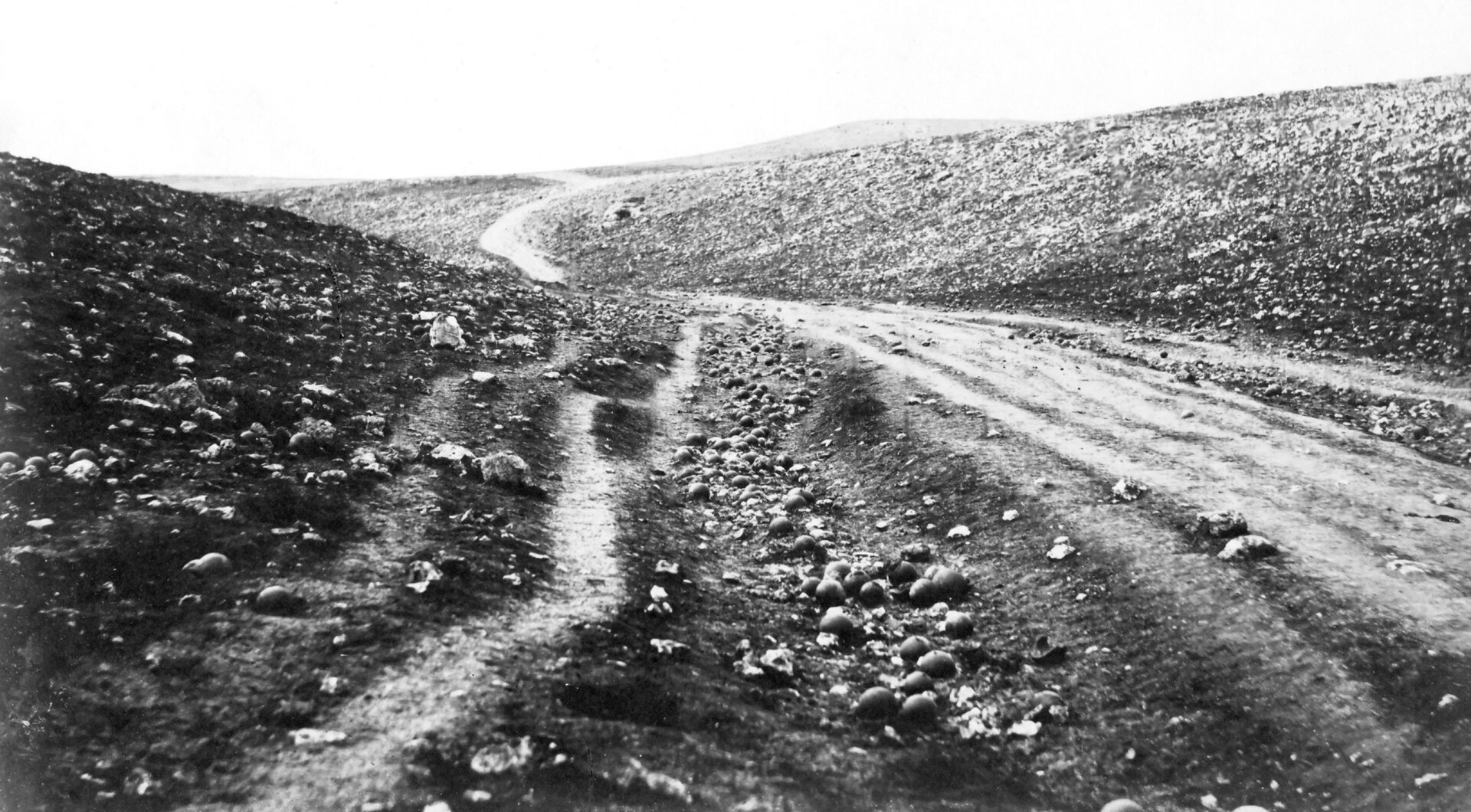
A dirt road through a ravine near Sevastopol, littered with Russian cannonballs, photographed by Roger Fenton on 23 April 1855 during the Crimean War. Fenton made two exposures from the same spot within minutes of each other: one with the road itself clear and the balls confined to the ditch beside it, one with balls scattered across the road. The second is the image everyone knows, and for over a century and a half it has been the subject of a genuine scholarly argument about whether Fenton, or an assistant, moved the ammunition into the road to make the picture more dramatic.
In 2007 the documentary filmmaker Errol Morris spent months trying to settle the question and eventually did, using the position of loose stones on the slope above the road rather than anything about the cannonballs themselves. His conclusion, published in the New York Times, is that the empty-road version was taken first. What that proves about Fenton's intentions, and what it does not prove, is treated at length below.
Prints survive in institutional collections on both sides of the Atlantic. The negative itself has not been traced to a known repository.
Provenance
Each link is graded. Documented: a cited source supports it. Disputed: the identification is argued but not established. Unknown: no owner for that span, and the gap is not smoothed into a narrative. The grades in the glossary.
- 1855-04-23 -Roger Fenton, on assignment for Thomas Agnew and Sonsdocumented
Two glass collodion negatives exposed from the same camera position in the Valley of the Shadow of Death near Sevastopol, during Fenton's second visit to the site that day, while the position was under Russian fire according to his own letters. Publication and sale rights belonged to his sponsor, Thomas Agnew and Sons, under the terms of the commission.37810
- 1855 - 1856Thomas Agnew and Sons, with co-publishers Colnaghi's and Williams and Co.documented
Exhibited among 312 Fenton photographs at the Water Colour Society's rooms, Pall Mall East, London, from 20 September 1855, and issued commercially as one of 337 mounted prints sold individually and in sets between November 1855 and 5 April 1856. Unsold stock, including negatives, was sold at auction by Agnew in 1856.61012
- 1856 - 1862Roger Fentonunknown
The specific fate of this negative between the 1856 Agnew stock auction and Fenton's own 1862 retirement auction is not documented in the sources consulted. Fenton continued to work as a photographer through this period, including as the British Museum's first official photographer.1114
- 1862 -Unknown, via Fenton's 1862 retirement auctionunknown
In October 1862 Fenton retired from photography and put his equipment and remaining stock of negatives, reported at over a thousand plates, up for auction. No source consulted traces this specific negative through that sale or afterward; its present whereabouts, or destruction, is undocumented.14
- - 1944Fenton family, latterly his grandniece Frances M. Fentonunknown
This entry concerns the print line, not the negative. The Library of Congress's 1944 purchase came from Fenton's grandniece, Frances M. Fenton, indicating a set of prints, described by the library as possibly Fenton's or Agnew's own working set, descended within the family from 1855 until the 1944 sale. The route of descent within that period is not documented in the sources consulted.17
- 1944 - presentLibrary of Congress, Prints and Photographs Divisiondocumented
Purchased in 1944 together with 262 other Fenton prints from Frances M. Fenton. Catalogued as LCCN 2001698869. Used as the reference print for this record.417
- 1855 - presentVictoria and Albert Museum, museum number 64:856documented
Entered the V&A collection through the Townshend Bequest. The date the bequest was received, and the print's history between 1855 and that bequest, are not given in the museum's own online catalogue entry.13
- - 1984Samuel Wagstaffunknown
The J. Paul Getty Museum's Fenton print carries an 84.XM accession prefix, which identifies the Museum's 1984 acquisition of Samuel Wagstaff's approximately 26,000-object photography collection, the founding acquisition of the Getty's Department of Photographs. This record infers the print's presence in the Wagstaff collection from the accession series; it has not independently verified an itemized Wagstaff provenance for this specific sheet.18
- 1950 - presentHarry Ransom Center, University of Texas at Austin (as part of the Gernsheim collection)documented
Not a single print but a distinct line of descent: in 1950 the collector Helmut Gernsheim purchased what was described as Fenton's own complete set of 360 mounted Crimean prints from a Fenton descendant for 50 pounds. Gernsheim's collection, including this material, was later placed with the University of Texas. No source consulted establishes whether any specific institutional print discussed elsewhere in this record is drawn from this set.19
Prices realised
| Date | Sale | Estimate | Result | Note |
|---|---|---|---|---|
| 27 April 2023 | Swann Auction Galleries, New York Fine Photographs, featuring 100 works from the Stephen White Collection, sale 2634, lot 9 | USD 20,000 - 30,000 | Hammer USD 18,000 DERIVED, not published. Derived from the premium-inclusive 22,500 at the 25 per cent rate for hammer up to and including USD 100,000 printed in section 7 of the Conditions of Sale reproduced on the same lot page. The same page also shows a current site-wide schedule of 30 per cent, which would give 17,308 and is not an increment; the 25 per cent schedule is the one printed as the conditions of this sale, so 18,000 is carried. Label stays DERIVED. With premium USD 22,500 premium-inclusive. The house lot page prints 'Sold: $22,500.00' with the label '(Sold Price includes Buyer's Premium)'. USD | Lot page read 2026-09-14. Catalogue description: salted paper print, image 27 x 35.9 cm, mount 48.9 x 62.9 cm, with Fenton's letterpress credit, title, publisher's credit and publishing date on the mount recto, dated 23 April 1855. Provenance as printed by the house: Lee Gallery, Winchester, Massachusetts. This is a sale of one salted paper print among several known, not of a unique object; the record already says so. Second confirmation of the 22,500 figure: the secondary reports the record already cites, which agree to the dollar. |
Hammer is the price at which the bidding stopped; with premium adds the fee the house charges the buyer on top. Hammer price and buyer's premium in the glossary.
Technical evidence
| Attribution note | Authorship is not in dispute. Fenton's negative was published on mounts printed with his name and the credit of his sponsor, Thomas Agnew and Sons, and the image is documented throughout in his own letters to his wife and his letterbooks. What is disputed is not who took the photograph but which of his two exposures at this spot came first, addressed below under the two-version question. |
|---|---|
| Process | Wet collodion glass negative, printed as a salted paper print. Fenton sensitized, exposed and developed each glass plate on site in his mobile darkroom van, since the wet collodion process required the plate to be coated, exposed and developed while the collodion remained damp, a window of roughly ten minutes.18 |
| Two negatives, one composition | Fenton made two exposures of the same view from the same camera position within a short interval on 23 April 1855: one with the road clear and shot confined to the roadside ditch, one with shot scattered across the road itself. The second is the image conventionally reproduced under this title.2915 |
| Sequence evidence | A group of loose stones on the slope above the road sits measurably lower, relative to the road edge, in the cannonballs-on-road exposure than in the clear-road exposure. Since stones displace downhill under gravity and not up, this fixes the clear-road exposure as the first of the two and the cannonballs-on-road exposure as the second. Identified by optical engineer Dennis Purcell working with Errol Morris.9 |
| Mount and publication credit | Surviving institutional prints are mounted with a printed publication line crediting Thomas Agnew and Sons as publisher; the Princeton impression's mount additionally names the print dealers Colnaghi's and Williams and Co. as co-publishers, consistent with Agnew's practice of selling the Crimea photographs both individually and through associated print dealers between November 1855 and April 1856.612 |
| Recorded print dimensions | Sheet or image dimensions differ across surviving prints, since each was individually printed and then trimmed and mounted, rather than issued at a fixed standard size: Library of Congress 28 x 36 cm; Getty Museum image 27.6 x 34.9 cm; Princeton sheet 26.6 x 35.1 cm on a 35.4 x 46.6 cm mount; V&A 20.6 x 16.4 cm.45613 |
| Camera and plate stock carried to the Crimea | Fenton brought five cameras and 700 glass plates, packed in specially grooved wooden cases, along with a wine merchant's van converted into a combined darkroom and living van, landing at Balaklava on 8 March 1855.138 |
Images
The record in full
Chapter 1What the photograph shows
A dirt track runs through a shallow ravine, curving away from the camera between bare, eroded slopes under a flat, overcast sky.
A dirt track runs through a shallow ravine, curving away from the camera between bare, eroded slopes under a flat, overcast sky. There are no figures, no buildings, nothing that reads as a battle. The only content is the ground itself and the objects scattered across it: round iron shot, spent and unexploded, some in the ditches at the base of the slopes and, in the more famous of Fenton's two exposures, dozens more lying in the road.
It is a photograph with nothing happening in it, which is exactly the point later writers have made about it. There is no action a wet-collodion camera of 1855 could have captured in any case; exposures ran to several seconds and required the photographer to sensitize, expose and develop a glass plate before the collodion dried, a window of about ten minutes in temperate weather and less in Crimean heat. What Fenton photographed was aftermath and evidence, a road that soldiers would not walk down without stepping on ordnance, and he let the absence of anyone walking down it carry the description.
Chapter 2The ravine and the siege
The valley lay within range of the Russian batteries defending Sevastopol during the siege that dominated the Crimean War from October 1854 into 1855.
The valley lay within range of the Russian batteries defending Sevastopol during the siege that dominated the Crimean War from October 1854 into 1855. British and allied troops used it as a supply route into their forward positions, and it took its name, the Valley of Death, from the volume of Russian round shot that fell short of its intended targets and rolled or lay in the roadway and ditches. It was not the valley made famous a few months earlier by Tennyson's poem about the Charge of the Light Brigade at Balaklava, a different location entirely; the two are sometimes confused because both borrow the same phrase from Psalm 23, and this record treats them as distinct.
When Thomas Agnew exhibited Fenton's photographs in London in September 1855, he extended the soldiers' plain nickname to the fuller, more literary Valley of the Shadow of Death, pulling the image explicitly into the register of the Twenty-Third Psalm. The expansion was Agnew's publishing choice, not necessarily Fenton's own name for the place, and it did the work of turning a soldier's grim joke into something closer to scripture.
Chapter 3Fenton's mission to the Crimea
Fenton's trip was funded commercially by the print publisher Thomas Agnew and Sons, who financed the expedition in exchange for the exclusive right to publish and sell the resulting photographs.
Fenton's trip was funded commercially by the print publisher Thomas Agnew and Sons, who financed the expedition in exchange for the exclusive right to publish and sell the resulting photographs. It also carried a measure of official backing: the Duke of Newcastle, then Secretary of State for War, arranged Fenton's passage from England aboard the transport ship HMS Hecla, and Prince Albert supplied letters of introduction to the British commander in the field, FitzRoy Somerset, Lord Raglan. Fenton had already received what one contemporary account calls valuable patronage from Queen Victoria and Prince Albert before he left. The government's interest was not disinterested: the war was deeply unpopular in Britain, William Howard Russell's dispatches for The Times had exposed disastrous mismanagement and neglect of the wounded, and photographs showing an orderly, functioning army served the same purpose army-approved sketches and paintings had always served, with the added authority of a medium widely believed at the time to be incapable of lying.
He landed at Balaklava harbour on 8 March 1855 with two assistants, thirty-six packing cases of equipment, five cameras and 700 glass plates carried in specially grooved boxes, and a converted wine merchant's van fitted out as a mobile darkroom and living quarters. The van's pale colour and size made it a visible target and it came under fire more than once. Working the wet collodion process in the field meant sealing himself into the van to coat, sensitize, expose and develop each plate before the chemistry dried, in heat he described as making perspiration start from every pore, while fighting dust and flies that could ruin a plate in seconds. In under four months, from 8 March to 26 June 1855, he produced roughly 360 usable negatives, a documentary record of an active war on a scale nothing had approached before.
Chapter 423 April 1855
Fenton's own account, given in his letters home, is that he visited the ravine more than once.
Fenton's own account, given in his letters home, is that he visited the ravine more than once. His first pass produced a view with the road left clear and the cannonballs confined to the ditches on either side. He returned to the same spot a second time that day, by his own description under active Russian fire, and worked for over an hour before coming away with what he called two good pictures. It is this second visit that produced the negative that shows the road itself scattered with shot.
Fenton wrote to his printseller and sponsor describing what he had seen at close range: round shot and shell lying like a stream at the bottom of the hollow the whole way down, so thick, he said, that a man could not walk without treading on them. That sentence, not the photograph, is the primary description of the site as Fenton actually found it on first encountering the valley, and it is worth holding onto when weighing what the second exposure adds to it.
Chapter 5The two-version question
The two negatives are the same composition from the same camera position, differing only in where the cannonballs lie: one with the road surface clear and the shot confined to the ditch below the...
The two negatives are the same composition from the same camera position, differing only in where the cannonballs lie: one with the road surface clear and the shot confined to the ditch below the bank on the left, one with a large number of balls distributed across the road itself. The second is the negative Agnew published and exhibited, the one reproduced in nearly every textbook account of early war photography, and the one usually meant when people refer to Valley of the Shadow of Death without qualification.
The German art historian Ulrich Keller was among the first to argue in print that Fenton, or an assistant working for him, moved the shot onto the road between the two exposures to strengthen the composition. Susan Sontag took up the claim in Regarding the Pain of Others (2003), writing that before taking the second picture, the one that is always reproduced, Fenton oversaw the scattering of the cannonballs on the road itself. It is important to be precise about what Sontag did and did not argue: she treated the staging as effectively established by Keller's account and used it as a case study in how even the earliest war photography could not be assumed to show events exactly as they occurred, not as a claim she herself proved from new evidence. The Musee d'Orsay's own curatorial position, by contrast, has held that deliberate staging under the conditions Fenton described, ongoing shelling of the position, is unlikely, since the danger would probably not have allowed for it.
Chapter 6Errol Morris and the shadow of a stone
The documentary filmmaker Errol Morris took up the question at length, publishing his findings in the New York Times beginning 25 September 2007 in a multi-part essay titled Which Came First, the...
The documentary filmmaker Errol Morris took up the question at length, publishing his findings in the New York Times beginning 25 September 2007 in a multi-part essay titled Which Came First, the Chicken or the Egg?, later expanded as the opening chapter of his book Believing Is Seeing: Observations on the Mysteries of Photography (2011). Morris traveled to the site near Sevastopol, consulted historians who split roughly evenly between believing the scene was staged and believing that soldiers had later gathered the spent shot from the surrounding ground and piled it on the road for collection and reuse, built a physical sundial on location to test the sun's position against the photographs' shadows, and corresponded with meteorologists and optics specialists in an attempt to date and sequence the two exposures from first principles. Much of this effort, by his own account, proved inconclusive.
The resolution came from a different piece of the frame entirely. The optical engineer Dennis Purcell, working with Morris, noticed a small group of loose stones on the slope to the left of the road whose position differs between the two photographs: in the image with cannonballs on the road, the stones sit measurably lower on the slope than they do in the clear-road image. Stones do not move uphill on their own. Since gravity only explains a downhill shift, the picture in which the stones sit lower must have been taken after the picture in which they sit higher. That places the clear-road exposure first and the cannonballs-on-the-road exposure second, which means whatever moved the stones, most plausibly Fenton and his assistant walking the ground to place the shot, happened between the two exposures rather than before either of them.
The Royal Collection Trust's own published account of its print reaches the same sequence independently, noting that Fenton made at least two distinct views from the position and that the version with fewer cannonballs on the ground indicates he rearranged the scene for the second.
Chapter 7What the stone evidence proves, and what it does not
Morris's rock analysis is good physical evidence for sequence: it establishes, about as firmly as this kind of forensic photo-history can establish anything, that the empty-road exposure came before...
Morris's rock analysis is good physical evidence for sequence: it establishes, about as firmly as this kind of forensic photo-history can establish anything, that the empty-road exposure came before the cannonballs-on-the-road exposure. It is not, by itself, evidence of motive. Morris was careful in his own writing to note that Fenton had legitimate documentary reasons to want a second, more explicit view of the danger the road represented, given that his stated task was to convey the true conditions of the war to a home audience already primed by press reports of mismanagement. The stones do not tell us whether Fenton considered rearranging ordnance on an active battlefield a legitimate act of illustration, a piece of theatrical embellishment he would have recognized as such, or simply the way any photographer with a camera and an available prop might have approached a picture he wanted to make stronger. What the evidence rules out is the possibility, floated by some of Morris's interviewees, that soldiers moved the balls off the road after Fenton photographed it full; the sequence runs the other way. It does not rule out Sontag and Keller's reading of intent, nor does it fully vindicate the Musee d'Orsay's skepticism that staging was practically possible under fire; it settles the order of the two exposures and leaves the question of what that order means for Fenton's honesty as a documentarian open, which is where this record leaves it as well.
Chapter 8Publication and exhibition, 1855-56
Fenton returned to England on 26 June 1855, in poor health and having contracted cholera on the journey home.
Fenton returned to England on 26 June 1855, in poor health and having contracted cholera on the journey home. Agnew opened an exhibition of 312 of his Crimean photographs on 20 September 1855 at the Water Colour Society's rooms in Pall Mall East, London. Between November 1855 and 5 April 1856, Agnew issued 337 of the photographs commercially on printed mounts, sold individually or grouped into sets; two multi-part panoramas were issued alongside the single sheets, an eleven-photograph Panorama of the Plateau of Sebastopol and an eight-photograph panorama of the plains of Balaklava and the valley of Inkerman. Valley of the Shadow of Death was not part of either panorama; it was sold as an individual sheet, which is the form in which the institutional prints catalogued below survive.
The exhibition and publication served their sponsors' purposes. Contemporary reviewers and, later, historians have generally read the Crimea photographs, this one included, as reassurance aimed at an anxious public rather than as war reportage in the modern sense: the war Fenton pictured is orderly, well-supplied and largely bloodless, in deliberate counterpoint to what Russell's newspaper dispatches had already told readers.
Chapter 9What happened to the negatives
Agnew sold the unsold stock of Fenton's Crimean prints and negatives at auction in 1856.
Agnew sold the unsold stock of Fenton's Crimean prints and negatives at auction in 1856. Fenton himself continued working as a photographer for several more years, including as one of the founders of the Photographic Society of London in 1853 and, later, as the first official photographer engaged by the British Museum, before giving up photography altogether. In October 1862 he announced his retirement from the profession and put his equipment and his entire remaining stock of negatives, reported at the time as more than a thousand large-format glass plates, up for auction. The negative for Valley of the Shadow of Death has not been traced to a known present-day repository in the sources consulted for this record; what survives are prints made from it before the negative left Fenton's or Agnew's hands.
In 1950 the collector and historian Helmut Gernsheim located a Fenton descendant and purchased what was described as Fenton's own complete set of 360 mounted salted-paper prints of the Crimean campaign for 50 pounds, a set that included this image and that Gernsheim later published and eventually placed with the University of Texas, where it forms part of the Crimean War holdings at the Harry Ransom Center. This is a separate body of material from the individually catalogued prints in the museums discussed below, and there is no evidence in the sources consulted that the two lines of descent overlap in any specific traceable sheet.
Chapter 10Where prints are held today
Because Fenton's negative was printed many times for sale rather than existing as a single unique object, provenance for Valley of the Shadow of Death has to be tracked institution by institution...
Because Fenton's negative was printed many times for sale rather than existing as a single unique object, provenance for Valley of the Shadow of Death has to be tracked institution by institution rather than as one continuous chain, and most individual acquisition histories before a print's arrival at its current museum are not published in detail. What is documented: the Library of Congress holds a salted paper print, sheet 28 by 36 centimetres, purchased in 1944 along with 262 other Fenton prints from his grandniece, Frances M. Fenton, a set the library's own catalogue notes may represent a group Fenton or Agnew kept and annotated themselves. The Victoria and Albert Museum's print (museum number 64:856) entered the collection through the Townshend Bequest. The Princeton University Art Museum's print (object x1991-193) was acquired by museum purchase through an anonymous gift; its mount carries the publication credit of Thomas Agnew and Sons together with the print dealers Colnaghi's and Williams and Co. The J. Paul Getty Museum's print carries an accession number in the 84.XM series, which identifies it as part of the roughly 26,000-object photography collection assembled by Samuel Wagstaff and acquired by the Getty in 1984, the founding acquisition of the museum's Department of Photographs; the Getty's online catalogue lists at least two Fenton prints of this title under separate object records, consistent with more than one impression, though the source pages consulted did not specify which shows which version of the road. The Royal Collection's print is catalogued as RCIN 2500514. The Musee d'Orsay, the Museum of Modern Art and the Art Institute of Chicago each hold at least one print; the Art Institute's public-domain repository record explicitly labels its print the first version, i.e. the clear-road exposure, which is one of the few institutional records in the sources consulted to make the version distinction explicit in its own metadata.
Chapter 11The market for this image
Prints of Valley of the Shadow of Death appear at auction periodically as part of general nineteenth-century photography sales rather than as a market unto themselves.
Prints of Valley of the Shadow of Death appear at auction periodically as part of general nineteenth-century photography sales rather than as a market unto themselves. The most recent documented sale in the sources consulted was at Swann Auction Galleries in New York on 27 April 2023, as part of a Fine Photographs sale featuring works from the Stephen White Collection: a salted paper print of the image sold against a pre-sale estimate of 20,000 to 30,000 US dollars, with a reported price of 22,500 US dollars. The sources consulted for this record report that single figure without specifying whether it represents the hammer price alone or the total including buyer's premium, and this record does not assert a hammer/premium split it cannot verify; see notes_for_editor. No auction result for this specific title exceeding that figure was located in the sources consulted, though the search was not exhaustive of every regional and specialist photography sale since the 1980s and a higher price at another house cannot be ruled out.
Chapter 12What is still unresolved
The order of the two exposures is now about as settled as photo-forensic evidence can make it.
The order of the two exposures is now about as settled as photo-forensic evidence can make it. What remains genuinely open is everything upstream and downstream of that fact: whether Fenton saw what he did as staging in any sense he would have found troubling, what became of the glass negative itself, and how each individual institutional print travelled from Agnew's 1855-56 publication run into the specific collection that holds it now. These gaps are recorded plainly in open_questions rather than papered over, in keeping with the rule that a documented gap is worth more than an invented bridge.
The artist
Roger Fenton
Fenton did not set out to be a photographer. He trained first as a painter in Paris under Paul Delaroche and was called to the bar as a lawyer in 1851 before photography, still barely a decade old as a practical medium, drew him away from both. He spent less than twenty years behind a camera in total, and less than four months of that in the Crimea, but the Crimean work is what survives most vividly of his career, this image above all.
Related works
| Work | Relation | Where it is |
|---|---|---|
| Cookhouse of the 8th Hussars Roger Fenton | Another widely reproduced image from the same 1855 Crimea campaign, showing camp life rather than battlefield aftermath Illustrates the range of Fenton's roughly 360 Crimean negatives, most of which show portraits, camps and landscape rather than combat or its traces. | Library of Congress and other institutional collections |
| Valley of the Shadow of Death (clear-road exposure) Roger Fenton | The companion exposure to the image described in this record, made minutes earlier or later from the same camera position on 23 April 1855 This is not a different photograph of a different place; it is the other half of the two-version pair discussed at length in the narrative. Institutions that hold both sometimes catalogue them as first and second versions. | Held alongside the cannonballs-on-road version at, among others, the Library of Congress and the Art Institute of Chicago |
| A Harvest of Death, Gettysburg, Pennsylvania Alexander Gardner and Timothy O'Sullivan | The nearest American Civil War equivalent in reputation and in the historiography of staged war photography; Gardner's photographs from Gettysburg in 1863 have been shown to include bodies moved for composition Cited by later scholars, including Morris, as a comparable case of battlefield photography edited for effect, useful for placing the Fenton dispute in a wider pattern rather than treating it as unique to him. | Library of Congress and other collections |
| Panorama of the Plateau of Sebastopol, in Eleven Parts Roger Fenton | A separate multi-sheet panoramic series published by Agnew from the same 1855 campaign; Valley of the Shadow of Death was not part of this series and was sold as an individual sheet Included to prevent a specific version-confusion risk: some secondary sources loosely describe Valley of the Shadow of Death as part of an eleven-part panorama, which the primary publication record does not support. | Institutional Fenton holdings, including the Library of Congress |
Open questions
- Where is the glass negative today, if it survives at all? No institution consulted for this record claims to hold it, and Fenton's remaining negative stock was dispersed at auction in 1862.
- What is the individual acquisition history of most institutional prints before they entered their present collections? Only a handful (Library of Congress 1944, V&A Townshend Bequest, Getty 1984 Wagstaff acquisition, Princeton anonymous-gift purchase) have a documented route in the sources consulted; the rest are undocumented in what was available.
- Did Fenton regard the second exposure as staging in any sense he would have considered dishonest, or as a legitimate illustrative choice consistent with the documentary conventions of 1855? The stone evidence fixes the sequence of the two exposures but is silent on intent, and scholars remain divided.
- Which specific print corresponds to which version at institutions holding more than one Fenton print of this title, such as the Getty, where the sources consulted list two separate object records without specifying which shows the clear road and which shows the road with shot.
- Is the Victoria and Albert Museum's recorded dimension of 20.6 by 16.4 centimetres for museum number 64:856 accurate for this title, given that it is far smaller and in a different aspect ratio than every other recorded print of the same negative? This could not be resolved from the sources consulted and may indicate a catalogue error, a cropped or reduced print, or a mismatched record.
- Has this specific title achieved an auction price higher than the 22,500 US dollars recorded at Swann Galleries in April 2023? The search for this record was not exhaustive of every specialist photography sale since prints of this image first reached the market in the twentieth century.
Questions about this object
What is The Valley of the Shadow of Death?
The Valley of the Shadow of Death is a photograph, dated 23 April 1855. Medium: Salted paper print from a wet collodion glass negative.
Who made The Valley of the Shadow of Death, and is the attribution settled?
The attribution to Roger Fenton is recorded here as accepted. Authorship is not in dispute. Fenton's negative was published on mounts printed with his name and the credit of his sponsor, Thomas Agnew and Sons, and the image is documented throughout in his own letters to his wife and his letterbooks. What is disputed is not who took the photograph but which of his two exposures at this spot came first, addressed below under the two-version question.
Where is The Valley of the Shadow of Death now?
No single print is 'the' object. Prints made from Fenton's negative are held by, among others, the Library of Congress, the Royal Collection Trust, the Victoria and Albert Museum, the Musee d'Orsay, the J. Paul Getty Museum, the Museum of Modern Art, the Art Institute of Chicago, and the Princeton University Art Museum. The Library of Congress copy (LCCN 2001698869) is used as the reference print for this record because it is fully catalogued, digitized and rights-cleared. Inventory number Library of Congress reference print: LC-USZC4-9001 group, LCCN 2001698869. Last confirmed 19 August 2026. Library of Congress Prints and Photographs Division catalog record, cross-checked against Wikimedia Commons file metadata.
What has The Valley of the Shadow of Death sold for?
Hammer USD 18,000 DERIVED, not published. Derived from the premium-inclusive 22,500 at the 25 per cent rate for hammer up to and including USD 100,000 printed in section 7 of the Conditions of Sale reproduced on the same lot page. The same page also shows a current site-wide schedule of 30 per cent, which would give 17,308 and is not an increment; the 25 per cent schedule is the one printed as the conditions of this sale, so 18,000 is carried. Label stays DERIVED.; with premium, USD 22,500 premium-inclusive. The house lot page prints 'Sold: $22,500.00' with the label '(Sold Price includes Buyer's Premium)'. Swann Auction Galleries, New York, 2023-04-27.
What is still unknown about The Valley of the Shadow of Death?
Where is the glass negative today, if it survives at all? No institution consulted for this record claims to hold it, and Fenton's remaining negative stock was dispersed at auction in 1862.
Sources
- 1Public Domain Review, 'Of Chickens, Eggs, and Cannonballs: Roger Fenton's Valley of the Shadow of Death (1855)'. publicdomainreview.org/collection/...
- 2Wikipedia, 'Valley of the Shadow of Death (Roger Fenton)'. en.wikipedia.org/wiki/...
- 3Tate Etc, issue 5, 'A terrible beauty: Roger Fenton'. tate.org.uk/tate-etc/...
- 4Wikimedia Commons file metadata for File:The valley of the shadow of death LCCN2001698869.jpg, sourced to the Library of Congress Prints and Photographs Division catalog record LCCN 2001698869. commons.wikimedia.org/wiki/...
- 5Princeton University Art Museum, catalogue entry for 'Valley of the Shadow of Death', object x1991-193. artmuseum.princeton.edu/art/...
- 6Princeton University Art Museum catalogue entry (publication credit line: Thomas Agnew and Sons, Colnaghi's, and Williams and Co.), same record as source 5. artmuseum.princeton.edu/art/...
- 7HistoryNet, 'In the Valley of the Shadow of Death: Roger Fenton's Crimean War Photos'. historynet.com/in-the-valley-of-the-shadow-of-death-roger...
- 8Harry Ransom Center Magazine (University of Texas at Austin), 'Fighting Heat, Dust, and Glare: Roger Fenton and the first photographic documentation during the Crimean War'. sites.utexas.edu/ransomcentermagazine/...
- 9PetaPixel, 'Famous Valley Of The Shadow Of Death Photo Was Almost Certainly Staged', reporting Errol Morris's and Dennis Purcell's rock-shadow analysis and its conclusion, with reference to Morris's original New York Times essays. petapixel.com/2012/...
- 10Errol Morris, 'Which Came First, the Chicken or the Egg?', New York Times Opinionator, Part One, 25 September 2007; later expanded as the opening chapter of Believing Is Seeing: Observations on the Mysteries of Photography (Penguin Press, 2011). Cited via its confirmed URL and via secondary accounts (sources 1, 2, 9) that describe its content and dates in detail; the original was not directly retrievable for this record. Flagged for direct verification against the original essay and book chapter. nytimes.com/2007/...
- 11Wikipedia, 'Roger Fenton', for biographical facts cross-checked against source 16 where possible. en.wikipedia.org/wiki/...
- 12Library of Congress, background note on the Fenton Crimean War Photographs collection, describing the September 1855 exhibition and the 1855-56 Agnew publication program including the eleven-part Sebastopol panorama and eight-part Balaklava/Inkerman panorama. loc.gov/pictures/...
- 13Victoria and Albert Museum, Explore the Collections, 'Valley of the Shadow of Death', museum number 64:856. collections.vam.ac.uk/item/...
- 14Reporting on Fenton's October 1862 retirement from photography and the auction of his equipment and negative stock, cross-checked across MilitaryHistoryNow ('War Through a Lens - Roger Fenton and the Birth of Battlefield Photography') and Amateur Photographer ('Roger Fenton - Iconic Photographer'). militaryhistorynow.com/2018/...
- 15Public Domain Image Archive, catalogue entry for 'Valley of the Shadow of Death (1st version)', Art Institute of Chicago source print, explicitly labeled as the first (clear-road) of the two exposures. pdimagearchive.org/images/...
- 16Biographical summary of Roger Fenton (birth at Crimble Hall, University College London, Paris training under Delaroche, call to the Bar 1851, founding of the Photographic Society of London in 1853), cross-checked across the Royal Collection Trust's Fenton biography page and Wikipedia. rct.uk/group/...
- 17Reporting on the Library of Congress's 1944 purchase of 263 Fenton prints, including Valley of the Shadow of Death, from his grandniece Frances M. Fenton, describing the set as possibly reflecting an arrangement kept by Fenton or Agnew. loc.gov/collections/...
- 18Getty Iris (J. Paul Getty Museum blog), 'Finding Beauty in Unexpected Places: The Wagstaff Collection of Photographs', on the Museum's 1984 acquisition of Samuel Wagstaff's photography collection and its 84.XM accession series. blogs.getty.edu/iris/...
- 19Reporting on Helmut Gernsheim's 1950 purchase of Fenton's complete set of 360 mounted Crimean prints for 50 pounds and its eventual placement with the University of Texas, cross-checked across the Harry Ransom Center Magazine (source 8) and general reporting on the Gernsheim collection. sites.utexas.edu/ransomcentermagazine/...
- 20Reporting on the sale of a salted paper print of Valley of the Shadow of Death at Swann Auction Galleries, New York, 27 April 2023, Fine Photographs sale featuring the Stephen White Collection, estimate USD 20,000-30,000, reported price USD 22,500. Swann's own lot page returned an access error when fetched directly for this record and should be checked directly for the hammer/premium breakdown. swanngalleries.com/news/...
- 21Swann Auction Galleries, 'Lot 9, Roger Fenton (1819-1869), Valley of the Shadow of Death - Fine Photographs / Stephen White Collection, sale 2634, 27 April 2023'. Sale, lot, estimate, premium-inclusive price, the house's own label that the price includes the buyer's premium, the premium schedule for this sale, and the printed provenance. Accessed 2026-09-14. catalogue.swanngalleries.com/Lots/...

Last verified · Published
Change log
19 August 2026 - Record created at the house standard: researched narrative, technical evidence, maker dossier, graded provenance chain, prices with hammer and premium separated, related works, open questions and sources.
24 September 2026 - Prices realised revised by the auction watch of 2026-09-14: the 2023-04-27 Swann Auction Galleries, New York row corrected (sale number and lot number absent).