Home of a Rebel Sharpshooter
Alexander Gardner · Early July 1863 (Encyclopedia Virginia gives July 6, 1863; other sources give only 'July 1863, after the Confederate retreat began July 4'); first published 1866
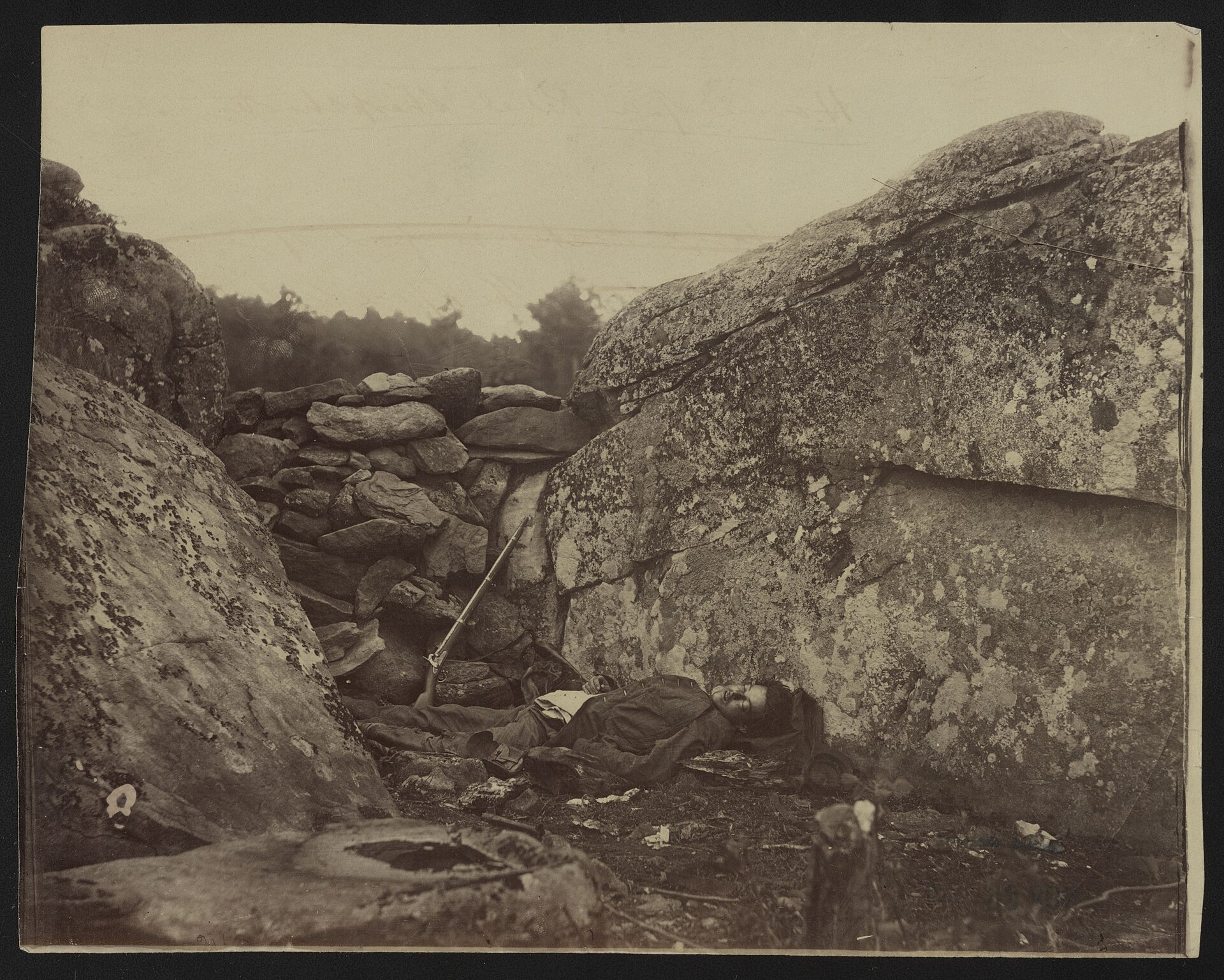
The record's anchor image: the dead soldier positioned in the stone sniper's nest at Devil's Den, Gettysburg, July 1863. Library of Congress digitization, LC-DIG-ppmsca-12562.
| Artist | Alexander Gardner |
|---|---|
| Date | Early July 1863 (Encyclopedia Virginia gives July 6, 1863; other sources give only 'July 1863, after the Confederate retreat began July 4'); first published 1866 |
| Medium | Albumen silver print from a wet collodion glass-plate negative, mounted on card |
| Dimensions | Varies by surviving print; no single dimension is published for the anchor Library of Congress digitization (LC-DIG-ppmsca-12562). A different Library of Congress print of the same view (LCCN 91732531) is recorded at 6 5/8 x 9 in (image), 11 x 14 in (mount). The companion stereograph negative (LC-DIG-cwpb-00069) is a 4 x 10 in wet-collodion glass stereo negative per Library of Congress format data; this figure was retrieved through automated search rather than a directly fetched catalogue page and should be re-verified against loc.gov before being treated as final. |
| Where it is now | Library of Congress, Prints and Photographs Division, Washington, D.C.last confirmed |
| Inventory number | LC-DIG-ppmsca-12562 (digital ID, LOC item 2012647605); a related glass stereo negative of the same staged scene under a variant title is held as LC-DIG-cwpb-00069 (LOC item 2018672107). A separate period print of the same view is catalogued as LOC item 91732531. |
| Attribution | DisputedThe image is universally attributed to Alexander Gardner's Gettysburg field team and was published under Gardner's byline as photographer in his own 1866 Sketch Book. Full note |
| Object type | Photograph |
| Period | American, Civil War era, nineteenth century |
| Cases | Disputed attribution |
| Inscriptions | None documented on the negative or any known print. Gardner's letterpress caption, printed on the facing text leaf in the 1866 Sketch Book, is the only contemporary text attached to the image; it is not an inscription on the object itself. |
| Owners on record | 5 links5 documented |
| Sources | 20 cited |
About this record Last verified · 20 sources cited · Change log
On this page 9 sections
ContentsClose
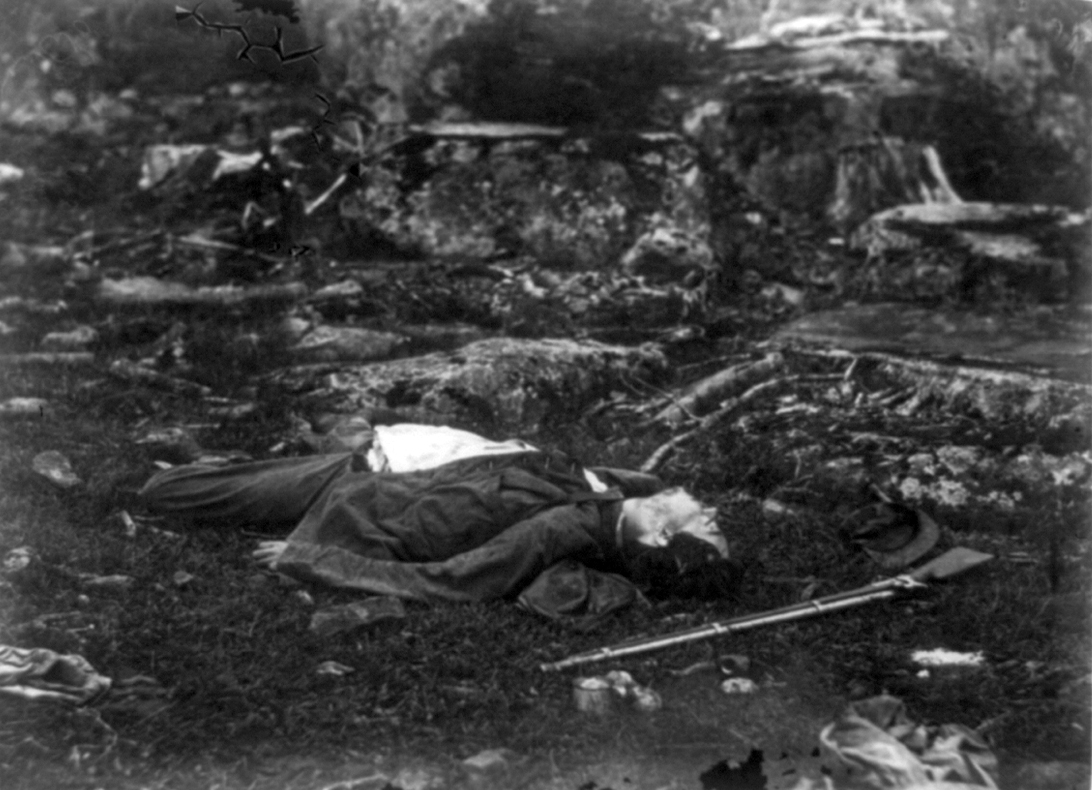
A dead Confederate soldier lies inside a stone sniper's nest at Devil's Den, Gettysburg, in a photograph Alexander Gardner's team made in July 1863 and published as Plate 41 of Gardner's Photographic Sketch Book of the War in 1866. Gardner's caption presented it as a chance discovery of a rebel sharpshooter's post. It was not. The same corpse appears in a second Gardner photograph, "A Sharpshooter's Last Sleep," lying in its original, more exposed position roughly forty to seventy-two yards away; historian William Frassanito demonstrated in 1975 that Gardner's team moved the body into the more picturesque rock enclosure and propped an ordinary infantry rifle, not a sharpshooter's weapon, beside it.
The manipulation went unremarked in print for nearly a century, noticed only in a brief 1961 magazine article before Frassanito's book-length documentation. Camera credit for the image is itself disputed between Gardner, who claimed it in his own Sketch Book, and Timothy O'Sullivan, credited in Gardner's own earlier 1863 sales catalogue and by Frassanito's research. The soldier's identity has never been confirmed; the most recent proposed identification, of a Georgia infantryman named John Rutherford Ash, rests on a claimed photographic resemblance and remains speculative.
The negative is held today by the Library of Congress as part of a collection whose documented custody runs through E. and H. T. Anthony and Company, the collectors Rand and Ordway, dealer John C. Taylor and publisher Edward Bailey Eaton before the Library's 1943 purchase; a separate period print survives independently in the National Archives under War Department custody. This is among the earliest documented instances of staging in war photography, and its own attribution and custodial history are almost as unsettled as the scene it depicts.
Provenance
Each link is graded. Documented: a cited source supports it. Disputed: the identification is argued but not established. Unknown: no owner for that span, and the gap is not smoothed into a narrative. The grades in the glossary.
- July 1863 -Alexander Gardner's Washington, D.C. photographic studiodocumented
Negative(s) exposed at Devil's Den, Gettysburg, by Gardner's field team days after the battle, under the studio's imprint. Gardner's own September 1863 sales catalogue offered the image within two months of the battle, crediting Timothy O'Sullivan as cameraman.81018
- 1863 - 1866Alexander Gardner's studiodocumented
Published as Plate 41, with a companion image as Plate 40, in Gardner's Photographic Sketch Book of the War, 2 vols. (Washington, D.C.: Philp and Solomons, 1865-66), each an original tipped-in albumen print. Gardner's own caption for Plate 41 credits himself, not O'Sullivan, as photographer, and constructs a discovery narrative for the scene that his own team had staged.81415
- 1866 - 1943E. and H. T. Anthony and Company, then Col. Arnold A. Rand and Gen. Albert Ordway (from 1879), then John C. Taylor, then Edward Bailey Eaton (from 1907)documented
This is the Library of Congress's own documented history for the Civil War glass-negative collection as a whole, which it states included roughly 2,000 negatives by Gardner's team. The chain is not confirmed item by item for this specific negative; the Library's own background essay states that after six changes of ownership it remains uncertain exactly which images passed through which hands.7
- 1943 - presentLibrary of Congress, Prints and Photographs Divisiondocumented
The Library purchased the collection in 1943, acquiring approximately 7,500 original glass-plate negatives and about 2,500 further glass and film copy negatives, after the collection had spent 1916 to 1943 in storage. This negative and its related prints are catalogued within that acquisition.7
- unknown - presentUnited States War Department, now National Archives at College Parkdocumented
A separate period print of the same staged scene is held by the National Archives (Identifier 533315, War and Conflict Number 254), credited to the War Department rather than to the Anthony-Rand-Ordway-Taylor-Eaton chain. The date and mechanism of this print's entry into War Department custody is not documented in the sources consulted.19
Technical evidence
| Attribution note | The image is universally attributed to Alexander Gardner's Gettysburg field team and was published under Gardner's byline as photographer in his own 1866 Sketch Book. But Gardner's own sales catalogue, issued in September 1863, two months after the battle, credited the cameraman as Timothy H. O'Sullivan, and historian William Frassanito's research supports O'Sullivan as the operator who exposed this negative. A 2014 Gettysburg National Military Park review of the full six-photograph sequence proposes that James Gibson, not O'Sullivan, may have made the companion stereo view at the same setup. No signature or maker's mark exists on the negative itself; every attribution rests on catalogue and connoisseurship evidence, not a document in the photographer's own hand. |
|---|---|
| Process | Wet collodion glass-plate negative, printed as an albumen silver print.15 |
| Negative, single-view | Digitized by the Library of Congress as LC-DIG-ppmsca-12562 (item 2012647605).12 |
| Negative, stereograph | A related wet-collodion glass stereograph negative of the same staged setup, digitized as LC-DIG-cwpb-00069 (item 2018672107), format recorded elsewhere as approximately 4 x 10 in; this figure needs re-verification against a directly loaded loc.gov page.4 |
| Alternate period print | A separate period print of the same staged scene survives under a third title, catalogued as Library of Congress item 91732531, recorded at 6 5/8 x 9 in (image) on an 11 x 14 in mount.620 |
| Companion negative (different object) | "A Sharpshooter's Last Sleep, Gettysburg, Pennsylvania," Plate 40 of the Sketch Book, Library of Congress item 2006692501. Shows the same corpse at its original, unmoved location; not this record's object.316 |
| Publication format | Tipped-in original albumen print, Plate 41, in Gardner's Photographic Sketch Book of the War, 2 vols. (Washington, D.C.: Philp and Solomons, 1865-66), each volume with 50 hand-mounted prints.815 |
| Alternate federal holding | A further print held by the National Archives at College Park, National Archives Identifier 533315, War and Conflict Number 254, credited to the War Department, a custody path independent of the Library of Congress collection.19 |
Images
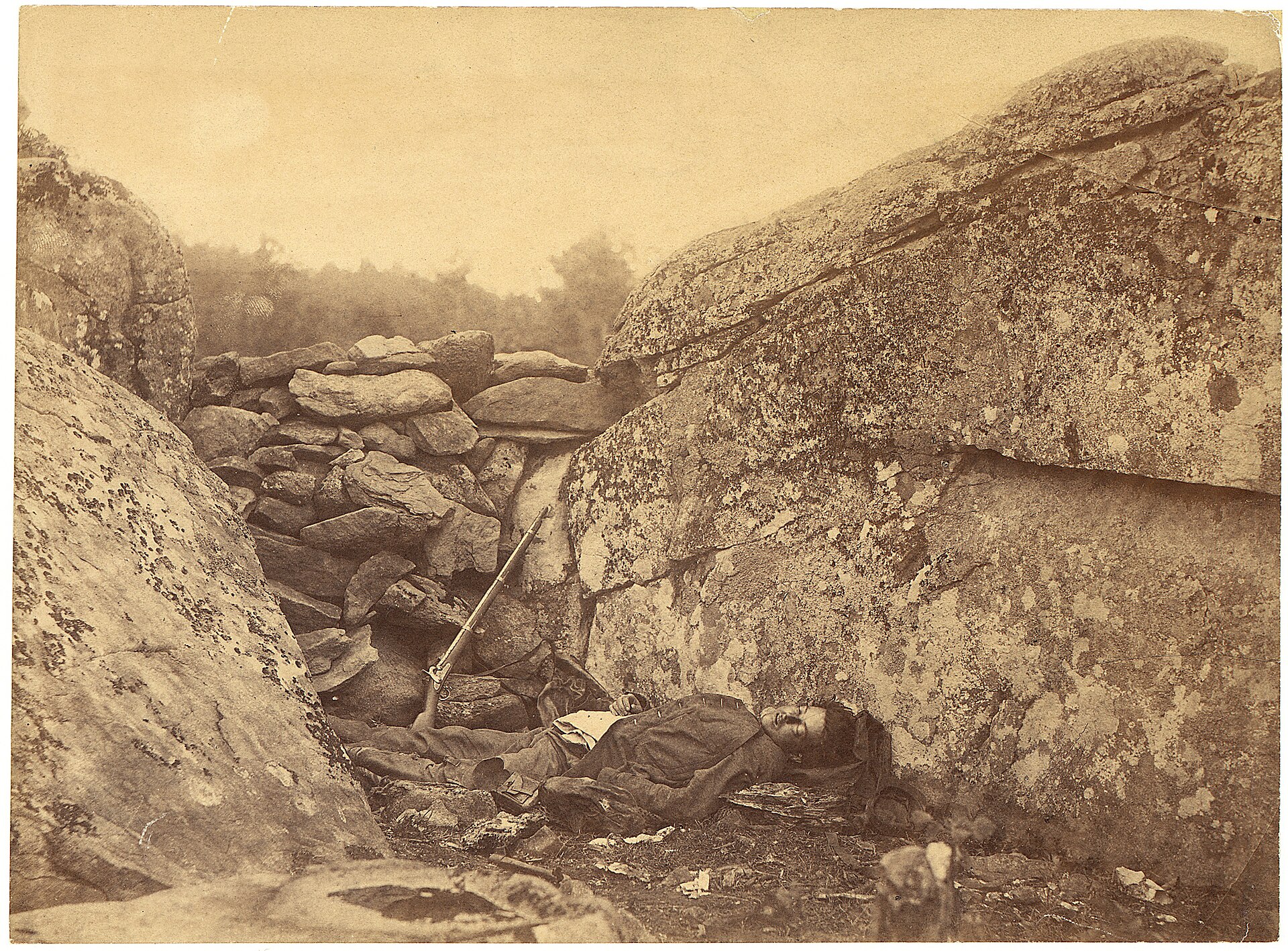
![Battle-field of Gettysburg--Dead Confederate sharpshooter at foot of Little Round Top [i.e., Devil's Den]](/assets/img/gardner-home-of-a-rebel-shar/battle-field-of-gettysburg-dead-confederate-sharpshooter-at.jpg)
The record in full
Chapter 1What the photograph shows
A dead Confederate soldier lies wedged into a stone breastwork built between two large boulders in the Devil's Den boulder field at Gettysburg.
A dead Confederate soldier lies wedged into a stone breastwork built between two large boulders in the Devil's Den boulder field at Gettysburg. His head rests near a knapsack that appears to serve as a pillow; a rifle leans against the rock wall beside him, its muzzle close to his face. The stones around him form a rough sniper's nest, the kind of improvised firing position both armies built out of the boulder field's granite outcrops during the three-day battle.
The print exists in more than one surviving copy and more than one negative. The Library of Congress holds a single-view glass negative and print under the short title "Home of a Rebel sharpshooter" (LC-DIG-ppmsca-12562), and separately a wet-collodion glass stereograph negative of what appears to be the same staged setup, catalogued as "The home of a rebel sharpshooter, on battle field of Gettysburg" (LC-DIG-cwpb-00069). A third period print of what the Library's own file describes as the same composition survives under yet another title, "Battle-field of Gettysburg--Dead Confederate sharpshooter at foot of Little Round Top [i.e., Devil's Den]" (LOC item 91732531). The multiplication of titles for what is substantially one staged scene, made in more than one camera format at one sitting, is itself part of the object's history and a hazard for anyone trying to catalogue it.
Chapter 2The companion photograph, and why the two must never be confused
This is not the only photograph Gardner's team made of this body.
This is not the only photograph Gardner's team made of this body. A second, distinct image, titled in the 1866 Sketch Book as "A Sharpshooter's Last Sleep, Gettysburg, Pennsylvania" and printed as Plate 40 (this record's subject is Plate 41), shows the same corpse lying in a more exposed position at the base of the rocks on the southern slope of Devil's Den, without the constructed stone breastwork and in a different pose. The Library of Congress catalogues it separately, as item 2006692501, and the Smithsonian's National Museum of American History holds and describes it independently as Plate 40.
The two photographs are related but are not the same object, the same negative, or interchangeable illustrations of the same event. "A Sharpshooter's Last Sleep" documents the body substantially where Gardner's team found it. "Home of a Rebel Sharpshooter," the anchor of this record, documents the body after it had been moved into the more photogenic rock enclosure roughly forty yards away. Treating the two as the same picture, or captioning one as a duplicate of the other, is the single most consequential error a cataloguer of this material can make, and it is the error this record exists to prevent.
Chapter 3Gardner's published account of the scene
Gardner's own caption for Plate 41, printed opposite the plate in the 1866 Sketch Book, states: "The artist, in passing over the scene of the previous days' engagements, found in a lonely place the...
Gardner's own caption for Plate 41, printed opposite the plate in the 1866 Sketch Book, states: "The artist, in passing over the scene of the previous days' engagements, found in a lonely place the covert of a rebel sharpshooter, and photographed the scene presented here." The text goes on to describe a soldier who built the stone breastwork himself, fired from it against Union officers, and was eventually killed by a shell fragment; Gardner further claims that he revisited the spot roughly four months later, during the November 1863 dedication of the Gettysburg cemetery, and found the soldier's skeleton still lying undisturbed and unidentified where he had photographed it.
Every element of that account beyond the bare fact that a dead man was photographed among the rocks is now understood to be either invented or unverifiable: there is no independent evidence the man built the breastwork, fired from it, or was a sharpshooter at all, and Gardner's return-visit anecdote cannot be checked against any other source. The caption is not incidental colour. It is a constructed narrative built to explain a scene that Gardner's own team had constructed a few hours earlier.
Chapter 4A century of silence, then a magazine article
The staging went unremarked in print for nearly a hundred years.
The staging went unremarked in print for nearly a hundred years. According to the historian-cited account collected by the hoax-documentation site Hoaxes.org, it was Frederic Ray, art director of the magazine Civil War Times, who first noticed in 1961 that the same corpse appeared in two Gardner photographs taken in two different places, and published the observation in a short piece. Ray's note did not receive the sustained documentary treatment the case is now known for.
That came in 1975, when William A. Frassanito published Gettysburg: A Journey in Time, a book-length study that matched Gardner's Gettysburg photographs against the ground itself, using surviving rock formations, tree lines and terrain features to fix camera positions. Frassanito examined six photographs of this same body made at Gettysburg in July 1863: geographic features place four of them on the southern slope of Devil's Den (the original find site) and two at what Gardner called the sharpshooter's den (the moved site). Frassanito's book made the case that has since become the standard account, and it is credited across the secondary literature, from the Library of Congress's own published essay on the subject to the Gettysburg National Military Park's staff, as the first rigorous documentary demonstration of the move.
Chapter 5The physical evidence Frassanito used
Frassanito's argument did not rest on the general plausibility of staging.
Frassanito's argument did not rest on the general plausibility of staging. It rested on matching specific physical details across the two photographs. The distinctive boulders and rock formations visible around the body in "A Sharpshooter's Last Sleep" and in "Home of a Rebel Sharpshooter" are traceable across the two images and to the ground at Devil's Den itself, which is how Frassanito fixed that the two scenes are roughly forty yards apart on the same rock outcrop rather than two unrelated deaths.
The rifle is the second and most frequently cited piece of evidence. The weapon propped against the rocks in the sharpshooter's nest photograph is an ordinary Springfield-pattern infantry rifle-musket, not a Sharps rifle or any weapon type associated with a dedicated sharpshooter unit, undermining Gardner's own caption on its own terms: the picture is titled for a role its central prop does not support. Gettysburg National Military Park's later review of the case adds a further correction to popular retellings: high-resolution examination of the image shows that what many descriptions call a stone pinning the soldier's leg beneath the breastwork is in fact a fold of his trouser cloth, not a rock, meaning some elements of the modern retelling have themselves needed correcting against the photographic evidence, not only Gardner's original caption.
Frassanito's own estimate of the distance the body was moved was not static. His 1975 book proposed roughly forty yards; a 1995 revisiting of the site, cited by the Gettysburg National Military Park blog, revised the estimate to approximately seventy-two yards after further ground survey. Both figures originate with Frassanito; the second supersedes the first in his own later work, and secondary sources have not consistently caught up with the revision, so both numbers still circulate.
Chapter 6Who actually operated the camera
Gardner's 1866 Sketch Book is well known among photo-historians for departing from Mathew Brady's practice: where Brady published every image his staff made under the single credit "Brady," Gardner's...
Gardner's 1866 Sketch Book is well known among photo-historians for departing from Mathew Brady's practice: where Brady published every image his staff made under the single credit "Brady," Gardner's book named eleven individual photographers in its captions, crediting negative-makers and print-makers by name across its hundred plates. Timothy O'Sullivan contributed the largest share of any single photographer in the book.
Set against that practice, the caption for Plate 41 is an outlier: it credits the image to "Alex. Gardner, photographer," not to an individual field operator. Gardner's own sales catalogue of September 1863, issued only two months after the battle and therefore closer in time to the event than the 1866 book, identifies the cameraman as O'Sullivan. Frassanito's research follows the earlier catalogue and credits O'Sullivan as the operator. The Gettysburg National Military Park's 2014 review goes further, proposing that the sequence of six photographs may divide between two operators: James Gibson working a stereo camera and Timothy O'Sullivan working a single-lens camera at the same setup, meaning the full six-image sequence may not be the work of one cameraman at all. No source consulted for this record resolves the question with certainty; what is documented is the discrepancy itself, and Gardner's own studio's inconsistent practice in claiming or assigning credit for this specific image.
Chapter 7Who the soldier was
The soldier's identity has never been confirmed and should not be treated as settled by any of the candidates that have been proposed.
The soldier's identity has never been confirmed and should not be treated as settled by any of the candidates that have been proposed. In 1925, the Confederate Veteran magazine published a family claim that the man was Andrew Johnston Hoge; Frassanito's own research rules this out, since Hoge served in the 4th Virginia Infantry, a unit that was nowhere near Devil's Den during or after the battle.
More recent amateur and enthusiast research, conducted by writer Scott Fink with input from Gettysburg National Military Park historian John Heiser, has proposed two further candidates from Georgia regiments engaged at Devil's Den on July 3: Everard Culver of the 15th Georgia, an identification the researchers themselves abandoned after finding no surviving photograph of Culver for comparison and noting his brother bore little resemblance to the man in Gardner's photograph; and John Rutherford Ash, a private in Company A of the 2nd Georgia Infantry, killed in the same fighting and listed among the Confederate dead whose bodies were never recovered. Fink's case for Ash rests on a claimed facial resemblance to a surviving 1850s photograph of Ash and on the general regimental positioning of the 2nd Georgia at the time and place Frassanito's photographic evidence indicates the body was found. Fink himself frames the conclusion cautiously, writing that it is reasonable to believe Ash and the photographed man are the same, even though absolute proof may never be available. This record treats every one of these identifications, including Ash's, as an unconfirmed and speculative proposal, not a documented fact, and none should be repeated as settled identification without that qualification.
Chapter 8Publication in the Sketch Book, and its reception
The photograph reached the public as Plate 41 of Gardner's Photographic Sketch Book of the War, published in two volumes by Philp and Solomons of Washington, D.C., in 1865-66, each volume containing...
The photograph reached the public as Plate 41 of Gardner's Photographic Sketch Book of the War, published in two volumes by Philp and Solomons of Washington, D.C., in 1865-66, each volume containing fifty hand-mounted original albumen prints tipped in by hand rather than reproduced by any mechanical printing process. The book sold poorly; a hand-assembled album of a hundred original photographic prints of recent war dead was, in the years immediately after the war's end, neither cheap to produce nor an easy commercial proposition, and firsthand accounts of substantial contemporary controversy over the staging itself have not surfaced in the sources consulted for this record. The manipulation was not a public scandal in 1866. It went unremarked in print for the better part of a century, surfacing only in Frederic Ray's 1961 magazine note and receiving full documentary treatment only with Frassanito's 1975 book, meaning that generations of readers, museum visitors and textbook users encountered this image as a literal, unstaged battlefield record for roughly a hundred years after its first publication.
Chapter 9From Gardner's studio to the Library of Congress
The Library of Congress's own published history of the Civil War Glass Negatives and Related Prints collection, of which this negative is a part, describes a long and documented chain of custody for...
The Library of Congress's own published history of the Civil War Glass Negatives and Related Prints collection, of which this negative is a part, describes a long and documented chain of custody for the negatives made under the supervision of Mathew Brady and Alexander Gardner during the war. During the war, financial pressure led Brady to transfer many of his negatives to the photographic supply firm E. and H. T. Anthony and Company, which published images from them commercially in its "War Views" series. In 1879, Colonel Arnold A. Rand and General Albert Ordway, both war veterans and collectors of war memorabilia, purchased the negatives, a collection that by the Library's own account included roughly 2,000 negatives by Gardner and his team specifically. Rand and Ordway sold the whole collection to another Civil War veteran, John C. Taylor, who issued lantern slides and stereo views from it through the 1880s and early 1890s. In 1907, Edward Bailey Eaton bought the negatives and used them to illustrate several Civil War books, most notably the ten-volume Photographic History of the Civil War. The collection was placed in storage in 1916 and remained there until the Library of Congress purchased it in 1943, acquiring roughly 7,500 original glass-plate negatives together with about 2,500 further glass and film copy negatives.
This is the Library's documented account of the collection as a whole, and it is the best-sourced account available for how negatives made by Gardner's Gettysburg team came to rest in Washington. It is not, in the sources consulted for this record, confirmed catalogue-entry by catalogue-entry for this specific negative; the Library's own background essay states plainly that after six changes of ownership before 1943, it remains uncertain exactly which images were made by Brady, which by Gardner's independent operation, and what was added by each subsequent owner. That uncertainty is native to the collection and is recorded here rather than smoothed over.
Chapter 10A second custody path: the National Archives
A further period print of the same staged composition exists outside the Library of Congress chain entirely, held by the National Archives at College Park under the title "Pennsylvania, Gettysburg.
A further period print of the same staged composition exists outside the Library of Congress chain entirely, held by the National Archives at College Park under the title "Pennsylvania, Gettysburg. The Home of a Rebel Sharpshooter," National Archives Identifier 533315, catalogued under War and Conflict Number 254 and credited to the U.S. War Department rather than to Gardner's studio or the Anthony-Taylor-Rand-Ordway-Eaton chain. Its existence confirms that prints or copy negatives of this image entered federal government custody by more than one route, independent of the Library of Congress's 1943 purchase, though the sources consulted here do not establish exactly when or how the War Department acquired its copy.
Chapter 11Reproduction and later use
Beyond the Anthony and Company "War Views" stereo cards issued during the Rand-Ordway-Taylor years, the image reached a much wider audience through Francis Trevelyan Miller's ten-volume Photographic...
Beyond the Anthony and Company "War Views" stereo cards issued during the Rand-Ordway-Taylor years, the image reached a much wider audience through Francis Trevelyan Miller's ten-volume Photographic History of the Civil War, published in 1911 using Eaton's negatives, one of the principal vehicles by which Civil War photography reached a mass American readership in the early twentieth century. It has since become one of the most reproduced single images of the American Civil War, used in museum exhibitions including the Library of Congress's own 2012-2013 "The Civil War in America," and remains a standard illustration in Gettysburg battlefield interpretation, including the National Park Service's own published walking-tour material on the Devil's Den photographs.
Chapter 12What is still unresolved
Three separate open questions run through this record rather than one.
Three separate open questions run through this record rather than one. First, camera credit: Gardner's own book, his own earlier catalogue, and later historians do not agree on whether Gardner, O'Sullivan, or Gibson exposed this particular negative. Second, the soldier's identity: no proposal advanced to date, including the Ash identification, rises above informed speculation built on facial comparison and unit positioning, neither of which is conclusive on its own. Third, the exact custodial path of this specific negative from Gardner's Washington gallery into the Rand-Ordway-Taylor-Eaton chain and finally to the Library of Congress in 1943 is documented for the collection as a whole but not confirmed item by item for this negative specifically. None of the three is bridged by guesswork in this record.
The artist
Alexander Gardner
Gardner is one of the two names most associated with Civil War photography, the other being his one-time employer Mathew Brady, and the break between them is directly relevant to this record: Gardner's departure from Brady's studio was driven by a dispute over exactly the kind of individual photographer credit this image's own attribution history turns on.
Related works
| Work | Relation | Where it is |
|---|---|---|
| A Sharpshooter's Last Sleep, Gettysburg, Pennsylvania Alexander Gardner (Sketch Book credit); camera operator disputed | Companion photograph, Plate 40 of the same Sketch Book. Shows the same corpse at its original, unmoved location, roughly forty (per Frassanito 1975) to seventy-two (per Frassanito 1995) yards from the site of this record's photograph. Not the same object; not interchangeable with it. See the dedicated narrative section above; this is the single most important related work for correctly cataloguing the anchor object. | Library of Congress, item 2006692501; also held by the Smithsonian's National Museum of American History as Plate 40 |
| Battle-field of Gettysburg--Dead Confederate sharpshooter at foot of Little Round Top [i.e., Devil's Den] Alexander Gardner (Sketch Book credit); camera operator disputed | A separate period print of what the Library of Congress's own record treats as the same staged sniper's-nest composition as this record's anchor image, catalogued under a distinct historical title. Illustrates how a single staged scene acquired more than one catalogue title across its different negatives and prints. | Library of Congress, item 91732531 |
| A Harvest of Death, Gettysburg, Pennsylvania Timothy H. O'Sullivan, negative; printed by Gardner | Another Gettysburg plate from the same Sketch Book project, showing a field of unstaged Confederate dead. Frequently discussed alongside this photograph as the documentary counterpart against which the sharpshooter photographs' staging stands out. Cited here for contrast, not as a version of this record's object. | Multiple institutional collections, including the Metropolitan Museum of Art |
| The Photographic History of the Civil War Compiled by Francis Trevelyan Miller, using negatives then owned by Edward Bailey Eaton | Ten-volume 1911 publication that reproduced this image for a mass American readership decades before Frassanito's staging analysis, part of the negative's documented custody chain. A circulation vehicle, not a distinct photographic object. | Widely held in libraries; original edition 1911 |
Open questions
- Which operator, Gardner, Timothy O'Sullivan, or James Gibson, actually exposed this negative? Gardner's own 1866 caption, his own 1863 sales catalogue, Frassanito's research and the Gettysburg National Military Park's 2014 review do not agree.
- Who was the soldier? No proposed identification, including the most recent Ash proposal, is confirmed; the strongest evidence offered for any candidate is facial resemblance in a period photograph, which is not conclusive.
- Exactly how far was the body moved, forty yards per Frassanito's 1975 estimate or seventy-two yards per his own 1995 revision? Both figures still circulate in secondary sources.
- What is the precise custodial path of this specific negative between Gardner's Washington gallery and its documented entry into the Rand-Ordway-Taylor-Eaton chain that the Library of Congress purchased in 1943? The chain is documented for the collection as a whole, not confirmed item by item for this negative.
- When and how did the National Archives' separate print (Identifier 533315, War and Conflict Number 254) enter federal custody, and is it a direct copy of the Library of Congress negative or a separately sourced print?
- Was the staging discussed at all publicly between the 1866 publication and Frederic Ray's 1961 magazine note, or did it go entirely unremarked in print for nearly a century? No source consulted for this record documents any intervening public discussion.
Questions about this object
What is Home of a Rebel Sharpshooter?
Home of a Rebel Sharpshooter is a photograph, dated early July 1863 (Encyclopedia Virginia gives July 6, 1863; other sources give only 'July 1863, after the Confederate retreat began July 4'); first published 1866. Medium: Albumen silver print from a wet collodion glass-plate negative, mounted on card.
Who made Home of a Rebel Sharpshooter, and is the attribution settled?
The attribution to Alexander Gardner is recorded here as disputed. The image is universally attributed to Alexander Gardner's Gettysburg field team and was published under Gardner's byline as photographer in his own 1866 Sketch Book. But Gardner's own sales catalogue, issued in September 1863, two months after the battle, credited the cameraman as Timothy H. O'Sullivan, and historian William Frassanito's research supports O'Sullivan as the operator who exposed this negative. A 2014 Gettysburg National Military Park review of the full six-photograph sequence proposes that James Gibson, not O'Sullivan, may have made the companion stereo view at the same setup. No signature or maker's mark exists on the negative itself; every attribution rests on catalogue and connoisseurship evidence, not a document in the photographer's own hand.
Where is Home of a Rebel Sharpshooter now?
Library of Congress, Prints and Photographs Division, Washington, D.C. Inventory number LC-DIG-ppmsca-12562 (digital ID, LOC item 2012647605); a related glass stereo negative of the same staged scene under a variant title is held as LC-DIG-cwpb-00069 (LOC item 2018672107). A separate period print of the same view is catalogued as LOC item 91732531.. Last confirmed 13 August 2026. Public Library of Congress online catalogue records, part of the Civil War Glass Negatives and Related Prints digital collection.
What is still unknown about Home of a Rebel Sharpshooter?
Which operator, Gardner, Timothy O'Sullivan, or James Gibson, actually exposed this negative? Gardner's own 1866 caption, his own 1863 sales catalogue, Frassanito's research and the Gettysburg National Military Park's 2014 review do not agree.
Sources
- 1Library of Congress, 'Home of a Rebel sharpshooter / Alex. Gardner, photographer.' (catalog record, item 2012647605). loc.gov/item/...
- 2Library of Congress, 'Home of a rebel sharpshooter / Alex. Gardner, photographer. - digital file from original photograph' (LC-DIG-ppmsca-12562). loc.gov/resource/...
- 3Library of Congress, 'A sharpshooter's last sleep, Gettysburg, Pennsylvania / Alex. Gardner, photographer.' (item 2006692501). loc.gov/item/...
- 4Library of Congress, 'The home of a rebel sharpshooter, on battle field of Gettysburg - digital file from original neg.' (LC-DIG-cwpb-00069). loc.gov/resource/...
- 5Library of Congress, 'The Case of the Moved Body,' Does the Camera Ever Lie?, Civil War Glass Negatives and Related Prints, Articles and Essays. loc.gov/collections/...
- 6Library of Congress, 'Battle-field of Gettysburg--Dead Confederate sharpshooter at foot of Little Round Top [i.e., Devil's Den]' (item 91732531). loc.gov/item/...
- 7Library of Congress, Civil War Glass Negatives and Related Prints, About This Collection (Anthony-Taylor-Rand-Ordway-Eaton provenance history). loc.gov/collections/...
- 8Wikipedia, 'Home of a Rebel Sharpshooter.' Flagged as a source consolidating Frassanito's findings and publication history; replace with Frassanito's own 'Gettysburg: A Journey in Time' (1975) and 'Early Photography at Gettysburg' (1995) directly where possible. en.wikipedia.org/wiki/...
- 9Wikipedia, 'Alexander Gardner (photographer).' source for the biography; with a scholarly biography (e.g. the Library of Congress's own Gardner materials or a published monograph) where possible. en.wikipedia.org/wiki/...
- 10HistoryNet, 'Behind the Barricade: The Devil's Den 'sharpshooter' identity revealed.' historynet.com/behind-barricade-identity-devils-den-sharp...
- 11Gettysburg National Military Park Blog, '"The Home of a Rebel Sharpshooter" Revisited, Part 1.' npsgnmp.wordpress.com/2014/...
- 12Gettysburg National Military Park Blog, '"The Home of a Rebel Sharpshooter" Revisited, Part II.' npsgnmp.wordpress.com/2014/...
- 13Encyclopedia Virginia, 'Home of a Rebel Sharpshooter, Gettysburg, July, 1863.' encyclopediavirginia.org/9469hpr-4a0266a0876582e
- 14American Battlefield Trust, 'The Home of a Rebel Sharpshooter, Gettysburg' (reproduces Gardner's original published caption). battlefields.org/learn/...
- 15National Museum of American History, Smithsonian Institution, 'Plate 41. Home of a Rebel Sharpshooter, Battle-field of Gettysburg.' americanhistory.si.edu/collections/...
- 16National Museum of American History, Smithsonian Institution, 'Plate 40. A Sharpshooter's Last Sleep, on Battle-field of Gettysburg.' americanhistory.si.edu/collections/...
- 17Hoaxes.org, 'A Sharpshooter's Last Sleep' (Photo Database). hoaxes.org/photo_database/...
- 18CUNY Graduate Center, Visual Culture of the American Civil War, 'Home of a Rebel Sharpshooter, Gettysburg.' civilwar.picturinghistory.gc.cuny.edu/item/...
- 19Wikimedia Commons, File:Pennsylvania, Gettysburg. The Home of a Rebel Sharpshooter - NARA - 533315.jpg (file description page, National Archives Identifier 533315). commons.wikimedia.org/wiki/...
- 20Wikimedia Commons, File:Battle-field of Gettysburg-Dead Confederate sharpshooter at foot of Little Round Top (i.e., Devil's Den) LCCN91732531.jpg (file description page). commons.wikimedia.org/wiki/...

_LCCN91732531.jpg)
Last verified · Published
Change log
13 August 2026 - Record created at the house standard: researched narrative, technical evidence, maker dossier, graded provenance chain, prices with hammer and premium separated, related works, open questions and sources.