Destitute pea pickers in California. Mother of seven children. Age thirty-two. Nipomo, California
Dorothea Lange · 1936-03-06
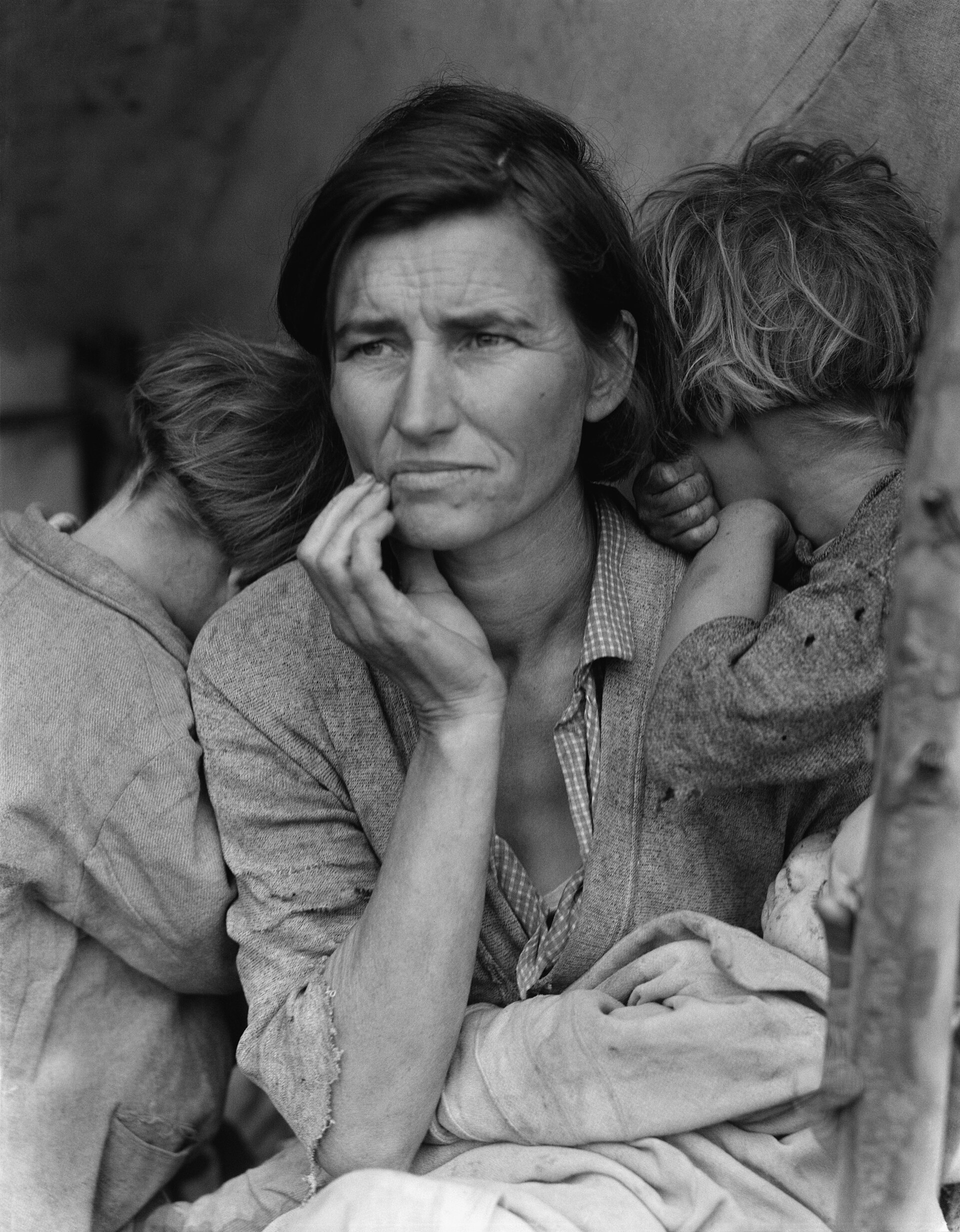
The object described in this record: the final, retouched negative of the sequence, digitized by the Library of Congress under digital ID fsa.8b29516. This is the image known worldwide as Migrant Mother.
| Artist | Dorothea Lange |
|---|---|
| Date | 1936-03-06 |
| Medium | Photographic negative, nitrate film, 4 x 5 in., made with a Graflex camera; the widely reproduced image is a later gelatin silver print or digital reproduction from this negative |
| Dimensions | Negative 4 x 5 in. (10.2 x 12.7 cm). Printed and reproduced sizes vary; a Museum of Modern Art gelatin silver print (1949) measures 28.3 x 21.8 cm (11 1/8 x 8 9/16 in). |
| Where it is now | Library of Congress, Prints and Photographs Division, Washington, DC. Part of the Farm Security Administration - Office of War Information Photograph Collection.last confirmed 6 August 2026 |
| Inventory number | LC-USF34-009058-C (original nitrate negative); digital ID LC-DIG-fsa-8b29516; control number fsa 1998021539/PP; LOT 0344 (corresponding file print) |
| Attribution | AcceptedMade by Dorothea Lange in March 1936 while she was a salaried field photographer for the Resettlement Administration (from 1937 the Farm Security Administration). Full note |
| Object type | Photograph |
| Period | American, twentieth century - Farm Security Administration documentary photography |
| Inscriptions | None on the image itself. The Library of Congress caption card, from which the catalog title is taken, reads: "Destitute pea pickers in California. Mother of seven children. Age thirty-two. Nipomo, California." A Rijksmuseum print carries a verso stamp reading "Reproduced from the collections of the Library of Congress." |
| Owners on record | 5 links5 documented |
| Sources | 23 cited |
About this record Last verified 6 August 2026 · 23 sources cited · Change log
On this page 10 sections
ContentsClose
Lange made this photograph in about ten minutes at a pea pickers' camp near Nipomo, California, on 6 March 1936, as one of five to seven exposures of the same encounter - not a single click but the last frame of a short sequence, worked closer with each shot. The negative the world knows was itself altered afterward: in 1939, at Lange's instruction, a darkroom assistant removed a thumb visible gripping a tent pole in the lower right corner, a retouching her own supervisor at the Farm Security Administration is reported to have objected to on documentary grounds.
The woman was not identified publicly for forty-two years. Florence Owens Thompson, Cherokee, a widow supporting her children through the worst of the Depression, was found in 1978 by a Modesto newspaper reporter, and her first public statement was a direct grievance: no payment, no name asked, a promised print that never arrived. Because Lange made the image as a salaried federal employee, it was public domain the moment it was exposed - which is exactly why neither woman ever controlled or profited from what became one of the most reproduced photographs in American history, until a public fundraising appeal during Thompson's final illness in 1983 produced the only compensation either of them ever received.
The original negative has never left government custody: Resettlement Administration to Farm Security Administration to Office of War Information to the Library of Congress, formally accepted on 18 January 1944, where it is held today.
Provenance
Each link is graded. Documented: a cited source supports it. Disputed: the identification is argued but not established. Unknown: no owner for that span, and the gap is not smoothed into a narrative. The grades in the glossary.
- 1936-03-06 - 1937Resettlement Administration, Historical Section (Roy Stryker, director)documented
Negative exposed by Dorothea Lange, a salaried field photographer for the Resettlement Administration, while on assignment documenting migratory farm labor in central California.129
- 1937 - 1939Farm Security Administration, Historical Sectiondocumented
The Resettlement Administration was reorganized as the Farm Security Administration in 1937; its photographic file, including this negative, continued under Roy Stryker's Historical Section.911
- 1939 - 1939Farm Security Administrationdocumented
The negative was retouched, at Lange's instruction, to remove a thumb visible gripping a tent pole in the lower right corner. The Library of Congress catalog record confirms the retouching occurred in the 1930s; secondary sources date it specifically to 1939, tied to preparation for a 1941 exhibition.16
- 1942 - 1944Office of War Information, Overseas Picture Divisiondocumented
The FSA photographic file was transferred to the Office of War Information in 1942 as the agency's mission shifted toward wartime information work.11
- 1944-01-18 - presentLibrary of Congress, Prints and Photographs Divisiondocumented
OWI director Elmer Davis formally offered the photographic files to the Library of Congress on 14 January 1944; Librarian of Congress Archibald MacLeish accepted four days later, on 18 January 1944. The negative has remained in the Library's custody since.11
Prices realised
| Date | Sale | Estimate | Result | Note |
|---|---|---|---|---|
| 11 March 2021 | Swann Auction Galleries | not stated in sources consulted | Hammer not separately reported in sources consulted With premium not separately reported in sources consulted USD | Sale of a later gelatin silver print of the horizontal-format Migrant Mother variant (a different frame from the sequence, not the negative described in this record), reported as selling for USD 63,750, described by the auction house as a record for that variant. In the same sale, a print of the standard/final-image variant sold for USD 23,750, and a print of a wide shot of the scene sold for USD 22,500. Public reporting gives a single all-in figure for each lot; hammer and buyer's premium are not separately stated in the sources consulted, so this record does not assert a split. These are sales of later prints, not of the negative itself, which as federal government property has never been and cannot be privately sold. |
| 2022-10 | Swann Auction Galleries | not stated in sources consulted | Hammer not separately reported in sources consulted With premium not separately reported in sources consulted USD | A vintage print of Migrant Mother, formerly in the collection of Romana Javitz (longtime head of the New York Public Library Picture Collection), sold for USD 305,000, reported as the top lot of the sale. This is a sale of a vintage print, not of the negative described in this record. Hammer and premium are not separately stated in the source consulted. |
Hammer is the price at which the bidding stopped; with premium adds the fee the house charges the buyer on top. Hammer price and buyer's premium in the glossary.
Technical evidence
| Attribution note | Made by Dorothea Lange in March 1936 while she was a salaried field photographer for the Resettlement Administration (from 1937 the Farm Security Administration). Attribution is not in dispute; the negative and the Library of Congress catalog record both carry her name. The single point of documented alteration is not authorship but the state of the negative: it was retouched in 1939, after the fact, to remove a thumb visible gripping a tent pole in the lower right corner. |
|---|---|
| Support and process | Nitrate negative, 4 x 5 in., exposed on a Graflex large-format camera. Digital reproductions distributed by the Library of Congress are scanned from this original nitrate negative.13 |
| Negative and reproduction numbers | Call number LC-USF34-009058-C [P&P]; copy transparency LC-USF346-009058-C; copy safety negative LC-USF347-009058-C; digital file from original negative LC-DIG-fsa-8b29516; duplicate negative LC-USF34-T01-009058-C.1 |
| Retouched vs. unretouched state | The negative was retouched, reportedly in 1939, to remove a thumb visible gripping a tent pole in the lower right corner. The Library of Congress separately holds the unretouched state as a black-and-white film copy negative of an unretouched file print (LC-USZ62-95653, digital ID cph.3b41800) and as digital files of the file print before and after conservation (LC-DIG-ppmsca-12883 and LC-DIG-ppmsca-23845).16 |
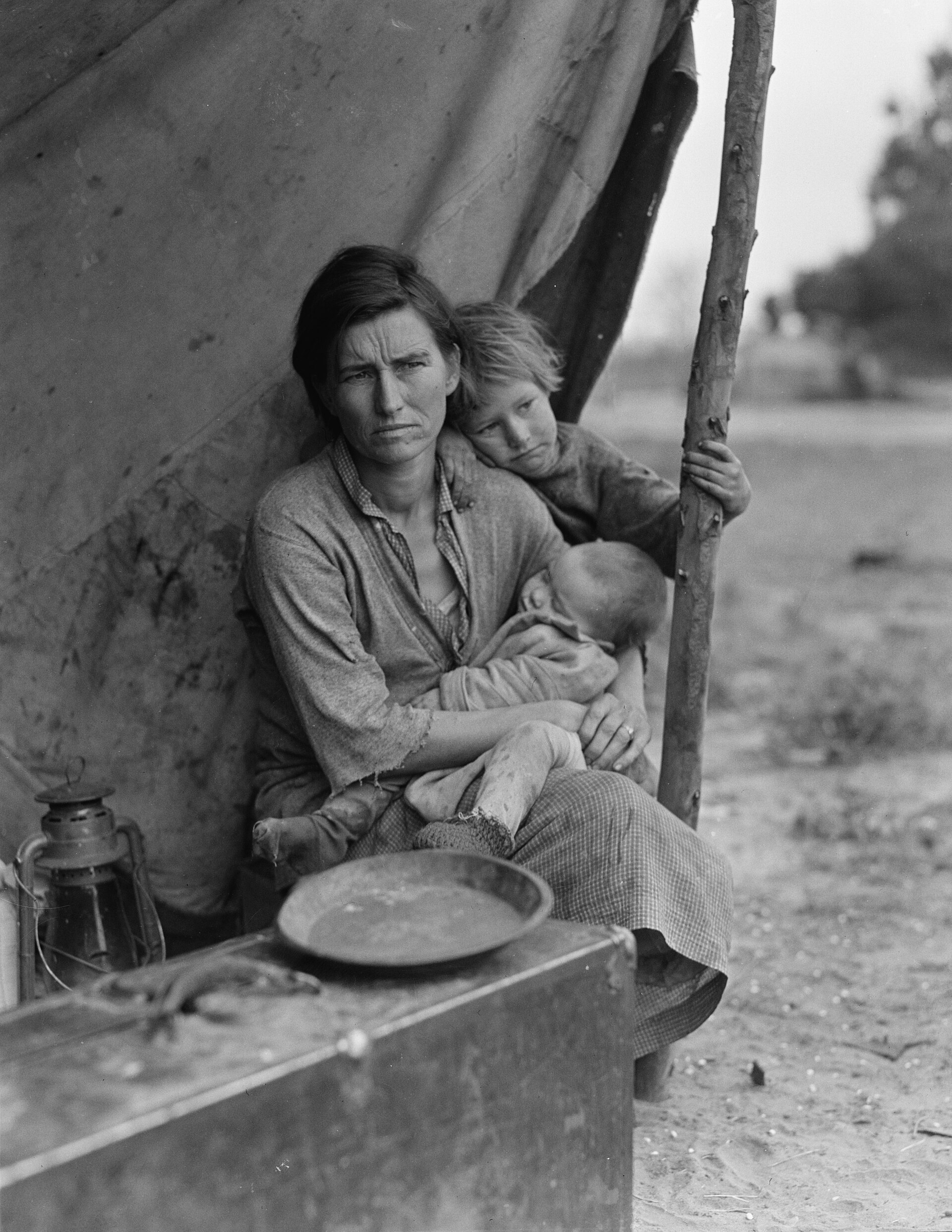
| Other exposures from the same sequence | At least two other negatives from the same camp visit carry distinct Library of Congress digital IDs, including fsa.8b29525 (wide view, captioned "Migrant agricultural worker's family. Seven children without food...") and a frame associated with fsa.8b29523 (a three-quarter pose distinct from the final image). Sources disagree on whether five, six or seven exposures were made in total.389 |
| Custody chain (government transfer dates) | Made under the Resettlement Administration (1936); files absorbed by the Farm Security Administration (1937); transferred to the Office of War Information (1942); formally offered to the Library of Congress by OWI director Elmer Davis on 14 January 1944 and accepted by Librarian of Congress Archibald MacLeish four days later.11 |
| Institutional prints of the same image | Museum of Modern Art, gelatin silver print, printed 1949, 28.3 x 21.8 cm, accession 331.1995, gift of the artist. Oakland Museum of California, gelatin silver print, 13.25 x 9.25 in., accession A65.104.2. Rijksmuseum, Amsterdam, print RP-F-F17668, verso-stamped as reproduced from the Library of Congress collections.121314 |
| Conservation of the unretouched file print | The Library of Congress catalogs separate digital files of its unretouched file print from before and after a conservation treatment (LC-DIG-ppmsca-12883, pre-conservation, and LC-DIG-ppmsca-23845, post-conservation), indicating the physical print was conserved at some point after digitization began. The date and nature of the conservation treatment are not stated in the sources consulted.1 |
Images
The record in full
Chapter 1What the photograph shows, and which negative this is
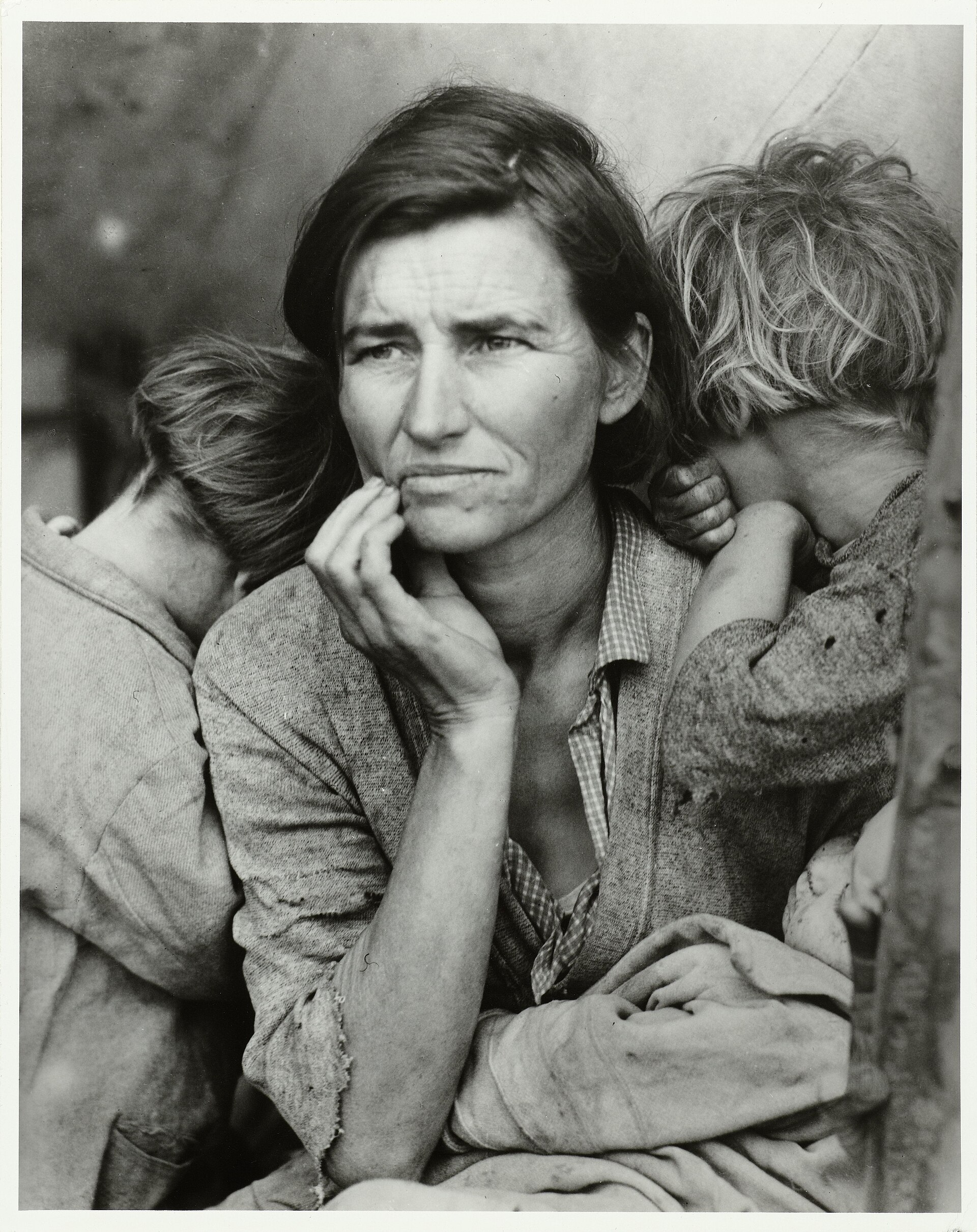
The image is a close three-quarter portrait: a seated woman, thirty-two years old, looks off to the side with her right hand raised to her jaw.
The image is a close three-quarter portrait: a seated woman, thirty-two years old, looks off to the side with her right hand raised to her jaw. A baby is asleep in her lap; two older children stand pressed against her, their faces turned away from the camera and buried in her shoulders. The picture is tightly framed, with almost no background information visible - no tent, no camp, no possessions - which is itself the result of a choice Lange made during the sequence, not a fixed starting point.
This record concerns one specific negative: LC-USF34-009058-C, digitized by the Library of Congress under the ID fsa.8b29516, cataloged under the title "Destitute pea pickers in California. Mother of seven children. Age thirty-two. Nipomo, California." This is the final and by far the most reproduced frame of a short sequence Lange made at the same camp on the same visit. It is not the only surviving photograph from that encounter, and getting the two categories - this negative, and the other negatives from the same ten minutes - straight is the point of the next section.
Chapter 2The sequence: this is not a single photograph
Lange's own account, published in Popular Photography in February 1960, says: "I made five exposures, working closer and closer from the same direction." Library of Congress and National Gallery of...
Lange's own account, published in Popular Photography in February 1960, says: "I made five exposures, working closer and closer from the same direction." Library of Congress and National Gallery of Art records of the surviving negatives from this camp visit describe six or seven frames, a discrepancy this record does not resolve because no source consulted reconciles Lange's count against the archival count with a documented explanation.
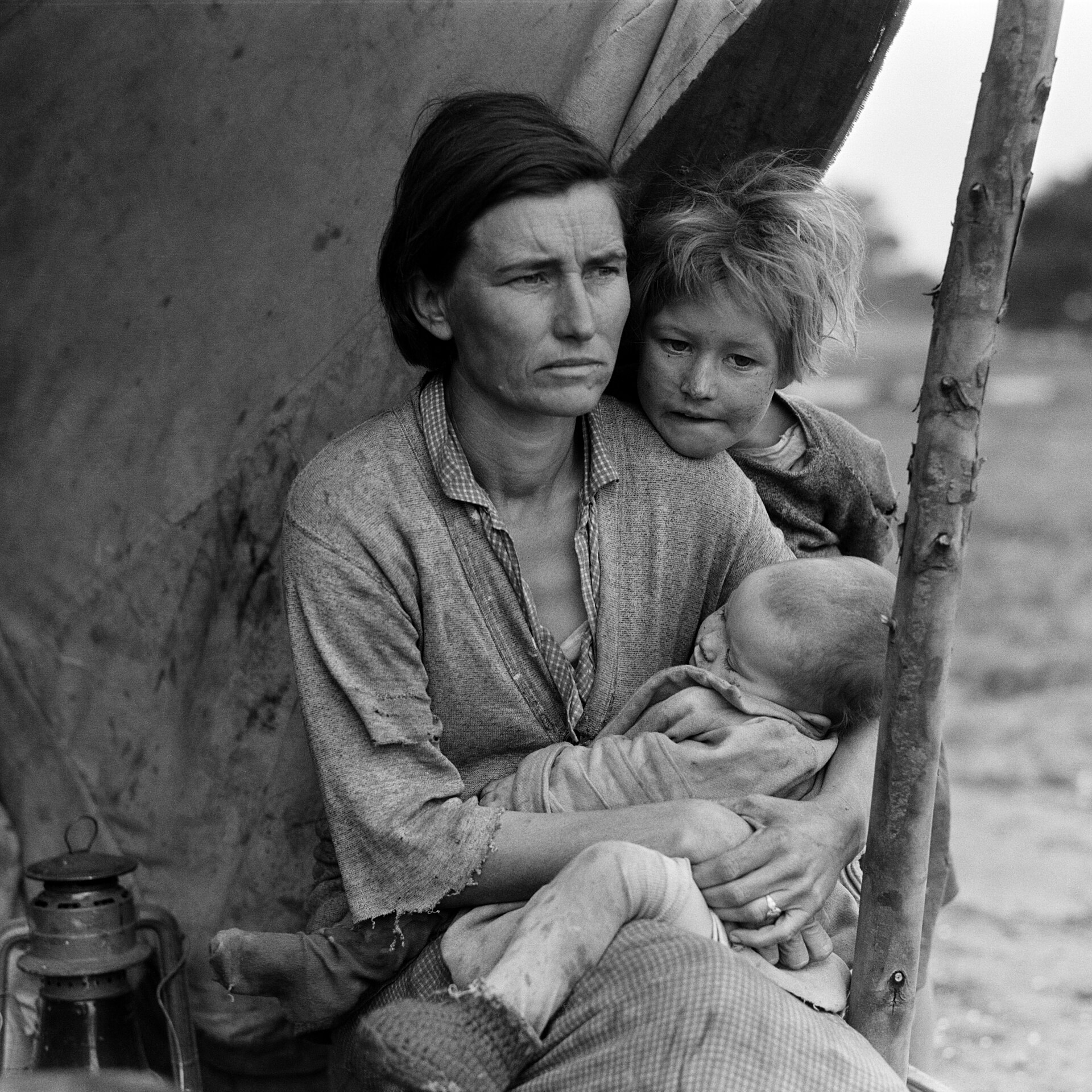
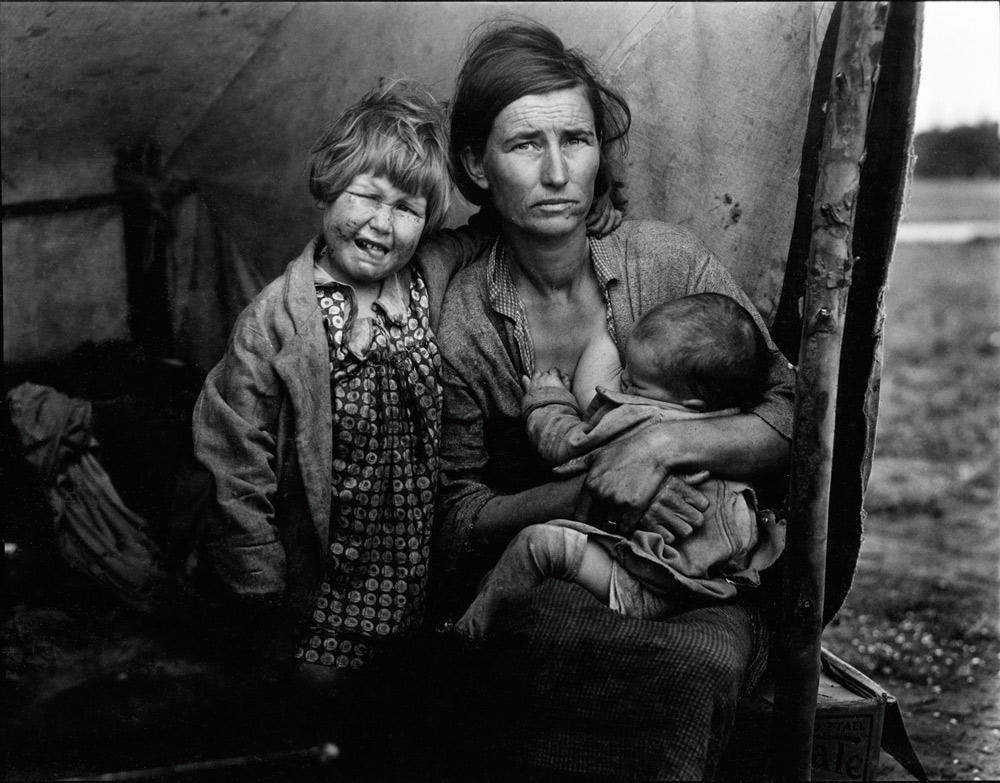
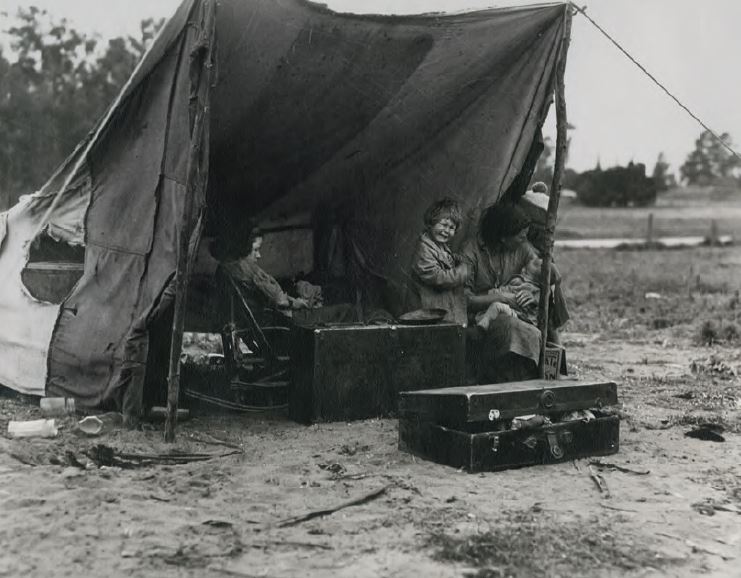
What is documented is the content of several of the other frames. At least two earlier exposures show the family's tent and surroundings, with the children facing the camera. One frame, cataloged by the Library of Congress under a related digital ID (fsa.8b29525) and captioned "Migrant agricultural worker's family. Seven children without food. Mother aged thirty-two. Father is a native Californian. Nipomo, California," shows a wider view. Another surviving frame shows Thompson breastfeeding an infant, looking down rather than out. A further frame (associated with digital ID fsa.8b29523 and sometimes called the "alternative" version) shows a similar three-quarter pose to the final image but is a distinct exposure, not a crop or a duplicate of it. Lange worked closer to the family with each frame and, by her own account, asked the children turned toward the camera in the earlier shots to turn away for the final exposure. Every one of these is a different photograph of the same encounter. None of them is the object described in this record, and where any appear in the gallery below they are labeled as such.
Chapter 3The retouching: a documented alteration to this specific negative
The negative held by the Library of Congress carries a second, separate layer of version history on top of the multi-exposure sequence: it was physically retouched after Lange made it, and the...
The negative held by the Library of Congress carries a second, separate layer of version history on top of the multi-exposure sequence: it was physically retouched after Lange made it, and the retouched state is the one reproduced in almost every printing of "Migrant Mother" made since.
The Library of Congress catalog note for fsa.8b29516 states plainly: "Digital file was made from the original nitrate negative for 'Migrant Mother' (LC-USF34-009058-C). The negative was retouched in the 1930s to erase the thumb holding a tent pole in lower right hand corner." Secondary accounts date the retouching to 1939, prompted by Lange's preparation of prints for a 1941 exhibition, and describe her instructing a darkroom assistant to remove what she called a "glaring defect" - Thompson's thumb, visible gripping a tent pole at the lower right of the frame, left behind as a faint smudge with the index finger still visible. Roy Stryker, who ran the FSA's Historical Section and was Lange's supervisor, is reported to have objected to the retouching on the grounds that it compromised the documentary claim of the entire FSA photographic project, even though altering prints for publication was common practice at the time and other outlets, including the New York Times, are reported to have retouched the image independently.
The Library of Congress separately holds and catalogs the unretouched state: a black-and-white film copy negative of an unretouched file print showing the thumb (LC-USZ62-95653, digital ID cph.3b41800) and a digital file made from the print itself before conservation (LC-DIG-ppmsca-12883) and after conservation (LC-DIG-ppmsca-23845). No file showing the unretouched, thumb-visible state was located on Wikimedia Commons with a verified clean public-domain license at the time of this research; none is included in the gallery for that reason, and its absence is recorded as an open question below rather than filled with an unverified image.
James Curtis, in Mind's Eye, Mind's Truth: FSA Photography Reconsidered, reads the retouching as more than cosmetic tidying: he argues the visible thumb, gripping the tent pole for support, read as a small note of physical competence and self-possession, and that removing it shifted the image slightly toward a mother who appears more purely anxious and dependent. This is Curtis's argued interpretation of the effect of the retouching, not a documented statement of Lange's intent; no source consulted quotes Lange explaining the retouching in those terms. She described it only as removing a defect.
Chapter 4Who Florence Owens Thompson actually was
The woman in the photograph was Florence Leona Christie, born 1 September 1903 in Indian Territory, in what is now Oklahoma.
The woman in the photograph was Florence Leona Christie, born 1 September 1903 in Indian Territory, in what is now Oklahoma. Both of her parents were of Cherokee descent. She married Cleo Owens at seventeen; they had six children before he died of tuberculosis in 1931, while she was pregnant with their sixth. The family had already moved to California to work in the fields and sawmills of the Sacramento Valley. After Cleo's death Thompson supported the children alone, working fields, restaurants and hospitals, and later had three more children with a partner, Jim Hill.
On 6 March 1936 the family's car broke down - the timing chain snapped - on US Highway 101 near a pea pickers' camp outside Nipomo, while Hill and two of the older boys went to find a part. Lange, driving past on her way home from a month documenting migratory farm labor for the Resettlement Administration, turned back after twenty minutes and spent roughly ten minutes photographing Thompson and the children who remained at the camp. By Lange's account, Thompson told her the family had been living on frozen vegetables from the surrounding fields and on birds the children killed, and had just sold the tires from the car to buy food. One of Thompson's sons, Troy Owens, later disputed elements of this account. It is also not settled whether Thompson was working as a pea picker at all that season, or was a Dust Bowl migrant merely passing through the camp; a scholarly account (Richard Steven Street, Photographing Farmworkers in California, 2004) describes Lange's own caption as vague or demonstrably inaccurate on this point.
Thompson was Cherokee, not the Dust Bowl "Okie" figure the photograph came to symbolize in the popular imagination. The photograph's fame rests substantially on a national reading of who she was that does not match key facts of who she actually was; this gap between symbol and person is itself one of the most consequential and well-documented facts about the image.
Chapter 5Forty-two years unidentified, then found: the 1978 investigation
Lange did not record Thompson's name at the time, and for over four decades the woman in the photograph was known to the public only as "Migrant Mother," an anonymous emblem of the Depression.
Lange did not record Thompson's name at the time, and for over four decades the woman in the photograph was known to the public only as "Migrant Mother," an anonymous emblem of the Depression. Thompson herself had seen the photograph reproduced and, in 1958, wrote to a magazine that had published it asking that unsold copies be recalled, out of concern for how the image and its associations affected her family; she withdrew the complaint once assured the photograph could not be legally restricted, since it belonged to the federal government.
In 1978, Modesto Bee reporter Emmett Corrigan located Thompson, then living in a mobile home in Modesto, California, and identified her publicly as the woman in the photograph. Her reaction, as reported at the time, was pointed: "I wish she hadn't taken my picture. I can't get a penny out of it. She didn't ask my name. She said she wouldn't sell the pictures. She said she'd send me a copy. She never did." The quotation states a specific, concrete grievance - an unfulfilled promise of a print and no payment - rather than a general complaint about fame.
Chapter 6Compensation, consent, and the ethics of the picture
Because Lange made the photograph as a paid federal employee on assignment, the negative was federal government property from the moment of exposure and entered the public domain immediately; neither...
Because Lange made the photograph as a paid federal employee on assignment, the negative was federal government property from the moment of exposure and entered the public domain immediately; neither Lange nor Thompson held any copyright in it to license or sell. Lange herself received no royalties from the image's use, and Thompson received nothing at all beyond whatever informal understanding, undocumented, may have passed between them at the camp. Thompson's later account explicitly states that Lange told her the photographs would not be sold - a statement at odds with the image's subsequent role as one of the most reproduced photographs of the twentieth century, appearing in exhibitions, books, magazines, postage stamps and countless commercial and editorial contexts.
In August 1983, when Thompson was hospitalized with cancer and the family made her illness public, more than 2,000 letters and roughly $35,000 in unsolicited donations arrived to help with medical costs - a form of public restitution that arrived only at the very end of her life and only because the family asked for it directly, not because any institution that had profited from the image initiated it. Her son Troy Owens later said the response changed how the family felt about the photograph: "For Mama and us, the photo had always been a bit of a curse. After all those letters came in, I think it gave us a sense of pride." Thompson died on 16 September 1983, five weeks after the fundraising effort began. Her gravestone at Lakewood Memorial Park in Hughson, California reads: "FLORENCE LEONA THOMPSON Migrant Mother - A Legend of the Strength of American Motherhood."
No source consulted for this record documents any lawsuit, settlement or formal claim brought by Thompson or her family against Lange, the federal government, or any publisher over use of the photograph. The record here is one of grievance stated but never legally pursued, not one of grievance resolved.
Chapter 7Why the photograph exists: the Resettlement Administration assignment
Lange was on the Historical Section payroll of the Resettlement Administration, an agency created under Franklin Roosevelt's New Deal and headed at the level relevant here by Roy Stryker, who...
Lange was on the Historical Section payroll of the Resettlement Administration, an agency created under Franklin Roosevelt's New Deal and headed at the level relevant here by Roy Stryker, who directed the unit's photographic documentation of rural poverty to build public and congressional support for relief and resettlement programs. In March 1936 Lange was completing roughly a month of fieldwork photographing migratory farm labor in central California when she encountered the Nipomo camp. Five days after returning home, on 12 March 1936, she reported to Stryker that her "negatives are loaded with ammunition" - a phrase that makes explicit what the assignment was for: not neutral documentation but material intended to move policy and opinion.
The photographs from Nipomo did produce a concrete, immediate government response: reporting on the destitute condition of the pea pickers' camp is credited with prompting federal relief to be sent to the area. This is the clearest instance in Lange's career of a single photograph functioning exactly as the Historical Section was designed to make photographs function - as evidence deployed to trigger action - and it is also the reason the negative was never going to be a private artifact: it was made, from the outset, as an instrument of government persuasion, using government equipment, on government time, for government purposes.
Chapter 8The immediate response, and its bitter irony
The photographs had a fast, concrete effect.
The photographs had a fast, concrete effect. Lange took her Nipomo pictures to George West, editor of the San Francisco News, who ran a story built around two of the images within days. Federal authorities responded by sending 20,000 pounds of food to the pea pickers' camp. By the time it arrived, Thompson and her family had already moved on, on to the next work, further up the coast toward Watsonville. The camp that received the food was, by then, largely occupied by other destitute families rather than the one the photograph made famous - a detail that is rarely included alongside the story of the photograph's civic power, and one that complicates any simple account of the picture as a direct cause of relief reaching the people it depicted.
Chapter 9Composition and the Madonna reading
The final frame is built on a stable triangular composition, Thompson's face at the apex, the two older children's turned-away heads forming the base, echoing a compositional structure long used in...
The final frame is built on a stable triangular composition, Thompson's face at the apex, the two older children's turned-away heads forming the base, echoing a compositional structure long used in Christian Madonna and Child imagery: mother at center, infant against her body, other figures gathered close. Critics and historians reaching for this comparison are not reporting anything Lange stated about her own intentions - no source consulted quotes her invoking Christian iconography - and this record treats the comparison as an argued critical reading, not a documented statement of purpose. Sarah Meister, a Museum of Modern Art curator, and other writers have made the comparison explicitly; other scholars, including a review by Margaret Olin in Critical Inquiry, have pushed back on the reading, proposing that an image of Charity overwhelmed by dependent children - put upon rather than serenely giving - fits the picture's actual content better than an untroubled Madonna does. Both readings are about what later viewers, including museum curators, have projected onto a triangular arrangement of bodies; neither is evidence of what Lange or Thompson understood the moment to mean.
Chapter 10Reproduction and how the fame was manufactured
Because the negative was public-domain government property from the day it was made, its circulation was never gated by licensing, which is a large part of why it became as ubiquitous as it did: any...
Because the negative was public-domain government property from the day it was made, its circulation was never gated by licensing, which is a large part of why it became as ubiquitous as it did: any publisher, any textbook, any museum could reproduce it without payment or permission from the moment it existed. The image ran in newspapers within days of the Nipomo visit, entered the FSA's own promotional use almost immediately, and was included in Edward Steichen's 1955 "Family of Man" exhibition at MoMA, one of the most widely seen photography exhibitions of the twentieth century, which fixed its status as an icon well before Thompson was identified. A print in the Rijksmuseum, Amsterdam (RP-F-F17668) carries a verso stamp reading "Reproduced from the collections of the Library of Congress," itself physical evidence of how directly institutions drew reproductions straight from the federal file rather than through any commercial licensing chain.
On 10 September 1998 the US Postal Service issued a 32-cent stamp reproducing the photograph as part of its "Celebrate the Century" series, in the sheet devoted to the 1930s under the heading "America Survives the Depression." The scholars Robert Hariman and John Louis Lucaites, in No Caption Needed: Iconic Photographs, Public Culture, and Liberal Democracy, argue that the image's civic power lies precisely in how it compresses a case for the welfare state into an emotional rather than a programmatic appeal: the photograph, they write, "works primarily to activate and manage feelings of both vulnerability and obligation that are endemic to our liberal-democratic culture," positioning the viewer, in their reading, in "the position of the absent father" - an argued critical interpretation of the image's function, not a claim about what Lange or the government intended when the picture was made.
In the early 2010s, colorized versions of Migrant Mother and other well-known black-and-white documentary photographs, produced by the Swedish photo editor Sanna Dullaway, circulated widely online; Dullaway was later commissioned by TIME in 2016 to colorize a further set of influential images, including this one, for a retrospective feature. The broader practice of colorizing historical black-and-white photographs, including this image, drew criticism from photography critics who argued it substitutes a colorist's invented palette for the documentary record, blurring the line between restoration and fabrication. This is a later reinterpretation of the image, not a change to the object itself; the negative and every print discussed in this record remain black and white.
Chapter 11Copyright and public domain status, checked rather than assumed
The Library of Congress's own rights statement for this item, transcribed from its catalog record, reads: "RIGHTS INFORMATION: No known restrictions on publication." That phrase describes the...
The Library of Congress's own rights statement for this item, transcribed from its catalog record, reads: "RIGHTS INFORMATION: No known restrictions on publication." That phrase describes the Library's institutional position - it does not itself assert that the work is in the public domain, only that the Library is not aware of a restriction, which is a narrower and weaker claim. The stronger and legally correct basis for public domain status is separate and specific: Lange made this photograph as a salaried employee of a federal agency, acting within the scope of that employment, and works of the United States federal government are excluded from copyright protection under US law. On that basis, Wikimedia Commons applies its {{PD-USGov-FSA}} determination to the file, and the Commons API confirms a clean license determination independent of the Library's own wording: for the file most closely tied to this negative (File:Migrant Mother (LOC fsa.8b29516).jpg), the platform's extmetadata field LicenseShortName returns "Public domain," with UsageTerms "Public domain" and AttributionRequired "false." The same clean determination was verified directly via the Commons API for every file used in the gallery below.
Chapter 12Where copies of the image live now
The original negative remains at the Library of Congress.
The original negative remains at the Library of Congress. Separately, physical prints made from it over the decades are held and cataloged as distinct objects by other institutions: the Museum of Modern Art holds a gelatin silver print (accession 331.1995, printed 1949, gift of the artist); the Oakland Museum of California, which received the bulk of Lange's personal archive of over 40,000 negatives and 6,000 vintage prints from her husband Paul Taylor after her death, holds its own print (accession A65.104.2); and the Rijksmuseum in Amsterdam holds a print reproduced directly from the Library of Congress file. None of these institutional prints is the negative described as the primary object of this record; each is a separate, later physical object carrying the same image.
Chapter 13What remains unresolved
The number of exposures Lange actually made that day is not settled between her own contemporaneous account and the archival record.
The number of exposures Lange actually made that day is not settled between her own contemporaneous account and the archival record. Whether Thompson was working the pea harvest or was a transient Dust Bowl migrant is contested rather than established. The exact date the retouching was first publicly disclosed or scrutinized by scholars, as opposed to simply being visible on comparison of the two file prints held at the Library of Congress, is not documented in any source consulted. And the informal understanding Thompson describes - that Lange promised not to sell the pictures and to send her a copy - was never reduced to anything in writing that has survived or been published; it exists only as Thompson's later recollection, unconfirmed and uncontradicted by any surviving record from Lange's side.
The artist
Dorothea Margaretta Lange (born Nutzhorn)
Lange was not a government functionary who happened to make one famous picture. She was a working portrait photographer who deliberately walked away from a successful San Francisco studio into documentary work during the Depression, was formally trained, was recognized in her own lifetime with the first Guggenheim Fellowship in photography awarded to a woman, and went on to make one of the most consequential and most suppressed bodies of work of the Second World War. The facts below are documented rather than inferred: her name, her training, her employment record, and the fate of her wartime photographs are all a matter of institutional record, not connoisseurship.
Related works
| Work | Relation | Where it is |
|---|---|---|
| Migrant agricultural worker's family, Nipomo, California (LC digital ID fsa.8b29525) Dorothea Lange | Different exposure from the same ten-minute sequence at the same camp; not the final iconic image Wider framing, children facing the camera. Shown in the gallery below labeled as a separate exposure. | Library of Congress, Prints and Photographs Division, Washington, DC |
| Migrant mother, alternative version (LC digital ID fsa.8b29523) Dorothea Lange | Different exposure from the same sequence, similar three-quarter pose but a distinct negative Sometimes reproduced cropped; the crop is derived from this different negative, not from fsa.8b29516. | Library of Congress, Prints and Photographs Division, Washington, DC |
| Migrant Mother, unretouched file print showing thumb Dorothea Lange | The pre-retouching state of the same final negative described in this record Digital IDs cph.3b41800 (film copy negative), ppmsca.12883 (pre-conservation print) and ppmsca.23845 (post-conservation print). No file of this state was found on Wikimedia Commons with a verified clean license; none is reproduced here for that reason. | Library of Congress, Prints and Photographs Division, Washington, DC |
| White Angel Breadline Dorothea Lange | Earlier Depression-era photograph by the same artist, 1933, made before her federal employment The photograph generally credited with turning Lange from a portrait photographer toward documentary social photography. | Oakland Museum of California |
Open questions
- How many exposures did Lange actually make at the Nipomo camp: her own 1960 account says five, while archival counts of surviving negatives from the visit range to six or seven. No source consulted reconciles the discrepancy.
- Was Florence Owens Thompson working as a pea picker that season, or was she a Dust Bowl migrant merely stopped at the camp? Lange's caption is disputed by at least one scholarly account as vague or inaccurate on this point.
- When was the retouching of the negative first publicly identified or written about? Sources agree it happened, reportedly in 1939, but none consulted documents when it became public knowledge or scrutiny.
- Did Lange and Thompson ever have any written or witnessed agreement about use of the photographs? Thompson's account of a promise not to sell the images and to send her a print is unconfirmed by any surviving record from Lange's side.
- What became of the remaining negatives from the sequence beyond fsa.8b29516, fsa.8b29525 and fsa.8b29523 - a complete, source-confirmed list of every negative number from the visit was not located.
Questions about this object
What is Destitute pea pickers in California. Mother of seven children. Age thirty-two. Nipomo, California?
Destitute pea pickers in California. Mother of seven children. Age thirty-two. Nipomo, California is a photograph, dated 1936-03-06. Medium: Photographic negative, nitrate film, 4 x 5 in., made with a Graflex camera; the widely reproduced image is a later gelatin silver print or digital reproduction from this negative.
Who made Destitute pea pickers in California. Mother of seven children. Age thirty-two. Nipomo, California, and is the attribution settled?
The attribution to Dorothea Lange is recorded here as accepted. Made by Dorothea Lange in March 1936 while she was a salaried field photographer for the Resettlement Administration (from 1937 the Farm Security Administration). Attribution is not in dispute; the negative and the Library of Congress catalog record both carry her name. The single point of documented alteration is not authorship but the state of the negative: it was retouched in 1939, after the fact, to remove a thumb visible gripping a tent pole in the lower right corner.
Where is Destitute pea pickers in California. Mother of seven children. Age thirty-two. Nipomo, California now?
Library of Congress, Prints and Photographs Division, Washington, DC. Part of the Farm Security Administration - Office of War Information Photograph Collection. Inventory number LC-USF34-009058-C (original nitrate negative); digital ID LC-DIG-fsa-8b29516; control number fsa 1998021539/PP; LOT 0344 (corresponding file print). Last confirmed 6 August 2026. The negative has been in continuous federal government custody since it was made. It passed from the Resettlement Administration (1936) to the Farm Security Administration (1937), to the Office of War Information (1942), and was transferred to the Library of Congress on 18 January 1944, where it remains cataloged today.
What has Destitute pea pickers in California. Mother of seven children. Age thirty-two. Nipomo, California sold for?
Hammer not separately reported in sources consulted; with premium, not separately reported in sources consulted. Swann Auction Galleries, 2021-03-11.
What is still unknown about Destitute pea pickers in California. Mother of seven children. Age thirty-two. Nipomo, California?
How many exposures did Lange actually make at the Nipomo camp: her own 1960 account says five, while archival counts of surviving negatives from the visit range to six or seven. No source consulted reconciles the discrepancy.
Sources
- 1Library of Congress, Prints and Photographs Online Catalog, item record for "Destitute pea pickers in California. Mother of seven children. Age thirty-two. Nipomo, California" (digital ID fsa.8b29516), including its Rights Advisory statement, call numbers and retouching note. Direct fetch of loc.gov was blocked by the site's bot protection (HTTP 403) during this research; the full catalog record text was verified via Wikimedia Commons's transcription of the same Library of Congress {{loc-image}} catalog data on File:Migrant Mother (LOC fsa.8b29516).jpg. Flagged for the editor to re-verify with a direct loc.gov fetch. loc.gov/item/...
- 2Library of Congress, digital file resource page for fsa.8b29516. loc.gov/resource/...
- 3Wikipedia, "Migrant Mother", consulted for the sequence account, the James Curtis retouching analysis, and reception history. Tertiary source; flagged for replacement with James Curtis, Mind's Eye, Mind's Truth: FSA Photography Reconsidered (Temple University Press) directly. en.wikipedia.org/wiki/...
- 4Wikipedia, "Florence Owens Thompson", consulted for biography, the 1978 identification by Modesto Bee reporter Emmett Corrigan, direct quotations from Thompson and her son Troy Owens, and the 1983 fundraising and death. Tertiary source; flagged for replacement with contemporary Modesto Bee reporting and family interviews directly. en.wikipedia.org/wiki/...
- 5Dorothea Lange, "The Assignment I'll Never Forget: Migrant Mother," Popular Photography, February 1960, as transcribed by Hanover College. history.hanover.edu/courses/...
- 6PetaPixel, "That Iconic 'Migrant Mother' Photo Was 'Photoshopped'" (30 November 2018), on the 1939 retouching, Lange's darkroom assistant, and Roy Stryker's objection. petapixel.com/2018/...
- 7Fine Books & Collections, "Dorothea Lange Leads March Sale of Fine Photographs at Swann," on the 11 March 2021 Swann Auction Galleries sale of three Migrant Mother print variants. finebooksmagazine.com/news/...
- 8Wikimedia Commons, File:Migrant Mother sequence by Dorothea Lange, 8b29525u.jpg, catalog metadata citing Library of Congress source loc.gov/pictures/resource/fsa.8b29525/. commons.wikimedia.org/wiki/...
- 9JSTOR Daily, "Dorothea Lange and the Making of Migrant Mother," on the Resettlement Administration assignment and Roy Stryker's role. daily.jstor.org/dorothea-lange-and-the-making-of-migrant-...
- 10Google Books / web search synthesis of scholarly commentary on the Madonna and Child compositional comparison, including Sarah Meister (Museum of Modern Art) and Margaret Olin's review in Critical Inquiry. Secondary synthesis rather than a direct fetch of either text; flagged for the editor to verify against Meister's MoMA teaching excerpt and Olin's review directly. criticalinquiry.uchicago.edu/margaret_olin_reviews_migran...
- 11Library of Congress finding aid material on the transfer of the Farm Security Administration / Office of War Information photographic file to the Library of Congress, including the 14 January 1944 offer by OWI director Elmer Davis and its acceptance four days later by Librarian of Congress Archibald MacLeish. findingaids.loc.gov/db/...
- 12Museum of Modern Art, collection record for Dorothea Lange, Migrant Mother, Nipomo, California, accession 331.1995. Direct fetch of moma.org was blocked (HTTP 403) during this research; details verified via search-indexed summary of the same page. Flagged for direct re-verification. moma.org/collection/...
- 13Oakland Museum of California, Dorothea Lange Digital Archive, catalog record for Migrant Mother, Nipomo, California, accession A65.104.2. dorothealange.museumca.org/image/...
- 14Wikimedia Commons, File:Migrant mother, 1936, RP-F-F17668.jpg, catalog metadata for the Rijksmuseum print, verso stamp text and CC0 rights statement. commons.wikimedia.org/wiki/...
- 15Search-indexed summary of Swann Auction Galleries reporting on its October 2022 Fine Photographs sale, in which a vintage print of Migrant Mother formerly owned by Romana Javitz sold for USD 305,000. Direct fetch of swanngalleries.com was blocked (HTTP 403) during this research. Flagged for direct re-verification. swanngalleries.com/news/...
- 16Wikimedia Commons API, extmetadata query confirming LicenseShortName "Public domain" for File:Migrant Mother (LOC fsa.8b29516).jpg and related files, independent of the Library of Congress's own "no known restrictions" wording. commons.wikimedia.org/w/...
- 17Women of the Hall (National Women's Hall of Fame), biographical entry for Dorothea Lange, consulted via web search synthesis for her birth name, the polio quotation, and the Guggenheim Fellowship. Not independently re-fetched in full; flagged for direct verification. womenofthehall.org/inductee/...
- 18Britannica, "Dorothea Lange" biographical entry, consulted via web search synthesis for her training under Clarence H. White, the San Francisco portrait studio, the impoundment of her Japanese American incarceration photographs, and her death five weeks before her Museum of Modern Art retrospective. Not independently re-fetched in full; flagged for direct verification. britannica.com/biography/...
- 19HISTORY.com, "The Real Story Behind the 'Migrant Mother' Photo," consulted via web search synthesis for the San Francisco News publication, the 20,000-pound federal food shipment to the Nipomo camp, and the detail that Thompson's family had already left by the time it arrived. Direct fetch redirected to an unrelated host during this research and was not completed; flagged for direct re-verification. history.com/articles/...
- 20Smithsonian National Postal Museum, "The Migrant Worker" exhibition page, for the 10 September 1998 32-cent "Celebrate the Century" postage stamp. Direct fetch of postalmuseum.si.edu was blocked (HTTP 403) during this research; date and series confirmed via web search synthesis. Flagged for direct re-verification. postalmuseum.si.edu/exhibition/...
- 21Robert Hariman and John Louis Lucaites, No Caption Needed: Iconic Photographs, Public Culture, and Liberal Democracy (University of Chicago Press), excerpt on Migrant Mother's civic and emotional function. press.uchicago.edu/Misc/...
- 22TIME, "30 of the Most Influential Photos of All Time, Colorized" (27 December 2016), on Sanna Dullaway's colorization of Migrant Mother for TIME. time.com/4028250/...
- 23HuffPost, "Sanna Dullaway's Colorized Series Of Historical Photos Creates Controversy," consulted via web search synthesis for the critical backlash to colorizing historical black-and-white documentary photographs. Not independently re-fetched in full; flagged for direct verification. huffpost.com/entry/...


.jpg&prop=imageinfo&iiprop=extmetadata)
Last verified 6 August 2026 · Published 6 August 2026
Change log
6 August 2026 - Record created at the house standard: researched narrative, technical evidence, maker dossier, graded provenance chain, prices with hammer and premium separated, related works, open questions and sources.