Addie Card, 12 years. Spinner in North Pownal Cotton Mill
Lewis Wickes Hine · 1910
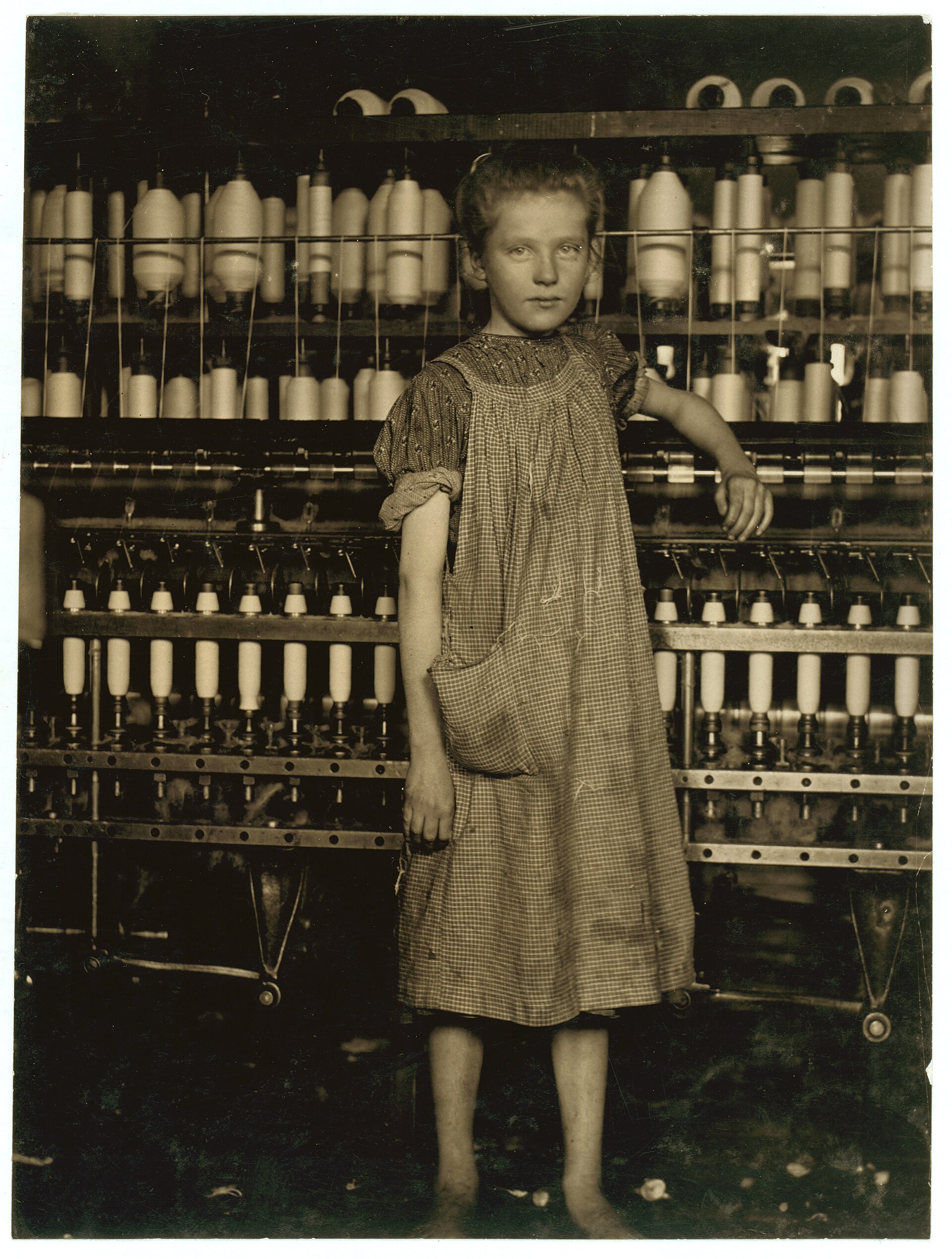
The record subject: Lewis Hine's Photo No. 1056, North Pownal, Vermont, 1910. Library of Congress, National Child Labor Committee Collection.
| Artist | Lewis Wickes Hine |
|---|---|
| Date | 1910 |
| Medium | Gelatin silver print. The Library of Congress catalogues the specific item behind this record's lead plate both as a black-and-white film copy negative (cph.3a15220) and, under the same photo number, as a color digital file scanned from a black-and-white original print (nclc.01824). |
| Dimensions | Approx. 11.5 x 8.5 cm (4.5 x 3 3/8 in), per the Library of Congress catalogue for this print/negative. A later print of the related Photo #1050 exposure, acquired by the National Gallery of Art in 2014, measures 24.1 x 19.2 cm (9 1/2 x 7 9/16 in) - see Technical. |
| Where it is now | Library of Congress, Prints and Photographs Division, Washington, DClast confirmed |
| Inventory number | National Child Labor Committee Collection; catalogued as cph.3a15220 and nclc.01824 |
| Attribution | AcceptedAuthorship is not in question. Full note |
| Object type | Photograph |
| Period | American, early twentieth century - documentary and reform photography |
| Inscriptions | Hine's own caption, per the Library of Congress catalogue: '[Addie Card], anaemic little spinner in North Pownal Cotton Mill. See photo No. 1056. Location: Vermont.' A related negative from the same sitting, Photo #1050, carries the fuller caption: 'Addie Card, 12 years. Spinner in North Pormal [i.e., Pownal] Cotton Mill. Vt. Girls in mill say she is ten years. She admitted to me she was twelve; that she started during school vacation and now would stay. E.F. Brown.' |
| Owners on record | 4 links4 documented |
| Sources | 21 cited |
About this record Last verified · 21 sources cited · Change log
On this page 9 sections
ContentsClose
In August or February 1910, the exact month is disputed across the institutions that hold related material, Lewis Hine photographed a twelve-year-old spinner at the North Pownal Manufacturing Company in Vermont, on assignment for the National Child Labor Committee. His caption on this negative, Photo No. 1056, calls her an anaemic little spinner; a companion negative from the same sitting, Photo #1050, records that the mill's other workers claimed she was ten while she herself admitted to twelve, a small documented lie the photograph exists to expose. For most of the twentieth century the girl was misidentified in print as Addie Laird, including on a 1998 US postage stamp; nobody, government researchers included, could trace anyone by that name.
The real identification came from outside any archive. Novelist Elizabeth Winthrop, who saw the photograph in 2002 and wrote the novel Counting on Grace in response to it, went looking for the real child afterward and found her correct name, Addie Card, on a 1910 census sheet in 2005. Writer Joe Manning then traced the rest of her documented life: an early marriage, a divorce that cost her custody of her daughter, a second marriage and an adopted daughter, decades in Cohoes, New York, and a death in 1993 at ninety-four, as a grandmother who never once mentioned to her family that she had ever been photographed.
This record anchors on the Library of Congress's own print of Photo No. 1056, part of the NCLC's archive since a 1954 gift, and is careful throughout to distinguish it from the more widely reproduced Photo #1050 negative held by the Metropolitan Museum, the National Gallery of Art and the National Archives: the same child, the same day, but not the same negative, and not always prints of demonstrably the same vintage.
Provenance
Each link is graded. Documented: a cited source supports it. Disputed: the identification is argued but not established. Unknown: no owner for that span, and the gap is not smoothed into a narrative. The grades in the glossary.
- 1910 - 1910National Child Labor Committee, New Yorkdocumented
Photographed by Lewis Hine on assignment for the NCLC during a field investigation of North Pownal, Vermont mills, working alongside investigator Edward F. Brown. Sources disagree on the exact month; see Open Questions.12610
- 1910 - 1954National Child Labor Committee, New Yorkdocumented
Retained as part of the NCLC's own working photographic archive and used in its exhibition panels, lantern-slide lectures and publications for the campaign against child labor.14
- 1954 - 1954Library of Congress, Washington DCdocumented
The NCLC's photographic archive, more than 5,100 prints and 355 glass negatives, was given to the Library of Congress in 1954 together with the NCLC's organizational records, by Gertrude Folks Zimand, the NCLC's general secretary.14
- 1954 - presentLibrary of Congress, Prints and Photographs Divisiondocumented
Held in the National Child Labor Committee Collection under the linked identifiers cph.3a15220 and nclc.01824. No known restrictions on publication.1
Technical evidence
| Attribution note | Authorship is not in question. The negative was made on assignment for the National Child Labor Committee (NCLC), which employed Hine as its staff investigative photographer from 1908 to 1924, and the surviving prints and negatives carry the NCLC's own captioning and numbering system. The Library of Congress received the material directly from the NCLC in 1954. |
|---|---|
| Caption, this negative | '[Addie Card], anaemic little spinner in North Pownal Cotton Mill. See photo No. 1056. Location: Vermont.' This is the caption on the Library of Congress record used as this record's lead plate.1 |
| Related exposure and its caption | A second negative from the same field visit is catalogued separately as Photo #1050, with the fuller caption: 'Addie Card, 12 years. Spinner in North Pormal [i.e., Pownal] Cotton Mill. Vt. Girls in mill say she is ten years. She admitted to me she was twelve; that she started during school vacation and now would stay. E.F. Brown.' This is the exposure held by the Metropolitan Museum, the National Gallery of Art and the National Archives, and the one most often reproduced under the mistaken name Addie Laird.24510 |
| Repository record, this print | Library of Congress, Prints and Photographs Division, National Child Labor Committee Collection. The Photo No. 1056 exposure is catalogued under two linked identifiers: cph.3a15220, digitized as a black-and-white film copy negative, and nclc.01824, digitized as a color digital file made from a black-and-white original print. The catalogue records consulted do not state which physical item is Hine's original and which is a later copy.1 |
| Dimensions | The Library of Congress catalogue records this print/negative at approximately 11.5 x 8.5 cm (4.5 x 3 3/8 in). The National Gallery of Art's gelatin silver print of the related Photo #1050 exposure, acquired in 2014, measures 24.1 x 19.2 cm (9 1/2 x 7 9/16 in), more than four times the surface area, consistent with a later enlargement rather than a print made close to 1910.15 |
| Process | Gelatin silver print, the standard process both for Hine's original NCLC field prints and for the later museum prints made from his negatives. No source consulted specifies whether Hine's original camera negative for this sitting was on glass or nitrate-based film stock, both of which he used during this period.45 |
| Rights and duplication | Public domain; no known restrictions on publication at the Library of Congress. Duplicate prints of Hine's NCLC negatives, including several from this North Pownal visit, were also given to the federal Children's Bureau shortly after its 1912 founding and are held today by the National Archives under Record Group 102.115 |
Images

The record in full
Chapter 1What the photograph shows
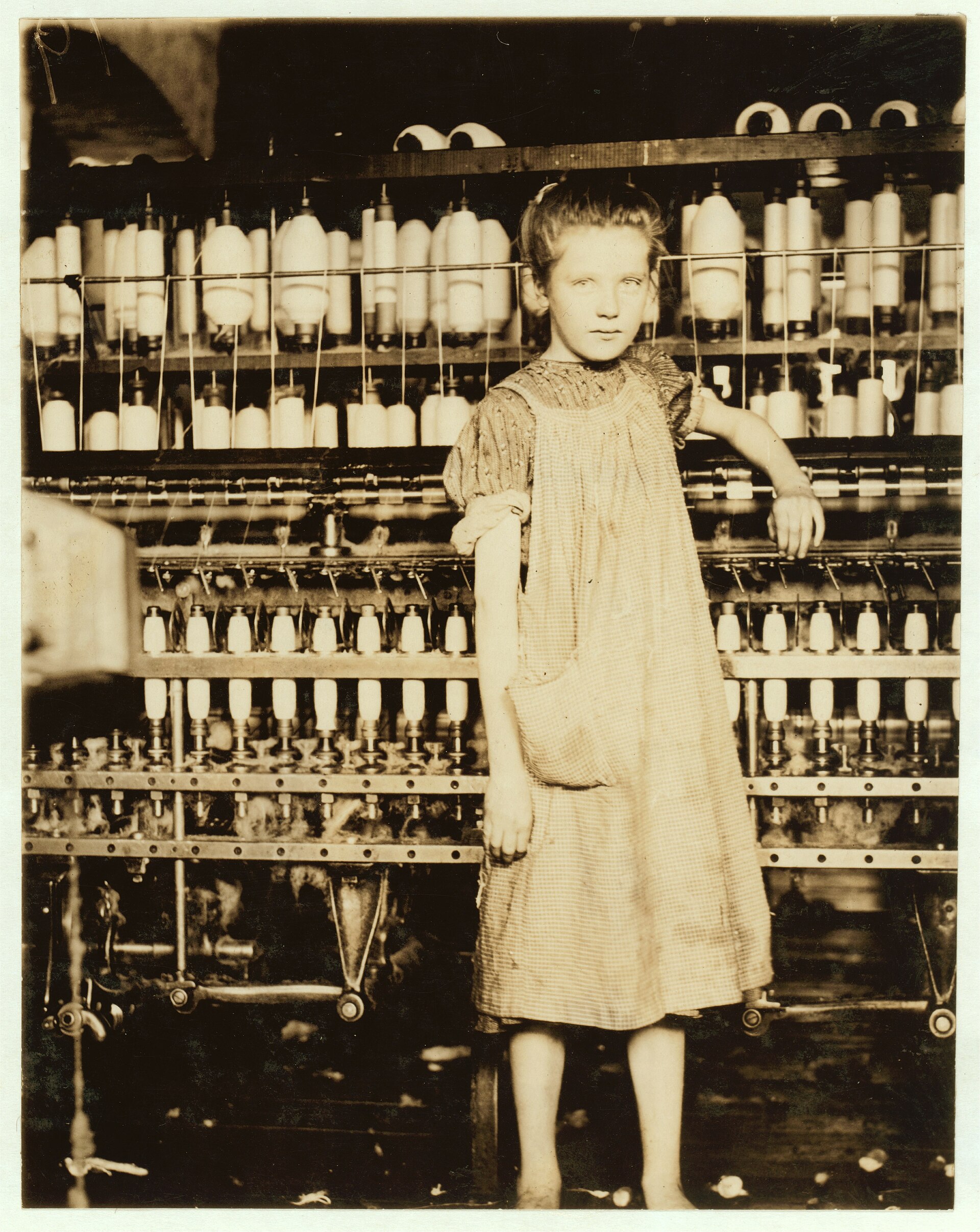
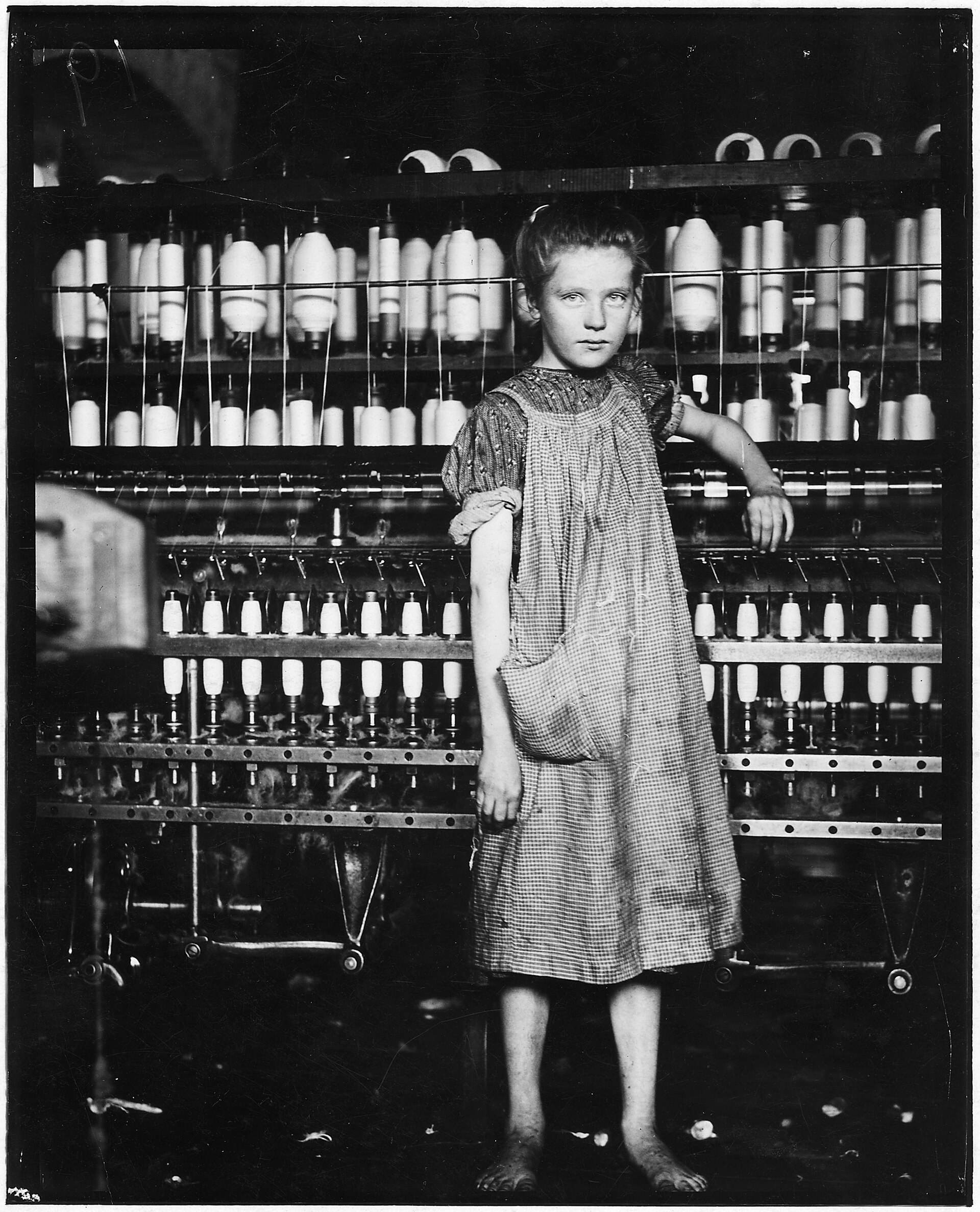
A girl stands in front of a spinning frame, the ranked rows of bobbins filling the background behind her.
A girl stands in front of a spinning frame, the ranked rows of bobbins filling the background behind her. Her dress is a filthy, spotted smock; one pocket is stuffed so full that it pulls the right strap off her narrow shoulder. Her left arm rests on the machine at an odd, slightly crooked angle. Her hair is pinned up away from her face, in the way mill rules required so it could not be caught in moving belts and spindles. Her bare feet, planted firmly on the mill floor, are slick with black grease. She looks directly at the camera: solemn, a little wary, not smiling.
That description is not this cataloguer's impression. It is the writer Elizabeth Winthrop's, recorded in 2006 after she saw a print of this photograph at the Bennington Museum in Vermont, a short drive from the mill itself. Winthrop wrote that Hine's own pocket notebook, from which the museum's label text was drawn, read simply: 'Anemic little spinner in North Pownal Cotton Mill, 1910.' That short note matches the short caption on this record's lead plate almost word for word, which is the basis for treating her description as a description of this negative's exposure rather than of the more fully captioned companion image discussed below.
The girl is Addie Card, aged twelve. She is not posed in the sense of an actor performing a role; she is standing where her job put her, dressed as she came to work that day, doing what an NCLC field investigation asked of any child found at a machine: stopping, and being looked at.
Chapter 2The mill's lie and Hine's caption
The single most important fact about this photograph is not visual.
The single most important fact about this photograph is not visual. It is textual, and it survives only because Hine wrote it down. The fuller caption attached to the companion negative from the same sitting, Photo #1050, reads in full: 'Addie Card, 12 years. Spinner in North Pormal [i.e., Pownal] Cotton Mill. Vt. Girls in mill say she is ten years. She admitted to me she was twelve; that she started during school vacation and now would stay.'
Unpack that sentence and it records a small, deliberate act of institutional deception, caught and corrected in real time. The mill's other workers, when asked, gave Addie's age as ten, below Vermont's legal minimum for factory labor. Addie herself, questioned directly, admitted to twelve, itself below the more permissive threshold for exemptions but at least not as flagrantly illegal as ten. Hine's caption does not resolve the discrepancy by picking a number. It records both claims and lets the gap between them stand as the evidence. A photograph of a small girl at a machine is affecting; a photograph paired with a note that someone lied about her age to keep her working is documentary evidence of exactly the practice the NCLC existed to expose.
This is also why the photograph cannot be read as a single unmediated snapshot. It is a photograph plus an interview plus a caption, produced as a unit, and the caption is doing at least as much evidentiary work as the image. Removing it, as most later reproductions and the 1998 postage stamp discussed below did, removes the specific claim the picture was built to prove.
Chapter 3North Pownal and its cotton mill
North Pownal is a village in the far southwestern corner of Vermont, on the Hoosic River, a few miles north of the Massachusetts line near Williamstown.
North Pownal is a village in the far southwestern corner of Vermont, on the Hoosic River, a few miles north of the Massachusetts line near Williamstown. Joe Manning, who later spent months tracing Addie's life, described driving into it decades afterward and finding the topography changed but the poverty legible: 'shacks and tiny houses on French Hill Road, and the badly maintained wood-frame duplexes that look like what they once were, mill housing.'
The mill itself, the North Pownal Manufacturing Company, had prospered through the 1800s and into the early 1900s before later becoming a tannery; it was demolished after closing in 1988, leaving a hazardous-waste cleanup site on the spot. A glass-enclosed sign now marks where it stood, on the riverbank, and for years that sign itself carried a picture of the mill next to a picture of the girl misidentified as Addie Laird - a small, ordinary irony, a correction still working its way through the historical record decades after the negative was made.
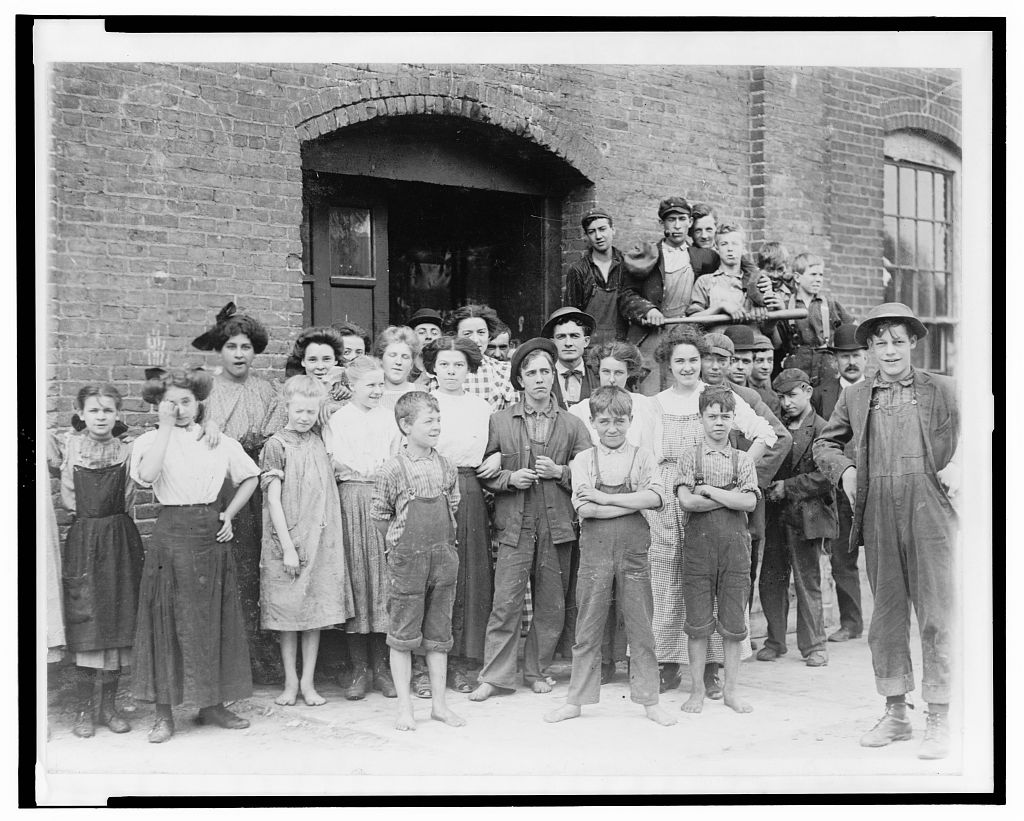
Hine did not photograph Addie in isolation. Group portraits from the same visit survive, including one captioned 'Every one of these was working in North Pownal Vermont cotton mill and work was slack,' showing several other named and unnamed children who worked the same floor. Addie was one investigation among many conducted that week; her later fame is a function of what happened to the photograph, not of anything that set her apart from her coworkers at the time.
Chapter 4How Hine worked, and who E.F. Brown was
Hine trained as a sociologist, not as an artist, at the University of Chicago, New York University and Columbia, and taught at New York's Ethical Culture School before turning to photography full...
Hine trained as a sociologist, not as an artist, at the University of Chicago, New York University and Columbia, and taught at New York's Ethical Culture School before turning to photography full time. He began photographing immigrants at Ellis Island around 1904 as a teaching project, and in 1908 gave up teaching to become the NCLC's staff investigator-photographer, a post he held until 1924.
His method combined disguise with documentation. Accounts of his fieldwork describe him presenting himself to mill owners and foremen as a Bible salesman, postcard photographer or industrial photographer documenting machinery, rather than as a labor reform investigator, precisely because a known NCLC photographer would have been refused entry or given a sanitized tour. Once inside, he talked to the children directly, memorized or covertly noted their answers, and matched names, ages, wages and injuries to each exposure. The resulting captions are plain and specific rather than editorial, which is part of why they still function as evidence: 'she admitted to me she was twelve' is a reported statement, not a rhetorical flourish.
The Vermont captions from this trip credit a named collaborator: E.F. Brown, or Edward F. Brown, who appears elsewhere in the NCLC's Library of Congress collection as the credited 'Investigator' on Hine photographs taken the same year in Wilmington, Delaware, among newsboys and news girls. Brown's role, on the evidence of these shared credits, was to gather and verify the biographical and wage information while Hine handled the camera; the caption on Photo #1050 is effectively a joint product of an investigator's interview and a photographer's exposure, filed together as a single piece of evidence.
Chapter 5One sitting, two negatives
This is the point at which the record has to be exact about which photograph it is describing, because Hine's North Pownal visit produced at least two distinct, separately numbered exposures of Addie...
This is the point at which the record has to be exact about which photograph it is describing, because Hine's North Pownal visit produced at least two distinct, separately numbered exposures of Addie Card, and they have had different afterlives.
This record's lead plate is Photo No. 1056, catalogued at the Library of Congress with the short caption 'anaemic little spinner.' A second negative, Photo #1050, carries the fuller caption quoting the mill's false claim about Addie's age and crediting E.F. Brown. The two photo numbers are close but not sequential in a way that proves anything about the order or spacing of the exposures; nothing in the sources consulted for this record establishes how many frames Hine took of Addie that day, or in what order.
What can be established is that the two negatives have been treated as separate items by every institution that holds them. The Library of Congress catalogues them under different identifiers with different caption text. The Metropolitan Museum's and National Gallery's prints, and a National Archives print captioned under the mistaken name 'Addie Laird,' all reproduce the Photo #1050 caption, not the Photo No. 1056 caption used on this record's lead plate. No source consulted for this record states that a print of the No. 1056 exposure is held anywhere outside the Library of Congress.
The practical consequence is that the image most people have seen reproduced in books, on the 1998 postage stamp and in the Reebok advertisement discussed below is very probably the Photo #1050 exposure, not the one anchoring this record. Both show the same child, on the same day, at the same machine, but they are not interchangeable as objects, and a reader comparing this record against a reproduction elsewhere should expect to see a related image rather than an identical one.
Chapter 6Four institutions, one negative each, and not always the same print
Prints of Hine's NCLC negatives now sit in at least four public collections, and they did not all arrive there the same way or at the same time, which matters for anyone trying to establish what a...
Prints of Hine's NCLC negatives now sit in at least four public collections, and they did not all arrive there the same way or at the same time, which matters for anyone trying to establish what a given print actually is.
The Library of Congress holds the NCLC's own archive entire: more than 5,100 prints and 355 glass negatives, transferred in a single 1954 gift along with the committee's organizational records. That transfer is the most direct, best-documented chain of custody of any Hine material and is the basis for this record's provenance. Shortly after its founding in 1912, the federal Children's Bureau separately received duplicate prints of Hine's NCLC photographs for its own files; those duplicates now sit in the National Archives under Record Group 102, which is why a National Archives print of the Photo #1050 exposure exists independently of the Library of Congress holding.
The Metropolitan Museum's and National Gallery's prints entered their collections much later and by a different route entirely: the art market. The National Gallery's print of the Photo #1050 exposure, acquired in 2014 through the Pepita Milmore Memorial Fund, has a stated provenance running from Hine himself, to the NCLC, to the New York dealer Alan Klotz Gallery, to a private collection, and then to the museum - a chain that places it, for decades, in private hands rather than in an institutional archive, and that print is also, at 24.1 by 19.2 centimeters, far larger than the Library of Congress's own dimensions for the equivalent negative, which points to a later, enlarged print rather than a print made close to the 1910 negative.
This matters because Hine material has a documented forgery problem, even though it does not implicate this specific image. After Hine's death in 1940, his negatives passed to Walter Rosenblum, a photographer he had mentored at the Photo League. Rosenblum preserved and eventually placed the negatives with the George Eastman Museum, but in 1998 and 1999 a collector who had paid several thousand dollars each for what he believed were vintage Hine prints grew suspicious of their unusually high quality and volume. Scientific testing, developed for the case, examined paper fiber composition, manufacturer watermarks and optical brightening agents, chemical additives not used in photographic paper before roughly 1945 and glowing distinctively under ultraviolet light. Every disputed print failed every test. Rosenblum was accused of having printed and sold hundreds of modern versions of Hine's work to six dealers; the case was settled out of court in 2001 on confidential terms, he admitted no wrongdoing and he maintained the photographs had been printed by Hine. Winterthur notes that selling prints made from Hine's negatives would not have been illegal had he identified himself as the printer made at or near the time of the original exposure, and settled a resulting lawsuit in 2001. The photograph at the center of that case, Power House Mechanic Working on a Steam Pump, is unrelated to the NCLC period and to Addie Card. But the case is the reason any Hine print, including the Met's and the National Gallery's prints of the Photo #1050 negative, should be described by print date as well as negative date, and this record has found no published statement from either museum specifying exactly when their print was made relative to 1910.
Chapter 7Sixty years as Addie Laird
For most of the twentieth century, the girl in this photograph had the wrong name in print.
For most of the twentieth century, the girl in this photograph had the wrong name in print. The investigator's field note behind Photo #1050 was transcribed, at some point in the NCLC's or Library of Congress's own processing, as 'Addie Laird' rather than Addie Card, a plausible enough misreading of period handwriting, and Laird is precisely the kind of surname, Scots rather than the French-Canadian names common among New England mill families, that should have prompted a second look and did not.
The error had real consequences once the image became famous. In 1998 the United States Postal Service, prompted by officials in North Pownal itself, issued a 32-cent stamp in its Celebrate the Century series commemorating early child labor reform, using this photograph and crediting the misidentified name. When researchers at the Department of Labor tried, around the same time, to locate any trace of an Addie Laird connected to Pownal, Vermont, they found none, because there was none to find.
The same photograph, still under the wrong name, had also by then appeared in a Reebok advertisement and hung, according to Joe Manning's later account, quietly on museum walls for decades: famous as an image and as a symbol of a reform campaign, entirely anonymous as a biography. Nobody, government researchers included, had been able to close the gap between the icon and the person.
Chapter 8Elizabeth Winthrop finds the census entry
The writer Elizabeth Winthrop first saw a print of this photograph in the summer of 2002, at that Bennington Museum exhibition of Hine's work.
The writer Elizabeth Winthrop first saw a print of this photograph in the summer of 2002, at that Bennington Museum exhibition of Hine's work. She did not forget the girl's face, and it became the seed of a novel, Counting on Grace, published by Wendy Lamb Books/Random House in the spring of 2006. The novel's narrator, Grace Forcier, is an invented character; Winthrop has been explicit that the book is historical fiction inspired by the photograph, not a biography, and this record treats it accordingly.
Finishing the novel in 2005 left Winthrop wanting to know who the real girl actually was, and she found, by her own account, that nobody could tell her: there was no record of anyone named Addie Laird in Pownal, and the Department of Labor had hit the same wall when preparing the 1998 stamp. She began her own search using the U.S. Census on microfiche at the Conte Archives in Pittsfield, Massachusetts, linked to Ancestry.com. Searching on the first name Addie alone returned nothing; Adeline, nothing; Adelaide returned a hit under the variant spelling Adalaid: a household headed by one Adalaid Harris in Bennington County, Vermont. Loading the corresponding microfiche roll, Winthrop found sheet 12B, recorded on May 4, 1910, by the enumerator George E. Corey: two Card sisters, Anna, 14, and Addie, 12, both listed as spinners in the cotton factory and both living with their grandmother, Mrs. Adalaid Harris, as head of household.
That single sheet corrected six decades of misidentification: the girl's name had never been Laird. It was Card. Winthrop was able to add, from the 1900 census, that Addie's father, Emmett D. Card, was already a widower by then, meaning Addie's mother had died before Addie turned two, and that by 1910 her father was no longer in the household at all; she and her sister were being raised entirely by their grandmother. A search of Pownal's town vault, prompted by Winthrop's assumption that a girl worked twelve-hour mill days at twelve could not have lived long, found no matching death or cemetery record, but did turn up, unexpectedly, on a page a town clerk found by chance while helping close out the search, Addie's marriage certificate: on February 23, 1915, aged seventeen, she married Edward Hatch, another mill spinner, also seventeen. Her grandmother died five days later.
Chapter 9Joe Manning traces the rest of her life
Winthrop's own research reached the 1920 census, which showed Addie still married to Hatch, apparently childless, living with her mother-in-law while Edward served in the Navy, and then went cold: no...
Winthrop's own research reached the 1920 census, which showed Addie still married to Hatch, apparently childless, living with her mother-in-law while Edward served in the Navy, and then went cold: no trace of either of them in the 1930 census under the Hatch name in Vermont. At that point, in October 2005, she hired a friend and fellow writer based nearby, Joe Manning, to continue the search. Manning later published a detailed account of the work in the Historical Journal of Massachusetts in 2008, and it is by far the most granular record of how the identification was actually completed.
Manning found, in the 1930 census, an Edward Hatch living in Detroit with a wife named Elvina Goguen, listed as his first wife, which raised rather than answered the question of what had happened to Addie. Working from a hunch that any child of the marriage might have been placed with one of Edward's siblings, Manning searched the 1930 census for Hatch girls born between 1915 and 1930 in Vermont and found a ten-year-old Hatch girl in Bennington living with her aunt, Mrs. Remington, one of Edward's sisters. Bennington town marriage records showed that girl marrying in 1940, listing her parents as Edward Hatch and Addie Card, noted as divorced; a birth certificate confirmed the daughter, Ruth, born June 26, 1919; and a divorce decree, obtained from Bennington County Family Court, showed that Edward had sued Addie for divorce on grounds of desertion and won custody, with Addie not appearing at the hearing. Manning could not establish an exact date for the divorce beyond that it fell between Ruth's 1919 birth and the 1930 census.
From there the trail moved to Addie's sister. A 1954 obituary for Annie (Card) Leroy, found through the Social Security Death Index and the Troy Record archive, named a surviving sister, 'Mrs. Ernest LaVigne, of New York City' - a second married name Manning had not yet had. Cross-referencing the Social Security Death Index under that name turned up Adeline M. LaVigne, who had died in Cohoes, New York, in July 1993, at the age of 94. A round of calls to funeral homes in Cohoes located her burial at St. Agnes Cemetery. On November 14, 2005, exactly four weeks after Manning's search for her had begun, he and his wife found the grave: a flat stone reading 'Adeline M. Lavigne, "Gramma Pat," 1898-1993.'
A cemetery obituary on file at the funeral home added the outline of Addie's later family: a daughter by Edward Hatch (Ruth, by then deceased); a second daughter, adopted with her second husband Ernest Lavigne, also deceased by the time of Manning's research; three grandchildren and three great-grandchildren, all descended from that second, adopted daughter, since Ruth had been estranged from Addie for life over what the family understood as Addie's abandonment of her as an infant. City directories placed Addie and Ernest Lavigne living together as a married couple in Cohoes as early as 1940; the couple later lived briefly in New Jersey and New York City before returning to Cohoes, where Addie spent most of her last fifty years, including roughly her final twenty in subsidized public housing. On January 7, 2006, Winthrop and Manning met Addie's step-family, the descendants of the adopted daughter, at Cohoes, and learned directly from them that Addie had gone into the mill at eight years old, suffered what the family called a nervous collapse at thirteen, one year after Hine's photograph, never knew her own birthday and was told it was December 6, and had never once mentioned the photograph, the stamp or her own fame to the family that loved her as 'Gramma Pat.'
Chapter 10The arc of Addie Card's life
Set out plainly, and only as far as the sources establish it: Addie Card was born in Pownal, Vermont, in 1898, one of at least two daughters of Emmett D.
Set out plainly, and only as far as the sources establish it: Addie Card was born in Pownal, Vermont, in 1898, one of at least two daughters of Emmett D. Card. Her mother died before Addie turned two; her father subsequently left the household, and Addie and her older sister were raised by their maternal grandmother, Adalaid Harris. Addie began mill work at around eight years old. In 1910, at twelve, she was photographed and interviewed by Lewis Hine and Edward F. Brown at the North Pownal Manufacturing Company. In 1911, by family account, she suffered a serious health collapse. In February 1915, aged seventeen, she married a fellow mill worker, Edward Hatch; her grandmother died days later. A daughter, Ruth, was born in 1919. The marriage ended in divorce, on grounds of desertion, sometime before 1930, with Edward awarded custody of Ruth, who was raised by his sister and remained estranged from Addie for the rest of both their lives. By 1940 Addie was living in Cohoes, New York, as the wife of Ernest Lavigne, going by the name Pat; the couple adopted a daughter. Addie worked various factory jobs in Cohoes for decades, later lost Ernest, and spent roughly her last twenty years in public housing there. She died in Cohoes in July 1993, at ninety-four, having been, by every account gathered by her step-family and by Manning, deeply loved by three generations of grandchildren who had no idea, until Manning and Winthrop arrived in 2006, that their grandmother had ever been photographed, let alone that her face had been on a postage stamp.
Two loose threads remain, honestly reported rather than smoothed over. Manning could not pin down an exact divorce date, only a window. And the burial record he found for an Ernest buried in 1967 at St. Mary's Cemetery in Hoosick Falls is treated in his own account as very probably, but not conclusively demonstrated to be, Addie's second husband.
Chapter 11A stamp, an advertisement, a reform campaign
The photograph's public life began as advocacy, not art.
The photograph's public life began as advocacy, not art. Hine's NCLC images were built for persuasion: assembled into travelling exhibition panels, lantern-slide lectures and committee publications aimed at legislators and the business owners who employed children, arguing for state and eventually federal restriction of child labor. The NCLC pursued that goal for over a century, through the constitutional defeats of the 1910s and 1920s, the eventual federal standards set by the Fair Labor Standards Act of 1938, and on afterward as an advocacy and research body, before formally ceasing operations in 2017.
The image outlived that specific campaign to become a general-purpose icon of the era, most visibly on the 1998 Celebrate the Century stamp and in a Reebok advertisement, both of which used it, ironically, under the wrong name for the child it actually showed. It has also been reprinted, by Manning's account, in dozens of books on American labor and photographic history, almost always as the Photo #1050 exposure rather than the one anchoring this record. Its rediscovery as an identified, named individual's photograph, rather than as an anonymous type, runs in the opposite direction from most documentary-photography fame, which tends to flatten a subject into a symbol; this photograph was flattened for nearly a century and then, unusually, un-flattened.
Chapter 12Custody, rights and what is still unresolved
As a work made for a private reform organization and transferred whole to the Library of Congress in 1954, this photograph carries no copyright restriction and no known claim against public use; the...
As a work made for a private reform organization and transferred whole to the Library of Congress in 1954, this photograph carries no copyright restriction and no known claim against public use; the Library states no known restrictions on publication for the National Child Labor Committee Collection, and duplicate Children's Bureau prints of the same negatives sit in the National Archives under the same public-domain status. That is a straightforward legal history, and it is one reason the image has circulated as widely and as loosely captioned as it has: nothing has ever stood in the way of anyone reprinting it under any name they were given.
What remains genuinely open is narrower and more specific. The month of the 1910 sitting is inconsistently recorded across the institutions that hold related material, and no primary NCLC field report resolving it has been located for this record. The precise relationship between Photo No. 1056 and Photo #1050, whether they were exposed minutes apart, on different days, or represent some other sequence in Hine's numbering, is not established by any source consulted. And whether the Library of Congress's own cph.3a15220 item is Hine's original print or a later copy negative made from it is not stated in the catalogue record itself. None of these gaps affect the identification of the child or the substance of what the caption records about her age; they affect only the finer-grained history of the object, and are recorded here as gaps rather than closed with a guess.
The artist
Lewis Wickes Hine
Hine came to photography from sociology, not from art school, and he never stopped thinking of the camera as a research instrument first. He spent sixteen years photographing for a single advocacy campaign, produced perhaps the most consequential body of reform photography made in the United States, and then spent his final years largely destitute and professionally shut out, rediscovered mainly after his death by photographers who had trained under him.
Related works
| Work | Relation | Where it is |
|---|---|---|
| Addie Card, 12 years. Spinner in North Pownal Cotton Mill (Photo #1050) Lewis Hine | A second, more fully captioned negative from the same North Pownal sitting, carrying the caption that quotes the mill's false claim about Addie's age Do not conflate with this record's lead plate. Different negative number, different caption text, and the surviving prints are held by different institutions with different acquisition histories than the print anchoring this record. | Metropolitan Museum of Art (DP237967) and National Gallery of Art (2014.164.1); also Library of Congress (cph.3a20286) and National Archives (523249, captioned under the mistaken name Addie Laird) |
| Every one of these was working in North Pownal Vermont cotton mill and work was slack Lewis Hine | Group portrait of other child workers photographed at the same mill during the same investigation Documents the wider child workforce Hine and Brown found at the Pownal Manufacturing Company; Addie was one subject among several photographed that visit. | Library of Congress, cph.3c34640 |
| Power House Mechanic Working on a Steam Pump Lewis Hine | Unrelated 1920-21 image, outside the NCLC period, but the subject of the proven Rosenblum print-forgery case The forensic paper and optical-brightener tests developed for this case are the standard method for dating any print made from a Hine negative, including the Met's and National Gallery's prints of the Photo #1050 Addie Card exposure, neither of which has a published print date in the sources consulted for this record. | Various collections, including the Greenville County Museum of Art |
| Migrant Mother Dorothea Lange | A later, comparable case of an anonymous documentary photograph whose subject was eventually identified by name Lange's sitter, Florence Owens Thompson, was identified by a Modesto Bee reporter in 1978, twenty-eight years before Addie Card's identification and by a very different route: a living subject recognizing herself in print, rather than genealogical research starting from a caption. | Library of Congress |
| Counting on Grace Elizabeth Winthrop (author) | The 2006 novel written in response to this photograph, whose research and publicity directly drove the identification of the real Addie Card A work of historical fiction inspired by the photograph, not a biography of Addie Card. Its narrator, Grace Forcier, is an invented character; nothing in the novel should be read back into this record as documented fact about Addie Card's own life. | Wendy Lamb Books / Random House |
Open questions
- What month in 1910 was this photograph actually taken? Elizabeth Winthrop's account places investigator E.F. Brown's mill visit in February 1910, a National Archives caption for the related Photo #1050 negative gives February 9, 1910, and several library and museum summaries describe the sitting as August 1910. No primary NCLC field report resolving this discrepancy has been located.
- What is the exact relationship between Photo No. 1056, this record's lead plate, and Photo #1050, the far more widely reproduced companion exposure? Whether they were taken minutes apart, on separate days, or represent some other point in Hine's numbering sequence is not established by any source consulted.
- Is the Library of Congress's cph.3a15220 item Hine's original print, or a later copy negative made from it? The catalogue record does not say, and a separately catalogued item under the same photo number, nclc.01824, is described as scanned from a black-and-white original print, raising the possibility that the Library holds both an original and a copy without saying which is which.
- When were the Metropolitan Museum's and National Gallery's prints of the Photo #1050 exposure actually made? Neither museum's published record states a print date, and the National Gallery's print, at more than four times the surface area of the Library of Congress's stated dimensions for the negative, is almost certainly a later enlargement rather than a print made near 1910.
- What was the exact date of Addie Card's divorce from Edward Hatch? Joe Manning's research established only that it fell between their daughter Ruth's 1919 birth and the 1930 census, on grounds of desertion, with Edward awarded custody.
- Is the Ernest buried in 1967 at St. Mary's Cemetery in Hoosick Falls, New York, definitely Addie's second husband, Ernest Lavigne? Manning's published account treats the identification as probable rather than conclusively documented.
Questions about this object
What is Addie Card, 12 years. Spinner in North Pownal Cotton Mill?
Addie Card, 12 years. Spinner in North Pownal Cotton Mill is a photograph, dated 1910. Medium: Gelatin silver print. The Library of Congress catalogues the specific item behind this record's lead plate both as a black-and-white film copy negative (cph.3a15220) and, under the same photo number, as a color digital file scanned from a black-and-white original print (nclc.01824).
Who made Addie Card, 12 years. Spinner in North Pownal Cotton Mill, and is the attribution settled?
The attribution to Lewis Wickes Hine is recorded here as accepted. Authorship is not in question. The negative was made on assignment for the National Child Labor Committee (NCLC), which employed Hine as its staff investigative photographer from 1908 to 1924, and the surviving prints and negatives carry the NCLC's own captioning and numbering system. The Library of Congress received the material directly from the NCLC in 1954.
Where is Addie Card, 12 years. Spinner in North Pownal Cotton Mill now?
Library of Congress, Prints and Photographs Division, Washington, DC. Inventory number National Child Labor Committee Collection; catalogued as cph.3a15220 and nclc.01824. Last confirmed 20 August 2026. Donated to the Library of Congress in 1954, along with the NCLC's organizational records, by Gertrude Folks Zimand, the NCLC's general secretary.
What is still unknown about Addie Card, 12 years. Spinner in North Pownal Cotton Mill?
What month in 1910 was this photograph actually taken? Elizabeth Winthrop's account places investigator E.F. Brown's mill visit in February 1910, a National Archives caption for the related Photo #1050 negative gives February 9, 1910, and several library and museum summaries describe the sitting as August 1910. No primary NCLC field report resolving this discrepancy has been located.
Sources
- 1Library of Congress, Prints and Photographs Division, National Child Labor Committee Collection, '[Addie Card], anaemic little spinner in North Pownal Cotton Mill. See photo No. 1056. Location: Vermont' (item 2018675329; digitized as cph.3a15220 and, under the same photo number, as nclc.01824). loc.gov/item/...
- 2Library of Congress, Prints and Photographs Division, National Child Labor Committee Collection, 'Addie Card, 12 years. Spinner in North Pormal [i.e., Pownal] Cotton Mill. Vt. Girls in mill say she is ten years. She admitted to me she was twelve; that she started during school vacation and new [sic] would "stay." E.F. Brown. See Photo #1050. Location: North Pownal, Vermont' (item 2018675335). loc.gov/item/...
- 3Wikimedia Commons, file description and Library of Congress-sourced licensing metadata for 'Addie Card, 12 years. Spinner in North Pormal (i.e., Pownal) Cotton Mill. Vt. ... LOC cph.3a20286.jpg,' citing Library of Congress record ncl2004001725/PP. commons.wikimedia.org/wiki/...
- 4The Metropolitan Museum of Art, 'Addie Card, 12 years. Spinner in North Pownal Cotton Mill. Girls in mill say she is ten years. She admitted to me she was twelve; that she started during school vacation and now would "stay". Location: Vermont,' object 285844. metmuseum.org/art/...
- 5National Gallery of Art, 'Addie Card, 12 years old. Spinner in cotton mill, North Pownal, Vermont,' Lewis Wickes Hine, accession 2014.164.1, Pepita Milmore Memorial Fund. Provenance and dimensions as stated on the museum's object page. nga.gov/artworks/...
- 6Elizabeth Winthrop, 'Searching for Addie: The Story behind a Famous Photograph,' Social Education 70, no. 4 (2006): 174-177, National Council for the Social Studies. elizabethwinthrop.com/wp-content/...
- 7Joe Manning, 'Addie Card: The Search for an Anemic Little Spinner,' Historical Journal of Massachusetts 36, no. 2 (Summer 2008): 167-183, Institute for Massachusetts Studies and Westfield State University. westfield.ma.edu/historical-journal/...
- 8Elizabeth Winthrop, 'Through the Mill,' Smithsonian Magazine, September 2006. smithsonianmag.com/history/...
- 9Time, 'Tracking Down Lewis Hine's Forgotten Child Laborers,' on Joe Manning's broader project identifying subjects of Hine's National Child Labor Committee photographs. time.com/3805208/...
- 10U.S. National Archives and Records Administration, Records of the Children's Bureau (RG 102), 'Addie Laird, 12 years old. Spinner in a Cotton Mill. Girls in mill say she is 10 years old. She admitted to me that...' (NARA 523249), dated February 9, 1910. commons.wikimedia.org/wiki/...
- 11Winterthur Museum, 'Treasures on Trial: The Art and Science of Detecting Fakes - Hine Photograph,' on the scientific authentication of a disputed Lewis Hine print and the discovery that it was printed decades after its claimed date. treasuresontrial.winterthur.org/evidence/...
- 12'Intrigue in the World of Photography: The Fake Lewis Hine Prints,' on the Walter Rosenblum print-forgery case and its 2001 settlement. thefrailestgesture.com/intrigue-in-the-world-of-photograp...
- 13New Orleans Museum of Art, 'Object Lesson: Lewis W. Hine and the Fight Against Child Labor,' on Hine's investigative and documentary methods. noma.org/object-lesson-lewis-hine
- 14Library of Congress, 'National Child Labor Committee Collection: Background and Scope,' on the 1954 gift of the NCLC's photographic archive. loc.gov/pictures/...
- 15National Archives, 'Records of the Children's Bureau' (Record Group 102), on the Bureau's 1912 founding and its holdings of duplicate Hine/NCLC prints. archives.gov/research/...
- 16Wikipedia, 'Lewis Hine,' consolidating biographical dates and career chronology. en.wikipedia.org/wiki/...
- 17Wikipedia, 'National Child Labor Committee,' consolidating the 1904 founding, 1907 congressional charter and 2017 closure. en.wikipedia.org/wiki/...
- 18Wikimedia Commons, file description and licensing metadata for 'Every one of these was working in North Pownal Vermont cotton mill and work was slack. LOC cph.3c34640.jpg.' commons.wikimedia.org/wiki/...
- 19Wikimedia Commons, file description and licensing metadata for 'Lewis Hine selfportrait.jpg,' credited to the George Eastman Museum. commons.wikimedia.org/wiki/...
- 20Wikimedia Commons, file description and licensing metadata for 'Lewis Hine - Addie Card, 12 years. Spinner in North Pownal Cotton Mill MET DP262027.jpg.' Consulted only to confirm the existence of a second, short-caption Met print and the reason it is excluded from this record's gallery pending confirmation of which negative it reproduces. commons.wikimedia.org/wiki/...
- 21Library of Congress Research Guide, 'Dorothea Lange's Migrant Mother Photographs in the Farm Security Administration Collection,' for the 1978 identification of Florence Owens Thompson, cited as a comparandum in Related Works. guides.loc.gov/migrant-mother
_Cotton_Mill._Vt._Girls_in_mill_say_she_is_ten_years._She_admitted_to_me_she_was_twelve;_that_she_started_during_school_vacation_LOC_cph.3a20286.jpg)


Last verified · Published
Change log
20 August 2026 - Record created at the house standard: researched narrative, technical evidence, maker dossier, graded provenance chain, prices with hammer and premium separated, related works, open questions and sources.