The object the museum keeps running
Six objects in this archive are still wound, played or demonstrated by the institutions that hold them. For each, on display and in working order are separate states with separate dates, and one of them lost its working state without anyone recording when.
Records in this piece: The Silver Swan, The Jaquet-Droz Automata (The Writer, The Draughtsman, The Musician), Il Cannone, Violin, the 'Duke of Alcantara', Violoncello, the 'Marylebone', Grand Piano by John Broadwood and Sons
On this page 9 sections
ContentsClose
In short
- Six objects in this archive are kept in working order by the institutions that hold them and are run in public on a schedule or on named occasions: two automata groups, three stringed instruments and a piano. Each has a different rule for who may operate it.
- For a working object the record needs three dated states, not one: whether it is on view, whether it works, and when it was last used. The Silver Swan was on view and not working from 2020 to March 2024. The Writer at Neuchatel is on view and out of order today.
- The Beethoven Broadwood was restored to playing condition in 1991-92, toured and recorded, and by 2018 was described as no longer playable. No source we found records the event in between, which is the gap a working-object record exists to prevent.
- Playing is a custodial decision written down. Genoa's published philosophy for Il Cannone limits use to carefully chosen occasions; UCLA lets competition winners play the Duke of Alcantara; the Bowes Museum publishes a daily time.
Six objects in this archive are still wound, played or demonstrated
Six objects in this archive are kept in working order and used in public by the institutions that hold them, and for each of them the record has to carry a working state as well as a display state. A painting on a wall is either shown or stored. A swan that swallows a fish, a boy who writes forty characters with a quill, a violin bequeathed to a city, a cello in a national museum's working collection and a piano that a deaf composer used are all shown, but each is also either working or not, and each has been used on a date that can be written down. Those are different facts, and they change at different times.
We put the six side by side because their custodians have made six different decisions about use, and all six are published. The table gives the state of each as we could confirm it this week, with the date the confirmation rests on. Where a state has changed and the change is undocumented, the table says so.
| Object | What it does | Who may run it | State, and the date it rests on |
|---|---|---|---|
| Silver Swan, Bowes Museum | Preens, catches a fish, to music | Museum staff, once a day at 2pm | Working since 19 March 2024; seized 2020 to 2024 |
| Jaquet-Droz automata, Neuchatel | Write, draw, play an organ | Museum demonstrator, first Sunday monthly | Two of three working; the Writer out of order, museum site read 11 September 2026 |
| Il Cannone, Genoa | Played in concert | Premio Paganini winner and named soloists, by city decision | Played; last documented public performance in our record November 2020 |
| Duke of Alcantara, UCLA | Played in recital | Faculty and student competition winners | Working, kept in a vault; several outings a year per UCLA |
| Marylebone cello, Smithsonian | Played in chamber concerts | The museum's curator-cellist | Working; off public view since 2012 |
| Beethoven's Broadwood, Budapest | Played and recorded 1992-94 | Loaned to named pianists in the 1990s | Described as not playable in 2018; change undated |
The Silver Swan performs at 2pm and did not perform for four years
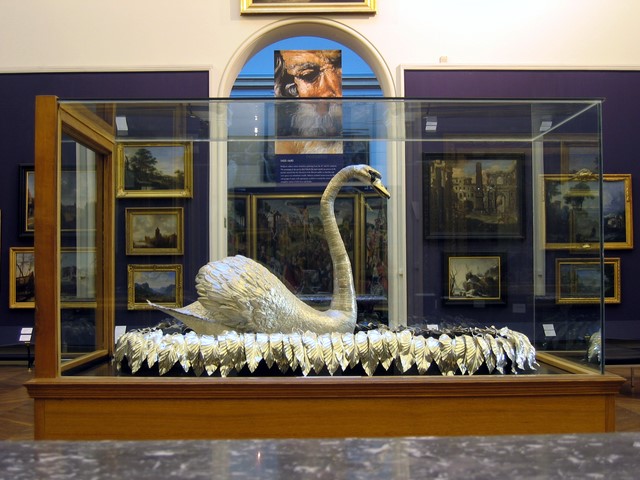
The Silver Swan has performed once a day at 2pm since Tuesday 19 March 2024, and before that date it had not performed since the Bowes Museum closed for the pandemic. The museum's own media release of 14 March 2024 gives the time and the day, and says the bird was coming back to life in her true form for the first time in four years after more than fifteen hundred hours of work by the Cumbria Clock Company, with interns from West Dean College and the Birmingham School of Jewellery alongside the museum's conservation team. The grant from the National Lottery Heritage Fund was 146,324 pounds, and a crowdfunding campaign added 20,375 pounds.
What makes this object useful to a method piece is that its working history is written down in a way its ownership history is not. Our record cannot account for roughly ninety years between the closure of Cox's museum in 1775 and the swan's reappearance at the 1867 Paris exposition, and the museum's own pages give the Bowes' purchase as both 1872 and 1873. But from the Second World War onwards the maintenance is a documented chain: dismantled during the war and restored by a member of staff in the 1940s; three interventions in the 1960s; a full stripping and documentation led by the clockmaker Matthew Read from 2008; a three-day maintenance visit in 2012 in which the only worn bearing found was a 1960s replacement, not an eighteenth-century part; the seizure during the closures; a two-week study in October 2021; and the 2023 programme.
The swan was on display throughout the four years it did not run. Anyone who wrote a record from a gallery visit in 2022 would have recorded it correctly as on view and wrongly, by omission, as a working automaton. The two states have to be dated separately, and this museum happens to publish both.
At Neuchatel two of the three automata run on the first Sunday, and the Writer does not
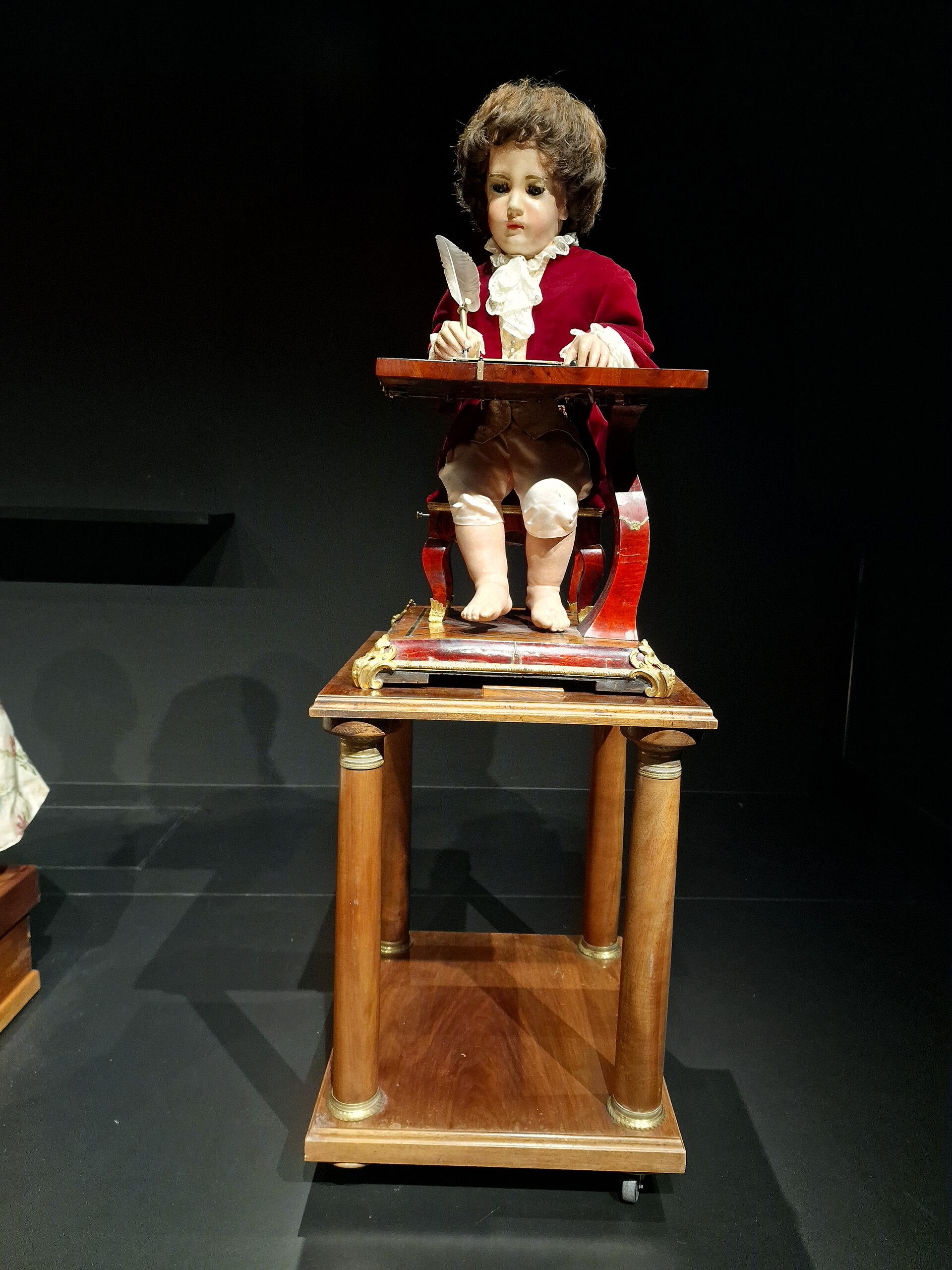
The Musee d'Art et d'Histoire in Neuchatel demonstrates the Jaquet-Droz automata in public at 2, 3 and 4pm on the first Sunday of every month, and its own site currently carries a warning that the Writer is out of order. We read that page on 11 September 2026. It says the Writer is not in working order because of a defective part and a technical problem, that repair is a complex operation needing several specialists, that the museum is doing everything possible to restore it, and that demonstrations of the Musician and the Draughtsman continue at the announced times and by appointment. The Writer stays on display in the automata room.
The three figures were built at La Chaux-de-Fonds between 1768 and 1774 by Pierre Jaquet-Droz, his son Henri-Louis and Jean-Frederic Leschot, toured before European courts as advertisements for the family's watch business, sold in 1787 with a fourth automaton now lost, and untraceable for over a century. A Neuchatel historical society bought the three survivors in 1906 for 75,000 gold francs and gave them to the city on 1 May 1909. Since then the museum has wound them for the public on a published schedule, with a watchmaking specialist as demonstrator, and hour-long demonstrations by reservation for groups of five to thirty.
The Writer is the one histories of computing cite, for its cams that a period owner could reorder to make the boy write a different sentence. It is also, this month, the one that does not write. Our record dates that condition to the museum's own notice and leaves it open when it began and when it will end, because the notice does not say. That is the correct shape for the field: a state, a source, a date read, and no invented duration.
Il Cannone is played on chosen occasions, by a rule the city wrote down
Il Cannone, the 1743 Guarneri del Gesu violin Paganini left to Genoa in his 1837 will, is played, and the city has published the rule under which it is played. The instrument reached the Comune in 1851 and has been municipal property since 14 July of that year. Its care runs through two roles that are both documented by name: a luthier-conservator, from Eugenio Praga in the late nineteenth century through Cesare Candi, who restored it in 1937, to Bruce Carlson today, and a violinist entrusted with keeping it in voice. Since the Premio Paganini competition was founded in 1953, tradition has given its winner the chance to play it.
Genoa's published conservation philosophy, as our record summarises it, states that the violin was rarely played in the decades after Paganini's death and that the public's wish to hear it should not be pursued at all costs, so playing is limited to carefully chosen occasions with particular precautions. The occasions are on record: Salvatore Accardo; Eduard Schmieder at the Palazzo Ducale in 1996; Shlomo Mintz with the Limburg Symphony in 1997; Eugene Fodor in San Francisco in 1999 under an armed escort; the jazz violinist Regina Carter, who recorded an album on it; Joanna Frankel at the Columbus Museum of Art in 2019. In 2004 Carlson, Giordano and Montanari replaced the fingerboard, bridge, tailpiece and pegs with replicas of the setup Paganini used, because the worn fingerboard was producing intonation trouble in fifths. That is a repair made so the object could keep being used, and it was presented at a conference on 14 October 2004 before it was done.
The point for the record is that use here is a policy, not an accident. The violin is not on a vault shelf being brought out when somebody asks; it is a working instrument whose working is rationed by a written rule, and the rule is a fact about the object as much as its back length of 35.4 cm.
The Duke of Alcantara lives in a vault and comes out as a prize
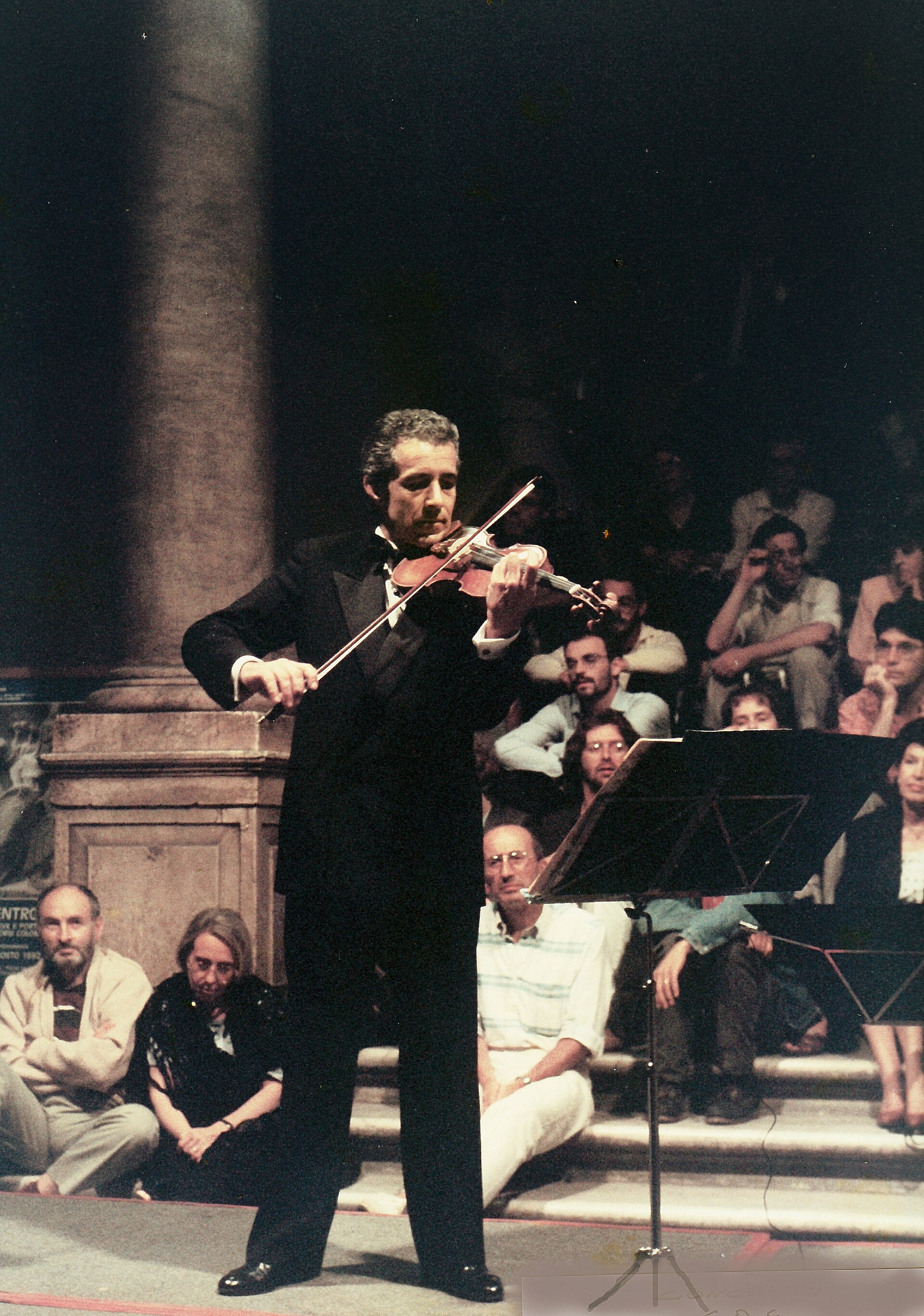
The Duke of Alcantara, a Stradivari violin of 1732, is kept in vault storage at UCLA's Fowler Museum and played by faculty and by the winners of two student competitions, a few students a year. Genevieve Vedder gave it to UCLA's Music Department in 1961 and a professor used it as a working teaching instrument until it disappeared from a graduate student's car in Pasadena on 2 August 1967. It resurfaced in January 1994 when its possessor sent it for repair and two Petaluma violin makers matched it to a reference catalogue of Stradivari photographs. A Los Angeles Superior Court settlement returned it to UCLA on 1 December 1995, and Alexander Treger, concertmaster of the Los Angeles Philharmonic, gave what appears to be its first public performance after the settlement at a private recital that month.
What we want to draw out is the custodial rule. Winners of the UCLA Philharmonia's All-Star Concerto Competition and the Atwater Kent String Concerto Competition earn the right to perform on it. A student in the class of 2016 described months of practising on it before her own performance, in a sentence that is the best short account of what the object still does at nearly three hundred years old: she had to learn how the Strad wanted to be played. Nothing in the vault is doing that. The violin does its work only in the hours it is out, and those hours are recorded because they are earned.
UCLA has twice come close to selling it for budget reasons and twice kept it. The record holds that as two dated near-events, because a working object that is sold stops being a working object of that institution, and the decision not to sell is as much a fact about its use as the competitions are.
The Marylebone cello is off view and still in the working collection
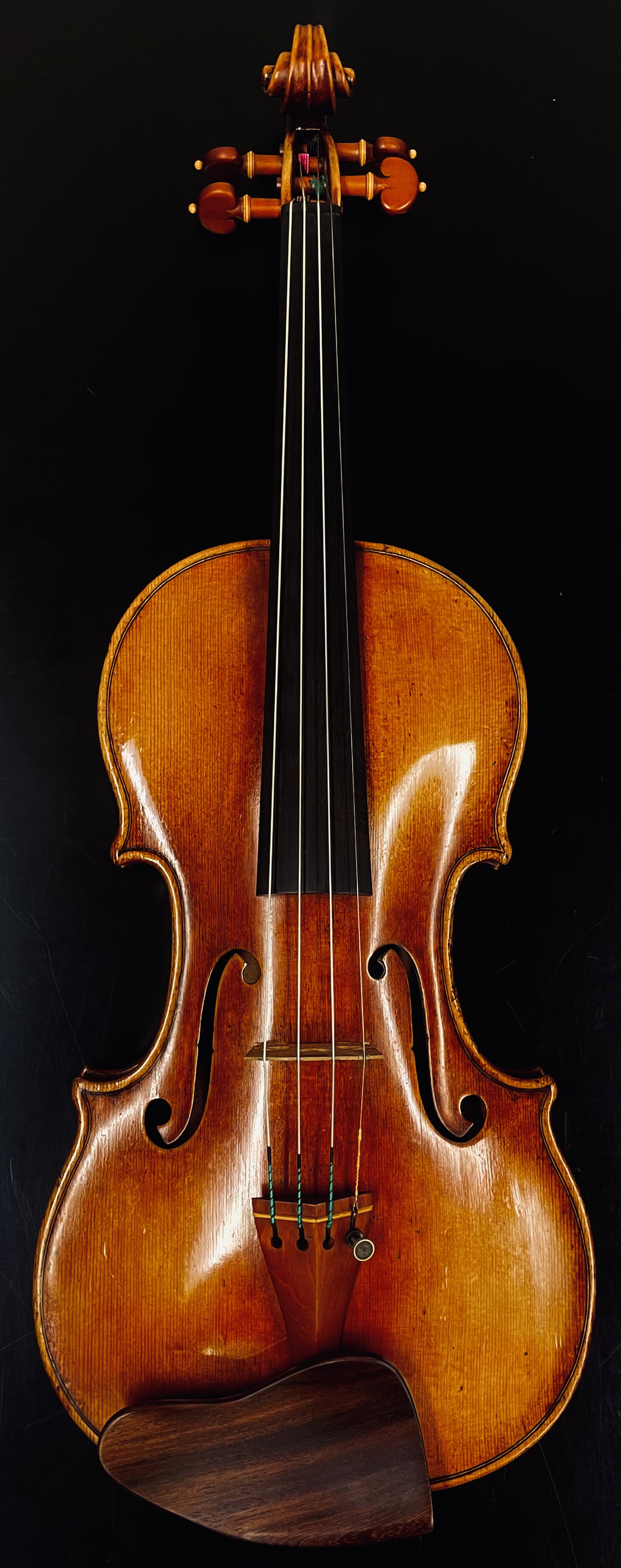
The Marylebone cello of 1688 has been off public display at the National Museum of American History since 2012 and is still played, by the museum's own curator of musical instruments. That combination is the reverse of the Silver Swan's four years, and it is why the two states have to be recorded separately: the swan was on view and not working; the cello is not on view and working. The Axelrod quartet of which it is the fourth piece was displayed from 1964 to 2012, and no source we consulted says why it came off view that year.
The Smithsonian Chamber Music Society's resident ensemble, renamed the Axelrod String Quartet on the strength of the Axelrod gift, gives concerts on instruments from the Axelrod, Amati and Vuillaume groups, with the curator Kenneth Slowik playing the cello parts. Slowik is separately reported to have played a Bach suite on this cello at the Italian ambassador's residence in Washington for the 150th anniversary of Italian unification. The instrument is one that Stradivari never decorated: the ornament on its ribs and pegbox is a twentieth-century transfer copying a genuinely decorated Stradivari cello in Madrid, added so the set would look complete, which the museum's catalogue records and popular description of the quartet erases.
A working collection is a category the Smithsonian uses deliberately, and it is the right name. The cello's value to the museum is partly that it is heard, and the record should say by whom and when, as far as that can be found, rather than treating not on view as the end of the entry.
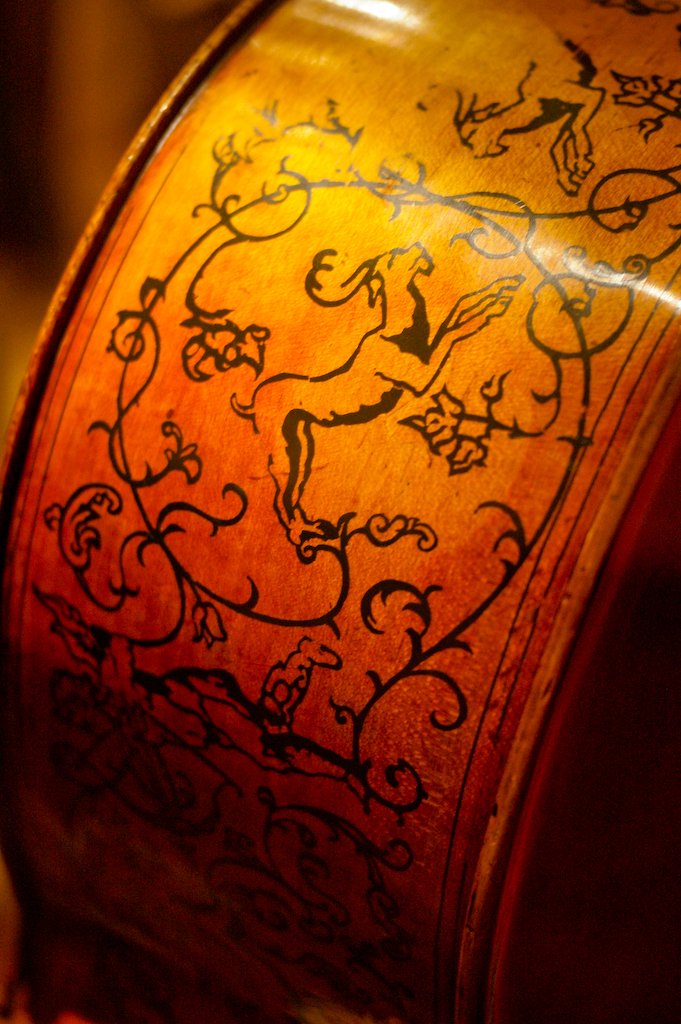
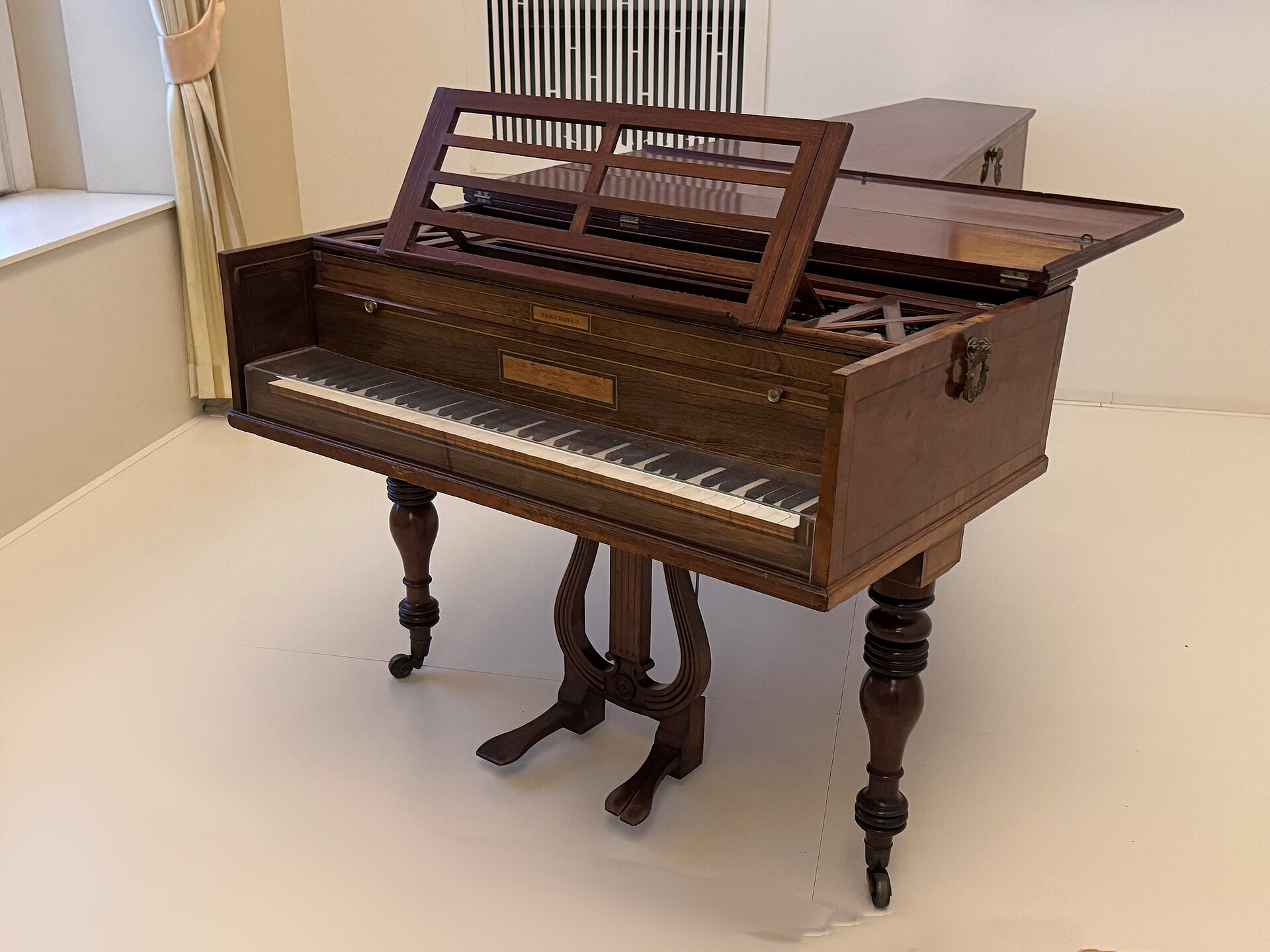
The Beethoven Broadwood shows how a working state gets lost without a record
The Broadwood grand that reached Beethoven in Vienna in May 1818 was restored to playing condition in 1991-92, toured and recorded through the mid-1990s, and was described in 2018 as no longer in playing condition, and no source we found records what happened in between. The restoration was by David Winston of the Period Piano Company. The instrument, on loan from the Hungarian National Museum, then went on a European tour with the fortepianist Melvyn Tan through Vienna, Bonn, Bath, London and Budapest, which produced a 1992 EMI recording, and Andras Schiff recorded late Beethoven bagatelles on it in the museum for Hungaroton in 1994. That run establishes a playable, touring instrument for several years after 1992.
Against it stands a 2018 article marking the bicentenary of the piano's arrival, which says plainly that Beethoven's original instrument is no longer in playing condition and that the anniversary concerts used a modern replica. Between 1994 and 2018 something changed, and we cannot say what or when. A working object can lose its working state through a conservation decision, a mechanical failure, an insurer's condition, a loan policy or simple neglect, and each of those is a dated act by a named party. None is on the public record here.
This is the case the other five should be read against. The Bowes Museum published the day its swan stopped and the day it started again. Neuchatel publishes a live notice. Genoa publishes a rule. UCLA publishes its competitions. The Smithsonian names its cellist. Budapest, for this object, has a restoration date and a silence. Our record states the silence as a gap, and the object's meaning has already moved once before along the same line: Liszt, who received it in 1845, kept it unplayed because he considered himself unworthy, and the museum has held a relic and an instrument at the same time since 1887.
What on display does not tell you about a working object
On display is a statement about a room; working is a statement about a mechanism; last used is a statement about a date and a person, and a record of a working object needs all three, each with the date it was confirmed. We have been writing records that carry a current_location field with an as_of date, and that field answers only the first question. For the six objects here we have now checked the other two against the custodians' own publications, and in four of six the answer is on a museum page that can be read today. In one it is on a competition page. In one it is a gap.
Two consequences for how we work. First, a working object's condition changes faster than its ownership, so the confirmation date matters more than it does for a panel painting: the swan record written in 2022 and the swan record written in 2025 describe different objects in the sense that matters to a visitor who has come to see it move. Second, the custodian's rule about use belongs in the record as a fact with a source, because it is what separates a museum object that happens to be functional from an instrument in service. Genoa's rule, UCLA's competitions and the Bowes' 2pm are as much a part of these objects as their dimensions.
We would rather have a record that says the Writer is out of order as of a date than one that describes a boy writing forty characters and lets a reader travel to Neuchatel to watch him not do it.
Why this archive is free to read
We do this for everyone who loves art. The people who have studied it for years, and the people who just stopped to look. Iconotheca exists so that what we learn belongs to all of them.
Nobody pays us for this. No ads, no sponsors, no commercial interest. These works belong to all of us, and we would rather share them with as many people as we can than keep them to ourselves.
If it gave you something today, tell us to keep going. Follow us, leave a like, or write a positive comment. We read every one, and they are what keeps us going.
Questions
Once a day at 2pm at the Bowes Museum, Barnard Castle, according to the museum's media release of 14 March 2024, which announced the return of daily performances from Tuesday 19 March 2024 after a conservation programme of more than fifteen hundred hours. The museum is open from 10am to 5pm daily.
The Musician and the Draughtsman are demonstrated at 2, 3 and 4pm on the first Sunday of every month at the Musee d'Art et d'Histoire, Neuchatel, and by reservation for groups. The Writer is out of order because of a defective part, according to the museum's own notice as read on 11 September 2026, and remains on display.
Yes, on occasions chosen by the city of Genoa, which has owned it since 1851. The winner of the Premio Paganini competition has traditionally been given the chance to play it since 1953, and named soloists have played it in concert and on recordings, most recently in our record in November 2020.
It was restored to playing condition in 1991-92, toured with Melvyn Tan and recorded by him for EMI in 1992 and by Andras Schiff for Hungaroton in 1994. A 2018 article on the bicentenary of its arrival in Vienna describes it as no longer in playing condition and says a replica was used for the anniversary concerts. We found no published account of when or why the working state was lost.
Sources
- 1The Bowes Museum, media release, '1500 hours of painstaking work with several thousand parts make a working Silver Swan', 14 March 2024, PDF. Read in full. Source for the 2pm daily performance from 19 March 2024, the four-year gap, the Cumbria Clock Company, the interns, and the 146,324 pound grant and 20,375 pound crowdfunding total. thebowesmuseum.org.uk/wp-content/...
- 2The Bowes Museum, 'Silver Swan Maintenance', account of the 2012 maintenance visit by the clockmaker Matthew Read and the 2008 programme. thebowesmuseum.org.uk/silver-swan-maintenance
- 3Musee d'Art et d'Histoire de Neuchatel, 'The Jaquet-Droz automata', collection page. Read in the in-app browser on 11 September 2026. Source for the first-Sunday demonstrations at 2, 3 and 4pm, the reservation terms, the gift of 1 May 1909, and the notice that the Writer is out of order. mahn.ch/en/...
- 4Iconotheca, record for Il Cannone, Guarneri del Gesu, 1743, with the city of Genoa's conservation sources, the line of conservators from Praga to Carlson, the 2004 restoration conference and the named performances. iconotheca.com/artworks/...
- 5Iconotheca, record for the Duke of Alcantara Stradivari, 1732, including the 1967 theft, the 1994 identification, the Los Angeles Superior Court settlement of 1 December 1995 and UCLA's competition rules for playing it. iconotheca.com/artworks/...
- 6Iconotheca, record for the Marylebone cello, Stradivari, 1688, Smithsonian accession 2000.0013, including the 1964-2012 display period and the curator-cellist Kenneth Slowik's performances. iconotheca.com/artworks/...
- 7Iconotheca, record for the Broadwood grand piano sent to Beethoven, Hungarian National Museum, including the 1991-92 restoration by David Winston, the Melvyn Tan tour and 1992 EMI recording, the 1994 Hungaroton recording and the 2018 bicentenary report that the instrument is no longer playable. iconotheca.com/artworks/...
- 8Art UK, 'The Silver Swan', The Bowes Museum, object record X.4653, for the accession number and dating 1772-1774. artuk.org/discover/...
- 9Iconotheca, record for the Silver Swan, James Cox, about 1773, Bowes Museum, with the full maintenance chain from the 1940s to the 2023 programme and the 1872 versus 1873 acquisition discrepancy. iconotheca.com/artworks/...
More in Museums and Exhibitions
The partThe complete object is a temporary arrangement
For a dispersed set, being complete is an event with a date and a duration. Twelve Renaissance tazze were whole and correct for two days in 2014, and...
When the Holder Is Not a Museum, the Accession Number Is Replaced by Law
Fourteen records here are held by a cathedral, a diocese, a cathedral works, a charitable trust or a monuments agency.
A Closing Date That Moves Both Ways, and Who Actually Moved It
Of 937 exhibitions tracked here, only 7 ever had a date move, and three of those flipped between the same two dates again and again.