Il Cannone
Bartolomeo Giuseppe Guarneri, called del Gesu · 1743
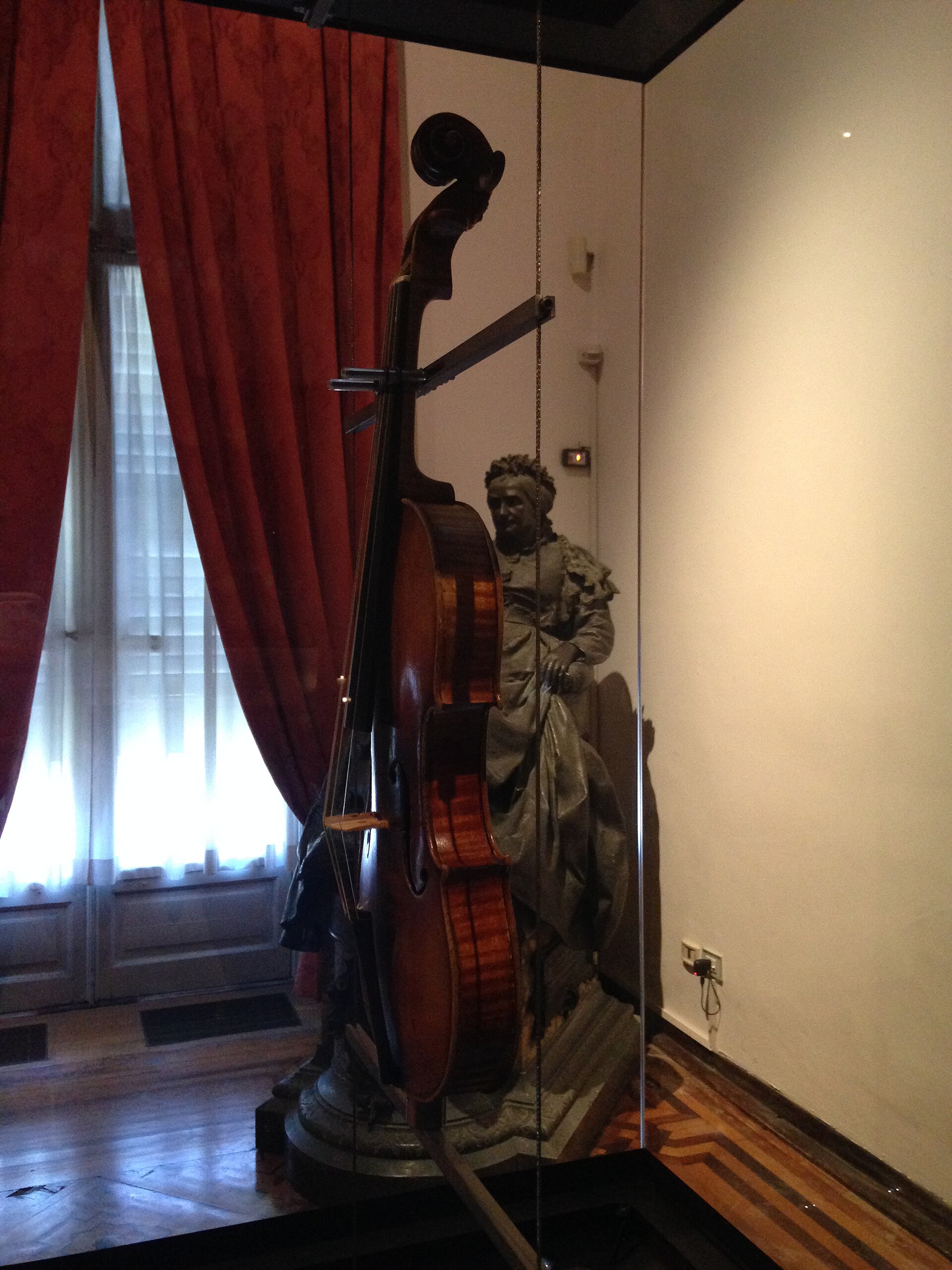
The record subject: Il Cannone, Guiseppe Guarneri del Gesu's 1743 violin, bequeathed by Niccolo Paganini to the city of Genoa, on display at Palazzo Doria-Tursi.
Palazzo Doria-Tursi, Comune di Genova · Photograph by bibbilo · CC BY-SA 4.0| Artist | Bartolomeo Giuseppe Guarneri, called del Gesu |
|---|---|
| Date | 1743 |
| Medium | Maple back, ribs and scroll, spruce belly, on a red-brown spirit varnish ground; ebony and other fittings replaced in 2004 as documented replicas of the setup Paganini used |
| Dimensions | Back length 35.4 cm; upper bouts 16.8 cm; middle bouts 11.1 cm; lower bouts 20.7 cm |
| Where it is now | Sala Paganiniana, Palazzo Tursi (Palazzo Doria-Tursi), Genoa - part of the Musei di Strada Nuova and the seat of the Comune di Genovalast confirmed |
| Inventory number | No public inventory number found in the sources consulted |
| Attribution | AcceptedMade and labelled by Guarneri del Gesu in his own workshop in Cremona; the maker's mark (his personal cross beside the signature), the unbroken ownership record back to Paganini, and Peter Klein's 1998 dendrochronological reading of the belly wood (youngest ring 1735, consistent with a 1743 build after normal seasoning) are all cited by specialists as supporting the date and attribution without dispute. Full note |
| Object type | Musical instrument |
| Period | Italian, eighteenth century (Cremonese violin making) |
| Cases | Has a provenance gap |
| Inscriptions | Guarneri's personal cross mark beside his signature, present on this and his other instruments; the exact printed wording of the label was not confirmed in the sources consulted for this record |
| Owners on record | 4 links3 documented, 1 unknown |
| Sources | 28 cited |
About this record Last verified · 28 sources cited · Change log
On this page 9 sections
ContentsClose
A violin made in Cremona in 1743 by Guarneri del Gesu, given to the teenage Niccolo Paganini after a concert in Livorno and played by him for the rest of his career. He called it his cannon for the power of its sound, and left it in his 1837 will to his native Genoa, which received it in 1851 and has kept it, played but never sold, ever since.
Two things separate this record from a repeated legend. First, the violin's care runs through a documented, nameable line of conservators and playing-curators stretching from Eugenio Praga in the late nineteenth century to Bruce Carlson today, a genuinely unusual civic institution in its own right. Second, the widely repeated claim that the instrument has a clean, unbroken history since Paganini's death does not survive close reading: the year Paganini acquired it, the eleven years between his death and its delivery to Genoa, the primary source for its own nickname, and whether its neck is truly untouched 1743 wood are all points where the sources consulted here disagree or simply go silent.
What is not in dispute is the one real scare in its recorded history, in 1825, and the fact that, alone among the instruments discussed on this site, it has never once changed hands for money.
Provenance
Each link is graded. Documented: a cited source supports it. Disputed: the identification is argued but not established. Unknown: no owner for that span, and the gap is not smoothed into a narrative. The grades in the glossary.
- 1743 - c. 1799/1802 (date disputed)Unknown until the Livron collectiondocumented
Made in Cremona by Guarneri del Gesu in 1743. Nothing is documented of its ownership between completion and its appearance in the possession of a businessman named Livron; the sources consulted give no detail on Livron himself or how he acquired it.89
- c. 1799/1802 (date disputed) - 1840Niccolo Paganinidocumented
Given permanently to Paganini by Livron after a concert in Livorno, when Livron refused to accept the instrument back. The exact year is disputed among sources consulted (1799, 1802, or before October 1801).8925
- 1840 - 1851Estate of Niccolo Paganini, in the custody of his heirsunknown
Paganini's 1837 will left the violin to Genoa, but the instrument was not delivered until 14 July 1851, eleven years after his death. No source consulted describes the custodial arrangement during the intervening period.1225
- 1851 - presentComune di Genova, held at Palazzo Tursidocumented
Delivered in person on 14 July 1851 by Paganini's son, Baron Achille Paganini, to the Mayor of Genoa, Antonio Profumo, under the terms of the 1837 will that the violin be perpetually preserved by the city. It has remained continuous municipal property since, has never been sold, and carries no auction or private-sale history.239
Technical evidence
| Attribution note | Made and labelled by Guarneri del Gesu in his own workshop in Cremona; the maker's mark (his personal cross beside the signature), the unbroken ownership record back to Paganini, and Peter Klein's 1998 dendrochronological reading of the belly wood (youngest ring 1735, consistent with a 1743 build after normal seasoning) are all cited by specialists as supporting the date and attribution without dispute. The Hill firm at one point catalogued the label date as 1742; ultraviolet examination later showed the final digit worn to look like a 2 and confirmed it as a 3. |
|---|---|
| Maker and date | Bartolomeo Giuseppe Guarneri, called del Gesu, Cremona, 1743.18 |
| Construction | Maple back, ribs and scroll; spruce belly; red-brown spirit varnish. Back and sound box are shorter and thicker than the later standard model, with a markedly curved neck.821 |
| Dimensions | Back length 35.4 cm; upper bouts 16.8 cm; middle bouts 11.1 cm; lower bouts 20.7 cm.8 |
| Maker's mark | Guarneri's personal cross beside his signature, found on this and his other instruments; the label's exact printed wording was not confirmed in this research.19 |
| Condition of the original body | Per luthier-restorer Alberto Giordano: the violin retains its original neck, the plates have never been re-graduated, and the varnish has never been polished.17 |
| 1937 restoration | Cesare Candi consolidated the neck joint, replaced the chain bar and stabilised the back ahead of the Stradivari bicentenary, retaining Paganini-era accessories where possible.415 |
| 2004 refitting | Fingerboard replaced (extended from 262 mm to 270 mm), maple wedge removed, new bridge and shortened tailpiece made as archive-based replicas, all four pegs replaced; the ivory upper nut judged original and left unaltered. Work by Bruce Carlson with Alberto Giordano and Pio Montanari, presented at an international conference in Genoa, 14 October 2004.4616 |
| Dendrochronology | Peter Klein, Hamburg, 1998: youngest growth ring in the belly wood dated to 1735, consistent with a 1743 build.8 |
| Playing wear | Marks on the top consistent with Paganini's chin, since he played without a chin rest.19 |
Images
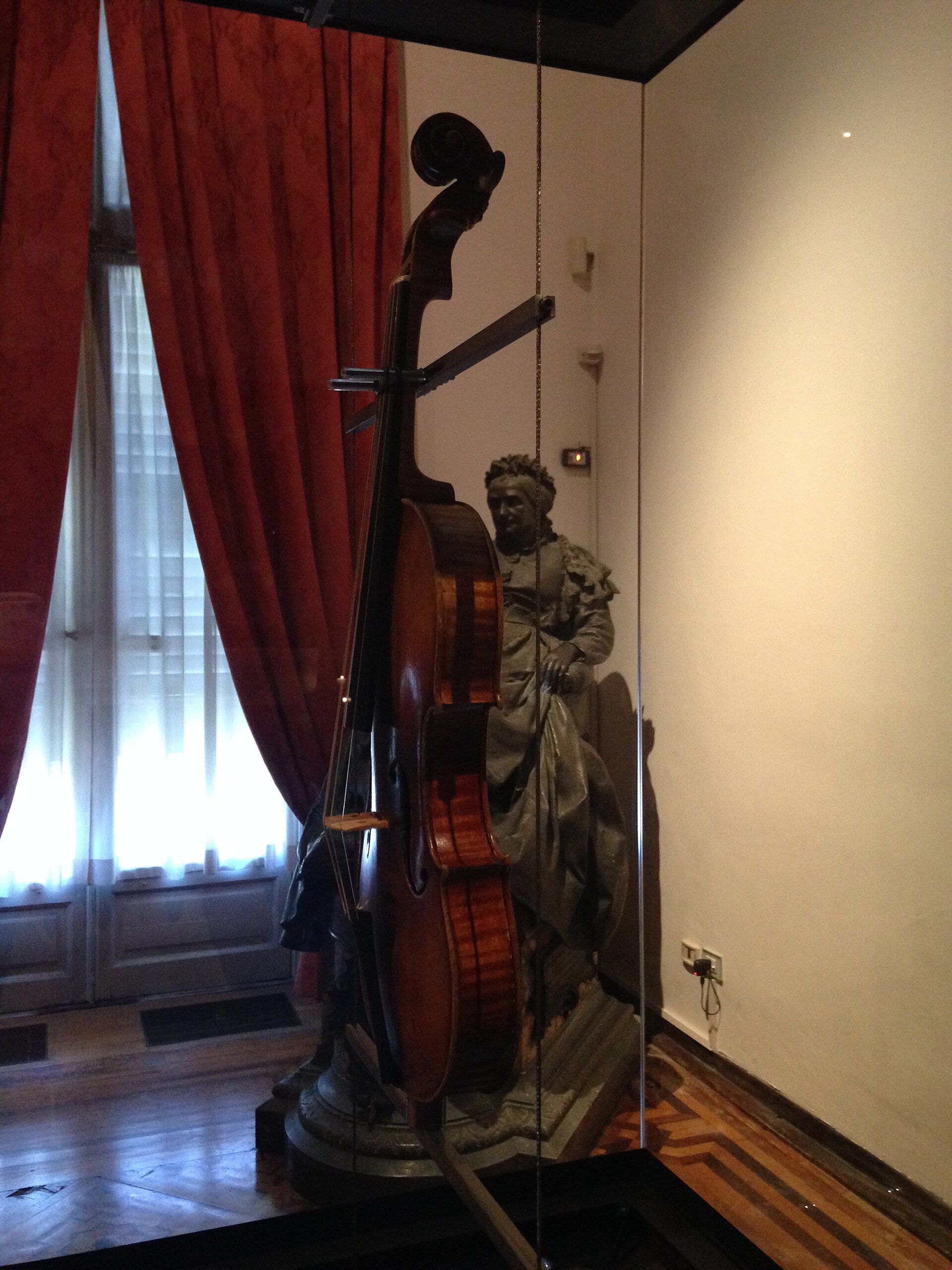
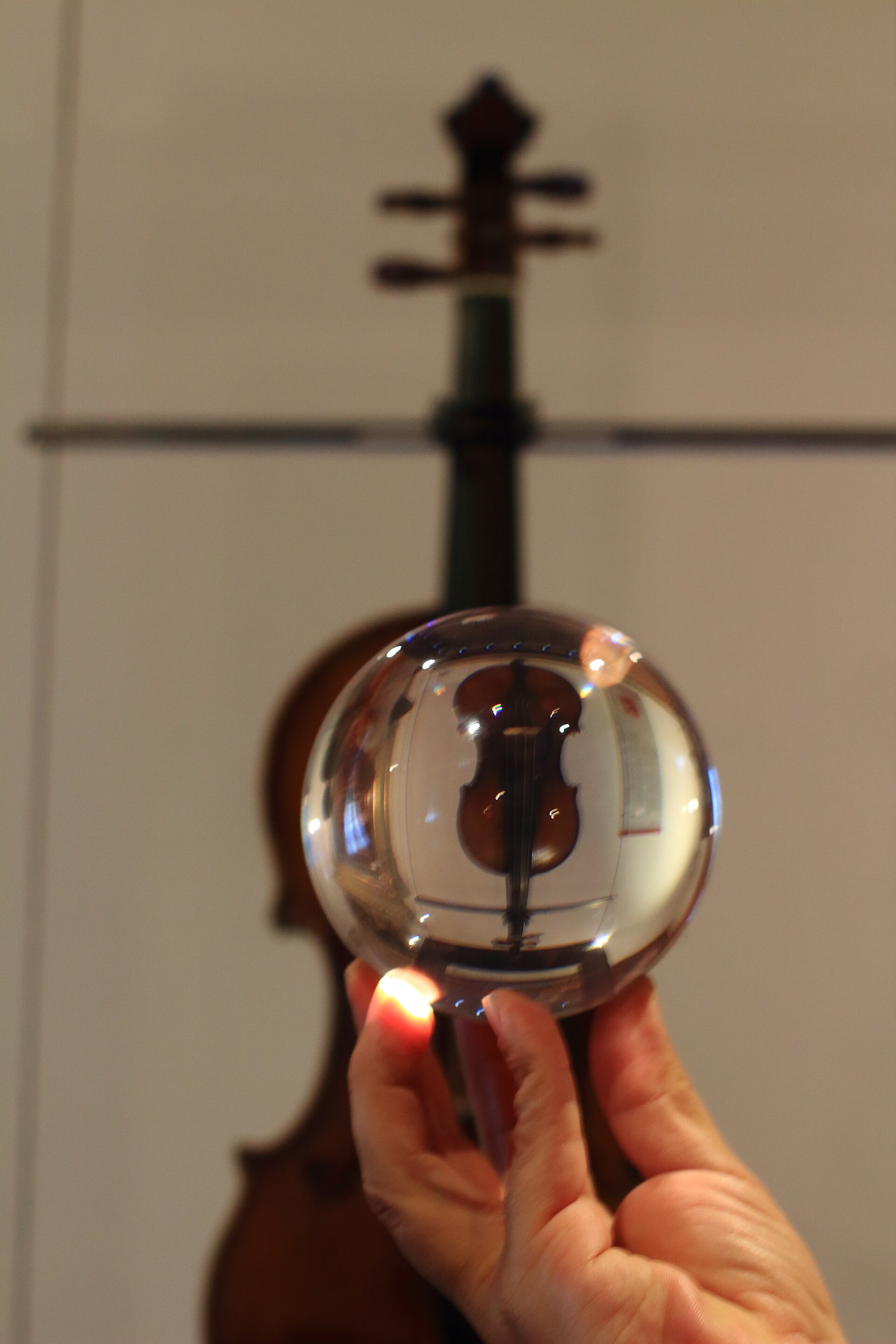
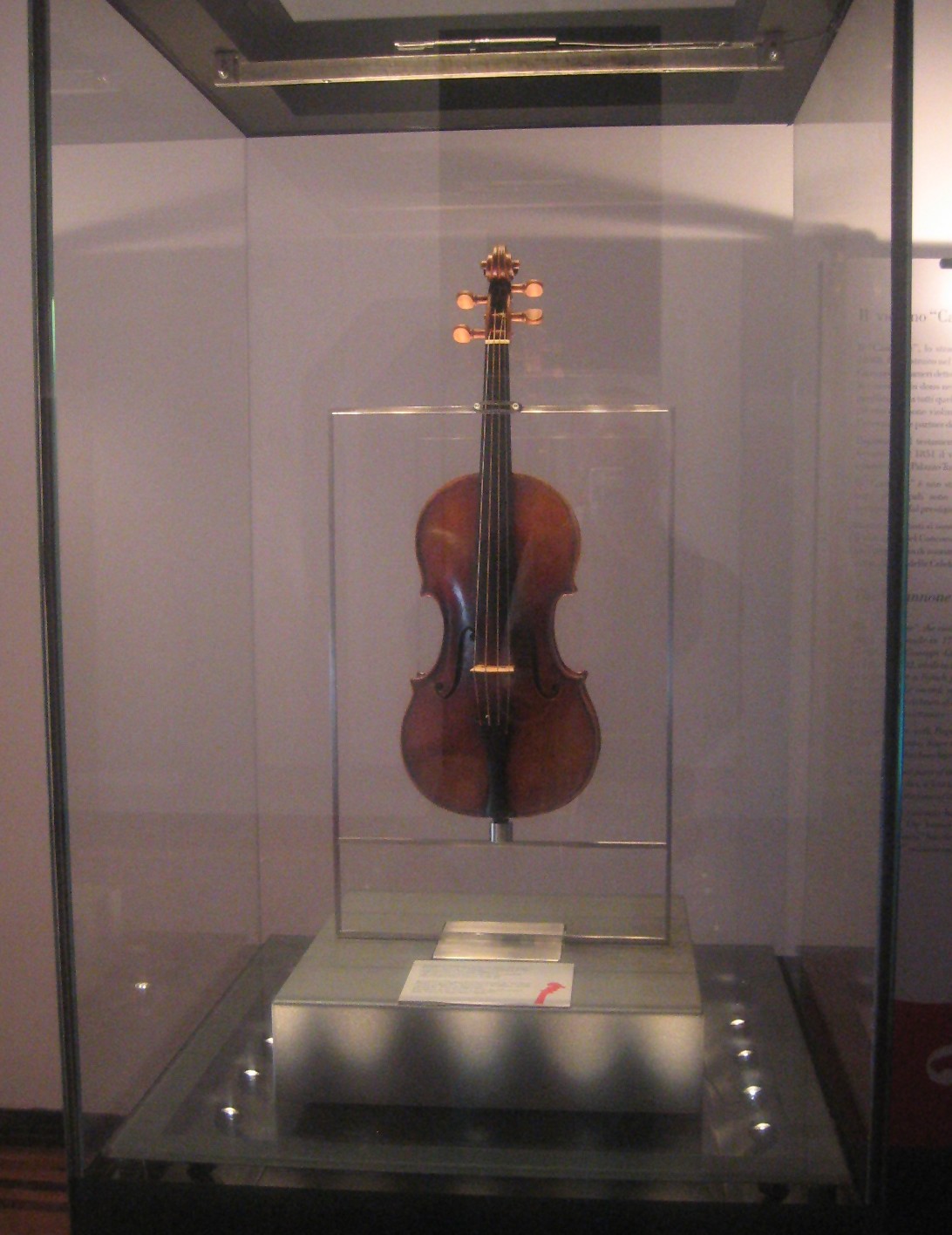
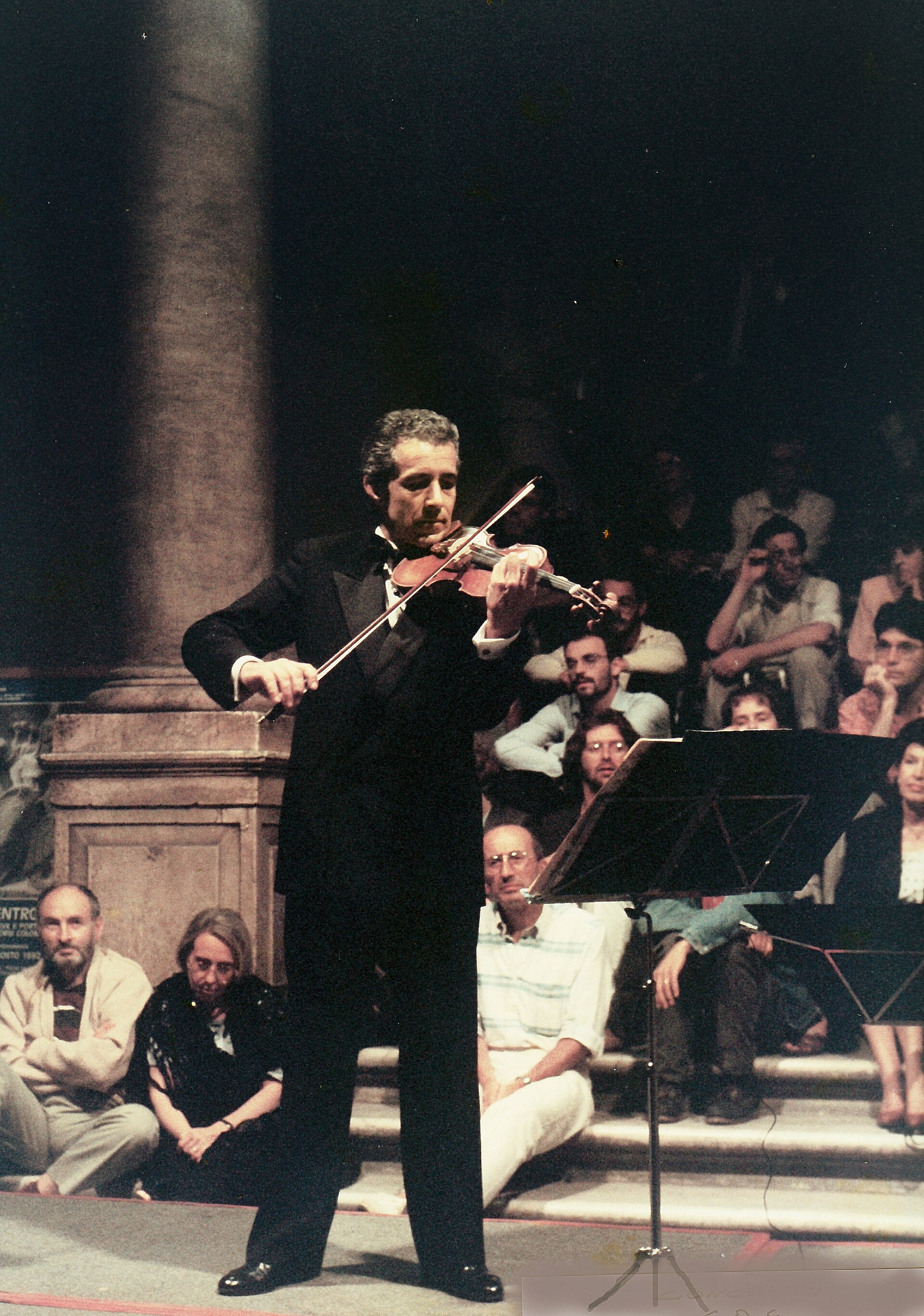
The record in full
Chapter 1What it is
A violin, made in Cremona in 1743 by Bartolomeo Giuseppe Guarneri, known as del Gesu for the sacred IHS monogram he stamped above his workshop and printed on his labels from 1731 onward.
A violin, made in Cremona in 1743 by Bartolomeo Giuseppe Guarneri, known as del Gesu for the sacred IHS monogram he stamped above his workshop and printed on his labels from 1731 onward. It is built in maple for the back, ribs and scroll and spruce for the belly, under a red-brown spirit varnish, and measures 35.4 cm down the back with upper, middle and lower bouts of 16.8, 11.1 and 20.7 cm.
Specialists who have examined it describe a shorter, thicker sound box than is usual and a markedly curved neck, part of the bolder, less formally precise construction Guarneri del Gesu adopted in the last decade of his working life. Its tone is recorded as bright and full, with unusual carrying power, which is the quality that gave the instrument its name. The varnish has never been polished, the plates have never been re-graduated, and the wood still carries the marks left by Paganini's chin, since he played without a chin rest.
Chapter 2How Paganini came to own it
The standard account, repeated across institutional and specialist sources, is that a French or Livornese businessman named Livron lent the young Paganini a Guarneri violin for a concert in Livorno...
The standard account, repeated across institutional and specialist sources, is that a French or Livornese businessman named Livron lent the young Paganini a Guarneri violin for a concert in Livorno and, having heard him play it, refused to take it back. The sources do not agree on the year: several institutional pages, including the city's own violin-competition site, place the gift in 1802 in Livorno, while the provenance chain published by the Tarisio Cozio Archive dates Paganini's ownership from 1799, and one general biography describes Paganini as still a teenager when it happened, which would place it before October 1801. This record treats the exact year as unresolved rather than picking one figure to smooth the story.
Before Livron, the instrument's history is not documented in any source consulted here. Nothing is known of its first fifty-six years beyond the fact of its making.
Chapter 3Why it is called Il Cannone
Paganini is consistently reported, across sources ranging from the violin's own custodial institution to specialist string-instrument press, to have called the instrument il mio cannone violino, my...
Paganini is consistently reported, across sources ranging from the violin's own custodial institution to specialist string-instrument press, to have called the instrument il mio cannone violino, my cannon violin, for the fullness and explosive carrying power of its sound. Every source consulted agrees on the substance of this claim and on Paganini himself as its author. None of them, however, cites a surviving letter, diary entry or other primary document in which the phrase appears; the attribution rests on a consistent biographical tradition rather than on a document this record's research was able to locate and inspect directly. It should be read as documented by strong and consistent secondary consensus, not as a quotation verified against a primary source.
Chapter 4The Bianchi incident, 1825
The one clearly documented scare in the violin's history dates to 1825.
The one clearly documented scare in the violin's history dates to 1825. Antonia Bianchi, the singer who was Paganini's companion and the mother of his son Achille, born that July in Palermo, seized the violin's case during a jealous quarrel and threw it to the floor, smashing the case. A servant wrested the violin from her hands before it could be destroyed. The story is reported by an Italian cultural-heritage listing site with the detail intact but without a primary citation of its own; this record flags it as documented by that source and not independently corroborated against a contemporary letter or newspaper account in this research pass.
The child present in that household as an infant, Achille Paganini, is the same person who, twenty-six years later, personally delivered the violin to the Mayor of Genoa.
Chapter 5The 1837 will and the 1851 bequest
Paganini's will, drawn up in 1837, left the violin to his native city with the instruction that it be perpetually preserved there.
Paganini's will, drawn up in 1837, left the violin to his native city with the instruction that it be perpetually preserved there. He died on 27 May 1840 in Nice, of internal hemorrhaging, at the age of 57. Execution of the bequest did not follow immediately: the violin passed to Genoa eleven years later, on 14 July 1851, when Paganini's son, Baron Achille Paganini, delivered it in person to the city's mayor, Antonio Profumo. What arrangement governed the instrument's custody in the intervening eleven years, between the death and the delivery, is not addressed in any source consulted for this record.
Since 1851 the violin has been municipal property of the Comune di Genova, housed at Palazzo Tursi, which had itself become the city's town hall only three years earlier, in 1848. The building is now part of the Strada Nuova museum group and, since 2006, of the UNESCO World Heritage listing for Genoa's Strade Nuove and the Palazzi dei Rolli.
Chapter 6The Vuillaume copy and the gift to Sivori
In Paris, the violin was repaired by the maker Jean-Baptiste Vuillaume, whose account of the episode is that he made an exact, unauthorised copy of the Cannone during the repair and revealed the...
In Paris, the violin was repaired by the maker Jean-Baptiste Vuillaume, whose account of the episode is that he made an exact, unauthorised copy of the Cannone during the repair and revealed the substitution only afterward. Paganini is reported to have been unable to tell his own violin from the copy at first handling, and to have offered to buy it once he understood what had happened; Vuillaume gave it to him instead. In 1840, on the advice of his lawyer Luigi Guglielmo Germi, Paganini passed the Vuillaume copy on to his pupil Camillo Sivori, recommending that Germi forward 500 francs of its value to Vuillaume.
Sivori kept the copy, now known as the Sivori violin, as his own favoured instrument for the rest of his career. On his death in 1894 his heirs donated it to the City of Genoa, and it has been displayed alongside the Cannone in Palazzo Tursi ever since. It is a documented, museum-owned copy made by a named nineteenth-century maker and should not be confused with the Cannone itself.
Chapter 7The succession of custodians
Genoa's care of the violin runs through two distinct, sometimes overlapping roles: a luthier-conservator responsible for its physical condition, and a violinist entrusted with playing it periodically...
Genoa's care of the violin runs through two distinct, sometimes overlapping roles: a luthier-conservator responsible for its physical condition, and a violinist entrusted with playing it periodically to keep it, in the language used by the people who do this work, in voice.
Eugenio Praga (1847-1901), a leading figure of the modern Genoese violin-making school, was the first maker called on to examine and care for the instrument after Paganini's death, a position sources attribute partly to his standing in Genoese society; he was, by one specialist account, probably the first maker after Paganini able to handle the original and take accurate measurements of its scroll and f-holes. Cesare Candi (1869-1947) succeeded him as conservator and in 1937 carried out a significant restoration ahead of the Stradivari bicentenary, consolidating the neck joint, replacing the chain bar and stabilising the back while deliberately retaining the accessories Paganini himself had used. Giuseppe Bernardo Lecchi (1895-1967), who had joined Candi's workshop in 1924 and won a first prize for a quartet at the 1937 Stradivari bicentenary exhibition, later himself held the position of official curator of the Cannone, though the sources consulted do not give exact start and end dates for that appointment. No source located here identifies who, if anyone, held the conservator's role between Lecchi's death in 1967 and 1972.
On the playing side, Mario Trabucco (1951-2025), a violin professor at Genoa's Niccolo Paganini Conservatory until 2015, served as curator-violinist of the Cannone and its Sivori companion from 1972, performing on it internationally in cities including Hanoi, Tokyo, St Petersburg and at the European Parliament in Strasbourg, and was still described as its former curator at his death on 4 March 2025. Since June 2000 the instrument's physical conservation has been the responsibility of the luthier Bruce Carlson, appointed conservator for the City of Genoa's historic violin collection, working with fellow Genoese makers Alberto Giordano and Pio Montanari; Carlson is also the person who now gives the violin its monthly playing to keep it in condition. No source consulted names anyone who has taken over the playing-curator role that Trabucco held since his death in March 2025.
Chapter 8The 2004 restoration and the reconstructed 1840 setup
By 2000 the fittings the violin was playing on had drifted well away from its nineteenth-century appearance and were causing real playing problems: the fingerboard was worn with a deep, irregular...
By 2000 the fittings the violin was playing on had drifted well away from its nineteenth-century appearance and were causing real playing problems: the fingerboard was worn with a deep, irregular hollow that produced intonation trouble in fifths. Carlson, with Giordano and Montanari, proposed a full overhaul of the mounting to the Genoa City Council, formally presented at an international conference on the violin's restoration and conservation held in Genoa on 14 October 2004.
The team replaced the fingerboard, extending it from 262 mm to 270 mm and removing a maple wedge that did not match early photographs, made a new bridge and a shorter tailpiece as replicas of originals found in the city's archive, and replaced all four pegs, which had been altered by an earlier, unrecorded maker. The upper nut, in ivory, was judged original and left untouched. The team's evidence base was a set of early twentieth-century photographs held in the Historical Photographic Archive of the Genoa City Council and in Candi's own personal collection, used to reconstruct, in the team's own description, the appearance of the Cannone as Paganini left it in 1840.
Set against this is a claim made directly by one of the restorers, Alberto Giordano, who states that the violin still retains its original neck, that the plates have never been re-graduated, and that the varnish has never been polished. Read together, the documented record is that the fingerboard, pegs, bridge and tailpiece now on the instrument are 2004 replicas of a nineteenth-century setup, while the body, top, back, ribs, scroll and, on this account, the neck itself, are original 1743 material reinforced rather than replaced. No source consulted gives a technical study, such as a CT scan or a full structural survey, that independently confirms whether the neck is wholly original wood or an early graft; this record treats that specific point as open.
Chapter 9Playing it today
The instrument is not simply a display case object.
The instrument is not simply a display case object. Since the International Violin Competition Premio Paganini was founded in 1953, tradition has given its winner the opportunity to play the Cannone. Genoa's own published conservation philosophy states plainly that the violin was rarely played in the decades after Paganini's death and that the public's wish to hear it should not be pursued at all costs; playing is limited to what the same source calls carefully chosen occasions with particular precautions taken.
Named soloists who have been lent the instrument for concerts or recordings include Salvatore Accardo, Eduard Schmieder at the Palazzo Ducale in Genoa in 1996, Shlomo Mintz with the Limburg Symphony Orchestra in 1997, Eugene Fodor in San Francisco in 1999, under a multi-million-dollar insurance policy and an armed escort of Italian police officers, the jazz violinist Regina Carter, who recorded a full album on it, Joanna Frankel at the Columbus Museum of Art in 2019, and Francesca Dego, who performed and recorded on it in Genoa in 2019 accompanied, in her own account, by six armed guards who never left the room. Outside of loans, Bruce Carlson takes it out of its display case for a warm-up roughly once a month.
Chapter 10Security, and the incident this record could not confirm
This record's research turned up one clearly documented scare, the 1825 Bianchi incident described above, and no confirmed case of an actual theft, theft attempt, or accidental drop or damage to the...
This record's research turned up one clearly documented scare, the 1825 Bianchi incident described above, and no confirmed case of an actual theft, theft attempt, or accidental drop or damage to the instrument itself since it entered Genoa's ownership in 1851. A dedicated search for a theft attempt, alarm incident or wartime evacuation story, including the instrument's whereabouts during the Second World War, did not surface a documented event in the sources consulted, despite that being exactly the kind of institution where such a story would be expected. That absence is reported here as a finding rather than papered over with a repeated rumour.
What is documented is preventive, not reactive: in June 2016, funded by a 250,000-euro donation from the Fondazione Enzo Hruby, Palazzo Tursi installed a new high-definition, infrared-capable video surveillance system covering the Paganini Room and the rest of the palace's holdings, described in the announcement as protection against thieves and vandals rather than as a response to any specific breach. Loan conditions for the instrument, separately, run to armed police escort and multi-million-dollar insurance, as recorded for the 1999 San Francisco loan and the 2019 Dego sessions.
Chapter 11Dendrochronology and the current monitoring project
In 1998 the dendrochronologist Peter Klein, working in Hamburg, dated the belly's youngest growth ring to 1735, consistent with a 1743 build after several years of normal wood seasoning and...
In 1998 the dendrochronologist Peter Klein, working in Hamburg, dated the belly's youngest growth ring to 1735, consistent with a 1743 build after several years of normal wood seasoning and supporting rather than complicating the accepted date. This is the only dendrochronological report on the instrument identified in this research.
More recently, Genoa's own published conservation materials describe a collaboration with Gabriele Rossi Rognoni, curator of the Museum of Musical Instruments at the Galleria dell'Accademia in Florence, and Marco Fioravanti of the University of Florence, aimed at more detailed, non-invasive monitoring and structural analysis of the violin's behaviour under playing and environmental conditions. No start date or published findings for this collaboration were located. An international conference on conservation methodology and the state of the art in caring for historic instruments was announced for 24 October 2025 in Genoa, with proceedings to be published; this record was researched before those proceedings could be consulted, and their content is unknown to it.
Chapter 12What has never happened to it
The Cannone has never been sold. It has been municipal property, held under the specific terms of a personal bequest, continuously since 1851, which means it has never been offered at auction, has...
The Cannone has never been sold. It has been municipal property, held under the specific terms of a personal bequest, continuously since 1851, which means it has never been offered at auction, has never required an export licence application, since it has never left Italian state or municipal ownership for sale, and carries no auction record, hammer price, estimate or premium of any kind to separate or correct. Any record purporting to give it a market value or a sale history should be treated with suspicion; the honest statement is that it has none.
The artist
Bartolomeo Giuseppe Guarneri, called del Gesu
Guarneri del Gesu was the fifth and last luthier of a single Cremonese family across three generations, working in a city already dominated by the Amati and Stradivari workshops. He is now ranked, alongside Antonio Stradivari, as one of the two most celebrated violin makers in history, but the record of his life is thin, and what does survive has had to compete for two centuries with a colourful, largely invented legend of a wild, criminal genius. Modern archival research has been correcting that picture rather than confirming it.
Related works
| Work | Relation | Where it is |
|---|---|---|
| The Sivori violin Jean-Baptiste Vuillaume | Exact copy of the Cannone made in Paris in 1833-34 during a repair; given by Paganini to his pupil Camillo Sivori in 1840 and donated to Genoa on Sivori's death in 1894 Displayed alongside the Cannone. A documented copy, not the object described in this record. | Palazzo Tursi, Genoa |
| Copies of the Cannone by Genoese makers Eugenio Praga and successors, including Cesare Candi, Paolo De Barbieri and Lorenzo Bellafontana | A local school of copying grew directly out of Praga's privileged access to the original as its first appointed conservator Cited by specialist sources as evidence of the Cannone's continuing influence on Genoese violin making rather than as objects independently verified for this record. | Various, private and institutional collections |
| The Vieuxtemps Guarneri Guarneri del Gesu | Another late-period instrument by the same maker, part of the wider cohort of surviving del Gesu violins used for comparison and connoisseurship A different, separately named instrument. Not to be confused with the Cannone. | On extended loan to a professional player; not publicly fixed |
| The Lord Wilton Guarneri Guarneri del Gesu | Another named del Gesu violin from the same maker's output, part of the comparanda for his late style A different, separately named instrument. Not to be confused with the Cannone. | Private ownership |
Open questions
- In what year did Paganini actually receive the violin from Livron? Sources give 1799, 1802, and, on one general account, before October 1801; none of the sources consulted resolves the conflict.
- Is there a surviving primary document, letter or diary entry in which Paganini himself uses the phrase Il Cannone, or does the naming rest entirely on later biographical tradition? None was located in this research.
- What governed custody of the violin in the eleven years between Paganini's death in 1840 and its delivery to Genoa in 1851?
- Who, if anyone, held the conservator's role for the Cannone between Giuseppe Bernardo Lecchi's death in 1967 and the documented 1972 start of Mario Trabucco's tenure as curator-violinist?
- Who, if anyone, has succeeded Mario Trabucco as the violin's playing-curator since his death on 4 March 2025?
- Is the neck on the instrument today wholly original 1743 material, as luthier Alberto Giordano's public statement implies, or was it reset or grafted during the 1937 consolidation by Cesare Candi? No technical study located in this research settles the question directly.
- Where was the violin during the Second World War? No source consulted documents its wartime custody, evacuation, or storage.
- What did the October 2025 international conference on conservation methodology conclude, and has Rossi Rognoni and Fioravanti's non-invasive monitoring project published findings? This record was researched before any proceedings could be consulted.
Questions about this object
What is Il Cannone?
Il Cannone is a musical instrument, dated 1743. Medium: Maple back, ribs and scroll, spruce belly, on a red-brown spirit varnish ground; ebony and other fittings replaced in 2004 as documented replicas of the setup Paganini used.
Who made Il Cannone, and is the attribution settled?
The attribution to Bartolomeo Giuseppe Guarneri, called del Gesu is recorded here as accepted. Made and labelled by Guarneri del Gesu in his own workshop in Cremona; the maker's mark (his personal cross beside the signature), the unbroken ownership record back to Paganini, and Peter Klein's 1998 dendrochronological reading of the belly wood (youngest ring 1735, consistent with a 1743 build after normal seasoning) are all cited by specialists as supporting the date and attribution without dispute. The Hill firm at one point catalogued the label date as 1742; ultraviolet examination later showed the final digit worn to look like a 2 and confirmed it as a 3.
Where is Il Cannone now?
Sala Paganiniana, Palazzo Tursi (Palazzo Doria-Tursi), Genoa - part of the Musei di Strada Nuova and the seat of the Comune di Genova. Inventory number No public inventory number found in the sources consulted. Last confirmed 12 August 2026. Municipal property of the Comune di Genova since 14 July 1851, under the terms of Paganini's 1837 will.
What is still unknown about Il Cannone?
In what year did Paganini actually receive the violin from Livron? Sources give 1799, 1802, and, on one general account, before October 1801; none of the sources consulted resolves the conflict.
Sources
- 1Wikipedia, 'Il Cannone Guarnerius'. en.wikipedia.org/wiki/...
- 2Wikipedia (Italian), 'Cannone (violino)'. it.wikipedia.org/wiki/...
- 3Comune di Genova / Premio Paganini, 'The Cannone'. premiopaganini.it/genoa-and-its-violin/...
- 4Comune di Genova / Premio Paganini, 'The historical recovery of the Cannone'. premiopaganini.it/index.php/...
- 5Comune di Genova / Premio Paganini, 'The philosophy for the conservation and use of the Cannone'. premiopaganini.it/index.php/...
- 6The Strad, 'Looking after Paganini's Il Cannone violin'. thestrad.com/lutherie/...
- 7Strings Magazine, 'One Violinist, One Violin... and Six Armed Guards: Francesca Dego on What It's Like to Play Paganini's Il Cannone'. stringsmagazine.com/one-violinist-one-violin-and-six-arme...
- 8Tarisio Cozio Archive, property record, Guarneri del Gesu, Cremona 1743, 'Il Cannone, Paganini'. tarisio.com/cozio-archive/...
- 9Tarisio Cozio Carteggio, 'The Paganini Cannon violin'. tarisio.com/cozio-archive/...
- 10Tarisio Cozio Carteggio, 'Eugenio Praga'. tarisio.com/cozio-archive/...
- 11Skinner Inc., 'A Charmed Life: Eugenio Praga and Paganini'. skinnerinc.com/news/...
- 12Wikipedia, 'Mario Trabucco'. en.wikipedia.org/wiki/...
- 13ANSA Liguria, 'Morto violinista Mario Trabucco, ex curatore Cannone Paganini', 4 March 2025. ansa.it/liguria/...
- 14Wikipedia, 'Giuseppe Bernardo Lecchi'. en.wikipedia.org/wiki/...
- 15Wikipedia, 'Cesare Candi'. en.wikipedia.org/wiki/...
- 16Carlson & Neumann Violins, 'Il Cannone'. ccnviolins.it/ilcannone.htm
- 17Alberto Giordano, 'Paganini's violin Il Cannone'. giordanoviolins.com/en/...
- 18Museums of Genoa (museidigenova.it), 'Il Cannone'. museidigenova.it/en/...
- 19Museums of Genoa (museidigenova.it), 'Paganini Rooms'. museidigenova.it/en/...
- 20ANSA Liguria, 'Sorveglianza speciale Cannone Paganini', 22 June 2016. ansa.it/liguria/...
- 21BBC Classical Music Magazine, 'Paganini's violin: a guide to the great Italian violinist's treasured Il Cannone'. classical-music.com/features/...
- 22Arte.it, 'Il Cannone, violino di Niccolo Paganini'. Flagged as a cultural-tourism listing without its own primary citation for the 1825 Bianchi incident; replace with a scholarly biography of Paganini if one can be sourced. arte.it/opera/...
- 23The Strad, 'International Violin Competition Premio Paganini'. thestrad.com/news/...
- 24Wikimedia Commons, Category:Il Cannone Guarnerius, and per-file (license, author, date) for each image used. commons.wikimedia.org/wiki/...
- 25Wikipedia, 'Niccolo Paganini'. en.wikipedia.org/wiki/...
- 26Wikipedia, 'Palazzo Doria-Tursi'. en.wikipedia.org/wiki/...
- 27Comune di Genova / Premio Paganini, 'The historical figure of Giuseppe Guarneri del Gesu'. premiopaganini.it/genoa-and-its-violin/...
- 28Amati Instruments Ltd., maker page, 'Bartolomeo Giuseppe Guarneri'. amati.com/maker/...
Last verified · Published
Change log
12 August 2026 - Record created at the house standard: researched narrative, technical evidence, maker dossier, graded provenance chain, prices with hammer and premium separated, related works, open questions and sources.