Violoncello, the 'Marylebone'
Antonio Stradivari · 1688
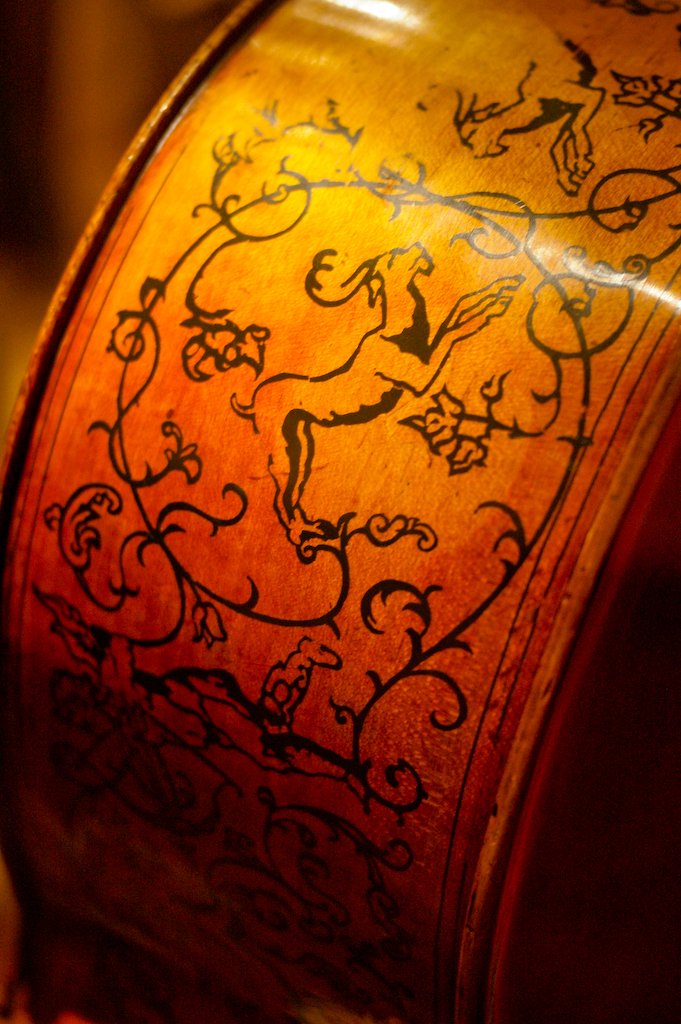
The Marylebone cello, Antonio Stradivari, Cremona, 1688, photographed at the National Museum of American History. The visible ornament on the upper right of the body is the twentieth-century applied decoration discussed in this record, not work original to Stradivari.
Photograph by Benjamin Chan, via Wikimedia Commons, CC BY-SA 2.0| Artist | Antonio Stradivari |
|---|---|
| Date | 1688 |
| Medium | Spruce top (multiple pieces), two-piece plain maple back with added corner wings, maple ribs and scroll, spirit varnish; ribs and pegbox carry a later applied decorative transfer |
| Dimensions | Overall, excluding tailpin: 121.92 x 43.5 x 24.77 cm (48 x 17 1/8 x 9 3/4 in), per the Smithsonian's own record. Length of back (the trade measurement used in violin-family cataloguing): 73 cm; upper bout 34.9 cm; middle bout 22.9 cm; lower bout 43.5 cm, per the Cozio Archive. |
| Where it is now | Smithsonian Institution, National Museum of American History (NMAH), Washington DC. Not currently on public display.last confirmed |
| Inventory number | NMAH object record nmah_739717, within accession 2000.0013 (the accession shared by all four instruments of the Herbert R. Axelrod Quartet of Decorated Instruments). Search-engine-mediated readings of the Smithsonian's own object page twice returned an object/catalog number of 2000.0013.04 for this cello specifically, but repeated direct and proxied fetches of si.edu and americanhistory.si.edu were blocked by the sites' own bot-verification screen, so that specific sub-number could not be confirmed against the raw page and should be checked directly before being treated as final. |
| Attribution | AcceptedAccepted as an autograph Stradivari cello of 1688. Full note |
| Object type | Musical instrument |
| Period | Italian (Cremonese school), late seventeenth century |
| Cases | Has a provenance gap |
| Inscriptions | Retains its original 1688 Stradivari label; the exact printed and handwritten text of the label is not reproduced in any source consulted for this record. |
| Owners on record | 13 links12 documented, 1 unknown |
| Sources | 12 cited |
About this record Last verified · 12 sources cited · Change log
On this page 9 sections
ContentsClose
A working cello of 1688 by Antonio Stradivari that spent more than two centuries in the ordinary trade of English and European violin dealing before becoming, in 1985, the fourth piece of a matched set assembled for the collector Herbert R. Axelrod. Unlike its three companions, this cello was never decorated by Stradivari himself: the ornament on its ribs and pegbox is a twentieth-century transfer copying a genuinely decorated Stradivari cello in the Spanish royal collection, added so the instrument would visually complete a 'quartet of decorated instruments.' The cellist Anner Bylsma called it, accurately, the tattooed cello.
The Axelrods gave the completed quartet to the Smithsonian's National Museum of American History, where it was valued at 50 million dollars, a figure the U.S. Senate Finance Committee later moved to question alongside a separate, unrelated federal tax fraud case against the donor. The cello itself carries no accusation of fakery or theft; the dispute that touched it was about what the whole gift was declared to be worth, not about what the instrument is.
It is now part of the Smithsonian's working collection of historical instruments, played on occasion by the museum's own curator-cellist, and is currently off public view.
Provenance
Each link is graded. Documented: a cited source supports it. Disputed: the identification is argued but not established. Unknown: no owner for that span, and the gap is not smoothed into a narrative. The grades in the glossary.
- 1688 -Made by Antonio Stradivari, Cremonadocumented
Original Stradivari label survives in the instrument. Built to Stradivari's larger, pre-1707 cello outline, later reduced in size.14
- unknown - c. 1821 or beforeUnrecorded owner; instrument reduced in sizedocumented
The cello was cut down from its original larger proportions, in the stated opinion of Alfred E. Hill's 1928 certificate probably by the London maker and dealer John Betts, whose shop is separately documented handling this and other large Stradivari cellos. The Cozio Archive's own listing places a 'John Betts' ownership entry and related names (Harford, a Rudolph Wurlitzer Co. transaction) in a position inconsistent with Betts's death in 1823; this record leaves the exact date of the reduction and the ordering of these entries unresolved rather than reconciling them by guesswork.4
- unknown - 1821Heinrich Glatzdocumented
Owned the cello until 1821, per the Cozio Archive.4
- 1821 - c. 1880James Cazenove, member of a family of financiersdocumented
Owned from 1821. One half of the instrument's working name.4
- 1880 - unknownAlexander Rivazdocumented
Owned from 1880.4
- unknown - 1911Mr. Payne, of Marylebone, Londondocumented
Held the cello until 1911; described in the Cozio Archive as a somewhat eccentric collector of instruments of very mixed quality. Supplies the other half of the working name.4
- 1911 - 1928W. E. Hill & Sons, then Hamma & Co. of Stuttgartdocumented
Hill and Sons acquired the cello in 1911 and it passed through Hamma and Co. before Hill and Sons reacquired it in 1928 and issued Alfred E. Hill's certificate describing the reduction and the retouched varnish.4
- 1933 - 1937Rudolph Wurlitzer Co., New Yorkdocumented
Held the cello from 1933; sold to Gustav Pistor by or in 1937.4
- 1937 - unknownDr. Gustav Pistordocumented
Owned from 1937. No further date is given in the source consulted.4
- unknown - 1985Unrecordedunknown
No owner or transaction is documented between Pistor's 1937 ownership and Axelrod's 1985 acquisition, a gap of roughly five decades.4
- 1985 - 1997Dr. Herbert R. Axelroddocumented
Acquired 1985, the same year the dealer Jacques Francais published an illustrated book on the completed Axelrod quartet; the sources consulted do not state whether Francais personally brokered this specific purchase. During Axelrod's ownership the cello received the applied decorative transfer copying the Spanish royal quartet's 1696 cello.34
- 1997 - 2000Smithsonian Institution, National Museum of American Historydocumented
Axelrod converted a long-standing loan to the Smithsonian into an outright gift in late 1997, reported in Smithsonian magazine in August 1998 and widely dated to 1998 in secondary sources; the Smithsonian's own accession number, 2000.0013, carries a year prefix consistent with formal registration of the gift in 2000. Both dates are documented in different kinds of source and this record does not collapse them into one.35
- 2000 - presentSmithsonian Institution, National Museum of American Historydocumented
On public display with the rest of the Axelrod Quartet from at least 1998 until 2012; not currently on view. Occasionally used in performance by the museum's curator of musical instruments.1211
Technical evidence
| Attribution note | Accepted as an autograph Stradivari cello of 1688. The instrument bears its original maker's label and has been examined and certified by W. E. Hill & Sons (1928) and catalogued in the Cozio Archive and in Jost Thone's Antonius Stradivarius catalogue. The body of the cello is not in dispute. What is not by Stradivari is the applied decoration on the ribs and pegbox, which is a twentieth-century addition copying the design of an actually Stradivari-decorated cello of 1696 in the Spanish royal collection; this record treats the instrument itself and its later decoration as two separate facts and does not present the ornament as the maker's own work. |
|---|---|
| Top | Spruce, of more than one piece, per the Smithsonian's own physical description.1 |
| Back, ribs and scroll | Plain maple; the back is in two pieces with narrow wings added at the corners.14 |
| Varnish | Orange-brown spirit varnish over a golden ground (Smithsonian description); described independently by the Cozio Archive as a light orange varnish, partly retouched during the eighteenth or nineteenth-century size reduction.14 |
| Size reduction | Originally built to Stradivari's larger, pre-1707 cello outline; reduced to closer to modern proportions, in the opinion of W. E. Hill & Sons' 1928 certificate probably by the London maker and dealer John Betts. The back length as reduced is 73 cm, against roughly 79-80 cm for an unreduced Stradivari long-pattern cello.4 |
| Decoration | Twentieth-century applied decorative transfer on the ribs and pegbox, copying the design of Stradivari's own 1696 decorated cello in the Spanish royal collection at the Royal Palace, Madrid. Not original to the instrument and not the work of Stradivari.14 |
| Label | Original Stradivari label of 1688 survives in the instrument; its exact wording is not published in any source consulted.4 |
| Dimensions (overall, Smithsonian) | 121.92 x 43.5 x 24.77 cm (48 x 17 1/8 x 9 3/4 in), excluding tailpin.1 |
| Dimensions (trade measure, Cozio Archive) | Back length 73 cm; upper bout 34.9 cm; middle bout 22.9 cm; lower bout 43.5 cm.4 |
| Certification | Certificate of W. E. Hill & Sons, London, 1928, signed in the person of Alfred E. Hill, describing the reduction, the retouched varnish and the quality of the scroll.4 |
Images
The record in full
Chapter 1What the instrument is
The Marylebone is a full-size cello built by Antonio Stradivari in Cremona in 1688: a multi-piece spruce top, a two-piece plain maple back to which narrow wings have been added at the corners, ribs...
The Marylebone is a full-size cello built by Antonio Stradivari in Cremona in 1688: a multi-piece spruce top, a two-piece plain maple back to which narrow wings have been added at the corners, ribs and scroll of matching plain maple, and a spirit varnish of orange-brown over a golden ground. The Smithsonian's own measurements give it as 121.92 by 43.5 by 24.77 centimetres overall, excluding the tailpin. In the measurement violin-trade catalogues actually use for comparing cellos, the back length, the Cozio Archive gives 73 centimetres, with upper, middle and lower bouts of 34.9, 22.9 and 43.5 centimetres.
It is not, physically, the instrument Stradivari built. Like a large number of seventeenth-century Cremonese cellos, it was reduced in size by a later maker to bring it closer to the proportions cellists and cello cases could actually use. A written opinion from Alfred E. Hill, on the 1928 certificate issued by W. E. Hill & Sons, records that the cello was originally of larger proportions and had been reduced in size, probably by the London maker and dealer John Betts, with the varnish somewhat retouched in the process; Hill considered the scroll, untouched by the reduction, to be particularly fine and quite pure. The instrument still carries its original Stradivari label.
Chapter 2A long-pattern cello and why it was cut down
In 1688 Stradivari had not yet settled on the cello proportions the instrument is built to today.
In 1688 Stradivari had not yet settled on the cello proportions the instrument is built to today. His larger, earlier cello outlines, sometimes called the long pattern, produced instruments close to 79 or 80 centimetres in back length, cumbersome for players and for makers copying them alike. Around 1707 Stradivari redesigned the cello on a smaller outline, the so-called forma B, at roughly 75.5 centimetres, and that later pattern became the template most subsequent cello makers actually used.
A large-pattern Stradivari cello built twenty years before that redesign was, by the standard eighteenth and nineteenth-century measure of a cello's usefulness, oversized. Cutting such an instrument down to a workable modern length, as happened here, was routine trade practice in London and Paris workshops of the period, not a mark of disrespect for the maker: Betts's own shop is recorded as having handled at least a dozen fine Stradivari cellos across the eighteenth and nineteenth centuries, several of which supplied English makers such as Lockey Hill and the Fendt family with working templates for their own instruments. The Marylebone, on the Cozio Archive's account, is very probably the source Lockey Hill used for one such set of templates, taken from a large Stradivari then in the Betts shop.
Chapter 3The decoration, and why it is not Stradivari's
Only a small number of Stradivari's own instruments carry decoration applied at the time of manufacture, roughly eleven surviving examples out of the more than one thousand instruments the Hill firm...
Only a small number of Stradivari's own instruments carry decoration applied at the time of manufacture, roughly eleven surviving examples out of the more than one thousand instruments the Hill firm calculated he made. Among the genuine examples are the 1679 Hellier violin, inlaid with ivory and, by one account, hundreds of small gems, and a complete matched quartet made for the Spanish court, now in the Royal Palace in Madrid, whose 1696 cello is the only decorated cello Stradivari is known to have built himself.
The Marylebone was not one of these. When Herbert Axelrod assembled his own quartet in the 1980s, he already owned two decorated Stradivari violins and a decorated viola, but the cello he needed to complete the set carried no ornament at all. According to the Cozio Archive, Axelrod had the design of the Madrid cello's decoration made into a transfer and applied to the ribs and pegbox of the Marylebone, so that the four instruments of his own quartet would present as a visually matched decorated set. The Dutch cellist Anner Bylsma, who is on record elsewhere performing on a different Smithsonian Stradivari cello, the Servais, called the Marylebone the tattooed cello, a name that is exact rather than affectionate: the ornament sits on the surface of the wood, copying a pattern that belongs to a different instrument in a different country, and it dates from the twentieth century, not the seventeenth. Nothing in the sources consulted suggests the transfer was ever presented to the Smithsonian, or by the Smithsonian to the public, as Stradivari's own work; the museum's own object record describes it plainly as twentieth-century applied decoration.
Chapter 4Two names from the London trade: Cazenove and Payne
The cello's working name compounds two later owners rather than describing anything about its manufacture.
The cello's working name compounds two later owners rather than describing anything about its manufacture. James Cazenove, a member of a prominent family of financiers, owned it from 1821; a Mr. Payne of Marylebone, in London, held it later in the nineteenth century and into the twentieth, until 1911. Payne is recorded as a somewhat eccentric collector who owned instruments of very mixed quality alongside genuine fine pieces. Neither man is otherwise notable in violin history; the name survives simply because it was the name attached to the instrument when it passed through the hands that later catalogued it.
Chapter 5The documented chain before Axelrod
Independently of the other three instruments in the Axelrod group, the Cozio Archive records a specific ownership chain for this cello, and it does not run through the same hands as the companion Ole...
Independently of the other three instruments in the Axelrod group, the Cozio Archive records a specific ownership chain for this cello, and it does not run through the same hands as the companion Ole Bull violin's published history. As far as the sources consulted allow it to be reconstructed: Heinrich Glatz owned the cello until 1821; James Cazenove from 1821; Alexander Rivaz from 1880; Payne of Marylebone until 1911; W. E. Hill & Sons from 1911; the Stuttgart dealers Hamma and Co. for a period before Hill and Sons reacquired it in 1928 and issued Alfred E. Hill's certificate; the Rudolph Wurlitzer Co. of New York from 1933; and Dr. Gustav Pistor from 1937.
Two further details appear in the same archive record without a clear place in this sequence: a mention of the dealer Harford and of a transaction involving Rudolph Wurlitzer Co. connected to the year 1929, and a reference to John Betts himself as a name in the ownership list rather than only as the probable hand behind the reduction. Given that Betts's own working life closed with his death in 1823, before Glatz's recorded ownership even ends, these entries most likely belong earlier in the story, around the reduction itself, than their position in the source suggests; this record does not guess at the correct placement and flags it as unresolved rather than silently reordering it.
Between Gustav Pistor's ownership from 1937 and Herbert Axelrod's acquisition in 1985, no owner or transaction is documented in any source consulted for this record. That gap of roughly five decades, spanning the Second World War and its aftermath in Europe, is real and is recorded as a gap, not bridged with an assumption.
Chapter 6Axelrod's quartet and the Smithsonian gift
Herbert Axelrod, a New Jersey publisher of pet-fishkeeping books who had built a fortune from Tropical Fish Hobbyist magazine and TFH Publications, bought his first Stradivarius violin in 1975 and...
Herbert Axelrod, a New Jersey publisher of pet-fishkeeping books who had built a fortune from Tropical Fish Hobbyist magazine and TFH Publications, bought his first Stradivarius violin in 1975 and went on to assemble a substantial collection of fine stringed instruments. He acquired the Marylebone cello in 1985, the same year the New York dealer Jacques Francais published a short illustrated book, The Dr. Herbert Axelrod Stradivari Quartet, describing all four instruments Axelrod had by then brought together; the sources consulted do not specify whether Francais personally brokered the cello's sale to Axelrod, only that his book documents the completed set that year.
The instruments had already been on loan to the National Museum of American History through the 1980s when, in late 1997, Axelrod converted the loan into an outright gift. Contemporary reporting in Smithsonian magazine, published in August 1998, describes the donation as recent and credits Gary Sturm, an assistant chairman in the museum's Division of Cultural History, with having done the work that won Axelrod's trust. The instruments and a one million dollar endowment for the Smithsonian Chamber Music Society were valued at the time at fifty million dollars, and the Smithsonian named Axelrod its 1999 Donor of the Year. The Smithsonian's own accession number for the group, 2000.0013, carries a year prefix consistent with the institution's formal registration of the gift being completed in 2000, two to three years after the donation was announced and the objects were already in the building; both dates are documented and this record gives both rather than picking one.
Chapter 7The valuation, and the Senate inquiry
The fifty million dollar figure did not hold up to later scrutiny.
The fifty million dollar figure did not hold up to later scrutiny. In May 2004 the Senate Finance Committee, chaired by Senator Charles Grassley, wrote to the Smithsonian seeking every record connected to the 1998 donation, including the donor's IRS Form 8283, the form used to substantiate a non-cash charitable deduction, as part of a wider inquiry into whether wealthy donors were routinely inflating appraisals of art, land and instruments to claim larger deductions than the gifts were worth. Independent estimates of the Axelrod quartet's value that surfaced during the same period ran as low as fifteen to twenty-six million dollars, well under half the figure used at the time of the gift.
This inquiry is genuinely about the same 1998 donation that includes the Marylebone cello, and it belongs in this record for that reason. It is not, however, an accusation that the cello itself is not what it is claimed to be, or that its Stradivari attribution or ownership history was fabricated; the concern raised was about the dollar figure attached to the gift as a whole for tax purposes, not about the authenticity of any one instrument in it. No source consulted for this record states what, if anything, the Senate inquiry concluded about this specific donation.
Chapter 8Axelrod's later legal trouble, kept separate
Axelrod's name recurs in a second, unconnected legal matter several years later.
Axelrod's name recurs in a second, unconnected legal matter several years later. In April 2004 he was indicted in federal court in New Jersey, accused of moving money into Swiss bank accounts over roughly twenty years without declaring it. He did not appear for his arraignment and was found to have flown to Cuba; he was arrested by German authorities at Berlin's Tegel airport in June 2004 as he arrived on a flight from Zurich, and was extradited to the United States. He pleaded guilty to helping an employee file a false tax return and, on 21 March 2005, was sentenced to eighteen months in prison, of which he served sixteen. He died in Zurich on 15 May 2017, aged eighty-nine.
Nothing in the sources consulted ties this tax case to the Smithsonian donation, the cello's attribution, or its ownership history; it is recorded here, dated and sourced, as a fact about the donor's own later life, not as a shadow over the object.
Chapter 9Life in the museum
The Axelrod quartet, together with the museum's separate Servais Stradivarius cello, a different and unrelated instrument of 1701 also in the Smithsonian's collection, was on public display at the...
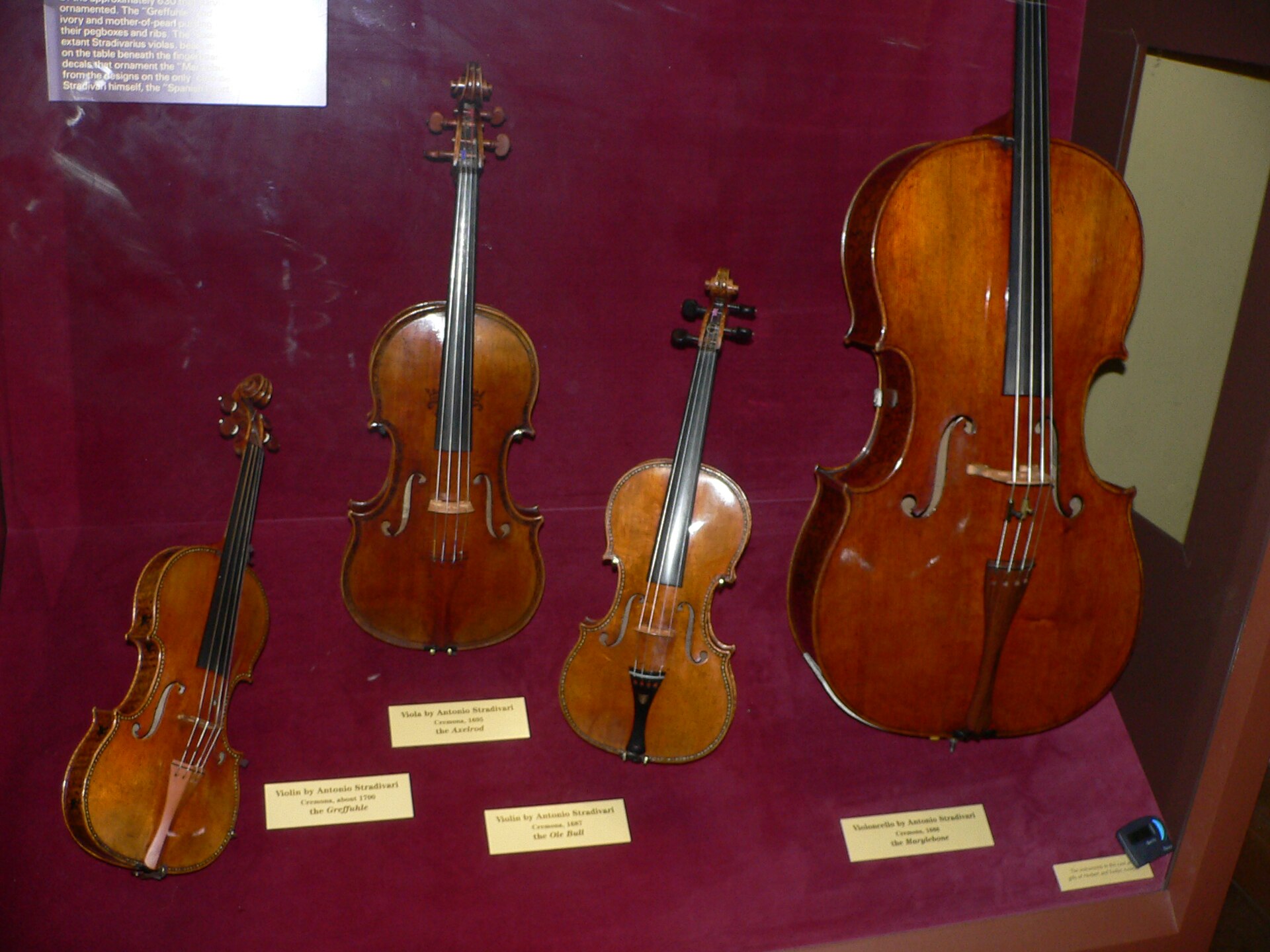
The Axelrod quartet, together with the museum's separate Servais Stradivarius cello, a different and unrelated instrument of 1701 also in the Smithsonian's collection, was on public display at the National Museum of American History from 1964 until 2012; no source consulted explains why it came off view that year. The Smithsonian Chamber Music Society, whose resident ensemble was renamed the Axelrod String Quartet on the strength of the gift, continues to give concerts using instruments from the Axelrod, Amati and Vuillaume groups the Axelrods donated, with the museum's own curator of musical instruments, the cellist Kenneth Slowik, playing the cello parts. Slowik is separately reported to have performed a Bach suite on the Marylebone cello itself at a celebration of the 150th anniversary of Italian unification, held at the Italian ambassador's residence in Washington. The instrument is not, as of this record, on public display, but it remains part of a working collection rather than a sealed one.
Chapter 10What is still unresolved
Two separate gaps sit inside this history and neither should be smoothed over.
Two separate gaps sit inside this history and neither should be smoothed over. The first is documentary: the exact sequence of ownership between John Betts's probable reduction of the cello, before or around 1821, and the start of the clearly dated Glatz-to-Cazenove chain, and the entirely undocumented five decades between Gustav Pistor's ownership from 1937 and Axelrod's acquisition in 1985. The second is a question of framing: this cello is marketed and displayed as one quarter of a matched set of decorated Stradivari instruments, when three of the four were decorated by Stradivari and this one was not, a distinction the museum's own catalogue record preserves but that popular description of the group routinely erases.
The artist
Antonio Stradivari
Stradivari is the most documented and least biographically certain of the great Cremonese makers: hundreds of his instruments survive with their original labels, yet basic facts of his early life, including his exact birth date and who, if anyone, formally trained him, are argued over rather than known. What is not in dispute is the scale and consistency of the output of a single workshop across roughly seventy-five working years.
Related works
| Work | Relation | Where it is |
|---|---|---|
| Violin, the 'Ole Bull' Antonio Stradivari, 1687 | Companion instrument in the Herbert R. Axelrod Quartet of Decorated Instruments; decorated by Stradivari himself, unlike this cello Its own published ownership chain (Ole Bull, John Hart, Plowden, Hulse, Hill and Sons, Oldham, Hill and Sons again, Kochanski, Fels, an unnamed amateur, Jacques Francais, Kreeger, Axelrod from 1981) is a distinct history from the cello's and should never be attributed to the cello. | Smithsonian NMAH, object nmah_739715 |
| Violin, the 'Greffuhle' Antonio Stradivari, dated variously 1700 and 1709 in different sources | Companion instrument in the same quartet The date conflict between sources for this violin was not resolved in the course of researching the cello and is noted here only so it is not carried over into this record by mistake. | Smithsonian NMAH, object nmah_739714 |
| Viola, the 'Axelrod' Antonio Stradivari, 1695 | Companion instrument in the same quartet Decorated by Stradivari along the rims of the top and back only, and in black rather than the inlay used on the two violins; carries a coronet under the fingerboard thought to indicate a noble original owner. | Smithsonian NMAH, object nmah_739716 |
| Cello, the 'Spanish Court' Antonio Stradivari, 1696 | The only cello Stradivari is known to have decorated himself; the source of the design later copied onto this record's subject The Marylebone's own decoration is a twentieth-century transfer of this instrument's pattern, not a related original; the two objects should never be described as sharing a maker's decorative campaign. | Royal Palace, Madrid, part of the Spanish royal Stradivari quartet |
| Cello, the 'Servais' Antonio Stradivari, 1701 | A separate, undecorated Stradivari cello in the same museum, displayed alongside the Axelrod Quartet at NMAH from 1964 to 2012 Not part of the Axelrod Quartet and not by the same donor; recorded here specifically to prevent confusion between the two Smithsonian Stradivari cellos. Also recorded on Anner Bylsma's 1992 Bach recording, the same cellist who gave this record's subject its 'tattooed cello' nickname. | Smithsonian NMAH |
| Violin, the 'Hellier' Antonio Stradivari, c. 1679 | Comparanda: one of the small group of instruments genuinely decorated by Stradivari at the time of manufacture, illustrating what this cello's ornament is not Ivory and, by some accounts, gem inlay applied by Stradivari's own workshop, unlike the applied transfer on this cello. | Private collection (offered for sale in recent years) |
Open questions
- Where, exactly, does John Betts's probable reduction of the cello and the associated names of Harford and a 1929-dated Wurlitzer transaction belong in the ownership sequence? The Cozio Archive lists them in a way that is chronologically inconsistent with Betts's death in 1823, and this record has not guessed at the correct placement.
- Who owned or held the cello between Dr. Gustav Pistor's recorded ownership from 1937 and Herbert Axelrod's acquisition in 1985? No source consulted documents this roughly fifty-year span.
- Exactly when, and on whose specific instruction, was the decorative transfer copying the Madrid cello applied to this instrument? The Cozio Archive attributes the idea to Axelrod but does not give a date narrower than his 1985-1997 ownership.
- What, if anything, did the Senate Finance Committee's 2004 inquiry into the Axelrod donation conclude about this specific gift's valuation? No source consulted reports an outcome.
- Why did the Axelrod Quartet, on view at NMAH since 1964, come off public display in 2012, and does the museum have any stated plan to return it to view?
- What was the resolution, if any, of the discrepancy between the instruments' 50 million dollar valuation at the time of the 1998 gift and the 15 to 26 million dollar range reported in later appraisals?
Questions about this object
What is Violoncello, the 'Marylebone'?
Violoncello, the 'Marylebone' is a musical instrument, dated 1688. Medium: Spruce top (multiple pieces), two-piece plain maple back with added corner wings, maple ribs and scroll, spirit varnish; ribs and pegbox carry a later applied decorative transfer.
Who made Violoncello, the 'Marylebone', and is the attribution settled?
The attribution to Antonio Stradivari is recorded here as accepted. Accepted as an autograph Stradivari cello of 1688. The instrument bears its original maker's label and has been examined and certified by W. E. Hill & Sons (1928) and catalogued in the Cozio Archive and in Jost Thone's Antonius Stradivarius catalogue. The body of the cello is not in dispute. What is not by Stradivari is the applied decoration on the ribs and pegbox, which is a twentieth-century addition copying the design of an actually Stradivari-decorated cello of 1696 in the Spanish royal collection; this record treats the instrument itself and its later decoration as two separate facts and does not present the ornament as the maker's own work.
Where is Violoncello, the 'Marylebone' now?
Smithsonian Institution, National Museum of American History (NMAH), Washington DC. Not currently on public display. Inventory number NMAH object record nmah_739717, within accession 2000.0013 (the accession shared by all four instruments of the Herbert R. Axelrod Quartet of Decorated Instruments). Search-engine-mediated readings of the Smithsonian's own object page twice returned an object/catalog number of 2000.0013.04 for this cello specifically, but repeated direct and proxied fetches of si.edu and americanhistory.si.edu were blocked by the sites' own bot-verification screen, so that specific sub-number could not be confirmed against the raw page and should be checked directly before being treated as final.. Last confirmed 2 September 2026. Gift of Evelyn and Dr. Herbert R. Axelrod.
What is still unknown about Violoncello, the 'Marylebone'?
Where, exactly, does John Betts's probable reduction of the cello and the associated names of Harford and a 1929-dated Wurlitzer transaction belong in the ownership sequence? The Cozio Archive lists them in a way that is chronologically inconsistent with Betts's death in 1823, and this record has not guessed at the correct placement.
Sources
- 1Smithsonian Institution / National Museum of American History, object record for the Stradivarius Violoncello 'The Marylebon' (nmah_739717). si.edu/object/...
- 2Smithsonian Institution / National Museum of American History, object record for the Stradivarius Viola 'The Axelrod' (nmah_739716), used for comparison of decoration and dimensions across the quartet. si.edu/object/...
- 3Wikipedia, 'Axelrod quartet'. en.wikipedia.org/wiki/...
- 4Tarisio, Cozio Archive, 'Antonio Stradivari, Cello, Cremona, 1688, the Cazenove, Marylebone' (Property ID 41432), including the W. E. Hill & Sons 1928 certificate summary, the literature list, and the Anner Bylsma 'tattooed cello' quotation. tarisio.com/cozio-archive/...
- 5Smithsonian Magazine, 'Sharing the Gift of Music', August 1998, on the Axelrod donation, Gary Sturm's role, and the Chamber Music Society endowment. smithsonianmag.com/arts-culture/...
- 6Smithsonian Magazine / Smithsonian Voices, 'Sound Scholarship', on Kenneth Slowik's performance on the Marylebone cello and the museum's instrument collection. smithsonianmag.com/arts-culture/...
- 7Wikipedia, 'Herbert R. Axelrod', for the donor's biography, the 1998 donation, the New Jersey Symphony sale, the tax fraud indictment, flight, arrest, sentencing and death. en.wikipedia.org/wiki/...
- 8The Strad, obituary, 'Stringed instrument collector and tropical fish expert Herbert Axelrod has died, aged 89', on the valuation controversy following the Smithsonian and New Jersey Symphony gifts. thestrad.com/stringed-instrument-collector-and-tropical-f...
- 9U.S. Senate Committee on Finance, press release, 'Grassley Seeks Details of Instrument Donation, Highlights Need for IRS Whistleblower Incentives', May 3, 2004, on the Committee's inquiry into the 1998 Axelrod donation's valuation. Retrieved via search summary of the Committee's own page; direct access to finance.senate.gov was blocked by the site during research and the wording should be checked against the primary page before being quoted verbatim. finance.senate.gov/chairmans-news/...
- 10Wikipedia, 'Antonio Stradivari', for the maker's biography, training, workshop, family, output and the Museo del Violino tools. en.wikipedia.org/wiki/...
- 11Smithsonian Chamber Music Society, 'The Axelrod String Quartet', on the ensemble's formation, members and use of the donated instruments. smithsonianchambermusic.org/about/...
- 12Wikipedia, 'Servais Stradivarius', on the separate, undecorated Smithsonian Stradivari cello displayed alongside the Axelrod Quartet, used here only to prevent confusion between the two instruments. en.wikipedia.org/wiki/...
Last verified · Published
Change log
2 September 2026 - Record created at the house standard: researched narrative, technical evidence, maker dossier, graded provenance chain, prices with hammer and premium separated, related works, open questions and sources.