Grand Piano by John Broadwood and Sons
John Broadwood and Sons (Thomas Broadwood) · 1817-1818 (built and shipped from London, 1817; delivered to Beethoven in Vienna, May 1818)
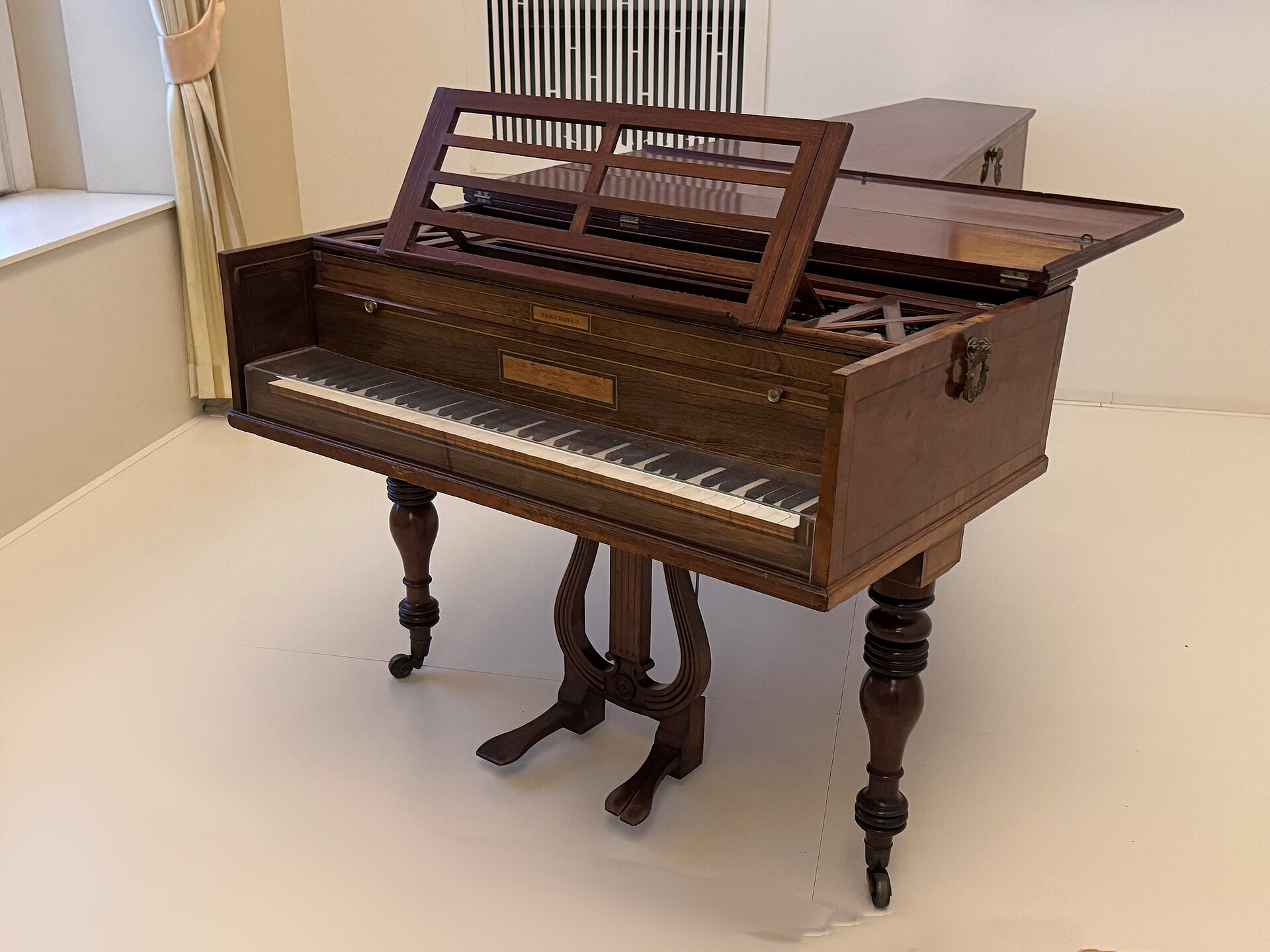
The instrument itself, on display at the Hungarian National Museum, Budapest. Built by John Broadwood and Sons of London, sent to Beethoven in 1817-18, later owned by Franz Liszt.
Photograph by Dguendel, own work, CC BY 4.0, via Wikimedia Commons| Artist | John Broadwood and Sons (Thomas Broadwood) |
|---|---|
| Date | 1817-1818 (built and shipped from London, 1817; delivered to Beethoven in Vienna, May 1818) |
| Medium | Wood (mahogany case) over an iron-braced timber frame, wire-strung, with English grand action; six-octave keyboard compass |
| Dimensions | Not published in the sources consulted for this record |
| Where it is now | Hungarian National Museum, Budapestlast confirmed |
| Inventory number | Not published in the sources consulted for this record |
| Attribution | AcceptedMaker not in dispute. Full note |
| Object type | Musical instrument |
| Period | Regency London (manufacture) and late Beethoven Vienna (use) |
| Inscriptions | Latin dedication above the keys: "Hoc Instrumentum est Thomae Broadwood (Londini) donum, propter Ingenium illustrissimi Beethoven" (This instrument is the gift of Thomas Broadwood of London, on account of the genius of the most illustrious Beethoven). A minor transcription variant of the Latin (Londrini for Londini, propiter for propter) appears in at least one secondary source; the sense is identical in both. The names of the five London pianists who selected the instrument are recorded with it. |
| Owners on record | 8 links8 documented |
| Sources | 22 cited |
About this record Last verified · 22 sources cited · Change log
On this page 11 sections
ContentsClose
A six-octave grand piano built by John Broadwood and Sons of London and sent as an unsolicited gift to Ludwig van Beethoven in Vienna, arriving in May 1818 after a sea and cart journey of some five months. Beethoven, by then substantially deaf, kept the instrument until his death in 1827; it was bought at his estate sale by the Viennese publisher C. A. Spina, who gave it in 1845 to Franz Liszt, an avowed admirer of Beethoven who never played it himself. Liszt bequeathed it to the Hungarian National Museum in Budapest, where it arrived in 1887 and remains today.
The popular version of this story compresses easily into a single warm anecdote: a grateful Englishman, a deaf genius, a piano that changed the music. The documented record is both better sourced and less tidy than that. Beethoven's own thank-you letter survives and is quoted here in full. The persistent claim that he had the piano's legs removed to feel the music through the floor does not hold up against the surviving instrument, which still has its legs. And the instrument's own recent history is not fully resolved: restored to playing condition in 1991-92 and toured and recorded through the 1990s, it is described in at least one 2018 account as no longer playable, with no source consulted explaining what changed or when.
Provenance
Each link is graded. Documented: a cited source supports it. Disputed: the identification is argued but not established. Unknown: no owner for that span, and the gap is not smoothed into a narrative. The grades in the glossary.
- 1817 - 1818John Broadwood and Sons, London (in transit)documented
Built and selected by a panel of five London pianists at Thomas Broadwood's instruction after his 1817 meeting with Beethoven in Vienna; shipped from London (date disputed between sources, either 27 December 1817 or 6 October 1817) via Trieste and overland to Vienna, arriving early May 1818.571718
- 1818 - 1827Ludwig van Beethoven, Vienna and Modlingdocumented
Kept and used by Beethoven for the rest of his life, at his Vienna lodgings and at Modling. Confirmed by his own thank-you letter to Broadwood of February 1818 and by consistent secondary accounts of his ownership through his death.2617
- 1827 - 1827Beethoven's estatedocumented
Beethoven died 26 March 1827; his possessions, including the Broadwood, were sold at an estate auction in Vienna. No hammer price for the piano was found in the sources consulted.1718
- 1827 - 1845C. A. Spina, Viennese art dealer and music publisherdocumented
Spina bought the piano at Beethoven's estate auction and kept it for close to two decades. Little is documented about this period of ownership beyond the purchase and the eventual gift to Liszt.11718
- 1845 - 1886Franz Liszt, Weimardocumented
Spina gave the piano to Liszt, most sources dating the gift to 1845 (at least one gives 1846). Liszt kept it in his library in Weimar as a personal relic and, by report, never played it himself.1317
- 1873 - 1886Franz Liszt (pledged, not yet transferred)documented
In a letter to the museum's curator Ferenc Pulszky dated 3 May 1873, marking the jubilee of his fifty-year career, Liszt pledged the piano and other personal relics to the Hungarian National Museum. Physical transfer did not occur at this time.317
- 1886 - 1887Hungarian National Museum, Budapest (bequest in process)documented
Liszt died 31 July 1886. The pledged relics, including the piano, reached the museum under his bequest; the museum's own published account gives the arrival as September 1887. Some secondary sources round this to a general donation date of 1874, apparently conflating the pledge letter's year with the delivery year.1316
- 1887 - presentHungarian National Museum, Budapestdocumented
Held continuously by the museum since 1887. Restored to playing condition in 1991-92, toured and recorded through the 1990s, and described in at least one 2018 source as no longer playable.11112
Prices realised
| Date | Sale | Estimate | Result | Note |
|---|---|---|---|---|
| 1827 | Beethoven's estate auction, Vienna | Not applicable; no pre-sale estimate found | Hammer Not published in the sources consulted With premium Not published in the sources consulted Unknown | The only recorded sale of this instrument. C. A. Spina is documented as the buyer; no price figure for the piano specifically was found in any source consulted, though the general estate sale is well attested. |
Hammer is the price at which the bidding stopped; with premium adds the fee the house charges the buyer on top. Hammer price and buyer's premium in the glossary.
Technical evidence
| Attribution note | Maker not in dispute. The instrument carries a Latin dedication naming Thomas Broadwood as donor, its arrival is confirmed by Beethoven's own thank-you letter of February 1818, and its identity as the piano now in the Hungarian National Museum is unbroken through documented custody: Beethoven, the Spina purchase at his 1827 estate sale, Liszt's ownership from 1845, and Liszt's bequest to the museum, received in 1887. |
|---|---|
| Maker | John Broadwood and Sons, London, England.810 |
| Date of manufacture and delivery | Built in London in 1817; delivered to Beethoven in Vienna in early May 1818 after a sea and overland journey via Trieste.51718 |
| Keyboard compass | Six octaves, reported as CC to c''''.18 |
| Case and frame | Mahogany case over an iron-braced timber frame, a Broadwood structural innovation intended to let the case withstand the higher string tension of an extended-compass grand.1018 |
| Action | English grand (Broadwood) action, built for greater volume and resistance to forceful playing than contemporary Viennese instruments.714 |
| Pedals | Described in secondary sources as a two-pedal system; the specific function of each pedal was not confirmed in the sources consulted for this record.18 |
| Serial number | Given as 7,632 in one secondary source; this record could not independently corroborate the number against a second source and states it with that caveat.18 |
| Inscription | Latin dedication above the keys naming Thomas Broadwood as donor and Beethoven as recipient, with the names of the five pianists (Kalkbrenner, Ries, Cramer, Ferrari, Knyvett) who selected the instrument.717 |
| Restoration | Restored to playing condition in 1991-92 by David Winston of the Period Piano Company; used on a European concert tour with fortepianist Melvyn Tan and recorded commercially (EMI, 1992; Hungaroton, with Andras Schiff, 1994). At least one 2018 source describes the instrument as no longer in playing condition; no source consulted explains the change.1112 |
Images
The record in full
Chapter 1What the piano is
The instrument is a grand piano with a six-octave keyboard compass, built in a mahogany case on an iron-braced timber frame, wire-strung, and fitted with the English grand action that Broadwood's...
The instrument is a grand piano with a six-octave keyboard compass, built in a mahogany case on an iron-braced timber frame, wire-strung, and fitted with the English grand action that Broadwood's firm had spent two generations refining. It is not a large piano by the standard of a modern concert grand, and contemporaries did not experience it as delicate: English pianos of this type were built to be louder and more resistant to heavy playing than the lighter Viennese instruments Beethoven had used before, a difference in engineering philosophy rather than simply in size.
Above the keys runs a Latin dedication naming Thomas Broadwood as the donor and Beethoven as its most illustrious recipient. The names of the five London pianists Broadwood consulted when selecting the specific instrument were also recorded on it. One secondary source gives the instrument's Broadwood workshop serial number as 7,632; this record could not independently corroborate that number against a second source and states it with that caveat.
Chapter 2How Broadwood built it, and why that mattered to a deaf composer
John Broadwood and Sons was, by the early nineteenth century, the largest piano manufactory in Europe by a wide margin, producing on the order of 700 instruments a year around 1800 against roughly 50...
John Broadwood and Sons was, by the early nineteenth century, the largest piano manufactory in Europe by a wide margin, producing on the order of 700 instruments a year around 1800 against roughly 50 a year from its nearest Viennese rival. The firm had reached that scale through methods drawn from the wider Industrial Revolution: division of labour, standardised parts, and steam-assisted machinery, applied to an object still generally thought of as bespoke cabinet work. Thomas Broadwood, who became a partner in the family firm in 1808, worked alongside his brother James Shudi Broadwood on structural improvements including metal bracing bars inside the grand piano case, added specifically to let the frame carry the higher string tension that came with a wider keyboard compass without the case working loose or the tuning collapsing under heavy playing.
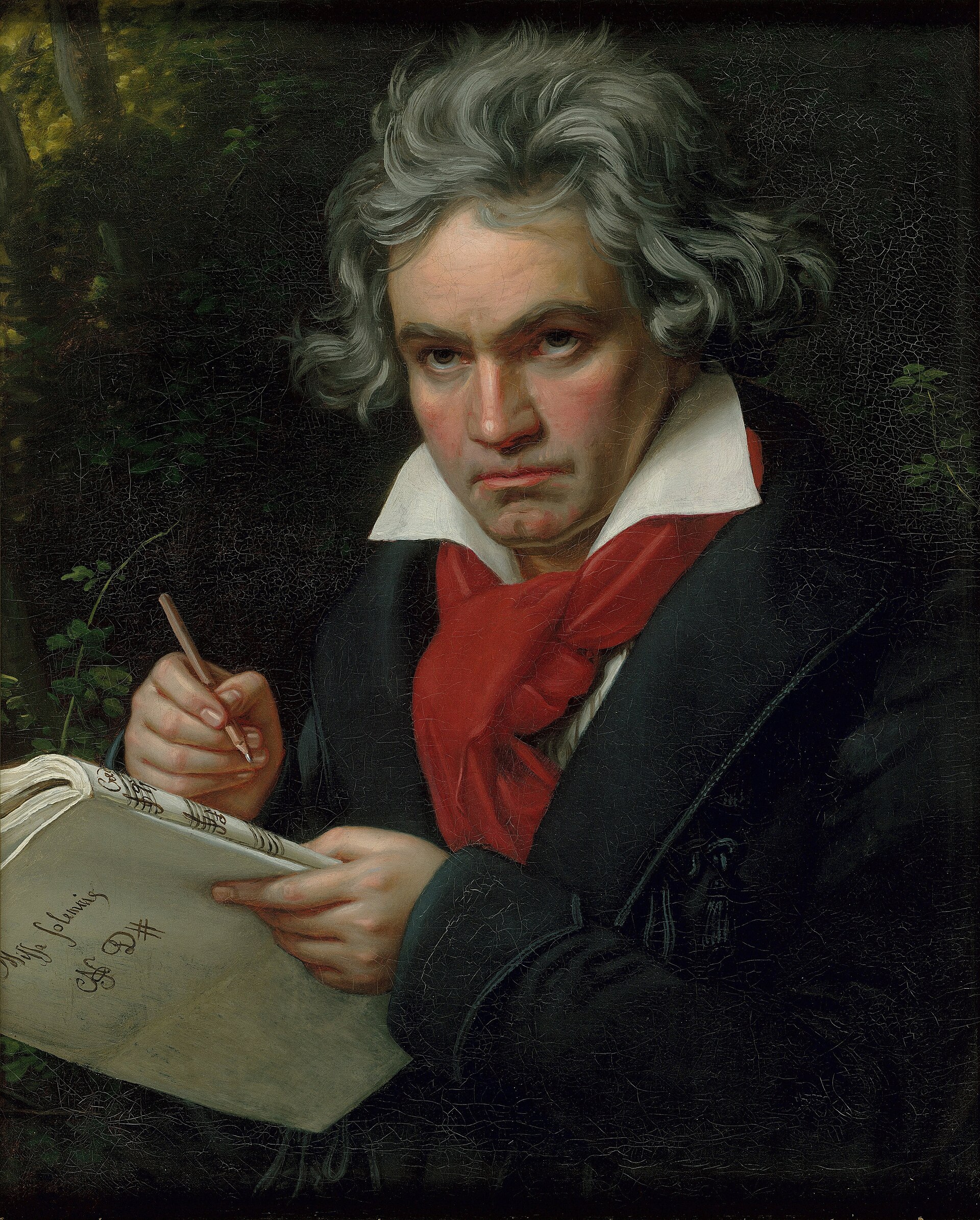
That engineering choice is why the gift suited Beethoven in particular. By 1817 he was profoundly deaf and had for some time preferred instruments capable of more volume and more percussive attack than the Viennese makers built. An English piano built to withstand force was, for a composer who could feel a piano's vibration more reliably than he could hear its tone, not a luxury gift but a practically useful one.
Chapter 3The meeting in Vienna
Thomas Broadwood travelled to Vienna in 1817, one stop on a European tour undertaken partly on the firm's business.
Thomas Broadwood travelled to Vienna in 1817, one stop on a European tour undertaken partly on the firm's business. He was introduced to Beethoven through a mutual acquaintance, a banker in Vienna named Bridi. According to the account preserved in the Broadwood firm's own papers, Beethoven was unwell when Broadwood called and declined a dinner invitation, but received him and played for him at his lodgings.
What Broadwood found was a composer of European fame who owned no piano of his own, borrowing or renting instruments from sympathetic local makers. Combined with what Broadwood already knew of Beethoven's deafness and of the greater power of London-built pianos, the visit appears to have been the direct occasion for the gift, though no single source consulted quotes Broadwood explaining his own reasoning in his own words.
Chapter 4Choosing the instrument and shipping it to Vienna
Back in London, Broadwood did not simply select a piano off the factory floor.
Back in London, Broadwood did not simply select a piano off the factory floor. He assembled five of London's most accomplished pianists and composers associated with the firm, Friedrich Kalkbrenner, Ferdinand Ries, Johann Baptist Cramer, Jacques-Godefroy Ferrari and Charles Knyvett, to choose the specific instrument that would be sent, and their names were recorded on it alongside the Latin dedication.
The sources consulted for this record do not agree on the exact dispatch date. Most popular accounts, tracing back to the same core narrative, give 27 December 1817 as the day the piano left London Docks by sailing ship for the Mediterranean and Trieste. A guide drawing on the Broadwood firm's own shipping ledger instead gives 6 October 1817 as the date of dispatch, citing a ledger line reading "Grand pianoforte...paid shipping expenses...for Mr Van Beethoven," with shipping costs of 27 pounds against total expenses of 78 pounds 16 shillings 6 pence. This record states both dates as reported rather than resolving the conflict, since no source consulted reconciles the ledger entry with the more commonly repeated December date.
What is not disputed is the route and the length of the journey: by sea into the Mediterranean as far as Trieste, where the piano waited for the Alpine passes to clear of snow, then roughly 360 miles overland by horse and cart to Vienna. It arrived in early May 1818, some five to seven months after it left London depending on which departure date is used, and it had sustained transit damage that the Viennese piano builder and Beethoven's close friend Nanette Streicher then repaired.
Chapter 5Customs, gratitude, and a documented letter
Word that the piano had been dispatched reached Beethoven in early January 1818, before the instrument itself arrived.
Word that the piano had been dispatched reached Beethoven in early January 1818, before the instrument itself arrived. His first recorded action was practical rather than sentimental: he wrote to his patron Count Moritz Lichnowsky asking him to intervene with the Austrian finance ministry so the piano could enter the country without the import duty normally charged on foreign musical instruments. The request succeeded, and a Vienna newspaper announcement of 8 June 1818 confirmed the court had waived the usual customs charges in recognition of Beethoven's standing.
Beethoven's letter of thanks to Broadwood survives and is one of the best-documented pieces of correspondence connected to any piano discussed in this archive. Writing from Vienna in early February 1818, before the instrument had physically arrived (sources give either 3 or 7 February for the exact date), he wrote: "I have never felt a greater pleasure than that which was caused me by the intimation of the arrival of this piano, with which you are honouring me as a present. I shall look upon it as an altar upon which I shall place the most beautiful offerings of my spirit to the divine Apollo. As soon as I receive your excellent instrument, I shall immediately send you the fruits of the first moments of inspiration I spend at it, as a souvenir for you from me." He signed himself Broadwood's friend and very humble servant. No source consulted records that Beethoven ever sent Broadwood the promised composition; if such a dedicated manuscript exists, it was not identified in the research for this record.
Chapter 6Beethoven's use of the piano, and what is myth
Beethoven kept the Broadwood for the rest of his life, using it at his Vienna lodgings and at Modling, where he was staying when the piano finally reached him in 1818.
Beethoven kept the Broadwood for the rest of his life, using it at his Vienna lodgings and at Modling, where he was staying when the piano finally reached him in 1818. He was, by this point, so severely deaf that even an unusually loud English piano could give him only a partial impression of its own tone. He is reported by more than one source to have had a metal frame or shell fitted above the instrument, intended to reflect or amplify sound back toward him, though this record found no museum-level technical documentation confirming that such an addition survives on the instrument or precisely when it was made; the claim rests on secondary accounts rather than a conservation report.
What can be corrected with more confidence is the popular story that Beethoven had the piano's legs removed so he could feel its vibrations through the floor. All three of Beethoven's pianos that survive today, the Broadwood in Budapest, an Erard now in Linz, and a later Graf in Bonn, still have their original legs. The story appears to be a later embellishment of a documented, more modest fact: that Beethoven, at other times and with other instruments, is recorded resting his teeth or a pencil against the piano's case to sense vibration directly, a different and better-attested habit that later writers seem to have conflated with the legs anecdote.
The claim, repeated in almost every popular account, that the Broadwood directly inspired the Hammerklavier Sonata, Op. 106, also needs qualifying. Beethoven's earliest sketches for that sonata are usually dated to around December 1817, before the piano had even left London, and the work was largely conceived for, and partly composed on, the Viennese instruments he already owned. The Broadwood arrived in Vienna while the sonata was still being finished, in its last stages of composition during 1818, so it is fair to say the piano shaped its final working-out and Beethoven's late piano writing more generally, but not that it originated the sonata's conception.
Chapter 7Death, auction, and a Viennese publisher
Beethoven died in Vienna on 26 March 1827.
Beethoven died in Vienna on 26 March 1827. His possessions, including the Broadwood, were sold at an estate auction. The buyer was C. A. Spina, a Viennese art dealer and music publisher. The sources consulted give no hammer price for the piano at this sale and no detail of Spina's own reasons for buying it beyond the general likelihood that a Beethoven relic already carried resale and reputational value in Vienna's music trade within Beethoven's own lifetime memory. Spina kept the instrument for close to two decades before parting with it.
Chapter 8Franz Liszt, an admirer with his own history with Beethoven
Spina gave the piano to Franz Liszt, most sources dating the gift to 1845, though at least one secondary account gives 1846; this record follows the majority date while noting the discrepancy.
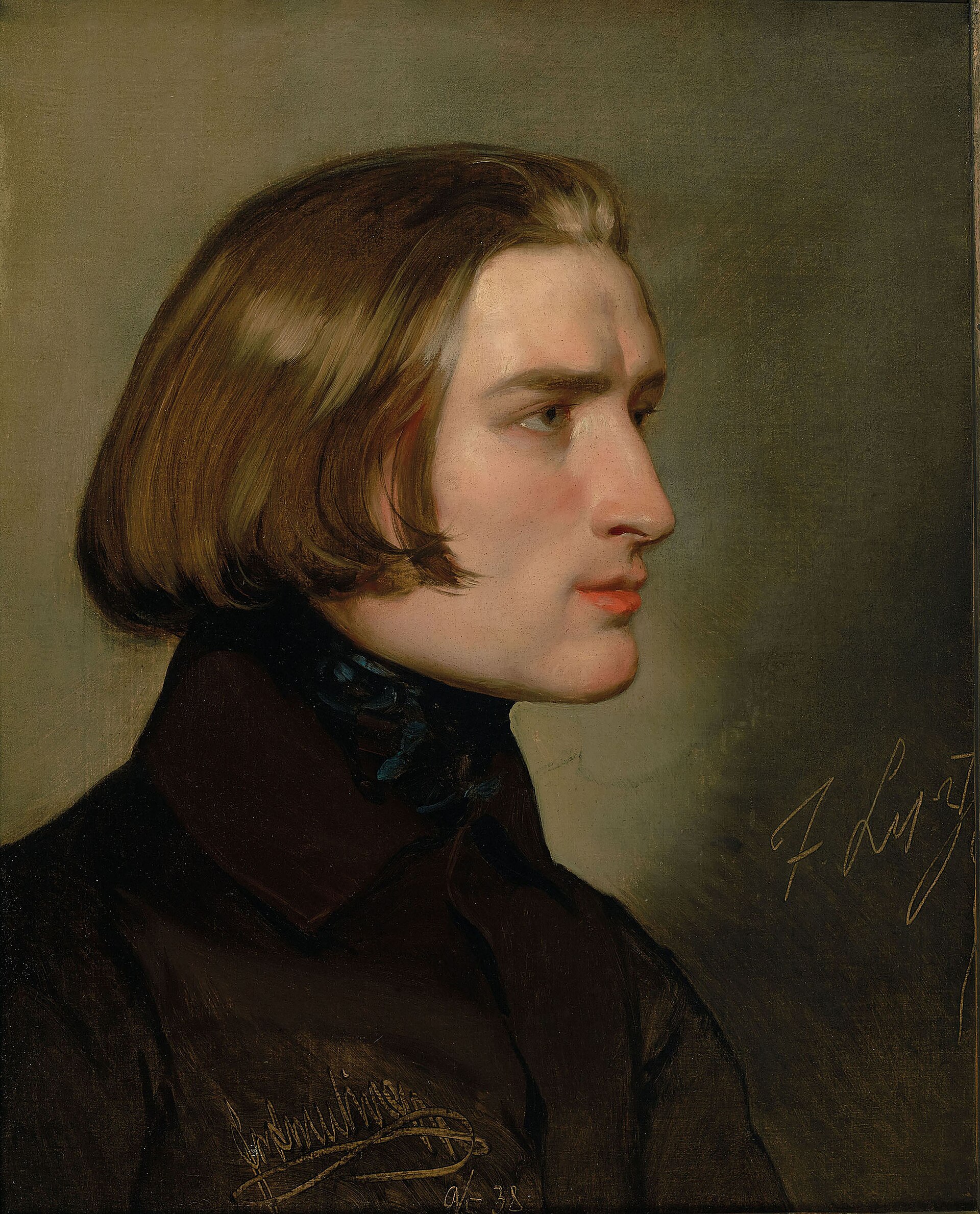
Spina gave the piano to Franz Liszt, most sources dating the gift to 1845, though at least one secondary account gives 1846; this record follows the majority date while noting the discrepancy. Liszt was an unusual recipient in one specific sense: he was one of the very few people alive by the 1840s who had a personal, if childhood, connection to Beethoven himself.
In early 1823, when Liszt was eleven, his father took him to Beethoven's Vienna apartment ahead of a concert the boy was to give. Beethoven, already deaf, communicated through the conversation books his visitors wrote in; his secretary Anton Schindler was present and later described the young Liszt to Beethoven as a true pianist, though he judged the boy's skill at improvisation still underdeveloped. The famous version of what happened next, that Beethoven attended Liszt's concert on 13 April 1823 and afterward kissed the boy's forehead in a public blessing later called the Weihekuss, is not supported by the documentary record: there is no evidence Beethoven attended the concert at all, and the kiss story was popularised decades later by the biographer Ludwig Nohl and reinforced by an 1873 lithograph. What is documented is the earlier private meeting itself, mediated through Schindler's notebook. Liszt himself never publicly denied the more romantic version and seems to have treated it, whether or not it happened exactly as told, as the symbolic beginning of his own career.
Liszt kept the Broadwood in his library in Weimar as one of his most treasured possessions and, by report, refused to play it himself, considering himself unworthy to touch the keys Beethoven had played. That reported refusal is consistent with how Liszt treated the instrument for the rest of his life: as a relic to be preserved rather than an instrument to be used.
Chapter 9From Weimar to Budapest
In 1873, in the wake of the public celebrations marking the fiftieth anniversary of his performing career, Liszt wrote to Ferenc Pulszky, curator at the Hungarian National Museum, on 3 May 1873...
In 1873, in the wake of the public celebrations marking the fiftieth anniversary of his performing career, Liszt wrote to Ferenc Pulszky, curator at the Hungarian National Museum, on 3 May 1873, pledging the Broadwood and a substantial group of his own personal relics, including laurel wreaths, a ceremonial sword, and a gold baton, to the museum as a gift to the Hungarian nation.
The pledge and the physical transfer were not the same event. Liszt continued to keep the piano with him, and it did not reach Budapest until after his death on 31 July 1886, arriving at the museum under his bequest in 1887 (the museum's own published account gives September 1887 as the arrival month). Some secondary sources round this to a donation date of 1874, apparently conflating the year of the pledge letter with the year of physical delivery; this record treats 1873 as the date of Liszt's documented commitment and 1887, per the museum's own account, as the date the instrument actually entered the collection.
Chapter 10Condition, restoration, and an unresolved present
The piano was restored to playing condition in 1991-92 by David Winston of the Period Piano Company, a British firm specialising in the conservation of historic keyboard instruments (Winston later...
The piano was restored to playing condition in 1991-92 by David Winston of the Period Piano Company, a British firm specialising in the conservation of historic keyboard instruments (Winston later also restored Chopin's Pleyel piano, now in the Cobbe Collection). Following that restoration, the instrument, on loan from the Hungarian National Museum, was taken on a European tour by the fortepianist Melvyn Tan through cities including Vienna, Bonn, Bath, London and Budapest, and the tour produced a 1992 EMI recording titled The Beethoven Broadwood Fortepiano. A separate recording by the pianist Andras Schiff, released on the Hungarian label Hungaroton in 1994, was also made on the instrument in the museum, performing late Beethoven bagatelles.
That run of activity through the early-to-mid 1990s establishes that the piano was in genuinely playable, touring condition for at least several years after its restoration. Against that, a 2018 article marking the bicentenary of the piano's arrival in Vienna states plainly that Beethoven's original instrument, now in Hungary's National Museum, is no longer in playing condition, and that anniversary concerts of the period used a modern replica on loan from the Royal Academy of Music's Richard Burnett Heritage Collection rather than the original. No source consulted explains what changed between the 1990s recordings and 2018, whether further deterioration, a conservation decision to stop playing it, or something else. This record states the 1990s playable condition and the 2018 description of it as unplayable as both true of their respective dates, and leaves the transition between them as an open question rather than guessing at a cause.
No organological condition report, describing which parts of the instrument (strings, hammers, action, soundboard) are original to 1817-18 and which have been replaced across two centuries of use, transit damage, repair by Nanette Streicher, and the 1991-92 restoration, was located in the sources consulted for this record. That is a genuine gap rather than a settled fact of originality, and it is recorded as such.
Chapter 11What the piano is now
The instrument is held today by the Hungarian National Museum in Budapest as part of its historical collections, described by the museum itself as one of its most treasured possessions since Liszt's...
The instrument is held today by the Hungarian National Museum in Budapest as part of its historical collections, described by the museum itself as one of its most treasured possessions since Liszt's bequest arrived in 1887. It is generally shown as part of the museum's permanent historical exhibition rather than kept in storage, though this record found no source giving a current gallery number or confirming its display status independent of any renovation the museum may be undergoing.
Its meaning has shifted twice since it left Broadwood's workshop. It was made as a working instrument and a piece of commercial and technical showmanship, proof of what English piano engineering could do, sent to the most famous composer in Europe partly as an advertisement for the firm. Beethoven used it as a tool, adapted, however imperfectly, to a body that could no longer hear it properly. By the time it reached Liszt it had already become something closer to a saint's relic: an object valued not for what it could still do but for whose hands had once been on it, kept unplayed by a man who considered himself unworthy to play it. The museum has, since 1887, held both of those identities at once, alternately restoring the instrument to sound and displaying it in silence.
The artist
John Broadwood and Sons, London (acting principal: Thomas Broadwood, 1786-1861); instrument's owner and namesake: Ludwig van Beethoven, 1770-1827
This record's subject has two people behind it rather than one, and the spec's usual single-artist dossier does not quite fit an object that is neither wholly defined by its maker nor by its most famous owner. John Broadwood and Sons was, by 1817, the largest and most industrially advanced piano manufactory in Europe, and Thomas Broadwood, the partner who arranged the gift, acted as much as a patron and admirer as a businessman when he sent an instrument to a composer who had not asked for one. Beethoven, the piano's most famous owner, shaped what the object means as much as its maker did: it is a footnote in Broadwood's firm history and one of three surviving physical traces of how a profoundly deaf composer kept working at the piano at all.
Exhibited
- 1887-presentPermanent historical exhibitionHungarian National Museum, Budapest
- 1991-1992European concert tour on the restored instrument, with fortepianist Melvyn TanVienna, Bonn, Bath, London, Budapest
Related works
| Work | Relation | Where it is |
|---|---|---|
| Beethoven's Erard piano, 1803 Sebastien Erard | A different, earlier piano owned by Beethoven; not the Broadwood, and facts about one must not be transferred to the other. One of the three Beethoven pianos to survive; French-made, given to him fourteen years before the Broadwood. | Museum, Linz, Austria |
| Beethoven's Graf piano Conrad Graf | A later Viennese piano Beethoven owned in his final years, associated in some accounts with an added hearing aid; distinct from the Broadwood. The third of the three surviving Beethoven pianos, alongside the Erard and this Broadwood. | Beethoven-Haus, Bonn |
| Broadwood and Sons Grand Fortepiano, 1823 John Broadwood and Sons | A different, later Broadwood grand from the same firm, of comparable type but a wider keyboard compass; not the Beethoven instrument. Useful direct comparison for Broadwood's construction methods in this period, but a separate instrument with its own history. | Beethoven Center, San Jose State University |
| Broadwood grand piano no. 4553, 1809 John Broadwood and Sons | This is NOT the piano described in this record. A separate, earlier Broadwood grand restored and documented by Early Music Studio, included here only to prevent the two being confused. Cited in restoration literature that also references the Beethoven Broadwood in passing; the two instruments are unrelated beyond sharing a maker. | Private ownership |
Open questions
- Which dispatch date is correct: 27 December 1817, as almost every popular account states, or 6 October 1817, as a Broadwood shipping ledger cited by the Surrey History Centre records? No source consulted reconciles the two.
- Did Beethoven actually have a metal shell or frame fitted above the piano to amplify or reflect sound toward him, as more than one secondary source reports, or is this a later embellishment? No conservation or museum-level technical source confirms the addition survives on the instrument.
- Was the piano given to Liszt by Spina in 1845 or 1846? The majority of sources consulted give 1845, but at least one gives 1846, and none of the sources consulted explains the discrepancy.
- What happened to the instrument's playing condition between the mid-1990s, when it was toured and recorded, and 2018, when a source describes it as no longer playable? No source consulted documents an intervening deterioration, damage, or conservation decision.
- What proportion of the surviving instrument (strings, hammers, action, soundboard) is original to 1817-18, and what has been replaced across Nanette Streicher's original repair, later use, and the 1991-92 restoration? No organological condition report was located.
- Is the workshop serial number 7,632, given in one source, correct? It was not corroborated against a second, independent source.
- What became of the promised composition Beethoven told Broadwood in his 1818 letter he would send as a personal souvenir? No source consulted identifies a surviving manuscript answering that promise.
- What price, if any, is recorded for C. A. Spina's purchase of the piano at Beethoven's 1827 estate auction? None was found in the sources consulted.
Questions about this object
What is Grand Piano by John Broadwood and Sons?
Grand Piano by John Broadwood and Sons is a musical instrument, dated 1817-1818 (built and shipped from London, 1817; delivered to Beethoven in Vienna, May 1818). Medium: Wood (mahogany case) over an iron-braced timber frame, wire-strung, with English grand action; six-octave keyboard compass.
Who made Grand Piano by John Broadwood and Sons, and is the attribution settled?
The attribution to John Broadwood and Sons (Thomas Broadwood) is recorded here as accepted. Maker not in dispute. The instrument carries a Latin dedication naming Thomas Broadwood as donor, its arrival is confirmed by Beethoven's own thank-you letter of February 1818, and its identity as the piano now in the Hungarian National Museum is unbroken through documented custody: Beethoven, the Spina purchase at his 1827 estate sale, Liszt's ownership from 1845, and Liszt's bequest to the museum, received in 1887.
Where is Grand Piano by John Broadwood and Sons now?
Hungarian National Museum, Budapest. Inventory number Not published in the sources consulted for this record. Last confirmed 18 August 2026. Received by the museum in 1887 under the bequest of Franz Liszt, who had pledged it and other personal relics to the museum's curator Ferenc Pulszky in a letter of 3 May 1873.
What has Grand Piano by John Broadwood and Sons sold for?
Hammer Not published in the sources consulted; with premium, Not published in the sources consulted. Beethoven's estate auction, Vienna, 1827.
What is still unknown about Grand Piano by John Broadwood and Sons?
Which dispatch date is correct: 27 December 1817, as almost every popular account states, or 6 October 1817, as a Broadwood shipping ledger cited by the Surrey History Centre records? No source consulted reconciles the two.
Sources
- 1Hungarian National Museum (Magyar Nemzeti Muzeum), "Collection of Musical Instruments," official museum page, describing the Broadwood piano's provenance and 1887 acquisition. mnm.hu/en/...
- 2Ludwig van Beethoven, letter to Thomas Broadwood, Vienna, February 1818, transcribed at Piano History Online (piano-tuners.org). piano-tuners.org/history/...
- 3Anett Fodor, "Exceptional Provenance: the story of Beethoven, Liszt and the Little Broadwood," Classical Music Daily, 3 April 2020. classicalmusicdaily.com/2020/...
- 4University of St Andrews Museums Collections Blog, "Beethoven - Two men and a fortepiano," 2 February 2018. university-collections.wp.st-andrews.ac.uk/2018/...
- 5Surrey History Centre (Surrey County Council), "Beethoven Broadwood Piano Bicentenary, 1818 to 2018," piano manufacturers research guide, citing the Broadwood shipping ledger. surreycc.gov.uk/culture-and-leisure/...
- 6San Jose State University Beethoven Center, "Broadwood & Sons Grand Fortepiano." sjsu.edu/beethoven/...
- 7Beethoven-Haus Bonn, "Beethoven and Great Britain," online exhibition. internet.beethoven.de/en/...
- 8Wikipedia, "John Broadwood and Sons." source; with a firm history or trade catalogue where available. en.wikipedia.org/wiki/...
- 9Gatwick City Times, "The Broadwood Family and Beethoven," 13 July 2017, local history blog on Thomas Broadwood and the Holmbush estate. gatwickcitytimes.wordpress.com/2017/...
- 10Piano History Online (piano-tuners.org), "250 Years in the History of Broadwood Pianos" (Wilkinson). piano-tuners.org/history/...
- 11Wikipedia, "Period Piano Company," on David Winston and the 1991-92 restoration. en.wikipedia.org/wiki/...
- 12Classic FM, "Listen to Beethoven's epic 'Hammerklavier' Sonata, played on the composer's own piano." classicfm.com/composers/...
- 13notesfromapianist, "It started with a kiss - or did it? Liszt and Beethoven meet in Vienna," 15 February 2020, drawing on Alexander Wheelock Thayer's Life of Beethoven and Anton Schindler's conversation-book transcriptions. notesfromapianist.wordpress.com/2020/...
- 14Skagit Symphony, "Beethoven's Pianos," on the surviving Erard, Broadwood and Graf instruments and the debunked piano-legs legend. skagitsymphony.com/beethovens-pianos
- 15Wikipedia, "Piano Sonata No. 29 (Beethoven)," for the Hammerklavier's composition chronology. en.wikipedia.org/wiki/...
- 16XpatLoop, "The Piano Once Belonged To Beethoven And Liszt On Display In National Museum In Budapest," 2012. xpatloop.com/channels/...
- 17The Cross-Eyed Pianist, "Broadwood Pianos celebrates 200th anniversary of giving Beethoven the piano that inspired his late piano sonatas," 27 April 2018. crosseyedpianist.com/2018/...
- 18Popular Beethoven, "Beethoven's Broadwood piano." popularbeethoven.com/beethovens-broadwood-piano
- 19Wikimedia Commons file page and metadata, "File:Budapest, Hungarian National Museum, Broadwood piano once belonging to Beethoven and Liszt.jpg," photograph by Dguendel, CC BY 4.0. commons.wikimedia.org/wiki/...
- 20Wikimedia Commons file page and metadata, "File:Joseph Karl Stieler's Beethoven mit dem Manuskript der Missa solemnis.jpg," public domain. commons.wikimedia.org/wiki/...
- 21Wikimedia Commons file page and metadata, "File:Portrait of Franz Liszt by Friedrich von Amerling.jpg," public domain. commons.wikimedia.org/wiki/...
- 22Early Music Studio, "The Broadwood Restoration in Photos," documenting a different Broadwood grand (no. 4553, 1809), cited here only to distinguish that instrument from the Beethoven Broadwood. earlymusicstudio.com/library/...


Last verified · Published
Change log
18 August 2026 - Record created at the house standard: researched narrative, technical evidence, maker dossier, graded provenance chain, prices with hammer and premium separated, related works, open questions and sources.