The Jaquet-Droz Automata (The Writer, The Draughtsman, The Musician)
Jaquet-Droz and Leschot workshop (Pierre Jaquet-Droz, Henri-Louis Jaquet-Droz and Jean-Frederic Leschot) · 1768-1774
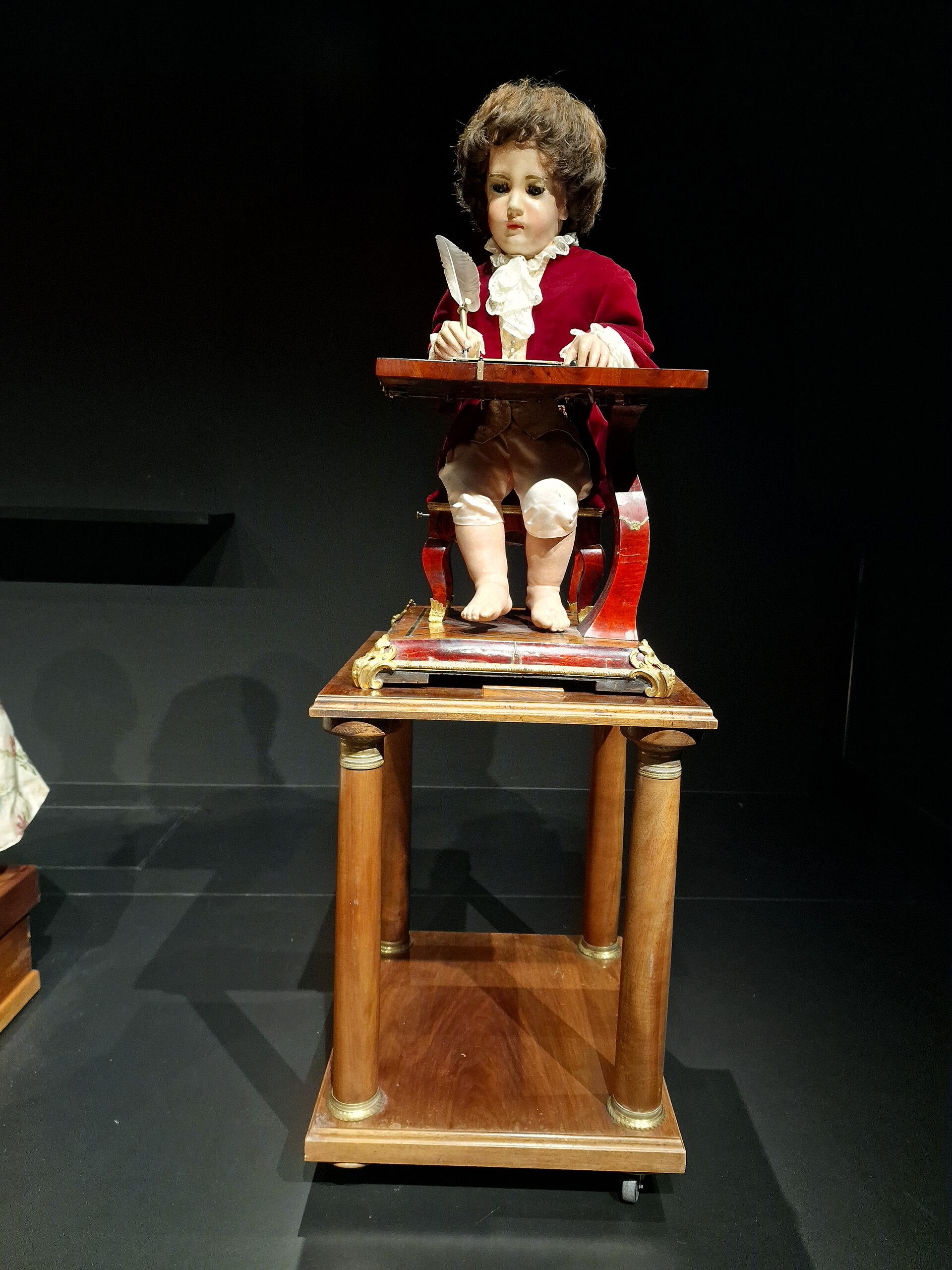
The Writer, photographed at the Musee d'Art et d'Histoire, Neuchatel, 30 July 2023. Approximately 70 cm high, its mechanism of roughly 6,000 components lets an operator set any text of up to forty characters using interchangeable cams.
Photograph by Gre regiment, via Wikimedia Commons · CC BY-SA 4.0| Artist | Jaquet-Droz and Leschot workshop (Pierre Jaquet-Droz, Henri-Louis Jaquet-Droz and Jean-Frederic Leschot) |
|---|---|
| Date | 1768-1774 |
| Medium | Brass, steel and wood mechanism housed inside articulated figures dressed in eighteenth-century court costume |
| Dimensions | The Writer approximately 70 cm high, seated. Comparable published dimensions for the Draughtsman and the Musician were not found in the sources consulted. |
| Where it is now | Musee d'Art et d'Histoire, Neuchatel, Switzerlandlast confirmed |
| Inventory number | Not published in the sources consulted |
| Attribution | AcceptedAll three automata are accepted as products of the joint workshop of Pierre Jaquet-Droz, his son Henri-Louis Jaquet-Droz, and their associate and informally adopted family member Jean-Frederic Leschot, built at La Chaux-de-Fonds between 1768 and 1774. Full note |
| Object type | Clocks and instruments |
| Period | Swiss, eighteenth century (Enlightenment) |
| Cases | Has a provenance gap |
| Inscriptions | None of the three automata carries an inscribed signature in the ordinary sense. Their own output functions as the closest equivalent: the Writer's handwritten text, set by the operator before each performance, and the Draughtsman's four fixed drawings, described under Technical below. |
| Owners on record | 6 links5 documented, 1 unknown |
| Sources | 19 cited |
About this record Last verified · 19 sources cited · Change log
On this page 9 sections
ContentsClose
Three life-sized mechanical figures built at La Chaux-de-Fonds between 1768 and 1774 by the watchmaker Pierre Jaquet-Droz, his son Henri-Louis, and their associate Jean-Frederic Leschot: a boy who writes any programmed text up to forty characters, a boy who draws four fixed pictures, and a young woman who plays a real pipe organ with her own fingers while her chest appears to breathe. Toured before European courts as advertisements for the family's watchmaking business, sold together with a fourth, now-lost automaton in 1787, and untraceable for well over a century afterward, the three survivors were bought by a Neuchatel historical society in 1906 and have belonged to the city's Musee d'Art et d'Histoire since 1909, where all but the Writer are still wound and demonstrated for the public.
They are treated today as an early landmark in the history of programmable machines: the Writer's set of interchangeable cams, one for each possible character, is a mechanical read-only memory that a period visitor could reconfigure to make the boy write a different message. That claim on the automata's importance rests on documented mechanism, not on hindsight alone.
Provenance
Each link is graded. Documented: a cited source supports it. Disputed: the identification is argued but not established. Unknown: no owner for that span, and the gap is not smoothed into a narrative. The grades in the glossary.
- 1768 - 1774Workshop of Pierre Jaquet-Droz, Henri-Louis Jaquet-Droz and Jean-Frederic Leschot, La Chaux-de-Fondsdocumented
Built over six years and first shown to the public at La Chaux-de-Fonds in 1774, alongside a fourth automaton, La Grotte, since lost. Sources agree on the three-name attribution to the workshop as a whole; they do not fully agree on which of the three men is individually credited with the Musician versus the Draughtsman.1593
- 1774 - 1787The Jaquet-Droz and Leschot workshop, touringdocumented
Shown at La Chaux-de-Fonds and Geneva, then presented in Paris by 1775, where Jean-Frederic Leschot is specifically recorded (Dictionnaire historique de la Suisse) as the family member who most often carried the automata abroad and who was received at the French court. A separately documented "Mechanical Spectacle" ran in Paris in 1775 and in London between 1775 and 1777. Claims that the three androids themselves also appeared before the Spanish court were not independently confirmed and are not treated as established here.4712
- 1787 - 1787The Gendre brothers, Madriddocumented
All four automata, including La Grotte, sold together to the Gendre brothers of Madrid in 1787. Reported via the French Wikipedia account of the automata, which is a tertiary source and is flagged here for replacement with an archival or scholarly citation.2
- 1787 - 1906Unrecordedunknown
Described in the same tertiary source as a nomadic period in which the automata were repeatedly sold and lost track of. No continuous ownership chain for the three surviving androids was found for this period of roughly 119 years. La Grotte is believed, on a later historian's inference rather than on direct record, to have broken down and been discarded somewhere within this span.27
- 1906 - 1906Societe d'histoire et d'archeologie du canton de Neuchateldocumented
Purchased the three surviving automata in 1906 for 75,000 gold francs. The seller is not named in the sources consulted.135
- 1909 - presentCity of Neuchatel, Musee d'Art et d'Histoiredocumented
The Society gave the three automata to the City of Neuchatel on 1 May 1909. They have remained in the museum's keeping since, with what the museum itself describes as almost no interruption, and two of the three are still demonstrated to the public on a published schedule.35
Technical evidence
| Attribution note | All three automata are accepted as products of the joint workshop of Pierre Jaquet-Droz, his son Henri-Louis Jaquet-Droz, and their associate and informally adopted family member Jean-Frederic Leschot, built at La Chaux-de-Fonds between 1768 and 1774. No serious source disputes the three-name attribution. What sources do not agree on is the internal division of labour: the workshop's own modern successor company and the museum's own published account both credit the Writer to Pierre Jaquet-Droz, but differ on how much of the Musician and the Draughtsman belongs to Henri-Louis Jaquet-Droz alone versus jointly with Leschot. This record reports the variance rather than choosing between the accounts. |
|---|---|
| Materials and construction | Brass, steel and wood mechanisms concealed entirely within the bodies of three articulated figures dressed in eighteenth-century court costume. In the Writer, every gear, cam and cam follower needed to control the hand, wrist and head sits inside the torso.15 |
| The Writer: mechanism | Reported at approximately 6,000 individual components; at least one specialist horological source gives a lower figure of roughly 4,000 for the same machine. Approximately 70 cm high, seated.1516 |
| The Writer: programming and output | A set of interchangeable steel cams, one per available character, lets an operator select and order up to forty characters across three lines before the automaton runs. The figure dips a goose-quill pen in an inkwell, shakes it, and writes the chosen text, moving its eyes and head to follow the pen.116 |
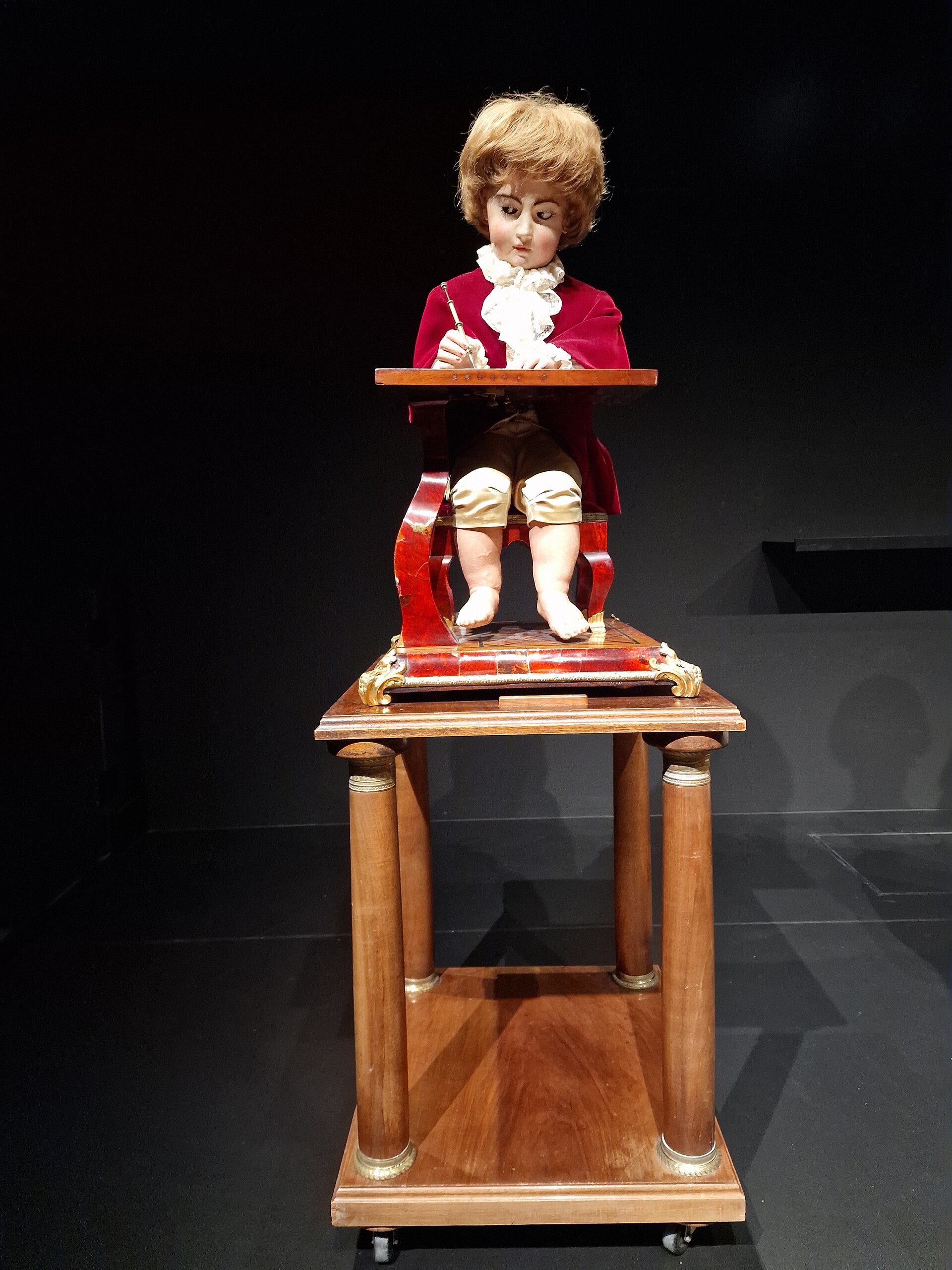
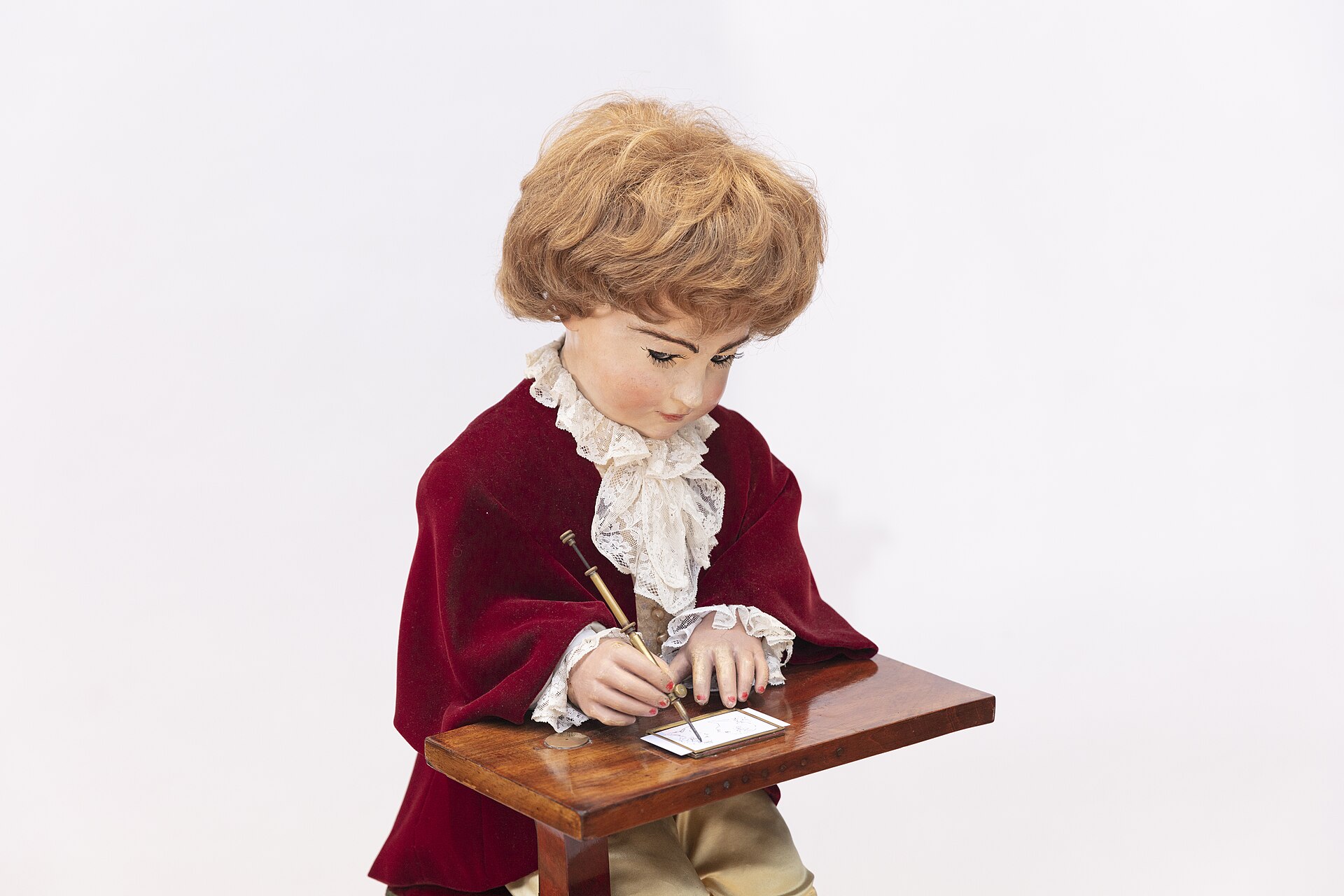
| The Draughtsman: mechanism | Approximately 2,000 components. A cam system codes pencil movement in two dimensions, plus a third cam that lifts the pencil between strokes.1 |
| The Draughtsman: repertoire | Four fixed drawings: a portrait of Louis XV; a royal couple generally identified as Louis XVI and Marie-Antoinette; a dog beside the caption Mon toutou (my doggy); and Cupid riding in a chariot drawn by a butterfly. The repertoire is fixed, unlike the Writer's programmable text.14 |
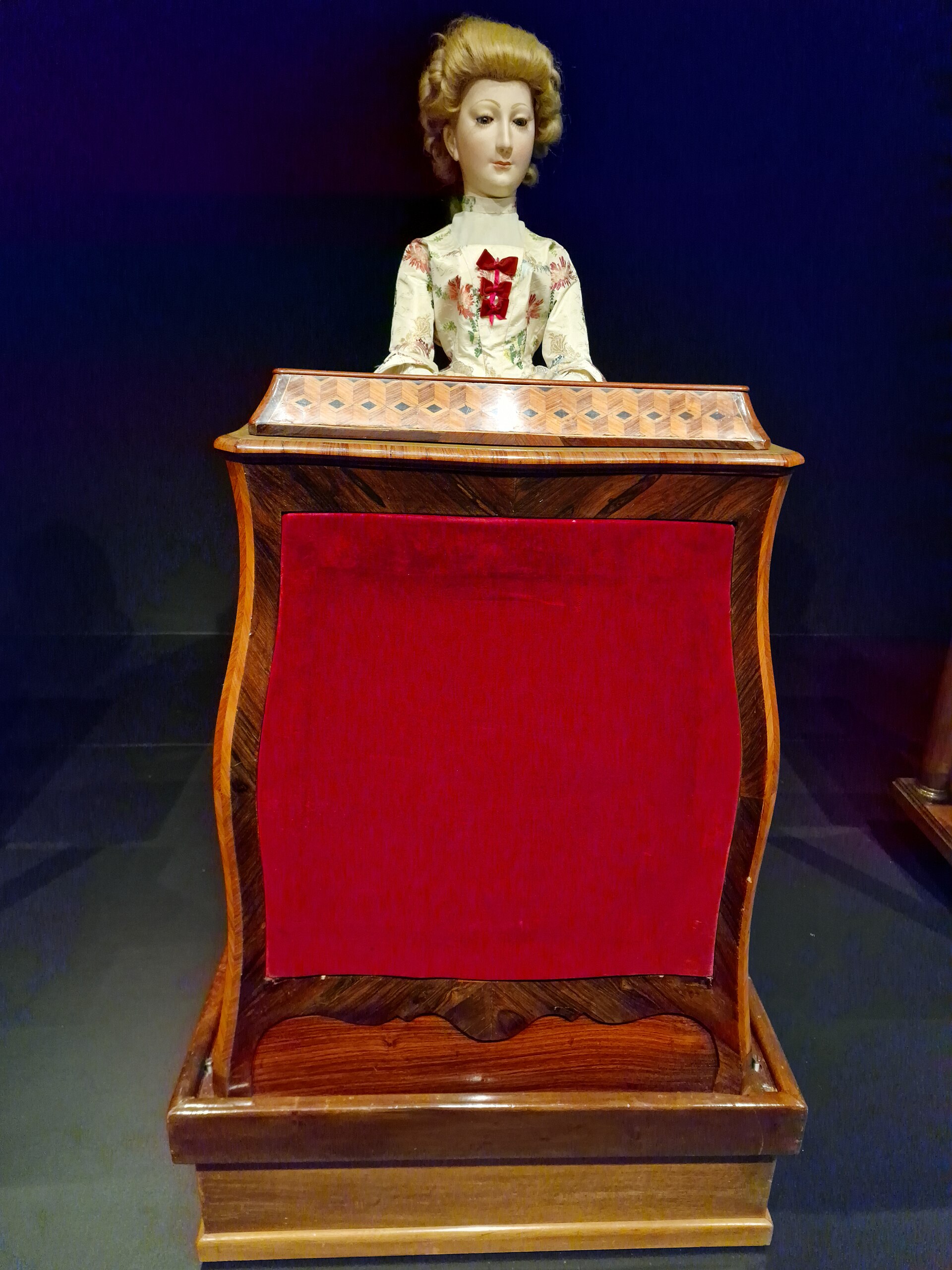
| The Musician: mechanism | Approximately 2,500 components, built around a genuine small pipe organ played by the figure's own fingers, not a concealed music box. The chest rises and falls to simulate breathing; the head and eyes track the hands while playing.15 |
| The Musician: repertoire | Five tunes, played on the organ built into the figure.1 |
| Current mechanical condition (as of this record) | The Musician and the Draughtsman remain in working order and are demonstrated for the public on a published schedule, generally the first Sunday of most months. The Writer is currently out of service, which the museum attributes to a defective part and an unresolved technical problem requiring several specialists to address.3 |
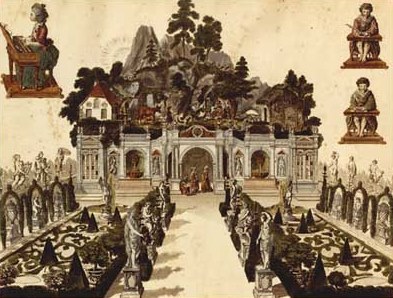
| La Grotte (lost, comparanda only) | A fourth automaton of the same commission, under one square metre in footprint, depicting a moving pastoral scene: livestock, a peasant travelling to a mill, a flute-playing shepherd with an echo effect, a shepherdess with a guitar, dancers, fountains and an aviary of singing birds. Known today only from a 1776 engraving by Balthasard Anton Dunker, completed by F. Lardy, and from a descriptive 1784 exhibition poster. Not extant and not photographed; included here for context, not as part of the object this record describes.67 |
Images
The record in full
Chapter 1Three machines built to look like people
The Jaquet-Droz automata are three separate mechanical figures, each close to life size, each built to perform one specific human skill with no assistance: writing, drawing, and playing music.
The Jaquet-Droz automata are three separate mechanical figures, each close to life size, each built to perform one specific human skill with no assistance: writing, drawing, and playing music. They are conventionally named for what they do. The Writer is a seated boy of about 70 cm who dips a real quill in real ink and writes a text of up to forty characters across three lines, choosing his own moment to shake excess ink from the pen before he starts. The Draughtsman is a boy who holds a pencil and produces one of four fixed drawings. The Musician is a young woman seated at a small organ who presses the keys herself, with her fingers, to produce real notes from a genuine built instrument rather than a hidden music box, while her chest rises and falls and her head and eyes follow her own hands.
Each figure conceals its entire mechanism inside its own body. In the Writer, every gear, cam and cam follower needed to steer the hand, wrist, and eyes sits inside the torso, which is part of why period audiences and some later writers described the three figures as androids rather than simply automata: the machinery does not merely operate the figure from outside, it is built to inhabit it.
Chapter 2Who built which one: a genuine, unsettled question
The firm responsible is universally given as three names: Pierre Jaquet-Droz, his son Henri-Louis Jaquet-Droz, and Jean-Frederic Leschot, a neighbor's son whom Pierre took in and treated as an...
The firm responsible is universally given as three names: Pierre Jaquet-Droz, his son Henri-Louis Jaquet-Droz, and Jean-Frederic Leschot, a neighbor's son whom Pierre took in and treated as an adoptive son after the boy's mother died. All three names appear on every serious account of the automata's origin, and no source disputes that the three men worked together on this project at La Chaux-de-Fonds between 1768 and 1774.
Where accounts genuinely diverge is on which of the three automata belongs to which man. One detailed horological history credits the Writer to Pierre Jaquet-Droz, begun in 1768 and already assisted by Leschot, and credits both the Musician and the Draughtsman, built 1772 to 1774, to Henri-Louis Jaquet-Droz assisted again by Leschot. The Neuchatel museum's own published account agrees that the Writer is Pierre's and that the Musician is a joint work of Henri-Louis and Leschot, but is silent on a separate credit for the Draughtsman. Neither source calls the other wrong; they simply report the internal division of labour differently, which is itself a fact about how thin the documentary record on workshop practice is. The Dictionnaire historique de la Suisse adds a distinct and more concrete data point: it records that Leschot, rather than either Jaquet-Droz, was the one frequently sent abroad to present the finished automata, including at the French court, where he is recorded as having met Marie-Antoinette. Construction credit and public-facing credit may therefore belong to different men, and this record does not resolve that gap by picking a version.
Chapter 3The Writer
The Writer's mechanism is reported at roughly 6,000 individual components, though at least one horological account puts the figure nearer 4,000; both numbers describe the same machine and neither has...
The Writer's mechanism is reported at roughly 6,000 individual components, though at least one horological account puts the figure nearer 4,000; both numbers describe the same machine and neither has been independently verified in the sources consulted. Its core is a set of interchangeable steel cams, one governing each character the boy is capable of forming, arranged so that an operator can select and order up to forty letters across three lines before the automaton runs. Running the program, the boy dips his goose-quill pen in an inkwell, shakes it, and writes the chosen text letter by letter on paper set before him on a small mahogany table, moving his eyes and head to follow the pen as he works.
Because the character set is swappable rather than fixed, the Writer is regularly cited in histories of computing as an early physical example of programmability: the cams function as a read-only memory that a period owner could reconfigure between performances, which is a meaningfully different claim from an automaton that always repeats the same single action.
Chapter 4The Draughtsman
The Draughtsman uses a comparable cam system adapted to two dimensions: cams coding horizontal and vertical pencil movement, plus a third cam that lifts the pencil clear of the paper between strokes.
The Draughtsman uses a comparable cam system adapted to two dimensions: cams coding horizontal and vertical pencil movement, plus a third cam that lifts the pencil clear of the paper between strokes. Unlike the Writer, its repertoire is fixed rather than programmable. It produces four drawings: a portrait of Louis XV; a royal couple generally identified as Louis XVI and Marie-Antoinette; a dog beside the words "Mon toutou" (my doggy); and a scene of Cupid riding in a chariot drawn by a butterfly. The mechanism is reported at roughly 2,000 components.
Chapter 5The Musician
The Musician is built around roughly 2,500 components and around a genuine small pipe organ rather than a music box concealed behind a keyboard.
The Musician is built around roughly 2,500 components and around a genuine small pipe organ rather than a music box concealed behind a keyboard. She presses the organ's keys herself, with her own fingers, to produce five tunes, and the figure was built to simulate the physical experience of playing rather than merely the sound of it: her chest rises and falls to suggest breathing, and her head and eyes track her hands as she plays. Of the three automata, the Musician is the one most often singled out in later scholarship, including Adelheid Voskuhl's study of eighteenth-century android automata, as a machine built specifically to perform the appearance of an interior life, breath and attention, rather than only the mechanical result of music.
Chapter 6The lost fourth automaton: La Grotte
The three androids were not the workshop's only large automaton of this campaign.
The three androids were not the workshop's only large automaton of this campaign. A fourth piece, known as La Grotte (The Grotto), was completed at the same time and, according to the early twentieth-century history of the firm by Charles Perregaux and F. Louis Perrot, was expected to have been at least as complicated as the three human figures. It survives today only as a description and a single engraving, drawn in England, engraved by Balthasard Anton Dunker, and completed by F. Lardy in 1776, held at the Neuchatel museum alongside the three automata it once travelled with.
A poster advertising the piece in Lyon in 1784 describes a small Renaissance-style architectural base, under a metre square, overlooking a moving pastoral scene: a cow, calf, goats, sheep and a dog; a peasant riding a donkey toward a mill; a shepherd playing a flute with an echo effect; a shepherdess with a guitar; a peasant woman playing a tympanum while two women dance; cascades and fountains; and an aviary of singing birds. Perregaux and Perrot's own account of its disappearance is cautious rather than certain: they judge it probable that a mechanism of that complexity, once it broke down, was never repaired and was left to decay in an attic. That is a documented historian's inference, not a documented event, and this record treats it as such.
Chapter 7On the road: Geneva, Paris, London
The three androids and La Grotte were first shown to the public at La Chaux-de-Fonds in 1774.
The three androids and La Grotte were first shown to the public at La Chaux-de-Fonds in 1774. From there the workshop took its creations on what amounted to a travelling advertisement for its watchmaking business, moving first to Geneva. By 1775 the automata had reached Paris, where multiple independent accounts, including the workshop's own successor company, place a presentation before the French court. The Dictionnaire historique de la Suisse specifically credits Jean-Frederic Leschot with being the family member most often sent abroad to present the automata, and records that in this capacity he was received at the French court and met Marie-Antoinette.
From Paris the tour continued to London, where a specialised history of European automaton exhibitions records a "Mechanical Spectacle" organised by Henri-Louis Jaquet-Droz and Leschot running in Paris in 1775 and in London between 1775 and 1777. Popular accounts of the tour also place the automata before the Spanish court and at courts further afield; this record has not been able to verify those specific stops against a source independent of promotional company history, and does not repeat them as established fact. What is separately well documented, and easy to confuse with a court tour of the three androids, is that Pierre Jaquet-Droz himself had already travelled to Spain in 1758, nearly a decade before this project began, to present ordinary clocks fitted with simpler automata, including a mechanical dog that famously startled King Ferdinand VI, to the Spanish court. That earlier, solo journey funded Pierre's later work; it is not evidence that the Writer, the Draughtsman or the Musician themselves were ever exhibited in Spain.
Chapter 8Sold together in Madrid, then lost to the record for over a century
The clearest documented ownership event between the workshop and the modern museum is a sale in 1787: the French Wikipedia's account of the automata, itself flagged here as a tertiary source pending...
The clearest documented ownership event between the workshop and the modern museum is a sale in 1787: the French Wikipedia's account of the automata, itself flagged here as a tertiary source pending replacement with an archival record, states that all four automata, including La Grotte, were sold together that year to the Gendre brothers of Madrid. The same account describes what followed as a nomadic existence in which the automata were repeatedly sold and lost track of, and it is in this period that La Grotte is believed, on Perregaux and Perrot's inference rather than on direct record, to have finally broken down beyond repair.
What is not recorded anywhere found in this research is a continuous chain of ownership for the three surviving androids between 1787 and 1906. That gap runs to roughly a century and a fifth, and this record states it as a gap rather than smoothing over it with plausible guesses.
Chapter 9Neuchatel, 1906 to the present
The automata resurface in the documentary record in 1906, when the Societe d'histoire et d'archeologie du canton de Neuchatel purchased the three surviving figures for 75,000 gold francs.
The automata resurface in the documentary record in 1906, when the Societe d'histoire et d'archeologie du canton de Neuchatel purchased the three surviving figures for 75,000 gold francs. From whom the Society bought them is not stated in the sources consulted. The Society then gave the automata to the City of Neuchatel on 1 May 1909, and they have belonged to the city's museum, now the Musee d'Art et d'Histoire, ever since, with what the museum itself describes as almost no interruption in that custody.
The museum still winds and operates two of the three automata for the public on a published schedule, generally the first Sunday of most months. The third, the Writer, is at present not in working order: the museum's own current account states plainly that it is out of service because of a defective part and an unresolved technical problem, and that returning it to operation will require several specialists working together. That is a live, dated fact about the object's condition rather than a historical one, and it is worth recording precisely because most popular writing about the automata still describes all three as demonstrably functional.
Chapter 10A landmark read backward from the history of computing
The Writer's swappable character cams are the reason these automata sit as often in histories of computing as in histories of clockmaking.
The Writer's swappable character cams are the reason these automata sit as often in histories of computing as in histories of clockmaking. A set of read-only mechanical instructions that a human operator can select and reorder before each run is, at the level of the concept rather than the electronics, the same idea later realised in the punched cards of Jacquard looms and, further downstream, in early stored-program computers. This record states that resemblance as a structural one recognised by later historians, not as a claim that the Jaquet-Droz workshop was working toward computing in the modern sense; nothing in the sources consulted suggests Pierre Jaquet-Droz, Henri-Louis Jaquet-Droz or Leschot understood their programmable cam as anything other than a way to vary the entertainment on offer and to demonstrate their firm's mechanical range to potential watch buyers.
The same workshop's ordinary business, selling elaborate singing-bird and musical clocks to European and, through the London merchant house of James Cox, Chinese markets, is the commercial context the three androids were built to advertise. Leschot in particular is recorded as having managed the firm's relationship with Cox's Canton agents, which is a reminder that the androids were never simply curiosities: they were the most spectacular item in a catalogue that otherwise sold expensive practical clocks.
Chapter 11Not to be confused with: Maillardet's automaton in Philadelphia
A separate, later automaton capable of writing and drawing exists today at the Franklin Institute in Philadelphia, built in London around 1800 by the Swiss mechanician Henri Maillardet, who had...
A separate, later automaton capable of writing and drawing exists today at the Franklin Institute in Philadelphia, built in London around 1800 by the Swiss mechanician Henri Maillardet, who had earlier trained in the Jaquet-Droz workshop before establishing his own practice. It is not one of the three objects described in this record, was not built by Pierre Jaquet-Droz, Henri-Louis Jaquet-Droz or Leschot, and has never belonged to the Neuchatel museum.
That automaton has its own, separately documented history of misidentification: when it arrived at the Franklin Institute by donation in 1928, the family that gave it believed it had been built in France by an inventor named Maelzel, and it was not until a 2007 restoration that the automaton itself wrote out a text identifying its true maker as Maillardet. Because Maillardet trained under Jaquet-Droz and built a machine that performs the same two skills, writing and drawing, the two objects are easy for a casual reader to conflate, and some popular retellings do slide between them. This record treats that as a documented cautionary case rather than as license to borrow any fact, image or drawing from the Philadelphia automaton for use here; none has been used.
The artist
Pierre Jaquet-Droz, Henri-Louis Jaquet-Droz and Jean-Frederic Leschot
The three automata are the product of a household as much as a workshop. Pierre Jaquet-Droz built the firm; his son Henri-Louis grew up inside it; Jean-Frederic Leschot, a neighbor's son whose mother had died, was taken in by Pierre and raised as an adoptive son before becoming his most consequential business partner. Reading any one of the three names in isolation understates how tightly the operation was a family and near-family enterprise, which is also why the surviving record is often vague about exactly which of the three men is responsible for which part of the work.
Related works
| Work | Relation | Where it is |
|---|---|---|
| La Grotte (The Grotto) Jaquet-Droz and Leschot workshop | Fourth automaton of the same 1768-1774 commission, sold together with the three surviving androids in 1787 Believed, on a historian's inference rather than direct record, to have broken down beyond repair and been discarded sometime after 1787. This is NOT one of the three objects described in this record. | Lost; known only from a 1776 engraving held at the Musee d'Art et d'Histoire, Neuchatel |
| Maillardet's automaton Henri Maillardet, a former Jaquet-Droz workshop apprentice | A separate writing-and-drawing automaton by a maker trained in this workshop; not built by Pierre Jaquet-Droz, Henri-Louis Jaquet-Droz or Leschot Explicitly excluded from this record. Itself the subject of a documented historical misattribution (to an inventor named Maelzel, corrected by a 2007 restoration), which this record cites as a cautionary parallel and nothing more. No image, fact or drawing from this object is used here. | The Franklin Institute, Philadelphia |
| Pendule a jeu de flutes (singing bird / flute-playing pendulum clock) Jaquet-Droz and Leschot workshop, 1784 | Contemporary product of the same firm and partnership, made in the same decade as the androids reached Geneva A different, smaller object from the same workshop tradition; illustrates the firm's ordinary commercial output alongside its showpiece automata. | Documented via a photograph credited to Mouret pendulier Sarl, Sainte-Croix |
| Automata of Jacques de Vaucanson (the Digesting Duck and the Flute Player) Jacques de Vaucanson | Comparanda: the other major androids of mid-eighteenth-century Europe, built by a different maker in a different country a generation earlier Included only as the standard point of comparison in the scholarly literature on Enlightenment automata; not by this workshop and not otherwise connected to this object. | Vaucanson's originals are lost |
Open questions
- From whom did the Societe d'histoire et d'archeologie du canton de Neuchatel purchase the three automata in 1906? The seller is not named in any source consulted for this record.
- Where were the three automata, and in whose hands, between the 1787 sale to the Gendre brothers in Madrid and the 1906 purchase? No source consulted supplies a continuous chain for this period of more than a century.
- Exactly how was credit for the Musician and the Draughtsman divided between Henri-Louis Jaquet-Droz and Jean-Frederic Leschot? Two reputable accounts (a specialist horological history and the museum's own published account) do not fully agree.
- Were the three androids themselves ever exhibited before the Spanish court, as some popular accounts state, or does this claim conflate them with Pierre Jaquet-Droz's separately documented 1758 solo journey to Spain with simpler clock-automata? This record found no independent confirmation either way.
- What in fact became of La Grotte after 1787? Its presumed decay in storage is a historian's considered inference (Perregaux and Perrot, writing in the twentieth century), not a documented event.
- What specific part has failed in the Writer, and when is restoration to working order expected? The museum's own account, current at the time of writing, states the problem exists but not its precise nature or timeline.
Questions about this object
What is The Jaquet-Droz Automata (The Writer, The Draughtsman, The Musician)?
The Jaquet-Droz Automata (The Writer, The Draughtsman, The Musician) is a clocks and instruments, dated 1768-1774. Medium: Brass, steel and wood mechanism housed inside articulated figures dressed in eighteenth-century court costume.
Who made The Jaquet-Droz Automata (The Writer, The Draughtsman, The Musician), and is the attribution settled?
The attribution to Jaquet-Droz and Leschot workshop (Pierre Jaquet-Droz, Henri-Louis Jaquet-Droz and Jean-Frederic Leschot) is recorded here as accepted. All three automata are accepted as products of the joint workshop of Pierre Jaquet-Droz, his son Henri-Louis Jaquet-Droz, and their associate and informally adopted family member Jean-Frederic Leschot, built at La Chaux-de-Fonds between 1768 and 1774. No serious source disputes the three-name attribution. What sources do not agree on is the internal division of labour: the workshop's own modern successor company and the museum's own published account both credit the Writer to Pierre Jaquet-Droz, but differ on how much of the Musician and the Draughtsman belongs to Henri-Louis Jaquet-Droz alone versus jointly with Leschot. This record reports the variance rather than choosing between the accounts.
Where is The Jaquet-Droz Automata (The Writer, The Draughtsman, The Musician) now?
Musee d'Art et d'Histoire, Neuchatel, Switzerland. Inventory number Not published in the sources consulted. Last confirmed 10 August 2026. Gift of the Societe d'histoire et d'archeologie du canton de Neuchatel to the City of Neuchatel on 1 May 1909, following the Society's purchase of the three automata in 1906 for 75,000 gold francs.
What is still unknown about The Jaquet-Droz Automata (The Writer, The Draughtsman, The Musician)?
From whom did the Societe d'histoire et d'archeologie du canton de Neuchatel purchase the three automata in 1906? The seller is not named in any source consulted for this record.
Sources
- 1Wikipedia, 'Jaquet-Droz automata'. en.wikipedia.org/wiki/...
- 2Wikipedia (French), 'Automates Jaquet-Droz'. fr.wikipedia.org/wiki/...
- 3Musee d'Art et d'Histoire, Neuchatel (MahN), 'The Jaquet-Droz automata', the museum's own current published account, including the Writer's present out-of-service status. mahn.ch/en/...
- 4Jaquet Droz (modern successor company), 'The extraordinary history of Jaquet Droz'. Company history; treated as promotional and cross-checked against independent sources where possible. jaquet-droz.com/en/...
- 5The History Blog, 'The glory of 18th century Swiss automata'. thehistoryblog.com/archives/...
- 6Societe d'histoire et d'archeologie du canton de Neuchatel (Images du patrimoine), 'Le quatrieme automate des Jaquet-Droz'. imagesdupatrimoine.ch/notices/...
- 7Automates et boites a musique, dossier 'La grotte des Jaquet-Droz', citing Charles Perregaux and F. Louis Perrot's early twentieth-century history of the firm and a descriptive 1784 Lyon exhibition poster. automates-boites-musique.com/index.php
- 8Automates et boites a musique, dossier on Jean-Frederic Leschot, covering his documented prosthetic-limb designs of the early 1790s. automates-boites-musique.com/index.php
- 9Horlogerie Suisse (archived), 'Les trois automates (1768-1774): L'Ecrivain, le Dessinateur et la Musicienne realises par Pierre Jaquet-Droz et Henri-Louis Jaquet-Droz', the source for the specific per-automaton authorship split reported in this record. archive.horlogerie-suisse.com/articles/...
- 10Wikipedia, 'Pierre Jaquet-Droz'. en.wikipedia.org/wiki/...
- 11Dictionnaire historique de la Suisse, 'Leschot, Jean-Frederic'. hls-dhs-dss.ch/fr/...
- 12Dictionnaire historique de la Suisse, 'Jaquet-Droz, Pierre'. hls-dhs-dss.ch/fr/...
- 13Dictionnaire historique de la Suisse, 'Jaquet-Droz, Henri-Louis'. hls-dhs-dss.ch/fr/...
- 14Adelheid Voskuhl, 'Producing objects, producing texts: accounts of android automata in late eighteenth-century Europe', Studies in History and Philosophy of Science, 2007. Abstract and secondary discussion consulted; full text paywalled. sciencedirect.com/science/...
- 15Adelheid Voskuhl, Androids in the Enlightenment: Mechanics, Artisans, and Cultures of the Self, University of Chicago Press. Scholarly monograph discussing the Musician automaton at length; consulted via publisher and secondary description only, not the full text. press.uchicago.edu/ucp/...
- 16Antiquarian Horological Society (AAHS), 'The Writer'. aahs.org.au/the-writer
- 17Wikipedia, 'Maillardet's automaton', for the separate object at the Franklin Institute and its own documented misattribution history. en.wikipedia.org/wiki/...
- 18The Franklin Institute, 'Maillardet's Automaton', the holding institution's own account of the object's 1928 donation and 2007 restoration. fi.edu/en/...
- 19Wikimedia Commons, Category:Jaquet-Droz automata, source of the photographs used in this record. commons.wikimedia.org/wiki/...
Last verified · Published
Change log
10 August 2026 - Record created at the house standard: researched narrative, technical evidence, maker dossier, graded provenance chain, prices with hammer and premium separated, related works, open questions and sources.