The Silver Swan
James Cox · c. 1773; Art UK dates the object 1772-1774. First recorded on public display in 1774, in James Cox's own descriptive catalogue of his Spring Gardens museum.
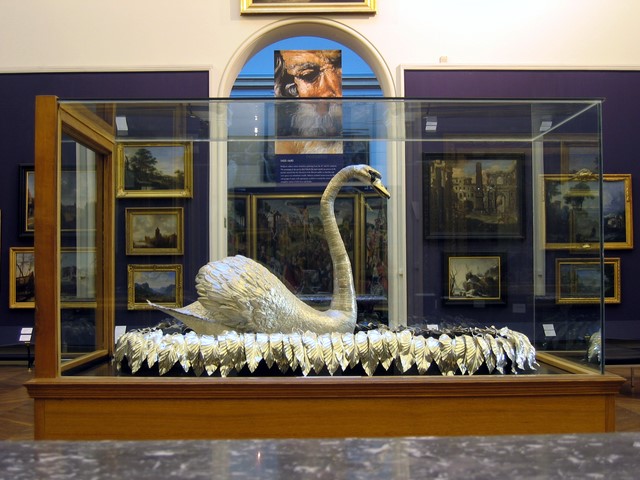
The Silver Swan on display at the Bowes Museum, Barnard Castle. Photographed by Andrew Curtis in December 2003, before the object's most recent restorations. The image's own geograph caption independently states the 1872 acquisition date and 200 pound price this record treats as the credible figures, corroborating the Bowes Museum's own account against the disputed 1882 date given elsewhere.
Andrew Curtis, via geograph.org.uk · CC BY-SA 2.0| Artist | James Cox |
|---|---|
| Date | c. 1773; Art UK dates the object 1772-1774. First recorded on public display in 1774, in James Cox's own descriptive catalogue of his Spring Gardens museum. |
| Medium | Chased and repousse silver over an iron and brass mechanical armature, with rotating glass rods simulating water, a music box, and gilt-brass and steel clockwork movements |
| Dimensions | Life-size, approximating the scale of an adult mute swan. No exact measurements are published in any of the sources consulted for this record; this is recorded as a gap, not filled with an estimate. |
| Where it is now | The Bowes Museum, Barnard Castle, County Durham, Englandlast confirmed |
| Inventory number | X.4653 |
| Attribution | DisputedSold, exhibited and still popularly credited under the name of James Cox, the London goldsmith and showman in whose Spring Gardens museum the swan first appeared in 1773-1774. Full note |
| Object type | Clocks and instruments |
| Period | British, Georgian, third quarter of the eighteenth century |
| Cases | Disputed attribution · Has a provenance gap |
| Inscriptions | None recorded in the sources consulted. |
| Owners on record | 6 links4 documented, 1 disputed, 1 unknown |
| Sources | 20 cited |
About this record Last verified · 20 sources cited · Change log
On this page 9 sections
ContentsClose
A life-size silver swan, its mechanism substantially the work of the mechanician John Joseph Merlin, made and sold under the name of the London jeweller-showman James Cox around 1773. Wound, it performs a half-minute sequence that has drawn crowds for two hundred and fifty years: it turns and preens, appears to swim on a bed of rotating glass rods, notices a shoal of silver fish, and bends to catch and swallow one, all to a tune from a concealed music box. Mark Twain watched it do exactly this at the Paris Exposition Universelle of 1867 and wrote it into The Innocents Abroad; John and Josephine Bowes watched it at the same exhibition and bought it a few years later for their new museum in Barnard Castle, where it still performs daily.
The record straightens out what a century and a half of retelling has blurred. The name on the object is not the name of the person who built its most admired feature, and that gap is not an oversight but a documented feature of how Cox's business worked. The date the Bowes acquired it is given as 1872, 1873 and 1882 across sources that ought to agree, including two pages published by the museum that now owns it; this record sets out the discrepancy and explains why the earliest date is the credible one. And the popular claim that the swan itself was built for the Chinese imperial court, though it echoes a genuinely documented episode in Cox's career, is not supported by any source found for this record and is treated here as unconfirmed rather than smoothed into fact.
No formal export-style accession identifier appears on the museum's own public pages; the number given here, X.4653, is drawn from Art UK, the Bowes Museum's own partner cataloguing platform, and is treated as the object's working identification number pending a clearer citation from the museum itself.
Provenance
Each link is graded. Documented: a cited source supports it. Disputed: the identification is argued but not established. Unknown: no owner for that span, and the gap is not smoothed into a narrative. The grades in the glossary.
- c. 1773 - 1774James Cox's workshop and museum, Spring Gardens, Londondocumented
Made in Cox's workshop and first recorded in his own descriptive catalogue of the Spring Gardens museum, 1773-1774. Art UK dates the object 1772-1774. The mechanism is credited substantially, though not entirely, to John Joseph Merlin, who managed the museum from 1772 to 1775; other, unnamed craftsmen in Cox's employ are understood to have contributed the music box and water mechanism.121216
- 1775 - 1867Unrecordedunknown
Cox's museum closed in 1775 following his Parliament-authorised lottery liquidation of 1773. What became of the swan specifically at that point, and where or with whom it remained for roughly ninety years, is not stated in any source consulted for this record.12
- by 1867 - 1872 (or 1873)Harry Emanuel, London jewellerdocumented
Exhibited by Emanuel at the Exposition Universelle, Paris, 1867, priced at 50,000 francs according to the Bowes Museum's own account. Mark Twain saw it perform there and described it in The Innocents Abroad. John and Josephine Bowes also saw it perform at this exhibition.311
- 1872 (Bowes Museum's principal account; a second Bowes Museum page gives 1873) - presentJohn and Josephine Bowes, later the Bowes Museumdisputed
Purchased from M. Briquet, a Parisian jeweller, for 5,000 francs (about 200 pounds), according to the Bowes Museum's own 'Silver Swan Story' page, which gives the year as 1872; a separate Bowes Museum-affiliated summary gives 1873. Art UK's own hosted record instead states the swan was bought by 'Founders, Josephine and John Bowes in 1882' -- a date this record treats as almost certainly an error, since Josephine Bowes died in February 1874, eight years before 1882, and could not have been a joint purchaser that year. This record adopts 1872 (with 1873 as a secondary possibility) as the credible date, both being consistent with Josephine's lifetime and with the couple's documented pattern of buying from the 1862, 1867 and 1871 exhibitions. The relationship, if any, between Briquet and Harry Emanuel (who had exhibited the swan in 1867) is not established by any source consulted.12313
- 1885 (John Bowes's death) - 1892The Bowes Museum Trust, pending the museum's openingdocumented
Both founders died before the museum opened: Josephine in 1874, John in 1885. The purpose-built museum at Barnard Castle, designed by Jules Pellechet and John Edward Watson, opened to the public in 1892 with the swan among its collection.1513
- 1892 - presentThe Bowes Museum, Barnard Castledocumented
Held continuously by the museum since its opening. Working identification number X.4653 per Art UK's hosted catalogue record; not independently published on the Bowes Museum's own public website pages consulted for this record. On permanent display in the Picture Gallery, performing daily. Underwent documented conservation interventions in the 1940s (post-wartime), three times in the 1960s, in 2008, in 2012, and most recently a full restoration from September to December 2023 funded principally by a National Lottery Heritage Fund grant.14685
Technical evidence
| Attribution note | Sold, exhibited and still popularly credited under the name of James Cox, the London goldsmith and showman in whose Spring Gardens museum the swan first appeared in 1773-1774. Cox ran a workshop-and-marketing operation rather than a bench: he subcontracted the actual mechanical work to a network of independent London craftsmen who mostly did not sign their names, and put his own name on the finished piece because export law required a maker's name on the dial of any clockwork sold abroad. The swan's head, neck and fish-catching mechanism is credited by the Bowes Museum and by Art UK to John Joseph Merlin, the Liege-born mechanician who managed Cox's museum from 1772 to 1775; the music box and the rotating-glass-rod water mechanism are attributed to other, unnamed specialists in Cox's employ. No signed component identifies any of them individually, so the division of labour rests on institutional attribution rather than a maker's mark. |
|---|---|
| Materials and construction | Chased and repousse silver body over an internal mechanical armature; rotating glass (crystal) rods simulating flowing water; silver fish and silver leaves at the base; gilt-brass and steel clockwork movements.89 |
| Date made | Given as c. 1773 by the Bowes Museum's own texts; Art UK dates the object 1772-1774. First recorded on public display in 1774 in James Cox's own museum catalogue.123 |
| Accession / object number | X.4653, per Art UK's hosted catalogue record (Design collection). Not independently published on the Bowes Museum's own public-facing website pages consulted for this record.1 |
| Mechanism | Three independent clockwork motors: one drives a concealed music box, one rotates the glass rods that simulate water, and one drives the head, neck and fish-catching sequence.79 |
| Attribution of the mechanism | The head, neck and fish-catching mechanism is credited to John Joseph Merlin. The music box and water mechanism are understood to be the work of other, unnamed craftsmen in James Cox's employ; no source consulted names them individually.29 |
| Reported complexity (unverified count) | Widely repeated in press and museum-adjacent sources as approximately 2,000 moving parts, including 139 rotating glass rods and 113 articulated neck rings. This record could not trace the figure to a primary engineering or conservation source and flags it as repeated rather than independently confirmed.378 |
| Performance duration | Reported variously across sources as approximately 30, 32 or 40 seconds; the discrepancy is unresolved in the material consulted for this record.2379 |
| Peer-reviewed technical study | A 2023 heritage-science article, 'Modelling a cam track for the Silver Swan automaton at Bowes Museum: a cross-disciplinary reflection on "what things are"', addresses the engineering of the mechanism's cam track directly. Full text could not be accessed during this research (the publisher returned an HTTP 403 response); flagged here for direct consultation by anyone needing the underlying engineering analysis.20 |
| Display and performance schedule | On permanent display in the Picture Gallery (second floor) of the Bowes Museum; performs daily at 2pm, with an additional performance at 11:45am during school holidays and bank holidays.4 |
Images
The record in full
Chapter 1What the swan is, and what it does
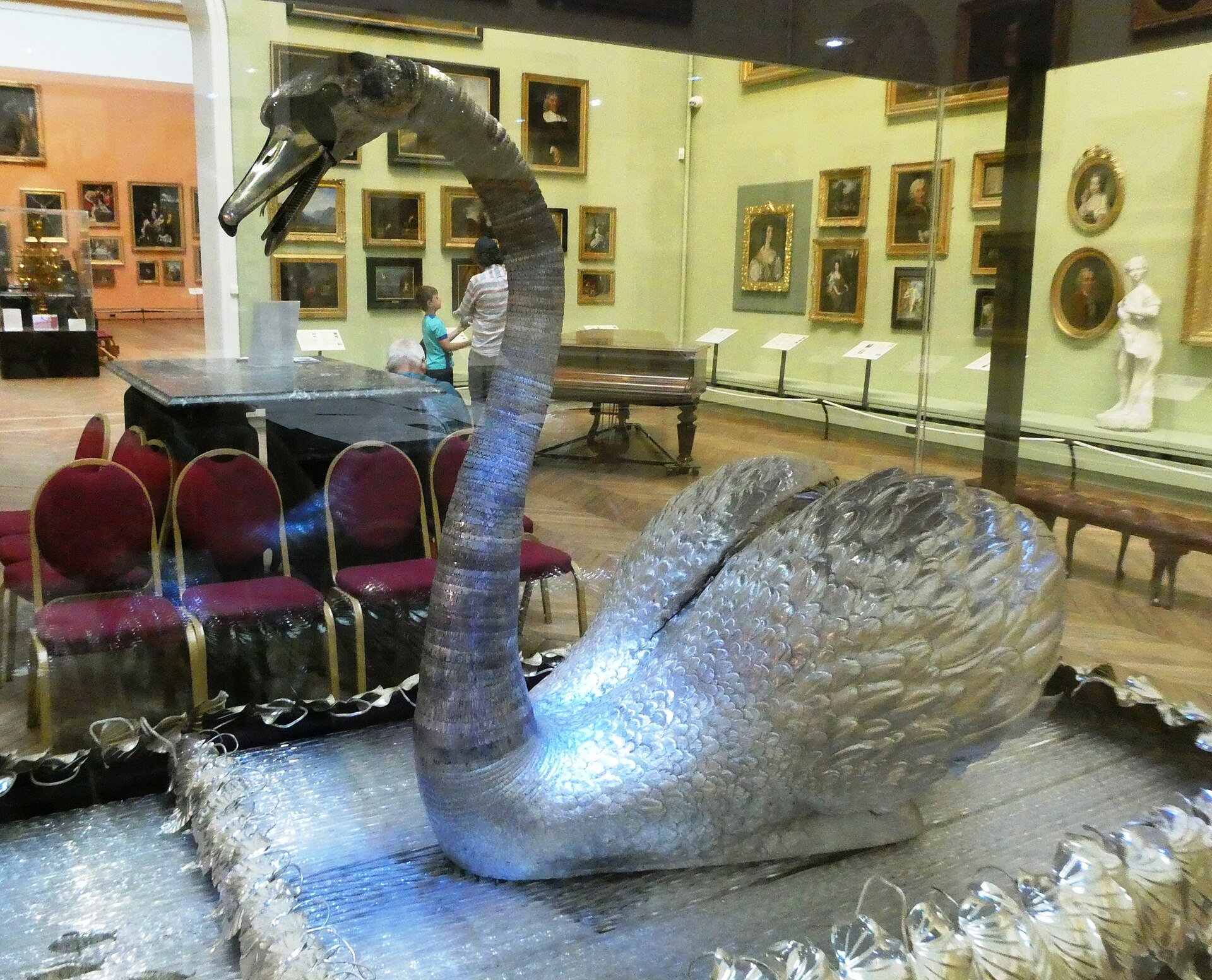
The Silver Swan is a life-size automaton in the form of a female mute swan, its body worked in chased and repousse silver over an internal mechanical armature.
The Silver Swan is a life-size automaton in the form of a female mute swan, its body worked in chased and repousse silver over an internal mechanical armature. It sits on a bed of twisted glass rods, made to catch the light and rotate so as to suggest a flowing stream, with silver fish visible beneath the surface and silver leaves scattered around the base. It is not a toy and was never treated as one: it was built to be watched by adults paying to be astonished.
Three separate clockwork motors drive it. One turns a barrel that plays a tune through a concealed music box. A second rotates the glass rods that stand in for water. A third animates the swan itself: the neck twists into a naturalistic preening posture, the head turns from side to side as though the bird were looking about, and then, in the sequence that has always been the point of the piece, the swan notices a fish swimming in the glass current below it, bends its neck down, appears to catch the fish in its beak, lifts its head, and performs the visible motions of swallowing. A fish concealed inside the beak accounts for the illusion. Sources differ on the exact running time of the full performance, giving about thirty seconds, thirty-two seconds, and forty seconds in different accounts; this record does not resolve that disagreement, because no single source of it stands out as more authoritative than the others, and the discrepancy itself is worth recording rather than silently picking one figure.
The figures most often quoted for the mechanism's complexity, that it contains around two thousand moving parts, including one hundred and thirty-nine rotating glass rods and one hundred and thirteen articulated neck rings, appear repeatedly across museum-adjacent press coverage and popular writing. This record repeats them because they are the numbers in circulation, but flags that no source consulted for this record traces them to an original engineering count or conservation report that could be cited directly; a specialist wanting a verified figure should go to the conservators who have actually had the mechanism apart, not to press coverage that copies an earlier press account.
Chapter 2A name on the object, and a name behind it
The swan is signed by nobody, and credited, in the way its own owning museum credits it, to two different men for two different reasons.
The swan is signed by nobody, and credited, in the way its own owning museum credits it, to two different men for two different reasons. James Cox is the name under which it was made, sold, catalogued and exhibited: it appeared in his own descriptive catalogue of his Spring Gardens museum in 1773-1774, and every institutional record since, including Art UK's own listing, gives Cox as a maker. John Joseph Merlin, a Liege-born mechanician who by 1766 was working for Cox and who managed Cox's museum from 1772 to 1775, is credited by the Bowes Museum and by Art UK with the swan's head, neck and fish-catching mechanism specifically, the part of the object that does the thing everyone remembers it for. The Google Arts and Culture entry hosted with the Bowes Museum's cooperation is explicit that Merlin's contribution was to that mechanism and that other unnamed craftsmen completed the remaining components, meaning the music box and the water mechanism most likely have a third and fourth set of hands behind them that no source consulted for this record can name.
This is not an isolated puzzle about one swan. The Metropolitan Museum of Art's own catalogue entry for a different, well-documented Cox automaton sets out the mechanism plainly: Cox himself, on a mid-century trade card, advertised as a working goldsmith, but by the 1770s he functioned almost entirely as an entrepreneur, coordinating what the Museum's catalogue calls a unique network of independent London suppliers and craftsmen who rarely signed their work, only a few of whom have ever been identified by name. English export law required a clockmaker's name to appear on the dial of any watch or clock made in London for sale abroad, which is why Cox's name appears on the dials of pieces he demonstrably did not build with his own hands. That legal requirement, more than personal vanity, is the documented mechanism by which one man's name came to sit permanently on the work of several others. It is attribution erasure with a traceable cause, not merely a case of a famous name eclipsing an obscure one.
Chapter 3James Cox: goldsmith, showman, and a business built on other people's hands
James Cox was born around 1723 and worked in London from mid-century until his death in 1800.
James Cox was born around 1723 and worked in London from mid-century until his death in 1800. He described himself as a goldsmith on his trade cards, offering, in the wording the Metropolitan Museum quotes from one surviving example, curious work in gold, silver, amber, pearl, tortoiseshell and precious stones. In practice his business from the mid-1760s was the design, assembly and marketing of extravagantly worked clockwork curiosities, contemporaries' term for which was sing-songs, aimed first at the Indian market and then, more lucratively, at China.
His most consequential single commission came in 1766, when the East India Company engaged him to build a pair of automaton chariots, each mounted with a tiny striking clock and a mechanical bird that flapped its wings on demand, as a diplomatic gift for the Qianlong Emperor. One of that pair survives, now in the Metropolitan Museum of Art's Jack and Belle Linsky Collection, and the Museum's own research traces it through a nineteenth-century pamphlet, the Rothschild collection, and the Linsky bequest; the story attached to it holds that it was carried out of China by a French sailor after the 1860 looting of the Old Summer Palace, though the Museum records that account as reported rather than independently verified. The Company's timing was not sentimental: 1766 was also the year its monopoly on British trade to China lapsed, and the gift was a piece of commercial diplomacy aimed at keeping the market open, dressed as a curiosity to delight an emperor already known to prize European clockwork.
The China trade did not stay open. A ban on shipping Cox's luxury goods to China left him with a large, unsold stock of exactly the kind of object the Silver Swan is, and it was to sell that surplus that he opened his own museum at Spring Gardens, near Charing Cross, in February 1772. When the museum itself failed to move enough stock, Parliament passed what its own text calls the Act for Enabling Mr. Cox to Dispose of His Museum by Way of Lottery in 1773, and Cox liquidated the collection by lottery, closing the museum in 1775. He was declared bankrupt for a second time in 1778, undone by the lost China trade, a failed attempt to sell jewellery to Catherine the Great of Russia, the trade disruption of the American Revolutionary War, and the royal patronage that never came. His sons continued the business afterwards in a reduced form, one in London and one in Canton, latterly reselling Swiss-made Jaquet-Droz watches into the same Chinese market their father had first tried to conquer with his own workshop's output.
Chapter 4The China trade claim, examined and graded
The task of checking whether the Silver Swan itself was ever destined for the Chinese imperial court, as some retellings assert, runs directly into the discipline this record is built on: a...
The task of checking whether the Silver Swan itself was ever destined for the Chinese imperial court, as some retellings assert, runs directly into the discipline this record is built on: a resemblance to a documented pattern is not the same thing as a documented fact.
What is documented, and documented well, is that Cox ran his business squarely aimed at the Chinese and Indian markets from the mid-1760s, that the East India Company used one of his automata as an actual diplomatic gift to Qianlong in 1766, that a ban on further shipments to China left him with unsold stock, and that this unsold stock, not a fresh commission, is what filled his London museum from 1772. The Silver Swan, first recorded in that same museum in 1773-1774, therefore belongs to the general category of object Cox's business was built to sell into the Chinese market, in the sense that his whole enterprise was oriented that way.
What is not documented in any source consulted for this record is a specific claim, an invoice, a shipping order, a passage in Cox's own catalogue, or an East India Company record, that names the Silver Swan as an intended gift or export item for Qianlong's court, still less that the emperor considered and declined it. That specific story appears in general web and tourism writing about the swan without a citation this record could trace to a primary document. Given that Cox's genuinely documented China-bound automaton, the surviving chariot, is a categorically different object now sitting in a different museum with its own fully worked provenance, this record treats the Qianlong-swan claim as an unconfirmed, plausible-sounding conflation with Cox's real and separate China trade, not as an established fact, and flags it as such rather than repeating it as settled history.
Chapter 5John Joseph Merlin: the mechanician behind the name on the label
John Joseph Merlin was born Jean-Joseph Merlin on 6 September 1735 in Huy, in the Prince-Bishopric of Liege, and died on 8 May 1803 in Paddington, London.
John Joseph Merlin was born Jean-Joseph Merlin on 6 September 1735 in Huy, in the Prince-Bishopric of Liege, and died on 8 May 1803 in Paddington, London. He came to England in 1760 as technical adviser to the Spanish ambassador and stayed for the rest of his life, working across an unusually wide range of mechanical invention: he is credited with an early form of roller skate, on which he is said to have famously crashed into a large mirror at a masquerade while attempting to play the violin; he built keyboard instruments, patenting in 1774 a pianoforte-and-harpsichord combination stop, and constructed a six-octave piano in 1775 that anticipated Broadwood's later grand pianos by some fifteen years; and he built a self-propelled wheelchair, prosthetic devices, playing cards adapted for blind users, and a mechanical chariot fitted with an odometer.
From 1766 he worked for James Cox as chief mechanician, and from 1772 to 1775 he managed Cox's museum at Spring Gardens day to day. The Silver Swan, in 1773, is the best-known product of that partnership, credited to Merlin specifically for its head, neck and fish-catching sequence. After Cox's museum closed, Merlin went into business for himself, opening his own Mechanical Museum at 2 Princes Street, Hanover Square, in April 1783, later expanding to number 11; it became a fashionable meeting place where wealthy Londoners took tea while looking at his instruments and automata. A dancing figure with a mechanical bird from that later museum was bought decades afterward at auction by Charles Babbage, who had seen it as a child and wrote about the impression it left on him. Merlin married Ann Goulding in 1783; she died in 1793, after which he largely withdrew from public life, his last recorded appearance dating to January 1803, a few months before his death.
Chapter 6Cox's Museum, Spring Gardens, 1772-1775
Cox's museum opened to the public in February 1772 at Spring Gardens, near Charing Cross, and quickly became one of the more fashionable and expensive destinations in London: the entry fee, around...
Cox's museum opened to the public in February 1772 at Spring Gardens, near Charing Cross, and quickly became one of the more fashionable and expensive destinations in London: the entry fee, around half a guinea, was substantial for the period, and Cox promoted the collection with printed catalogues and verses in the London papers, some of which, by later account, he had placed himself. James Boswell visited on Samuel Johnson's recommendation, and Frances Burney referred to the museum in her novel Evelina, evidence of how thoroughly it had entered fashionable conversation.
The Silver Swan is recorded in the museum's own descriptive catalogue for 1773-1774, which dwells on the lifelike scale and movement of the bird, the fine detail of its silverwork, and the intricacy of its hidden mechanism, and records visitors' reported verdict that such a thing could not have been made by human hands but only by magic, the kind of promotional flourish Cox's catalogues specialised in. When the museum failed to sell down Cox's accumulated Eastern-trade stock fast enough, Parliament passed the Act enabling him to dispose of the collection by lottery in 1773, and the museum finally closed in 1775, its contents dispersed. What happened specifically to the Silver Swan at that point, whether it was a lottery prize, held back, or sold privately, is not recorded in any source consulted for this record; this is treated as a gap in the object's provenance rather than bridged with a guess.
Chapter 7Mark Twain and the swan at the 1867 Exposition
By 1867 the Silver Swan was in the hands of the London jeweller Harry Emanuel, who exhibited it at the Exposition Universelle in Paris that year, priced, according to the Bowes Museum's own account...
By 1867 the Silver Swan was in the hands of the London jeweller Harry Emanuel, who exhibited it at the Exposition Universelle in Paris that year, priced, according to the Bowes Museum's own account, at fifty thousand francs. Among the visitors who watched it perform was the American writer Samuel Clemens, travelling as a newspaper correspondent and writing under the name Mark Twain, whose account of the trip became The Innocents Abroad, published in 1869.
In Chapter XIII, describing his visit to the exposition, Twain wrote of the crowds and distractions that kept him from examining any single exhibit closely, and then singled the swan out by name: "I watched a silver swan, which had a living grace about his movements, and a living intelligence in his eyes -- watched him swimming about as comfortably and as unconcernedly as if he had been born in a morass instead of a jeweler's shop -- watched him seize a silver fish from under the water and hold up his head and go through all the customary and elaborate motions of swallowing it." The passage is quoted here from the text of Chapter XIII as hosted by the University of Virginia's Mark Twain archive, and matches the wording given, with minor spelling variants, in every other transcription of the chapter consulted for this record. It is one of the earliest datable eyewitness descriptions of the automaton actually performing, independent of Cox's own promotional catalogue nearly a century earlier, and it captures precisely the effect the mechanism was built to produce: the sense, in an age already arguing about the boundary between the mechanical and the living, that the thing in front of you might not entirely be a machine.
Chapter 8John and Josephine Bowes, and an acquisition date that does not add up
John Bowes was born in London on 19 June 1811 and died on 9 October 1885.
John Bowes was born in London on 19 June 1811 and died on 9 October 1885. Josephine Benoite Coffin-Chevallier was born in Paris in 1825 and died there on 9 February 1874. John moved to Paris in 1847, bought the Theatre des Varietes, and there met Josephine, then performing under the stage name Mademoiselle Delorme; they married in 1852. Together, beginning in earnest around 1862, they built one of the largest private collections of fine and decorative art assembled in nineteenth-century Europe, reportedly some fifteen thousand objects in a little over a decade, bought substantially through the Paris auction and dealer network centred on the Hotel Drouot, including named dealers such as Mme Lepautre and A. Lamer whose annotated sale records the museum still holds. They also bought directly from the great Paris and London international exhibitions of 1862, 1867 and 1871, which is precisely the route by which the Silver Swan reached them: they are recorded, like Twain, as having seen it perform at the 1867 Exposition Universelle, and their acquisition of it followed some years afterward.
The date of that acquisition is where the sources genuinely disagree, and the disagreement is worth setting out in full rather than picking a winner silently. The Bowes Museum's own "Silver Swan Story" page gives 1872, naming the seller as M. Briquet, a Parisian jeweller, and the price as two hundred pounds. A geograph.org.uk caption for one of the photographs used in this record, written independently of the museum's own web copy, corroborates this: 1872, a Parisian jeweller, two hundred pounds. Elsewhere the museum's own material has given 1873. Art UK's own hosted record for the object, by contrast, states that the swan was "bought by Founders, Josephine and John Bowes in 1882." That date cannot be correct as stated: Josephine Bowes died in February 1874, eight years before 1882, and could not have been a purchaser alongside her husband in that year. Whether the 1882 date is a simple transcription slip for 1872, an error introduced at some later point in Art UK's own cataloguing, or confusion with some other event in the object's history is not explained by any source consulted for this record, but the internal contradiction is clear enough on its own terms that this record treats 1872 (with 1873 as a live but secondary possibility, both consistent with Josephine's lifetime and with the couple's documented buying pattern from the 1867 exhibitions) as the credible acquisition date, and 1882 as very likely an error carried on an otherwise authoritative page.
Also unresolved is the relationship between Harry Emanuel, the jeweller who exhibited the swan at the 1867 exposition, and M. Briquet, the Parisian jeweller named as the seller to the Bowes five or six years later. No source consulted states whether Briquet was Emanuel's agent, had bought the swan from Emanuel in the interim, or is otherwise connected to him; this record does not supply a link it cannot document.
Chapter 9Into the museum, and the object's identification today
Neither Bowes lived to see their museum open.
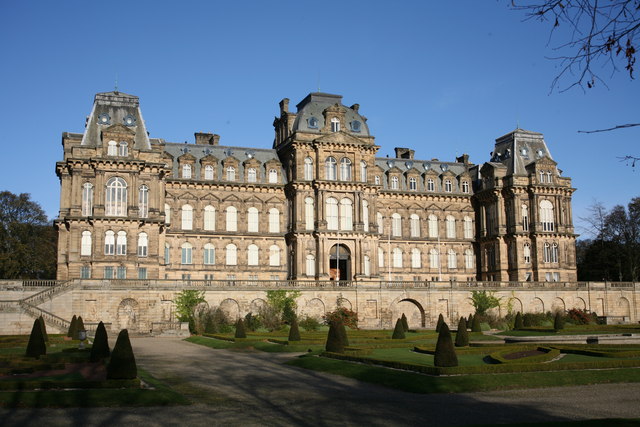
Neither Bowes lived to see their museum open. Josephine died in 1874 and John in 1885; the Bowes Museum, a purpose-built gallery in Barnard Castle designed jointly by the French architect Jules Pellechet and John Edward Watson of Newcastle, opened to the public in 1892, seven years after its last surviving founder's death, with the Silver Swan among its showpieces.
The object's formal identification within the museum's own records proved harder to pin down for this record than is usual for an object of this standing. The Bowes Museum's public-facing website pages about the swan, including its dedicated collections page, its longer "Silver Swan Story" feature, its maintenance updates and its exhibition materials, do not themselves publish an accession or object number anywhere in the text consulted. A direct fetch of the swan's own page on Art UK, the aggregation platform through which most UK public collections publish their catalogue data (including the Bowes Museum's), initially returned an HTTP 403 response to a plain request; following this publication's standing procedure for treating a 403 as a bot block rather than a dead page, the same URL was retried through an in-app browser that renders the page as a visitor would see it, and it returned in full. That rendered page gives the accession number as X.4653, alongside a date of 1772-1774, a medium of "silver, glass and metal," a classification of "Sculpture," and both James Cox and John Joseph Merlin listed as artists and makers. This record therefore records X.4653 as the object's working identification number, sourced to Art UK rather than to a Bowes Museum page of its own, and notes plainly that the museum's own website does not appear to publish the number independently. For a single, famous, unambiguously identified object like this one, the absence of a museum-published number on the main public pages is unusual for a British institution but does not create any risk of confusing this swan with another object; there is only one Silver Swan at the Bowes Museum, and its identity is not in question even where its filing number is comparatively hard to find.
Chapter 10Two and a half centuries of upkeep
A mechanism built to be wound and run in front of an audience, repeatedly, for two hundred and fifty years, accumulates a maintenance history worth reading in its own right.
A mechanism built to be wound and run in front of an audience, repeatedly, for two hundred and fifty years, accumulates a maintenance history worth reading in its own right. The swan is recorded as having been dismantled at some point connected with the Second World War, plausibly as a precaution against bomb damage to the museum's collection more broadly, and was restored to working order afterwards in the 1940s by a member of the museum's own staff rather than by an outside specialist. It underwent three further conservation interventions in the 1960s, two of them carried out in London.
A more systematic conservation programme began in 2008, described by the museum as the first major project of its kind in a generation, with the clockmaker Matthew Read, then a conservation tutor at West Dean College, leading a full stripping and documentation of the mechanism. Read returned for a shorter three-day maintenance visit in 2012, refreshing the oil on the bearings and inspecting roughly ninety per cent of the moving parts without a full disassembly; the only worn bearing his team found, tellingly, was not an eighteenth-century original but a replacement fitted during the 1960s repairs, a small but real piece of evidence about which parts of the object are genuinely period and which are twentieth-century intervention.
The mechanism seized during the museum's Covid-era closures and did not resume working when the museum reopened. A two-week study and disassembly project followed in October 2021 to assess the damage and plan a repair. The resulting programme, running from September to December 2023 and led by the Cumbria Clock Company (the firm also responsible for restoring the Great Clock at the Palace of Westminster, commonly known as Big Ben), was funded principally by a National Lottery Heritage Fund grant of one hundred and forty-six thousand three hundred and forty-two pounds against a total project cost of one hundred and ninety-nine thousand one hundred and forty-two pounds, with conservation interns from Birmingham City University and West Dean College working alongside the museum's own team. The work involved fully disassembling and servicing the neck and head assembly, including its twelve neck rings, the drive units, the music box and the glass rods. After more than fifteen hundred hours of work, the swan was reported functional again by March 2024 and resumed its daily public performance, an unbroken thread of maintenance running from a wartime dismantling to a National Lottery grant, on the same object, in the same museum, across eighty years.
Chapter 11A single object, not a genre
Mechanical swans are not unique to Cox and Merlin.
Mechanical swans are not unique to Cox and Merlin. Automaton swans of varying sophistication were made by several eighteenth- and nineteenth-century workshops and survive today in a number of private and institutional hands elsewhere in Europe and beyond; the type as a whole belongs to the broader Enlightenment fashion for lifelike mechanical animals that also produced Jacques de Vaucanson's celebrated digesting duck of 1739 in France. None of that wider genre is the subject of this record. This record concerns one specific object: the swan first catalogued in James Cox's own Spring Gardens museum in 1773-1774, its mechanism credited in substantial part to John Joseph Merlin, exhibited by Harry Emanuel at the Paris Exposition Universelle in 1867, bought by John and Josephine Bowes shortly afterward, and held ever since at the Bowes Museum in Barnard Castle under the working identification number X.4653. Any other silver swan automaton encountered elsewhere, however similar in appearance or effect, is a different object with its own separate history, and should not be assumed to share this one's provenance.
Chapter 12Fame, and what it has been asked to mean
Art UK's own text for the object makes a claim worth taking seriously rather than treating as marketing copy: that in acquiring an object "so magically realistic that it contributed to the debate on...
Art UK's own text for the object makes a claim worth taking seriously rather than treating as marketing copy: that in acquiring an object "so magically realistic that it contributed to the debate on the meaning and definition of life," the Bowes acquired something that functioned, for its Georgian and Victorian audiences, as a genuine provocation about where mechanism ends and life begins, a debate very much alive in the same decades that produced Vaucanson's duck and the broader eighteenth-century fascination with automata as philosophical objects as much as entertainments. Twain's own description leans on exactly that ambiguity, praising "a living grace" and "a living intelligence" in a machine he knew perfectly well was not alive. This record treats that reading as well supported by the object's own reception history, evidenced in Twain's language and in the museum's own framing, rather than as a modern imposition; it is not, however, evidence that Cox or Merlin set out to make a philosophical statement, only that the object's uncannily lifelike performance provoked one in its viewers, then and now.
No source consulted for this record ties the choice of a swan specifically, as against any other animal, to a documented iconographic programme, a patron's brief, or a stated intention on Cox's or Merlin's part. Swans carried familiar associations in European ornament and myth, grace, fidelity, transformation, but nothing in the sources consulted connects any of that to a deliberate design choice here rather than simple showmanship: a swan's long, mobile neck and naturally graceful bearing made it an obvious vehicle for demonstrating exactly the kind of lifelike articulated movement Cox's museum existed to sell. Where a hidden programme might be suspected, the honest finding is that none has been documented, and that absence is recorded here as a finding rather than papered over with speculation.
The swan's fame has since been actively curated rather than merely inherited. In 2023 the Bowes Museum built its entire annual exhibition programme, "The Magic of the Silver Swan," around the object's two hundred and fiftieth anniversary, borrowing comparanda from the British Museum, the Science Museum, the Musee des Arts et Metiers in Paris, the Royal Collection Trust, the Bodleian Library and other institutions, and setting the swan alongside Charles Babbage's Difference Engine and contemporary kinetic art by artists including Yinka Shonibare, a deliberate act of framing the eighteenth-century object as the ancestor of a much longer history of mechanism and movement in art. The swan's own reproduction and circulation runs through exactly the channels the period allowed: Cox's own printed catalogues and planted newspaper verses in the 1770s, Twain's bestselling travel book from 1869 onward, and, in the twenty-first century, the museum's own social media and press coverage of each conservation campaign, most recently the 2023-2024 restoration, each cycle of repair generating a fresh wave of press attention that keeps the object's reputation in circulation.
Chapter 13What is not known
Several genuine gaps remain in the swan's documented history, and this record lists them rather than closing them with inference.
Several genuine gaps remain in the swan's documented history, and this record lists them rather than closing them with inference. Roughly ninety years separate the closure of Cox's museum in 1775 from the swan's documented reappearance in Harry Emanuel's hands at the 1867 Paris exposition; nothing consulted for this record accounts for where the object was, or in whose ownership, across that interval. The precise year of the Bowes' purchase is given as both 1872 and 1873 by the museum's own published materials, with no source explaining why its two accounts differ. No published measurement of the swan's overall dimensions was found in any source consulted, despite it being one of the most photographed objects in the museum's collection. And the frequently repeated figures for the mechanism's part count, two thousand moving parts, one hundred and thirty-nine glass rods, one hundred and thirteen neck rings, could not be traced to a primary engineering or conservation source during this research; a specialist requiring a verified figure should approach the Bowes Museum's conservation team or the Cumbria Clock Company directly, rather than the press coverage that has copied the same numbers for over a decade.
The artist
James Cox (c. 1723-1800), credited maker; John Joseph Merlin (1735-1803), mechanician
This is a two-name dossier because the object itself is a two-name problem. James Cox is the name the Silver Swan was sold, catalogued and exhibited under, and the name every institution since has led with. John Joseph Merlin is the man credited with the mechanism that actually makes the object famous. Understanding either one requires understanding both, and understanding why their names ended up attached to the same object in such different ways.
Related works
| Work | Relation | Where it is |
|---|---|---|
| Automaton in the form of a chariot pushed by a Chinese attendant and set with a clock James Cox | Cox's other major, fully documented China-trade automaton; one of a pair given by the East India Company to the Qianlong Emperor in 1766. This is the object genuinely tied to the Qianlong court; the Silver Swan's own connection to that trade is unconfirmed and should not be assumed from this comparison. Traced through a 1868 pamphlet, the Rothschild collection, and the Linsky bequest of 1982; reportedly removed from China by a French sailor after the 1860 looting of the Old Summer Palace, an account the Metropolitan Museum itself records as reported rather than independently verified. | The Metropolitan Museum of Art, New York (Jack and Belle Linsky Collection, object number 1982.60.137) |
| The Peacock Clock James Cox's workshop | The other great surviving showpiece of Cox's Spring Gardens enterprise, and the clearest evidence of the scale his workshop operated at. Brought to Russia in 1781, probably by Cox's own clockmaker-supplier Frederick Jury, after Cox's attempt to sell directly to Catherine the Great failed. | State Hermitage Museum, St Petersburg |
| Miniature secretary incorporating a watch James Cox's workshop | Another product of Cox's subcontracted craftsmen network, catalogued by the Metropolitan Museum under Cox as entrepreneur rather than maker. c. 1766-72; illustrates the same maker's-name-as-brand practice discussed in this record's attribution note. | The Metropolitan Museum of Art, New York |
| Dancing figure with automated bird John Joseph Merlin | Surviving example of Merlin's own later, independent output after he left Cox's employ and opened his own museum. Babbage had seen the piece as a child at Merlin's museum in Hanover Square and later purchased it himself, for 35 pounds according to the account in Wikipedia's Merlin biography, itself flagged for replacement with a primary Babbage-archive citation. | Untraced at time of writing; formerly bought at auction by Charles Babbage |
| Other mechanical swan automata (general genre, not individually verified) Various eighteenth- and nineteenth-century workshops | Version-safety note: mechanical swan automata are a recognised minor genre in their own right, existing in other private and institutional collections beyond the Bowes Museum. This record concerns only the Bowes Museum's Cox/Merlin swan, accession X.4653, first recorded 1773-1774. No other swan automaton should be assumed to share this object's history. | Various |
Open questions
- Did John Joseph Merlin build the entire mechanism, or only the head, neck and fish-catching sequence specifically? Sources agree on his credit for that sequence but do not agree on, or even address, who built the music box and the water mechanism.
- Was the Silver Swan ever actually intended for the Qianlong court, or is the popular claim a conflation with Cox's separately and well-documented 1766 East India Company chariot gift? No primary source located for this record confirms or denies a China connection specific to the swan.
- What happened to the swan between the closure of Cox's museum in 1775 and its documented reappearance, in the hands of the jeweller Harry Emanuel, at the Paris Exposition Universelle in 1867? Roughly ninety years are unaccounted for in every source consulted.
- Did the Bowes acquire the swan in 1872 or in 1873? The Bowes Museum's own published materials give both dates without acknowledging the discrepancy.
- Is the 1882 acquisition date given on Art UK's hosted record simply an error? Josephine Bowes died in February 1874, eight years before 1882, making her a purchaser in that year impossible as stated; no source consulted explains how the date entered the record.
- What was the relationship between Harry Emanuel, who exhibited the swan in 1867, and M. Briquet, the Parisian jeweller named as the seller to the Bowes a few years later? No source consulted establishes whether Briquet was Emanuel's agent or a separate seller.
- What are the swan's exact overall dimensions? No source consulted publishes a measurement beyond the description 'life-size'.
- Is the widely repeated figure of approximately 2,000 moving parts, 139 glass rods and 113 neck rings independently verifiable, or does it trace back to a single unattributed source that later coverage has simply copied?
Questions about this object
What is The Silver Swan?
The Silver Swan is a clocks and instruments, dated c. 1773; Art UK dates the object 1772-1774. First recorded on public display in 1774, in James Cox's own descriptive catalogue of his Spring Gardens museum.. Medium: Chased and repousse silver over an iron and brass mechanical armature, with rotating glass rods simulating water, a music box, and gilt-brass and steel clockwork movements.
Who made The Silver Swan, and is the attribution settled?
The attribution to James Cox is recorded here as disputed. Sold, exhibited and still popularly credited under the name of James Cox, the London goldsmith and showman in whose Spring Gardens museum the swan first appeared in 1773-1774. Cox ran a workshop-and-marketing operation rather than a bench: he subcontracted the actual mechanical work to a network of independent London craftsmen who mostly did not sign their names, and put his own name on the finished piece because export law required a maker's name on the dial of any clockwork sold abroad. The swan's head, neck and fish-catching mechanism is credited by the Bowes Museum and by Art UK to John Joseph Merlin, the Liege-born mechanician who managed Cox's museum from 1772 to 1775; the music box and the rotating-glass-rod water mechanism are attributed to other, unnamed specialists in Cox's employ. No signed component identifies any of them individually, so the division of labour rests on institutional attribution rather than a maker's mark.
Where is The Silver Swan now?
The Bowes Museum, Barnard Castle, County Durham, England. Inventory number X.4653. Last confirmed 3 September 2026. Design collection; long-term collection object on public display in the Picture Gallery, where it performs daily. Accession number as published by Art UK, the Bowes Museum's own partner catalogue platform; the Bowes Museum's public-facing website pages do not themselves display the number.
What is still unknown about The Silver Swan?
Did John Joseph Merlin build the entire mechanism, or only the head, neck and fish-catching sequence specifically? Sources agree on his credit for that sequence but do not agree on, or even address, who built the music box and the water mechanism.
Sources
- 1Art UK, 'The Silver Swan' (The Bowes Museum), object record, accessed via in-app browser rendering after a plain HTTP request returned 403. Gives accession number X.4653, date 1772-1774, medium silver/glass/metal, and states a disputed 1882 acquisition date. artuk.org/discover/...
- 2The Bowes Museum, 'The Silver Swan' (collections page). Gives maker credit, 1873 date, and a 1872-vs-1873 acquisition account distinct from the museum's own 'Silver Swan Story' page. thebowesmuseum.org.uk/collections/...
- 3The Bowes Museum, 'The Silver Swan Story'. Gives the 1872 acquisition date, M. Briquet as seller, Harry Emanuel's 1867 exhibition of the piece, and the object's conservation history from the 1940s onward. thebowesmuseum.org.uk/the-silver-swan-story
- 4The Bowes Museum, 'Silver Swan Maintenance', account of the 2012 maintenance visit by clockmaker Matthew Read of West Dean College. thebowesmuseum.org.uk/silver-swan-maintenance
- 5The Bowes Museum, press release, 'The Magic of the Silver Swan' (2023 exhibition), PDF. thebowesmuseum.org.uk/wp-content/...
- 6Visit County Durham, 'Funding win for Silver Swan conservation work', detailing the National Lottery Heritage Fund grant of 146,342 pounds against a total project cost of 199,142 pounds, and the Cumbria Clock Company's role. visitcountydurham.org/news/...
- 7Smithsonian Magazine, 'This Robotic Silver Swan Has Fascinated Fans for Nearly 250 Years'. smithsonianmag.com/smart-news/...
- 8Colossal, 'The Iconic "Silver Swan" Automaton Gets a Well-Deserved Fluff of the Feathers', on the 2023 conservation programme. thisiscolossal.com/2023/...
- 9Google Arts & Culture (hosted with the Bowes Museum), 'The Silver Swan - the workshop of James Cox of London', giving mechanism detail and Merlin's specific credit for the head/neck mechanism. artsandculture.google.com/asset/...
- 10Futility Closet, 'The Silver Swan', a short popular account citing the Innocents Abroad passage and an 1773 Act of Parliament. futilitycloset.com/2010/...
- 11Mark Twain, The Innocents Abroad, Chapter XIII (1869), primary source, hosted text via the University of Virginia Mark Twain archive. Source of the verbatim quotation used in this record. twain.lib.virginia.edu/innocent/...
- 12The Metropolitan Museum of Art, catalogue entry, 'Automaton in the form of a chariot pushed by a Chinese attendant and set with a clock,' James Cox, 1766 (object number 1982.60.137, Jack and Belle Linsky Collection), citing Vincent and Leopold, European Clocks and Watches in the Metropolitan Museum of Art (2015), Le Corbeiller (1984), Pagani (2001), R. Smith (2000) and Riello (2008). Primary basis for Cox's East India Company commission, subcontracting practice, museum, lottery Act, and bankruptcy. metmuseum.org/art/...
- 13Wikipedia, 'Josephine Bowes', for birth/death dates (1825-1874) and the couple's documented collecting practice and Paris dealer network. en.wikipedia.org/wiki/...
- 14Asian Art Newspaper, 'Ziminzhong: Chinese Clocks', on the Qianlong Emperor's collecting of European automata and Cox's 1766 East India Company commission. asianartnewspaper.com/ziminzhong-chinese-clocks
- 15Wikipedia, 'Bowes Museum', for the museum's founding, architects, and 1892 opening date. en.wikipedia.org/wiki/...
- 16Wikipedia, 'James Cox (inventor)', consolidating Cox's biography, Spring Gardens museum, 1773 lottery Act, and bankruptcy. en.wikipedia.org/wiki/...
- 17Wikipedia, 'John Joseph Merlin', consolidating Merlin's biography, roller-skate invention, instrument-making, work for Cox, and later independent museum. en.wikipedia.org/wiki/...
- 18Wikimedia Commons, file metadata ( via the MediaWiki API) for the images used in this record, confirming CC BY-SA 2.0 licensing and photographer credit for the geograph.org.uk-sourced files. commons.wikimedia.org/wiki/...
- 19The Metropolitan Museum of Art, 'James Cox (ca. 1723-1800): Goldsmith and Entrepreneur', Heilbrunn Timeline of Art History. Flagged for direct re-verification. metmuseum.org/toah/...
- 20International Journal of Heritage Studies / Journal of Conservation and Museum Studies (Taylor & Francis), 'Modelling a cam track for the Silver Swan automaton at Bowes Museum: a cross-disciplinary reflection on "what things are"' (2023). tandfonline.com/doi/...

Last verified · Published
Change log
3 September 2026 - Record created at the house standard: researched narrative, technical evidence, maker dossier, graded provenance chain, prices with hammer and premium separated, related works, open questions and sources.