Woman Writing a Letter, with her Maid
Johannes Vermeer · c. 1670-71
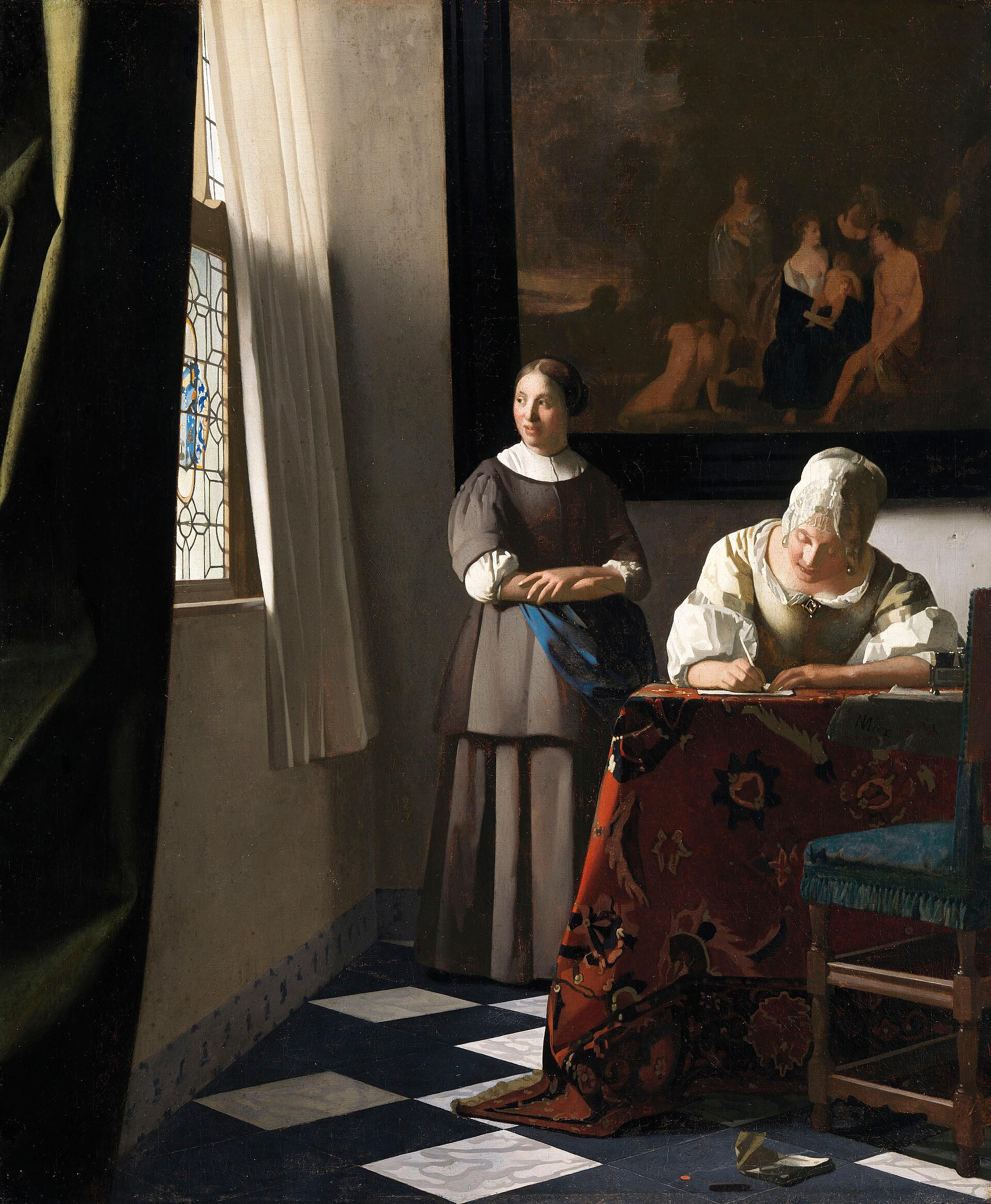
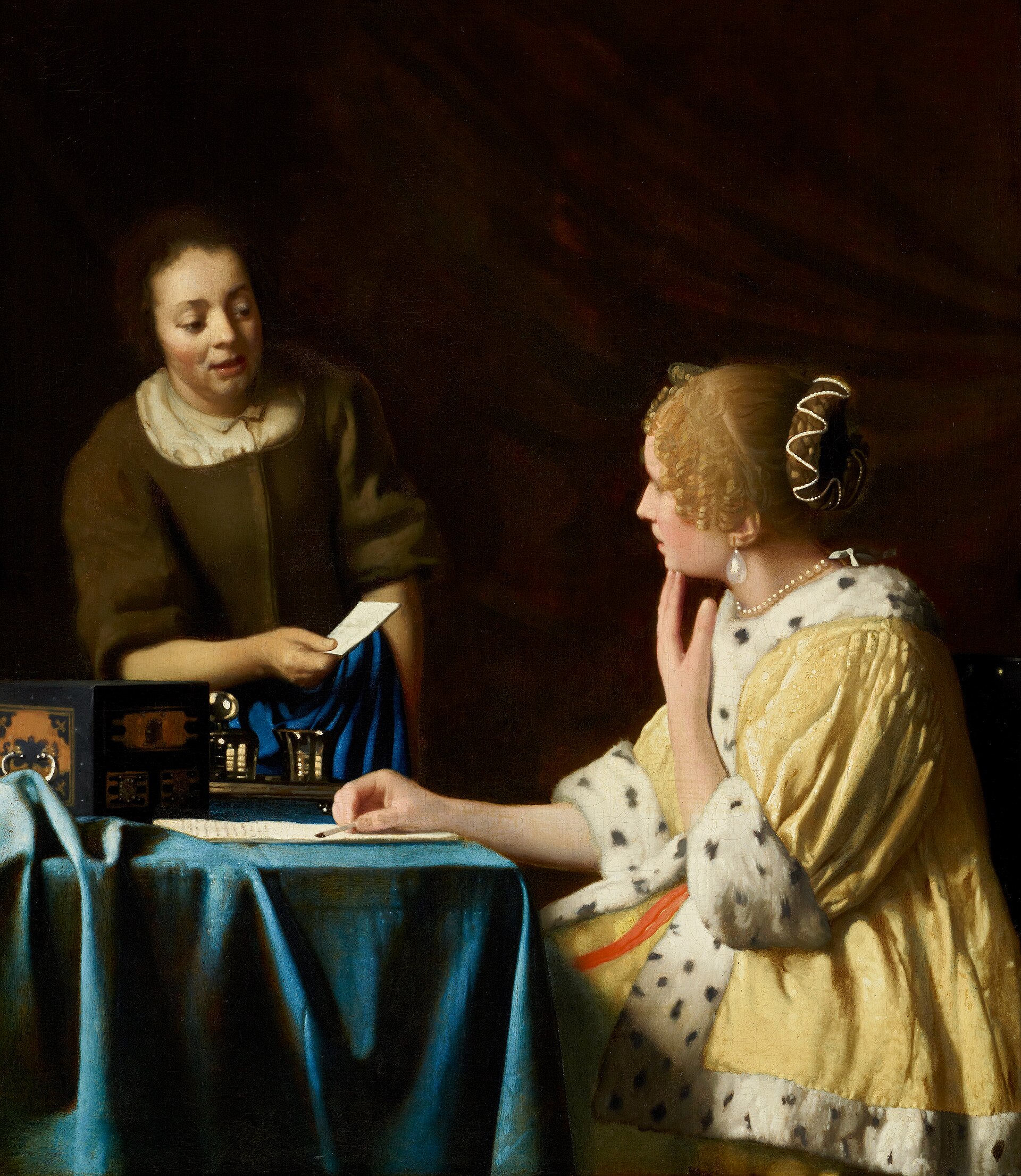
The whole picture, c. 1670, oil on canvas, National Gallery of Ireland, NGI.4535. This Commons file names the gallery's online collection as its source; the upload comment of 2 February 2022 reads 'same source, original colour'.
| Artist | Johannes Vermeer |
|---|---|
| Date | c. 1670-71 |
| Medium | Oil on canvas |
| Dimensions | 71.1 x 60.5 cm (National Gallery of Ireland); 72.2 x 59.7 cm in the 1995 Washington catalogue and the 2012 Metropolitan Museum Journal; 71.1 x 58.4 cm on Essential Vermeer |
| Where it is now | National Gallery of Ireland, Dublin (Room 38)last confirmed |
| Inventory number | NGI.4535 |
| Attribution | AcceptedAccepted as an autograph, signed work by Vermeer in every catalogue consulted. Full note |
| Object type | Painting |
| Period | Dutch, seventeenth century |
| Cases | Has a provenance gap |
| Inscriptions | Signed: a monogram-ligature of I V M with Meer, on the paper hanging over the edge of the table, centre right (read JvMeer by the gallery, IFMeer by Wheelock, 1995). |
| Owners on record | 25 links17 documented, 4 disputed, 4 unknown |
| Sources | 38 cited |
About this record Last verified · 38 sources cited · Change log
On this page 10 sections
ContentsClose
A Vermeer of about 1670 that, on the gallery's and the 1995 catalogue's reading of a deed (Montias read it differently), his widow handed to a Delft baker in January 1676 against a bread debt of 617 guilders; a Rotterdam lot of 1730 matched to it by description and approximate size made 155 guilders; it made 62,000 francs in Paris in 1889; and it reached the collection of the diamond and gold magnate Alfred Beit about 1895. In 1952 it went to Russborough House in County Wicklow. It was stolen from there twice: in April 1974, in a raid that RTE (26 June 2001) says was by an IRA gang which included Rose Dugdale, who RTE (18 March 2024) says was jailed for nine years over the art theft; and in May 1986, in a raid that the Irish Times (30 September 2002) attributes to a gang headed by Martin Cahill, for which no court record was seen.
After the 1974 raid, for which the sources report differing ransom demands, the picture was recovered in County Cork within about a fortnight and with the discovery, during its repair, of the red seal on the floor. The 1986 theft ended on 1 September 1993 in a car park at Antwerp airport, where it was recovered with the Belgian police in an operation the obituaries of Scotland Yard's Charles Hill describe. Sir Alfred and Lady Beit had given it to the National Gallery of Ireland in 1987 while it was still missing. It hangs in Room 38 in Dublin.
This record follows the 1995 Washington catalogue and the gallery's own provenance and grades every link. It records what is not known: who held it after 1701, who bought it in 1730, where it was between 1798 and 1881 and in whose hands it was for seven years after 1986. It also keeps apart what scholars have argued about the Finding of Moses on the wall and the objects on the floor, none of which any document confirms.
Provenance
Each link is graded. Documented: a cited source supports it. Disputed: the identification is argued but not established. Unknown: no owner for that span, and the gap is not smoothed into a narrative. The grades in the glossary.
- c. 1670 - 1675Johannes Vermeer, Delftdocumented
Painted in Delft, c. 1670 or c. 1670-71 by scholars' dating. Signed; attribution accepted. The Dublin gallery says that during his lifetime Vermeer did not sell it.136
- 1675 - 27 January 1676Catharina Bolnes, widow of Vermeer, Delftdisputed
The widow's holding of this particular canvas rests on identifying it with the picture in the deed of 27 January 1676 (see next link).3
- 27 January 1676 - 1701Hendrick van Buyten, master baker, Delft (1632-1701)disputed
Catharina Bolnes gave two Vermeers to Van Buyten as security for a debt of 617 guilders and 6 stuivers for bread (Montias doc. 361). The deed describes one as two persons, one of whom sits and writes a letter. Wheelock and Broos assume this is the Dublin picture. Montias, per Wheelock's footnote, took Van Buyten's large painting of 1701 to be Mistress and Maid. Wikipedia's summary says she 'sold and transferred' them and was 'paid' 617 guilders; the Washington catalogue says security.3910
- 1701 - before 1710Unknownunknown
Nothing opened records how the picture passed from Van Buyten's house, where a large Vermeer hung in the vestibule in 1701, to Josua van Belle.3
- before 1710 - 1710Josua van Belle (1637-1710), Rotterdam merchant trading with Spain, burgomaster 1705documented
Identification probable: identified from the 1730 sale of his estate, whose lot 92 matches the picture by description and approximate dimensions (Wheelock and Broos).3
- 1710 - 1729Ida Catharina van der Meyden, widow of Van Belle, Rotterdamdocumented
Named in the 1995 provenance; no further detail. Identification probable (the chain rests on the 1730 lot matching by description and approximate size).3
- 6 September 1730 - 6 September 1730Van Belle sale, Rotterdam, lot 92documented
Identification probable (description and approximate dimensions). Lot 92, a sitting young lady writing a letter with a maid waiting, by Vander Meer, in Hoet's printed account. 155 guilders. Buyer not stated in sources opened.3
- 1730 - 1734Unknownunknown
The buyer at the 1730 sale and the route to Van Bleyswijck are not recorded in the sources opened.3
- 1734 - 1734Franco van Bleyswijck, Delft (buried Oude Kerk, 9 October 1734)documented
Identification probable (description). Appraised at 100 guilders. His estate went to two cousins and brothers-in-law, Hendrik and Johan Diederik van Slingelandt.3
- 1734 - 1761Hendrik van Slingelandt (1702-1759), burgomaster of The Hague, and Maria Catharina van der Burch (1707-1761)documented
Identification probable (description). Lot A of the Van Bleyswijck estate, listed as a damsel who writes a letter and a maid next to her by J. v. Meer, 100 guilders. After the couple's deaths the painter Aert Schouman priced 'A writing Woman by J. van der Meer' at 30 guilders.3
- 1761 - 1771 or 1775Maria Catharina van Slingelandt (to 1771) or Agatha van Slingelandt (to 1775), The Haguedisputed
One of the two daughters, Agatha or Elisabeth Maria, inherited it; the catalogue lists the two names above and does not choose.3
- 1771 or 1775 - 1798Possibly Barthout van Slingelandt, Dordrecht (1771-1798), or Willem Bentinck, The Hague (1775-1798)disputed
The catalogue marks both with a question mark.3
- 1798 - before 1881Unknownunknown
The catalogue says the later history is unrecorded until 1881.3
- before 1881 - 1881Viktor von Miller zu Aichholz (1845-1910), Viennadocumented
Austrian industrialist, later banker, numismatist and collector. The catalogue does not know why he sold. Sold to Sedelmeyer; price not recorded.3
- 1881 - 1881Charles Sedelmeyer, Parisdocumented
Bought from Von Miller zu Aichholz and sold the same year for 60,000 francs to Secretan. Later illustrated as The Billet-doux (Sedelmeyer catalogue of 1898, no. 86).36
- 1881 - 1889E. Secretan, Parisdocumented
Eugene Secretan, director of the Societe des Metaux, copper industrialist and collector; the collection stood as security and was sold after his firm failed in 1889.331
- 1889 - 1889Secretan sale, Paris, lot 140, to Boussod, Valadon and Co.documented
62,000 francs. Sale date 1 June (Washington catalogue, Dublin gallery) or 1 July 1889 (Essential Vermeer, Wikipedia); carried as disputed until the sale catalogue is checked.13631
- 1889 - before c. 1895Marinoni collection, Paris, then F. Kleinberger, Paris (dealer)documented
Named in the provenance; dates and first name of Marinoni, and the price of any sale, not given.3
- c. 1895 - 1906Alfred Beit (1853-1906), Londondocumented
Bought from Kleinberger (Hofstede de Groot 1907-1928, no. 37, cited by Wheelock). One of Beit's first acquisitions as a collector. Bode's 1904 catalogue of Beit's Park Lane collection is cited.324
- 1906 - 1930Sir Otto Beit, 1st Baronet, Londondocumented
- 1930 - 1986Sir Alfred Beit, 2nd Baronet; from 1952 at Russborough, Blessington, County Wicklowdocumented
Inherited from his father. Stolen from Russborough on 26 April 1974 (27 April in some sources) in a raid reported as IRA-led and recovered in County Cork in early May 1974. Conservation by Andrew O'Connor, 1974.131114
- 21 May 1986 - 21 May 1986Theft from Russborough Housedocumented
Date from the 1995 catalogue (Essential Vermeer says 1 May). The Irish Times and RTE attribute the raid to a gang headed by Martin Cahill; no court record was seen.381112
- 1986 - 1 September 1993Unknownunknown
Custody in these years is not documented in the sources opened.318
- 1 September 1993 - 1 September 1993Recovered in Antwerpdocumented
Recovered in a car-park operation at Antwerp airport involving the Scotland Yard detective Charles Hill and the Belgian police, as the obituaries of Hill report. The Dublin gallery's provenance records the recovery in 1993.3181920
- 1987 - presentNational Gallery of Ireland, Dublin (NGI.4535)documented
Credit line: presented, Sir Alfred and Lady Beit, 1987 (Beit Collection). The Washington catalogue and Essential Vermeer say bequeathed. The gift was made while the painting was missing; it was recovered in 1993. On display in Room 38.1236
Prices realised
| Date | Sale | Estimate | Result | Note |
|---|---|---|---|---|
| 6 September 1730 | Van Belle estate sale, Rotterdam (auction house not named in the sources opened) | None recorded | Hammer 155 guilders (the recorded price; no commission or premium is separated in the sources) With premium Not recorded Dutch guilders | Lot 92, 'a sitting young lady writing a letter, next to which a maid stands waiting, by Vander Meer' (Hoet). Identified by description and approximate dimensions. Buyer not recorded in the sources opened. |
| 1889-06-01 or 1889-07-01 (sources differ) | Galerie Sedelmeyer, Paris (Secretan sale) | None recorded | Hammer 62,000 francs (as recorded by the Washington catalogue) With premium Not separated in the sources opened French francs | Lot 140, to Boussod, Valadon and Co. The 1881 price of 60,000 francs, from Sedelmeyer to Secretan, was a dealer sale, not an auction. The picture has not been sold at auction since 1889. In the same sale Millet's Angelus was bid to 553,000 francs (Wikipedia). |
Hammer is the price at which the bidding stopped; with premium adds the fee the house charges the buyer on top. Hammer price and buyer's premium in the glossary.
Technical evidence
| Attribution note | Accepted as an autograph, signed work by Vermeer in every catalogue consulted. The signature is read in two ways, JvMeer at the centre right (National Gallery of Ireland) and IFMeer with the I V M in ligature on the paper hanging over the table edge (Washington catalogue, 1995). The picture is identified with a lot of the Van Belle sale of 1730 by description and dimensions, not by a mark. |
|---|---|
| Support | Plain-weave linen canvas, thread count 14 x 14 per square centimetre. The canvas has been lined and the original tacking edges removed (Wheelock and Broos, 1995).3 |
| Possible cutting down | Strainer-bar marks 2.6 cm from the fold edge on the top, bottom and right edges. The weaker cusping on the left and the absence of strainer marks there may mean the canvas was cut down on that side (1995).3 |
| Canvas match | Computer analysis of weave density finds the Dublin canvas matches the smaller Woman with a Lute in the Metropolitan Museum when that picture is turned on its side. The authors give the Dublin canvas as much larger (183 per cent of the Lute's area, from their sizes of 72.2 x 59.7 cm and 51.4 x 45.7 cm). They caution that stored canvases could wait years in the studio, so a match dates nothing alone (Metropolitan Museum Journal 47, 2012).4 |
| Ground | Warm buff-grey, visible on the window frame where the lead casts shadows, along a few contours of the figures and along the shadowed edge of the carpet.3 |
| Handling | The carpet is very sketchy and almost unfinished, with bright blocks of colour set side by side. The lady's white sleeve was painted wet-in-wet. The background paint overlaps the maid's blue apron. The lower edge of the green curtain appears to have stood slightly further left at an earlier stage.36 |
| Construction lines | The floor tiles were laid out with incised lines and the trailing corner of the carpet flows into them. A dent in the paint at the lady's left eye marks the vanishing point, consistent with the pin-and-string method Jorgen Wadum describes for thirteen Vermeers.3 |
| Dimensions | 71.1 x 60.5 cm (National Gallery of Ireland). 72.2 x 59.7 cm (Washington catalogue of 1995 and Liedtke, Johnson and Johnson, 2012). 71.1 x 58.4 cm (Essential Vermeer). The record does not choose between them.1346 |
| Signature | The gallery gives 'JvMeer' at the centre right. The 1995 catalogue reads IFMeer with I and V and M in ligature, on the paper hanging over the edge of the table. Essential Vermeer places it on the table under the writing hand.136 |
| Seal and wax stick | The red wax seal on the floor was discovered by the conservator Andrew O'Connor when he treated the painting in 1974 (note in the Burlington Magazine, April 1977). Lisa Vergara says an earlier owner had the seal and stick overpainted. Sources do not say who covered them or when.358 |
| 1974 damage | The Washington catalogue says the picture was only slightly damaged in the first theft and could be repaired. Essential Vermeer says it received a few small scratches.37 |
| Dating | c. 1670 (Gallery; Wheelock, 2000), c. 1670-71 (Liedtke, 2008; Franits, 2015).16 |
| Frame | No frame is described in the sources opened. Accounts of the 1974 raid say the pictures were cut or prised from their frames with screwdrivers.71114 |
Images
The record in full
Chapter 1Two women, one letter and a window the maid keeps looking at
The picture shows a tall interior lit from the left.
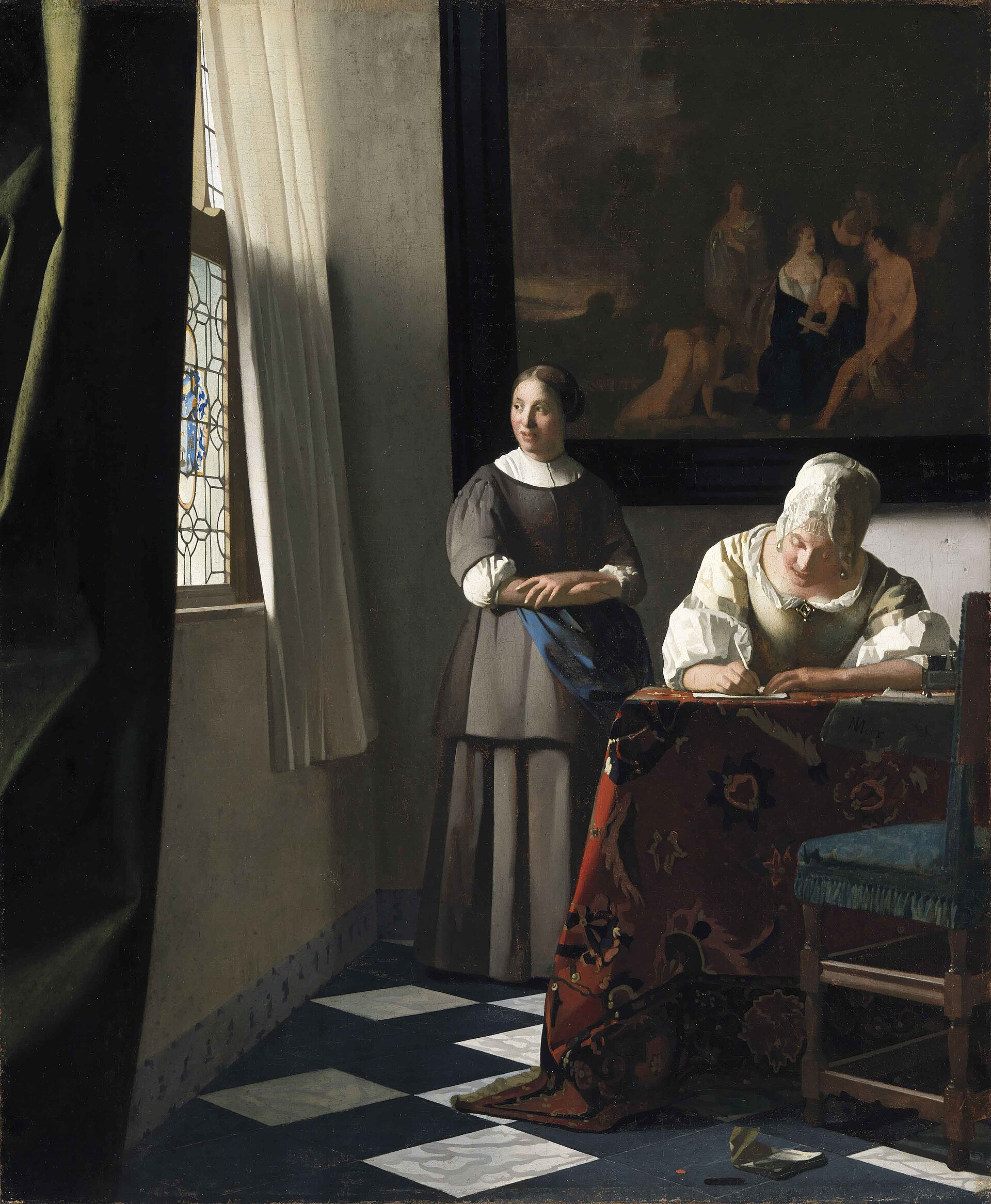
The picture shows a tall interior lit from the left. A young woman in a pale green dress with white sleeves and a white cap sits at a table covered with a patterned red carpet and writes. Behind her, and to the left, a maid in a grey and tan dress with a blue apron stands with her arms folded and looks out of a leaded window hung with a translucent curtain. The 2003 Dublin Love Letters catalogue entry, printed under Peter Sutton's name by Essential Vermeer, notes a dark green curtain at the left, a black and white marble floor with a skirt of tiles, and a large painting of the Finding of Moses in an ebony frame on the back wall. In the lower right corner, on the floor, lie a red seal, a stick of sealing wax and a crumpled paper. The National Gallery of Ireland reads that paper as either a letter with a crumpled wrapper or a letter-writing manual, and says in either case the objects look as if the lady had discarded them in some agitation (source 1).
The gallery gives the size as 71.1 by 60.5 centimetres, the medium as oil on canvas and the date as about 1670. Scholars place it a little later or leave it there: Arthur Wheelock c. 1670 in 2000, Walter Liedtke c. 1670-71 in 2008, Wayne Franits c. 1670-71 in 2015 (source 6). Wheelock, writing the entry in the 1995 Washington and The Hague catalogue, counts it among Vermeer's finest achievements of the early 1670s and stresses how plain it looks: two women in a spacious, austere room, one writing and one turning towards the light, with no communication between them and no hint of interruption (source 3).
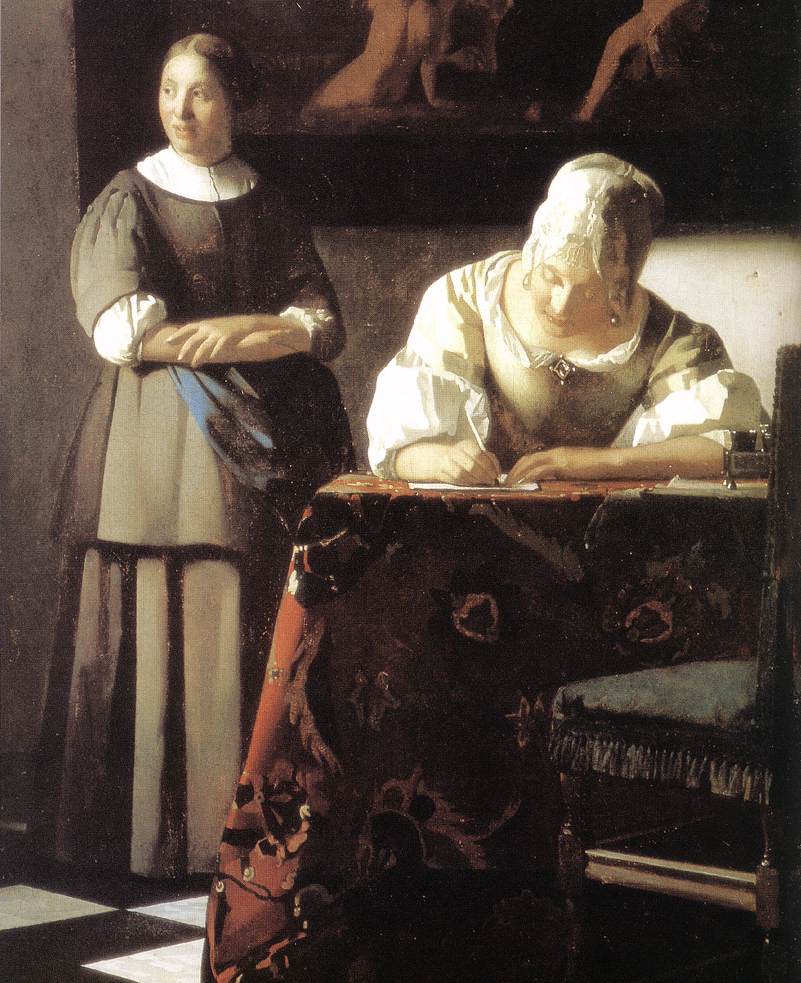
The geometry is the part that carries the drama. Wheelock observes that the orthogonals of the lower and upper window frames run across the maid's folded arms and her lit forehead and meet at a vanishing point on the mistress's left eye, so that the viewer is drawn to the maid first and only then to the writer. The maid stands in the centre of the canvas and the mistress is pushed against the right edge, in a compressed space that Wheelock says heightens her inner intensity (source 3). The lowered viewpoint, scarcely above the table top, makes the standing figure taller and the room higher; the same entry adds that the distance from the table edge to the bottom of the picture equals the distance from the bottom of the ebony frame to the top (source 5).
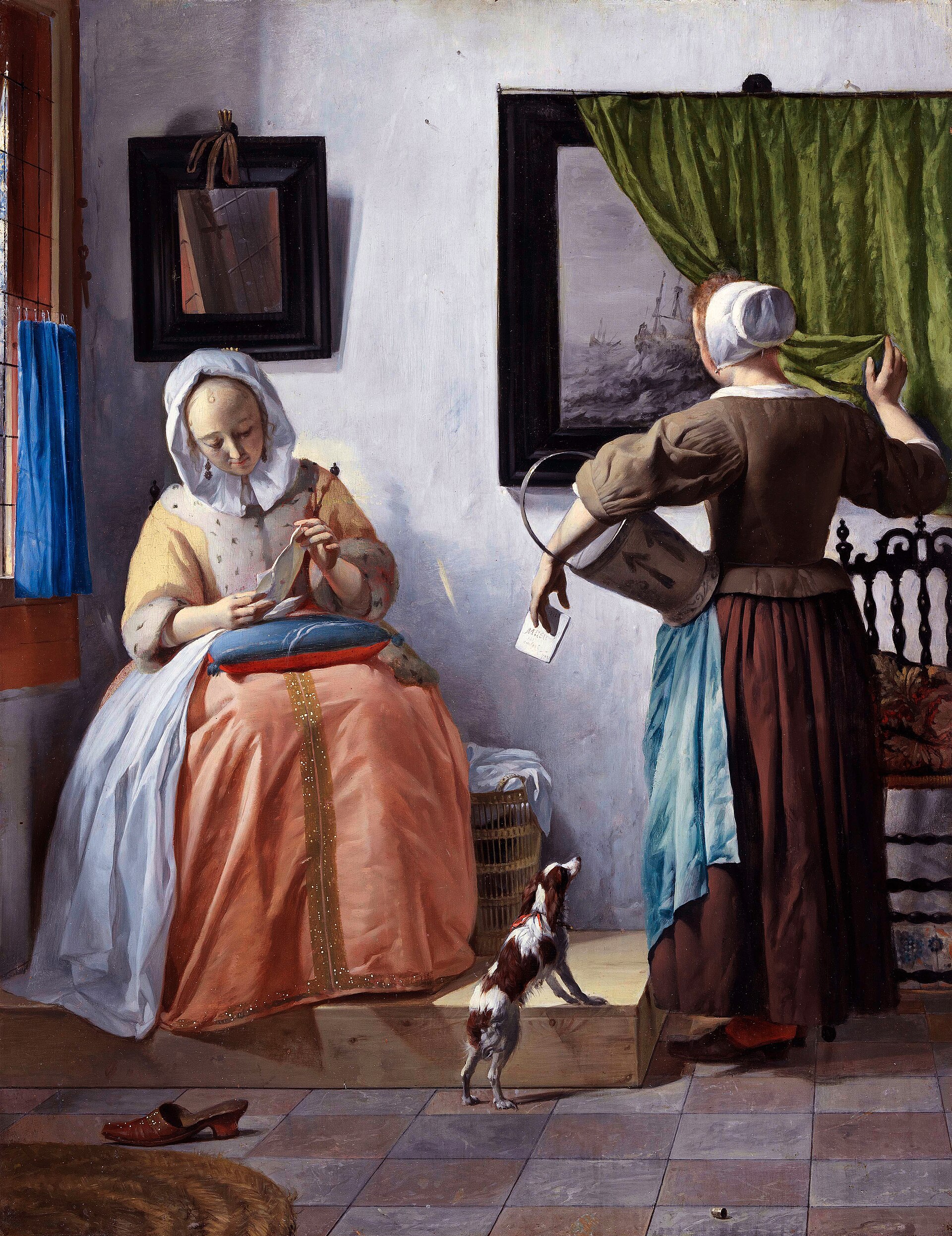
Two readings of the maid are on record and neither is documented. One treats the two women as emotionally disconnected, the maid bored and restless while she waits to carry the letter away; Pascal Bonafoux, as summarised on Wikipedia, answers that her mere presence at so intimate an act implies some degree of intimacy (source 33). The Essential Vermeer commentary notes that Vermeer gives the servant the centre of the picture, a place above her mistress, and compares her pose and dress with the maid in Gabriel Metsu's Woman Reading a Letter in the same Dublin collection (source 6).
Chapter 2Pin, string, canvas and brush: what the surface shows
The Washington catalogue of 1995 records the support as a plain-weave linen canvas with a thread count of 14 by 14 per square centimetre.
The Washington catalogue of 1995 records the support as a plain-weave linen canvas with a thread count of 14 by 14 per square centimetre. The canvas has been lined and the original tacking edges have been removed. Strainer-bar marks 2.6 centimetres from the fold edge show on the top, bottom and right edges, and the weaker cusping on the left, together with the missing strainer marks there, may mean the canvas was cut down on that side (source 3). The ground is a warm buff-grey, visible on the window frame where the lead casts shadows, along a few contours of the figures and along the shadowed edge of the carpet.
The handling is uneven in a way that tells you where Vermeer's attention went. The carpet is described as very sketchy and almost unfinished, with bright blocks of colour set side by side instead of soft transitions, and Essential Vermeer adds that the pattern has been reduced to calligraphic shorthand. The lady's white sleeve was painted wet-in-wet. The floor tiles were laid out with incised lines, and the trailing corner of the carpet flows into them. The background paint overlaps the maid's blue apron, and the lower edge of the green curtain seems to have stood slightly further to the left at an earlier stage (sources 3 and 6).
A dent in the paint at the lady's left eye marks the vanishing point (source 3). In the same catalogue Jorgen Wadum, then chief paintings conservator at the Mauritshuis, argued that Vermeer fixed a pin in the grounded canvas at the vanishing point, tied a string to it and snapped a chalked line across the surface to lay out the orthogonals, and that thirteen paintings still carry physical evidence of the method. Wadum argues that the pin and string, and not a camera obscura, built the perspective, while allowing that Vermeer probably used a camera obscura as a compositional aid in some other respects. Popular accounts, among them the Essential Vermeer page on the 1986 theft, say a restorer noticed the pinprick after the 1993 recovery and first took it for thieves' damage; the printed technical description of 1995 simply records the dent, and I found no primary statement that dates the observation to 1993 (sources 3 and 8).
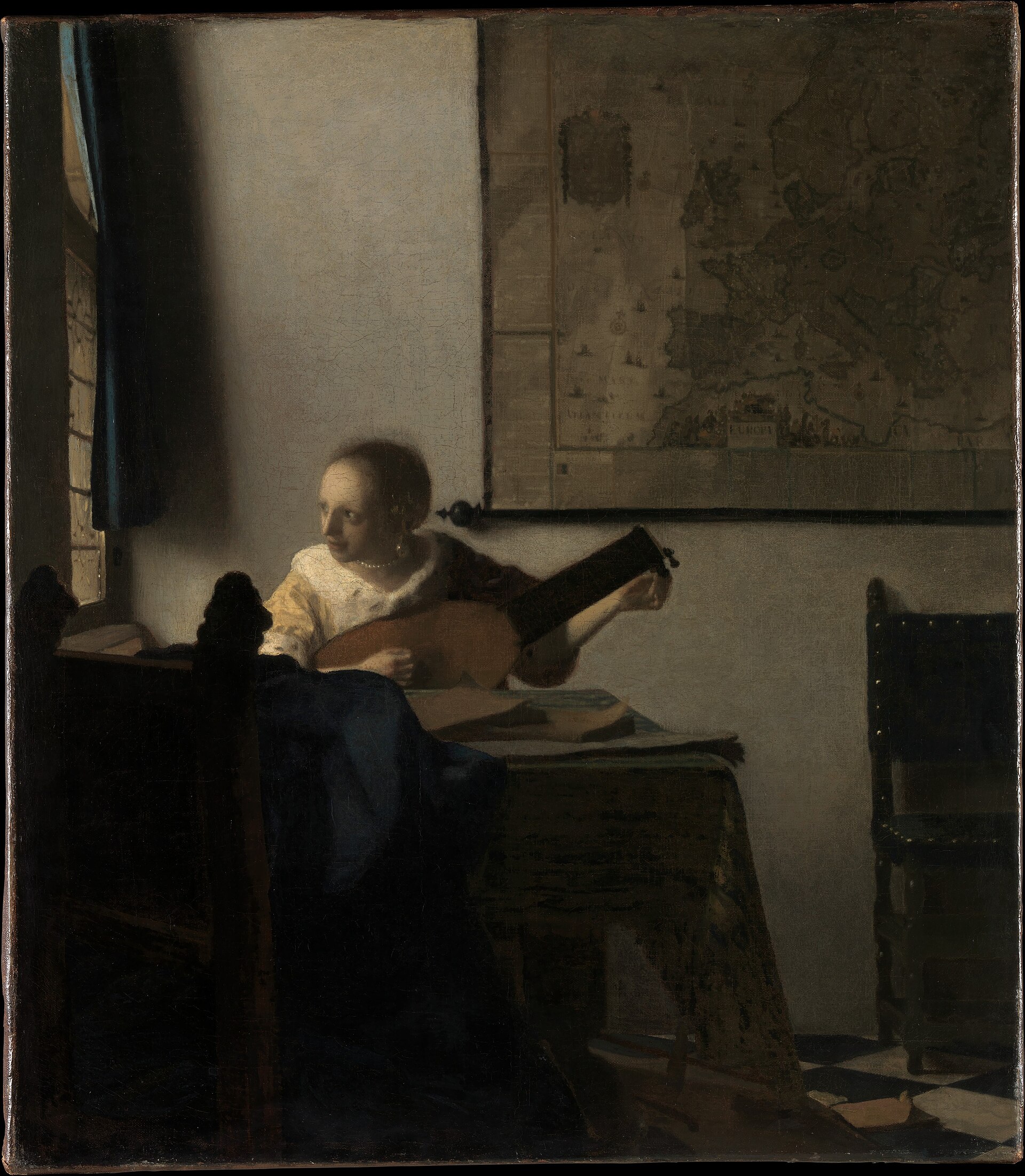
The canvas has also been studied for what it shares with other Vermeers. Computer analysis of weave density by Walter Liedtke, C. Richard Johnson Jr. and Don H. Johnson, published in the Metropolitan Museum Journal in 2012, found that the changing density of warp threads in the much smaller Woman with a Lute in New York, set on its side, matches the great majority of the vertically aligned warp threads in the Dublin canvas. They call the match much less expected than the other two they found in Vermeer's work, and call the Dublin canvas much larger (183 per cent of the New York canvas's area, from the sizes of 72.2 x 59.7 cm and 51.4 x 45.7 cm in the same article). Their caution is the useful part: the inventory of Vermeer's house made in February 1676 lists ten unused painter's canvases, so a canvas could sit in the studio for years, and a weave match must be backed by other evidence before it dates anything. They raise the possibility that the smaller canvas was cut from a roll the artist kept in reserve (source 4).
The red seal and the stick of wax were not always visible. A footnote in the 1995 catalogue states that the wax seal was discovered by Andrew O'Connor when he conserved the painting in 1974, after the first theft, and cites his note in the Burlington Magazine of April 1977. Lisa Vergara, in the 2003 Love Letters catalogue as quoted by Essential Vermeer, says an earlier owner had the seal and the stick overpainted; Essential Vermeer's own theft page speaks of a thick layer of varnish and overpaint, and a 2008 review of Matthew Hart's book speaks of layers of varnish only. None of the sources I could open says who covered the seal, when or why (sources 3, 5, 8 and 35).
Chapter 3The picture on the wall and the thing on the floor
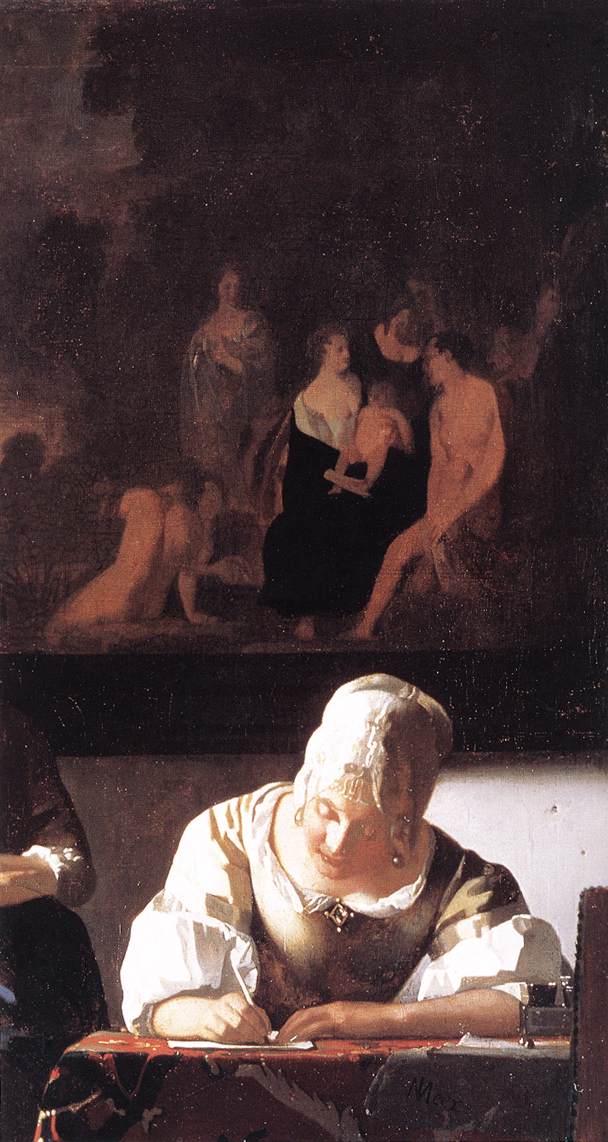
The big painting on the back wall is a Finding of Moses, the story told in Exodus 2:1-10, in which Pharaoh's daughter and her maids find the infant Moses in a basket among the bulrushes.
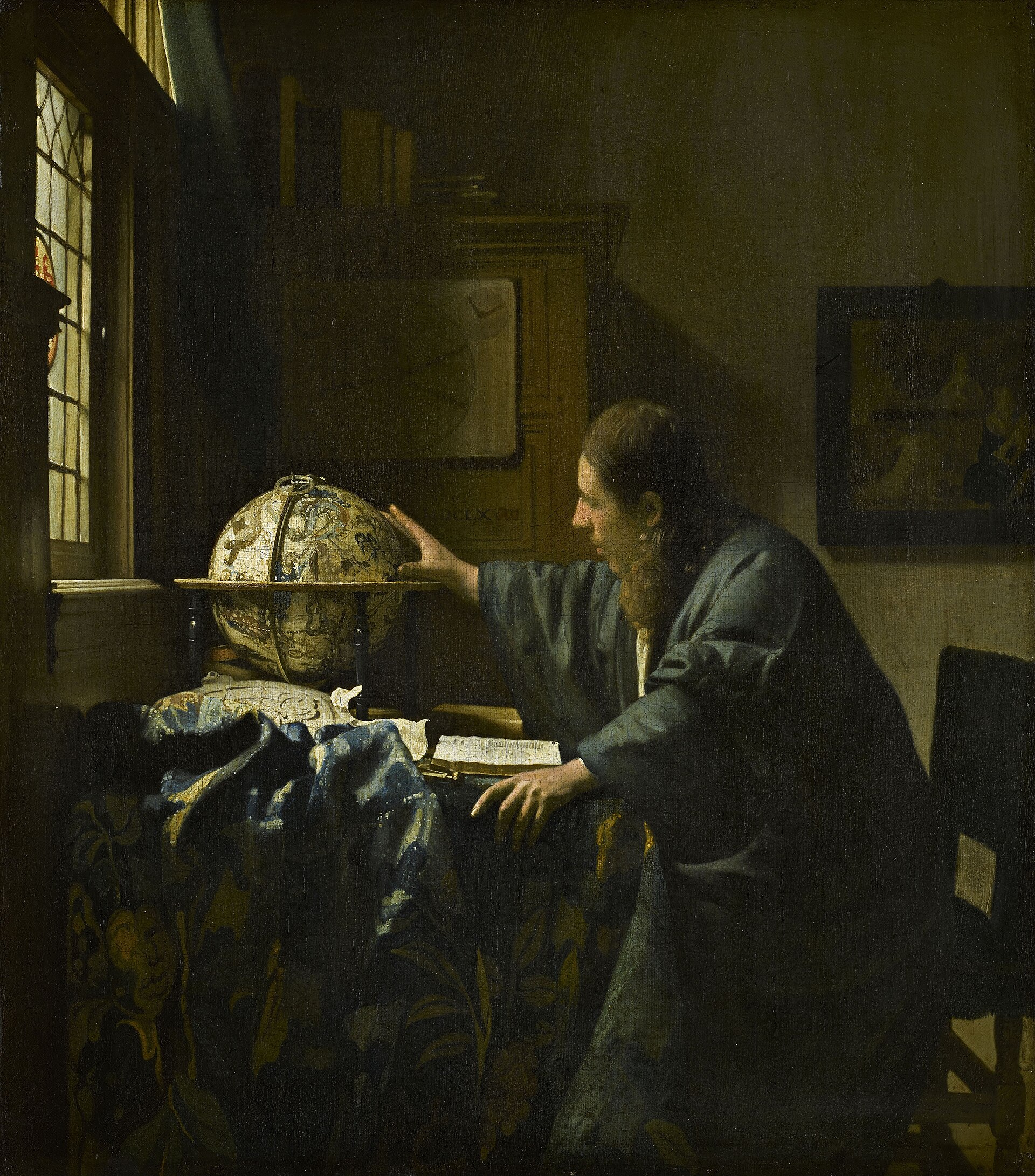
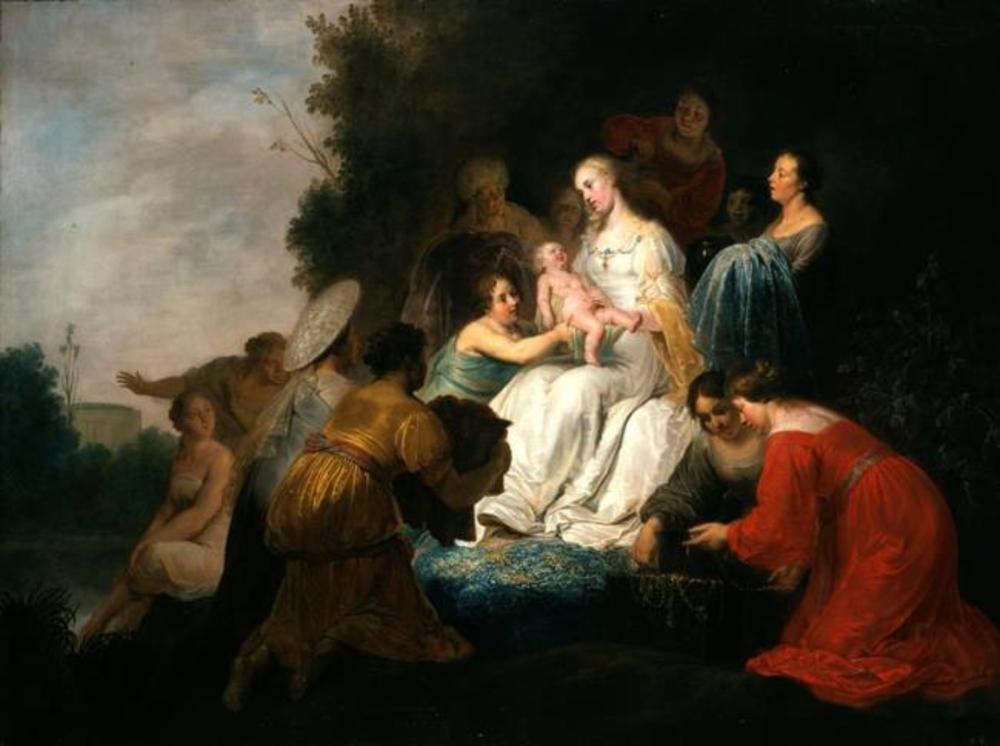
The big painting on the back wall is a Finding of Moses, the story told in Exodus 2:1-10, in which Pharaoh's daughter and her maids find the infant Moses in a basket among the bulrushes. That much is visible. It is also visible, and recorded by Wheelock and by that entry, that the same composition appears at a much smaller scale on the wall of Vermeer's Astronomer of 1668 in the Louvre, so Vermeer used one canvas, perhaps from his own family's possessions as that entry suggests, in two pictures. Wheelock's footnote records that Albert Blankert in 1977 agreed with an earlier proposal to give the painting-within-the-painting to Sir Peter Lely, who worked in Holland as a history painter until the early 1640s and trained in Haarlem, and that Pieter de Grebber's Finding of Moses of 1634 in Dresden is a similar treatment. Essential Vermeer prints the Dresden picture beside Vermeer's and remarks that Vermeer schematised the figures as he did in every other picture-within-a-picture (sources 3, 5 and 6).
What the Moses picture means for the scene is argued and not documented, and four named scholars give four answers. Wheelock, in 1995, notes that Dutch writers read the story as proof of divine providence and of God's power to bring opposing factions together, and he points to a Utrecht preacher, Henricus Caesarius, who in 1609 tied the Moses story to Proverbs 16:7 (when a man's ways please the Lord, he makes even his enemies to be at peace with him). Wheelock adds that the explicit link between Moses and providence has not yet been found in a seventeenth-century source and is made in an eighteenth-century edition of Ripa's Iconologia, though he thinks the association probably an old one. His proposal is that the conjunction of the Moses picture, the cast-off letter and the writing mistress may suggest reconciliation and peace of mind reached through one's own effort in step with faith (source 3).
The same entry agrees that the Moses picture undoubtedly bears on the subject, adds that its meaning remains obscure, and keeps Wheelock's providence reading in view. Vergara, in the same catalogue, reads it by analogy. She points out that the picture is built on a vertical axis that runs from Pharaoh's daughter holding the infant, through the letter being written, down a leg of the chair and on to the lit corner of the paper on the floor, and she takes the daughter, famed in Dutch literature for compassion and independence, as a type of the ideal woman for whom the writer stands. On her reading the standing figure in the biblical scene, Moses's sister, who was sent as a go-between, is echoed by the standing maid. Vergara also relates the picture to Gerard de Lairesse's distinction between the antique and the modern in the Groot Schilderboek; Essential Vermeer notes that the book appeared in Amsterdam in 1707, after Vermeer's death (sources 5 and 6).
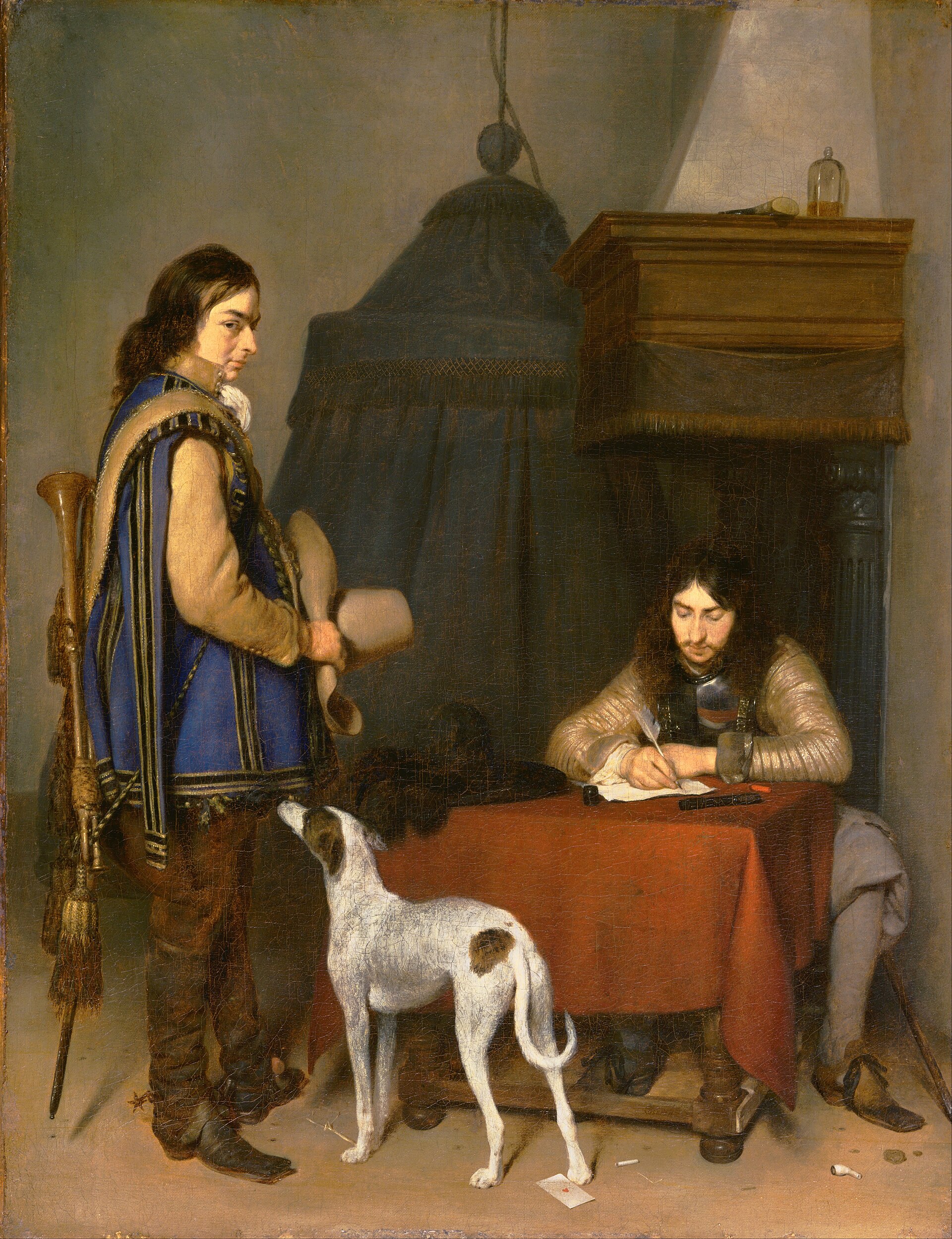
The object on the floor has produced the same spread of views. Wheelock holds that the crumpled paper must be a letter the lady has received, since a discarded draft would not carry the red seal that lies beside it, and that her intense concentration is the reply. Blankert, in his essay in the same 1995 catalogue, takes the crumpled item to be a book of model love letters tossed aside as useless, so that the lady has begun again on a clean sheet; he bases the picture on Gerard ter Borch's Lady Sealing a Letter of about 1659 with its waiting servant. Vergara prefers a letter with its wrapper crumpled, either received or a rejected draft. The gallery's online description keeps both possibilities open, while its highlight page and label text say probably a letter-writing manual (sources 1, 2, 3 and 5). The same entry also notes the empty chair on the near side of the table: chairs of that type were not left freestanding but set against the wall when unused, so someone has recently been sitting there, and the viewer is made complicit in a private drama.
No document records what Vermeer meant by any of this, and no inventory, letter or contract ties the Moses picture or the floor still life to a patron's instruction. Each reading above is a modern scholar's argument from other Dutch pictures and texts, and the record keeps them apart for that reason. The one finding they share is that the objects on the floor mark a disturbance at odds with the calm of the room.
Chapter 4A debt paid in pictures: the baker, 1676
Vermeer never sold this picture in his lifetime, according to the 1995 Washington catalogue.
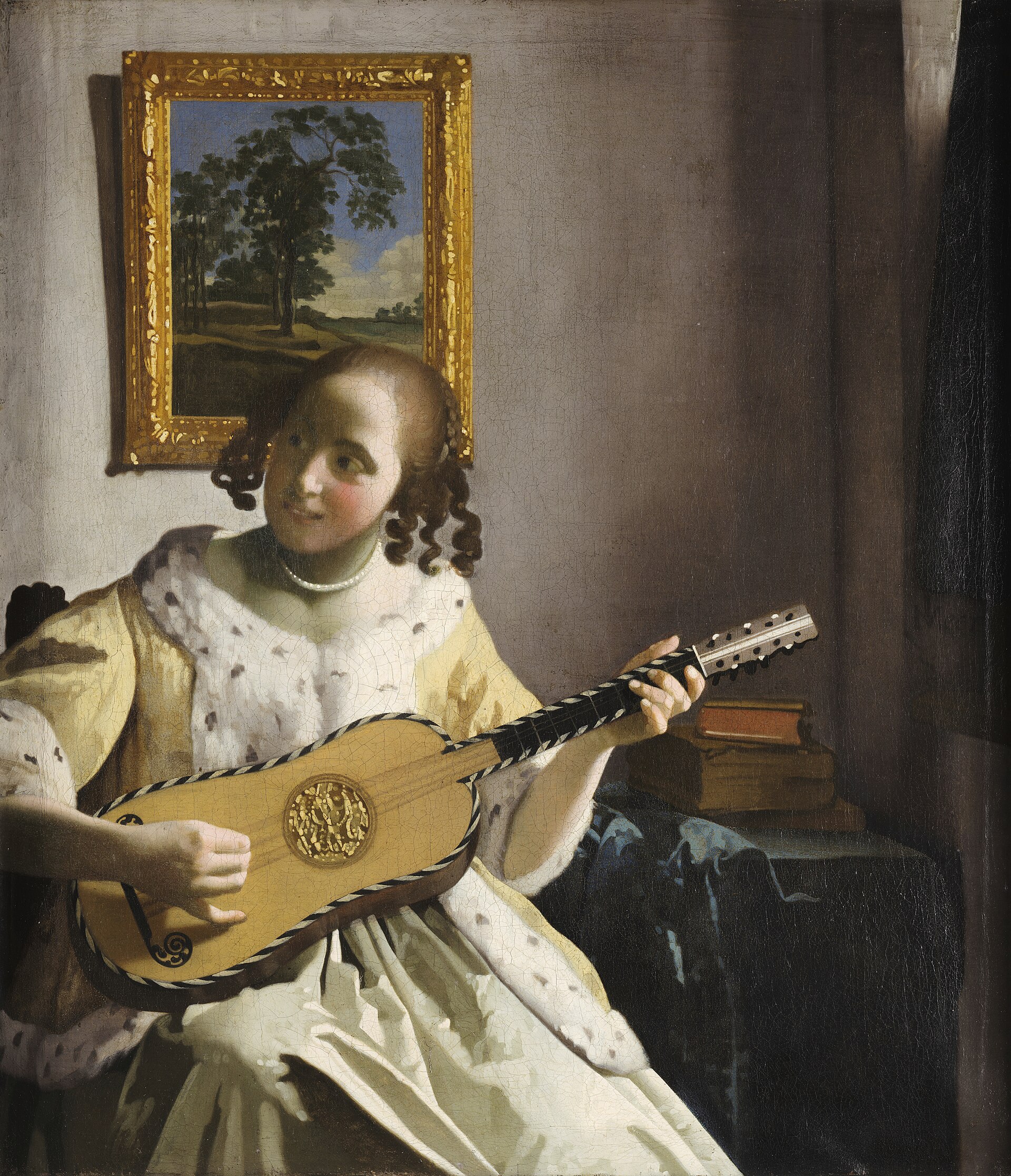
Vermeer never sold this picture in his lifetime, according to the 1995 Washington catalogue. After he died in December 1675 it was still in the house, and on 27 January 1676 his widow Catharina Bolnes gave two of his paintings to a Delft master baker, Hendrick van Buyten (1632-1701), as security for 617 guilders and 6 stuivers she owed him for bread. The deed, printed by John Michael Montias as document 361, describes one of the two as showing two persons, one of whom sits and writes a letter, and the other as a person playing a zither. The paintings were to be returned if she paid all her debts, and she was given twelve years to repay the main part at fifty guilders a year without interest (sources 3, 9 and 10).
The identification of the writing picture with the Dublin canvas is Wheelock's and Ben Broos's; Broos writes in 1995 that it may reasonably be assumed, and the two take the zither player to be The Guitar Player in the Iveagh Bequest at Kenwood. It is an inference from the wording of the deed, not a match by marks. Montias took a different line. When Van Buyten's own estate was inventoried in 1701 it held a large painting by Vermeer in the vestibule and two small works in another room (Montias document 442), and Montias assumed the large one must be the letter-writer that had stood as security, which would make it the big canvas now called Mistress and Maid in the Frick Collection. Wheelock answers in a footnote that the woman in the Frick picture is not writing but looking up from a letter a servant has just brought her. This record therefore grades the 1676 link as disputed, with Wheelock's reading as the one the Dublin gallery follows (sources 1 and 3).
Van Buyten was no stranger to Vermeer's work. The French diplomat Balthasar de Monconys, visiting Delft in the summer of 1663, found the painter with none of his pictures to show and was taken to a baker's, where he saw one for which, he was told, six hundred livres had been paid. It showed a single figure, and Monconys thought six pistoles too much for it. Essential Vermeer says the baker was almost certainly Van Buyten, and Wikipedia gives the same identification and the date as August 1663. A picture with a single figure is not this one, which has two, so Monconys saw something else (sources 9 and 10).
Part of what the 617 guilders meant in the period is on record. Essential Vermeer, working from Montias, says the sum was roughly two to three years' worth of bread, or the price of a small house, and that a guilder a day was a very good wage; Wikipedia's article on Van Buyten says the same of the guilder a day. Neither source offers a modern equivalent and this record gives none. Monconys's journal gives six hundred livres; Essential Vermeer glosses the figure as about 600 guilders and Wikipedia's Van Buyten article gives guilders, but livres and guilders are different units and this record draws no comparison with the 617 guilders of 1676 (sources 9 and 10).
Chapter 5Rotterdam and The Hague: 155 guilders, 100 guilders, 30 guilders
The next owner the catalogue names is Josua van Belle (1637-1710), a Rotterdam merchant trading with Spain who served as burgomaster in 1705, and then his widow Ida Catharina van der Meyden, in...
The next owner the catalogue names is Josua van Belle (1637-1710), a Rotterdam merchant trading with Spain who served as burgomaster in 1705, and then his widow Ida Catharina van der Meyden, in Rotterdam from 1710 to 1729. How the picture passed from Van Buyten's house, where it was in 1701, to Van Belle before 1710 is not recorded in anything I could read (source 3).
On 6 September 1730 the Van Belle estate sold its pictures in Rotterdam, and lot 92 is the first sale record. It appears in Hoet's printed account as a seated young lady writing a letter, a maid standing beside her waiting for it, by Vander Meer, and it made 155 guilders. Wheelock says its dimensions correspond more or less with those of the Dublin canvas, and that is the evidence for the identification. Who bought it in 1730 is not stated in the sources I opened (source 3).
By 1734 it belonged to Franco van Bleyswijck, a former member of Delft's Council of Forty who was buried in the Oude Kerk on 9 October 1734, and it was appraised at 100 guilders. His estate was divided between two cousins and brothers-in-law, and the lot containing the picture went to Hendrik van Slingelandt (1702-1759), alderman and burgomaster of The Hague, as 'A Damsel who writes a letter and a maid next to her by J. v. Meer'. After Hendrik's death and his wife Maria Catharina van der Burch's two years later, the Hague painter Aert Schouman examined and priced the contents of the house. He thought 'A writing Woman by J. van der Meer' was worth no more than 30 guilders. One of the two daughters, Agatha or Elisabeth Maria, inherited it (source 3).
After that the trail thins. The 1995 catalogue lists Maria Catharina van Slingelandt (1761-1771) or Agatha van Slingelandt (1761-1775), then possibly Barthout van Slingelandt of Dordrecht (1771-1798) or Willem Bentinck of The Hague (1775-1798), and says the later history is unrecorded until 1881. The record cannot choose between those names and does not try. The three figures from the eighteenth century, 155 guilders in 1730, 100 in 1734 and 30 in 1761, are the only prices that survive for the picture before 1881, and the last two are appraisals, not sales (source 3).
Chapter 6Vienna, Paris and the Secretan sale
The picture surfaces in 1881 in the hands of Viktor von Miller zu Aichholz (1845-1910) of Vienna, an Austrian industrialist and later banker, numismatist and collector.
The picture surfaces in 1881 in the hands of Viktor von Miller zu Aichholz (1845-1910) of Vienna, an Austrian industrialist and later banker, numismatist and collector. The catalogue says plainly that the reason he sold is not known. The Paris dealer Charles Sedelmeyer bought it from him and sold it that same year to E. Secretan for 60,000 francs. Secretan was a director of the Societe des Metaux, the copper concern. His attempt to corner the copper market collapsed in March 1889, his collection had stood as security for loans, and the people handling the bankruptcy chose a public sale (sources 3 and 31).
The Secretan sale took place at Sedelmeyer's gallery in Paris, and Vermeer's picture, then known in France as Le Billet doux, was lot 140. It made 62,000 francs and went to the firm Boussod, Valadon and Co. The sale date is given two ways. The 1995 catalogue and the Dublin gallery's online record say 1 June 1889; Essential Vermeer and Wikipedia's article on Secretan say 1 July 1889, and Wikipedia cites a New York Times report dated 2 July 1889 that the sale had closed. Wikipedia's Secretan article also lists the catalogue as 'sold at Sedelmeyer's Galleries, Paris, July, 1889', which makes July the better supported date and 1 June look like a catalogue slip; I did not see the sale catalogue, and the record carries both dates until it can be checked. Set against 62,000 francs is the sale's star lot, Millet's Angelus, which Wikipedia says was bid to a record 553,000 francs in a contest between French and American buyers (sources 1, 6 and 31).
The Antiques and Art Ireland notice of the 2024 Dublin exhibition, my only source for this, says that another Vermeer from Secretan's collection, Mistress and Maid, was in the same 1889 sale, so that the Dublin and New York pictures were last united at that auction before the Rijksmuseum showed them together in 2023 (source 29).
After the sale the picture is traced to a Paris collection called Marinoni, whose first name and dates the Dublin and Washington catalogues do not give, and then to the Paris dealer F. Kleinberger, who sold it to Alfred Beit. Wheelock cites Hofstede de Groot's catalogue of 1907-1928, no. 37, for the Kleinberger sale. Sedelmeyer went on illustrating it as a picture that had passed through his gallery: the exhibition lists give an illustrated Sedelmeyer catalogue of 300 old master pictures from 1898, where it appears as The Billet-doux (no. 86), and a Sedelmeyer volume of 1914 (no. 22). The Washington catalogue reports no price for the Kleinberger sale or for the earlier sale from Von Miller zu Aichholz (sources 3 and 6).
Chapter 7Alfred Beit, Otto Beit and the house at Russborough
Alfred Beit (1853-1906) was born in Hamburg and sent by his Amsterdam diamond firm to Kimberley in 1875.
Alfred Beit (1853-1906) was born in Hamburg and sent by his Amsterdam diamond firm to Kimberley in 1875. According to the Wikipedia biography he made a fortune in diamonds and then in Witwatersrand gold, moved to London in 1888 and had a mansion, Aldford House, built in Park Lane in the 1890s. The 1995 catalogue says he began collecting around 1895 and that the Vermeer was one of his first acquisitions. Wilhelm von Bode's Die Kunstsammlungen des Alfred Beit in seinem Stadthause in Park Lane zu London was printed in Berlin in 1904 and is cited by the Washington catalogue for pages 8 to 10 (sources 3 and 24).
Alfred Beit died unmarried on 16 July 1906 and left his fortune to his brother Otto (1865-1930), who had worked with him in the diamond trade since 1888. The Vermeer passed to Otto, who was later made a baronet; Wikipedia's article on the younger Alfred puts the creation in February 1924 and the Washington catalogue says 1928, and I have not settled the difference. Alfred Beit the elder never held a baronetcy: Otto was the first baronet, and Alfred Beit (1903-1994), Otto's son and the elder Alfred's namesake nephew, was the second (sources 3, 23 and 24).
The second baronet inherited the title and the collection in 1930. According to Wikipedia he sat as a Conservative member of Parliament for St Pancras South East from 1931 to 1945, served in the RAF in the war and married Clementine Mitford, a cousin of the Mitford sisters, in April 1939; an Irish Times feature of 2011 gives the year as 1938. In 1952 the couple bought Russborough House in County Wicklow, a Palladian house built from 1741 for Joseph Leeson, later Earl of Milltown, to hang the collection. The Irish Times says they bought it after spotting an advertisement in Country Life, and a 1995 magazine article says Sir Alfred bought it by telegram, sight unseen. They created the Alfred Beit Foundation in 1976 and opened the house to the public in 1978 (sources 14, 22, 23 and 30).
In the decades before the thefts the picture travelled. The Dublin gallery's exhibition list puts it in the Royal Academy's Dutch Art show of 1929, at the Boijmans museum in Rotterdam in 1935, at the Academy again in 1938, at Cape Town in 1949 and 1950, on the Metropolitan Museum, Toledo and Toronto tour of Dutch painting in 1954 and 1955, in Dublin in 1957 and at the Mauritshuis and the Orangerie in 1966. At the 1929 show it was catalogued as The Love-Letter and in the souvenir volume as The Letter, the kind of title that invites confusion with the Rijksmuseum's Love Letter (sources 1 and 6).
Chapter 826 April 1974: the first theft, as the sources tell it
Most sources put the first raid on Russborough House on Friday 26 April 1974; Essential Vermeer and Wikipedia's article on the painting say 27 April.
Most sources put the first raid on Russborough House on Friday 26 April 1974; Essential Vermeer and Wikipedia's article on the painting say 27 April. The account in a 1995 article in Insight on the News by Deirdre McQuillan runs as follows: at about 9:30 in the evening a woman with a French accent knocked on the door and was joined within seconds by three men with revolvers. Sir Alfred Beit and his wife Clementine were struck on the head with the guns, taken into the library and bound with stockings. The raiders then cut 19 paintings from their frames, among them a Goya, three Rubens, two Gainsboroughs and the Vermeer, and loaded them into a silver-grey Ford Cortina. The whole affair took under ten minutes. Radio Telefis Eireann's retrospective of 26 June 2001 says Beit, then 71, and one of his staff were struck with revolvers and tied up in the library, where they watched the gang cut the paintings out with a screwdriver (sources 11 and 14).
The haul was valued at 8 million pounds by RTE and the Insight article, and at 20 million dollars by Time in its issue of 20 May 1974. Time, the earliest source I could open, reported on 20 May 1974, before any trial, that Bridget Rose Dugdale, then 33 and described as the daughter of a British insurance tycoon, was accused of masterminding and directing the theft. The magazine reported that the pictures had been recovered intact two weeks before in a remote cottage in County Cork, where police found both the paintings and Dugdale, and that at her arraignment in Dublin she shouted to the spectators that the British had an army of occupation in a small part of Ireland (sources 13 and 14).
The ransom demand is reported in different terms. The 1995 Insight article says the thieves demanded the release of the Price sisters, imprisoned in England for a London car bombing, together with 500,000 pounds. RTE says the IRA tried to have four members who had bombed London transferred to a Belfast prison in return for five of the most important paintings. Wikipedia's article on Dugdale gives the demand as 500,000 Irish pounds and the release of Dolours and Marian Price, who it says were on hunger strike in Brixton prison. Essential Vermeer says the ransom letter, with pages torn from Beit's diary, asked for the release of the two sisters in exchange for five paintings and the equivalent of 1.2 million dollars for the others. The record does not choose between them (sources 7, 11, 14 and 16).
The recovery date also varies by source. RTE says the Gardai recovered all the paintings eleven days later; Wikipedia and Essential Vermeer put the raid on the cottage at Glandore at 4 or 5 May; the Southern Star, summarising Anthony Amore's 2022 book The Woman Who Stole Vermeer, says Dugdale was arrested about ten days after the raid. The sources agree that the pictures were found in County Cork and that all 19 were recovered; Essential Vermeer and the Southern Star add that Dugdale had rented the cottage from a farmer under an alias. Essential Vermeer reports that the Vermeer was found in the house with two other paintings, bearing a few small scratches, while the rest were in a borrowed car; the Washington catalogue says it was slightly damaged and could be repaired (sources 3, 7, 11, 15 and 16).
Dugdale was charged in Dublin and on 25 June 1974 she was sentenced to nine years in prison after pleading, in her own words reported by Wikipedia, 'proudly and incorruptibly guilty'; RTE reported on her death that she had been jailed for nine years over the art theft and the hijacking of a helicopter. She was released in October 1980, according to Wikipedia, and died in a Dublin nursing home on 18 March 2024, according to RTE. The Insight article reports that Beit, then 71, never again went into the museum part of the house and that neither he nor his wife spoke publicly about the ordeal (sources 14, 16 and 17).
The repair of the canvas produced the one discovery that the theft added to the picture's history. When Andrew O'Connor treated it in 1974 the red seal and the stick of wax on the floor appeared, and the Washington catalogue credits him with finding them (source 3). Whether earlier owners could see the seal depends on when it was covered, and no source opened says.
Chapter 9May 1986 to September 1993: the second theft and the car park in Antwerp
The 1995 catalogue dates the second raid to 21 May 1986; Essential Vermeer gives 1 May.
The 1995 catalogue dates the second raid to 21 May 1986; Essential Vermeer gives 1 May. The Irish Times of 30 September 2002 recorded it as a raid in May 1986 by a gang of Dublin criminals headed by Martin Cahill, known as the General, who stole 18 works including the Vermeer, Goya's Portrait of Dona Antonia Zarate and Gabriel Metsu's Young Man Writing a Letter. Cahill was shot dead in Dublin on 18 August 1994. The attribution of the robbery to him is the newspaper's, and Wikipedia's article on Cahill repeats it; I found no court record of it in the sources I could open (sources 8, 12 and 21).
Essential Vermeer, a secondary source, says the thieves cut a pane out of a French door at 2 a.m., left when the alarm sounded, waited in bushes while the administrator checked the house and, an hour later, took 18 paintings in six minutes. RTE puts the value of the haul at 30 million pounds and Essential Vermeer at over 45 million dollars. Essential Vermeer adds that Sir Alfred, then 83, was in London and says, without naming a source, that the Vermeer was held for a ransom of 20 million pounds that was never paid; Wikipedia's article on the painting says the same and cites a Times article of 31 July 2005 that I could not open. RTE (26 June 2001) says that after failing to sell the paintings Cahill turned to loyalist paramilitaries, who took a Metsu miniature to Turkey in the belief that dealers might buy it and were met by Turkish police who arrested three men (sources 8 and 11).
The Vermeer came back on 1 September 1993, according to the Washington catalogue and Essential Vermeer (Wikipedia's article on the painting says August 1993), whose entry says years of secret negotiations and international detective work preceded it. The detail is in the obituaries of the Scotland Yard detective Charles Hill, who died on 20 February 2021. The New York Times obituary of 10 March 2021 says Hill, posing as a middleman for a Middle Eastern tycoon, dealt with a gangster who had come into possession of four of the paintings not recovered in other countries; in the parking garage of Antwerp airport Hill saw the man take Goya's Dona Antonia Zarate out of a sports bag in the trunk of his car and unroll it before the Belgian police arrived, and the other three paintings were in the trunk too, the Vermeer in a trash bag. The Washington Post obituary quotes Hill calling the Vermeer 'the greatest masterpiece I've had the pleasure to hold.' The Times obituary of 2 March 2021 adds that it was his most dangerous assignment, involving a confrontation in a Belgian hotel with a Dublin man who was later murdered, and that Hill had told a colleague where he would be so that, if he ended up in Antwerp harbour, his body would be identified more easily (sources 3, 18, 19 and 20).
Accounts differ on the shape of the operation. Wikipedia's article on the painting says the exchange 'turned out to be a sting operation organised by the Irish police'; the obituaries put Hill, of Scotland Yard, in the car park with the Belgian police. Essential Vermeer says the paintings were found in the trunk of a car rented by three Irishmen and a Yugoslav, which none of the obituaries says. Essential Vermeer also reports that one stolen picture turned up in Istanbul in 1990 and that the Vermeer was rumoured to be in a Luxembourg bank vault; I could not find a source for either and have left them out of the chain. The Irish Times reported in 2002 that all but two of the 1986 paintings, a pair of Venetian scenes by Guardi, had been recovered. The Washington Post says Hill was still looking for the Guardi pair when he died (sources 8, 12, 19 and 33).
Chapter 10The 1987 gift, and a picture that was not in the building
The Dublin gallery credits the painting as presented by Sir Alfred and Lady Beit in 1987, as part of the Beit Collection.
The Dublin gallery credits the painting as presented by Sir Alfred and Lady Beit in 1987, as part of the Beit Collection. Seventeen paintings made up the gift, according to Wikipedia's article on Sir Alfred and the Irish Times feature of 28 May 2011; RTE (26 June 2001) says 'over a dozen' went to the State. The gallery's own pages from 2006 say the Dutch collection 'has been crowned by the Beit Gift of works by Vermeer, Metsu, Ruisdael and Hobbema' (sources 1, 11, 23, 30 and 36).
The gift was made while the Vermeer was missing. It had been stolen on 21 May 1986, by the Washington catalogue's date, and did not come back until September 1993. The catalogue says Sir Alfred, who died in May 1994 at 91, lived to see the rescue and had already bequeathed his Vermeer to the Dublin museum in 1987. That catalogue and Essential Vermeer say 'bequeathed'; the gallery's own credit line says 'presented'. Sir Alfred died on 14 May 1994 by the catalogue's count and 12 May by Wikipedia's, and the record carries both (sources 1, 3 and 23).
Parliament noticed the gift within a year. On 20 January 1988 Senator Mrs Bulbulia told the Seanad that Sir Alfred had 'bequeathed' his pictures to the nation and presented them to the gallery, put the commercial value of the Beit collection at between 50 million and 100 million, and said it was hanging in Room 28 on the ground floor next to a room where some of the largest humidity fluctuations had been recorded. She was pressing the Government to fund air conditioning for the building. The speaker gives no currency; Wikipedia's article on Sir Alfred reads it as Irish pounds. She was speaking of the Beit collection as a whole and did not mention the Vermeer by name in the passage I read (sources 23 and 25).
Sir Alfred was made an honorary Irish citizen in 1993, according to Wikipedia, 'in recognition of his philanthropy' including the 1987 gift; the Irish Times says the Beits were both made citizens that year. None of the sources I could open sets out the conditions of the gift, an Irish tax treatment of it or a ministerial role in accepting it, and those questions are recorded as open below (sources 23 and 30).
Russborough was raided again after the gift, and the later thefts took pictures that were still in the house. The Irish Times recorded a raid in June 2001 in which armed men rammed a car through the front door and took two paintings, a Bellotto and a Gainsborough, the second of which had been taken in the earlier raids as well, and Wikipedia lists a 2002 raid in which five paintings were taken by an associate of Cahill's. RTE noted on the day of the 2001 raid that neither of the paintings stolen then was State-owned (sources 11, 12 and 22).
Chapter 11Since 1993: Room 38, three Vermeer shows and a second Vermeer on loan
The Washington and The Hague exhibition of 1995 and 1996, two years after the recovery, put it in the catalogue entry that this record leans on most heavily.
The Washington and The Hague exhibition of 1995 and 1996, two years after the recovery, put it in the catalogue entry that this record leans on most heavily. The Dublin gallery's list then runs through the Rijksmuseum's Glory of the Golden Age in 2000, the Dublin and Greenwich exhibition Love Letters in 2003 and 2004, shows in Tokyo, Kyoto, Sendai and Osaka in 2008, 2011 and 2018-19, the Staedel's 200th-anniversary display in Frankfurt in 2015, and the Louvre, Dublin and Washington exhibition Vermeer and the Masters of Genre Painting in 2017 and 2018 (source 1).
That last show, conceived by the Dublin gallery and curated by Dr Adriaan Waiboer, brought together over 60 pictures and, by the gallery's count, as many as ten Vermeers, almost a third of his surviving work and the third highest number ever assembled. The Dublin picture hung with Woman Holding a Balance, Woman with a Pearl Necklace, The Astronomer and The Geographer (source 28). In 2023 it went to the Rijksmuseum's Vermeer (9 February to 4 June), no. 35 by Essential Vermeer's list. Wikipedia says that show featured 28 Vermeers, the most shown together, and drew more than 650,000 visitors (sources 1, 6 and 34).
In 2024, with the Frick Collection's building closed for renovation, Mistress and Maid travelled to Dublin for Vermeer Visits (11 May to 18 August 2024, Room 38, Milltown Wing), curated by Dr Lizzie Marx, which the gallery described as an unprecedented chance to unite the pair. Antiques and Art Ireland adds that this was only the second time the Frick picture had left New York since it was acquired in 1919, and that it rarely travels because of the conditions of its bequest. The Dublin picture stays on display in Room 38, according to the gallery's collection page, which carries no date (sources 2, 26, 27 and 29).
The theft has become its own literature. Wikipedia lists Matthew Hart's The Irish Game (2004), Amore's The Woman Who Stole Vermeer (2022), Sean O'Driscoll's biography of Rose Dugdale (2022) and the 2023 film Baltimore, released as Rose's War in the United States and Germany in March 2024. Those accounts and the contemporary reports do not always agree on dates and details, and this record dates each event to the source that gives it (sources 16, 21 and 33).
A student who wants the image can use the Dublin gallery's online collection, which gives the signature, provenance and exhibition history, and the public domain reproductions on Wikimedia Commons, one of which is derived from the gallery's own file. I found no published IIIF manifest, no infrared reflectogram and no pigment analysis for this picture in the sources I could open (sources 1, 3, 37 and 38).
Chapter 12Names, numbers and the other letter pictures
The picture has had more than one name and several are close to those of other Vermeers, which is how mistakes begin.
The picture has had more than one name and several are close to those of other Vermeers, which is how mistakes begin. The Dublin gallery calls it Woman Writing a Letter, with her Maid. The English-language literature mostly says Lady Writing a Letter with her Maid, and Dutch writers say Schrijvende vrouw met dienstbode. In 1676 Catharina Bolnes's deed called it a picture of two persons, one of whom sits and writes a letter; the Van Belle sale of 1730 called it 'a sitting young lady writing a letter, next to which a maid stands waiting'; the Van Slingelandt papers of 1734 call it 'a damsel who writes a letter and a maid next to her' and, in 1761, 'a writing woman'. Sedelmeyer in 1898 called it The Billet-doux, Burlington House in 1929 The Love-Letter and the souvenir volume The Letter (sources 1, 3 and 6).
It carries these numbers: NGI.4535 in the Dublin gallery; no. 19 in the 1995 Washington and The Hague catalogue; L31 in Walter Liedtke's 2008 catalogue of the complete paintings, as cited in the Metropolitan Museum Journal; no. 37 in Hofstede de Groot's catalogue of 1907-1928; no. 17 in the Dublin gallery's 1988 Beit Collection catalogue; no. 27 in Blankert's catalogues of 1978 and 1992; and no. 35 in Essential Vermeer's list for the Rijksmuseum exhibition of 2023. Watson (1960) is cited in the 1995 literature list for the Beit Collection and O'Connor (1977) for the conservation (sources 3, 4 and 6).
Several other Vermeers depict a woman and a letter and are not this picture. Mistress and Maid in the Frick Collection shows the moment a servant brings a letter to a lady who has put down her pen. The Love Letter in the Rijksmuseum, stolen from a Brussels exhibition in 1971 and recovered about two weeks later, is a different picture and has nothing to do with the Beit theft. Woman in Blue Reading a Letter and Girl Reading a Letter at an Open Window are further letter pictures by Vermeer and are not this one. The Washington catalogue's discussion of Mistress and Maid is the reason the 1676 deed is graded as it is, because Montias read the deed in favour of that picture and Wheelock did not (sources 3 and 34).
The dimensions differ between catalogues and the record lists them: 71.1 by 60.5 centimetres on the Dublin gallery's pages, 72.2 by 59.7 in the Washington catalogue and in Liedtke's article, and 71.1 by 58.4 on Essential Vermeer. The signature is reported in two forms: the gallery gives 'JvMeer' at the centre right and the Washington catalogue gives 'IFMeer' with the I and V and M in ligature, on the paper hanging over the edge of the table, which Essential Vermeer describes as under the writing hand. Dates run from c. 1670 to c. 1670-71, and Essential Vermeer's list gives 1671 for Albert Blankert (1975). The Dublin picture does not belong to the Dissius sale of 16 May 1696, in which 21 Vermeers from the Van Ruijven inheritance were sold in Amsterdam: the Washington provenance puts it with Van Buyten from 1676. No Rothschild or Hope owner appears in the gallery's or the catalogue's chain, and the picture on the back wall is a Finding of Moses (sources 1, 3, 5, 6 and 32).
The artist
Johannes Vermeer (also Jan Vermeer; written J. van der Meer in the Slingelandt papers)
Vermeer lived and worked in Delft and died there at 43 in debt. The Dublin gallery says probably as few as 36 of his pictures have survived. Montias argued that Pieter van Ruijven and his family bought a large share of his work, and Broos (1995) cautions against reading that as a monopoly. The way his surviving pictures reached other hands after his death is documented unevenly. This one reached a baker.
Related works
| Work | Relation | Where it is |
|---|---|---|
| Mistress and Maid Johannes Vermeer | Companion theme, c. 1667; different picture. Montias read the 1676 deed in its favour and Wheelock did not. Lent to the National Gallery of Ireland for Vermeer Visits, 11 May to 18 August 2024. Per Antiques and Art Ireland (one source), it and the Dublin picture were in the same Secretan sale in 1889. | The Frick Collection, New York |
| The Astronomer Johannes Vermeer | Contains the same Finding of Moses on the wall, at smaller scale; dated 1668. Wheelock and the Love Letters entry printed under Sutton's name point to the repeated painting-within-a-painting. | Musee du Louvre, Paris |
| The Guitar Player Johannes Vermeer | Probably the second picture given to the baker Van Buyten with this one in January 1676. Identification by Wheelock and Broos (1995), from the wording of the deed. | Iveagh Bequest, Kenwood House, London |
| Woman with a Lute Johannes Vermeer | Canvas weave match with the Dublin canvas (Liedtke, Johnson and Johnson, 2012). The authors give the Dublin canvas as much larger (183 per cent of the Lute's area). | Metropolitan Museum of Art, New York |
| Finding of Moses (1634) Pieter de Grebber | Comparable treatment of the subject cited in the 1995 catalogue; the wall picture has been given to Sir Peter Lely by some scholars. Wheelock's footnote records Blankert (1977) on the Lely proposal. | Gemaeldegalerie, Dresden |
| Officer Writing a Letter, with a Trumpeter Gerard ter Borch | Letter-writing scene with a waiting messenger, set beside the Dublin picture by Lisa Vergara. Blankert, in the 1995 catalogue, takes Ter Borch's Lady Sealing a Letter, with its waiting servant, as the source for Vermeer's composition. | Philadelphia Museum of Art |
| Woman Reading a Letter Gabriel Metsu | Essential Vermeer suggests its maid may have inspired Vermeer's. Metsu's pair of letter pictures is also in the Dublin collection. | National Gallery of Ireland, Dublin |
| The Love Letter Johannes Vermeer | Not related by provenance; named here because titles overlap. Exhibited under that title in 1929, the Beit picture is not this one. Stolen from a Brussels exhibition in 1971 and recovered about two weeks later. | Rijksmuseum, Amsterdam |
Open questions
- Is the 'two personages, one of whom sits and writes a letter' of Catharina Bolnes's deed of 27 January 1676 this picture, as Wheelock and Broos assume, or the Frick's Mistress and Maid, as Montias's reading implies? No mark or measurement settles it.
- Who owned the picture between Van Buyten's death in 1701 and Josua van Belle's ownership before 1710, and who bought lot 92 at the Van Belle sale of 6 September 1730?
- Which heir held it after 1761 (Maria Catharina or Agatha van Slingelandt, Barthout van Slingelandt or Willem Bentinck), and where was it between 1798 and 1881, when Viktor von Miller zu Aichholz sold it to Sedelmeyer?
- Was the Secretan sale on 1 June or 1 July 1889? The Dublin gallery and the 1995 catalogue say June; Essential Vermeer and Wikipedia say July. The sale catalogue would settle it; Wikipedia's Secretan article lists that catalogue as July 1889.
- What was the object on the floor: a received letter (Wheelock), a letter with a crumpled wrapper (Vergara), or a letter-writing manual (Blankert)? No document says, and the picture alone cannot.
- Who covered the red seal and the wax stick, and when? The 1995 catalogue credits Andrew O'Connor's 1974 treatment with revealing them; Lisa Vergara says an earlier owner overpainted them. Pre-1974 reproductions would show whether they were ever visible.
- Where did the Finding of Moses on the wall come from, and is it the picture Albert Blankert, in 1977, agreed to give to Sir Peter Lely? The Astronomer shows the same wall picture and no source names a specific canvas.
- What route did the Vermeer take between 21 May 1986 and 1 September 1993, and who held it? The accounts name a Belgian car park and a gangster; none of the sources I could open gives the chain of hands.
- What were the terms of the 1987 gift: its valuation, any Irish tax treatment and any minister's or Government's part in accepting it? No source opened sets them out. The Seanad speaker's 50 to 100 million gives no currency.
- Is there published pigment analysis, a reflectogram or an X-radiograph of this picture, beyond the thread count and weave map in the 1995 catalogue and the 2012 article? The Washington technical description mentions none, and I found no IIIF manifest.
- Which price did Alfred Beit pay Kleinberger around 1895, and what did Kleinberger pay the Marinoni collection? The catalogue records the sequence and no sum.
Questions about this object
What is Woman Writing a Letter, with her Maid?
Woman Writing a Letter, with her Maid is a painting, dated c. 1670-71. Medium: Oil on canvas.
Who made Woman Writing a Letter, with her Maid, and is the attribution settled?
The attribution to Johannes Vermeer is recorded here as accepted. Accepted as an autograph, signed work by Vermeer in every catalogue consulted. The signature is read in two ways, JvMeer at the centre right (National Gallery of Ireland) and IFMeer with the I V M in ligature on the paper hanging over the table edge (Washington catalogue, 1995). The picture is identified with a lot of the Van Belle sale of 1730 by description and dimensions, not by a mark.
Where is Woman Writing a Letter, with her Maid now?
National Gallery of Ireland, Dublin (Room 38). Inventory number NGI.4535. Last confirmed 8 October 2026. Presented, Sir Alfred and Lady Beit, 1987 (Beit Collection); recovered 1 September 1993 after the theft of 21 May 1986.
What has Woman Writing a Letter, with her Maid sold for?
Hammer 155 guilders (the recorded price; no commission or premium is separated in the sources); with premium, Not recorded. Van Belle estate sale, Rotterdam (auction house not named in the sources opened), 1730-09-06.
What is still unknown about Woman Writing a Letter, with her Maid?
Is the 'two personages, one of whom sits and writes a letter' of Catharina Bolnes's deed of 27 January 1676 this picture, as Wheelock and Broos assume, or the Frick's Mistress and Maid, as Montias's reading implies? No mark or measurement settles it.
Sources
- 1National Gallery of Ireland online collection, 'Woman Writing a Letter, with her Maid', NGI.4535: title, size, signature, credit line, full provenance, exhibition history. Primary (institution). onlinecollection.nationalgallery.ie/objects/...
- 2National Gallery of Ireland, collection highlight page for the painting: size 71.1 x 60.5 cm, number NGI.4535, on display in Room 38. Undated page. nationalgallery.ie/art-and-artists/...
- 3Ben Broos and Arthur K. Wheelock Jr., Johannes Vermeer, exhibition catalogue (Washington and The Hague, 1995), entry 19 and Wheelock/Blankert/Wadum essays. Primary scholarly source; open PDF from the National Gallery of Art. nga.gov/content/...
- 4Walter Liedtke, C. Richard Johnson Jr. and Don H. Johnson, 'Canvas Matches in Vermeer: A Case Study in the Computer Analysis of Fabric Supports', Metropolitan Museum Journal 47 (2012). people.ece.cornell.edu/johnson/...
- 5Essential Vermeer, 'Critical Assessments: Lady Writing a Letter with her Maid', with two excerpts from the Love Letters catalogue (2003), one printed under Peter Sutton's name (its text refers to 'the Sutton essay', so the author is not certain) and one by Lisa Vergara. Secondary compilation of primary scholarship. essentialvermeer.com/cat_about/...
- 6Essential Vermeer, interactive catalogue page for the painting: technical report, provenance, exhibitions, dating by scholar. Secondary; its provenance repeats the 1995 catalogue but says 'bequeathed' and dates the Secretan sale 1 July 1889, where the Dublin record says 1 June. essentialvermeer.com/catalogue/...
- 7Essential Vermeer, 'Vermeer Thefts: 1974 - Lady Writing a Letter with her Maid'. Secondary; unsourced in places. essentialvermeer.com/fakes_thefts_school_of_delft_lost_sp...
- 8Essential Vermeer, 'Vermeer Thefts: 1986 - Lady Writing a Letter with her Maid'. Secondary; unsourced in places; its date of 1 May 1986 conflicts with the 1995 catalogue. essentialvermeer.com/fakes_thefts_school_of_delft_lost_sp...
- 9Essential Vermeer, 'The Life and Art of Johannes Vermeer, part three': the Monconys passage of 1663 and the baker Van Buyten, with Montias's figures. Secondary. essentialvermeer.com/vermeer's_life_03.html
- 10Wikipedia, 'Hendrick van Buyten', summarising Montias, Vermeer and his Milieu (1989). en.wikipedia.org/wiki/...
- 11RTE News, 'Russborough House has history of art thefts', 26 June 2001. rte.ie/news/...
- 12The Irish Times, 'Previous raids on Russborough', 30 September 2002. irishtimes.com/news/...
- 13Time, 'Renegade Debutante', 20 May 1974 (Wayback Machine copy of the Time archive page). web.archive.org/web/...
- 14Deirdre McQuillan, 'Adventures of a Mobile Masterpiece', Insight on the News 11:44 (20 November 1995); Questia preview via the Wayback Machine, the opening paragraphs only. web.archive.org/web/...
- 15Jack McCarron, 'Escape to West Cork was bad move for suspect in art heist', The Southern Star, on Anthony M. Amore, The Woman Who Stole Vermeer (2022). Undated page; secondary summary of a book. southernstar.ie/news/...
- 16Wikipedia, 'Rose Dugdale': the 1974 raid, the ransom, the sentence, her release and death. en.wikipedia.org/wiki/...
- 17RTE News, report on the death of Rose Dugdale, 18 March 2024. rte.ie/news/...
- 18Richard Sandomir, 'Charles Hill, Detective Who Found The Scream, Dies at 73', The New York Times, 10 March 2021 (a copy of the article hosted as a PDF by a third party; the publisher's page was not opened). skysoldiersfoundation.org/wp-content/...
- 19Harrison Smith, 'Charles Hill, who tracked down stolen masterpieces like The Scream, dies at 73', The Washington Post, 11 March 2021 (third-party PDF copy). skysoldiersfoundation.org/wp-content/...
- 20'Charles Hill', obituary, The Times (London), 2 March 2021 (third-party PDF copy). skysoldiersfoundation.org/wp-content/...
- 21Wikipedia, 'Martin Cahill'. en.wikipedia.org/wiki/...
- 22Wikipedia, 'Russborough House', for the thefts of 1974, 1986, 2001 and 2002 and the Beit Foundation. en.wikipedia.org/wiki/...
- 23Wikipedia, 'Sir Alfred Beit, 2nd Baronet': career, marriage, the 1987 gift and honorary citizenship. en.wikipedia.org/wiki/...
- 24Wikipedia, 'Alfred Beit' (1853-1906). en.wikipedia.org/wiki/...
- 25Seanad Eireann debate, 20 January 1988, Appropriation Act 1987 motion, speech by Mrs Bulbulia on the National Gallery and the Beit gift (Wayback Machine copy of historical-debates.oireachtas.ie). web.archive.org/web/...
- 26National Gallery of Ireland, 'Vermeer Visits', 11 May to 18 August 2024. nationalgallery.ie/art-and-artists/...
- 27National Gallery of Ireland, press release announcing the 2024 exhibition programme. nationalgallery.ie/what-we-do/...
- 28National Gallery of Ireland, 'Vermeer and the Masters of Genre Painting: Inspiration and Rivalry', 17 June to 17 September 2017. nationalgallery.ie/vermeer-and-masters-genre-painting
- 29Antiques and Art Ireland, 'Vermeers reunited at the National Gallery of Ireland', 8 May 2024. antiquesandartireland.com/2024/...
- 30Deirdre McQuillan, 'Hidden treasure', The Irish Times, 28 May 2011. irishtimes.com/culture/...
- 31Wikipedia, 'Eugene Secretan': the copper collapse of 1889 and the Secretan sale of 1 July 1889. en.wikipedia.org/wiki/...
- 32Wikipedia, 'Jacob Dissius': the Van Ruijven inheritance and the sale of 16 May 1696. en.wikipedia.org/wiki/...
- 33Wikipedia, 'Lady Writing a Letter with her Maid'. en.wikipedia.org/wiki/...
- 34Wikipedia, 'Johannes Vermeer': baptism, marriage, guild, death, inventory, the Rijksmuseum exhibition of 2023. en.wikipedia.org/wiki/...
- 35Michael Carlson, review of Matthew Hart, The Irish Game (2004), 'The General meets the Girl with the Pearl Earring', Irresistible Targets blog, 6 September 2008. Review of a book I could not open; weakest source in the record. irresistibletargets.blogspot.com/2008/...
- 36National Gallery of Ireland, archived paintings page (Wayback Machine, 10 December 2006), on the Dutch collection and the Beit gift. web.archive.org/web/...
- 37Wikimedia Commons file page, 'Woman writing a letter, with her maid, by Johannes Vermeer.jpg' (public domain; source named as the gallery's online collection). commons.wikimedia.org/wiki/...
- 38Wikimedia Commons file page, 'DublinVermeer.jpg' (public domain; source unstated). commons.wikimedia.org/wiki/...


Last verified · Published
Change log
8 October 2026 - Record created at the house standard: researched narrative, technical evidence, maker dossier, graded provenance chain, prices with hammer and premium separated, related works, open questions and sources.