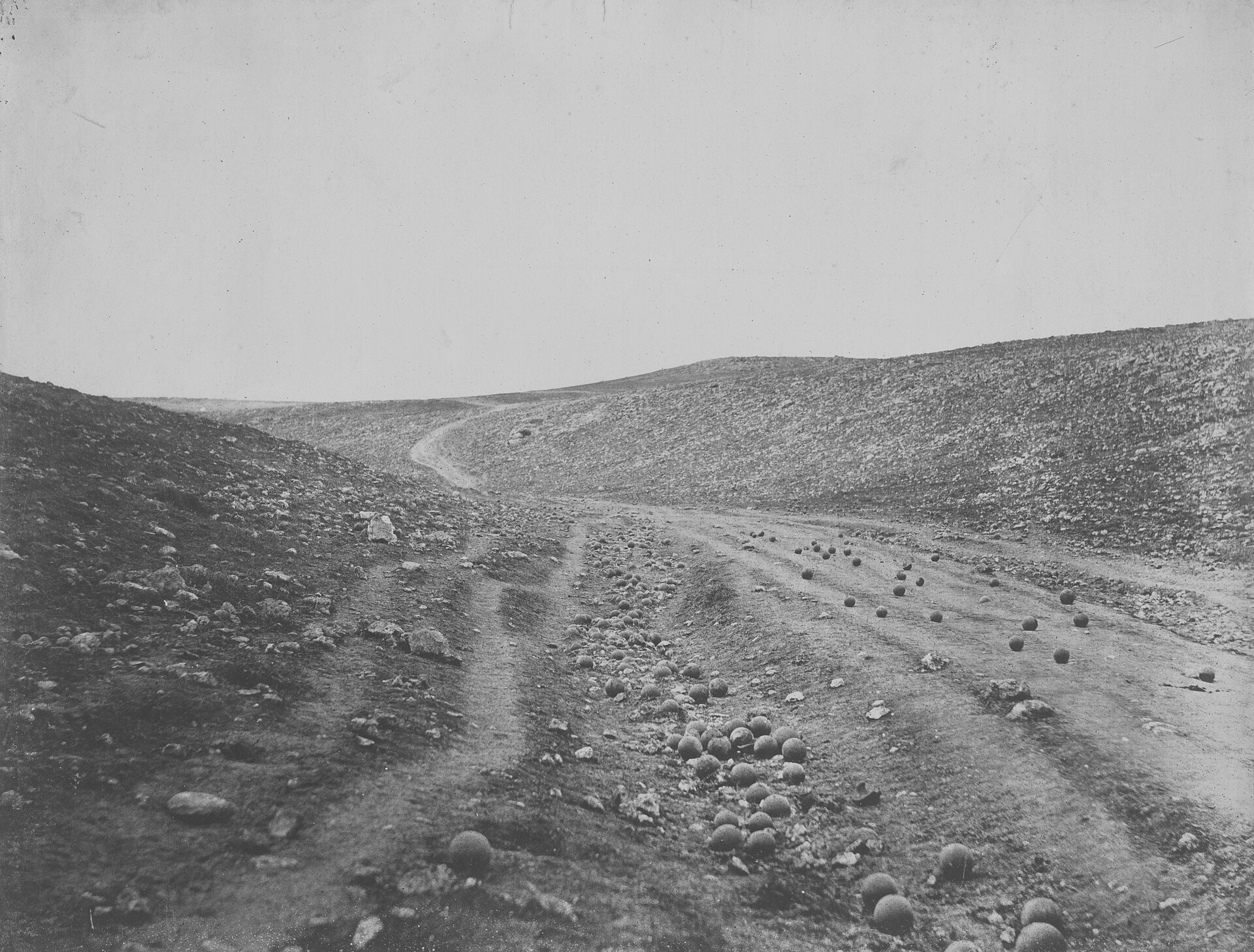
The Valley of the Shadow of Death
23 April 1855 · Salted paper print from a wet collodion...
No single print is 'the' object
 British · 1819-1869
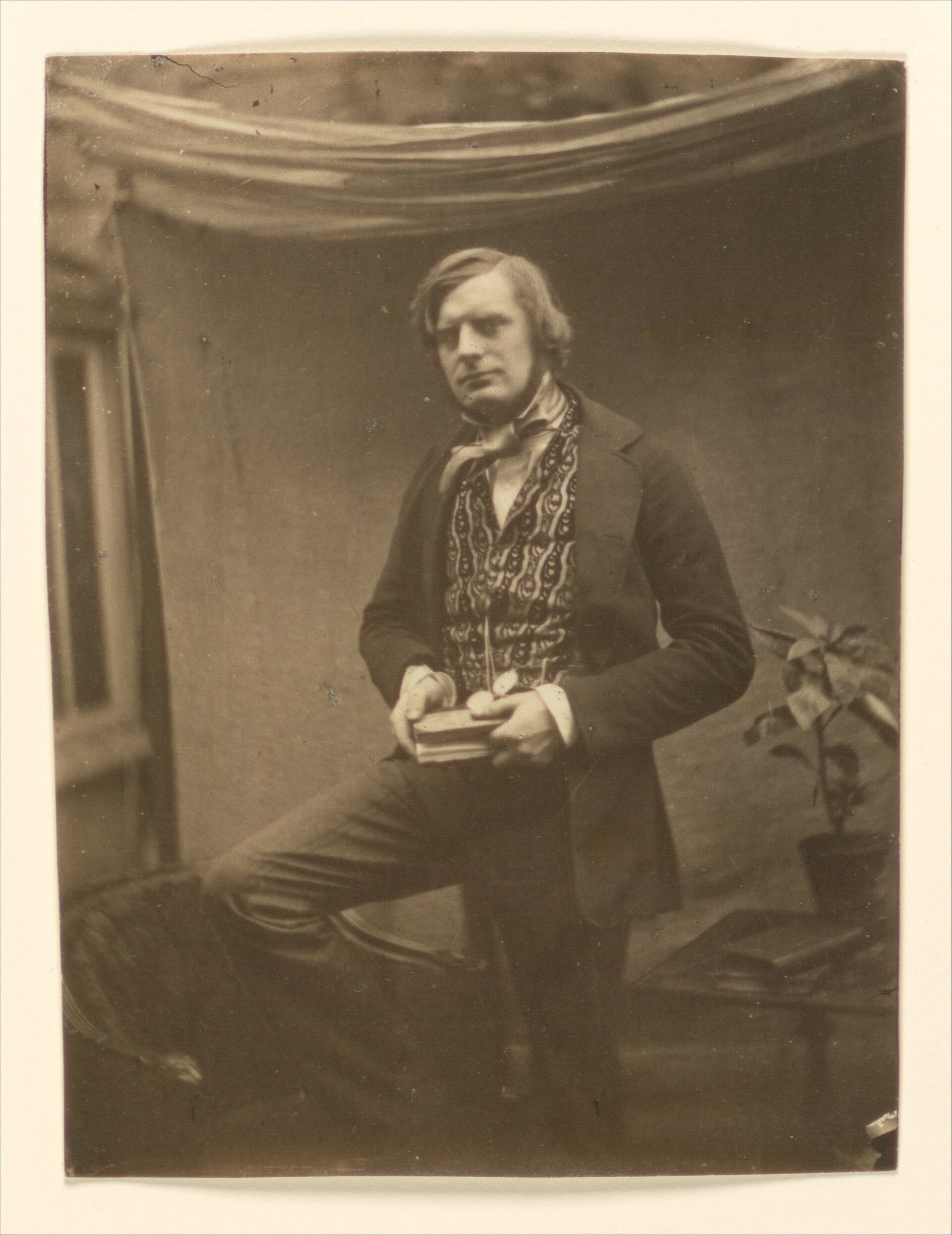
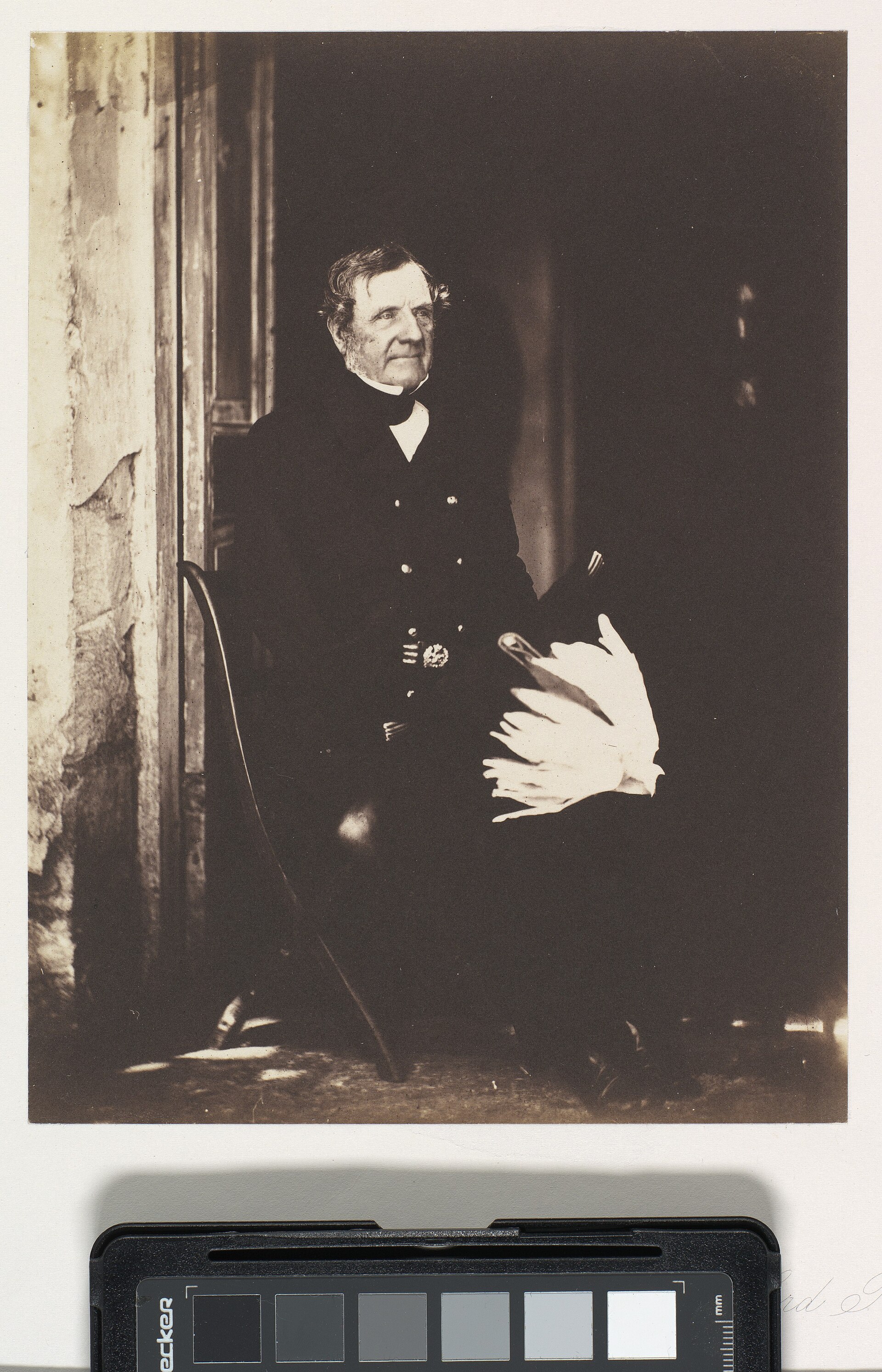
Fenton photographed by himself, February 1852, an albumen silver print from a glass negative, three years before the Crimea and the same year he set off for Russia. Catalogued by the Metropolitan Museum of Art as [Self-Portrait] by Roger Fenton, accession 2005.100.285, an institutional identification rather than a later attribution.
Metropolitan Museum of Art, New York| Worked as | Photographer, Founder, Photographic Society of London |
|---|---|
| Born | 28 March 1819 · Crimble Hall, Heywood, near Rochdale, Lancashire, England |
| Died | 8 August 1869 · Potters Bar, Middlesex, England |
| Nationality | British |
| Movement | British photography, 1850s golden age |
| In this archive | 1 artwork |
| Sources | 19 cited |
| Last verified |
About this page 1 artwork in the archive · Last verified · 19 sources cited
Roger Fenton spent barely a decade behind a camera, and for most of it he was not photographing war. He trained as a lawyer and then as a painter before photography drew him away from both in his early thirties, and by the time he abandoned the medium entirely in 1862 he had photographed Russian bridge works, the state rooms and children of Queen Victoria, the antiquities of the British Museum, the cathedrals and ruined abbeys of England, a suite of staged Orientalist studio tableaux, and a final series of lush still lifes. He is remembered almost entirely for four months of that decade: March to June 1855, when Thomas Agnew and Sons sent him to the Crimea and he returned with the photograph now known as The Valley of the Shadow of Death.
What most accounts leave out is that the single most reproduced war photograph of the nineteenth century is itself two photographs, made minutes apart, differing only in whether the road is littered with Russian cannonballs or swept clear of them. The order in which Fenton made them, and what that order can and cannot prove about his honesty as a witness, was argued in print for a century and a half and was not settled by connoisseurship at all. It was settled in 2007 by an American documentary filmmaker measuring the shadows cast by loose stones on a hillside.
The rest of Fenton's career is less argued over and, in its way, more interesting for it: a founder and first honorary secretary of what became the Royal Photographic Society, the first photographer the British Museum ever employed, and a working artist who abandoned the whole enterprise at the height of his reputation for reasons his biographers still cannot fully agree on.
Born 28 March at Crimble Hall, near Heywood, Rochdale, Lancashire, third son of the banker and MP John Fenton.1516
Studies painting in Paris in the circle of Paul Delaroche, alongside future photographers Gustave Le Gray, Charles Negre and Henri Le Secq.10
Exhibits paintings at the Royal Academy, London.10
Called to the Bar. Sees the Photographic Department of the Great Exhibition and takes up the calotype process.1015
Travels to Russia (St Petersburg, Kiev, Moscow) to photograph Charles Vignoles's Dnieper bridge works at Kiev, using a dry waxed-paper negative process learned from Gustave Le Gray in Paris.3
Founds and becomes first Honorary Secretary of the Photographic Society of London, inaugural meeting 20 January.1014
Meets Queen Victoria and Prince Albert at a Photographic Society exhibition in January; is commissioned to photograph the royal family and, later, Balmoral. Appointed the British Museum's first official photographer.410
Sails for the Crimea under sponsorship of Thomas Agnew and Sons; works in the field 8 March to 26 June, producing a reported 300 to 360 negatives including The Valley of the Shadow of Death (23 April).312
Agnew exhibits 312 Crimean photographs at the Society of Watercolour Painters, London, from 20 September 1855, and publishes 337 commercially between November 1855 and April 1856.3
Steps down as Honorary Secretary of the Photographic Society after three years in the post.10
Photographs the major cathedrals and ruined abbeys of England, Wales and Scotland, working at formats up to 14 by 18 inches.1
Produces a suite of roughly fifty staged Orientalist studio compositions, including Reclining Odalisque; reviewed in the Journal of the Photographic Society as without equal in landscape work.113
Produces a final series of still lifes. His infant son and his Crimean assistant Marcus Sparling both die in April.110
Announces his complete retirement from photography, sells his equipment and remaining negative stock (reported at over 1,000 plates), and resigns from the Photographic Society.1015
Dies 8 August at Potters Bar, Middlesex, aged fifty.15
The Library of Congress purchases 263 Fenton prints, including The Valley of the Shadow of Death, from his grandniece Frances M. Fenton.19
Helmut Gernsheim purchases what is described as Fenton's own complete set of 360 mounted Crimean prints from a Fenton descendant; later placed with the University of Texas at Austin.19
Fenton's own grey paper albums, including material from the 1858 Orientalist series, are dispersed at Christie's; the Getty Museum acquires the largest share.1113
The Getty Museum acquires Samuel Wagstaff's photography collection, including Fenton material, founding its Department of Photographs.19
All the Mighty World: The Photographs of Roger Fenton, 1852-1860 tours the National Gallery of Art (Washington), the Getty Museum, the Metropolitan Museum of Art and Tate Britain.7
The State Hermitage Museum exhibits 22 Fenton photographs of 1852 and 1855 from its own collection.3
Fenton trades within the specialist nineteenth-century photography market rather than among the record-setting lots of the wider photography auction market, which belong to twentieth-century names. Within his own market the Orientalist studio series and the Crimean material are the strongest and most frequently cited performers, and in every result located for this record the sources consulted report a single realised figure without stating whether it is the hammer price or a total inclusive of buyer's premium; this record flags that gap rather than asserting a split it cannot verify.
| Date | Sale | Work | Result | Note |
|---|---|---|---|---|
| 17 June 2010 | Dominic Winter Auctioneers | Effendi and Musician (Orientalist study) | Hammer Not specified in the sources consulted With premium Reported price GBP 27,000 GBP | Sold against a pre-sale estimate of GBP 3,000, South Cerney, Gloucestershire. Part of a group of five Fenton photographs realising a combined total reported as approximately GBP 100,000 by one source and GBP 100,500 by another. |
| 17 June 2010 | Dominic Winter Auctioneers | Untitled Orientalist genre photograph | Hammer Not specified in the sources consulted With premium Reported price GBP 32,000 GBP | Sold against a pre-sale estimate of GBP 5,000 to 8,000, in the same South Cerney sale as above. |
| 1978 | Christie's | Reclining Odalisque | Hammer Not specified in the sources consulted With premium Reported price GBP 5,400 GBP | Part of the dispersal of Fenton's grey paper albums, 1978-1982, from which the sole known print of this composition passed to the Metropolitan Museum of Art. |
| 27 April 2023 | Swann Auction Galleries | The Valley of the Shadow of Death | Hammer Not specified in the sources consulted With premium Reported price USD 22,500 USD | Salted paper print, New York, Fine Photographs sale featuring the Stephen White Collection, against an estimate of USD 20,000 to 30,000. The object itself is the subject of a dedicated record elsewhere in this archive. |
Hammer is the price at which the bidding stopped; with premium adds the fee the house charges the buyer on top. Hammer price and buyer's premium in the glossary.
| Institution | City | Holdings | Note |
|---|---|---|---|
| Metropolitan Museum of Art | New York | The largest single online open-access Fenton holding: Crimean, Orientalist, still life, landscape and British Museum material, released under the Museum's Open Access policy. | Source of most CC0 Fenton photographs on Wikimedia Commons. |
| Library of Congress, Prints and Photographs Division | Washington, D.C. | 263 Fenton Crimean prints purchased in 1944 from his grandniece Frances M. Fenton, including The Valley of the Shadow of Death. | Fully catalogued and digitised. |
| Royal Collection Trust | London and Windsor | The royal commissions (Buckingham Palace, Balmoral) and an extensive Crimean holding, including a dedicated album of officers' portraits. | Acquired directly by Queen Victoria and Prince Albert, Fenton's patrons. |
| Victoria and Albert Museum | London | Crimean and other Fenton prints, including a Valley of the Shadow of Death impression from the Townshend Bequest. | |
| J. Paul Getty Museum | Los Angeles | The largest share of Fenton's dispersed grey paper albums (Christie's, 1978-1982), plus Crimean material via the 1984 Wagstaff acquisition; co-organiser of the 2004 All the Mighty World catalogue. | |
| Harry Ransom Center, University of Texas at Austin | Austin | Helmut Gernsheim's 1950 purchase of what was described as Fenton's own complete set of 360 mounted Crimean prints, plus Fenton's Crimean letterbooks. | The letterbooks are partially digitised via De Montfort University's Fenton's Crimean Letterbooks project. |
| State Hermitage Museum | St Petersburg | 22 Fenton photographs of 1852 and 1855, including Russian material from the Vignoles bridge trip. | Exhibited May 2010, curated by Natalia Avetyan. |
| Cleveland Museum of Art | Cleveland | English cathedral and abbey architectural studies, including Tintern Abbey and Lincoln Cathedral. |
Fenton was the third son of John Fenton, a Lancashire banker and Member of Parliament for Rochdale, born at the family seat of Crimble Hall near Heywood in 1819.
Fenton was the third son of John Fenton, a Lancashire banker and Member of Parliament for Rochdale, born at the family seat of Crimble Hall near Heywood in 1819. He took a BA at University College London in 1840 and studied law on and off through the 1840s, eventually being called to the Bar in 1851, the same year that ended his interest in becoming a barrister in any serious sense. Long before the call to the Bar came through, an inheritance from his grandfather, a mill owner, had already sent him to Paris to study painting, where he worked in the circle of Paul Delaroche, the history painter whose studio also trained Gustave Le Gray, Charles Negre and Henri Le Secq, three other painters who would abandon the brush for the camera within a few years of Fenton himself. Fenton exhibited paintings at the Royal Academy between 1848 and 1851, without making the reputation he had hoped for.
The pivot came at the Great Exhibition of 1851, at the Photographic Department housed within it. Fenton was drawn not to the daguerreotype, already the more established and more fashionable process, but to the calotype, the paper-negative method that produced a softer, more drawing-like image and, because it could be printed repeatedly from one negative, suited an artist's temperament better than a daguerreotype's single unrepeatable plate. Within a year he had taken the medium up seriously enough to plan a major expedition with it.
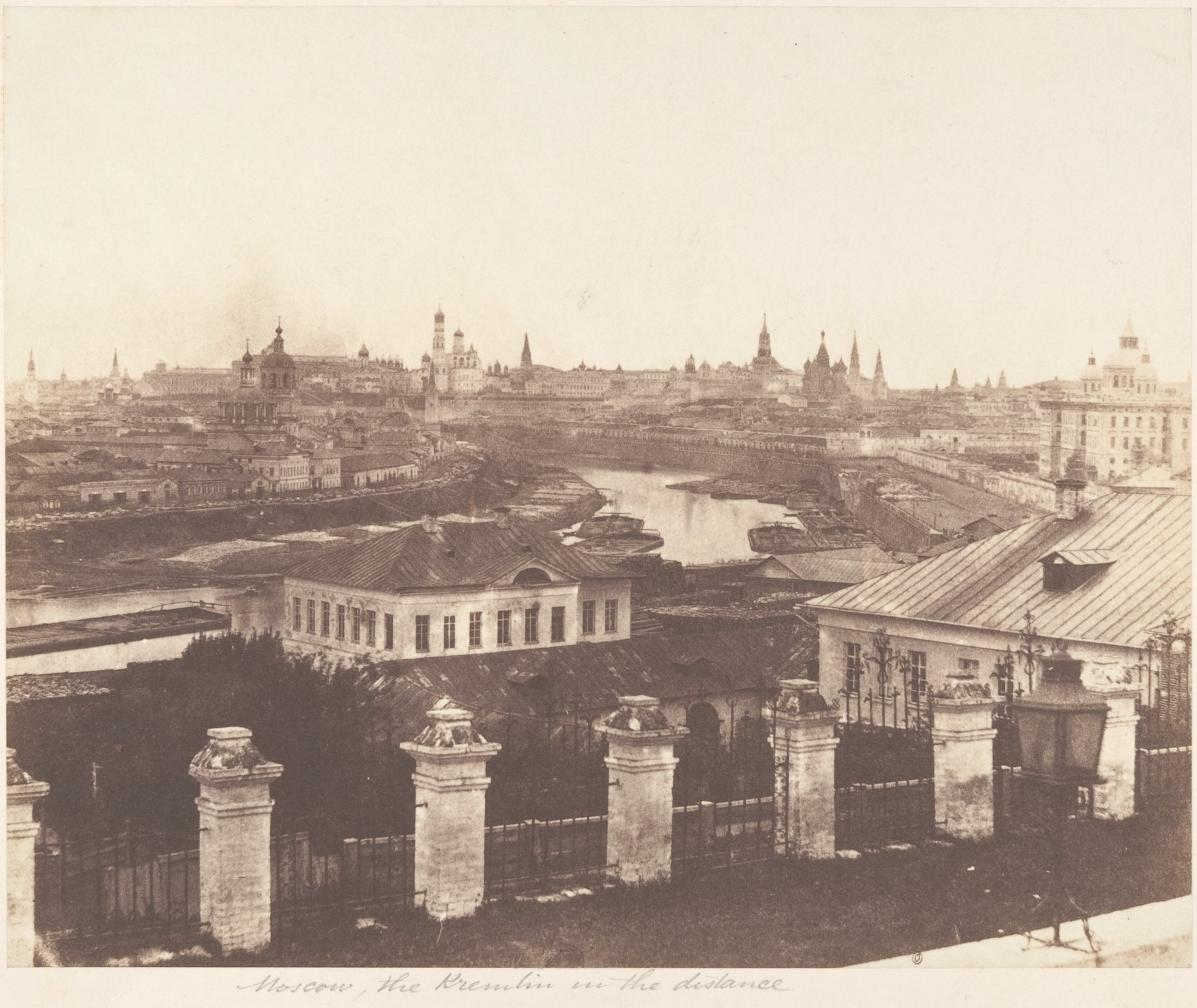
Fenton's first substantial photographic campaign had nothing to do with war.
Fenton's first substantial photographic campaign had nothing to do with war. In the summer and autumn of 1852 he travelled to Russia at the instigation of the British civil engineer Charles Vignoles, who had been commissioned by Emperor Nicholas I to build the first permanent bridge across the Dnieper at Kiev and wanted the stages of construction recorded. Fenton was in St Petersburg in August, in Kiev by 24 September, and visited Moscow before returning home. He did not confine himself to the bridge: the surviving prints from the trip include views of the Kremlin and the cities he passed through, evidence that the commission was a pretext for a wider ambition to photograph Russia's exotic architecture in the manner of colleagues then working in Egypt and the Near East.
He had learned the specific technique for the trip in Paris, from Gustave Le Gray: a dry waxed-paper negative, in which the paper is impregnated with melted beeswax before being sensitised with silver salts. The decisive advantage over a wet process was practical rather than aesthetic. A waxed-paper negative could be prepared days or weeks before it was needed and exposed and developed later, at leisure, which mattered enormously to a photographer travelling for months through a country with no darkroom on every corner. It was a deliberate choice for an expedition, distinct from the glass-negative process he was already using for studio and London work in the same year, and distinct again from the wet collodion process he would rely on exclusively by the time he reached the Crimea three years later.
Twenty-two of Fenton's photographs from 1852 and 1855, among them a view of the Dnieper's banks near Kiev, entered the State Hermitage Museum's collection and were the subject of a dedicated exhibition there in May 2010, curated by Natalia Avetyan of the museum's Department of Russian Culture: a holding, and a piece of institutional interest in Fenton, that sits outside the usual British and American story of his career.
Fenton was the organising force behind the Photographic Society of London, whose inaugural meeting was held on 20 January 1853, and he served as its first Honorary Secretary for the following three...
Fenton was the organising force behind the Photographic Society of London, whose inaugural meeting was held on 20 January 1853, and he served as its first Honorary Secretary for the following three years, stepping down from the post in January 1856. The society, later granted the Royal prefix, was one of the first formal bodies anywhere devoted to photography as a subject in its own right, bringing together the amateur gentlemen-scientists and the small number of working professionals then practising the medium in Britain.
It was through the society that Fenton's career took its most consequential turn before the Crimea. At a Photographic Society exhibition in January 1854 he met Queen Victoria and Prince Albert, both keenly interested amateurs of the new medium themselves. He was asked shortly afterward to come to Buckingham Palace to photograph the royal family, and a string of further commissions followed between 1854 and 1856, including a journey to Balmoral to photograph the royal children and the castle Prince Albert had just had rebuilt. The same year, 1854, the British Museum appointed Fenton its first official photographer, a post distinct from the royal work and one he held alongside it, systematically photographing the Museum's antiquities and galleries, including the Lycian sculptures and the fossil skeletons then on display, for scholarly and institutional record rather than for sale.
By the time Thomas Agnew and Sons approached him about the Crimea in early 1855, Fenton was not an unknown quantity being given his first major commission. He was the sitting secretary of the country's only photographic society, a photographer already trusted by the sovereign, and the British Museum's own chosen man for the job of putting its collection on record.
Fenton's expedition to the Crimea, and the photograph that made his reputation there, The Valley of the Shadow of Death, are the subject of a dedicated record elsewhere in this archive, which carries...
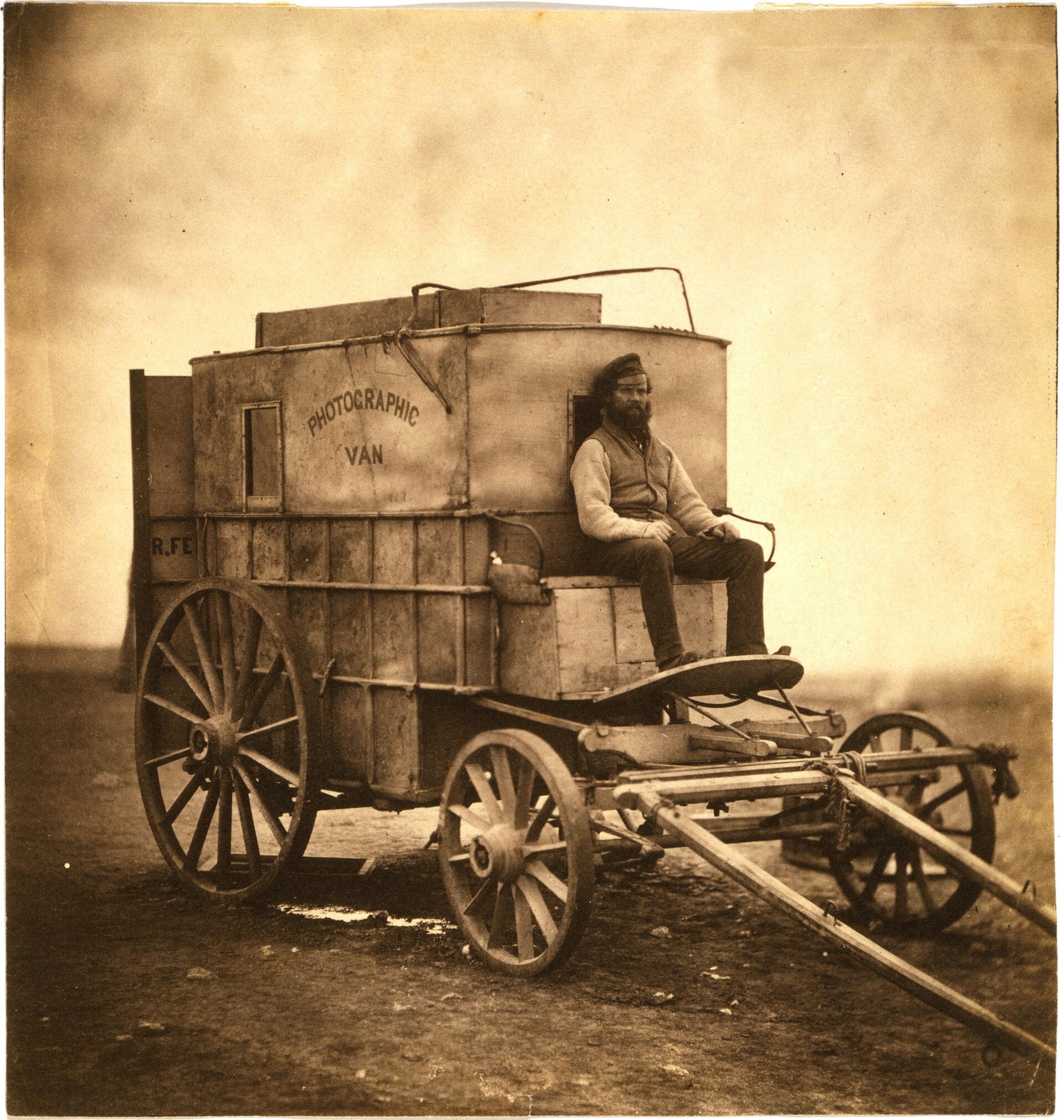
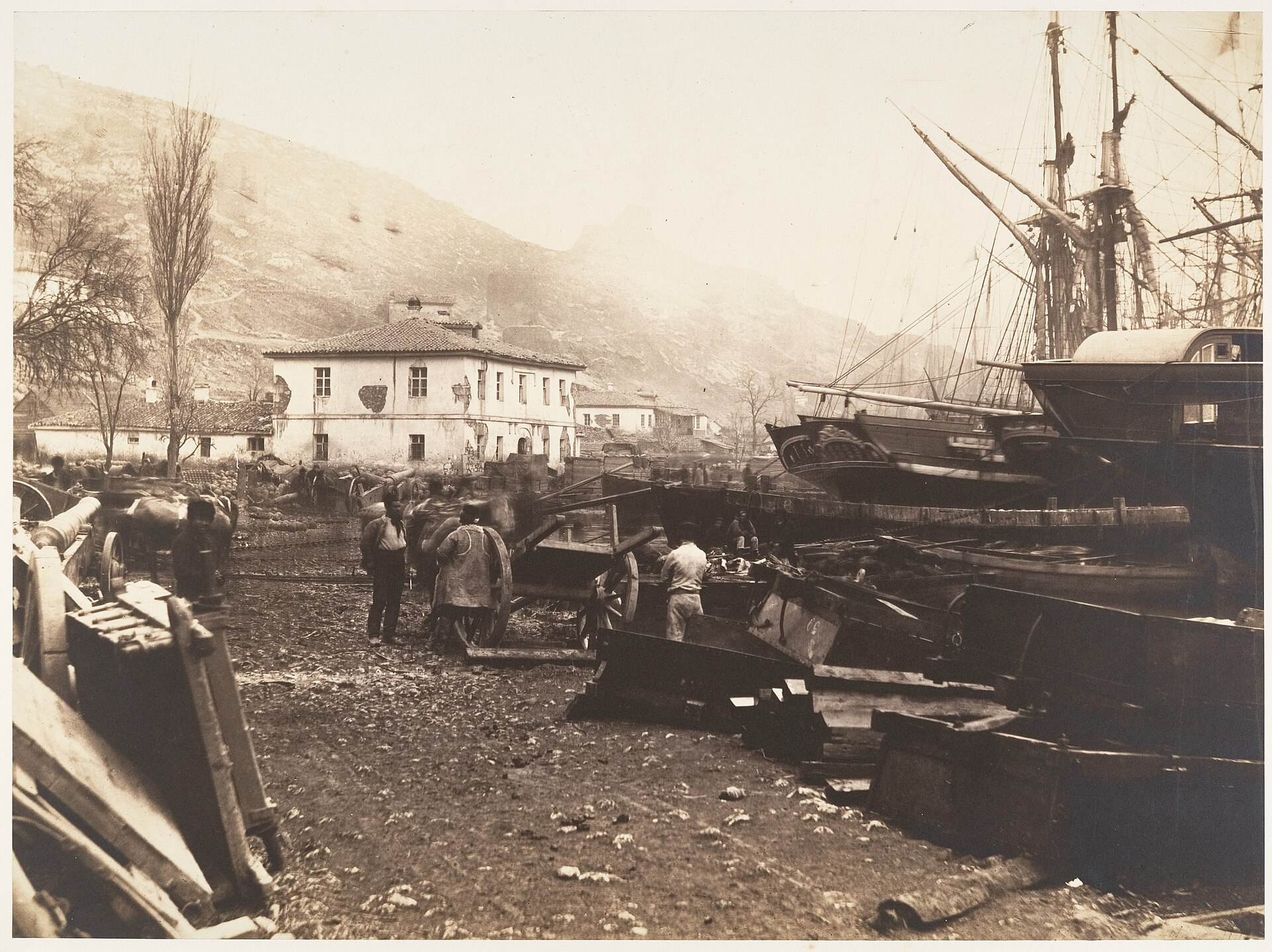
Fenton's expedition to the Crimea, and the photograph that made his reputation there, The Valley of the Shadow of Death, are the subject of a dedicated record elsewhere in this archive, which carries the full provenance chain, the technical evidence and the sourcing for what follows here in summary. He sailed under commercial sponsorship from the print publisher Thomas Agnew and Sons, who held the exclusive right to publish and sell the results, with the Duke of Newcastle arranging his passage as Secretary of State for War and Prince Albert supplying letters of introduction to Lord Raglan, the British commander in the field. He landed at Balaklava on 8 March 1855 with two assistants, a horse-drawn van converted into a mobile darkroom, and roughly seven hundred glass plates, and worked until 26 June, when he returned to England in poor health, having contracted cholera on the voyage home.
The count of negatives he brought back is not given identically in every source: the Library of Congress's background material on the collection and several period accounts put the figure at roughly 360, while a State Hermitage account of the campaign, drawing independently on the same general record, gives it as over 300 across 111 days in the field. This record treats the figure as a documented range rather than a single settled number, since no primary tally in the sources consulted resolves the difference.
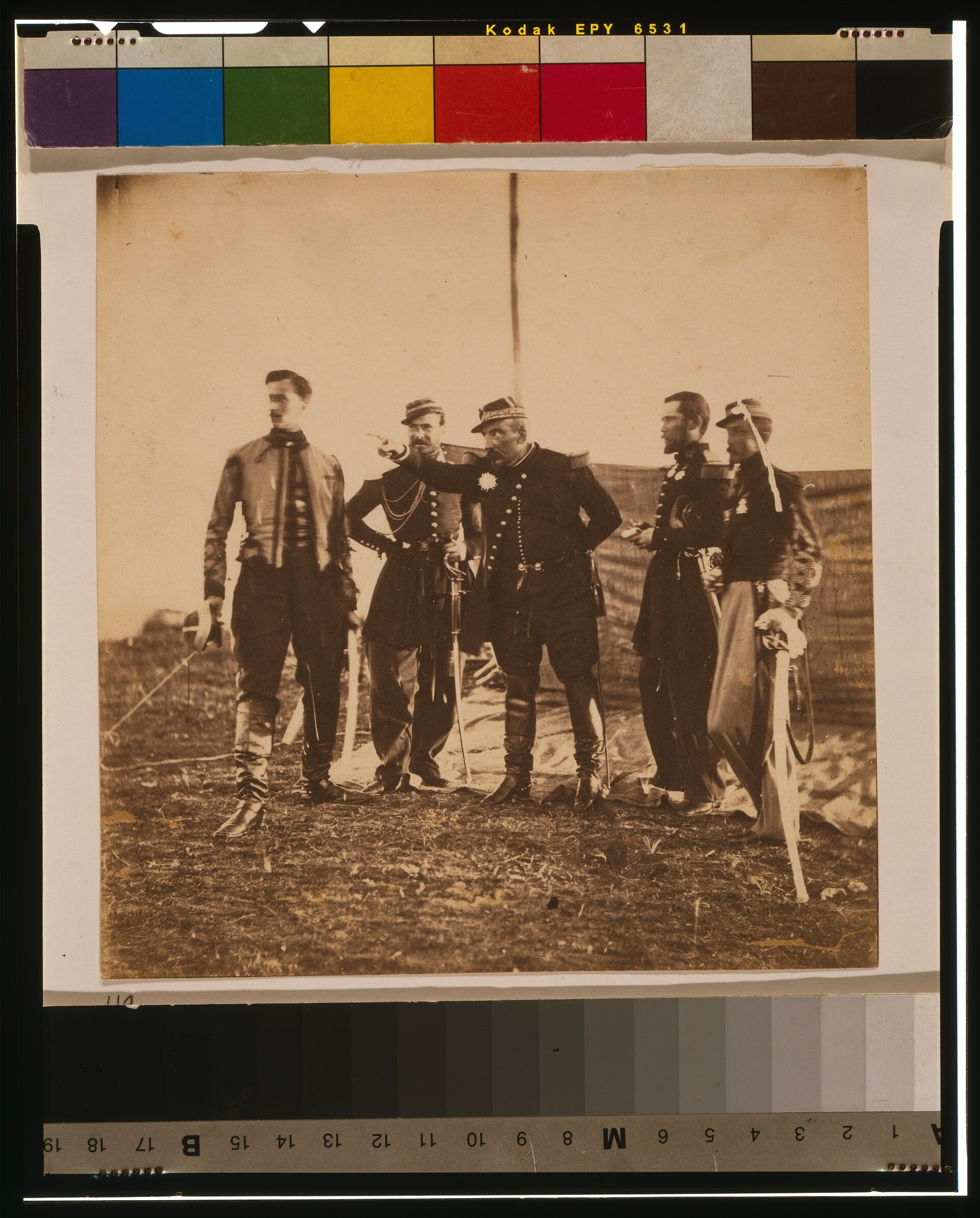
Agnew exhibited 312 of the photographs at the Society of Watercolour Painters' rooms in Pall Mall East from 20 September 1855, and issued 337 of them commercially between November 1855 and April 1856, on mounts carrying his own publication line. Contemporary and later commentators have generally read the resulting body of work, most of it calm camp scenes, officer portraits and empty landscape rather than combat, as reassurance manufactured for an anxious home public already alarmed by William Howard Russell's dispatches for The Times on the army's mismanagement, and the government's own encouragement of the trip supports that reading.
Fenton made two exposures from the same camera position in a ravine near Sevastopol on 23 April 1855, minutes or at most an hour apart by his own account: one with the road clear of debris and the...
Fenton made two exposures from the same camera position in a ravine near Sevastopol on 23 April 1855, minutes or at most an hour apart by his own account: one with the road clear of debris and the Russian round shot confined to the ditch beside it, one with shot scattered across the road itself. Agnew published and exhibited the second, and it is the second that is universally reproduced under the title today. For over a century, the question of whether Fenton or an assistant moved the shot onto the road to make a stronger picture was argued from style and circumstance alone. The German art historian Ulrich Keller made the case in print that the scene was arranged; Susan Sontag repeated the claim as settled in Regarding the Pain of Others (2003); the Musee d'Orsay's own curatorial position held that deliberate staging under what Fenton described as active shelling was practically implausible.
None of that settled the order of the two exposures, and order is not the same question as intent. It was Errol Morris, publishing in the New York Times from 25 September 2007 and later in his book Believing Is Seeing (2011), working with the optical engineer Dennis Purcell, who found physical evidence rather than argued for a reading: a small cluster of loose stones on the slope above the road sits measurably lower, relative to the road's edge, in the cannonballs-on-the-road exposure than in the clear-road exposure. Stones displace downhill under gravity and not up, which fixes the clear-road photograph as the first of the two and the cannonballs-on-the-road photograph as the second. The Royal Collection Trust's own account of its print reaches the same sequence independently.
What the stones prove is sequence, not motive. Morris himself was careful to say so: Fenton had a legitimate documentary reason to want a more explicit picture of the danger the road represented, quite apart from any wish to make a stronger composition, and the physical evidence is silent on which of those motives, or some mixture of the two, drove the second exposure. The dispute that mattered for a century and a half, in other words, turned out to be a dispute about a question the evidence could not answer, and the question the evidence could answer was not the one anyone had been arguing about.
After the Crimea, Fenton set himself, in the words of the Metropolitan Museum's own account of his career, the task of photographing the major churches and abbeys of Great Britain, working at a scale...
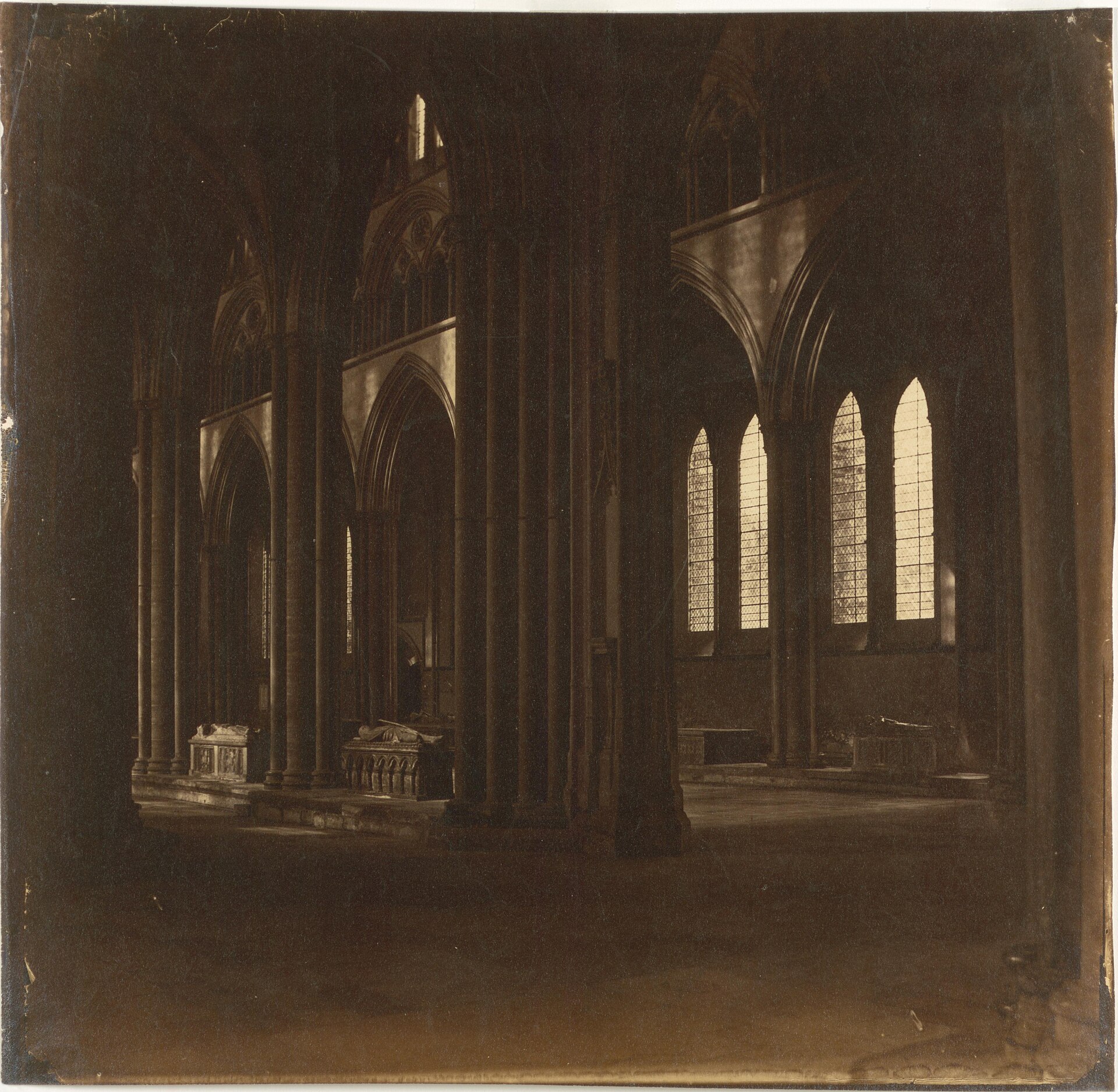
After the Crimea, Fenton set himself, in the words of the Metropolitan Museum's own account of his career, the task of photographing the major churches and abbeys of Great Britain, working at a scale as large as fourteen by eighteen inches and choosing his vantage points and lighting with a precision his contemporaries recognised as unmatched. His subjects included the Gothic cathedrals of Salisbury, Wells, Lincoln and Lichfield, Westminster Abbey and the Houses of Parliament, Windsor and Balmoral Castles, and the ruined abbeys of Rievaulx, Fountains, Furness, Tintern, Melrose, Rosslyn and Lindisfarne. His landscape work in England, Wales and Scotland through the same years drew comparison, from contemporaries as much as from later historians, to the paintings of Constable and Turner. A reviewer for the Journal of the Photographic Society, writing of the Society's 1858 annual exhibition, put it plainly: no one, the review said, could touch Fenton in landscape, and there was an artistic feeling about the pictures that made them something more than mere photographs.
This was not incidental studio work squeezed between commissions. It was, on the scale Fenton pursued it, a second career inside the first, pursued with the same large-format technical rigour he had brought to Russia and the Crimea, and it is the body of work most responsible for the modern judgement that Fenton was, before anything else, one of the first photographers to treat the medium as fully the equal of painting rather than a mechanical substitute for it.
In the summer of 1858, working in a London studio rather than on location, Fenton produced a suite of staged Orientalist compositions: models dressed in Ottoman and Persian costume, arranged with...
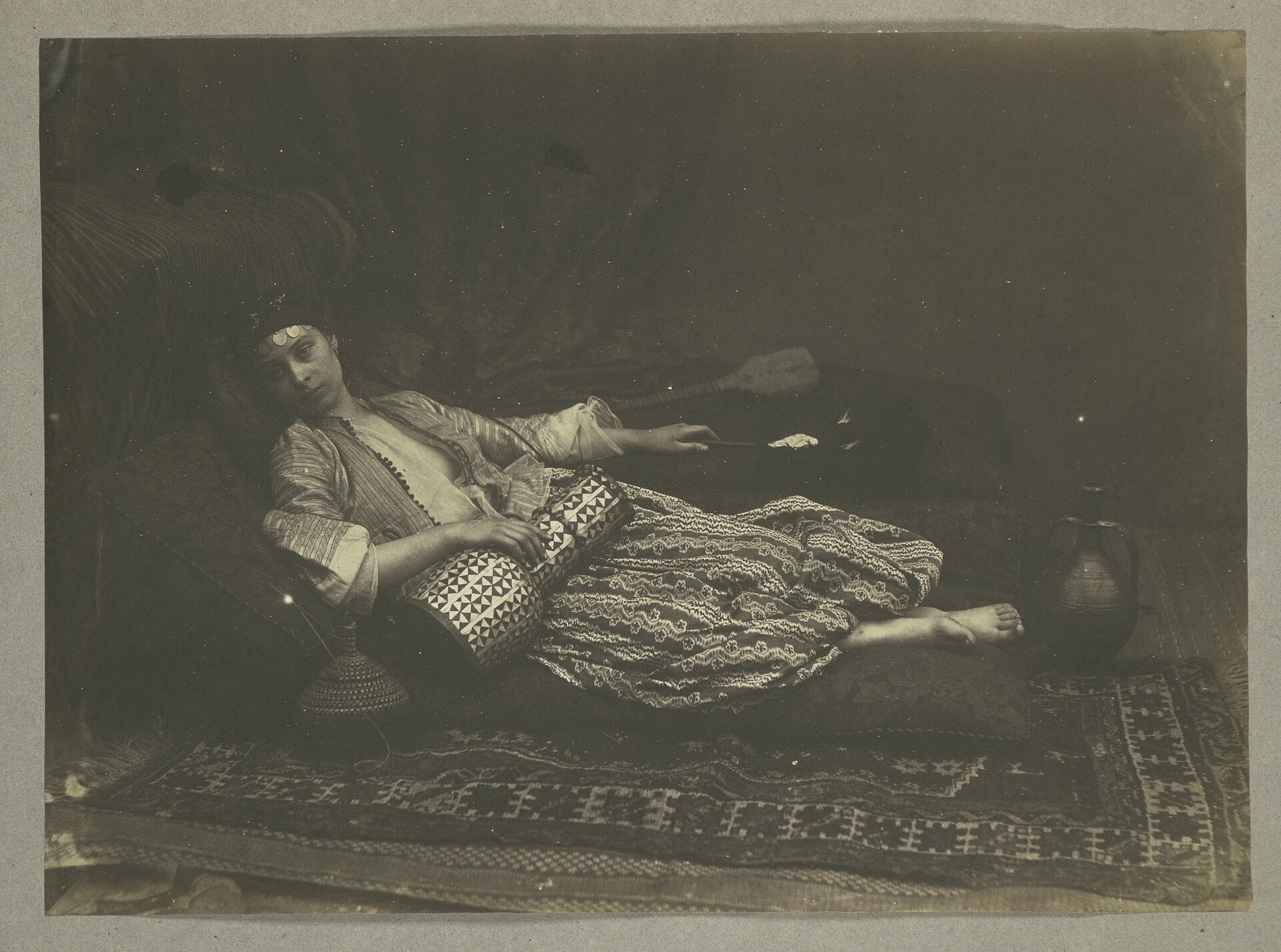
In the summer of 1858, working in a London studio rather than on location, Fenton produced a suite of staged Orientalist compositions: models dressed in Ottoman and Persian costume, arranged with carpets, hookahs and studio props into tableaux of harem life, music and repose that owed less to documentary observation than to the paintings of Delacroix and Ingres, according to the Metropolitan Museum's own curatorial account of the series, and to the wider mid-century European fascination with an imagined East that Fenton would have passed through en route to Balaklava three years earlier. Around fifty of these Orientalist photographs are known to survive; fewer than twenty were ever exhibited by Fenton in his own lifetime, and most were never published at all.
The single best-documented example, Reclining Odalisque, exists in only one known print, now at the Metropolitan Museum. Gordon Baldwin, the Getty curator and a co-author of the standard modern account of Fenton's photographs, called it one of the very best of the Orientalist pictures, one that transcends the genre's usual limits to produce a genuinely vulnerable portrait rather than a costume exercise. That single surviving print was bought at Christie's in 1978 for 5,400 pounds sterling, part of the dispersal, between 1978 and 1982, of what are known as Fenton's own grey paper albums, a body of material from which the Getty Museum acquired the largest single share of what survives of the series.
This record treats the reading of the series as period visual culture, an artistic and commercial response to a documented Victorian vogue for exotic subject matter, as the argued position of Baldwin and his co-authors rather than as a claim about what Fenton himself privately believed the pictures meant. No letter, diary entry or contemporary statement by Fenton on the subject was located in the sources consulted for this record.
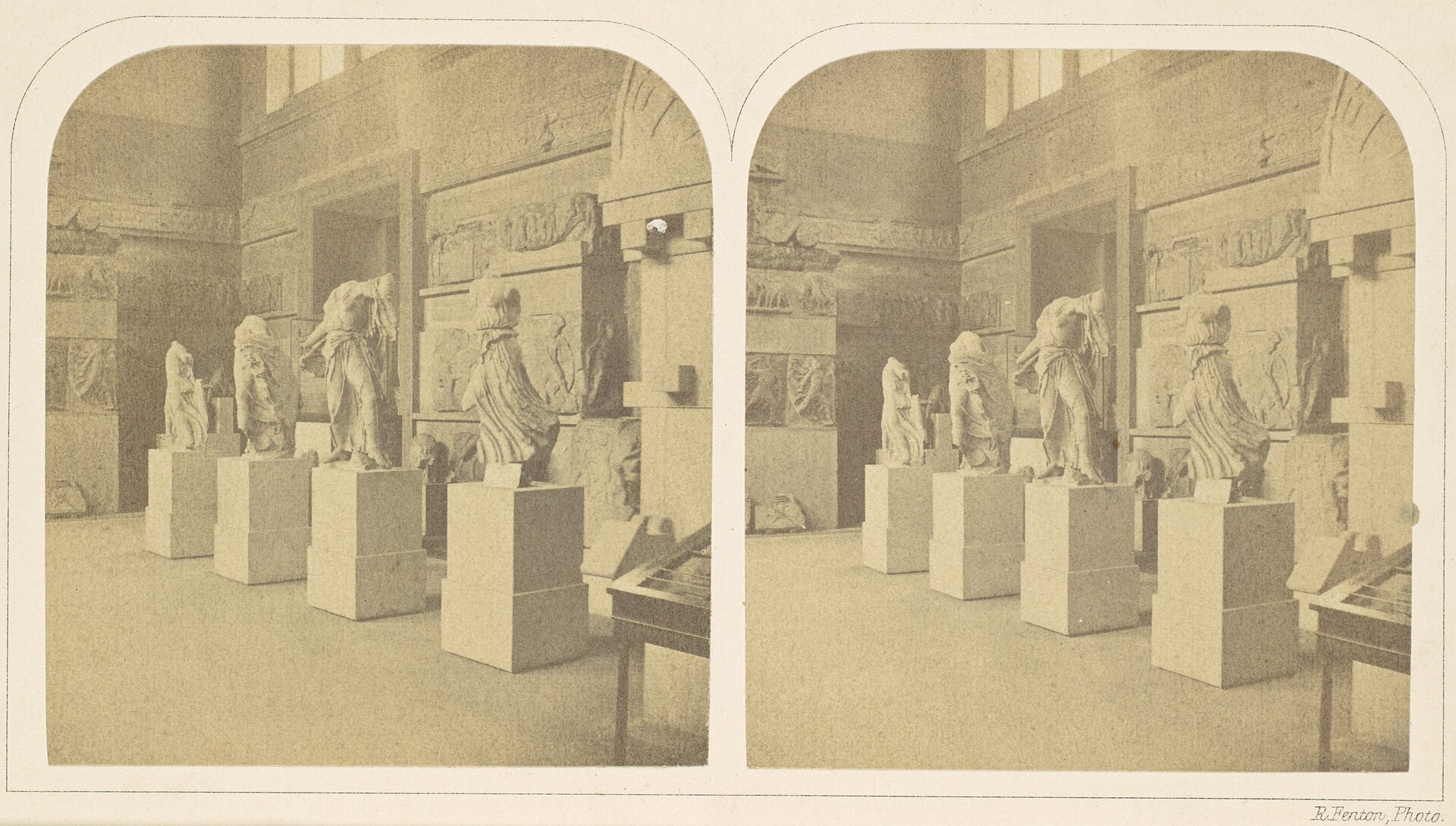
Fenton's appointment as the British Museum's first official photographer, from 1854, ran alongside his royal and later his cathedral work rather than as a separate late-career episode, and it...
Fenton's appointment as the British Museum's first official photographer, from 1854, ran alongside his royal and later his cathedral work rather than as a separate late-career episode, and it produced a body of documentary photography distinct in purpose from everything else he made: images intended for institutional record and scholarly reference rather than for sale to a print-buying public. His surviving Museum photographs include the Lycian Saloon, then newly opened to display sculpture brought from Xanthos in Asia Minor, and antiquities such as the Museum's Megatherium skeleton, some made as stereographs as well as single large-format prints, a format suited to the Museum's interest in giving scholars and visitors a sense of an object's physical presence rather than only its outline.
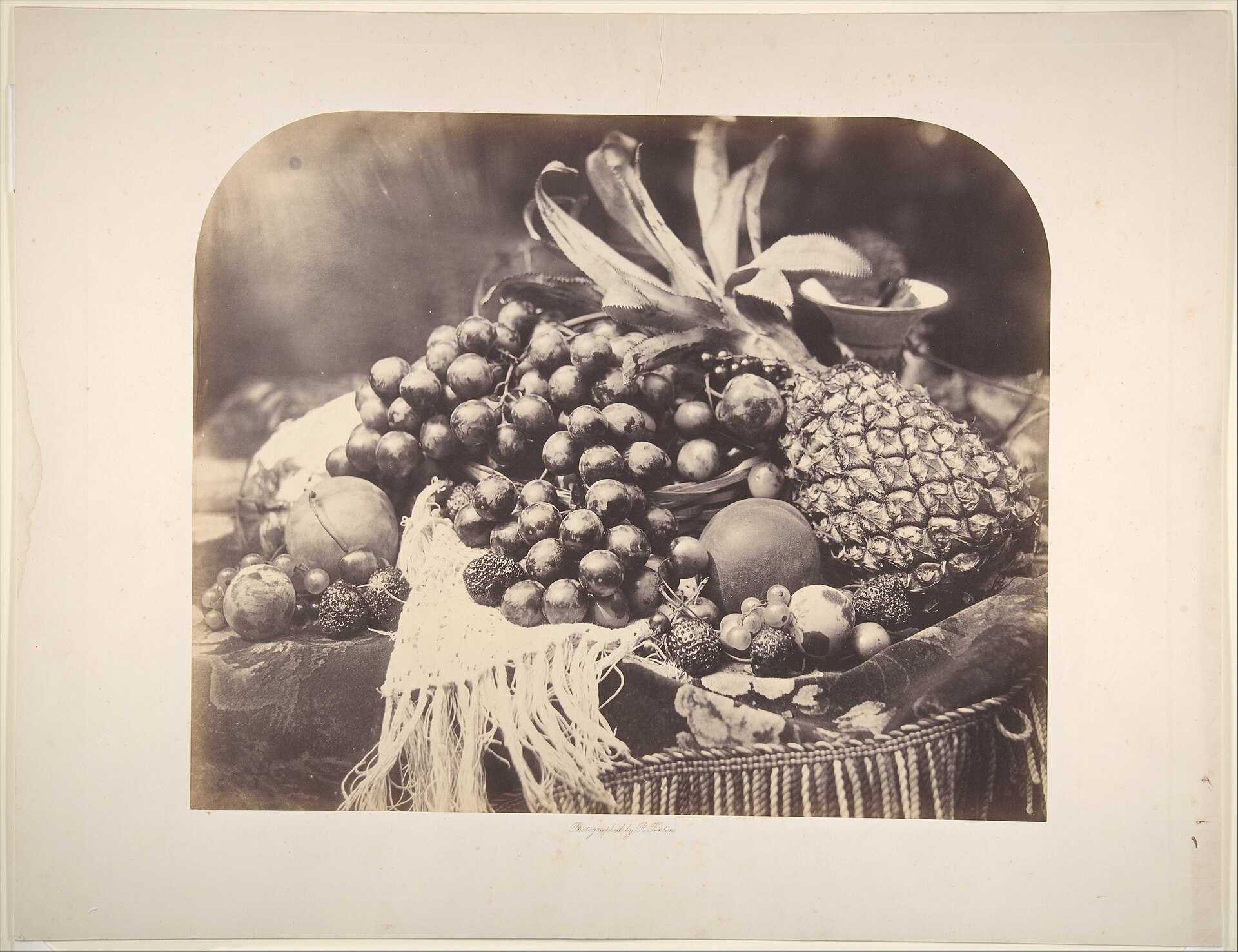
Fenton's last sustained body of work, produced around 1860, was a series of lush still lifes of fruit and flowers, technically accomplished studio pieces that the Metropolitan Museum's own account of...
Fenton's last sustained body of work, produced around 1860, was a series of lush still lifes of fruit and flowers, technically accomplished studio pieces that the Metropolitan Museum's own account of his career describes as his final series before he gave up photography altogether. In April 1860, Fenton's infant son died at fifteen months old, and in the same month his long-serving photographic assistant Marcus Sparling, who had worked alongside him in the Crimea, also died. Separately, and probably at the same time, the Fenton family's cotton-manufacturing interests were suffering under the cotton famine of the early 1860s, and the closure of the family mill is thought to have removed a source of income Fenton could otherwise have relied on.
A further, more public grievance has also been cited: the organising committee of the 1862 International Exhibition in London placed photography in the section reserved for machinery, tools and instruments rather than among the fine arts, a classification many photographers of Fenton's generation, himself included by most accounts, took as confirmation that the medium's claim to be an art in its own right, the very claim the Photographic Society had been founded to advance, was losing rather than winning the argument. None of these explanations is recorded in Fenton's own hand as the reason; his biographers offer them in combination rather than naming a single decisive cause, and this record does the same rather than picking one. In October 1862 Fenton announced his complete and permanent retirement from photography, sold his equipment and his remaining stock of negatives, reported at the time at over a thousand large-format glass plates, and resigned from the Photographic Society. He returned to legal practice and did not photograph again before his death at Potters Bar, Middlesex, on 8 August 1869, aged fifty.
No catalogue raisonne of Fenton's complete output exists.
No catalogue raisonne of Fenton's complete output exists. The closest equivalent is All the Mighty World: The Photographs of Roger Fenton, 1852-1860, the exhibition and accompanying catalogue by Gordon Baldwin, Malcolm Daniel and Sarah Greenough, with research support from Roger Taylor, which toured the National Gallery of Art in Washington, the Getty Museum, the Metropolitan Museum of Art and Tate Britain between October 2004 and January 2006 and drew together roughly ninety representative works from the Getty's own holdings and other collections. It is a career survey rather than a numbered inventory of every surviving print, and it makes no claim to be complete.
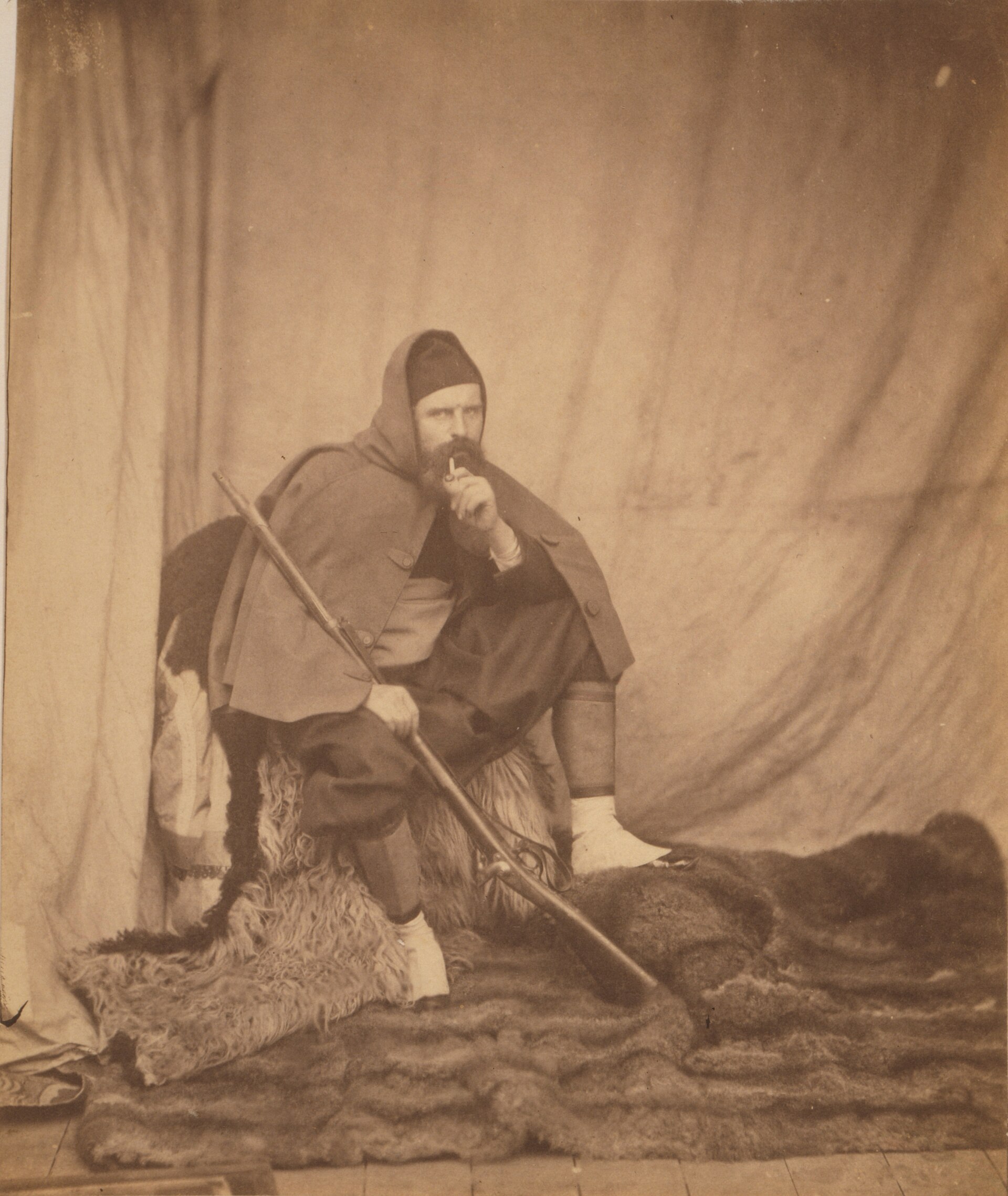
Authorship itself is not in serious dispute for the great majority of Fenton's work: publication mounts, Agnew's own printed credit lines, institutional acquisition records and, for the Crimean material, Fenton's own letters home, establish what he made with a security that painting attribution of the same period rarely enjoys. No authentication board or attribution committee currently rules on new Fenton claims; institutional curatorial departments, chiefly at the Metropolitan Museum, the Getty, the Library of Congress, the Royal Collection Trust and the Victoria and Albert Museum, catalogue and attribute material individually against the reference corpus the 2004 catalogue established. One genuine and unresolved case of contested authorship does survive in the record, however: the well-known photograph of Fenton himself seated in borrowed Zouave uniform in the Crimea is credited by the Library of Congress, and by Wikimedia Commons following it, to his assistant Marcus Sparling, while the Getty Museum's own 2004 exhibition catalogued the same image as a self-portrait. The sources consulted for this record do not resolve which institution is correct.
Fenton's photographs trade within the specialist nineteenth-century photography market rather than commanding headline prices in the wider photography auction market, where the record-setting lots of...
Fenton's photographs trade within the specialist nineteenth-century photography market rather than commanding headline prices in the wider photography auction market, where the record-setting lots of the last two decades belong to twentieth-century names such as Man Ray and Edward Steichen. Within his own market, the Orientalist studio series and the Crimean material are the strongest performers. A group of five Fenton photographs, including an Orientalist composition titled Effendi and Musician and a further unnamed Oriental-genre photograph, sold at Dominic Winter in South Cerney, Gloucestershire, on 17 June 2010 for a combined total reported as approximately 100,000 pounds sterling by one account and 100,500 pounds by another, roughly five times the group's combined pre-sale estimate; Effendi and Musician alone made 27,000 pounds against an estimate of 3,000, and the second Orientalist lot made 32,000 pounds against an estimate of 5,000 to 8,000. Neither source consulted specifies whether these figures are hammer prices or totals inclusive of buyer's premium, and this record does not assert a split it cannot verify.
Reclining Odalisque, now the Metropolitan Museum's sole known print of that composition, was itself bought at Christie's in 1978 for 5,400 pounds, as part of the wider dispersal of Fenton's grey paper albums between 1978 and 1982 from which the Getty Museum drew the bulk of its own Orientalist holdings; again, the source consulted does not specify hammer against premium. A single print of The Valley of the Shadow of Death, the subject of its own dedicated record in this archive, sold at Swann Auction Galleries in New York on 27 April 2023 for a reported 22,500 US dollars against an estimate of 20,000 to 30,000 dollars, the same caveat about an unspecified hammer/premium split applying there as well.
The order of the two Valley of the Shadow of Death exposures is now as settled as photo-forensic evidence can make it, but almost everything else about Fenton's decade behind the camera carries an...
The order of the two Valley of the Shadow of Death exposures is now as settled as photo-forensic evidence can make it, but almost everything else about Fenton's decade behind the camera carries an honest gap. Why he stopped in 1862 is argued rather than known, and this record has deliberately not smoothed three or four competing, non-exclusive explanations into one. The authorship of the Zouave-uniform photograph is credited two different ways by two credible institutions, unreconciled in the sources consulted. The total number of Crimean negatives he produced is given as either roughly 360 or over 300, depending on the source, and neither figure carries the standing to overrule the other. No full modern census of every surviving Fenton print across every holding institution exists; the 2004 catalogue is a survey, not an inventory. These are recorded here as findings rather than papered over with an invented certainty.
Photographer; Founder, Photographic Society of London. 1819-1869.
Born 28 March 1819, Crimble Hall, Heywood, near Rochdale, Lancashire, England; died 8 August 1869, Potters Bar, Middlesex, England.
Metropolitan Museum of Art (New York); Library of Congress, Prints and Photographs Division (Washington, D.C.); Royal Collection Trust (London and Windsor); Victoria and Albert Museum (London); J. Paul Getty Museum (Los Angeles); Harry Ransom Center, University of Texas at Austin (Austin).
Fenton trades within the specialist nineteenth-century photography market rather than among the record-setting lots of the wider photography auction market, which belong to twentieth-century names. Within his own market the Orientalist studio series and the Crimean material are the strongest and most frequently cited performers, and in every result located for this record the sources consulted report a single realised figure without stating whether it is the hammer price or a total inclusive of buyer's premium; this record flags that gap rather than asserting a split it cannot verify.
Why did Fenton abandon photography completely in October 1862? His biographers offer overlapping, unresolved explanations: personal tragedy (his infant son and his assistant Marcus Sparling both died in April 1860), financial pressure from the collapse of family cotton-manufacturing income, and disillusionment at photography's 1862 classification with machinery rather than fine art.
Six canonical documentary photographs in this archive were arranged, retouched or captioned to say more than they showed.
9 min read
Of 232 auction results in this archive, 53 carry no hammer price published by the house that sold the object.
9 min read
Last verified
One artwork and its story every Tuesday, with the picture: who owned it, what it made, and what closes soon in the exhibition calendar. No promotion, and nothing we cannot cite.
We send one email to confirm the address and keep nothing else. Every letter carries a one-click unsubscribe. How we handle your data.


