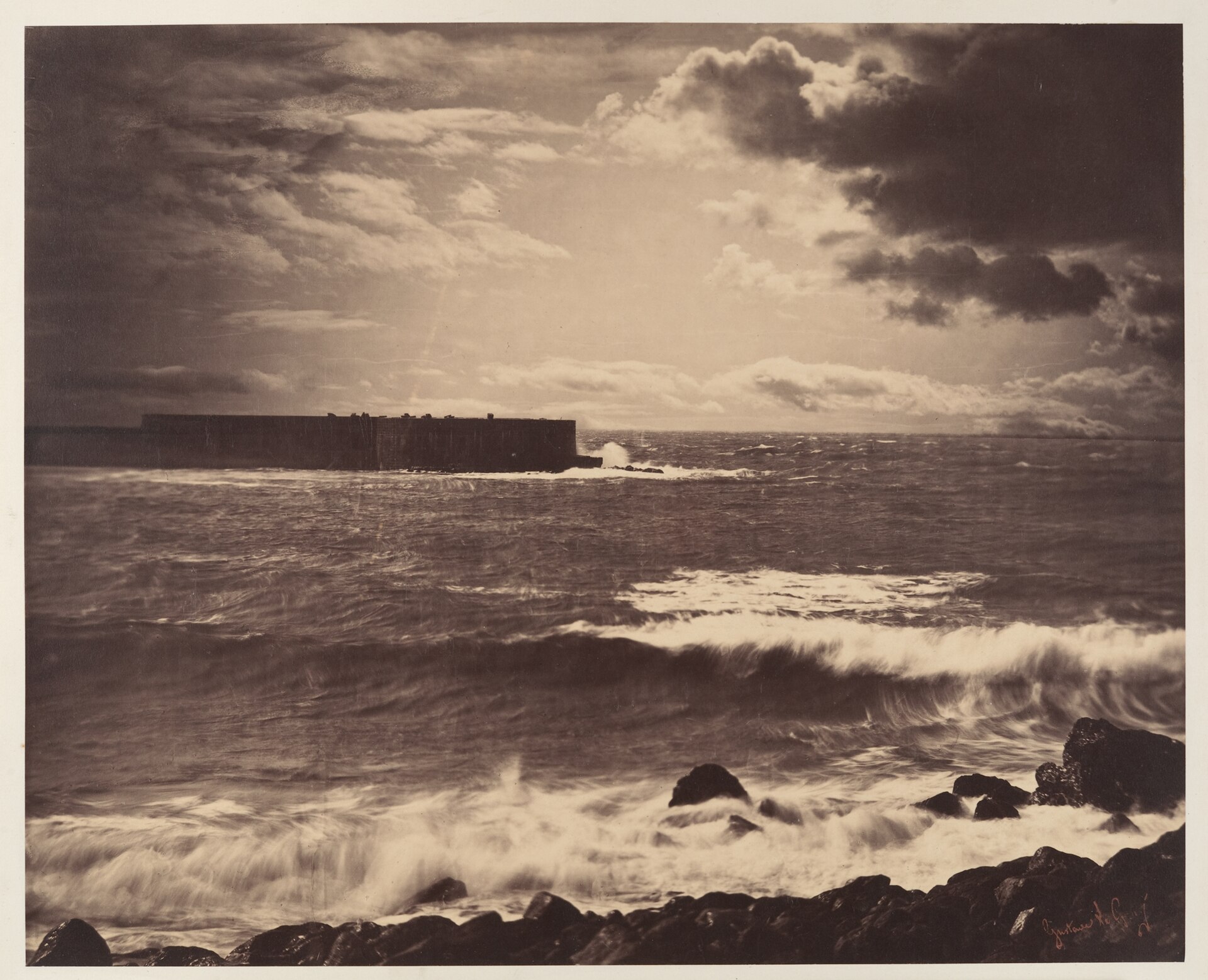
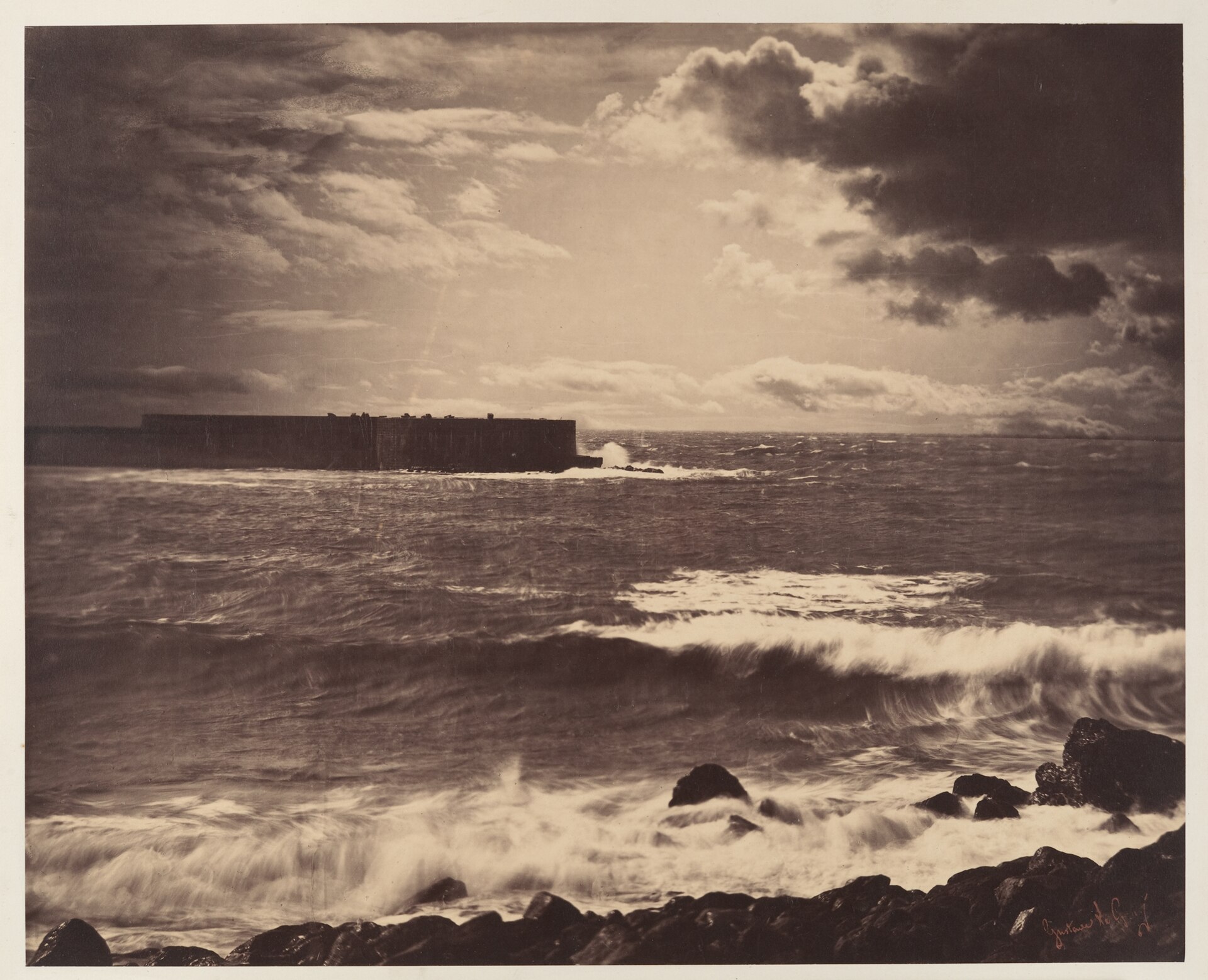
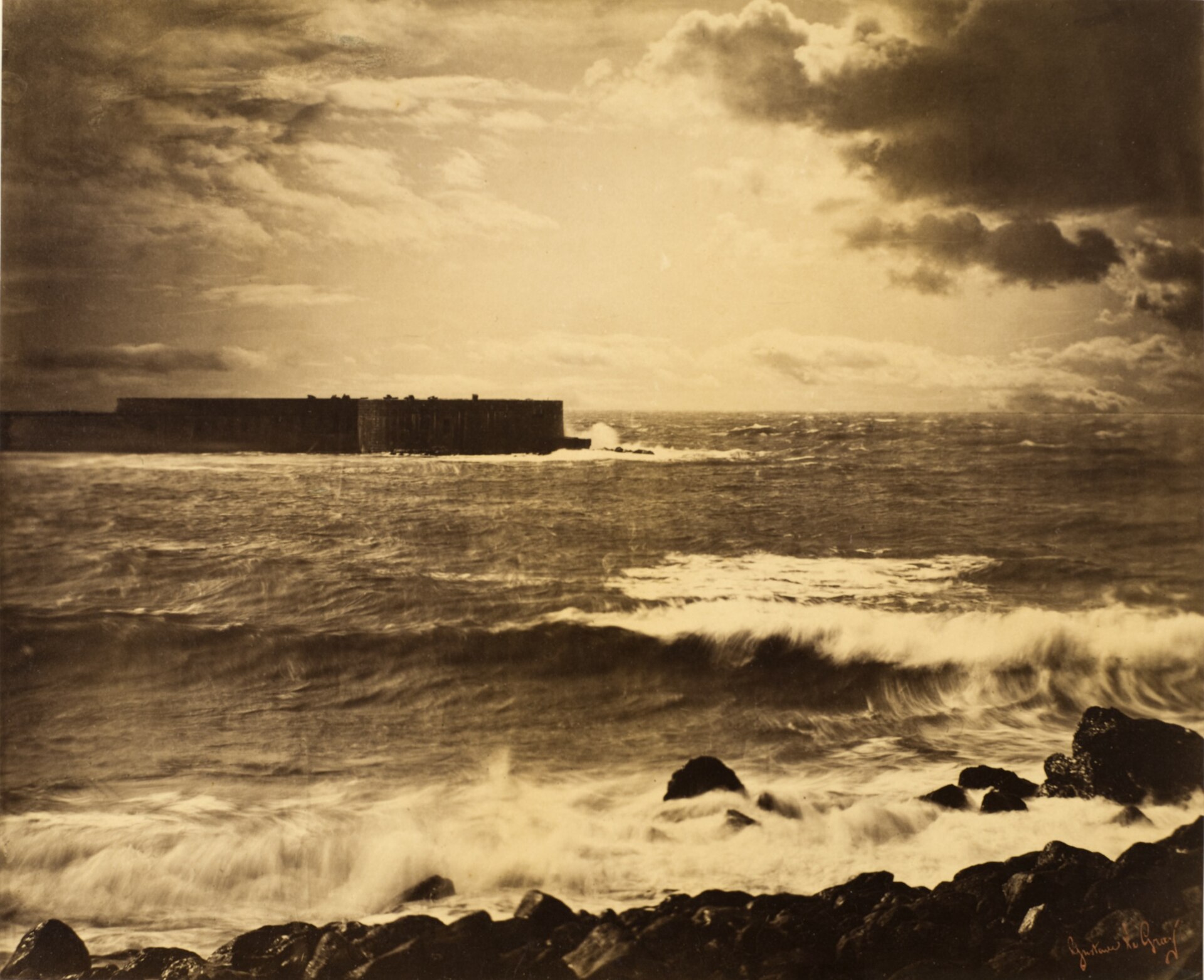
The Great Wave, Sete
1857 · Albumen print from two...
 French · 1820-1884
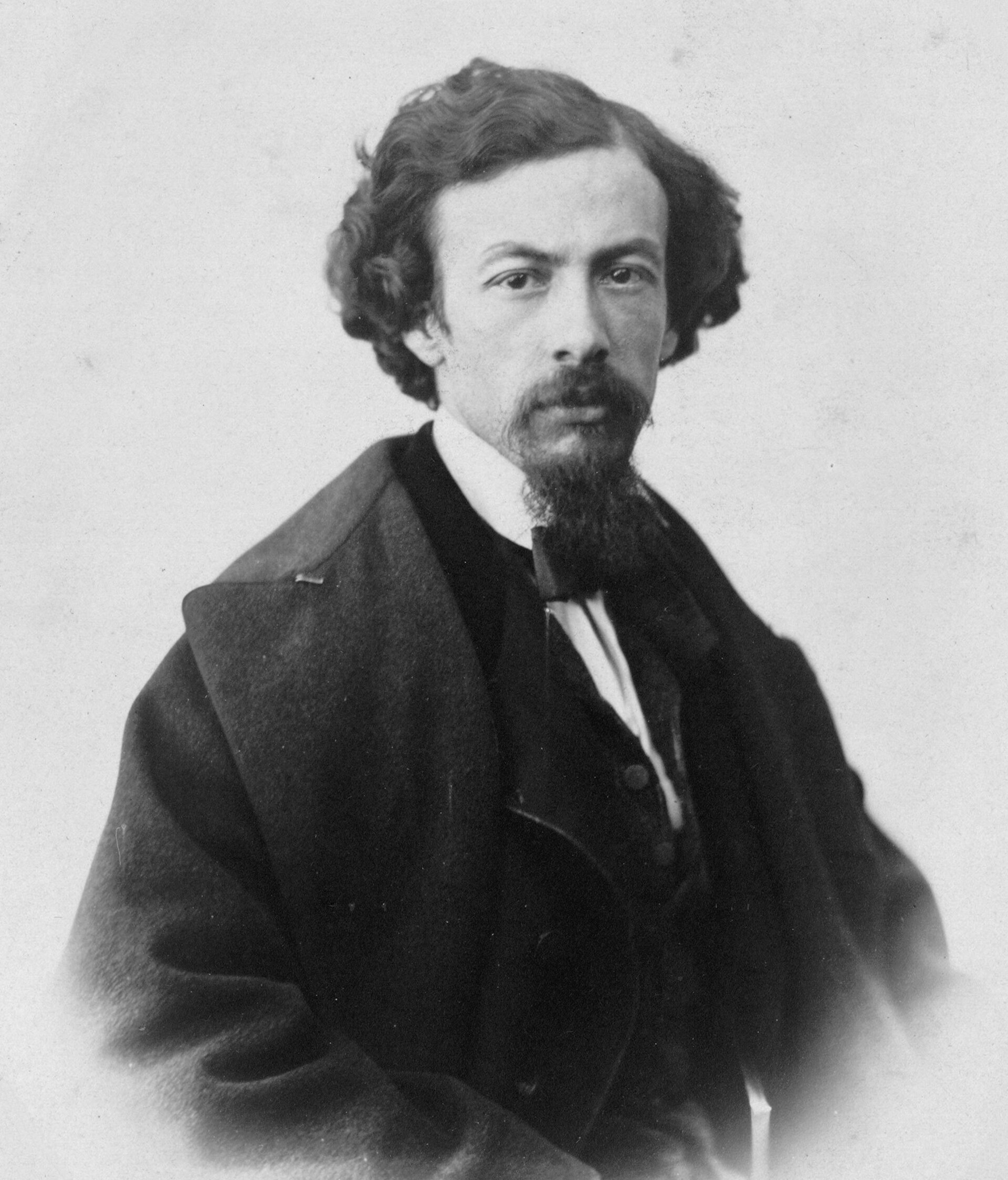
Le Gray's own self-portrait. The Bibliotheque nationale de France holds two dated versions of this self-portrait via Gallica, one catalogued to about 1850-1852 and one to about 1856-1859; both are catalogued by the BnF itself as Autoportrait de Gustave Le Gray, Gustave Le Gray photographe, an institutional identification rather than a later dealer's attribution.
Bibliotheque nationale de France, via Gallica| Full name | Jean-Baptiste Gustave Le Gray |
|---|---|
| Worked as | Photographer, Painter |
| Born | 30 August 1820 · Villiers-le-Bel, near Paris |
| Died | 30 July 1884 · Cairo, Egypt |
| Nationality | French |
| Movement | Founding generation of French art photography, Second Empire |
| In this archive | 1 artwork |
| Sources | 24 cited |
| Last verified | 17 September 2026 |
About this page 1 artwork in the archive · Last verified 17 September 2026 · 24 sources cited
Le Gray trained as a painter and never stopped thinking like one, which is the single most useful fact for reading everything he made afterward. In barely three years, 1856 to 1858, he produced the seascapes that made him briefly the most talked-about photographer in Europe: images that solved a real optical problem of the period, wet-collodion negatives could not hold both a bright sky and a dark sea in one exposure, by printing sky and sea from two separate negatives onto a single sheet. That is not a scandal. It is a documented technique, described in his own writing, and it means that some of his most famous photographs are provably composite images rather than single exposures, a fact his contemporaries did not always grasp.
He is also the rarest kind of nineteenth-century subject for a publication like this: a photographer whose best-known print set the world auction record for any photograph in 1999, whose corpus spans architecture, imperial military reportage and portraiture as well as the seascapes, and whose career collapsed into bankruptcy, exile and a death in relative obscurity in Cairo. The standard account tends to stop at the seascapes. What it usually skips is that no complete census of surviving prints of his most famous image exists, that he reused sky negatives across different compositions in ways that still are not fully mapped, and that a cluster of fake daguerreotypes bearing his name surfaced on the market as recently as 2019.
This page treats Le Gray as the subject he actually is: a painter-trained technician whose central achievement is inseparable from a hard, checkable question about what a photograph is allowed to be made of.
Born 30 August in Villiers-le-Bel, near Paris, the only child of a haberdasher.12
Trains as a painter in Paris under Francois-Edouard Picot and then Paul Delaroche, alongside fellow students Roger Fenton, Charles Negre and Henri Le Secq.341
Travels and paints in Switzerland and Italy, financed by his parents.12
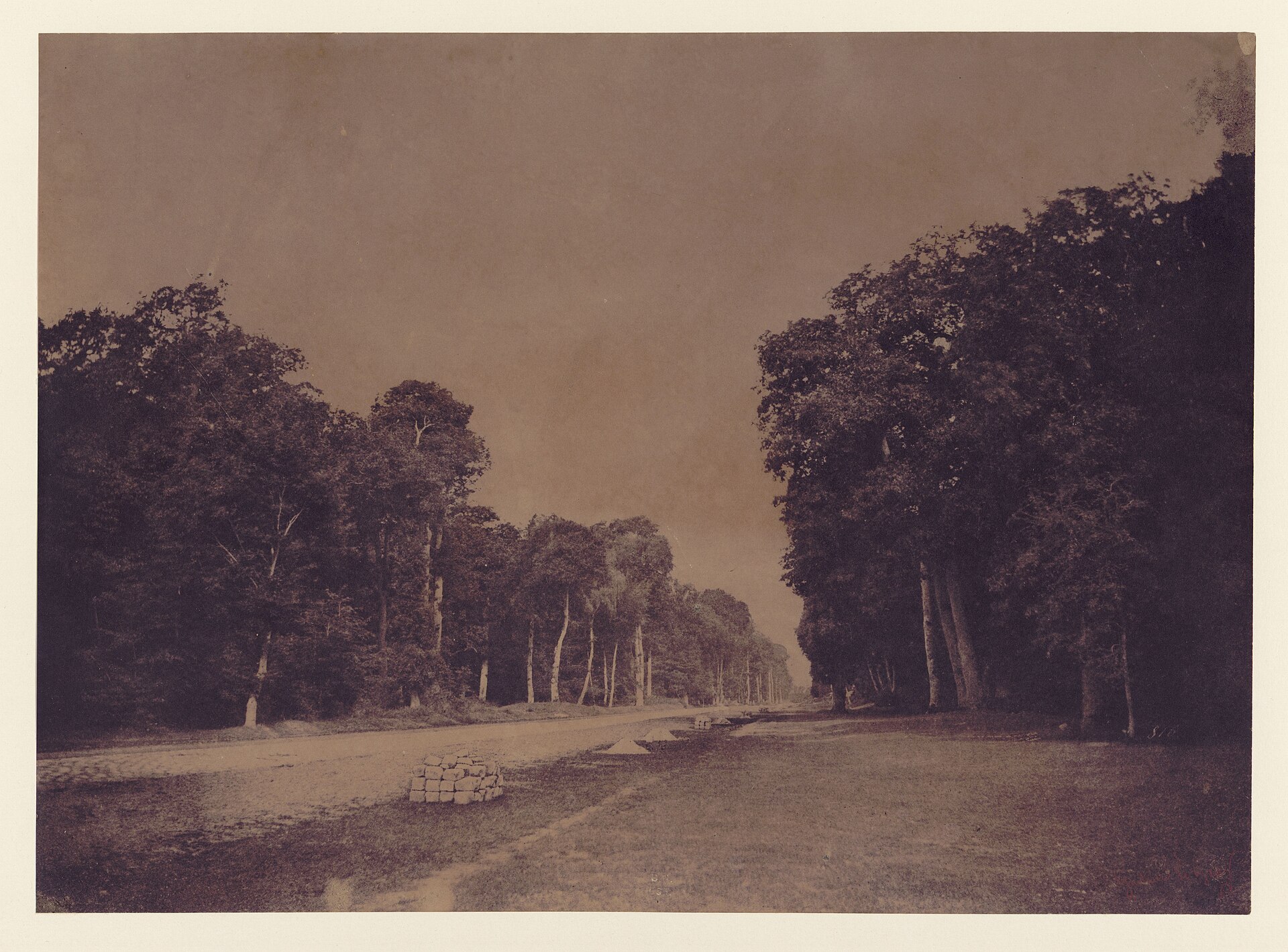
Begins photographic excursions into the forest of Fontainebleau, working in the same terrain as the Barbizon painters.56
Publishes Traite pratique de photographie sur papier et sur verre and develops the dry waxed paper negative process.73
Co-founds the Societe Heliographique in Paris and is one of five photographers, with Edouard Baldus, Hippolyte Bayard, Henri Le Secq and Auguste Mestral, commissioned for the Mission Heliographique to document historic French monuments; he and Mestral return with more than six hundred negatives.8
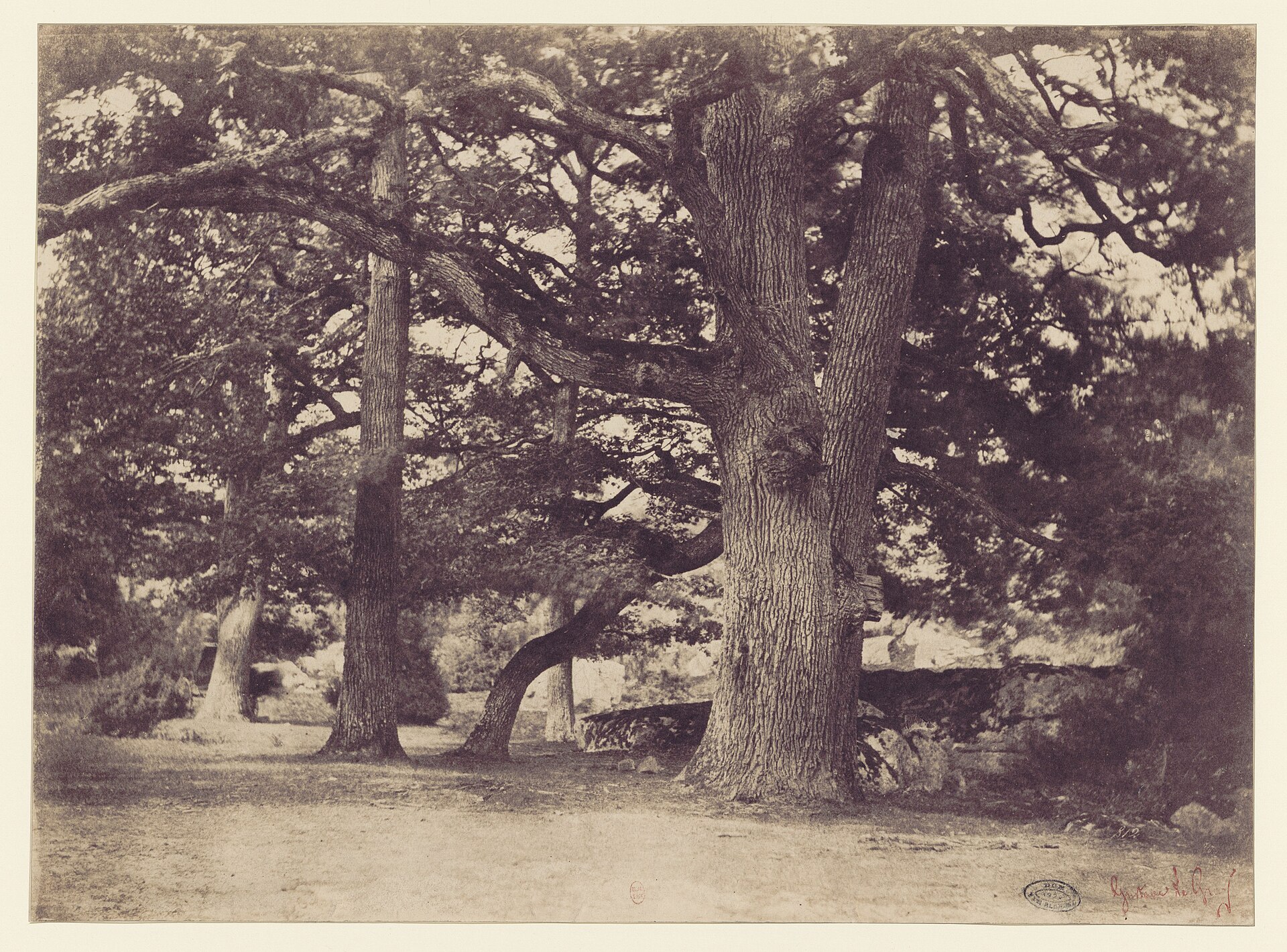
Photographs Chenes au Bas-Breau and the oak-lined Pave de Chailly in the forest of Fontainebleau.96
Opens a lavish studio at 35 boulevard des Capucines, Paris, and becomes an official photographer to Napoleon III.810
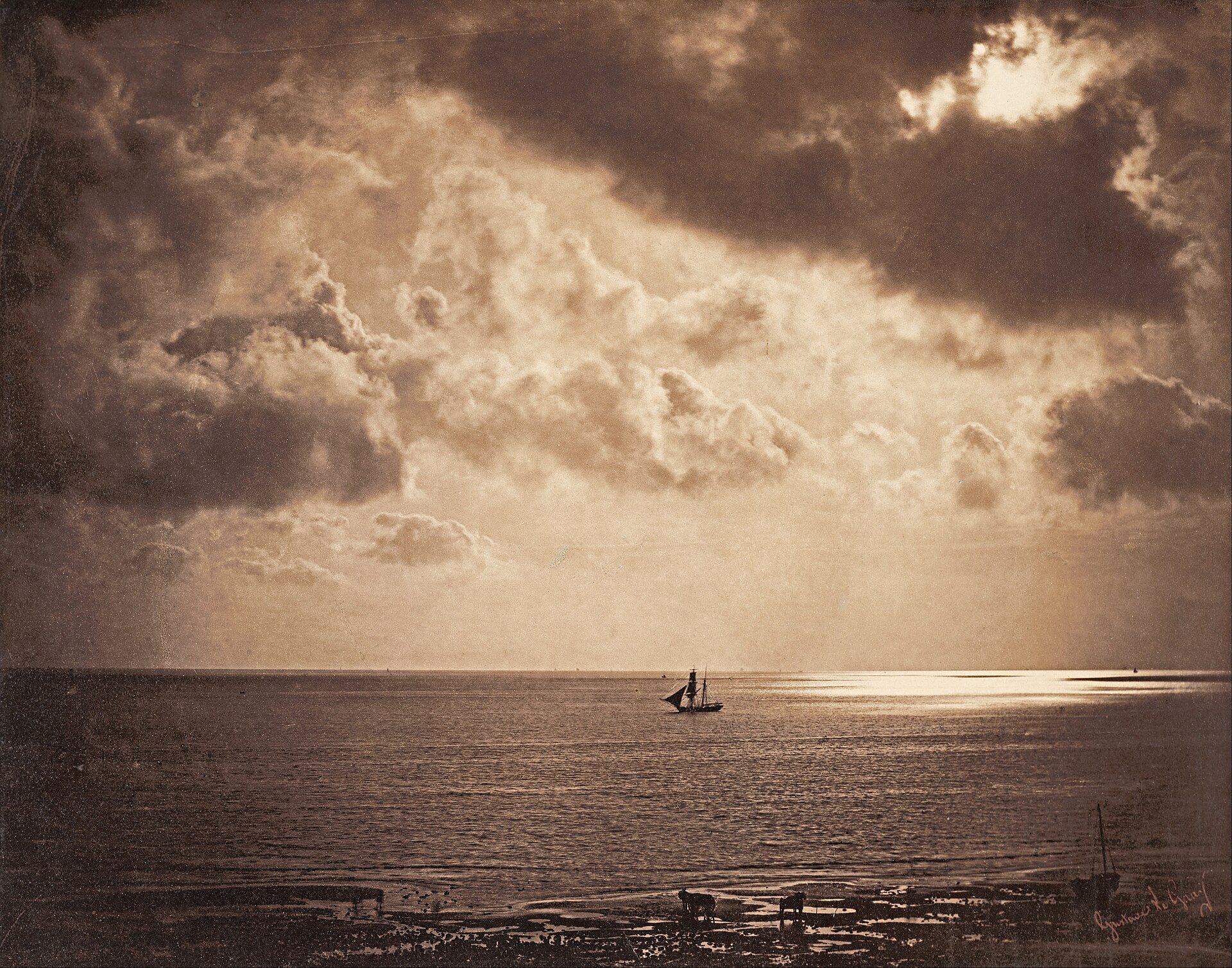
Photographs seascapes on the Normandy coast, including The Brig (Brig upon the Water), the composition that establishes his combination-printing technique publicly and is later reproduced from copy negatives in the hundreds.1112
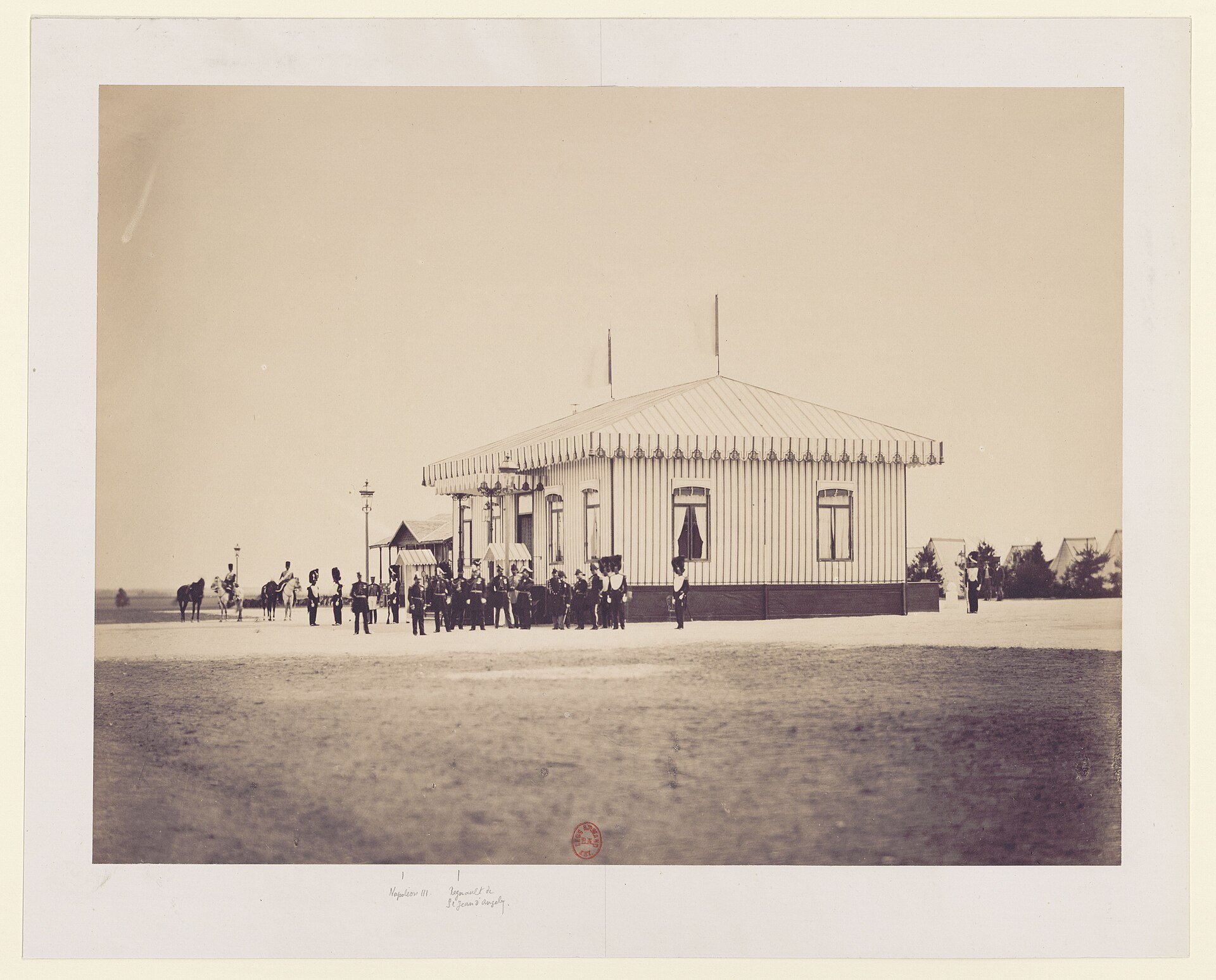
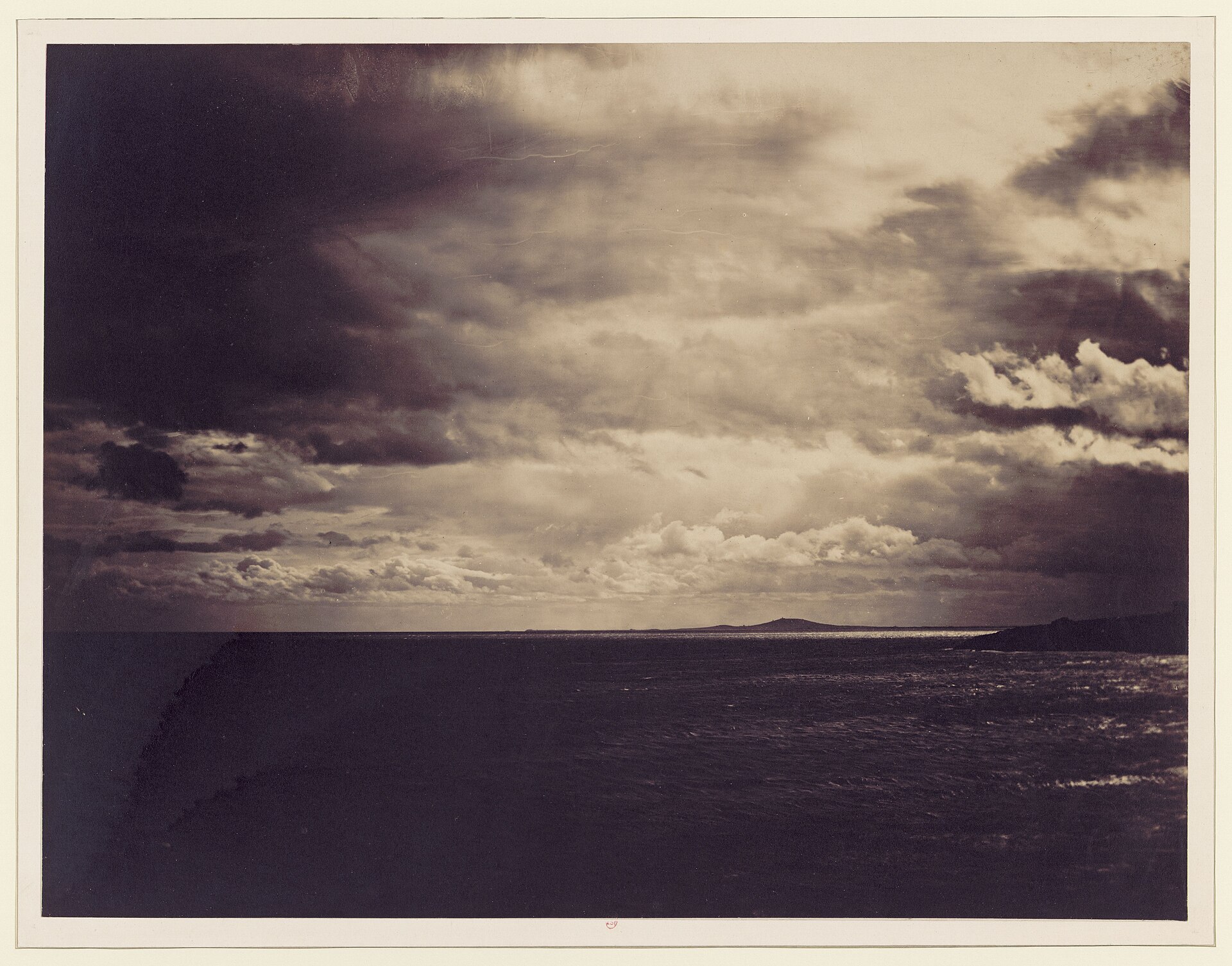
In April, exposes the Mediterranean seascape series at Sete, including Grande Vague, Sete, no. 17, around the opening of the Toulouse-Sete railway line; from August to October, commissioned by Napoleon III to photograph the army encampment at Camp de Chalons, later bound into some 28 presentation albums for the Emperor's officers.813
Photographs a further seascape campaign on the Brittany and Channel coasts; on 25 July, the columnist Henri d'Audigier publishes the fullest surviving eyewitness account of the Sete photograph in La Patrie.148
Gustave Le Gray et Cie is dissolved on 1 February; in May he leaves France for the Mediterranean, initially in the company of Alexandre Dumas, abandoning his family and evading his creditors.815
Settled in Cairo, teaching drawing and running a modest photography business, with occasional commissions from the Egyptian viceroy Ismail Pasha.815
27 October: a print of Grande Vague, Sete from the Andre and Marie-Therese Jammes collection sells at Sotheby's London for GBP 507,500 with premium, then the highest price paid for any photograph at auction.1614
Ken Jacobson publishes The Lovely Sea View, the first dedicated study of the 1856-58 marine photographs.17
Sylvie Aubenas curates the retrospective and monograph Gustave Le Gray, 1820-1884 at the Bibliotheque nationale de France, shown in abridged form at the Getty Museum the same year.18
A print of Grande Vague, Sete, no. 17 sells at De Baecque et Associes, Lyon, for a hammer of EUR 57,000; separately, a cluster of daguerreotypes fraudulently attributed to Le Gray, Louis-Auguste Bisson and Louis Daguerre surfaces on the market, with Swann Auction Galleries withdrawing one Le Gray-attributed lot.192021
November: the Rijksmuseum publishes a four-year technical reconstruction by Christian Klant confirming the mechanics of Le Gray's two-negative seascape process.22
Le Gray's seascapes are the engine of his market and one of them holds the all-time auction record for a single photograph, set in 1999 and never displaced for that specific image. Beneath that peak, the wider seascape cohort trades at levels an order of magnitude lower, and ordinary regional results for prints of his most famous title sit lower again, which makes condition, printing generation and documented history the real determinants of price rather than subject alone.
| Date | Sale | Work | Result | Note |
|---|---|---|---|---|
| 27 October 1999 | Sotheby's | Grande Vague, Sete, no. 17 (Le Gray) | Hammer Not published in any source consulted; a figure of GBP 442,500 has circulated for this lot, but no primary sale record confirms it, and it does not match the beech-tree study's own GBP 441,500 total either, so it should not be repeated as this photograph's price. With premium GBP 507,500, premium-inclusive total GBP | Jammes collection sale, London. Then the highest price ever paid for a single photograph at auction. Reported dollar equivalents of roughly USD 840,000-850,000 circulated at the time depending on the day's exchange rate; the sterling figure is the reliable one. |
| 27 October 1999 | Sotheby's | Beech tree study, Forest of Fontainebleau (Le Gray) | Hammer Not published in any source consulted. With premium GBP 441,500, premium-inclusive total GBP | Sold in the same Jammes sale, to the same telephone bidder as the seascape above, minutes before it; briefly held the world-record price for any photograph. |
| 2011-08 | Rouillac | Bateaux Quittant le Port du Havre (Le Gray) | Hammer EUR 917,000 With premium Not confirmed in EUR in the sources consulted; reported by trade press as approximately USD 1.32 million with premium. EUR | Vendome. Briefly the world record for any nineteenth-century photograph before being overtaken later the same year. Sold to a Houston-based buyer. |
| 2011-08 | Rouillac | La Vague Brisee (Le Gray) | Hammer Not specified as hammer or premium-inclusive in the source consulted. With premium Approximately EUR 372,000, split not confirmed EUR | Vertical companion image from the same 1857 Sete campaign as Grande Vague, Sete, sold in the same Rouillac sale. |
| 18 November 2019 | De Baecque et Associes | Grande Vague, Sete, no. 17 (Le Gray) | Hammer EUR 57,000 With premium Not published as a total by the house; a buyer's premium of 25 per cent is stated, which would add approximately EUR 14,000, derived by this record and not published by the auctioneer. EUR | Lyon. Lot 297, described by the house as an exceptionally well-preserved impression with only minor sky-area flaws, against an estimate of EUR 30,000-40,000. |
Hammer is the price at which the bidding stopped; with premium adds the fee the house charges the buyer on top. Hammer price and buyer's premium in the glossary.
| Institution | City | Holdings | Note |
|---|---|---|---|
| Metropolitan Museum of Art | New York | Grande Vague, Sete (accession 1976.646); Brig on the Water | Catalogued public domain under the Museum's Open Access policy. |
| J. Paul Getty Museum | Los Angeles | Grande Vague, Sete; The Brig | Part of the Museum's photography holdings released broadly under its Open Content Program. |
| Art Institute of Chicago | Chicago | Grande Vague, Sete, from an album the museum's own catalogue associates with the title Vistas del Mar | Acquired with the Hugh Edwards Fund. |
| Los Angeles County Museum of Art | Los Angeles | Grande Vague, Sete (accession M.2008.40.1284) | The Marjorie and Leonard Vernon Collection, gift of the Annenberg Foundation and Carol Vernon and Robert Turbin, 2008. |
| Bibliotheque nationale de France | Paris | The largest single body of Le Gray material anywhere, including Grande Vague, Sete, the Fontainebleau forest studies, the Camp de Chalons photographs and two documented self-portraits | Digitised and accessible via Gallica; from the former collection of Alfred Armand for its Grande Vague print. |
| Musee d'Orsay | Paris | Grande vague, Sete - no. 17 (reference PHO 1985 127) | Acquired by the French national museums in 1985 from the former collection of Roger Therond. |
| Victoria and Albert Museum | London | Grande Vague, Sete (museum number 68004), The Breaking Wave, The Brig | Entered the collection through the Townshend Bequest; the Museum's own site permits only limited non-commercial reproduction, so no image from its holdings appears in this page's gallery. |
| George Eastman Museum | Rochester, New York | A print of Grande Vague, Sete | Gift of the Eastman Kodak Company from the former collection of the photography historian Gabriel Cromer; a precise accession number was not confirmed in the sources consulted. |
| Rijksmuseum | Amsterdam | A Le Gray seascape acquired in 2019 | The acquisition that prompted the museum's 2021-2025 technical study of his combination-printing method. |
Le Gray trained in Paris under Francois-Edouard Picot and then in the studio of Paul Delaroche, the leading history painter of the July Monarchy.
Le Gray trained in Paris under Francois-Edouard Picot and then in the studio of Paul Delaroche, the leading history painter of the July Monarchy. His fellow students there included Roger Fenton, Charles Negre and Henri Le Secq, three names that, alongside Le Gray's own, would define French and British photography in the following decade. Delaroche's studio is documented as a genuine hinge point: it produced, within a few years, several of the photographers who set the medium's early technical and aesthetic standards, a fact noted repeatedly in the scholarship on Negre and Le Secq as well as on Le Gray.
His parents financed a period of travel and painting in Switzerland and Italy in the mid-1840s. He turned to photography seriously only by the late 1840s, already in his late twenties and already trained to compose a picture rather than merely record a scene. Contemporaries and later historians agree this shaped everything that followed: Le Gray treated the camera as an instrument for building a complete visual impression, closer to how a painter's memory and eye compose a view, rather than as a device limited to whatever a single plate could literally capture.
In 1850 Le Gray published Traite pratique de photographie sur papier et sur verre, a technical manual, and around the same time perfected a dry, waxed paper negative process: waxing the paper before...
In 1850 Le Gray published Traite pratique de photographie sur papier et sur verre, a technical manual, and around the same time perfected a dry, waxed paper negative process: waxing the paper before sensitising it made the negative more transparent and, critically, let it be prepared in advance and kept usable for several days before exposure and development, a real practical improvement on Talbot's calotype, which had to be exposed and developed close together in time. This is the invention with which his name is most associated in the technical history of photography, though it is worth being precise that the seascapes that made him famous a few years later were shot on wet-collodion glass negatives, not on his waxed paper.
Le Gray stated his ambition directly. Writing on photography as a would-be art form, he expressed the wish that photography would be counted among the arts rather than left to industry and commerce, and, discussing what made a photographic print artistically successful, argued that its beauty nearly always lay in the sacrifice of certain details in order to produce an impression that could reach, in his words, the most sublime art. That statement, cited across the secondary literature on him, is the closest thing to a manifesto he left, and it reads as a direct explanation of why he was willing to build an image out of two negatives rather than treat a single exposure as sacred.
By 1855 Le Gray had opened a lavishly appointed studio at 35 boulevard des Capucines in Paris and held the position of official photographer to Napoleon III.
By 1855 Le Gray had opened a lavishly appointed studio at 35 boulevard des Capucines in Paris and held the position of official photographer to Napoleon III. In August to October 1857, the same year as his Mediterranean seascape campaign, he received an unusual state commission: to photograph the Emperor's newly established training camp at Chalons-sur-Marne, where some 25,000 troops of the Imperial Guard drilled under conditions meant to correct failures exposed by the Crimean War.
The resulting photographs, bound as presentation albums, were a tool of imperial patronage in a very direct sense: around 28 albums were produced, 27 of them given by the Emperor personally to his senior officers as gifts, with one copy retained by Napoleon III himself and never subsequently located. The albums varied in size according to the recipient's rank, the larger copies running to about 41 camp scenes and the smaller to about 27, which makes them as much an instrument of court hierarchy as a photographic record. Of the 22 albums identified today, only six survive intact in private hands, and the fullest known example, containing 66 albumen prints, entered the market only after remaining undiscovered in a single family's possession for more than 160 years, a rarity profile closely comparable to the seascapes' own.
Between 1856 and 1858 Le Gray photographed the sea on the Normandy coast, at Sete on the Mediterranean, and on the Brittany and Channel coasts.
Between 1856 and 1858 Le Gray photographed the sea on the Normandy coast, at Sete on the Mediterranean, and on the Brittany and Channel coasts. The technical problem he was working against was real and specific: wet-collodion emulsion of the period was not evenly sensitive across the spectrum, so an exposure timed for a dark, textured sea left the bright sky blown out to a featureless white, and an exposure timed for the sky left the sea a black silhouette. No single negative could hold both.
His solution was to stop trying. He exposed two separate glass negatives from the same or a closely matched camera position, one for the sea and shore, one for the sky, and combined them in the darkroom, printing both onto a single sheet of albumen paper with the join running along the horizon. On many prints the seam is invisible without close inspection. This makes a documented technical fact of something that is often treated, wrongly, as suspicious: several of Le Gray's most celebrated seascapes, including his single most valuable print, are composite images built from two negatives, not single exposures, and this was his own stated method rather than a deception uncovered later. He also reused certain sky negatives across more than one seascape composition over several years, which is the source of a real, still partly unresolved version-safety question about how many distinct negative pairings exist behind the prints that carry his best-known titles.
The clearest demonstration is not the Mediterranean series but an earlier 1856 Normandy composition usually called The Brig or Brig upon the Water, which established the technique publicly before the Sete campaign refined it, and which proved commercially durable enough that Le Gray had copy negatives made so it could be printed in the hundreds for sale, a detail that matters directly for anyone trying to tell a scarce vintage impression from a later, mass-produced one.
Contemporary and later criticism has consistently placed Le Gray's seascapes against the marine painting tradition rather than against other photography: specialist dealers and historians of the work...
Contemporary and later criticism has consistently placed Le Gray's seascapes against the marine painting tradition rather than against other photography: specialist dealers and historians of the work draw the comparison to seventeenth-century Dutch marine painters and to the Romantic and sublime seascape tradition of Caspar David Friedrich, Thomas Luny and J.M.W. Turner, a reading that fits both the compositions themselves, built around a single dramatic sky and sea with almost nothing else in the frame, and Le Gray's own stated ambition toward what he called the most sublime art. Contemporary French reviewers reached for the same register in different words: the Revue Photographique in 1859 called his marine views enchanted paintings and reported that accomplished painters had been seen admiring the photographs, a genuinely striking reversal of the usual nineteenth-century hierarchy between the two media.
The fullest surviving eyewitness account of the Sete photograph specifically comes from the columnist Henri d'Audigier, writing in La Patrie on 25 July 1858 after visiting Le Gray's studio: he described how the swells become fleecy in the distance, descend foaming toward the viewer and break like white powder on the rocks along the shore, and that each wave is crowned by a little white puff whose every bitter drop can be counted. D'Audigier also wrote that the scene must have been fixed on the glass in about a twentieth of a second, as though it were a single instantaneous capture. It was not, and nothing in his account suggests he understood that he was looking at two negatives joined at the horizon. A scholarly reading of the photograph has since treated that gap, between a sophisticated viewer's confident belief in an instant and the actual double exposure behind it, as evidence of exactly how completely Le Gray's combination printing succeeded as an illusion, describing the technique as a kind of temporal collage rather than a single seized moment.
The studio that photographed an Emperor's army failed within three years of its peak.
The studio that photographed an Emperor's army failed within three years of its peak. Le Gray's backers, footing the bills for an operation with a small, wealthy clientele and a proprietor with little head for business, grew reluctant to keep covering losses, and the cheap, mass-produced carte-de-visite format was simultaneously undercutting the market for expensive studio portraiture of the kind Le Gray specialised in. Gustave Le Gray et Cie was dissolved on 1 February 1860. That May, around forty years old, he left France, abandoning his wife and remaining children and evading his creditors, travelling the Mediterranean for a period in the company of the writer Alexandre Dumas and photographing Giuseppe Garibaldi during the Sicilian campaign before the two men parted ways.
He eventually settled in Cairo, where by the mid-1860s he was teaching drawing and running a modest photography business, with occasional commissions from the Egyptian viceroy Ismail Pasha. He died there on 30 July 1884, in relative obscurity, remembered chiefly by a small circle of friends that included his former pupil Nadar. The seascapes, made and sold across barely three years inside an otherwise turbulent and financially disastrous career, remain the work by which he is overwhelmingly known today.
Le Gray taught photography to a genuine cohort rather than a handful of followers.
Le Gray taught photography to a genuine cohort rather than a handful of followers. At least seven students are documented by name in the major retrospective exhibition of his work, including Charles Negre, Henri Le Secq, John B. Greene, Auguste Salzmann, and Alphonse Delaunay, and a wider account credits him with as many as fifty known pupils across his teaching years, among them Nadar and Adrien Tournachon, whose own acclaimed portraits have at times been misattributed to his more famous brother. The pedagogical claim made for this circle, that it broke deliberately with earlier photographic convention on subject, composition and print quality, is a critical judgement rather than a documented programme, and is presented here as such; what is documented is the roster of names and the fact that several of them became significant photographers in their own right within a few years of leaving his instruction.
Le Gray's output resists a single accepted-works figure because it spans genuinely different bodies of material researched and catalogued separately.
Le Gray's output resists a single accepted-works figure because it spans genuinely different bodies of material researched and catalogued separately. The 1851 Mission Heliographique alone produced more than six hundred negatives from Le Gray and his fellow photographer Auguste Mestral combined, touring the Loire valley, the Pyrenees and Auvergne. The Camp de Chalons commission is countable in albums rather than prints: around 28 made, 22 identified as surviving today, six intact in private hands. The seascapes are the least counted of all: Grande Vague, Sete, no. 17, his single best-documented image, is confirmed in at least seven public collections, the Metropolitan Museum of Art, the J. Paul Getty Museum, the Art Institute of Chicago, the Los Angeles County Museum of Art, the Bibliotheque nationale de France, the Musee d'Orsay and the Victoria and Albert Museum, and further impressions have surfaced at auction as recently as 2019, but no source consulted for this page establishes a complete census of every surviving vintage print. One turned up in 2024 misfiled inside an unrelated Venetian photograph album at a provincial auction, damaged, trimmed, and missing the red ink signature Le Gray used on many of his prints, a genuine, undramatic reminder that further impressions may still be sitting unidentified in ordinary collections.
No foundation, board or catalogue committee currently rules on new Le Gray attributions. Authentication rests on the dry embossed stamp of his firm, Gustave Le Gray & Cie, ink mount numbering that in several cases matches independently across institutions, the presence or absence of his characteristic red ink signature, documented provenance through named nineteenth- and twentieth-century collections, and, increasingly, technical reconstruction of his negative and printing methods. In November 2025 the Rijksmuseum published the results of a four-year technical study by the photographer and historical-process specialist Christian Klant, commissioned after the museum acquired a Le Gray seascape in 2019, which used period-accurate wet-collodion equipment and materials to confirm and detail the two-negative combination method directly, resolving much of what had previously rested on inference from the prints alone.
Le Gray's reputation has also made him a target for outright fraud rather than only for the ordinary attribution disputes that follow any nineteenth-century photographer.
Le Gray's reputation has also made him a target for outright fraud rather than only for the ordinary attribution disputes that follow any nineteenth-century photographer. In 2019 the trade press reported a cluster of daguerreotypes entering the market attributed variously to Le Gray, to Louis-Auguste Bisson, and to Louis Daguerre himself, arriving from a small number of related, self-identified online sellers rather than an established dealer; a consignment yielding both a previously unrecorded Le Gray and a previously unrecorded Daguerre in the same year was treated by specialists as implausible on its face. Swann Auction Galleries withdrew a lot attributed to Le Gray from sale once doubts were raised, before any transaction completed.
The source consulted for this episode did not specify the technical basis on which the fakes were first suspected, and that gap is recorded here rather than guessed at. Independently, and worth stating plainly: any claimed Le Gray daguerreotype should be treated with particular caution on medium grounds alone. He is not documented in the sources consulted for this page to have worked in the daguerreotype process at any point in his career; his known output is paper and wet-collodion glass negatives, printed on albumen or salted paper. A photograph attributed to him in a medium he is not known to have used is, at minimum, the kind of claim that should be tested against his documented working methods before it is tested against anything else.
Le Gray's reputation did not survive his death intact.
Le Gray's reputation did not survive his death intact. Nineteenth-century photography generally commanded little of the market attention given to painting for most of the following century, and Le Gray's own work moved through dealers and a small number of deep specialist collections, most importantly the holding assembled by Andre and Marie-Therese Jammes, without being tested against the wider art market. His standing was rebuilt from the middle of the twentieth century onward through exactly this kind of specialist collecting and scholarship, culminating in the major retrospective curated by Sylvie Aubenas at the Bibliotheque nationale de France in 2002, shown in an abridged form at the Getty Museum the same year, and in Ken Jacobson's dedicated 2001 study of the 1856-58 marine photographs specifically, still the closest thing to a specialist catalogue of that body of work.
The market caught up abruptly. On 27 October 1999, Sotheby's London sold the photography holdings of the Jammes collection in a single-owner sale of 287 lots, and within it a print of Grande Vague, Sete reached a total of GBP 507,500 with the buyer's premium included, then the highest price ever paid for a single photograph at auction anywhere. A print of a Le Gray beech-tree study from the Forest of Fontainebleau, sold earlier in the same sale to the same telephone bidder, had itself briefly held the record for any photograph at GBP 441,500, premium included, only minutes before the seascape broke it again. Photography, as a collecting category, was being priced against painting for the first time in that room, and Le Gray's name was at the centre of it.
Several genuine gaps remain rather than being smoothed over.
Several genuine gaps remain rather than being smoothed over. No source consulted establishes a complete census of surviving vintage prints of Grande Vague, Sete, nor whether every print catalogued under that title across seven or more institutions shares an identical negative pairing, given Le Gray's documented practice of reusing sky negatives between compositions. The Museum of Modern Art dates its own print of the composition to 1856, a year earlier than the 1857 date used by every other institution holding a print and tied by them to the documented April 1857 opening of the Toulouse-Sete railway line, and no source consulted reconciles the discrepancy. Napoleon III's own retained copy of the Camp de Chalons album has never been located. What became of the record-setting 1999 print after its buyer, reported but never confirmed by Sotheby's to be Sheikh Saud bin Mohammed Al-Thani of Qatar, died in 2014, is not established in any source consulted; it is recorded here as unresolved rather than assumed to sit in any particular collection.
Photographer; Painter. 1820-1884.
Born 30 August 1820, Villiers-le-Bel, near Paris; died 30 July 1884, Cairo, Egypt.
Fraudulent daguerreotypes attributed to Le Gray, 2019. A cluster of daguerreotypes entered the market in 2019 attributed variously to Gustave Le Gray, to Louis-Auguste Bisson, and to Louis Daguerre himself, arriving from a small number of related, self-identified online sellers rather than an established dealer. Trade reporting treated a single consignment yielding both a previously unrecorded Le Gray and a previously unrecorded Daguerre in the same year as implausible on its face.
Metropolitan Museum of Art (New York); J. Paul Getty Museum (Los Angeles); Art Institute of Chicago (Chicago); Los Angeles County Museum of Art (Los Angeles); Bibliotheque nationale de France (Paris); Musee d'Orsay (Paris).
Le Gray's seascapes are the engine of his market and one of them holds the all-time auction record for a single photograph, set in 1999 and never displaced for that specific image. Beneath that peak, the wider seascape cohort trades at levels an order of magnitude lower, and ordinary regional results for prints of his most famous title sit lower again, which makes condition, printing generation and documented history the real determinants of price rather than subject alone.
Whether a complete census of surviving vintage prints of Grande Vague, Sete exists across public and private hands. No source consulted establishes one, and impressions continue to surface, including one identified in 2024 inside an unrelated album at a provincial auction.
Last verified 17 September 2026
One artwork and its story every Tuesday, with the picture: who owned it, what it made, and what closes soon in the exhibition calendar. No promotion, and nothing we cannot cite.
We send one email to confirm the address and keep nothing else. Every letter carries a one-click unsubscribe. How we handle your data.