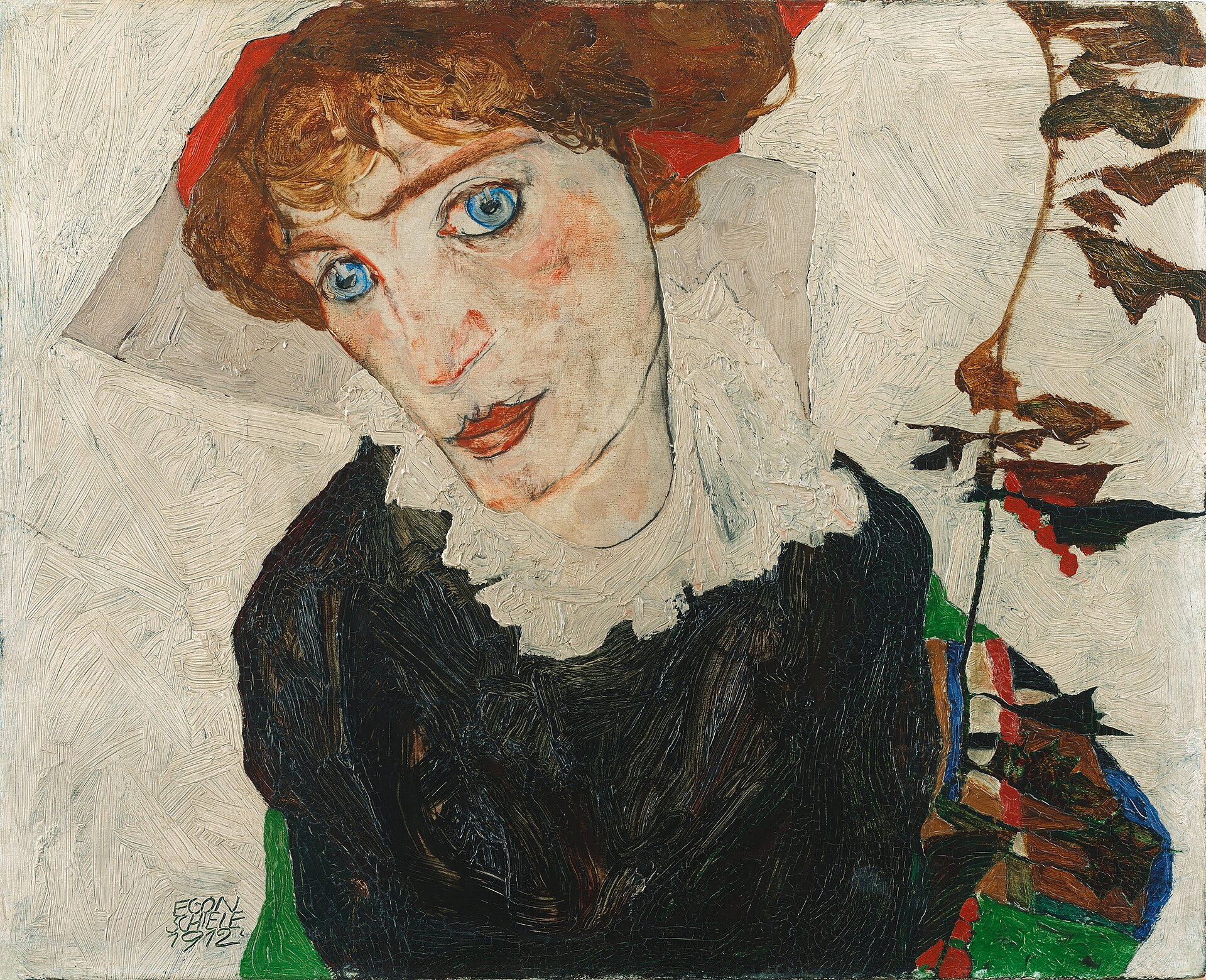
Portrait of Wally Neuzil
1912 · Oil on wood panel
Leopold Museum, Vienna. Owned by the Leopold Museum...
 Austrian · 1890-1918
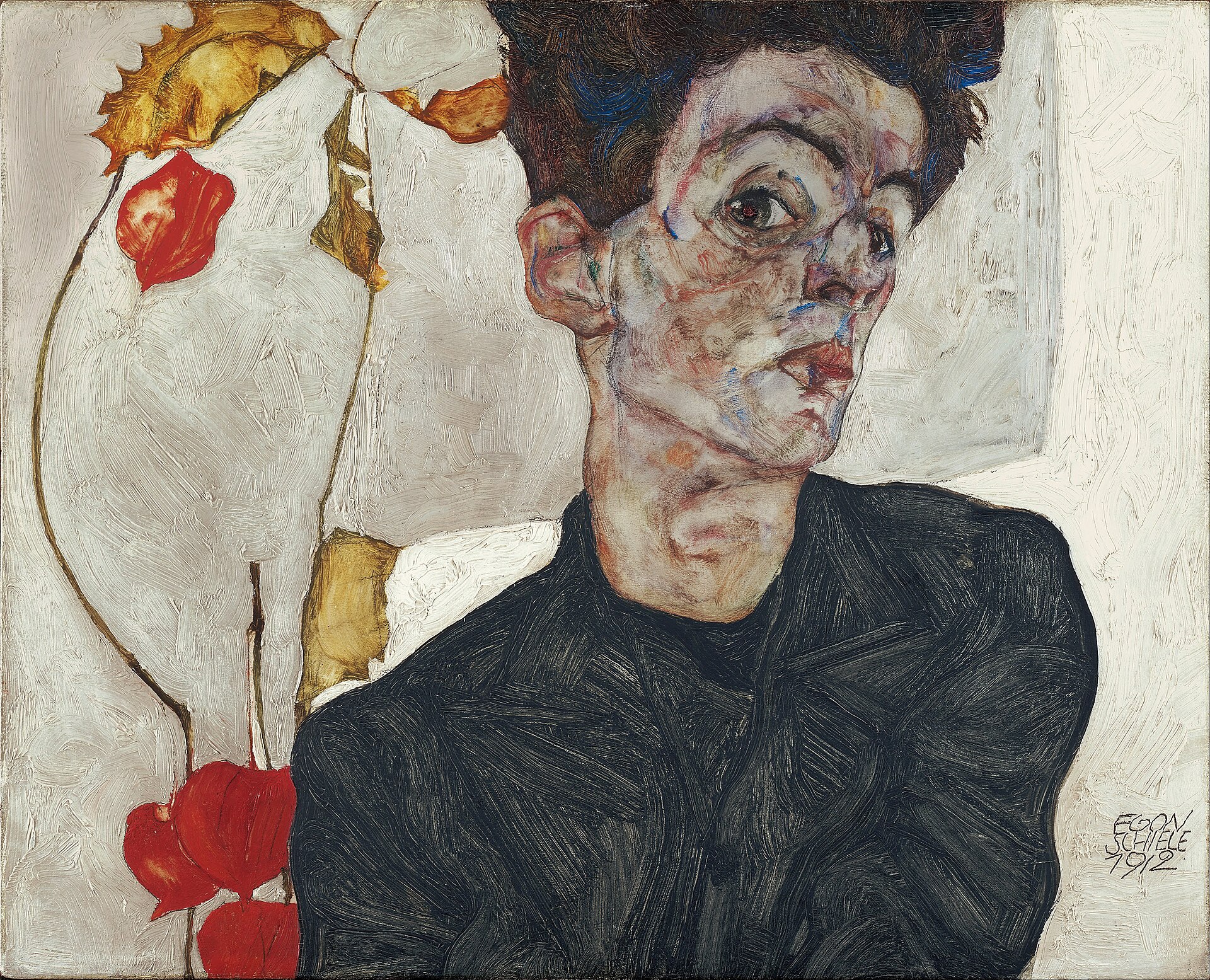
Self-Portrait with Chinese Lantern Plant (Physalis), 1912. Painted as the pendant to the Wally Neuzil portrait this archive holds as its own record; Rudolf Leopold said in 1957 that acquiring this self-portrait's counterpart was the reason he wanted the Wally panel badly enough to trade another picture for it. Identification as a self-portrait is not disputed.
Leopold Museum, Vienna| Full name | Egon Leo Adolf Ludwig Schiele |
|---|---|
| Worked as | Painter, Draughtsman |
| Born | 12 June 1890 · Tulln an der Donau, Austria-Hungary |
| Died | 31 October 1918 · Vienna, Austria |
| Nationality | Austrian |
| Movement | Vienna Expressionism, out of the Klimt and Secession circle |
| In this archive | 1 artwork |
| Sources | 15 cited |
| Last verified | 17 September 2026 |
About this page 1 artwork in the archive · Last verified 17 September 2026 · 15 sources cited
Schiele worked for about eleven years and was dead at twenty-eight. In that span he produced a body of work large enough that its own cataloguing is still an active research project a century later, and small enough that almost every major picture is individually trackable through the market and the archives. The two facts are connected: a compressed, mostly Viennese output, made almost entirely between 1908 and 1918 and bought in that period by exactly the Jewish professional and mercantile class of Vienna that the Nazi state dispossessed after March 1938, means there is close to no way to write a full ownership history of a major Schiele without writing a history of Aryanisation somewhere in the chain.
The single fact most readers do not already know is not about the pictures. It is that the restitution of Schiele's own patrons' collections is not settled history. As of this record's research date a New York appellate court is actively deciding whether the Art Institute of Chicago must surrender a drawing a trial judge has already found, in a 79-page opinion, to have been stolen property for eighty-six years. Ten other works from the same collection have already been returned or sold since 2018. This page sets out who Schiele was, how the corpus is counted, what the market actually pays, and the collection dispute in the precise terms the courts have used, rather than the smoothed version that circulates in press coverage.
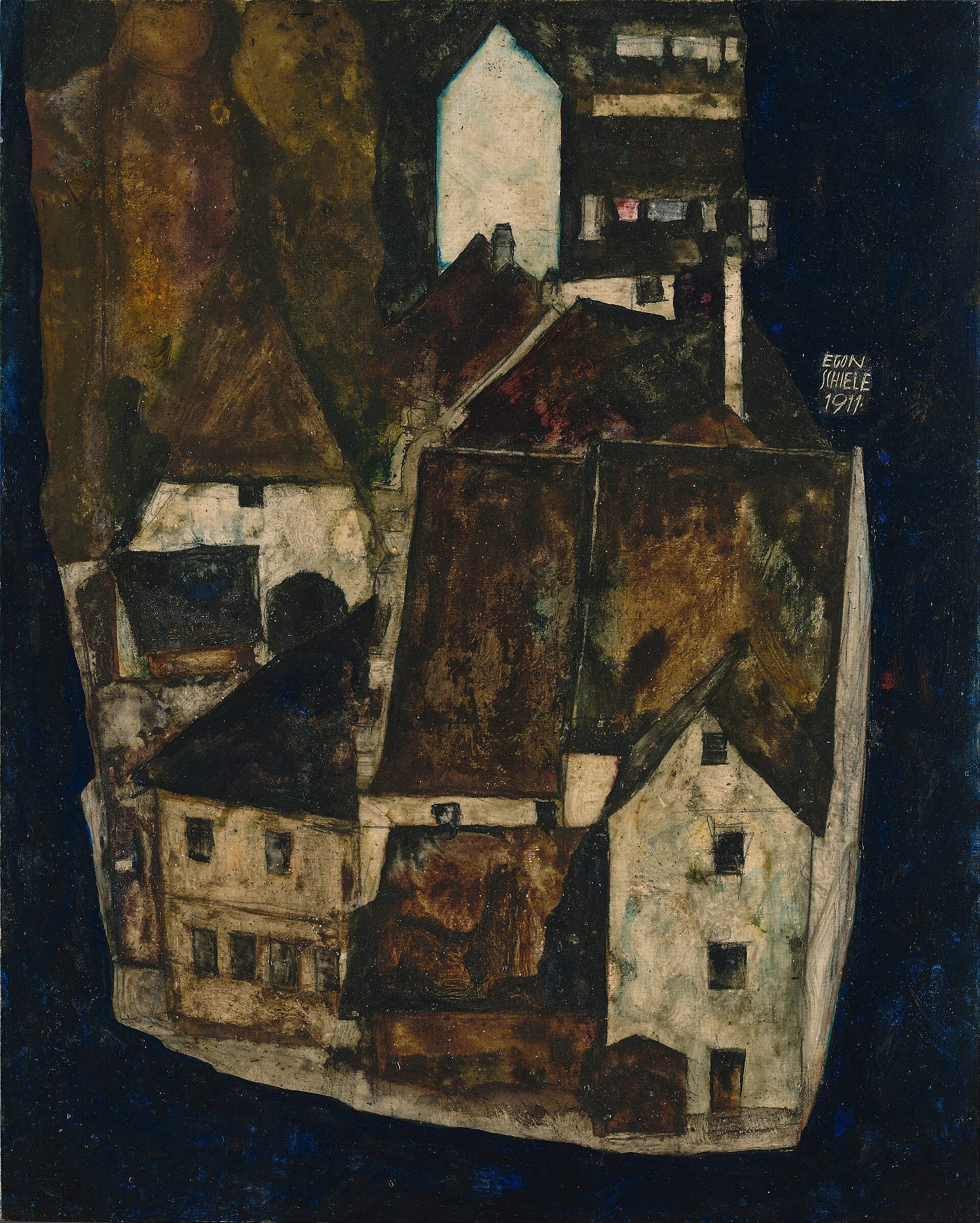
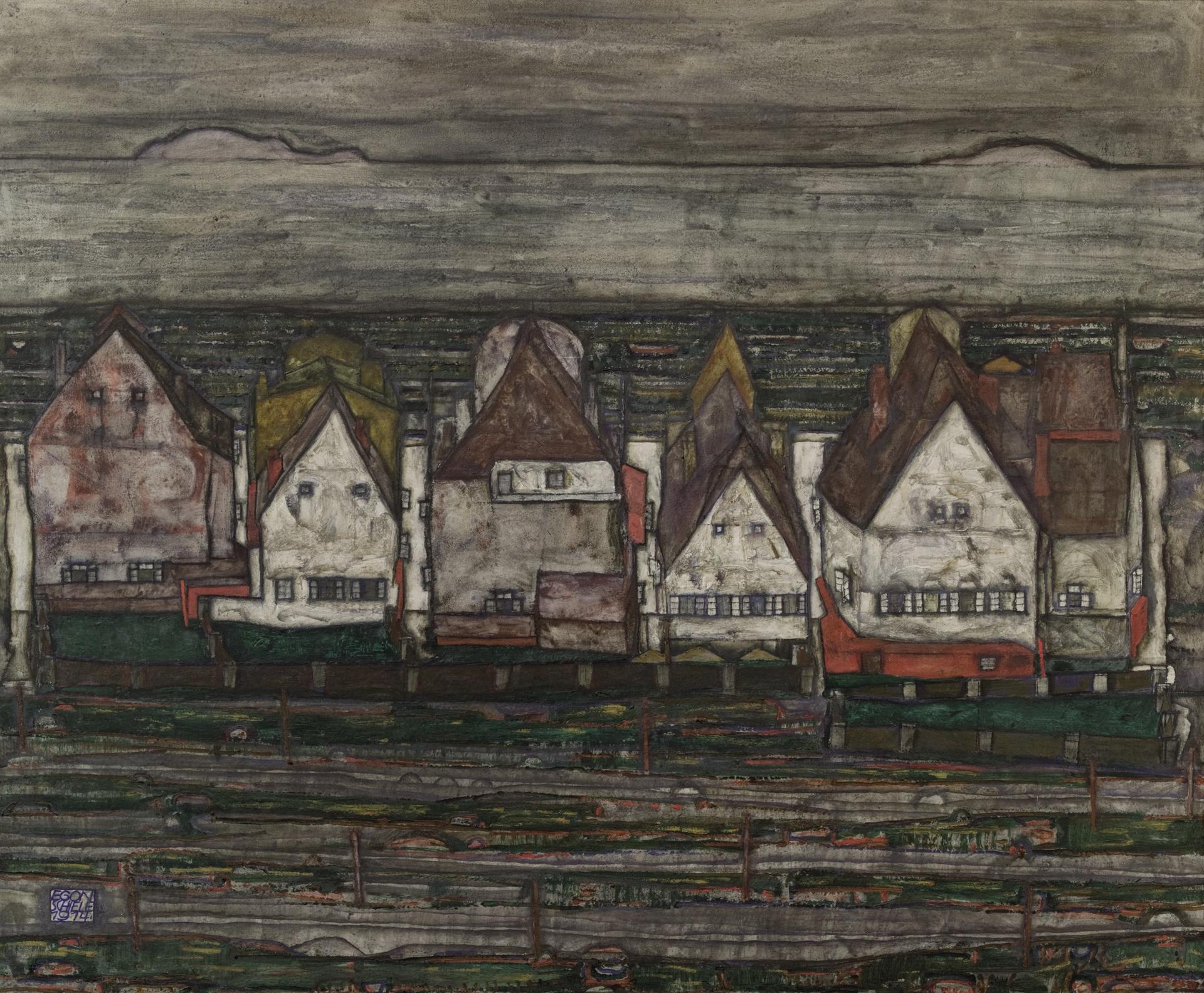
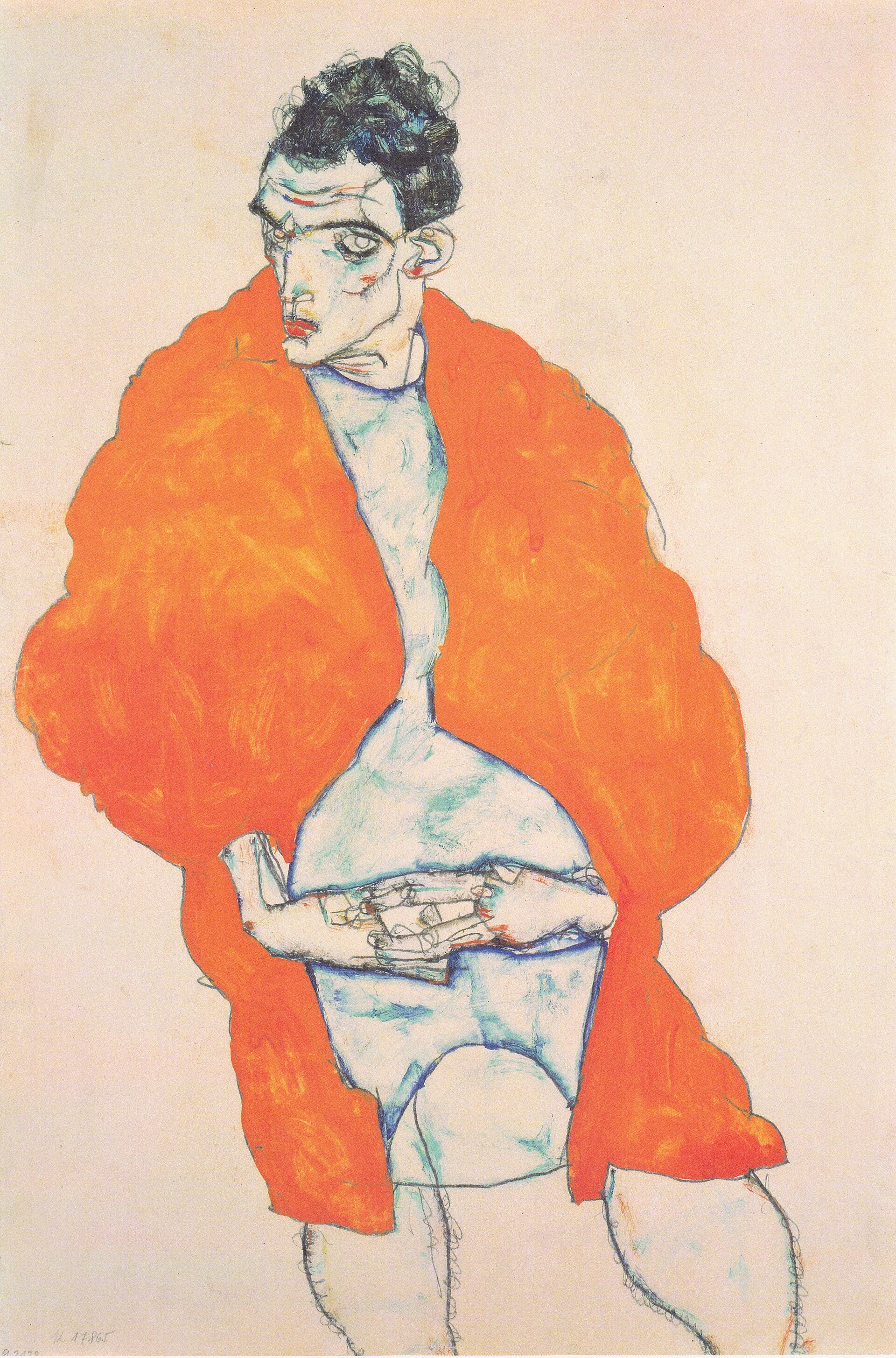
Born 12 June at Tulln an der Donau, son of the town's railway station master.1
Enrols at the Vienna Academy of Fine Arts.1
Seeks out Gustav Klimt, who buys his drawings and introduces him to patrons.1
Leaves the Academy; founds the Neukunstgruppe; shows at the Vienna Kunstschau on Klimt's invitation.1
Abandons the decorative Klimt-derived manner; begins the isolated, distorted figures against blank ground that define his mature line.2
Meets Wally Neuzil, then seventeen; they live together in Vienna and later Krumau.1
Arrested at Neulengbach in April; convicted of exhibiting indecent drawings to minors after the abduction and seduction charges are dropped.1
Marries Edith Harms on 17 June; conscripted three days later.1
Guarding Russian prisoners of war and later serving at the camp at Muhling, makes the watercolour studies including Russian War Prisoner.1
Wally Neuzil dies nursing in Dalmatia; Schiele is reassigned to Vienna.1
Given the main hall of the 49th Vienna Secession exhibition, showing fifty works; Edith dies of influenza 28 October, six months pregnant, and Schiele dies of the same illness 31 October.1
Fritz Grunbaum, arrested after the Anschluss and held at Dachau, is coerced into signing over power of attorney; his collection of eighty-one Schiele works is subsequently seized.7
Grunbaum is murdered at Dachau.7
The Second Circuit affirms judgment for the possessor David Bakalar on laches grounds over the drawing Seated Woman with Bent Left Leg (Torso), a different Grunbaum-collection work.9
Reif v Nagy: the New York Supreme Court orders dealer Richard Nagy to surrender two Grunbaum-collection Schieles; upheld on appeal in 2019.8
13 September: Russian War Prisoner and other works seized from the Art Institute of Chicago and two other museums. 20 September: seven further Grunbaum-collection Schieles voluntarily surrendered by MoMA, the Morgan Library, the Ronald Lauder collection, the Santa Barbara Museum of Art and the Vally Sabarsky Trust. 9 November: several of the returned works sell at Christie's New York.6714
26 July: an eleventh Grunbaum-collection work, Seated Nude Woman, front view, returned by the estate of Gustav Papanek.10
23 April: Justice Althea Drysdale orders the Art Institute of Chicago to return Russian War Prisoner; an appellate stay follows days later.11
14 January: oral argument heard in the Art Institute of Chicago's appeal. No ruling issued as of this record's research date.12
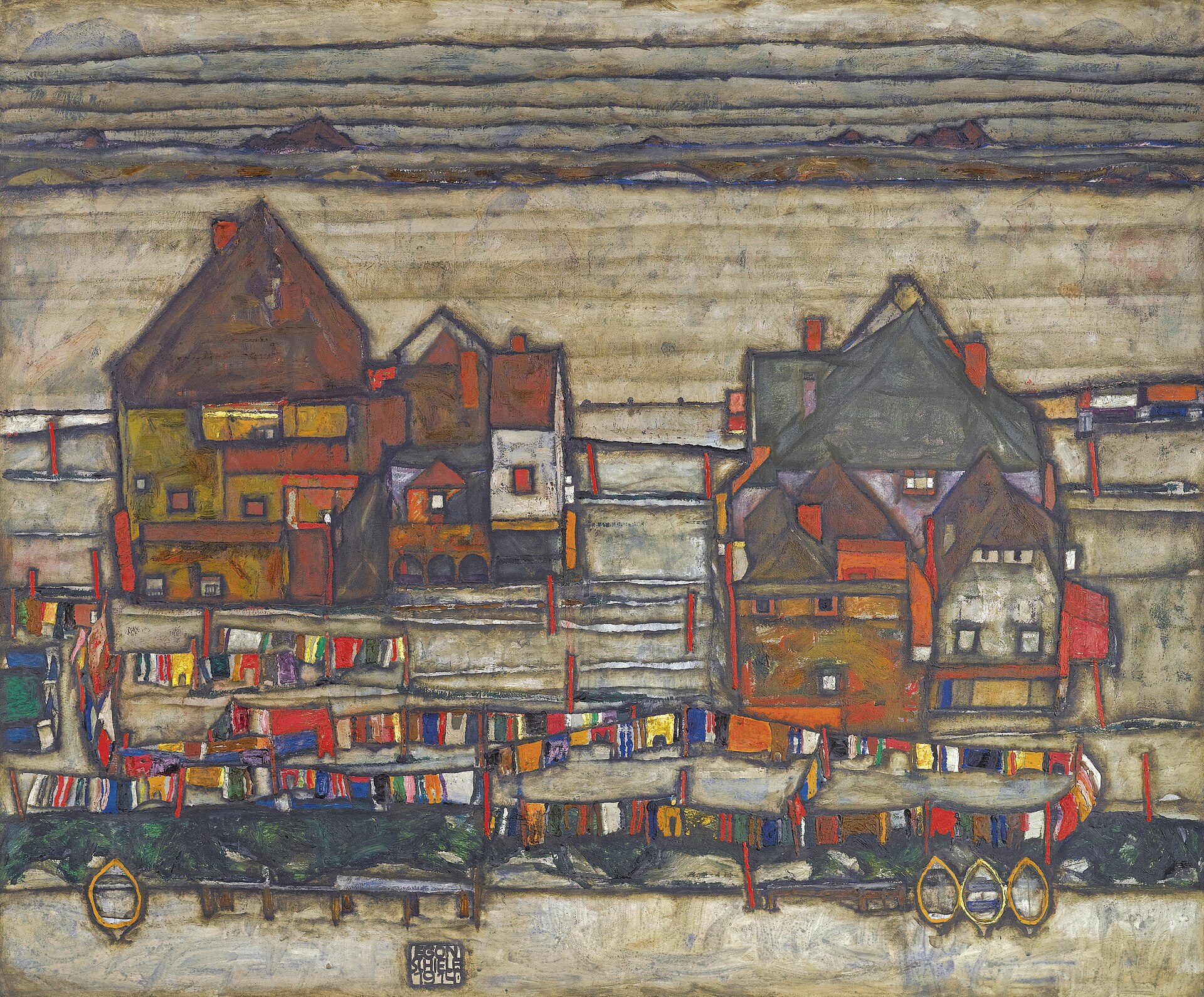
The record price, 24.7 million pounds with fees at Sotheby's London on 22 June 2011 for Hauser mit bunter Waesche (Vorstadt II), was a forced sale in substance if not in form: the Leopold Museum consigned it specifically to help fund the nineteen-million-dollar settlement it had just agreed over the Wally Neuzil portrait, and Sotheby's premium-inclusive reporting convention means the hammer figure alone was never separately published.
Below that single result, the clearest recent evidence comes from the Grunbaum restitution itself. Works returned to the heirs in September 2023 were sold at Christie's New York within seven weeks, on 9 November 2023, at prices where both hammer and premium are on record: Stehende Frau (Dirne) made a 2.2 million dollar hammer against a 1 to 2 million dollar estimate, 2.7 million dollars with premium. The clearance of restituted Schieles at that level, immediately and at multiples of the pre-attribution estimate range typical of the artist's smaller works, is itself a market signal: buyers pay a premium for a picture whose Nazi-era gap has just been closed by a court or a settlement, not a discount.
| Date | Sale | Work | Result | Note |
|---|---|---|---|---|
| 22 June 2011 | Sotheby's, London | Hauser mit bunter Waesche (Vorstadt II) (1914) | Hammer Not separately published With premium GBP 24.7 m (approx. USD 39.8 m) GBP | Auction record for the artist. Consigned by the Leopold Museum to help fund its 2010 settlement over the Wally Neuzil portrait. NOT a Grunbaum-collection work. |
| 9 November 2023 | Christie's, New York | Stehende Frau (Dirne) / Standing Woman (Prostitute) (1912) | Hammer USD 2.2 m With premium USD 2.7 m USD | Grunbaum-collection work, restituted by the Museum of Modern Art seven weeks earlier. Estimate USD 1-2 m on a hammer basis. |
Hammer is the price at which the bidding stopped; with premium adds the fee the house charges the buyer on top. Hammer price and buyer's premium in the glossary.
| Institution | City | Holdings | Note |
|---|---|---|---|
| Leopold Museum | Vienna | The largest single Schiele holding in the world, assembled by Rudolf Leopold from the 1950s postwar market. | Includes the Wally Neuzil portrait and its pendant self-portrait; several holdings carry their own Nazi-era restitution history, documented case by case rather than assumed clean. |
| Albertina | Vienna | A major graphic-arts collection including Schiele drawings and watercolours. | |
| Belvedere | Vienna | Paintings including works that passed through the same postwar restitution-in-error machinery documented on this archive's Wally Neuzil record. | |
| Museum of Modern Art | New York | Formerly held Stehende Frau (Dirne), restituted to the Grunbaum heirs in September 2023 and sold at Christie's the same year. | No longer holds the work; listed to show where it left the institutional record. |
| Art Institute of Chicago | Chicago | Russian War Prisoner (1916), watercolour and pencil. | Subject to an active, unresolved restitution order under appeal as of this record's research date. See narrative. |
Schiele was born on 12 June 1890 in Tulln an der Donau, where his father Adolf Schiele was the railway station master.
Schiele was born on 12 June 1890 in Tulln an der Donau, where his father Adolf Schiele was the railway station master. His father died of syphilis when Egon was fourteen; a sister, Elvira, had already died in childhood of congenital syphilis contracted from him. Two other sisters, Melanie and Gertrude, survived; Gertrude, always called Gerti, later modelled for him. He enrolled at the Vienna Academy of Fine Arts in 1906 and left after three years, dissatisfied with his conservative instructor Christian Griepenkerl.
The scholarly reference for his output is Jane Kallir's catalogue raisonne, first published in 1990 and expanded in 1998, which brings together the paintings, drawings, watercolours, sketchbooks, graphic prints and sculpture in one numbering system. Kallir's own gallery, Galerie St Etienne in New York, describes the full corpus as a few hundred oil paintings against a much larger body of works on paper; the 1990 edition alone listed more than two thousand five hundred authenticated drawings and watercolours, with the 1998 edition adding over two hundred further entries as new works surfaced and others were reattributed. The Kallir Research Institute began moving the catalogue online in 2018, updating the entries on oils, prints, sketchbooks and sculpture first and continuing work on the drawings and watercolours since, precisely because new works keep appearing and because provenance research, especially on the Nazi-era gap, keeps changing what a given entry can responsibly say.
Schiele sought out Gustav Klimt in 1907.
Schiele sought out Gustav Klimt in 1907. Klimt bought his drawings, traded work with him, sent him models and introduced him to patrons and to the Wiener Werkstaette, the applied-arts workshop associated with the Vienna Secession. That patronage is the reason Schiele had any market at all in his early twenties; a young painter without an academy diploma and without Klimt's introductions would not have reached the same collectors this fast.
In 1909, the year he left the Academy, Schiele founded the Neukunstgruppe with a group of similarly dissatisfied students, and Klimt invited him to show at that year's Kunstschau, the large independent exhibition in Vienna. There Schiele encountered work by Edvard Munch, Jan Toorop and Vincent van Gogh, alongside the Vienna Secession's own output. His early manner in this period was close enough to Klimt's decorative, gilded idiom that he is recorded as having called himself, in effect, the silver Klimt: the same gestural vocabulary and metallic pigment, without yet the raw distortion that followed. That changed within about a year.
Around 1910 Schiele abandoned the decorative surface almost entirely.
Around 1910 Schiele abandoned the decorative surface almost entirely. He stripped his figures of the ornamental context Klimt had built around them and set them, isolated, against blank or near-blank ground, intensifying the palette into the acid greens, oranges, yellows and reds that mark his mature drawings. The line itself became the content: taut, interrupted, deliberately awkward at the joints, describing a body that reads as exposed rather than posed. Negative space is not filler in these pictures; it is doing as much work as the figure, which is part of why so many of them read as unfinished even when they are not.
His paintings and his drawings did not move together. Through the 1910s the drawings sharpened toward greater anatomical precision even as the psychological charge increased, while the paintings developed an increasingly heavy, worked paint surface, culminating in the bold impasto of his last canvases. By 1917 and 1918 his drawn line had calmed into something closer to classical modelling, fuller forms and smoother contours that several scholars read as an unexpected, late homage to the academic training he had rejected a decade earlier; his oils in the same two years moved the opposite way, becoming more painterly rather than less. Because a substantial part of the 1918 work was left unfinished at his death, including a large planned family group, how far that late synthesis would have gone is a question the surviving pictures cannot fully answer.
In April 1912 Schiele and Wally Neuzil were living in Neulengbach, west of Vienna, where his studio had become a gathering place for local children who came to look at his pictures and, on occasion...
In April 1912 Schiele and Wally Neuzil were living in Neulengbach, west of Vienna, where his studio had become a gathering place for local children who came to look at his pictures and, on occasion, to model. He was arrested on suspicion of abducting and seducing a girl of thirteen. Police searching the studio seized more than a hundred drawings as pornographic, and one was burned by the judge over a candle flame in open court.
The abduction and seduction charges did not hold. He was convicted instead on the narrower count of exhibiting erotic drawings where children could see them. He had already spent twenty-one days in custody awaiting trial; the court added three more. In his own defence, recorded from the trial, he said he did not deny having made drawings and watercolours of an erotic nature, but that they were always works of art, and asked whether there were no artists who had made erotic pictures. He stopped using children as models afterward. The morbidity and sexual explicitness of his work, by several accounts, did not decrease.
Valerie Neuzil, always called Wally, met Schiele in 1911, when he was twenty-one and she seventeen; she had previously modelled for Klimt.
Valerie Neuzil, always called Wally, met Schiele in 1911, when he was twenty-one and she seventeen; she had previously modelled for Klimt. She lived with him in Vienna, in Krumau in southern Bohemia, and at Neulengbach, and she appears through a substantial part of his output in those years, including the 1912 panel now in the Leopold Museum, Vienna, that this archive already carries as its own record under the title Portrait of Wally Neuzil. The relationship ended when Schiele married Edith Harms on 17 June 1915; he was conscripted into the army three days later. Wally died in 1917, nursing in Dalmatia.
The same year produced Cardinal and Nun (Caress), now also in the Leopold Museum, in which a cardinal in scarlet embraces a nun who pulls away from him. The Leopold Museum's own catalogue text reads the rigid, mirrored pose as a deliberate paraphrase of Klimt's The Kiss of five years earlier, replacing Klimt's gold ground and reconciled couple with plain colour and open struggle, and proposes, on the same page, that Schiele gave the cardinal and the nun his own and Wally's features, the roles reversed. That is the museum's argued reading rather than anything Schiele wrote down about the picture himself, and this record states it as such: a proposal about a specific 1912 painting, not a settled fact about his intentions.
The full account of what happened to that specific portrait afterward, including the 1998-2010 dispute between the Leopold Museum and the estate of its earlier owner Lea Bondi Jaray and the nineteen-million-dollar settlement that resolved it without the painting changing hands, is set out in that record and is not repeated here. What belongs on this page is the pattern it establishes: a Schiele picture bought by a Viennese Jewish dealer or collector before 1938, taken or sold under duress after the Anschluss, and only decades later the subject of litigation whose outcome is a payment rather than a return. The collection at the centre of this page's hardest material follows the same pattern at a larger scale.
Three names recur in Schiele's early patronage and none of them was a museum.
Three names recur in Schiele's early patronage and none of them was a museum. Arthur Roessler, an art critic on the Vienna social-democratic newspaper Arbeiter-Zeitung, met him at the Neukunstgruppe's first exhibition at the Pisko gallery in December 1909 and became his most consistent early champion, buyer and eventually his biographer. Heinrich Benesch, a railway official, was drawn in after seeing a single sunflower picture and went on to become the most persistent collector of Schiele's drawings and watercolours, buying steadily from about 1910.
Karl Maylander, a Viennese businessman who knew Schiele personally, assembled a substantial holding of his drawings among other young Austrian artists. Maylander was deported from Vienna to the Lodz ghetto in October 1941 and murdered there. He had left his possessions with an acquaintance, Etelka Hofmann, who sold them after the war; the resulting dispersal produced its own, separate restitution history, distinct from the Grunbaum case below, that an Austrian government commission examined in 2010 and that the Leopold Museum has since resolved with at least one Maylander descendant over specific pictures. It is a second, independent demonstration of the same structural fact: the buyers of Schiele's work in his own lifetime were disproportionately the Viennese Jewish collectors whom the following three decades of Austrian history destroyed.
Schiele married Edith Harms on 17 June 1915 and was conscripted three days later, initially posted away from Vienna and later, from 1916, guarding transports of Russian prisoners of war and serving...
Schiele married Edith Harms on 17 June 1915 and was conscripted three days later, initially posted away from Vienna and later, from 1916, guarding transports of Russian prisoners of war and serving at a prisoner-of-war camp at Muhling. The watercolour and pencil studies he made there of individual prisoners, including the 1916 sheet later titled Russian War Prisoner, are the direct product of that posting and, as it happens, the specific work at the centre of the still-unresolved litigation described below.
Reassigned to Vienna in 1917, he had more time to work at scale again, and 1918 brought the clearest institutional recognition he received in his life: he was given the main hall of the 49th Vienna Secession exhibition, showed fifty works, and designed the exhibition poster, placing himself in the position Christ occupies in a Last Supper. The show succeeded. He did not live to build on it.
Otto Kallir published the first Schiele catalogue in 1930 and a full catalogue raisonne in 1966.
Otto Kallir published the first Schiele catalogue in 1930 and a full catalogue raisonne in 1966. His granddaughter Jane Kallir published Egon Schiele: The Complete Works in 1990, with an expanded edition in 1998, still the standard scholarly reference; it assigns every accepted work a number prefixed by medium, P for paintings, D for drawings and watercolours, Sk for sketchbooks, G for graphics and S for sculpture. Galerie St Etienne, the gallery Otto Kallir founded and Jane Kallir still directs, describes the accepted corpus as a few hundred paintings against thousands of works on paper; the digital successor to the printed catalogue, hosted by the Kallir Research Institute, had passed several hundred entries online by the time this record was researched, with the oils, prints, sketchbooks and sculpture updated first and the watercolours and drawings, the largest and least settled category, still being brought up to date.
There is no second authenticating body. Where Otto and Jane Kallir's catalogues are silent or where new provenance research changes an attribution or an owner, there is no rival board to appeal to; the Kallir Research Institute is, in practice, the authority, which is also why its ongoing digitisation project matters more for Schiele than the equivalent project would for an artist with a competing catalogue.
Fritz Grunbaum was a Viennese cabaret performer, writer and outspoken critic of the Nazi regime who owned, by the count reported when his heirs' claims reached the press in 2023, eighty-one works by...
Fritz Grunbaum was a Viennese cabaret performer, writer and outspoken critic of the Nazi regime who owned, by the count reported when his heirs' claims reached the press in 2023, eighty-one works by Schiele. He was arrested after the Anschluss and held at Dachau, where in 1938 he was coerced into signing a power of attorney in favour of his wife Elisabeth; she was in turn compelled to hand the collection over to Nazi officials. Grunbaum was murdered at Dachau in 1941. No court has recorded a voluntary sale.
The collection's post-war path runs through the same kind of clerical and institutional laundering this archive's Wally Neuzil record documents for a single panel: works changing hands through dealers, galleries and eventually museums across the following seventy years, most of them printed in good faith by each successive owner with a provenance line that omitted the 1938 transfer. The 2018 case that first broke the pattern open in court, Reif v Nagy, is discussed below; the point to hold onto here is the number. Eighty-one Schieles is not a handful of contested pictures. It is one of the largest single Nazi-era collections of any artist's work still being tracked through the market, and as of this record's research date roughly one in eight of them has been recovered.
The record on Grunbaum-collection Schieles is not uniform, and treating it as a single settled story is the exact error this archive exists to correct.The first ruling went the other way.
The record on Grunbaum-collection Schieles is not uniform, and treating it as a single settled story is the exact error this archive exists to correct.
The first ruling went the other way. In Bakalar v Vavra, David Bakalar, who had bought the drawing Seated Woman with Bent Left Leg (Torso) from a Manhattan gallery in the early 1960s, was sued by Grunbaum's heirs. The Second Circuit affirmed the district court's judgment for Bakalar in October 2012 on the defence of laches: the heirs, or their predecessors, were found to have known or had reason to know of the claim and to have delayed inexcusably in pursuing it, and the court held that the defence does not reset with each new generation of heirs. The drawing stayed with Bakalar.
The pattern reversed in 2018. In Reif v Nagy, the Commercial Division of the New York Supreme Court, Justice Charles Ramos presiding, ordered the London dealer Richard Nagy to surrender two Schiele works, Woman in a Black Pinafore and Woman Hiding Her Face, finding that Nagy had failed to prove Grunbaum voluntarily transferred the works during his lifetime. An appellate court upheld the decision in 2019, and it became the precedent the Manhattan District Attorney's office relied on to seize further Grunbaum-collection works from museums.
The largest single action followed in September 2023. Seven Schiele works, held by the Museum of Modern Art, the Morgan Library and Museum, the Neue Galerie founder Ronald Lauder's private collection, the Santa Barbara Museum of Art and the Vally Sabarsky Trust, were voluntarily surrendered to Grunbaum's heirs at a ceremony at the Manhattan District Attorney's office on 20 September 2023, collectively valued in excess of nine and a half million dollars. The Allen Memorial Art Museum and the Carnegie Museum of Art returned two further works after the same investigation notified them. A drawing held by the estate of Gustav Papanek, Seated Nude Woman, front view of 1918, was returned on 26 July 2024, the eleventh recovered work overall, after the Papanek heirs cooperated once told the work had been stolen.
One work seized in the same September 2023 action has not been resolved, and it is the hardest material on this page, because it is not yet history.Russian War Prisoner, the 1916 watercolour and...
One work seized in the same September 2023 action has not been resolved, and it is the hardest material on this page, because it is not yet history.
Russian War Prisoner, the 1916 watercolour and pencil sheet Schiele made while guarding Russian prisoners of war, was seized from the Art Institute of Chicago on 13 September 2023 on a warrant signed by New York Supreme Court Justice Althea Drysdale, then valued at approximately 1.25 million dollars. The museum contested the seizure on several grounds: that no documentary evidence supported a Nazi-era seizure of the specific sheet, that it had instead been voluntarily sold in the 1950s by Grunbaum's sister-in-law Mathilde Lukacs, and that the Manhattan District Attorney lacked jurisdiction over a work that had passed through a New York gallery before reaching Chicago.
On 23 April 2025 Justice Drysdale issued a 79-page decision rejecting the museum's account and ordering restitution. She found the drawing to have been stolen property for the preceding eighty-six years, noted that the storage facility that had held the Grunbaum collection under Nazi administration was itself Nazi-run, and identified forged signatures and misspellings on invoices from the dealer Eberhard Kornfeld that the museum's chain of title depended on. The Art Institute said it was reviewing the decision and would pursue an appeal; an appellate judge granted an emergency stay days later, keeping the drawing in Chicago while that appeal proceeds. Oral argument was heard on 14 January 2026. No appellate ruling had been issued as of this record's research date, and the drawing remains in the museum's custody.
Say plainly what that means for a reader relying on this page: the question of whether Russian War Prisoner belongs with the Grunbaum heirs or with the Art Institute of Chicago is, as of now, an open legal question before a New York appellate court, not a decided fact. Everything else on this page about the case is a trial court's findings and a museum's stated position pending appeal, not a final result.
Schiele's auction record was set on 22 June 2011, when Sotheby's London sold Hauser mit bunter Waesche (Vorstadt II) of 1914, consigned by the Leopold Museum to help fund its own...
Schiele's auction record was set on 22 June 2011, when Sotheby's London sold Hauser mit bunter Waesche (Vorstadt II) of 1914, consigned by the Leopold Museum to help fund its own nineteen-million-dollar settlement over the Wally Neuzil portrait, for 24.7 million pounds with fees against an estimate of 22 to 30 million pounds on a hammer basis; Sotheby's does not publish the hammer figure separately from the premium-inclusive result, so the two are not directly comparable and the hammer alone was never released.
The restituted Grunbaum-collection works sold at Christie's New York on 9 November 2023 sit a tier below that, and here hammer and premium are both on record. Stehende Frau (Dirne), the 1912 work returned by the Museum of Modern Art, made a hammer price of 2.2 million dollars against an estimate of 1 to 2 million, or 2.7 million dollars with the buyer's premium included. That sale and its companions from the same restitution, Selbstbildnis from the Morgan Library and Liebe Gegensaetze from the Ronald Lauder collection among them, together realised roughly 16.5 million dollars in that single evening session, a figure that measures what an institution that has just given up a picture for nothing can still expect the market to pay for it once title is clean.
Jane Kallir, writing as co-director of Galerie St Etienne, the gallery her grandfather founded and that still holds the working archive behind the catalogue raisonne, has stated that the gallery sees...
Jane Kallir, writing as co-director of Galerie St Etienne, the gallery her grandfather founded and that still holds the working archive behind the catalogue raisonne, has stated that the gallery sees an average of one Schiele forgery a week, roughly fifty a year, a volume she attributes directly to the prices the genuine work now commands. She describes three recurring types: an authentic work by a different, minor hand with a forged Schiele signature added, which rarely survives comparison on style alone; a copy of a known, published work, usually caught by comparison with a photograph of the original, though the closest copies defeat photographic comparison and need to be examined in the flesh; and an entirely invented pastiche in Schiele's manner, which she calls the hardest to bring off because it demands real fluency in his technique rather than mere copying. Her own account is that increased market scrutiny and improved connoisseurship have made most of these catchable, not that the volume has fallen.
The influenza pandemic reached Vienna in the autumn of 1918.
The influenza pandemic reached Vienna in the autumn of 1918. Edith Schiele, six months pregnant, fell ill on 19 October and died of the disease on 28 October. Schiele drew her on 27 October, the day before she died. He contracted the same illness and died on 31 October, three days after her, at twenty-eight. Their unborn child died with Edith. A large planned family group, showing Schiele himself with a woman and a child, was left unfinished on the easel; it is usually read as a statement of the future he did not get, though that reading is an inference from the subject and the date rather than anything Schiele wrote about the picture himself.
Whether the Art Institute of Chicago's appeal succeeds is the largest open question this page carries, and it is a live one: oral argument has been heard and no decision issued.
Whether the Art Institute of Chicago's appeal succeeds is the largest open question this page carries, and it is a live one: oral argument has been heard and no decision issued. Beyond it, Grunbaum's heirs have recovered eleven of the eighty-one Schiele works his collection is reported to have held before 1938; where the remaining works are, and whether all of them survive at all, is not established in the sources available to this record. The Maylander dispersal, a separate collection with its own Holocaust-era break, has not been fully mapped either; only isolated pictures from it have surfaced in restitution proceedings so far, and there is no published account of its full original extent to compare against.
Painter; Draughtsman. 1890-1918.
Born 12 June 1890, Tulln an der Donau, Austria-Hungary; died 31 October 1918, Vienna, Austria.
Ongoing market forgery, not a single exposed case. Galerie St Etienne, the gallery still directed by catalogue-raisonne author Jane Kallir, reports seeing an average of one Schiele forgery a week, about fifty a year, which she attributes to the prices the authentic work commands. She identifies three recurring types: a genuine minor work with a forged Schiele signature added; a copy of a known, published work; and an invented pastiche in his manner, the hardest to execute convincingly.
Leopold Museum (Vienna); Albertina (Vienna); Belvedere (Vienna); Museum of Modern Art (New York); Art Institute of Chicago (Chicago).
The record price, 24.7 million pounds with fees at Sotheby's London on 22 June 2011 for Hauser mit bunter Waesche (Vorstadt II), was a forced sale in substance if not in form: the Leopold Museum consigned it specifically to help fund the nineteen-million-dollar settlement it had just agreed over the Wally Neuzil portrait, and Sotheby's premium-inclusive reporting convention means the hammer figure alone was never separately published.Below that single result, the clearest recent evidence comes from the Grunbaum restitution itself. Works returned to the heirs in September 2023 were sold at Christie's New York within seven weeks, on 9 November 2023, at prices where both hammer and premium are on record: Stehende Frau (Dirne) made a 2.2 million dollar hammer against a 1 to 2 million dollar estimate, 2.7 million dollars with premium.
Will the Art Institute of Chicago's appeal succeed? Oral argument was heard 14 January 2026; no ruling has been issued as of this record's research date.
Across the disputed objects in this archive, the instrument that delivered one to its claimant was almost never a judgment.
9 min read
A restitution is itself an undocumented transfer. This archive holds an object delivered to a family that had never owned it, a...
12 min read
Last verified 17 September 2026
One artwork and its story every Tuesday, with the picture: who owned it, what it made, and what closes soon in the exhibition calendar. No promotion, and nothing we cannot cite.
We send one email to confirm the address and keep nothing else. Every letter carries a one-click unsubscribe. How we handle your data.