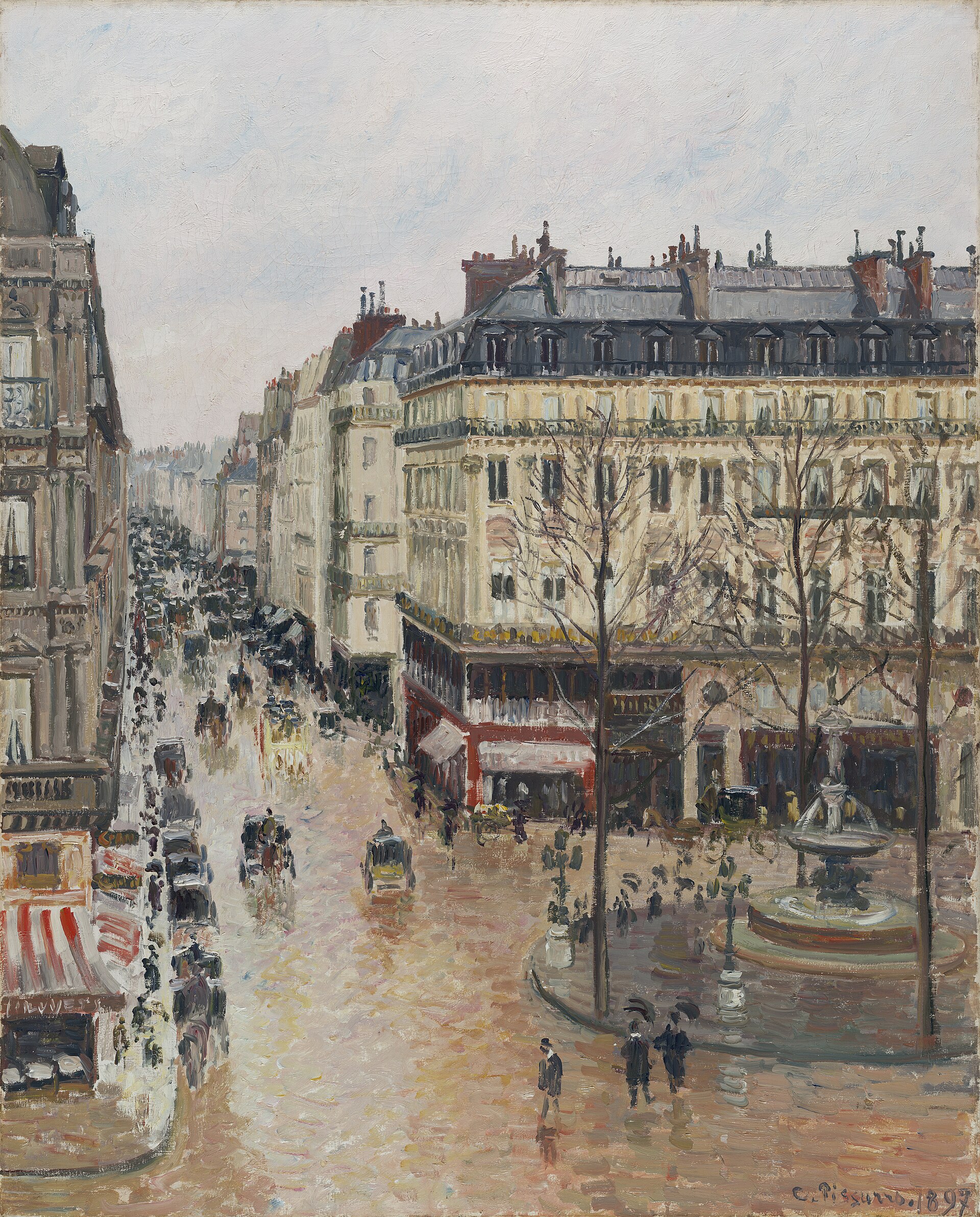
Rue Saint-Honore in the Afternoon. Effect of Rain
1897 · Oil on canvas
Museo Nacional Thyssen-Bornemisza, Madrid, room 33.
 Danish-French · 1830-1903
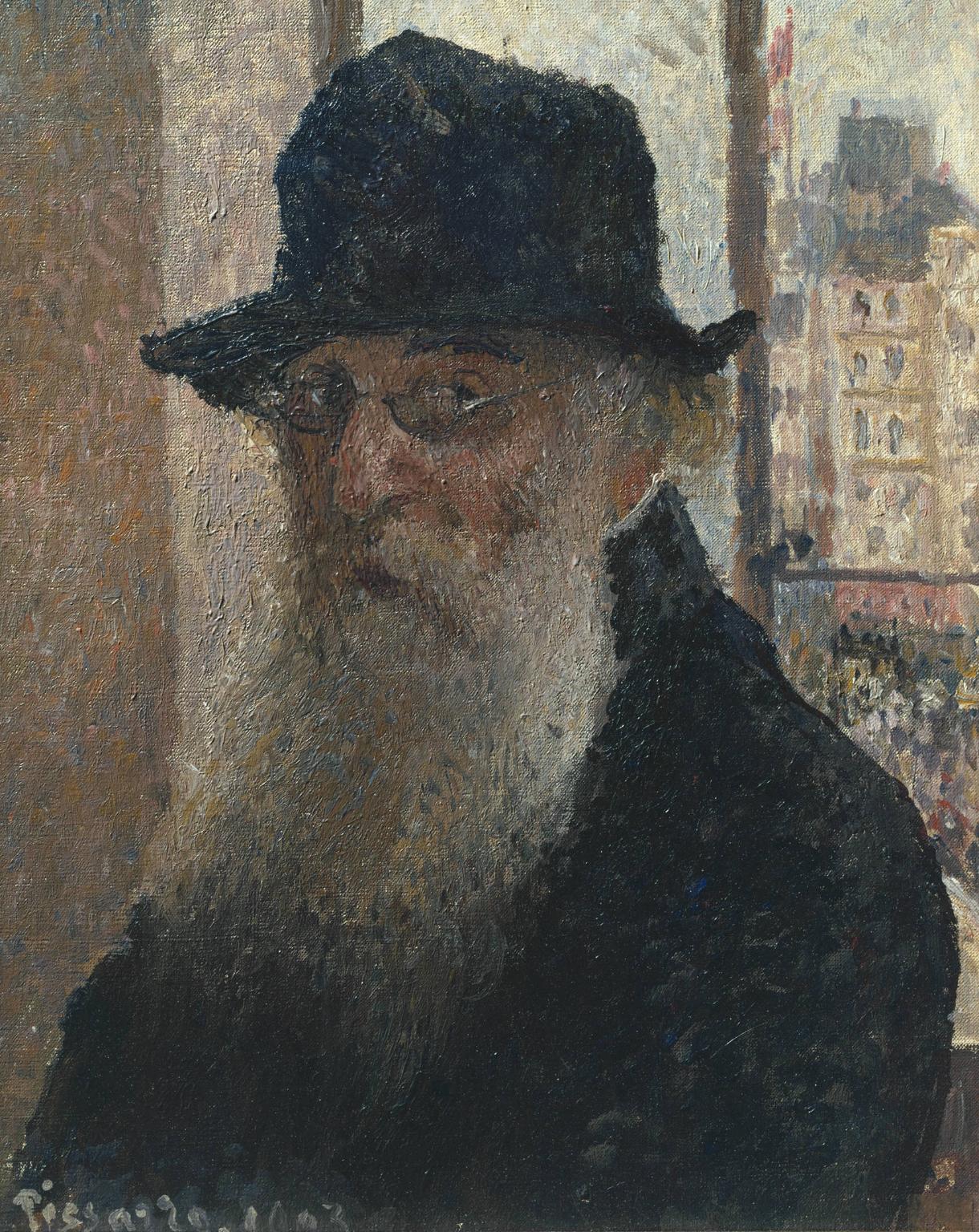
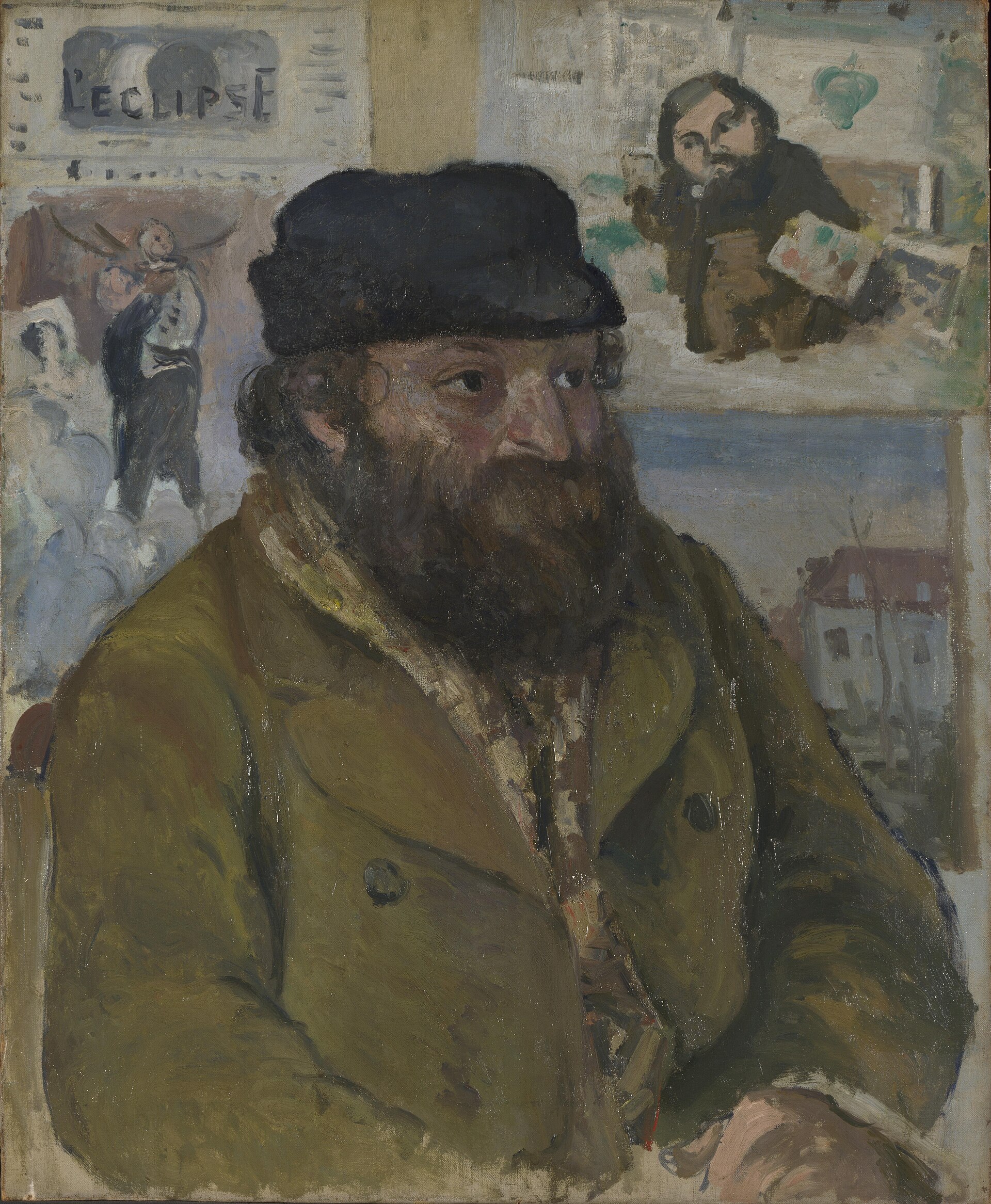
Self-portrait, 1903, painted at the place Dauphine at seventy-three, months before his death, with the Samaritaine building behind him. Given to the Tate by his son Lucien in 1931. A documented, securely identified self-portrait.
Tate| Full name | Jacob Abraham Camille Pissarro |
|---|---|
| Worked as | Painter, Printmaker |
| Born | 10 July 1830 · Charlotte Amalie, Saint Thomas, Danish West Indies |
| Died | 13 November 1903 · Paris |
| Nationality | Danish-French |
| Movement | Impressionism |
| In this archive | 1 artwork |
| Sources | 20 cited |
| Last verified | 17 September 2026 |
About this page 1 artwork in the archive · Last verified 17 September 2026 · 20 sources cited
Pissarro is the only painter who exhibited at all eight Impressionist exhibitions between 1874 and 1886, and the only member of the group not born in Europe. He came into the world on a Danish colonial island in the Caribbean, to a Jewish family the local congregation refused to recognise as married, and he held Danish nationality for most of his working life. Cezanne called him a father. Gauguin called him a father. He was an anarchist who read Kropotkin, subscribed to the anarchist press for two decades, and said so in his own letters rather than leaving it to biographers to infer.
The single thing most readers of this page do not know is that one of his paintings is currently the subject of the longest-running Nazi-era restitution litigation to have reached the United States Supreme Court twice. Rue Saint-Honore in the Afternoon. Effect of Rain, painted in December 1897 in the middle of a family bereavement, was taken from Lilly Cassirer Neubauer in Berlin in 1939 as the price of an exit visa. It hangs in Madrid today, in a museum that asserts title under Spanish law, and the claim on it remains open as this page is written. It is not the only Pissarro the Nazi state or its collaborators took; this page sets out three separate cases, because a single object cannot carry what the pattern shows.
He is also, less dramatically, the connecting figure of French painting in the second half of the nineteenth century: the one artist who worked alongside Corot, Cezanne, Gauguin, Seurat and Signac in turn, changing his own technique each time without ever losing the thing that made his pictures his.
Born 10 July at Charlotte Amalie, Saint Thomas, Danish West Indies, to a Sephardic Jewish family; the local congregation refused to recognise his parents' marriage.8
Sent to boarding school at the Savary Academy, Passy, near Paris.8
Settles permanently in Paris to become a painter; begins working with Corot.8
Meets Claude Monet at the Academie Suisse, February.9
Meets Paul Cezanne at the Academie Suisse, autumn.9
Franco-Prussian War forces the family to Norwood, England; of some 1,500 paintings left behind, only about forty survive occupying soldiers' use of the canvases as floor mats.8
Settles at Pontoise; paints alongside Cezanne, whose technique changes decisively under his influence.11
First Impressionist exhibition, Paris.8
Exhibits at all eight Impressionist exhibitions - the only artist of the group to do so.8
Gauguin, mentored by Pissarro at Pontoise, paints Pissarro's Garden, Pontoise.12
Meets Georges Seurat and Paul Signac; adopts their Divisionist (pointillist) technique.8
Shows pointillist work at the eighth and final Impressionist exhibition; the critic Felix Feneon coins the term Neo-Impressionism.8
Makes Turpitudes sociales, an album of thirty anarchist drawings, as a gift for his niece Esther Isaacson.13
Abandons the pointillist technique, judging it an obstacle to spontaneity.8
Writes to Lucien on 13 April that his and his circle's anarchist ideas 'pass into our works.'10
Receives an unsolicited Kropotkin book, forwards it to Lucien with a copy of La Revolte, 26 April.10
A recurrent eye infection forces him to paint through hotel windows; the first urban series begins at the Hotel-Restaurant de Rome, Paris.8
Takes his family to Belgium during the anti-anarchist repression that followed President Carnot's assassination.13
His son Lucien has a stroke in spring; his son Felix dies in November at twenty-three; Rue Saint-Honore in the Afternoon. Effect of Rain is painted in December, in the following fortnight.14
Signs the Manifesto of the Intellectuals for Dreyfus in January; joins the committee honouring Zola in March.10
Dies in Paris, 13 November, while preparing to move studio for another series; buried at Pere Lachaise.9
Lilly Cassirer Neubauer forced to transfer Rue Saint-Honore... Effet de pluie to the dealer Jakob Scheidwimmer for 900 Reichsmarks, the price of an exit visa from Nazi Germany.18
Supreme Court of the United States rules unanimously on the choice-of-law question in Cassirer v. Thyssen-Bornemisza Collection Foundation, 21 April.2
Supreme Court vacates the Ninth Circuit's judgment a second time and remands, 10 March; the case returns to the district court in Los Angeles.3
Pissarro's late urban series set his enduring commercial profile: Durand-Ruel could not sell his rural subjects through most of the 1880s, and began buying the Paris and Rouen views in bulk once the eye condition forced the change of subject in the 1890s. The market since has been shaped as much by restitution as by connoisseurship - two of the small number of individually documented high prices for his work belong to paintings that changed hands as the direct result of a Nazi-era claim being resolved, one of them setting his auction record in the same sale.
| Date | Sale | Work | Result | Note |
|---|---|---|---|---|
| 5 February 2014 | Sotheby's | Le Boulevard Montmartre, Matinee de Printemps (1897) | Hammer not published in the sources consulted With premium GBP 19,682,500 total with buyer's premium GBP | Restituted to Gerta Silberberg by the Israel Museum, Jerusalem, in 2000 following the 1935 forced sale of her father-in-law Max Silberberg's collection. Roughly double the pre-sale estimate; reported as an artist record at the time. Buyer not named in the sources consulted. |
| 1995 | Christie's, New York | La Cueillette des pois (Pea Harvest, c. 1887, gouache) | Hammer not published With premium USD 800,000 total, per the buyers' own account USD | Bought in good faith by the American collectors Bruce and Robbi Toll; ordered returned without compensation to the heirs of the original Jewish owner, Simon Bauer, by the Paris High Court in November 2017, upheld on appeal. |
Hammer is the price at which the bidding stopped; with premium adds the fee the house charges the buyer on top. Hammer price and buyer's premium in the glossary.
| Institution | City | Holdings | Note |
|---|---|---|---|
| Museo Nacional Thyssen-Bornemisza | Madrid | Rue Saint-Honore in the Afternoon. Effect of Rain (1897), the subject of the Cassirer restitution claim. | Room 33; in the museum's custody continuously since 1993. |
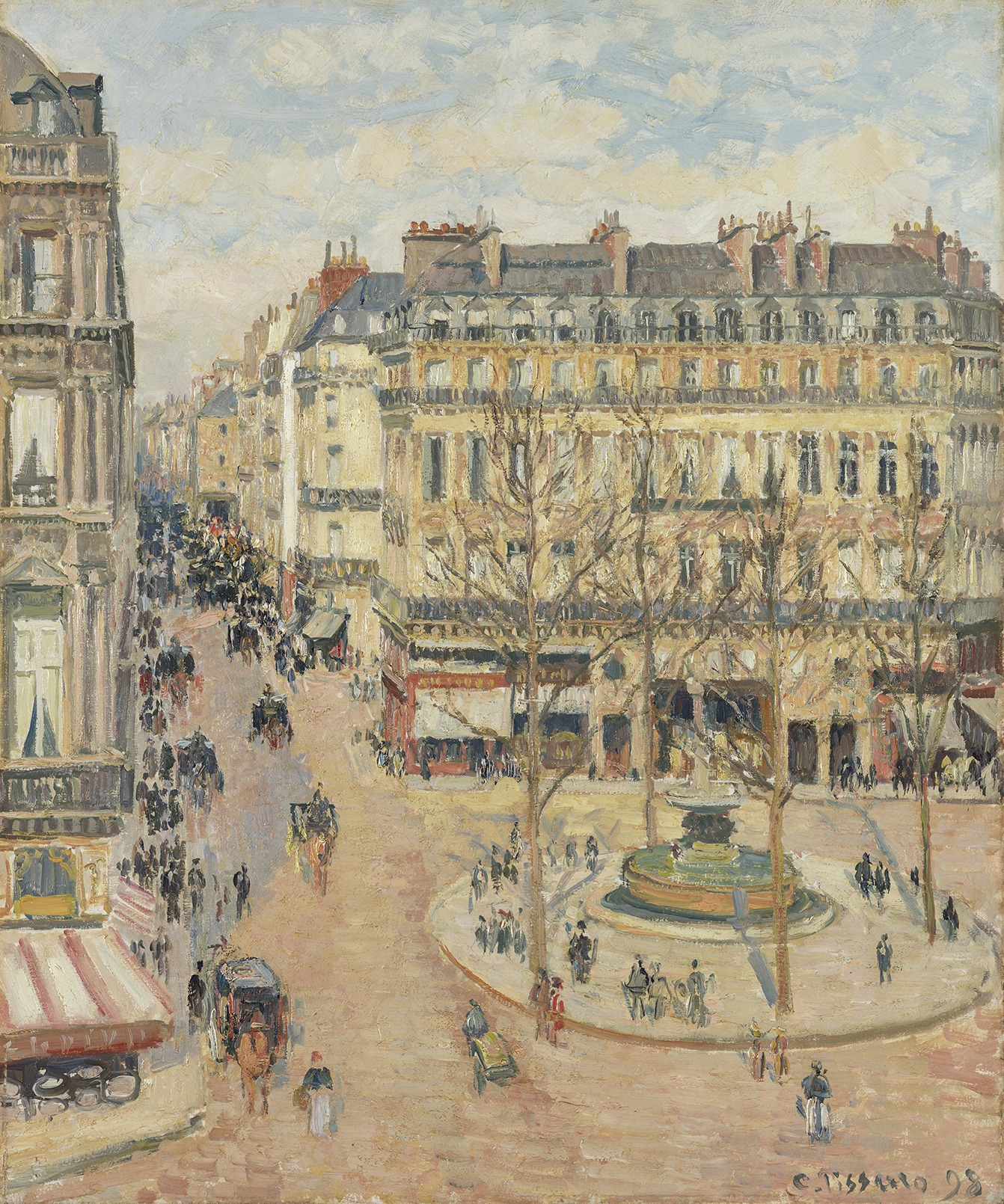
| Nelson-Atkins Museum of Art | Kansas City | Rue Saint-Honore, apres-midi, effet de soleil (1898, PDR 1199). | The frequently confused sibling to the Madrid picture; not under any claim. |
| Ordrupgaard | Copenhagen | Rue Saint-Honore, matin, effet de soleil (1898, PDR 1200). | The third of the same-corner group. |
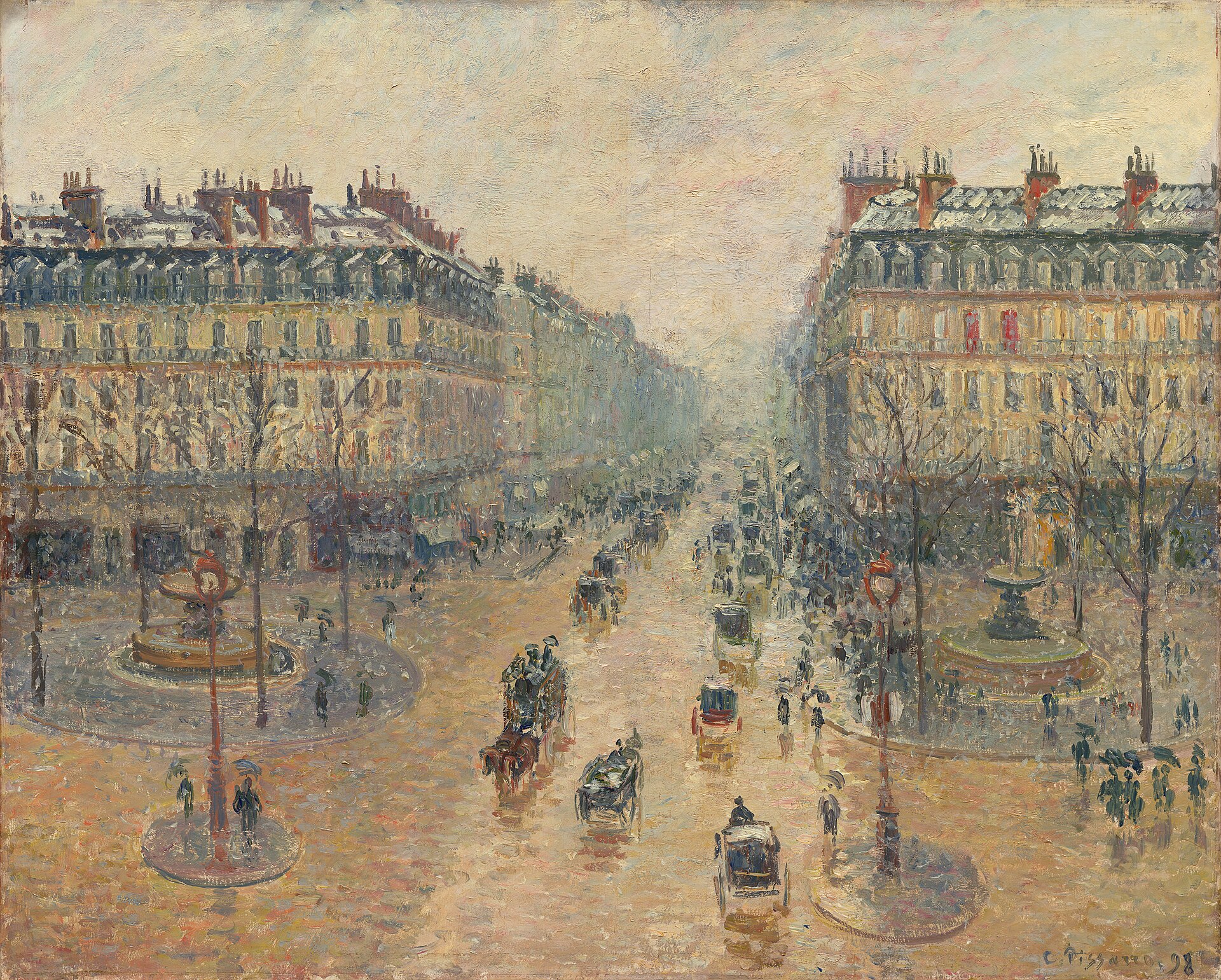
| Pushkin State Museum of Fine Arts | Moscow | Avenue de l'Opera, effet de neige, le matin, from the 1898 rue de Rivoli campaign. | |
| Tate | London | Self-portrait (1903), given by his son Lucien in 1931. | Painted months before his death. |
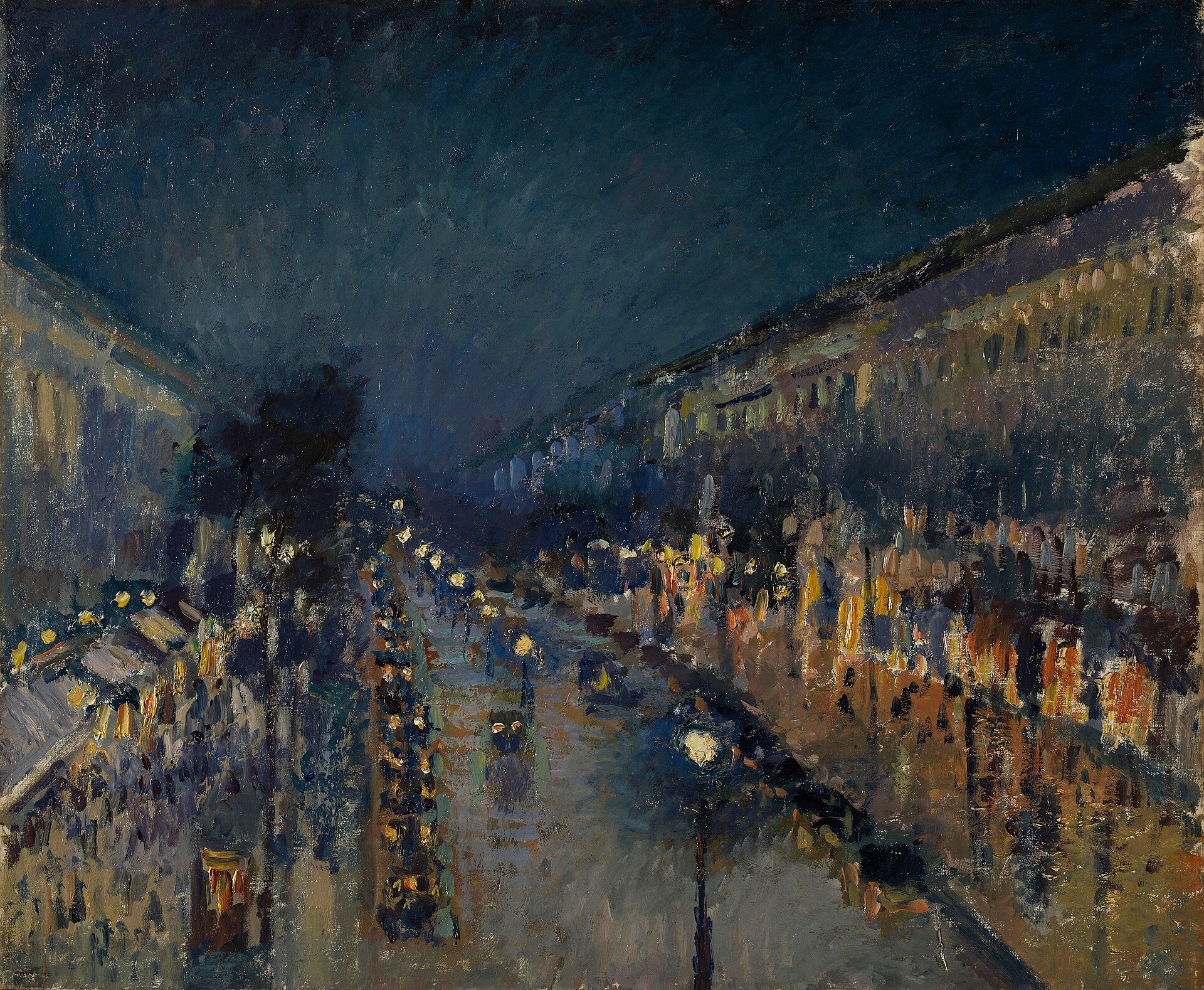
| National Gallery | London | Portrait of Cezanne (1874) and Boulevard Montmartre at Night (c. 1897). | |
| Musee d'Orsay | Paris | La Bergere Rentrant des Moutons (1886), on rotating loan under the Meyer/University of Oklahoma settlement. | Splits display time with the Fred Jones Jr. Museum of Art, University of Oklahoma, under a contested 2016-era settlement. |
| The Art Institute of Chicago | Chicago | The Place du Havre, Paris (1893), the first of the window series. | Potter Palmer Collection. |
Pissarro was born on 10 July 1830 at Charlotte Amalie on Saint Thomas, then a Danish colonial possession in the Caribbean.
Pissarro was born on 10 July 1830 at Charlotte Amalie on Saint Thomas, then a Danish colonial possession in the Caribbean. His father was of Portuguese Jewish descent and held French nationality; his mother came from a French Jewish family with roots in Provence. The local Jewish congregation objected to the marriage, because his mother had previously been married to his father's uncle, and it refused to recognise the union. As a result the four Pissarro children were barred from the island's Jewish school and sent instead to an all-Black primary school. He was an outsider before he had painted anything.
At twelve his father sent him to boarding school at the Savary Academy in Passy, near Paris. He returned to Saint Thomas to work in the family business, then left permanently for Paris in 1855 to become a painter, holding Danish nationality rather than French for most of his working life, which is why he did not serve in the Franco-Prussian War in 1870.
Everything that followed ran against the standard shape of a nineteenth-century French painter's career. He trained with Corot, who encouraged him toward the Salon. At the free studio of the Academie Suisse he met Claude Monet in February 1860 and, in the autumn of 1861, a provincial newcomer named Paul Cezanne. He was the only artist to show at all eight Impressionist exhibitions between 1874 and 1886, and by the 1880s and 1890s he was the figure through whom Cezanne, Gauguin, Seurat and Signac all passed in turn, each learning something different from him and each remembered by history for having done so.
In 1872 Pissarro settled at Pontoise, northwest of Paris, and gathered a small circle of painters around him, Armand Guillaumin among them and, most consequentially, Cezanne.
In 1872 Pissarro settled at Pontoise, northwest of Paris, and gathered a small circle of painters around him, Armand Guillaumin among them and, most consequentially, Cezanne. For roughly two years the two men painted side by side, mostly outdoors, and Pissarro demonstrated a method of working patiently and directly from the motif that changed Cezanne's entire approach; Cezanne had come from the darker, more agitated manner of his early Paris years and left Pontoise painting in short strokes of broken colour, disciplined by observation rather than temperament. Cezanne never disowned the debt. Writing to the dealer Ambroise Vollard in 1902, near the end of his own life, he said of Pissarro: 'he was a father to me, a man to consult and something like the good Lord.'
Gauguin arrived later, as a Sunday painter and stockbroker who bought Impressionist pictures before he made them. Pissarro took him in at Pontoise, introduced him to Degas and to Cezanne, and gave him the run of his studio; Gauguin's early Pissarro's Garden, Pontoise (1881) was painted while he was staying there. Gauguin, too, called him 'Father Pissarro,' and wrote in 1902, the same year as Cezanne's letter, that Pissarro 'was one of my masters and I do not deny him' - a notable admission from a painter who spent much of his later career disowning influences. Pissarro's own children were part of the same pattern: he ran a household that doubled as an informal school, and it is why his contemporaries nicknamed him Pere Pissarro and why later historians describe him as a father figure not only to the core Impressionists but to Cezanne, Seurat, Gauguin and van Gogh, the four major figures who followed.
The Franco-Prussian War of 1870-71 forced the family to England, to Norwood outside London; as a Danish national Pissarro was not conscripted, but he lost something no exemption could protect.
The Franco-Prussian War of 1870-71 forced the family to England, to Norwood outside London; as a Danish national Pissarro was not conscripted, but he lost something no exemption could protect. He returned to find that of roughly 1,500 paintings made over the previous twenty years and left behind in his house at Louveciennes, only about forty survived. Soldiers quartered in the property had used the canvases as floor mats to keep mud off their boots.
The scale of the loss changes how the surviving early work should be read. A Pissarro from before 1870 is not simply an early painting; it is one of roughly forty objects that answer for two decades of a working painter's development, the rest destroyed by an accident of occupation rather than by any critical judgment. It is also, incidentally, the reason his catalogue is comparatively thin before 1870 and dense after it - a gap that is not a gap in his output, only in what survived to be catalogued.
Pissarro's technique is diagnostic across three distinct phases, and mistaking one period's handling for another is a common source of misdated attributions in the trade.Through the 1860s his palette...
Pissarro's technique is diagnostic across three distinct phases, and mistaking one period's handling for another is a common source of misdated attributions in the trade.
Through the 1860s his palette is closer to Corot and the Barbizon painters he trained among: earth tones, tonal unity, a conventional build from dark ground to light. From the early 1870s, working alongside Monet, Sisley and Cezanne, he moves to the broken comma-stroke brushwork and unmixed, high-key colour that define classic Impressionism, applied wet-in-wet directly from the motif.
In 1885 he met Georges Seurat and Paul Signac and, for roughly five years, adopted their Divisionist method: small, distinct dots or dashes of pure colour set beside each other so the eye performs the mixing. He and Signac showed this work alongside Seurat's at the eighth and final Impressionist exhibition in 1886, which prompted the critic Felix Feneon to coin the term Neo-Impressionism for the group. Pissarro was, characteristically, the connecting figure again - the established Impressionist lending his authority to a movement two younger painters had invented.
He abandoned the method around 1890, concluding that its slow, systematic application of paint had become an obstacle to spontaneity and to fidelity to his own sensations in front of the motif - he wrote that it was impossible to remain true to his impressions while working that way. What follows after 1890 is neither a return to the 1870s manner nor a repudiation of what he learned from Seurat: broken, comma-like strokes reappear, but disciplined by a structural sense of colour relationships the pointillist years had taught him. The late window series, discussed below, are painted in this third manner.
The urban series that now dominate perceptions of Pissarro's late career were not a change of subject chosen for its own sake.
The urban series that now dominate perceptions of Pissarro's late career were not a change of subject chosen for its own sake. A recurrent eye infection made it painful and eventually impossible for him to work outdoors except in warm weather, and from 1893 his doctor's instruction was specific: keep the eye away from street wind and dust. Pissarro's response was to rent rooms with views and paint through the window glass. The first campaign was at the Hotel-Restaurant de Rome in the Saint-Lazare quarter of Paris in 1893; from it came The Place du Havre, Paris, now in the Art Institute of Chicago.
He kept working this way for the rest of his life. Between 1893 and 1903 he produced more than three hundred canvases of Paris, Rouen, Dieppe and Le Havre across eleven separate series, taken from a sequence of rented rooms, each series returning to a single view under changing weather, light and season. He credited Monet's Rouen Cathedral series, seen at Durand-Ruel's gallery in May 1895, with settling him on the method, and he urged his son Lucien to travel from London to see Monet's series hung together before it was broken up and sold as separate pictures. Durand-Ruel, who had struggled to sell Pissarro's rural subjects for years - contemporary critics dismissed him as a painter of cabbages and turnips - began buying the urban views in bulk, and they sold. A painter forced indoors by his own body ended his career as the most systematic recorder in paint of the modern French city, a reversal nobody planning a career would have chosen.
Pissarro's anarchism is not an inference from his subject matter.
Pissarro's anarchism is not an inference from his subject matter. It is documented in his own hand, over more than a decade of weekly letters to his son Lucien, published in full by John Rewald.
Writing from Paris on 13 April 1891, in the middle of a letter about dealers, prices and the state of the market, Pissarro sets out the connection between his politics and his painting directly: 'I firmly believe that something of our ideas, born as they are of the anarchist philosophy, passes into our works, which are thus antipathetic to the current trend.' A year later, on 26 April 1892, writing from Eragny, he reports that someone had sent him an unsolicited copy of a book by Kropotkin, which he forwarded to Lucien along with a copy of the anarchist paper La Revolte, noting in the same letter that the paper's editor Jean Grave and the anarchist Emile Pouget had just been arrested in a general police sweep, and that 'it is easy to see that a real revolution is about to break out - it threatens on every side.'
The associations were not casual. Pissarro was a regular subscriber to Grave's papers, first Le Revolte and then, from 1895, Les Temps Nouveaux, which he supported financially and to which he contributed at least three lithographs; his correspondence records him repeatedly paying off the papers' debts and, in 1900, giving fifty francs to a campaign in support of Spanish refugees. He knew the geographer and anarchist theorist Elisee Reclus, and in the autumn of 1894, after the assassination of President Sadi Carnot by the Italian anarchist Sante Geronimo Caserio triggered a round of anti-anarchist repression in France, Pissarro judged it prudent to take his family across the border to Belgium. In 1899 he joined the short-lived Club de l'art social alongside Grave, Rodin, Emile Pouget and Louise Michel, formed to discuss what an anarchist role for artists might look like.
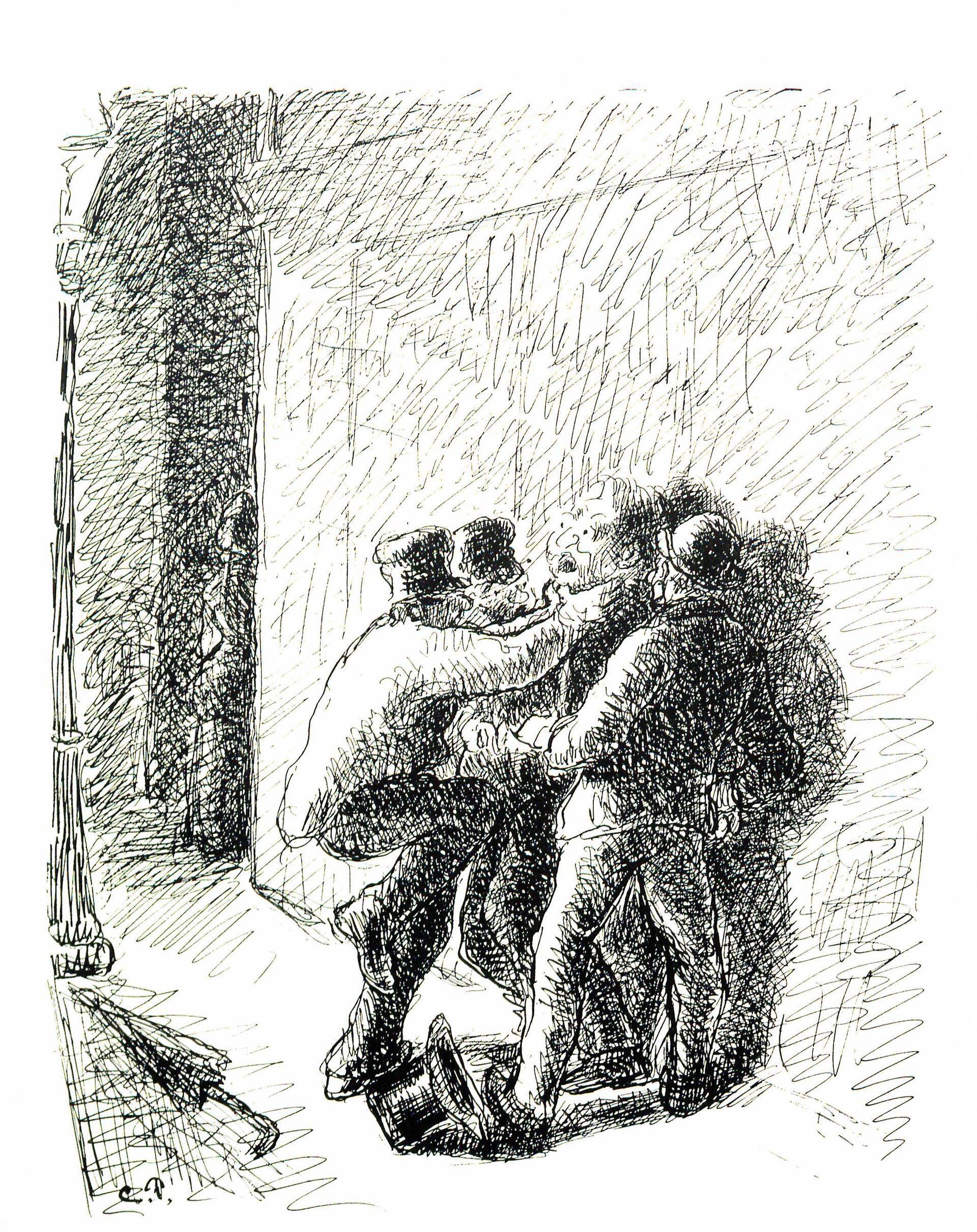
In 1889 he made the clearest statement of it in a work of art: an album of thirty drawings titled Turpitudes sociales, made as a gift for his niece Esther Isaacson to fix her own anarchist sympathies, using caricature and allegory to attack money, the stock exchange, capital, organised religion and wage labour, and closing on images of hope built around the barricade. It is a documented, dated, purpose-built political object, not a private hobby kept separate from the exhibited paintings - his own words to Lucien insist the ideas run through those too.
Pissarro followed the Dreyfus case as it broke.
Pissarro followed the Dreyfus case as it broke. On 14 November 1897 he wrote to Lucien enclosing newspapers on the case and noting that 'honorable people in high positions' were asserting Alfred Dreyfus's innocence; by 22 November he cited Bernard Lazare's new pamphlet as proof that the document used to convict Dreyfus was a forgery. In January 1898 he asked to have his name added to the Manifesto of the Intellectuals in Dreyfus's defence, and around 5 March 1898 he agreed to sit on a committee organised to honour Emile Zola for 'J'Accuse,' Zola's open letter of 13 January 1898 accusing the French general staff of covering up the case. Writing to a relative, Esther, on 13 January 1898, the day Zola's letter appeared, he recorded hearing his old Impressionist colleague Armand Guillaumin say that 'if Dreyfus had been shot at once, people would have been spared all this commotion,' adding drily that 'he is not the only one of this opinion.'
The affair fractured friendships that had survived two decades of shared exhibitions. Degas, by his own family's account, became fervently anti-Dreyfusard and stopped acknowledging Pissarro in the street; he did not attend Pissarro's funeral in 1903. Renoir had already, in a letter of 1882, objected to exhibiting alongside 'the Israelite Pissarro,' and during the affair he declined to sign the pro-Dreyfus petitions and disparaged Zola. Monet, by contrast, signed the manifesto immediately and remained cordial. None of this is reconstructed from atmosphere: it is what the painters themselves wrote and did, and it shows that Pissarro's Jewishness, largely unremarked earlier in his career, became a fault line inside the Impressionist circle at exactly the moment - the winter of 1897-98 - that he was painting the Rue Saint-Honore series discussed below.
Rue Saint-Honore in the Afternoon. Effect of Rain, oil on canvas, 81 by 65 centimetres, PDR 1196 in the 2005 catalogue raisonne, is a full object record of its own in this archive; the entry that...
Rue Saint-Honore in the Afternoon. Effect of Rain, oil on canvas, 81 by 65 centimetres, PDR 1196 in the 2005 catalogue raisonne, is a full object record of its own in this archive; the entry that follows is a summary written to stand on this page and should not be read as a substitute for it. Pissarro painted it from a rented room at the Grand Hotel du Louvre between 4 and 22 December 1897, in the weeks immediately after the death of his fifth child, Felix, at twenty-three; on 15 December, in the middle of that fortnight, he wrote to Lucien that they should work in order to heal their wounds. It shows the junction of the rue Saint-Honore and the place du Theatre-Francais in the rain. It is one of at least three paintings sharing variants of the same title from the same corner and the same winter - a version-safety problem this archive treats in full on the object record - and the catalogue number, not the title, is what tells them apart.
By 1939 it belonged to Lilly Cassirer Neubauer, a member of one of Berlin's most important Jewish collecting and dealing families. That year, needing to leave Germany, she was compelled by the Munich dealer and Nazi party member Jakob Scheidwimmer to transfer the painting to him for 900 Reichsmarks - about 350 dollars - paid into a blocked account she could not access, as the price of an exit visa. The holding institution's own published chronology describes this as a sale below market value made to obtain a visa and avoid a concentration camp; this record does not use either side's preferred adjective, and states plainly that it was a transfer compelled by a state that had made her survival conditional on it. The painting passed from Scheidwimmer to a further owner, Julius Sulzbacher, from whom the Gestapo then seized it outright - a fact that appears in the holding museum's own account of the chain, which is worth noting because it is the institution resisting the claim that publishes it. It was sold at a Berlin auction in 1943 and then disappears from the record for eight years, resurfacing at a Beverly Hills gallery in 1951.
The painting passed through two more American private owners before Baron Hans Heinrich Thyssen-Bornemisza bought it in 1976.
The painting passed through two more American private owners before Baron Hans Heinrich Thyssen-Bornemisza bought it in 1976. In 1993 the Spanish state purchased the Baron's entire collection, this painting among 775 works, and installed it in the newly opened Museo Nacional Thyssen-Bornemisza in Madrid, where it remains today, in room 33. Lilly Cassirer Neubauer had separately settled a claim against the German state in 1958, accepting 120,000 Deutschmarks as the picture's assessed 1956 value at a time when nobody could locate it; that settlement compensated her for a lost object and has not been treated by any court as a waiver of a claim to the object itself, should it resurface.
It resurfaced. Her grandson Claude Cassirer sued the foundation in California in 2005, under the Foreign Sovereign Immunities Act, and after his death in 2010 his children continued the action. What followed is twenty-one years, at the date of writing, of litigation almost entirely about which country's law applies rather than about what happened in Berlin in 1939 - a fact no party to the case disputes. Every court that has reached the merits has held for the foundation on the ground that Spanish law governs and that Spanish law lets a good-faith possessor acquire title by long prescription. The Supreme Court of the United States intervened on the choice-of-law question itself, unanimously, on 21 April 2022, holding only that a court hearing a Foreign Sovereign Immunities Act claim must use the same choice-of-law rule it would use against a private party - a ruling about method, not about ownership.
On remand the Ninth Circuit applied that method and again found for the foundation, in January 2024. Nine months later, on 16 September 2024, the Governor of California signed Assembly Bill 2867, a statute stating that a thief cannot convey good title, rejecting good-faith acquisition and adverse possession as defences to a claim for art lost through Nazi-era persecution, and applying retroactively to pending cases. On 10 March 2025 the Supreme Court granted certiorari a second time, vacated the Ninth Circuit's January 2024 judgment, and sent the case back so the new statute could be applied. It is now before the United States District Court for the Central District of California; on 17 November 2025 the Attorney General of California moved to intervene in defence of the statute's constitutionality. No judgment currently stands on who owns the painting.
Two further Pissarro paintings carry documented Nazi-era restitution histories independent of the Cassirer case, and taken together the three show how differently the same category of claim can...
Two further Pissarro paintings carry documented Nazi-era restitution histories independent of the Cassirer case, and taken together the three show how differently the same category of claim can resolve.
Le Boulevard Montmartre, Matinee de Printemps (1897) belonged to the Breslau industrialist and collector Max Silberberg, who was forced to consign it and the bulk of his collection to sale at the Paul Graupe auction house in Berlin on 23 March 1935, after his company was Aryanised and his home taken by the SS; Silberberg and his wife were murdered at Auschwitz in 1942. The painting reached the Israel Museum in Jerusalem as a gift in 1997; in 2000 the museum transferred title to Silberberg's daughter-in-law and sole heir, Gerta Silberberg, who in turn lent it back to the museum for the rest of her life. Sotheby's sold it in London on 5 February 2014 for a premium-inclusive total of 19,682,500 pounds, roughly double its estimate and a record for the artist at the time; the hammer price alone is not published in the sources consulted, and the buyer was not named.
La Cueillette des pois (Pea Harvest, c. 1887), a gouache, was one of ninety-three Impressionist paintings in the Paris collection of the Jewish dealer Simon Bauer, thirteen of them by Pissarro, seized under Vichy anti-Jewish measures after Bauer was deported to the Drancy transit camp. A French court declared the forced sales of his collection null and void as early as November 1945, but this particular work stayed missing; Bauer's grandson Jean-Jacques continued the search after his grandfather's death in 1947. It surfaced on loan to the Marmottan Monet museum in Paris in May 2017, on loan there from the American collectors Bruce and Robbi Toll, who had bought it at Christie's in New York in 1995 for 800,000 dollars in what they maintained was full good faith. The Paris High Court ordered its return to the Bauer heirs on 7 November 2017; the ruling was upheld on appeal, the French High Court holding, in terms that go beyond the facts of this one case, that anyone in possession of stolen art must return it unconditionally regardless of the possessor's good faith.
A third case, La Bergere Rentrant des Moutons (Shepherdess Bringing in Sheep, 1886), stolen from the Meyer family's bank storage in occupied France in 1941, took a different route entirely: recovered by a good-faith American buyer, donated to the University of Oklahoma's Fred Jones Jr. Museum of Art in 2000, identified by the Holocaust survivor Leone Meyer in 2012, and resolved not by a court ruling on the merits but by a negotiated settlement splitting the painting's display between Oklahoma and a French museum. Meyer tried to overturn that settlement in French courts; on 14 May 2021 a French court rejected her attempt, ruled that an Oklahoma district court, not a French one, holds jurisdiction over the settlement contract, and held her liable for contractual penalties that had by then reached 3.65 million dollars. Unlike the Bauer case, good faith was never overridden here - it was priced into a settlement instead. This record has not traced the dispute past that date.
Three paintings by the same artist, three different legal machineries, three different outcomes: outright court-ordered return with good faith held irrelevant; a private settlement that a court later declined to unwind; and a live, unresolved federal case built entirely on which country's law applies. A diligence file that assumes Nazi-era restitution resolves in one predictable shape has not looked at this artist's own market.
The standard reference is the critical catalogue compiled by Joachim Pissarro and Claire Durand-Ruel Snollaerts, published by Skira in association with the Wildenstein Institute in 2005-2006: three...
The standard reference is the critical catalogue compiled by Joachim Pissarro and Claire Durand-Ruel Snollaerts, published by Skira in association with the Wildenstein Institute in 2005-2006: three volumes, 1,529 paintings, expanding the 213 works and a number of newly discovered documents onto the first catalogue raisonne, the two-volume Camille Pissarro, son art, son oeuvre compiled over twenty years by the artist's own son Ludovic-Rodo Pissarro with the art historian Lionello Venturi and published by Paul Rosenberg in Paris in 1939. Every painting accepted in 1939 was retained in the 2005 edition.
The Wildenstein Institute, which co-published the 2005 catalogue, transferred its full archive and publication rights in 2017 to the Wildenstein Plattner Institute (WPI), a New York non-profit established the previous year, which now hosts committees reviewing works proposed for addition to the catalogue and is developing a digital edition. Stern Pissarro Gallery, run today by the artist's great-granddaughter Lelia Pissarro, directs enquiries about Camille Pissarro's own paintings, gouaches and pastels to the WPI, and enquiries about his watercolours and drawings to Dr. Joachim Pissarro, co-author of the 2005 catalogue; the gallery's own authentication service is reserved for the artist's descendants Paulemile, Georges Henri Manzana and Ludovic-Rodo Pissarro, and does not extend to Camille Pissarro himself.
This record has not been able to verify, to its own citation standard, a single individually documented case of a forged Camille Pissarro painting exposed by name, date and named investigating body - which is itself worth stating rather than passing over. Readers researching this artist should note one specific trap: the 2011 BBC television dispute over Bords de la Seine a Argenteuil, in which the Wildenstein Institute rejected a painting owned by the British collector David Joel and a French court upheld the rejection in December 2015, is consistently mis-filed online as a Pissarro case. It is not. The painting was presented and disputed as a work of Claude Monet; Wikipedia's own article on it identifies the artist only as 'unknown' because of the dispute. This record corrects the conflation rather than repeating it.
Painter; Printmaker. 1830-1903.
Born 10 July 1830, Charlotte Amalie, Saint Thomas, Danish West Indies; died 13 November 1903, Paris.
No individually documented Camille Pissarro forgery case. This record has not been able to verify, to its own citation standard, a single case of a forged Camille Pissarro painting exposed by name, date and a named investigating body. A general 2023 Italian police raid on forgery workshops near Rome recovered fake works attributed to Picasso, Rembrandt, Jean Cocteau and others including Paul-Emile Pissarro - the artist's son and a distinct painter - but the sources consulted do not name a Camille Pissarro forgery among the works seized.
Museo Nacional Thyssen-Bornemisza (Madrid); Nelson-Atkins Museum of Art (Kansas City); Ordrupgaard (Copenhagen); Pushkin State Museum of Fine Arts (Moscow); Tate (London); National Gallery (London).
Pissarro's late urban series set his enduring commercial profile: Durand-Ruel could not sell his rural subjects through most of the 1880s, and began buying the Paris and Rouen views in bulk once the eye condition forced the change of subject in the 1890s. The market since has been shaped as much by restitution as by connoisseurship - two of the small number of individually documented high prices for his work belong to paintings that changed hands as the direct result of a Nazi-era claim being resolved, one of them setting his auction record in the same sale.
Who owns Rue Saint-Honore in the Afternoon. Effect of Rain? No court judgment currently stands on the merits: the case is pending before the United States District Court for the Central District of California following the Supreme Court's second vacatur of 10 March 2025.
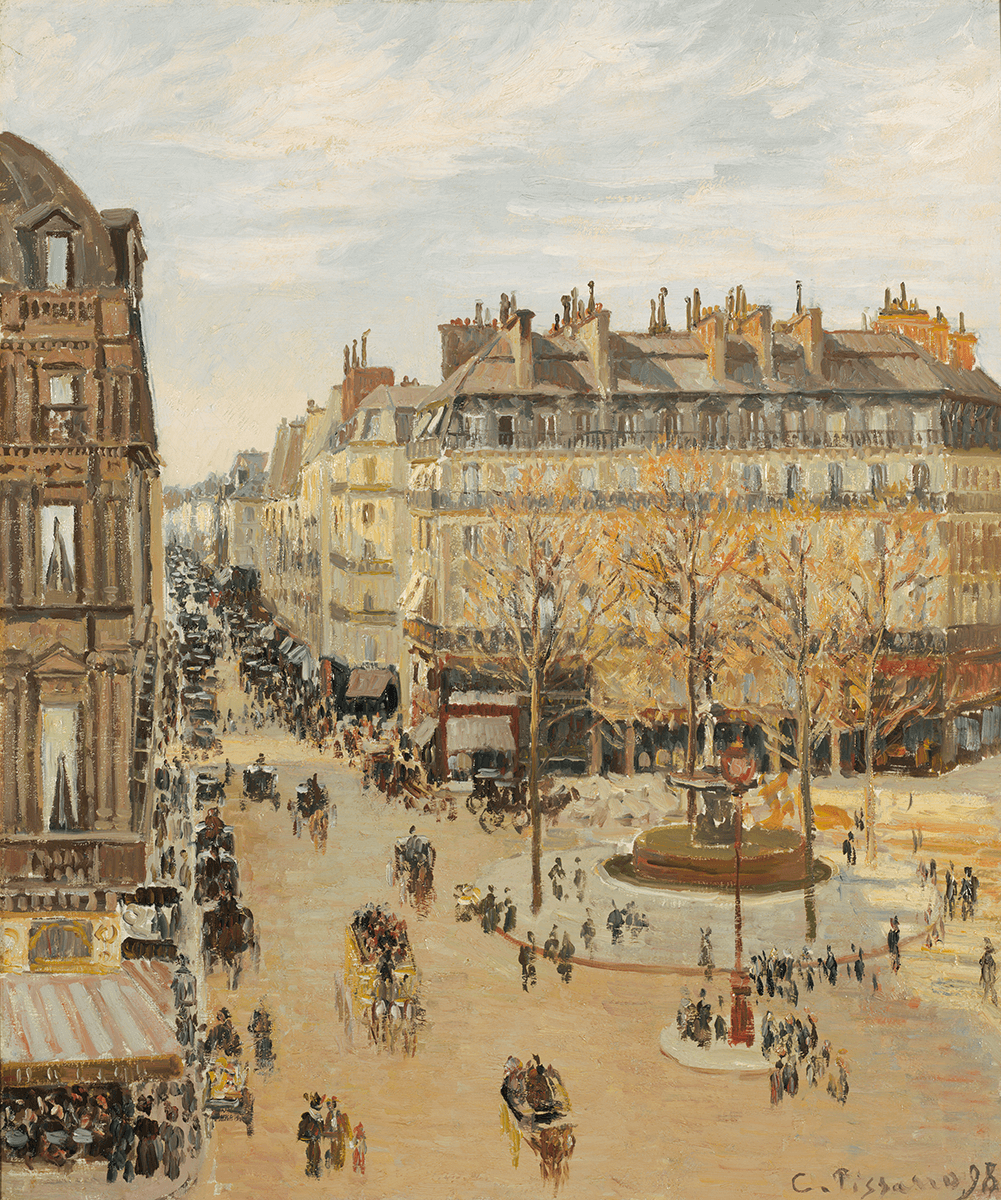 Shown: Rue Saint-Honore in the Afternoon. Effect of Rain, Camille Pissarro
On 3 April 2026 a New York court decided a Nazi-era laches defence on the facts.
8 min read
A restitution is itself an undocumented transfer. This archive holds an object delivered to a family that had never owned it, a...
12 min read
Documentation in a provenance chain rises from 63 per cent at the earliest links to 96 per cent at the most recent.
10 min read
Twelve records here sit in a museum that carries a collector's name. In none of them is the museum the owner.
11 min read
Last verified 17 September 2026
One artwork and its story every Tuesday, with the picture: who owned it, what it made, and what closes soon in the exhibition calendar. No promotion, and nothing we cannot cite.
We send one email to confirm the address and keep nothing else. Every letter carries a one-click unsubscribe. How we handle your data.