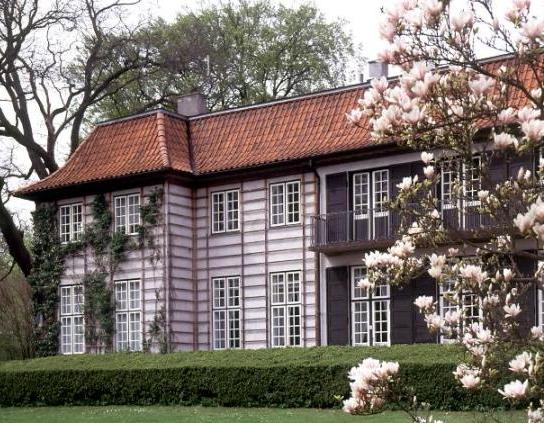
The 1918 Tvede-designed villa seen from across the surrounding park, the building at the centre of the estate Wilhelm and Henny Hansen built to house their collection.
Photograph by Nafred, released into the public domainOn this page 16 sections
ContentsClose
Ordrupgaard's strength is the pairing it was built around: French nineteenth-century painting, from Delacroix and the Barbizon School through Realism, Manet and Impressionism proper into Gauguin, shown in the same rooms as Denmark's own Golden Age and its successors through Hammershoi. The 1923 sale of roughly half the French holdings to the Ny Carlsberg Foundation means the collection now at Ordrupgaard is smaller than what Wilhelm Hansen originally assembled, but what remains, together with what he bought back between 1923 and 1933, still runs from the movement's Barbizon roots to Gauguin's late voyages. Two twenty-first-century extensions, by Zaha Hadid and then Snohetta, were built specifically to let the museum show more of this material at once, and Finn Juhl's own house extends the same collecting interest into Danish mid-century design.
| Kind | Museum |
|---|---|
| Founded | 1918 |
| City and country |  Charlottenlund, Denmark Charlottenlund, Denmark |
| Address | Vilvordevej 110, 2920 Charlottenlund, Denmark |
| Website | museumordrupgaard.dk/en |
| Status | Open, confirmed |
| Record last verified |
Visiting
- Hours
- Tue-Sun11:00 to 17:00Exhibitions and shop
- Wed11:00 to 19:00Extended Wednesday hours for exhibitions and shop; free entry 16:00-19:00 for students and under-27s
- Sat-Sun and holidays11:00 to 17:00Finn Juhl's House, walk-in
- Tue-Frivaries to variesFinn Juhl's House: guided tour only, at set time slots, booking required
- Daily08:00 to 18:00The Art Park; dogs on a leash permitted
- Closed
- Monday.
- Admission
- Adult (26 and over)DKK 140Ticket is non-refundable and valid one year from purchase; covers the permanent collection and current special exhibition
- Student / under 26DKK 95Non-refundable
- Children / under 18FreeFree
- Groups, minimum 10 peopleDKK 130Per person; tickets for the whole group must be bought together, non-refundable
- Finn Juhl's House add-onDKK 75Requires a museum entrance ticket first; valid only for the booked time slot, non-refundable; free for annual-pass members visiting on weekends
Free entry: Wednesdays 16:00-19:00: free entry for students and everyone under 27- Tickets
- billet.ordrupgaard.dk The museum's own ticket page.
- Do I need to book?
- Not for the museum itself; Finn Juhl's House needs a booked time slot and, Tuesday to Friday, is accessible only on a guided tour
- Address
- Vilvordevej 110, 2920 Charlottenlund, Denmark MapS-train Line C to Klampenborg St. or Lyngby St., then bus 388 to the Vilvordevej stop, about 2 minutes' walk from the museum; or alight at Ordrup St., about a 15-minute walk
Bus Bus 388 stops at Vilvordevej, 2 minutes' walk from the museum, roughly twice an hour, serving both Klampenborg and Lyngby stations; buses 169, 179 and 185 stop at Femvejen, about 10 minutes' walk away
Bicycle Bicycles travel free on the S-train to Klampenborg St. or Ordrup St.
Car Free on-site parking with electric-vehicle chargers at Vilvordevej 110 - Website
- museumordrupgaard.dk/en
- Telephone
- +45 39 64 11 83
- [email protected]
Before you go how long, access, photography, bags, eating, shop
- How long to allow
- Two to three hours for the villa, the Hadid and Snohetta galleries and the park; add another hour for a timed visit to Finn Juhl's House
- Access
- Wheelchair access through the main entrance, accessible toilets in the foyer, a small number of wheelchairs and walkers available first-come first-served, designated accessible parking with a courtyard drop-off point, free entry for a support companion with a Companion Card, service dogs welcome, and staff trained in the Sunflower Lanyard scheme for hidden disabilities
- Photography
- Not stated on the museum's own visiting pages consulted for this record
- Bags
- A cloakroom with a limited number of lockers and hangers is provided; food and drink are not permitted in the exhibition galleries, and packed lunches are restricted to the Art Park
- Eating
- Cafe Mondrup, open the same days as the exhibitions, with an extended Wednesday evening kitchen
- Shop
- Museum shop, open the same hours as the exhibitions
Prices and hours change. We take them from the institution's own pages and print the day we read them, and you can check the current position at the source we used. Confirm before you travel.
What is inside
The Tvede villa: the Danish and French galleries
The original three-winged neo-classical mansion, designed for Wilhelm and Henny Hansen by the Danish architect Gotfred Tvede and completed in 1918. A small conservatory links the family's living quarters to a purpose-built three-room picture gallery that Hansen had constructed specifically to hang his French paintings, and the same building carries the core of the Danish Golden Age holdings assembled alongside them.
Photograph by Boberger · CC BY-SA 4.0 The Zaha Hadid extension
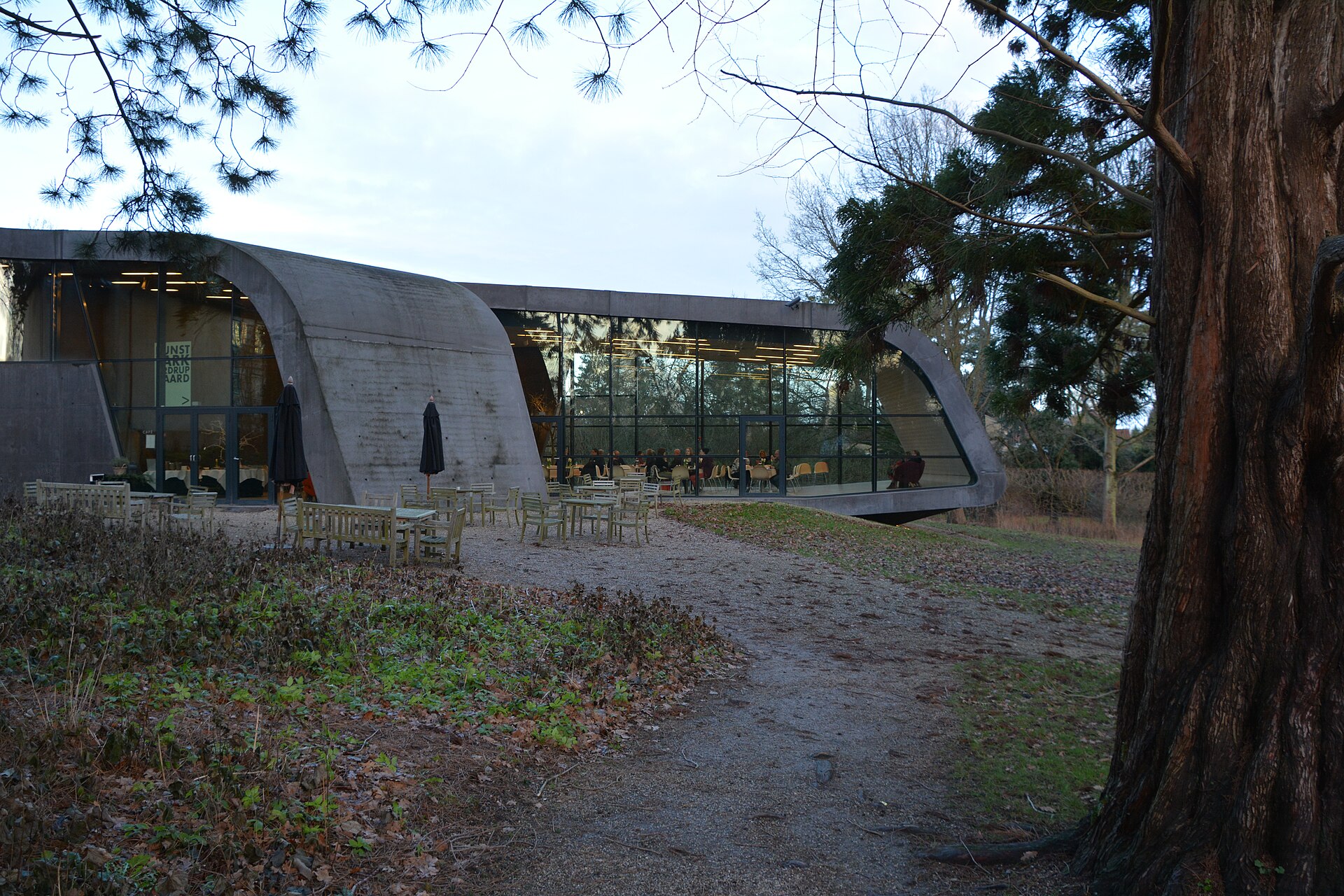
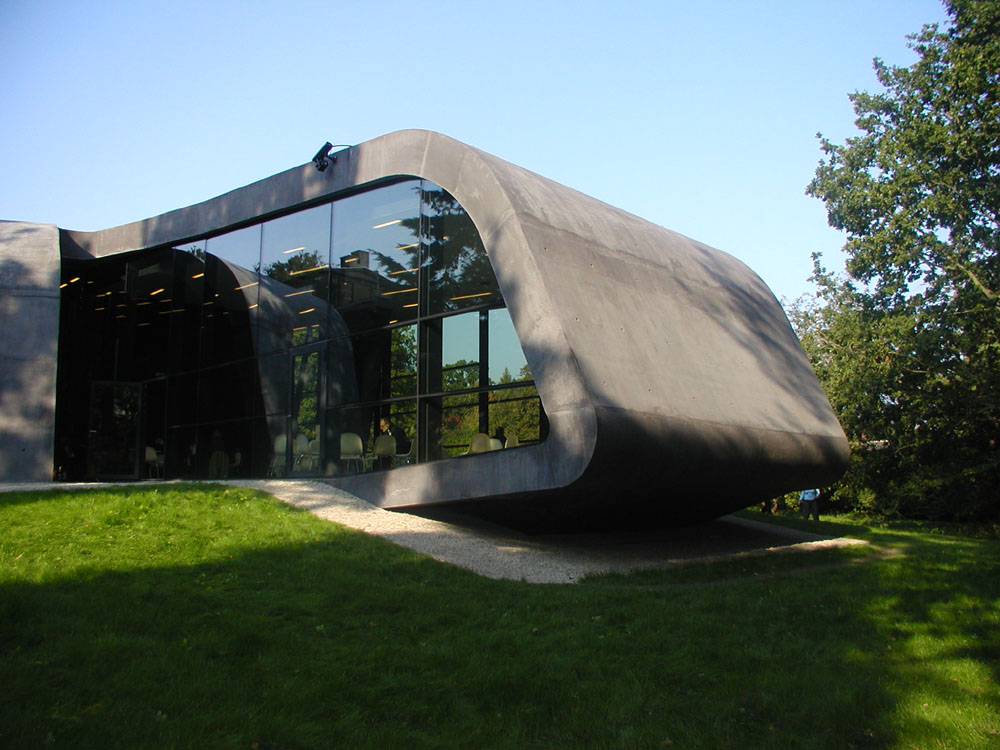
A 1,150 square-metre wing inaugurated on 30 August 2005, Zaha Hadid's first completed building in northern Europe. Black lava-concrete walls set against glazed sections that reflect the surrounding park give the extension its rounded, wing-like profile, added chiefly to give the museum proper exhibition, climate-control and security capacity that the 1918 villa was never built for.
The Snohetta extension
A largely underground wing by the Norwegian firm Snohetta, opened 13 August 2021. Only a sculptural stainless-steel form on the forecourt marks it from outside. Five new gallery rooms continue below ground: two extend the run of spaces begun in the Hadid wing, and three are given over to the French Impressionist collection, with the surrounding protected parkland cut into as little as possible during construction.
Photograph by John Lord from Edinburgh, Scotland · CC BY 2.0 Finn Juhl's House
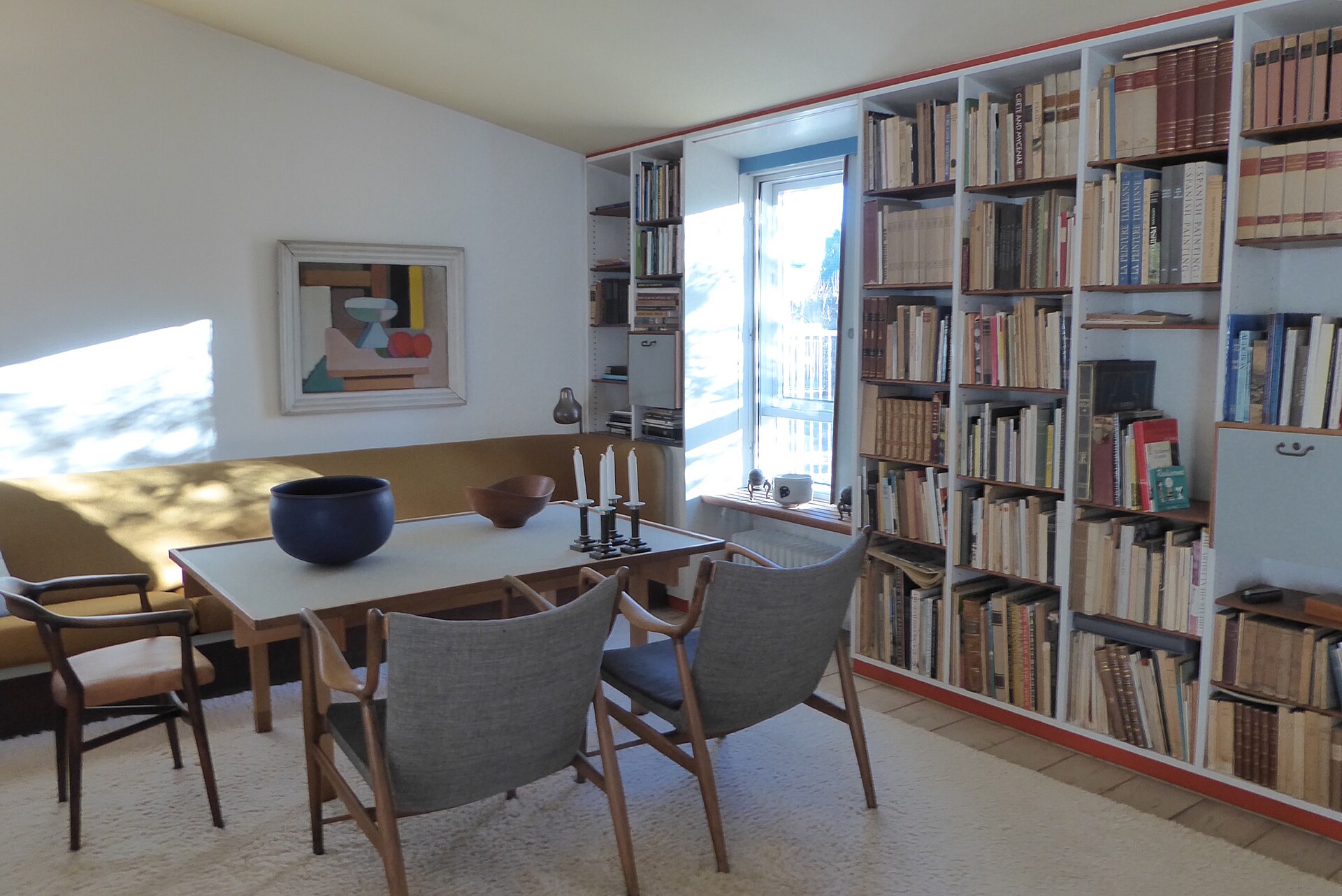
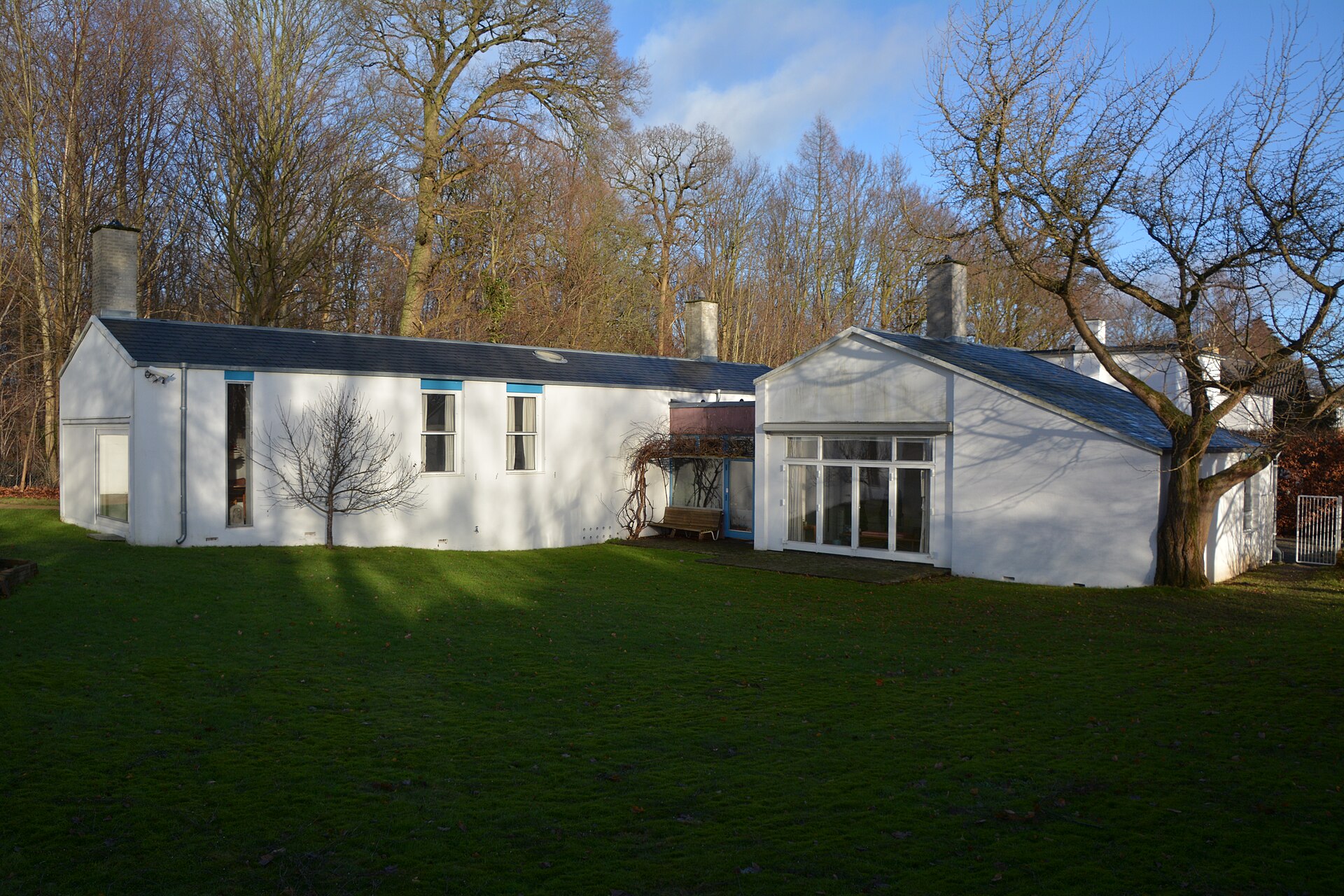
The furniture designer and architect Finn Juhl's own home, which he designed and built for himself in 1941-1942 on a plot next to the Ordrupgaard grounds and lived in until his death in 1989. A donation from Birgit Lyngbye Pedersen opened the house to the public on 3 April 2008 as a satellite of the museum, furnished throughout with Juhl's own pieces rather than a later reconstruction.
The Art Park and rose garden
An English-style park around the villa, open daily, that once did double duty as the family's kitchen and flower garden, with fruit trees, ponds and a lake carrying a small island and a rowing boat. Its French-inspired rose garden held a monumental ceramic fountain by Jean Gauguin, since moved indoors for conservation and no longer functioning as a fountain.
What to see first
Young Girl on the Grass (Mademoiselle Isabelle Lambert)
Berthe Morisot, 1885One of the works singled out when Ordrupgaard's French holdings travelled to the Royal Academy, and a reminder that Wilhelm Hansen's collecting of Impressionism was not limited to its most famous men7
Waterloo Bridge, Overcast
Claude Monet, 1903Part of Monet's London series and one of the later, more atmospheric works Hansen added to a collection that otherwise leans toward the movement's earlier decades7
The Ruse, Roe Deer Hunting Episode (Franche-Comte)
Gustave Courbet, 1866Represents the Realist hunting scenes Hansen bought to set alongside Impressionism proper, tracing the French nineteenth century back past the movement that made his collection famous7
Portrait of a Young Girl, Vaite (Jeanne) Goupil
Paul Gauguin, 1896One of eight Gauguin canvases at Ordrupgaard spanning nearly the artist's whole career and his voyages, described by a contemporary French critic as making the collection one of the richest outside France7
Danish Golden Age paintings by Christoffer Wilhelm Eckersberg and Christen Kobke
Eckersberg and Kobke, early to mid nineteenth centuryHung in the same villa as the French pictures on purpose, so a visitor can set Denmark's own Golden Age directly beside its French contemporaries rather than reading about the comparison secondhand5
Interiors by Vilhelm Hammershoi
Vilhelm Hammershoi, turn of the twentieth centuryExtends the Danish holdings a generation past the Golden Age into the quiet, sparsely furnished interiors that later built Hammershoi's international reputation5
Ceramic fountain sculpture
Jean GauguinThe rose garden's own large-scale sculpture, made by the son of Paul Gauguin, now kept indoors for conservation rather than left to run as a working fountain5
Finn Juhl's own furniture and fittings, in situ
Finn Juhl, 1942 onwardNot a period room built after the fact: it is the designer's actual house, furnished with pieces he lived with from 1942 until his death in 19895
Exhibitions on now
- On now23 Oct to 13 Dec 2026Confirmed , 6 weeks ago
- Opening soon3 Feb to 23 May 2027Confirmed , 6 weeks ago
Past exhibitions here
A villa built to hold a collection
Ordrupgaard began as a private house built to show art rather than simply to live in. The insurance executive Wilhelm Hansen and his wife Henny Nathalie Soelberg Jensen commissioned the Danish architect Gotfred Tvede to design a three-winged neo-classical mansion on farmland at Charlottenlund, north of Copenhagen, completed in 1918. Tvede's design already anticipated what the house would be used for: a small conservatory connects the family's own rooms to a purpose-built three-room gallery, constructed specifically to hang Hansen's French paintings rather than adapted from an existing space afterward. At the house's inauguration on 14 September 1918, Hansen stated his intention that the collection would eventually pass to the Danish state, a promise made decades before either he or Henny died.
The couple opened their doors to the public one day a week from 1918, well before Ordrupgaard became a state institution in the legal sense. That gap between a private house that already behaved like a museum and the formal museum that followed is part of what makes Ordrupgaard's early history distinct from institutions built from the outset as public galleries: the building, the hang and the collecting habit all came from one family's own taste, and the museum inherited that arrangement rather than designing one from scratch.
An insurance fortune and a Paris habit
Hansen made his money in insurance, founding the Danish companies Dansk Folkeforsikringsanstalt and Mundus and running the insurer Hafnia as managing director from 1905 until his death in 1936. His interest in French art grew out of frequent business trips to Paris, where he spent whatever spare time he had in galleries and museums rather than at the negotiating table. He became fixed on the Barbizon School and then the Impressionists, buying his first Impressionist works in 1916 and continuing to acquire French paintings, pastels and sculpture through 1933. The French critic Theodore Duret advised him on a number of these purchases.
By 1918, contemporary opinion already rated Hansen's French holdings among the most significant collections of nineteenth-century French art assembled outside France itself, and a later French critic went further, calling it one of the richest and most complete such collections anywhere beyond French borders. The collection was never built as a survey for its own sake: it moves from Delacroix and Romanticism through the Barbizon School and Realism, into Manet, then into Impressionism proper with Monet, Renoir, Pissarro, Sisley and Degas, and on into Gauguin and early Symbolism, so that a visitor walking the French rooms in order effectively walks the sequence of movements that produced Impressionism and what came after it.
The 1923 crash and what it cost the collection
The 1922 collapse of Landmandsbanken, then Denmark's largest bank, put Hansen under serious financial pressure, and by 1923 he had sold roughly half of his French collection, on the order of 80-odd works, to cover his losses. A number of the paintings sold, including pieces by Cezanne, Manet and Gauguin, were bought by the Ny Carlsberg Foundation and remain today at the Ny Carlsberg Glyptotek in Copenhagen rather than at Ordrupgaard. Hansen did not stop collecting after the sale: between 1923 and 1933 he bought again, specifically French, rebuilding a version of the collection the crash had gutted, and the roughly 150 nineteenth and early twentieth-century French works that remained in the family's hands at his death in 1936 are the core of what the museum shows today.
Henny Hansen outlived her husband by fifteen years. On her death in 1951 she left the house, the park and the collection to the Danish state, and the property opened to the public as a state museum in 1953. The 1923 sale is not a footnote to be skipped: it is the reason the collection now at Ordrupgaard and the related pictures now at the Glyptotek have to be read as two halves of a single collecting project, split by a banking crisis rather than by curatorial choice, and a full accounting of exactly which paintings crossed which way is not laid out in one place on the museum's own site.
Denmark's own Golden Age hung beside its French counterpart
Ordrupgaard's Danish holdings were assembled on the same collecting trip as the French pictures, not as an afterthought bolted on to make the museum feel more national. The Danish Golden Age, roughly the first half of the nineteenth century, is represented through Christoffer Wilhelm Eckersberg and his pupil Christen Kobke, alongside Johan Thomas Lundbye, and the collection continues into the later Fynbo painters and into Vilhelm Hammershoi and L.A. Ring, whose careers run into the twentieth century. Housing the Danish and French pictures under one roof lets a visitor set Eckersberg's clarity and Kobke's close, unshowy observation directly against their French contemporaries, an argument about shared taste across two national schools that the building itself makes simply by the order in which its rooms are hung.
The decorative arts sit alongside the paintings rather than in a separate department: ceramics, chandeliers and furniture by the Danish designer Thorvald Bindesboll, who died in 1908, extend the same collecting interest into applied art, and the museum's later acquisition of Finn Juhl's own house, discussed below, continues that same thread of Danish design into the mid-twentieth century.
Building outward: Hadid's black lava wing, then Snohetta underground
The 1918 villa was never designed to hold a public museum's climate control, security or exhibition space, and by the early 2000s that mismatch had become a real constraint on what Ordrupgaard could show. The Iraqi-born architect Zaha Hadid designed a 1,150 square-metre extension, inaugurated on 30 August 2005, her first completed building in northern Europe and the first major building by a foreign architect in Denmark since the late eighteenth century. Black lava-concrete cladding, set against glazed sections that mirror the surrounding park, gives the extension its rounded profile, which visitors nicknamed the beached whale almost as soon as it opened. The wing added exhibition rooms, proper climate control and modern security, all things the neo-classical villa could not provide on its own.
A second extension followed in 2021, designed by the Norwegian firm Snohetta and largely built underground so as to disturb the protected park as little as possible; only a sculptural stainless-steel form on the forecourt marks its presence from outside. Five new gallery rooms sit below ground, two continuing the sequence begun in the Hadid wing and three dedicated to the French Impressionist collection, connected to the rest of the museum and its grounds as a single continuous route rather than as a separate annex a visitor has to backtrack to find.
Finn Juhl's own house, and the park around all of it
The furniture designer and architect Finn Juhl built himself a house on a plot next to the Ordrupgaard grounds in 1941-1942, one of the first functionalist single-family houses built in Denmark, and lived there until his death in 1989. A donation from Birgit Lyngbye Pedersen allowed the house to open to the public on 3 April 2008 as a satellite of the museum. Because the house was Juhl's actual home rather than a later curated reconstruction, it is furnished throughout with pieces he owned and used, which is part of why the museum treats it as a separate ticketed visit with its own timed entry rather than folding it into the main galleries.
Around the villa and its extensions runs an English-style park, open every day, that began as the estate's own kitchen and flower garden, with fruit trees, ponds and a small lake carrying an island and a rowing boat. Its French-inspired rose garden once held a monumental ceramic fountain sculpture by Jean Gauguin, son of the painter, which has since been moved indoors for conservation and no longer operates as a working fountain. Taken together, the villa, the two twenty-first-century extensions, Finn Juhl's house and the park form a site that has been added to across more than a century without any one addition displacing what came before it, which is itself part of what the museum now asks a visitor to notice.
What visitors say
Visitors consistently describe Ordrupgaard as a small museum that rewards the trip out from central Copenhagen, praising the French and Danish collections together, the way the Hadid extension sits against the original villa, and the grounds. The most repeated reservations are practical rather than curatorial: the distance and travel time from the city centre, a sense among some visitors that the admission price is steep for a collection that can be seen in an hour or two if Finn Juhl's House and the park are skipped, and complaints about the cafe, including reports of poor service and outdoor umbrellas that visitors felt spoiled the view of the modern building.
What is praised, what is criticised
- Praised: The French and Danish collections shown together in the same rooms, letting a visitor compare them directly
- Praised: The Zaha Hadid extension's fit with the original mansion, which repeat visitors describe as blending rather than competing with the 1918 villa
- Praised: The peacefulness of the park and grounds, and Finn Juhl's House as a distinct, additional reason to visit
- Praised: The overall setting, called by more than one visitor a hidden gem on the outskirts of Copenhagen
- Criticised: The distance and travel time from central Copenhagen, which some reviewers weigh against a collection they consider small for the ticket price
- Criticised: Service at the museum cafe, including a detailed complaint of rude treatment, and outdoor umbrella furniture that visitors felt disrupted the view of the modern extension
- Criticised: A sense among some casual visitors that, outside the special exhibitions, there is not enough on show to justify the trip unless the visitor already has a specific interest in the collection
Ratings on other platforms
TripAdvisor: 4.5 from 187 ratings, read 9 September 2026
Google: 4.5 from 1,372 ratings, read 9 September 2026
A platform average is a tertiary source: it moves, it is not audited, and we quote no visitor's words.
Questions about Ordrupgaard
Where is Ordrupgaard?
Vilvordevej 110, 2920 Charlottenlund, Denmark.
How much does it cost to visit?
Adult (26 and over): DKK 140; Student / under 26: DKK 95; Children / under 18: free; Groups, minimum 10 people: DKK 130; Finn Juhl's House add-on: DKK 75. As confirmed 9 September 2026.
When is it open?
Tue-Sun 11:00-17:00; Wed 11:00-19:00; Sat-Sun and holidays 11:00-17:00; Tue-Fri varies-varies; Daily 08:00-18:00. Closed: Monday. As confirmed 9 September 2026.
How do you get there?
S-train: Line C to Klampenborg St. or Lyngby St., then bus 388 to the Vilvordevej stop, about 2 minutes' walk from the museum; or alight at Ordrup St., about a 15-minute walk; Bus: Bus 388 stops at Vilvordevej, 2 minutes' walk from the museum, roughly twice an hour, serving both Klampenborg and Lyngby stations; buses 169, 179 and 185 stop at Femvejen, about 10 minutes' walk away; Bicycle: Bicycles travel free on the S-train to Klampenborg St. or Ordrup St; Car: Free on-site parking with electric-vehicle chargers at Vilvordevej 110.
What should you see first?
Young Girl on the Grass (Mademoiselle Isabelle Lambert) (Berthe Morisot, 1885); Waterloo Bridge, Overcast (Claude Monet, 1903); The Ruse, Roe Deer Hunting Episode (Franche-Comte) (Gustave Courbet, 1866); Portrait of a Young Girl, Vaite (Jeanne) Goupil (Paul Gauguin, 1896); Danish Golden Age paintings by Christoffer Wilhelm Eckersberg and Christen Kobke (Eckersberg and Kobke, early to mid nineteenth century); Interiors by Vilhelm Hammershoi (Vilhelm Hammershoi, turn of the twentieth century).
What we could not confirm
- The museum's own English-language pages do not lay out, in one place, which specific paintings crossed from Wilhelm Hansen's collection to the Ny Carlsberg Foundation in the 1923 sale and which stayed at Ordrupgaard, so a full accounting rests on the secondary literature rather than a museum-published list.
- No source consulted for this record gives a museum-published catalogue raisonne or accession-by-accession purchase history for the French collection between 1916 and 1933; the sequence of individual acquisitions and Theodore Duret's advisory role are known in outline rather than in full detail.
- No English-language visitor-figure or attendance data for Ordrupgaard was found in the sources consulted, so the effect of the 2005 and 2021 extensions on attendance cannot be stated numerically here.
Images
Sources
- 1Museum Ordrupgaard, official English-language homepage museumordrupgaard.dk/en/
- 2Museum Ordrupgaard, opening hours page museumordrupgaard.dk/en/%C3%A5bningstider
- 3Museum Ordrupgaard, practical information page (accessibility, transport, facilities) museumordrupgaard.dk/en/praktisk-information
- 4Museum Ordrupgaard, online ticket shop (admission prices) billet.ordrupgaard.dk
- 5Wikipedia, "Ordrupgaard" en.wikipedia.org/wiki/Ordrupgaard
- 6Wikipedia, "Wilhelm Hansen (art collector)" en.wikipedia.org/wiki/Wilhelm_Hansen_(art_collector)
- 7Apollo Magazine, "Gauguin and the Impressionists: Masterpieces from the Ordrupgaard Collection" apollo-magazine.com/gauguin-and-the-impressionists-masterpieces-from-the-ordrupgaard-collection/
- 8Wikimedia Commons, Category:Ordrupgaard commons.wikimedia.org/wiki/Category:Ordrupgaard
- 9Wikimedia Commons, Category:Ordrupgaard Zaha Hadid extension commons.wikimedia.org/wiki/Category:Ordrupgaard_Zaha_Hadid_extension
- 10Wikimedia Commons, Category:Finn Juhls hus commons.wikimedia.org/wiki/Category:Finn_Juhls_hus
- 11Wikimedia Commons API, imageinfo/ licence records for the lead and wing photographs commons.wikimedia.org/w/api.php?action=query&titles=File:Ordrupgaards%20hovedbygning%20set%20fra%20parken.jpg&prop=imageinfo&iiprop=extmetadata&format=json
- 12Wanderlog, "Ordrupgaard, Copenhagen, Denmark - Reviews, Ratings, Tips" (aggregating Google and TripAdvisor scores) wanderlog.com/place/details/207881/ordrupgaard
