Rue Saint-Honore in the Afternoon. Effect of Rain
Camille Pissarro · 1897
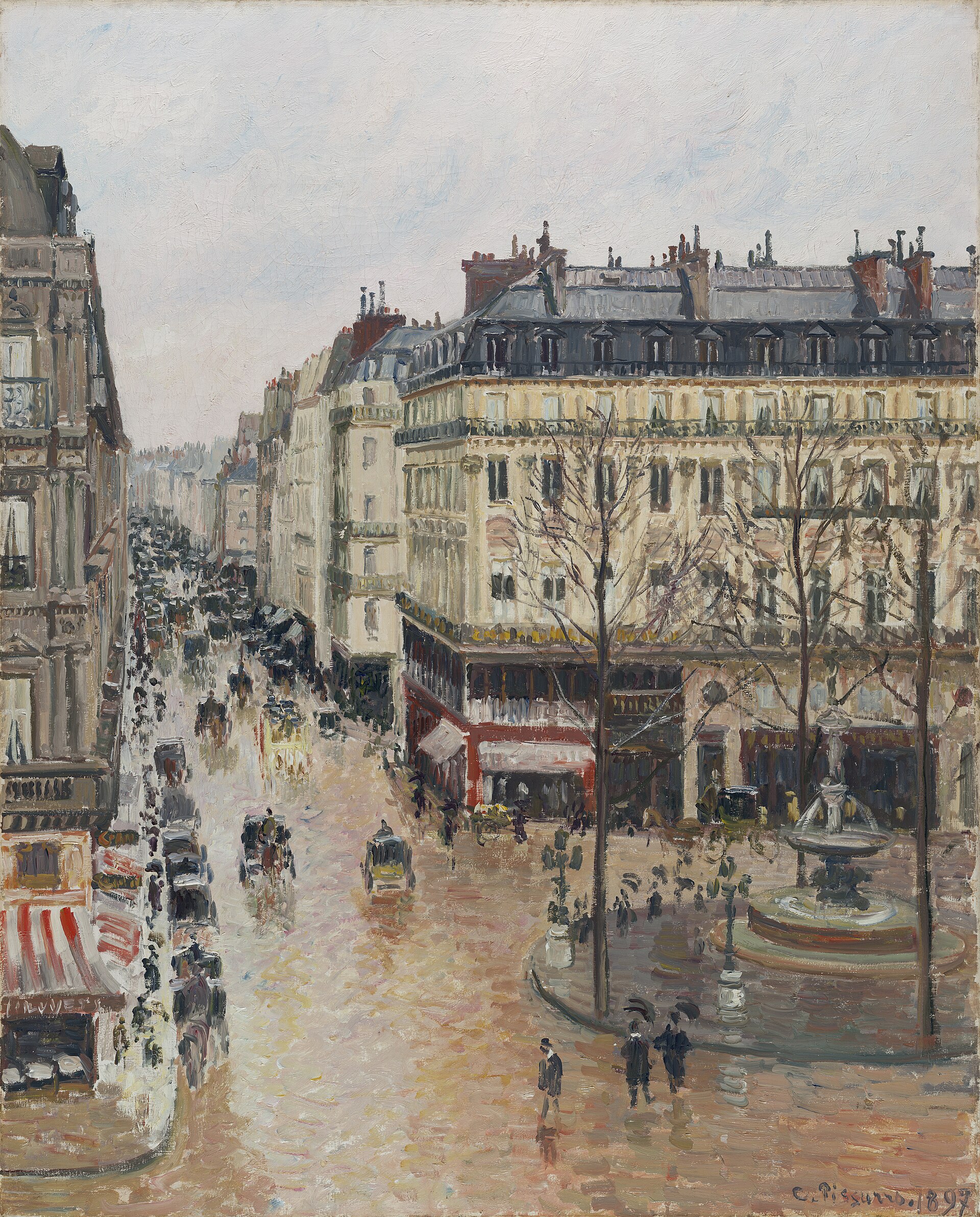
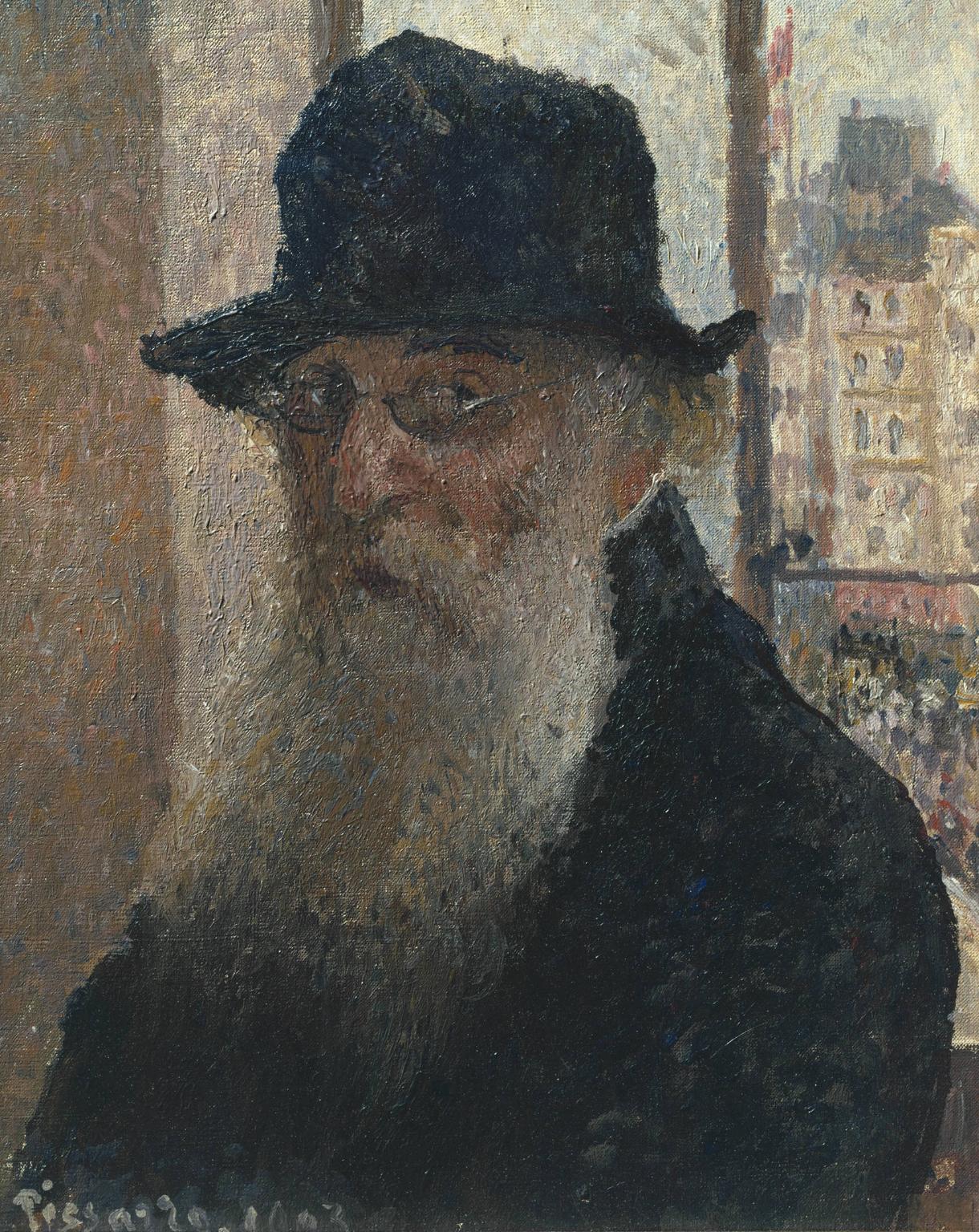
The record subject. Oil on canvas, 81 x 65 cm, 1897, PDR 1196. Museo Nacional Thyssen-Bornemisza, Madrid, inventory 712 (1976.74). Reproduced from the museum's own collection record.
About this record Last verified 3 September 2026 · 10 sources cited · Change log
On this page 11 sections
ContentsClose
A Paris street in the rain, painted from a hotel window in December 1897 in the weeks after the artist's son died, taken from a Jewish woman in Berlin in 1939 as the price of an exit visa, and hanging in Madrid since 1993. The claim on it has been in litigation for twenty-one years, has been to the United States Supreme Court twice, and is not over.
This is the record in the corpus where nothing has been decided. No panel has ever heard it. No object has moved. The courts that reached the merits held for the museum on Spanish law; the Supreme Court then vacated that judgment in March 2025 because California had changed its statute; the case went back to the trial court, and in November 2025 the Attorney General of California intervened to defend the new statute against constitutional attack. A reader who wants to know who owns this painting is asking a question that has no answer today.
Provenance
Each link is graded. Documented: a cited source supports it. Disputed: the identification is argued but not established. Unknown: no owner for that span, and the gap is not smoothed into a narrative. The grades in the glossary.
- 1897 -Camille Pissarrodocumented
Painted from a rented room at the Grand Hotel du Louvre between 4 and 22 December 1897, one of two canvases made there before the artist returned to Eragny for Christmas.4
- - 1939Cassirer family, Berlin; latterly Lilly Cassirer Neubauerdocumented
The painting was in the Cassirer family in Berlin and belonged to Lilly Cassirer Neubauer by 1939. The Cassirers were among the principal Berlin collectors and dealers of French modern painting. Published accounts differ on whether the first family purchase was made from the artist or through Durand-Ruel, and this record does not resolve it.19
- 1939 -Jakob Scheidwimmer, Munich art dealer and Nazi party memberdocumented
Scheidwimmer refused to allow the painting to leave Germany and required that it be transferred to him. The stated price of 900 Reichsmarks, about 350 dollars, was paid into a blocked account to which Lilly Cassirer Neubauer had no access. The transfer was the condition of an exit visa. The holding institution's own chronology describes it as a sale below market value made in order to obtain a visa and avoid a concentration camp.189
- Julius Sulzbacherdocumented
Acquired from Scheidwimmer. Recorded in the holding institution's own published chronology.1
- Gestapodocumented
Seized from Julius Sulzbacher by the Gestapo. This link appears in the account published by the institution that currently resists the claim.1
- 1943 - 1951Unknownunknown
Sold at auction in Berlin in 1943 for 95,000 Reichsmarks and then untraced. No owner is documented between that sale and the painting's appearance at the Frank Perls gallery in Beverly Hills in 1951. Eight years are missing from every published chain.
- 1951 - 1952Sydney Brody, Los Angelesdocumented
Acquired at the Frank Perls gallery, Beverly Hills.1
- 1952 - 1976Sydney Schoenberg, Missouridocumented
Frank Perls was instructed by Brody to place the painting for sale at the Knoedler gallery in New York, where Schoenberg bought it the same year.1
- 1976 - 1993Baron Hans Heinrich Thyssen-Bornemiszadocumented
Acquired from the Stephen Hahn Gallery, New York. Shown thereafter with the Thyssen-Bornemisza collection at Lugano and, to 1990, in temporary exhibitions in Australia, Japan, the United Kingdom, Germany, France, Italy and Spain.1
- 1993 - presentFundacion Coleccion Thyssen-Bornemisza, Madriddisputed
Acquired under a contract of 21 June 1993 with Favorita Trustees Limited, as part of the purchase of 775 works reported at 350 million dollars. The foundation asserts that the acquisition is valid and incontestable under Spanish law. The Cassirer heirs dispute that title. Every United States court to reach the merits has upheld the foundation, but no such judgment currently stands: the last was vacated by the Supreme Court on 10 March 2025 and the case is pending in the Central District of California. Custody has not been interrupted.1257
Prices realised
This painting has not been offered at public auction since 1943 and is not for sale. It is the property of a Spanish state foundation and is subject to an outstanding restitution claim, which makes any published estimate of its value speculative. The only documented prices in its history are the 900 Reichsmarks paid into a blocked account in 1939, the 95,000 Reichsmarks it made at auction in Berlin in 1943, the 120,000 Deutschmarks agreed in 1958 as its market value at 1 April 1956, and its share of the 350 million dollars the Spanish state paid in 1993 for 775 works. No hammer or premium figure is published for any of them, and the 1993 sale was a private treaty purchase of a whole collection, not an auction.
Technical evidence
| Attribution note | Signed and dated by the artist and catalogued as PDR 1196 in the Pissarro and Durand-Ruel Snollaerts catalogue raisonne. Authorship has never been questioned by any party in twenty-one years of litigation. The dispute is entirely about title. |
|---|---|
| Support | Canvas.3 |
| Medium | Oil.3 |
| Dimensions | 81 x 65 cm, upright format.3 |
| Catalogue raisonne | PDR 1196, in the Pissarro and Durand-Ruel Snollaerts catalogue raisonne. The number is the only safe way to distinguish this canvas from PDR 1199 (Nelson-Atkins) and PDR 1200 (Ordrupgaard), both titled Rue Saint-Honore with a different weather effect.4 |
| Inventory | Museo Nacional Thyssen-Bornemisza, Madrid, 712 (1976.74). The second element records the Baron's acquisition year, 1976.3 |
| Viewpoint | Painted from a rented room at the Grand Hotel du Louvre in December 1897, looking at the junction of the rue Saint-Honore and the place du Theatre-Francais, with the rue de Rohan at the left running towards the rue de Rivoli.4 |
| Position in the series | One of two canvases painted from that room between 4 and 22 December 1897, before the four-month campaign of 1898 from 172 rue de Rivoli that produced the bulk of the series and of which Durand-Ruel bought twelve canvases at once in May 1898.4 |
| Display | Room 33, level 1, Museo Nacional Thyssen-Bornemisza, Madrid. Continuously in the museum's custody since 1993.13 |
Images
The record in full
Chapter 1The claim is outstanding, and that is the point of this record
Most objects in this archive have an ending.
Most objects in this archive have an ending. This one does not, and the honest way to publish it is to say where the file stands on the day it was written.
The Fundacion Coleccion Thyssen-Bornemisza holds the painting in Madrid and asserts title under Spanish law. The heirs of Lilly Cassirer Neubauer, from whom it was taken in Berlin in 1939, claim it. Since 2005 the claim has been litigated in the United States federal courts under the Foreign Sovereign Immunities Act. Every court that reached the merits has held for the foundation, on the ground that Spanish law governs and that Spanish law lets a good-faith possessor acquire title by prescription. The Supreme Court of the United States has intervened twice on how the governing law is chosen.
On 10 March 2025 it did so a second time, vacating the Ninth Circuit's judgment of January 2024 so that the courts below could reconsider it under a California statute enacted in September 2024. The case returned to the district court in Los Angeles. On 17 November 2025 the Attorney General of California moved to intervene to defend that statute's constitutionality. Nothing in this record should be read as a statement of who owns the picture.
Chapter 2What it is, and the fortnight it was painted in
Oil on canvas, 81 by 65 centimetres, dated 1897.
Oil on canvas, 81 by 65 centimetres, dated 1897. It shows the junction of the rue Saint-Honore and the place du Theatre-Francais in the rain; in the left foreground the rue de Rohan runs down towards the rue de Rivoli and the Louvre.
Pissarro painted it from a rented room. Between 4 and 22 December 1897 he was in Paris looking for new motifs and took a room at the Grand Hotel du Louvre, writing that he had found a room with a superb view of the avenue de l'Opera and the corner of the place du Palais Royal, and that the Paris streets people call ugly were silvery, luminous and alive. He painted two canvases from that room before going home for Christmas, and this is one of them.
He was working through something. In the spring of 1897 his eldest son Lucien had a stroke and Pissarro went to London from May to July to sit with him. In November his fifth child Felix, whom the family called Titi, died at twenty-three. On 15 December, in the middle of the fortnight in which this picture was made, he wrote to Lucien that they should work in order to heal their wounds and that he hoped his son could shield himself with art. The museum's own scholarship makes the connection between the bereavement and the intensity of the December campaign, and it is the only reading of this picture the sources support.
Chapter 3Why he was painting out of windows at all
The urban series were forced on him by his eyes.
The urban series were forced on him by his eyes. A recurrent infection made it impossible for him to work outdoors except in warm weather, and from 1893 he rented rooms with views and painted through the glass. The first campaign, at the Hotel-Restaurant de Rome in the Saint-Lazare quarter in 1893, came directly from his doctor's instruction not to expose the eye to street wind and dust.
Out of that constraint came a body of work that changed his market. In the last decade of his life, between 1893 and 1903, he made over three hundred canvases of Paris, Rouen, Dieppe and Le Havre, in eleven separate series. Durand-Ruel bought the views in bulk for the first time and they sold. The painter who had been mocked as the cabbage painter for his fields and orchards ended his career as the most systematic recorder of the modern French city, and did it because he could not stand in the street.
He had also lost most of his earlier work. Of roughly 1,500 paintings made in twenty years and left behind when he fled the Franco-Prussian war, about forty survived; Prussian soldiers quartered in his house had used the canvases as floor matting. A late Pissarro is not just a late work. It is a large part of what is left.
Chapter 4Three pictures of the same street corner, and how to tell them apart
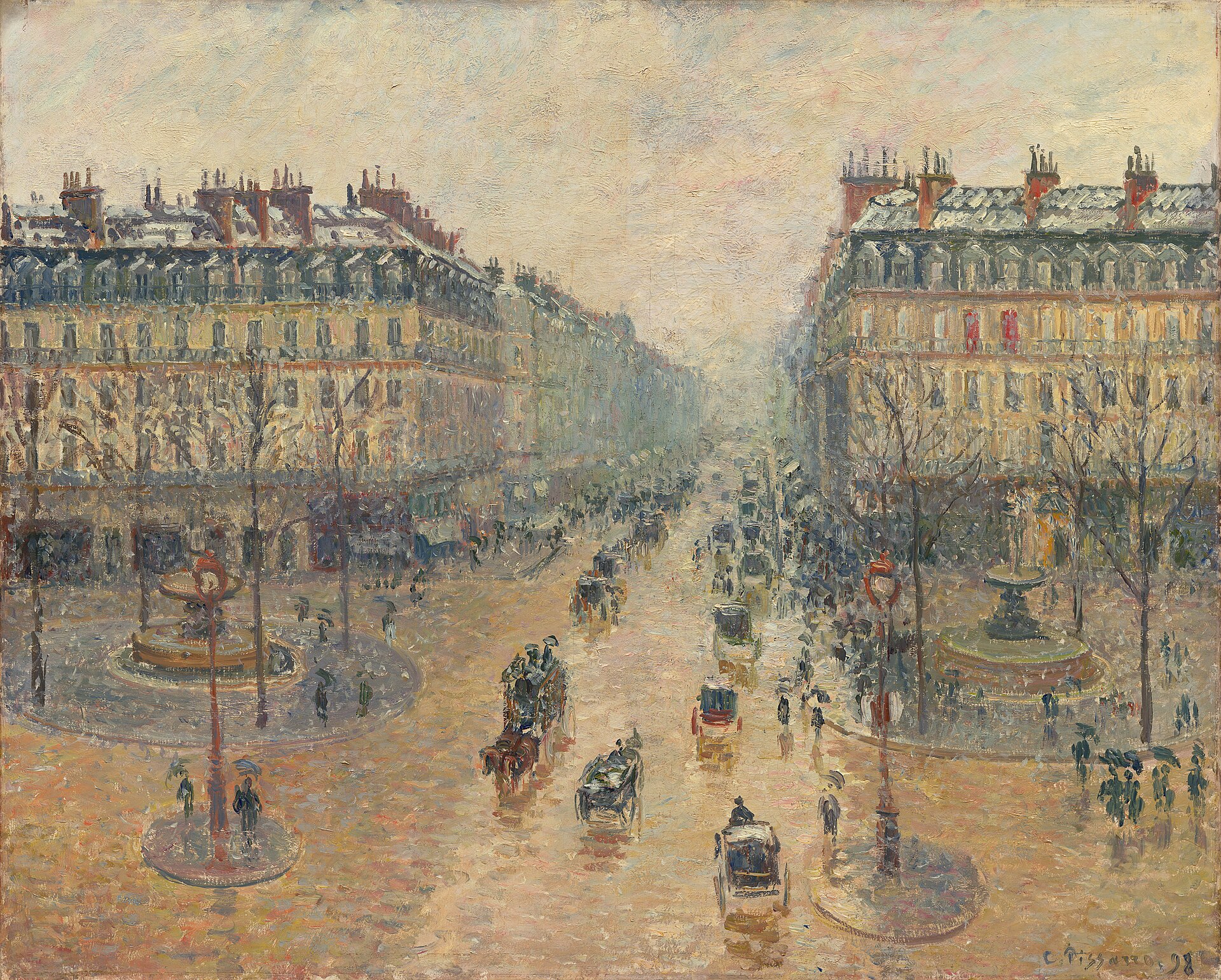
On 5 January 1898 Pissarro moved into the Grand Hotel du Louvre proper, at 172 rue de Rivoli, and stayed four months painting the same view under snow, rain, fog and spring light.
On 5 January 1898 Pissarro moved into the Grand Hotel du Louvre proper, at 172 rue de Rivoli, and stayed four months painting the same view under snow, rain, fog and spring light. In May, Durand-Ruel bought twelve canvases from the series at once.
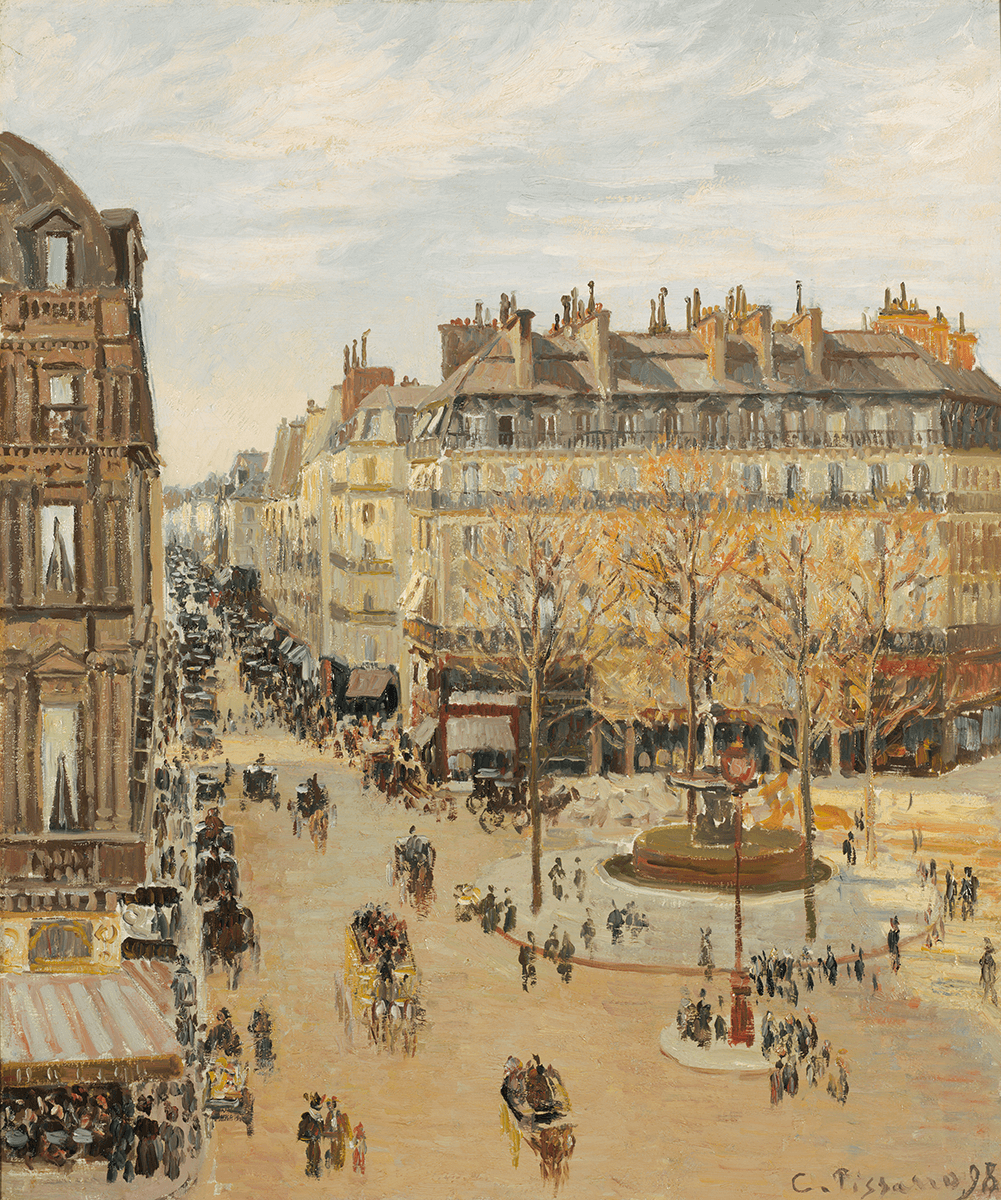
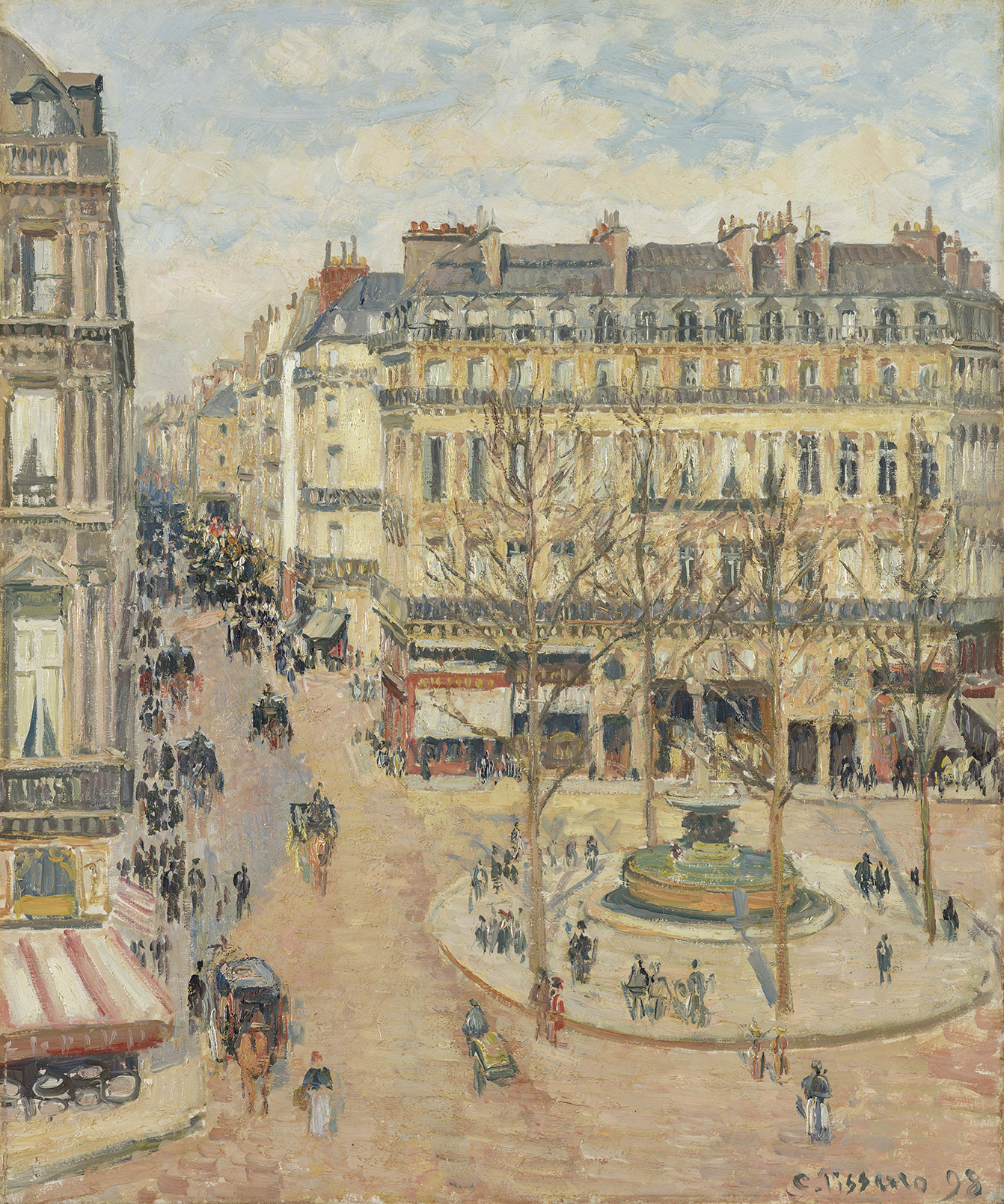
That is a version-safety problem, and it is a real one for this object. At least three canvases carry the title Rue Saint-Honore with a weather effect attached:
PDR 1196, dans l'apres-midi, effet de pluie, 1897, 81 by 65 cm. The picture in this record. Museo Thyssen-Bornemisza, Madrid, inventory 712 (1976.74). The one under claim.
PDR 1199, apres-midi, effet de soleil, 1898, 65.4 by 54.6 cm. Nelson-Atkins Museum of Art, Kansas City. Not under claim.
PDR 1200, matin, effet de soleil, 1898, Ordrupgaard, Copenhagen. Not under claim.
Coverage of the litigation routinely reproduces whichever of these an editor found first. The catalogue number is the only reliable discriminator, and the difference matters commercially as well as legally: two of these three have clean chains and one does not.
Chapter 5The chain to 1939
The painting entered a German Jewish collection almost immediately.
The painting entered a German Jewish collection almost immediately. It passed to Lilly Cassirer Neubauer through her husband's family. The Cassirers were among the most important collectors and dealers of French modern painting in Berlin, and the picture was in the family for about four decades before the state came for it.
By 1939 Lilly Cassirer Neubauer needed to leave Germany. The mechanism used against her is documented and it is not ambiguous in outline, whatever the parties call it. Jakob Scheidwimmer, an art dealer and a member of the Nazi party, would not permit the painting to leave Germany and required that it be sold to him. She parted with it for 900 Reichsmarks, roughly 350 dollars at the time, paid into a blocked account she could not touch. In exchange she got out.
The foundation's own published chronology puts it as a sale below market value made in order to obtain a visa to escape from Germany and avoid a concentration camp. That is the holder's language, and it concedes the coercion while declining the word theft. This record uses neither side's adjective: the transaction was a transfer compelled by a state that had made her flight conditional on it.
Chapter 6What happened to it inside Germany
Scheidwimmer did not keep it. The painting was acquired by Julius Sulzbacher, and it was then seized from Sulzbacher by the Gestapo.
Scheidwimmer did not keep it. The painting was acquired by Julius Sulzbacher, and it was then seized from Sulzbacher by the Gestapo. Both facts appear in the holding institution's own account of the provenance, which is worth noting: the museum that resists the claim publishes a chain containing a Gestapo confiscation.
It was sold at auction in Berlin in 1943 for 95,000 Reichsmarks and then dropped out of sight. The gap between that sale and its reappearance in California in 1951 is the classic 1933 to 1945 break this archive exists to record, except that here the break sits after the seizure rather than around it.
Chapter 7The American decades
In 1951 the painting was acquired at the Frank Perls gallery in Beverly Hills by the American collector Sydney Brody.
In 1951 the painting was acquired at the Frank Perls gallery in Beverly Hills by the American collector Sydney Brody. In 1952 Perls was instructed by Brody to place it for sale at the Knoedler gallery in New York, where it was bought the same year by Sydney Schoenberg, a collector from Missouri. In 1976 Baron Hans Heinrich Thyssen-Bornemisza acquired it from the Stephen Hahn Gallery in New York.
The route matters because of what the courts later made of it. Two respected New York and Los Angeles dealers handled the picture in the early 1950s, and neither the American buyers nor the Baron is recorded as having known of the 1939 transfer. The foundation's case rests on exactly that: good faith at the moment of acquisition. The claimants' case is that good faith is beside the point, because a thief cannot pass good title, which is the rule in California and is not the rule in Spain.
From 1976 the picture was exhibited as part of the Thyssen-Bornemisza collection at Lugano and, up to 1990, in temporary exhibitions in Australia, Japan, the United Kingdom, Germany, France, Italy and Spain. The foundation notes the publicity; the implication drawn is that the family could have found it. The family did not find it until 2000.
Chapter 8The 1958 settlement, and what it did not do
In 1950 Lilly Cassirer Neubauer brought proceedings in Germany to recover the painting.
In 1950 Lilly Cassirer Neubauer brought proceedings in Germany to recover the painting. She did not know where it was.
In 1958 she reached an agreement with the Federal German government, with Scheidwimmer and with Sulzbacher, accepting compensation of 120,000 Deutschmarks, a figure agreed to represent the market value of the work as at 1 April 1956. The foundation's chronology records that she gave 14,000 marks of that sum to another party to the agreement.
What that settlement did to the claim on the object itself is one of the sharpest questions in the case, and the answer is that it did not extinguish it. The point has been argued and the courts have not treated the 1958 compensation as a waiver of the right to seek physical restitution should the painting resurface. This is a distinction with wide application: a post-war compensation payment made against a lost object is not a sale of it, and a diligence file that treats a German Wiedergutmachung settlement as clearing title is making an error of law, not a judgement call.
What the settlement does establish is that by 1958 the German state had accepted, and paid on the basis, that this painting was taken from her by persecution.
Chapter 91993: how the picture became Spanish state property
The Spanish state agreed the purchase of the Thyssen-Bornemisza collection under a contract signed on 21 June 1993, between the Fundacion Coleccion Thyssen-Bornemisza and Favorita Trustees Limited.
The Spanish state agreed the purchase of the Thyssen-Bornemisza collection under a contract signed on 21 June 1993, between the Fundacion Coleccion Thyssen-Bornemisza and Favorita Trustees Limited. The collection ran to 775 works and the reported price was 350 million dollars. The museum had opened in Madrid the previous year.
The foundation's position is that the transaction was carried out after due diligence into the seller's title and that its acquisition is accordingly valid, effective and incontestable under Spanish law, which it says is the law applicable to the sale.
The consequence for the claimants was structural rather than evidential. The holder was now an instrumentality of a sovereign state, which is why every subsequent step has had to be taken under the Foreign Sovereign Immunities Act and why the case has spent two decades on questions of jurisdiction and choice of law rather than on what happened in Berlin in 1939.
Chapter 10Twenty-one years of litigation, in order
The family made its first claim in 2002 and the foundation rejected it.
The family made its first claim in 2002 and the foundation rejected it. In 2005 Claude Cassirer, Lilly's grandson, sued in California. He died in 2010 at eighty-nine; his children continued the action, supported by the United Jewish Federation of San Diego County. The Jewish Community of Madrid and the Federation of Jewish Communities in Spain entered the case as interested parties.
In June 2012 the district court rejected the claim as time-barred. In July 2014 the Ninth Circuit reversed. In June 2015 the district court held that the foundation would in any event have acquired title by prescription under Spanish law. In July 2017 the Ninth Circuit overturned that and sent the case back to examine whether the foundation could be treated as an accessory to a crime against property, which under article 1956 of the Spanish Civil Code would block prescription; the foundation sought rehearing, the Kingdom of Spain appeared as amicus curiae, and rehearing was refused in December 2017. The foundation petitioned the Supreme Court in April 2018 and certiorari was denied in May.
In December 2019 Judge John F. Walter dismissed the case, holding that under Spanish law the foundation is the rightful owner and that neither the Baron nor the foundation knew at acquisition that the painting had been stolen. The Ninth Circuit affirmed in August 2020.
On 21 April 2022 the Supreme Court decided the case unanimously. The holding is narrow and important: in a suit under the Foreign Sovereign Immunities Act raising non-federal claims, a court must determine the substantive law using the same choice-of-law rule it would apply in a similar suit against a private party, which means the forum state's rule and not one derived from federal common law. The Court did not decide who owns the painting. It decided which signpost the lower courts must read.
On remand the Ninth Circuit read it, applied California's governmental interest test, and concluded in January 2024 that California's own rule pointed to Spanish law, and therefore to the foundation. Rehearing en banc was denied in July 2024.
Chapter 11A legislature answers a court
On 16 September 2024 the Governor of California signed Assembly Bill 2867.
On 16 September 2024 the Governor of California signed Assembly Bill 2867. The statute concerns the recovery of artwork and personal property lost through persecution. It states the rule that a thief cannot convey good title and that stolen art should be returned to its original owner, defines duress to include a threat of force, violence, danger or retribution sufficient to coerce a reasonable person, and rejects good-faith acquisition and adverse possession as defences. It applies retroactively, including to claimants whose limitation period had run, and by its terms it applies to all actions pending on the date of enactment.
The Cassirer plaintiffs asked the Supreme Court to send the case back in light of it. On 10 March 2025 the Court granted certiorari, vacated the Ninth Circuit's January 2024 judgment and remanded. The case is now back before the United States District Court for the Central District of California, and on 17 November 2025 the Attorney General of California filed to intervene in defence of the statute's constitutionality.
Set that sequence against this archive's argument about the Washington Principles. The 1998 text bound nobody and left every design choice to national machinery. Here the machinery is a state legislature in a third country, retrofitting a choice-of-law rule in order to change the result of one case. It is not a restitution commission and it does not pretend to be. It is the only lever that existed.
Chapter 12What the holder publishes, and where its chronology stops
The museum links a document headed as the Cassirer lawsuit from the painting's own catalogue page.
The museum links a document headed as the Cassirer lawsuit from the painting's own catalogue page. It is a useful thing to read, because it is the holder setting out the history in its own words, and because it concedes more than a reader would expect: the 1939 sale below market value made to obtain an exit visa, the Gestapo seizure from Sulzbacher, the 1950 German proceedings, the 1958 compensation.
The file carries a March 2025 date and its chronology ends with the Ninth Circuit's decision of January 2024 and the statement that the foundation is the legitimate owner. It does not record the Supreme Court's order of 10 March 2025 vacating that judgment. Anyone consulting the museum's page for the current position of the case is reading a chronology that stops one step short of it.
The museum's catalogue entry for the painting itself carries no provenance list at all. The inventory number, 712 (1976.74), encodes the year the Baron bought it and nothing before.
Chapter 13What a collector should take from this file
Four things, none of which is about Pissarro.First, a compensation settlement is not a conveyance.
Four things, none of which is about Pissarro.
First, a compensation settlement is not a conveyance. Lilly Cassirer Neubauer was paid 120,000 Deutschmarks in 1958 for a picture nobody could find, and that payment has not been held to extinguish the right to the picture. Any file that treats a German post-war award as clearing a 1930s break is wrong.
Second, the identity of the holder decides the forum, and the forum decides the law. The moment the collection became Spanish state property the claim became a sovereign immunity case. Twenty-one years have gone on choice of law and jurisdiction.
Third, good faith is a defence in some systems and irrelevant in others. Spanish law lets a good-faith possessor take title by prescription; California law says a thief conveys nothing. The same facts produce opposite owners. There is no international rule that resolves it, which is exactly what the 1998 principles left unbuilt.
Fourth, and most practical: this object has never been before a restitution panel. Not one. Every step of it has been taken in American courts because that was the only door that opened. Where a claim looks unresolved for decades, ask whether a forum exists at all before concluding that the claim is weak.
The artist
Jacob Abraham Camille Pissarro
Pissarro is the only artist who exhibited in all eight Impressionist exhibitions between 1874 and 1886, and the only one of the group who was born outside Europe, in the Danish West Indies, to a Jewish family whose marriage the local congregation refused to recognise. He was an anarchist by conviction and remained one. He lost most of his early work to a war. He made the pictures he is now best known for from hotel windows because his eyes would not let him work outdoors. Almost nothing about his career was the standard shape.
Exhibited
- 1898Durand-Ruel gallery showing of the Paris seriesGalerie Durand-Ruel, Paris
- 1976-1990Thyssen-Bornemisza Collection, permanent display and touring exhibitions in seven countriesVilla Favorita, Lugano, and elsewhere
- 1992-presentPermanent collection, room 33Museo Nacional Thyssen-Bornemisza, Madrid
Related works
| Work | Relation | Where it is |
|---|---|---|
| Rue Saint-Honore, apres-midi, effet de soleil (PDR 1199) Camille Pissarro | Same motif, different effect and year. Frequently confused with this picture 1898, 65.4 x 54.6 cm. Not under claim. | Nelson-Atkins Museum of Art, Kansas City |
| Rue Saint-Honore, matin, effet de soleil (PDR 1200) Camille Pissarro | Same motif, different effect and year 1898. Not under claim. | Ordrupgaard, Copenhagen |
| Place du Theatre-Francais, Rain Effect Camille Pissarro | The other canvas painted from the same hotel room in December 1897 Painted, on the museum's account, in a single day. | Dallas Museum of Art |
| The Place du Havre, Paris Camille Pissarro | The first of the Paris window series, 1893 PDR 986. Painted from the Hotel-Restaurant de Rome on his doctor's instruction not to expose his eye to the street. | The Art Institute of Chicago, Potter Palmer Collection |
| Portrait of Wally Neuzil Egon Schiele | Comparison of dispositions: a claim resolved by paying for the claim rather than moving the object The Schiele case ended in a nineteen million dollar settlement in 2010. This one has ended in nothing, twenty-one years in. | Leopold Museum, Vienna |
Open questions
- Who owns the painting? No court judgment currently stands on the merits: the Ninth Circuit's January 2024 judgment for the foundation was vacated by the Supreme Court on 10 March 2025 and the case is pending in the district court.
- Is Assembly Bill 2867 constitutional as applied to a pending action against an instrumentality of a foreign state? That question is live and is why the Attorney General of California moved to intervene on 17 November 2025.
- Who bought the painting at the Berlin auction of 1943 for 95,000 Reichsmarks, and by what route did it reach the Frank Perls gallery in Beverly Hills by 1951? Eight years of the chain are unaccounted for in every published version, including the holder's.
- What due diligence did the Fundacion Coleccion Thyssen-Bornemisza actually carry out in 1993? The foundation states that investigations into the legitimacy of the seller's title were made. The scope and the documents have not been published.
- Why does the museum's own catalogue entry for the painting carry no provenance list, when the museum publishes a separate document setting out a full chronology of the ownership dispute?
- To whom did Lilly Cassirer Neubauer pay the 14,000 marks recorded in the foundation's chronology as taken out of her 1958 compensation, and on what basis?
Questions about this object
What is Rue Saint-Honore in the Afternoon. Effect of Rain?
Rue Saint-Honore in the Afternoon. Effect of Rain is a painting, dated 1897. Medium: Oil on canvas.
Who made Rue Saint-Honore in the Afternoon. Effect of Rain, and is the attribution settled?
The attribution to Camille Pissarro is recorded here as accepted. Signed and dated by the artist and catalogued as PDR 1196 in the Pissarro and Durand-Ruel Snollaerts catalogue raisonne. Authorship has never been questioned by any party in twenty-one years of litigation. The dispute is entirely about title.
Where is Rue Saint-Honore in the Afternoon. Effect of Rain now?
Museo Nacional Thyssen-Bornemisza, Madrid, room 33. TITLE is asserted by the Fundacion Coleccion Thyssen-Bornemisza on the basis of Spanish law and has been upheld in every United States court to reach the merits; it is not settled, because the Supreme Court vacated the last such judgment on 10 March 2025. CUSTODY has been continuous in Madrid since 1993 and has never been interrupted by any order. Inventory number 712 (1976.74). Last confirmed 4 August 2026. Purchased by the Spanish state with the Thyssen-Bornemisza collection under a contract of 21 June 1993 between the Fundacion Coleccion Thyssen-Bornemisza and Favorita Trustees Limited. Claim by the Cassirer family outstanding and pending in the United States District Court for the Central District of California.
What is still unknown about Rue Saint-Honore in the Afternoon. Effect of Rain?
Who owns the painting? No court judgment currently stands on the merits: the Ninth Circuit's January 2024 judgment for the foundation was vacated by the Supreme Court on 10 March 2025 and the case is pending in the district court.
Sources
- 1Museo Nacional Thyssen-Bornemisza, 'Lawsuit Cassirer / Thyssen', the foundation's own published chronology of the ownership and the litigation, linked from the painting's catalogue page, file dated March 2025. PRIMARY, and the holder's own account. Its chronology ends with the Ninth Circuit decision of January 2024 and does not record the Supreme Court order of 10 March 2025. museothyssen.org/sites/...
- 2Cassirer v. Thyssen-Bornemisza Collection Foundation, 596 U.S. 107 (2022), slip opinion, decided 21 April 2022, Kagan J. for a unanimous Court. Holding: in an FSIA suit raising non-federal claims, a court determines the substantive law using the same choice-of-law rule applicable in a similar suit against a private party. PRIMARY. supremecourt.gov/opinions/...
- 3Museo Nacional Thyssen-Bornemisza, collection entry for Rue Saint-Honore in the Afternoon. Effect of Rain: 1897, oil on canvas, 81 x 65 cm, inventory 712 (1976.74), room 33. The entry carries no provenance list. museothyssen.org/en/...
- 4Paula Luengo, 'Camille Pissarro: Rue Saint-Honore in the Afternoon, Effect of Rain, 1897', Open Windows 6, Museo Thyssen-Bornemisza. The museum's own scholarship on the picture: the December 1897 stay at the Grand Hotel du Louvre, the view, the death of Felix Pissarro, the series method and the PDR numbers. museothyssen.org/sites/...
- 5Office of the Attorney General of California, press release, 17 November 2025, 'Attorney General Bonta Steps Up to Defend California Law Helping Holocaust Survivors Recover Stolen Art', recording the motion to intervene in Cassirer v. Thyssen-Bornemisza Collection Foundation in the United States District Court for the Central District of California. PRIMARY. oag.ca.gov/news/...
- 6Transnational Litigation Blog, Cassirer v. Thyssen-Bornemisza post index, for the dated sequence of the 2023 to 2025 steps including the denial of rehearing en banc in July 2024 and the GVR petition. tlblog.org/tag/...
- 7Center for Art Law, 'Rehearing with a Chance of Restitution: The Effects of Rainfall and Recent Developments on Rue Saint Honore', for the terms of Assembly Bill 2867 and the Supreme Court's March 2025 order. itsartlaw.org/art-law/...
- 8The National Law Review, 'Nazi-Looted Art: One Painting, Two Owners, and Two Laws in Conflict: Cassirer v. Thyssen-Bornemisza Collection Foundation', for the blocked account, the dollar equivalent of the 1939 payment and the 1958 valuation date of 1 April 1956. natlawreview.com/article/...
- 9Wikipedia, 'Rue Saint-Honore in the Afternoon. Effect of Rain', TERTIARY, used only for the 900 Reichsmark figure, the 1943 Berlin auction at 95,000 Reichsmarks and the reported 1993 collection price. Flagged for replacement with the pleadings in the Central District of California. en.wikipedia.org/wiki/...
- 10Wikipedia, 'Camille Pissarro', TERTIARY, used only for the biography: birth, nationality, the eight Impressionist exhibitions, the anarchist associations, the 1,500 lost canvases, the eye condition and the children. Flagged for replacement with Joachim Pissarro and Claire Durand-Ruel Snollaerts, Pissarro: Critical Catalogue of Paintings (2005). en.wikipedia.org/wiki/...
Last verified 3 September 2026 · Published 4 August 2026
Change log
4 August 2026 - Record created at the house standard: researched narrative, technical evidence, maker dossier, graded provenance chain, prices with hammer and premium separated, related works, open questions and sources.
3 September 2026 - Re-verified 2026-09-03: searched specifically for the district court ruling multiple 2025 legal-press pieces said was expected in spring 2026 following the Supreme Court remand and the Attorney General Bontas 17 November 2025 motion to intervene. No report of an actual ruling was found despite four separate targeted searches for June-August 2026 coverage - every hit either predates the remand or repeats the same spring 2026 forecast without a follow-up. Recorded as still pending as of this verification, not resolved; this is itself worth tracking on the next pass, since a ruling this overdue against forecast may mean either a quiet continuance or reporting that has not yet surfaced. oag.ca.gov and museothyssen.org sources spot-checked, resolve 200.