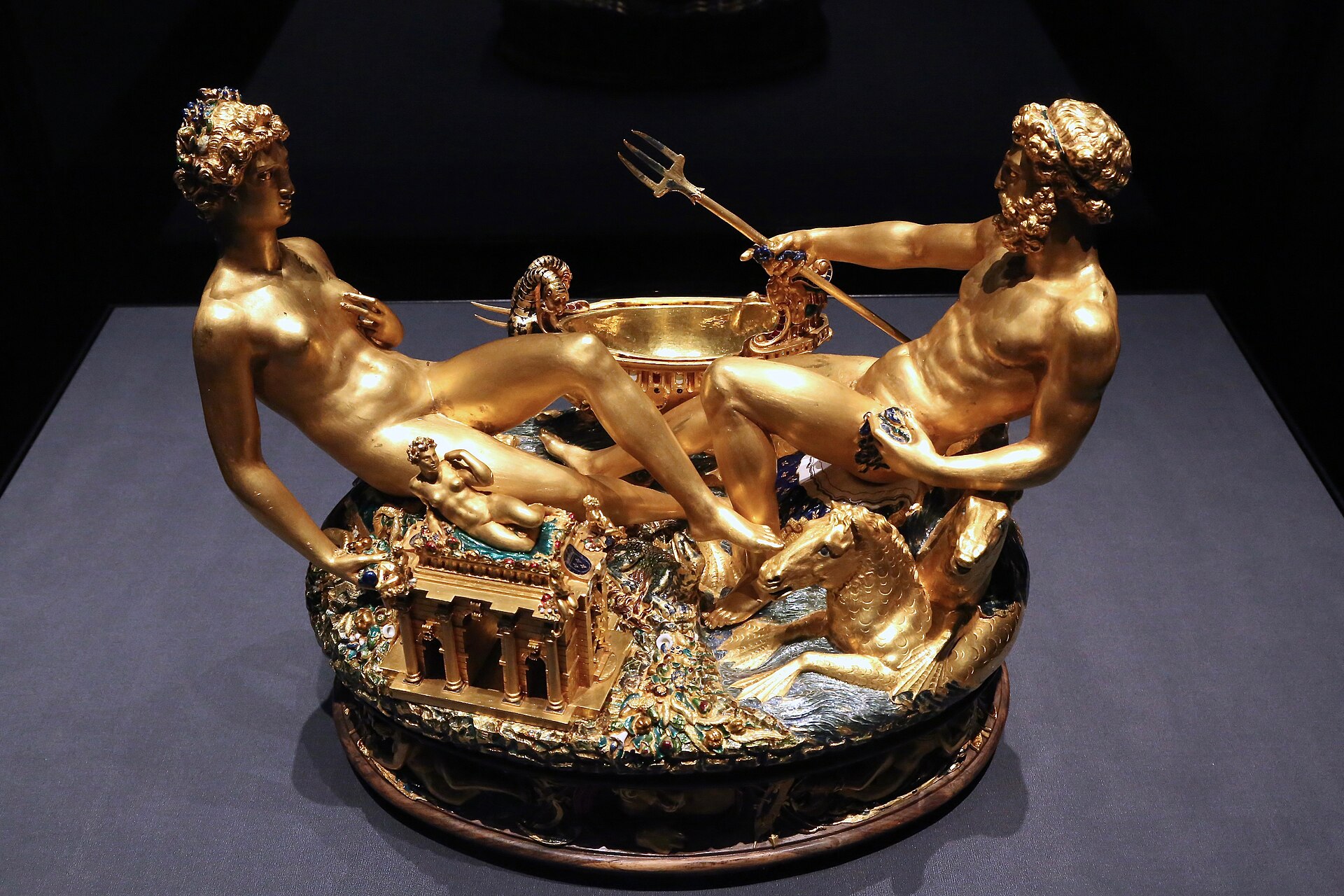
Saliera (Salt Cellar of Francis I)
1540-1543 · Gold
Kunsthistorisches Museum, Vienna, Kunstkammer
 Florentine · 1500-1571
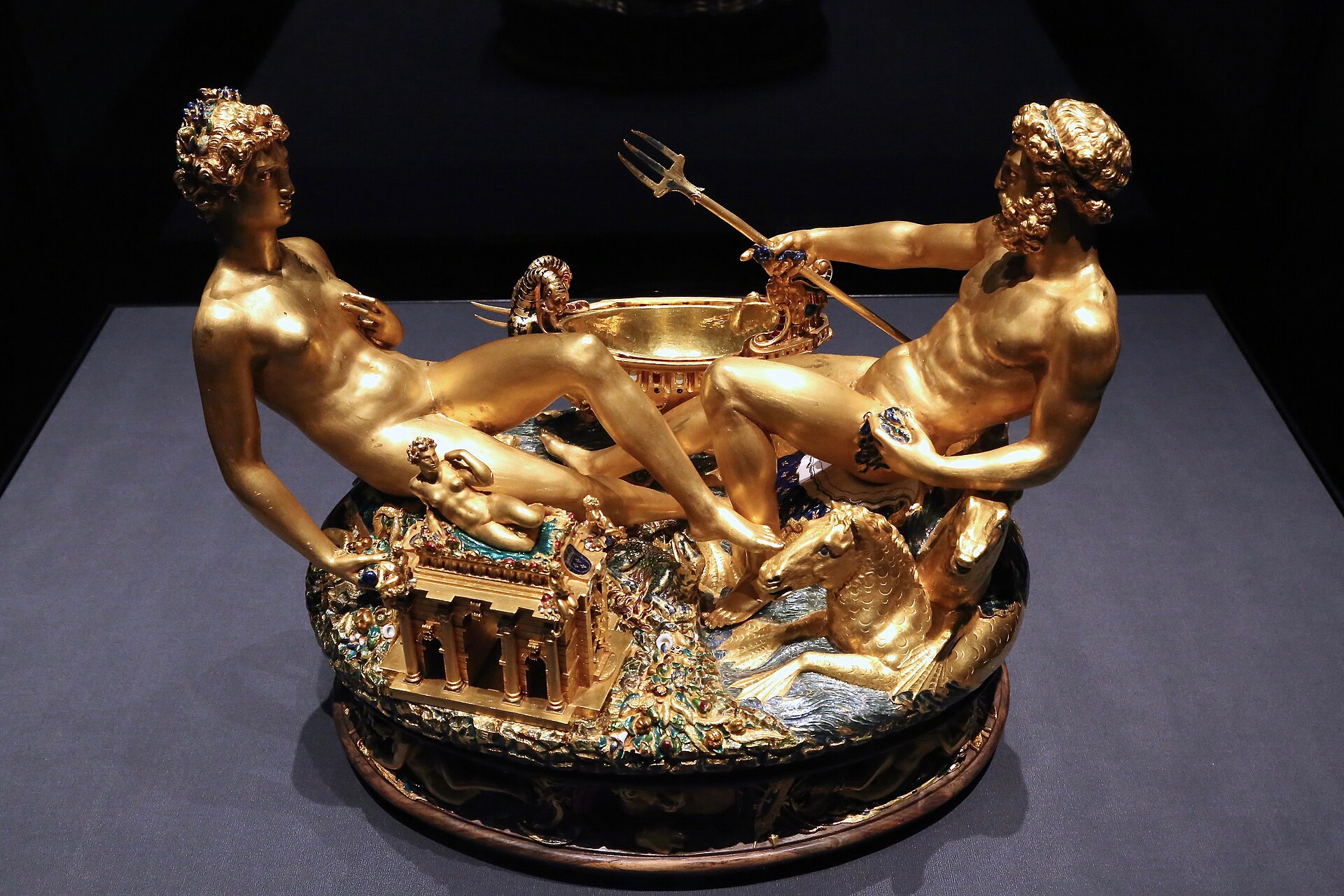
Saliera (Salt Cellar of Francis I) Gold, hammered and chased, with vitreous enamel, on an ebony base, 1540-1543. Cellini's sole surviving work in gold, made for Francis I of France. Kunsthistorisches Museum, Vienna. No verified portrait. No securely identified likeness of this maker is available under a free licence. We do not publish a face we cannot verify.
Photograph by Dr. Alexey Yakovlev, via Wikimedia Commons, CC BY-SA 2.0| Worked as | Goldsmith, Sculptor, Medallist, Author |
|---|---|
| Born | 3 November 1500 · Florence, Republic of Florence |
| Died | 13 February 1571 · Florence, Grand Duchy of Tuscany |
| Nationality | Florentine |
| Movement | Mannerism |
| In this archive | 1 artwork |
| Sources | 9 cited |
| Last verified |
About this page 1 artwork in the archive · Last verified · 9 sources cited
Cellini is the rare Renaissance goldsmith whose life is not reconstructed from account books and stylistic argument alone, because he wrote it down himself, at exhausting length, in an autobiography that is one of the earliest and most vivid first-person memoirs by a working artist in European history. That memoir is also the reason his reputation is so hard to separate from his actual surviving output: the man who says he shot the commander of an invading army, murdered at least two people in the street and was pardoned twice by name, escaped from the papal fortress of Rome by a rope of cut bedsheets with a broken leg, and single-handedly saved a bronze statue from ruin by throwing his own dinner plates into the furnace, made almost nothing that survives to check any of it against.
The accepted corpus of Cellini's own work in precious metal is essentially one object, a gold salt cellar now in Vienna, because the rest of what he is documented to have made for two popes and a king of France was melted down for its bullion value, the routine fate of princely goldsmith's work across European history. His larger reputation rests instead on a handful of bronze and marble sculptures from his last thirty years in Florence, on two technical treatises he wrote himself, and on an autobiography that is testimony from a passionately interested party rather than a neutral record, a distinction this page holds to throughout.
What a reader most needs to know going in is the shape of that gap: an extraordinary quantity of documented, often self-incriminating detail about the man, set against an extremely small, closely watched body of surviving objects, one of which was catalogued under his name for over half a century before being taken away from him entirely.
Born 3 November in Florence, second child of the musician Giovanni Cellini and Maria Elisabetta Granacci.12
Apprenticed at fifteen to the goldsmith Antonio di Sandro (Marcone); banished from Florence for six months at sixteen after a street fight, and works in Siena during the exile.2
Moves to Rome at nineteen to work as a goldsmith.2
Fined for sodomy over a relationship with Domenico di Ser Giuliano da Ripa, per court records cited in secondary literature; not mentioned in Cellini's own Vita.2
Serves as a bombardier defending Castel Sant'Angelo during the Sack of Rome; claims in his own account to have shot the Constable of Bourbon and wounded Philibert of Chalon, Prince of Orange.12
Brother Cecchino is fatally wounded, 27 May, avenging a friend's death in a street brawl; Cellini later kills the guard responsible near the Torre Sanguigna in Rome.1
Kills the goldsmith Pompeo de' Capitaneis (Pompeo of Milan) in Rome during the papal vacancy; pardoned by the newly elected Pope Paul III within days of the killing.1
Imprisoned in Castel Sant'Angelo, at thirty-seven, on a charge of embezzling papal jewels during the 1527 sack; escapes by a rope of cut bedsheets, breaks his right leg in the fall, is recaptured, and is eventually released through the intercession of Cardinal Ippolito d'Este of Ferrara.12
Works at the French court of Francis I; designs and makes the gold Saliera (Salt Cellar of Francis I), now Kunsthistorisches Museum, Vienna.18
Returns to Florence and enters the service of Duke Cosimo I de' Medici.2
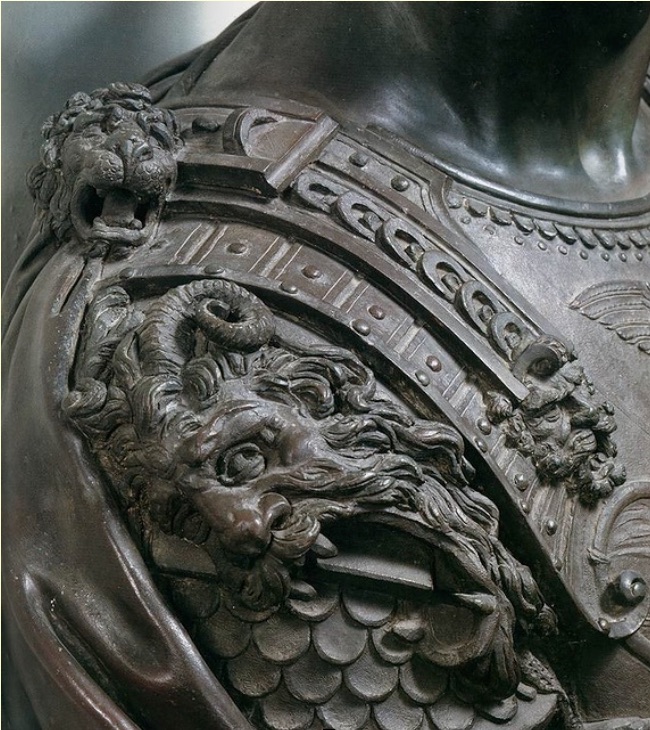
Casts the bronze bust of Cosimo I de' Medici, now in the Museo Nazionale del Bargello, Florence.23
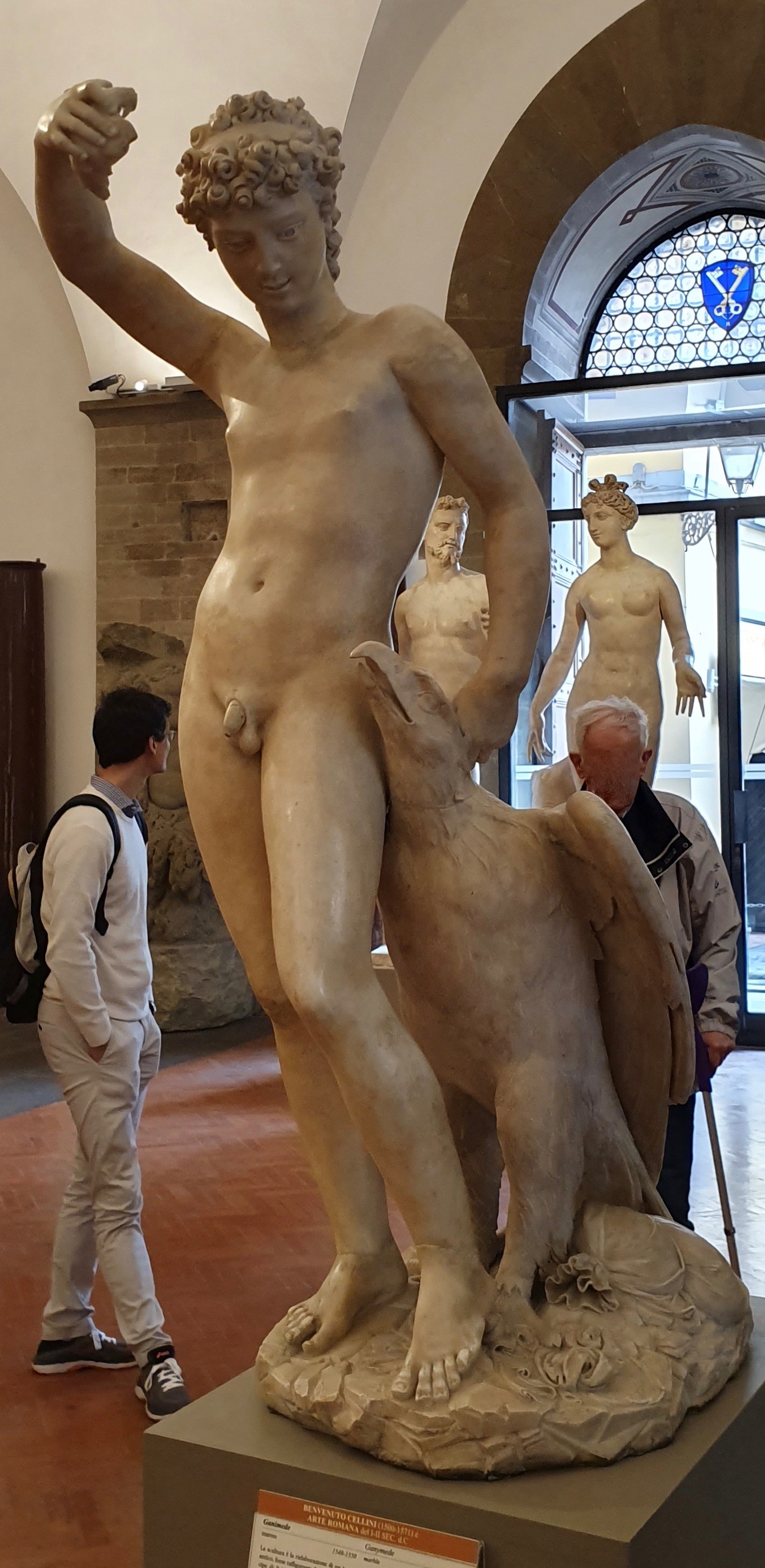
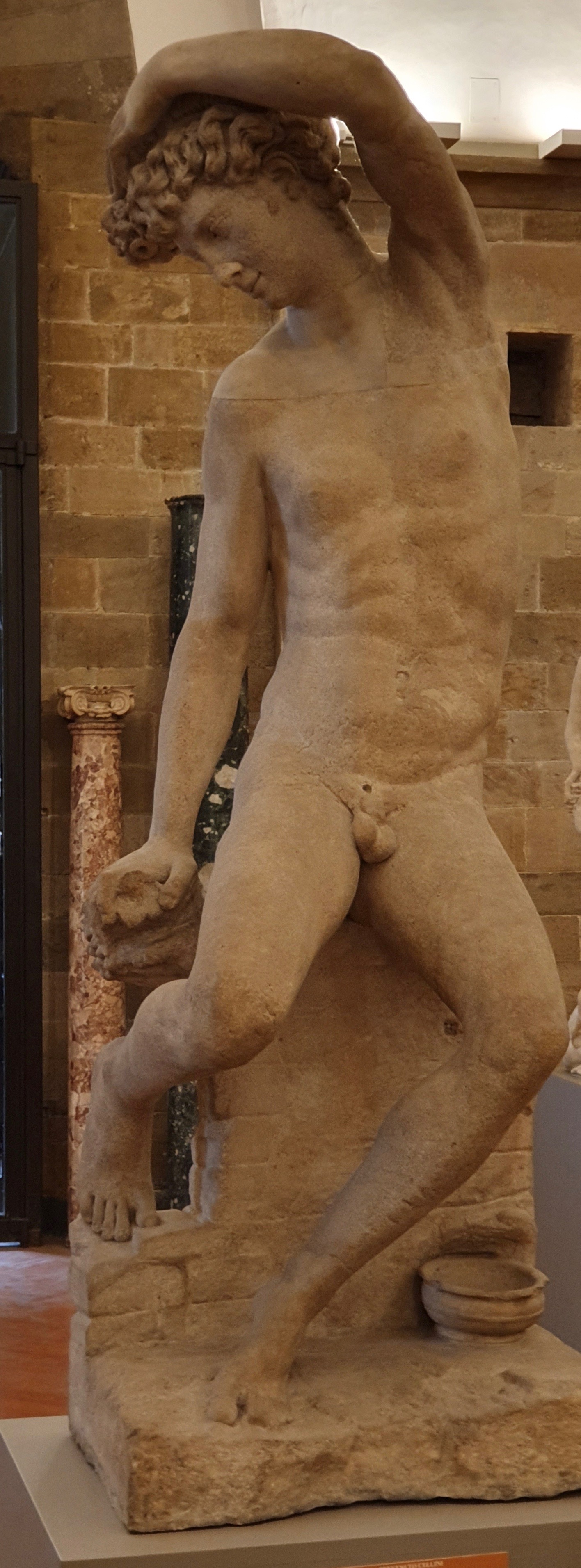
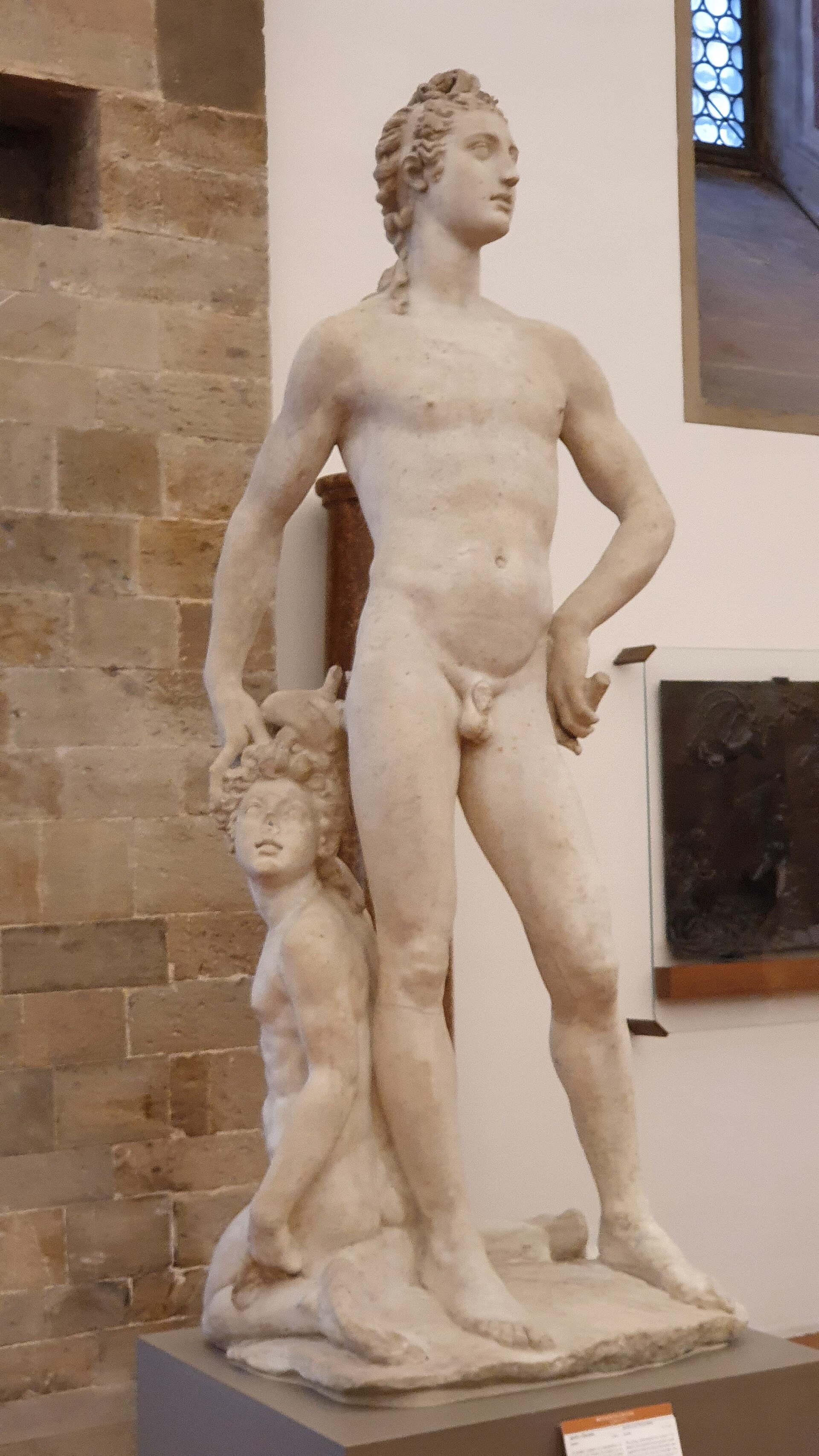
Restores an antique Roman Ganymede torso and begins the marble Narcissus, both now in the Bargello.3
Casts the four bronze pedestal statuettes for the Perseus monument (Jupiter, Danae with the infant Perseus, Minerva, Mercury).3
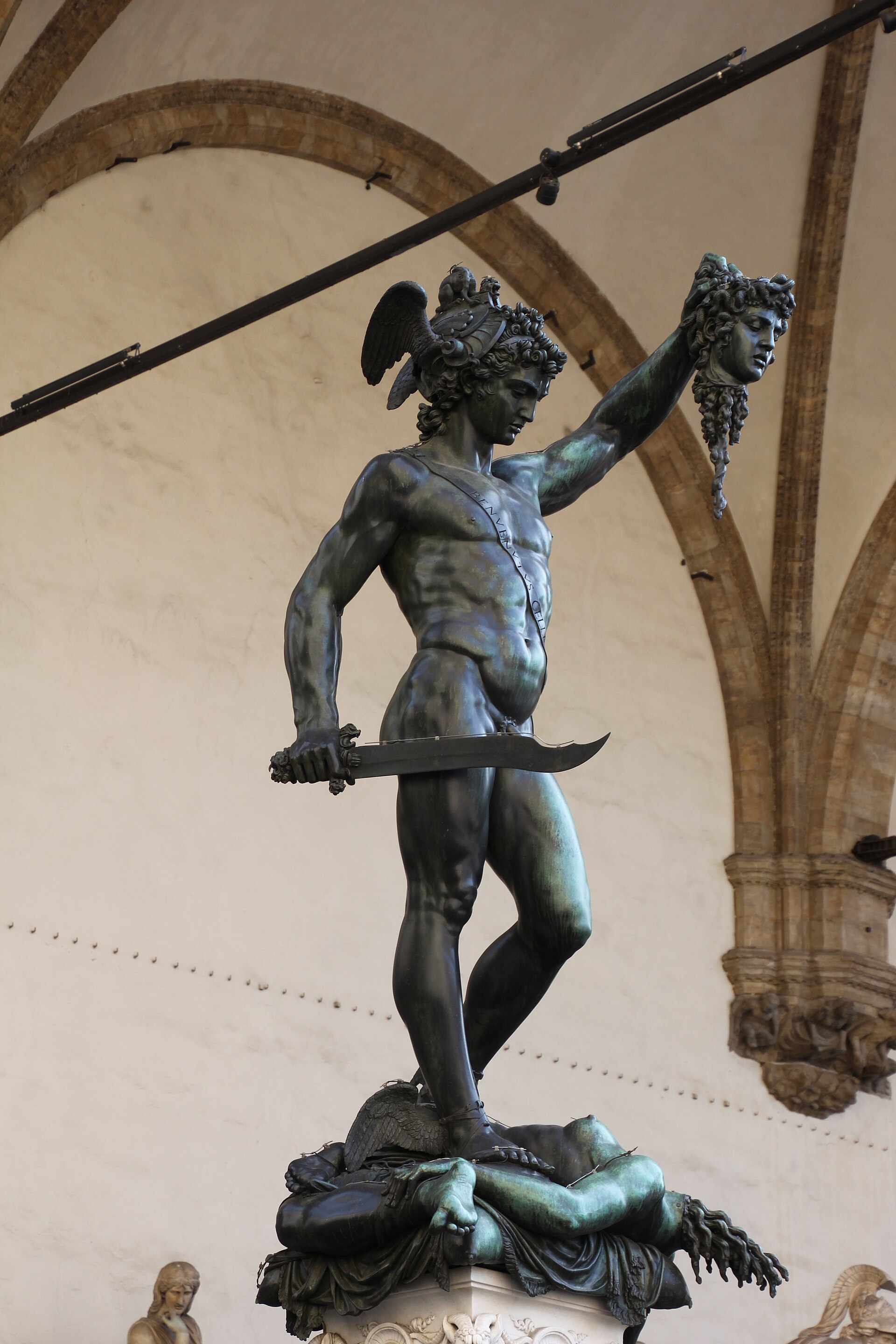
Perseus with the Head of Medusa is unveiled in the Loggia dei Lanzi, Piazza della Signoria, Florence, in April.23
Convicted of sodomy on the accusation of his apprentice Fernando di Giovanni di Montepulciano; fined fifty gold scudi and sentenced to four years' imprisonment, commuted to house arrest through Medici intercession.2
Carves the marble Crucifix later given by the Medici to Philip II of Spain, now at the Escorial monastery.23
Writes the Vita, beginning at fifty-eight; breaks off unfinished shortly before a final trip to Pisa.12
Marries his servant Piera Parigi.2
Named a member (Accademico) of the newly founded Accademia delle Arti del Disegno in Florence, 13 January, under the sponsorship of Giorgio Vasari, who paints Cellini's portrait into a court-artists fresco in the Palazzo Vecchio the same year.25
Writes and, in 1568, publishes in Florence his two technical treatises, on goldsmithing and on sculpture, the only works of his own printed in his lifetime.3
Dies in Florence, 13 February; gives all his sculptures, finished and unfinished, to Francesco I de' Medici shortly before death; buried in the Chapel of San Luca, Santissima Annunziata.23
The Vita is first printed, more than a century and a half after Cellini's death.2
The gold morse (clasp) Cellini made for Clement VII's cope is broken up, per later sources, among treasures surrendered to help pay the indemnity imposed on the Papal States by Napoleon's Treaty of Tolentino.2
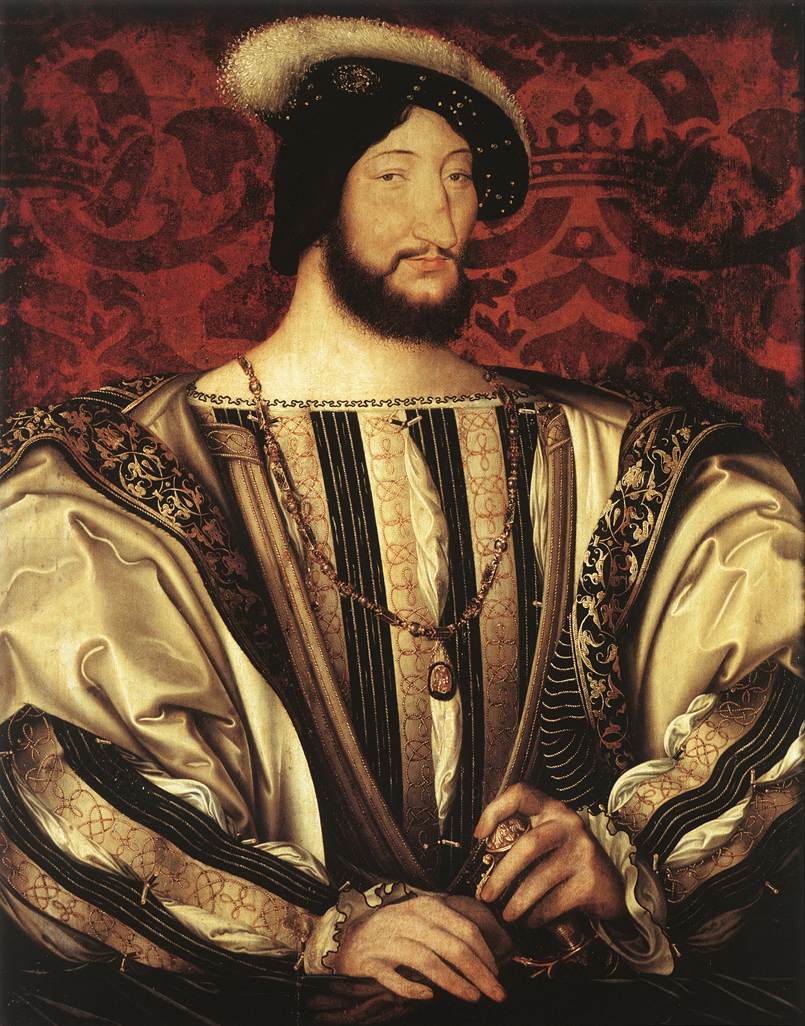
Eugene Plon disputes the traditional identification of Cellini's portrait in Vasari's 1563 fresco, arguing the figure is actually Bartolomeo Ammannati.5
The Rospigliosi Cup enters the Metropolitan Museum of Art as part of the Benjamin Altman bequest, catalogued as Cellini's work.49
Studies reaffirm the original sixteenth-century identification of Cellini's figure in the Vasari fresco against Plon's 1891 challenge.5
Perseus with the Head of Medusa is removed from the Loggia dei Lanzi for cleaning and conservation, December 1996, after pollution had streaked and banded the bronze; returned to display in June 2000.2
There is, in the ordinary sense, no market in Cellini's accepted work, because there is almost none of it left to trade. Every securely accepted object named in this record is in a public institutional collection, and none has a recorded modern auction appearance in the sources consulted; the absence is itself the finding the task of researching this page kept returning to. What princely goldsmith's work of this period generally suffered, being melted down for its bullion value across the centuries in wars, debts and regime change, appears to have happened to nearly everything else Cellini is documented to have made: two lost silver royal statues and a vase from the same French commission as the Saliera, a gold morse broken up in 1797 to help pay a war indemnity, a lost prayer-book cover, a lost chalice. Where a market does exist that touches Cellini's name, it is in printed matter and later reproductions, principally the antiquarian book trade in early editions of his own 1568 treatises and the Vita, a wholly different and far smaller market from the value that would attach to a unique autograph goldsmith or sculptural object, none of which is available to buy.
| Institution | City | Holdings | Note |
|---|---|---|---|
| Kunsthistorisches Museum | Vienna | The Saliera (Salt Cellar of Francis I), Kunstkammer, Room XXIX | Cellini's sole surviving work in gold, universally accepted; the single strongest attribution to his own hand that exists. |
| Museo Nazionale del Bargello | Florence | Bronze bust of Cosimo I de' Medici; marble Narcissus; marble Apollo and Hyacinthus; restored antique marble Ganymede | The largest single concentration of accepted Cellini sculpture. |
| Loggia dei Lanzi, Piazza della Signoria | Florence | Bronze Perseus with the Head of Medusa and its four pedestal statuettes | In situ since 1554, apart from the 1996-2000 removal for cleaning. |
| Musee du Louvre | Paris | Nymph of Fontainebleau (bronze tympanum) | The sole surviving element of an unfinished doorway made for Francis I at Fontainebleau. |
| Real Monasterio de El Escorial | San Lorenzo de El Escorial | Marble Crucifix, 1556-1562 | Given by the Medici to Philip II of Spain. |
| Museo Archeologico Nazionale | Florence | Small bronze Alexander and Bucephalus, incorporating antique Roman elements | 1548. |
| North Carolina Museum of Art | Raleigh | Small bronze Neptune with two seahorses, c. 1562 | |
| Metropolitan Museum of Art | New York | The Rospigliosi Cup | Not by Cellini. Catalogued as his work 1913 to 1969; reattributed by Yvonne Hackenbroch to Jacopo Bilivert of Delft in 1969, then to the Aachen goldsmith Reinhold Vasters in her 1984-85 monograph; the Museum's own current catalogue names no maker at all. Recorded separately on this title as a documented false attribution, not as part of Cellini's accepted corpus. |
Almost everything narrative told about Cellini's life comes from one source: the Vita, an autobiography he began dictating and writing in 1558, at the age of fifty-eight, and abandoned unfinished a...
Almost everything narrative told about Cellini's life comes from one source: the Vita, an autobiography he began dictating and writing in 1558, at the age of fifty-eight, and abandoned unfinished a few years later, shortly before his last trip to Pisa around 1563. It remained unpublished for over a century and a half after his death and was first printed only in 1728. Its own opening lines set out exactly why it should be read with suspicion as well as pleasure: Cellini states plainly that any man who has done something of excellence, if he is a person of truth and honesty, ought to write his own life, but should not attempt it until he has passed the age of forty. He was writing about a man of parts, courage and grievance, and that man was himself.
The book has been compared by later readers to Augustine's Confessions and Rousseau's, and it is a genuinely singular document: an artist of the first rank narrating his own commissions, patrons, rivalries, imprisonments and killings in his own voice, decades before anything comparable exists for any other goldsmith of the period. It is also, on the evidence of the text itself, a work of self-justification written by a man who admits to multiple killings and clearly wants the reader on his side for each of them. Where a claim in this record rests on the Vita alone and nowhere else, that is stated plainly rather than smoothed over.
Cellini was born in Florence on 3 November 1500, the second child of Giovanni Cellini, a musician and builder of musical instruments, and Maria Elisabetta Granacci.
Cellini was born in Florence on 3 November 1500, the second child of Giovanni Cellini, a musician and builder of musical instruments, and Maria Elisabetta Granacci. His father wanted him to become a musician and reluctantly agreed, when the boy was fifteen, to apprentice him instead to a goldsmith, Antonio di Sandro, known as Marcone. At sixteen he had already attracted attention in Florence by taking part in a street fight with other young men and was banished from the city for six months, a pattern of violence followed by displacement that recurs through the rest of his life. He worked in Siena for a goldsmith named Fracastoro during the banishment, then in Bologna, where he also became an accomplished player of the cornett and flute, before moving to Rome at nineteen to work as a goldsmith among the city's specialist trades: chased medals, engraved cardinals' seals, and enamel work, all crafts he names admiringly in his own account of the Roman goldsmiths he studied and competed against, among them the Milanese medallist Caradosso, whose name he records as Ambrogio Foppa.
In Rome Cellini's early work won him the patronage of Pope Clement VII, for whom he cut dies at the papal mint and worked as a jeweller, including years spent on a gold clasp, or morse, for the...
In Rome Cellini's early work won him the patronage of Pope Clement VII, for whom he cut dies at the papal mint and worked as a jeweller, including years spent on a gold clasp, or morse, for the pope's cope, set with what Cellini describes as one of the largest diamonds then known. Neither the morse nor a companion chalice for the same pope survives: later sources record that Pope Pius VI had it and other treasures broken up in 1797 to help meet the indemnity Napoleon imposed on the Papal States under the Treaty of Tolentino, a documented instance of exactly the melting-for-bullion attrition that accounts for almost everything else Cellini made in precious metal.
During the Sack of Rome in 1527, Cellini served as a bombardier defending the Castel Sant'Angelo, where Clement VII had taken refuge, and by his own account did real, useful service: he says he kept the castle's abandoned artillery firing when the assigned gunners had broken down in grief at watching their own families sacked below the walls. He also claims, in the same passage, to have personally shot and killed Charles III, Duke of Bourbon, the commander of the besieging Imperial army, in heavy fog at long range, and separately to have wounded Philibert of Chalon, Prince of Orange. His own translator's footnote on the Bourbon claim is blunt: all historians agree Bourbon was shot dead placing ladders against the walls near where Cellini was standing, but the honour of firing the shot cannot be assigned to any one person in particular. The claim is graded here as Cellini's own, undisprovable and unprovable, and repeated by him with obvious pride.
On 27 May 1529, Cellini's younger brother Giovanfrancesco, called Cecchino, a professional soldier, was killed avenging a friend, Bertino Aldobrandi, who had been cut down by an officer of the city...
On 27 May 1529, Cellini's younger brother Giovanfrancesco, called Cecchino, a professional soldier, was killed avenging a friend, Bertino Aldobrandi, who had been cut down by an officer of the city guard in a street brawl in Rome. Cecchino ran the guard's corporal through and was himself shot in the leg by an arquebusier acting, as Cellini records without softening it, in self-defence; he died some hours later. Cellini had a monument carved for him and altered the family coat of arms so that the heraldic lion held an axe rather than the traditional lily, stating in his own account that he did this so that he himself would never forget to avenge his brother.
He kept the promise. By his own detailed narration, he stalked the arquebusier who had fired the fatal shot for weeks, then attacked him outside his house near the Torre Sanguigna in Rome, wounding him with a dagger blow that broke his shoulder before killing him with a second blow to the base of the skull as he fled. Cellini fled to the protection of Duke Alessandro de' Medici and was never formally charged; Clement VII, on next seeing him, said only, according to Cellini, "Now that you are cured, Benvenuto, take heed how you live," which Cellini and his translator both read as the pope's tacit acknowledgment that he knew exactly what had happened and had decided to overlook it.
Cellini's most consequential killing came in 1534.
Cellini's most consequential killing came in 1534. During the vacancy following Clement VII's death, he killed a rival goldsmith, Pompeo de' Capitaneis, known as Pompeo of Milan, stabbing him in the street in Rome after what Cellini describes as a long-running provocation. He went into hiding under the protection of Cardinal Cornaro, and when Cardinal Alessandro Farnese was elected Pope Paul III only days later, the new pope, wanting Cellini back at work on his coinage, was told of the killing by an adviser who warned that granting pardons so early in a new papacy might look bad. Cellini's own account of the pope's reply is exact and became one of the most quoted lines associated with him: "You know less about such matters than I do. Know then that men like Benvenuto, unique in their profession, stand above the law; and how far more he, then, who received the provocation I have heard of?" A formal pardon followed at the traditional August amnesty granted to twelve outlaws by the city magistrates of Rome. Whatever the truth of the provocation, the sentence establishes as documented fact that a reigning pope pardoned Cellini by name for a killing within days of his own election.
In 1538, at thirty-seven, Cellini was arrested and imprisoned in the Castel Sant'Angelo on a charge, which he insists was fabricated, of embezzling roughly eighty thousand crowns' worth of jewels he...
In 1538, at thirty-seven, Cellini was arrested and imprisoned in the Castel Sant'Angelo on a charge, which he insists was fabricated, of embezzling roughly eighty thousand crowns' worth of jewels he had been trusted to unset from Clement VII's regalia and sew into the pope's clothing during the chaos of the 1527 sack. His own account of his examination before the Governor of Rome and two other officials is a set-piece of controlled fury, ending with a demand that they check the Apostolic Camera's own jewel registers, which they did, finding nothing missing; he was kept in the castle regardless, in part because Pier Luigi Farnese, the pope's son, stood to gain financially from a conviction. Francis I of France intervened directly through his ambassador, claiming Cellini as his own subject, which only deepened Paul III's determination to keep him rather than be seen to yield.
Cellini's own description of his escape, made under his parole to a castellan he says treated him with real kindness, is one of the most detailed action narratives in the whole book: cutting new bedsheets into strips and sewing them into a rope, stealing a pair of pincers from a guard to draw the nails from his cell door's hinges, faking the nail heads with wax mixed with iron rust so nightly inspections would not notice, and finally climbing out over the castle's roofs and down the outer walls in the dark. On the last descent his hands gave out or he misjudged the drop; he fell, struck his head, and broke his right leg three inches above the heel on the metal ball of his own dagger's sheath. He bound the leg with a strip of the same linen and crawled the final stretch to a gap under the city gate on his hands and knees. He was recaptured within days and held under harsher conditions, including, according to his own later account and secondary sources, a period in which he genuinely feared being poisoned, before the intercession of Pier Luigi's wife and of Cardinal Ippolito d'Este of Ferrara secured his eventual release.
Cellini worked at the court of Francis I through the early 1540s, the years in which he made the Saliera, the gold salt cellar for Francis I now in Vienna's Kunsthistorisches Museum and the single...
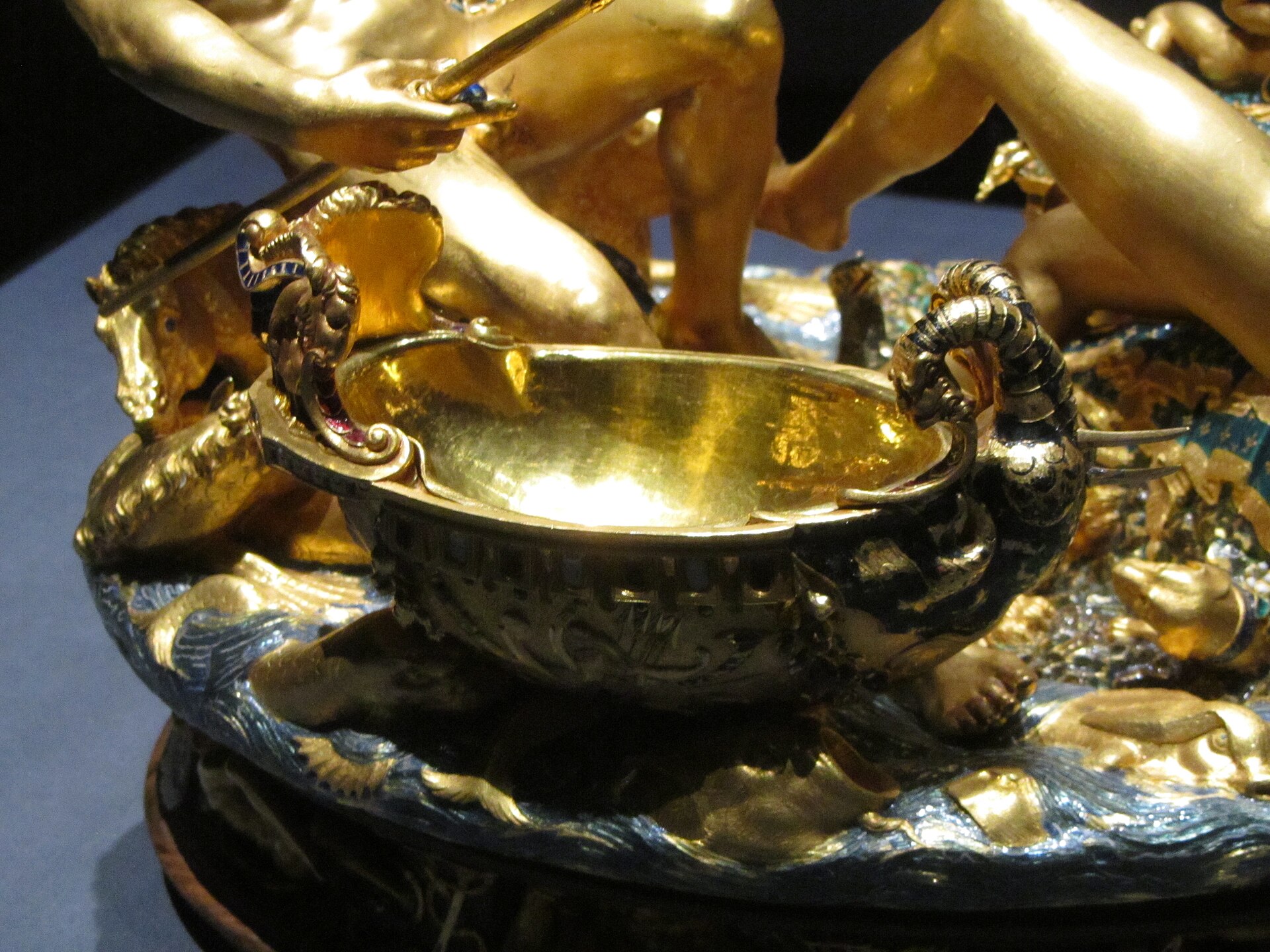
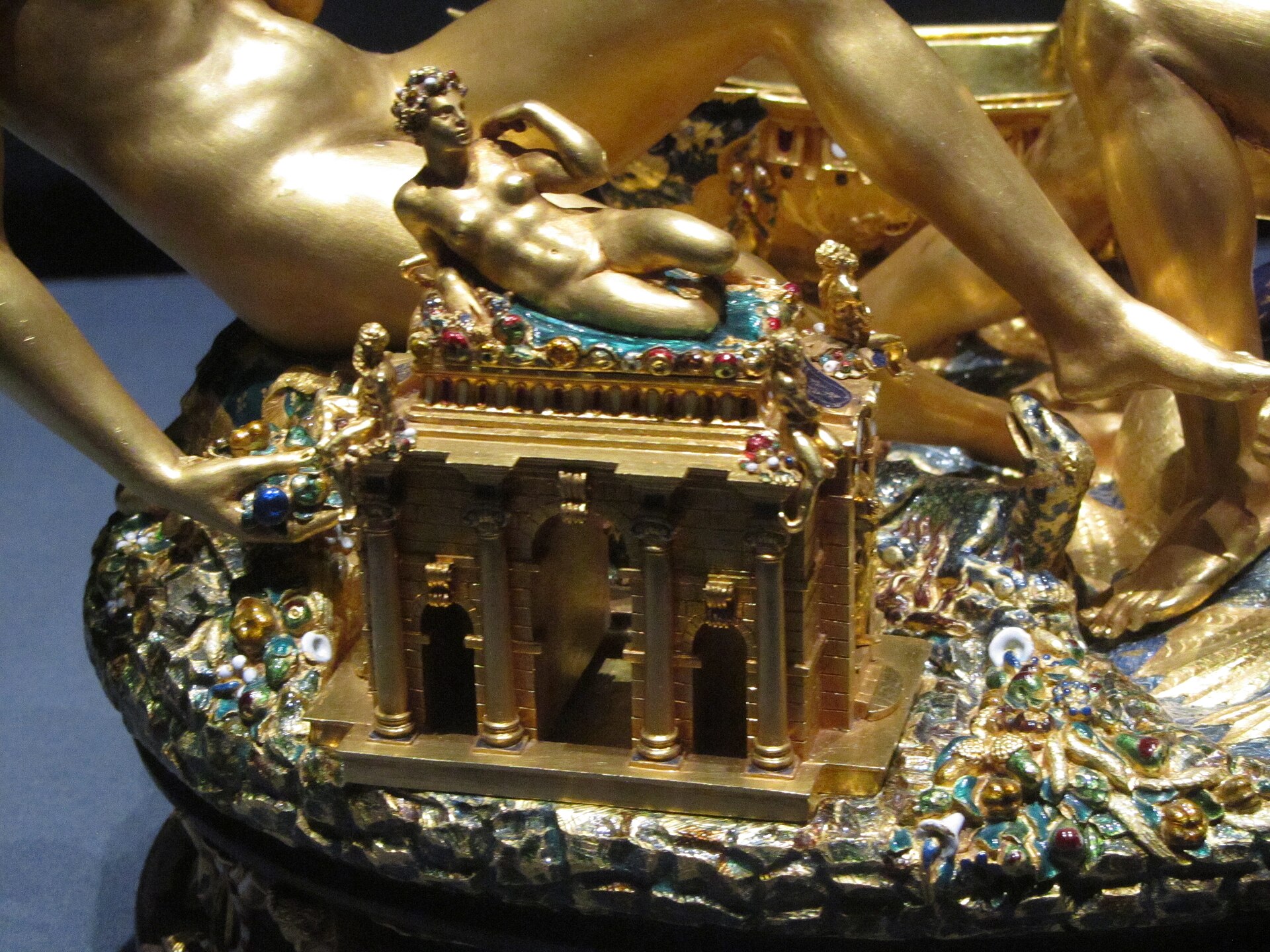
Cellini worked at the court of Francis I through the early 1540s, the years in which he made the Saliera, the gold salt cellar for Francis I now in Vienna's Kunsthistorisches Museum and the single work in gold universally accepted as being from his own hand. That object carries its own separately published record on this title, with its full provenance chain, its 1993-2006 theft and recovery, and its technical evidence set out at length; it is treated here only for what it establishes about Cellini himself. He designed the piece first for Cardinal Ippolito II d'Este in Rome, whose adviser warned it would take the working lives of ten men to finish and that the Cardinal should not expect to see it completed in his lifetime; the Cardinal declined to commission it in precious metal on those grounds of scale rather than cost, and Cellini's own account of overruling the Cardinal's literary advisers on the subject matter, "You have spoken, I will do," is characteristic of how he wanted to be seen: the sole author of his own designs, deferring to no patron's committee.
What the French years also establish, in his own figures, is what royal patronage of this kind actually paid. Cellini records that Francis I gave him a thousand gold crowns a year for board alone, separate from payment for his labour, and that in the king's service he made more than four thousand gold crowns in a single year, a sum he later cited, when Sicilian agents tried to recruit him away from a much more modest arrangement in Florence, as proof he had not stayed loyal to Cosimo I out of financial need. No source consulted supplies an independent period-wage comparison that would translate either figure into a modern equivalent with a stated method, so none is asserted here; the number is recorded as Cellini's own, in his own currency, for a reader to weigh directly.
Cellini returned to Florence in 1545 and was taken into the service of Duke Cosimo I de' Medici, who gave him a house on Via del Rosario with a foundry attached and, per the sources consulted, an...
Cellini returned to Florence in 1545 and was taken into the service of Duke Cosimo I de' Medici, who gave him a house on Via del Rosario with a foundry attached and, per the sources consulted, an annual salary of two hundred scudi, a figure this record was not able to verify against a primary account and flags accordingly. Cosimo set him two major commissions: a bronze portrait bust of himself, cast in 1545-1548 (sources differ within that range) and now in the Bargello, and a large bronze group of Perseus holding the severed head of Medusa, intended for the Loggia dei Lanzi on the Piazza della Signoria, in the same square as Michelangelo's David and Donatello's Judith and Holofernes.
The placement was not incidental. Standing beside the two works it was meant to be judged against, a mythological hero displaying the head of a monster he has just killed reads, as the literature on the piece treats it, as a direct visual argument for princely power exercised through decisive, sanctioned violence, the same claim Cosimo I's Medici dukedom made about itself in Florence after 1537. Cellini himself does not gloss the political reading in his own account; it is the argued position of later art historians reading the object against its setting and its patron, not a claim this record attributes to Cellini's own stated intention.
Cellini's own narration of casting the bronze for Perseus is the most vivid single passage in the entire Vita and has been reproduced, excerpted and dramatised more than any other episode of his...
Cellini's own narration of casting the bronze for Perseus is the most vivid single passage in the entire Vita and has been reproduced, excerpted and dramatised more than any other episode of his life, including in a nineteenth-century print by Henri Fantin-Latour. Partway through the pour, exhausted and running a sudden violent fever, he collapsed into bed convinced he was dying, only to be told the mould had failed and the metal had curdled in the furnace. By his own account he leapt up, dressed, drove his terrified assistants back to work by force of will alone, and when the recharged furnace still would not flow properly, ordered roughly two hundred of his own household's pewter plates, cups and bowls broken up and thrown into the mix to restore the alloy, an improvisation he says none of the assembled master founders had ever seen attempted before. The mould filled. When he uncovered the cooled bronze two days later, the head of Medusa and the head of Perseus had both come out perfectly, and only part of one foot was left unfinished, a detail Cellini says he had predicted to Duke Cosimo in advance and took particular pride in having been right about.
The story is Cellini's own and appears nowhere else independently; it is graded here as documented only to the extent that the finished bronze survives and the missing portion of the foot is a real, checkable feature of the object, which lends the account more credibility than most of his self-narrated exploits, without making every detail of the telling itself verifiable.
The gap between what Cellini is documented to have made and what can be seen today is not an accident of neglect; it is the ordinary fate of princely goldsmith's work across European history, which...
The gap between what Cellini is documented to have made and what can be seen today is not an accident of neglect; it is the ordinary fate of princely goldsmith's work across European history, which functioned as a standing form of liquid reserve and was melted down for bullion in wars, debts and regime change far more often than it was preserved as art. Cellini's own French commission supplies the clearest illustration inside his own career: a life-sized silver Jupiter and a large silver vase, made for Francis I in the same years and by the same commission as the Saliera, are not known to survive in any form. The gold morse made for Clement VII's cope, on which he worked for years and describes at length, was broken up in 1797 to help pay Napoleon's indemnity against the Papal States. A gold cover for a prayer book, a gift from Paul III to the Emperor Charles V that Cellini also describes making in detail, is likewise lost.
Against that, what is accepted as surviving in Cellini's own hand is a short list that can be named in full: the Saliera in Vienna; the bronze Perseus with the Head of Medusa and its four pedestal statuettes of Jupiter, Danae with the infant Perseus, Minerva and Mercury, cast in 1552, in the Loggia dei Lanzi; the bronze bust of Cosimo I in the Bargello; a marble Crucifix, carved 1556-1562, later given by the Medici to Philip II of Spain and now at the Escorial; the bronze tympanum known as the Nymph of Fontainebleau, the only surviving element of an unfinished French royal doorway, now in the Louvre; two marble figures, Narcissus and Apollo and Hyacinthus, worked at intervals between about 1548 and 1557 and both in the Bargello; and a marble restoration of an antique Roman Ganymede torso, also in the Bargello, on which Cellini carved new head, arms and attributes onto a genuinely ancient fragment rather than working from scratch. A small bronze Alexander and Bucephalus in Florence's Museo Archeologico Nazionale is similarly built in part from ancient Roman elements. Beyond the sculpture, a handful of small decorative and functional objects in iron, a damascened flask and a sculpted iron key for a strongbox, both worked in gold and silver inlay, survive in a single private collection in Novara. There is, on the evidence gathered here, effectively no secondary market in any of this: none of it is known to be in private hands, and none of it has a recorded modern auction appearance, because there is almost nothing left to sell.
The clearest illustration of how thin the margin for error is on a Cellini attribution is an object that is not by him at all.
The clearest illustration of how thin the margin for error is on a Cellini attribution is an object that is not by him at all. The Rospigliosi Cup, a gold and enamel drinking vessel that entered the Metropolitan Museum of Art in New York in 1913 as part of the Benjamin Altman bequest, was catalogued and exhibited as Cellini's work for decades and became one of the most visited objects in the museum. It is now established, on construction evidence rather than style, to be a nineteenth-century object; Yvonne Hackenbroch reattributed it first to Jacopo Bilivert of Delft in 1969, then, in her own 1984-85 monograph, to the Aachen goldsmith Reinhold Vasters, who worked between 1853 and 1890 and whose own preliminary sketches for pieces later sold as Renaissance masterpieces have since come to light; the Metropolitan's own current catalogue names no maker at all. Vasters' skill at replicating Cellini's manner was close enough that only taking the cup apart exposed the problem: it is built with soft solder hidden under electrotype gilding and cast in unorthodox sections, construction methods that were not available to a sixteenth-century goldsmith. This publication carries a separate, fuller record on the object itself, including its own successive reattributions after being taken from Cellini's name.
The contrast with the Saliera sharpens rather than complicates the point. The Rospigliosi Cup's attribution to Cellini rested on style alone and did not survive technical examination. The Saliera's rests on a documented royal commission, Cellini's own detailed first-person account of designing and delivering it, and an unbroken chain of ownership from the French crown to the Habsburg Kunstkammer to a public museum. Style alone, on this evidence, is not enough to hang a Cellini attribution on; construction and documentation are what actually hold.
Alongside the Vita, Cellini spent part of his last decade writing two technical treatises, one on goldsmithing and one on sculpture, begun in 1565 and finished three years later, when both were sent...
Alongside the Vita, Cellini spent part of his last decade writing two technical treatises, one on goldsmithing and one on sculpture, begun in 1565 and finished three years later, when both were sent to print in Florence in 1568, the only work of his own that Cellini saw published in his lifetime. They describe, in his own words rather than a later scholar's reconstruction, the working methods visible in his surviving objects: a complete model made first, in wax, at full intended size, before any metal is touched; hammering and chasing sheet gold and silver by hand for fine figural work, as distinct from casting, which he treats in the treatises as the coarser, faster method proper to larger bronze sculpture such as the Perseus. Read together with the Perseus casting narrative in the Vita, the treatises are a genuine primary technical source for how sixteenth-century goldsmith's work was actually made, from the one working goldsmith of the period who troubled to write the process down for other practitioners rather than for a patron or a biographer.
Cellini's rivalry with the sculptor Baccio Bandinelli, already established over decades of Florentine competition for ducal favour, is documented independently of the Vita in a way few of his other...
Cellini's rivalry with the sculptor Baccio Bandinelli, already established over decades of Florentine competition for ducal favour, is documented independently of the Vita in a way few of his other conflicts are. Sources consulted, tertiary and flagged as such, record a public exchange before Duke Cosimo in which Bandinelli called Cellini a filthy sodomite; Cellini describes the moment in his own account only as an atrocious insult he tried to laugh off, without repeating the word. Court records cited in the secondary literature show Cellini was fined for sodomy once as a young man in 1523, over a relationship with another man named Domenico di Ser Giuliano da Ripa, and convicted again in 1556 on the accusation of his own apprentice, Fernando di Giovanni di Montepulciano, receiving a fine of fifty gold scudi and a four-year prison sentence that was commuted to house arrest through Medici intercession. Cellini's own memoir passes over both episodes in silence; the record of them survives only because Florentine and Roman court and notarial records outlived his own editorial control of his story, a useful corrective to how selectively the Vita tells its own history.
Bandinelli's own professional judgment of Cellini's work, for what it is worth from a declared rival, survives independently too: asked by Duke Cosimo to value the finished Perseus so the duke could pay a fair price, Bandinelli, despite being on openly bad terms with Cellini, told the duke's intermediaries the work was rich, beautiful and excellent in execution, and that sixteen thousand crowns or more would not be an excessive price. Cellini, characteristically, refused to accept the compliment gracefully, saying he would take no praise from a man who spoke ill of everybody.
Cellini's own appearance is known chiefly from a single contemporary source: a small figure among the court artists of Duke Cosimo I painted by Giorgio Vasari in a round fresco, or tondo, in the...
Cellini's own appearance is known chiefly from a single contemporary source: a small figure among the court artists of Duke Cosimo I painted by Giorgio Vasari in a round fresco, or tondo, in the Palazzo Vecchio in 1563, in Cellini's own final years. Vasari's own inscription names nine of the eleven figures shown, Cellini among them under the caption "Benvenuto SCVL," and the identification was accepted without challenge from the sixteenth century until 1891, when the French scholar and Cellini biographer Eugene Plon argued in print that the figure traditionally called Cellini was in fact Bartolomeo Ammannati, and that a different figure was the real Cellini. Later studies, in 1971, reaffirmed the original sixteenth-century identification against Plon's challenge, and it is that reaffirmed reading this record's portrait plate follows, with the dispute recorded rather than smoothed over.
The confusion did not stop there. A widely circulated 1771 engraving by the British artist Joseph Collyer, commissioned specifically as a portrait of Cellini and based on the same Vasari tondo, in fact reproduced the wrong figure entirely: Collyer misidentified his source and engraved a portrait of Vasari himself, not Cellini, and that mistaken image circulated under Cellini's name for decades. A later and more careful engraving of the correct tondo figure by Raffaello Morghen, made in 1822, became the image most widely reproduced as Cellini's likeness afterward. No self-portrait by Cellini's own hand, in any medium, was located in the sources consulted for this record with a secure and undisputed identification; the possible self-portrait drawings referenced in some literature are noted with a question mark by their own cataloguers and are not used here.
Cellini died in Florence on 13 or 14 February 1571 (sources consulted give both dates without resolving the discrepancy) and, shortly before his death, gave all his sculptures, described in the...
Cellini died in Florence on 13 or 14 February 1571 (sources consulted give both dates without resolving the discrepancy) and, shortly before his death, gave all his sculptures, described in the period record as "finite et non finite," finished and unfinished alike, to Francesco I de' Medici, Cosimo I's son and successor. He was buried in the Chapel of San Luca, the chapel of the Accademia delle Arti del Disegno within the church of Santissima Annunziata in Florence, the same academy that had made him one of its first members in January 1563 at Vasari's own instigation. He had married a servant, Piera Parigi, in 1562, and named five children by her, of whom a son and two daughters are recorded as surviving him.
What happened to the sculptures given to Francesco I as a single lifetime gift, whether any unfinished pieces from that bequest can be identified among the surviving Bargello works or whether they were dispersed or lost, is not established by any source consulted here and is recorded as an open question rather than resolved with a guess. The same caution applies across this entire record: an author this good at telling his own story, about a body of work this small and this heavily melted, leaves an unusually wide gap between what is narrated and what can actually be checked, and that gap is the single most important thing to carry into reading anything else written about him.
Goldsmith; Sculptor; Medallist; Author. 1500-1571.
Born 3 November 1500, Florence, Republic of Florence; died 13 February 1571, Florence, Grand Duchy of Tuscany.
The Rospigliosi Cup. A gold and enamel cup, in the Metropolitan Museum of Art since the 1913 Benjamin Altman bequest, catalogued and displayed as Benvenuto Cellini's work for over half a century.
Kunsthistorisches Museum (Vienna); Museo Nazionale del Bargello (Florence); Loggia dei Lanzi, Piazza della Signoria (Florence); Musee du Louvre (Paris); Real Monasterio de El Escorial (San Lorenzo de El Escorial); Museo Archeologico Nazionale (Florence).
There is, in the ordinary sense, no market in Cellini's accepted work, because there is almost none of it left to trade. Every securely accepted object named in this record is in a public institutional collection, and none has a recorded modern auction appearance in the sources consulted; the absence is itself the finding the task of researching this page kept returning to.
What became of the sculptures, finished and unfinished, that Cellini gave to Francesco I de' Medici shortly before his death in 1571 is not established by any source consulted; whether any can be identified among the surviving Bargello works is unresolved.
A maker's bill, workbook or memoir is the only provenance document that fixes date, cost and first owner at once.
10 min read
Ten objects in this archive were stolen, some twice. In no case does the thief appear as an owner.
11 min read
Last verified
One artwork and its story every Tuesday, with the picture: who owned it, what it made, and what closes soon in the exhibition calendar. No promotion, and nothing we cannot cite.
We send one email to confirm the address and keep nothing else. Every letter carries a one-click unsubscribe. How we handle your data.
_Portrait_of_Benvenuto_Cellini_on_the_fresco_Cosimo_I_di_Medici_among_court_sculptors,_architects_and_engineers.png)