Saliera (Salt Cellar of Francis I)
Benvenuto Cellini · 1540-1543
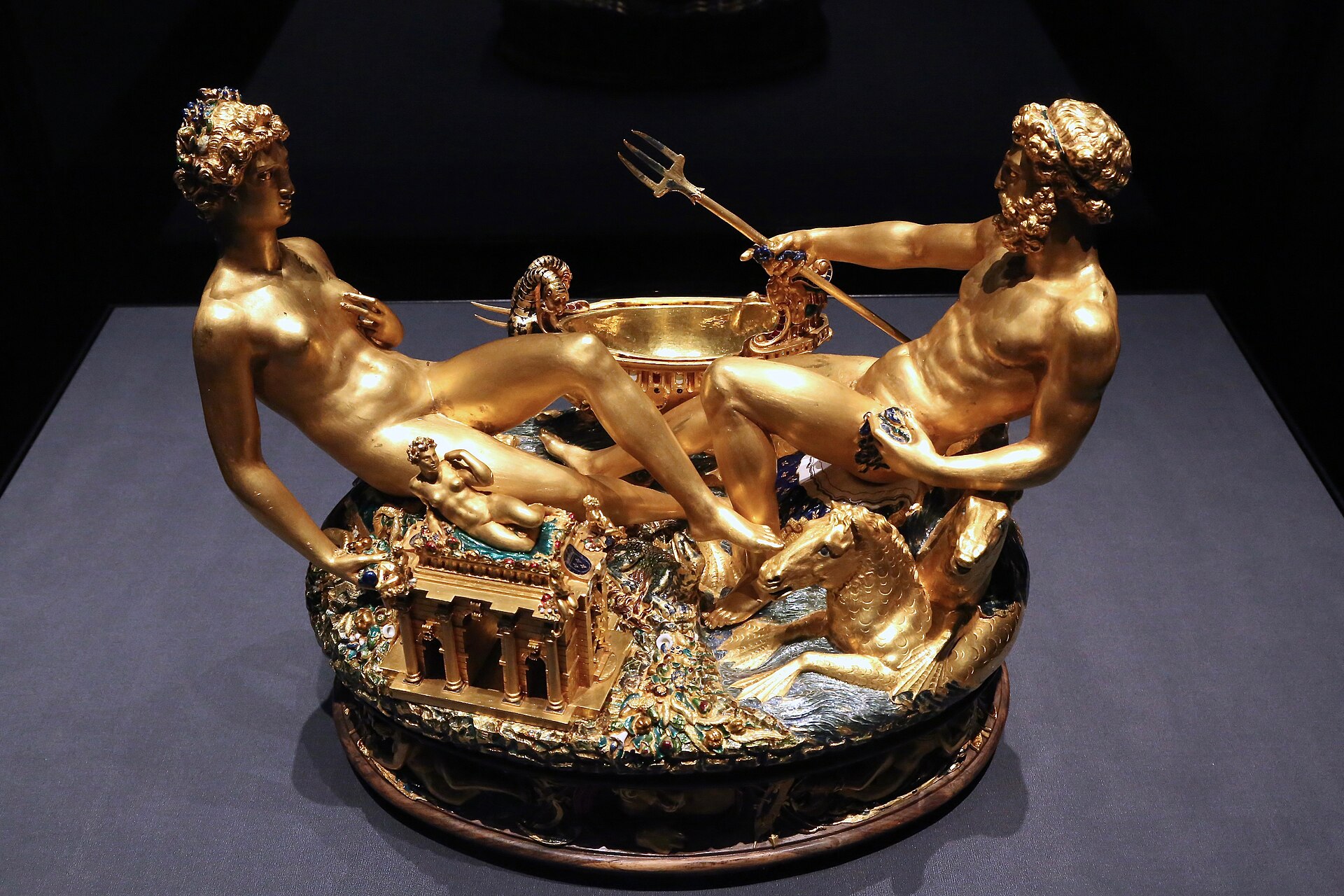
The Saliera as displayed at the Kunsthistorisches Museum, Vienna. Neptune, holding his trident, sits opposite the earth goddess, their legs interlaced across the oval base.
Photograph by Dr. Alexey Yakovlev, via Wikimedia Commons, CC BY-SA 2.0| Artist | Benvenuto Cellini |
|---|---|
| Date | 1540-1543 |
| Medium | Gold, hammered and chased, with vitreous enamel, on a base of ebony with gilt mounts; ivory elements are recorded in the museum's own materials list |
| Dimensions | 28.5 x 21.5 x 26.3 cm (Kunsthistorisches Museum's own published figures). Wikipedia and other secondary sources give a differing 26.3 x 28.5 cm / 10.4 x 11.2 in without ascribing the figure to a named cataloguer; this record follows the holding institution. |
| Where it is now | Kunsthistorisches Museum, Vienna, Kunstkammer, Room XXIXlast confirmed |
| Inventory number | Kunstkammer, Inv. Nr. 881 |
| Attribution | AcceptedUniversally accepted on the strength of Cellini's own detailed written account of designing and making the piece in his autobiography (the Vita, written 1558-1563), corroborated by an unbroken and documented chain of ownership from the French royal treasury to the Habsburg Kunstkammer to the Kunsthistorisches Museum. Full note |
| Object type | Goldsmith's work |
| Period | Renaissance and Mannerist Europe, mid-sixteenth century, made at the French royal court |
| Inscriptions | None documented. No signature or maker's mark is recorded on the object; its authorship is established by Cellini's own written account and by continuous provenance rather than by an inscription. |
| Owners on record | 8 links8 documented |
| Sources | 20 cited |
About this record Last verified · 20 sources cited · Change log
On this page 9 sections
ContentsClose
A gold table sculpture just under thirty centimetres across, made for Francis I of France between 1540 and 1543, and the only work in gold universally accepted as being by Benvenuto Cellini's own hand. Neptune and the earth goddess recline across an oval base, their legs interlaced to signify where sea runs into land, holding a ship for salt and a small temple for pepper; the king who owned it is present only in his emblems, a salamander and a coat of arms, so that the object reads as an allegory of a king ruling the whole compassed world while he seasons his food.
It survived where its royal companions in gold and silver, made in the same commission, did not, and it survived a criminal history as vivid as its art-historical one: stolen from the Kunsthistorisches Museum in Vienna in under a minute in 1993 by a security-alarm engineer who had inspected the building's defences, held for nearly three years while its thief tried to ransom it back to the museum's own insurer by text message, and recovered undamaged, or nearly so depending on which account is read, from a lead box buried in an Austrian forest in January 2006.
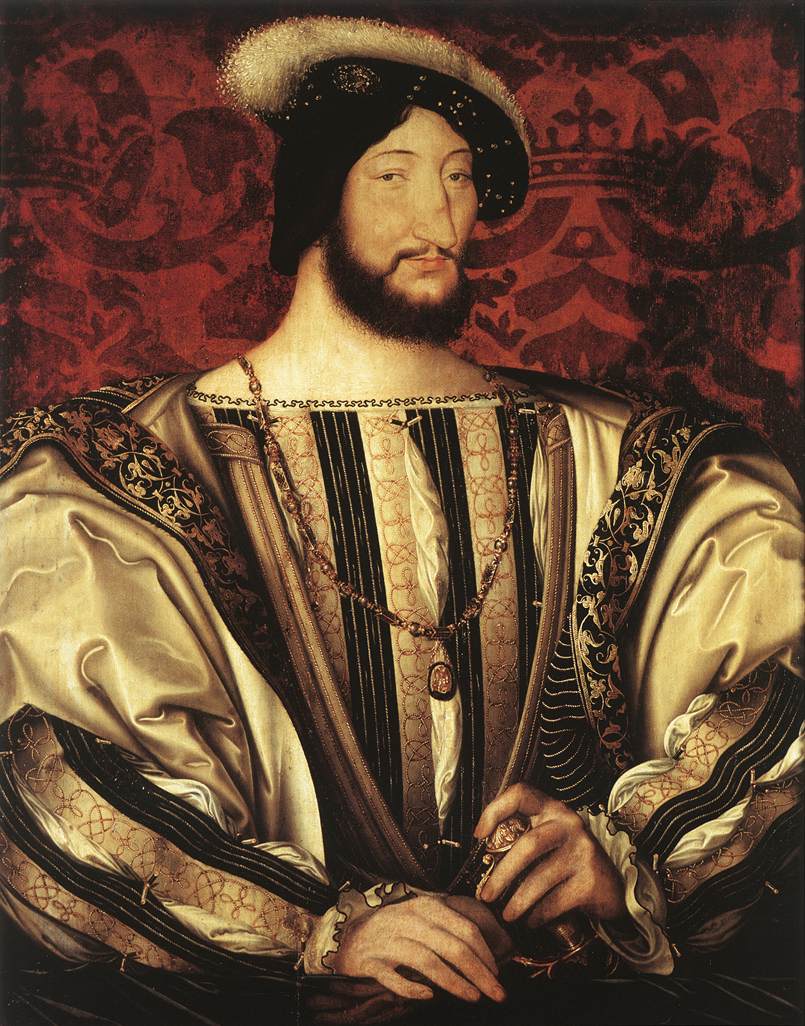
Its passage from the French crown to Vienna was itself a piece of sixteenth-century diplomacy: given by Charles IX of France to his new wife's uncle as thanks for standing in for him at a proxy wedding meant to bind the French crown to the Habsburgs. It has been the single most recognisable object in the Kunsthistorisches Museum's Kunstkammer since 1891, and the theft has become, whether the museum intends it or not, part of what visitors are told about it today.
Provenance
Each link is graded. Documented: a cited source supports it. Disputed: the identification is argued but not established. Unknown: no owner for that span, and the gap is not smoothed into a narrative. The grades in the glossary.
- c. 1539 - 1540Cardinal Ippolito II d'Este (Cardinal of Ferrara)documented
Commissioned a model for a salt cellar from Cellini in Rome, then declined to have it executed in precious metal on grounds of cost and time, after his adviser Gabriello Cesano warned it would take ten men's working lives to finish. Cellini kept the wax model.114
- 1540 - 1543Francis I, King of Francedocumented
Cellini showed his existing wax model to Francis I at the French court; the king ordered it carried out in gold immediately and provided a thousand crowns of gold for the material. Completed and delivered by 1543, per Cellini's own detailed account in his autobiography.1
- 1543 - 1570French royal crown (Francis I and his successors)documented
Remained French crown property following Francis I's death in 1547 until Charles IX gave it away in 1570. The intervening custodial detail, which residence held it and whether it was displayed, is not established in sources consulted; recorded as a gap in an otherwise documented span.5
- 1570-10-26 - 1570Gift transactiondocumented
Given by Charles IX of France to Archduke Ferdinand II of Tyrol at Speyer, in gratitude for Ferdinand standing as Charles's proxy at his wedding (by proxy) to Elisabeth of Austria, held at Speyer Cathedral on 22 October 1570; the couple were married in person the following month at Mezieres. The marriage was arranged to bind the French crown to the Habsburgs during the French Wars of Religion.51516
- 1570 - c. 1806-1891Archduke Ferdinand II of Tyrol and successors, Kunstkammer, Ambras Castledocumented
Held in Ferdinand II's Kunstkammer at Ambras Castle near Innsbruck, one of the defining princely collections of the Renaissance and now regarded as the oldest surviving purpose-built museum in the world. The Ambras holdings were transferred to Vienna progressively over the nineteenth century; the exact stages are not consistently dated across sources consulted.515
- 1891 - 2003-05-11Kunsthistorisches Museum, Viennadocumented
Entered the Kunsthistorisches Museum's collection with the rest of the former imperial Kunstkammer upon the museum's opening in 1891, and remained on view in the Kunstkammer until the 2003 theft.45
- 2003-05-11 - 2006-01-21Robert Mang (theft and concealment)documented
Stolen from its display case during the night of 11 May 2003, in well under a minute, after the thief climbed exterior restoration scaffolding and broke a window; the alarm was triggered and dismissed as false by museum security. Held by the thief for close to three years, reportedly under his own bed for much of that time, before an extortion attempt led to his identification.45789
- 2006-01-21 - presentKunsthistorisches Museum, Viennadocumented
Recovered by police, led by Robert Mang himself to a forest near Brand, Zwettl district, Lower Austria, where it had been buried in a lead-lined box. Returned briefly to display in early 2006, withdrawn for conservation (extent disputed between sources), and returned permanently to the Kunstkammer on 14 March 2006, where it remains.345
Technical evidence
| Attribution note | Universally accepted on the strength of Cellini's own detailed written account of designing and making the piece in his autobiography (the Vita, written 1558-1563), corroborated by an unbroken and documented chain of ownership from the French royal treasury to the Habsburg Kunstkammer to the Kunsthistorisches Museum. It carries no signature or maker's mark; authorship rests on the memoir and the provenance, not on an inscription. This is the single most secure attribution to Cellini as a goldsmith that exists, in explicit contrast to objects such as the Metropolitan Museum's Rospigliosi Cup, which carried an attribution to Cellini for over half a century before being withdrawn. |
|---|---|
| Support | Base of partially gilded ebony, with a projecting cornice carrying eight further gold figures in half-relief.12 |
| Medium | Gold, hammered from sheet and finished by chasing rather than cast; vitreous enamel; ivory elements recorded in the museum's own materials description.124 |
| Dimensions | 28.5 x 21.5 x 26.3 cm per the Kunsthistorisches Museum's own published catalogue entry. Wikipedia and several secondary sources instead give approximately 26.3 x 28.5 cm (10.4 x 11.2 in), without citing a source for the discrepancy; this record follows the holding institution's figures and flags the variance rather than silently picking one.24 |
| Technique | Full-size wax model made first (Cellini's standard practice, which he attributes to his training under the Milanese goldsmith Caradosso), then executed by hammering and chasing gold sheet, following the method Cellini himself describes in his later goldsmithing treatise.16 |
| Enamel composition | A published SEM-EDS (scanning electron microscopy with energy-dispersive X-ray spectroscopy) study of enamel samples reports a silicate glass coloured with sodium, potassium and copper compounds. This record was able to access only the paper's abstract and citation, not the full text (repeated fetch attempts returned an access error); flagged for an editor with institutional access to verify directly.19 |
| Location and inventory | Kunsthistorisches Museum, Vienna, Kunstkammer, Room XXIX. Inventory number Kunstkammer 881.2 |
| Condition, 2006 recovery | Disputed between sources. English-language reporting states the object was recovered undamaged. German-language sources describe scratches to the gold surfaces from glass fragments and improper storage, and chipped enamel, requiring roughly three weeks of conservation before permanent return to display on 14 March 2006. No published conservation report was located to resolve the discrepancy.45 |
| Companion commissions, not surviving | A silver statue of Jupiter and a large silver vase, made by Cellini for Francis I in the same period and by the same royal commission as the Saliera, are not known to survive.1 |
Images

The record in full
Chapter 1What it is
The Saliera is a table sculpture in gold, roughly oval, about 28.5 by 21.5 centimetres and 26.3 centimetres high on the Kunsthistorisches Museum's own published figures, standing on a base of...
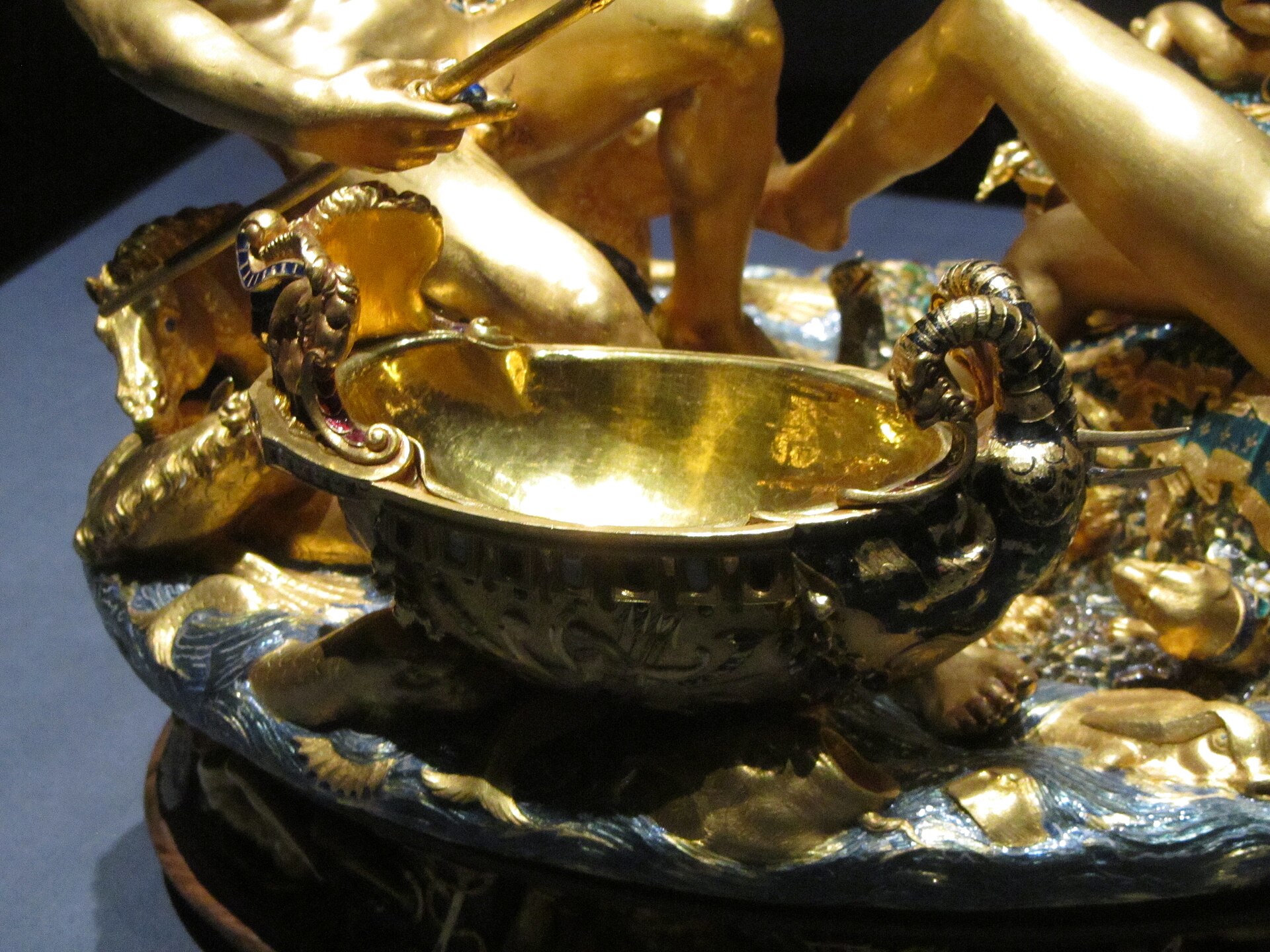
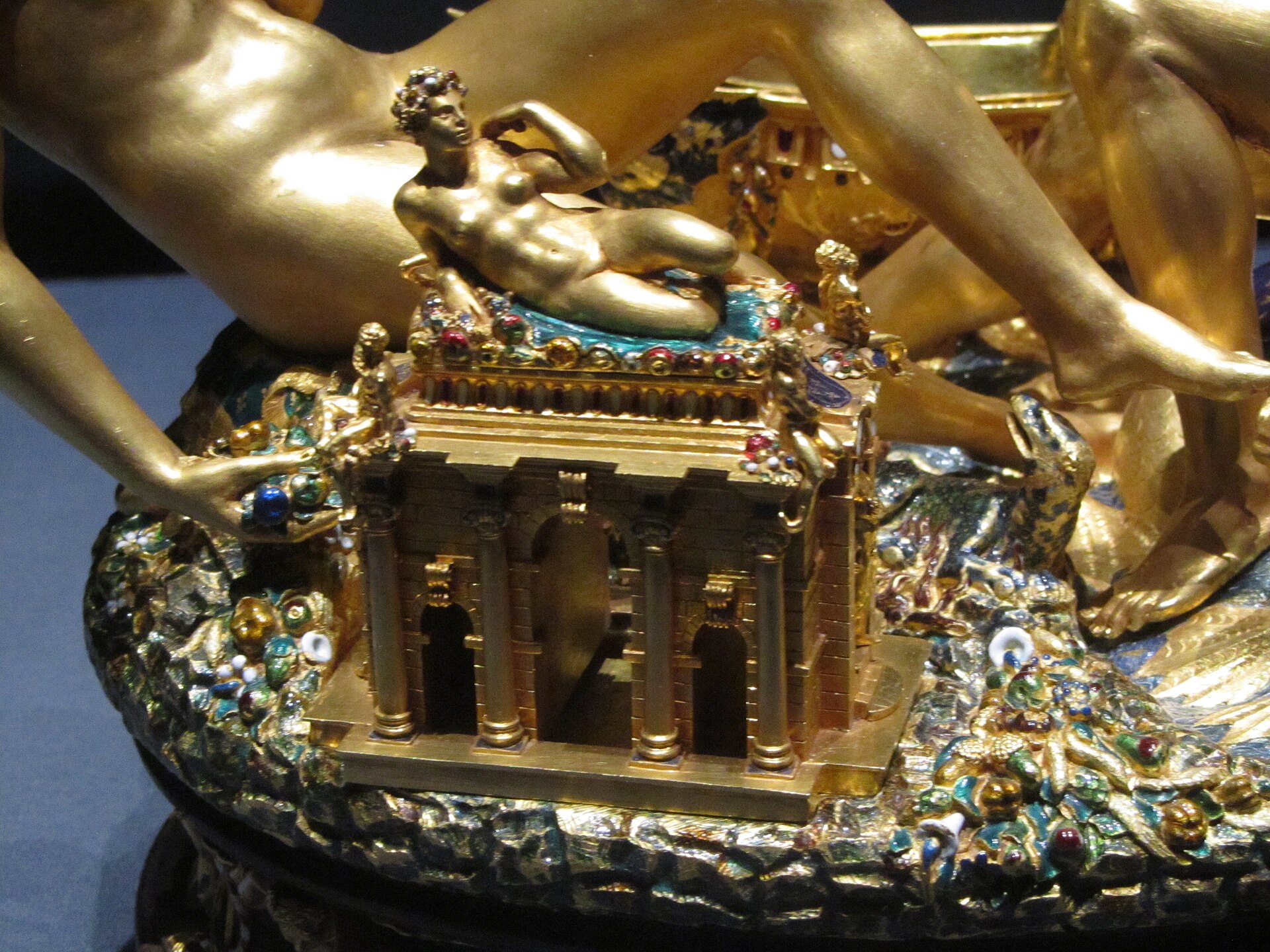
The Saliera is a table sculpture in gold, roughly oval, about 28.5 by 21.5 centimetres and 26.3 centimetres high on the Kunsthistorisches Museum's own published figures, standing on a base of partially gilded ebony. It was made to hold salt and pepper at a royal table, and its two containers are disguised as narrative sculpture: a small ship, elaborately worked, for salt, and a miniature temple in the Ionic order for pepper.
Two nearly life-size-in-miniature reclining figures occupy the oval. A male figure representing the sea, holding a trident, sits beside the salt-ship and is surrounded by sea-horses and marine creatures worked in gold and coloured with vitreous enamel. A female figure representing the earth sits beside the pepper-temple, a cornucopia spilling fruit in one hand, and land animals worked around her base. Their legs are deliberately interlaced across the middle of the oval. Around the base, in a projecting frieze, are eight further figures in half-relief: four representing the times of day (Night, Day, Twilight, Dawn) and four representing the chief winds, all worked in gold and partly enamelled.
It is a functional object and a piece of narrative sculpture at once, made to be picked up, carried to a table, and used, and it was in fact used: Cellini records dining off it once, on the day he finally delivered it, before the king took formal possession.
Chapter 2How it was made
Cellini describes his own working method for the piece in his memoir, and it matches the method he says he learned in Rome from the goldsmith Caradosso: a full model made first in wax, at the...
Cellini describes his own working method for the piece in his memoir, and it matches the method he says he learned in Rome from the goldsmith Caradosso: a full model made first in wax, at the intended size, before any metal was touched. He made the wax model for this piece in Rome, at half a cubit and more across, and only years later, once King Francis I had seen it and ordered it carried out in gold, did the metalworking begin.
The finished piece is not cast. The gold figures were hammered by hand from sheet and finished by chasing, the technique Cellini's own later treatise on goldsmithing (I trattati dell'oreficeria e della scultura, published 1568) describes as the proper method for fine figural work in precious metal, as distinct from casting, which he treated as a coarser, faster technique for larger sculptural bronze. A published scientific study using scanning electron microscopy with energy-dispersive X-ray spectroscopy (SEM-EDS) has examined samples of the enamel and reported a silicate glass coloured with sodium, potassium and copper compounds, consistent with sixteenth-century enamelling practice; this record has not been able to obtain the full published paper, only its abstract and citation, and flags it for an editor to verify directly.
Cellini took roughly three years, working alongside the making of other royal commissions at the same time, including a silver statue of Jupiter and a large silver vase for the same patron. Neither of those companion pieces is known to survive.
Chapter 3A commission that changed patrons
The salt cellar was not designed for Francis I.
The salt cellar was not designed for Francis I. Cellini was working in Rome for Ippolito II d'Este, Cardinal of Ferrara (1509-1572), a son of Alfonso I d'Este and Lucrezia Borgia who later became one of the wealthiest and most lavish patrons of the arts of his generation, and who would go on to build the Villa d'Este at Tivoli. The Cardinal commissioned a model for a salt cellar, and two of the literary men in his circle, Luigi Alamanni and Gabriello Cesano, each proposed a subject in words: Alamanni suggested Venus and Cupid, Cesano an Amphitrite surrounded by Tritons. Cellini, by his own account, listened, thanked them, and told them plainly that he would follow his own idea instead: "You have spoken, I will do."
He designed the Neptune-and-earth composition described above and presented it to the Cardinal as a wax model. Cesano's reaction, on seeing it, was that it would take the working lives of ten men to finish, and warned the Cardinal not to expect it in his own lifetime. The Cardinal declined to commission the piece in precious metal. He kept the model rather than discarding it, however, and some time later, travelling to France on business of his own, brought Cellini and the model with him. (Note: some English-language sources, including the English Wikipedia article on this object, misdate this Cardinal as "Ippolito d'Este, c. 1479-1520" - those are the dates of an earlier Ippolito I d'Este, a different and earlier cardinal of the same Ferrarese family. The patron in Cellini's own account, present at the French court in the 1540s, can only be Ippolito II d'Este; this is flagged in notes_for_editor.)
Chapter 4Francis I orders it in gold
At the French court, having already made a silver basin and ewer for the King, Cellini was asked by Francis I for a matching salt cellar.
At the French court, having already made a silver basin and ewer for the King, Cellini was asked by Francis I for a matching salt cellar. He replied that he already had a design ready, fetched the wax model he had made in Rome, and showed it to the King. Cellini's own account of the moment is direct: the King "cried out in astonishment: 'This is a hundred times more divine a thing than I had ever dreamed of. What a miracle of a man! He ought never to stop working.'" Francis ordered it carried out in gold on the spot.
The Cardinal of Ferrara was present at this exchange and recognised his own rejected commission returning to him at one remove, remarking to the King that the undertaking was so large he doubted they would ever see it finished - the same objection, in substance, that Cesano had raised in Rome. Francis overruled the concern. Asked how much gold the piece would need, Cellini named a thousand crowns; the King ordered his treasurer, the Viscount of Orbec, to pay it out in gold coin that same day. The thousand crowns describes the value of the raw material handed to Cellini, not a separate fee for his labour; his own account does not give a distinct wage figure for the commission, and no source consulted supplies a reliable period-wage comparison for that sum, so none is asserted here.
Chapter 5The design as an allegory of rule
Cellini's own description of the finished object, given in his memoir, is exact enough to be treated as documentary evidence for what he intended: two figures "seated with their legs interlaced...
Cellini's own description of the finished object, given in his memoir, is exact enough to be treated as documentary evidence for what he intended: two figures "seated with their legs interlaced, suggesting those lengthier branches of the sea which run up into the continents", the sea as a man with a trident and a ship for salt, the earth as a woman with a temple for pepper and a horn of plenty, and, around the base, four gold figures for Night, Day, Twilight and Dawn, and four more for the chief winds. He does not, anywhere in his own account, name the two central figures as Neptune and Tellus (or Ceres); those names are a later cataloguing convention, applied by scholars reading a sea-god-with-trident and an earth-goddess-with-cornucopia against the standard vocabulary of classical mythography, not a label Cellini himself used. That the identification is essentially uncontroversial does not make it a documented fact about Cellini's own naming; it is graded here as argued rather than documented, and stated as such.
The salamander worked beneath the earth goddess's foot, representing fire, is Francis I's own personal emblem, and the King's coat of arms and other heraldic devices appear elsewhere on the piece. Read together, the object sets sea, earth, and fire, together with the salt and pepper it physically holds, into a single composed scheme with the king's own badges worked into it: the four elements and the two great table seasonings, gathered and mastered by their royal owner. That the piece functions as an allegory of Francis I's rule over a compassed, orderly cosmos is the standard art-historical reading of the object and is treated by scholars as its evident purpose rather than a hidden one; there is no argument in the literature consulted that anything in the programme is esoteric or secret. The absence of anything hidden is itself the finding worth stating plainly, rather than manufacturing a deeper mystery the object does not carry. Several sources also note a general compositional debt in the four base figures (Night, Day, Twilight, Dawn) to Michelangelo's allegorical tomb figures for the Medici Chapel in Florence, a comparison made by later art historians rather than a connection Cellini states himself; it is presented here as an argued, not a documented, point.
Chapter 6From the French crown to the Habsburgs
Francis I died in 1547 and the Saliera remained French crown property.
Francis I died in 1547 and the Saliera remained French crown property. It stayed so, on the evidence available, until 26 October 1570, when Charles IX of France gave it to his uncle-by-marriage Archduke Ferdinand II of Tyrol at Speyer. The gift marked a specific diplomatic moment: Ferdinand II, younger brother of the Holy Roman Emperor Maximilian II, had stood as Charles IX's proxy at Elisabeth of Austria's wedding to the French king, a ceremony held in Speyer Cathedral on 22 October 1570 because Charles himself could not be present; the couple were formally married in person a month later at Mezieres. The marriage itself was arranged to bind the French crown to the Habsburgs at a moment when France was riven by the Wars of Religion and the Valois monarchy wanted Catholic Habsburg support against the Huguenot party. The Saliera was, in that light, not a private gift between relatives but a piece of state gratitude, made to the man who had physically stood in for the king at the altar and whose family the marriage was designed to secure. What the sources consulted do not establish is the object's own history between 1543 and 1570 in any more specific detail: which French royal residence held it, whether it was used again after the one dinner Cellini records, or how it passed from Francis I through his three successor kings to Charles IX. That gap is recorded as a gap.
Chapter 7Ambras and the invention of the Kunstkammer
Ferdinand II installed the Saliera in the Kunstkammer he built at Ambras Castle, near Innsbruck.
Ferdinand II installed the Saliera in the Kunstkammer he built at Ambras Castle, near Innsbruck. That collection is historically significant in its own right: Ambras is described by scholars as the oldest purpose-built museum in the world and the only Renaissance Kunstkammer of its kind to survive at its original site, and Ferdinand II was one of the defining collector-princes of the sixteenth century, amassing armour, portraiture, naturalia and precious objects on a scale that left his estate in debt at his death in 1595. The Saliera sat within that collection, one gold object among a vast encyclopedic hoard meant to represent the whole of created nature and human artifice in miniature, for roughly three centuries.
The Ambras holdings were progressively moved to Vienna over the nineteenth century, and the Saliera entered the new Kunsthistorisches Museum's collection with the rest of the imperial Kunstkammer when the museum opened in 1891. Its attribution had drifted during the intervening centuries: sources describe it as having been catalogued for a period without a secure name attached, before renewed scholarly interest in Cellini, driven in part by Goethe's German translation of Cellini's autobiography, reconnected the object in Vienna with the salt cellar Cellini describes in his own memoir. That reconnection is what makes the object's later attribution history unusually strong: unlike most goldsmith's work of the period, whose makers are argued from style alone, the Saliera's identity as Cellini's salt cellar rests on matching an object in a collection against a first-person written account of its making.
Chapter 8Eleven May 2003: fifty-six seconds
On the night of 11 May 2003, during Vienna's Long Night of Museums, a section of the Kunsthistorisches Museum's exterior was covered in scaffolding for restoration work.
On the night of 11 May 2003, during Vienna's Long Night of Museums, a section of the Kunsthistorisches Museum's exterior was covered in scaffolding for restoration work. A man climbed the scaffolding, forced or broke a window, and made his way into the Kunstkammer, where the Saliera was displayed in a cabinet without armoured glass. Accounts of the exact duration vary between roughly forty-six and fifty-six seconds for the theft itself, and agree that it was very fast.
An alarm was triggered during the break-in. The security guard on duty silenced or reset it as a presumed false alarm and did not investigate the gallery; the theft was not discovered until museum staff arrived the following morning, around 8:20 am. The museum and the responsible ministry initially issued firm denials that security had failed, describing the museum's standard as international-level and suggesting the culprit had to be a professional master thief; the museum's own former director, Wilfried Seipel, later said he had asked for better security around the construction site before the theft and had been refused by the castle administration responsible for the building. That is a documented instance of an internal warning going unheeded, not a claim made only after the fact.
Chapter 9The alarm engineer who defeated an alarm
The thief was identified as Robert Mang, described in contemporaneous reporting as a man in his late forties or fifty, with no prior criminal record, who ran or worked for a Viennese security-alarm...
The thief was identified as Robert Mang, described in contemporaneous reporting as a man in his late forties or fifty, with no prior criminal record, who ran or worked for a Viennese security-alarm company. The irony the user's brief anticipates is real and was widely reported at the time, but the underlying facts are less tidy than the headline version. Some accounts state that Mang had inspected the museum's security in the days before the theft and identified specific weaknesses; in a 2004 radio interview, given while he was still unsuspected, he spoke as a security expert and criticised the Saliera's protection as inadequate, specifically citing the unarmoured display glass and unsecured windows - a claim later proven, embarrassingly for the museum, to be accurate. Other accounts frame the theft itself as an impulsive act, committed while intoxicated after a party on the night the museum was busiest with visitors, rather than a planned professional job. Both can be true at once: a professional's accumulated, half-conscious knowledge of a building's weak points, acted on within a specific impulsive window. Mang himself later described the act as a "prank" and "child's play", and told police the object was simply easy to carry: "The Saliera is so handy. I couldn't have taken a painting that easily." Whether his professional training was the actual enabling cause, or a colourful coincidence that press coverage inflated into causation, is recorded here as unresolved rather than settled.
Chapter 10Extortion, October 2005 to January 2006
The Saliera was missing for close to three years.
The Saliera was missing for close to three years. Reporting consistent across several sources places it, for much of that period, hidden under Mang's own bed. In October 2005, Mang sent the police the detachable gold trident from the Neptune figure, together with a ransom demand reported most consistently as ten million euros, communicated in part by text message and structured as a kind of scavenger hunt for the exchange of money for object. Sources are not fully consistent on the details beyond that core: a five-million-euro figure and a thirteen-million-dollar figure both appear in different accounts, which may reflect separate demands made at different points, currency conversions applied inconsistently by different outlets, or simple reporting error; this record cannot resolve the discrepancy and states it as an open question rather than picking one figure to assert as definitive.
The demand and the trident were addressed, in some accounts, to the museum's insurer, Uniqa, rather than to the museum directly, with a threat to melt the object down and film its destruction if payment was refused. Investigators traced a mobile phone used to send the extortion messages to a shop on Vienna's Mariahilfer Strasse, where security-camera footage captured an image of the man buying a prepaid SIM card. Mang had used multiple disposable phones over the course of the extortion but was caught out, on this account, by returning to buy a replacement.
Chapter 11Recognition, confession, recovery
Police released the shop's photograph publicly.
Police released the shop's photograph publicly. Mang was recognised from it by acquaintances, and, faced with imminent identification, went to the police - some accounts say directly, others say via his lawyer after an initial denial - on 21 January 2006. He then led investigators to a forest near the small town of Brand, in the Zwettl district of the Waldviertel region of Lower Austria, roughly ninety kilometres north of Vienna, where the Saliera had been buried in a lead-lined box.
Its physical condition on recovery is one of the clearest factual conflicts in the record. English-language reporting, including the Wikipedia article on the object, states it was recovered undamaged. German-language sources, including the German Wikipedia article, are more specific and less flattering to that claim: they describe scratches to the gold figures attributed to glass fragments from the broken display case and to the conditions of its improper storage, and chipping to some of the enamelled sections, requiring roughly three weeks of conservation treatment before the piece returned to permanent display. The museum's own contemporary press release, issued 31 January 2006, announces the object's return to view but does not itself state a condition or describe any conservation work, which means the fullest account of damage available to this record comes from a tertiary source, not the institution. No published conservation report was located. The Saliera went briefly back on view from 31 January to 19 February 2006, was withdrawn again, and returned permanently on 14 March 2006 as part of the exhibition Europa ohne Grenzen.
Chapter 12Trial and sentence
Mang was tried in September 2006. He was convicted of theft, described in reporting as an aggravated break-in, and acquitted of the separate charge of extortion, the court finding insufficient...
Mang was tried in September 2006. He was convicted of theft, described in reporting as an aggravated break-in, and acquitted of the separate charge of extortion, the court finding insufficient evidence to prove the specific threat to destroy the piece that the extortion charge required; he had faced up to ten years on the combined charges. He was sentenced to four years' imprisonment. Reporting on an appeal, heard in mid-2007, is thinner and less consistent: the German Wikipedia article states the sentence was increased to five years on appeal, and that Mang was released early having served roughly two years and nine months; a photograph from a wire agency independently confirms an appeal hearing took place in Vienna on 26 June 2007, which corroborates that an appeal occurred without independently confirming its outcome. This record treats the appeal's precise result as unconfirmed to the standard the rest of this record holds to, and flags it for an editor with access to Austrian court records or contemporary German-language wire reporting to verify directly. What became of Mang after his release is not addressed in any source consulted.
Chapter 13What the museum did afterward
The Kunsthistorisches Museum's own press release on the Saliera's return describes a substantially rebuilt security regime for the object specifically: video surveillance with recording, motion...
The Kunsthistorisches Museum's own press release on the Saliera's return describes a substantially rebuilt security regime for the object specifically: video surveillance with recording, motion detectors, separate sensors on the window openings, an alarmed display case, and dedicated personal security staff assigned to the room in addition to ordinary gallery attendants. Wilfried Seipel, the director at the time of the theft, remained in post for several more years; Sabine Haag succeeded him as director in 2009, a change reported afterward as bringing a more security-conscious institutional posture, though the sources consulted do not establish a direct causal link between the theft and that later change of leadership, and this record does not assert one.
The theft itself is now, by the museum's own choice or simply by force of its own fame, part of how the object is discussed. It is a stop on the Kunsthistorisches Museum's official multilingual audio guide, tourist literature routinely leads with the 2003-2006 story before it reaches the sixteenth century, and a 2013 exhibition and later high-resolution digital display projects have both continued to fold the theft into the object's public presentation rather than treating it as an embarrassment to be minimised. A find that once threatened to become the museum's most damaging modern scandal has been absorbed into the object's own legend.
Chapter 14The lone survivor
The claim that the Saliera is Cellini's only surviving work in gold is well supported by every source consulted and is not seriously disputed in the literature; his other securely accepted works...
The claim that the Saliera is Cellini's only surviving work in gold is well supported by every source consulted and is not seriously disputed in the literature; his other securely accepted works, including the bronze Perseus with the Head of Medusa in Florence and the bronze bust of Cosimo I de' Medici, are sculpture in a different medium and a different register of survival risk. The claim is worth taking seriously rather than repeating as a slogan, because the reason for it is structural, not accidental: princely gold and silver plate was, across European history, a standing form of liquid reserve, routinely melted down for bullion in wars, debts, and revolutions in a way that bronze and marble sculpture, having no melt value, generally was not. Cellini's own memoir supplies the clearest possible illustration inside this very commission: the silver Jupiter statue and the large silver vase he made for Francis I at the same time as the Saliera are not known to survive at all. The Saliera's survival, in other words, is not the rule for Renaissance goldsmith's work; it is the rare exception, and its own near-melting, threatened by its own thief in 2005, was simply the same fate the rest of the age's great goldsmith's work actually suffered, arriving three and a half centuries later and, this time, failing.
The comparison to the Metropolitan Museum's Rospigliosi Cup, a different object already recorded elsewhere in this publication, sharpens the point rather than complicating it. The Rospigliosi Cup was catalogued as Cellini's work from 1913 and was one of the Metropolitan's most visited objects for half a century before being reattributed away from him, then reattributed twice more, and is now catalogued to no named maker at all, a nineteenth-century object built with soft solder and unorthodox casting that a sixteenth-century goldsmith would not have used. Its attribution to Cellini rested on style alone and did not survive close technical examination. The Saliera's attribution rests on a documented royal commission, the maker's own first-person account of designing and delivering it, and an unbroken chain of ownership from the French crown to the Habsburg Kunstkammer to a public museum. It is the single strongest attribution to Cellini's own hand that exists, and it is the only one of the two objects that has never had to be taken away from him.
The artist
Benvenuto Cellini
Cellini is an unusual case among Renaissance goldsmiths in that his life is not reconstructed from account books and stylistic argument alone: he wrote it down himself, at length, in an autobiography that survives complete and that is one of the earliest vivid first-person memoirs by a working artist in European history. That memoir is also self-promoting, occasionally implausible, and was unpublished for over a century and a half after his death, so it is read here as testimony from an interested party rather than as neutral record, exactly as the reference standard for this publication treats a comparable case.
Related works
| Work | Relation | Where it is |
|---|---|---|
| Model for a salt cellar (wax, later silver) Benvenuto Cellini | Cellini's first design for this object, made in Rome for Cardinal Ippolito II d'Este and rejected by him as too costly and slow before Francis I later commissioned it in gold Known only from Cellini's own account in his autobiography; no physical trace of the original wax or silver model has been identified. | Not known to survive |
| Silver statue of Jupiter and a large silver vase Benvenuto Cellini | Made for Francis I in the same French commission and in the same years as the Saliera The clearest illustration inside Cellini's own memoir of how much of his court output for Francis I is lost; the Saliera's survival is the exception rather than the rule. | Not known to survive |
| Perseus with the Head of Medusa Benvenuto Cellini | Cellini's other universally accepted masterpiece, in bronze rather than gold His major surviving work in sculpture, as against the Saliera's status as his sole surviving work in goldsmithing proper. | Loggia dei Lanzi, Florence |
| Bust of Cosimo I de' Medici Benvenuto Cellini | Securely documented bronze portrait bust from Cellini's later Florentine period Made for Cellini's later patron Cosimo I after his return from France. | Museo Nazionale del Bargello, Florence |
| Nymph of Fontainebleau Benvenuto Cellini | A bronze lunette relief made for Francis I in the same French years as the Saliera Originally made for the Chateau de Fontainebleau; relocated to the Louvre. | Musee du Louvre, Paris |
| Cup, known as the Rospigliosi Cup Unrecorded nineteenth-century goldsmith; formerly catalogued as Benvenuto Cellini | Not by Cellini. A direct cautionary comparandum: catalogued as his work for over fifty years before three successive reattributions removed his name from it entirely Already recorded separately in this publication. The contrast with the Saliera's documented, unbroken attribution is instructive: style alone supported the Rospigliosi Cup's attribution to Cellini and did not survive technical examination, where the Saliera's rests on a first-person account and continuous provenance. | Metropolitan Museum of Art, New York |
Open questions
- What happened to the Saliera between 1543 and 1570 while it remained French crown property is not established by any source consulted: which royal residence held it, whether it was displayed or used again after the single dinner Cellini records, and how it passed from Francis I through three successor kings to Charles IX.
- The exact date and mechanism of the object's transfer from Ambras Castle to the new Kunsthistorisches Museum in Vienna is inconsistently given across sources, some pointing to piecemeal nineteenth-century transfers and others simply to the museum's 1891 opening.
- Whether Robert Mang's professional knowledge as an alarm-systems installer was the actual enabling cause of the theft, or a colourful coincidence amplified after the fact by press coverage, cannot be resolved from the sources consulted: accounts differ on whether he had specifically scouted the museum's defences in advance or acted on a drunken impulse during a single busy night.
- The exact number, amount, and sequence of ransom demands is inconsistently reported. A figure of ten million euros is the most widely repeated, but five-million-euro and thirteen-million-dollar figures also appear in reputable-seeming reporting, and this record cannot establish whether these reflect separate demands, currency-conversion confusion, or simple error.
- The object's condition on recovery in January 2006 is reported inconsistently: English-language sources state it was undamaged, German-language sources describe specific scratches and chipped enamel requiring roughly three weeks of conservation. No published conservation report was located to settle the question.
- Whether Robert Mang's original four-year sentence was genuinely increased to five years on appeal in 2007, and the exact date of his release, are reported only in a single tertiary source (the German Wikipedia article) and could not be independently corroborated from a primary or contemporary wire-service account in the time available.
- What became of Robert Mang after his release from prison is not addressed in any source consulted.
- Whether any part of Cellini's original wax or silver model, made in Rome for Cardinal Ippolito II d'Este before the piece was ever commissioned in gold, survives in any form is not addressed in the sources consulted.
Questions about this object
What is Saliera (Salt Cellar of Francis I)?
Saliera (Salt Cellar of Francis I) is a goldsmith's work, dated 1540-1543. Medium: Gold, hammered and chased, with vitreous enamel, on a base of ebony with gilt mounts; ivory elements are recorded in the museum's own materials list.
Who made Saliera (Salt Cellar of Francis I), and is the attribution settled?
The attribution to Benvenuto Cellini is recorded here as accepted. Universally accepted on the strength of Cellini's own detailed written account of designing and making the piece in his autobiography (the Vita, written 1558-1563), corroborated by an unbroken and documented chain of ownership from the French royal treasury to the Habsburg Kunstkammer to the Kunsthistorisches Museum. It carries no signature or maker's mark; authorship rests on the memoir and the provenance, not on an inscription. This is the single most secure attribution to Cellini as a goldsmith that exists, in explicit contrast to objects such as the Metropolitan Museum's Rospigliosi Cup, which carried an attribution to Cellini for over half a century before being withdrawn.
Where is Saliera (Salt Cellar of Francis I) now?
Kunsthistorisches Museum, Vienna, Kunstkammer, Room XXIX. Inventory number Kunstkammer, Inv. Nr. 881. Last confirmed 3 September 2026. In the museum's own collection since the 1891 opening, having passed there with the dispersed Habsburg Kunstkammer of Ambras Castle; removed from display only during the 2003-2006 theft.
What is still unknown about Saliera (Salt Cellar of Francis I)?
What happened to the Saliera between 1543 and 1570 while it remained French crown property is not established by any source consulted: which royal residence held it, whether it was displayed or used again after the single dinner Cellini records, and how it passed from Francis I through three successor kings to Charles IX.
Sources
- 1Benvenuto Cellini, The Autobiography of Benvenuto Cellini, translated by John Addington Symonds. Project Gutenberg EBook #4028. Primary source: Cellini's own account of the commission, design and completion of the salt cellar. gutenberg.org/cache/...
- 2Kunsthistorisches Museum Wien, official object database entry for the Saliera. khm.at/en/...
- 3Kunsthistorisches Museum Wien, press release via OTS, 'Saliera wieder im Kunsthistorischen Museum zu sehen', 31 January 2006. Primary institutional source for the object's return to display and the described security measures. ots.at/presseaussendung/...
- 4Wikipedia, 'Cellini Salt Cellar'. en.wikipedia.org/wiki/...
- 5Wikipedia (German), 'Saliera'. de.wikipedia.org/wiki/...
- 6JSTOR Daily, 'Benvenuto Cellini and the World's Most Spectacular Salt Cellar'. about.jstor.org/blog/...
- 7ARCAblog (Association for Research into Crimes against Art), 'The Art Theft of Cellini's Saliera: Security Scrutiny in a high profile theft', October 2012. art-crime.blogspot.com/2012/...
- 8Priceless (blog), 'The Vienna Art History Museum Robbery'. pricelessblog.squarespace.com/articles/...
- 9beyondarts.at, 'The theft of the Saliera', Kunsthistorisches Museum Vienna visitor guide. beyondarts.at/guides/...
- 10wien.ORF.at, 'Kriminalfall Saliera vor zehn Jahren geklaert', ten-year retrospective on the case. wien.orf.at/v2/...
- 11noe.ORF.at, 'Saliera vor 15 Jahren entdeckt', retrospective on the recovery, consulted for corroboration of the Zwettl-district recovery location. noe.orf.at/stories/...
- 12Today.com (Associated Press), 'Thief of $65 million painting is sentenced', September 2006. today.com/popculture/...
- 13Ars Electronica Center, 'Saliera', on the object's high-resolution digital display at the Center's Deep Space installation. ars.electronica.art/center/...
- 14Wikipedia, 'Ippolito II d'Este'. Consulted specifically to correct the misdating of the Cardinal of Ferrara found in the English Wikipedia article on the Saliera itself. en.wikipedia.org/wiki/...
- 15Wikipedia, 'Ferdinand II, Archduke of Austria', for the Ambras Kunstkammer and Ferdinand's role as governor of Tyrol. en.wikipedia.org/wiki/...
- 16Wikipedia, 'Elisabeth of Austria, Queen of France', for the 1570 proxy wedding date and the dynastic context of the marriage. en.wikipedia.org/wiki/...
- 17Wikipedia, 'Rospigliosi Cup', consulted to verify the attribution history used for comparison; the object itself is separately recorded in this publication. en.wikipedia.org/wiki/...
- 18Andritz Pumps Magazine, 'The Salieria robbery'. andritz.com/pumps-magazine-en/...
- 19SEM-EDS Micro-Analytical Data from Enamel Samples of Cellini's Salt Cellar 'Saliera', ResearchGate listing. Only the abstract and citation were accessible; the full paper returned an access error on repeated attempts and has not been directly verified. researchgate.net/publication/...
- 20visitingvienna.com, 'The Saliera at the Kunsthistorisches Museum', consulted for the object's current presentation to visitors and audio-guide status. visitingvienna.com/sights/...
Last verified · Published
Change log
3 September 2026 - Record created at the house standard: researched narrative, technical evidence, maker dossier, graded provenance chain, prices with hammer and premium separated, related works, open questions and sources.