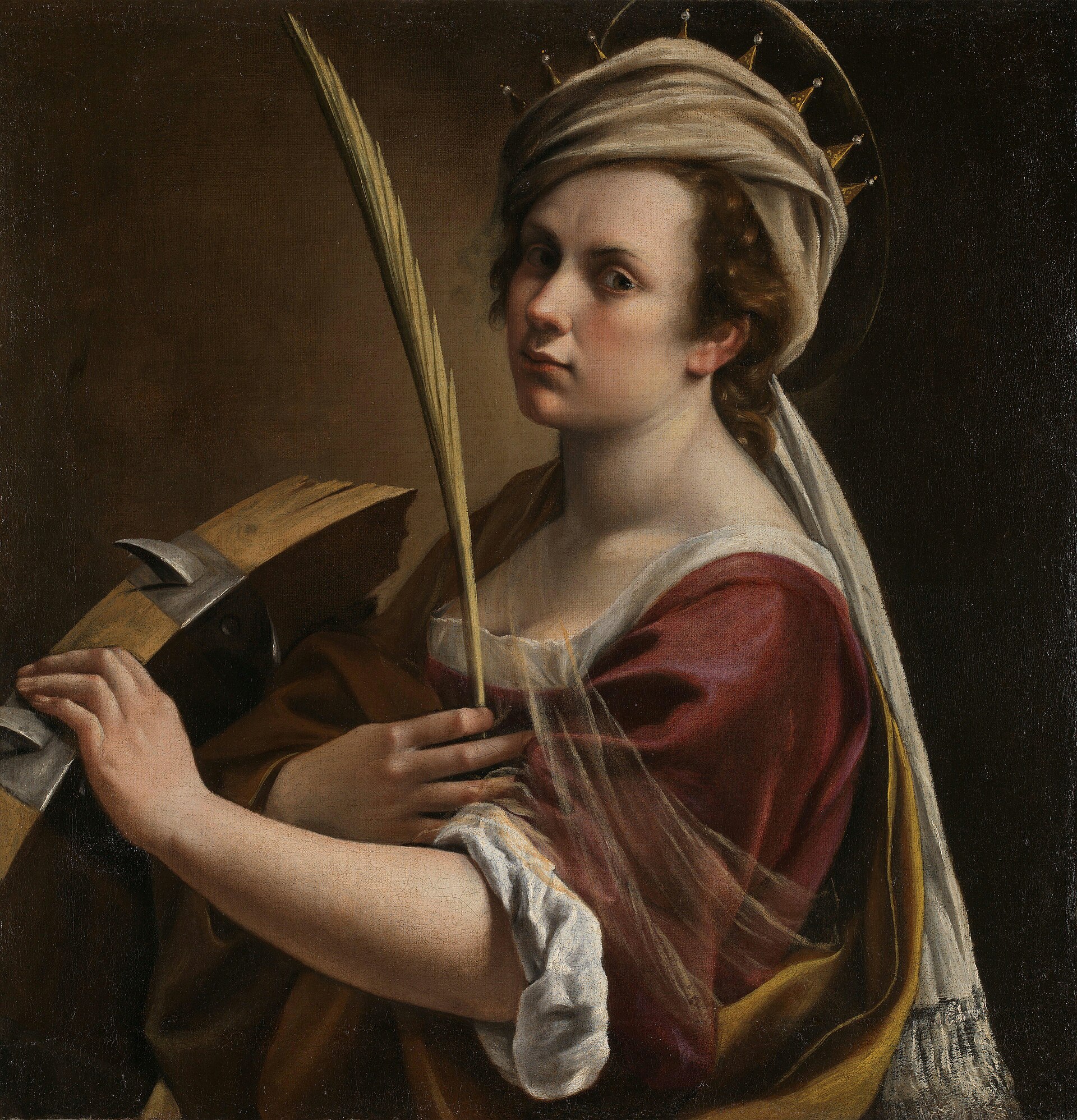
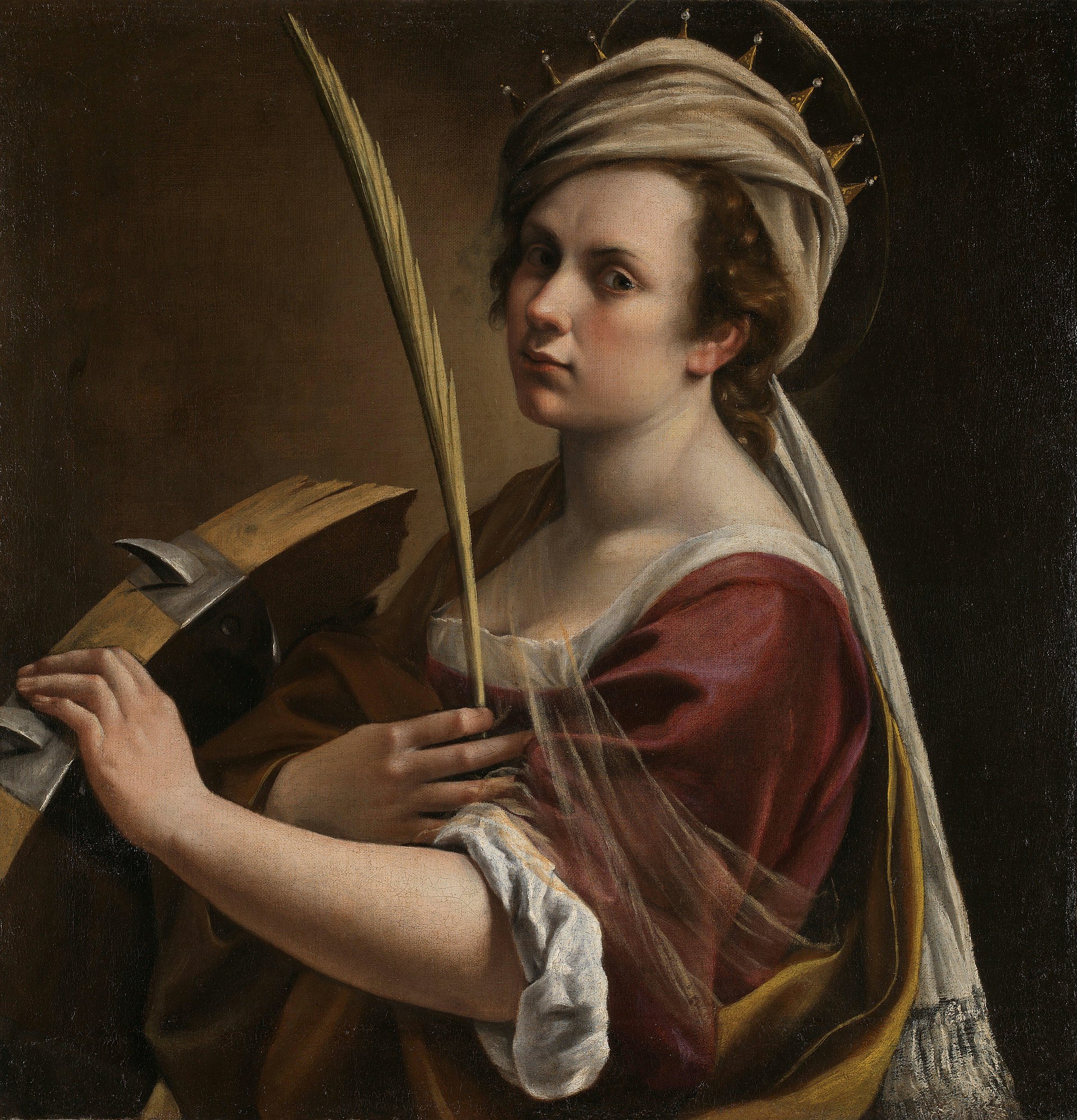
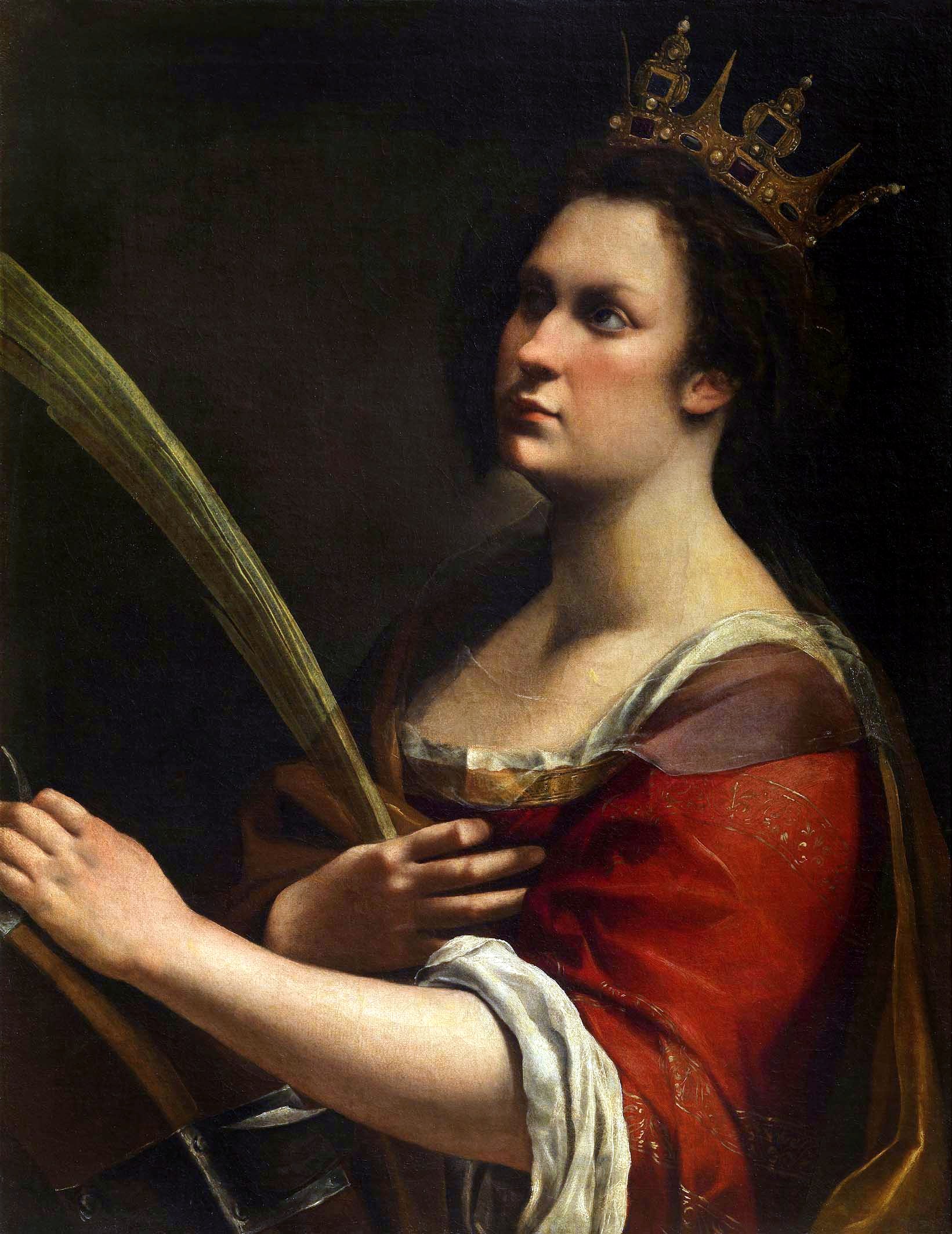
Self Portrait as Saint Catherine of Alexandria
c. 1615-17 · Oil on canvas
National Gallery, London
 Italian · 1593-1656
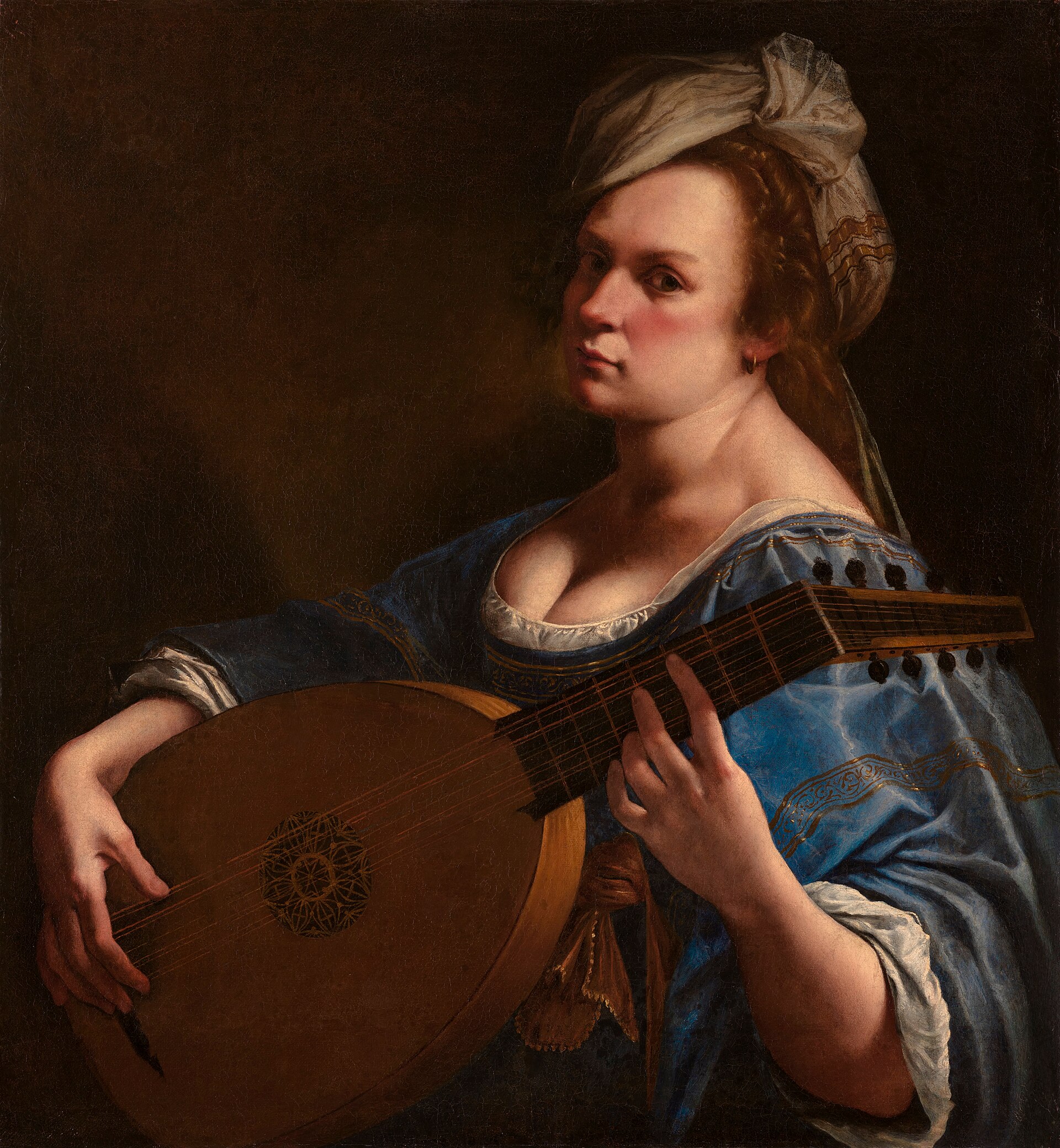
Self Portrait as a Lute Player, about 1615-17, oil on canvas, 77.5 by 71.8 cm, Wadsworth Atheneum Museum of Art, Hartford, Connecticut, Charles H. Schwartz Endowment Fund, accession 2014.4.1; bought at Christie's New York on 30 January 2014, lot 36. WHAT IS ESTABLISHED: that the sitter is Artemisia Gentileschi. The 1638 inventory of the Medici villa at Artimino records 'il ritratto dell'artimisia di sua mano che suona il liuto', the portrait of Artemisia playing the lute by her own hand, an identification of the picture first proposed by Gianni Papi in 2000; and her physiognomy is independently fixed by three works of the 1620s in which the identification is not in question, Jerome David's engraving after a lost self portrait (British Museum 1913,0331.91), a bronze portrait medal, and Simon Vouet's painted portrait of her now held by the Fondazione Pisa. The National Gallery's 2024 catalogue concludes from these that it can be deduced with certainty that it is Artemisia herself. WHAT IS ARGUED: whether the picture records a real performance, the Ballo delle zingare given in the Medici palace in February 1615 with music by Francesca Caccini, in which a 'Sig.ra Artimisia' sang and danced. Mary Garrard proposed it, Alexandra Lapierre and R. Ward Bissell took it up, and Sheila Barker cautions that other women of the same name were present at court. The exact date and the sequence of this picture against the London and Uffizi Saint Catherines are also unsettled. Nothing in that dispute affects the identification of the sitter. Note that several other pictures commonly called self portraits are contested AS self portraits, including the Royal Collection La Pittura, which Bissell argued in 1999 is not one, and the Uffizi Saint Catherine, read as a self portrait by Locker, Papi and Garrard but not by Judith Mann. This portrait was chosen because it is the one anchored by a document made within her lifetime.
Wadsworth Atheneum Museum of Art, Hartford, Connecticut. Wikimedia Commons; licence verified per file at fetch time from extmetadata.LicenseShortName: Public domain; Copyrighted: False| Full name | Artemisia Gentileschi, baptised in Rome in 1593 and signing herself Artemisia Lomi during the Florentine years, after... |
|---|---|
| Worked as | Painter, Workshop head |
| Born | Born in Rome on 8 July 1593, the date given by the National... · Rome |
| Died | Not established. The National Gallery gives 'in or shortly... · Naples, presumed |
| Nationality | Italian |
| Movement | Caravaggism in Rome, a courtly Florentine manner in the 1610s, a Venetian inflection in... |
| In this archive | 1 artwork |
| Sources | 32 cited |
| Last verified | 17 September 2026 |
About this page 1 artwork in the archive · Last verified 17 September 2026 · 32 sources cited
The number of paintings given to Artemisia Gentileschi has grown substantially since 1990 and it is still moving. How far it has grown is a question nobody can answer with a figure, because no count has been published since 1999 and no register of additions or removals exists at all. R. Ward Bissell's catalogue raisonne of 1999 remains the last full one, and there is no successor. Since it appeared, pictures have entered the corpus from a Lyon family, a French family in the Vosges, a Munich saleroom where the picture was catalogued as somebody else, a Sienese library photograph and a Neapolitan exhibition that proposed four attributions in a single stroke. Others have gone out. There is no authentication board, no foundation, no estate and no committee. Attribution is settled by named scholars arguing in print, and ratified in practice by whichever museum is willing to write the cheque.
That is why she belongs in a provenance record rather than a biography. The documentary spine is unusually strong in places and unusually weak where a buyer needs it. She signed a minority of her pictures. From about 1630 she ran a large Neapolitan workshop in which her name marked the commission and the composition rather than every square inch of the surface, which is why the curators of the 2022 Naples exhibition could attribute pictures to her while conceding that other hands are in them. Against that stand a court transcript of 1612 running to nearly two hundred folios, thirty-six private letters found in a Florentine archive in 2011, Medici payment records, a ceiling commission with a documented fee, and a signature that appears, when it appears at all, in Latin and in a spelling that varies from picture to picture.
The market has repriced her four times in twelve years, and each new record was set in a different city. The National Gallery in London bought its Self Portrait as Saint Catherine of Alexandria in July 2018 for 3.6 million pounds, seven months after it was knocked down at the Hotel Drouot for 1.85 million euros hammer, 2.3 million with fees; the three dealers who bridged that gap and the Gallery's price are all named in the Gallery's own published provenance. On 4 February 2026 a panel measuring about 32 by 25 centimetres made 5,687,000 dollars with premium at Christie's in New York, and on the same day the National Gallery of Art in Washington announced that it had acquired the Mary Magdalene in Ecstasy that had sold in Paris in 2014 for 865,500 euros with fees. None of that sequence is about a change in quality. It is a corpus being assembled in public, at auction, by people bidding against an incomplete list.
Born in Rome on 8 July, eldest child and only daughter of the painter Orazio Gentileschi and Prudenzia di Montone. Her godmother at the baptism was Artemisia Capizucchi, of the Roman nobility, which Bissell argues is the whole explanation of her given name.146
Her mother, Prudenzia di Montone, dies. She is twelve and takes on the care of three younger brothers. The Getty places the start of her training in her father's workshop at this point; the National Gallery dates the beginning of formal training to 1608-09, and Orazio's own letter of 1612 speaks of three years of study, which fits the later date.16
Begins formal artistic training with her father, in 1608 or 1609.1
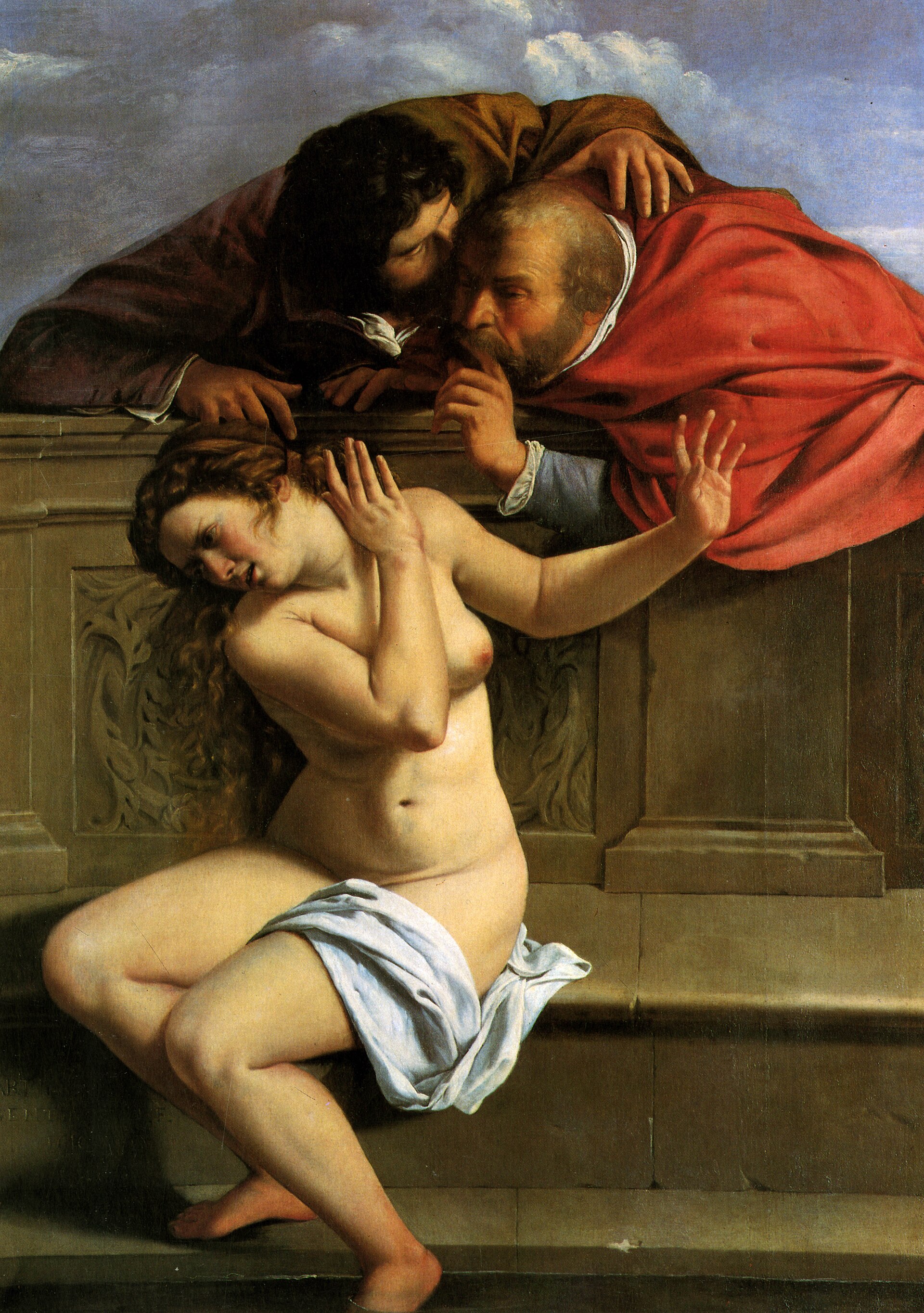
Signs and dates the Susanna and the Elders now at Schloss Weissenstein, Pommersfelden: ARTIMITIA GENTILESCHI F 1610. Her earliest dated painting, made at sixteen or seventeen.1623
Raped by Agostino Tassi in May, at the family house in via della Croce. Tassi had been brought into the household by Orazio in connection with work on perspective.56
Orazio petitions Pope Paul V in March, after joint commissions with Tassi had been completed and paid. The National Gallery calls it a seven-month trial; the span from the March petition to the sentence of 27 November is closer to eight. She testifies at eighteen and is examined under torture with the sibille.15
27 November: the court sentences Tassi to choose between five years in the galleys and perpetual banishment from Rome. He chooses exile. There is reason to believe the sentence was never served.15
Marriage contract with the Florentine painter Pierantonio Stiattesi drawn up 11 August; the wedding takes place in Rome on 29 November. Orazio writes to Maria Maddalena of Austria that after three years of study his daughter has no peers.26
The marriage is registered with Florentine officials on 11 January. The couple move to Florence, where she sets up a studio in her father-in-law's house on via Campaccio, near San Lorenzo.2
Her daughter Agnola is born in December and dies before baptism. Michelangelo Buonarroti the Younger was to have been godfather.2
February: a 'Sig.ra Artimisia' dances and sings in the Ballo delle zingare in the Medici palace, with music by Francesca Caccini and an all-female cast. Garrard proposed that the Hartford Lute Player records the occasion; Lapierre and Bissell took the suggestion up, Sheila Barker is more cautious.2
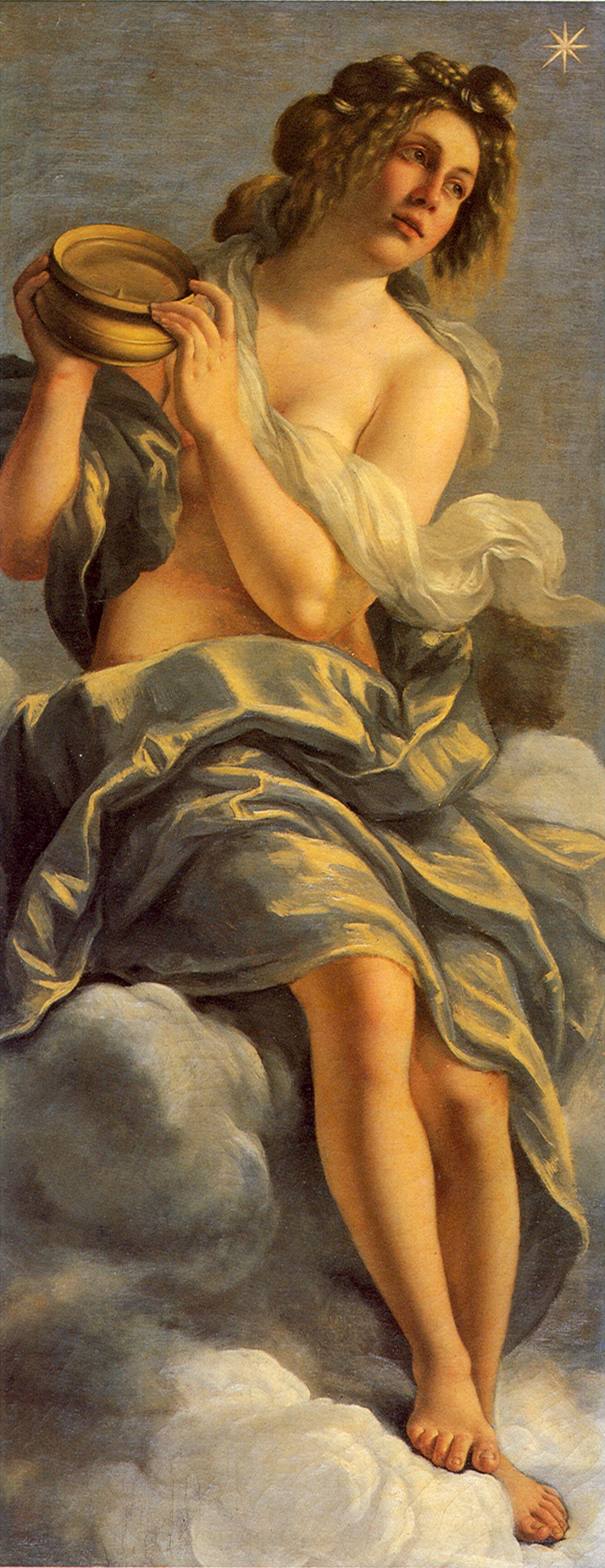
August: payments begin for the Allegory of Inclination for the gallery ceiling of the Casa Buonarroti. They run to August 1616. It is her only documented Florentine work. The National Gallery notes she probably did not start painting until late 1615 or the spring of 1616, being heavily pregnant that autumn.2
Her son Cristofano is born in November. Cristofano Allori stands as godfather. Her father-in-law dies and the studio moves to Borgo Ognissanti.2
19 July: matriculates at the Accademia e Compagnia delle Arti del Disegno in Florence. The National Gallery's press office calls her the first woman member; its own catalogue calls her one of the first in the Academy's fifty-year history; the Getty calls her the first. She is on the roster from 1616 to 1620.126
Signs and dates the Jael and Sisera now in the Museum of Fine Arts, Budapest, a fixed point at the end of the Florentine years.5
Returns to Rome, beset by creditors after running up debts. The National Gallery says she remained there ten years, but she was in Venice by 1627 and the Getty places the Lucretia in the Venetian years of the later 1620s, so the Roman decade was interrupted.16
Signs and dates the full-length Portrait of a Gonfaloniere, Collezioni Comunali d'Arte, Bologna: the only surviving example of her portrait practice, which seventeenth- and eighteenth-century sources treat as one of her strengths. Also dated 1622 is the Susanna at Burghley House, whose autograph status is not universally accepted.5
A letter describes her as 'bella piu che mai', more beautiful than ever. It is addressed to Francesco Maria Maringhi.2
Between 1623 and 1626, the Judith and her Maidservant now in the Detroit Institute of Arts, and the Penitent Magdalene now in Seville Cathedral.5
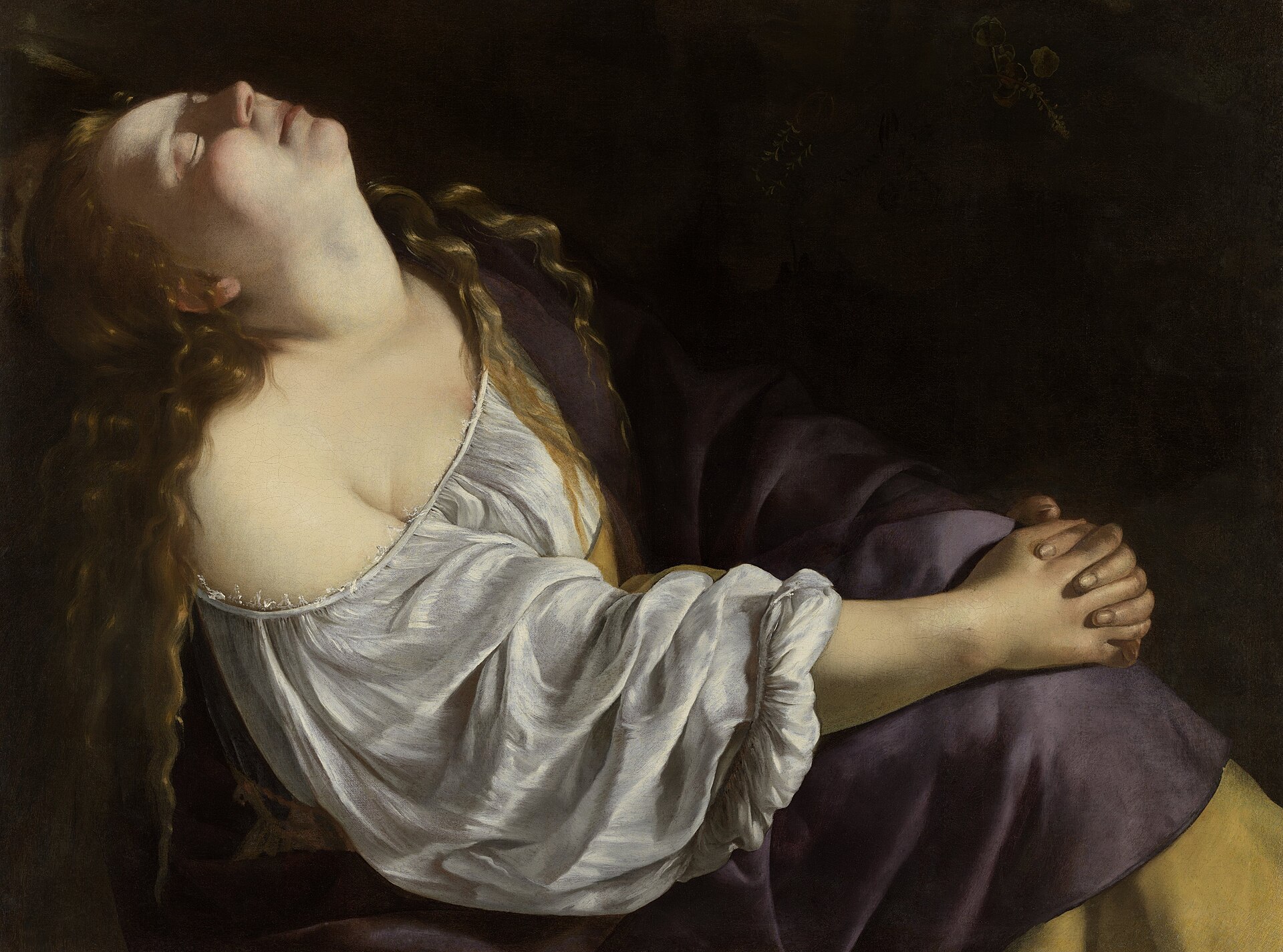
About this date, Mary Magdalene in Ecstasy, painted in the second Roman period, the years in which, on the Washington curator's account, she worked without a workshop.78
In Venice. A pamphlet of poems is printed on four of her pictures: two on a self portrait, one each on a Susanna and a Sleeping Cupid, and three on a Lucretia. Bissell attributed the verses to Giovanni Francesco Loredan.46
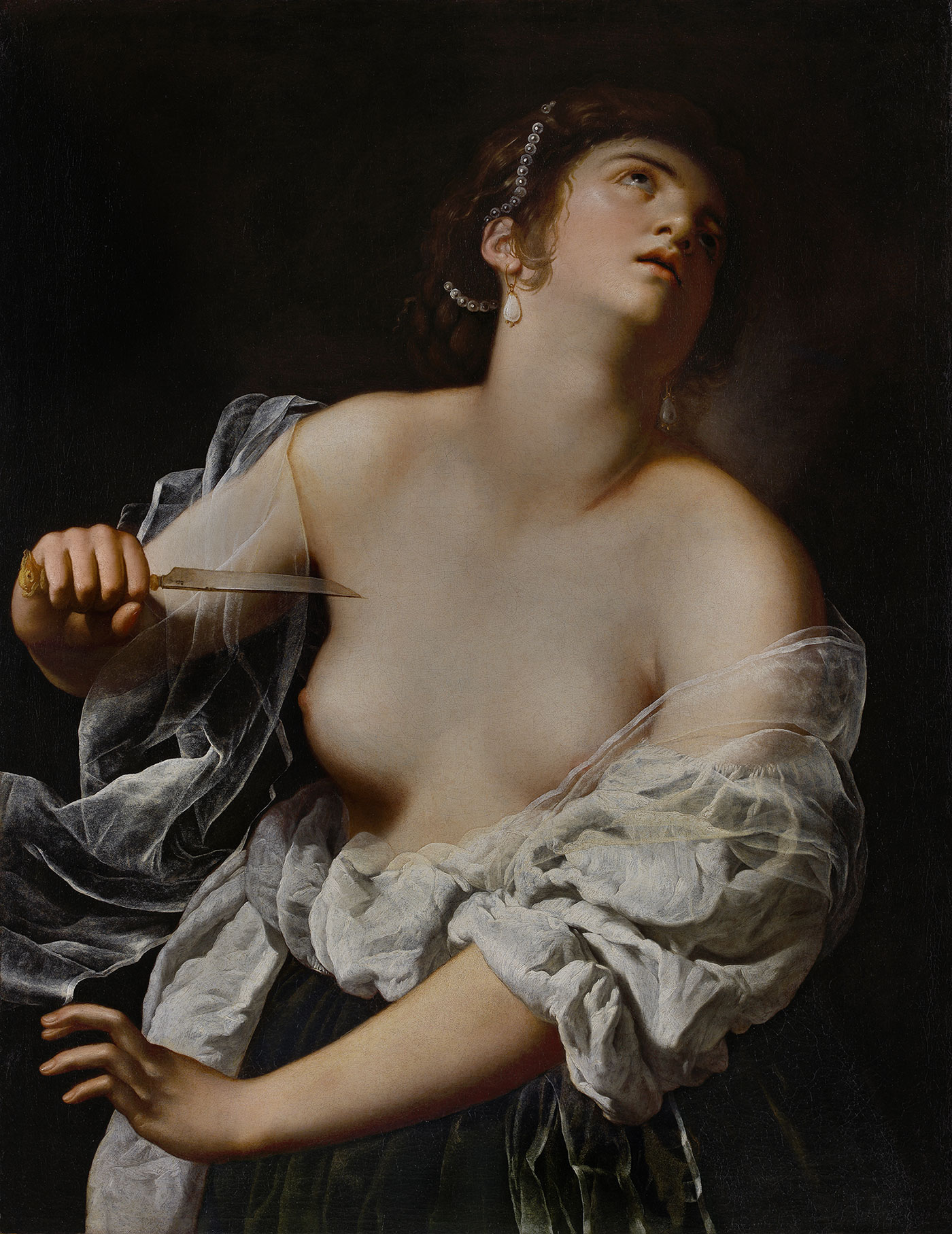
About this date the Lucretia now in the Getty Museum, showing her engagement with Titian and Veronese and her contact with Nicolas Regnier, Johann Liss and Bernardo Strozzi.6
Settled in Naples. Signs and dates the large Annunciation now at Capodimonte. Begins a dense correspondence with Cassiano dal Pozzo.15
Vesuvius erupts. The new bishop of Pozzuoli, Martin de Leon y Cardenas, commissions the redecoration of the choir of Pozzuoli cathedral; the wider scheme, which also involved Stanzione and Lanfranco, is completed by 1640 and her three canvases for it are dated almost certainly to 1635-37. About this year the duke of Alcala carries her Penitent Magdalene to Seville.5
Signs and dates the Clio, Muse of History, in a private collection.5
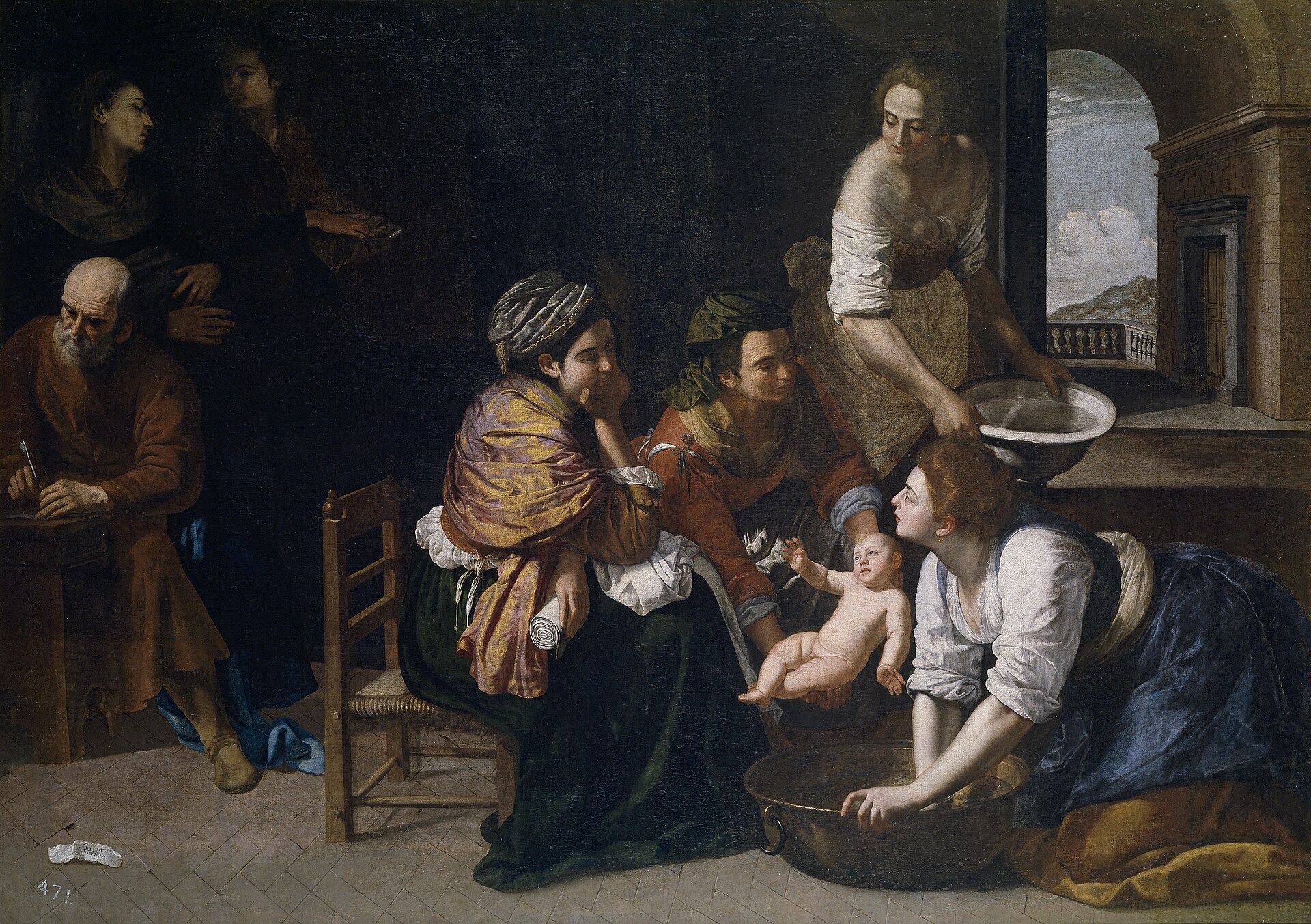
About 1633-34, the Birth of Saint John the Baptist now in the Prado, signed ARTEMITIA CINTILES, part of a six-canvas Baptist cycle for a chapel at the Buen Retiro commissioned for Philip IV through the Count of Monterrey. Four of the six were painted by Massimo Stanzione and one, now lost, by Paolo Finoglio.5
About 1636-37, David and Bathsheba, Columbus Museum of Art, the first of several versions of the subject, some autograph and some given to the workshop.5
The Medici inventory of the villa at Artimino records the portrait of Artemisia playing the lute by her own hand, and a second self portrait, now untraced, in which she appears as an Amazon with helmet, sword and shield.2
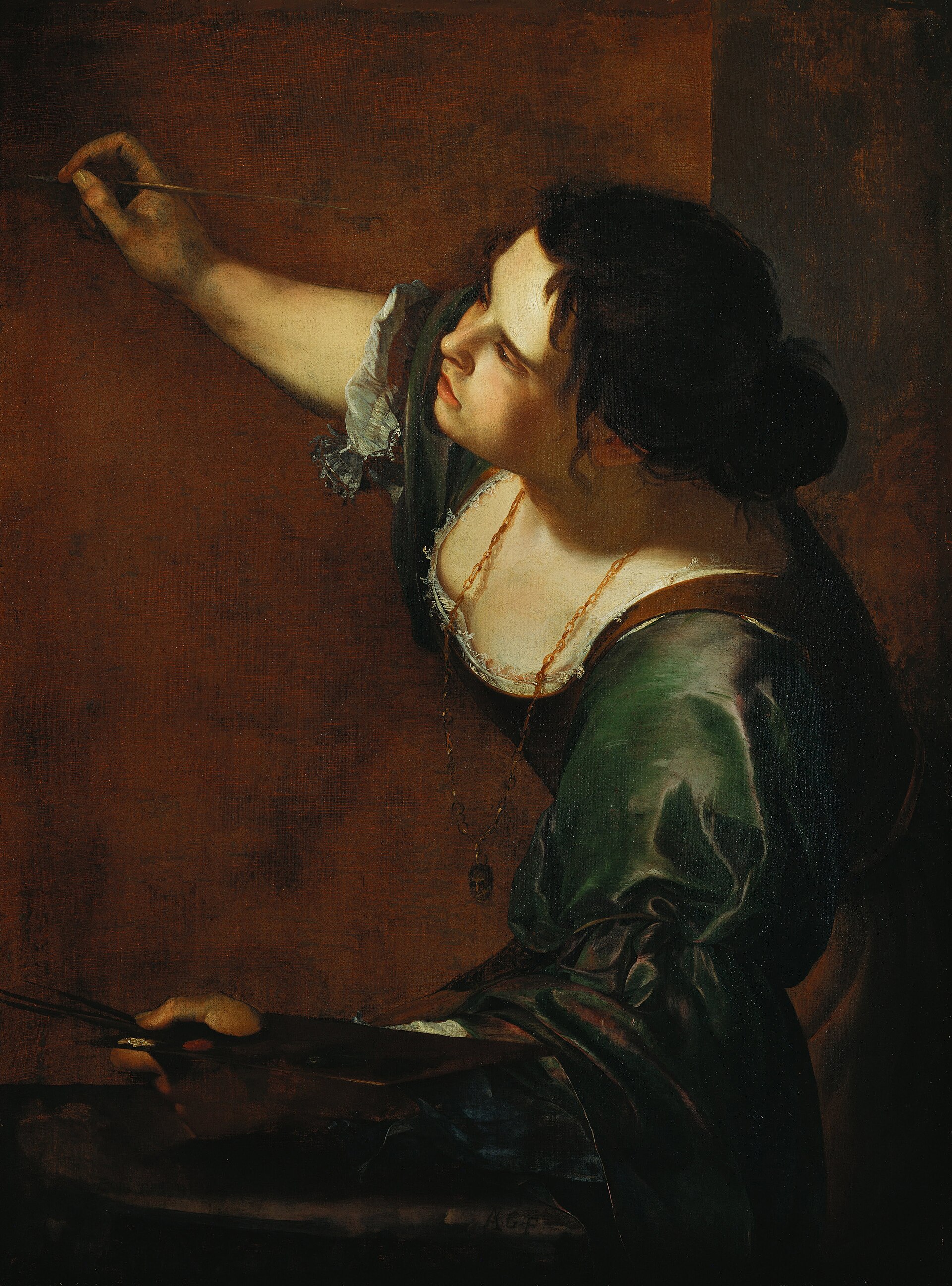
About 1638-39, the Self-Portrait as the Allegory of Painting, signed A.G.F., Royal Collection RCIN 405551.21
In London, where her father is completing the Queen's House ceiling at Greenwich. Whether she worked on that ceiling is disputed: Bissell argued she did, and Gabriele Finaldi's 1999 essay is cited against him.14
Back in Naples by about 1640-41, where she remains for the rest of her life.5
Signs and dates the Susanna and the Elders now in the Moravian Gallery, Brno.5
A Susanna and the Elders owned by Averardo de' Medici in Florence bore the date 1652. The Dizionario Biografico argues this should be the year of her death, because a Venetian volume of 1653, the Cimiterio of Loredan and Michiele, carries two sarcastic epitaphs for her.5
The latest year named in the standard life dates, which Dorotheum renders as 'after January 1654'. No document of that year is cited in any source consulted here. The National Gallery gives her death as in or shortly after 1654, the Uffizi gives 1652 or 1653, the Getty gives about 1654, and the Dizionario Biografico argues for 1652. No death record has been produced.1562029
The Neapolitan Giovanni Canale publishes a tribute calling her as famous as she is beautiful, more than a decade after her death.2
About this year a descendant of Michelangelo Buonarroti the Younger has drapery painted over the nude Allegory of Inclination in the Casa Buonarroti, for propriety.2
Bernardo De Dominici, writing in 1742-43, credits her with inspiring the expressive sweetness and chromatic refinement of Palumbo, Cavallino and Stanzione.24
R. Ward Bissell publishes 'Artemisia Gentileschi: A New Documented Chronology' in the Art Bulletin, the archival foundation of everything since.4
Mary Garrard publishes 'Artemisia Gentileschi: The Image of the Female Hero in Italian Baroque Art', Princeton, with an English translation of the trial record in an appendix.412
Bissell publishes his catalogue raisonne, 688 pages, in three parts: autograph paintings, incorrect and questionable attributions, and lost works. It is still the last one.4
'Orazio and Artemisia Gentileschi' opens in Rome, then travels to the Metropolitan Museum and the Saint Louis Art Museum. Keith Christiansen writes the Orazio entries and Judith W. Mann the Artemisia entries; where they disagree, the catalogue prints the picture twice.19
Francesco Solinas finds thirty-six letters in the Archivio Frescobaldi in Florence, written by Artemisia and her husband to Francesco Maria Maringhi. In the same year Mary Magdalene in Ecstasy resurfaces in the south of France.712
Sotheby's Paris sells Mary Magdalene in Ecstasy for 865,500 euros with fees, a record at the time. The Wadsworth Atheneum buys the Self Portrait as a Lute Player at Christie's New York on 30 January, lot 36.823
19 December: the Self Portrait as Saint Catherine of Alexandria is sold at the Hotel Drouot, lot 69, hammer 1.85 million euros, 2.3 million with fees, to Marco Voena, Old and Modern Masters Ltd and Fabrizio Moretti.2815
July: the National Gallery announces the purchase for 3.6 million pounds. A five-month conservation follows, filmed as fourteen short films. In the same year a David and Goliath makes 104,000 euros at Hampel in Munich after an eleventh-hour reattribution.1217
March: the Opificio delle Pietre Dure announces its findings on the Uffizi Saint Catherine at a press conference in Florence. March to August: the National Gallery picture tours Britain as 'Artemisia Visits', including the first display of a national-collection painting in a prison. November: Lucretia makes 4.8 million euros with fees at Artcurial.21527
'Artemisia' opens at the National Gallery in October, the first monographic exhibition devoted to her in the United Kingdom, and closes six and a half weeks into a fourteen-week run. The trial transcript is exhibited for the first time. Gillespie and Papi publish the David and Goliath in the Burlington Magazine.2121718
The Getty acquires Lucretia, accession 2021.14, announced 30 March. 'By Her Hand: Artemisia Gentileschi and Women Artists in Italy, 1500-1800' opens at the Wadsworth Atheneum and Detroit.68
December: 'Artemisia Gentileschi in Naples' opens at the Gallerie d'Italia, curated by Denunzio and Porzio, and proposes four new attributions. The small panel later sold in 2026 goes on loan to the Nasjonalmuseet in Oslo, where it remains until 2025.101125
Denunzio and Porzio publish 'Artemisia Gentileschi a Napoli. Studi e documenti', printing Neapolitan notarial inventories that place her pictures in named houses in the seventeenth century.24
The National Gallery publishes its full online catalogue entry for NG6671 by Letizia Treves, with technical contributions by Larry Keith and Marta Melchiorre.2
4 February: Christie's New York sells the small panel for 5,687,000 dollars with premium, a record. The same day the National Gallery of Art in Washington announces its acquisition of Mary Magdalene in Ecstasy, accession 2025.88.1.71416
This is a market being made in public, on a corpus that is still being assembled, and it behaves accordingly. The record has moved four times in twelve years, in 2014, 2017, 2019 and 2026, and three of those four were set by a picture that had been unknown, misattributed or lost to the record a few years earlier. The exception is the 2026 panel, which had been on public loan in Oslo and reproduced in the National Gallery's catalogue before it sold. Provenance research and cleaning, not connoisseurship of accepted works, is what has generated the returns.
Three tiers trade. At the top, a secure autograph picture with a published technical file and an exhibition history: this is where the 2017, 2019 and 2026 results sit, between roughly two and six million dollars, and it is thin, perhaps one or two lots in a good year. In the middle, pictures catalogued as Artemisia and workshop, or as Artemisia with a collaborator, where the division of hands is unresolved and the catalogue note is doing the work of an unsettled argument; these are priced at a heavy discount and the discount is not a considered judgement, because no published method separates the hands. At the bottom, and this is where the money has actually been made, pictures catalogued as somebody else. The David and Goliath that made 104,000 euros at Hampel in Munich in 2018 and was published as hers in the Burlington Magazine two years later is the whole thesis in one lot.
Two structural cautions. Museum prices are not market prices and are frequently not disclosed at all: the Getty and the National Gallery of Art have both declined to publish what they paid, and the National Gallery's 3.6 million pounds was assembled from six named sources including an American friends body, a legacy administered by the Art Fund and gifts from wills. And the with-fees figures that dominate the reporting are not comparable to hammer prices; where a source conflates them, this record says so rather than guessing.
| Date | Sale | Work | Result | Note |
|---|---|---|---|---|
| 2014 | Sotheby's, Paris | Mary Magdalene in Ecstasy, about 1625, oil on canvas, 81 x 105 cm | Hammer not published separately With premium EUR 865,500 EUR | Reported as EUR 865,500 with fees, about USD 1.2m. A record for the artist at the time. The picture had resurfaced in the south of France in 2011 and was authenticated by Gianni Papi from a black-and-white photograph in a Sienese library. The hammer is not published in the sources consulted and is not inferred here. |
| 19 December 2017 | Christophe Joron-Derem, Hotel Drouot, Paris | Self Portrait as Saint Catherine of Alexandria, about 1615-17, oil on canvas, 71.4 x 69 cm | Hammer EUR 1,850,000 With premium EUR 2,300,000 EUR | Lot 69. HAMMER and PREMIUM are separately attested here: The Art Newspaper reports the hammer at EUR 1.85m (about USD 2.1m); the French edition reports the sale at EUR 2.3m with fees and calls it a record for the artist. Consigned by Nicolas Boudeville, the last of a French family at Chatenois in the Vosges believed to have held it for several generations. Bought by Marco Voena, Old and Modern Masters Ltd and Fabrizio Moretti. |
| 2018 | Hampel Fine Art Auctions, Munich | David and Goliath, late 1630s, oil on canvas | Hammer not published separately With premium EUR 104,000 EUR | Sold at Sotheby's in 1975 as Giovanni Francesco Guerrieri; reattributed to Artemisia at the eleventh hour before this sale and bought by an anonymous UK-based collector. Restored in London by Simon Gillespie and published as autograph by Gillespie and Gianni Papi in the Burlington Magazine in 2020. The single most instructive result in this table: the reattribution happened around the sale, not after it, and the price still did not reflect it. |
| 13 November 2019 | Artcurial, Paris | Lucretia, dated about 1627 by the Getty and about 1630 by The Art Newspaper, oil on canvas, 36 1/2 x 28 5/8 in. | Hammer not published separately With premium EUR 4,800,000 EUR | Auctioneer Matthieu Fournier. Estimate EUR 600,000 to 800,000. Reported at EUR 4.8m WITH FEES, about USD 5.3m; the hammer is not published in the sources consulted and is not inferred. Bought by a British buyer, the London dealer Patrick Matthiesen. Rediscovered after forty years in a Lyon family. The record for the artist until February 2026. |
| 4 February 2026 | Christie's, New York, Old Masters | Self-Portrait as Saint Catherine of Alexandria, about 1615, oil on panel, 32.3 x 24.6 cm | Hammer not published in the sources consulted With premium USD 5,687,000 USD | THE CURRENT RECORD. Estimate USD 2.5m to 3.5m. Reported at USD 5,687,000 with premium; Christie's did not publish a separate hammer figure in the reporting consulted here and none is inferred. Described by the house as one of only five known self portraits and probably the earliest. Jennifer Wright, head of Old Masters at Christie's New York, reported competitive bidding worldwide. Provenance: bought at Livorno in the last century by a collector from Pisa, in that family until 2016, then the European market, acquired in New York in 2018 through Murphy and Partners, on loan to the Nasjonalmuseet in Oslo 2022 to 2025. The National Gallery's 2024 catalogue reproduces what is on the balance of evidence the same panel as Self Portrait as a Female Martyr, about 1613-14, 31.8 x 24.8 cm. |
| 2019 | Sotheby's, New York | Elisabeth Louise Vigee Le Brun, Portrait of Muhammad Dervish Khan, 1788; a comparable, not a Gentileschi | Hammer not published in the sources consulted With premium USD 7,200,000 USD | Included because it is the benchmark that the Gentileschi reporting routinely gets wrong. This, and not any Gentileschi, is the auction record for a female Old Master. |
| 23 October 2025 | Dorotheum, Vienna, Old Masters | Workshop of Artemisia Gentileschi, Mary Magdalen, oil on canvas, 134 x 168 cm | Hammer not published in the sources consulted With premium EUR 78,000 EUR | Listed here to fix the workshop tier. A picture catalogued as workshop rather than autograph realised EUR 78,000 against autograph results between thirty and seventy times higher. Lot 124, Mary Magdalen, oil on canvas, 134 by 168 cm, framed, from a private European collection, against an estimate of EUR 60,000 to 80,000. The house's catalogue note relates it to her corpus of the 1640s and compares a composition by Onofrio Palumbo at Matera. The figure published by the house is the realised price; no separate hammer is given and none is inferred. |
Hammer is the price at which the bidding stopped; with premium adds the fee the house charges the buyer on top. Hammer price and buyer's premium in the glossary.
| Institution | City | Holdings | Note |
|---|---|---|---|
| Museo e Real Bosco di Capodimonte | Naples | The largest single concentration. The signed and dated Annunciation of 1630, the Judith Slaying Holofernes of about 1612-13 (158.8 x 125.4 cm, inv. Q 378), a Judith and Maidservant with the Head of Holofernes (272 x 221 cm, inv. Q 377), and two of the three altarpieces painted for the cathedral of POZZUOLI, the Saints Proculus and Nicea and the Saint Januarius in the Amphitheatre at Pozzuoli. | The Pozzuoli altarpieces, almost certainly 1635-37, belong to a choir scheme ordered by the new bishop Martin de Leon y Cardenas after the 1631 eruption of Vesuvius and completed by 1640, which also involved Stanzione and Lanfranco. Their stylistic unevenness has produced a range of collaboration hypotheses and none has been settled. The third of the three, the Adoration of the Magi, is in the Museo Nazionale di San Martino. |
| Gallerie degli Uffizi | Florence | Judith Beheading Holofernes, inv. 1890 no. 1567, signed on the sword blade EGO ARTEMITIA LOMI FEC, in room D29 'Caravaggio and Artemisia'; Saint Catherine of Alexandria, inv. 8032. | The Uffizi publishes its Judith at 146.5 by 108 cm against the 199 by 162.5 cm in general circulation, and dates it about 1620 and completed in Rome, against the Dizionario Biografico's placement at the end of the Florentine years. The Saint Catherine was examined by the Opificio delle Pietre Dure in 2019, which found a turbaned figure and a third head beneath it. |
| Casa Buonarroti | Florence | The Allegory of Inclination, on the gallery ceiling, her only documented Florentine commission, with payments from August 1615 to August 1616. | Still in the room it was painted for. Drapery was added over the nude about 1684 and has not been removed; a conservation campaign carried out in public in the museum separated the two hands by imaging and presented the original state as a digital reconstruction shown beside the object. |
| The National Gallery | London | Self Portrait as Saint Catherine of Alexandria, about 1615-17, oil on canvas, 71.4 x 69 cm, NG6671, Room 32. | The first painting by her in a British public collection. Bought 2018 for GBP 3.6m, conserved over five months, filmed as fourteen short films, toured Britain in 2019 including the first display of a national-collection picture in a prison, and the occasion of the 2020 exhibition. Its full technical and provenance file is published free online, which makes it the best-documented object in the corpus. |
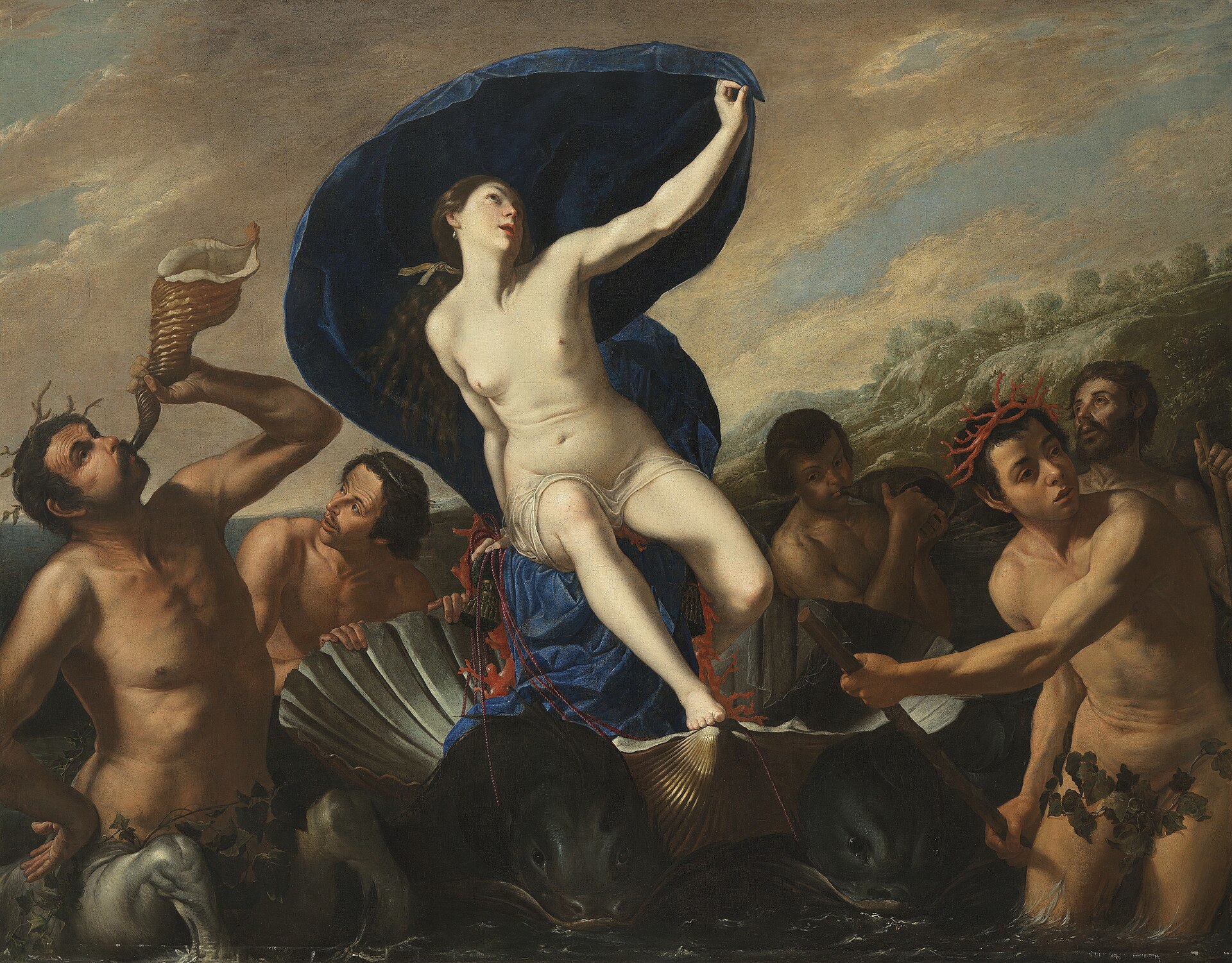
| National Gallery of Art | Washington | Mary Magdalene in Ecstasy, about 1625, oil on canvas, 81 x 105 cm, accession 2025.88.1, gallery 29 of the West Building; and the Triumph of Galatea. | The Magdalene was acquired in 2026 and is described by the Gallery as the first singular work by her to enter the collection, a formula that accommodates the Galatea already there under a shared attribution. The Galatea is the contested picture: given to her with an associate by the 2022 Naples curators, to Bernardo Cavallino alone by Nicola Spinosa, and reported by the Gallery itself to show no evidence of two separate hands. |
| J. Paul Getty Museum | Los Angeles | Lucretia, about 1627, oil on canvas, 36 1/2 x 28 5/8 in., accession 2021.14. | Acquired 2021 from the Matthiesen Gallery for an undisclosed sum after making EUR 4.8m with fees at Artcurial in 2019. The Getty holds two major works by her father Orazio, Lot and His Daughters and Danae and the Shower of Gold, which makes it one of the few places to compare the two hands directly. |
| Royal Collection Trust | London and Windsor | Self-Portrait as the Allegory of Painting (La Pittura), about 1638-39, oil on canvas, 98.6 x 75.2 cm, signed A.G.F., RCIN 405551. | Acquired by Charles I, for whom she worked in London from 1639. The most reproduced image associated with her, and the one her cataloguer argued is not a self portrait at all. |
| Wadsworth Atheneum Museum of Art | Hartford, Connecticut | Self Portrait as a Lute Player, about 1615-17, oil on canvas, 77.5 x 71.8 cm, Charles H. Schwartz Endowment Fund, 2014.4.1. | Bought at Christie's New York in January 2014. Identifiable with the 1638 Medici Artimino inventory entry, which makes it the most securely identified likeness of the artist there is. An X-radiograph shows an inverted female head beneath the lutenist's hand: a reused canvas. |
| Museo Nacional del Prado | Madrid | Birth of Saint John the Baptist, about 1633-34, signed ARTEMITIA CINTILES. | From a six-canvas cycle for a chapel at the Buen Retiro commissioned for Philip IV through the Count of Monterrey, viceroy at Naples. Four of the six were by Massimo Stanzione, also in the Prado, and one, by Paolo Finoglio, is lost. The Escorial holds a small signed Madonna and Child on copper in the Casita del Principe. |
| Pinacoteca Nazionale di Bologna | Bologna | Susanna and the Elders, dated 1652, oil on canvas, 200.3 x 225.6 cm, Collezioni della Pinacoteca Nazionale. | Lent to the National Gallery's 2020 exhibition. Note that the 1652 Susanna attributed by the Naples curators in 2022 is described as being in a London private collection, and that Bissell recorded a Susanna dated 1652 in the possession of Averardo de' Medici in Florence, from which the Dizionario Biografico argues for her death in that year. Whether these are one picture, two or three is not resolved in any source consulted here. |
| Detroit Institute of Arts | Detroit | Judith and Her Maidservant with the Head of Holofernes, about 1625-27, 182.8 x 142.2 cm per the 2001 Metropolitan catalogue, 187.2 x 142 cm in aggregated data, accession 52.253, Gift of Mr Leslie H. Green. | Dated about 1623-26 by the Dizionario Biografico and about 1625-27 by the 2001 Metropolitan catalogue. From the second Roman period, the years the Washington curator describes as producing some of her strongest work, when she was operating without a workshop. Provenance recorded in 2001 as Prince Brancaccio, Rome, then Alessandro Morandotti and Adolph Loewi, then Leslie H. Green. Co-organiser with the Wadsworth Atheneum of 'By Her Hand', 2021-22. |
| Schloss Weissenstein, Schonborn Collection | Pommersfelden | Susanna and the Elders, 1610, oil on canvas, 170 x 119 cm, accession 191, signed and dated ARTIMITIA GENTILESCHI F 1610. | The earliest dated picture and the fixed point for the whole early career. That a sixteen- or seventeen-year-old signed a large multi-figure nude is the fact every argument about her training has to accommodate. In a private princely collection open to the public, not a state museum. |
| Private collections | Various | The panel that set the record in February 2026; the Susanna and the Elders of 1652 in London attributed by the Naples curators; the David and Goliath published in 2020; a Clio signed and dated 1632; a signed Corisca and the Satyr; a Cleopatra. | This is the category that moves and the reason a register is needed. There is no body tracking whether any of these has changed hands since it was last published, and several are known to the literature only through an exhibition catalogue photograph. |
It is often said that her corpus has doubled since 1990.
It is often said that her corpus has doubled since 1990. No source consulted for this page substantiates a count at either end of that claim, and this record therefore does not make it. What can be shown is the direction and the mechanism. There is no ratified number of paintings by Artemisia Gentileschi and no body with standing to produce one. The last full catalogue raisonne is R. Ward Bissell's Artemisia Gentileschi and the Authority of Art: Critical Reading and Catalogue Raisonne, published by Pennsylvania State University Press in 1999: 688 pages, 27 colour and 257 black-and-white illustrations, a 133-page text, four appendixes and a catalogue divided into three parts, headed Autograph Paintings, Incorrect and Questionable Attributions, and Lost Works. That three-part structure is the most honest thing in the field, because it publishes the rejections alongside the acceptances instead of leaving them to be inferred from an absence.
Against Bissell stands Mary Garrard's Artemisia Gentileschi: The Image of the Female Hero in Italian Baroque Art, Princeton, 1989, the book that made her a subject of serious study in English. It is not a catalogue raisonne and it does not offer a rival count. The two books are two arguments about what the pictures are for. Garrard read the work through the artist's sex and her experience; Bissell set out to read it regardless of her sex, and argued in print that most of her subjects were chosen by her predominantly male patrons, that her nudes were priced and painted for male buyers who found in them an outlet for sexual desire, and that her own letters do not support the case for her as a woman of feminist convictions. Steven Ostrow, reviewing the book for caa.reviews in January 2000, called the catalogue of authentic works the most comprehensive and convincing to date and the book a polemical refutation of the feminist approach, both at once. He also recorded his own dissent on two attributions, which is how this discipline actually works.
The National Gallery in London, announcing its purchase in July 2018, wrote of 'sixty or so paintings attributed to Artemisia'. That phrasing is doing careful work. Attributed is not accepted, and sixty or so is not a count. Since 1999 the additions have come from every direction: a Lucretia out of a Lyon family after forty years, a Mary Magdalene resurfacing in the south of France in 2011 and authenticated by Gianni Papi from a black-and-white photograph he found in a Sienese library, a David and Goliath sold in 1975 as Giovanni Francesco Guerrieri and reattributed at the eleventh hour in a Munich saleroom in 2018, a self portrait unknown before it reached the Paris market in 2017, and four pictures proposed at once by the curators of the 2022 Naples exhibition. Christie's, selling a panel in February 2026, described it as one of only five known self portraits and probably the earliest. Five is a count of a category that did not have a stable membership twenty years ago.
Nobody has reconciled these bodies of material. There is no online catalogue raisonne, no concordance between Bissell's numbers and the pictures added since, and no published register of what has been removed. A specialist checking a Gentileschi in 2026 is checking it against a book of 1999, a run of exhibition catalogues, and a scatter of journal articles in three languages.
The clearest demonstration of how attribution works in this field is printed inside a single volume.
The clearest demonstration of how attribution works in this field is printed inside a single volume. Orazio and Artemisia Gentileschi, shown at the Museo del Palazzo di Venezia in Rome from 15 October 2001 to 6 January 2002, at the Metropolitan Museum of Art from 14 February to 12 May 2002 and at the Saint Louis Art Museum from 15 June to 15 September 2002, was organised around a father and a daughter whose hands are not always separable. Keith Christiansen wrote the entries for Orazio and Judith W. Mann wrote the entries for Artemisia. Where they disagreed, the catalogue did not arbitrate. It printed the picture twice, once in each half. The picture is the Cleopatra in the Amedeo Morandotti collection in Milan, oil on canvas, 118 by 181 cm: catalogue number 17 under Orazio, dated about 1610-12, and catalogue number 53 under Artemisia, dated about 1611-12, with the provenance and the bibliography in the first entry and the second simply referring back to it. Christiansen wrote in the preface that the authorship of a picture of that quality still being under debate testifies to the problems attending the study of her paintings, and that despite Garrard's monograph and Bissell's indispensable catalogue raisonne the field remained far from a coherent view of her career.
That arrangement is worth understanding because it is the opposite of what a buyer expects an institution to do. A museum catalogue is normally read as a ruling. This one declined to rule, and by declining it produced the most useful document in the literature: a picture with two catalogue numbers, two authors and two arguments, published simultaneously by the same institution. Anyone who wants to know how firm a Gentileschi attribution is should start there rather than with a certificate.
The grammar of the disagreement is consistent across the field. One side argues from handling and from documented commissions: this drapery, this flesh, this model, and a period reference to a picture of this subject by this painter. The other argues from narrative construction: Orazio followed established modes of representation, while his daughter invented the moment, held the pause, and finished the story that her father left hanging. Neither method settles a picture on its own, and in a corpus with no agreed inventory of either the survivors or the losses, both methods have been asked to carry more weight than they can bear.
The Cleopatra dispute is worth following because it shows what each side actually argues from. Bissell made the case for Orazio on three grounds: that the head corresponds to a figure in the Casino delle Muse frescoes, that the linens resemble those in Orazio's Pommersfelden Madonna and Child, and that a letter of 1613 records Orazio having a Cleopatra in his studio which he meant to send to Florence. That is connoisseurship plus a document. The case for Artemisia rests on interpretive tone, on how the narrative is constructed and where the moment is chosen. The earliest notice of the picture is in Carlo Giuseppe Ratti's Genoese guidebook of 1780, which lists four paintings in the palace of Pietro Maria III Gentile: a Cleopatra, a Judith, a Lucretia and a Sacrifice of Isaac. They were moved to the Palazzo Cattaneo-Adorno before 1846, an inventory of 1811 was drawn up with a view to sale, and a guidebook of 1818 states the collection had been dispersed by then.
The same argument runs through a second object, and the Metropolitan catalogue says the exhibition was more or less launched by it: the small Danae on copper that the Saint Louis Art Museum bought in 1986 amid what the catalogue calls a flurry of debate. It first appeared at a Sotheby's sale in Monaco in 1986 as Orazio. Matthiesen published it as Artemisia, an attribution accepted by Nicolson, Papi and Contini. Freedberg, Schleier and Bissell argued for Orazio, though Schleier later questioned that. Garrard proposed a third artist entirely, perhaps one of Artemisia's own daughters, making a reduced copy of the nude from the Morandotti Cleopatra. Four positions, one small picture on copper, and a museum that had already bought it.
Nor are those two isolated. The Metropolitan catalogue lists the Oslo Judith and Her Maidservant, the Naples Judith Slaying Holofernes and the Milan Lucretia as further pictures published under both names, and records that Gianni Papi had recently given the Lucretia to Orazio.
Bissell's own book contains the same problem in miniature. Ostrow, reviewing it, accepted the catalogue as the best available and in the same paragraph refused Bissell's attribution to Artemisia of the central portion of the Galatea then in a New York private collection, and noted that others would question Bissell's argument for her participation in the Queen's House ceiling paintings at Greenwich, pointing to Gabriele Finaldi's essay in the 1999 National Gallery volume on Orazio at the court of Charles I. Both of those disputes are still live. The Galatea in particular went on to be attributed to her by one set of curators in 2022 and to Bernardo Cavallino alone by another scholar, with the owning museum reporting that it found no evidence of two separate hands at all.
Five classes of evidence carry weight, and they are unevenly distributed across the corpus.The signature.
Five classes of evidence carry weight, and they are unevenly distributed across the corpus.
The signature. She signed a minority of her pictures and dated fewer. The signatures are in Latin, they are inconsistent in spelling, and the inconsistency is itself diagnostic rather than suspicious. The Pommersfelden Susanna and the Elders carries ARTIMITIA GENTILESCHI F 1610 on the wall behind the figure. The Uffizi Judith carries EGO ARTEMITIA LOMI FEC on the sword blade, I, Artemisia Lomi, made this, using the Lomi name she took in Tuscany. Wikimedia Commons transcribes that inscription as ERGO and translates it as 'therefore', which is both bad Latin and wrong; the 2001 Metropolitan catalogue reads EGO. The Prado Birth of Saint John the Baptist is inscribed ARTEMITIA CINTILES, a phonetic mangling of her own surname. The Royal Collection La Pittura is signed only A.G.F. A specialist who expects a consistent autograph across four decades and three cities will reject genuine pictures.
The documented commission. Michelangelo Buonarroti the Younger's payments for the gallery ceiling at the Casa Buonarroti run from August 1615 to August 1616 and constitute her only documented Florentine work. The three altarpieces for Pozzuoli cathedral belong to a choir scheme ordered by the new bishop, Martin de Leon y Cardenas, after the eruption of Vesuvius in 1631 and completed by 1640; the pictures themselves are dated almost certainly to 1635-37. The Prado Birth of the Baptist belonged to a six-canvas cycle for a chapel at the Buen Retiro, commissioned for Philip IV through the Count of Monterrey, viceroy at Naples, of which four canvases were painted by Massimo Stanzione and one, now lost, by Paolo Finoglio. This class of evidence is the strongest there is and it covers a fraction of the whole.
The period inventory. The Self Portrait as a Lute Player now at the Wadsworth Atheneum is recorded in the 1638 inventory of the Medici villa at Artimino as the portrait of Artemisia playing the lute, by her own hand. One line does two jobs: it attributes the picture and it identifies the sitter, and it does so within her lifetime.
The shared design. This is the newest and, for a specialist, the most useful. The National Gallery's technical work on its Self Portrait as Saint Catherine, published by Larry Keith and colleagues in 2019 and set out at length in the Gallery's 2024 catalogue entry, established that she transposed parts of her designs from canvas to canvas by tracing or cartoon. Tracings taken from the Hartford Lute Player and the London Saint Catherine align perfectly at the heads and separately at the shoulders, which means the design was transferred in parts rather than as a whole, leaving the neck longer in the London picture. The Opificio delle Pietre Dure, examining the Uffizi Saint Catherine in Florence in 2019, found beneath it a turbaned figure whose outlines match the London picture almost exactly, and a third, smaller female head beneath that. An X-radiograph of the Hartford picture found an inverted female head under the lutenist's left hand: she abandoned a composition, turned the canvas through 180 degrees and painted over it. A cartoon match is not a signature. It is a physical link between two objects that connoisseurship cannot argue away, and in a corpus this unstable it is worth more than most opinions.
The photograph in the archive. Twice now a picture has been recovered because a scholar remembered a black-and-white plate. Gianni Papi authenticated the Mary Magdalene now in Washington from a photograph in a Sienese library, and had proposed the London David and Goliath as hers as long ago as 1996 on the evidence of a single black-and-white photograph, more than twenty years before the picture itself came back to the surface. Photographic archives are doing work here that no stylistic argument could do, and they are the part of the apparatus least likely to be digitised.
The record of the proceedings brought in Rome in 1612 against the painter Agostino Tassi is held in the Archivio di Stato di Roma, Tribunale criminale del governatore, Processi del XVII secolo...
The record of the proceedings brought in Rome in 1612 against the painter Agostino Tassi is held in the Archivio di Stato di Roma, Tribunale criminale del governatore, Processi del XVII secolo, volume 104, folios 270 to 447. It is the earliest surviving record of Artemisia Gentileschi's voice. It is a documentary source of the first order and it should be handled like one, which means being exact about what it contains and equally exact about what it does not.
What the record establishes. That Tassi, a collaborator of her father who had been brought into the household in connection with work on perspective, was prosecuted over the rape of Orazio's daughter. That the assault took place in May 1611, in the family's house in via della Croce, when she was seventeen. That Orazio did not petition Pope Paul V until March 1612, after joint commitments with Tassi had been completed and paid, a delay the Dizionario Biografico treats as material rather than incidental. That the complaint named Cosimo Quorli, a papal official, as complicit, and a neighbour named Tuzia. That she testified at eighteen and was examined under torture with the sibille, cords wound round the fingers and drawn tight, to test whether she was telling the truth. That the court delivered its sentence on 27 November 1612, requiring Tassi to choose between five years in the galleys and perpetual banishment from Rome. And that the action was framed in the law of the time as an injury to her father, which is why Orazio is the complainant and Artemisia is a witness in a case about herself.
What the record does not establish. It does not establish that the sentence was served. The Dizionario Biografico states that there is reason to believe it was not; the National Gallery says the banishment was never enforced; neither cites an enforcement folio, because the sentence and its execution are different documents. It does not establish that any painting was made in response. The National Gallery, which owns a picture painted within a few years of the trial and hangs it as a self portrait, states in its own catalogue that reading her assumption of the role of Saint Catherine as rooted in the trial seems rather far-fetched, and that caution is needed in seeing her features in every heroine she painted and reading the pictures in purely autobiographical terms. That is the holding institution arguing against the popular reading of its own most popular painting. It does not establish permanent illiteracy: Bissell examined thirty letters written across three decades and concluded that they show a clever, alert, pragmatic and outspoken person rather than a well-read one given to recondite allusion, which is a judgement about her letters and not about her schooling.
The transcript has been published in Italian and translated into English in the appendix to Garrard's 1989 book, which is where most Anglophone scholarship reads it. Its status as a museum object is recent: it was shown in public for the first time in the National Gallery's exhibition in London in 2020. That is a small fact with a large implication. The single most cited document in the literature on this artist had never been exhibited until the year of her first British monographic show.
This publication takes no view on the biographical readings and records only that they are contested, that the holding institutions are themselves among the sceptics, and that the transcript is a legal record of a criminal proceeding rather than a key to a body of paintings.
She married Pierantonio Stiattesi in Rome on 29 November 1612, under a contract drawn up on 11 August and registered with Florentine officials on 11 January 1613, and the couple travelled to Florence...
She married Pierantonio Stiattesi in Rome on 29 November 1612, under a contract drawn up on 11 August and registered with Florentine officials on 11 January 1613, and the couple travelled to Florence at the end of 1612 or early in 1613. She stayed until 1620. It is the period in which the documentary record thickens and it is the period that now sets the market.
She set up a studio almost immediately in the house of her father-in-law, the tailor Vincenzo Stiattesi, on via Campaccio near San Lorenzo, and after his death in 1615 on Borgo Ognissanti. On 19 July 1616 she matriculated at the Accademia e Compagnia delle Arti del Disegno. The precise standing of that event is disputed inside a single institution: the National Gallery's press release of 2018 calls her the first woman to become a member, its own scholarly catalogue entry of 2024 calls her one of the first women to do so in the Academy's fifty-year history, and the Getty calls her the first woman to join. This record does not adjudicate between an institution's press office and its curators. Membership mattered for reasons that had nothing to do with honour: it gave a painter standing to contract, to buy materials on credit and to be paid, which for a married woman under Tuscan law was the difference between a practice and a pastime.
The commission that documents her Florentine position best is the Allegory of Inclination, painted for Michelangelo Buonarroti the Younger for the gallery ceiling of the Casa Buonarroti, a room conceived as a monument to his great-uncle. Payments run from August 1615 to August 1616. It is her only documented Florentine work. Buonarroti also stood as guarantor for her, was to have been godfather to her daughter Agnola, born in December 1614 and dead before baptism, and introduced her to the Florentine court. The figure holds a mariner's compass and looks up to a star: inclination in its period sense, the inborn disposition that carries a person towards greatness, here Michelangelo's. It is a personification, and it has been read since the nineteenth century as carrying her face. Whether she intended a self portrait is not settled and this record does not settle it.
What happened to the picture afterwards is the more instructive part, because it is a documented case of a painting being altered for propriety and then restored under a modern ethic that declined to undo the alteration. In about 1684 a descendant found the nude figure embarrassing and had drapery painted across it. That overpaint has been on the canvas for more than three centuries and is now part of its history. A conservation campaign carried out in public in the museum, with ultraviolet, infrared and radiographic imaging used to separate the two hands, left the drapery in place and presented the original state as a reconstruction shown alongside the object. That is a defensible decision and it is also a decision: what hangs on the ceiling is a seventeenth-century painting by two hands, shown next to a modern image of what one of them did.
The other Florentine document is financial and does not flatter the patron. The Uffizi's own account of its Judith Beheading Holofernes is that the naturalistic force of the picture provoked strong reactions on arrival in Florence and that it was denied the honour of being exhibited in the gallery. The Uffizi also dates the canvas to about 1620 and states that it was completed in Rome after her return, which sits awkwardly against the Dizionario Biografico's placement of it at the far end of the Florentine years and its suggestion that it was painted for Cosimo II. Both positions are in print, both come from serious quarters, and this record carries both.
The National Gallery's Self Portrait as Saint Catherine of Alexandria is the best-documented Gentileschi acquisition there has ever been, and it is the model for what an entry on this site should...
The National Gallery's Self Portrait as Saint Catherine of Alexandria is the best-documented Gentileschi acquisition there has ever been, and it is the model for what an entry on this site should contain.
The object. Oil on canvas, 71.4 by 69 centimetres, about 1615 to 1617, NG6671. The support is a medium-weight plain weave linen made from two horizontal strips joined and stretched before painting, the lower strip about 7 centimetres wide. The top edge is jagged and shows little or no cusping, which means it was cut down.
The chain. The picture was unknown before it reached the Paris market in 2017. The Gallery's published provenance runs: the Boudeville family, believed to have held it for several generations, at Chatenois in the Vosges; by descent to Charles Marie Boudeville, who died in the early 1940s; to his son Georges Boudeville, 1930 to 1984; to his only son Nicolas Boudeville, born 1966; sold by him through the auctioneer Christophe Joron-Derem at the Hotel Drouot on 19 December 2017, lot 69, where it was bought by Marco Voena, Old and Modern Masters Ltd and Fabrizio Moretti; purchased by the National Gallery in 2018. Three named dealers stand between a French family and a national collection, and the Gallery published their names rather than writing 'private collection'. That is the standard other institutions should be held to.
The money, separated. At Drouot the hammer was 1.85 million euros, about 2.1 million dollars; with fees the sale is reported at 2.3 million euros. The Gallery paid 3.6 million pounds seven months later. The dealers' outlay was the with-fees 2.3 million euros, not the 1.85 million hammer, so any margin has to be computed from the larger figure; and because the two ends are in different currencies, no margin is stated here as a number. The funding is itemised in its press release: 3.7 million dollars from the American Friends of the National Gallery, 380,000 pounds from the National Gallery Trust, 250,000 pounds from the Art Fund through the legacy of Sir Denis Mahon, which also covered part of the conservation, and 280,000 pounds from donations and gifts from wills. The gap between what the dealers paid in December and what the Gallery paid in July covers their margin plus whatever the research, the attribution work and the risk were worth. It is visible at all only because both ends were published, which is rare.
The conservation. There was no record of any treatment before acquisition, though the canvas had been lined and cleaned at least once, and the lining canvas carried the number 715 on the reverse. On arrival there was a compound tear about 4 centimetres wide beside the sitter's right wrist, a deformation above the crown, a triangular loss along the top edge and deep scratches near the upper right. The treatment ran five months: cleaning, removal of old fillings and retouchings, consolidation of the tear with sturgeon glue, removal of the old lining, repair, insertion of new oil-primed canvas at the losses, two flattenings, filling of woodworm holes, refacing and relining, and restretching on the existing stretcher with a loose lining. The tacking edges were missing on all sides but the right. A strip of primed canvas was added at the top and the missing crown point and the tip of the palm were reconstructed, while the halo was deliberately left cropped. That last choice is the interesting one: the Gallery completed what it could argue from evidence and left visible what it could not.
The campaign. The treatment was filmed as fourteen short films released in near real time under the tag NGArtemisia, and the picture went on public display in December 2018. Between March and August 2019 it toured under the title Artemisia Visits to a women's library in Glasgow, a doctors' surgery in Yorkshire, a Catholic high school in Newcastle upon Tyne, a women's prison in Surrey and a public library in Walthamstow, the first time a painting from the national collection had been shown in a prison. The acquisition then produced the exhibition: Artemisia, the first monographic show devoted to her in the United Kingdom, scheduled for 3 October 2020 to 24 January 2021 and built around some thirty works. On the Gallery's own account it closed six and a half weeks into what it calls a fourteen-week run when the country locked down; the scheduled dates it publishes, 3 October to 24 January, in fact span about sixteen weeks. Its catalogue, edited by Letizia Treves, runs to 256 pages with 140 illustrations. The exhibition also put the trial transcript on public display for the first time and lent the Bologna Susanna of 1652 and the Mary Magdalene in Ecstasy that Washington would buy six years later.
What the money did not buy is a settled reading. The Gallery owns the picture, hangs it as a self portrait, and prints in its own catalogue the argument that reading it against the trial is far-fetched.
She was in Naples by the beginning of 1630, when she signed and dated the large Annunciation now in the Museo di Capodimonte, and apart from the London interval she remained there until she died.
She was in Naples by the beginning of 1630, when she signed and dated the large Annunciation now in the Museo di Capodimonte, and apart from the London interval she remained there until she died. She disliked the city and said so repeatedly in letters to Cassiano dal Pozzo, Galileo, Andrea Cioli, Antonio Ruffo and Francesco I d'Este, and she nevertheless built the most productive practice of her life there.
The Neapolitan work is where attribution becomes genuinely hard, because it stopped being a question about one pair of hands. She took large commissions and she subcontracted. The three large canvases for the cathedral of POZZUOLI, not Naples, executed almost certainly between 1635 and 1637, are the most demanding commission of her career and the only altarpieces she ever painted: it was a genre she had not practised before she reached Naples and never returned to afterwards. They belonged to a wider scheme for the choir ordered by the new bishop, Martin de Leon y Cardenas, after the eruption of Vesuvius in 1631 and completed by 1640, a project that also drew in Massimo Stanzione and Giovanni Lanfranco. The three are, the Saints Proculus and Nicea and the Saint Januarius in the Amphitheatre at Pozzuoli, both now at Capodimonte, and an Adoration of the Magi now in the Museo Nazionale di San Martino. The Dizionario Biografico notes plainly that the stylistic unevenness of those three has generated a variety of hypotheses about collaboration. The names that recur are Bernardo Cavallino, Onofrio Palumbo, Viviano Codazzi, who painted architecture, and Domenico Gargiulo, called Micco Spadaro, who painted landscape and figures in the distance.
The 2022 exhibition at the Gallerie d'Italia in Naples, curated by Antonio Ernesto Denunzio and Giuseppe Porzio, made the underlying problem explicit and then took a position on it. The curators proposed four attributions at once: the Triumph of Galatea in Washington, a Susanna and the Elders of 1652 in a London private collection, and Israelites Celebrating the Return of David and Bathsheba at Her Bath, both in the Ringling Museum at Sarasota. Their criterion was not the hand. It was that she owned the commission and invented the composition, even where other painters worked on the canvas. On that basis a picture can be hers and contain very little of her paint.
That is a defensible position and it is not the only one. Nicola Spinosa gives the Galatea to Bernardo Cavallino alone. The National Gallery of Art in Washington, which owns it, has reported finding no evidence of two separate hands in it at all. So there are three incompatible readings of one canvas: two painters with her in charge, one painter who is not her, and one painter without saying which. A collector reading a catalogue note that says 'Artemisia Gentileschi and workshop' should understand that the phrase is currently doing the work of an unresolved argument rather than describing a known division of labour.
The Neapolitan notarial archives are the part of this story that has actually moved recently. The 2023 volume of studies and documents edited by Denunzio and Porzio prints inventories that place her pictures in named Neapolitan houses in her own century, with the descriptions the appraisers actually wrote. The post-mortem inventory of Ettore Capecelatro, marquis of Torello, drawn up in April 1655, is one; another records a Judith of five by six palmi in a gilded frame by the hand of Artemisia Gentileschi, which is a rare instance of a period document recording the frame as well as the picture. Other collections list her against a Sacrifice of Abraham and a Saint Cecilia. The same research recovered a payment order in favour of Vittoria Corenzio, who owned the house where Artemisia was living in the 1650s, which is the kind of document that fixes a person to an address at a date.
One detail from those archives deserves to be read by anyone who thinks connoisseurship is a modern invention. When the Capecelatro heirs needed their pictures listed properly, they engaged the painter Domenico Gargiulo to redo the inventory, and he restored the works to their correct authors, described the subjects better and put a price on each one. The man attributing and valuing the collection was a painter who had himself collaborated with Artemisia. Attribution in Naples was a trade performed by practitioners, for money, and it has left a paper trail.
Because the corpus has no board and no register, the physical inscription carries more weight here than it does for painters with a functioning authentication apparatus.
Because the corpus has no board and no register, the physical inscription carries more weight here than it does for painters with a functioning authentication apparatus. It is worth setting out exactly what the inscriptions say, because they are not uniform, the variation is evidence rather than doubt, and at least one of them is mistranscribed in the reference source most people will reach for.
The Pommersfelden Susanna and the Elders, at Schloss Weissenstein, accession 191, is inscribed on the wall behind the figure ARTIMITIA GENTILESCHI F 1610, expanded as FACIEBAT. It is the earliest dated picture and the anchor of the whole early career, and it is signed with an I where a modern reader expects an E, twice.
The Uffizi Judith Beheading Holofernes is inscribed at the lower right, on the blade of the sword, EGO ARTEMITIA LOMI FEC, for FECIT: I, Artemisia Lomi, made this. Lomi is the Pisan family name of her father's brother Aurelio, and she used it in Tuscany, where it was worth more than Gentileschi. A signature that changes surname by city is a provenance instrument in its own right. It is also the clearest case on this page of a reference source being wrong: the Wikimedia Commons file page transcribes the inscription as ERGO and translates it as 'therefore did Artemisia Lomi', which is not what the picture says and not what the word would mean. The 2001 Metropolitan catalogue, produced when the canvas was on loan and in front of the cataloguer, reads EGO.
The Burghley House Susanna and the Elders is signed at the lower centre ARTEMITIA GENTILESCHI LOMI FACIEBAT A D MDCXXII, using both surnames at once and the year 1622 in Roman numerals. Its autograph status is not universally accepted, and it was first listed as by Artemisia by the ninth earl of Exeter in an eighteenth-century inventory.
The Prado Birth of Saint John the Baptist is inscribed ARTEMITIA CINTILES, expanded as ARTEMITIA GENTILESCHI, alongside the number 471. A picture painted for a royal commission carries a phonetic misspelling of the painter's own surname, which tells you something about who was actually holding the brush when the inscription went on, or about how little the spelling mattered to the people involved.
The Royal Collection Self-Portrait as the Allegory of Painting, RCIN 405551, oil on canvas, 98.6 by 75.2 centimetres, about 1638 to 1639, is signed only with the initials A.G.F., for Artemisia Gentileschi fecit. Three letters on the picture that is most often reproduced as her self portrait, and which Bissell argued in 1999 is not a self portrait at all.
The practical consequence is that a signature on a Gentileschi is a starting point and not a conclusion, in both directions. An unexpected spelling is not a red flag; a plausible spelling is not a guarantee; and four of her most secure pictures would fail a naive test for a consistent autograph.
She was not a curiosity sustained by novelty.
She was not a curiosity sustained by novelty. She was a working history painter with an international client list, and the list is documented.
In Florence her patrons were the Medici and their circle. Orazio had written to the dowager Grand Duchess Christina of Lorraine in 1612, sending a sample of his daughter's work and boasting, in a letter to Maria Maddalena of Austria in the same year, that after three years of study she had no peers and that perhaps the most important masters of the profession could not achieve what she had. That is a father marketing an eighteen-year-old, and it worked. The National Gallery's catalogue lists as painted for Cosimo II a Judith beheading Holofernes now in the Uffizi, a Diana at Her Bath now untraced, and a Hercules probably never finished or delivered. The Cosimo II patronage of the Uffizi Judith is not secure: it is the Dizionario Biografico's suggestion, and the Uffizi itself dates the canvas to about 1620 and says it was finished in Rome after she had left Florence.
The Casa Buonarroti ceiling is the one Florentine commission with a documented payment record, running from August 1615 to August 1616. Michelangelo Buonarroti the Younger also acted as her guarantor, which is a financial fact rather than a social one: he was standing behind her debts. It is frequently said that she was paid several times what the other painters on that ceiling received. No source consulted here prints the comparative figures, so this record does not repeat the claim; the account book would settle it and should be read.
Beyond Tuscany the buyers were the highest available. Fernando Afan de Ribera, duke of Alcala, viceroy at Naples, carried her Penitent Magdalene to Seville around 1631, where it remains in the cathedral. Philip IV of Spain received the Birth of Saint John the Baptist through the Count of Monterrey, as part of a six-canvas Baptist cycle for a chapel at the Buen Retiro in which four canvases were by Massimo Stanzione and one, now lost, by Paolo Finoglio. Charles I of England bought from her, and she reached London to assist her ailing father as he completed the Queen's House ceiling at Greenwich. The National Gallery dates that journey to 1639; Orazio died in 1639, so on that dating the assistance can only have been brief, and the date deserves checking against the London records. She corresponded with the Messinese collector Antonio Ruffo, with Cassiano dal Pozzo, with Galileo, and with Francesco I d'Este.
In Venice in 1627 a pamphlet of poems was printed on four of her pictures, two on a self portrait and one each on a Susanna and a Sleeping Cupid, with three on a Lucretia. Bissell attributed the verses to Giovanni Francesco Loredan, and the Getty considers it highly probable that its own Lucretia is the picture praised in them. A printed pamphlet of praise poetry is a marketing document, and it is the earliest evidence that her pictures were being promoted as a brand rather than sold one by one.
This publication converts none of these sums into modern money. The methods differ by an order of magnitude and every published equivalence for a seventeenth-century Tuscan or Neapolitan payment rests on a choice of index that the citing author rarely states.
Her reputation has moved through four distinct phases, and the market has followed each of them at a lag.She was famous in her lifetime and for a generation after it.
Her reputation has moved through four distinct phases, and the market has followed each of them at a lag.
She was famous in her lifetime and for a generation after it. Bernardo De Dominici, writing in the 1740s, credited her with shaping the Neapolitan scene and specifically with inspiring the expressive sweetness and chromatic refinement of Palumbo, Cavallino and Stanzione. A Neapolitan poet published a tribute in 1667, more than a decade after her death, calling her as famous as she was beautiful. That is contemporary and near-contemporary testimony to a working reputation, not a modern reconstruction.
Then she disappeared, along with her father and most of the Caravaggisti, and stayed out of the literature until the twentieth century. The National Gallery puts the re-evaluation of her work in the last fifty years, and says plainly that many paintings remain unidentified. The Getty puts the thorough reassessment of her place in Baroque art in the late twentieth century. The scale of the change is easy to measure: when Eleanor Tufts published Our Hidden Heritage in 1974 she complained that no book had ever been written on Artemisia; fewer than fifty years later, as Aoife Brady noted in the Burlington Magazine, there were more than a dozen substantial scholarly volumes devoted to her in several languages, besides the novels, plays, documentaries and a feature film.
The revival that followed was driven by Garrard's book of 1989 and by the feminist art history it belonged to, and it made her a public figure in a way that no other seventeenth-century Italian painter except Caravaggio has managed. It also produced a reading of the pictures as autobiography that the specialist literature has been steadily walking back ever since. Bissell attacked it directly in 1999. The National Gallery's own 2024 catalogue entry states that over half of her known paintings have at some point been identified as self portraits or as containing her portrait, warns against seeing her features in almost every heroine she painted, and calls the reading of her Saint Catherine as rooted in the trial rather far-fetched.
The fourth phase is the one now under way and it is the reason this page exists. Since about 2010 the driver has not been interpretation but discovery: pictures coming out of French and Italian private collections, technical imaging linking canvases to one another, notarial archives in Naples placing her work in named houses in the seventeenth century, and museums competing for the results. The Getty bought in 2021. The National Gallery of Art in Washington bought in 2026 and announced it on the day her auction record was broken. Straussman-Pflanzer, the curator who acquired the Washington picture, had shown it in her own exhibition four years earlier, which is how museum acquisition actually works and is rarely stated so clearly.
Each phase has been accompanied by the claim that she is finally being seen properly. The honest position is narrower: the corpus is larger than it was, the documentary base is better than it was, and the interpretive quarrel of the 1990s has not been settled so much as set aside while people look at the pictures.
Four public results define the market and they are all recent.
Four public results define the market and they are all recent. Read in order they describe a corpus being priced as it is discovered rather than a reputation being revalued.
Paris, 19 December 2017. Christophe Joron-Derem, Hotel Drouot, lot 69: the Self Portrait as Saint Catherine of Alexandria, out of the Boudeville family in the Vosges. Hammer 1.85 million euros, about 2.1 million dollars. With fees the sale is reported at 2.3 million euros, which was itself a record for the artist. Bought by Marco Voena, Old and Modern Masters Ltd and Fabrizio Moretti. Seven months later the National Gallery paid 3.6 million pounds for it. The picture had been unknown to scholarship until it reached the market.
Paris, 13 November 2019. Artcurial, the auctioneer Matthieu Fournier: Lucretia, out of a Lyon family after forty years, estimated 600,000 to 800,000 euros, sold at 4.8 million euros with fees, about 5.3 million dollars, to the London dealer Patrick Matthiesen. That was the record for six years, and the Getty acquired the picture from him in 2021, accessioning it as 2021.14. A picture estimated at six figures made seven, and then went to a museum at an undisclosed third price.
Paris, 2014. Sotheby's: Mary Magdalene in Ecstasy, 865,500 euros with fees, about 1.2 million dollars, itself a record at the time. It had resurfaced in the south of France in 2011 and had been authenticated by Gianni Papi from a black-and-white photograph in a Sienese library. The National Gallery of Art in Washington bought it from a private collection for an undisclosed sum and announced the acquisition on 4 February 2026.
New York, 4 February 2026. Christie's, Old Masters: a Self-Portrait as Saint Catherine of Alexandria, oil on panel, 32.3 by 24.6 centimetres, about 1615, against an estimate of 2.5 to 3.5 million dollars. It made 5,687,000 dollars with premium, the current record. Christie's did not publish a separate hammer figure in the reporting consulted here, and this record does not infer one; at the house's published rates the hammer is materially lower than the reported total and any comparison with the 2019 Artcurial figure, which is also a with-fees number, is a comparison of like with like only by accident. Jennifer Wright, head of the department, described competitive bidding from around the world. The panel had been bought at Livorno in the last century by a collector from Pisa, stayed in that family until 2016, went to the European market, was acquired in New York in 2018 through Murphy and Partners, and was on loan to the Nasjonalmuseet in Oslo from 2022 to 2025.
Against those four, one number matters more than any of them for anybody trying to buy. In 2018, at Hampel Fine Art Auctions in Munich, a David and Goliath that had sold at Sotheby's in 1975 as Giovanni Francesco Guerrieri was reattributed to Artemisia at the eleventh hour and made 104,000 euros. It was then cleaned by Simon Gillespie in London and published as hers by Gillespie and Gianni Papi in the Burlington Magazine in 2020. That is the whole thesis of this market in one lot: the money is not in buying an accepted Gentileschi, it is in the gap between a saleroom's catalogue and the literature, and that gap is closing.
Two cautions belong on any comparable. First, museum prices are not market prices. The National Gallery's 3.6 million pounds was assembled from six named sources including 3.7 million dollars from an American friends body and a legacy administered by the Art Fund, and the Washington and Getty prices were not disclosed at all. Second, the female Old Master record is held by someone else: 7.2 million dollars for Elisabeth Louise Vigee Le Brun's portrait of Muhammad Dervish Khan at Sotheby's New York in 2019. Gentileschi is not yet the most expensive woman painter of the pre-modern period, and the reporting that treats her as such is wrong.
She painted the same subjects repeatedly, her titles were assigned long after her death, and the results are a standing trap.
She painted the same subjects repeatedly, her titles were assigned long after her death, and the results are a standing trap. Anyone consulting a database, a stock photograph or a Commons file on this artist should treat the label as a claim to be checked rather than a fact.
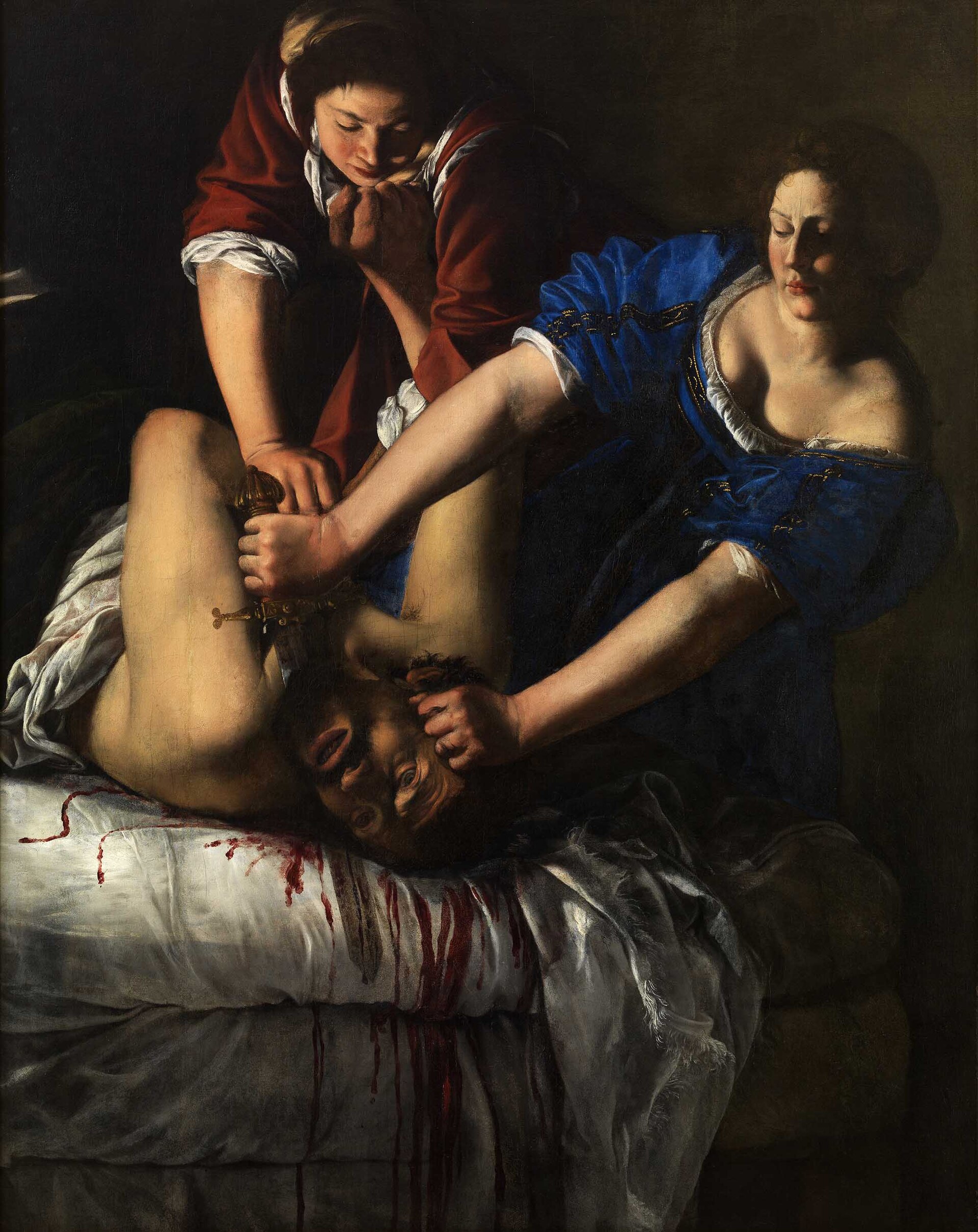
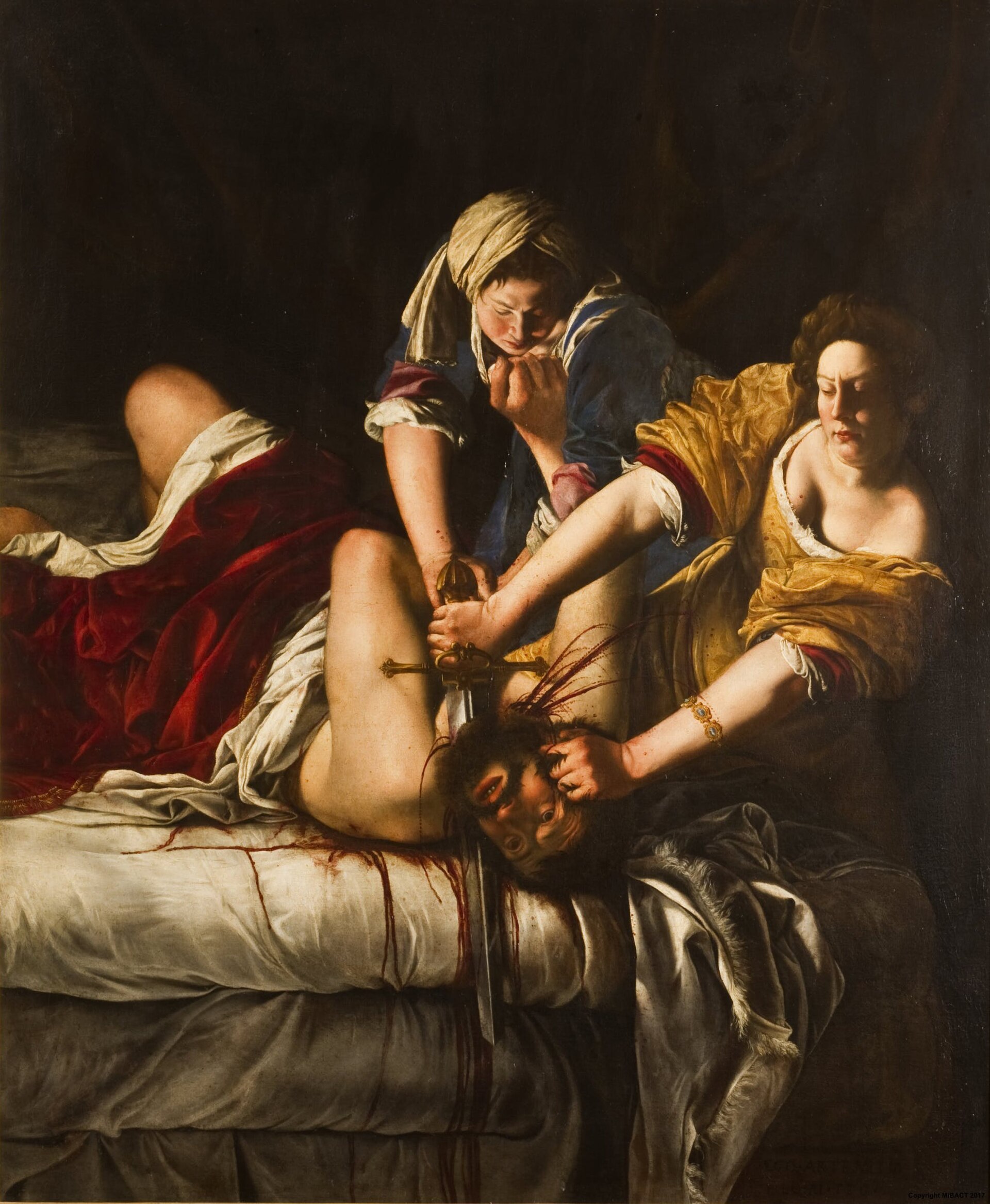
The Judith pictures are the worst case. There are at least two autograph Judith Slaying Holofernes compositions: the earlier, in the Museo di Capodimonte at Naples, and the later, in the Uffizi at Florence. The National Gallery's catalogue states that she must have used a cartoon or tracing of the Naples picture to make the Florence one, which is precisely why they resemble each other closely enough to be confused and are aesthetically quite different. On top of those sit the several Judith and her Maidservant compositions, in the Galleria Palatina at Florence, the Detroit Institute of Arts, Capodimonte, the Musee des Explorations du Monde at Cannes, and the Nasjonalmuseet in Oslo, which are a different subject at a different moment in the story. A caption that says only 'Judith' has told the reader nothing.
The dimensions are not a safe discriminator either, because the published figures conflict. For the Uffizi picture, inventory 1890 number 1567, the figure in general scholarly circulation is 199 by 162.5 centimetres, and it is the figure carried by the aggregated structured data. The Uffizi's own catalogue page, in both English and Italian, gives 146.5 by 108 centimetres. The 2001 Metropolitan catalogue, compiled while the canvas was on loan, gives the width as 162.5 cm. That corroborates the general figure against the museum's own website, so on the width the Uffizi page appears simply to be wrong. On the height this record takes no position: the Metropolitan catalogue's height as scanned here is corrupted and is not quoted, and the discrepancy between 199 and 146.5 cm is unexplained in every source consulted. The picture should be remeasured. The Capodimonte picture is separately recorded at 158.8 by 125.4 or 125.5 centimetres, which is not close to either.
The dating is contested in the same way. The Uffizi dates its Judith to about 1620 and states that it was completed in Rome after her return from Florence; the Dizionario Biografico places it at the far end of the Florentine years and repeats the suggestion that it was painted for Cosimo II. Both are in print.
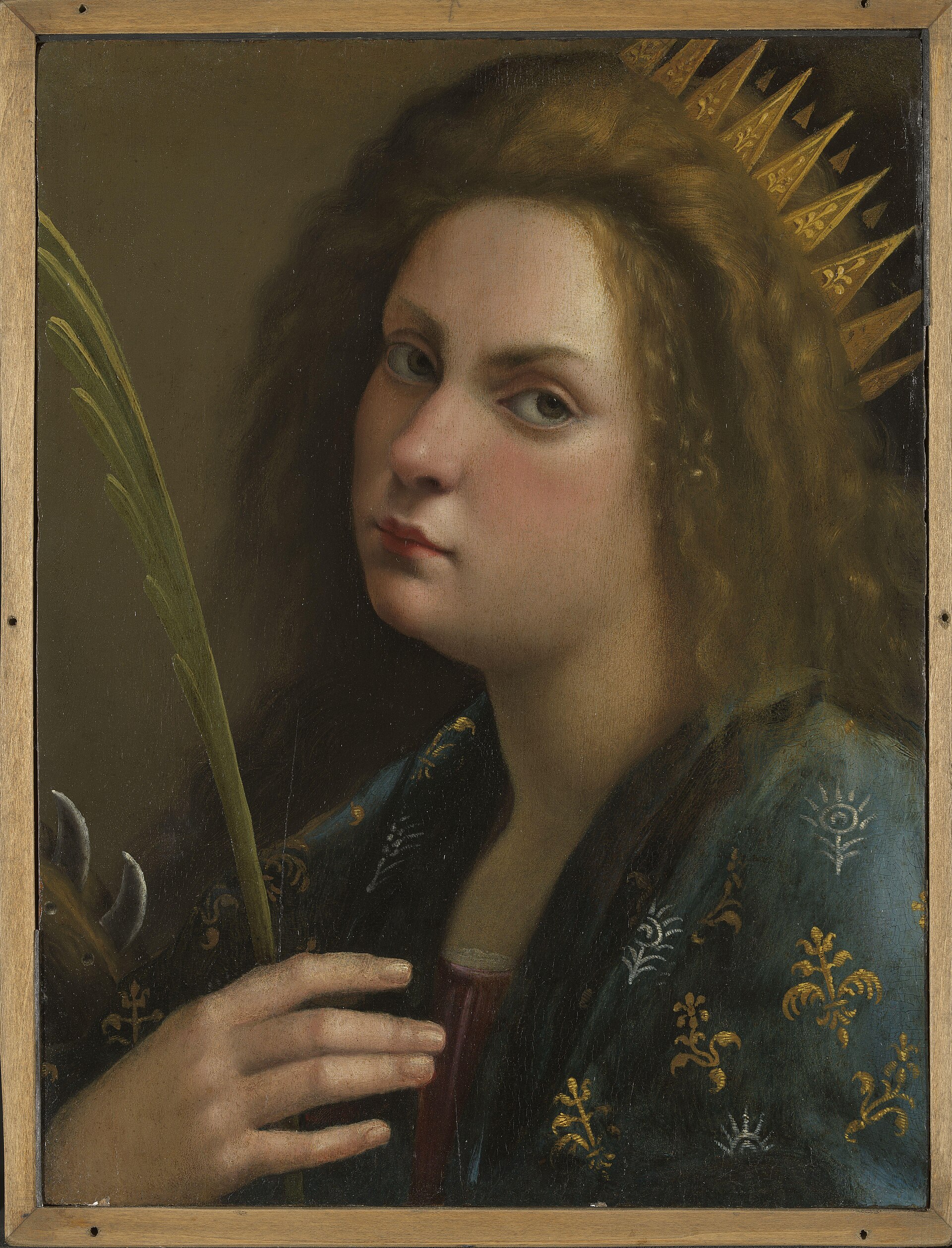
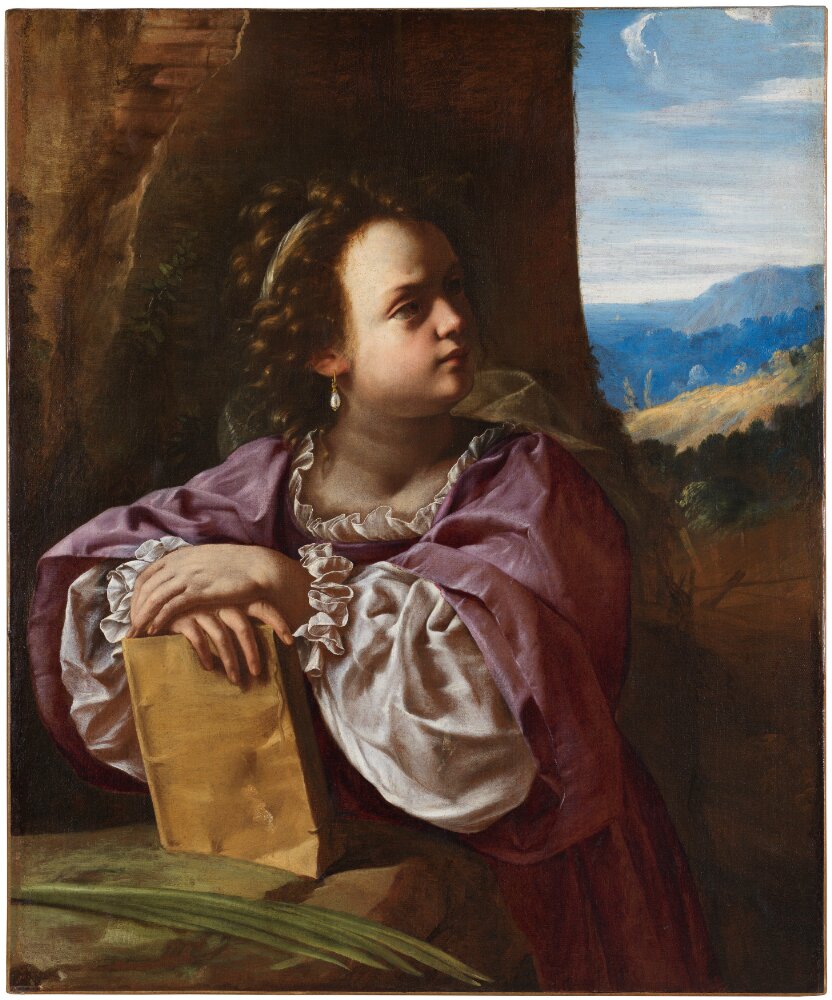
The Saint Catherine group is a second trap and a more expensive one. There are at least three closely related pictures: the National Gallery's Self Portrait as Saint Catherine of Alexandria, NG6671, oil on canvas, 71.4 by 69 centimetres; the Uffizi's Saint Catherine of Alexandria, inventory 8032, oil on canvas, about 77.5 by 61.6 centimetres, whose sitter has been identified as Maria Maddalena of Austria and as Caterina de' Medici and does not resemble the artist in the London and Hartford pictures; and the small panel sold at Christie's in February 2026. There is also a female martyr in the Nationalmuseum in Stockholm, NM 7538, whose identification as Saint Catherine rests partly on the book she holds.
The small panel carries the naming problem in its own right. Christie's sold it as Self-Portrait as Saint Catherine of Alexandria, about 1615, oil on panel, 32.3 by 24.6 centimetres. The National Gallery's 2024 catalogue reproduces what is, on the balance of the evidence, the same object as Self Portrait as a Female Martyr, about 1613-14, oil on panel, 31.8 by 24.8 centimetres, private collection, USA, and calls it the earliest known likeness of Artemisia by her own hand. Same support, same order of size, same status, same claim to primacy, two titles, two datings and two sets of measurements about half a centimetre apart. This record treats them as one picture and states the residual doubt rather than concealing it. A reader building a comparable set should be aware that the identification of the subject as Saint Catherine specifically, rather than an unnamed martyr, was the auction house's, and that the martyr's palm in that composition was painted over the shawl and the background at a late stage, exactly as it was in the London canvas.
The holdings are dispersed across Italy, Spain, Britain, Germany, the Czech Republic, Scandinavia and the United States, and no single institution has anything approaching a representative group.
The holdings are dispersed across Italy, Spain, Britain, Germany, the Czech Republic, Scandinavia and the United States, and no single institution has anything approaching a representative group. That is a direct consequence of the way she worked, selling single pictures to courts and viceroys across two peninsulas rather than leaving a studio to be dispersed in one sale.
Naples holds the largest concentration, at Capodimonte and the Museo Nazionale di San Martino, including the signed Annunciation of 1630 and two of the three altarpieces painted for the cathedral of Pozzuoli, the third being in the Museo Nazionale di San Martino. Florence has the Uffizi Judith and Saint Catherine, the Palatina Judith and her Maidservant and Conversion of the Magdalene, and the Casa Buonarroti Allegory of Inclination, which remains in the room it was painted for. Rome has the Galleria Spada. Madrid has the Prado, El Escorial has the small signed copper. Seville Cathedral has the Penitent Magdalene the duke of Alcala carried there about 1631. Britain has the Royal Collection La Pittura, the National Gallery self portrait and the Burghley House Susanna, whose autograph status is not universally accepted. Germany has the 1610 Susanna at Pommersfelden and a Lucretia at Potsdam; Brno has the signed Susanna of 1649; Budapest has the Jael and Sisera signed and dated 1620. In the United States the pictures are at the Getty, the National Gallery of Art, Detroit, the Wadsworth Atheneum, the Saint Louis Art Museum, the Metropolitan Museum and the Ringling.
What is still in private hands is the part that matters for this site, because it is the part that can move. The Susanna and the Elders of 1652 attributed by the Naples curators is in a London private collection. The small panel that set the record in February 2026 went to a private buyer. The David and Goliath published in 2020 belongs to an anonymous UK collector. The 2001 Metropolitan catalogue and the Dizionario Biografico between them list a Clio signed and dated 1632, a signed Corisca and the Satyr, a Cleopatra and a Self Portrait as a Female Martyr as being in private collections AS AT 2001. No register tracks whether any of them has moved since, and at least one is likely to be stale; every one of these locations should be re-verified before it is relied on.
Three categories should be treated as open rather than settled. The untraced Medici pictures: a Diana at Her Bath, a Hercules that was probably never delivered, and a self portrait as an Amazon recorded in the 1638 Artimino inventory alongside the Lute Player and now lost. The Neapolitan pictures recorded in seventeenth-century notarial inventories but never matched to a surviving canvas, including the Judith in a gilded frame, the Sacrifice of Abraham and the Saint Cecilia. And the works from the 1640s, the decade Bissell found most problematic and where the ratio of documented to surviving pictures is worst. Anyone offered a Gentileschi with a plausible seventeenth-century document attached should begin by asking how many candidate pictures that document could equally well describe.
Painter; Workshop head. 1593-after 1654.
Born Born in Rome on 8 July 1593, the date given by the National Gallery, London; the eldest child and only daughter of the painter Orazio Gentileschi and Prudenzia di Montone, Rome; died Not established. The National Gallery gives 'in or shortly after 1654'; the Getty gives about 1654; the Uffizi gives 1652 or 1653; the Dizionario Biografico degli Italiani argues for 1652 on the ground that two sarcastic epitaphs for her appear in a volume printed in Venice in 1653. No death record has been produced and no burial entry has been cited in any source consulted here, Naples, presumed.
There is no certificate worth having. Because there is no authentication board, foundation or estate, no document exists that can settle a Gentileschi attribution commercially. Any certificate offered with a picture is one person's opinion, and the opinions that matter are published under their authors' names in books and journals.
Museo e Real Bosco di Capodimonte (Naples); Gallerie degli Uffizi (Florence); Casa Buonarroti (Florence); The National Gallery (London); National Gallery of Art (Washington); J. Paul Getty Museum (Los Angeles).
This is a market being made in public, on a corpus that is still being assembled, and it behaves accordingly. The record has moved four times in twelve years, in 2014, 2017, 2019 and 2026, and three of those four were set by a picture that had been unknown, misattributed or lost to the record a few years earlier.
How many paintings are actually accepted, and by whom? No figure has been published since Bissell in 1999, and the National Gallery's 'sixty or so paintings attributed' is a count of claims.
Last verified 17 September 2026
One artwork and its story every Tuesday, with the picture: who owned it, what it made, and what closes soon in the exhibition calendar. No promotion, and nothing we cannot cite.
We send one email to confirm the address and keep nothing else. Every letter carries a one-click unsubscribe. How we handle your data.