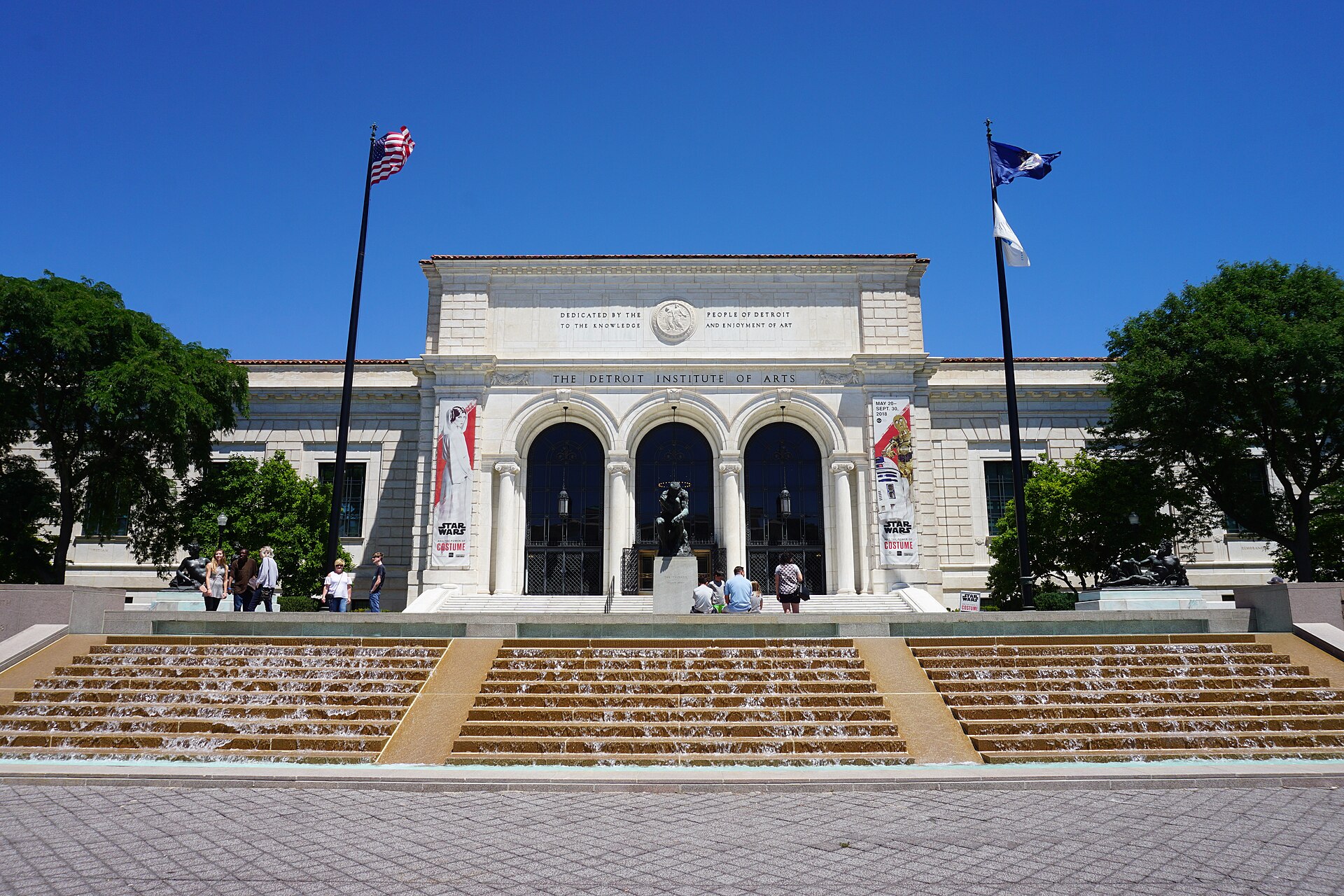
The museum's Beaux-Arts entrance front, with THE DETROIT INSTITUTE OF ARTS carved above the three arched doorways and the fountain steps in front, photographed in July 2018.
Photograph by Michael Barera, CC BY-SA 4.0Detroit Institute of Arts
Museum · Founded 1885
Open, admission and hours confirmed 28 September 2026 · 18 sources
On this page 14 sections
ContentsClose
The DIA's real strength is breadth kept coherent by one directing intelligence: William Valentiner's 1920s and 1930s acquisitions gave the museum an American collection ranked among the country's best, a genuine Van Gogh, and a Bruegel, while the Rivera murals give it a single unrepeatable centerpiece no other American museum can claim. Add to that an unusually long-running, dedicated department for African American art, founded in 2000 rather than retrofitted after 2020, and a global collecting range across Asian, Islamic, African, Oceanic and Native American art, and the result is a museum built to be walked as a whole rather than visited for one wing.
| Kind | Museum |
|---|---|
| Founded | 1885 |
| City and country |  Detroit, United States Detroit, United States |
| Address | 5200 Woodward Avenue, Detroit, MI 48202 |
| Website | dia.org |
| Status | Open, confirmed |
| Record last verified |
Visiting
- Hours
- MondayClosed
- Tuesday-Thursday09:00 to 16:00
- Friday09:00 to 21:00
- Saturday-Sunday10:00 to 17:00
- Closed
- Monday. New Year's Day, Juneteenth, Independence Day, Thanksgiving Day, Christmas Eve and Christmas Day.
- Admission
- AdultUSD 20
- Senior or College Student (valid ID)USD 10
- Youth (6-17)USD 8
- Child under 5Freefree
- DIA MembersFreefree
- Tri-County resident (Wayne, Oakland, Macomb)Freefree general admission with ID at the front desk, funded by the tri-county property tax millage renewed through 2032
- Special Exhibition, AdultUSD 30surcharge ticket for a current special exhibition (e.g. Georgia O'Keeffe: Architecture, Sep 2026-Jan 2027); includes general admission
- Special Exhibition, College/YouthUSD 15surcharge ticket for a current special exhibition; includes general admission
- Special Exhibition, Tri-County resident AdultUSD 20discounted special-exhibition rate for Wayne, Oakland or Macomb residents, ID at front desk
- Special Exhibition, Tri-County resident College/YouthUSD 10discounted special-exhibition rate for Wayne, Oakland or Macomb residents, ID at front desk
- Tickets
- dia.org/tickets The museum's own ticket page.
- Do I need to book?
- No advance booking required for general admission; tickets can be bought online or at the door, and by phone on 313-833-7900. School and guided group tours must be booked several weeks ahead
- Address
- 5200 Woodward Avenue, Detroit, MI 48202 MapStreetcar QLine, Ferry Street/Warren Avenue stop on the Woodward corridor, a short walk from the museum entrance
Bus DDOT routes 4 (Woodward) and 8 (Linwood); SMART FAST Woodward 461 and 462 from the suburbs
Car Surface and structure parking nearby, including a Wayne State University lot on Woodward with an entrance on Harper; the museum's own Parking and Directions page lists current lots and rates - Website
- dia.org
- Telephone
- 313-833-7900
- [email protected]
Before you go how long, access, photography, bags, eating, shop
- How long to allow
- Two to three hours to see the Detroit Industry murals and a selection of highlights; a full day for visitors who want to work through more than 100 galleries covering the whole encyclopedic collection
- Access
- The museum states it is committed to accessibility for all visitors and maintains a dedicated accessibility page covering wheelchair access, elevators and accommodations; visitors with specific needs are directed to contact the museum ahead of a visit
- Photography
- Personal cameras and candid photography are allowed throughout the museum unless a specific artwork or exhibition entrance says otherwise; flashes must be off and tripods, monopods and selfie sticks are not permitted. Professional or commercial photography needs separate clearance under the museum's Film and Photography policy
- Bags
- All bags are subject to inspection at every entrance and at any point inside the museum. Backpack-style carriers, luggage and anything worn on the back or shoulders are not allowed in the galleries; complimentary coat check is at the Woodward and Farnsworth entrances, with self-service lockers at the Loggia entrance
- Eating
- Cafe DIA, Kresge Court and Prentis Court offer dining areas within the building; outside food and drink are not allowed past the entrances or in the galleries
- Shop
- A museum shop sells books, prints and gifts tied to the collection; DIA members get a 10 percent discount there and at the cafes
Prices and hours change. We take them from the institution's own pages and print the day we read them, and you can check the current position at the source we used. Confirm before you travel.
What is inside
Rivera Court
The covered interior courtyard at the heart of the building, entirely surrounded by Diego Rivera's 27-panel Detroit Industry fresco cycle painted in 1932-33, showing automotive and pharmaceutical production at Ford's River Rouge plant and elsewhere in the city
American art
Galleries tracing American painting, sculpture and decorative arts from the colonial period through the twentieth century, a collection the museum itself ranks among the strongest of its kind in the country and the setting for Van Gogh's Self-Portrait alongside major American holdings
European Old Masters and modern European art
Encyclopedic holdings running from early Netherlandish and Italian panel painting, including Bruegel's Wedding Dance, through the German Expressionists to modern European painting, sculpture and decorative arts made between 1850 and 1970
General Motors Center for African American Art
A curatorial department established in 2000, one of the first at a major American fine arts museum devoted specifically to African American art, holding works spanning from nineteenth-century painters to living contemporary artists
Africa, Oceania, Indigenous Americas, Asia, Islamic and Ancient Near Eastern art
Galleries covering more than 8,000 years of artmaking across these regions, including sculpture, textiles, ceramics and ritual objects that the museum groups together as its global, non-Western collecting areas
Contemporary and Modern art, and Graphic Arts
Painting, sculpture, design and new media including video, installation and performance art made after 1950, alongside a separate department of prints, drawings and photographs; the contemporary galleries have periodically closed for reinstallation
What to see first
Detroit Industry, north and south walls
Diego Rivera, 1932-1933A 27-panel fresco cycle Rivera considered his most successful work, covering the walls of the museum's central court and depicting the Ford Motor Company's River Rouge plant, now a National Historic Landmark in its own right4
Self-Portrait
Vincent van Gogh, 1887The first painting by Van Gogh to enter any museum collection in the United States, acquired under director William Valentiner and now a centerpiece of the American and European galleries3
Nocturne in Black and Gold, the Falling Rocket
James McNeill Whistler, about 1875The painting at the center of the 1878 Whistler v. Ruskin libel trial, after Ruskin accused Whistler of 'flinging a pot of paint in the public's face', a case still taught as a turning point in how critics could be held to account for reviewing modern art9
The Wedding Dance
Pieter Bruegel the Elder, 1566One of only two major paintings by Bruegel the Elder in an American public collection, spotted in a London gallery by director William Valentiner in 1930 and bought as a sensational discovery; Diego Rivera studied it while working on the Detroit Industry murals8
Quilting Time
Romare Bearden, 1986A large-scale work commissioned directly by the DIA that celebrates African American family tradition and community, held in the General Motors Center for African American Art5
Officer of the Hussars
Kehinde Wiley, 2007A monumental equestrian portrait that places a contemporary Black subject into the visual language of European aristocratic portraiture, one of the museum's most reproduced recent acquisitions5
Minnehaha
Edmonia Lewis, about 1868A marble sculpture by an artist of African American and Native American descent working in Rome, part of a series inspired by Longfellow's 'The Song of Hiawatha' and among the earliest works by a woman of color in a major US museum collection5
Exhibitions on now
- On now5 Dec 2025 to 3 Jan 2027Confirmed , 7 weeks ago
- On now27 Mar to 25 Oct 2026Confirmed · check before you travel
A temple of art built on Woodward Avenue
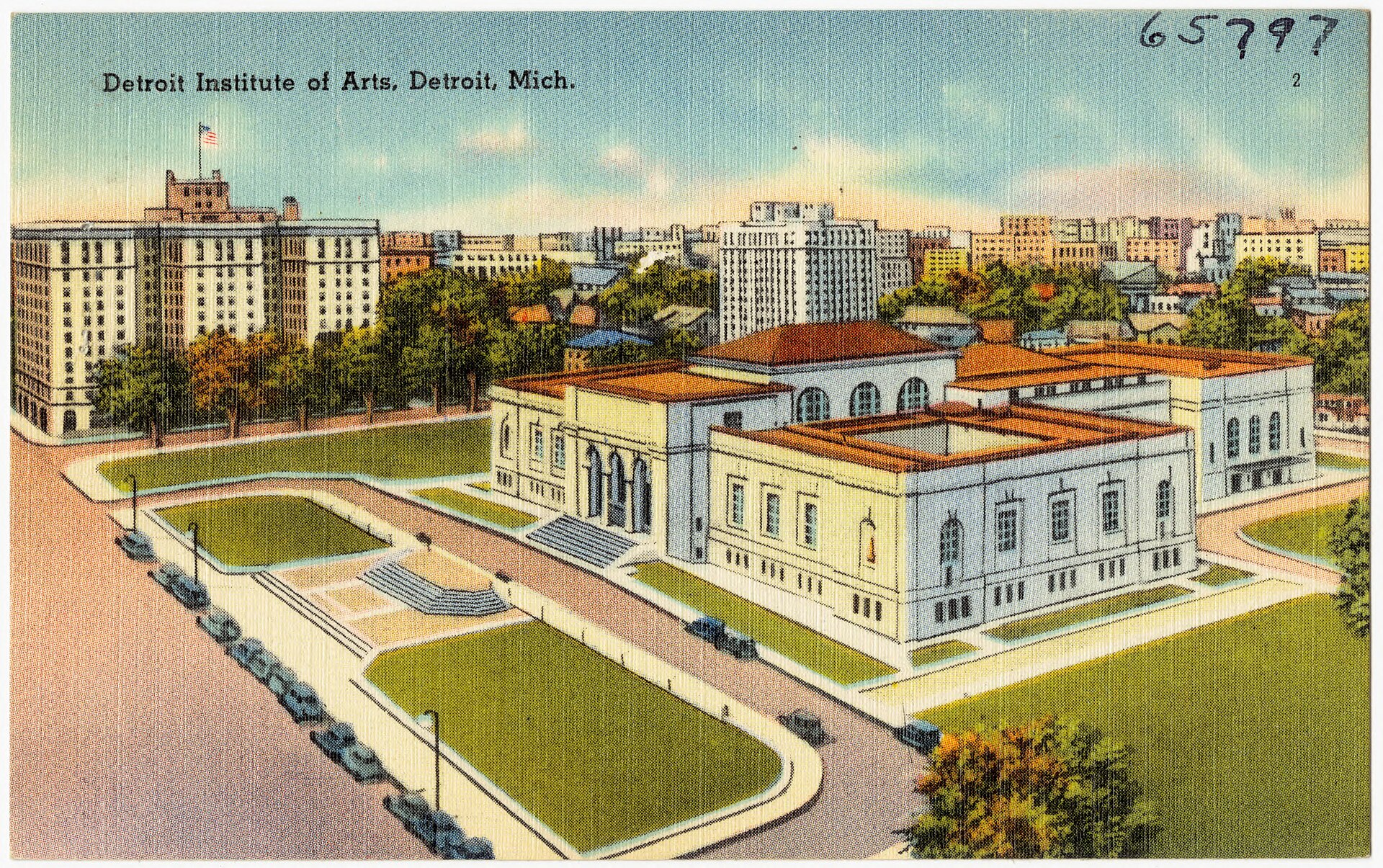
The museum that became the Detroit Institute of Arts opened in 1885 as the Detroit Museum of Art, founded after newspaper publisher James E. Scripps returned from a European tour convinced the city needed a public gallery of its own. It debuted in 1888 in a small building on Jefferson Avenue and, as the collection outgrew that site, the institution took the name Detroit Institute of Arts in 1919 and moved in 1927 to the Beaux-Arts building it still occupies on Woodward Avenue.
Philadelphia architect Paul Philippe Cret designed the new building, and it was called a temple of art almost from the day it opened. Cret modeled each gallery on the character of a European house museum, so a visitor moving through the building was meant to feel the setting change with the art on the walls rather than walk a single uniform corridor. A south wing followed in 1966 and a north wing in 1971, both by Gunnar Birkerts in a deliberately contrasting modernist style, and a further renovation and expansion begun in 1999 and completed in 2007 brought the building to its current 658,000 square feet and more than 100 galleries.
The director who built the collection
Much of what makes the DIA's holdings distinctive traces back to one director's eye. William Valentiner led the museum from 1924 to 1945 and used that tenure to acquire works that still anchor the galleries today, among them Vincent van Gogh's Self-Portrait, the first painting by Van Gogh to enter any museum collection in the United States. In 1930 Valentiner spotted Pieter Bruegel the Elder's The Wedding Dance in a London gallery and brought it back to Detroit, a discovery contemporaries treated as a sensation and that gave the museum one of only two major Bruegel paintings now in American public hands.
The collection Valentiner shaped has kept growing on the same encyclopedic principle he set: the DIA today holds more than 65,000 objects, ranked among the largest and most significant collections in the country, spanning American, European, modern and contemporary, Asian, African, Islamic, Native American, Oceanic and ancient art under one roof. In 2000 the museum formalized part of that range by creating the General Motors Center for African American Art, one of the first curatorial departments at a major American museum devoted specifically to that collecting area.
Diego Rivera's Detroit Industry, and the room built around it
The single work most visitors come to see is not on a wall but wrapped around an entire room. Diego Rivera spent eight months in 1932 and 1933 painting 27 fresco panels across the walls of the museum's interior court, a commission tied to Edsel Ford and the industrial output of his family's company. The murals depict the production lines at Ford's River Rouge plant, most famously the assembly of a V-8 engine on the north wall, alongside scenes of medical and pharmaceutical manufacturing that read as both a tribute to industrial labor and a warning about what that labor costs the people who do it.
Rivera later called Detroit Industry his most successful work, and the murals were declared a National Historic Landmark in 2014, the same year the city's bankruptcy nearly forced the museum to sell the paintings around them. The court itself, now generally called Rivera Court, functions as the building's real center: every other wing radiates from it, and it remains the image most people associate with the museum before they ever set foot inside.
The Grand Bargain: when bankruptcy nearly took the collection
Detroit filed for the largest municipal bankruptcy in US history in July 2013, and because the city had owned the museum's building and collection outright since 1919, creditors began treating the DIA's art as a city asset that could be sold to help cover roughly seventeen billion dollars in debt. The city's emergency manager hired Christie's to appraise the municipally purchased portion of the collection, which came back valued at several hundred million dollars, and for more than a year it was a live possibility that paintings by Van Gogh, Matisse, Bruegel and Rivera himself could be auctioned off piece by piece to pay bondholders.
What stopped that outcome became known as the Grand Bargain: a coalition of national and local foundations, the state of Michigan, and the DIA itself pledged more than 800 million dollars, directed not at creditors but at the city's underfunded pension systems, on the condition that the museum's collection and building be permanently protected from sale and transferred out of city ownership into the nonprofit that runs the museum today. A bankruptcy court judge approved the plan in November 2014, the transfer of ownership was completed that December, and by January 2015 the DIA confirmed it had raised its own 100 million dollar share of the pledge. The episode left the museum institutionally independent of the city for the first time since 1919, and its own galleries and fact sheets now treat 2014 as the year that changed, alongside 1927, when the building's history is told.
A museum still answering for its own governance
The DIA's public reputation is not built on the Grand Bargain alone. In July 2020, six current and former staff members told Artnet News that director Salvador Salort-Pons had used his position to benefit his father-in-law, a private collector whose paintings the museum had exhibited and whose works, including some never intended for public display, its conservation department had cleaned and restored. The same reporting described a pattern of senior positions filled without open searches, which staff said undercut the museum's own stated diversity commitments regardless of whether individual hires broke any written policy. Salort-Pons disputed the characterizations but agreed the museum would commission an outside review of its loan procedures.
The complaints did not stay internal. A staff petition that summer led to an independent investigation, and in March 2021 seven members of the DIA's board of directors resigned following its findings, a scale of turnover unusual for a museum of this size. The DIA has continued operating and expanding its programming since, including a 2022-2027 strategic plan built around inclusion and community access, but the episode is part of the institution's recent record and belongs beside the story of how the collection itself was saved.
What visitors say
Visitors on TripAdvisor and Google consistently rate the DIA among the best encyclopedic museums in the country for the price of admission, repeatedly singling out the Rivera Court as a highlight worth the trip on its own and praising the breadth of a collection that pairs Van Gogh and Bruegel with a long-established, dedicated African American art department. The most common complaints are practical rather than curatorial: temporary gallery closures for renovation while full admission is still charged, difficulty navigating the building's more than 100 rooms even with a floor plan, uneven lighting in some galleries, and pricier food at the on-site cafe.
What is praised, what is criticised
- Praised: The Rivera Court and the Detroit Industry murals, named again and again as the single reason to visit even by people not otherwise drawn to a museum
- Praised: The range of the collection for a mid-size American city museum, from Old Masters and Van Gogh to a long-standing, dedicated African American art program
- Praised: Free general admission for residents of Wayne, Oakland and Macomb counties, funded by the tri-county millage, which visitors from those counties call out as an unusually generous local benefit
- Criticised: Some visitors report frustration that admission is charged at the full rate while galleries, including a run of second-floor spaces closed since March 2025 for renovation, are unavailable
- Criticised: In 2020, current and former staff told Artnet News that director Salvador Salort-Pons had exhibited and had the museum's conservation department work on paintings owned by his father-in-law, and described a pattern of senior hires made without open searches; seven board members resigned in 2021 following an independent investigation into the workplace complaints that followed
Ratings on other platforms
TripAdvisor: 4.8 from 3,030 ratings, read 13 August 2026
A platform average is a tertiary source: it moves, it is not audited, and we quote no visitor's words.
Questions about Detroit Institute of Arts
Where is Detroit Institute of Arts?
5200 Woodward Avenue, Detroit, MI 48202.
How much does it cost to visit?
Adult: USD 20; Senior or College Student (valid ID): USD 10; Youth (6-17): USD 8; Child under 5: free; DIA Members: free. As confirmed 28 September 2026.
When is it open?
Monday closed; Tuesday-Thursday 09:00-16:00; Friday 09:00-21:00; Saturday-Sunday 10:00-17:00. Closed: Monday. New Year's Day, Juneteenth, Independence Day, Thanksgiving Day, Christmas Eve and Christmas Day. As confirmed 28 September 2026.
How do you get there?
Streetcar: QLine, Ferry Street/Warren Avenue stop on the Woodward corridor, a short walk from the museum entrance; Bus: DDOT routes 4 (Woodward) and 8 (Linwood); SMART FAST Woodward 461 and 462 from the suburbs; Car: Surface and structure parking nearby, including a Wayne State University lot on Woodward with an entrance on Harper; the museum's own Parking and Directions page lists current lots and rates.
What should you see first?
Detroit Industry, north and south walls (Diego Rivera, 1932-1933); Self-Portrait (Vincent van Gogh, 1887); Nocturne in Black and Gold, the Falling Rocket (James McNeill Whistler, about 1875); The Wedding Dance (Pieter Bruegel the Elder, 1566); Quilting Time (Romare Bearden, 1986); Officer of the Hussars (Kehinde Wiley, 2007).
What we could not confirm
- The second-floor renovation has a published completion: the modern and contemporary galleries reinstall as Reimagine Modern Art and Reimagine Contemporary Art, both opening November 15, 2026, per the museum's own exhibition pages (sources 17 and 18)
- Whether the museum has published any further governance reforms since the 2021 board resignations beyond the loan-policy review it agreed to in 2020
Images
Sources
- 1Wikidata, 'Detroit Institute of Arts' (Q1201549) wikidata.org/wiki/Q1201549
- 2Detroit Institute of Arts, 'Plan Your Visit' dia.org/visit
- 3Detroit Institute of Arts, 'About Us' dia.org/about
- 4Detroit Institute of Arts, 'DIA Fact Sheet' dia.org/about/media-room/fact-sheet
- 5Visit Detroit, 'Must See Masterpieces at the Detroit Institute of Arts' visitdetroit.com/inside-the-d/must-see-masterpieces-at-the-detroit-institute-of-arts-in-2022/
- 6Detroit Institute of Arts, 'Frequently Asked Questions' dia.org/visit/faqs
- 7Detroit Institute of Arts, 'Parking and Directions' dia.org/visit/parking
- 8Smithsonian Magazine, 'Detroit Exhibit Celebrates Bruegel's The Wedding Dance and Its Controversial Codpieces' smithsonianmag.com/smart-news/Detroit-Exhibit-Celebrates-Bruegels-The-Wedding-Dance-and-Its-Controversial-Codpieces-180973778/
- 9Encyclopaedia Britannica, 'Nocturne in Black and Gold, the Falling Rocket' britannica.com/art/Nocturne-in-Black-and-Gold-the-Falling-Rocket
- 10Artnet News, Rachel Corbett, 'There's No One on Staff Who Can Lead: Former Detroit Institute of Arts Employees Accuse Its Director of Mismanagement and Ethics Violations', 17 July 2020 news.artnet.com/art-world/staff-unrest-at-the-detroit-institute-arts-1895307
- 11CBS News Detroit, '7 Board Members At Detroit Institute Of Arts Resign Amid Toxic Workplace Allegations', 30 March 2021 cbsnews.com/detroit/news/7-board-members-at-detroit-institute-of-arts-resign-amid-toxic-workplace-allegations/
- 12PBS NewsHour, 'Foundations pledge $300 million to spare Detroit art collection', 13 January 2014 pbs.org/newshour/arts/foundations-pledge-300-million-spare-detroit-art-collection
- 13Detroit Historical Society, 'Detroit Institute of Arts', Encyclopedia of Detroit detroithistorical.org/learn/online-research/encyclopedia-of-detroit/detroit-institute-arts
- 14TripAdvisor, 'Detroit Institute of Arts' attraction reviews tripadvisor.com/Attraction_Review-g42139-d265439-Reviews-Detroit_Institute_of_Arts-Detroit_Michigan.html
- 15Wikimedia Commons, File:Detroit Institute of Arts July 2018 1.jpg commons.wikimedia.org/wiki/File:Detroit_Institute_of_Arts_July_2018_1.jpg
- 16Detroit Institute of Arts, 'General Admission Tickets' dia.org/tickets
- 17Detroit Institute of Arts, 'Reimagine Modern Art' exhibition page dia.org/events/exhibitions/reimagine-modern-art
- 18Detroit Institute of Arts, 'Reimagine Contemporary Art' exhibition page dia.org/events/exhibitions/reimagine-contemporary-art
