The Painting She Did Not Sign
Artemisia Gentileschi signed nineteen of about forty-eight surviving paintings by one count, and an earlier catalogue counts seventeen signed works in fourteen spellings. The one in this archive is not signed, and the only inscription on it is a stock number on a lining canvas.
Records in this piece: Self Portrait as Saint Catherine of Alexandria, The Man with the Golden Helmet
On this page 9 sections
ContentsClose
In short
- Judith Mann's study of her signatures states that Artemisia signed nineteen of her approximately forty-eight extant paintings, and argues she used her name to further her reputation and her prospects for commissions. The 2001 Orazio and Artemisia catalogue counts seventeen signed autograph works carrying fourteen different variations of her name.
- The picture in this archive is not one of them. The National Gallery's 2024 catalogue entry records a single inscription on the object, the number 715 on the reverse of its lining canvas, which is a stock number and not a name.
- What identified it was a tracing. Letizia Treves states that the areas overlapped to the millimetre with the buried underdrawing of the Uffizi Saint Catherine, and Cecilia Frosinini of the Opificio delle Pietre Dure says Artemisia reused a cartoon or preparatory drawing with variations.
- A false signature was painted over her real one on the Pozzuoli Saint Januarius. It was found only because the cathedral burned in May 1964 and the picture was cleaned afterwards.
- Lomi was the real family name and Gentileschi the adopted one, taken by her father from an uncle. Her father signed a Prado picture HOR.S LOMI, and a Roman notary still recorded her as Lomi on 17 November 1621, so the story that she borrowed the name in Florence for its prestige is a simplification.
- A Susanna she painted for Queen Henrietta Maria was hers in the 1639 royal inventory, became Gentileschi's daughter in 1659, lost her name entirely in a printed transcription of 1757, was reassigned to Benedetto Gennari II in 1862, sat in store as seventeenth-century French school until the late 2010s, and was returned to her in the Burlington Magazine in October 2023.
The most inventive signer of her century did not sign this one
Artemisia Gentileschi signed her paintings more variously and more deliberately than almost any painter of her age, and the picture this archive holds carries no signature at all.
Judith Mann, who has spent a career on the problem, puts the count at nineteen signatures across approximately forty-eight surviving paintings, and argues that Artemisia affixed her name in creative ways that reveal her to be a talented manipulator of her image and her identity, amplifying her patrons' enjoyment, furthering her own reputation and enhancing her prospects for commissions. That is a painter for whom the signature was working equipment.
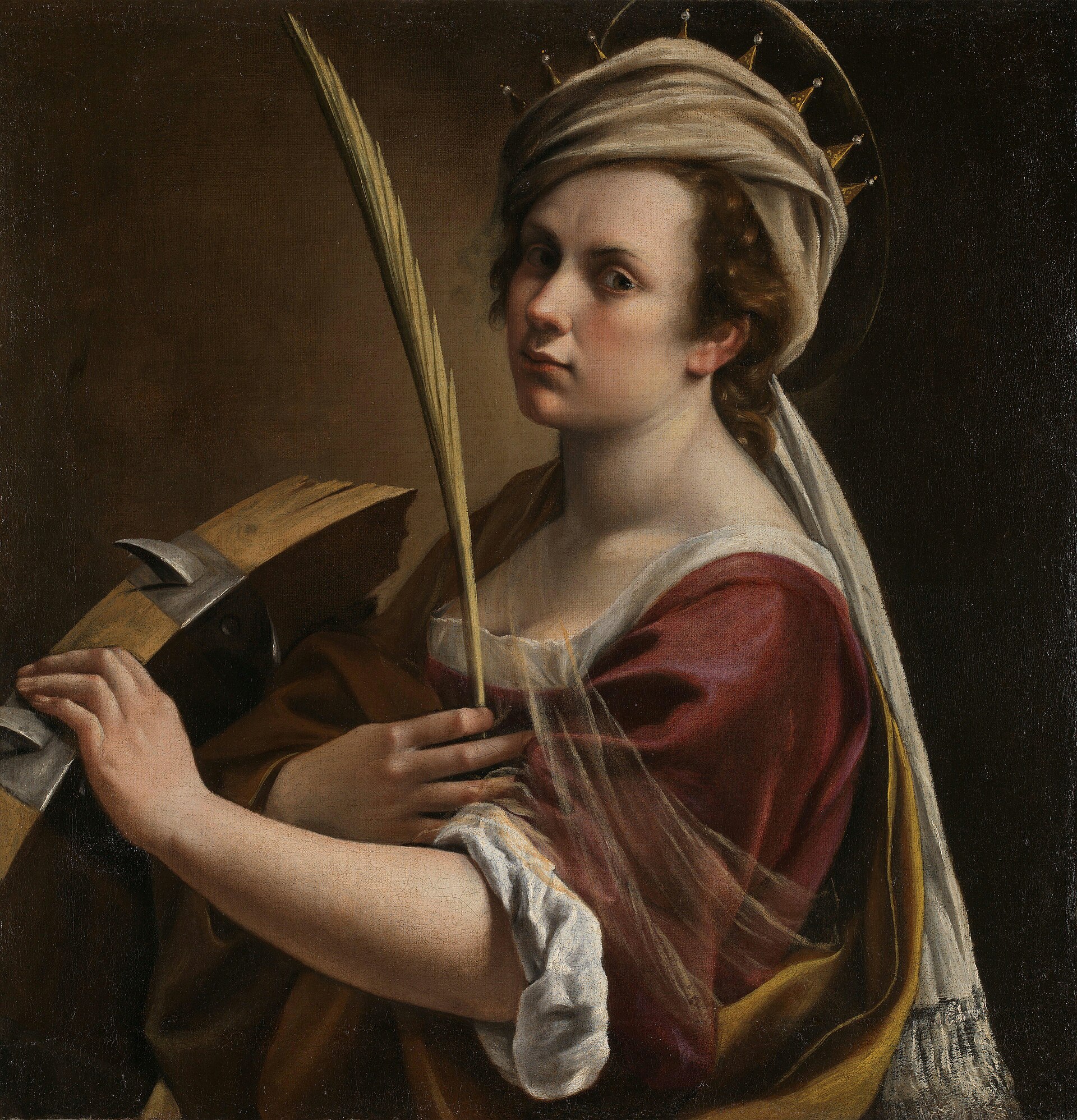
Self Portrait as Saint Catherine of Alexandria has none. It cost the National Gallery a total of 3.6 million pounds in 2018 on evidence that has nothing whatever to do with her name, and the story of how it was identified is a better argument for her hand than a signature would have been.
The only inscription on the object is a stock number on a lining canvas
The National Gallery's 2024 scholarly catalogue entry records exactly one inscription anywhere on the painting: the lining canvas bore the inscription 715 in the upper right quadrant of the reverse.
That is a dealer's or a collection's stock number, written on a canvas that is not hers. The lining is nineteenth or early twentieth century, and the entry notes that the original canvas had lost its tacking edges on every side except the right, which had been unfolded and used to extend the composition when the picture was previously lined. So the one piece of writing on the object was put there by somebody in the trade at least two hundred years after she died.
The object even changed shape on the way in. The Drouot catalogue gave 71 by 71 centimetres; the Gallery publishes 71.4 by 69, after conservators fitted a thin strip of primed canvas to the irregular upper edge during relining and stopped counting the unfolded tacking edge as part of the picture. Our own record gave 71.5 by 71, which is the saleroom's object and not the Gallery's, and it is corrected in this push. Both figures were true of the same painting at different moments, which is the sort of thing a record has to say out loud rather than average.
It was identified by a tracing that fits another picture section by section
What established the attribution was the discovery that parts of the London figure can be laid over a figure buried under the Uffizi Saint Catherine of Alexandria.
An X-radiograph of the Uffizi painting showed, in the Gallery's words, an underlying composition of a turbaned figure almost identical to that in the National Gallery picture. Letizia Treves, who curated the Gallery's Artemisia exhibition, described the fit in 2019: it became very, very clear, to the millimetre, that these areas overlapped perfectly, so she must have used some sort of drawing method to transfer sections. Cecilia Frosinini, director of the paintings conservation department at the Opificio delle Pietre Dure, put the practice plainly: we believe that she had a cartoon or at least a preparatory drawing that she reused several times, adding some changes or some variation from one to the other. The Gallery is careful about how close the fit is. It reports that the turbaned head, the clothing, the arms and the hands align almost perfectly, but that the head sits slightly differently in relation to the arms and torso, so the design was transferred in parts, or by shifting the cartoon a few centimetres, and no lines or marks left by the transfer itself have been detected.
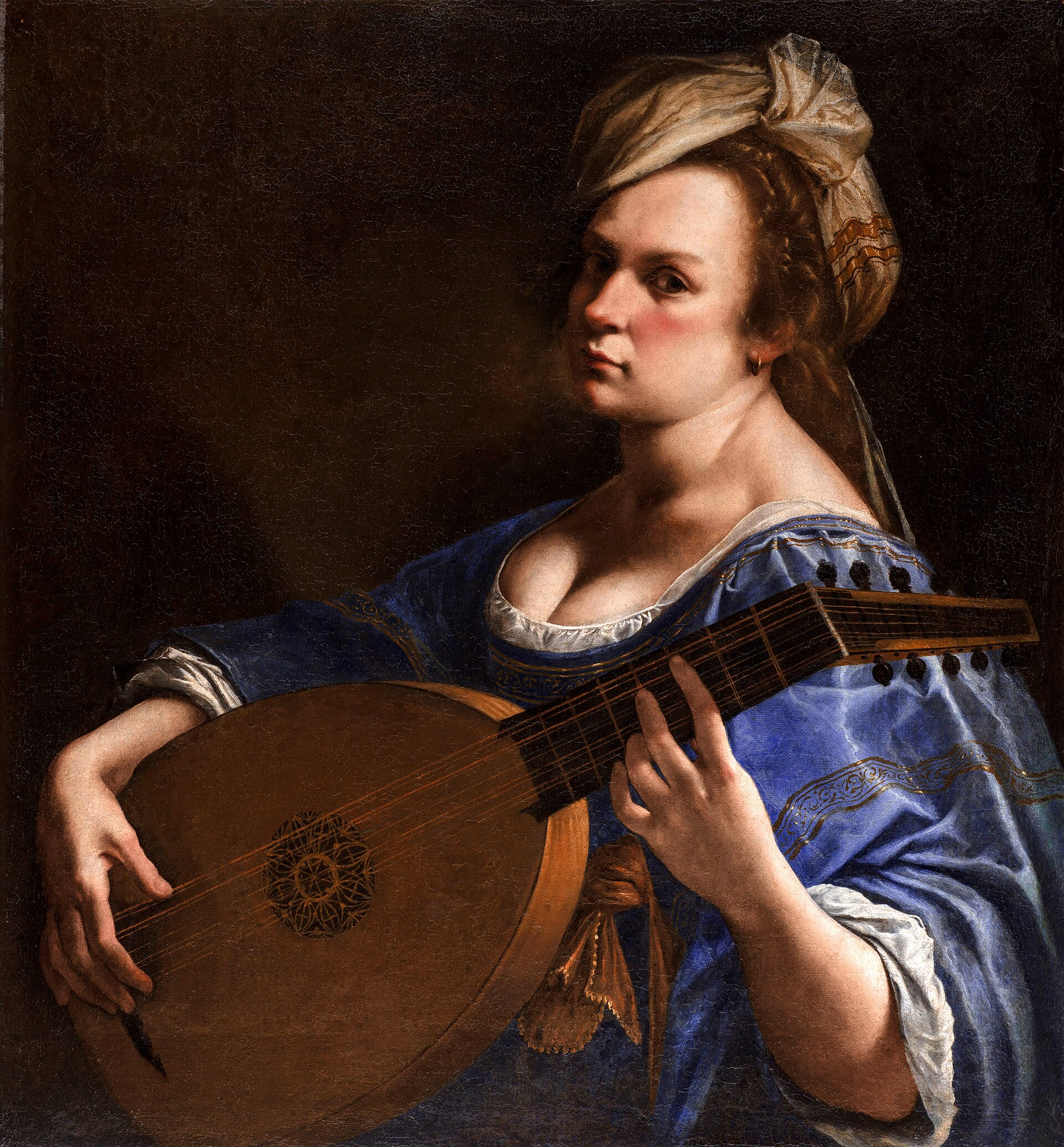
The London canvas also shows her changing her mind. Technical images reveal a shape under the area where the broken wheel now sits, which the Gallery reads as perhaps a prophetic tablet or, more probably, a book, painted out with a dark umber-containing paint; the drapery over the sitter's right shoulder was rearranged; and the pearl-topped crown was clearly a late addition, sitting awkwardly on the headcloth. The Gallery goes as far as to say the picture may initially have been conceived as an altogether different subject, with the artist assuming the guise of a classical figure, perhaps a sibyl. The Hartford Self Portrait as a Lute Player, which this archive reproduces alongside the record, has an inverted female head beneath the lutenist's left hand, because she abandoned a composition, turned the canvas through 180 degrees and painted over it.
One caution, since two institutions disagree and neither is careless. The National Gallery's own figure caption dates the Uffizi Saint Catherine, inventory 8032, to about 1615 to 1617; the Uffizi and the reporting around the 2019 X-ray give 1618 to 1620. Which picture came first is therefore not settled, and the tracing argument does not depend on settling it.
Seventeen signed works, fourteen spellings of her own name
When she did sign, she almost never signed the same way twice.
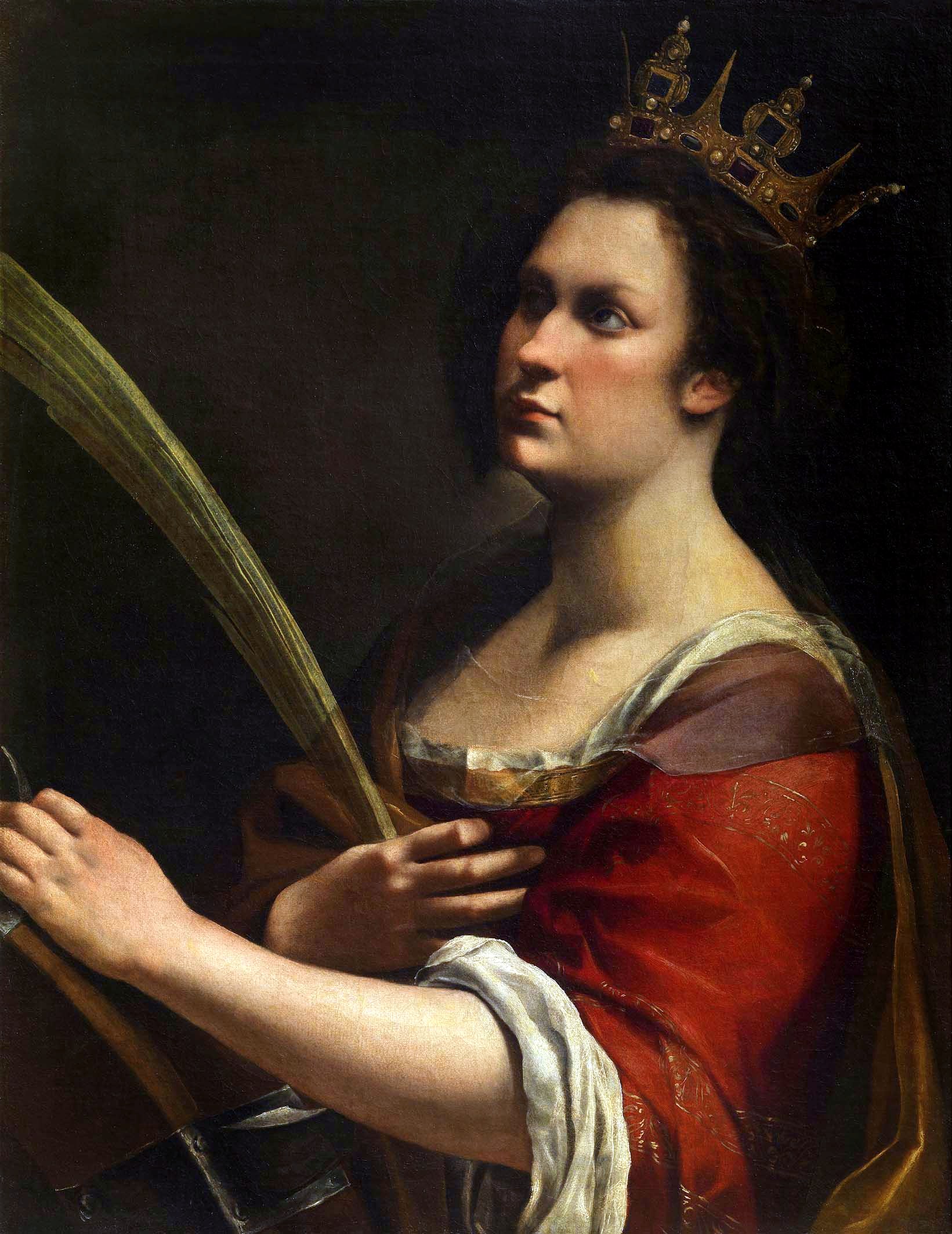
The 2001 Orazio and Artemisia Gentileschi catalogue states it flatly: there is really no consistency in Artemisia's signatures; of the seventeen signed works believed to be autograph, there are fourteen different variations. Mann's later count is nineteen signatures among about forty-eight surviving paintings, so the total is a range and not a figure. The variation is not sloppiness. It moves between Latin and Italian, between her full name and initials, and between the two family names, and it is placed on a wall, a chair back, a column, a sword blade, a tree, a book, a scrap of paper and the edge of a table.
| Painting | Date | Where the signature sits | What it reads |
|---|---|---|---|
| Conversion of the Magdalene, Pitti | About 1615 to 1616 | Back of the chair | ARTIMISIA LOMI |
| Jael and Sisera, Budapest | 1620 | Pilaster at the centre | ARTEMITIA. LOMI FACIBAT M.D.CXX |
| Judith Slaying Holofernes, Uffizi | About 1620 | The sword blade | EGO ARTEMITIA LOMI FEC. |
| Susanna and the Elders, Burghley House | 1622 | Lower centre | ARTEMITIA GENTILESCHI LOMI / FACIEBAT. A D. M DC XXII |
| Self-Portrait as the Allegory of Painting, Royal Collection | 1638 to 1639 | Corner of the tabletop | A.G. F. |
| Virgin and Child with a Rosary, El Escorial | 1651 | Front edge of the table | Artemitia Gentileschi |
The Budapest reading can be checked against the museum rather than the catalogue, which is the test this house applies wherever it can. The Museum of Fine Arts in Budapest records for inventory 75.11: signed on the pilaster in the centre, ARTEMITIA. LOMI FACIBAT M.D.CXX. The two agree in their lettering, including the non-classical FACIBAT, and differ only in spacing, line breaks and a final point.
Lomi was the real name, and the Florence story is too neat
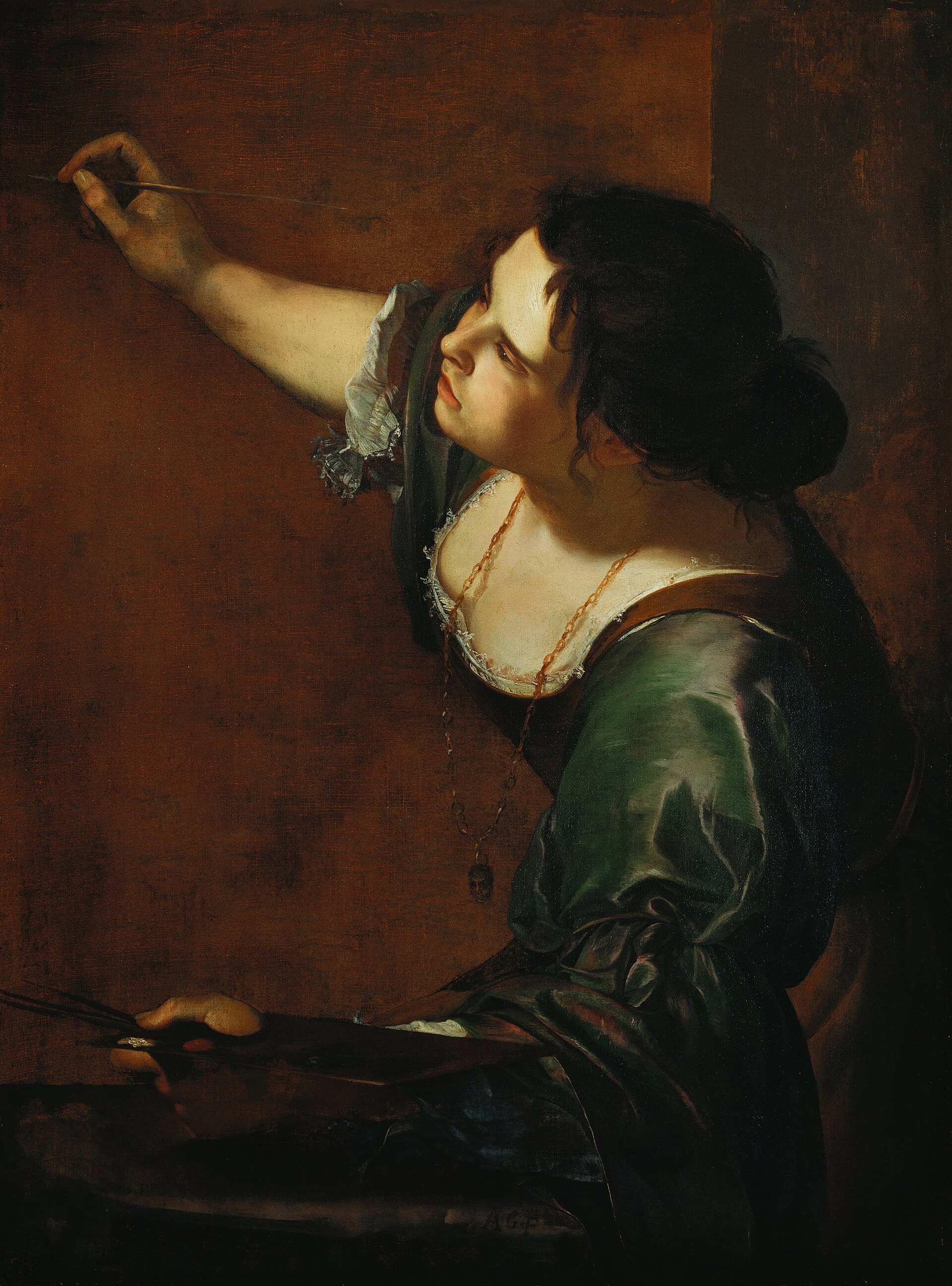
The widely repeated account has Artemisia adopting the name Lomi in Florence to borrow the standing of her uncle Aurelio Lomi, and the documents do not support it in that form.
Lomi was the family's own name. Keith Christiansen records that her father Orazio lived with an uncle who was a captain of the guards in the Castel Sant'Angelo and took from him his adopted name, Gentileschi, the family name having been Lomi. Orazio signed a Prado picture HOR.S LOMI himself. And the usage was not confined to Tuscany: the same catalogue notes that Artemisia is still recorded as Lomi by a Roman notary on 17 November 1621, and raises the possibility that the Jael and Sisera signed LOMI in 1620 was made in Rome.
So the two names are two real family names rather than a stage name and a true one, which matters for anybody reading a signature as evidence of where and when she was working.
A false signature was painted over her real one, and a fire found it
The history of her signatures is a history of them being doubted, obscured, forged and used against her.
Her Saint Januarius in the Amphitheater hung in Pozzuoli cathedral, which was engulfed by fire in May of 1964. The picture was cleaned after the fire, and at that point the signature was revealed, having been covered by a later, spurious signature. Somebody had painted a false name over a real one, and it took a cathedral burning for that to come out.
The Burghley House Susanna of 1622 carries her longest signature, combining both family names, and it too had been obscured by dirt and varnish until the canvas was cleaned before a 1995 exhibition. R. Ward Bissell in 1999 and Mary Garrard in 2001 have both been reluctant to accept it, because of its unique format and repainting around the letters, while a technical analysis made at the Indianapolis Museum of Art in 1995 found the signature consistent with the rest of the painting and apparently inscribed by the same artist. That disagreement is live and we are not going to resolve it here.
It cuts the other way too. On the El Escorial Virgin and Child with a Rosary the picture is not universally accepted in spite of the signature, and Evelina Borea proposed Angelo Caroselli, positing that the signature was added to increase the painting's value. And the signature and date on the Pommersfelden Susanna of 1610 were doubted for decades for a reason that had nothing to do with the paint: scholars had her birth year wrong, thinking her born in 1597, until Bissell published her baptismal record of 1593 in 1968. A signature settles nothing on its own, in either direction.
The picture that lost her name for three centuries
A Susanna and the Elders that Artemisia painted for Queen Henrietta Maria shows what happens to an attribution when nobody can read a name off the canvas.
Its documentary chain was published in the Burlington Magazine in October 2023 by Niko Munz and Adelaide Izat, and every step is a quoted inventory. In 1639 Abraham van der Doort listed it for Charles I as done by Artimi=sio Gentellesco. In the Commonwealth sale of 1651 it is Susanna done by Arthemysia, at twenty pounds. By 1659, in Ralph Bankes's private list, she has become Gentilesco's daughter. In Queen Anne's inventory of about 1704 to 1710 she is back, as Aremsa Gentilesco. Then in 1757 George Vertue's printed transcription of the Charles I catalogue omits van der Doort's ascription altogether and the picture is unattributed. In 1862 Richard Redgrave, Surveyor of Pictures, reassigns it to Benedetto Gennari II on a mistaken correlation with an entry in James II's inventory. It then sat in storage until the late 2010s among unattributed works assigned to the seventeenth-century French school.
The authors suggest the absence of a signature, or its removal or obscuring when the canvas was enlarged, hastened that loss. They also establish a documentary rule worth carrying to any Gentileschi provenance, and it is their inference rather than an archival statement: in the Charles I sale catalogue, a work ascribed to Gentileschi without a first name implies Orazio, whereas Artemisia's first name is apparently always noted with hers.
| Date | What the record calls her |
|---|---|
| 1639, van der Doort for Charles I | done by Artimi=sio Gentellesco |
| 1651, Commonwealth sale | Susanna done by Arthemysia, twenty pounds |
| 1659, Ralph Bankes's list | Gentilesco's daughter |
| About 1704 to 1710, Queen Anne's inventory | Aremsa Gentilesco |
| 1757, Vertue's printed transcription | no attribution at all |
| 1862, Richard Redgrave | Benedetto Gennari II |
She is not the only painter whose pictures moved. The Saint Louis Danae was sold at Sotheby's in Monaco on 22 February 1986 as Orazio, argued to Artemisia by Mann, rejected by Bissell in 1999, and hangs today under her name with no attribution history on the museum's own page. The Cleopatra then in a Milanese collection was printed twice in the same 2001 catalogue, once by Christiansen as Orazio and once by Mann as Artemisia, each editor saying in print that the other disagreed. Bissell noted that one fifth of the pictures in the 1995 Burghley House exhibition had their original Cecil attributions changed.
What the absence of her name is actually worth
An unsigned picture attributed on weave, tracing and pigment is better evidence than a signed one, and this is the case that shows why.
A signature is a mark on a surface and surfaces are workable. It can be cleaned off, painted over, forged over the top of a real one, doubted for its spelling, disbelieved because a birth year was wrong, or read as proof that somebody wanted to raise a price. A cartoon reused across two canvases and found by radiography under a later composition is not workable in that way, because it is a record of a working method rather than a claim about authorship. The National Gallery bought a picture with no name on it and can say more about who made it than the market could say about several that are signed.
It is worth being precise about what this does not prove. The Gallery's case is an argument from a body of technical evidence and comparison, and technical evidence is read by people who can disagree, as the two datings of the Uffizi canvas already show. But the reason to hold the attribution is stated, checkable and published, which is what this archive asks of every link it grades.
This archive holds the same argument running the other way. The Man with the Golden Helmet was bought for Berlin in 1897 as a Rembrandt, and in 1986 the Gemaeldegalerie concluded that it is not one; the museum withdrew an attribution rather than finding a fake. That withdrawal rested on examination, exactly as the National Gallery's addition does. A name can be given and taken away by the same kind of evidence, which is the reason to record the evidence and not just the name.
Why this archive is free to read
We do this for everyone who loves art. The people who have studied it for years, and the people who just stopped to look. Iconotheca exists so that what we learn belongs to all of them.
Nobody pays us for this. No ads, no sponsors, no commercial interest. These works belong to all of us, and we would rather share them with as many people as we can than keep them to ourselves.
If it gave you something today, tell us to keep going. Follow us, leave a like, or write a positive comment. We read every one, and they are what keeps us going.
Questions
No. The National Gallery's 2024 catalogue entry records only one inscription anywhere on the object, the number 715 written on the upper right of the reverse of a nineteenth or early twentieth-century lining canvas. That is a stock number, not a signature, and the attribution rests on technical examination and comparison instead.
Judith Mann's 2009 study in Renaissance Studies states that she signed nineteen of her approximately forty-eight extant paintings. The 2001 Orazio and Artemisia Gentileschi catalogue counts seventeen signed works believed to be autograph and notes that they carry fourteen different variations of her name, so the figure should be given as a range.
Lomi was her family's actual name. Her father Orazio took the name Gentileschi from an uncle he lived with, and signed at least one Prado painting HOR.S LOMI himself. Artemisia used Lomi in Florence and was still recorded as Lomi by a Roman notary on 17 November 1621, so the common account that she adopted the name only in Florence to borrow a relative's prestige is a simplification.
The total cost of acquisition was 3.6 million pounds in 2018. The Gallery's own press release breaks that down as 3.7 million US dollars from the American Friends of the National Gallery, London, 380,000 pounds from the National Gallery Trust, 250,000 pounds from Art Fund through the legacy of Sir Denis Mahon including funding towards conservation, and 280,000 pounds from donations and gifts from wills, with two of those totals subject to confirmation of donor pledges.
It was sold at the Hotel Drouot in Paris on 19 December 2017, as lot 69, by the auctioneer Christophe Joron-Derem, having descended in the Boudeville family. It was catalogued under Artemisia Gentileschi's own name against an estimate of 300,000 to 400,000 euros, and was bought by the dealers Marco Voena and Fabrizio Moretti, from whom the Gallery purchased it in 2018.
Yes. Her Saint Januarius in the Amphitheater was in Pozzuoli cathedral when it burned in May 1964, and when the painting was cleaned afterwards her real signature was revealed under a later, spurious one.
Sources
- 1National Gallery, London, 2024 scholarly catalogue entry for Self Portrait as Saint Catherine of Alexandria, NG6671, by Letizia Treves with technical contributions by Larry Keith and Marta Melchiorre, for the provenance through the Boudeville family and the Drouot sale of 19 December 2017 lot 69 to Marco Voena and Fabrizio Moretti, the single recorded inscription 715 on the lining canvas, the loss of the tacking edges and the strip of primed canvas added at relining, the painted-out shape read as a book or prophetic tablet, the revised drapery, the late pearl-topped crown, the suggestion that the picture may have begun as another subject such as a sibyl, the X-radiograph of the Uffizi picture, inventory 8032, showing an almost identical turbaned figure and a third smaller head, and the Gallery's own dating of that canvas to about 1615 to 1617, and the inverted female head under the Hartford Lute Player. nationalgallery.org.uk/paintings/...
- 2National Gallery, London, collection page for Self Portrait as Saint Catherine of Alexandria, for the published dimensions of 71.4 by 69 cm, against the 71 by 71 cm given in the 2017 sale catalogue. nationalgallery.org.uk/paintings/...
- 3Christophe Joron-Derem, Hotel Drouot, Paris, sale of 19 December 2017, lot 69, Artemisia Gentileschi, Sainte Catherine d'Alexandrie, oil on canvas, 71 by 71 cm, with old restorations and small tears noted, estimate 300,000 to 400,000 euros, and a result of 2,360,600 euros. The house prints that figure under a heading reading Resultats sans frais, results without fees, but it is in fact premium-inclusive: the terms on the same page give a buyer's premium of 23 per cent before tax and 27.6 per cent with tax, and 1,850,000 euros plus 27.6 per cent is 2,360,600 exactly. So the hammer is 1.85 million euros, the figure this archive already carries, and 2,360,600 euros is the premium-inclusive result. joron-derem.com/lot/...
- 4Cabinet Turquin, expert to the sale, on the discovery of the picture by Maitre Joron-Derem and its being wholly unpublished before the sale of 19 December 2017 at the Hotel Drouot. turquin.fr/en/...
- 5Judith W. Mann, "Identity signs: meanings and methods in Artemisia Gentileschi's signatures", Renaissance Studies 23, no. 1 (2009), pp. 71 to 107, for the count of nineteen signatures among approximately forty-eight extant paintings and for the argument that she exploited her name to further her reputation and her prospects for commissions. Quoted from the publisher-deposited abstract record, the journal's own page being bot-walled; the full article was not read. api.crossref.org/works/...
- 6Keith Christiansen and Judith W. Mann, Orazio and Artemisia Gentileschi, Metropolitan Museum of Art, Palazzo Venezia and Saint Louis Art Museum, 2001, read as the full OCR text of the catalogue, for the statement that there is no consistency in her signatures and that seventeen signed autograph works carry fourteen variations, for the transcribed signature lines, for Orazio's adopted name and the Lomi family name and the Roman notary of 17 November 1621, for the spurious signature over her own on the Pozzuoli Saint Januarius revealed after the fire of May 1964, for the Burghley Susanna signature revealed in 1995 and doubted by Bissell and Garrard against the Indianapolis analysis, for Borea's attribution of the El Escorial picture to Caroselli, for the doubts over the Pommersfelden signature before Bissell published the 1593 baptism in 1968, for the Saint Louis Danae sold as Orazio at Sotheby's Monaco on 22 February 1986, and for the Cleopatra printed twice under both painters by the two editors. OCR of a printed catalogue, so transcriptions were checked against a museum record where possible. archive.org/download/...
- 7Museum of Fine Arts, Budapest, record for Jael and Sisera, inventory 75.11, giving the signature on the central pilaster as ARTEMITIA. LOMI FACIBAT M.D.CXX, which corroborates the 2001 catalogue's lettering. mfab.hu/artworks/...
- 8"X-ray of Uffizi's Artemisia Gentileschi reveals a tantalising underpainting", The Art Newspaper, 11 April 2019, for the turbaned underpainting facing the observer as in the National Gallery picture, for Cecilia Frosinini of the Opificio delle Pietre Dure on a reused cartoon or preparatory drawing, for Letizia Treves on the areas overlapping to the millimetre, for the mysterious little face beside Saint Catherine's own, and for the Uffizi dating of 1618 to 1620 against the National Gallery's about 1615 to 1617. theartnewspaper.com/2019/...
- 9Niko Munz and Adelaide Izat, "Artemisia Gentileschi's Susanna and the elders painted for Henrietta Maria", The Burlington Magazine 165, no. 1447, October 2023, pp. 1053 to 1073, accepted manuscript deposited in Oxford University Research Archive, for the chain of attribution from van der Doort's 1639 inventory through the Commonwealth sale of 1651, Ralph Bankes's list of 1659, Queen Anne's inventory of about 1704 to 1710, Vertue's printed transcription of 1757, Redgrave's reassignment to Benedetto Gennari II in 1862 and the rediscovery in store in the late 2010s, for the suggestion that the absence of a signature hastened the loss of attribution, for the observation that the Royal Collection self portrait has kept her name partly because its signature is visible, and for the authors' argued rule that Gentileschi without a first name implies Orazio in the Charles I sale catalogue. ora.ox.ac.uk/objects/...
- 10National Gallery, London, press release of July 2018 announcing the acquisition, for the total cost of 3.6 million pounds and the published funding breakdown from the American Friends of the National Gallery London, the National Gallery Trust, Art Fund through the legacy of Sir Denis Mahon, and donations and gifts from wills. nationalgallery.org.uk/about-us/...
- 11Saint Louis Art Museum, collection record for Danae, object number 93:1986, giving the artist as Artemisia Gentileschi and the date about 1612, with no attribution history recorded on the page. slam.org/collection/...
More in The Women Behind the Art
The partWhat the Opera Paid Marie van Goethem
The model for Degas's Little Dancer is documented in a payroll and two lines of his handwriting.
The Publisher Was the Sitter
Truth sold her own cartes de visite, registered the copyright in her own name and left the photographer unnamed.
The Half That Was Not Sold
Vera Salomons inherited 57 of her father's Breguet watches. Her mother got the other seventy and they were auctioned.