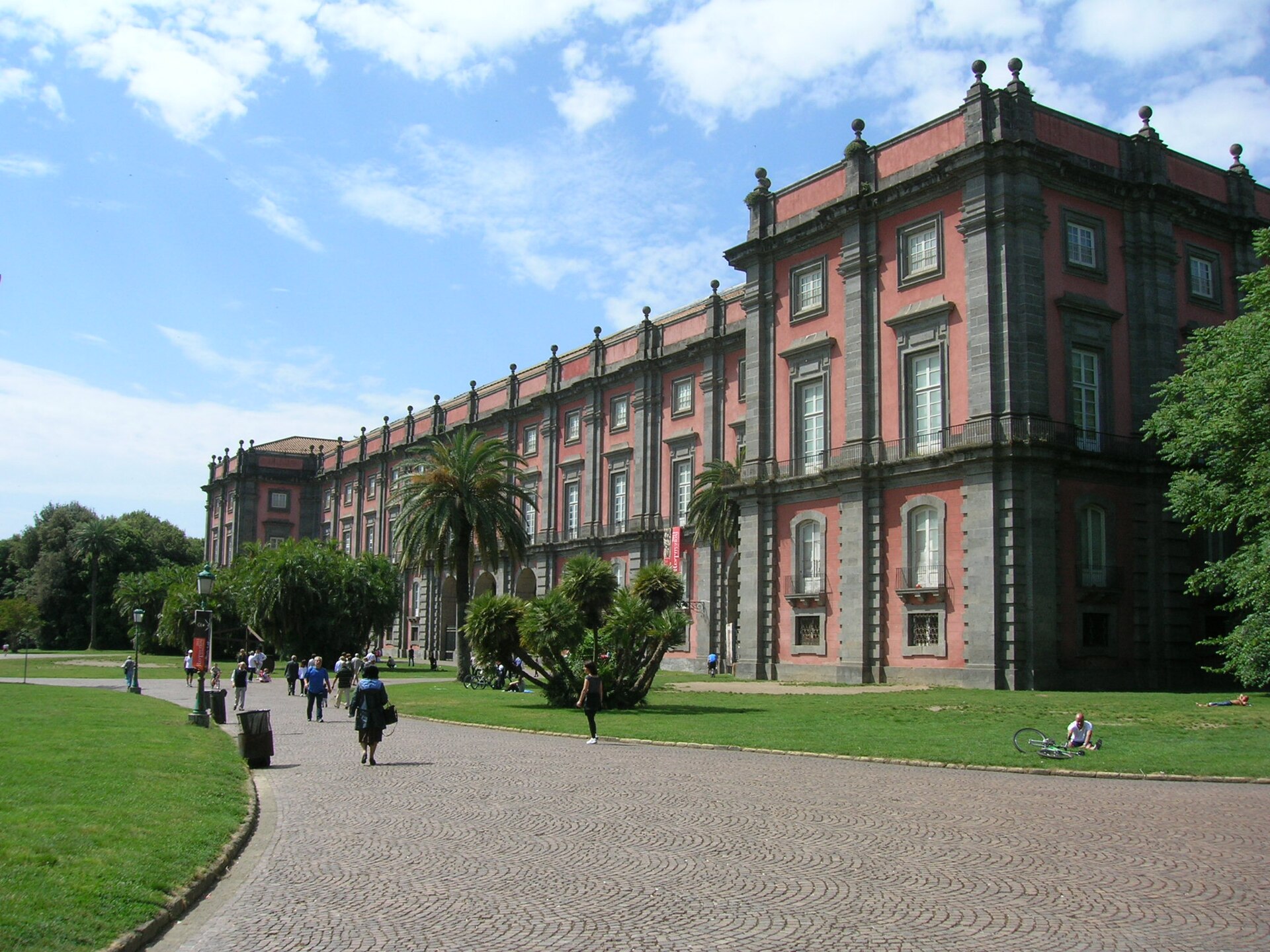
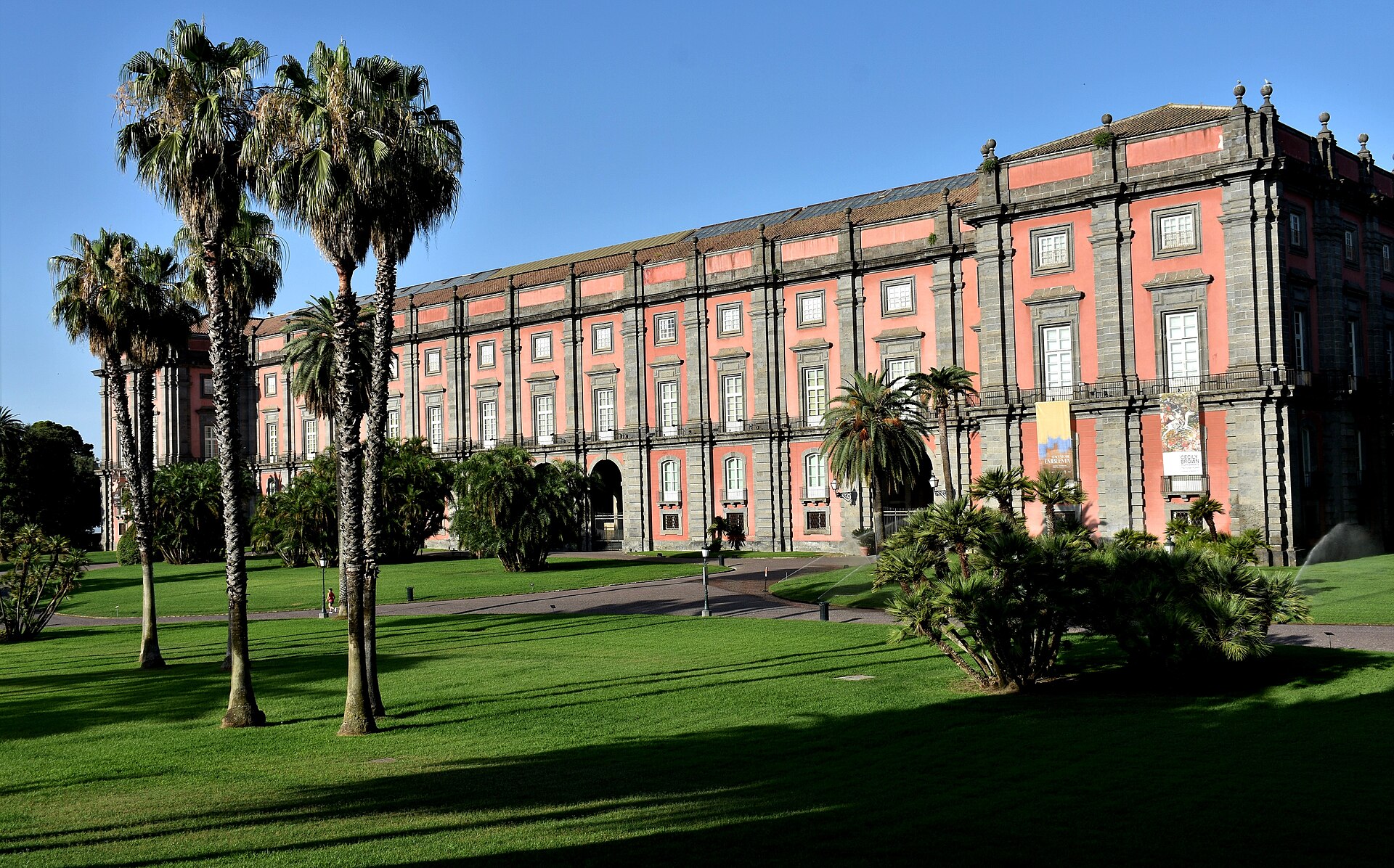
The salmon-pink facade of the Palace of Capodimonte, seen from the grounds of the Real Bosco, the royal park surrounding it.
Photograph by Mentnafunangann · CC BY-SA 4.0Museo e Real Bosco di Capodimonte
Museum · Founded 1738
Open, admission and hours confirmed 23 August 2026 · 15 sources
On this page 14 sections
ContentsClose
One of Italy's largest museums by any measure, and the single best place anywhere to see the Neapolitan school of painting, alongside a Farnese-built core of Renaissance and Baroque masterpieces (Titian, Raphael, Caravaggio, Parmigianino, Bruegel) that was strong enough to anchor a six-month exhibition inside the Louvre's own Grande Galerie in 2023. The Royal Apartment, the porcelain and armoury collections and an entire third floor of contemporary and 19th-century material sit inside a working palace still mid-way through a EUR 150 million, multi-site renovation begun under one director and being finished by his successor, which means the collection's real current shape, what floor is open, which room is mid-redisplay, is a live fact rather than a fixed one.
| Kind | Museum |
|---|---|
| Founded | 1738 (King Charles VII of Naples, later Charles III of Spain, decided to build a grand palace on the Capodimonte hill, largely to house the Farnese Collection he inherited from his mother Elisabetta Farnese); became a purely national museum in 1950, with the Galleria Nazionale inaugurated in 1957 |
| City and country |  Naples, Italy Naples, Italy |
| Address | Via Lucio Amelio 2, 80131 Napoli, Italy |
| Website | capodimonte.cultura.gov.it |
| Status | Open, confirmed |
| Record last verified |
Visiting
- Hours
- Monday, Tuesday, Thursday, Friday, Saturday08:30 to 19:30Applies to the First Floor (Galleria Farnese, Galleria delle cose rare, Collezione De Ciccio and current exhibitions on that floor), last entry 18:30. The Second Floor (Neapolitan art, 1200s-1700s) instead closes earlier on these same days, at 17:00, last entry 16:30. Room 62, the Sala dei Capolavori on the second floor, follows the longer 8:30-19:30 hours every open day
- Sunday and public holidays08:30 to 19:30The Second Floor keeps these longer hours only on free-entry days, Sundays and holidays; the First Floor is closed entirely on Sundays and public holidays
- WednesdayClosed, the museum's weekly closing day
- Closed
- Wednesday.
- Admission
- Full price (Intero)EUR 15Ticket covers current exhibitions and is valid all day, with re-entry allowed
- Groups over 15 paying visitors, age 25+EUR 14
- Tickets bought and validated 8:30-9:30 or 17:30-18:30EUR 12The last hour before final ticket sales
- Reduced, EU citizens 18-25EUR 2Valid to the 25th birthday inclusive; also purchasable at the ticket office via the 18app culture-voucher scheme for EUR 2.00
- Free, under 18FreeAlso free for disabled visitors and one family member or carer, and other categories set out in the Ministry of Culture's own concessions rules
Free entry: First Sunday of every month. 25 April. 2 June. 4 November- Tickets
- portale.museiitaliani.it The museum's own ticket page.
- Do I need to book?
- Not stated as compulsory; tickets are sold through the Musei Italiani platform
- Address
- Via Lucio Amelio 2, 80131 Napoli, Italy MapBus Lines 3M, 168, 178, C67 to the Porta Piccola/Porta Miano stops on Via Lucio Amelio, or C63 to Porta Grande on Via Capodimonte
Metro + bus Metro Line 1 to Museo, or Line 2 to Piazza Cavour, then onward by bus; a bus also stops at Piazza Museo, next to the Naples National Archaeological Museum
Walking Three signed walking routes connect the historic centre to the museum in about 30 minutes, including a route linking Capodimonte directly to the Naples Archaeological Museum via the Ponte della Sanita and the Catacombs of San Gennaro - Website
- capodimonte.cultura.gov.it
- Telephone
- +39 081 7499154
- [email protected]
Before you go how long, access, photography, bags, eating, shop
- How long to allow
- Not stated in hours worked out on the museum's own site; the collection spans multiple floors of a large royal palace plus an extensive surrounding park
- Access
- Seating for visitors with reduced mobility is available; the museum belongs to the Campania Artecard network of sites offering combined-ticket discounts
- Photography
- Not detailed on the pages fetched for this record
- Bags
- The cloakroom (guardaroba) service has been suspended since 1 May 2026, per the museum's own site
- Eating
- Not detailed on the pages fetched for this record
- Shop
- Not detailed on the pages fetched for this record
Prices and hours change. We take them from the institution's own pages and print the day we read them, and you can check the current position at the source we used. Confirm before you travel.
What is inside
Galleria Farnese and the Farnese antiquities (ground and first floor)
The ancient Roman sculpture the Farnese family assembled, one of the great collections of classical antiquity anywhere, shown alongside the family's Renaissance and Baroque pictures; most of the Farnese antiquities that once stood here were moved to the Naples Archaeological Museum in the 19th century, but the paintings and a core of ancient material remain the anchor of this wing
Galleria Nazionale, 13th-18th century paintings (first and second floors)
The core picture gallery: gold-ground and early Renaissance panels through to the 18th century, with major works by Simone Martini, Masaccio, Bellini, Botticelli, Raphael, Titian, Parmigianino, El Greco, Bruegel the Elder, Caravaggio and Annibale Carracci, plus the deepest holding anywhere of the Neapolitan school, Jusepe de Ribera and Luca Giordano among them. Room 62, the Sala dei Capolavori (Room of Masterpieces) on the second floor, is singled out on the museum's own hours page as open every day the museum is, including days the rest of the second floor keeps shorter hours
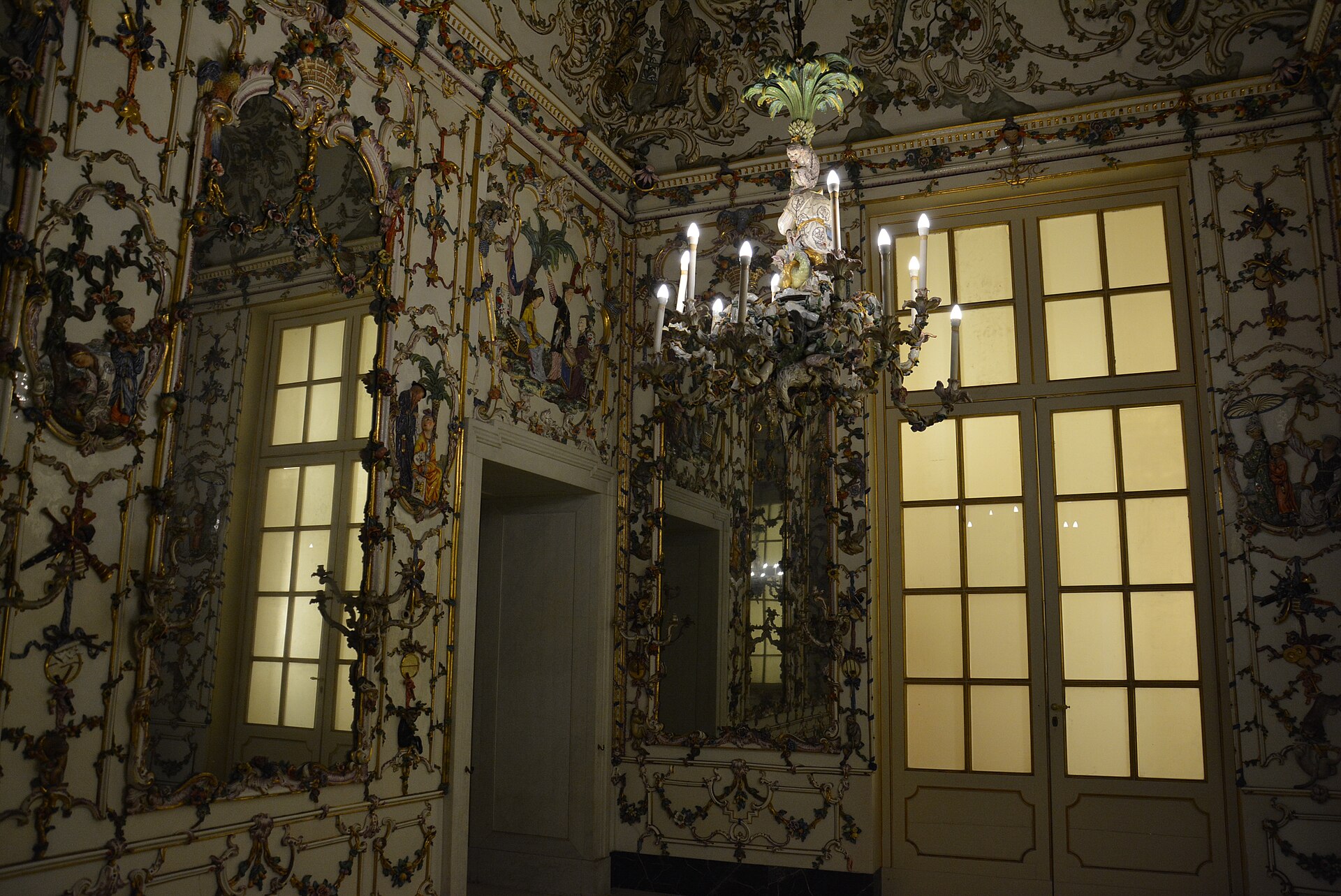
Photograph by Mentnafunangann · CC BY-SA 4.0 Appartamento Reale, the Royal Apartment (first floor, rooms 31-60)
Nine main rooms, from the Salone della Culla (Cradle Room) to the Salone delle Feste (Ballroom), furnished as a sequence moving through five Bourbon monarchs, two French rulers and finally the Dukes of Aosta, the palace's last royal occupants: 18th-century furniture, chinoiserie, Empire-style pieces, tapestries, porcelain table services and hardstone objects hung alongside paintings. As of August 2026 the apartment is mid-redisplay, and the museum's own site states explicitly that its most famous single room, the Salottino di Porcellana (Porcelain Parlour, Room 52), is not open to visitors because of a redisplay project themed around the porcelain collector Federico Forquet, even though the surrounding nine rooms have stayed open through the work
Galleria delle Porcellane (Rooms 35-36) and the Armeria (Rooms 46-50)
Around 6,000 porcelain and ceramic pieces, mostly from the Bourbon royal collection and reorganised into these dedicated rooms from 1872 under Annibale Sacco, head of the House of Savoy's household, including services from the Meissen, Sevres, Vienna and Berlin manufactories alongside Naples's own Capodimonte and Real Fabbrica production. The Armeria holds the Farnese and Bourbon arms and armour collection. As of August 2026 the museum's own site states part of the Armeria is closed for restoration and reorganisation work, alongside part of the second floor
Third floor: contemporary art and the Mimmo Jodice photography gallery (currently closed)
Houses the museum's contemporary art holdings, including more than 70 Arte Povera works donated by the dealer Lia Rumma in 2022 (Vincenzo Agnetti, Giovanni Anselmo, Enrico Castellani, Luciano Fabro and Michelangelo Pistoletto among the artists), a dedicated gallery for the Naples photographer Mimmo Jodice, and the 19th-20th century section including the Ottocento privato rooms. As of August 2026 the museum's own site states the entire third floor is closed for restoration, requalification and energy-efficiency works, alongside part of the Armeria and part of the second floor
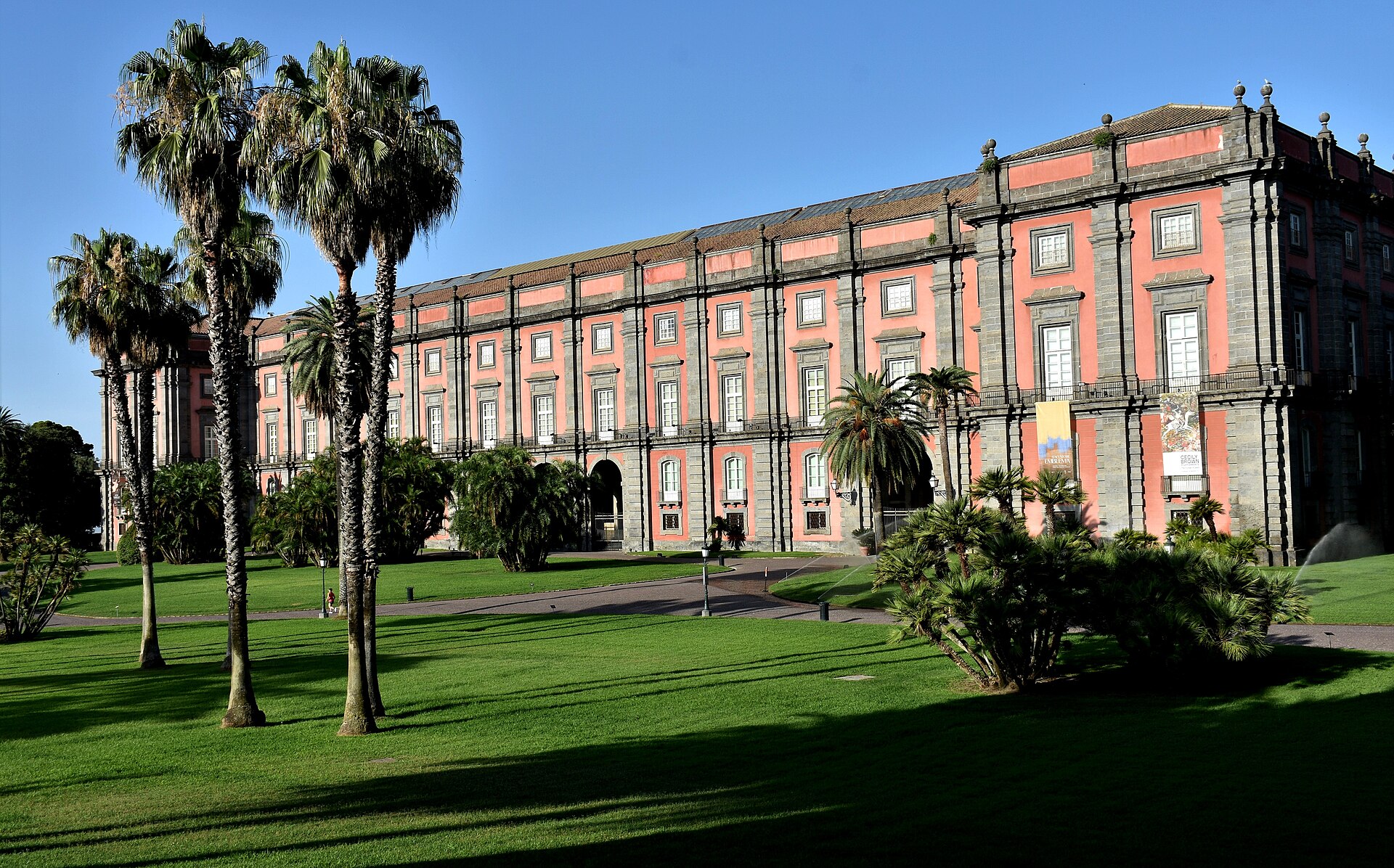
Photograph by Giuseppe Guida · CC BY-SA 4.0 Real Bosco di Capodimonte (the royal park)
One of the largest urban parks in Italy, laid out from the 1730s around the palace, with historic buildings including the Stufa dei Fiori (a flower greenhouse) and the Torre Garden, both of which close for a summer break each year, and the church of San Gennaro, which the museum's own site states is currently closed. The park has multiple gates with different opening hours by season, generally 7:00 to between 17:00 and 19:30 depending on the time of year
What to see first
Salottino di Porcellana (Porcelain Parlour)
Real Fabbrica della Porcellana di Capodimonte, 1757-1759A small room entirely lined, walls and ceiling, in painted and gilded porcelain, commissioned by Queen Maria Amalia of Saxony for the boudoir of her private apartment at the Palace of Portici and moved here intact in 1866 when the porcelain cladding was dismantled and reinstalled in this room. Arguably the single most famous room in the museum; it sits inside the wider Galleria delle Porcellane, a 16-room, roughly 1,500-piece display of the museum's approximately 7,000-piece porcelain and earthenware holdings, which reopened to the public in June 2026 after the redisplay this record previously found it closed for.9
Danae
Titian, c. 1545One of several versions Titian painted of the same subject for Cardinal Alessandro Farnese; part of the group of 70-plus Capodimonte masterpieces the Louvre hosted for six months in 2023 (see narrative), directly acknowledged by the Capodimonte director as one of the works international visitors were most likely to already recognise from art history textbooks.7
Portrait of Pope Paul III
Titian, c. 1543A Farnese-commissioned portrait of the pope who made Titian's patron a cardinal; shown at the Louvre in 2023 in direct dialogue with the Louvre's own Italian Renaissance portraiture, one of the pairings the joint exhibition was built around.7
Antea
Parmigianino, c. 1524-1527One of the most reproduced portraits in Italian Renaissance painting, its sitter's identity still debated; also named by the museum's own director as a work whose fame precedes public awareness of which museum actually holds it.7
The Flagellation of Christ
Caravaggio, c. 1607-1608Painted in Naples during Caravaggio's flight from Rome after killing a man in 1606, one of two Caravaggios the museum has shown together under the title 'Capodimonte doppio Caravaggio' alongside the Ecce Homo, and a work central to the Neapolitan Caravaggisti tradition the museum holds in unmatched depth.3
The Battle of Pavia tapestries
Flemish, 16th century, from Farnese ownershipA set of large narrative tapestries depicting the 1525 battle at which Francis I of France was captured, part of the Farnese collection and shown together in a dedicated exhibition ('La Battaglia di Pavia. Gli Arazzi di Capodimonte'); tapestries this size and this well documented rarely survive as a matched set.8
Crucifixion
Masaccio, c. 1426A small predella panel from the dismembered Pisa Altarpiece, one of the foundational works of Florentine Renaissance painting, its other surviving panels scattered among museums in London, Berlin, Pisa and Malibu.3
Lia Rumma gift of Arte Povera
Various, including Vincenzo Agnetti, Giovanni Anselmo, Enrico Castellani, Luciano Fabro and Michelangelo Pistoletto, donated 2022More than 70 works by around 30 major Italian postwar artists, given to the Italian state specifically for display at Capodimonte by the influential dealer Lia Rumma, now housed on the museum's third floor, currently closed for restoration work (see Inside).3
Past exhibitions here
- Closed16 Apr to 8 Sep 2026Confirmed · check before you travel
A hunting lodge that outgrew its own excuse
Charles VII of Naples, who would later inherit the Spanish throne as Charles III, first proposed a hunting lodge on the Capodimonte hill in 1738. The plan grew almost immediately into something else: Charles needed somewhere to house the Farnese Collection he had inherited from his mother, Elisabetta Farnese, the last direct descendant of the ducal Farnese line of Parma, and his existing residence at the Palace of Portici was too small for the court besides. What began as a lodge became a palace built specifically to be a museum in waiting, decades before Naples had any comparable public gallery to put it in.
Looted, evacuated, and reassembled twice
The collection's early history is a history of removal under pressure. When the short-lived Parthenopean Republic was declared in 1799, King Ferdinand IV fled to Palermo aboard Nelson's Vanguard, taking the most valuable pieces with him; what he left behind was looted by French troops garrisoned at the palace under General Jean Etienne Championnet. During the subsequent nine years of French rule, from 1806 to 1815, the remaining collection was transferred out entirely, to what is now the Naples National Archaeological Museum. Only after Ferdinand's restoration in 1815 did the palace begin to reassemble a collection of its own again, with new decoration completed by 1840 and a gallery of contemporary art added on top of the older holdings. The palace passed to the House of Savoy in 1861, gaining further acquisitions under the painter Domenico Morelli as an advising consultant and an entire collection of historic firearms and weapons; the palace did not become a purely national museum, independent of any royal household, until 1950, with the Galleria Nazionale as it now stands inaugurated in 1957.
Sixty masterpieces go to Paris, then come home
In June 2023 the Louvre opened Naples a Paris, an exhibition president Laurence des Cars called an unprecedented arrangement between the two institutions: more than 70 of Capodimonte's masterpieces, including Titian's Danae and his Portrait of Pope Paul III, and Parmigianino's Antea, were installed across three of the Louvre's own spaces, among them the Grande Galerie itself, for six months, until January 2024. Capodimonte's director, Sylvain Bellenger, described the reasoning bluntly: pictures like the Danae or the Antea are already familiar from art-history textbooks to visitors who have never connected them to Naples at all, and the loan was a chance to send the museum's own name to Paris rather than only its pictures. The paintings returned to Naples at the close of the show, but the loan is also a reminder that a museum this size routinely has significant holdings travelling elsewhere, which is part of why what is actually on the walls in Naples on any given date is worth checking rather than assuming.
A director's farewell, and a EUR 150 million project handed on
Sylvain Bellenger left Capodimonte in December 2023 after an eight-year tenure, marking his departure with a speech that was candid about both what had been achieved and what had not. He described a EUR 150 million renovation spread across 15 separate construction sites within the palace and its grounds, aimed in part at cutting the museum's own energy bills (he said he acted after receiving electricity bills of over a million euros a year, and finding that even changing a lightbulb required a public tender) through a photovoltaic project targeting 91 percent energy self-sufficiency, installed so the historic roofline would look, in his words, exactly as it did in the 1700s. He listed what the project would add: a restored garden, continued digitisation funded through Italy's PNRR recovery programme, a home for the Lia Rumma gift of Arte Povera works, and a new Casa della Fotografia dedicated to Mimmo Jodice, the first photography museum south of Milan. He also named what the museum was working without: a single art-historian curator for 49,000 objects, and three architects responsible for nineteen buildings and the largest urban forest in Italy. His successor, Eike Schmidt, previously director of the Uffizi in Florence, took over in January 2024 to see the programme through.
What is actually closed right now
As of August 2026, well after Bellenger's projected completion date, several sections remain shut. The museum's own site states plainly that the entire third floor, which holds the contemporary art galleries, the Mimmo Jodice photography section and the 19th-to-20th-century rooms, is closed for restoration, requalification and energy-efficiency work, alongside part of the Armeria and part of the second floor. The Church of San Gennaro inside the Real Bosco is separately closed. Most strikingly, the Appartamento Reale's single most famous room, the Salottino di Porcellana, is not open to visitors: the museum's own notice attributes this specifically to a redisplay of the wider ten-room porcelain cabinet themed around the collector Federico Forquet, even though the nine other rooms of the Royal Apartment have stayed open through the same phase of work. A visitor arriving expecting the porcelain room they may have seen photographed will not find it open.
What visitors say
Capodimonte is consistently ranked among Italy's most important picture galleries, praised in the same breath as the Uffizi and the Naples Archaeological Museum for the depth of its Renaissance and Neapolitan holdings, while visitors and the museum's own site agree that a large, ongoing renovation programme has made parts of the collection genuinely hard to see on any given visit.
What is praised, what is criticised
- Praised: the depth of the Farnese and Neapolitan-school holdings, giving Capodimonte a claim to be the best single place to see paintings of the Neapolitan school, work the museum's own English Wikipedia entry says is 'often under-appreciated by the wider world'
- Praised: the Salottino di Porcellana, when open, singled out repeatedly as one of the most extraordinary single rooms of any European royal residence
- Praised: the setting itself: a royal palace inside one of the largest urban parks in Italy, giving the museum a scale and a green surrounding that few city-centre picture galleries can match
- Criticised: the scale of current closures: as of August 2026 the museum's own site lists the entire third floor (contemporary art, the Mimmo Jodice photography gallery, the 19th-20th century section), part of the Armeria, part of the second floor, the Salottino di Porcellana specifically, and the Church of San Gennaro in the park as all closed for restoration, redisplay or energy-efficiency work at the same time
- Criticised: the suspension of the cloakroom service since 1 May 2026 and of the audioguide service, both stated on the museum's own ticketing page without a restoration date
- Criticised: the layered complexity of the opening hours themselves, which differ by floor and by day (First Floor and Second Floor keep different hours, and the Second Floor's hours change again on Sundays and free days), a level of detail a visitor has to actively look up rather than infer from a single posted closing time
Questions about Museo e Real Bosco di Capodimonte
Where is Museo e Real Bosco di Capodimonte?
Via Lucio Amelio 2, 80131 Napoli, Italy.
How much does it cost to visit?
Full price (Intero): EUR 15; Groups over 15 paying visitors, age 25+: EUR 14; Tickets bought and validated 8:30-9:30 or 17:30-18:30: EUR 12; Reduced, EU citizens 18-25: EUR 2; Free, under 18: free. As confirmed 23 August 2026.
When is it open?
Monday, Tuesday, Thursday, Friday, Saturday 08:30-19:30; Sunday and public holidays 08:30-19:30; Wednesday closed. Closed: Wednesday. As confirmed 23 August 2026.
How do you get there?
Bus: Lines 3M, 168, 178, C67 to the Porta Piccola/Porta Miano stops on Via Lucio Amelio, or C63 to Porta Grande on Via Capodimonte; Metro + bus: Metro Line 1 to Museo, or Line 2 to Piazza Cavour, then onward by bus; a bus also stops at Piazza Museo, next to the Naples National Archaeological Museum; Walking: Three signed walking routes connect the historic centre to the museum in about 30 minutes, including a route linking Capodimonte directly to the Naples Archaeological Museum via the Ponte della Sanita and the Catacombs of San Gennaro.
What should you see first?
Salottino di Porcellana (Porcelain Parlour) (Real Fabbrica della Porcellana di Capodimonte, 1757-1759); Danae (Titian, c. 1545); Portrait of Pope Paul III (Titian, c. 1543); Antea (Parmigianino, c. 1524-1527); The Flagellation of Christ (Caravaggio, c. 1607-1608); The Battle of Pavia tapestries (Flemish, 16th century, from Farnese ownership).
What we could not confirm
- No reopening date is published anywhere fetched for this record for the third floor (contemporary art, Mimmo Jodice photography, 19th-20th century section), part of the Armeria, part of the second floor, the Church of San Gennaro, or the Salottino di Porcellana; all are stated as closed for ongoing work with no end date given.
- The museum's own primary domain, capodimonte.cultura.gov.it, was unreachable throughout this research by both a direct HTTP fetch (connection timed out) and the in-app browser (navigation denied). This page instead relies on Wayback Machine snapshots of that same domain from January, April and August 2026, each individually fetched and read, which is why sources on this page cite web.archive.org URLs rather than the live site directly; the underlying content is the museum's own, not a secondary summary of it.
- Whether the EUR 150 million, 15-site renovation programme Sylvain Bellenger described at his December 2023 farewell is now complete is unclear: a search-indexed headline (not itself opened, given the primary domain's unreachability) suggests a 'ribbon-cutting' event around May 2026, yet the same month's own hours-and-tickets pages, fetched directly via Wayback Machine, still list five separate sections as closed for restoration work with no date given.
Images
Sources
- 1Wikidata, Museo di Capodimonte (Q290549): label, default label 'Museo e Real Bosco di Capodimonte' matching the brief exactly, coordinates 40 52'01.16"N 14 15'01.26"E matching the brief's 40.86699,14.25035, founder Bruno Molajoli, inception 1757, date of official opening 1957, address via Lucio Amelio 2, phone, email [email protected], official website capodimonte.cultura.gov.it. Fetched and raw-verified 7 August 2026. wikidata.org/wiki/Q290549
- 2Fetched and read in full, 7 August 2026. en.wikipedia.org/wiki/Museo_di_Capodimonte
- 3Museo e Real Bosco di Capodimonte, official homepage, Wayback Machine snapshot of 5 August 2026 (the live capodimonte.cultura.gov.it domain was unreachable by direct HTTP fetch, timing out after 75 seconds, and by the in-app browser, which reported the navigation denied; this archived copy of the museum's own page was fetched and read directly instead): current and recent exhibitions list, the Corot acquisition announcement, the cloakroom suspension notice (1 May 2026), the list of collection sections currently closed for restoration (Arte contemporanea, Armeria in part, Collezione De Ciccio, Ottocento privato, Galleria dell'800), and Real Bosco garden-closure notices. web.archive.org/web/20260805112915/https://capodimonte.cultura.gov.it/
- 4Museo e Real Bosco di Capodimonte, official Orari (hours) page, Wayback Machine snapshot of 10 April 2026, fetched directly (see source 3 for why the live domain could not be reached): the full floor-by-floor and day-by-day hours structure, the third-floor and part-Armeria closure notice for restoration/requalification/energy-efficiency work, the Church of San Gennaro closure, the Appartamento Reale redisplay and the Salottino di Porcellana's specific closure for the Federico Forquet porcelain-cabinet project, and the 1872 Annibale Sacco porcelain-collection reorganisation history. web.archive.org/web/20260410095035/https://capodimonte.cultura.gov.it/orari/
- 5Museo e Real Bosco di Capodimonte, official Biglietti (tickets) page, Wayback Machine snapshot of 10 April 2026, fetched directly (see source 3): current admission prices and tiers, free-admission days, the 18app discount route, and the audioguide-suspension notice. An older, clearly superseded COVID-era price block further down the same archived page (referencing a since-ended vaccination-certificate discount and suspended free Sundays under a 2020 decree) was identified as stale leftover content and NOT used for any figure on this page. web.archive.org/web/20260410094132/https://capodimonte.cultura.gov.it/biglietti/
- 6Museo e Real Bosco di Capodimonte, official Come raggiungerci (how to reach us) and Contatti pages, Wayback Machine snapshot of 21 January 2026, fetched directly (see source 3): bus and metro routes, walking-route options, taxi stands, secretariat and Ufficio Accoglienza phone numbers and emails, and direct confirmation of 'DIRETTORE GENERALE Eike SCHMIDT' as the museum's own stated current director. web.archive.org/web/20260121164312/https://capodimonte.cultura.gov.it/come-raggiungerci/
- 7Musee du Louvre press office, 'Naples a Paris. Le Louvre invite le musee de Capodimonte', official press release for the exhibition of 7 June 2023 to 8 January 2024: the more-than-70-work loan across the Grande Galerie, the Chapelle room and the Salle de l'Horloge, direct quotations from Louvre president Laurence des Cars and Capodimonte director Sylvain Bellenger (including his remarks on the Danae, the Portrait of Paul III and the Antea), and the exhibition's curatorial team. Fetched and read in full, 7 August 2026. presse.louvre.fr/naples-a-parisle-louvre-invite-le-musee-de-capodimonte/
- 8Wikimedia Commons and the Museo e Real Bosco di Capodimonte's own past exhibitions listing (see source 3): confirms 'La Battaglia di Pavia. Gli Arazzi di Capodimonte' as a named past exhibition of the Farnese-owned Battle of Pavia tapestries, cross-checked against the Commons file 'Battle of Pavia tapestries.jpg' and related images in the same Commons category for the object's existence and Farnese provenance. web.archive.org/web/20260805112915/https://capodimonte.cultura.gov.it/
- 9Wikimedia Commons, Category:Sala 52 - Salottino di Porcellana (Palace of Capodimonte): wikitext description confirming the room's 1757-1759 commission by Queen Maria Amalia of Saxony for her boudoir at the Palace of Portici, its 1866 dismantling and reinstallation at Capodimonte as room 52, and its dimensions (6.75 x 4.80 x 5.13 m). Cross-checked against and consistent with the same 1866 date given independently by English Wikipedia (source 2). Fetched and read in full, 7 August 2026. commons.wikimedia.org/wiki/Category:Sala_52_-_Salottino_di_Porcellana_(Palace_of_Capodimonte)
- 10Le Monde (English edition), 'Naples in Paris: The Louvre hosts Capodimonte masterpieces', 12 June 2023. A direct fetch returned Le Monde's bot-block subscriber page rather than the article text; only the headline and framing, sourced from a search index rather than the raw article body, are used here, and no further detail from this source is quoted or paraphrased. lemonde.fr/en/culture/article/2023/06/12/naples-in-paris-the-louvre-hosts-capodimonte-masterpieces_6030976_30.html
- 11Corriere del Mezzogiorno (Corriere della Sera, Naples edition), 'Capodimonte, l'addio di Bellenger: "Abbiamo fatto miracoli"', by Mirko Labriola, 19 December 2023: Bellenger's full farewell speech, the EUR 150 million/15-site renovation figure, the photovoltaic/91-percent-energy-autonomy project and the roof-appearance detail, the over-a-million-euro annual electricity bill and public-tender-for-a-lightbulb remark, the Lia Rumma and Casa della Fotografia Mimmo Jodice announcements, the '49,000 works, one art-historian curator, three architects for nineteen buildings' staffing detail, and Eike Schmidt named as the designated successor, formerly director of the Uffizi. Fetched and read in full, 7 August 2026. napoli.corriere.it/notizie/cronaca/23_dicembre_19/capodimonte-l-addio-di-bellenger-ho-fatto-miracoli-9ad5219f-c39b-4d6a-9313-debc63d1exlk.shtml
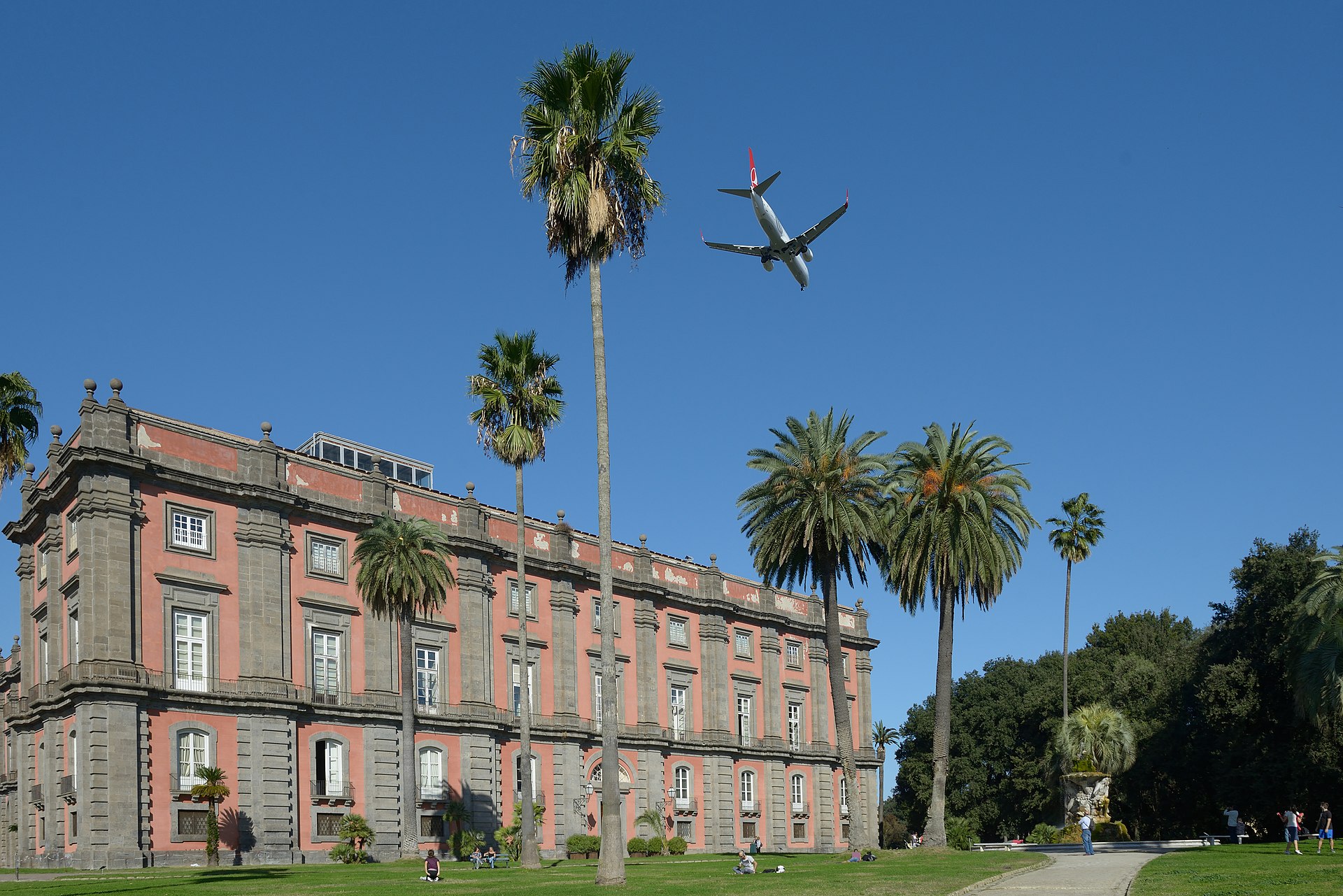
- 12Wikimedia Commons, File:Reggia di Capodimonte 1.JPG: CC BY-SA 4.0, author Mentnafunangann, the same image used as Wikidata's own primary image for this institution, confirmed by eye as the palace facade from the park. Used as the lead plate. commons.wikimedia.org/wiki/File:Reggia_di_Capodimonte_1.JPG
- 13Wikimedia Commons, File:Museo Capodimonte Napoli facciata Sud.jpg: LicenseShortName confirmed as Creative Commons Attribution-Share Alike (3.0/2.5/2.0/1.0), author Wolfgang Moroder, camera-location geotag matching the museum's coordinates, confirmed by eye as the palace's south facade. A separate courtesy note from the author requesting no social-media use is the author's own preference statement, not part of the licence terms, and does not affect eligibility under the CC BY-SA test. Used as a context plate. commons.wikimedia.org/wiki/File:Museo_Capodimonte_Napoli_facciata_Sud.jpg
- 14Wikimedia Commons, File:Real Bosco di Capodimonte. (9923).jpg: CC BY-SA 4.0, author Giuseppe Guida, confirmed by eye as the palace viewed from within the surrounding park. Used as a context plate. commons.wikimedia.org/wiki/File:Real_Bosco_di_Capodimonte._(9923).jpg
- 15Wikimedia Commons, File:Salottino di Porcellana 001.JPG: CC BY-SA 4.0, author Mentnafunangann, confirmed by eye as the porcelain-clad interior of Room 52. Used as the Salottino wing/highlight plate, captioned to note the room's current closure. commons.wikimedia.org/wiki/File:Salottino_di_Porcellana_001.JPG


.jpg)
