Self Portrait as Saint Catherine of Alexandria
Artemisia Gentileschi · c. 1615-17
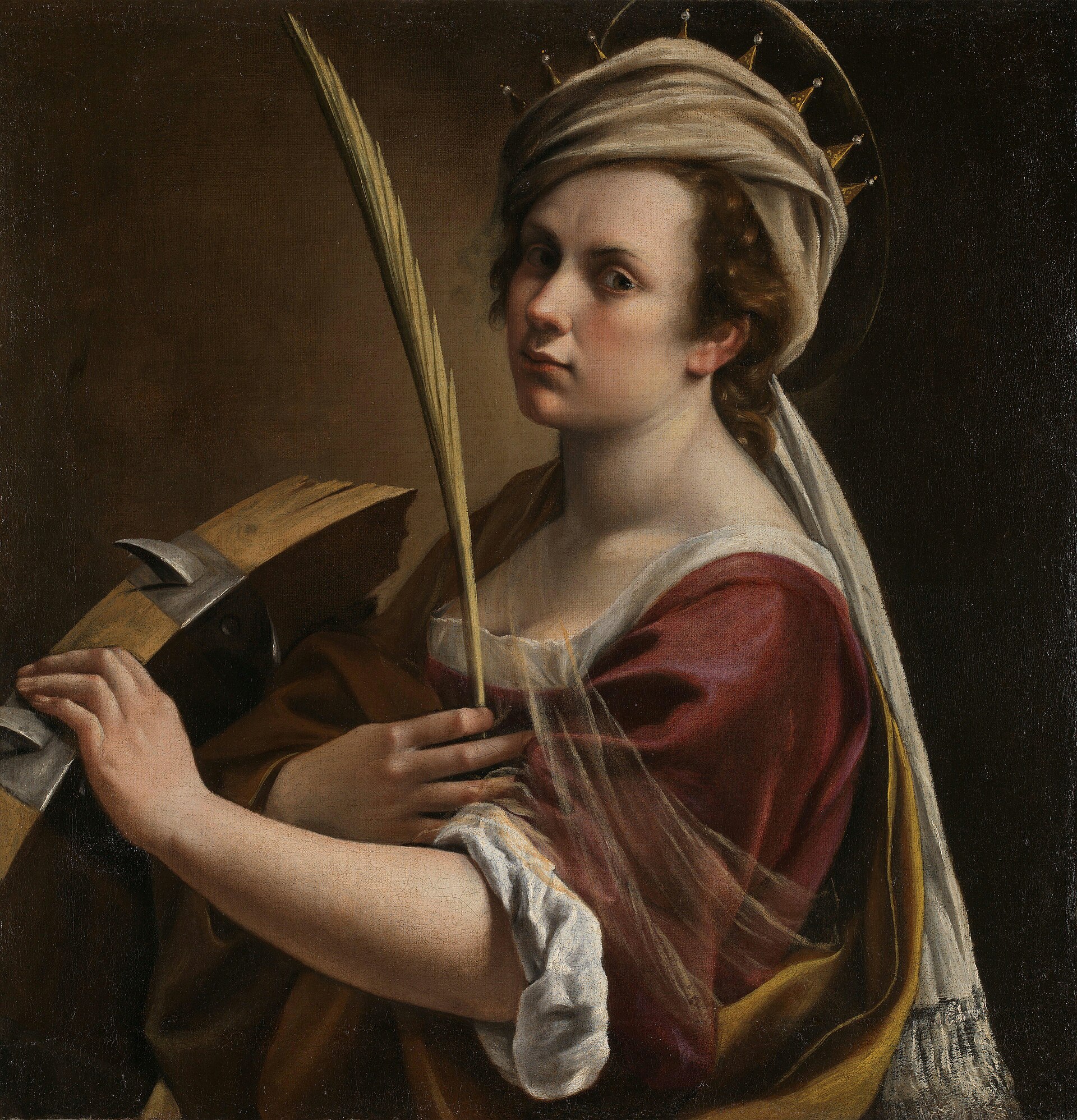
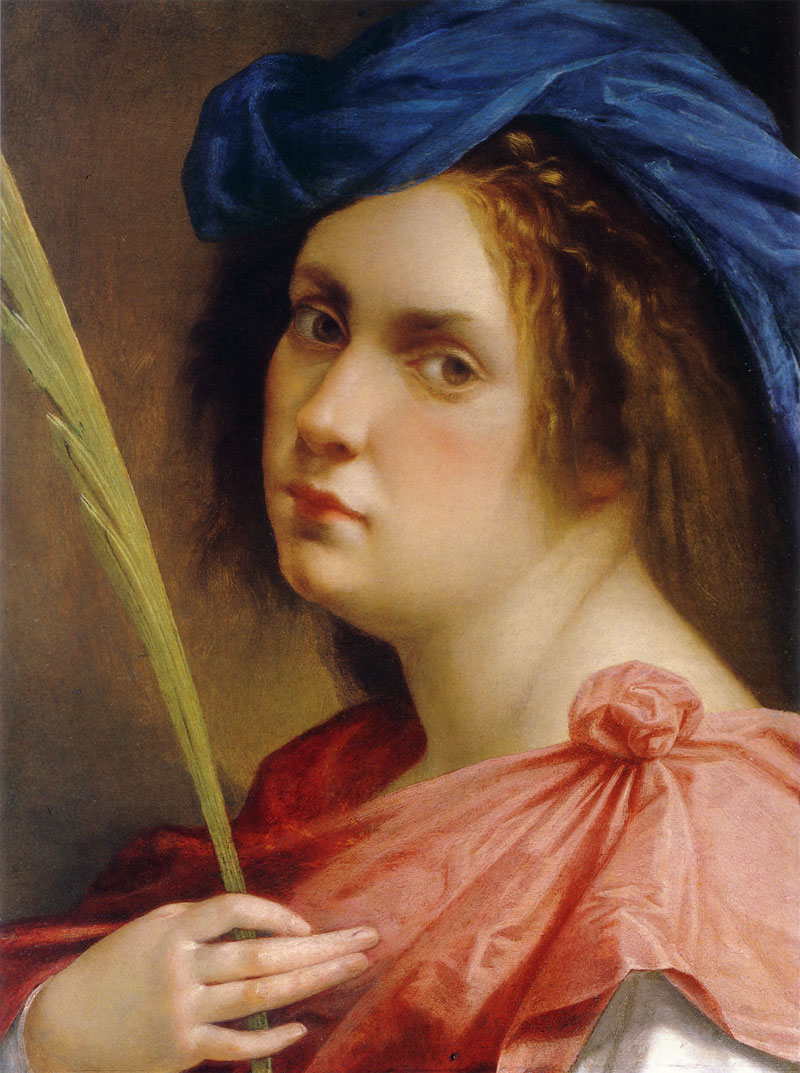
The record subject. Oil on canvas, c. 1615-17, 71.4 x 69 cm. National Gallery, London, NG6671, acquired 2018.
| Artist | Artemisia Gentileschi |
|---|---|
| Date | c. 1615-17 |
| Medium | Oil on canvas |
| Dimensions | 71.4 x 69 cm (the National Gallery's published dimension for the object as it is now, after the 2018 conservation treatment fitted a strip of primed canvas to the irregular top edge and stopped counting an unfolded tacking edge at the right as part of the composition. The 2017 Drouot catalogue gave 71 x 71 cm, which is the same painting measured before that treatment.) |
| Where it is now | National Gallery, Londonlast confirmed |
| Inventory number | NG6671 |
| Attribution | AcceptedUniversally accepted as an autograph self-portrait by Artemisia Gentileschi; there is no record of the attribution ever being contested or reassigned to her father Orazio Gentileschi or to another hand. Full note |
| Object type | Painting |
| Period | Italian Baroque, seventeenth century |
| Cases | Has a provenance gap |
| Inscriptions | None on the painted surface itself. The numeral '715', of unknown significance, was inscribed on the earlier lining canvas removed during the 2018 conservation treatment. |
| Owners on record | 6 links5 documented, 1 unknown |
| Sources | 17 cited |
About this record Last verified · 17 sources cited · Change log
On this page 10 sections
ContentsClose
Artemisia Gentileschi painted herself in the guise of the martyred Saint Catherine of Alexandria around 1615-17, in her early twenties, not long after she had settled in Florence following the 1612 rape trial in Rome that made her, briefly, notorious. The picture disappeared from the historical record for roughly three centuries, surfacing only in a French family's ownership by the early 1940s, and was sold as a rediscovery at a regional Paris saleroom in December 2017 for an artist-record 1.85 million euros at the hammer. Dealers who bought it there resold it within months, by private treaty, to the National Gallery in London for a reported 3.6 million pounds - only the second painting by a woman the Gallery had acquired since 1991 and the first work by Gentileschi to enter its collection.
The 2018 conservation campaign that followed did more than clean the picture. X-radiography and infrared imaging found that Gentileschi built the composition in stages, painting out an earlier shape beneath the broken wheel, repositioning the turban and drapery, and adding the pearl-topped crown and martyr's palm only in the final stages - evidence of a working artist revising her own image as she went, not copying a fixed design. A parallel scientific study of the Uffizi's closely related Saint Catherine of Alexandria then found, in 2019, that its underpainting traces onto the London picture to the millimetre: the two paintings share a cartoon, even though the Uffizi canvas was finished as a portrait of a Medici lady rather than as a self-portrait. They remain two separate objects, and this record describes only the one in London.
The National Gallery has also placed the picture on its own published list of acquisitions with incomplete 1933-45 provenance, because it cannot document how the Boudeville family in the Vosges first came to own it, only that they held it across three generations before selling it. The Gallery states it is satisfied the picture was in family hands well before the war; the underlying gap remains open on the record.
Provenance
Each link is graded. Documented: a cited source supports it. Disputed: the identification is argued but not established. Unknown: no owner for that span, and the gap is not smoothed into a narrative. The grades in the glossary.
- c. 1615-17 -The artist, Artemisia Gentileschi, Florencedocumented
Painted in Florence in the years immediately following Gentileschi's move there after the 1612 Roman trial. No commission or first owner is documented; the picture may have been painted speculatively rather than to order.1
- c. 1617 - early 1940sUnknown, then Charles Marie Boudeville, Chatenois, Vosges, Franceunknown
No owner is documented for roughly three centuries. The picture is first documented in the possession of Charles Marie Boudeville by the time of his death in the early 1940s. The National Gallery has placed the acquisition on its own published list of works with incomplete 1933-45 provenance because how and when the Boudeville family acquired the picture cannot be established; the Gallery's stated position is that available evidence points to inheritance and to ownership predating 1933, but that evidence has not been published in full in the sources consulted.67
- early 1940s - 1984Georges Boudeville (1930-1984), son of Charles Marie Boudevilledocumented
Second documented generation of family ownership, per the National Gallery's own catalogue entry.1
- 1984 - 2017Nicolas Boudeville (b. 1966), sole son of Georges Boudevilledocumented
Third documented generation of family ownership; consigned the picture for sale in 2017.1
- 2017 - 2018Marco Voena (Old and Modern Masters Ltd) and Fabrizio Moretti, jointly, trading via the London gallery Robilant + Voenadocumented
Bought jointly at the Drouot sale of 19 December 2017 (hammer EUR 1.85m, EUR 2,360,600 with premium); the picture entered the stock of Robilant + Voena, London.62
- 2018 - presentNational Gallery, London (NG6671)documented
Bought from Robilant + Voena by private treaty (not at auction) in 2018 for a reported total of GBP 3.6 million, funded by the American Friends of the National Gallery, London (GBP 2.7m), the National Gallery Trust (GBP 380,000), the Art Fund via the Sir Denis Mahon legacy (GBP 250,000, including conservation), and gifts and legacies (GBP 280,000). The National Gallery's own 2024 catalogue entry does not itself state a price.238
Prices realised
| Date | Sale | Estimate | Result | Note |
|---|---|---|---|---|
| 19 December 2017 | Christophe Joron-Derem, Hotel Drouot, Paris Tableaux anciens, modernes et contemporains, bijoux et orfevrerie, sculptures, mobilier et objets d'art du XVIIeme siecle a nos jours, Hotel Drouot, 19 December 2017 (public exhibition in salle 9 from Saturday 16 December), lot 69, confirmed on the house's lot page ('Lot n. 69') | EUR 300,000 - 400,000, as printed on the house's lot page | Hammer EUR 1,850,000 (unchanged), now labelled DERIVED from the house total under the house's printed schedule: 'frais legaux : 23% H.T. (27,6% T.T.C.)'. 2,360,600 / 1.276 = 1,850,000, a round bidding figure. The Art Newspaper report the record already cites gives the same hammer; the house itself prints only the total. With premium EUR 2,360,600 premium-inclusive, printed on the house's lot page as 'Resultat : 2 360 600 EUR' and on the house's results notice headed 'Vente le 19 decembre 2017 - 2 360 600 EUR'. NOTE the lot page's template heading over that figure reads 'Resultats sans frais'; the arithmetic against the page's own 27.6 per cent shows the figure is WITH fees. Carried as premium-inclusive. EUR | House lot page and results notice read 2026-09-16 at rung 1, HTTP 200, in full. Catalogued as: Artemisia GENTILESCHI (Rome 1593-Naples 1652), Sainte Catherine d'Alexandrie, huile sur toile, 71 x 71 cm, '(Restaurations anciennes, petites dechirures et petits manques). Sans cadre.' Expert for Old Master paintings in the sale: Cabinet Turquin. The house's catalogue note relates the picture to the Uffizi Saint Catherine (inv. 8032, c. 1614-16, 76 x 62 cm) and lists the variants: turban here against the jewelled crown in Florence, the palm higher and uncut, the wheel behind the saint rather than under her hand, the veil from the right shoulder rather than the left; it also names the Autoportrait en martyre (private collection, 31.5 x 24.5 cm) and the Hartford lute-player self-portrait as comparanda, and says the specialists regard those as self-portraits, 'ce qui semble aussi le cas de cette toile'. No provenance block is printed on the house page. The 2018 National Gallery purchase is a private-treaty transaction and stays where the record has it. |
Hammer is the price at which the bidding stopped; with premium adds the fee the house charges the buyer on top. Hammer price and buyer's premium in the glossary.
Technical evidence
| Attribution note | Universally accepted as an autograph self-portrait by Artemisia Gentileschi; there is no record of the attribution ever being contested or reassigned to her father Orazio Gentileschi or to another hand. The National Gallery's own technical dossier corroborates authorship not by document but by physiognomic comparison: the sitter's features match those in the near-contemporary Self Portrait as a Lute Player (Wadsworth Atheneum, Hartford), a bronze portrait medal of the artist from the mid-1620s (Scher Collection, New York), a painted portrait of Artemisia by Simon Vouet (Palazzo Blu, Pisa), and Jerome David's engraving of about 1627-28 after a now-lost painted self-portrait. A 1623 documentary description of Artemisia as 'more beautiful than ever' is also cited in support. As with most of her Florentine-period pictures, there is no signature and no contract; the identification of the sitter as Artemisia herself, rather than a generic model, rests on this cumulative visual comparison rather than a single document. |
|---|---|
| Support | Medium-weight, plain-weave linen canvas in two horizontal strips joined by a seam approximately 7 cm above the bottom edge; the top edge was trimmed before the picture's earliest documented owner, removing part of the halo and the tip of the palm frond, later compensated with an added strip of primed linen in the 2018 conservation treatment.1 |
| Ground | An initial organic layer containing calcium sulphate with black and red pigment, over which lies the working ground: a yellow-brown preparation of yellow earth, calcium carbonate, lead white, umber and finely ground black pigment.1 |
| Underdrawing and design transfer | No conventional preparatory underdrawing was found. Infrared reflectography shows only minimal sketch lines (around the curls above the right ear and an undefined shape beneath the wheel); most fine dark lines visible in infrared are brush-drawn contour adjustments made during painting. Comparison with the Wadsworth Self Portrait as a Lute Player and the Uffizi Saint Catherine of Alexandria indicates the head and shoulders were transferred between pictures by tracing or a shared cartoon rather than freehand copying.15 |
| Pentimenti | X-radiography and false-colour reflectance imaging reveal an earlier stage of the composition: an unidentified shape (possibly a book or tablet) beneath the present wheel, later painted out in umber-rich dark paint; the yellow shawl painted over both the earlier shape and the wheel's first position; the turban/headcloth repositioned; hair locks on the left suppressed under later background paint; the pearled crown added as a late element over the headcloth; and the martyr's palm added last, over both drapery and background. The underlying forms have been read as consistent with a more generic, classicising female figure preceding the specific identification as Saint Catherine.1 |
| Pigment analysis - red dress | Purple-toned underpaint of azurite, red lake, lead white, black and yellow earth; shadows built from successive translucent glazes of red lake, powdered colourless glass and vermilion; upper glazes, now faded, identified as a red lake from a cochineal insect dyestuff.1 |
| Pigment analysis - yellow shawl | Base of yellow earth, umber, red earth and bone black; shadows in a now-degraded yellow lake of unidentified source; highlights in lead white with lead-tin-antimony yellow, a pigment first documented in Rome earlier in the seventeenth century and uncommon enough in surviving paintings to serve as supporting evidence for the picture's date and Rome-trained, Florentine-period origin.1 |
| Paint medium | Heat-bodied linseed oil, confirmed by analysis of a paint sample from the arm.1 |
| Condition on arrival, 2017-18 | Aged glue-paste lining of nineteenth- or early-twentieth-century date; a compound tear approximately 4 cm wide beside the right wrist with associated paint loss; a triangular paint and ground loss along the top edge beside the palm frond; deformation and paint loss above the left side of the crown; several small deep scratches near the upper right corner; discoloured varnish and old retouching throughout; the numeral '715' inscribed on the old lining canvas, of unknown significance.1 |
| Conservation treatment, 2018 | Five-month treatment under Larry Keith (Chief Restorer and Keeper), with Paul Ackroyd and Lynne Harrison on the structural work: removal of discoloured varnish and old retouching, consolidation and repair of the tear, removal of the old lining and application of a new loose lining, insertion of primed-linen fills for canvas losses, and addition of a primed-canvas strip along the trimmed top edge to allow reconstruction in paint of the missing palm tip, crown pearl and halo arc.14 |
Images
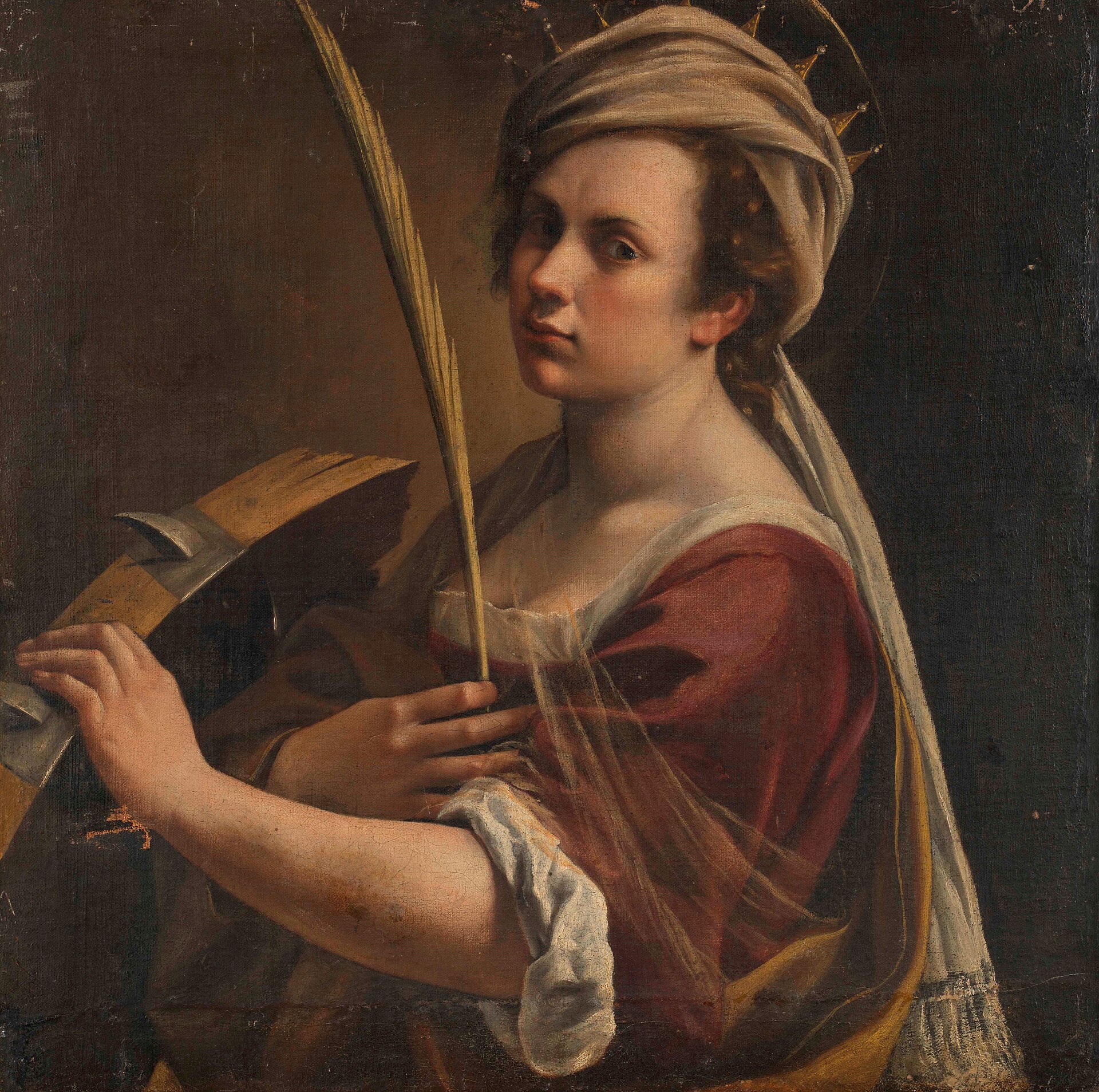
The record in full
Chapter 1What it is
A half-length self-portrait, 71.4 by 69 centimetres, oil on canvas, showing Artemisia Gentileschi in the guise of Saint Catherine of Alexandria: turned three-quarters toward the viewer, wearing a red...
A half-length self-portrait, 71.4 by 69 centimetres, oil on canvas, showing Artemisia Gentileschi in the guise of Saint Catherine of Alexandria: turned three-quarters toward the viewer, wearing a red dress and a pale gold shawl, a jewelled crown set over a headcloth, holding the martyr's palm frond in one hand and resting the other on the broken spiked wheel that identifies the saint and recalls the instrument on which she was to be tortured before it miraculously shattered.
The canvas is built from two horizontal strips of a medium-weight plain-weave linen, joined by a seam about seven centimetres above the bottom edge - ordinary studio practice for a artist assembling material to hand rather than working from a single large bolt. The top edge was trimmed at some point before the picture is first documented, cutting into the halo and the tip of the palm frond; the National Gallery's 2018 conservation treatment added a strip of new canvas along that edge so the composition could be completed in paint, a fact any reader comparing photographs of the picture before and after 2018 should know.
Chapter 2Saint Catherine, and why a rape survivor might paint her
Catherine of Alexandria was, by legend, a fourth-century scholar and princess who refused the Roman emperor Maxentius's demand that she renounce Christianity, was condemned to death on a spiked...
Catherine of Alexandria was, by legend, a fourth-century scholar and princess who refused the Roman emperor Maxentius's demand that she renounce Christianity, was condemned to death on a spiked breaking wheel, saw the wheel shatter at her touch, and was beheaded regardless. She was one of the most frequently painted female saints in Counter-Reformation Italy, and images of her were especially current in Florence in the 1610s, a city where Cosimo II de' Medici's own sister was named Caterina.
Gentileschi arrived in Florence in late 1612 or January 1613, months after the eight-month Roman trial in which she had testified, under judicial thumbscrews applied to verify her evidence, that the painter Agostino Tassi had raped her the previous year. Tassi was convicted; the sentence of exile was never enforced. Several scholars - among them Mary Garrard, whose work is part of the standard literature on this picture - have argued that Gentileschi's choice of martyr subjects in this period, and specifically a broken instrument of torture held calmly in her own two hands, functions as a form of professional self-assertion after an ordeal in which she herself was interrogated and disbelieved. This is a scholarly argument, not a documented statement of the artist's intent: Gentileschi left no letter explaining why she painted herself as Catherine. The reading is widely repeated because it is consistent with the facts of the trial and with her later, well-documented correspondence asserting her professional equality to male painters - but it remains an inference from the image, not a record of her stated purpose, and this record treats it as such.
Chapter 3A three-hundred-year gap, then a French family
Nothing connects the picture to any recorded owner between its execution in Florence, around 1615-17, and its documented presence in the possession of Charles Marie Boudeville, in Chatenois in the...
Nothing connects the picture to any recorded owner between its execution in Florence, around 1615-17, and its documented presence in the possession of Charles Marie Boudeville, in Chatenois in the Vosges, by the time of his death in the early 1940s. Three generations of the same family then held it without incident: from Charles Marie Boudeville to his son Georges Boudeville (1930-1984), and from Georges to his only son Nicolas Boudeville, born 1966, who consigned it for sale in 2017.
The family is not recorded as having known what they owned. No twentieth-century exhibition, publication or dealer record places the picture anywhere before the sale, and none of the sources consulted for this record explain how or when it entered French private hands in the first place.
Chapter 4The 1933-45 gap and the National Gallery's own spoliation check
Because the documented ownership before the early 1940s cannot be established, the National Gallery placed this acquisition on its own published list of works with incomplete provenance for the Nazi...
Because the documented ownership before the early 1940s cannot be established, the National Gallery placed this acquisition on its own published list of works with incomplete provenance for the Nazi era, 1933-45 - the list the Gallery has maintained since 1999 under the Washington Principles on Nazi-Confiscated Art. The concern is structural rather than specific: French Jewish-owned collections were subject to forced sale and outright seizure under the occupation, and a picture that cannot be shown to have been in the same hands across that period cannot be cleared of the possibility, however faint, that it changed hands under duress during it.
The Gallery's stated position, given to press at the time of acquisition, is that the evidence available to it points to inheritance rather than purchase by Charles Marie Boudeville, and therefore to family ownership predating 1933 - the Gallery said there was 'strong evidence' for this, without publishing the evidence itself in the sources consulted here. The picture was bought regardless, with the incomplete-provenance flag standing rather than resolved. A reader relying only on the celebratory coverage of the 2018 purchase would not learn that this question exists; it is recorded here because it is the National Gallery's own caveat, not an accusation manufactured for this record.
Chapter 5The sale that revealed it: Drouot, 19 December 2017
The picture was entered for sale by the auctioneer Christophe Joron-Derem at the Hotel Drouot in Paris on 19 December 2017, as lot 69 of a sale of European paintings, with an estimate of 300,000 to...
The picture was entered for sale by the auctioneer Christophe Joron-Derem at the Hotel Drouot in Paris on 19 December 2017, as lot 69 of a sale of European paintings, with an estimate of 300,000 to 400,000 euros - a figure set before its full significance was recognised. Once attributed with confidence to Gentileschi, bidding carried it to a hammer price of 1.85 million euros; with the buyer's premium the total came to 2,360,600 euros. It was, at the time, an auction record for the artist.
The successful bid was made jointly by the dealers Marco Voena, trading as Old and Modern Masters Ltd, and Fabrizio Moretti, and the picture entered the stock of Voena's London gallery, Robilant + Voena. The underbidder, and how close the contest ran, are not recorded in the sources consulted for this entry.
Chapter 6From the trade to Trafalgar Square: the 2018 acquisition
The National Gallery did not buy the picture at auction.
The National Gallery did not buy the picture at auction. It bought it from Robilant + Voena by private treaty in 2018, for a total reported at 3.6 million pounds (about 4.7 million US dollars at the time) - roughly 1.5 times what the dealers had paid seven months earlier, the ordinary margin of a dealer who has correctly identified and researched a rediscovery before reselling it to an institution.
The Gallery's own press release itemises the funding: 2.7 million pounds from the American Friends of the National Gallery, London; 380,000 pounds from the National Gallery Trust; 250,000 pounds from the Art Fund, drawn from the legacy of the collector and scholar Sir Denis Mahon and earmarked to cover conservation as well as purchase; and a further 280,000 pounds from gifts and legacies, including named support from Lord and Lady Sassoon, Lady Getty and the writer and Gallery trustee Hannah Rothschild. No single source covered the full price; the acquisition was assembled, as most seven-figure museum purchases now are, from a coalition of a dedicated overseas patrons' group, the Gallery's own trust, a national fund, and private legacy giving.
Director Gabriele Finaldi framed the purchase in terms of representation rather than rarity for its own sake: 'Works by women artists of this time are very rare compared to works by male artists, and our collection reflects that historical fact.' Curator Letizia Treves, who holds the Gallery's James and Sarah Sassoon curatorship of later Italian, Spanish and French seventeenth-century paintings, called Artemisia 'without question one of the most celebrated painters of her time' and said the self-portrait adds substantially to the picture's art-historical significance beyond its quality alone. Contemporary reporting states plainly what the Gallery's own catalogue entry does not spell out in figures: this was the first painting acquired by a woman artist since five works by Paula Rego entered the collection as a gift in 1991, and only the twenty-first work by a woman across a collection of more than 2,300 paintings. It was also the first work by Gentileschi, and the first self-portrait by any woman, to enter the Gallery's Italian seventeenth-century holdings.
Chapter 7Conservation, 2018
The Gallery's conservation department, led by Chief Restorer and Keeper Larry Keith with structural treatment by Senior Restorer Paul Ackroyd and Lynne Harrison, carried out a five-month treatment...
The Gallery's conservation department, led by Chief Restorer and Keeper Larry Keith with structural treatment by Senior Restorer Paul Ackroyd and Lynne Harrison, carried out a five-month treatment before the picture went on public display. The condition on arrival was consistent with a picture that had spent decades unregarded in a private house: an aged glue-paste lining of nineteenth or early-twentieth-century date; a compound tear roughly four centimetres wide beside the right wrist, with associated paint loss; a triangular loss of paint and ground along the top edge beside the palm frond; deformation and paint loss above the left side of the crown; several small deep scratches near the upper right corner; and discoloured varnish and old retouching throughout.
Treatment removed the degraded varnish and earlier restorations, consolidated the tear, replaced the old lining with a new loose lining on the existing stretcher, and made good the canvas losses with inserts of primed linen. A strip of new, primed canvas was added along the trimmed top edge so that the missing tip of the palm frond, the missing pearl of the crown, and the cropped arc of the halo could be reconstructed in paint - a legitimate and disclosed compensation for old damage, not a change to the composition Gentileschi painted, and one any comparison of pre- and post-2018 photographs of the picture needs to account for.
Chapter 8What the X-rays and infrared found: a picture built in stages
Technical examination undertaken alongside the conservation treatment - X-radiography, conventional infrared reflectography, shortwave-infrared Reflectance Imaging Spectroscopy, and X-ray...
Technical examination undertaken alongside the conservation treatment - X-radiography, conventional infrared reflectography, shortwave-infrared Reflectance Imaging Spectroscopy, and X-ray fluorescence pigment mapping, published by Larry Keith and colleagues in 2019 - found that the finished composition is not what Gentileschi began with.
Beneath the wheel, X-radiography and false-colour reflectance imaging show an earlier, now-hidden shape, tentatively read as a book or tablet, later painted out with an umber-rich dark paint before the wheel was added over it. The pale gold shawl across the shoulder is painted over both the wheel's earlier position and this earlier shape, meaning the drapery was reworked after the saint's principal attribute was already blocked in. The turban-like headcloth was repositioned, and hair locks originally painted falling on the left side were suppressed beneath later background paint. Some of the underlying contours are close enough to those of a classicising female type - a sibyl, in the technical report's own tentative reading - that the picture may have begun as a more generic allegorical female figure before Gentileschi committed to Saint Catherine's specific iconography partway through painting it. The pearl-topped crown was added late, sitting over the headcloth rather than integrated with it from the start, and the martyr's palm was one of the last elements added, painted over both drapery and background. Infrared reflectography itself found little conventional underdrawing - most of the fine dark lines visible in infrared are contour refinements made with the brush during painting, not a preparatory sketch - which is consistent with an artist composing and revising directly in paint rather than working from a fixed design transferred in advance.
Pigment analysis found nothing exotic in most of the palette - lead white, vermilion, yellow earth, umber, azurite and red lake, bound in heat-bodied linseed oil - but the highlights of the yellow shawl are built with lead-tin-antimony yellow, a pigment first reported in Rome in the earlier seventeenth century and rare enough in surviving paintings that its presence here is itself a small piece of material dating and localisation evidence, consistent with the picture's Florentine, Rome-trained origin.
Chapter 9The Uffizi's twin composition - and why it is not this painting
In 2019, conservators at the Opificio delle Pietre Dure in Florence, led by Cecilia Frosinini, carried out ultraviolet, infrared and X-ray examination of the Uffizi's own Saint Catherine of...
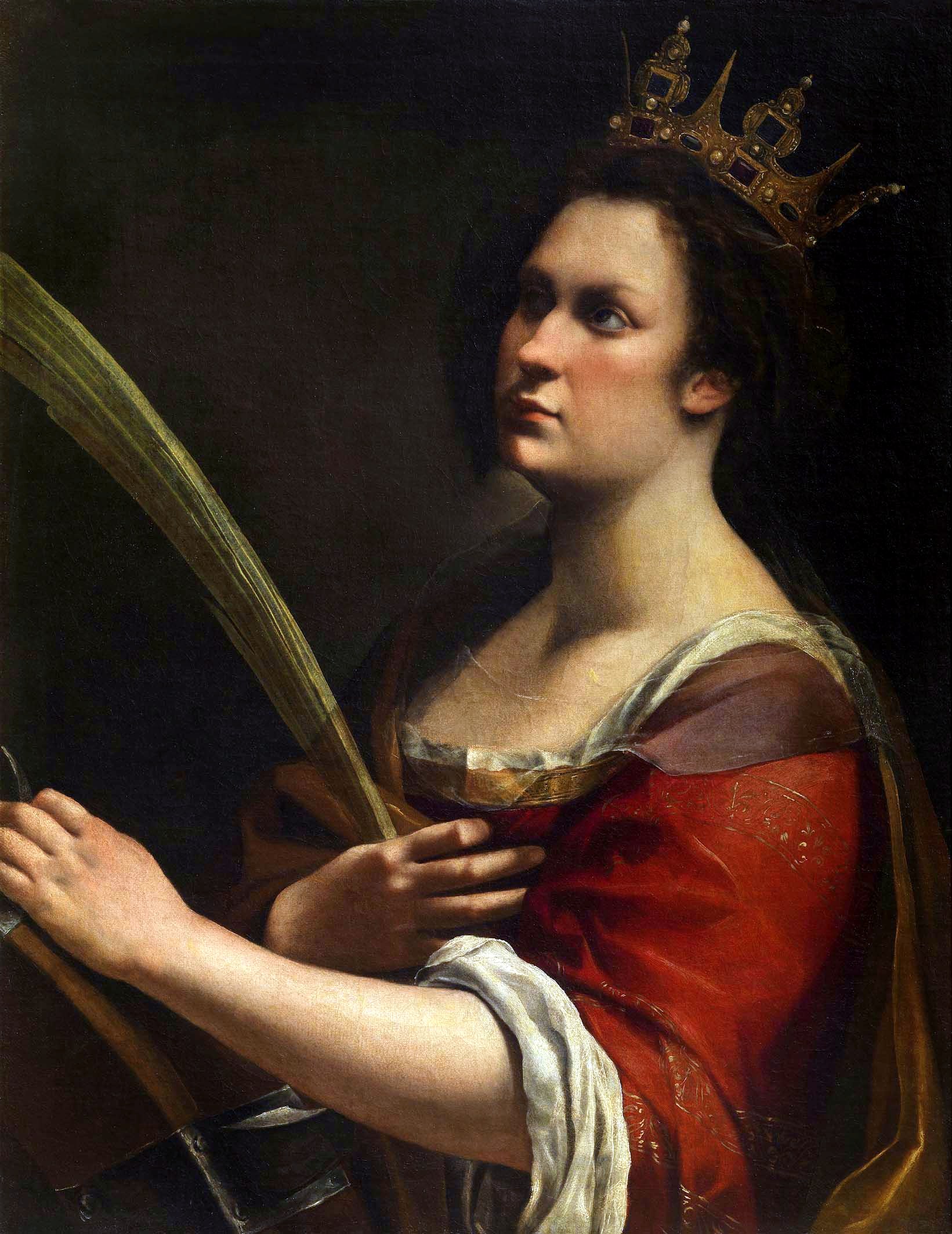
In 2019, conservators at the Opificio delle Pietre Dure in Florence, led by Cecilia Frosinini, carried out ultraviolet, infrared and X-ray examination of the Uffizi's own Saint Catherine of Alexandria, a picture of the same dimensions and the same years as the National Gallery canvas. Its finished, visible surface shows a different sitter in a different mood: a woman in an elaborate gem-encrusted crown gazing upward, generally identified with Caterina de' Medici, daughter of Grand Duke Ferdinando I, or otherwise connected to the Florentine court rather than presented as a self-portrait.
Underneath that finished surface, the X-radiograph shows an earlier stage that is, in the researchers' own account, traceable onto the London self-portrait to the millimetre: a turbaned figure gazing directly at the viewer, in a pose and format the two pictures share. A third, unexplained face was also found painted out on the Uffizi canvas, belonging to neither the finished composition nor the earlier one. The evidence indicates that Gentileschi used the same cartoon, or the same preparatory drawing, to lay in both pictures, then developed one into the London self-portrait and the other into a courtly portrait for a Medici patron, discarding the self-portrait likeness in the process.
The two pictures are not versions of one another and are not interchangeable: the Uffizi canvas is a separate object, in a separate collection, finished with a different sitter's face, and this record describes only the National Gallery painting. Readers should not treat a reproduction of the Uffizi picture as an illustration of the work catalogued here.
Chapter 10The self-portrait tradition Gentileschi worked in
This is not Gentileschi's only self-portrait, and placing it against the others clarifies what is distinctive about it.
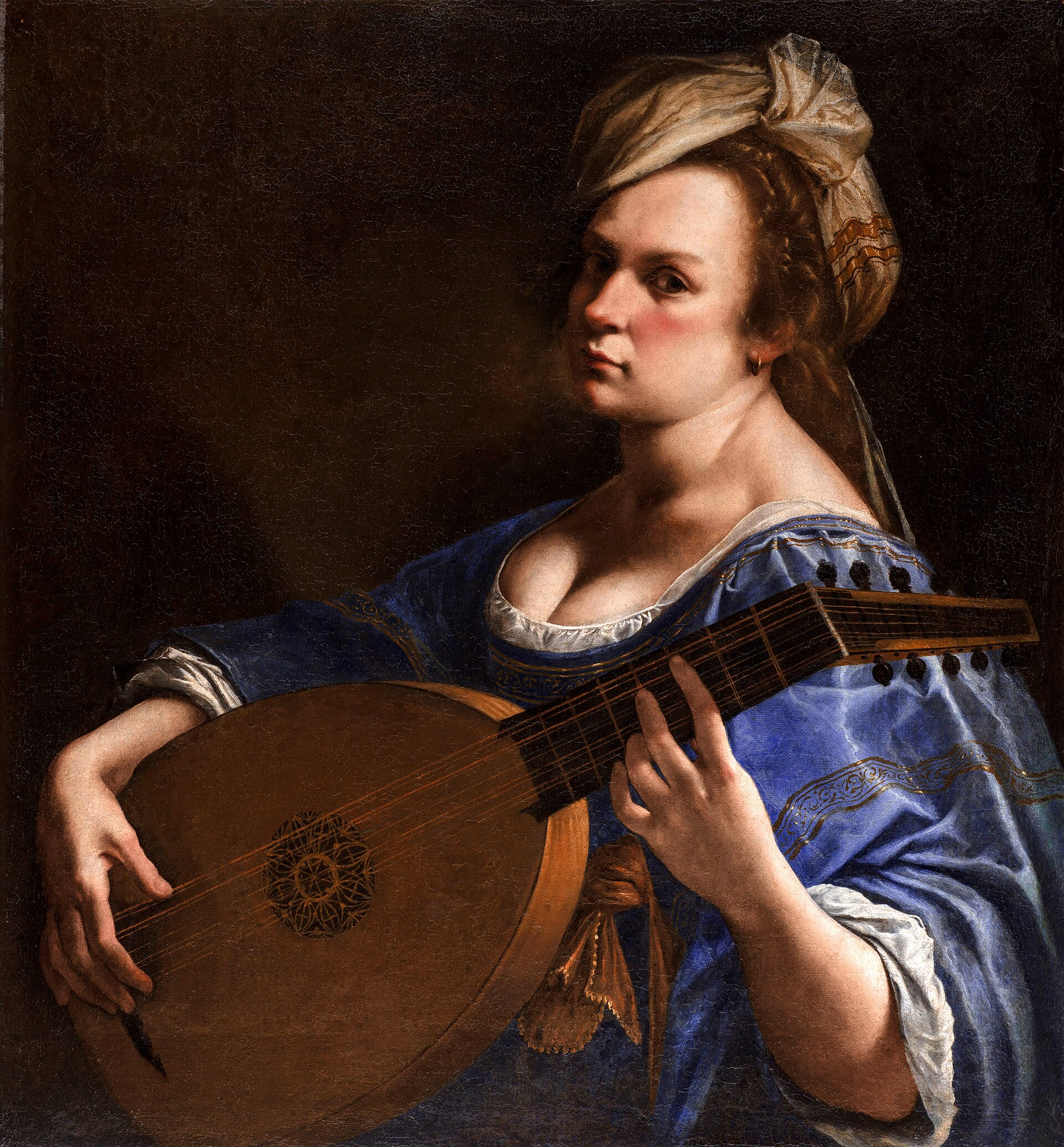
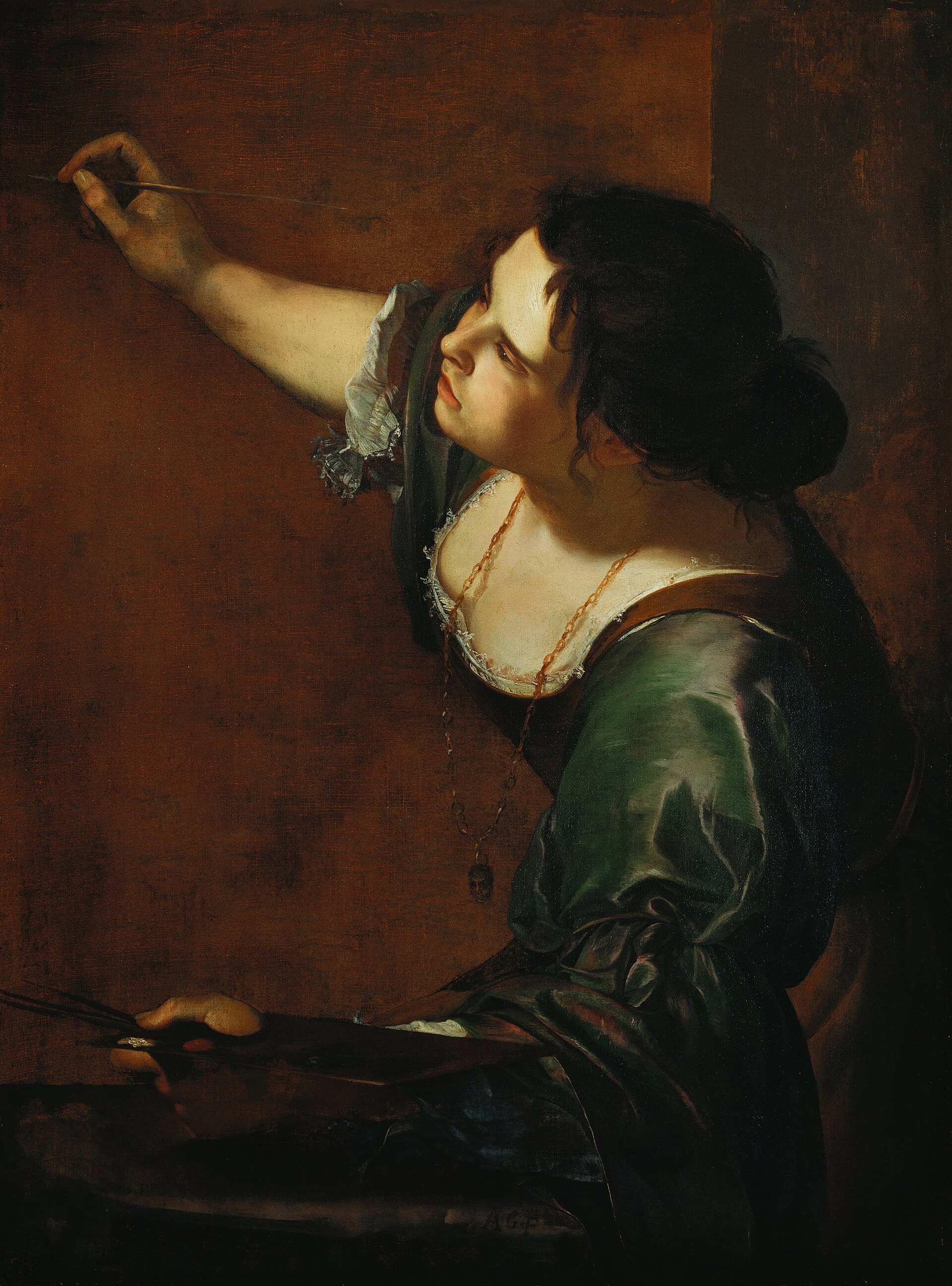
This is not Gentileschi's only self-portrait, and placing it against the others clarifies what is distinctive about it. A small self-portrait in oil on panel, sometimes called Self-Portrait as a Martyr, generally dated around 1615 and now in a private US collection, shows her again using her own features for a devotional female figure, on a much smaller scale than the London canvas. The Self-Portrait as a Lute Player, close in date to the present picture and now in the Wadsworth Atheneum in Hartford, shares enough of the London picture's head and shoulders that the National Gallery's technical study found the two align closely when traced over one another - evidence the artist reused elements of her own likeness across different pictures in this period, whether or not she used a single physical cartoon for all three. Latest and most different in intent is the Self-Portrait as the Allegory of Painting, or La Pittura, painted in London around 1638-39 for Charles I and now in the Royal Collection: here Gentileschi paints herself not as a saint or martyr but as the personification of Painting itself, mid-brushstroke, her own initials inscribed beneath the palette she holds - a self-fashioning as a working professional rather than as a suffering exemplar, made explicit by a female artist depicting the female personification of her own art, a coincidence of subject and sitter only a woman painter could achieve.
Read across this sequence, the Saint Catherine self-portrait sits at an early point in a working habit that continued for decades: Gentileschi returning to her own face and figure not out of narcissism but because a model was free, always available, and - in a profession where a woman's authorship was itself contested - because putting her own features into a martyr, a musician, or an allegory was itself a claim about who had made the picture.
Chapter 11Display since 2018
Following conservation, the picture was taken on 'Artemisia Visits', a tour in 2019 to unconventional public venues around the United Kingdom - among them a school in Newcastle, a GP surgery in...
Following conservation, the picture was taken on 'Artemisia Visits', a tour in 2019 to unconventional public venues around the United Kingdom - among them a school in Newcastle, a GP surgery in Pocklington, and a prison in Surrey - conceived explicitly to put the picture in front of audiences who would not otherwise visit the National Gallery. It was then the subject of the Gallery's own major monographic exhibition, Artemisia, in 2020-21 (catalogue number 11), and has since travelled to the Wadsworth Atheneum and the Detroit Institute of Arts (2021-22, catalogue number 25), to Naples (2022-23, catalogue number 1), and to Birmingham in 2024.
Chapter 12What is still unresolved
The picture's ownership before the early 1940s is not documented at all, and its ownership across the Nazi era specifically remains, on the Gallery's own published position, a matter of inference...
The picture's ownership before the early 1940s is not documented at all, and its ownership across the Nazi era specifically remains, on the Gallery's own published position, a matter of inference rather than record. The underbidder at the 2017 Drouot sale is not named in any source consulted here. The reading of the broken wheel as a response to the 1612 trial is a scholarly argument, well supported by circumstance and consistent with Gentileschi's later documented statements about her own professional standing, but it is not something she is recorded as having said herself, and this record has been careful to keep the two apart.
The artist
Artemisia Lomi Gentileschi
Artemisia Gentileschi was born in Rome on 8 July 1593, the eldest child and only daughter of the painter Orazio Gentileschi, a leading follower of Caravaggio, and trained in his workshop from childhood. She is now the most extensively studied woman painter of the seventeenth century, but for roughly three centuries after her death she was known mainly, when known at all, as a footnote to her father's career or reduced in the popular imagination to the facts of the 1612 trial. Her modern reputation is a twentieth- and twenty-first-century reconstruction, built by scholars including Mary Garrard and R. Ward Bissell, working from a documented but long-neglected career that spanned Rome, Florence, Venice, Naples and London.
Related works
| Work | Relation | Where it is |
|---|---|---|
| Self-Portrait as a Lute Player Artemisia Gentileschi | Closely contemporary self-portrait, c. 1615-18; National Gallery technical study found the head and shoulders align closely with this picture when traced A separate painting, not a version of the Saint Catherine self-portrait. | Wadsworth Atheneum Museum of Art, Hartford, Connecticut |
| Saint Catherine of Alexandria Artemisia Gentileschi | Shares an underlying cartoon or preparatory drawing with this painting, established by 2019 X-ray and infrared study; the visible, finished picture shows a different sitter THIS IS A DIFFERENT PAINTING from the National Gallery self-portrait described in this record, despite the near-identical subject and title sometimes given to it. Its finished surface is generally identified with Caterina de' Medici or another Florentine court sitter, not as a self-portrait; only an earlier, painted-over stage beneath the visible surface resembles the London picture, and that stage is not visible to the naked eye. Do not use an image of the Uffizi picture to illustrate the National Gallery work. | Galleria degli Uffizi, Florence |
| Self-Portrait as the Allegory of Painting (La Pittura) Artemisia Gentileschi | Later self-portrait by the same artist, c. 1638-39, showing her personifying the art of Painting itself A separate, later painting from her London period; included here to show the range of her self-portrait practice, not as a version of this picture. | Royal Collection Trust (Royal Collection of the United Kingdom) |
| Self-Portrait as a Martyr Artemisia Gentileschi | Earlier, smaller self-portrait using martyr imagery, c. 1615 Oil on panel, a different and much smaller support than the National Gallery canvas; a separate painting. | Private collection, United States |
Open questions
- How and when did the picture leave Italy and enter French private ownership? No source consulted documents its whereabouts between its execution in Florence, c. 1615-17, and its presence in the Boudeville family by the early 1940s.
- Can the Boudeville family's ownership be documented back across the 1933-45 period with primary evidence, rather than inference? The National Gallery states it is satisfied on this point but has not published the underlying evidence in the sources consulted for this record.
- Who was the underbidder at the Drouot sale of 19 December 2017, and how close did the bidding run past the low estimate? Not named in the sources consulted.
- Was the underlying shape beneath the wheel, tentatively read by the National Gallery's own technical report as possibly a book or tablet, ever more precisely identified? The 2019 published technical study describes it as unresolved.
- Does documentary evidence exist (a commission, a payment, a contemporary description) for who first owned the picture, or was it commissioned at all, as opposed to painted speculatively? None has been found.
Questions about this object
What is Self Portrait as Saint Catherine of Alexandria?
Self Portrait as Saint Catherine of Alexandria is a painting, dated c. 1615-17. Medium: Oil on canvas.
Who made Self Portrait as Saint Catherine of Alexandria, and is the attribution settled?
The attribution to Artemisia Gentileschi is recorded here as accepted. Universally accepted as an autograph self-portrait by Artemisia Gentileschi; there is no record of the attribution ever being contested or reassigned to her father Orazio Gentileschi or to another hand. The National Gallery's own technical dossier corroborates authorship not by document but by physiognomic comparison: the sitter's features match those in the near-contemporary Self Portrait as a Lute Player (Wadsworth Atheneum, Hartford), a bronze portrait medal of the artist from the mid-1620s (Scher Collection, New York), a painted portrait of Artemisia by Simon Vouet (Palazzo Blu, Pisa), and Jerome David's engraving of about 1627-28 after a now-lost painted self-portrait. A 1623 documentary description of Artemisia as 'more beautiful than ever' is also cited in support. As with most of her Florentine-period pictures, there is no signature and no contract; the identification of the sitter as Artemisia herself, rather than a generic model, rests on this cumulative visual comparison rather than a single document.
Where is Self Portrait as Saint Catherine of Alexandria now?
National Gallery, London. Inventory number NG6671. Last confirmed 28 August 2026. Acquired 2018 by private treaty from the London dealers Robilant + Voena.
What has Self Portrait as Saint Catherine of Alexandria sold for?
Hammer EUR 1,850,000 (unchanged), now labelled DERIVED from the house total under the house's printed schedule: 'frais legaux : 23% H.T. (27,6% T.T.C.)'. 2,360,600 / 1.276 = 1,850,000, a round bidding figure. The Art Newspaper report the record already cites gives the same hammer; the house itself prints only the total.; with premium, EUR 2,360,600 premium-inclusive, printed on the house's lot page as 'Resultat : 2 360 600 EUR' and on the house's results notice headed 'Vente le 19 decembre 2017 - 2 360 600 EUR'. NOTE the lot page's template heading over that figure reads 'Resultats sans frais'; the arithmetic against the page's own 27.6 per cent shows the figure is WITH fees. Carried as premium-inclusive. Christophe Joron-Derem, Hotel Drouot, Paris, 2017-12-19.
What is still unknown about Self Portrait as Saint Catherine of Alexandria?
How and when did the picture leave Italy and enter French private ownership? No source consulted documents its whereabouts between its execution in Florence, c. 1615-17, and its presence in the Boudeville family by the early 1940s.
Sources
- 1National Gallery, London, catalogue entry NG6671, 'Self Portrait as Saint Catherine of Alexandria', National Gallery Catalogues: Online Entries for Individual Paintings (2024), incorporating L. Keith et al., technical investigation of Artemisia's Florence self-portraits (2019). nationalgallery.org.uk/paintings/...
- 2The Art Newspaper, 'Newly discovered Artemisia Gentileschi painting sells for EUR 2.4m at auction in Paris' (19 December 2017). theartnewspaper.com/2017/...
- 3Antiques Trade Gazette, 'National Gallery acquires record-setting self-portrait of Artemisia Gentileschi for GBP 3.6m from London gallery' (2018). antiquestradegazette.com/news/...
- 4Getty Conservation Institute / Getty Publications, 'Self-Portrait as Saint Catherine of Alexandria', Conserving Canvas case study 22. getty.edu/publications/...
- 5The Art Newspaper, 'X-ray of Uffizi's Artemisia Gentileschi reveals a tantalising underpainting' (11 April 2019), reporting the Opificio delle Pietre Dure study led by Cecilia Frosinini. theartnewspaper.com/2019/...
- 6Wikipedia, 'Self-Portrait as Saint Catherine of Alexandria', consolidating the Boudeville provenance chain and the Drouot sale record. en.wikipedia.org/wiki/...
- 7Artnet News, 'The National Gallery's New Artemisia Gentileschi Should Be a Triumph-But Clouds Are Forming Over Its Ownership During WWII'. news.artnet.com/exhibitions/...
- 8National Gallery, London, press release, 'The National Gallery acquires Artemisia Gentileschi Self Portrait' (2018). nationalgallery.org.uk/about-us/...
- 9National Gallery, London, artist page, 'Artemisia Gentileschi'. nationalgallery.org.uk/artists/...
- 10Royal Collection Trust, 'Self-Portrait as the Allegory of Painting (La Pittura)'. rct.uk/collection/...
- 11National Gallery, London, 'Artemisia in her own words', exhibition supplement quoting the Ruffo correspondence of 1649. nationalgallery.org.uk/exhibitions/...
- 12Wikipedia, 'Saint Catherine of Alexandria (Artemisia Gentileschi, Florence)', for the Uffizi picture's dimensions and 1683/1890 provenance notices. en.wikipedia.org/wiki/...
- 13Smithsonian Magazine, 'X-Ray Analysis Reveals Self-Portrait Hidden Under Artemisia Gentileschi Painting', corroborating the Uffizi underpainting findings. smithsonianmag.com/smart-news/...
- 14The Conversation, 'National Gallery at 200: in praise of Artemisia Gentileschi's Self Portrait as Saint Catherine of Alexandria', for the scholarly reading of the self-portrait against La Pittura and Gentileschi's self-fashioning. theconversation.com/national-gallery-at-200-in-praise-of-...
- 15Hyperallergic, 'The National Gallery Acquires Its First Painting by a Woman Since 1991'. hyperallergic.com/451309/...
- 16Christophe Joron-Derem, 'Artemisia Gentileschi (Rome 1593-Naples 1652), Sainte Catherine d'Alexandrie - Lot 69, 19 December 2017'. Lot 69, estimate EUR 300,000-400,000, result EUR 2,360,600, dimensions and condition line, the catalogue note and the 23 per cent HT / 27.6 per cent TTC fee schedule. Accessed 2026-09-16. joron-derem.com/lot/...
- 17Christophe Joron-Derem, 'Artemisia Gentileschi, Sainte Catherine d'Alexandrie - Vente le 19 decembre 2017 - 2 360 600 EUR'. The house's own results notice repeating the EUR 2,360,600 figure. Accessed 2026-09-16. joron-derem.com/actualite/...
Last verified · Published
Change log
28 August 2026 - Record created at the house standard: researched narrative, technical evidence, maker dossier, graded provenance chain, prices with hammer and premium separated, related works, open questions and sources.
24 September 2026 - Prices realised revised by the auction watch of 2026-09-16: the 2017-12-19 Christophe Joron-Derem, Hotel Drouot row corrected (no house source on the row).
26 September 2026 - Corrected the dimensions. The record gave 71.5 x 71 cm and described that as the measurement after the National Gallery's 2018 treatment, but the Gallery publishes 71.4 x 69 cm; the 71 cm width is the 2017 Drouot catalogue's pre-conservation figure. The record now carries the Gallery's current dimension and names the saleroom's as the earlier state. Found by iconotheca-women-desk while researching the-painting-she-did-not-sign.