Who She Was, and Who Owned the Picture of Her
Four famous photographs of women in this archive. Only one of the four is named on the picture, by herself, and she is the only one who owned the right to reproduce it.
Records in this piece: Destitute pea pickers in California. Mother of seven children. Age thirty-two. Nipomo, California, Carte-de-visite of Sojourner Truth, Addie Card, 12 years. Spinner in North Pownal Cotton Mill, The Critic
On this page 9 sections
ContentsClose
In short
- Of the four most reproduced photographs of women in this archive, the maker named the woman in one of them. In that one case the woman named herself, in a caption she registered as her own property.
- The name of the woman in a documentary photograph is usually established by an outsider with no stake in the picture, long after the fact: a reporter on the Modesto Bee in 1978, and a novelist reading a 1910 census sheet in 2005.
- The wrong name can outlive the right one and acquire federal authority on the way. Addie Card was printed as Addie Laird from an investigator's note of February 1910 until 2005, and the United States Postal Service put the error on a stamp in 1998.
- Naming follows property. Sojourner Truth entered a copyright in her own name on 16 February 1864 and controlled her image; Lange's negative was public property from the instant of exposure because she was a salaried federal employee, so Florence Owens Thompson could never control or profit from the most reproduced photograph of the Depression.
- One of the four women has no name in any source this archive could reach, and our record for the picture declines to supply one rather than repeat an unconfirmed guess.
The woman in the photograph is named last, or never
Four photographs in this archive are famous for the face of a woman, and only one of the four carries her name. That one is the carte de visite of Sojourner Truth, and the name is there because Truth put it there and registered it. The photographer of the print we hold is recorded by the Smithsonian as unidentified, which is the point: the name on it is the sitter's doing, not the maker's. In the other three the woman reached the world unnamed, and the name was supplied later by somebody who had no part in making the picture, or has never been supplied at all.
This is not a coincidence of four cases. It is what the paperwork of documentary photography does. A caption is written by the photographer or the agency that commissioned the picture, for the purpose the picture was commissioned to serve, and a name is rarely part of that purpose. An anaemic little spinner makes the argument for a child labour law. A mother of seven at the age of thirty-two makes the argument for a federal relief camp. The individual woman is evidence, and evidence is described rather than introduced.
So the interesting question for an archive is not who these women were, which is usually recoverable, but who did the recovering, how long it took and what it changed. On this evidence the answer is consistent and unflattering. The name arrives decades late, from outside every institution that holds the picture, and it never carries any right over the picture with it.
Lange recorded the age and not the name
Dorothea Lange wrote down the age of the woman in Migrant Mother and did not write down her name.
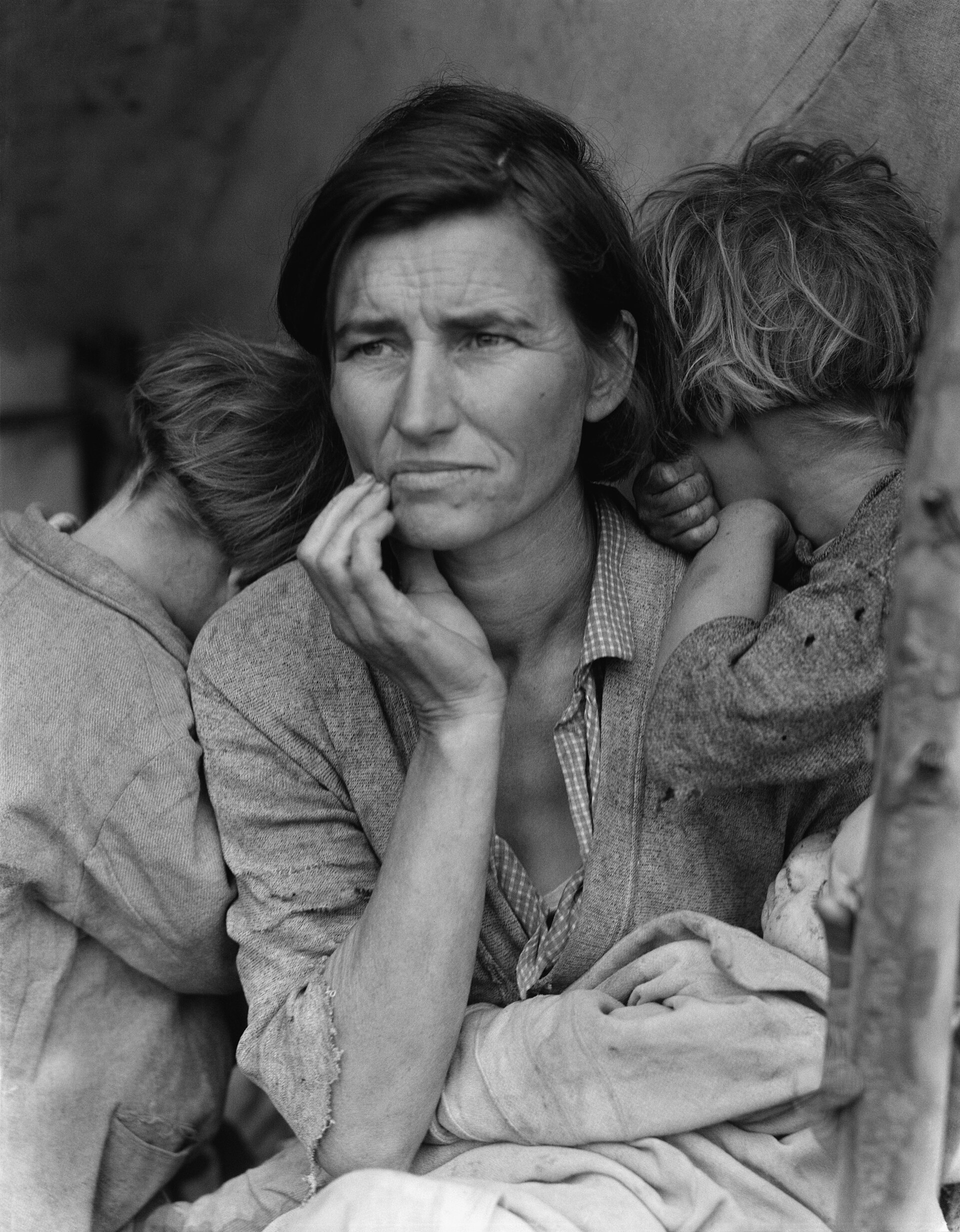
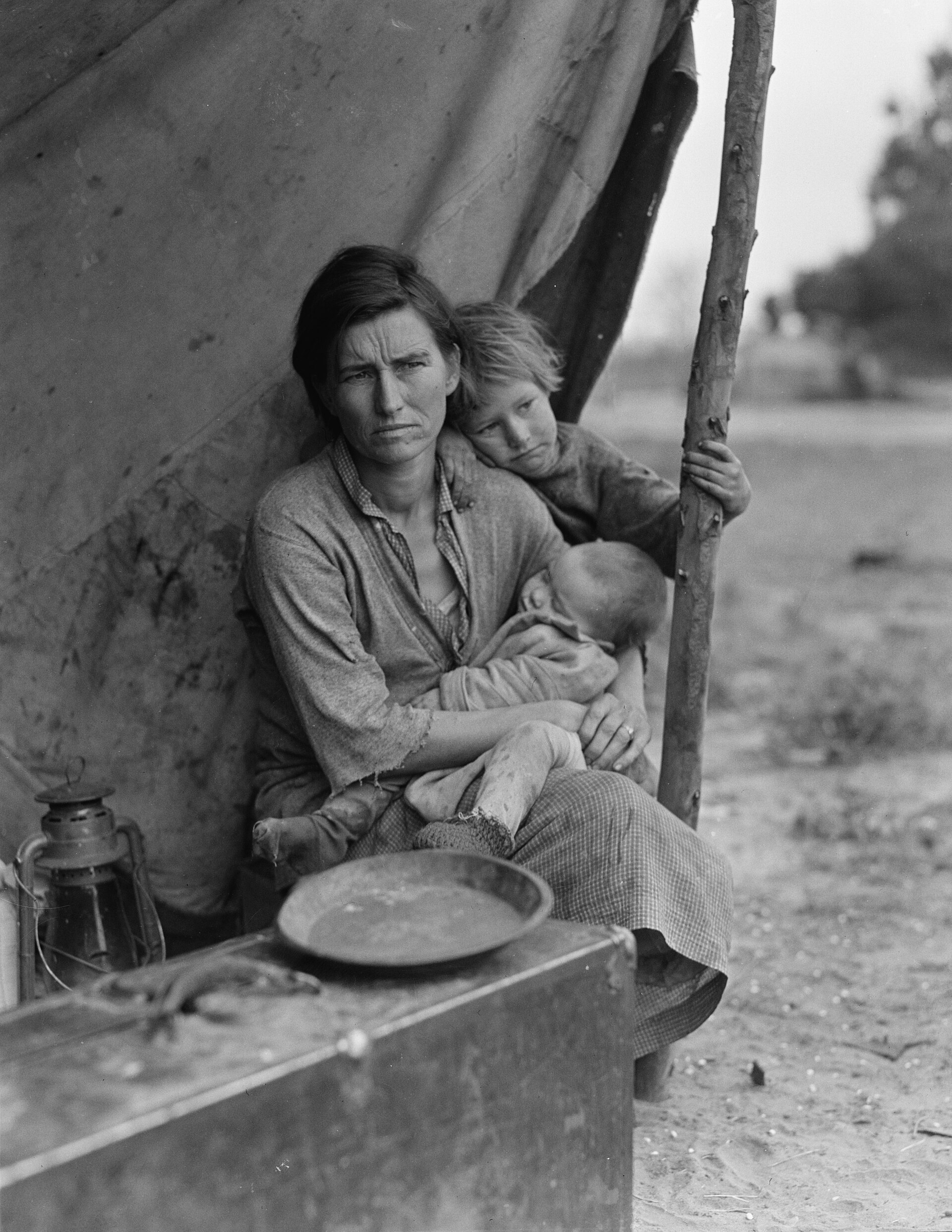
Lange's own account of the encounter, published in Popular Photography in February 1960 and quoted at length by the Library of Congress in its research guide to the series, is explicit about it. She wrote that she made five exposures, working closer and closer from the same direction, and then: I did not ask her name or her history. She told me her age, that she was thirty-two. The caption that has carried the picture for ninety years, and which is still the title of our record, is built from what she was told: destitute pea pickers in California, mother of seven children, age thirty-two, Nipomo, California.
The documentary record around the sitting is thinner than the picture's fame suggests. The Library of Congress states that extended captions and supplementary textual files for this series in the Farm Security Administration written records have not been found, and that the order in which the exposures were made cannot be determined from the negative numbers, because those numbers were assigned later at the Resettlement Administration. There is no paper naming her because no step in the process required one.
Forty-two years, and then a reporter came looking
Florence Owens Thompson was identified in 1978, forty-two years after the exposure, by Emmett Corrigan of the Modesto Bee, who tracked her to a trailer park outside Modesto, California, where she was seventy-five years old.
What the public then learned was a life the caption had no room for. She was born Florence Leona Christie in 1903 in Indian Territory, Oklahoma, and she was Cherokee. She married at seventeen. She was widowed at twenty-eight, pregnant with her sixth child, when her husband died of tuberculosis. Asked about the years the photograph stands for, she said: We just existed. Anyway, we lived. We survived, let's put it that way. Her children eventually bought her a house and she preferred to live in a trailer, because, she said, I need to have wheels under me.
What was promised that afternoon rests on Thompson alone. Her grievance, given in 1978, was three-part: her name was not asked, she was told the pictures would not be sold, and a promised print never came. Our record is careful about the status of that: it is her later recollection, unconfirmed and uncontradicted by any surviving record from Lange's side, because no such record exists. The Antiques Roadshow account adds a fourth version, that Lange had promised her name would never be published and that Thompson wanted this to spare her children embarrassment. None of these is incompatible with the others and none of them is documented. What is documented is Lange's own sentence that she did not ask. When she had a stroke in 1983 her children, unable to pay the hospital, used her identity as the Migrant Mother to raise about fifteen thousand dollars in donations. The Antiques Roadshow account says the money helped to defray her medical bills and that Thompson herself gained nothing, which is the flattest sentence anyone has written about the economics of this photograph.
A wrong name lasted ninety-five years and reached a postage stamp
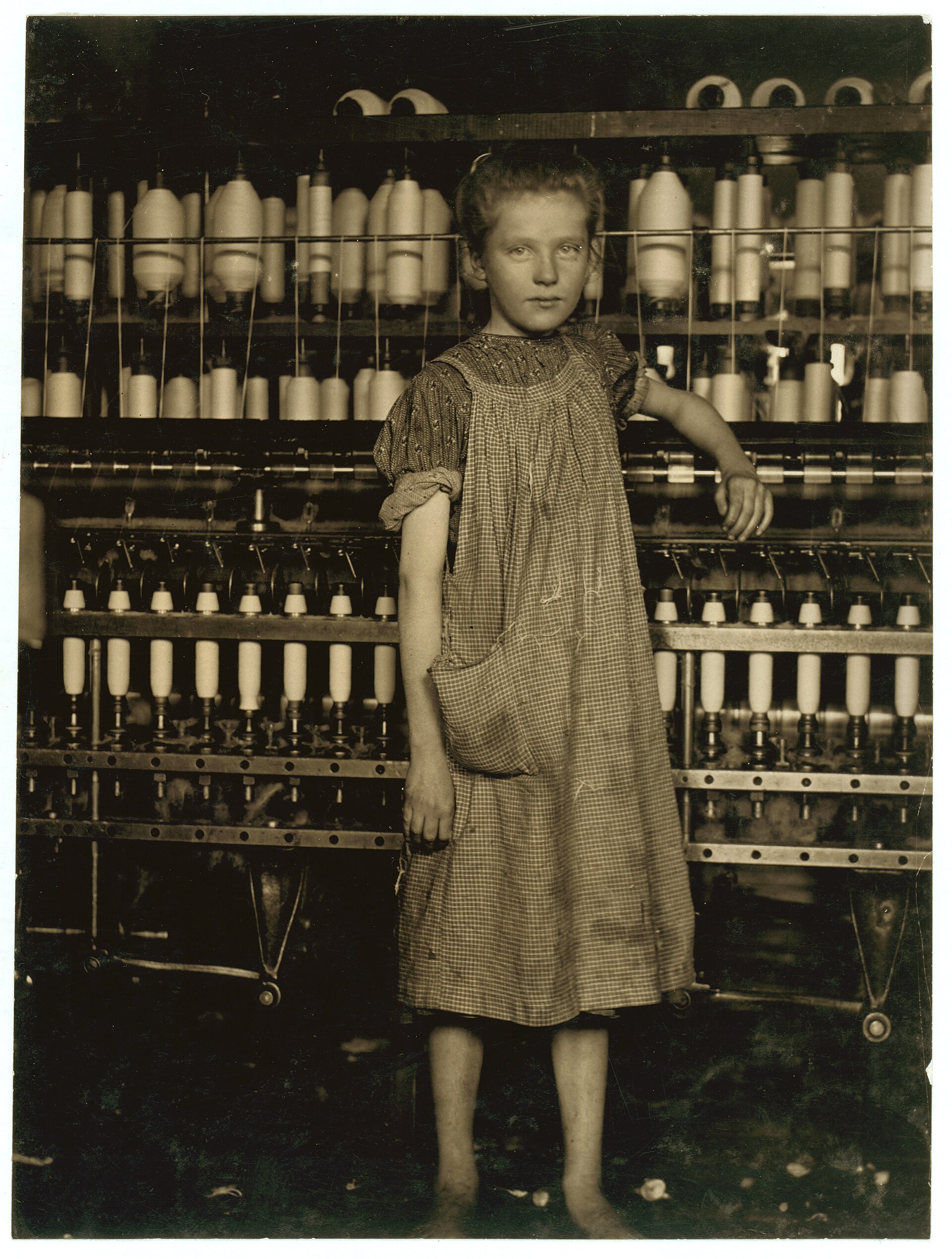
The child in Lewis Hine's most reproduced mill photograph was printed as Addie Laird for ninety-five years, and her name was Addie Card.
How the error entered is itself disputed, and the piece cannot settle it. Elizabeth Winthrop writes that a child labour investigator named E. F. Brown listed her as Addie Laird. Joe Manning says Hine wrote it. Winthrop's later account in Smithsonian says only that somebody named her Addie Laird. Our own record reads the surviving caption, which carries Brown's name and the spelling Card, and concludes that the Laird form came in later, transcribed from period handwriting in the National Child Labor Committee's or the Library of Congress's own processing. Four accounts, and no field report that settles it. Hine's own note in his pocket notebook described her without naming her at all, as an anaemic little spinner in the North Pownal cotton mill. Even the month is unsettled: Winthrop puts the investigator's visit in February 1910, the Library of Congress dates the photograph August 1910, and no primary field report resolving it has been located. Laird is a Scottish name, most workers in New England mills of that period had been recruited from Canada, and Winthrop records that people in North Pownal were always puzzled by it.
In 1998, at the urging of North Pownal officials, the United States Postal Service issued the image as a stamp in its Celebrate the Century series, to commemorate child labour reform. Winthrop records that researchers at the Department of Labor admitted at that point that they could find no trace of an Addie Laird anywhere. The government printed a name its own researchers could not trace. The correction came in 2005 from a novelist who had written a book about the photograph and then went looking for the child: Winthrop found her on a 1910 census sheet, Bennington County, Vermont, roll 1612, page 111, sheet 12B, recorded on 4 May 1910 by an enumerator named George E. Corey, as Addie Card, twelve years old, living with her grandmother alongside her sister Anna, both of them spinners in the cotton factory. She married Edward Hatch, another spinner, on 23 February 1915. Both were seventeen.
One woman in this archive owned the picture of herself
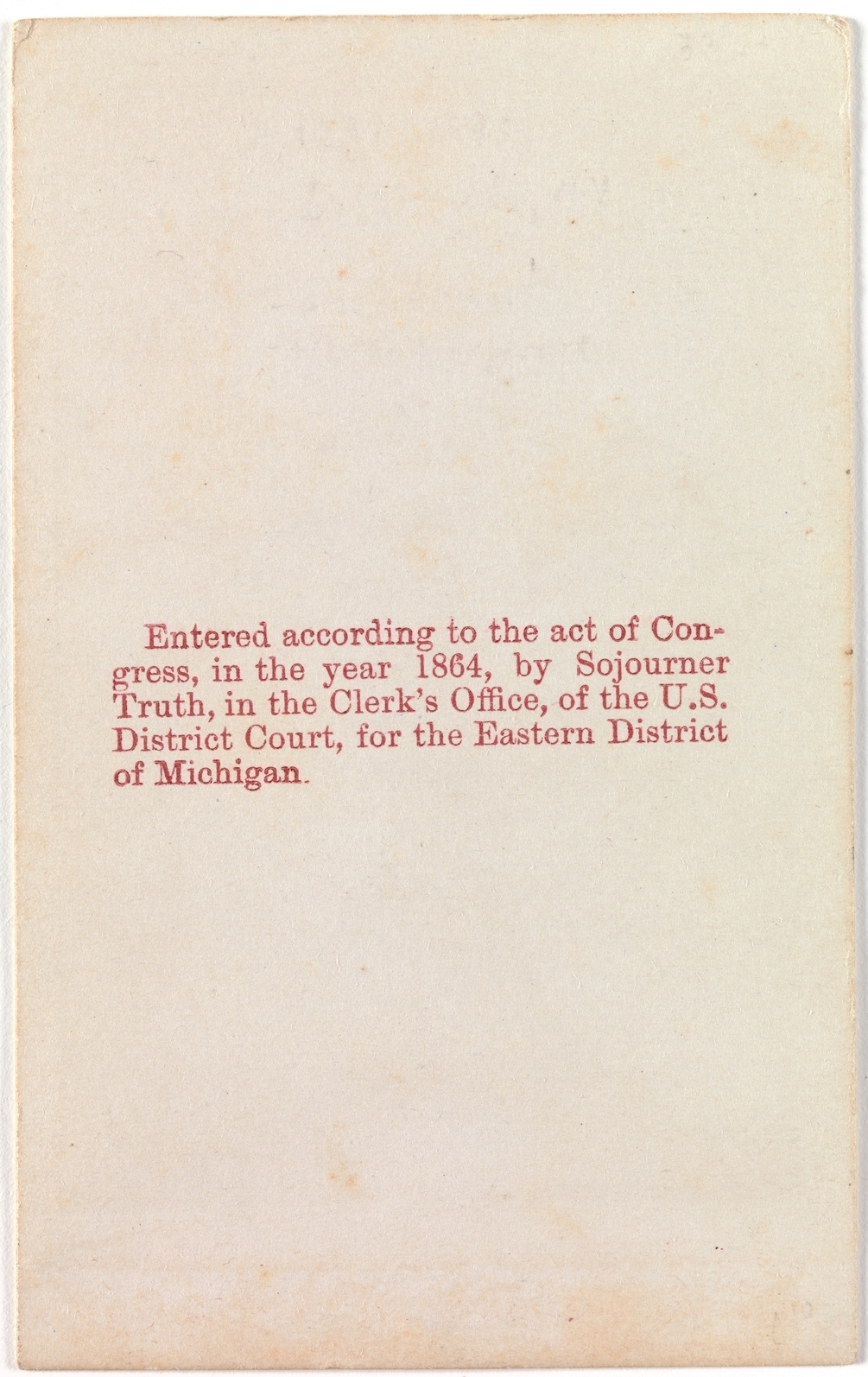
Sojourner Truth registered a copyright in her own photographic image, and the claim entered the public record on 16 February 1864 in the United States District Court for the Eastern District of Michigan.
The mechanism she used is the precise and beautiful part. Photographs were not yet the category the statute protected, so the registration was made as an engraving, under the Act of 1802 that gave whoever designed, engraved, etched or worked a print the sole right of printing, reprinting, publishing and vending it for fourteen years from the recording of the title. The Copyright Office's own account quotes the court record: the title of an Engraving, the title whereof is in the words, towit, and then a picture of Sojourner Truth and the line I sell the Shadow to Support the Substance, Sojourner Truth. The caption is the title, the title is the property, and her name is inside it.
She was selling. She sat for portraits at least eleven times and charged twenty-five to fifty cents a card, at lectures and by post, to fund her work and, by 1863, the first Michigan Colored Infantry. The Copyright Office records her reflection that she used to be sold for other people's benefit, but now she sold herself for her own. A formerly enslaved woman who could not read had found the one filing that put a photograph of her body under her own control, at a date when no studio in the country would have volunteered it. Our own record is careful that the 1863 print it holds, NMAAHC 2012.46.11, carries neither the caption nor the copyright notice: the celebrated captioned cards are a related but separate group of objects, and the scholarship consulted for that record knows of no other sitter of the period, as against a studio, holding copyright in their own photographic image.
The third woman at the opera has no name in any source we reached
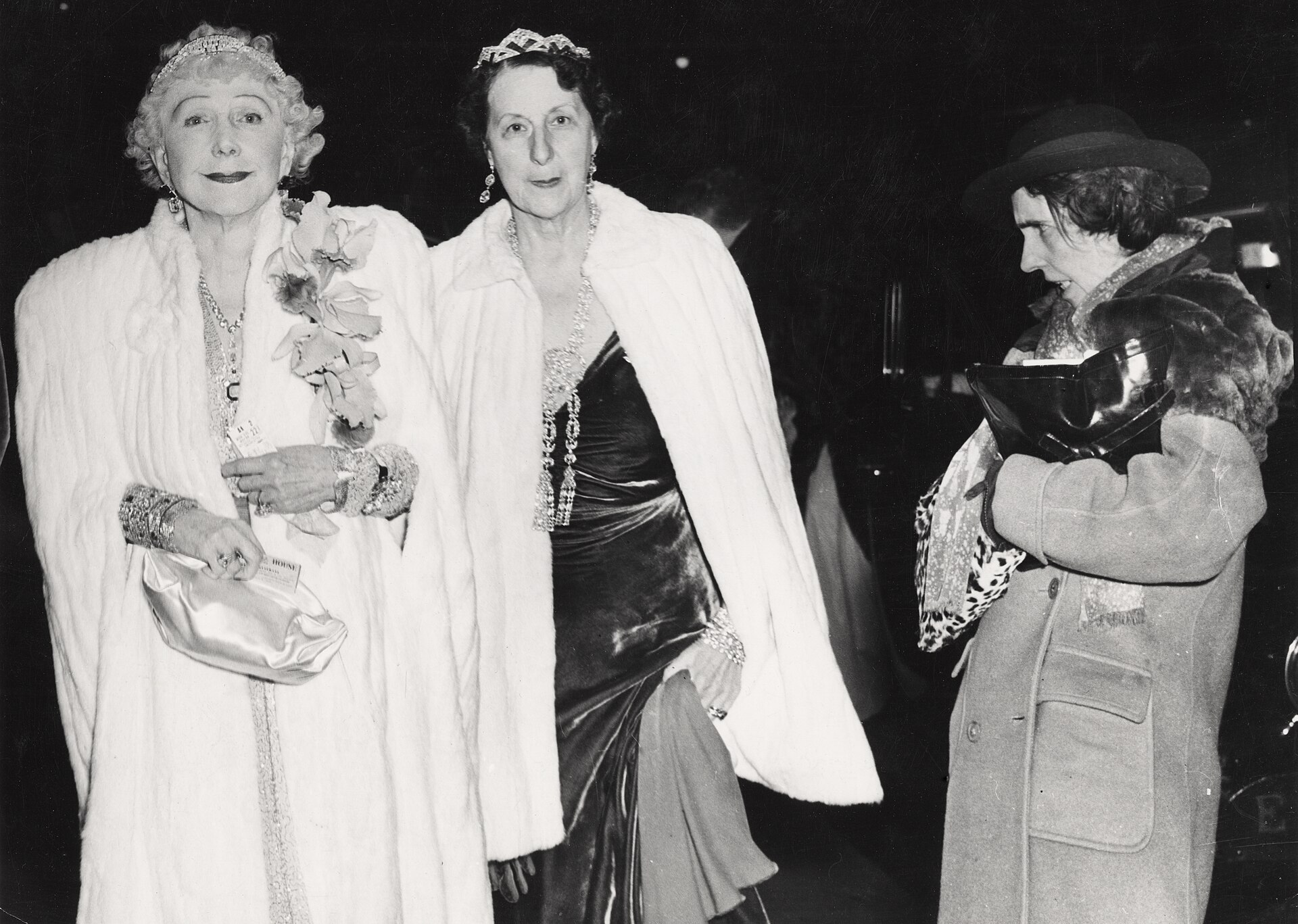
Weegee's The Critic, made at the Metropolitan Opera on the night of 22 November 1943, holds three women, and two of them are documented.
The two in furs and diamonds are Mrs George Washington Kavanaugh, born Marie Magdalena Muller, and Elizabeth Wharton Drexel, Lady Decies. They were named because they were rich, catalogued, painted and reported on, and their names come to us through the ordinary apparatus of recorded wealth. The woman on the right, whose expression is the reason anyone remembers the picture, is not identified in any source our record for it could reach, and the record declines to guess at a name rather than repeat an unconfirmed one.
She was also not a bystander. The encounter was arranged: Weegee had his assistant bring an intoxicated regular from a Bowery bar, ply her with wine and release her into the path of the arriving socialites on a signal. That staging is documented independently by the biographer Christopher Bonanos and by the curator Miles Barth, working from the testimony of Weegee's own assistant. So the photograph rests on a woman who was recruited, used, published and never named, while our record leaves both the whereabouts of the original negative and the picture's copyright status open. The picture is about a gap between wealth and poverty, and it reproduces that gap exactly in what it records about the three people in it.
Four pictures, four women and the right to reproduce each one
Set the four side by side and the pattern is a property pattern rather than a moral one.
| Photograph | The woman | How the caption named her | Name established | Established by | Reproduction right |
|---|---|---|---|---|---|
| Carte de visite, 1863 print; captioned cards from 1864 | Sojourner Truth | By her own name, inside the registered title | 1864, at once | Herself | Hers, copyright entered 16 February 1864 |
| Hine, Photo No. 1056, 1910 | Addie Card | Addie Laird, from a caption in the committee's papers | 2005, ninety-five years later | Elizabeth Winthrop, from a 1910 census sheet | Public, National Child Labor Committee collection at the Library of Congress |
| Lange, fsa.8b29516, 6 March 1936 | Florence Owens Thompson | Not named; age given as thirty-two | 1978, forty-two years later | A Modesto Bee reporter | Public from the moment of exposure, made by a salaried federal employee |
| Weegee, The Critic, 22 November 1943 | Unidentified | Not named | Not established | Nobody | Unresolved across the holding institutions |
The column that decides the others is the last one. Where the woman held the right, she was named immediately and by herself. Where the right was public, the picture could travel for decades with no name attached and nothing in the system was broken by that, because a public-domain photograph needs no rights-holder to be identified in order to be reproduced. Where the right is unresolved, the woman is still unnamed. In none of the three cases where she did not own the picture did any holding institution establish her name; in each of those cases it was done, or left undone, by somebody outside.
What to ask of a photograph of a woman
The useful questions about a documentary photograph of a woman are who wrote the caption, what the caption was for, and who owned the negative.
Those three answers predict almost everything else, including whether her name survives. They also mark where an archive can do real work. Naming a sitter is not a courtesy and it is not sentiment: it converts evidence back into a person, and it is checkable, from census sheets, marriage records, court filings and enumerators' handwriting. Winthrop found Addie Card because she read a census roll. A reporter found Florence Owens Thompson because he acted on a tip and recognised a face. Neither needed access no one else had.
Where it cannot be done, the honest entry is the empty one. Our record for The Critic says the third woman is not identified in any source it could reach and offers no candidate, which is worth more than a plausible name that later has to be withdrawn. The same discipline applies to what Lange and Thompson each said was promised in March 1936. Two accounts survive, they do not match, and the record says so.
Why this archive is free to read
We do this for everyone who loves art. The people who have studied it for years, and the people who just stopped to look. Iconotheca exists so that what we learn belongs to all of them.
Nobody pays us for this. No ads, no sponsors, no commercial interest. These works belong to all of us, and we would rather share them with as many people as we can than keep them to ourselves.
If it gave you something today, tell us to keep going. Follow us, leave a like, or write a positive comment. We read every one, and they are what keeps us going.
Questions
Florence Owens Thompson, born Florence Leona Christie in Indian Territory, Oklahoma, in 1903, and Cherokee. She was identified in 1978, forty-two years after Dorothea Lange photographed her at a pea pickers' camp near Nipomo, California, by a reporter from the Modesto Bee who tracked her to a trailer park outside Modesto.
No. In her own account of the encounter, published in Popular Photography in February 1960 and quoted by the Library of Congress, Lange wrote that she did not ask her name or her history, and that the woman told her only her age, thirty-two.
Nobody can say for certain. Elizabeth Winthrop writes that a child labour investigator named E. F. Brown listed her that way; Joe Manning says Hine wrote it; our own record reads the surviving caption, which carries Brown's name and the spelling Card, and concludes the Laird form was introduced later in archival transcription. The name stood until 2005, when Winthrop found her as Addie Card on a 1910 census sheet for Bennington County, Vermont. The United States Postal Service had already issued the image as a stamp in 1998 under the wrong name.
One did. Sojourner Truth registered a copyright claim in her own photographic image, entered on 16 February 1864 in the United States District Court for the Eastern District of Michigan, filed as an engraving because the statute of 1802 protected prints rather than photographs. She sold the cards at twenty-five to fifty cents to fund her work.
No source this archive could reach identifies her. She was recruited from a Bowery bar by Weegee's assistant for a staged encounter, documented independently by the biographer Christopher Bonanos and the curator Miles Barth, and our record for the photograph declines to supply a name rather than repeat an unconfirmed one.
Sources
- 1Library of Congress, Prints and Photographs Division, research guide, Dorothea Lange's "Migrant Mother" Photographs in the Farm Security Administration Collection, Introduction, quoting Lange's account in Popular Photography, February 1960, and stating that extended captions and supplementary textual files for the series have not been found. guides.loc.gov/migrant-mother
- 2Library of Congress, Prints and Photographs Online Catalog, item record for Destitute pea pickers in California. Mother of seven children. Age thirty-two. Nipomo, California, digital file fsa.8b29516. loc.gov/item/...
- 3Antiques Roadshow, WGBH, The Story of the "Migrant Mother", for the 1978 identification by a Modesto Bee reporter, Thompson's birth as Florence Leona Christie in Indian Territory in 1903, her own words, and the 1983 appeal that raised about fifteen thousand dollars towards her hospital bills. pbs.org/wgbh/...
- 4Marilyn Creswell, Librarian-in-Residence, United States Copyright Office, "Sojourner Truth and the Power of Copyright Registration", Copyright: Creativity at Work, 8 December 2020, quoting the court record of the deposit and giving the date the copyright entered the public record as 16 February 1864. web.archive.org/web/...
- 5National Museum of African American History and Culture, Smithsonian Institution, object record for the Carte-de-visite of Sojourner Truth, 2012.46.11, the 1863 print held without caption or copyright notice. nmaahc.si.edu/object/...
- 6Elizabeth Winthrop, "Searching for Addie: The Story behind a Famous Photograph", Social Education 70, no. 4 (2006), 174-177, for E. F. Brown's February 1910 note naming her Addie Laird, the 1998 Celebrate the Century stamp issued at the urging of North Pownal officials, the Department of Labor's inability to trace the name, and the 1910 census sheet, roll 1612, page 111, sheet 12B, recorded 4 May 1910 by George E. Corey. elizabethwinthrop.com/wp-content/...
- 7Joe Manning, "Addie Card: The Search for an Anemic Little Spinner", Historical Journal of Massachusetts 36, no. 2 (2008), for the documented later life traced after the identification. westfield.ma.edu/historical-journal/...
- 8Library of Congress, Prints and Photographs Division, National Child Labor Committee Collection, item record for Hine's Photo No. 1056, Addie Card, spinner in North Pownal Cotton Mill. loc.gov/item/...
- 9International Center of Photography, collection object record for Weegee, The Critic, accession 7229.1993, one of the institutional holdings of the print. icp.org/browse/...
- 10Elizabeth Winthrop, "Through the Mill", Smithsonian Magazine, September 2006, on the search for the child in Hine's photograph. smithsonianmag.com/history/...
More in The Women Behind the Art
The partWhat Counts as a Photograph She Made
Julia Margaret Cameron registered 508 photographs and never attached a specimen to any of them.
The Woman Whose Money the Vermeers Lived On
Three Vermeers in this archive were painted in the years Vermeer worked in Maria Thins's household.
The Queen Who Never Saw the Watch That Carries Her Name
Breguet No. 160 is called the Marie-Antoinette. Nothing from the queen's lifetime connects her to it: the firm's records call it a gold watch, and...