Carte-de-visite of Sojourner Truth
Sojourner Truth (born Isabella Baumfree) · 1863
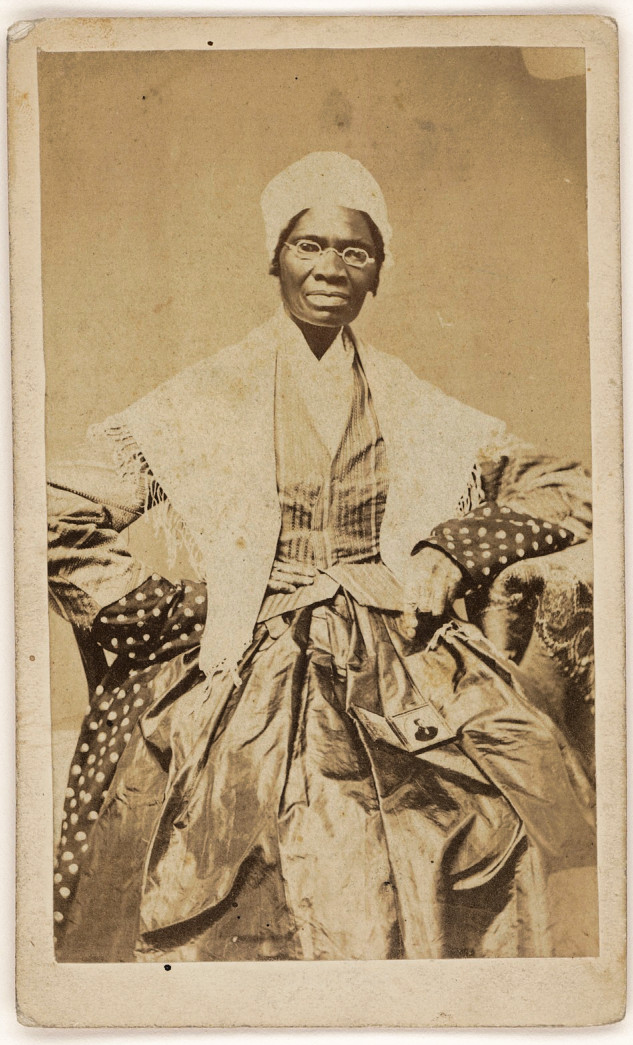
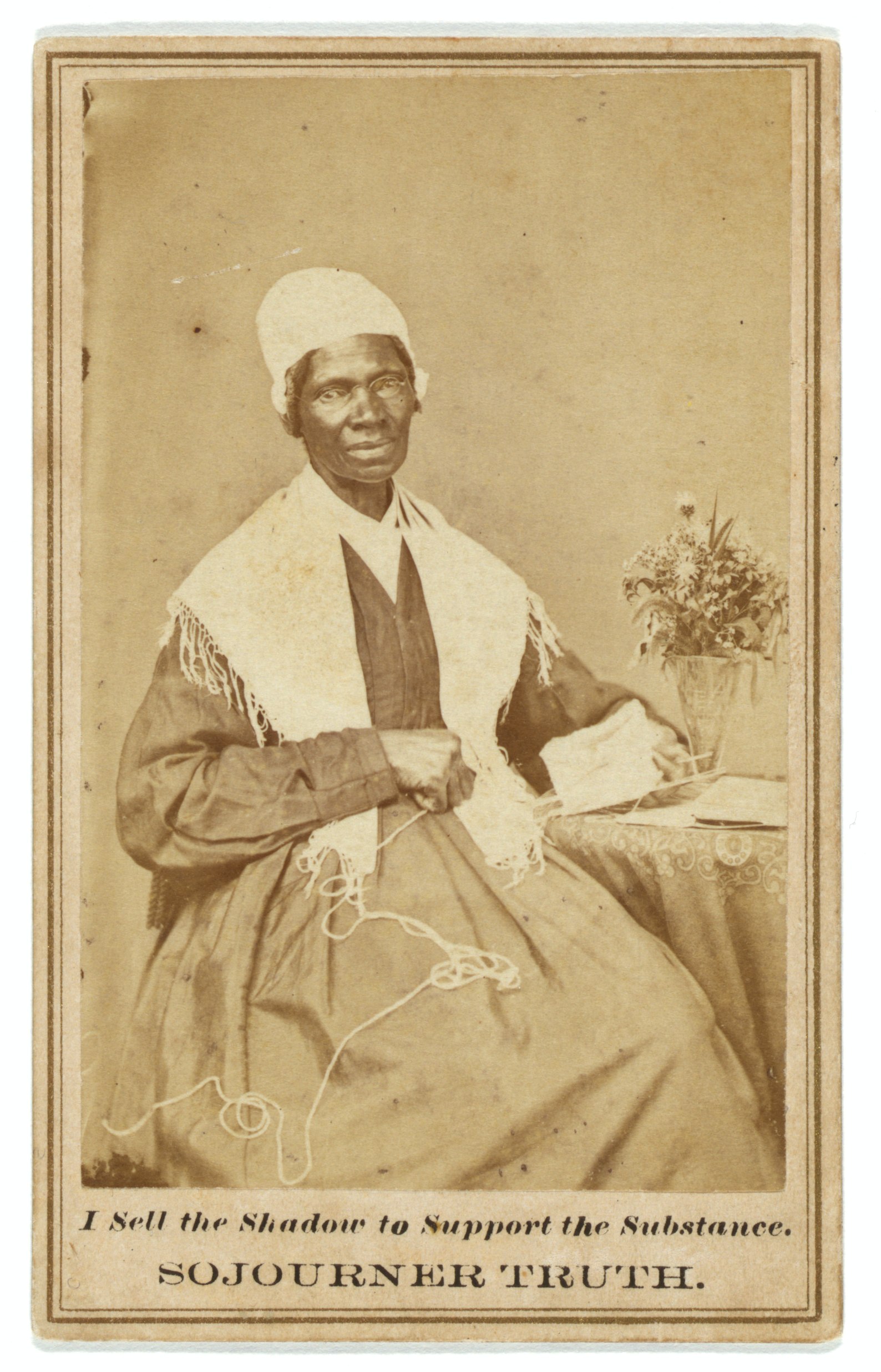
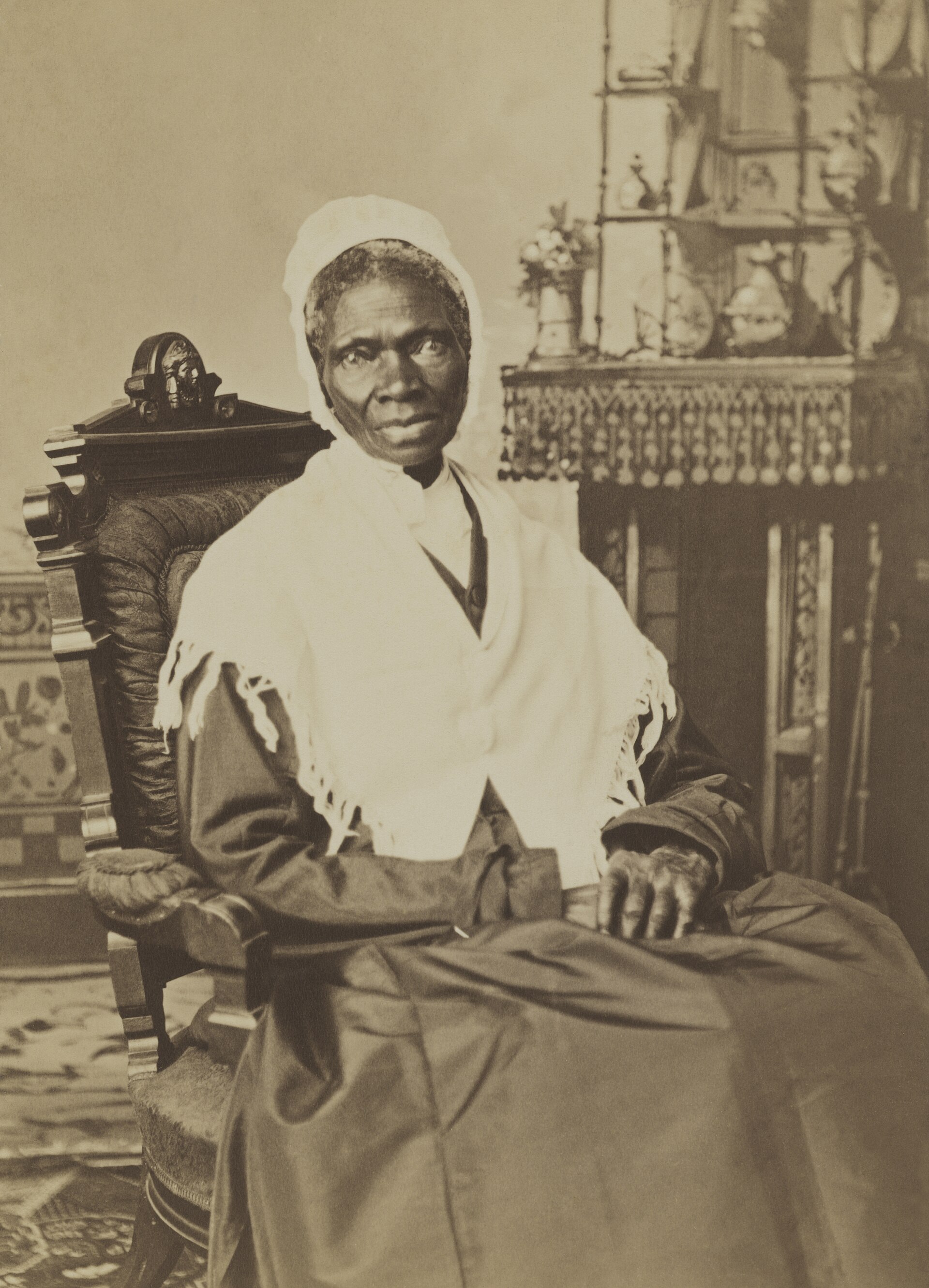
The object recorded here. Sojourner Truth seated with a daguerreotype of her grandson, James Caldwell of Co. H, 54th Massachusetts Infantry Regiment, on her lap. Albumen print, Battle Creek, Michigan, 1863 per NMAAHC's current catalog date (the Commons filename preserves an earlier, since-revised museum date of circa 1866). No caption appears on the front; the caption discussed at length in this record, "I Sell the Shadow to Support the Substance," belongs to a different, later series of Truth's cartes de visite, not to this print.
| Artist | Sojourner Truth (born Isabella Baumfree) |
|---|---|
| Date | 1863 |
| Medium | Albumen print (with silver nitrate) on card mount, carte de visite format |
| Dimensions | Mount: 10.2 x 6.4 cm (4 x 2 1/2 in.) |
| Where it is now | National Museum of African American History and Culture, Smithsonian Institution, Washington, D.C.last confirmed |
| Inventory number | 2012.46.11 |
| Attribution | UnknownThe National Museum of African American History and Culture (NMAAHC) lists the photographer of this specific print as unidentified; no studio imprint, backmark or photographer's name is published for it. Full note |
| Object type | Photograph |
| Period | American, Civil War era |
| Cases | Has a provenance gap |
| Inscriptions | No inscriptions on the front. The back carries the inscription "[Sojourner Truth]" and an identification number, per NMAAHC's own catalog description; the museum does not state whether the hand is Truth's own, a dealer's, or a later cataloger's. |
| Owners on record | 3 links2 documented, 1 unknown |
| Sources | 21 cited |
About this record Last verified · 21 sources cited · Change log
On this page 9 sections
ContentsClose
NMAAHC 2012.46.11 is an 1863 carte de visite of Sojourner Truth seated with a daguerreotype of her grandson, James Caldwell of the 54th Massachusetts Infantry, on her lap. It carries no caption on its front and no copyright notice on its back, which sets it apart from the far more famous captioned cartes de visite Truth began selling about a year later under the printed line "I Sell the Shadow to Support the Substance," registered in her own name with the federal courts on February 16, 1864, a legally unprecedented act for a formerly enslaved, illiterate woman and, per the scholarship consulted for this record, the only known instance of a SITTER of that era holding copyright in her own photographic image. It was not, however, the only instance of someone other than a studio doing so: cartes de visite of the child Fannie Virginia Casseopia Lawrence were copyrighted in 1863 in the name of the woman who had bought her freedom, Catherine S. Lawrence. Narrowed 2026-09-27.
That later, celebrated story belongs to a different, related group of objects: a print at the Art Institute of Chicago credited to the photographer S. C. Wright, a recto-and-verso pair at the Metropolitan Museum of Art showing the caption and the printed copyright notice in full, a sibling copy in the Library of Congress's Gladstone Collection, and a Battle Creek studio print credited to Wright's New York Gallery. This record treats every one of them as a separate, clearly captioned object, and reserves its specific factual claims, including the print's own 1863 date, for the object actually held under 2012.46.11.
What remains undocumented is nearly as telling as what is documented: no source located here names the photographer of this specific print, explains how or when it entered the Smithsonian's collection, or records any attempt by Truth to enforce her 1864 copyright against an infringer. The record states each of these as an open question rather than filling the gap with an inference borrowed from a better-documented, but different, object.
Provenance
Each link is graded. Documented: a cited source supports it. Disputed: the identification is argued but not established. Unknown: no owner for that span, and the gap is not smoothed into a narrative. The grades in the glossary.
- 1863 - 1863Sojourner Truth (sitter) and an unidentified photographic studio, Battle Creek, Michigan areadocumented
The sitting is placed in 1863 by NMAAHC's own (revised) catalog date, tied to the 1863 organization of the 54th Massachusetts Infantry Regiment and grandson James Caldwell's 1863-65 captivity depicted via the daguerreotype in Truth's lap. A closely related print of the same pose is independently dated by the Library of Congress to "[Battle Creek, Michigan] ... [1863]," citing Grigsby, Enduring Truths, pages 52-53. The specific studio or photographer is not identified in either institution's published record.123416
- 1863 - by 2012Unknownunknown
No custodial chain for this specific print is published between the 1863 sitting and its appearance in the Smithsonian's collection under an accession number prefixed 2012. This is a genuine, unfilled gap rather than an inferred one; this record does not borrow the documented Liljenquist or Emily Howland Album acquisition histories described elsewhere in the literature, which belong to separate, different Truth photographs entirely.1
- by 2012 - presentNational Museum of African American History and Culture, Smithsonian Institutiondocumented
The museum's own credit line, "Collection of the Smithsonian National Museum of African American History and Culture," documents institutional custody under accession number 2012.46.11. NMAAHC did not open to the public until September 2016; a 2012-prefixed accession number is consistent with the museum's pre-opening, founding-era collecting campaign, though no specific donor, purchase, dealer or prior owner is named in the catalog record or in the museum's press materials located for this record.1
Technical evidence
| Attribution note | The National Museum of African American History and Culture (NMAAHC) lists the photographer of this specific print as unidentified; no studio imprint, backmark or photographer's name is published for it. This record follows the museum's own cataloging on that point. Per this archive's editorial practice for sitter-driven photographic records, the artist_dossier below treats Sojourner Truth herself as the image's controlling author: the person who sat for it, who is independently documented staging her own portraits with deliberate props, and who built a personal copyright and sales practice around cartes de visite of this general type beginning about a year after this particular Michigan sitting. The camera operator is a separate, unresolved question addressed in the technical notes and open questions below. |
|---|---|
| Support and process | Albumen print, described by NMAAHC as albumen and silver nitrate on photographic paper, mounted on card in standard carte de visite format.1 |
| Dimensions | Mount 10.2 x 6.4 cm (4 x 2 1/2 in.), per NMAAHC's published measurement.1 |
| Inscriptions | No inscriptions on the front. The back carries the inscription "[Sojourner Truth]" and an identification number; NMAAHC's catalog does not identify whose hand added it.1 |
| Dating history | NMAAHC's own catalog record dated this print "ca. 1866" as late as September 2017 (per Internet Archive capture); by September 2020 the same record read "1863," tied to the 54th Massachusetts Infantry Regiment's 1863 organization and grandson James Caldwell's 1863-65 captivity. This record follows the revised 1863 date. The Wikimedia Commons file used as the lead image was uploaded in December 2016, while the museum's page still read 1866, and its filename and metadata were never updated to match the museum's later revision.1234 |
| Photographer | Unidentified in NMAAHC's own catalog record. No studio imprint or backmark is published for this print.1 |
| Classification and subject headings | Catalogued by NMAAHC under Slavery and Freedom Objects, Photographs and Still Images; genre headings cartes-de-visite, albumen prints, portraits; subject headings include Antislavery, Families, Motherhood, Photography, Slavery, Social reform, U.S. History (Civil War, 1861-1865), United States Colored Troops, Women.1 |
Images
The record in full
Chapter 1What this print actually shows
The object cataloged by the National Museum of African American History and Culture under accession number 2012.46.11 is a single carte de visite: an albumen print mounted on card, 10.2 by 6.4...
The object cataloged by the National Museum of African American History and Culture under accession number 2012.46.11 is a single carte de visite: an albumen print mounted on card, 10.2 by 6.4 centimeters, showing Sojourner Truth seated, looking directly into the camera. She wears a dot-print dress, a striped jacket, a dark apron, a light shawl over her shoulders and a light cap. Her right hand rests at her waist. Her left hand appears to point toward a small daguerreotype lying open on her lap, a portrait of her grandson, James Caldwell, a private in Company H of the 54th Massachusetts Infantry Regiment. NMAAHC's own description states plainly that there are no inscriptions on the front of the mount. The back carries only the inscription "[Sojourner Truth]" and an identification number.
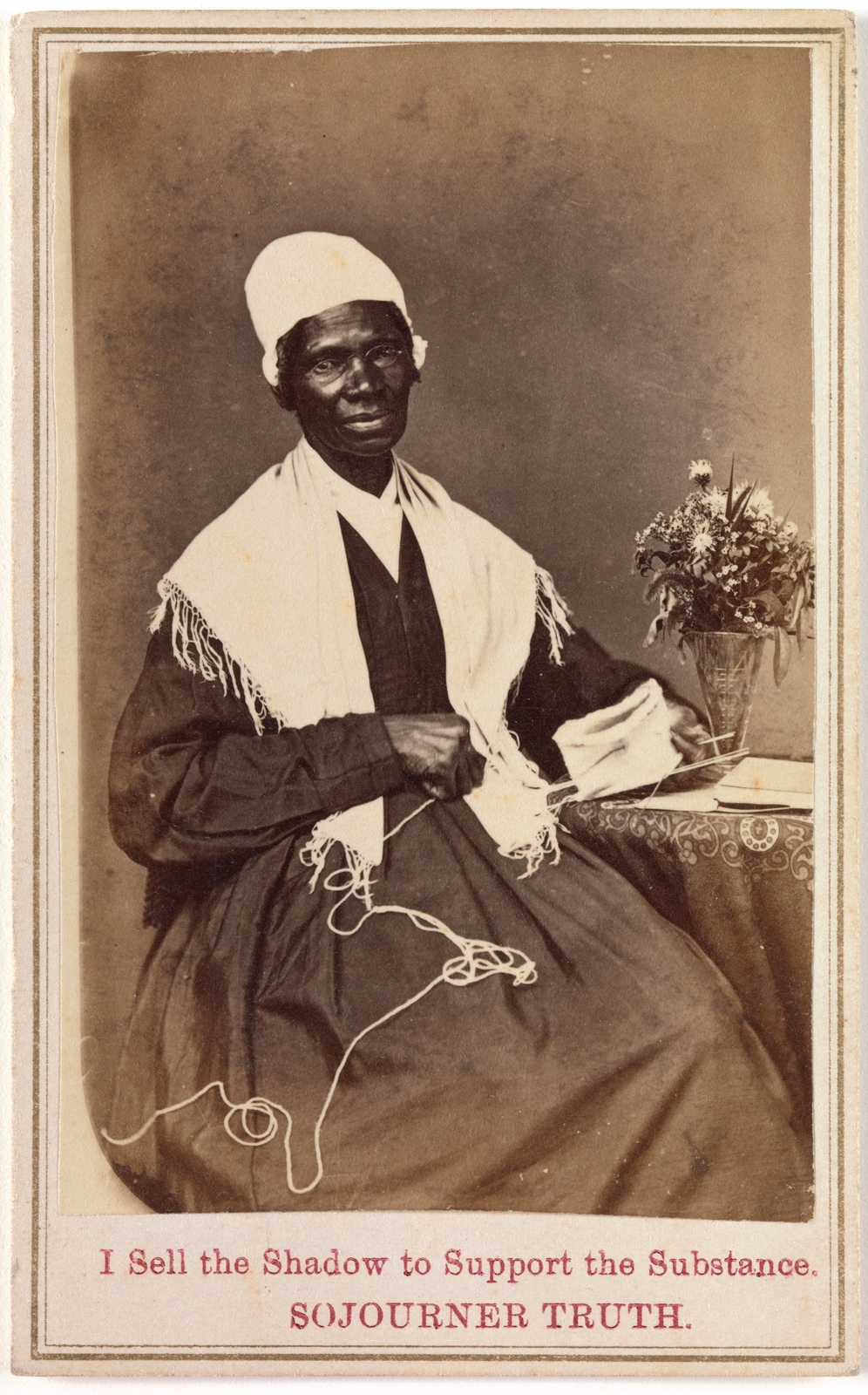
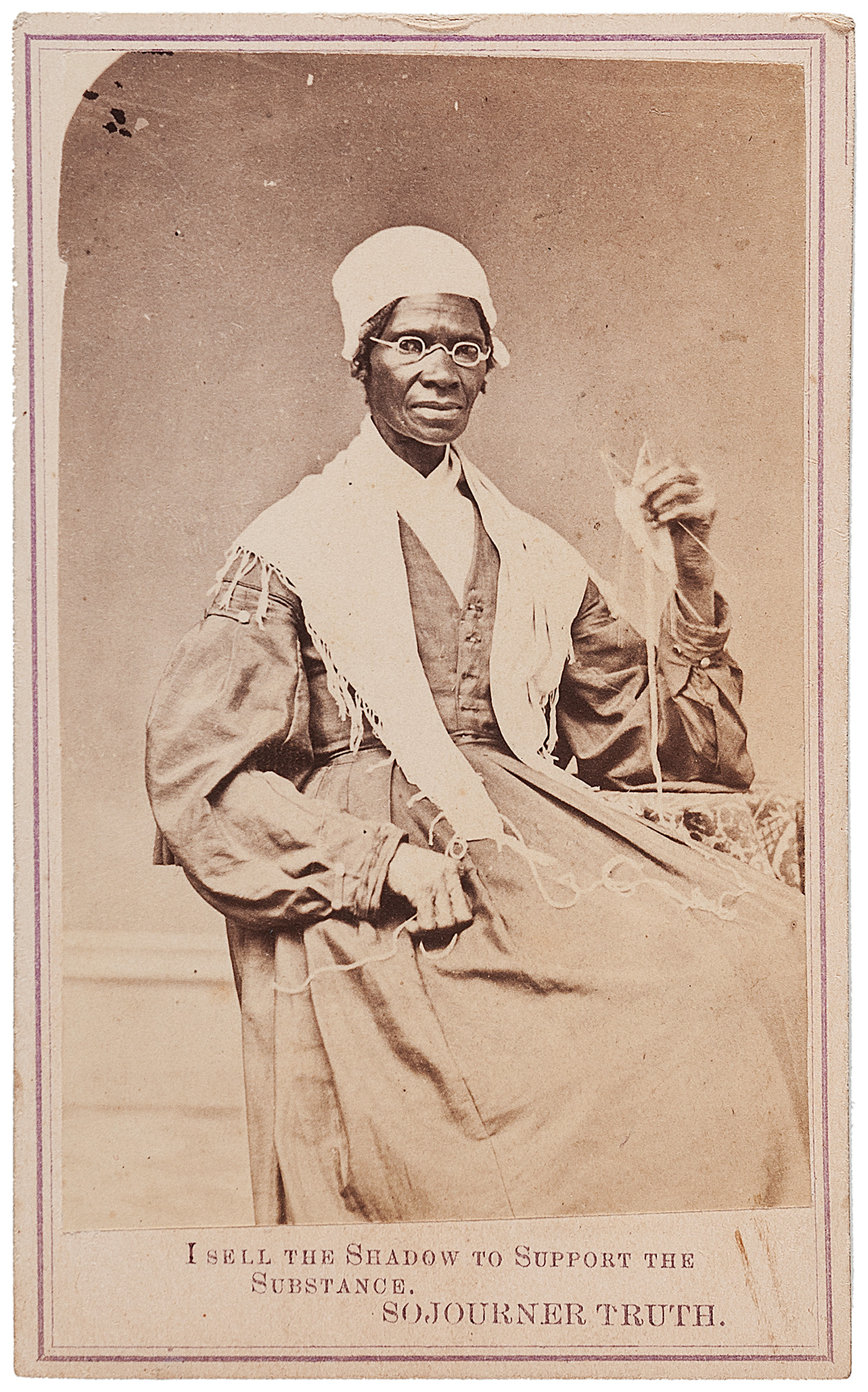
That last point matters more than it might seem, because it runs against the object most readers expect to find under Truth's name. Her most reproduced cartes de visite carry a printed caption beneath the portrait, "I Sell the Shadow to Support the Substance," over her name in capitals, with a copyright notice printed on the back. This print carries neither. It is not defective, misprinted or a proof state of the captioned cards; it is a different sitting, made before Truth began the captioned, copyrighted series, and it survives in the Smithsonian's collection on its own terms. Every claim in this record that concerns the captioned, copyrighted cartes is presented as context about a related but physically distinct body of objects, never as a description of the print actually held under 2012.46.11.
Chapter 2Sojourner Truth, in outline
She was born Isabella Baumfree around 1797 in Ulster County, New York, enslaved from birth under New York's own slave law.
She was born Isabella Baumfree around 1797 in Ulster County, New York, enslaved from birth under New York's own slave law. Dutch, not English, was her first language, since she was raised in a Dutch-speaking household of enslavers in the Hudson Valley. She was sold at least twice as a child, separated from her parents at around age nine, and passed through several owners before being held for roughly seventeen years by John Dumont of West Park, New York. In late 1826, with New York's gradual emancipation law due to free the state's remaining adult slaves on July 4, 1827, she walked away from Dumont's farm carrying her infant daughter, Sophia, leaving other children behind under terms of indenture the law still permitted. She was taken in by Isaac and Maria Van Wagenen, a Quaker-influenced family near New Paltz, who purchased her services for the remainder of the year and, by her later account, refused to be thanked as owners. She took their name for a time, Isabella Van Wagenen, and in 1828 she sued in Ulster County to recover her five-year-old son Peter, who had been sold illegally across state lines into slavery in Alabama; a New York court ordered him returned, and she won, one of the first recorded instances of a Black woman successfully suing a white man in an American court.
In 1843 she renamed herself Sojourner Truth, telling those who asked that she had been called to travel and speak the truth. She could not read or write, and dictated her life story to Olive Gilbert, published in 1850 as the Narrative of Sojourner Truth. On May 29, 1851, she addressed the Woman's Rights Convention in Akron, Ohio; the speech she is most remembered for today, built around the repeated line "Ain't I a Woman?", is a later, heavily rewritten version published by the convention organizer Frances Gage in 1863, which imposed a Southern slave dialect on a woman who had never lived in the South and spoke English as a second language. A contemporary transcript by the abolitionist newspaper editor Marius Robinson, who attended the convention and worked directly with Truth, survives from June 1851 and reads very differently. The historian Nell Irvin Painter examined both versions in her 1996 biography Sojourner Truth: A Life, A Symbol and judged Robinson's transcript the more reliable record of what Truth actually said; the Sojourner Truth Project has since built directly on that finding. The gap between the two versions is now treated by historians as a documented case of a Black woman's words being rewritten for her, which sits in useful and pointed tension with the deliberate, first-person self-representation she built through her own photographs a decade later.
She went to court a third time in 1865, after a Washington, D.C. streetcar conductor dislocated her shoulder trying to force her off his car; her resulting lawsuit cost the conductor his job and pushed the streetcar company to enforce the district's desegregation law. From 1857 she lived in and around Battle Creek, Michigan, first in Harmonia, a small biracial Spiritualist community outside the town, and from around 1867 in Battle Creek itself, where she remained until her death on November 26, 1883.
Chapter 3A grandson at war: why this sitting exists
The 54th Massachusetts Infantry, organized in early 1863, was the first Black regiment raised in the North under Federal authority, and its assault on Fort Wagner that July became one of the war's...
The 54th Massachusetts Infantry, organized in early 1863, was the first Black regiment raised in the North under Federal authority, and its assault on Fort Wagner that July became one of the war's most publicized demonstrations that Black soldiers would fight and die for the Union. James Caldwell, Truth's grandson, enlisted in the regiment's Company H in 1863. The National Anti-Slavery Standard reported Truth's pride in his service at the time. Caldwell was then taken prisoner and held on James Island, South Carolina, from 1863 until 1865, according to both the Library of Congress and NMAAHC's own catalog descriptions of related prints from the same sitting; neither institution's published record states what became of him after his release, or whether he survived to see Truth again.
The photograph inside the photograph is the point of the composition, not an incidental prop. Darcy Grimaldo Grigsby, the art historian whose 2015 book Enduring Truths: Sojourner's Shadows and Substance is the fullest study of Truth's photographic practice, observes that Truth deliberately chose what she held in her lap across her sitting career: "initially, the photograph of her heroic missing grandson and thereafter, her knitting," as the wall text for the University of California, Berkeley Art Museum and Pacific Film Archive's 2016 exhibition on Truth's photography put it, drawing on Grigsby's research. The image within the image is also a small essay on the technology itself: the more expensive, singular daguerreotype, made to be kept and treasured by one family, nested inside the cheaper, endlessly reproducible carte de visite, made to be mailed, sold and passed hand to hand. A formerly enslaved grandmother displaying a photographic keepsake of a grandson serving, and then imprisoned, in the Union's first Black regiment is not a neutral studio arrangement; it stages, in a single frame, the family bonds slavery worked to sever and the war Truth spent her later life supporting.
Chapter 4The copyright campaign of 1864, and why it belongs to different cards
Beginning in February 1864, roughly a year after the sitting described above, Truth started having a new series of cartes de visite printed that carried, beneath her portrait, her chosen name in...
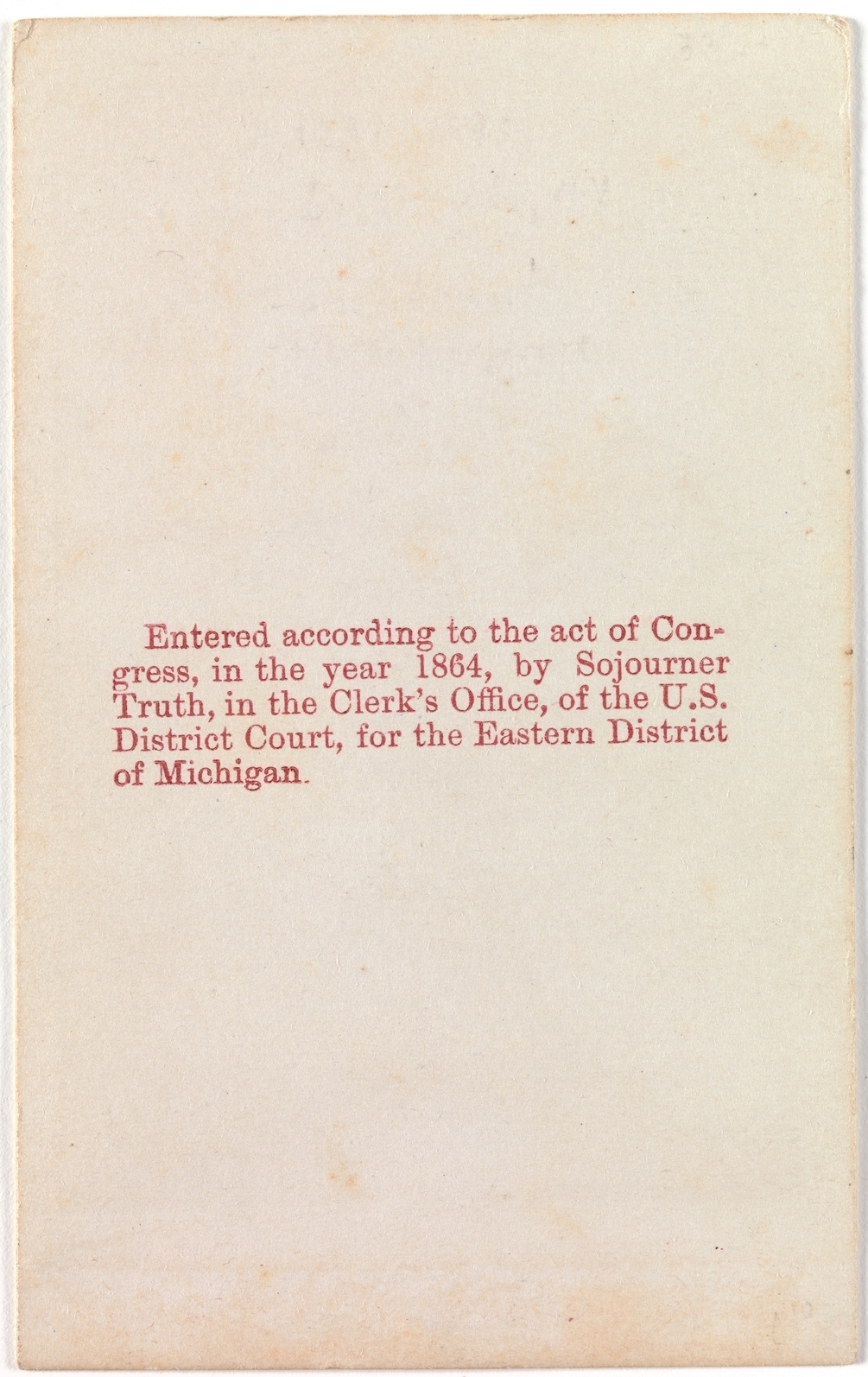
Beginning in February 1864, roughly a year after the sitting described above, Truth started having a new series of cartes de visite printed that carried, beneath her portrait, her chosen name in capitals and the line "I Sell the Shadow to Support the Substance," and on the back a printed copyright notice: "Entered according to the act of Congress, in the year 1864, by Sojourner Truth, in the Clerk's Office, of the U.S. District Court, for the Eastern District of Michigan." The Library of Congress's own account of the registration, published by the U.S. Copyright Office's blog in December 2020, states that Truth deposited "the title of an Engraving, the title whereof is in the words, towit: [Picture of Sojourner Truth] 'I Sell the Shadow to Support the Substance, Sojourner Truth,'" and that the claim entered the record on February 16, 1864, filed in Detroit. That detail is a legal-history fact worth sitting with: photography did not become its own explicitly protected category under federal copyright law until the Act of March 3, 1865. Truth registered her image a year earlier by using the existing statutory category for prints and engravings, a mechanism available since the early nineteenth century, to claim a photograph before photographs themselves had a dedicated legal home. She had, in effect, found the nearest available door in a house not built for her and let herself in before the room she actually needed was finished.
The 2024 University of Pittsburgh Law Review article "Abolitionist Creativity, Care, and the Shadow of Intellectual Property," by Julia Choucair Vizoso and Chris R. Byrnes, draws on Grigsby's research to make a further, sharper point: of the surviving cartes de visite of the period that carry any copyright notice at all, and few do, every other one names the photographer. Truth's cards are the only ones from the period known to register the copyright in the sitter's own name rather than the studio's. Frederick Douglass, an avid and photography-literate portrait sitter in the same years, appears on cards that credit the photographer at the bottom of the mount, in the ordinary commercial convention. Truth, illiterate, formerly enslaved, and past sixty, is the outlier: the one sitter of her era on record asserting that the legal claim to her own likeness belonged to her rather than to whoever operated the camera.
Chapter 5What the caption meant
"Shadow" was ordinary nineteenth-century usage for a photograph, playing on the older warning to "secure the shadow ere the substance fade," a phrase photography studios printed on their own...
"Shadow" was ordinary nineteenth-century usage for a photograph, playing on the older warning to "secure the shadow ere the substance fade," a phrase photography studios printed on their own advertising to urge customers to sit before death took the chance away. Grigsby's research establishes that Truth herself used "shadow" this way in her own recorded speech, not only on the printed cards. Read as a simple pun, the caption says: I sell my image (shadow) in order to support my body and my life's work (substance). Grigsby's closer reading goes further, arguing that the line does something more deliberate for a woman whose own body had once been legally another person's property: Truth "sells not her substance, not herself, not her 'I' but her shadow, a substitute so elusive as to thwart bodily violation. Here the commodified self is redefined as part of the image world, of representation, not embodiment." In other words, the caption draws a line the law of slavery had never allowed her: a difference between the thing that can be sold and the person doing the selling.
The communications scholar Celnisha L. Dangerfield, working from a Black feminist framework, reads the same caption as "an act of indignant agency," arguing that Truth "flips symbols of Whiteness and patriarchy so they work for her, not against her": a legal instrument built by and for white male authorship, turned to a formerly enslaved Black woman's own account. Truth put the point in her own recorded words late in life. In 1870 the New York World reported her declaring that she "used to be sold for other people's benefit, but now she sold herself for her own," a line that should be read the way most of Truth's surviving speech has to be read: as a newspaper's rendering of an illiterate speaker's words, not a verbatim transcript she reviewed and approved, and therefore evidence of the same kind, with the same built-in caution, as the Gage/Robinson problem in her 1851 speech.
Grigsby traces a further layer specific to the Civil War years: shadow and substance were also the terms of a live legal and monetary argument over whether the federal government's new paper currency, backed by nothing but public confidence rather than gold, could count as real value. Pro-slavery and hard-money positions insisted paper was mere representation, a shadow with no substance behind it. Truth's cartes de visite, cheap paper notes bearing her image, printed and multiplied and exchanged for coin at her lectures, worked the same trick the Republican government's currency worked: turning a representation into value by the same shared confidence, in order, as Grigsby puts it, "to produce wealth dependent on a consensus that representation produces material results, to make money where there was none, and to do so partly in order to abolish slavery." Truth had invented her own kind of paper money, for her own kind of war effort.
Chapter 6How many sittings, how many prints
Two different counts circulate for Truth's photographic output, and they measure different things.
Two different counts circulate for Truth's photographic output, and they measure different things. The Library Company of Philadelphia's object record for its own captioned carte states that "During the period of the Civil War, Truth captioned, marketed, copyrighted, and sold at least eleven different carte-de-visite portraits of herself at her lectures and through the mail"; that figure describes the captioned, copyrighted series. A separate and different count of eleven appears in the United States Copyright Office's account, which says only that "Truth sat for portraits at least eleven times", a count of SITTINGS across her whole carte career rather than of captioned copyrighted cards. The two elevens are not the same claim and should not be merged. This record previously attributed the Library Company sentence to the Library of Congress and reworded "copyrighted" as "placed under copyright"; corrected 2026-09-27. Separately, Grigsby's book, cited in the University of Pittsburgh Law Review article, states that Truth "sat for at least twenty-eight portraits" across her life and had hundreds of copies printed and sold from them; that figure describes her total documented sitting history, captioned and uncaptioned alike, of which the 1863 grandson sitting recorded here is one. Neither figure has been independently verified against a primary source for this record, and the two are not obviously reconciled anywhere in the secondary literature located; they are presented here as two separate, sourced tallies rather than as a single settled number, which is itself the more honest position to hold given the state of the published scholarship.
Chapter 7Selling the shadow: prices and mechanics
The Library of Congress's account of the registration states that Truth charged twenty-five to fifty cents per card.
The Library of Congress's account of the registration states that Truth charged twenty-five to fifty cents per card. Grigsby's research, reflected in the BAMPFA exhibition materials built from it, gives fifty cents plus postage for cards ordered by mail. Truth sold the captioned cards in person at her lectures and speaking engagements, and by mail order to correspondents who wrote to her directly, a distribution method that depended on the same expanding federal postal system that was, in these same years, carrying soldiers' letters and photographs across the country. The proceeds funded her anti-slavery lecture tours and, by her own stated purpose, supported her in old age; the Library of Congress's account also connects her fundraising in this period to support for "the first Michigan Colored Infantry fighting in the Civil War," the regiment recruited from Truth's adopted home state.
Chapter 8The legal record: three lawsuits, and one honest silence
Truth is documented going to court on her own account three times across her life, and each case is independently sourced: the 1828 Ulster County suit that recovered her son Peter from illegal sale...
Truth is documented going to court on her own account three times across her life, and each case is independently sourced: the 1828 Ulster County suit that recovered her son Peter from illegal sale into Alabama slavery; a hearing over the same wrongful action; a 1835 slander suit she brought against members of the Folger household after they accused her of poisoning a fellow member of the religious commune known as the Kingdom, following the death of its leader Elijah Pierson, a suit she won, reportedly with 125 dollars in damages, described by multiple secondary sources as one of the first successful defamation suits by a Black woman against a white defendant in the United States; and the 1865 Washington, D.C. streetcar case that followed her forcible removal from a car and the dislocation of her shoulder.
None of those three documented cases is a copyright or image-piracy case. This record set out to establish, per its research brief, whether Truth pursued any legal or public case against unauthorized copying of her registered photographic image, precisely the kind of enforcement question a copyright claim this early and this unusual invites. No such case turned up in the sources consulted for this record, published or secondary. That absence is reported here as a finding, not filled in with a plausible-sounding guess: the documented achievement is the registration itself, a genuinely novel legal act for a formerly enslaved, illiterate woman in 1864, and the historical record on whether she, or anyone acting for her, ever had occasion or means to enforce it against a specific infringer appears to be thinner than the registration itself, or simply unrecovered by the scholarship this record was able to reach.
Chapter 9Other Truth cartes de visite in the record, and how they differ from this one
Because Truth sat for a documented multiple of separate photographic sessions over roughly two decades, several distinct objects survive under her name in public collections, and this record treats...
Because Truth sat for a documented multiple of separate photographic sessions over roughly two decades, several distinct objects survive under her name in public collections, and this record treats every one of them as a separate physical object from the print held under NMAAHC 2012.46.11, regardless of how similar the pose or period.
The Art Institute of Chicago holds an albumen carte de visite, cataloged as Untitled ("I Sell the Shadow to Support the Substance"), dated 1864-65 and credited to Truth "in collaboration with S. C. Wright," a photographer active in the mid-to-late nineteenth century; the museum's own description explains the caption as wordplay on "secure the shadow ere the substance fade." A separate pair of prints at the Metropolitan Museum of Art, also dated 1864 and released under CC0, preserves both sides of one such captioned card: the front shows Truth seated at a small table with a potted plant, knitting, the printed caption beneath her; the back carries the printed copyright notice quoted above in full. A third print of what appears to be the same seated-with-knitting composition and caption survives in the Library of Congress's Gladstone Collection of African American Photographs, also dated 1864, evidence that this particular captioned sitting was printed and distributed in multiple surviving copies, consistent with Truth's own account of selling cards in quantity at her lectures and by mail. A further captioned print, credited on its mount to "Wright's New York Gallery, Battle Creek, Mich.," shows Truth seated with knitting in a different studio setting, and its photographer credit line makes it the strongest surviving link to the S. C. Wright named at the Art Institute; whether the two are the same print, from the same negative, or two separate Wright sittings has not been established here.
Closest of all to the object described in this record is a second surviving print of the same grandson pose, held by the Library of Congress as part of the Liljenquist Family Collection of Civil War Photographs (LC Control Number 2017648645, digital IDs ppmsca.52069 and ppmsca.52165 for front and back). The Library of Congress catalogs this print as "[Battle Creek, Michigan] : [Publisher not identified], [1863]," a date and place drawn explicitly, per the catalog's own notes, from Grigsby's book, pages 52-53; it was purchased by Tom Liljenquist at Swann Auction Galleries in New York in March 2017 and gifted to the Library that year. This print's own back carries only "[Sojourner Truth]" and an identification number, matching the sparse verso NMAAHC records for 2012.46.11. The two institutions appear to hold two separate surviving prints of the same 1863 Battle Creek sitting, one uncaptioned like the other, though this record has not been able to establish whether they derive from the same negative or represent two separate but visually similar exposures from the same sitting.
Finally, a bust-length portrait credited to the Randall Studio shows Truth in a different setting from any of the seated cartes above. The National Portrait Gallery dates its own print of it, NPG.79.220, to 1864 and printed about 1870, and places the studio in Detroit, so it is a late print of an early negative rather than a late sitting. That print is also catalogued as a cabinet card and not a carte de visite. Corrected 2026-09-27; this record previously called it a later sitting from Truth's final decade. None of the objects described in this section is the print recorded here; each is presented in the images and related_works sections below with that distinction stated plainly.
Chapter 10The photographer question
NMAAHC's own catalog record leaves the photographer of 2012.46.11 unidentified, and no studio imprint or backmark is described.
NMAAHC's own catalog record leaves the photographer of 2012.46.11 unidentified, and no studio imprint or backmark is described. This is not unusual for cartes de visite of the period generally, but it is a genuine gap given how much of the surrounding story depends on attribution: the Art Institute of Chicago names S. C. Wright for its differently dated, differently posed 1864-65 Truth carte, and a Commons-hosted print carries a Battle Creek gallery credit for "Wright's New York Gallery." Truth lived in and around Battle Creek from 1857 onward, so a Battle Creek studio is a plausible, geographically consistent guess for the 1863 grandson sitting as well, but this record has found no documentary link, such as a matching backmark or a dated business record, connecting Wright's studio specifically to the print held under 2012.46.11. It remains an open question, stated as such below rather than resolved by inference from proximity.
Chapter 11A date that changed: the catalogue history
The Wikimedia Commons file used as this record's lead image, uploaded in December 2016 under the title "Sojourner Truth CDV c1866.jpg," credits NMAAHC 2012.46.11 and dates the print circa 1866.
The Wikimedia Commons file used as this record's lead image, uploaded in December 2016 under the title "Sojourner Truth CDV c1866.jpg," credits NMAAHC 2012.46.11 and dates the print circa 1866. That date was not an uploader's invention. Internet Archive Wayback Machine captures of NMAAHC's own object page show the museum's own catalog record displaying "Date ca. 1866" as late as September 23, 2017. By the next available capture, September 27, 2020, the same record had been revised to read simply "Date 1863," the date this record follows, and the museum's description had also grown to include the full account of James Caldwell and the 54th Massachusetts Infantry Regiment quoted earlier in this record. The revision was not captured at the moment it happened, only bracketed between two snapshots roughly three years apart, but the direction of the change is clear and its logic is visible: once the grandson in the daguerreotype was identified and tied to a regiment organized in 1863 and a documented captivity running from 1863 to 1865, the museum had firmer external evidence for the date of the sitting than a general stylistic estimate could offer, and it appears to have adopted the firmer date. The Commons file, uploaded in the window when the museum's own page still said 1866, was simply never updated to match, and has carried the older date in its filename and metadata ever since. This record uses 1863, following NMAAHC's current, evidence-linked dating, and treats the Commons file's title as an artifact of when it was made rather than as a rival claim about the photograph itself.
Chapter 12Between camera and archive: an undocumented custody
Nothing in the sources located for this record explains how this specific print traveled from an 1863 Battle Creek sitting into the Smithsonian's collection.
Nothing in the sources located for this record explains how this specific print traveled from an 1863 Battle Creek sitting into the Smithsonian's collection. The accession number's 2012 year-prefix places its formal entry into NMAAHC's collection at least four years before the museum opened to the public in September 2016, consistent with the founding-era collecting campaign the museum carried out while its building was still under construction, but the museum's own catalog record supplies only a generic credit line, "Collection of the Smithsonian National Museum of African American History and Culture," without naming a donor, a purchase, a dealer or a prior owner. No press release, finding aid or auction record connecting this specific object to the 2012 accession was found. This is reported here as an open question rather than papered over with a plausible-sounding chain borrowed from the Liljenquist or Howland acquisitions described elsewhere in this record, which are genuinely documented but belong to entirely separate objects and separate transactions.
Chapter 13Reception since
Truth's photographic practice has moved from a footnote to a subject of sustained scholarly attention over the past decade.
Truth's photographic practice has moved from a footnote to a subject of sustained scholarly attention over the past decade. Grigsby's 2015 book remains the fullest study and supplied the primary research behind the University of California, Berkeley Art Museum and Pacific Film Archive's 2016 exhibition Sojourner Truth, Photography, and the Fight Against Slavery, which placed a large selection of her cartes de visite alongside Civil War-era federal currency to make explicit the shadow-and-substance argument about paper, value and representation. The Library of Congress's own Copyright Office marked Truth's registration with a dedicated blog post in December 2020, framing her as an early "copyright innovator." Most recently, the 2024 University of Pittsburgh Law Review article by Vizoso and Byrnes uses Truth's 1864 registration as the founding example for a broader argument in critical race intellectual property scholarship, treating her assertion of copyright in her own name as a documented instance of a formerly enslaved person occupying, rather than being excluded by, a legal structure built without her in mind. None of this later attention changes what can specifically be said about the uncaptioned 1863 print held under 2012.46.11; it establishes the scholarly and legal context in which that print, and the caption it does not carry, are now read.
The artist
Sojourner Truth (born Isabella Baumfree, also recorded as Isabella Van Wagenen)
Sojourner Truth is treated in this record as the controlling author of the image, not merely its sitter. She could not read or write, yet she is the only documented sitter of her era known to have registered a photographic copyright in her own name rather than a studio's, and the surviving record shows her repeatedly using courts, the press and, from 1864, federal copyright law itself to assert a claim over her own body, labor and likeness that the law of her birth had denied her outright. This dossier covers the documented facts of her life and legal history; where her own words survive only through a white amanuensis, editor or newspaper, that mediation is stated rather than smoothed over.
Related works
| Work | Relation | Where it is |
|---|---|---|
| Untitled ("I Sell the Shadow to Support the Substance") Sojourner Truth, in collaboration with S. C. Wright | Different, later, captioned sitting of Truth; carries the copyright caption this NMAAHC print does not Albumen print, 1864-65. Gift of W. Bruce and Delaney H. Lundberg. Not the print described in this record. | Art Institute of Chicago (object 238249) |
| "I Sell the Shadow to Support the Substance" (recto and verso) Sojourner Truth (photographer unidentified) | Different, captioned 1864 sitting; verso carries the printed copyright notice discussed in this record CC0. Shows Truth seated at a table, knitting, with a potted plant. Not the print described in this record. | Metropolitan Museum of Art (DP265089 front, DP265040 back) |
| Sojourner Truth, carte de visite Sojourner Truth (unidentified photographer) | A separate surviving print of the same captioned 1864 seated-with-knitting sitting reflected in the Met pair above Evidence that this captioned sitting was printed and sold in multiple surviving copies. Not the print described in this record. | Library of Congress, Gladstone Collection of African American Photographs (LCCN 98501244) |
| Sojourner Truth CDV, Wright's New York Gallery Sojourner Truth (Wright's New York Gallery, Battle Creek, Mich.) | A captioned print naming a Battle Creek studio, the strongest surviving link to the S. C. Wright credited at the Art Institute of Chicago Shows Truth seated with knitting. Whether it shares a negative with the Art Institute's print is not established. Not the print described in this record. | Formerly Cowan Auctions; now Wikimedia Commons |
| [Sojourner Truth seated with photograph of her grandson, James Caldwell of Co. H, 54th Massachusetts Infantry Regiment, on her lap] Sojourner Truth (unidentified photographer) | The closest known sibling to this record's print: a second surviving print of the same uncaptioned 1863 Battle Creek grandson sitting Dated by the Library of Congress to Battle Creek, Michigan, 1863, citing Grigsby, Enduring Truths, pages 52-53. Purchased by Tom Liljenquist at Swann Auction Galleries, March 2017, and gifted to the Library that year. A separate physical print from the NMAAHC object, not the same object. | Library of Congress, Liljenquist Family Collection of Civil War Photographs (LC 2017648645; ppmsca.52069 front, ppmsca.52165 back) |
| Sojourner Truth, circa 1870 Randall Studio | A separate Randall Studio portrait, dated by the National Portrait Gallery to 1864 and printed about 1870 Bust-length portrait, different setting and period from the 1863 and 1864 sittings above. Not the print described in this record. | Public domain reproduction via Wikimedia Commons |
Open questions
- Who operated the camera for the NMAAHC 2012.46.11 sitting? NMAAHC's own catalog leaves the photographer unidentified, and no backmark or studio imprint is published.
- How and when did this specific print enter the Smithsonian's collection? The accession number's 2012 prefix places it in the museum's pre-opening founding collection, but no donor, purchase, dealer or prior owner is published in the catalog record or in press materials located for this record.
- Is the NMAAHC print and the Library of Congress's Liljenquist print of the same grandson pose (LC 2017648645) from the same negative, or two separate exposures from the same sitting? Not established in the sources consulted.
- Did Sojourner Truth, or anyone acting on her behalf, ever pursue a legal or public case against unauthorized copying of her copyrighted photographic image? No such case was found in the sources consulted; the well-documented fact is the 1864 registration itself, not any subsequent enforcement of it.
- What became of James Caldwell after his 1863-1865 captivity at James Island, South Carolina? The sources consulted for this record do not state whether he survived the war or what happened to him afterward.
- Exactly when between September 2017 and September 2020 did NMAAHC revise its own catalog date for this print from "ca. 1866" to "1863"? Bracketed here only by two Internet Archive Wayback Machine captures three years apart; a finer date was not recoverable.
- Do the two published sitting counts, at least eleven captioned and copyrighted cartes per the Library Company of Philadelphia, against at least eleven SITTINGS per the United States Copyright Office, which is a different count of the same number and at least twenty-eight portraits total per Grigsby, reconcile against a documented primary list anywhere in the scholarship? Not found in the sources consulted; they are reported here as two distinct, separately sourced figures rather than a single settled total.
Questions about this object
What is Carte-de-visite of Sojourner Truth?
Carte-de-visite of Sojourner Truth is a photograph, dated 1863. Medium: Albumen print (with silver nitrate) on card mount, carte de visite format.
Who made Carte-de-visite of Sojourner Truth, and is the attribution settled?
The attribution to Sojourner Truth (born Isabella Baumfree) is recorded here as unknown. The National Museum of African American History and Culture (NMAAHC) lists the photographer of this specific print as unidentified; no studio imprint, backmark or photographer's name is published for it. This record follows the museum's own cataloging on that point. Per this archive's editorial practice for sitter-driven photographic records, the artist_dossier below treats Sojourner Truth herself as the image's controlling author: the person who sat for it, who is independently documented staging her own portraits with deliberate props, and who built a personal copyright and sales practice around cartes de visite of this general type beginning about a year after this particular Michigan sitting. The camera operator is a separate, unresolved question addressed in the technical notes and open questions below.
Where is Carte-de-visite of Sojourner Truth now?
National Museum of African American History and Culture, Smithsonian Institution, Washington, D.C. Inventory number 2012.46.11. Last confirmed 5 September 2026. Credit line "Collection of the Smithsonian National Museum of African American History and Culture" on the museum's own object record. No donor, purchase source, or acquisition date beyond the accession number's 2012 year-prefix is published in the catalog record or in the museum's press materials located for this record.
What is still unknown about Carte-de-visite of Sojourner Truth?
Who operated the camera for the NMAAHC 2012.46.11 sitting? NMAAHC's own catalog leaves the photographer unidentified, and no backmark or studio imprint is published.
Sources
- 1National Museum of African American History and Culture, Smithsonian Institution, "Carte-de-visite of Sojourner Truth," object record, accession 2012.46.11. nmaahc.si.edu/object/...
- 2Internet Archive Wayback Machine capture of NMAAHC object record nmaahc_2012.46.11, September 1, 2016, showing catalog date "ca. 1866." web.archive.org/web/...
- 3Internet Archive Wayback Machine capture of NMAAHC object record nmaahc_2012.46.11, September 23, 2017, still showing catalog date "ca. 1866." web.archive.org/web/...
- 4Internet Archive Wayback Machine capture of NMAAHC object record nmaahc_2012.46.11, September 27, 2020, showing the revised catalog date "1863" and the full description naming James Caldwell and the 54th Massachusetts Infantry Regiment. web.archive.org/web/...
- 5Marilyn Creswell, "Sojourner Truth and the Power of Copyright Registration," Library of Congress Copyright Office blog, December 8, 2020. Read in full on 27 September 2026 in an Internet Archive capture of 17 December 2025, loc.gov being behind a bot wall. Used for the February 16, 1864 registration deposit of the title of an engraving, the twenty-five to fifty cent in-person price, and the statement that "Truth sat for portraits at least eleven times". NOTE, corrected 2026-09-27: this post does NOT carry the "eleven captioned and copyrighted cartes" figure, which belongs to the Library Company of Philadelphia; the earlier flag for re-verification is now discharged. blogs.loc.gov/copyright/...
- 6Julia Choucair Vizoso and Chris R. Byrnes, "Abolitionist Creativity, Care, and the Shadow of Intellectual Property," University of Pittsburgh Law Review, vol. 85 (Summer 2024), pp. 891-897 for the Sojourner Truth material, citing Darcy Grimaldo Grigsby, Enduring Truths: Sojourner's Shadows and Substance (University of Chicago Press, 2015) throughout. lawreview.law.pitt.edu/ojs/...
- 7University of California, Berkeley Art Museum and Pacific Film Archive (BAMPFA), press release, "Sojourner Truth, Photography, and the Fight Against Slavery," July 18, 2016, for the exhibition organized by Darcy Grimaldo Grigsby, including the "went to court three times" note and mail-order pricing. bampfa.berkeley.edu/sites/...
- 8W. Norton, 1996): National Park Service, Britannica, and Women's History biographical entries on Sojourner Truth. nps.gov/people/...
- 9New York Almanack, reporting on the documented 1828 Ulster County court case Sojourner Truth (as Isabella Van Wagenen) brought to recover her son Peter from illegal sale into Alabama slavery. newyorkalmanack.com/2025/...
- 10American History Central, biographical entry on Sojourner Truth, consulted for the 1828 and 1865 lawsuits. americanhistorycentral.com/entries/...
- 11Sojourner Truth (dictated to Olive Gilbert), Narrative of Sojourner Truth (Boston, 1850), referenced here for the fact of its dictated authorship rather than quoted directly. archive.org/details/...
- 12News Center Maine, "Sojourner Truth did not say 'Ain't I a Woman?' in famous speech," VERIFY fact-check, summarizing Nell Irvin Painter's 1996 finding that Marius Robinson's 1851 transcript is more reliable than Frances Gage's 1863 rewritten version. newscentermaine.com/article/...
- 13The Sojourner Truth Project, built on Nell Irvin Painter's research comparing the Robinson and Gage versions of the 1851 Akron speech. thesojournertruthproject.com
- 14Ossining History on the Run and related secondary accounts of the 1835 libel suit Truth (as Isabella Van Wagenen) brought against the Folgers over accusations connected to the death of Elijah Pierson and the collapse of the religious commune known as the Kingdom. ossininghistoryontherun.com/2023/...
- 15Visit the Capitol, U.S. Capitol Visitor Center, biographical entry on Sojourner Truth, consulted for the 1865 Washington, D.C. streetcar case. visitthecapitol.gov/who-are-the-people-ar/...
- 16Library of Congress, "[Sojourner Truth seated with photograph of her grandson, James Caldwell of Co. H, 54th Massachusetts Infantry Regiment, on her lap]," catalog record, LC Control Number 2017648645 (digital IDs ppmsca.52069 front, ppmsca.52165 back), Liljenquist Family Collection of Civil War Photographs. loc.gov/resource/...
- 17Art Institute of Chicago, "Untitled ('I Sell the Shadow to Support the Substance')", object 238249, consulted via the museum's public API for date, medium, dimensions, credit line, and description naming S. C. Wright as collaborating photographer. artic.edu/artworks/...
- 18Art Blart, exhibition documentation of "Sojourner Truth, Photography, and the Fight Against Slavery" (BAMPFA, 2016), quoting Darcy Grimaldo Grigsby on Truth's deliberate choice of lap props ("initially, the photograph of her heroic missing grandson and thereafter, her knitting") and on the meaning of the 1863 grandson portrait. artblart.com/tag/...
- 19Wikimedia Commons file metadata (via the Commons API) for File:Sojourner Truth CDV c1866.jpg, including upload date, licensing (Public Domain Mark 1.0), and credit link to NMAAHC 2012.46.11. commons.wikimedia.org/wiki/...
- 20Wikimedia Commons file metadata for the Metropolitan Museum of Art recto/verso pair, File:Sojourner Truth, "I Sell the Shadow to Support the Substance" MET DP265089.jpg and MET DP265040.jpg, both CC0, dated 1864. commons.wikimedia.org/wiki/...
- 21Library Company of Philadelphia, Digital Collections, object record Islandora:3252, 'I sell the shadow to support the substance. Sojourner Truth. [graphic]', read on 27 September 2026 in an Internet Archive capture of 14 November 2024 because the live host refuses direct fetches. The source of the sentence that Truth captioned, marketed, copyrighted and sold at least eleven different carte-de-visite portraits of herself at her lectures and through the mail, which this record had previously attributed to the Library of Congress. web.archive.org/web/...


Last verified · Published
Change log
5 September 2026 - Record created at the house standard: researched narrative, technical evidence, maker dossier, graded provenance chain, prices with hammer and premium separated, related works, open questions and sources.
27 September 2026 - Three corrections by the women desk, made while writing the-publisher-was-the-sitter. (1) MISATTRIBUTION: the 'at least eleven different carte-de-visite portraits' sentence is the Library Company of Philadelphia's, not the Library of Congress's, and its verb is 'copyrighted', not 'placed under copyright'. The Copyright Office post this record also cites carries a DIFFERENT eleven, a count of sittings. Both are now stated and distinguished, and the Library Company added as a source. (2) OVERCLAIM narrowed: she is the only known SITTER of the era to hold copyright in her own photographic image, but not the only non-studio holder, since the 1863 cartes of Fannie Virginia Casseopia Lawrence were copyrighted in her redeemer's name. (3) DATING: the Randall Studio portrait is not a later sitting from Truth's final decade; the National Portrait Gallery dates NPG.79.220 to 1864, printed about 1870, in Detroit, and catalogues it as a cabinet card. Also discharged the standing flag on the Copyright Office source, now read in full in a Wayback capture.