The Critic
Weegee (Arthur Fellig) · 22 November 1943
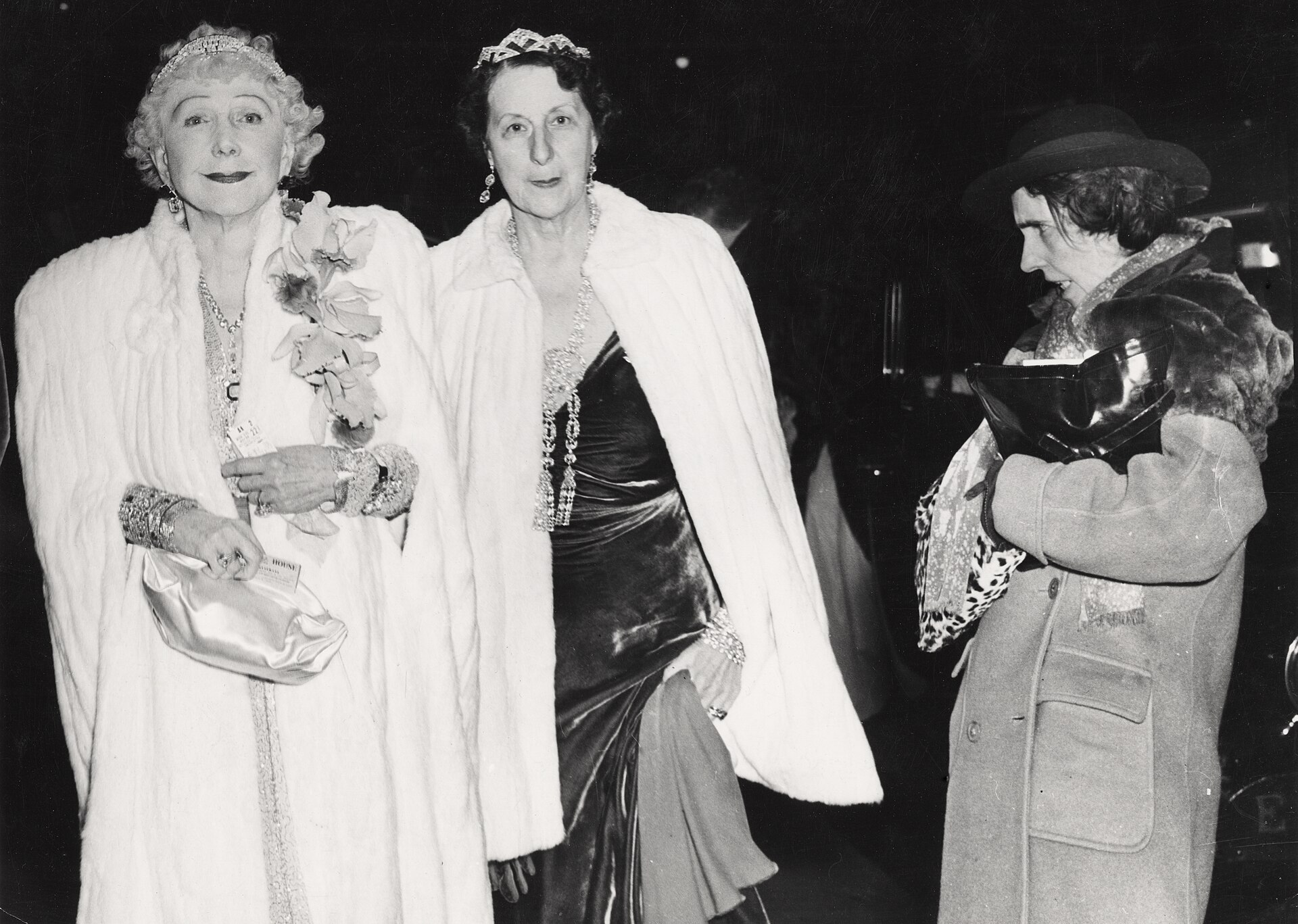
The record subject, in the tightly cropped three-figure composition under which it has been reproduced since Weegee's 1945 book Naked City. Verified directly via Wikimedia Commons' own imageinfo at the time of writing: dated 22 November 1943, credited to Weegee, marked Public domain and Copyrighted: false, with credit metadata tracing its 1945 Acme Newspictures distribution and 1959 newspaper republication.
| Artist | Weegee (Arthur Fellig) |
|---|---|
| Date | 22 November 1943 |
| Medium | Gelatin silver print, printed from a large-format press camera negative. The negative itself is not individually catalogued by any source consulted; see Technical and Current location. |
| Dimensions | Varies by print; no source consulted publishes the original negative's own dimensions. Individually measured prints range from image 10 1/2 x 12 1/2 in (26.7 x 31.8 cm) to a wider 12 1/2 x 16 3/8 in (31.8 x 41.6 cm) print that includes onlookers cropped from the standard composition. Full figures are given under Technical. |
| Where it is now | International Center of Photography, New York (the Weegee Archive). ICP separately catalogues at least three prints connected to this scene; the original camera negative is understood to sit within ICP's general holding of roughly 7,000 Weegee negatives from the Wilma Wilcox estate, but no source consulted assigns the negative itself an individual catalogue number or independently confirms its physical survival as a distinct, identified sheet of film.last confirmed 17 September 2026 |
| Inventory number | ICP holds three separately catalogued items connected to this image: 7229.1993 (Bequest of Wilma Wilcox, 1993), E.L. 1986.55 (Gift of Wilma Wilcox), and an uncropped, wider print catalogued only as Weegee Portfolio 25. Vintage prints of the same image are independently catalogued elsewhere, including the Whitney Museum of American Art (96.90.2) and the Art Institute of Chicago (accession number not published on the record consulted, object ID 123386). Treat any single accession number quoted for 'the' photograph as referring to one specific print, not to the image as a whole. |
| Attribution | AcceptedAuthorship by Weegee is not in dispute. Full note |
| Object type | Photograph |
| Period | American, twentieth century - tabloid and documentary photojournalism |
| Inscriptions | None documented in the sources consulted. |
| Owners on record | 8 links7 documented, 1 disputed |
| Sources | 26 cited |
About this record Last verified 17 September 2026 · 26 sources cited · Change log
On this page 9 sections
ContentsClose
On the night of the Metropolitan Opera's Diamond Jubilee opening, 22 November 1943, Weegee had his assistant recruit an intoxicated regular from a Bowery bar, ply her with wine, and release her into the path of two arriving socialites on a prearranged signal. The resulting photograph, later titled The Critic, was read for decades as a spontaneous collision of wealth and poverty; it is now documented, independently by biographer Christopher Bonanos and by International Center of Photography curator Miles Barth working from the testimony of Weegee's own assistant, as a staged encounter.
The two society women are identified: Mrs. George Washington Kavanaugh, born Marie Magdalena Muller, and Elizabeth Wharton Drexel, Lady Decies, both long dead and both well documented. The third woman is not identified in any source this record could reach, and this record declines to guess at her name rather than repeat an unconfirmed one. Multiple institutions, chiefly the International Center of Photography via the estate of Weegee's companion Wilma Wilcox, hold separately catalogued prints of the image in at least two different crops, with genuinely unresolved questions about the original negative's whereabouts, the picture's first publication, and its current copyright status.
The picture's fame has survived the exposure of its own artifice essentially intact, and has arguably been sharpened by it: a photograph about the gap between appearance and reality turns out to be, itself, a lesson in the gap between a photograph's appearance and what actually happened in front of the camera.
Provenance
Each link is graded. Documented: a cited source supports it. Disputed: the identification is argued but not established. Unknown: no owner for that span, and the gap is not smoothed into a narrative. The grades in the glossary.
- 1943-11-22 -Weegee (Arthur Fellig)documented
Weegee sent his assistant Louis (Louie) Liotta to recruit an intoxicated woman at Sammy's Bowery Follies on the Bowery; Liotta plied her with wine and positioned her outside the Metropolitan Opera House, releasing her into the path of Mrs. George Washington Kavanaugh and Lady Decies on a prearranged signal as they arrived for the season's opening night. Weegee is reported to have exposed several plates of the resulting moment. This account is corroborated independently by Miles Barth's curatorial research at ICP (via Liotta's own testimony) and by Christopher Bonanos's 2018 biography.789101112
- 1943-11-22 - 1943-12-06Acme Newspictures / Life magazine (wire distribution and first traced national publication)disputed
Life published the photograph in its issue of 6 December 1943 with the 'fashionable people' caption. Secondary accounts state PM paid Weegee five dollars for the image but declined to run it as inappropriate for wartime, and that Acme then distributed it nationally with a caption reframing the picture as moral indignation. This conflicts with credit metadata associated with the Wikimedia Commons file, which connects the image to PM's own publication. Both positions are stated here rather than adjudicated.11019
- 1945 -Weegeedocumented
The title by which the picture is now universally known dates only to this 1945 book, two years after the photograph was taken.1019
- 1968 - 1986Wilma Wilcox (Weegee's companion, as custodian of his estate after his death in 1968)documented
Wilcox held Weegee's prints and negatives privately for approximately eighteen years following his death before beginning to place material with the International Center of Photography.2326
- 1980 -The Weegee Portfolio Incorporated (Wilma Wilcox, Sidney Kaplan, Aaron Rose and Larry Silver)documented
This venture is the source of the wider, uncropped print of this scene now catalogued at ICP as Weegee Portfolio 25.426
- 1986 -International Center of Photography (gift of Wilma Wilcox)documented
Catalogued as E.L. 1986.55.3
- 1993 - presentInternational Center of Photography (bequest of Wilma Wilcox)documented
Wilcox's 1993 bequest of roughly 16,000 prints and 7,000 negatives, including the print catalogued 7229.1993, made ICP the largest single holding of Weegee's work. The original camera negative for this specific image is presumed to sit within that general holding but is not separately identified by number in any source consulted.226
- - presentMultiple public institutions holding individually catalogued vintage prints independent of the Wilcox gift: Whitney Museum of American Art (Gift of Denise Rich, 96.90.2), Art Institute of Chicago (Gift of Mrs. Stuyvesant Peabody), the Getty Museum, the Museum of Fine Arts, Houston, and the National Gallery of Art (a related Kavanaugh portrait)documented
Exact gift or purchase dates are not published on the records consulted for most of these institutions; two collection pages (Getty, Museum of Fine Arts Houston) blocked automated access entirely and could not be verified beyond the bare fact of holding.56212425
Technical evidence
| Attribution note | Authorship by Weegee is not in dispute. It is confirmed by Wikimedia Commons' own file metadata, by the Life magazine credit of December 1943, and by every institutional catalogue record consulted for this entry (the International Center of Photography, the Whitney Museum of American Art, the Art Institute of Chicago). What is genuinely contested is not who took the picture but whether it recorded a real encounter. Christopher Bonanos's biography and the International Center of Photography's own curatorial account, both drawing on the testimony of Weegee's assistant Louis (Louie) Liotta, document that the disheveled onlooker was recruited and positioned in advance of the two society women's arrival. That staging is treated in full in the narrative below. |
|---|---|
| Negative and camera | No source consulted specifies the exact negative format or camera used for this particular frame. Weegee's standard equipment throughout the 1940s was a 4x5 inch Speed Graphic press camera fitted with a flashbulb and typically pre-focused at a fixed distance, the method he used for the great majority of his tabloid work in this period.1419 |
| Number of exposures | A secondhand account attributed to Weegee's assistant Louis Liotta, reported by ICP curator Miles Barth, states that Weegee exposed several plates of the encounter in quick succession. Only one framing is treated as the finished picture titled 'The Critic'; a second, wider negative or print of the same scene survives independently (see next row).10 |
| Two different framings | ICP holds a wider, less-cropped print, catalogued only under the descriptive title '[Mrs. George Washington Kavanaugh and Lady Decies entering the opening night of the Metropolitan Opera's Diamond Jubilee, New York]' (Weegee Portfolio 25, image 12 1/2 x 16 3/8 in), that includes onlookers at the left edge of the scene. The tightly cropped three-figure composition reproduced as 'The Critic' removes those onlookers; the Whitney Museum's own catalogue entry states that Life magazine cropped the picture 'to eliminate the plain people at left' for its December 1943 publication. Whether the wider ICP print is an uncropped print from the same negative as the standard 'Critic' image, or a separate exposure from the same staged sequence, is not established in any source consulted.45 |
| Documented print dimensions | ICP 7229.1993: image 12 3/4 x 10 5/8 in (32.4 x 27 cm), sheet 14 x 11 in (35.6 x 27.9 cm). ICP E.L. 1986.55: image 10 1/2 x 12 1/2 in (26.7 x 31.8 cm), sheet 11 x 14 in. Whitney 96.90.2: sheet 11 x 13 7/8 in (27.9 x 35.2 cm), image 10 1/2 x 12 1/2 in (26.7 x 31.8 cm). Art Institute of Chicago (object ID 123386): image/paper 26.9 x 34 cm, mount 40.6 x 51 cm. Dimensions and even orientation vary between catalogued prints; do not cite one figure as 'the' size of the photograph.2356 |
| Publication captions | The Life magazine caption of 6 December 1943 read in full: 'The fashionable people were laden with jewels. Most bejeweled was Mrs. George W. Kavanaugh and Lady Decies whose entry was viewed with distaste by spectator.' Secondary accounts state that when Acme Newspictures distributed the image on the wire, the accompanying caption reframed Weegee's sardonic comment on wealth as straightforward moral indignation; no source consulted quotes that Acme caption verbatim.1019 |
| Book title | The title 'The Critic' dates only to the picture's inclusion in Weegee's book Naked City (Essential Books, New York, 1945), two years after the photograph was taken. It is a retrospective title, not the caption under which the image first circulated.1019 |
| Copyright status | Wikimedia Commons treats the file as public domain in the United States on the basis of its 1945 Acme Newspictures distribution and 1959 newspaper republication without a copyright notice attached. The Whitney Museum's own online catalogue nonetheless attaches the rights line 'copyright Weegee, ICP, Getty Images' to its print, and Getty Images licenses the image commercially. This record follows the public-domain sourcing it was commissioned under but records the conflict rather than resolving it.15 |
| Flash technique | The stark white-on-black rendering of the two society women against the dark ground, on which the picture's visual argument depends, is consistent with direct on-camera flashbulb lighting at close range, Weegee's standard method. No source consulted gives a technical account specific to this negative.19 |
| Support and process | Gelatin silver print on paper stock in every catalogued example consulted; no source describes a variant medium.2356 |
Images
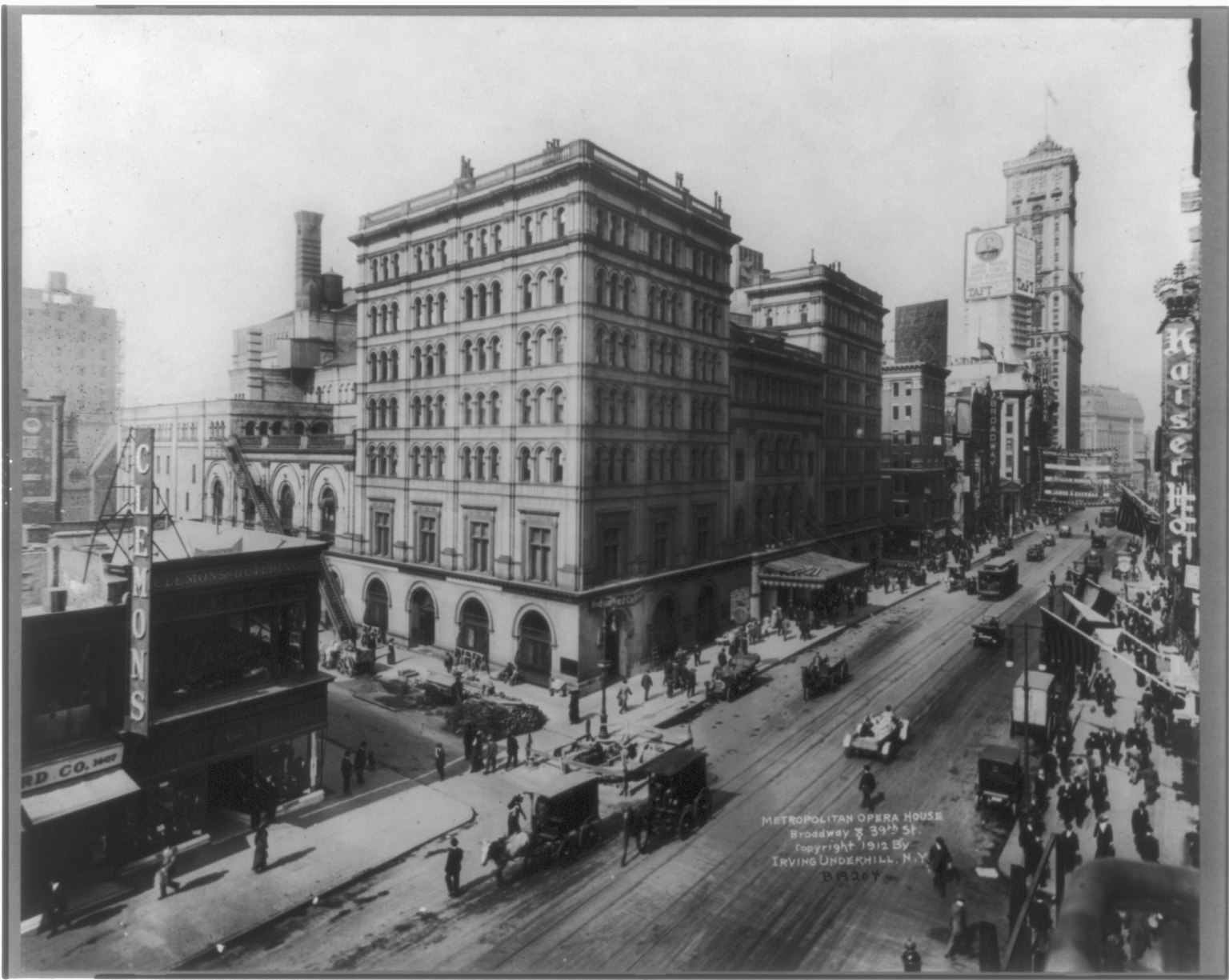
The record in full
Chapter 1What the picture shows
Two women in white evening dress and heavy jewelry are caught mid-stride, arriving at the curb outside the Metropolitan Opera House.
Two women in white evening dress and heavy jewelry are caught mid-stride, arriving at the curb outside the Metropolitan Opera House. A third woman stands at the edge of the frame in dark, shabby clothing, her face turned toward them in an expression that has been read, depending on the viewer, as scorn, hatred, envy or simple drunkenness. The contrast is total and immediate: white against dark, jewels against none, poise against a slouch. It is built entirely out of Weegee's standard on-camera flash, which bleaches the two society women to near-blank highlights and lets the third woman's clothing and skin sink into shadow.
The picture is usually reproduced in a tight, three-figure crop. A wider negative or print of the same scene, held at the International Center of Photography, includes bystanders at the left edge of the composition that the familiar crop removes. Whether that wider print is simply an uncropped print from the same negative as the famous image, or a separate frame from the same staged sequence, is not established in any source consulted, and is treated here as an open question rather than settled fact.
Chapter 2Opening night, 22 November 1943
The photograph was taken on the opening night of the Metropolitan Opera's sixtieth season, marketed as its Diamond Jubilee, on 22 November 1943.
The photograph was taken on the opening night of the Metropolitan Opera's sixtieth season, marketed as its Diamond Jubilee, on 22 November 1943. The evening's opera was Mussorgsky's Boris Godunov, conducted by George Szell with Ezio Pinza in the title role. Weegee, forty-four years old, worked the entrance without an official invitation, relying on his press credentials for access, as he did at crime scenes and fires throughout the city.
The date sits in the middle of the Second World War. Rationing, blackout drills and casualty lists were part of daily life in New York that autumn, which is part of why the display of furs and jewelry at an opera opening carried an edge it might not have carried in peacetime, and part of why, according to one account of the picture's history, the wire distributor's caption reframed the image as a comment on wartime extravagance rather than the wry, class-contrast joke Weegee himself seems to have intended.
Chapter 3Who the two society women were
The taller of the two women, in most captions given first, was Mrs.
The taller of the two women, in most captions given first, was Mrs. George Washington Kavanaugh, born Marie Magdalena Muller (sources also give Miller) in Richmond, Virginia, in 1867 or 1868 depending on the source. She was first married to William Henry Haberle, a brewery heir from Syracuse, and inherited his fortune on his early death; she married Colonel George Washington Kavanaugh in London in 1912. The couple kept a townhouse at 10 East 62nd Street in Manhattan, and Mrs. Kavanaugh was a fixture of the society pages for decades, known in particular for the size, rather than the connoisseurship, of her jewelry collection; a theft of an estimated 25,000 dollars in jewels from her in 1936 made news in its own right. Colonel Kavanaugh died in September 1951; Mrs. Kavanaugh died at their New York residence in January 1954.
Her companion that night was Elizabeth Wharton Drexel, by 1943 the Baroness Decies and so styled Lady Decies, born in Philadelphia on 22 April 1868. She had already buried one husband, John Vinton Dahlgren, who died of tuberculosis in 1899, and divorced a second, Henry Symes Lehr, in 1929 after a marriage she later called, in her own memoir, a tragic farce. She married John Beresford, 5th Baron Decies, in 1936; he filed for divorce in 1942, which she contested, and he died on 31 January 1944, two months after this photograph was taken and before any divorce was finalized, meaning she was still correctly styled Lady Decies on the night in question and remained so, as his widow, until her own death. She published two books of society memoir, King Lehr and the Gilded Age (1935) and Turn of the World (1937), and died at the Hotel Shelton in Manhattan on 13 June 1944, less than seven months after the photograph was taken. Both women were long dead well before this record was written; no living-person concern attaches to either name.
Chapter 4How the picture was made
Weegee did not wait for an accidental collision of rich and poor.
Weegee did not wait for an accidental collision of rich and poor. According to the fullest secondary account of the making of the picture, drawn from the recollection of his assistant Louis Liotta and reported by the International Center of Photography curator Miles Barth in Weegee's World (1997), Weegee sent Liotta to find an intoxicated woman at Sammy's Bowery Follies, a bar on the Bowery that Weegee frequented and photographed repeatedly. Liotta found a willing subject there in the late afternoon, gave her wine, and brought her to the curb outside the Metropolitan Opera House well ahead of the crowd. Weegee positioned himself roughly twenty feet away and had Liotta hold the woman back near the entrance; on a prearranged signal, timed to the arrival of Mrs. Kavanaugh and Lady Decies, Liotta released her with a small push into the two women's path. Weegee is reported to have exposed several plates of the resulting moment in quick succession, of which the tightly cropped frame later titled 'The Critic' is the one that survived into print.
Christopher Bonanos's 2018 biography Flash: The Making of Weegee the Famous reaches the same conclusion by an independent line of research: that Weegee got the onlooking woman drunk that afternoon, brought her to the Met, and waited for the moment to take the picture. Reviewers of Bonanos's book who had access to the full text (Edward Kosner in The New York Review of Books, Terry Teachout in Commentary) both confirm the staging as the biography's finding and note that Weegee was not shy about the mechanics once pressed; Kosner quotes Bonanos's own summary judgment on Weegee's method generally, that his best pictures are intensely truthful even where he 'would give the truth some extra help.'
The two published accounts (Barth via Liotta, and Bonanos independently) agree on the essential shape of the story: an accomplice, a plied drink, a prearranged cue, a timed release into the socialites' path. They differ, or simply do not overlap, on some details neither source resolves precisely, including the exact hour, the precise wording of the signal, and how many total exposures were made. This record treats the core staging as documented and the fine detail as reported rather than independently verified line by line.
Chapter 5The woman whose name is not established
No source consulted for this record gives a confirmed name for the disheveled woman recruited at Sammy's.
No source consulted for this record gives a confirmed name for the disheveled woman recruited at Sammy's. She is described in every account only by her state (drunk), her origin (a Bowery bar regular) and her role in the staged scene. This record has deliberately not assigned her a name.
A separate, independently documented Weegee photograph exists of a different Sammy's Bowery Follies regular named Norma Devine, captioned by Weegee as aspiring to understudy Mae West and catalogued at the International Center of Photography as a distinct object from 'The Critic.' The two subjects share a venue and a photographer, and it would be easy for a careless retelling to fuse them into one identified woman. No source consulted makes that connection, and this record does not make it either. Whether the woman in 'The Critic' was ever named in a source this desk could not reach, whether she is now identifiable by any means, and what became of her afterward are treated here as open questions rather than closed ones. She did not consent to becoming the emblem of an argument about class, and the honest position is that her identity and her fate are not known from the sources available.
Chapter 6Publication and the changing caption
The image reached the public through more than one channel, and the sources consulted do not agree on the order.
The image reached the public through more than one channel, and the sources consulted do not agree on the order. Wikimedia Commons' own file metadata for the image credits Weegee and points to distribution through Acme Newspictures in 1945 in connection with the promotion of Naked City, and to a further newspaper republication in 1959, both apparently without a copyright notice attached, which is the basis on which Commons treats the file as public domain. Separately, a detailed secondary account states that PM, the newspaper Weegee worked for most closely in this period, paid him five dollars for the photograph but declined to run it, on the judgment that displaying such lavish jewelry during wartime was in poor taste, and that Acme then distributed the image nationally on the wire with a caption that converted Weegee's satirical joke about wealth into a caption of straightforward moral indignation. Life magazine published the photograph in its issue of 6 December 1943, with a caption that reads, in full: 'The fashionable people were laden with jewels. Most bejeweled was Mrs. George W. Kavanaugh and Lady Decies whose entry was viewed with distaste by spectator.'
This record has not been able to independently confirm which of these publication accounts is complete. It is possible that PM printed something related to the opera opening on or near 22 November 1943 without running this specific image, and that later tellings have simplified 'photographed for PM' into 'published in PM.' It is stated here as an unresolved conflict rather than smoothed into a single confident timeline.
The title 'The Critic' itself is later than the picture. It was fixed only when Weegee included the image in his first book, Naked City, published by Essential Books in 1945, two years after the photograph was taken. Everything published about the picture in 1943, including the Life caption, describes the scene rather than naming it.
Chapter 7Two framings, one story to get right
Version control on this image matters because more than one crop of it circulates under the same title.
Version control on this image matters because more than one crop of it circulates under the same title. The image most people know, three figures close together against a dark ground, is a tight crop. The Whitney Museum's own catalogue entry for its print states plainly that Life magazine cropped the picture 'to eliminate the plain people at left' when it ran the image in December 1943. The International Center of Photography separately catalogues a wider print of the same encounter, filed only under a descriptive title rather than 'The Critic,' that does show additional bystanders at the edge of the frame.
This record has not been able to establish whether that wider ICP print represents an uncropped print made from the very same negative that, cropped, became 'The Critic,' or a different frame from the sequence of several exposures that period accounts say Weegee made that night. Anyone working from a reproduction of this image should check which crop they are looking at before treating it as identical in every respect to another reproduction captioned the same way.
Chapter 8A copyright status that is not fully settled
There is a genuine, documentable conflict over the picture's copyright status that a diligence check should not paper over.
There is a genuine, documentable conflict over the picture's copyright status that a diligence check should not paper over. Wikimedia Commons asserts that the image is in the public domain in the United States because it circulated in 1945 and again in 1959 without a copyright notice attached, at a time when American law required that notice to secure or preserve federal copyright in a published work. Against that, the Whitney Museum's own online catalogue entry for its print attaches the rights line 'copyright Weegee, ICP, Getty Images,' and Getty Images licenses reproductions of Weegee's photographs, including this one, commercially through its association with the International Center of Photography's rights management. This record follows the public-domain sourcing on which it was commissioned, and that sourcing is itself verifiable and specific (a named file, specific distribution dates, a specific absence of notice). But the fact that a major museum and a commercial rights agency currently treat the same image as under copyright is worth stating plainly rather than silently resolving in either direction.
Chapter 9Collection history
No single institution holds every physical example of this image, because Weegee, like most working press photographers of his era, made and distributed prints freely rather than treating each one as...
No single institution holds every physical example of this image, because Weegee, like most working press photographers of his era, made and distributed prints freely rather than treating each one as a unique numbered object. The International Center of Photography holds the largest concentration by far, as the recipient of Wilma Wilcox's 1986 gift and 1993 bequest of Weegee's personal archive of roughly 16,000 prints and 7,000 negatives, which is also the source of the 1980 Weegee Portfolio, an authorized limited edition of prints struck from his original negatives by Wilcox and three collaborators, one of which is the wider print of this scene now catalogued at ICP as Weegee Portfolio 25.
Independent of the Wilcox estate, individual vintage prints of the tightly cropped 'Critic' composition are separately catalogued at the Whitney Museum of American Art (a gift of Denise Rich) and at the Art Institute of Chicago (a gift of Mrs. Stuyvesant Peabody, whose record explicitly marks the print as not public domain, in contrast to the file this record uses as its lead plate). The Getty Museum and the Museum of Fine Arts, Houston, each hold an example as well, confirmed by their own object pages, though this record could not retrieve full catalogue detail for either page at the time of writing (both blocked automated access). A related Weegee photograph of Mrs. Kavanaugh with her daughter, Leonora Warner, is held by the National Gallery of Art in Washington; its full record was likewise not retrievable here. None of this changes the central fact: there is no single 'the print' of this image, and any provenance claim made about one physical print should not be assumed to apply to another.
Chapter 10Reputation and the ethics of the staged candid
Time magazine included 'The Critic' among its selection of the hundred most influential images ever made, and the picture is routinely taught and reproduced as one of the signature images of American...
Time magazine included 'The Critic' among its selection of the hundred most influential images ever made, and the picture is routinely taught and reproduced as one of the signature images of American photojournalism's mid-century engagement with class. For decades it was presented, and read, as an unposed piece of street photography: a lucky, cruel coincidence of timing that photography alone could catch.
The revelation of its staging, documented independently by Miles Barth's curatorial research at ICP and by Christopher Bonanos's biography, has not dislodged the picture from that reputation so much as changed what the reputation is understood to rest on. Critics reviewing Bonanos's book in 2018 treated the disclosure less as a scandal than as a case study: Edward Kosner's verdict, after describing the staging plainly, is that 'the picture outshines the backstory,' and multiple accounts note that Weegee's practice of arranging or nudging his tabloid pictures into shape was not confined to this one frame. What makes 'The Critic' the standard teaching example rather than a footnote is precisely that it looks so completely like the thing it is not: an accident. The picture is now used, as much as anything, to teach the limits of trusting a photograph's apparent spontaneity, which is a use its maker, a man who stamped his own prints 'Weegee the Famous' and built a career on the appearance of uncanny access, would very likely have appreciated as a form of continued fame rather than resented as an exposure.
Chapter 11A reported wartime afterlife
One further claim about the picture's circulation is worth recording, clearly labelled as a claim rather than a settled fact.
One further claim about the picture's circulation is worth recording, clearly labelled as a claim rather than a settled fact. Miles Barth's account, as reported in a Timeline/Medium feature on the photograph, states that the image was printed on leaflets and dropped by the Allies over German positions at Anzio, Italy, in 1944, captioned to ask American soldiers whether the class divide at home was what they were fighting for, and that it reportedly reached a soldier named Charles Kavanaugh who recognized his own grandmother, Mrs. George Washington Kavanaugh, in the photograph. This record has not located a primary wartime leaflet, an Allied psychological-warfare record, or any source independent of Barth's account that confirms the story. It is retold here because it recurs in serious secondary coverage of the photograph and because, if true, it is a remarkable second life for a picture that was itself manufactured; it is graded as reported, not documented, and should not be repeated as settled history without further sourcing.
Chapter 12What the picture argues, and for whom
Weegee worked through most of the early 1940s for PM, the ad-free New York afternoon tabloid founded by Ralph Ingersoll in 1940 and financed by Marshall Field III, whose declared editorial position...
Weegee worked through most of the early 1940s for PM, the ad-free New York afternoon tabloid founded by Ralph Ingersoll in 1940 and financed by Marshall Field III, whose declared editorial position, printed in its first issue, was that it was 'against people who push other people around' and answerable to its readers alone rather than to advertisers. PM's photographers, who at various points included Margaret Bourke-White and Arthur Leipzig alongside Weegee, worked inside that stated mission of using photography as social argument rather than simple record. Weegee's own class-contrast pictures of the period, of which this is by far the most famous, fit that mission closely: two overdressed women set beside one under-dressed woman is a visual sentence with an obvious subject and verb, wealth confronted by poverty, that needs no caption to be read.
What the staging changes is not the argument the picture makes but the honesty of how it claims to make it. A found moment and a manufactured one can carry an identical visual argument about inequality; only one of them is also a true claim about what actually happened on a particular sidewalk on a particular night. Weegee, by his own later account, called this photograph his masterpiece. He did not, so far as any source consulted records, ever call it a candid one; that claim was made for him, by captions, by decades of reproduction, and by viewers who had no reason to doubt what a news photograph is supposed to be. The picture's afterlife as the standard example of a faked spontaneity is, in that sense, simply the record catching up with what its own maker arranged and never bothered to correct.
The artist
Arthur Fellig, called Weegee (born Ascher Fellig)
Weegee built his career on the appearance of an uncanny sixth sense for disaster, and the picture in this record is, more than any other single image he made, the proof that the appearance and the reality were two different things he was equally willing to sell. He was not a fine-art photographer by training or by early ambition; he was a tabloid stringer who understood, earlier and more completely than most of his rivals, that a photograph's claim to have simply recorded reality was itself the most valuable and most manipulable thing about it.
Related works
| Work | Relation | Where it is |
|---|---|---|
| [Mrs. George Washington Kavanaugh and Lady Decies entering the opening night of the Metropolitan Opera's Diamond Jubilee, New York] Weegee | A wider, less-cropped print of the same encounter, showing onlookers cropped out of the standard 'Critic' composition Not established whether this is an uncropped print from the same negative as 'The Critic,' or a separate frame from the same staged sequence. | International Center of Photography, New York (Weegee Portfolio 25) |
| Norma Devine is Sammy's Mae West Weegee | A separate, independently identified photograph of a different Sammy's Bowery Follies regular Included specifically to show that Norma Devine is a documented, named Weegee subject at Sammy's who is not the woman in this photograph; no source consulted connects the two. | International Center of Photography, New York |
| Mrs. George Washington Kavanaugh and her Daughter, Leonora Warner Weegee | Another Weegee photograph of the same sitter, Mrs. Kavanaugh Holding confirmed via the museum's own object page title; the page itself blocked automated access and its full catalogue detail could not be independently verified for this record. | National Gallery of Art, Washington DC |
| The Critic Weegee | A separately catalogued vintage print of the same image Credit line 'Gift of Mrs. Stuyvesant Peabody.' The Art Institute's own rights field marks this specific print as not public domain, in contrast to the Wikimedia Commons file used as this record's lead plate. | Art Institute of Chicago |
| The Critic Weegee | A further separately catalogued vintage print Holding confirmed via the museum's own object page title; the page blocked automated access and its accession detail could not be independently verified for this record. | Museum of Fine Arts, Houston |
Open questions
- Who was the disheveled woman recruited at Sammy's Bowery Follies? No source consulted gives a confirmed name; she should not be assumed to be Norma Devine, a different, separately documented Weegee subject at the same venue.
- Did PM actually publish this photograph on or near 22 November 1943, or did it pay Weegee and decline to run it, with Life's 6 December 1943 issue being the true first publication? The sources consulted give both accounts and this record has not resolved the conflict.
- Is the wider print at the International Center of Photography (Weegee Portfolio 25) an uncropped print from the same negative as the standard 'Critic' image, or a separate exposure from the same staged sequence of several plates?
- Where is the original camera negative now, and is it individually catalogued anywhere, or does it remain an untracked item within ICP's general holding of roughly 7,000 Weegee negatives?
- Is the Anzio leaflet story (a photograph of this scene dropped as Allied propaganda, reportedly recognized by a soldier named Charles Kavanaugh) independently verifiable, or does it rest solely on Miles Barth's account as relayed in later secondary coverage?
- Which claim to copyright governs current reproduction of this specific image: the public-domain basis Wikimedia Commons states, or the 'copyright Weegee, ICP, Getty Images' rights line the Whitney Museum's own catalogue attaches to its print?
Questions about this object
What is The Critic?
The Critic is a photograph, dated 22 November 1943. Medium: Gelatin silver print, printed from a large-format press camera negative. The negative itself is not individually catalogued by any source consulted; see Technical and Current location.
Who made The Critic, and is the attribution settled?
The attribution to Weegee (Arthur Fellig) is recorded here as accepted. Authorship by Weegee is not in dispute. It is confirmed by Wikimedia Commons' own file metadata, by the Life magazine credit of December 1943, and by every institutional catalogue record consulted for this entry (the International Center of Photography, the Whitney Museum of American Art, the Art Institute of Chicago). What is genuinely contested is not who took the picture but whether it recorded a real encounter. Christopher Bonanos's biography and the International Center of Photography's own curatorial account, both drawing on the testimony of Weegee's assistant Louis (Louie) Liotta, document that the disheveled onlooker was recruited and positioned in advance of the two society women's arrival. That staging is treated in full in the narrative below.
Where is The Critic now?
International Center of Photography, New York (the Weegee Archive). ICP separately catalogues at least three prints connected to this scene; the original camera negative is understood to sit within ICP's general holding of roughly 7,000 Weegee negatives from the Wilma Wilcox estate, but no source consulted assigns the negative itself an individual catalogue number or independently confirms its physical survival as a distinct, identified sheet of film. Inventory number ICP holds three separately catalogued items connected to this image: 7229.1993 (Bequest of Wilma Wilcox, 1993), E.L. 1986.55 (Gift of Wilma Wilcox), and an uncropped, wider print catalogued only as Weegee Portfolio 25. Vintage prints of the same image are independently catalogued elsewhere, including the Whitney Museum of American Art (96.90.2) and the Art Institute of Chicago (accession number not published on the record consulted, object ID 123386). Treat any single accession number quoted for 'the' photograph as referring to one specific print, not to the image as a whole.. Last confirmed 17 September 2026. Weegee's longtime companion Wilma Wilcox preserved his prints and negatives after his death in 1968 and gave and bequeathed them to the International Center of Photography (a 1986 gift and a 1993 bequest of roughly 16,000 prints and 7,000 negatives), which is now the largest single holding of his work. Individual vintage prints of this specific image also passed independently into other public collections; see the provenance block for the full, graded chain.
What is still unknown about The Critic?
Who was the disheveled woman recruited at Sammy's Bowery Follies? No source consulted gives a confirmed name; she should not be assumed to be Norma Devine, a different, separately documented Weegee subject at the same venue.
Sources
- 1Wikimedia Commons, File:The Critic by Weegee.jpg, file description page and imageinfo/extmetadata via the Commons API. commons.wikimedia.org/wiki/...
- 2International Center of Photography, 'The Critic,' collection object record, accession 7229.1993. icp.org/browse/...
- 3International Center of Photography, 'The Critic,' collection object record, accession E.L. 1986.55. icp.org/browse/...
- 4International Center of Photography, '[Mrs. George Washington Kavanaugh and Lady Decies entering the opening night of the Metropolitan Opera's Diamond Jubilee, New York],' collection object record (Weegee Portfolio 25). icp.org/browse/...
- 5Whitney Museum of American Art, Weegee, 'The Critic,' collection record 96.90.2. whitney.org/collection/...
- 6Art Institute of Chicago, 'The Critic,' collection record, object ID 123386, retrieved via the museum's public API. artic.edu/artworks/...
- 7PopMatters, review of Christopher Bonanos, Flash: The Making of Weegee the Famous (Henry Holt, 2018): 'Truth or Fiction?' popmatters.com/flash-weegee-the-famous-bonanos-2574073728...
- 8Edward Kosner, 'Shots in the Dark,' The New York Review of Books, 6 December 2018, review of Bonanos's Flash. nybooks.com/articles/...
- 9Terry Teachout, 'The Lost World of Weegee,' Commentary, review of Bonanos's Flash. commentary.org/articles/...
- 10'Well Done! 71 Years Ago Today...,' Fans in a Flashbulb, 22 November 2014, citing Miles Barth, Weegee's World (1997) and the testimony of Louis Liotta. fansinaflashbulb.wordpress.com/2014/...
- 11'"The Critic" @ 75,' Fans in a Flashbulb, 22 November 2018. fansinaflashbulb.wordpress.com/2018/...
- 12Smithsonian Magazine, 'A Night at the Opera.' smithsonianmag.com/arts-culture/...
- 13Luisa Rollenhagen, 'Nazis loved this photo of America's class divide so much, they allegedly used it as propaganda,' Timeline (Medium), citing Miles Barth. medium.com/timeline/...
- 14Wikipedia, 'Weegee.' Tertiary source; flagged for replacement with primary biographical documentation. en.wikipedia.org/wiki/...
- 15Wikipedia, 'PM (newspaper).' Tertiary source; flagged for replacement with a scholarly history of PM. en.wikipedia.org/wiki/...
- 16Wikipedia, 'Elizabeth Wharton Drexel.' Tertiary source; flagged for replacement with a genealogical or biographical primary record. en.wikipedia.org/wiki/...
- 17Wikipedia, 'George W. Kavanaugh.' Tertiary source; flagged for replacement. en.wikipedia.org/wiki/...
- 18History's Jewel Box, 'Great Jewelry Collectors: Mrs. George Washington Kavanaugh.' historysjewelbox.com/post/...
- 19TheArtStory, 'Weegee,' biography and overview. theartstory.org/artist/...
- 20Art Blart, tag archive 'Weegee The Critic,' citing Boo Paterson and Miles Barth. Secondary aggregator; flagged for replacement with the original exhibition catalogue text (Foundation Henri Cartier-Bresson / Fundacion MAPFRE, 2024-2025). artblart.com/tag/...
- 21Getty Museum, 'The Critic,' collection object page. Holding confirmed; full catalogue detail could not be retrieved (site returned no readable content at time of writing). getty.edu/art/...
- 22Wikimedia Commons, File:Metropolitan Opera House, Broadway & 39th St., New York City LCCN2003665647.jpg (Library of Congress), imageinfo/extmetadata via the Commons API. commons.wikimedia.org/wiki/...
- 23International Center of Photography, 'Norma Devine is Sammy's Mae West,' collection object record. icp.org/browse/...
- 24National Gallery of Art, 'Mrs. George Washington Kavanaugh and her Daughter Leonora Warner,' Weegee, collection object page. Holding noted via the museum's own object page title; full page blocked automated access and could not be independently verified beyond that. nga.gov/collection/...
- 25Museum of Fine Arts, Houston, 'The Critic,' collection object page. Holding noted via the museum's own object page title; full page blocked automated access and could not be independently verified beyond that. emuseum.mfah.org/objects/...
- 26Digital Camera World, 'Crime, chaos, and celebrity: Weegee's photography takes center stage at ICP,' for the scale and dating of the Wilma Wilcox gift and bequest and the Weegee Portfolio venture. digitalcameraworld.com/photography/...


Last verified 17 September 2026 · Published 17 September 2026
Change log
17 September 2026 - Record created at the house standard: researched narrative, technical evidence, maker dossier, graded provenance chain, prices with hammer and premium separated, related works, open questions and sources.